Download Now
Home Blog Page 1653

This is One Skill I Learnt That Truly Changed My Life: Speed Reading in Law School

1
This is One Skill I Learnt That Truly Changed My Life: Speed Reading in Law School

There are some events, they change everything for you. The story of your life can be then divided in two parts, pre and post-event. One small skill I learned somewhere in the middle of law school made that kind of difference to my life.

As I joined law school, I struggled to find my feet in a very new, different kind of environment. I was told that to do well in law school I needed to work super hard, so hard that I would barely have time to breathe. For the first semester, this was true. I felt the pressure of a mountain as I learnt to cope with the pressure of writing 5 well researched, properly footnoted projects including project proposals within two months along with regular lessons in the class. Throw in moots, debates, society interviews, trying to find an identity in a new place – keeping sane wasn’t easy! Exams came – and the methods that once worked well with boards exams and in school did not work anymore. Scoring well was no longer about reading some limited chapters and writing a lot in the answer paper. Things were different in law school – and I couldn’t quite grasp what I needed to do.

Note that I was the 2nd topper in the national entrance test. The topper didn’t join NUJS – so in the first semester I was the de facto-topper. However, while I knew exactly what to do to crack an objective multiple choice based exam full of GK and logical reasoning, I was writing exams with subjective questions in English for the first time, having studied in vernacular medium schools all my life. I had to figure that out as well.

I was also a terrible speaker – for the first time in my life I was learning to speak English and had to accept English as the only language for communication. That was quite challenging as well. My difficulty to speak fluently also affected my ability to do well in viva, class presentations and even mooting. Fluent speaking and other mooting skills can easily pave way for one to be a good lawyer. Online courses like this are often a great way to acquire these skills sets and become a champion mooter within three months.

When I look back, I can certainly say that the first two years were the most difficult years of law school. I set high targets for myself despite setbacks. Still, as I struggled through those two years, I felt depressed. I had this constant sense of underachievement. I was determined, but at the same time I felt lost. I didn’t see how I was going to get where I wanted to. The entire point of going to law school seemed to be lost, and I didn’t know if I would find my way.

Then one day I came across this skill.

It transformed my mindset towards work and success. Once I learned it several locks opened at once and I felt empowered. I stopped falling for the common wisdom that told me just to try harder but failed to show me the way. At once many lessons I was taught since childhood that held me back from achieving true success in my own terms came undone. It was the beginning of an amazing journey from there.

But what happened? What was this skill that changed everything for me? How can one skill make so much difference in a law student’s life?

I came across this blogpost from Tim Ferriss, who I later accepted as a sort of my imaginary guru: http://www.fourhourworkweek.com/blog/2009/07/30/speed-reading-and-accelerated-learning/

I tried the stuff he suggested (so should you), and did not stop there. I read everything I could find on internet about speed reading. I practiced and pushed through initial self-doubt.

When I started getting a grip on this skill, the following things happened to me, not necessarily in the order described though:

1. I managed classwork much better:

Suddenly the mandatory reading for the class was quite easy. I just had to carry the text, in the first 5 minutes of the class I would know enough to answer most questions asked by the teacher, and then continue to read the text critically. I found the pace of most classes to be terribly slow – so reading during the class hours kept my brain engaged and saved me hour of studies before the exam.

2. My exam score improved drastically while the time I spent studying went down:

As I drastically changed how I read textbooks, classnotes, case laws and even reference material – study time went down by leaps and bounds while on the other hand I managed to cover a lot more than ever. I had my specific way of reading different material. For instance, I would start reading a scholarly article from the end, learn the conclusion first, and then identify the broad themes through scheming and only then reading the major arguments thoroughly. This improved retention of information in a massive way, and improved critical analysis of the text. For most part of the semester, I didn’t spend much time with course work – instead I found time to focus on a freelancing business, mooting, blogging and whatever else I wanted to do. I used to do marathon study before the end-semester exams though – I could end up studying even 10-12 hours straight – but this would cover the entire syllabus for one subject taught over 3-4 months. Life was suddenly so much easier, and people would ask me how I had managed to juggle so much, and I would tell them: learn speed reading.

3. I got a taste of hacking, so I started fiddling around with other things:

Speed reading was an eye opener. All my life I was told to work even harder if I wanted more success. Here was proof that most people didn’t even know the real secrets of success! Why don’t they teach speed reading in school? It would made things so much easier! I started questioning the popular wisdom – if it is popular, there must be something much better out there. This was a watershed change in my life. As I developed a faith that things can be hacked, i.e. done in a much simpler, efficient way that the majority doesn’t know about – and I started discovering these things. You should not be surprised that I started CLAThacker – a community for law school aspirants which soon became the biggest such online community. I found simpler ways to solve CLAT questions that I taught to thousands of students in 5 states. It also made me question my early career choices later and then further led me to starting up my own business early in life.

4. I learned how important it is to teach:

Real learning takes place when you try to teach a skill you know to another person. I was flooded with requests to teach speed reading, so I came up with a lot of exercises. I went deep into the science of it to understand how it works, and I tweaked my methods until they worked every time. I started taking workshops for IMS on speed reading. Doing all of these took my own understanding and ability to altogether different heights. My teacher’s instinct comes largely from this selfish need – when I teach anything, I learn so much better.

Did you ever try learning speed reading? Did you ever have a similar experience in your life when a small skill made a huge difference? Share it in the comments below.


Download Now

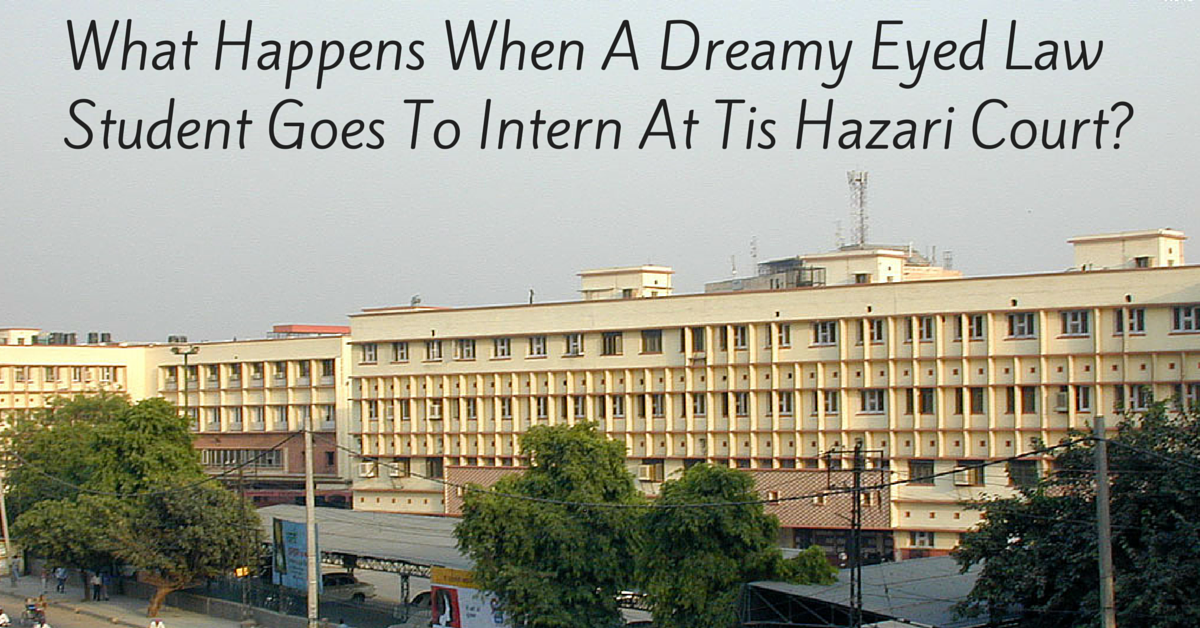
What Happens When A Dreamy Eyed Law Student Goes To Intern At Tis Hazari Court?

0
What Happens When A Dreamy Eyed Law Student Goes To Intern At Tis Hazari Court?

Yash Bagra, a law student from Nirma University had the shock of his life when he went to intern at Tis Hazari – Old Delhi’s infamous district court. He writes about his experience in this post, over to him.

Tis Hazari

When I began my BA.LLB journey, I was not sure that on which road or field I have to build my career. Determining what I was supposed to do seem like a mammoth task. The only thing I was sure about was that I have to do something different in life but was not confirmed what`s that different thing going to be. This internship opportunity was very important in giving me an introduction to an entirely fresh learning experience and also in helping me anticipate my future prospects.

It is said that the thing which starts with a bang it also ends with a bang. The very first day of my internship was a kind of day which I can never forget in my whole life because it defaced all my misconceptions towards the Indian litigation process. I had very high regards for the Indian litigation process before that day in face of it being very smooth, without any flaws and had a very glossy looking picture in my mind, but it is said that what you think or believe is not always true especially in the practical world. The condition of the court was like a Fish market where you have to keep every step of yours very carefully. Tis Hazari Court has one of the highest practicing lawyers under its roof and plus one of the most crowded court of our country which is also now a bit relieved by opening of new District and sessions court in various other sectors of New Delhi. A lawyer`s work out there is not so easy as shown in various Bollywood movies (but “tareeqh p tareeqh p tareeqh” fits here very aptly). It is pretty difficult for a new budding lawyer to earn his/her living on his/her own out there. She/he has to practice under someone for few years to create his position among the well-established lawyers where he is right now only a small fish in a very big ocean.

Learning Outcomes

District and session court is the place where every law student must intern in his initial years although these days student choose not to intern as they consider interning at a trial court to be below par as per their knowledge level, but I believe that interning at a trial court is very much necessary to learn the procedures of law from a basic level.

During my internship I was supposed to read and analyze the cases on an advance basis as I have to brief all the issues and facts of the cases to Sir under whom I was interning before we move to the court for the proceeding of our case. He used to ask me certain questions that what will you argue in a certain situation depending upon the facts only and then after my reply he used to argue against me and used to tell me what way I can make my argument look better and convincing in front of a judge. He also used to scold me whenever I was not prepared with facts or issues of the case and as a punishment he used to give me a situation on which I have to prepare a memorial. In starting I find all these tasks to be very burdensome but gradually when I was able to see a positive change in myself I started liking it and started working much harder to complete any task given to me.

It is not that what you expect is what you get all the time. It so happened to me that one day I was asked to bring dates for certain cases and that too without any genuine reason, one moment I thought to ask Sir that Sir everything is fine, client is there you are there – then why are you not going for the proceeding of the concerned case but the very next moment I thought that it will be not so prudent on my part to ask such a question to a lawyer of his caliber, but the thing which has to be seen here is that this is the very reason of Lakhs of cases being pending in various courts throughout our country. It is the callous attitude of lawyers plus general public towards their case that a case remains pending for decades sometimes.

There is a dire need to make some reasonable changes in the Indian litigation process which can makes it a bit faster in delivering justice to the needy, which can right now be done by the young minds coming to this profession but it is prudent to note that it is a herculean task to achieve but still not utopian.

Download Now

What I Have Learned From My Two Internships At District Courts

0
What I Have Learned From My Two Internships At District Courts

Republished from A First Taste of Law archives. What should you expect at a district court internship?

I, just like any other law student who have just completed his/her 1st semester, was nervous cum excited to start with my first of my internships, in the district court. It was a first step in my career. “District Court”…… this word often portrays the same picture of the Court that we watch in the Bollywood movies. I still remember the day when I started my first internship in the District Court. The black coat gave me a feeling of an advocate who is just ready to march into the Courtroom to solve the case. As I entered the premises, the actual district court was totally different from what I used to watch the movies. The picture that flashed in my mind was of much disciplined, neat and tidy district court. But it was quite opposite. There was a huge rush of people with the lawyers discussing their cases. Some were sipping tea in the tea stall whereas some were rushing to the Courtroom and some were sitting in the bar council lawn and discussing some stuff. The advocates were pre-occupied with their cases and had no time to spare. Since there were elections going on, so it was another topic of discussion among the advocates. So as I walked down the stairs, I entered into the chamber of my advocate. As it was an advocate’s chamber, it contained too many books or rather BARE-ACTS ranging from CPC to Constitutional Law to Indian Contract Act. Apart from this, it had bundles of files which contained the cases of the clients. I introduced myself and my advocate or better to address her as my ma’am as I did, asked me some general questions and from then onwards my internship actually begun.

She told me that that the first step involved before pleading is, drafting of a plaint. At that time the situation of a budding lawyer could be compared to that of a student who is in first standard and has just started learning addition, subtraction, division and multiplication and it is totally new for him. So it all depends upon the teacher as to how she tackles with the student. The same was the case with me. The words like plaint, written statement, rebuttals although sound interesting but it was totally new to me and when you read these words in Hindi is all the more very difficult. My ma’am told me how to draft a plaint and she, in fact, asked me to read various cases so that it would be easier for me to interpret various words more easily and in this way I would also learn to draft a better plaint. She also very beautifully explained the entire format of the proceedings i.e. written statement follows plaint, which is followed by replication, then additional pleas, final hearing which involves evidence of both the parties, date of argument, judgment and finally execution.

She often enquired from her clients as what is the date that has been fixed by the judge. In this way, it reminded me of a very famous Hindi dialog “tareek pe tareek, tareek pe tareek……” She asked me to move along with her in the district court and thereby to understand the proceedings that took place. There were different Courtrooms and judges ranging from District judge to the additional district judge to civil judge(senior division) to civil judge(junior division) and so on. The cases are dealt according to their pecuniary jurisdiction. Section 9 of the CPC clearly mentions about the competency of the Court. It explains what all cases could be dealt by the Court and what they are expressly or impliedly barred from dealing with.

As I entered the Courtroom, it was totally different from what I used to think. There was a judge sitting in the Courtroom and different advocates were pleading before the Hon’ble judge in the mother tongue that is “Hindi”. The judge asked some of the questions and the legal terminology used by the advocates was although easy to comprehend but difficult to understand for common people. My advocate used to deal in civil matters basically conflicts related to property rights and execution of wills and gift deeds as like. So the cases that I actually came through were mostly civil in nature. For instance, there was a case that was related to the partition of the property. For a student of the first semester what is necessary while watching the proceedings is to understand as far as possible each and every word that is pronounced while an advocate is pleading before the Judge. Although it is difficult to easily understand each and every line, yet it is necessary to jot down each and every point that he come through the proceedings. The way an advocate pleads before the judge and prays before him to grant the partition and exclusive possession by meters and bounds are really worth noting. Apart from this, another thing that has to be kept in mind is the different terminologies that are used like an injunction, jurisdiction, stay order, judgment, decree, misjoinder, and nonjoinder so on. These words are sacrosanct for an advocate. It is used in day to day proceedings in the Court. One has to be thorough with the drafting of a plaint, deeds and the format in which the proceedings take place as it forms the core of the internship.

Moving a step ahead, another basic element of the proceedings is Civil Procedure Code which I learned in my summer internship done in the district Court. CPC is the most important element while any proceedings are being carried on. CPC is divided into orders and rules. For instance, order 1 mention about the parties in the suit. Order 3 explains the power of attorney and appointment of the pleader. Similarly, order7 explains about the plaint, order 8 about written statement, order 14 about how the issues are framed and as like. One has to mention the order of the CPC while drafting a plaint. Apart from this, I also saw the proceedings on order 22 Rule 3. It explained that if any suit has been filed at the time when the person was alive, but the person died after filing of the suit; so it will not bar the rights of his legal heir to sue or be sued. But if a person is already dead and then a suit has been filed in the name of the dead person, then it is legally not valid. This is because of the reason that how can a suit be filed against a person who is not alive. In case there is no legal representative, then a Court officer shall be appointed for the same. Similarly, one has to be through with the basic rules like Rule 1 of CPC that is an appearance of both the parties on the day fixed by the Court. Rule 2 explains about the dismissal of the suit in case of non-appearance of the parties and as like. When the proceedings are taking place, then there might be a situation that a law student who has just completed his/her first year might not be able to grasp each and every order of the CPC. But it is the duty of every student to be curious and enquire about each and every section and orders that have been mentioned. Thus, it could be said that the entire proceedings in the district Court revolves around CPC. It forms the core of all the activities and all the plaints actually start with an order.

Apart from the proceedings, every Court contains a library. One should definitely visit the library in the Court. The library contained books, journals, and cases which are now taken as precedents. Apart from SCC (Supreme Court Cases) there are other journals as well like ALR known as Allahabad Law Reports, ACC (Allahabad Criminal Cases), BJ (Bankers Journal), CRC (Civil and Revenue Cases) that we could come across in the library. Law is a vast ocean. The more you go into the depth, the more you acquire knowledge and this is what I exactly felt when I was going through various journals in the library.

CONCLUSION

Millions of people come into the Court and hires an advocate with the expectation that they would win the case and justice would be rendered upon. But the question arises that “has the justice been conferred upon each and every person?” The answer may be quite difficult. Various appeals are dismissed and many cases keep on piling. Suits filed by a father keep on going and even his grandson becomes a party to it. Interning in a district Court offers a vast experience to a law student. It not only provides a practical knowledge about the various acts like Indian Contract Act, CPC, but also provides you an insight as to what the Indian Judiciary is all about. It provides you with the knowledge that how the cases should be pleaded before the Hon’ble Judge. It enhances your knowledge and widens the horizon especially for those who want to go in for litigation after the completion of their course. It is the duty of every advocate to render his best and true efforts while solving any case because it is meant for the benefit of the common man. Law does not mean simply to solve the case for monetary value but also moral values should be kept in mind to great extent. Through the internship in the district Court and by watching the proceedings, one could easily learn about these prospects.

Download Now

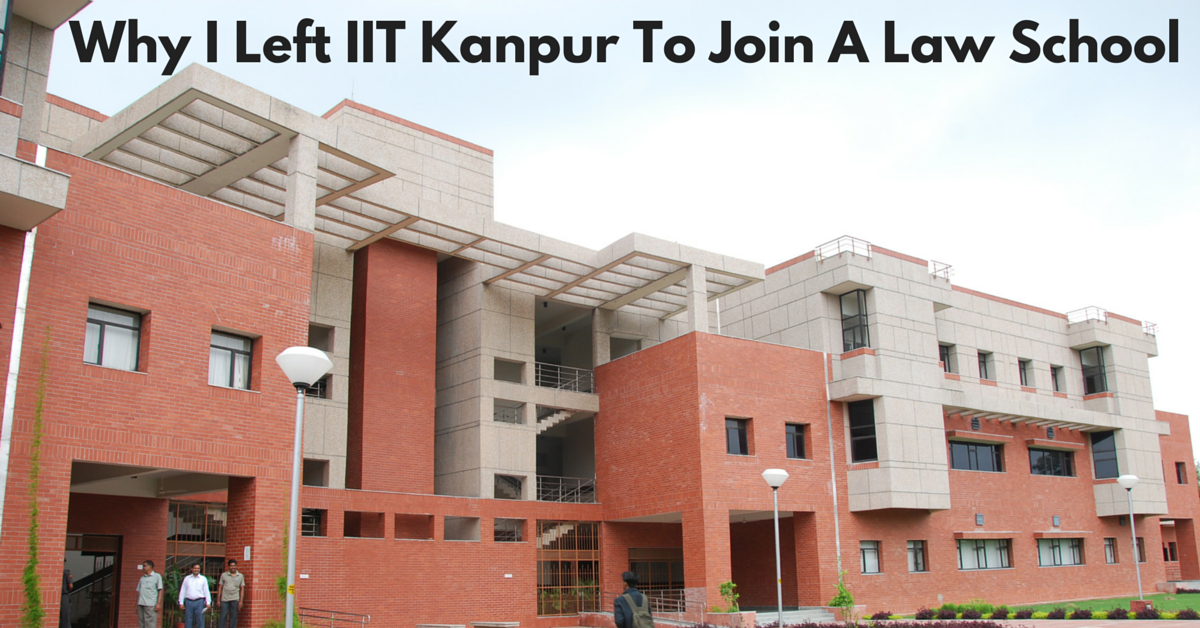
Why I Left IIT Kanpur To Join A Law School

0

This article is being republished from A First Taste of Law Archives. Utkarsh Agarwal joined IIT Kanpur, dream come true for most students in India. He was also on track to change his stream and get into IT which is every IIT students first choice. However, all of a sudden he dropped out of IIT wrote CLAT and then joined NUJS Kolkata – a top law school. Why would someone do that? Utkarsh tells a fascinating story in this blog post. Over to him.

In India, there are IITs and non-IITs. IITs are where brilliant minds of a generation are trained to create the future.

Students from these IITs are destined to be CEOs and scientists i.e. the outliers. Once you graduate from IIT, you cannot not be successful. IIT, in India, means the difference between an ordinary student and an extraordinary student.

For several decades, IITs were the only institutions in India to receive global recognition. Indian Engineers unlike Indian architects or Indian doctors were the vanguard of their field. The Indian Government intended to preserve this brilliance. Money was therefore poured into IITs. Armed with huge campuses, the best research infrastructure and tons of subsidies, IITs continued to bloom. Unlike any other college in India, IIT had no rules regarding attendance, accommodation, or even examination. Further, most IITs had their own post office, bank and railway reservation counter. Students in the IITs, popularly known as IITians, were special. Even today, they are, even to the most cynical observer, elite.

I joined IIT Kanpur as a student of Bachelor’s in Chemistry.

I had no interest in the subject and like most of my batchmates, was vying to change my branch to Computer Science. Three months into complex models of ketones, life became intolerable. So, I left and went back home. Soon, a plethora of people made it known to me that I should, in their opinion, go back and continue.

A year later, I had my head buried into Winfield trying to make sense of ‘Vicarious Liability’ preparing for a torts paper at the West Bengal National University of Juridical Sciences, one of India’s top law school. The question here is not simply why I quit IIT rather but what made me leave an elite IITian group and along with it, the promise of success.

It wasn’t Law.

It wasn’t the fabled overwhelming desire towards a subject, which I had never studied before or an unfounded passion for philanthropy, which I had never fostered before that time, that drove me to Law. Unfortunately, I have never felt Law be my true calling and unlike the Lawyer in the Monk Who Sold His Ferrari, I still very much coveted the success IITs offered. Therefore, taking up Law was clearly neither a passionate nor a spiritual undertaking. In fact, it was many months after I quit IIT that I took up an interest in Law.

IITians were smarter than an average student, however, not everyone studying in IIT was a genius, certainly not me. Setting up a multi-billion dollar company or changing the world by challenging conventions was definitely not on my list when I quit. I had also not put in ten thousand hours in any activity, other than maybe sleeping, that could provide a legitimate excuse for my departure. I was therefore just an ordinary IITian.

It wasn’t even pressure of any kind. I was performing fairly well in my examinations in IIT and at no point did I feel unable to cope with the curriculum. The ragging didn’t get to me and I did not mind living in the cramped up shabby accommodation. I wasn’t even homesick and I did make a lot of friends. I harbored no hate for chemistry and had a good chance of changing my branch to my liking. So, to the best of my recollection, there was no specific incident, which would trigger my departure. Therefore, there was no general psychological reason for the same.

After having debunked the conventional excuses, which one generally professes on leaving an elite institution, I finally figured that leaving IIT Kanpur was an issue specific to me, not as a student but as an individual. Recognizing the reasons behind my departure would, therefore, require of me to have a deep understanding of what being an IITian meant.

IITians are identified as different and special.

However, ironically, as an unintended consequence, this causes a loss of individual identity. One stops being an individual and assumes the identity of the institution. One’s identity then is limited by one being a part of the institution, or in my case, my once being a part of the institution. Getting into IIT becomes the single most important aspect of an IITians life. People profile you on the basis of that. Further, your individual achievements are rebranded as an institutional achievement. Therefore, an individual stops being himself and becomes an IITian.

IITs were provided with all the resources possible.

They were allotted large amounts of land and hence had huge campuses with all the amenities required inside the campus. Inside the campus, an IITian is hence insulated from the harsh conditions of the outside world. Therefore, IITians are isolated from the world. This also reduces the amount of space they are privy to by restricting their whole life, for four years, to the college campus. Not just space but also the activities and the people IITians interact with on a daily basis are severely limited. Thus, life at IITs is monotonous.

IITians are a valuable resource of our country.

They are supposed to create a better infrastructure, a better economy and thus quicken the development of the country. This is why the Government gives out a lot of subsidies and scholarships to IITians. Thanks to these subsidies and other amenities, IITians are disconnected from the plight of the outer world. Further, the technical education makes it more difficult to find an application in daily life. Therefore, IITians develop apathy towards the normal people outside and dwell in their esoteric groups.

After months of pondering, I have come to the conclusion, the aforementioned consequences of studying in IIT clashed with my very nature. I wanted to preserve my individual identity and did not appreciate being trapped in a college campus for four years with little or no connection to happening of the outside world. Law was, therefore, a calculated choice. It is a profession where the individual skill is of greater importance than the choice of institution. It also requires one to be privy to the major developments in the outside world. Law has a subject matter that constantly changing, it is always new. Further, Law pervades the lives of everyone, unlike engineering which is limited to a specialized group. An ordinary lawyer is, therefore, most connected to the lives of common people than an ordinary Engineer. It was, therefore, the part of me which wanted to be much more relevant to people which made me leave IIT and choose Law.

Download Now

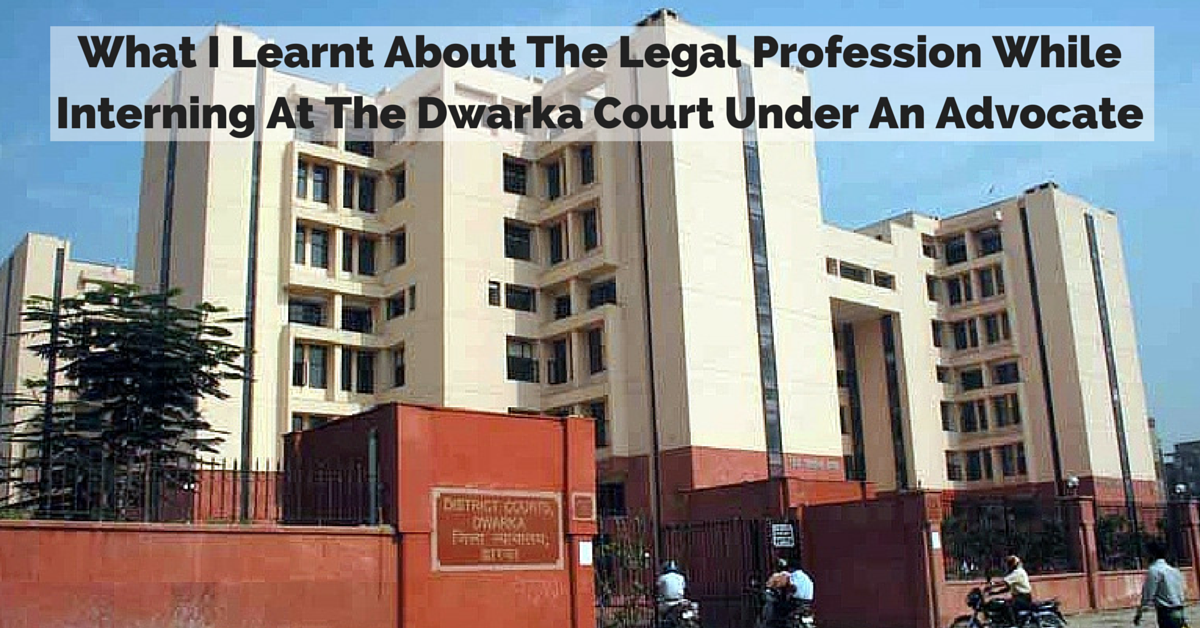
What I Learnt About The Legal Profession While Interning At The Dwarka Court under an Advocate

0
What I Learnt About The Legal Profession While Interning At The Dwarka Court Under An Advocate

This article was written by Sikander Sharma, a student of University School of Law and Legal Studies.

At the end of the first year in the Law School, an amazing opportunity at the notice board in the corridor of my college caught my sight. I wanted to grab it without procrastinating any further. It was an honour working with the President of the Dwarka Court Bar Association, Advocate Naresh Sharma, as he then was, in the summer of 2013. Thanks to the Internship and Placement Cell of my college which accepted my request for the internship.

I was already excited and keen to intern with Mr. Sharma. The very first day of my Internship was crucial for me as it is for any intern so as to leave a good impression on the minds of the people at the workplace. I wore a black suit and reached the Courts’ Complex at 9 am sharp as I was told to do so.

I took his permission to enter the chamber and he welcomed me with warm greetings and also introduced me with the fellow interns and junior counsels. I was asked to bring a diary or notepad to jot down the cases to be heard for each day before leaving the chamber.

Now, we were on our way to the courtroom. He briefed me with the facts of the case while speeding towards the courtroom and told me that it was a rape trial and he was going to cross examine the prosecution, witness.

This was like a boon to me as I am more inclined towards Criminal Law. I was asked by one of my seniors to carefully observe and notice the language and tone of Mr. Sharma while the cross examination and the way it affects the witness and her statement. This was the part where I had learnt some of the technicalities of advocacy. He had a deep and audible voice which was pleasant to everyone’s ears in the courtroom.

Now, the quality of his voice had another aspect – it was dominating and could make the witness nervous affecting his statement and secondly, it showed his confidence affecting the view of the Judge which could be seen later in the Judgment.

I was asked to attend the court proceedings similarly on a daily basis both in the District Courts and the High Court, observe them, draft petitions for the filing of cases with the help of a senior intern , research on matters to be heard before the court and most importantly appear as a trainee before the judge asking him to give a subsequent date in case the prime counsel could not come.

I was little nervous on the first day of confronting the Judge, but later it became a routine and I could interestingly speak in different styles whenever I got an opportunity which made me feel like an advocate.

Ironically, the only sentence I had to say was “Your Lordship, the Prime Counsel could not appear as he has a case in the High Court”

A few days later, we were asked by one of the seniors to attend the proceedings at Courtroom no. 207 for it was known as the most entertaining court in the whole complex. A court that is entertaining?

It sounded a bit strange to us but when we went inside , we were actually amused after a while. That was a Family Court. The Judge in there had undoubtedly no intention to seek our attention but only to deliver justice. We had never seen a Judge so outgoing and friendly both with the parties to the case as well as the pleaders. In a divorce matter , he pacified the counsel for the plaintiff by saying “Wakil sahab, why do you worry so much? Let us find a solution instead of multiplying the complexities”

What I had inferred from his behaviour was that he was actually striving to bridge the gap between the parties to the case i.e the husband and the wife by reflecting a sociable and uninhibited attitude so that they could explain their grievance without hesitation. This could be seen in that Court pertaining to any matter, be it marriage, divorce, maintenance, succession or any other family dispute.

His approach was to settle the disputes by advising the parties to the case to co-operate with each other instead of promoting the ever increasing litigation custom of arguing. Such an approach by a person sitting behind the dais endeavours to preserve the social relationships in the society.

Another thing which I had learnt during the internship was saving time and valuing it. I then came to the conclusion that time is not only what my watch reads but it is indeed, big fat money.

Whenever I accompanied Mr. Sharma towards the court, I always watched him walking at a fast pace. He never used to wait for the elevators but hastened downstairs every time he had to appear before the Judge and it was a real challenge to outrun him.

One generally gets to see a huge variety of pleaders in the District Courts. You find some of them very articulate in their speech and some are going to blow your mind up

I was sitting in the Courtroom for a matter to be called up where I was analysing the way the different pleaders presented their case and acknowledged that most of them used to speak in Hindi and even in their local languages which were barely comprehensible. This was unlike the Delhi High Court where you find all the silver-tongued lawyers with a fine quality of language.

One should definitely opt for an internship in the District Courts in the first year where you get to know about the reality i.e. how the Court actually works, how the drafting is done, the procedure which is confirmed to during the trial, the location of the specific Court, the jurisdiction of the Courts and a lot more.

If one is attentive and craving for knowledge, there is a lot to do and learn from but in case one tends to be lethargic and does not pay heed to minor details in the surroundings, even god cannot help . It is worth noting that a clerk working at a lawyer’s chamber knows far more than a student of first year. Going for the Supreme Court or any prestigious Law firm in the first year only to upload your facebook status does not pay you much.

Nevertheless, the environment in the chamber made me comfortable , the senior interns were helpful, the junior counsels taught me the functioning of the court. Overall, my experience in the District Court was fascinating and very informative. And I am pretty sure that this will add up to my advocacy skills in the future.

Download Now

What Makes A Good Law Review Editor

0
What Makes A Good Law Review Editor

Arpita Sengupta, a student at NUJS is an editor of the Journal of Indian Law and Society. We asked Arpita what are the qualities of a good law review editor, and she wrote this article. Over to Arpita.

Law Review is a law school journal wherein the major task of article publication lies entirely with students.

Legal scholars across the world have always held Law Reviews in high esteem. The US Supreme Court has gone to the extent of citing law review articles in deciding cases and substantiating the legal scholarship paradigm. In the United States, a stint as a law review editor is almost regarded as an assured opportunity to work in any federal court as a litigator. An editor is accredited the highest degree of prestige and is viewed as one with excellent analytical skills, legal writing expertise, intelligence and flawless argumentation.

One wonder as to what are the skills that a person must possess in order to be a Law Review Editor. While some legal scholars feel that there are no set standards to determine one’s eligibility, others feel that an editor must have certain qualities like great research skills, eye for detail, ability to persuade others, strong work ethics, and good writing skills. Let us explore as to what it really takes to be the chosen one.

1) Leadership –

One of the most important attributes of an editor is to be a good leader. An editor should be able to assume the responsibility of his team and provide his own opinion on the issue at hand. He should have good managerial skills and should instruct his peers fearlessly.

2) Ability to Comprehend –

An editor should understand what the goal of the article is and try and debunk any kind of ambiguity or legal jargons.

3) Critical Analysis –

An editor should have a critical bend of mind so as to change a matter of fact legal argument into an invaluable legal question. He should interpret a matter not only in the literal sense of the term or the black-letter provisions of law but also add his own analysis, comments and interpretation to it.

4) Research and Writing skills –

The most important skill required of an editor is unparallel research and writing skills. One must be fully adept in language, grammar and sentence structuring abilities. For an article to be ascribed as an excellent one, extensive research and reading is a necessity.

5) Persuasion –

An editor should have the power of persuasion. Whether an article is to be selected or rejected, whether any argument is valid or flawed can be made clear by the art of persuasion.

6) Communication Skills –

Good communication skills is an indispensable character of a Law Review Editor. They need to articulate and communicate lucidly in writing.

7) Listening –

An editor should not only be a good writer and researcher but should also be a good listener. He should listen to everyone’s arguments and only after inculcating his interpretation into it should he decide on the merits or demerits of the argument.

8) Decision Making Capacity –

A good editor is one who has the capacity to make a decision in a situation of conflict. Merely pondering over an issue is of no avail. One should have the capacity to make feasible decisions that would be beneficial for the progress of the journal.

9) Time Management –

An ability to manage time is of great necessity. Soliciting articles, selection of articles, carrying out editing work, publication of the journal and all other activities need to be carried out in a decided timeline or else a lot of pending work can create a bad impression about the journal. An editor might be faced with a time crunch and a need to prioritize between law review work and academics. He should have the willingness to efficiently manage both.

10) Coordination –

An editor should be a good coordinator. He should effectively coordinate between other editors, authors, publishers and the like. He should identify the best people for the job and allocate different work to different people based on their area of specialization and interest. Only then will the work be done efficiently and in time.

11) Learning –

Many students covet the post of a Law Review Editor for the sole purpose of adding a value to their resume. However, an editor should also be interested in learning and increasing his knowledge base. He should be interested in improving his communicating, writing, editing, speaking, footnoting skills while valuably adding to the journal’s advancement and expansion.

A Law Review Editor needs to be approachable, open to others’ views, non-opinionated and a person with a vision. One cannot possibly specify an exhaustive list of qualities needed to be an editor. One can learn the art of editing through experience, hard work and eagerness to learn. On the contrary, some editors can be inherently blessed with great editing and writing skills. One can say that confidence, leadership and willingness to go the extra mile is what makes one a good Law Review Editor.

Download Now

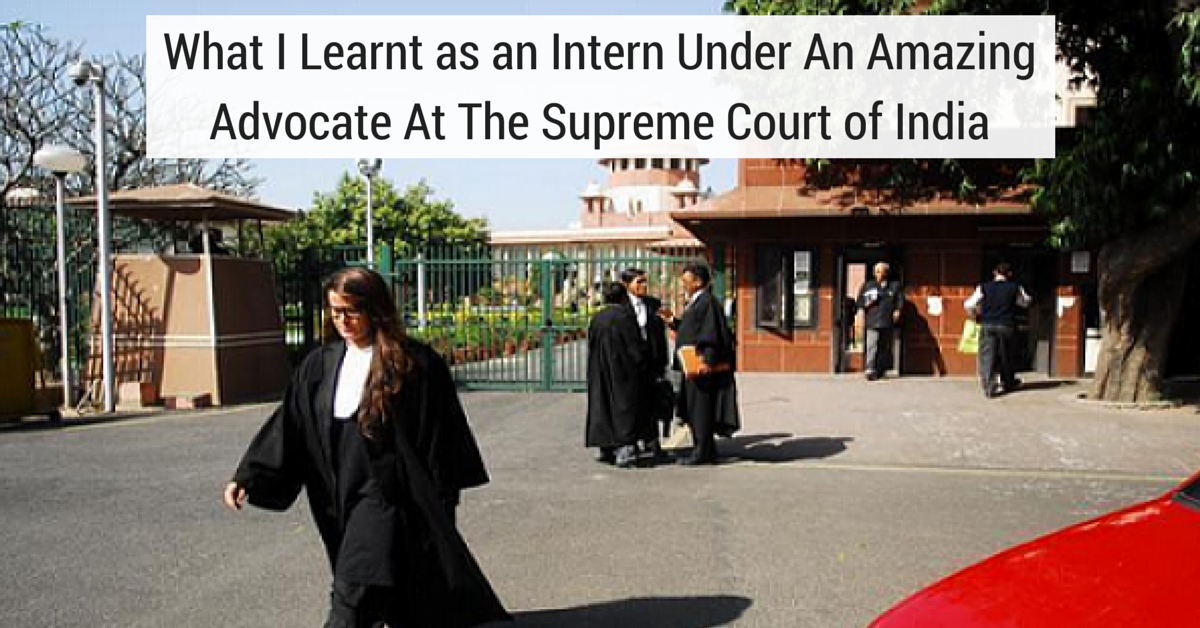
How is it to intern under a Lawyer at The Supreme Court of India

0
What I Learnt as an Intern Under An Amazing Advocate At The Supreme Court of India

The law is not what we learn from our books, it is much beyond that. Written by Pallavi Dhok of BHARATI VIDYAPEETH’S NEW LAW COLLEGE, PUNE. If you want to share your law school stories write to [email protected]

The office was located in the old chamber of Supreme Court. There was a space crunch and the office couldn’t accommodate more than 8-10 people at a time. There were 3 associates and 2 clerks to manage the files and other clerical work.

I interned at the Chambers of Dr. J.P.Dhanda for a period of one month. One is expected to work for 5 days a week. One is expected to reach the office by 10:00 a.m. sharp. He is very particular about punctuality. However, there was no fixed time for leaving the office; you can leave if you finish your work early.

The first day of an internship can be a little intimidating for anyone, so was this for me. I was really nervous and didn’t want to screw things up on the very first day. I got this internship through a contact or what we like to call “jugaad.”

However, once I reached the chambers of Dr. J.P.Dhanda, I introduced myself, and he said, “Welcome Puttar! It’s going to be an interesting journey from here on!” and all my fear and nervousness vanished into thin air. He asked a few questions about my college and the subjects that have been covered in my college and what all I learned from my previous internships.

There was one more intern apart from me. On our first day, he introduced us to the kind of work he dealt with and asked us to make ourselves comfortable. He asked us to research on few provisions of the Indian Penal Code. Since, it was our first day we were not given much work and were allowed to leave early.

Since I interned during the vacations of the Supreme Court, we didn’t really get to witness the proceedings of the Hon’ble court. However, we were lucky enough to witness Mr. Dhanda in action. One thing I learned that day was the importance of “quality research work”. It was interesting to see how the tables turned the moment he started quoting relevant case laws. It was astonishing to see that he remembered each and every provision on his fingertips.

The main tasks given to us were mostly research work and preparing briefs of the case.

We were asked to research for judgments/articles/case laws on criminal issues specifically dacoity, assault, murder, robbery, mischief, etc. We were given files to read and get acquainted with the facts of the case. We were asked to prepare briefs of the case supporting them with relevant case laws and judgments. Now, when it comes to looking for case laws we think it is going to be an easy task, but on the contrary it drives you crazy if you don’t know how to use Manupatra or SCC online or other such portals. One should know how to look for case laws using citation and how to refine the search and get the desired results.

There were days when no work was given to us that was when Mr. Dhanda taught us about the basics of law. He taught us how and when a Special Leave Petition is filed, what does Public Interest Litigation mean and who can file it. It was a great opportunity to improve my researching skills and gain knowledge about things that are not really taught in our colleges.

During his free time, Mr. Dhanda used to read the landmark judgments, acts, and amendments and encouraged us to do the same. He believed that learning is a continuous process and one must be curious to learn new things. He encouraged us to ask questions if we didn’t understand something and was ready to clear our doubts.

We were allowed to sit with him during the client meetings. He used to make sure that we get maximum exposure and learn each and everything that is there in the field of law. We were asked to watch the meeting carefully and later explain whatever we understood. He gave us a quick insight about the Indian Penal code, Criminal Procedure Code as well as Civil Procedure Code.

One gets to learn a lot from these client meetings.

One thing you must always remember while dealing with clients is to be always on their side, understand what they are going through and to think from their point of view. Also, to survive in this field one needs to have excellent relations with everyone (even if you don’t like them)

The internship also taught me a great deal of professional ethics. One must sympathize with their clients and make sure that they are satisfied with the work. Working directly under a Supreme Court advocate gives you an opportunity to learn more as you can have his full attention. He advised us on how to deal with clients, how to be professional about it and how to act in front of the Hon’ble Judges of the Supreme Court.

There were times when I was given clerical work like typing and also, it used to get monotonous as we only got research work related to Criminal matters. However, I was lucky enough to get some drafting work and was asked to file a reply for a matter related to Consumer Protection Act.

One thing that I absolutely loved about this internship was the work environment.

Work environment really matters a lot. If you have cooperative and helpful people around you, it gets easier to get the job done. Most of the work was given to us by Mr. Dhanda himself. He used to make sure that we always have some or the other work to do and was always happy to teach us something new. If you are honestly sincere and hardworking, he makes sure that you get a lot of work. Another good thing about this internship was there was no workload. He believed in getting the work done at your own pace, but if you’re taking your own time you cannot make any mistakes. If you get it wrong, you are asked to do it all over again. The work done should be crisp and quality work.

Dr. J.P. Dhanda is a great source of inspiration. According to him the more we read, the more we learn. He used to share his experiences of how things actually work in the legal world, his struggles and how he became a successful lawyer. There were times when he used to quote Shakespeare in order to keep us motivated. One of the inspirational quotes was: “Ignorance is the curse of God; Knowledge is the wing wherewith we fly to heaven”.

The most important thing that I learned during my internship was if you want to extract the most out of your internship, ask for work and don’t be afraid to ask if you don’t understand something.

People are more than happy to give you work and teach you how it is done. If you wait for work to be given to you, you’ll end up sitting idle and learn nothing. The law is not what we learn from our books, it is much beyond that. Internships are an opportunity to apply the knowledge of the law practically.

Another important lesson that I learned while I was interning under Mr. Dhanda was to have “patience”. As you know, they say, “Rome wasn’t built in a day.” It takes time to get to the top. He once said: If you want to get noticed and be successful you must have patience and while you’re at it keep on learning. People are going to tell you that this job is not meant for you, WHY Law? Don’t listen to them. Just do what you got to do, be confident about it and you’ll get there.

It is very important to choose your internship wisely.

If you don’t enjoy the kind of work you are given, it’ll be a waste of both time and energy. If you are interested in litigation, this is the kind of internship that you must go for.

This internship has taught me more than just law. It gave me an exposure to the real side of the law and motivated me to keep on learning. Internships not only give you the practical knowledge, but it also helps you to open the doors of your mind and think in a completely different way. You get to improve your logical, as well as legal reasoning while interning. It is only possible to learn all this during an internship because no one can teach you how to deal with clients or how to sympathize with them; you learn all this only when you start working and dealing with all these issues on your own.

The biggest challenge while interning under a Supreme Court advocate for me was that I had no knowledge about the Criminal Procedure Code or the Civil Procedure code since these subjects were not yet taught to us in our college. Knowing the fact that I had minimal knowledge about the said subjects he kept encouraging me to learn those subjects. The research work made it possible to learn about those subjects and discover more in law.

Internships offer more than what law schools can offer a student.

It provides a person with real life work experience in a prospective career field. It gives you a close look at what you are really getting into, so it is very important to choose an internship which interests you the most. The key to making the most out of an internship is to work to the best of your abilities and you will shine in the world like bright stars in the sky.

“It’s not important what you are underneath, but what you do that defines YOU- Batman.”


Download Now

Book review: The Story of Delhi Durbar

0
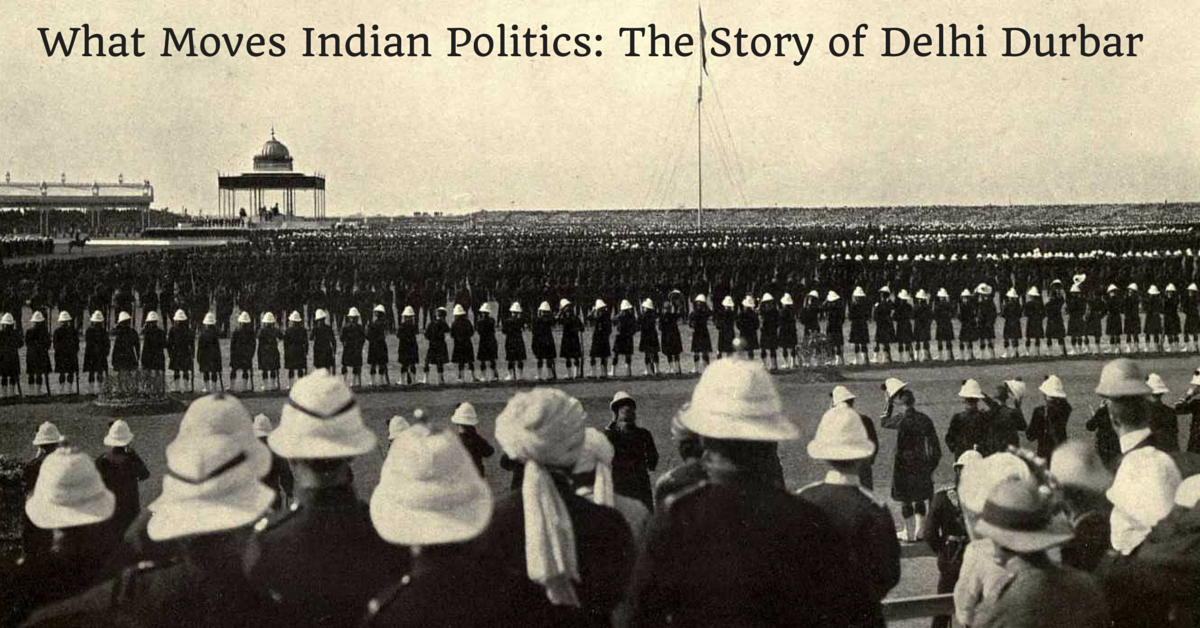
What Moves Indian Politics: The Story of Delhi Durbar

This article is being republished from A First Taste of Law archives.

Hello, good people, Merry Christmas! While I have been busy in other things and couldn’t write a single blog post in the last couple of weeks, Jay Sayta has again saved the day with his post on Delhi Durbar – a book on political fiction. He spoke to the author of this truly extraordinary and interesting political thriller, in which the protagonist manages the invisible funds of the political leaders. Read on if you want to know more.
If you are interested in buying the book, you can do so over here without even having to visit a bookstore at a 22% discount – Delhi Durbar (you can order it on Flipkart, pay cash on delivery).
Over to Sayta.
——————————————————
While I have always been an ardent fan of popular fiction, particularly the works of Jeffrey Archer and Frederick Forsyth, I have not been finding any Indian fiction author that I really liked – until recently. Bored with reading bestsellers, I was browsing through recent popular Indian fiction when a relatively obscure novel titled ‘Delhi Durbar’ caught my attention. The novel claimed to be a political thriller set in the backdrop of a hypothetical third front government coming to power. The publishers even gave a ‘Love it or money back’ guarantee. Curious, I purchased the book and immediately started reading it.

And the novel did not disappoint me. The novel is the narrative of the protagonist-Jasjit Singh Sidhu, a political wheeler-dealer whose job is to shovel the money looted by our ‘men in khadi’. His latest assignment is managing the funds of the recently elected third front Prime Minister, Paresh Yadav. The novel then goes on to describe the horse-trading and arm-twisting that takes place during the BCCI elections; the caste and reservation politics played by our politicians for petty electoral gains; and the mind-boggling amounts of unaccounted wealth in the hands of our politicians.

The main theme of the novel, however, is the threat of a military takeover of the third front government by the President (who happens to be an ex-Army chief). It raises pertinent questions as to the threat to India’s democracy by the executive; while the post of the President is a ceremonial one, India’s first citizen still enjoys a number of discretionary Constitutional powers which may be used to wretch the pillars of democracy (especially when the President is a person with considerable clout in India’s armed forces). Delhi Durbar serves as a reminder of the gory excesses of the Indira Gandhi government during the emergency and the potential threat of a military takeover.

While India’s armed forces have always remained subservient to its political masters; an organized revolt led by an ambitious military leader can easily usurp India’s democratic institutions. The examples of a number of military coups in South Asia and the discipline and capability of our armed forces reaffirms the possibility of such a coup d état impossible.

Delhi Durbar succinctly portrays the indiscriminate looting of national wealth by our politicians. The author, Krishan Pratap Singh (a former investment banker and the son of a diplomat) was kind enough to share some of his thoughts with me over e-mail. Says Singh, “I first got the idea to write about political fiction when I read Jeffrey Archer’s First Among Equals. But that was years ago, and I didn’t do anything about it. But after the 2002 Gujarat riots I began to strongly feel that our politicians were rascals, not up to the job, and began to think of an alternate universe. From this thought process emerged the Raisina Series. Delhi Durbar is the second/middle novel where I wanted to show the rot in the political system and vent my frustration at the loot that was taking place in Delhi all around me, yet was invisible to the rest of the country.”Singh feels vindicated after the unearthing of the various scams this year which has reaffirmed his statements about the rot in our political system.

All in all, Delhi Durbar will not be known for its eloquent language and Singh’s literary skills may not match that of Archer’s (his legendary book “First Among Equals” never ceases to amaze me and Archer may also have a reason to feel vindicated as the political situation that he predicted in his 1984 came true in the 2009 British elections), but his depiction of the nexus between India’s media, bureaucrats, politicians, military, and lobbyists/wheeler-dealers/power-brokers is worth reading.

There are few writers who write good political thrillers these days; Frederick Forsyth would undoubtedly top that list; Delhi Durbar reminds me of his bestselling masterpiece Icon (a novel where he depicts the turmoil in Russian politics after the disintegration of the Soviet Union). Though Krishan Pratap Singh has a lot to prove before he joins the elite list of bestselling novelists, fast paced Delhi Durbar effectively represents the deep-rooted rot in the political system without being monotonous or boring. It shows that manipulation, dishonesty and bribery are the only skills required in politics.

Delhi Durbar will certainly not let you down if you are looking for an entertaining read and at the same time provide you with insights as to what greases the wheels of political India.

Download Now

My Experience at Campus Law Center, Delhi University

0
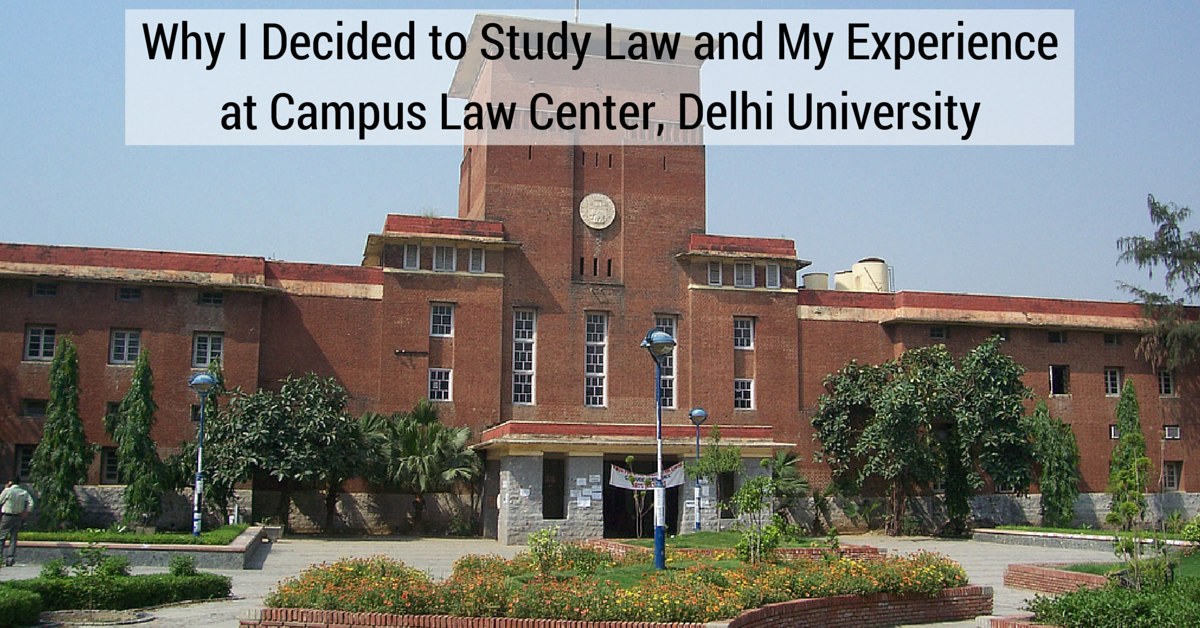
Why I Decided to Study Law and My Experience at Campus Law Center, Delhi University

This article was written by Ayush Puri of Campus Law Center, Delhi. This is being republished from A First Taste of Law archives.

Stumbling upon law as a career prospect dawned upon me quite unconventionally.

It was a decision that no one expected me to take especially after graduating in science. Most people were shocked by the path I had chosen. But my experience so far tells me that this decision might turn out to be a masterstroke. In this day and age of competition for college seats, jobs and pay packages, I like to hold my own view and I believe, this makes my story all the more riveting.

I belong to a typical middle-class Punjabi family. We are known to have large hearts but not so much known to have a strong study oriented approach to a career. All bread earners in my family have either been into business or jobs and nobody has ever pursued any degree except for a B. Com. or a B.A., But my approach has always been different. Being an adolescent with limitless dreams, I wanted to become a multi-millionaire scientist. Since I started studying science, I was truly fascinated by it. In fact, in class 5, I once told my teacher that I only wanted to study science and no other subject.

At that point of time, I could think of nothing but science. I read extensively about the works and achievements of many researchers who were champions in their respective fields like Louis Pasteur, Isaac Newton, Alexander Fleming, Hargobind Khorana, Marie Curie and Homi J. Bhabha to name a few. They inspired me to the core and I dreamt about becoming a legend like them someday. Years rolled by, but my fascination for science never declined. Although I am blessed with extremely supportive parents, yet I never knew about how actually such renowned scientists reached the pinnacle of their careers and the ground conditions involved as I had no one pursuing this field around me who could provide some guidance. So with all those dreams intact, I was continually enchanted by my science textbooks.

I was really good at academics at school. After securing a 3rd rank in my class in 10th standard, I chose biology as my stream. At that moment, I never thought about what I wanted to become after taking up science. I only thought the excitement those subjects generated in me.

On the very first day of class 11, I remember my friends coming up to me asking about my stream. As soon as the word ‘biology’ came out, they all had a common remark, “Oh! Physics, chemistry and biology, you must have chosen them to become a doctor.” This career centered approach was new to me. I had just chosen my subjects out of interest but had never given a passing thought to what I would exactly do after studying them.

Being naïve and immature, I almost unknowingly entered the rat race without even thinking if I ever wanted to be a doctor. Soon, like many of my classmates, the major topic of discussion revolved around colleges, the number of seats, recruiting hospitals and the pay packages. My parents as well never questioned my choice and were happy in whatever I chose with my own volition. Subsequently, I was admitted to a medical entrance examination coaching centre as per my wishes.

For two long years, my life was more or less confined to school and the coaching centre.

After a series of low scores in exams, I realized my approach would never fit in the larger scheme of things. The extremely competitive atmosphere for a handful of college seats demanded a very different methodology for ‘cracking’ the entrance exam. Every second question in class was turned down by the coaching centre teacher saying that ‘it is not in the syllabus’ or ‘this question is not asked in the exam’. I tried really hard to change my method but in vain. Consequently, I felt demoralized, disheartened and completely demotivated. I had little time to enjoy the subject. Instead of the fascination, the competition was now the major driving force behind studies.

After CBSE 12th Board exams, I performed poorly in some of the entrance tests. I had cleared all exams for private colleges, but I did not want my family to take the burden of exorbitant fees exceeding INR 40 lakhs. Being fed up, I went up to my parents and told them about my plan to shift to law. It was the first time I mentioned law as a subject to them, let alone telling them that it was a subject of interest. Even for my cooperative parents, it was a difficult pill to swallow. They told me to take my entrance exams first then we could think about it together.

By the time my entrance exams got over, the percentage cutoffs were declared by Delhi University. I had got good marks, owing to which I was fortunate to get admission in Zoology Honours at Sri Venkateswara College. In the first year, I was one of the toppers in the University exams. Meanwhile, my father insisted that I appear for the entrances once more. This time, a difference of 1 mark from the cutoff stopped me from taking admission to a premier medical college. It was as if the Almighty had indicated that although I was good enough, he didn’t want me to follow that path.

The next 2 years of college was a life changing experience.

The next 2 years of college changed my life. Now I had ample time to enjoy the subject. Also, the fact that I had already studied more than 1/3rd of the college syllabus during preparation for entrances only helped. This was a blessing in disguise indeed. I did not feel any need to study at home. I could just attend classes and many of them were like revision classes for me. My school’s vice principal once told me that whatever we learn might seem to be a waste of time and energy at that point of time, but that very knowledge comes to our rescue at some point or the other in our lifetime. I was now realizing how true her words were.

This extra time enabled me to become an active member in the core team of the social service society of my college – ‘Parivartan’.

I got the opportunity to interact with students of different fields. Consequently, it improved my communication skills, organizational skills and current affairs. I realized how much there was to learn from different people. Through Parivartan, working for various Non-Governmental Organizations (NGOs) provided me with a first-hand experience of various problems in our society. I got to understand the hardships of poor children, stray animals and abandoned pets, leprosy patients, differently abled and the abysmal state of our degrading ecology. As a result, I gradually started reading newspapers and watching news daily which made me more aware.

Simultaneously, I also got engaged in a research project funded by the University of Delhi.

I worked on the 16S rDNA and Hsp60 chaperone protein sequences to trace the evolutionary history and relationships of 10 clinically and economically relevant species of Helicobacter through in silico analysis. Helicobacter, a genus of epsilon-proteobacteria is recognized as a Group 1 carcinogen known to cause many diseases such as gastric adenocarcinoma, peptic ulcers and MALT lymphoma among many others in both humans as well as livestock. I learnt many concepts and techniques unknown to many of my classmates. Moreover, I learnt how to gather and analyze information from various research papers, teamwork (as I was a part of a team of 9 students + professors as mentors), how to make and give presentations as well as how to extract every bit of knowledge from learned mentors. Through the project, I also attended many seminars and an international conference as well.

In the final year, I was elected as the president of the Zoological Society while working for 3 different NGOs.

I learnt how to delegate work to different members of the society. For the NGOs, I taught abandoned and runaway children, promoted the cause of ending educational inequity and wrote various letters to many stakeholders responsible for the welfare of the differently-abled. Through them I learnt about PILs (Public Interest Litigation), Juvenile Justice (Care and Protection of Children) Act, Environment (Protection) Act, Water Act and Air Act among others. Reading about them gradually instilled a keen interest in the legality of such issues. This is the point when I again thought of law though I was not very confident about it. I did not know many people who took such a decision after graduating in science. The uncertainty grew when my parent themselves weren’t convinced by it. Moreover, I had scored well till then in my graduation exams. My family and friends were shocked by the fact that I was departing from science and considering law as an option.

Meanwhile, after clearing an entrance exam for M.Sc., I was called to Mumbai for an interview to one of the most prestigious research institutes in the country.

While taking a round of all research labs in the institute, I was amazed by the infrastructure but just couldn’t imagine myself in place of other students working there. I felt uneasy and uncomfortable as if I was at a place where I did not belong. Later in the evening, I visited Government Law College that is situated just a few kilometers from the institute. Although the condition of the building was deplorable yet I felt light-headed and could breathe easy as if I was blessed with a new pair of lungs. After enquiring about the procedure for admission, I bought a vada pao and sat on the boundary wall in Marine Drive facing the sea. With the sound of nothing but the gentle sea breeze, I reflected upon what I wanted to pursue and everything pointed towards law.

On my way back to Delhi, the berth besides mine was booked by a Mumbai High Court lawyer. For most part of the journey we didn’t talk. Finally, when less than an hour was left, we started chatting. He told me about the bright and not-so-bright sides of the field of law in our nation. Having a knowledgeable lawyer giving an account of his own experiences while sitting beside you was quite a pleasant coincidence especially when you are facing a dilemma like I was. After coming back, I talked to many lawyers if I could take such a decision. Their answer was in the affirmative. They all unanimously said that academic background doesn’t matter. I got to know that one of my aunts (who is quite a successful advocate) herself graduated in zoology before she took up law. Consequently, my confidence grew and the resolution to pursue law looked all the more plausible.

But still, leaving out the option of masters in science with the only law as a career prospect was a risky proposition. So, I appeared for all entrance exams.

But, I was particularly nervous about the examination for Faculty of Law, University of Delhi.

I remember checking out their website and facebook as well two to three times a day for any news of the results. The tentative date for the declaration of results had passed yet there was still no update. The anxiety grew on a daily basis. Finally, when the results were announced a week later, I breathed a sigh of relief. I had scored well with a good rank. Law was now definitely an option.

Moreover, I was selected through interviews for a prestigious fellowship by an international NGO. To add to the confusion, I cleared all M.Sc. entrances and scored a high aggregate percentage in graduation. The anxiety grew every time I pondered over it. My parents did not say much but I knew they wanted me to pursue science. My friends were divided. Some said law others said science. In this chaos, I finally chose to go with my gut feeling that pointed towards law. After all, every accomplishment starts with a decision to try. Thus, I took admission in Campus Law Centre, Faculty of Law, Delhi University (DU) and eagerly waited for the first day of college.

I clearly remember that day. It was hot and humid with the sun beating down. There was ruckus near the information board as students tried to figure out which class they were allotted. There were long queues of students in black and white attire (which, I think, were second and third year students) and like every college in DU, groups of students hanging out in the garden or the canteen. After finding out my allotted section and time table, I went to my class at the top floor. I gradually realized that this class was very different from that in graduation. My classmates were from different streams, academic backgrounds and of different ages. Some were as old as me and others were as old as or older than my father. It took time, but eventually I got used to it.

The first semester has just concluded, so my experiences so far have not been that much owing to the paucity of time.

I participated in paralegal training organized by the Delhi State Legal Services Authority in Tis Hazari. It was a really good experience as I learnt about the state of the judiciary in the country and the immediate need of free legal aid to the poor and the vulnerable sections of the society. The Constitution of India, as well as the principles of natural justice, demand justice to be accessible to all. I was also selected for the Debate and Discussion Society as well as the Placement Assistance Council of the college.

The initial classes were introductory but later on when we started with the core syllabus, I gradually started to take a keen interest in the subjects. I particularly developed a liking for family law and criminal law. The teachers for these subjects were quite experienced as well. Meanwhile, I got selected for an internship as well in a law firm owned by a Senior Advocate of the Supreme Court. I visited various courts and tribunals such as the Delhi High Court, Supreme Court, National Consumer Disputes & Redressal Commission, Company Law Board etc. I assisted lawyers in various cases and attended meetings too. It was a very good experience as there was a lot to learn from learned lawyers and I gained practical experience attending proceedings in various courts. The semester exams were conducted in the month of December and the results are awaited.

All in all, my experience till now has been great.

I don’t even once regret my decision to choose law, how unconventional it may be for a science graduate like me. In the words of Robert Frost, ‘I took the road less travelled by’. I do possess the confidence to do something substantial with my life even if I do not reach the apex of success in this field. Thus, I lack any insecurity that could pave the way for any apprehension regarding the choice of my career. NR Narayana Murthy said, “It is less important, I believe, where you start, it is more important how and what you learn.” Although I am not in a position to ascertain like Frost but I can definitely hope that my decision ‘makes all the difference’.

Submitted by:

Ayush Puri

LL.B. (1st year)

Campus Law Centre

University of Delhi



Download Now

Job Opportunity-Legal Manager-HUAWEI

0

HUAWEI group job opportunity.HUAWEI group is hiring for ‘Legal Manager’ at Gurgaon.Details are as follows:

Job at a glance

  • Designation-Legal Manager
  • Qualification-LLB
  • Location-Gurgaon
  • Salary-not disclosed
  • Experience-8 to 11 years
  • Keyskills-complaince management,international trade
  • Company name-Huawei
  • company website-www.huawei.com

company profile

Huawei is a leading global information and communications technology (ICT) solutions provider. Through our dedication to customer-centric innovation and strong partnerships, we have established end-to-end advantages in telecom networks, devices and cloud computing. We are committed to creating maximum value for telecom operators, enterprises and consumers by providing competitive solutions and services. Our products and solutions have been deployed in over 140 countries, serving more than one third of the world’s population.
At Huawei, we define human progress by innovations that enrich humanity. We do not view connectivity as a privilege, but a necessity. We believe that the impact of information and communications technology should be measured by how many people can benefit from it. For more information visit our website www.huawei.com & www.huaweidevice.co.in

click here to apply

Huawei

Download Now
logo
FREE & ONLINE 3-Day Bootcamp (LIVE only) on

How Can Experienced Professionals Become Independent Directors

calender
28th, 29th Mar, 2026, 2 - 5pm (IST) &
30th Mar, 2026, 7 - 10pm (IST).
Bootcamp starting in
Days
HRS
MIN
SEC
Abhyuday AgarwalCOO & CO-Founder, LawSikho

Register now

Abhyuday AgarwalCOO & CO-Founder, LawSikho