Download Now
Home Blog Page 1689

Duties Of The Employer Under The Equal Remuneration Act, 1976

2

In this blog post, Hari Manasa Mudunuri, a student of  University College Of Law, Osmania University, who is currently pursuing a Diploma in Entrepreneurship Administration and Business Laws from NUJS, Kolkata, discusses the duties of an employer under the Equal Remuneration Act, 1976.

hari


Introduction

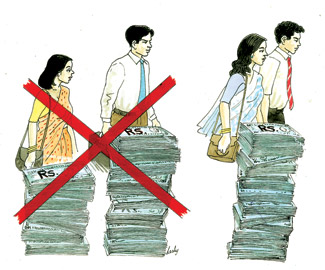
In India, the Vedic period gave equal status to men and women, but this ideology had a tectonic shift over a period. The men have overshadowed the position of women in the society. At the time of Independence, the inequality was apparent, and the constitutional framers had to address this as it chose a democratic republic as a form of governance. Systems have to be put in place for the operation of the democratic forces to ensure equality.  The constitutional provisions and various legislations have been enacted which became a bedrock towards ensuring equal opportunities to men and women. When equal opportunities are put in place, the next line of action needed is equal remuneration for the same work done without reference to the gender. To make this legislation a success, the onus is on the employer for effective implementation.

The employment of women has been increasing gradually over the years. Moreover, the works which were considered gender specific underwent a sea of change. Women were usually seen as less productive than their male counterparts. The general perspective of women was that they weren’t as serious as men in their work as family and home are their main priority. Economic dependency is the major cause for the women to have a weak bargaining power. This usually makes the employer take them for granted, and the wage rate would be unequal.

In the modern times, the women are no longer restricted to minimal jobs or the traditional works. They are employed at par with men and to protect their interests and ensure they get a fair chance, statutory recognition is given through different legislations, enacted both at center and state levels. The Workmen Compensation Act, Payment of Wages Act, Factories Act, Minimum Wages Act, The Equal Remuneration Act, Maternity Benefits Act, ESI Act, etc. are some of the legislations aimed at ensuring equal wages without gender bias.
 z_p17-Equal

Constitutional validity

Gender Justice is an important ingredient of every civilized society. It’s no longer the popular mindset that the female is a weaker sex. To imbibe this principle in the society, various steps were taken at the international level:

  • The International Labour Organization held in 1951 a Convention concerning Equal Remuneration for Men and Women Workers for the Work of Equal Value.
  • The Universal Declaration of Human Rights, under Article 23 ensures that everyone without any discrimination has the right to equal pay for equal work.
  • The Convention on Elimination of all form of Discrimination, 1979 has it’s the main objective to prevent discrimination especially in the case of women.

At the national level, certain legislations were enacted by the British India. But it’s the national leaders, freedom fighters and intellectuals and the democratic movements sweeping the world over brought about positive changes in the position of women and in achieving equality.

  • The Preamble of the Constitution provides for Justice and Equality to all.
  • Article 14 equality before law
  • Article 15 guarantees a right against discrimination
  • Article 15(3) recognizes ‘protective discrimination’ to bring women at par with men in all possible respects.
  • Article 16 provides right to equal opportunity regarding public employment irrespective of the sex of the person.
  • Article 39(a) states that the citizens, men, and women, equally, have the right to an adequate means of livelihood.
  • Article 39(d) “that there is equal pay for equal work for both men and women”.
  • Article 42 requires the state to make provision for securing humane conditions of work and maternity relief.

The Doctrine of ‘equal pay for equal work’ is not a fundamental right but a Constitutional right. Equal remuneration for men and women is the right of an employee without any qualification. The Act of Equal Remuneration, 1976 was enacted to comply with the provisions of Directive Principle of State Policy (DPDP) under Article 39. The Act, being a beneficial legislation, ensures adequate payment or remuneration to be made irrespective of the physical strength of employee and removing the scope of social and economic injustice merely on the ground of sex, thereby working to establish a just society in the country.

equal-remuneration-bareact-1976-500x500

The salient features of the Equal Remuneration Act, 1976

  • The Act is a Central Legislation and applies to the whole of India.
  • The objective of the Act is to provide for protection against discrimination of women workers on the ground of sex, about the payment of equal remuneration in the matter of employment.
  • Restricting the employer to create terms and conditions in a contract of service or work of labor contrary to equal pay for equal work doctrine and the provisions of Equal Remuneration Act.
  • The Act doesn’t make a distinction like employment or the period of employment and applies to all workers even if engaged only for a day or few days.
  • No overriding effect is given to any agreement, settlement or contract to the provisions of the Equal Remuneration Act.
  • Any settlement or any agreement with the employee that is detrimental to the employee isn’t allowed.
  • The Ministry of Labour and The Central Advisory Committee are responsible for enforcing this Act.
  • Meaning of equality of work: The equality of work is not based solely on the designation or the nature of work but also on factors like qualifications, responsibilities, reliabilities, experience, confidentiality, functional need and requirements commensurate with the position in the hierarchy are equally relevant.
  • When the employer doesn’t comply with the provisions of the act, he will be liable to pay fine, imprisonment, or both.

https://lawsikho.com/course/labour-law-hr-managers
click above

The duties of the employer under the Act

Duty-of-care-responsibility

  1. Section 4: The duty of the employer to pay equal remuneration to both men and women workers for same work or work of similar nature

 No employer shall pay to any worker, employed by him in an establishment or employment, remuneration, cash or in kind at rates less favorable than those at which he pays remuneration to the workers of the opposite sex for performing the same work or work of a similar nature.

  • The rate of remuneration of any worker will not be reduced to avoid complying with Section 4(1).
  • In respect of any establishment, the rates of remuneration payable before the commencement of the Act for men and women for same or similar nature work is different only on the ground of sex, then the highest of the rates will be payable after the commencement of the Act.


  1. Section 5: No discrimination to be made while recruiting men and women workers

For any recruitment or any condition of service after recruitment like promotions, training or transfer, for the same or similar nature work, the employer will not make any discrimination against women except where the employment of women in such work is prohibited or restricted by or under any law for the time being in force.

Proviso: the provisions of the Act will not affect the priority given or reservation for SC, STs, ex-service men, retrenched employees.

  1. Section 8: Maintaining a Registrar

Rule 6 read with Section 8 provides that: The employer has to maintain proper registers and relevant documents of all the employees and workers as prescribed by law in Form D. The Form needs to have:

  • category of workers
  • Description of work
  • No, if men employed
  • Number of women employed
  • Rate of remuneration
  • Components of remuneration.

gavel_money

  1. Relevant case laws

The Indian Courts have played a major role in upholding the doctrine and ensuring proper enforcement of the social legislations for the benefit of the class of people the legislation was enacted for.

  1. A landmark case in the light of equal pay for equal work was the Judgment given by the Hon’ble Supreme Court in the case of Randhir Singh v. Union of India. Here, the Court adopted a sociological ideology and deviated from strict interpretation to liberal interpretation for the employees. The court, in this case, relied on ‘‘socialist’ as envisage in the Preamble to the Constitution in deciding the case, and it was held that the principle of equal pay for equal work was deducible from article 14 and 16 of the Constitution of India, may be properly applied to the cases of unequal scale of pay based on classification, though those drawing a different scale of pay do identical work under the same employer.” Here, the court observed that “equal pay for equal work” is deducible from Articles 14 &16, understood in the light of the Preamble and Art. 39(d).


Class or category of employee:

  • M/s Mackinnon Mackenzie and Co. Ltd. v. Audrey D’Costa and other, 1987

In the given case, a woman employee was discriminated while payment of salary as the employer contended that the lady was working as a Confidential Stenographer and is part of a different class. The court rejected the plea of the employer that the woman was in a different class. It held, ‘If only women are working as Confidential Stenographers it is because the management wants them there. Women are neither specially qualified to be Confidential Stenographers nor disqualified on account of sex to do the work assigned to the male Stenographers. Even if there is a practice in the establishment to appoint women as Confidential Stenographer such practice cannot be relied on to deny them equal remuneration due to them under the Act.’ Therefore, the Court applied the Equal Remuneration Act to grant equal salary to female stenographers.

  • Inder Singh & Others v. Vyas Muni Mishra & Others 1987
    The court decided that when two groups of persons are in the same or similar posts performing the same kind of work, either in the same or in the different departments, equal pay will be paid to them by removing unreasonable discrimination and treating the two groups that are similarly situated, equally.


Meaning of same work or work of similar nature:

Mackinnon Mackenzie & Co. Ltd. v. Audrey D’Costa & Another, 1987

The court observed while determining the term ‘same work or work of similar nature’ under Section 2(h), the following are considered

  • the authority should take a broad view
  • ascertain if any differences are of practical importance, the authority should take an equally broad approach to the very concept of similar work implies differences in detail, but these should not defeat a claim for equality on trivial grounds.
  • It should look at the duties performed, not those theoretically possible. In making comparison, the authority should look at the duties performed by men and women.

Relevance of conditions to employment:

Bhagwan Dass & Others v. State of Haryana & Others, 1987
The Court held that when it’s proved that the nature of duties and functions discharged and worked done similar, then the mode of selection and period of appointment is irrelevant and immaterial for the applicability of equal pay for equal work.

Constitutional relevance:

  •  Sita Devi & Others v. State of Haryana & Others, 1996

The learned Judge held that the “doctrine of equal pay for equal work is recognized as a facet of the equality clause contained in Article 14 of the Constitution.”

  •  S. Nakara v. Union of India:

 A Constitutional Bench affirmed the decision in the case of Randhir Singh, in the given case. The Court held that “having regard to the constitutional mandate of equality and inhibition against discrimination in Articles 14 and 16, in service jurisprudence, the doctrine of “equal pay for equal work” has assumed the status of a fundamental right.”


 

Get all the templates, formats, step by step guides, checklists and information you need related to employment laws in one place, free of cost. we have simplified compliances, record-keeping, contracts, policies, disputes and litigation for you. Never struggle with employment and labour law again in your life. Click here to download the  Legal handbook for HR managers.
 
LawSikho has created a telegram group for exchanging legal knowledge, referrals and various opportunities. You can click on this link and join:  
 
https://t.me/joinchat/J_0YrBa4IBSHdpuTfQO_sA

 
Follow us on Instagram and subscribe to our YouTube channel for more amazing legal content


Download Now

Comparative Study Of Protection Of Database In US, EU, And India

0

In this blog post, Hari Manasa Mudunuri, a student of  University College Of Law, Osmania University, who is currently pursuing a Diploma in Entrepreneurship Administration and Business Laws from NUJS, Kolkata, gives a comparative study of protection of database in USA, EU, and India.

hari

Database

The general understanding of the term “Database” is a base of data. It can be understood as a collection of data that is organized so that it can easily be accessed, managed and updated. Some authors have defined the term in the following manner:

  1. “An updatable storage of information of an application’s world and managing software that conceals from the user the physical aspects of information storage and information representation.” Dr. Naphtali Rishe ’92: Database Design: The Semantic Modelling Approach
  2. “A database is a collection of persistent data that is used by the application systems of a given enterprise.” C.J. Date
  3. “A database is an organized collection of data.” By Merriam-Webster.

canstock8151524

From the above definitions, it’s clear that a database means a set of related data and the manner in which it’s organized. The access to such data is provided by the Database Management System (DBMS), which consists of computer software allowing users to interact with one or more databases and provides access to all of the data contained in the database.

The DBMS provides various functions that allow entry, storage, and retrieval of large quantities of information and provides ways to manage how that information is organized.

A DBSM is a computer software that interacts with the user, the database, and other applications to capture and analyze data. However, the terms database and DBSM are used as synonyms.


Database protection

In those cases where a Copyright can’t protect a right in the database due to lack of a Creative element, a sui generis database right exists to recognize and protect the investment made in compiling the database. Data protection is the process of safeguarding important information from corruption loss.

549563_769315309751600_1671606305_n

International Conventions

  1. In 2002, at the request of the Standing Committee on Copyright and Related Rights (SCCR), the WIPO Secretariat commissioned studies on the economic impact of international database protection concerning intellectual property (IP) in non-original databases. The SCCR discussed these studies.
  2. The WIPO Diplomatic Conference on Certain Copyright and Neighboring Rights Questions in 1996, which adopted the WIPO Internet Treaties, but the members could not agree on Intellectual Property in Respect of Databases. Although the agreement was not reached, the Conference adopted a Recommendation Concerning Databases.
  3. The member states of World Intellectual Property Organization (WIPO) have been attempting to create an international protection of non-original databases, which do not qualify for protection under copyright law through a sui generis right, or an alternative solution is to use an approach based protection against misappropriation and unfair practices.
  4. The European Community adopted, in 1996, and had provisions on sui generis protection of databases.
  5. The Directive has been implemented in countries of the European Union and by some countries linked to the Union through trade agreements. A few other countries also provide for the protection of unoriginal databases in their national laws.


India

In India, the personal and sensitive data are protected by the Information Technology Rules, 2011. These rules protect only information about the following:

  • Passwords
  • Financial information
  • Physical, psychological and mental health conditions
  • Sexual orientation
  • Medical records and history
  • Biometric information

Unlike the European Union, India doesn’t have a separate legislation for protecting the database. The various means of protections and rights guaranteed can be traced to the following:

  • The rights guaranteed under Article 21 of the Indian Constitution extend to data in electronic form that every citizen has the Fundamental right to liberty and right to privacy.
  • The Indian Penal Code, 1860 prevents data theft, and the definition of movable property includes corporal property, thereby information stored on a computer is included in the definition. Hence any theft, misappropriation or criminal breach of trust are punishable under the IPC
  • The Indian Contract Act can be invoked by incorporating a separate clause in the contract for confidentiality of the database.
  • Section 66E of the Information Technology Act provides for the punishment for privacy violation etc. Apart from this various other sections cover different aspects of enforcing the rights in database.
  • The Copyright Act, 1957 protects a copyright to a database

In India, there is no sui generis protection as the government felt that the current protection under the Copyright Act is sufficient, and a need for additional protection has not come up.

USA

  1. USA doesn’t have a database protection law. A collection of data, which lacks creativity, doesn’t attract legislative protection in the USA.
  2. For a long period in the USA, many electronic database aggregators, publishers and companies have been lobbying Congress to pass laws on copyright protection to databases. However, no law has been passed till date.
  3. The United States Copyright Act protects a database. The necessity for a copyright is originality; the courts have from time to time interpreted the meaning of originality and that the requirement is not stringent.

European Union

  1. The rights in the database have been recognized and codified in the European Union in 1996 for the first time.
  2. The European Union law creates database rights automatically and doesn’t provide for compulsory registration.
  3. The European Unions Database Directive applies to all databases marketed in the European Union, which contain some element of intellectual creation.
  4. The EU law has introduced rules of data protection with the objective f harmonizing the national laws of member states. These rules need to implement by the members.
  5. Some of the Rules laid down in the Directive are:
  • Rules on lawful processing of non-sensitive data
  • Rules on lawful processing of sensitive data
  • Rules of secure processing
  • Rules on transparency of processing
  • Rule on promoting compliance
  1. The burden of proof is on the database maker to demonstrate that there has been a substantial investment in determining whether or not there has been sufficient intellectual creation,
  2. Once this has been established, the database owner is then vested with the right to prevent the unauthorized extraction or re-utilization of the whole or substantial parts of the contents of the database
  3. These rights last for an initial period of 15 years, plus an additional 15 years for any further investment that the compiler makes which results in a substantial change to the database.
  4. Under the EU law, the national law must empower the data subject to protect his/her data as per the provisions provided in the Directive. Some of these rights are:
  • Right to access
  • Right to object
  • Independent supervision
  • Remedies and sanctions
  1. The European Court of Justice in a landmark judgment of Football Dataco Limited, Football Association Premier League Ltd, Football League Limited, Scottish Premier League Limited, Scottish Football League and PA Sports UK Limited v. Yahoo! UK Ltd and Others have clarified the circumstances where a database may be protected by copyright U/A 3 of the Directive and when sui generis can protect the database right U/A 7.
  2. For instance: In the UK, the Data Protection Act provides for the protection of database and specifies eight legally protected Data Protection Principles. They are:
  • Fairly and lawfully processed
  • Processed for limited purposes and not in any manner incompatible with those purposes
  • Adequate, relevant and not excessive
  • Accurate and where necessary, up to date
  • Not kept for longer than is necessary
  • Processed in line with the data subject’s rights.
  • Personal information shall not be transferred to countries outside the EEA without adequate protection

copyright

Conclusion

The European Union has created the Directive to resolve the issues about the database in 1996. The Directive provides for two forms of protection – copyright and a sui generis right specific to database. The Copyright protects the author’s intellectual creation whereas, a sui generis protection is against unauthorized use of the database n any form when such a database is not a new creation but involves a substantial investment. Thereby the EU countries provide a larger protection of rights and enforcement mechanisms.

In India, the database rights are recognized through different legislations and has scope for further improvement and a consolidated piece of legislation solely for the purpose of protecting the database to keep up with the changing digital world.

The USA needs to enact a separate legislation to provide for the protection of database and the enforcement of related rights about database.


Download Now

Minimum Wages Act, 1948 In Punjab With Reference To Central Law And Penalty For Non-Compliance

0

In this blog post, Shubham Khunteta, a student of National Law University Odisha, Cuttack, who is currently pursuing a Diploma in Entrepreneurship Administration and Business Laws from NUJS, Kolkata, discusses the Minimum Wages Act, 1948 and the minimum wages in Punjab with reference to central law and penalty for non-compliance.

minimum-wages-act-banner

Introduction

Minimum wages is the term that is often used to provide reasonable wages to the employee both in the organized and the unorganized sector. Fixation of these wages can’t be left to be determined according to the forces of demand and supply as that would expose the less privileged class to the prevailing economic condition which may not be compatible to satisfy their basic needs and other needs that are effectively in hierarchy after the basic needs. When we talk about the reasonable wages, it is usually to the extent that employee can efficiently sustain himself/herself without any unnecessary burden. This wage if left in the hands of employers for fixation –

  • Then it would not serve the purpose as they may according to their will can increase/decrease the wages which may tantamount to the exploitation of the worker and if the inflation is extremely high, and the wages are not in proportion to the existing standards of living, then that would compromise the workers right to get reasonable wages.
  • It is also thought that if employers are being given the discretion to fix these wages, then they would, based on the sector’s performance, arbitrarily increase/decrease the wages, which would be damaging to the interests of the worker who are often most vulnerable to these changes.

Now, to regulate all this, the government brought out the legislation to provide that no employer shall pay to workers in certain categories of employment, wages at a rate less than the minimum wage prescribed through notifications by the competent authorities under the Act. The Act provides for fixation / periodic revision of minimum wages in employments where the labor is vulnerable to exploitation. Under the Act, the appropriate Government, both Central and State can fix / revise the minimum wages in such scheduled employments[1] Falling in their respective jurisdiction. There exists more than one minimum wage in India.

_70125803_rupee-getty

Important provisions and headings relevant in the Act

As per Section 2 of the Act and Sections 27 and 28, it is mentioned that State as well as Centre has the power to form Minimum Wage rates.[2]In India, minimum wages are declared at national, regional, sectoral and occupational or skill level. As per Section 3 of the Act, minimum rates of wages may be fixed at national & state level. Also, Section 3 (3) of the Act specifies that minimum rates of wages may be fixed for different skills and occupations. Section 2(h) of the Act of 1948 defines “wages” and also indicates those payments which are not to be included in the definition of ‘wages’, which is as under:

“Wages” means all remuneration, capable of being expressed in terms of money, which would, if the terms of the contract of employment, express or implied, were fulfilled, be payable to a person employed in respect of his employment or of work done in such employment, [and includes house rent allowance], but does not include-

(i) The value of- (a) any house accommodation, supply of light, water, medical attendance, or(b) any other amenity or any service excluded by general or special order of the appropriate Government;(ii) any contribution paid by the employer to any Pension Fund or Provident Fund or under any scheme of social insurance;(iii) any travelling allowance or the value of any travelling concession;(iv) any sum paid to the person employed to defray special expenses entailed on him by the nature of his employment; or(v) any gratuity payable on discharge;”

This distinction is made in the wages because these non-inclusions in the wages form part of salary, which usually is paid to the qualified professionals in the organized sector.

Declaration of minimum wages

Minimum wages in India is declared on the daily, hourly, and monthly basis. As per Section 3 (b) of the Act, it defines that Minimum Wages are as per the piece rate, hour rate, and monthly rate as well as per Section 3 (14) (b) of the Act, there has not been any specific period. But may be in accordance with the period fixed under Section 4 of the Payment of Wages Act, 1936 (4 of 1936)[3].

Minimum wages are fixed by

As per Section 8[4] of the Act, there is a Central as well as Regional Advisory Board formed which has involvement from governmental bodies, employer representatives and trade unions representatives of employees. As per Section 9 of the Act[5] uprating are centered on decision jointly made by the Government, employer and trade union representatives.

Component of minimum wages

Minimum wages in India has both fixed and variable component. Section 4[6] mentions that minimum wages may be inclusive of basic pay and with a special allowance on which it is based. Fixed component of minimum wages is updated in more than 2 years. Section 3[7] Of the Act mentions that the period for revision of fixed component of minimum wages can be anywhere within 5 years of its fixation. The variable component of minimum wages is updated at uneven time lags. Section 4 of the Act mentions that the special allowance rate should be adjusted at such intervals and in such manner as the appropriate Government may direct.


Minimum Wages Act, 1948 applicability to Punjab and relevant rules[8]

States frame rules for the minimum wages by the backing of the provisions of Section 27 of the Minimum Wages Act, 1948. Minimum wages governed by this Act is of scheduled employment only, and states can add any new scheduled employment if it is of the opinion that it is necessary.

Mode of computation of cash value of wages

The retail price at the nearest retail market would be taken into an explanation to compute the cash value of the wages paid in kind and of essential commodities supplied at concessional rates subjected to directions issued by government from time to time.

Deduction permissible from wages of the employee (See Rule 21 for requisite conditions to be satisfied before going ahead with the fines and deductions)

Before listing out the deductions permissible from the wages, it is better to enumerate what is the deemed and the not deemed or supposed deduction from the wages[9]

Deemed deduction from wages – Every payment made by the employee to the employer or his agent.

Not deemed deduction from the wages – Imposition for a good and sufficient cause like the withholding of an increment or promotion or the reduction to a lower post or time-scale or to a lower stage in a time-scale or suspension are not deemed deduction. In other words, if the employee is punished by preventing his promotion or increment or reducing his post or suspension, then that would not be supposed the deduction from the wages.

Fines imposed on the below-mentioned grounds are deductions

  1. Absence from duty without sufficient cause and without leave (Fine may be imposed as an alternative to deduction approved under Rule 2(2) (ii). This implies outright fine may be taken instead of deducting it from the wages provided for a month at the specified time.
  2. Negligence in work;
  3. Smoking on the premises where it is not permissible;
  4. Entry or leave from a gate in the premise not specified and permitted;
  5. Non-maintenance of the department and the cleanliness by breaching rules or instructions;
  6. Impairment to work in process or property of the employer;
  7. Intervention with the safety devices fitted in the premises;
  8. Distribution of any advertising material on the premises without previous approval from the employer;
  9. Misconduct
  • Deduction for absence from duty;
  • Deduction for loss by negligence or default in bailed goods entrusted by the employer to the employee;
  • Deduction for house accommodation given by employer;
  • Deduction for amenities and services( doesn’t include the supply of tools and protective required for the work) provided by the employer and as specified by the general or special order of the government;
  • Deduction for recovery of advance by the employer to the employee, but it is kept in mind that such advance don’t exceed the 2 months wages and deduction do not exceed the ¼ of wages earned in a month;
  • Deduction of Income-tax if employee wages come under the tax bracket, and the employer pays it;
  • Deductions on the direction of the court or the other competent authority;
  • Deductions for subscription to provident fund to which the Provident Fund Act applied as defined in Sec 58A of Indian Income-tax Act;
  • Deduction for payment to cooperative society or any insurance scheme prescribed by the government;
  • Deduction for recovery of loans made from any fund constituted for the welfare of labor and granted for house building or other purposes [Approved by State government].
  • Deduction for payment of insurance premium on Fidelity Guarantee Bond.

**** Any fine imposed or deduction made for any loss or damage shall be made only when employed person is given the reasonable opportunity of fair hearing. Fines imposed shall be intimated to the employee under Rule 21(3)[10]. Any deduction made for the purpose as mentioned above except for the payment to cooperative society shall not exceed 50% of the wages [Rule 21(4)][11].

See Rule 21(4) (iii) for recovery of fine related conditions and the requirements to be satisfied for the successful salvage of fine without any hiccups.

Part I of Schedule I of Act defining sectors of employment regulated by Minimum Wages Act, 1948

Scheduled employment means an employment specified in the Schedule, or any process or branch of work forming part of such employment. State government has power under Section 27[12] to add to schedule any employment in respect of which it is of the opinion that minimum rate of wages should be fixed under this Act by notification in the Official Gazette not less than 3 months’ notice of its intention to do so. Employees in this employment are divided in unskilled, semi-skilled, skilled and highly skilled, and their pay varies accordingly to their skills in this employment.

State Government had issued letter No.2015/8232-8377 dated 24.4.2015[13] wherein minimum rates of wages had been increased to the tune of Rs.200/- per month provisionally w.e.f. 1.3.2015 and the daily rate has been enhanced to Rs.263.72 and hourly wages are Rs.32.96., but latest data on the minimum wage in Punjab w.e.f. Sep1, 2015 to Feb 28, 2016[14].

gavel_money

Legal sanctions can be imposed if compliance is lacking

In the case of non-compliance, fines, imprisonment, and payment of arrears can be applied as per law. Section 22 of the Act mentions that if anyone contravenes the rules formed under the Act, he may be punished to pay fine, imprisonment which may extend to a period of six months or payment of arrears by the employer to the employee.

Complaint regarding procedure

In case individuals earn less than specified minimum wages, they can complain to Labour Inspectorate coordinates or Trade Union Coordinates. As per Section 19 of Minimum Wages Act, 1948, the government may appoint such person as it thinks fit to be Inspectors for this Act. As per Section 20 (2) of Minimum Wages Act, 1948 it mention that employee can make a complaint in writing by himself or through any legal practitioner or any official of a registered trade union authorized to act on his behalf or any Inspector or any person acting with the permission of the authority.

payday2

Conclusion

After reading the above-mentioned details, it can be deduced that the there is a parliament backed legislation which under its provisions render powers on the states to make relevant rules in consonance with the Act[15] to make the statute fractious and functional and to notify in accordance with their needs the sectors of new employment and fix wages in assistance and in collaboration with Central advisory council so as to resolve any disputes if arose Meanwhile in taking the decision for the revision of wages.

So, at last, it can be understood that if the state want to revise the wages considering cost of living index, it can do so if it feels that the wages for the employees are not appropriate and employees are grappling with the present wages, but it should be kept in mind that appropriate authority can only revise wages when it is of the opinion that majority or class in the employment of particular sector are affected.


Footnotes:

[1] Sec 2(g) of the Minimum Wages Act, 1948

[2] http://www.paycheck.in/main/salary/minimumwages/minfaqfolder#header0

[3]https://indiankanoon.org/doc/915487/

[4] Sec 8, Minimum Wages Act, 1948

[5] Sec 9, Minimum Wages Act, 1948

[6]Sec 4, Minimum Wages Act, 1948

[7] Sec 3, Minimum Wages Act, 1948

[8] http://www.ilo.org/dyn/travail/docs/624/Minimum%20Wages%20(Central)%20Rules%201950.pdf

[9] Rule 21(iii) of Punjab minimum wages rule, 1950

[10] See, Punjab Minimum Wages Rules, 1950

[11]Ibid at 10

[12]See; Minimum Wages Act, 1948

[13]http://www.labourlawreporter.com/wp-content/uploads/PUNJAB-MW.pdf

[14]http://www.paycheck.in/main/salary/minimum wages/Punjab/minimum-wage-in-punjab-w-e-f-september-1-2015-to-february-28-2016

[15]http://pblabour.gov.in/pdf/acts_rules/minimum_wages_act_1948.pdf


Download Now

What Was The Intent Behind Enactment Of The Shops And Establishment Act?

0

In this blog post, Sayan Mukherjee, a student of University of Calcutta, who is currently pursuing a Diploma in Entrepreneurship Administration and Business Laws from NUJS, Kolkata discusses the intent behind the enactment of the Shops and Establishment Act.

sayan

Unfortunately, a country like India is, at its economic essence, known for the widespread unemployment and unequal employment which degrades the national grandeur. The alarming rate of population and other grave factors has resulted into a chain of economic vices in India.

About 94% of India’s working population is the part of the unorganized sector. In the Indian context, organized sector refers to licensed organizations, i.e., those who are registered and pay income tax, sales tax, etc. For example, incorporated entities, publicly traded companies, shopping malls, corporations, factories, hotels, and large businesses. On the other hand, unorganized sector or own account enterprises involve all unlicensed, unregistered or self-employed economic activities. These include shops, handicrafts, commercial establishments, rural traders, farmers, and residential hotels, restaurants, eating houses, theaters and other places of public entertainment.  d771e14e-8b97-47fa-bcc3-91b246e6340a

To develop and control the fallen state of economic activities, the Government of India enacted The Shops and Establishments Act, 1953 with the sole intention of providing statutory obligation and rights to both employees and employers in the unorganized sector of employment. Before going into the detailed purpose, it should be made clear that the law for each and every state is different as the State frames this law and not the Centre. The basic objective would remain the same while there will be the difference in prescribed fee for registration and renewal, etc. by the concerned state. Thus, justice will be done if we analyze the purpose of enactment in connection with the West Bengal Shops & Establishments Act, 1963.

The intent behind enactment of shops and establishment Act may be summarized hereunder:

  • To empower the State Governments to make legislations and frame its rules for the Act

The first thing the government wanted through this enactment was to reach out to the most remote parts of the nation for providing benefits of the statute. The Act of 1953 provides for, in its scope, that a state has the power to formulate law in this regard. It further provides that the state government can exempt, either permanently or for a specified period, any establishment from all or any provisions of the Act.  Likewise, in West Bengal, the Act of 1963 came into force to regulate these matters.

  • To organize the unorganized sector of the economy

As most of the working population is engaged in the unorganized sector, the lawmakers, through this enactment, attempt to merge the characteristics of both organized and unorganized sector.

  • To mandate registration

big-7N

Vide Section 16 of the West Bengal Shops & Establishment Act, 1963, it is compulsory for every employer to send a statement in prescribed form along with the prescribed fee to Inspector of the local area, within 30 days of commencement of the shop or establishment. The statement should contain:

  1. Name of employer or manager if any;
  2. The postal address of the establishment;
  3. Category of the establishment;
  4. Declaration of weekly closing days in the case of a shop;
  5. The name of the shop or the establishment;
  6. Such other particulars as may be prescribed.

If the Inspector is satisfied with the correctness of the statement, he shall register the shop or the establishment in such manner prescribed and shall issue a certificate of registration in prescribed form to the shop-keeper or the employer. It’s also expressly notified that closing of the shop or the establishment must be informed to the Inspector within 10 days so that, the name can be removed from the registrar and the registration certificate is formally canceled. Thus, this whole process is a perfect way to keep track of all unorganized occupation and attempts to organize them in a nutshell.

  • To regulate wage policy

pennies1

The Act tries to stop arbitrary wage policy in the unorganized sector. Through its machinery, it ensures that employees get their due remunerations as per the provisions of Payment of Wage Act, 1936 and the Workmen’s Compensation Act, 1932. Vide Section 14 of the West Bengal Shops & Establishment Act, 1963, all wages payable to a person employed shall be paid within the 10th day of the month of which such wages are payable. Further, the Act also looks after u/s 13 that wages for overtime work shall be calculated at ‘the rate one and one-half times of’[1] The ordinary rate of wage payable to the employee. A terminated employee must also be paid his dues within a day of termination. However, an employer is also entitled to deduct a certain amount from the wages of the employees for:

  • Absence from duty,
  • Fines,
  • Advance or overpayment already made,
  • Income tax deduction,
  • The deduction made as per an order of the court, etc.

Thus, this Act looks forward to securing wages for the employees and enhance its smooth transfer after that.

  • To restrict employment of children

The Act of 1953 provides that no child less than 14 years of age may be allowed to work. Further, it lays down that young person less than 17 years may be allowed to work but maximum of 6 hours a day along with a recess of at least half an hour. Again, a working time gate of 1.00am to 7.00pm has been established for young person or woman, subject to the declaration of respective State Government. Similarly, the WB Act of 1963 shows equivalent provisions defined under Section 8 of Section 11.

  • To regulate working conditions and avail benefits

The Act also intends to provide proper working conditions and benefits to both the employees and the employers. From recess, closed days and holidays, and overtime work to annual leave, maternity leave, and other related benefits, all are provided for under this Act. It also sends for benefits for a terminated employee. Here, a person who has continuously served for 1 year has to be provided with a 30 days’ notice in writing or wages in lieu of such notice before termination of his service. A similar provision has been laid down under section 15 of the West Bengal Shops & Establishment Act, 1963. Hence, the sole intention behind this is to keep the employees satisfied and extract better quality of service from the national asset.

Group of businessman carrying briefcase run around a clock 3d illustration

  • To prescribe legitimate working hours

Section 6 and 7 of the West Bengal Act of 1963 provides details of the working hours in a shop and an establishment respectively. The legitimacy of the work hour prescribed is clear which directs and provides security to the employee from the bossy approach of the shop-keeper. Thus, this Act works itself to ensure that even in the unorganized sector a human being is not unreasonably exploited by forcing him to labor more than 48 hours a week.

  • To look after health and safety of both the employer & the employee

Provisions of the Shops & Establishment Act, 1953 ensures that the premises must be clean and free from effluvia. Further, there must be prescribed precautions against fire and in the case of a manufacturing unit, a first aid box should be maintained. Therefore, the Act clearly intends to eradicate unhygienic working conditions which endanger the labor quality of the nation.

  • To punish the offenders under the Act

Under section 20, 21 and 22 of West Bengal Shops & Establishment Act, 1963, the process of adjudication of any wrong under the Act have been summarily enumerated. Thus for the persons violating the provisions of these rules, well defined legal machinery work in aid and secures the rights of involved parties in a shop or an establishment.

  • To organize and maintain records

The Act provides that a State Govt. has to provide appropriate order so that the employer is bound to maintain and keep a register of employees and such other registers, records, and documents, and produce them on demand by the Inspector. Under West Bengal Shops & Establishment Act, 1963 this provision is enumerated under Section 17. It further provides that these documents shall be inspected and signed by the employees regularly. Thus, this provision intends to provide a security and acts as a proof of evidence when disputes arise.

To conclude, it can be rightly declared that the Shops & Establishment Act, 1953 has not only helped in organizing and systematizing the economic working of the indigenous and self-reliant labor force, but also it formed a stepping stone for various state governments to turn its attention to these productive units and frame various legislations and rules to guide them as per the requirements of each locality.

Footnotes:

[1]Inserted by s.6 of the West Bengal Shops and Establishments (Amendment) Act. 1988.


Download Now

Penalties And Procedure For Non-Compliance Under The Contract Labour (Regulation and Abolition) Act, 1970

5

In this blog post, Subhalagna Choudhury, a student of Department of Law, University of Calcutta, who is currently pursuing a Diploma in Entrepreneurship Administration and Business Laws from NUJS, Kolkata, writes about the penalties and procedure for non-compliance under the Contract Labour (Regulation and Abolition)  Act, 1970.

PICTURE (1)

Introductory words

The Contract Labour (Regulation and Abolition Act), 1970 has been brought to the fore to “regulate the employment of contract labour in certain establishments and to provide for its abolition in certain circumstances and for matters connected therewith.” The main object of this Act is to prevent the exploitation of contract labour and to ensure as well as introduce better conditions of work. It should be well pointed out at first that there exists a fine line of difference between contract labor and direct labor. A workman who has been hired by a contractor for working in an establishment can be termed as a contract laborer. Here, ‘workman ‘, refers to any person employed in an establishment to carry out labor that may be skilled or unskilled, technical or clerical, manual or supervisory. However, this excludes people employed in managerial or administrative capacity or supervisory positions where the salary exceeds Rs 500/- per month. Contract workers are indirect employees regarding employment relationship and wages payment.  The Act essentially applies to the principal employer of an establishment and the contractor who employed 20 or more workmen even for one day, in the preceding twelve months as the contract laborer. The Act, however, does not pertain to seasonal employment or intermittent employment.  This Act makes an endeavor to create a balance between, providing minimum wages to contract workers through the licensing of contractors and holding the principle employers accountable for the enforcement of the law. It should be noted here, that the contractor’s license issued by the licensing authority is mandatory as otherwise, the contractor cannot undertake any work through contract labor (Section-12). The Central Government, as well as the State Governments, are required to set up advisory boards (functioning in consonance with the Act) which can constitute committees as they deem fit. In matters of conflicts arising on the administrative front, the advice of the boards can be sought.  One of the best parts of the Act is that it empowers the State and the Central Government to prohibit certain kinds of work through contract labor. This has been enunciated specifically to protect the human rights of the workers so that nothing is furnished at the cost of their lives. The Government for this purpose has the authority to issue a notification in the official Gazette to prohibit the employment of contract labor in any process or operation or work (section 10). The Act enumerates certain joint and several responsibilities on the principal employer and the contractor. It is the duty of the principal employer to ensure that the contractor adheres to the following liabilities (presented below in a concise form):

 Servagya_contract_Labour

Liabilities:

  • Pays the wages as determined by the Government or as fixed by the Commissioner of Labour. The payment of wages shall be disbursed through the contractor or his nominees, and a representative of the principal employer is required to sign the register as a token of having disbursed the salary.
  • The work for which the labor is employed must not be of a perennial nature. Discipline at work is an area of supervision of the contractor, and thus, the workers shall not be subjected to the control of the principal employer.
  • Fair wages are paid to the contract laborer even in their absence.

 Ensures that the following facilities are provided:

  • Canteens in case 100 and more workers are employed by a contract for any work that is likely to last for six months or more.
  • Restrooms for the workmen to halt at night if the work entrusted is likely to extend beyond three months.
  • The required number of latrines and urinals that in all circumstances should be catered to men and women, separately.
  • Drinking water.
  • First aid.
  • Registers and records about contract workers, abstracts of the Act, notices, etc.
  • A mandatory employment card for the workers or employees.

https://lawsikho.com/course/labour-law-hr-managers

Registration of Establishment:

big-7N

Every principal employer of an establishment shall make an application for registration in triplicate in form no. 1 to the registering authority of the area. A receipt should be available that witnesses the payment of the prescribed fee in actuality. If the application is successful, the registering officer shall register the establishment subject to Rule 17-20 followed by the issuing of registration certificate in form II. If the establishment is not registered or the contractor is not licensed, or in both cases, the contract laborer shall be deemed by law, as direct workmen and the principal employer shall be liable for the wages, services and all kinds of facilities to him. For any given contravention, a penalty may be imposed up to a fine of Rs 100/- (maximum) along with three years of imprisonment or both.


Obligations and Penalties:

The Contract Labour (Regulation and Abolition Act), 1970 imposes certain obligations and penalties for non-compliance, respectively. In any event of the contractor failing to provide for the above facilities, the obligation is automatically transferred to the principal owner. While the principal employer may be offered some consolation in respect of the recovery of expenses, it would, however, be prudent to negotiate clearly and define the mutual rights and duties, before entering into any form of contract with the contractor. Conditions are likely to be imposed upon the contractor for compliance with the Contract Labour Act. In cases of large corporate houses, employing far more than 100 laborers, it would be wise to ensure that the contractor has previously in all other circumstances been working in consonance with the Act, has a valid license and has not been at default to labor payment. Diligence especially is required in those areas where due protection may not be provided to the principal employers.

This Act very particularly states the penalties for non-compliance in Chapter VI (Sections 23 and 24). It must be mentioned that an authorized inspector under this Act has been empowered to make an investigation, examination or inquiry with regard to an establishment. However, in case he is faced with an obstruction, then the person so concerned shall be subjected to an imprisonment for three years along with a fine that may extend to five hundred rupees or both. Such an obstruction also extends to the nonproduction of documents or registers on the demand of the inspector.

Whenever any provision of this Act is contravened (extending to provisions relating to license), it is implied that such an action has been acted against the regulation of contract labor. Hence, the person concerned shall be punishable with an imprisonment for a term that may extend to a maximum of three months or may be penalized with a fine up to one thousand rupees or both. In the case of continuing contravention, an additional fine of Rs one hundred for each day may be imposed during which such contravention continues. Section 24 deals with other general offenses of noncompliance under the act for which the person may be imprisoned for up to three months or with a fine that may extend up to one thousand rupees. It should be particularly noted here that if the offender is a company, then the company, as well as all the persons associated with such contravention, shall be responsible for the offense (jointly and severally). Provided that there is nothing to show that the company had contravened the provisions of the act without a prior knowledge and had been duly diligent in its conduct, the company and the liable persons associated shall be punished accordingly. This also includes negligence on the part of the director, manager, sub-manager, agent, etc. However, the cognizance of offense can only take place if there had been a previous complaint in writing concerning a particular issue of the contravention and that, such a complaint was made within three months from the date on which the alleged commission of the offense came to the knowledge of the inspector. The Presidency Magistrate or a Magistrate of the first class are empowered to try such cases.

 construction (1)

Concluding words

The Contract Labour (Regulation and Abolition Act), 1970 has been time and again emphasized with an idea to improve the impoverished conditions of workers in India. This Act, not only advocates the rights of the workers but can also be treated as one embedded with core humanitarian principles. Because colonial and the rising Bourgeoisie had further deteriorated the economic conditions of the lower strata of the society, this Act can thus be regarded as a much progressive measure to uplift the state of workers and ensure justice to them in general.


Get all the templates, formats, step by step guides, checklists and information you need related to employment laws in one place, free of cost. we have simplified compliances, record-keeping, contracts, policies, disputes and litigation for you. Never struggle with employment and labour law again in your life. Click here to download the  Legal handbook for HR managers.
 

LawSikho has created a telegram group for exchanging legal knowledge, referrals and various opportunities. You can click on this link and join:  

https://t.me/joinchat/J_0YrBa4IBSHdpuTfQO_sA

Follow us on Instagram and subscribe to our YouTube channel for more amazing legal content 

 
Download Now

Working Hour Regulations Under The Delhi Shops And Establishments Act, 1954

0

In this blog post, Saurodeep Dutta, a student of University of Calcutta, who is currently pursuing a Diploma in Entrepreneurship Administration and Business Laws from NUJS, Kolkata, discusses the working hour regulations under the Delhi Shops and Establishments Act, 1954.

IMAG0215_1

Introduction

The Delhi Shops and Establishments Act, 1954 was brought into power in 1955 after receiving Presidential assent in 1954, applying exclusively to the territory that is designated under the area of Delhi and will not apply to any place outside of Delhi. It is a legislation that covers the shops and establishments of the capital territory of Delhi, but the Delhi High Court has held on a previous occasion that the mere fact that the business of the petitioner is being carried on from a particular office, i.e., petitioner’s officer in Delhi, did not mean that the office could be treated as an establishment to be covered under the Act.[1]

Group of businessman carrying briefcase run around a clock 3d illustration

Working hours

A quick description of Working Hours is pertinent to the subject at hand, and working hours refer to any hours spent by the working employee exclusively working for the employer in the shop or establishment wherein he is so employed, excluding any time that is spent for intervals and mealtimes.

During such times, the person is exclusively working for the employer. The person must be available to be, or actually be, under the direction and control of the employer, and it appears immaterial whether the person so employed has in actuality managed to work during the entirety of the designated Working Hours or not, or whether such employer has in actuality taken any work from him. The only obligation appears to be that he must be at all times during such hours, remain at the disposal of the employer, excluding, of course, the time allowed for rest intervals and meals times.

Regulations


Adults

It is important for any employer, and especially for the employees to find out exactly how long the employer may be able to extricate work from the employees (for employers), and conversely how long the employer may be able to keep an employee on the premises before it becomes illegal. In this respect, Section 8 of the Delhi Shops and Establishment Act, 1954 is of prime importance.

According to Section 8 of the Act, any adult will be able to work in the establishment for a total of nine (9) hours per day, extending to a total of 48 hours of work for one week. The occupier (in layman’s terms, an occupier is a person who controls the working of the factory, shop or another place where the employee/worker is employed[2]) of the establishment is required to fix the daily amount of hours worked. In other words, an employee may not work for more than 9 hours a day, but his weekly contribution regarding hours worked will not be more than 48, requiring the occupier to ensure the right balance regarding hours worked per day and week.

However, in case there is any instance of stock taking or working on accounts, and such person is required to work more than the requisite 48 hours per week, the person may do so, subject to the following restrictions:-

  • The employee must under no circumstances be required to work for more the 54 hours for that week.
  • The aggregate of such hours worked must not exceed more than 150 hours per year.
  • If there are any such extra hours of work as has been described, an advance intimation of at least 3 days will have to be given by the occupier to the Chief Inspector.
  • Any person who is working such extra hours will be required to be paid overtime compensation to the tune of double his normal rate of compensation.[3]

Young Persons

Section 13 of the Act contains regulations limiting the hours of work for young persons[4] who work in these shops and establishments. Section 13 states that:

No young person shall be required or allowed to work in the business of an establishment for more than six hours a day.

  • No young person shall be employed continuously for more than three and a half hours without an interval of at least half an hour for rest or meals and the spread over shall not exceed eight hours on any day.

textile

Special Working Hours for Women and Young Persons

Section 14 of the Act lays down special working hours for women and young persons. This is a common feature in almost all forms of employee-beneficial legislation.

Under this Section, no women or young persons shall be allowed to work in a shop or establishment that is covered under this Act, during the hours of 9pm – 7am during the summer season (summer season starts from 1st April and ends on 30th September) and from 8pm to 8am during the winter season (the winter season starts from 1st October and ends on 31st March of the following year[5])

Footnotes:

[1]Bhandari Builders Pvt. Ltd. v. M.K. Seth, 1988 (15) DRJ 77 (SN)

[2]See Section 2(n) of the Factories Act, 1948 for a more precise definition.

[3]For the purpose of calculating the normal hourly wage, the day shall be reckoned as consisting of eight hours.

[4]The persons who have completed twelve years of age but are below eighteen years fall within the definition of “young persons” as given in section 2 (34) of the Act.

[5] Comments under Section 14 of the Act, http://www.delhi.gov.in/wps/wcm/connect/doit_labour/Labour/Home/Acts+Implemented/Details+of+the+Acts+Implemented/The+Delhi+Shops+Act,+1954/


Download Now

Copyright law for Fashion Designers In India

0

In this blog post, Sammanika Rawat and Saurabh Kumar, both students of WB-NUJS, Kolkata, discuss the copyright protection that fashion designers in India can avail for their original work.


fashion-designing


Introduction

As per the World Intellectual Property Organization (WIPO), Intellectual Property mainly refers to the legal rights resulting from the intellectual activity in the industrial, scientific, literary and artistic fields[1] which is in intangible form. Copyright in the strict sense refers to the protection of the intellectual creativity in literary, artistic and musical works, etc[2]. The moral basis on which copyright protection rests is ‘Thou Shalt not steal’[3]. In this project, the author shall make an attempt to analyze the principles of Copyright law towards protecting the Fashion Designers with the help of the legislations and their judicial interpretation by the court.

copyrightallrightsreserved

What is Copyright?

In India, copyright is a natural right[4] which comes into existence as soon as a work is created. Copyright is not an absolute right of the owner. Copyright creates an incentive[5] for creating fixed[6] original[7] expression[8]. Balancing the copyright proprietor’s desire to restrict access of his copyrighted works to those willing to pay for such access and the public’s interest in freely using the protected work remains the serious issue under Copyright law[9]. The doctrine of ‘fair dealing’ and the provision for ‘non-voluntary licenses’ in specific situations allow the usage of copyrighted work. Copyright vests in original, literary, dramatic, musical and artistic[10] works.[11] It is the original skill or labor in the execution of the work and not originality of thought, which is required.[12] One may not be liable if he has only taken from the main idea[13] be it original[14]. The law requires the substantial use of expression[15] to presume infringement[16]. Similarity, two different works in itself does not amount to copyright[17] infringement, rather the subject and the source determines the threshold of the infringement. The law provides for both civil[18] as well as criminal remedies for infringement of copyright. The Copyright Act, 1957 is in harmony with the Berne Convention for the Protection of Literary and Artistic Works, 1886 and the Universal Copyright Convention, the Geneva Act, 1952. The term of copyright protection is 60 years.

Protection for Fashion Designers as per judicial pronouncements

75ba73b6e12a66ed39a2a54e7a80b190

It is well known that there are various elements of fashion which are protected under Copyright law[19] such as drawings, photographs of models, jewelry, editorial content, fabric pattern and design software[20], fashion designs which are not always strictly protected. However in Louis Vuitton Malletier v. Atul Jaggi and Another,[21] Delhi High Court recognized copyright of plaintiff in ‘Toile Monogram’ pattern as well as in the Murakami monograms of plaintiff.

 The Copyright Act, 1957[22] recognizes artistic work[23], be it in the form of drawing, two dimensional or three dimensional; however Section 15 of the Act restricts copyright in those designs which are registered under the Designs Act, 2000[24]. In Rajesh Masrani v. Tahiliani Design Private Limited[25], Delhi High Court held that since the work was ‘artistic’ in nature, it was not capable of being covered under the Design Act, 2000 and hence Section 15(2) was not applicable. However, in Microfibres, Inc v. Girdhar[26], Delhi High Court held that to be eligible for Designs Act, registration is significant. As per Article 2(5) of the Berne Convention, the collections of literary or artistic works such as encyclopedias and anthologies which, by reason of the ‘selection and arrangement’ of their contents, constitute intellectual creations shall be protected as such, without prejudice to the copyright in each of the works forming part of such collections. In Microfibres[27], another issue which was raised was whether the arrangement of motifs, flowers, leaves and shapes which have been arranged in a particular manner would be applicable for Copyright as ‘labor and skill’[28] was applied to have a particular pattern. Court held that such a work fell out of the scope of ‘artistic work’ as defined under Section 2 (c) of the Act. On a contrary; in Nova Ball Bearing Industries v. Mico Ball Bearing[29], Delhi High Court recognized the copyright in ‘artistic carton’ in which plaintiff packed his items. Similarly in Mother Dairy v. Sri Vinayaka Milk Products[30], Delhi High Court held that the plaintiff’s ‘Mother Dairy’ blue logo and trade dress is an ‘original artistic work’ under Section 2(c) of Act.

37c5752d-06d3-4d39-99aa-95256405fd03

The courts have had a favourable response towards recognizing copyright in shapes of the articles. E.g., in Faber-castell Aktiengesellschaft .v Cello Pens Private Limited[31], Bombay High Court while deciding on the case of infringement of copyright of the shape of a crayon set, laid down the following test. It said “Court must have due regard to the overall impact of the rival marks or goods and that the law recognized the importance of the shape in which a trader chooses to sell his goods. Firstly, test is whether the shape adopted by the plaintiff is ‘capricious’, meant purely to give the article a distinctive appearance and characteristic of that particular manufacturer’s goods. Secondly, a conscious imitation by a defendant of the various constituent elements that go into the uniqueness of the plaintiff’s product must lead to a conclusion that confusion and deception are both, respectively, inevitable and intended.” Similarly in Kiran Jogani and Another v. George V. Records, Sarl[32], the Delhi High Court said that the triple criteria of prima facie case, balance of convenience and irretrievable loss and injury required to be fulfilled to establish infringement.

Similarly in William Grant and Sons Limited v. McDowell and Company Limited[33], Delhi High Court recognized copyright in the shape and design of the container of Scotch whisky trade marked as “Glenfiddich”. Delhi High court said that the plaintiff constitutes an original artistic work within meaning of Section 2(c) of Indian Copyright Act, 1957 and hence entitled to protection as such under Indian law by virtue of membership, of both India and United Kingdom, to Berne Convention and Universal Copyright Convention (UCC).

Another interesting case related to fashion designs came to Delhi High Court in 2008[34]. There, the plaintiff was engaged in the business of product lines while defendant was manufacturer and vendor of fashion items. Plaintiff found that each and every print of defendant corresponded exactly with plaintiff’s prints. Plaintiff alleged that defendant attempted to conceal his copying of plaintiff’s work by making minor and insignificant variation in one or two prints. Defendant contended that plaintiff had no right to claim protection under the 1957 Act as the ‘artistic work’ was actually designs relating to textile products, which come under purview of 2000 Act. High Court held that ‘it had been stated by plaintiff that designs were not being mass-produced and it was integral to nature of business of plaintiff that not more than twenty copies were made of any single costume.  It stands to reason that plaintiff’s product lines and accessories were known for uniqueness and distinctiveness as creative inputs were required.’ Court emphasized that the uniqueness should not only be in conceptualization but also in creation and presentation as it were sine qua non of haute couture. It also went on to say that the legislature had deemed it expedient to exclude ‘artistic work’ from definition of ‘design’ in 2000 Act and to highlight in 1957 Act. However, it also gave the observation that Copyright in any design which was capable but which had not been registered should cease as soon as any article to which design had been applied had been reproduced more than fifty times by owner. It said that ‘artistic work’, per se, would denote creativity, innovativeness, elegance, exclusivity and like.

The Calcutta High Court in Barbara Taylor Bradford v. Sahara Media Entertainment Ltd[35] explained the rationale behind the basic copyright law which is, ‘you can borrow the idea of another author, but not the expression’. In Anil Gupta v. Kunal Dasgupta[36], court held that ‘if an idea is developed into a concept fledged with adequate details, then the same is capable of protection under the Copyright Act.’ In the particular case, the court cited with approval Fraser v. Thomas Television[37] where the court had observed, ‘I accept that to be capable of protection the idea must be sufficiently developed, so that it would seem to be a concept which has at least some attentiveness for a television programmer and which is capable of being realized as an actuality.’


Conclusion

Fig-B-LL_1-624x820

It is difficult to differentiate the copying of an idea which is permitted and of an expression which is protected. The thin line between the ending of an idea and beginning of an expression is difficult to draw. These are the situations for legal assessment. When we say that an expression must originate from the author and not be copied from another work, the work here is considered to be original when it “owes its origin to the author”[38]. For fashion designers must keep in mind that even if the defendant’s work is found to be substantially similar or even identical to an earlier work, it would still be copyrightable as long as it can be shown by the defendant that he created the work independently of the plaintiff’s work. If the author has utilized the plaintiff’s work, then he must show that he has contributed something more than merely trivial variations, something that can be recognized as his own. At the same time, the author must be able to show some labor, which emerges from his intellect. A drawing which is simply traced from another drawing is not an original artistic work; a drawing which is made without any copying from anything originates with the artist. In case of compilations the courts had held that the labour and skill employed in selecting and arranging existing subject matter gives rise to an original literary work. As Eastern Book Company v. D.B. Modak[39], the Supreme Court held that to claim copyright in a compilation, the author must produce the material with exercise of his skill and judgment which may not be creativity in the sense that it is novel or non-obvious, but at the same time it is not a product of merely skill and labour. The work of compilation must have a flavor of ‘creativity’ to be called original. If a work is created by making use of works in the public domain then ‘sweat of the brow’ test is replaced by ‘minimum of creativity test’.

Footnotes:

[1] WIPO, Intellectual Property Reading Material (1995) p.5.

[2] Alka Chawal, Law of Copyright: Comparative Perspectives (Gurgaon: LexisNexis, 2013)

[3] Macmilllan & Co. LLtd v. Cooper. (1924) 26 BOMLR 292

[4] Registration of copyright is optional. Registration can be done for both published and unpublished work.

[5] Deepak Printery, Ahmedabad v The Forward Stationary Mast 1981 PTC 186 (Guj). Held, the object of the law is to protect authors from exploitation.

[6] Fixation is an important aspect of Copyright.

[7] Copyright law emphasizes on originality. However the threshold of originality has been kept very low.

[8] Copyright law protects expressions and not ideas.

[9] Alka Chawal, Law of Copyright: Comparative Perspectives (Gurgaon: LexisNexis, 2013)

[10] Artistic work may be two dimensional or three dimensional, maps as well as technical drawings.

[11] S.13 Copyright Act 1957.

[12] Supra at 4.

[13] Copyright law does not protect ideas. They are protected under the ‘doctrine of unjust enrichment’, quasi-contract or breach of trust or confidence etc.

[14] Original means the work must be an expression of original thought, University of London press Ltd v University Tutorial Press Ltd (1916) 2 Ch. 601

[15] Northrop Ltd v Textea Blackburn Ltd [1974] R.P.C. 57

[16]Delhi High Court in Zee Telefilms Ltd. v. Sundial Communication 2003 (27) PTC 457 (Bom)(DB) held that when an idea is converted into a concept, it becomes copyrightable.

[17] In so far as it is possible for a person to create same or similar work independently, there is no copyright infringement.

[18] Civil remedies which include injunction, damages and account of profits, delivery of infringing copies and amages for conversion.

[19] Article 2(1) of the Berne Convention states that “The expression “literary and artistic works” shall include every production in the literary, scientific and artistic domain, whatever may be the mode or form of its expression, such as books, pamphlets and other writings; lectures, addresses, sermons and other works of the same nature; dramatic or dramatico-musical works; choreographic works and entertainments in dumb show; musical compositions with or without words; cinematographic works to which are assimilated works expressed by a process analogous to cinematography; works of drawing, painting, architecture, sculpture, engraving and lithography; photographic works to which are assimilated works expressed by a process analogous to photography; works of applied art; illustrations, maps, plans, sketches and three-dimensional works relative to geography, topography, architecture or science.”

[20] Jimenez Guillermo C, Fashion law: A Guide for Designers, Fashion Executives and Attorneys (New York: Fairchild Books, 2nd ed 2014).

[21] Louis Vuitton Malletier v Atul Jaggi and another 2010 Indlaw DEL 1326

[22] Herein after the Act.

[23] As per S.2(c) “artistic work” means-

(i) a painting, a sculpture, a drawing (including a diagram, map, chart or plan), an engraving or a

photograph, whether or not any such work possesses artistic quality;

(ii) work of architecture;7 and

(iii) any other work of artistic craftsmanship;

[24] As per S.15(1) of the Copyright Act 1957, Copyright shall not subsist under this Act in any design which is

registered under the Designs Act, 1911. (2) Copyright in any design, which is capable of being registered under the Designs Act, 1911, but which has not been so registered, shall cease as soon as any article to which the design has been applied has been reproduced more than fifty times by an industrial process by the owner of the copyright or, with his license, by any other person.

[25] Rajesh Masrani v Tahiliani Design Private Limited Indlaw DEL 2023

[26] Microfibres, Inc v Girdhar and Company Others 2006 Indlaw DEL 146

[27] Supra.

[28] Eastern Book Company v D.B. Modak (2008) 1 SCC 1.

[29] Nova Ball Bearing Industries v Mico Ball Bearing 1980 Indlaw DEL 162

[30] Mother Dairy Fruit and Vegetable Private Limited v Sri Vinayaka Milk Products 2015 Indlaw DEL 3680

[31] Faber-castell Aktiengesellschaft, Germany and another v Cello Pens Private Limited, Daman and Diu and another 2016 (1) Bom.C.R. 129

[32] Kiran Jogani and Another v George V.Records, Sarl 2008 (155) DLT 739

[33] William Grant and Sons Limited v Mcdowell and Compay Limited 1995 Indlaw DEL 10861

[34] Tahiliani Design Private Limited v Rajesh Masrani 2008 Indlaw DEL 2279

[35] 2003 47 SCL 445 Cal

[36] AIR 2002 Delhi 379

[37] [(1983) All ER 101]

[38] Supra at 9.

[39] Supra at 28.

Download Now

Glorification Of Terrorists In Kashmir

0

In this blog post, Uday Agnihotri, a student of Rajiv Gandhi National University of Law, Patiala, Punjab, writes about the growing menace of terrorism in Kashmir and the glorification of terrorists in Kashmir much to the detriment of India as well as the population of Kashmir.

AAEAAQAAAAAAAAfdAAAAJGQwNDgzOGIwLTBhMmItNDVhNC05MjQyLTFlOWM0OWJmZTc1Mw

On 8th July, 2016, a ‘Kashmiri youth leader’, along with two other ‘liberalists’, was assassinated by the oppressors and the subjugators of Kashmir. This killing of a ‘martyr’ by the ‘dushmans’ sparked massive protests in the state. The state witnessed the biggest congregation for his funeral. His body was wrapped in the national flag (although, of a different nation) and was offered a 21-gun-salute (not by the army, but the militants). A nation mourned; a nation rejoiced. Interestingly, on the same date, a commander of an (in) famous terror outfit – who had a bounty of Rs. one million on his head, along with two other terrorists, was killed by the Indian security forces. A nation mourned; a nation rejoiced.

Indian Kashmiri refugees chant slogans beside a burning Indian flag during a protest against the visit of Indian Prime Minister Narendra Modi to Kashmir and strongly condemn his anti-Pakistan remarks, in Muzaffarabad, the capital of Pakistan-administered Kashmir on August 12, 2014. Narendra Modi accused Pakistan on August 12, 2014 of waging a proxy war in Kashmir as he became the first Indian prime minister in nine years to visit Kargil, scene of a deadly 1999 conflict with Pakistan.  AFP PHOTO/Sajjad QAYYUM

This story (of the death and aftermath) of Burhan Muzaffar Wani, a commander of Hizbul Mujahideen, portrays the fragility and the sensitivity of the issue of Kashmir. It is a story of revenge, amplified (and misdirected and manipulated) by the separatists and various terror networks. Due to the atrocities committed on the people, with blatant abuse of powers conferred under the AFSPA, the people, especially the youth, are susceptible to the propagators of separation and terrorism. And this radicalization is bound to increase further with each and every instance of misuse. The recent hue and cry regarding the use of ‘pellet guns’ on ‘civilians and children’ and the subsequent inundation of morphed images of Indian celebrities on social media is aimed yet again to incite hatred towards the Indian government. This idea of inducting young children into terrorist organizations and giving them weapons on one hand, and causing a furor when they are wounded by the army on the other, is ingenious, ironical and disturbing. Born in an affluent family in Dadsara village of Jammu and Kashmir, to a headmaster and a post-graduate science teacher, Wani, soon became the ‘poster boy’ of militancy (as early as at 20). What is more surprising is that he joined the separatist militant group (at 15) to avenge the beating up of his brother by the army. Even though such atrocities have led to a sense of alienation among the Kashmiris, however such a reaction is uncalled for and unjustified. Burhan Wani, ‘the boy whose brother was beaten up till he lost his consciousness, despite bringing a packet of cigarettes for the army’ is the same ‘man who was the master mind of countless terrorist attacks, who killed countless unarmed Hindu Kashmiris, and who asked people to join him in his fight against the “dushman”’.

1-855820-660x330

Amidst all the atrocities committed upon the people, one must not take our army men for granted. It is also a fact that they have to face hostile crowd. The violent protesters and terrorists, too, injure and kill countless army men. But it all goes unnoticed because it’s their duty. But what also is their duty is to keep the extremism in check by neutralizing the violent delinquents, to stop the influence of our ‘beloved’ nosy neighbour and above all, to maintain peace and security in the valley. The presence of Armed Forces in the region is a necessity as the choice between the devil and the deep blue sea is simple. What also is necessary is to check and regulate the powers conferred to them. And above all, to check the people who come under the sway of such separatist militants as the likes of Burhan Wani and make them realize that the ‘azadi’ they are looking for is not from the country but from such diabolical influences; that people like Burhan Wani are not ‘heroes’, ‘leaders’ or ‘martyrs’, but terrorists. This glorification of terrorists has to stop immediately.

Download Now

Harshal Joshi, Legal Head India at the Legal Dog LLC, on how the NUJS diploma course benefited him

0

IMG-20160813-WA0010 (2)

Harshal Joshi has nearly 11 years of experience as a lawyer with expertise in contracts management, contract negotiations, general corporate practice US and India. Harshal co-founded and was working as Head of Operations at Kamath Legal Solutions, a Legal Process Outsourcing company (LPO), which was subsequently taken over by The Legal Dog LLC based out of Florida, US.  Harshal was Legal Head India at the Legal Dog LLC’s India operations for 8 years. Recently he has started his own practice and is also associated with The Legal Dog LLC as a Senior Lawyer (External Consultant). He also works as a corporate lawyer on a retainer basis for some companies in India. In the past, he has worked as a judicial law clerk/research assistant with Hon’ble High Court Judge, Justice A.H. Joshi and has also interned with many prestigious organizations. He did his LLB in 2005 from Dr. Babasaheb Ambedkar College of Law, Nagpur. He is a Certified Contracts and Commercial Management Practitioner with International Association for Contract and Commercial Management. He successfully completed the NUJS diploma in Entrepreneurship Administration and Business Law in 2016. Let’s hear what Hrashal has to say about the course. Over to Harshal:

Although I had decided to start my own corporate law practice, I realized that I lacked practical knowledge on certain aspects of business laws.  So I was searching the Internet for something that would give me the practical knowledge that I require and that’s when I came across this course. On further research, I found the course syllabus to be very practical and detailed. It covered almost all aspects of business law and the NUJS tag added credibility to it.

My purpose of joining the course is fulfilled and I can say that this course has helped me a lot.  I am utilizing the practical knowledge gained by the course in my practice.  Apart from that, I’m regularly utilizing the templates offered by this course in the assignments that I am getting from companies. It is my handy source of reference.

All modules in this course are meticulously designed with the emphasis on practical knowledge and it’s very difficult to say which module was more informational than the other. Still, I particularly found the modules on statutory compliances, due diligence, business structuring and institutional financing to be really beneficial for me because I wanted practical insight into these topics.

Non-lawyers such as businessmen are usually afraid of legal jargons that are found in books; however, this course uses a very simple and easy to understand language and therefore I recommend this course to all those who wish to enhance their business law knowledge.

In future, I want to develop my practice into corporate governance and statutory compliance.  I am confident that the learning’s from this course would help me in my future plans.

I have already recommended this diploma to my friends.  I feel that this diploma can be very useful for law students and fresh lawyers because it is very different from what is taught in law schools and it will certainly help them in the long run.

Download Now

Undertaking a Private Placement

0

In this blog post, Sanjna Vijh, a student pursuing a Diploma in Entrepreneurship Administration and Business Laws by NUJS, provides an overview on a private placement. 


Every business needs funding as a fuel to run the business. There are several avenues for businesses to raise capital, and a business may choose to opt for more than one. One of the ways by which companies can raise capital is by way of selling securities to a selected small group of investors, which is known as private placement. download (6)The securities offered in private placement are not listed on a public exchange. Companies may offer securities like equity shares, preference shares & debentures, convertible and redeemable securities in a private issue. Companies usually prefer private placement as the procedure for issuing shares privately is relatively less complicated than a public issue. Articles of Association of a company must authorize to issue private placement of securities. The procedure for undertaking private placement is codified in Sections 42, and 62 of the Companies Act, 2013 (Act) read with the Companies (Prospectus and Allotment of Securities) Rules, 2014 (Rules).

Section 42 defines “private placement” as any offer of securities or invitation to subscribe securities to a select group of persons by a company (other than by way of a public offer) through the issue of a private placement offer letter and which satisfies the conditions specified in this section. In the case of a listed company, a private placement is usually called “preferential issue.”


Procedure

Before making the offer, a shareholders’ resolution need to be passed in favor of the private placement transaction. First, a private placement offer letter is issued by the company in Form PAS-4[1]. This letter contains certain information about the company and terms of the offer. As per Rule 14(1) (b) and Section 42(7), the offer letter is to be accompanied by an application form, either in writing or electronic form, serially numbered and addressed specifically to the person to whom the allotment is being made. The Companies (Amendment) Bill, 2016 which is still pending, proposes to do away with the provision of this separate offer letter[2].images (6)

A private placement offer can be made to up to 200 persons in aggregate in a financial year, excluding offers made to qualified institutional buyers, or in ESOPs[3]. Offer can only be made to persons whose names are identified before the invitation to subscribe. The provisions for a private placement transaction in the Act and Rules were inserted to remove discrepancies in the previous law. Thus, it is clarified in the current law that the limit of 200 persons is calculated individually for every type of security (equity share, preference share or debenture)[4]. The Act also clarifies that any offer not in compliance with the provisions of Section 42 will be considered a public offer with compliance thereof.[5] The minimum investment size should not be less than Rs. 20,000 of the face value of securities[6]. Complete information about private placement offers is to be submitted to the Registrar (to SEBI in the case of a listed company) in Form PAS-4 within 30 days of circulating the offer letter[7].


Conditions

Payment of subscription money towards securities is to be made through cheque or demand draft or other banking channels thereby maintaining transparency[8]. Additionally, the money received on the application in such a transaction shall be kept in a separate bank account in a scheduled bank and utilized only for adjustment against allotment of securities or repayment of money for the securities not allotted[9].download (8)

It is required by the provisions to complete allotment within 60 days from the receipt of application money otherwise repay the money within 15 days from the expiry of that period. An interest of 12% per annum is applicable on late refund of money. It is also restricted to make a fresh offer of the same nature unless a previous private placement offer is completed or withdrawn by the company[10].

Companies undertaking private placement are not allowed to release any advertisements or use media & marketing in any other way to spread information about the offer.

In order to strictly enforce the provisions governing a private placement transaction and ensure fairness in the procedure, the penalty for contravention of provisions of Section 42 is set at the amount involved in the offer, or Rs. 2 Crores, whichever is higher, along with repayment of money received from subscribers[11].


Conclusion

The provisions of law governing private placement in India are pro-investor and aim to ensure transparency in the process and accountability of the company. Strict penalties and records of the transaction that need to be submitted with Registrar help keep a check on companies indulging in malpractices. Therefore, it is the most preferred practice to increase capital which gives companies an option to issue any kind of securities to anyone previously identified by the company and also secures dealings of investors.


[divider]

References:

[1] Rule 14 (1) of Rules

[2] http://www.prsindia.org/billtrack/the-companies-amendment-bill-2016-4232/

[3] Section 42(2) & Rule 14 (2) (b) of the Act

[4] Rule 14 (2) (b) of Rules

[5] Section 42(7) and Explanation I of the Act

[6] Rule 14 (2) (d) of Rules

[7] Rule 14 (3) of the Rules

[8] Section 42(5) of the Act

[9] Section 42(6) of the Act

[10] Section 42(3) of the Act

[11] Section 42(10) of the Act


Download Now
logo
FREE & ONLINE 3-Day Bootcamp (LIVE only) on

How Can Experienced Professionals Become Independent Directors

calender
28th, 29th Mar, 2026, 2 - 5pm (IST) &
30th Mar, 2026, 7 - 10pm (IST).
Bootcamp starting in
Days
HRS
MIN
SEC
Abhyuday AgarwalCOO & CO-Founder, LawSikho

Register now

Abhyuday AgarwalCOO & CO-Founder, LawSikho