
Download Now
Home Blog Page 1691

How To Get Quoted in Times of India As An Expert On Gambling Law While You Are a 4th Year Law Student

0
How To Get Quoted in Times of India As An Expert On Gambling Law While You Are a 4th Year Law Student

Jay Sayta

This Interview with Jay Sayta, who is now a full fledged lawyer running a practice focused on gaming laws after a stint with Luthra and Luthra, was originally published when he was still a law student at National University of Juridical Sciences, Kolkata as a 4th year law student, in A First Taste of Law which has since been shut down. We are republishing this valuable article for other law students to take a cue from. Back to 2012.


In my mind, Jay Sayta is a wonderkid. In his first year he started a website on Gambling Laws, which went on to become a phenomenon in the legal gambling industry in India – which was earlier connected by a group of closely networked professionals and owners. For the first time, the law was being written in language that everyone could understand, and there were people to answer questions on what is legal and what is not. The quality of his writing and analysis was astonishing even when he was in his first year in law school – and he has went on to become an expert often quoted by media on Gambling Law related issues. How did all these happen? Get to know the story from Jay himself.

Please introduce yourself and GLaws for our readers.

A I am a fourth year law student at NUJS Kolkata and I started GLaws in October 2010. GLaws is India’s first and only website monitoring developments in the gaming industry and gaming laws. We will endeavour to urge for reforms in the archaic gaming laws and a better regulatory environment is in everyone’s interest.

What do you consider to be the biggest success stories about GLaws?

I have been in touch with various top people in the gaming industry, lawyers, journalists, academicians etc. At least a dozen law firms have approached me to share my views on the subject. Hundreds of readers have written to me giving their positive feedback and endorsing my opinions and views. This has given me the enthusiasm and kept me going. It is the constant encouragement of the thousands of readers, friends and the legal fraternity that keeps me going.

How did you come across the idea of working on gambling laws? Why such an unusual choice?

I was curious about the status of gambling in India in my first year and I thought I should write a law journal article about it. I wrote something and approached some seniors to review it.

And that’s when you approached me (Ramanuj) and Abhyudaya. We found it very unusual for a first year student to come and ask for help on such a subject – and very happy to pitch in.

Yes, I wanted to know how to research and write on the subject. You encouraged me to start my website rather than just write an article and later you and Abhyudaya constantly helped and encouraged me. This is what kept me going. Again I was also interested in writing and I had reasonable skills in writing and research ever since my school days. As the blog kept evolving, many people kept contacting me with questions and praises – which was wonderful and encouraged me to keep up the regular research and writing.

I also find this a very unique practice area which is well developed abroad and expect it to be a separate practice area in India in the years to come. Many foreign law firms specially American, Canadian and British ones are specialized in gaming laws; Indian law firms are short-sighted in their approach and don’t realize the potential of this area in the coming years once the regulatory environment changes. And the regulatory environment is certain to change in the next few years and I personally would see this as an opportunity to develop skills in this area.Jay Sayta (2)

Do you generate any revenue from the blog? How?

I have not focused on this aspect- and hence there has not been any significant revenue generated so far. My aim is to create a brand and be a good resource for the general public and legal fraternity. I will explore the option fully later if necessary. Still, if you are a law student starting a blog – keep the revenue issue on mind. Potential areas are banner ads, google ads, and consultancy offers that come if you write a good blog.

How often are you approached by the media about gambling law related news?

Various top media houses have asked me about my views on the subject and have formed their opinion/editorial position based on my comments. Times of India and Mint have cited me as an expert. I hope the issue of gambling law reforms is covered more often in the media. The recent betting and fixing IPL scandal should be used as an opportunity to convince lawmakers to reform gaming laws.

How did you become an expert at such an unusual subject which is not taught anywhere?

As I started writing, people accepted my position, though I must admit I am no expert in the subject and no one has really persisted and done in-depth research on gambling laws. Hence by default, people treat me as someone who has knowledge in this area.

You are right, there is no such subject as gaming laws in Indian law schools, but parts of it are taught in some sports law or criminal law courses. I hope in future there is a separate course on Gaming laws or at least is clubbed with Sports or Media/Entertainment law subjects.

Are there any good books on gambling law?

In India there have been a couple of commentaries on lottery and gambling laws but they are very old and do not cover the new challenges and developments in this sphere. Justice Mukul Mudgal’s recent commentary on Sports Law has a chapter on Sports Betting laws. There are various foreign commentaries on the subject but the Indian law is different and thus they are not very helpful.

What about career prospects in gambling law for law students?

Gaming law is an exciting and interesting field and dozens of law firms have done work in this area. Today mainly it is about whether a game contains elements of skill, criminal liability for certain types of gaming and betting, structuring games, advising casinos and online gaming websites, studying the regulatory and policy framework, comparative analysis and academic research.

These days many law students are starting hundreds of blogs, most do not come across any significant success? What will you say is the reason your blog became such a hit?

I think the most important thing is to keep following the developments and write on a consistent basis after adequate research. Even though initially your writings may not attract much attention, it is only if you do persistent research and form reasoned opinions that you are going to be noticed. Also my advice is that you must start your own website only if you are passionate about the subject and if you have a flair for journalism or can write well.

Again it is necessary to meet people associated with your subject, interact with them and follow developments.

How do you keep yourself updated with industry news? How do you go about your research?

A Just as one does normal research- that is reading news, journals, case laws, books, industry-related websites and interacting with people associated with the industry for their insights. I do not hesitate to get in touch with people who would have information.

How did you build relationships within Indian casino and legal gambling industry? When and how did you start networking with the industry people?

I have tried to interact with people associated with the gaming industry including well-placed lawyers. Many of them have contacted me and I have remained in touch and interacted with them for their insights and updates.

What do you want to do after graduating? What are your future plans with GLaws?

I have not yet decided my plans after graduation, but gaming law is certainly one area which I would like to work on in future. I would continue writing on GLaws and researching on the subject as long as it possible given my constraints and I will devote sufficient time to ensure that I disseminate knowledge in this area.Jay Sayta

Do you think there is any possibility of certain kind of gambling or casinos becoming legal in India?

A Sikkim and Goa are two states where casinos are legal. Daman is another state where casinos will come up this year. There are proposal for casinos in Maharashtra, Punjab and some other states- hopefully there will be political will to take the important decision of legalising gambling. FICCI and other organizations are also leading from the front to push the government to legalise betting, lotteries are already legal; an important matters are pending in various courts on games of skill- so this is an area to watch out for in the future.

Would you say that lawyers are taking an important lead in the legal gambling industry in India?

I don’t think enough is being done by lawyers though for important policy making there has to be enough political will. There is not much awareness even amongst the legal fraternity about gaming laws and top lawyers are blissfully unaware even about the basic Acts governing gambling in India; so there has to be more discourse and academic writing on this subject.

What are your thoughts on the recent incidents of spot fixing in Cricket?

As a cricket lover and someone who follows gaming laws, I was deeply saddened by the scandal but not at all shocked. There has been anecdotal evidence to suggest that most International and IPL matches in recent times might be fixed and I would even go to the extent of saying that most prominent cricketers are involved in this rot.

Stronger laws, awareness, accountable and efficient sports federations and reforms in betting laws are required to curb this malaise. Cheating in sport can be made an offence in the betting act itself or through a separate law. Legalising betting may also help to solve the disease to some extent as there would be transparency in betting patterns and those sportspersons, administrators or others indulging in betting in suspicious circumstances or winning consistently despite huge odds could be investigated easily.


Download Now

Appointment Of Additional Directors In A Company

2
In this blog post, Kanchan Yadav, a student at South Calcutta Law College and pursuing a  Diploma in Entrepreneurship Administration and Business Laws by NUJS, enumerates the need and the procedure for the appointment of additional directors in a company. 
 

Screen Shot 2016-08-29 at 12.35.40 pm


The Companies Act, 2013, allows a company to appoint only a fixed minimum and maximum number of directors. A private company must appoint at least two directors to function, and a public company must have three. A one person company must employ at least one director. However, all these companies can employ only a maximum of fifteen directors. Only an individual can be appointed as a Director in a company. This excludes another company, or any association, firm or any other body with artificial legal personality from the ambit of being appointed as a director.

Typically, the founders or the promoters of the company become the first directors of the company. All other directors and additional directors are appointed by the Board of Directors subsequently. Typically, an Additional Director is appointed by the Board of Directors to fill a casual vacancy of a Director and/or considering the necessity of another Director on the Board taking into account the recent vital projects taken up by the company. However, if by appointing additional director(s) the company is exceeding the maximum number of directors, they must have a special resolution passed to that effect. The additional directors can hold office only until the next general meeting. However, it must be considered that one cannot be a Director in more than twenty companies (out of which maximum ten can be public) at the same time.


 

Appointment of an Additional Director

The key points to appointing an Additional Director are listed below:

  1. Check the Articles of Association of the Company to see whether they authorize the Board of Directors of the Company to Appoint Additional Director. If not, alter the Articles of Association accordingly.
  2. Obtain a written consent [Section 264(1)] from the person who is to be appointed as an AD.
  3. Ensure that the person who is to be appointed as AD must have Director Identification Number before being appointed as Director under Section 266A.
  4. Convene Board Meeting after giving notice to all the directors [Section 286] to discuss besides others the following matters. To consider and approve the appointment of an additional director. (Section 260)
  5. Inform the Stock Exchange about which shares of the company are listed on the date of this meeting before the board meeting.
  6. Inform the said Stock Exchange within 15 minutes of the Board Meeting, and of the outcome of the meeting by letter or fax.download (1)
  7. Pass the necessary Resolution for the appointment of Additional Director to hold the office up to the date of Annual General Meeting. (Section 260)
  8. Check that the Director makes an intimation within twenty days of his appointment to the other companies in which he is already a director, Managing Director, Manager, Secretary. [Section 305(1)].
  9. File e-form no 32 with the concerned ROC within 30 days from the date of Appointment.
  10. Pay the requisite fee at the prescribed rates.
  11. Make necessary entries in the Register of Directors and the Register of Director’s Shareholding. [Section303(1) & 307].
  12. Check that the number of directors including the Additional Director does not exceed the maximum strength fixed for the Board by Articles of Association of the Company. (Section 260)
  13. Notify the Stock Exchange with which shares of the Company are listed about the change in the company directors.
https://lawsikho.com/course/diploma-companies-act-corporate-governance
Click Above

The Additional Director has the same rights and liabilities as the permanent directors; however, he can hold office only up to the date of the next Annual General Meeting. But this does not mean that he can hold office till the conclusion of next general meeting. He must vacate the office on the date the Annual General Meeting supposed to happen, whether or not it occurred.

When one is offered a position of an Additional Director in any company, be it public or private, he also must follow some protocols before he can be deemed fit to accept the same.


  1. A person who is intended to become a Director must apply to the Registrar for obtaining a Director Identification Number in Form No DIR-3
  2. An individual who hasfwk-siegel-fig15_002 been appointed as a Director must notify the company about his consent to act as Director in Form No DIR-2
  3. The prospective Director should give a declaration to the company that he holds a DIN and if not disqualified to become a Director in Form No DIR-8
  4. Film Form MBP-1 for disclosure of interest of the Director as required under Section 184(1) read with rule 9(1) of Companies (Meetings of Board and its Powers) Rules, 2014
  5. Form No DIR-12 must be submitted to the Registrar within thirty days of appointment.

If the Director fails to notify the Registrar of his appointment within the specified time, he can be imprisoned for six months or may have to pay a fine which may extend to fifty thousand rupees.  The position of Additional Director is not meant to enable the company to keep on its Board a person as Additional Director for an indefinite period. It is so that the companies can benefit from the services of a person, who is otherwise suitable for serving on the Board, and whose presence in the Board is desirable in the interests of the company till the next Annual General Meeting is held.


Duties and Liabilities of an Additional Director

The duties and liabilities of the additional directors are the same with the permanent and independent directors, which include but are not limited to:

  • A Director of a company shall act in accordance with the Articles of Association (AOA) of the company.
  • A Director of the company shall act in good faith, in order to promote the objects of the company, for the benefits of the company as a whole, and in the best interests of the stakeholders of the company.
  • A Director of a company shall exercise his duties with due and reasonable care, skill and diligence and shall exercise independent judgment.images
  • A Director of a company shall not involve in any situation in which he may have a direct or indirect interest that conflicts, or possibly may conflict, with the interest of the company.
  • A Director of a company shall not achieve or attempt to achieve any undue gain or advantage either to himself or his relatives, partners, or associates and if such Director is found guilty of making any undue gain, he shall be liable to pay an amount equal to that gain to the company.
  • A Director of a company shall not assign his office, and any assignment so made shall be void.
  • If a Director of the company contravenes the provisions of this section, the Director shall be punishable with fine which shall not be less than one Lakh Rupees but which may extend to five Lac Rupees.


If he so wishes, an independent Director can resign by giving a notice in writing to the company and the board. The effect will take place from the date when the company has received the notice, or from the date the Director has conveyed it to the company, whichever is later. He also must inform the Registrar about his resignation along with the reason within thirty days from the date of resignation. Also, if the board finds out the Additional Director is acting in a fraudulent or irresponsible manner, or he is acting against the interest of the company, or is, in general, a bad fit – he can be removed from office by passing an ordinary resolution with a majority vote from the shareholders, anytime before the completion of his term. However, the Director must have a reasonable opportunity of being heard before he is terminated.


LawSikho has created a telegram group for exchanging legal knowledge, referrals and various opportunities. You can click on this link and join:  

https://t.me/joinchat/J_0YrBa4IBSHdpuTfQO_sA

Follow us on Instagram and subscribe to our YouTube channel for more amazing legal content 


References:

  • Study material of NUJS diploma course in Entrepreneurship Administration and Business Law
  • Company Law by Avtar Singh, ‘Company Law’, 16th edition
  • www.topcafirms.com/index.php/white-paper/4736-provisions-related-to-appointment-of-additional-director-section-260
Download Now

Distribution Waterfall – An Overview

0

In this blog post, Amala Haldar, a student pursuing a Diploma in Entrepreneurship Administration and Business Laws by NUJS, analyses the concept of distribution waterfall. 

download (2)


Introduction

A distribution waterfall may precisely be imagined as a waterfall having water (read money) in several buckets. The allocation methods are different for different buckets. It is usually used to allocate proceeds from fund’s realized investments and cash inflows among its private equity fund sponsors and investors in the fund.download

Distribution waterfall is also used to describe the method by which capital is distributed to a fund’s investors as underlying investments are sold. It specifies, for example, that an investor will receive his or her initial investment plus a preferred return before the general partners participate in the profits. Such an arrangement can increase the investor’s confidence in the equity fund and its potential profitability for them.

Here, we shall discuss distribution waterfall in relation to private equity funds. Distribution waterfall forms the center of the economic relationship between a private equity fund sponsor and its investors. There are certain conventions that are adhered to. However, it is one of the most heavily negotiated terms of any private equity fund.

Usually, there are two main types of distribution waterfalls. They are as follows:

  • American waterfall
  • European waterfall

A close look at the working of both the methods would help us get a better understanding.


American Waterfall

This is also called a deal-by-deal waterfall. A deal-by-deal waterfall involves the following steps:

  1. Step one, hundred percent of the cash inflows from a realized investment is paid to the fund’s investors until they have received an amount equal to their capital used in the realized investment, plus an amount equal to the unreturned invested capital in all previously realized investments, plus an amount equal to the unrealized investments, and the fees and expenses allotted to these investments.download (1)
  2. Then comes step two, here, any cash flows from a realized investment more than the amount paid in step 1 is given to the fund’s investors until they have received an amount similar to the preferred return on the amount in step 1, usually expressed as a percentage (eight percent compounded annually).
  3. Any cash flows from the realized investment more than the amount paid in the above steps is paid to the sponsor until it has received an amount equal to 20 percent of the amount paid to the investors in the steps mentioned above.
  4. In the final step, any cash flow from a realized investment more than the amount paid in steps 1, 2 and three is split between the fund sponsor (20 percent) and the investors (80 percent).

This method incentivizes  professionals and attracts talent to the fund sponsor.


European Waterfall

This method is also called the whole fund waterfall. The steps involved in this method are as follows:

  1. Step one, hundred percent of the cash inflows from a realized investment is paid to the fund’s investors until they have received an amount equal to the total drawn down commitments.images
  2. In the next step, any cash flows from a realized investment more than the amount paid in step 1 is paid to the fund’s investors until they have received an amount equal to the preferred return on the total drawn down commitments, typically expressed as a percentage thereon (eight percent compounded annually).
  3. Next, any cash inflows from realized more than the amount paid in steps 1 and two are paid to the fund sponsor until it has received an amount equal to 20 percent of the amount paid to the investors in step 2 and step 3.
  4. In the last step, any cash inflows from a realized investment more than the amount paid in steps 1, 2, and three are split between the fund sponsor (20 percent) and the investors (80 percent).

This method is usually preferred by institutional investors. The reason is that the return of the contributed capital earlier in the life of the fund is advantageous from a time value of money perspective.

It is not that advantageous from the perspective of the fund sponsor though as there is a delay in receiving carried interest and it a disadvantage if seen from the time value perspective.


Conclusion

The applicability of the methods depends on various factors. The preference changes with these factors.

Firstly, it depends on the incentive structure one wants to adopt. Secondly, the operational capabilities form a major role; the American waterfall has operational complexities that are usually dealt with by the fund administrator. Thirdly, the place or location influences the distribution waterfall to be obtained. Often when local norms are not followed it is to be negotiated and bringing in a new format against the conventional norms becomes difficult.

Thus we understand that several factors influence choosing the mechanism that has to be adhered to. However, it is interesting to note that the most competent fund administrators usually do not have any problem handling both European and American waterfall.


Download Now

Can An AGM Be Held At Any Place Other Than At The Registered Office Of The Company?

0

In this blog post, Amala Haldar, a student pursuing a Diploma in Entrepreneurship Administration and Business Laws by NUJS, provides information on the meeting premise of an Annual General Meeting. 

download

According to Section 96 of The Companies Act, 2013 every company other than a One Person Company must hold an Annual General Meeting (AGM). Thus, we know how significant it is. Extensive rules are laid out on the procedures of holding an AGM; however, the above question is not frequently addressed when it comes to dealing with the provisions of an AGM. However, through effective interpretation of the Companies Act, 2013 and 1956 the solution can be inferred. But to adhere to the question, the various facets of an Annual General Meeting are to be kept in mind.


The Basics of AGM

Any question relating to Annual General Meetings can be answered only if we know the key terms related to it. Thus starting with the basics is always a good idea. I do not intend to bore you with details, so just a comprehensive gist of the basics is provided below.

What is an AGM?

AGM stands for Annual General Meeting. It is an organized gathering of shareholders and directors of a Company (public or private) held once in every calendar year, the length of time between one to two AGMs cannot be more than 15 months.

If the Board fails to convene its Annual General Meeting in any year, any Member of the company may approach the prescribed authority, which may then directly call for the Annual General Meeting.

How are people informed of the AGM?

Notice in writing of every Meeting shall be given to every Member of the company. Such notice shall also be given to the Directors and Auditors of the company, to the Secretarial Auditor, to Debenture Trustees, if any, and, wherever applicable or so required, to other specific persons.download

The notice should clearly state the day, date, time and place of AGM are to be held.

What is meant by place of AGM?

The venue of the Annual General Meeting is considered to be the place of an AGM. According to the law, the place of an AGM should be at the registered office or any other place in the city town or village where the Registered Office is situated.

What is a Registered Office?

A Registered Office is the official address of the company. It is an office which makes the company capable of receiving and acknowledging all communications and notices addressed to it. The company shall furnish verification of the registered office to the registrar within thirty days of incorporation.

https://lawsikho.com/course/diploma-companies-act-corporate-governance
Click Above

The Relevant Sections

There are a few sections that explain the limitations to the place where Annual General Meetings are to be held. However, they are subject to exceptions. The following Sections and their interpretations are as follows:


  • Section 96(2): Section 96(2) of the Companies Act, 2013 states that — “Every Annual General Meeting shall be called during business hours, that is between 9 am and 6 pm on any day other than a National Holiday and shall be held either at the registered office of the company or at some other place within the city, town or village in which the registered office of the company is situated.”

It also states that — “Provided that the Central Government may exempt any company from the provisions of this sub-section subject to such conditions as it may impose.”

  • Section 166(2): Section 166(2) of the Companies Act, 1956 states that — “Every Annual General Meeting shall be called for a time during business hours, on a day  other than a public holiday, and shall be held either at the registered office of the company or at some other place within the city, town or village in which the registered office of the company is situated.” images (1)

The very reason why we are looking back to the old legislation is that a very precise and unambiguous definition of the phrase –“ or at some other place within the city, town or village in which the registered office of the company is situated.” was provided in the context. Facing controversy relating to the above Section the Department of Company Affairs in the Year 1981 issued a clarification stated that by “some other place within the city, town or village in which the registered office of the company is situated.” it is meant that, AGM can be held at any place within the postal limits of the city in which the registered office is situated. The words of Section 166(2) of the old legislation are identical to the words of Section 96(2), so this clarification is equally applicable in the context of Companies Act, 2013. Thus, it is not necessary to hold the AGM at the registered office, but it should be held at some place within the postal limits of the city in which registered office is situated as deemed convenient by the management.

  • Chapter (vii) of Section 96(2): Chapter vii of Section 96(2) of the Companies Act, 2013 states that Government companies can hold Annual General Meetings outside the city or village where the registered office is situated with the permission of the Central Government. Thus,  it is an exemption provided under the Companies Act, 2012 whereby with the consideration of the Central Government, Annual General Meetings can be held elsewhere.


Conclusion

Yes, an AGM can be held at any place other than the Registered Office of the Company. On the effective interpretation of the Sections of the Companies Act, 2013 and 1956 respectively, we find that the Annual General Meeting of a Company can be held at any place other than the Registered Office of the Company, but it has to be in the same city, town or village where the Registered Office is situated.

However, certain companies may be exempted from the provisions by the Central Government. In such cases, few conditions may also be imposed by the Central Government as it may deem fit. Thus, it is not a necessity for all Companies to hold their Annual General Meetings at their Registered Office.


LawSikho has created a telegram group for exchanging legal knowledge, referrals and various opportunities. You can click on this link and join:  

https://t.me/joinchat/J_0YrBa4IBSHdpuTfQO_sA

Follow us on Instagram and subscribe to our YouTube channel for more amazing legal content 


Download Now

Procedure and Duration For Claiming  A Tax Refund

0

In this blog post, Mohammed Azharuddin, legal counsel at Borderless Access Panels Pvt. Ltd and a student of Diploma in Entrepreneurship Administration and Business Laws by NUJS, provides the procedure and duration for claiming a tax refund. 

Azhar-Pic


Introduction

The Indian taxation laws permit the assessee to claim refunds for excess tax paid to the government during a financial year. A tax refund applicable to employees could be termed as and falls under the following: Tax Deduction at Source at a rate higher than the actual tax payable.download (2)

Under the current scenario, the companies ask their employees to submit a proof of their tax returns & savings investment so that such savings and investment can be set off against the tax that is deducted.

As per the Income Tax Act 1961, section 237 and 245 deals with provisions relating to refund of taxes and any such refunds arise on an assesse satisfying to the assessing officer that the amount of tax paid by the assesse for any year exceeds the amount of tax payable by him.


Procedure to Claim Refund

Following is the procedure to claim refund:

  • For any assesse to claim a refund under the IT Act, he/she shall do so by filing form 30.
  • Under the ordinary course, there is no necessity for filing any form and tax refund may be claimed during/while filing the Income tax returns.download
  • There is no tax applicable for refunds as the same is receipt of excess tax paid and not income earned.
  • It takes 4 to 6 months from the date of filing the Income Tax returns to receive the refund.
  • The claim of a refund shall be made within one year from the last date of the assessment year.
  • In the event of occurrence of any delay due to any reason whatsoever then an application for condonation shall be filed before the tax authorities provided that any request for condonation shall not be applicable If the same is extended beyond six years.
  • Eligibility for Interest on the refund shall arise and is calculated at the rate of 0.5% per month and 6% per annum from the first day of assessment year until the date when the refund is paid to the assesse.
  • A rejection on tax refund may happen in the event of incorrect calculation of tax payable by the assesse.


Refund on TDS

Tax Deduction at Source is a means of collecting tax in India. TDS is required to be deducted at the time of making any payments and such deductions are deposited with the Income Tax department. The Income Tax Act mandates deduction of any permissible payments as tax within a range of 1% to 10%.

Procedure for claiming TDS refund

  • There are no specific forms to be filled for claiming tax deduction as the same needs to be mentioned while filing the income tax returns. 
  • The ideal time frame to receive a refund under this claim if 4-6 months and any refund to be received shall have an interest coverage of 6% per annum if the refund payable is more than 10% of the total payable for that year.
  • TDS is applicable on the following transactions as per the IT Act:
    • Transfer of immovable property other than agricultural land.
    • Payments made to a contractor / sub-contractor for carrying out any work.
    • Payment of rents.
  • Deduction of TDS is usually done by the companies while paying any professional fee to its consultants and the current rate of such deduction is 10%.


Refund on Service tax:

During any transaction of commercial nature, if service tax is paid more than the actual liability then the assesse shall be entitled to claim a refund on the excess tax paid since such assesse shall not be able to adjust tax paid against subsequent payment of taxes.download (4)

Procedure to claim refund*

  • The application has to be made in the prescribed form (Form – R).
  • The application has to be filed in triplicate with the jurisdictional Assistant/Deputy Commissioner of Central Excise/Service Tax.
  • The application should be accompanied by documentary evidence to the effect that the amount claimed as refund is the amount actually paid by him more than the Service Tax due and the incidence of such tax claimed as refund has not been passed on to any other person.


Download Now

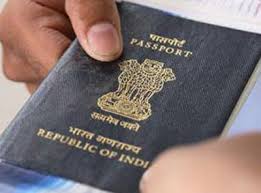
Impounding a Passport under the Passports Act

0

In this blog post, Vivek Chattopadhyay,  a final year law student of School of Law, KIIT University, describes the process of impounding a passport under the Passports Act, 1967. 

IMG_20160728_011147


Introduction

The Passports Act was enacted to regulate the free movement of citizens departing out of this country. Under Article 21 of the Constitution, though the right to free movement is a given fundamental right, but restricting it is considered a gross violation of Article 14 of the Constitution. The Passports Act was created to regulate this as a means of positive reinforcement by not letting those who may hamper the sovereignty and integrity of the country.


Impounding Of Passports

In India, passports are issued by the Passport Seva Kendra which is the online portal of the Passport Office where after filling up all the relevant details; the user is then directed to his nearest Regional Passport Office to complete the rest of the formalities. But, enough of how to create your passport, this piece pertains to Impounding of passports in general which are provided for under Section 10 (3) of the Passports Act, 1967[1] which reads:

10(3) The passport authority may impound or cause to be impounded or revoke a passport or travel document,—

(a) If the passport authority is satisfied that the holder of the passport or travel document is in wrongful possession thereof;images

(b) If the passport or travel document was obtained by the suppression of material information or on the basis of wrong information provided by the holder of the passport or travel document or any other person on his behalf:  [Provided that if the holder of such passport obtains another passport, the passport authority shall also impound or cause to be impounded or revoke such other passport.]. [Provided that if the holder of such passport obtains another passport, the passport authority shall also impound or cause to be impounded or revoke such other passport.]”

(c) If the passport authority deems it necessary so to do in the interests of the sovereignty and integrity of India, the security of India, friendly relations of India with any foreign country, or in the interests of the general public;

(d) If the holder of the passport or travel document has, at any time after the issue of the passport or travel document, been convicted by a court in India for any offence involving moral turpitude and sentenced in respect thereof to imprisonment for not less than two years;

(e) If proceedings in respect of an offence alleged to have been committed by the holder of the passport or travel document are pending before a criminal court in India;

(f)If any of the conditions of the passport or travel document has been contravened;

(g) If the holder of the passport or travel document has failed to comply with a notice under sub-section (1) requiring him to deliver up the same;

(h) If it is brought to the notice of the passport authority that a warrant or summons for the appearance, or a warrant for the arrest, of the holder of the passport or travel document, has been issued by a court under any law for the time being in force or if an order prohibiting the departure from India of the holder of the passport or other travel document has been made by any such court and the passport authority is satisfied that a warrant or summons has been so issued, or an order has been so made.

In very rudimentary terms, Section 10 (3) talks about conditions during which a passport may be impounded, like under Sub-section (a) under wrongful possession; (b) when it is obtained through fraud or misrepresentation; (c) if the Passport Office deems it necessary, for preserving friendly relations with other nation states; (d) when a holder of a passport has been convicted of a crime carrying imprisonment over 2 years; (e) when there is an ongoing criminal proceedings against the holder of that passport; (f) if any conditions of issue of passport has been contravened; (g) failure of complying against noticed served under sub-section (1); (h) when it is brought to the notice of the Passport office that a warrant for arrest or an issue of summons has been made against the holder of such passport.


How To Get A Passport Impounded

  • Step 01: Find the correct sub-section under which your reason for getting someone’s passport falls under and prepare a written complaint on the basis of that. (For the sake of simplicity, one may refer to the rudimentary version mentioned above for ease of understanding of the legal language so involved).images (2)
  • Step 02: Compose a written complaint to the Passport Officer commonly called the Passport issuing authority of your Regional Passport Office describing to him the facts and circumstances under which your matter lies and why under which sub-section of Section 10 (3) do you want to get the passport of such person impounded.
  • Step 03: Submit the application to your regional passport office. Once done, within a span of 15 days, the Regional Passport Office will summon both the accused (the person whose passport you want to get impounded) and the complainant (you, in this case) to provide statements as to why the person concerned should or should not get his passport impounded. Once the statements have been recorded, the Passport Officer then decides the matter by either impounding or not impounding the concerned passport.
  • Step 04 (Optional): If the complainant is not satisfied with the outcome of the process or if the accused wants to appeal, he may do so by appealing before the Chief Passport Officer for final disposal of the matter.


[divider]

Reference:

[1] The Indian Passports Act, 1967, §10(3), https://indiankanoon.org/doc/83644/ (Last accessed on 27-08-2016)

Download Now

Legal Sources of Cost Auditing in India

0

In this blog post, Afzal Sorathiya, a student pursuing a Diploma in Entrepreneurship Administration and Business Laws by NUJS, analyses the legal sources of cost auditing in India. 

 download (3)

What is Cost Auditing?

The concept of cost audit has been explained by ICWA Institute as ‘an audit of efficiency of minute details of expenditure, while the work is in progress and not a post-mortem examination, cost audit is mainly a preventive measure, a guide for management policy and decision in addition to being a barometer of performance’.

Cost Audit can be called efficiency audit. It is evidenced by amendment in section 209, which reads. ‘The object of the amendment of the section is to ensure specified company proper records relating to utilization of material labor available which would make efficiency (cost) audit possible’.


What is its Relevance?

The Cost Accounting Record Rules (CARR) and Cost Accounting Report Rules (CART) were introduced in the 1970s and 1980s to reduce the misuse of national resources.

In the recent past, India has experienced reduced public interest because of weak corporate governance thus affecting the trust and confidence of the retail and institutional investors and stakeholders.download (1)

Regulatory mechanism in India is being strengthened for each sector and availability of standardized cost data is a pre-requisite for effective functioning of any regulator. More than 80% of international trade disputes today are caused on account of transfer pricing which is based on the cost data to determine the arm’s length price. Thus standardizing and assessing the competitiveness for various industries needs cost data.

Information of cost data is critical in many ways other than transfer pricing like predatory pricing, fixation of margin for the purpose of applying anti-dumping duty, free trade agreement, protection of consumer, sick companies revival and corporate governance.

Cost Audit gives an assurance that the company’s cost accounting records are so maintained that it gives a true and fair picture of the cost of the product/activity.


Advantages of Cost Audit

  1. A close check is maintained on all wastage, material in stores, etc., and the same are located and reported.
  2. Production Inefficiency will be identified and converted into monetary terms thus leading to optimum utilization of resources.images (3)
  3. Correct responsibilities of individuals are fixed and management by exception is made possible.
  4. Budgetary control system and standard costing will be facilitated with Cost Audit by a qualified cost accountant.
  5. Records will be up-to-date and information made easily available for various purposes.
  6. Cost Audit can bring to surface number of frauds and errors, which may not be surfaced otherwise. This is attributed to minute examination of records and comparison with standards.
  7. Cost Audit offers various advantages to share holders, management, consumers and the government.


Appointing Authorities of Cost Audit

A cost auditor may be appointed by:

  1. Internal authorities, i.e., the management of the company.
  2. External authorities, i.e.,:
    1. The Government.
    2. The Customer.
    3. Trade association or tribunal.

Based on these appointing authorities the corresponding types of Cost Audit are listed below.


Types of Cost Audit

The main types of Cost audit are the following:

  • Cost Audit as an Aid to Management and Directors: This purpose is to ensure that all information that is presented before the management is reliable, relevant, and prompt so that proper action can be taken of the same. It should also be ensured that no information is suppressed.
  • Cost Audit on Behalf of a Customer: It is a very old practice to place orders/contracts on Cost + basis, in such cases, the customer decides the final price that needs to be paid after adding profit margin to the cost. In such cases Cost Audit is carried out for the concerned product thus helping in arriving at the cost and then the final price.
  • Cost Audit on Behalf of Government: The Government is requested for financial help and protection in lot of cases. In such cases, before concluding anything, the Government may choose to get the Audit done by a Cost Accountant thus ensuring that the decision to be taken would be genuine.download
  • Cost Audit under Statute: The 1965 Amendment Act has introduced new section 233B in 1956 Companies Act, after which the Central Government can order certain classes of companies to get the accounts audited by a cost accountant who is a member of the ICWAI (Institute of Cost and Works Accounts of India) now known as ICMAI (Institute of Cost and Management Accountants of India). These companies are required to necessarily maintain proper records with respect to the material consumed, labor utilized and all other expenses as defined under Section 209 (or may be amended to date). The aim of this particular type of cost audit may be that the Government wishes to know, as a control instrument, the costs of various goods/services and the expenditure involved. The power to prescribe, the fixed forms in which reports of cost audit are to be made rests with the Government.
  • Cost Audit on Behalf of the Trade Association: Trade Associations need to maintain pricing of goods and services at a certain level. For the said purpose, the costing information submitted to the association has to be cross checked. The trade associations have full authority to have the production capacity and the comparison of the efficiency of productive processes.


What is the Qualification of Cost Auditors?

As per the Rule 2 Clause C of the 2014 Cost Records and Audit Rules, a Cost Auditor means a Cost Accountant in practice as defined in Clause B who is appointed by the Board.

Cost Accountant in practice means that the person should hold a valid certificate of practice as defined under the section 6 sub-section 1 of that Act and who is deemed to be in practice under section 2 sub-section 2 and includes a firm or LLP of Cost Accountants.

Thus, only a Cost Accountant as defined under section 2 sub-section: 28 of the 2013 Companies Act with valid certificate to practice is qualified to get appointed as a Cost Auditor.


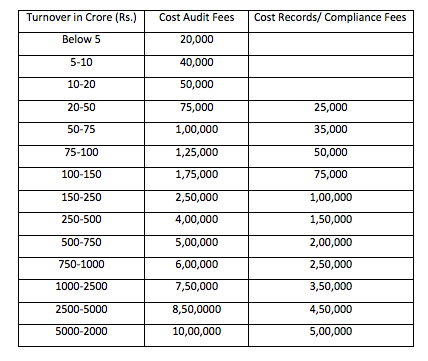
Costs for Cost Auditing:

As defined and decided by the ICMAI Institute the minimum fees for Cost Audit is summarized in the table below:Screen Shot 2016-08-27 at 10.25.08 pm


Applicability of Cost Audit

Rules 1-6 are defined for determining the applicability of Cost Audit as per the Cost Records and Audit Rules 2014, but describing each rule in detail in this article of 1500 words is not possible hence only a brief is mentioned below:

Regulated sectors and Non-Regulated sectors are the categories and a general threshold of turnover of INR 35 Crore or more has been prescribed for companies covered. Micro or Small enterprise as per the 2006 MSMED Act has been taken out of the purview.

For Regulated sectors like Telecommunication, Electricity, Gas and Petroleums, Pharma and Drugs, Sugar and Fertilizers, Cost audit requirement has been made subject to a turnover based threshold of INR 50 Crore for all product and services and at INR 25 Crore for individual product and services. For Non-regulated sector the threshold is INR 100 Crore and INR 35 Crore respectively for all products and services and individual product and services.

What are the consequences of not doing it?

If a company fails to maintain Cost Records, the company shall be punishable with fine ranging from INR 25,000 to INR 5 Lac. Also the officer of the company who is in default is subject to one-year imprisonment or fine ranging from INR 10,000 to INR 1 Lac or both. Hence, it is the duty of the compliance officer to ensure that all the legal compliances with respect to the cost record and cost audit being complied with.


Procedure for Cost Auditing

With respect to the 2013 Companies Act, images (2)the Ministry of Corporate Affairs notified 2014 Companies (Cost Records and Audit) Rules on 30th Jun 2014, which was amended, vide 2014 Companies (Cost Records and Audit) Amendment Rules on 31st Dec 2014. The mechanism with respect to maintenance of cost records, cost audit and appointment of cost auditors has been changed and shall be in accordance with 2014 Companies (Cost Records and Audit) Rules as amended.

The applicability of maintenance of Cost Records and Cost Audit shall be for those sectors which are mentioned in the Tables ‘A’ and ‘B’ * to the 2014 Companies (Cost Records and Audit) Amendment Rules dated 31stDec 2014 notified by the Government vide GSR-1/2015(E) dated 1st Jan 2015.


* Note: The tables cannot be incorporated in this article because of limitation of number of words in the article.

Download Now

How to E-Verify Income Tax Returns

0

In this blog post, Aditi Sampat, Advocate at Nabco Enterprises Pvt Ltd and a student of the Diploma in Entrepreneurship Administration and Business Laws by NUJS, provides details on the e-verification process of income tax returns. 

aditi-1


Heads of Income under Income Tax Act

As per Section 14 of the Income Tax Act, all income shall, for the purposes of charge of income-tax and computation of total income, be classified under the following heads of income:images

  • S – 17 – Salary – Income, under this head, can be taxed only when there exists an employer – employee relationship between the payer and payee.
  • S – 22 – Income from house property–Income earned from house property whether residential or commercial is subject to tax under the existing Tax Laws.
  • S – 28 – Profits and gains of business or profession –Business or Professional Income earned in a year is subject to Income Tax under this head.
  • S – 45 – Capital gains –Profit earned from the transfer of a Capital Asset is chargeable to Tax under this head.
  • S – 56 – Income from other sources – Income not falling under the above four heads is taxed under the Income Tax Act under this head.


Filing of Returns under Income Tax Act

Filing of Income Tax Return is mandatory since Return is a conclusive proof of Income earned in a Financial Year. Section 139 of the Income Tax Act mentions the due dates for filing the Income Tax Return for various types of assesses:

  • 30th September of the Assessment Year in case of:
    • Companies
    • Audit Requirement under Income Tax Act or any other Law.
    • A working partner of a firm whose accounts require to be audited.
  • 31st July of the Assessment Year for all others that is, salaried employees, consultants or self-employed professionals who do not require an audit of their books of account.images (2)

As per Section 139(1), every person has to furnish a return of his income on or before the due date, if his total income exceeds the basic exemption limit before the due date. As far as companies and firms are concerned, the return of income or loss should be filed for every previous year on or before the due date in the prescribed form.

Failure to file returns by the due date attracts penalty in the form of interest @ 1% per month on the balance tax payable from the due date to the actual date of filing.

A person who is required to file returns under Section 139(1) of the Income Tax Act, fails to file returns before the end of the relevant Assessment Year, a penalty of Rs. 5000/- shall be levied on the assesse.


 How to E-Verify of Income Tax Returns

The Income Tax filing process is not complete unless the Returns are verified. The Income Tax Department has simplified the process of verification by introducing several means to e-verify the Income Tax Returns. The Return can be e-verified by generating an EVC or Electronic Verification Code, a post which, ITR V would not be required to be sent by Speed Post to the Income Tax Department.

The Electronic Verification Code is a ten-digit alphanumeric code which is unique to a Permanent Account Number of a Tax Payer.download

The EVC can be obtained in the following ways:

  • EVC through Internet banking – The Bank through which the assesse generates the EVC should be authorised by the Income Tax Department. In addition to this, the Tax Payer’s PAN should be KYC Compliant. Through Internet Banking, the Tax payer can request access to Income Tax Department’s website – incometaxindiaefiling.gov.in, and subsequently be able to generate an EVC which will be displayed on the screen and also is sent to the Tax Payer’s registered mobile number. Post which, the Tax Payer can e-verify the Income Tax return with the EVC generated.
  • EVC through Aadhaar One Time Password – Verification of the Income Tax return can be done by linking the Aadhaar Card to the PAN Card on the Income Tax Department’s website – www.incometaxindiaefiling.gov.in. Post authenticating the Aadhar and linking it to the PAN Card, a One Time Password will be sent to the tax payer’s registered mobile number. The One Time Password which is valid only for ten minutes can be used to verify Income Tax Return.
  • EVC through ATM – It is required that Banks should be registered with the income tax department for providing the service of generating EVC through ATM. EVC through the ATM can be generated by logging into the bank account through the ATM and selecting option ‘Generate EVC for income tax return filing’. The bank’s systems will request the income tax department’s website to send the EVC to the taxpayer’s registered mobile number which can then be utilised for verifying the Income tax return.images
  • EVC though the Income Tax Department website (www.incomeindiaefiling.gov.in) – In cases where the tax payer’s gross total income after deductions is Rs 5 lakhs, or less and also no refund is due to the tax payer, EVC can be generated from the Income tax department’s filing website. The EVC, in this case, shall be sent to the registered email id and mobile number of the taxpayer.
  • Physical ITR-V – if any of the above methods fails, then the Income Tax Return can be verified by taking a printed copy and sending it by Speed Post. The Taxpayer ought to sign the same and send it within 120 days of e-filing the Return.


[divider]

References:

  1. Income Tax Act 1961 – Bare Act.
  2. http://www.moneycontrol.com/news/tax/here-is-how-you-e-verify-your-income-tax-return_2070021.html
  3. http://www.moneycontrol.com/master_your_money/tax/article.php?autono=736313
  4. https://incometaxindiaefiling.gov.in/eFiling/Portal/StaticPDF/e-Verification_User_Manual.pdf
  5. http://incometaxmanagement.com/Pages/Tax-Management-Procedure/4-2-Time-Limit-For-Filling-Return-Of-Income.html
Download Now

Return of Income and Different Modes of Filing Return of Income

1

In this blog post, Shuaib Ahmed Saifi, a student studying at Dr. Ram Manohar Lohiya National Law University, Lucknow and pursuing a Diploma in Entrepreneurship Administration and Business Laws by NUJS, describes the process of filing for the return of income. 


What is the return of income?

In Indian law the tax liability is twofold, one, the payment of the income tax on the total income and second, disclosing the details of income through various sources, the taxable and non-taxable income and giving details about the total tax. The second liability is called the return of income. Thus, the taxpayer’s responsibility is not only limited to the payment of tax but also disclosing to the Government the details of the income.download

The return of income can simply be seen as a balance sheet of the income and the tax that is due on such income. The details of one’s income from various sources, tax liability thereon, the details of tax paid and any refunds that have to be given by the government is simply the return of income. Section 139 of the Income Tax Act, 1961 deals with the return of income. According to this section every person whose income has exceeded the non-taxable income limit is liable to file a return of income before a specified date in a specified manner, the details of which are given in the Act. The filing of return is proof that one has an income for which the tax had been paid. The income tax return is a standard proof of income, and it establishes a record with the tax department.


Who should file an Income Tax Return?

Any individual who has a taxable income is bound by law to file a tax return. imagesTax return has to be filed irrespective of the fact that one has paid the tax. If the employer deducts tax and submits it even, in that case, one has to file the tax return. As mentioned earlier that the tax liability is twofold. Currently, income above Rs.2 Lacks is taxable.

It is not that people with lower incomes cannot file a tax return. Anyone who has any income, even within the exemption limit, can file an income tax return. Although such a person is not legally bound to do it and no penalty would be faced by such person who otherwise would be faced by persons with income above exemption limit.


Why should one file a return of income?

The return of income is to be filed as a legal liability. The income tax mandates persons who have income above the exemption limit to file a return of income u/s 139 of the Act. The persons who do not file a return of income can face prosecution, scrutiny, penalties and interests.images (2)

However, there are other benefits also. Firstly, the filing of returns helps in adjusting the accounts with the Government. If there is any extra tax paid then, it can be refunded by the Government only after the filing of the return. If any loss is accrued in a year, then the filing of return helps in reducing the tax which the IT department otherwise would charge based on the information submitted in previous. Thus, it becomes necessary for a business person to file returns regularly in case the revenues are not steady.

Another important benefit of filing returns is that it serves as a proof of income. The return of income is a recognized proof of income and is used by almost every authority that needs to verify the income of a person. This proof, in turn, helps in various ways, which are:

  1. Loans- Bank grants loans only after a proper scrutiny of the income of the person. The bank wants to be sure of the sources of income as they want to be assured that the loan will be repaid. Thus, without a return of income file, it is difficult to get loans.
  2. Insurance/Accidental claims- The courts take into consideration the income of the person while awarding claims. In such cases, the courts consider the return of income as the proof of income and award the claims accordingly.
  3. Obtaining Visa, Government tenders, jobs, startup funding, etc., require the proof of income which the return of income is.


What are the different modes of filing return of income?

There are many modes to file a return of income. The mode depends on upon the need of the person filing. If the return of income is relatively simple, i.e., the person has only one or two sources of income then the person can file the return himself without any aid of professionals like Chartered Accountant or Tax Advocate. Depending upon the feasibility, the person can file the return on the online platform or can use the traditional paper method. In the following paragraphs, the different modes are discussed separately.

There are three options that a person has while filing for returns, these are:

  1. Self-Filing: One can file the returns directly. There are two ways of doing it, online or physically/paper based. However, the offline submission can only be made if the income is less than Rs. 5 lacs and there is no refund claimed. Also, there should not be any income located abroad to file returns offline. The relevant forms can be filled up and can be submitted to the Income Tax office of relevant jurisdiction. Upon submission, a duly stamped and numbered acknowledgment slip should be collected by the person filing the return. In the case of online submissions, one can do it in two ways, partially online and completely online. This will be discussed in detail later. This method of filing return is apt for people who have simple, one or two, sources of income and who do not require any professional consultation.
  1. Tax Return Preparers: The tax return preparers are appointed under a scheme by the Government. People who find it difficult to understand the nuances of the documents/papers/forms the tax return preparers are appointed to help such people. A tax return preparer can be located in any area using the website www.trpscheme.com. After submitting the relevant information on this website a tax return preparer can be found. The tax return preparers charge fees for filing the returns. While filing the return through a tax return preparer, one should check the details of the return preparers as the identification number, name and counter signature on the form.
  2. Chartered Accountant: In simple cases where the income sources are simple and limited to one or two the need for a CA does not arise. However, in complicated cases where there are tax audits, multiple sources, deductions, etc. are involved consulting a Chartered Accountant becomes a necessary. The CA charges fees for this work. Checking the credentials of the CA is suggested.

Returns can also be filed through two platforms. There are two platforms that can be used the online and offline platforms. Although some smart phone apps have also come up for filing the returns, there have very limited usage and are thus not of major importance. The filing of the return on the official website is the widely used and most apt way to file the return.

Filing return online can be done in two ways; one is completely online and the other partially. In the completely online method, the person has to log into the website with a user ID and password after creating an ID. After logging in the user has to select the required form and fill up the details on the site and submit. This will complete the filing of return.download

In the partially online method, the person has to download the relevant ITR form. Then the form has to be filled up, and a file has to be generated. Then the person has to log into the website and upload the filled up form and submit it.

The offline method is the traditional method of filing a return. The relevant form has to be filled up by hand; all the documents are to be attached, and the form is then to be submitted to the office of the IT department physically. This method is time and effort demanding. It is totally upon the preferences of the person to decide the mode of filing the return.

Thus, the filing of return of income is a legal duty, and the person needs to file it before the expiry of the period. The filing of return also has other benefits as has been mentioned above. The filing process has been simplified over the years. The online submission of the ITR also helps in reducing the usage of paper and promotes e-governance.

Download Now

Triggering Of Open Offer Beyond The Threshold Limit Under SEBI (SAST) Regulations

1

In this blog post, Suraj Pattanaik, a student pursuing a Diploma in Entrepreneurship Administration and Business Laws by NUJS, analyses the concept of open offer beyond the threshold limit under SEBI (SAST) Regulations. 


Introduction

The takeover of companies is an incredibly popular and a well-established strategy for corporate growth. ‘Takeover’ generally refers to the acquisition of one company by another company. In order to promote fairness in the securities market and also to protect the interest of small investors, SEBI, the market regulator has framed Regulations, providing for the acquisition of shares and takeover of listed companies known as ‘Takeover Code.’download

For the past few years, the M&A deals in India have been governed by the age-old takeover rules. In the meanwhile, a lot has changed in the corporate world. It seems that the SEBI realized that these rules need to be revamped to keep them in line with the ever-changing global scenario.

Takeover Regulations Advisory Committee (‘TRAC’) was constituted in September 2009 under the chairmanship of Mr. C. Achyutan to review the SEBI (Substantial Acquisition of Shares and Takeovers) Regulations, 1997 (‘Current Regulations’).

TRAC submitted its report consisting of its recommendations and draft of Proposed Takeover Regulations to SEBI in July 2010. At the Meeting of SEBI held on July 28, 2011, SEBI had accepted most of the recommendations of TRAC.

SEBI (SAST) Regulations, 2011 is the most significant law which regulates M&A’s deals involving Indian Listed Companies. It endeavors to protect the interest of the investors of a listed company and make sure that an exit opportunity is given to the public shareholders at a highest possible price where there is a substantial acquisition of shares or voting rights or control over a listed company, consolidation of holdings by existing shareholders.[1]

The new Takeover Regulations sought to ensure better that the acquisition markets operate in a fair, equitable and transparent manner.


Key Terms under the SEBI (SAST) Regulations, 2011

  • Acquisition– Reg. 2 (1) (a)-It means, directly or indirectly, acquiring or agreeing to acquire shares or voting rights in, or control over, a target company.
  • Shares– Reg. 2 (1) (v)- Shares means shares in the equity share capital of a target company carrying voting rights, and includes any security which entitles the holder thereof to exercise voting rights;

Explanation.—For the purpose of this clause shares will include all depository receipt carrying an entitlement to exercise voting rights in the target company.images

  • Persons Acting in Concert (PAC)– Reg. 2 (1) (q)-persons who, with a common objective or purpose of acquisition of shares or voting rights in, or exercising control over a target company, pursuant to an agreement or understanding, formal or informal, directly or indirectly co-operate for acquisition of shares or voting rights in, or exercise of control over the target company.

There are certain other categories of people who are presumed to be PAC unless proved otherwise. It is a well settled legal principle that the question of whether or not two persons are PACs is a question of fact, to be answered after evaluating the facts and circumstances of each case.[2]

  • Control– Reg. 2 (1) (e)- It includes the right to appoint majority of the Directors or to control the management or policy decisions exercisable by a person or persons acting individually or in concert, directly or indirectly, including by virtue of their shareholding or management rights or shareholders agreements or voting agreements or in any other manner.
  • Promoter– Reg. 2 (1) (s)- It has the same meaning as in the Securities and Exchange Board of India (Issue of Capital and Disclosure Requirements)Regulations, 2009 and includes a member of the promoter group.
https://lawsikho.com/course/diploma-companies-act-corporate-governance
Click Above

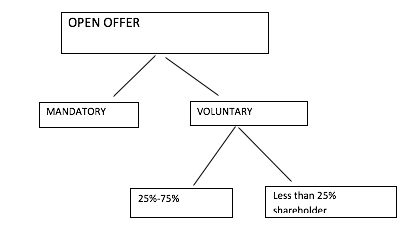
Open Offer Triggers

Across the globe, the jurisprudence of Takeover Regulations revolves around offering an exit opportunity to the public / minority shareholders of a company in the event of any substantial change in shareholding or change in control of the company. It is only fair and equitable that the public stakeholders who have invested in the company, relying on the management or the promoters of the company are given an opportunity to withdraw their investments when there is a change in the management or promoter shareholding.[3]

Screen Shot 2016-08-27 at 3.04.13 pm


I) Regulation 3 of SEBI (SAST) Regulations, 2011

It contains provisions regarding the substantial acquisition of shares or voting rights of the Target Company. It provides specific limits beyond which the acquirer(s) is required to come out with an open offer in accordance with the Regulations.

Major thresholds limit as per SEBI (SAST) Regulations, 2011-

  • 0%- 25%
  • 25%-75%
  • 75% and above

Initial Threshold Limit: Regulation 3(1) provides that when an acquirer together with PACs intends to acquire shares or voting rights which along with the existing shareholding would entitle him to exercise 25% or more of the voting rights in the target company, in such a case the acquirer is required to make public announcement to acquire at least additional 26% of the voting rights of Target Company from the shareholders through an open offer.images

(The 1st trigger point is during the acquisition of 25% or more shares of the target company by the acquirer company.)

Creeping Acquisition Limit: Regulation 3(2) allows the persons either by themselves or through PAC with them who are holding more than 25% but less than 75% shares or voting rights in the Target Company to acquire further up to 5% shares or voting rights in the financial year ending 31st March. The allowable acquisition of 5% is popularly known as ‘Creeping Acquisition.’

(The 2nd trigger point is if the acquirer tries to acquire more than 5% of shares in a financial year after the satisfaction of 1st trigger point.)


II) Offer Size

Mandatory Open Offer: In the mandatory open offer, the acquirer has to give an open offer to the shareholders for acquisition of at least 26% of the total shares of the Target Company.

Voluntary Open Offer: It means Open Offer given by the acquirer voluntarily without triggering the mandatory Open Offer obligations.

Regulation 6 of SEBI (SAST) Regulations, 2011 deals with Voluntary Open Offer and provides the eligibility, conditions, and restrictions.download

Eligibility for making Voluntary Open Offer:

  • Acquirer along with PACs should be holding at least 25% or more shares in the Target Company prior to making Voluntary Open Offer.
  • The Acquirer or PACs have not acquired any shares of the Target Company in the preceding 52 weeks without attracting the Open Offer obligation.

Conditions for making Voluntary Open Offer:

  • The aggregate shareholding after completion of the Voluntary Open Offer should not exceed beyond the maximum permissible non-public shareholding.
  • No acquisition during the offer period except under the Voluntary Open Offer.

Restrictions:

The acquirer becomes ineligible to acquire further shares for a period of six months after the completion of Open Offer except by way of:

  • Another Voluntary Open Offer;
  • Acquisitions by making a competing offer.


LawSikho has created a telegram group for exchanging legal knowledge, referrals and various opportunities. You can click on this link and join:  

https://t.me/joinchat/J_0YrBa4IBSHdpuTfQO_sA

Follow us on Instagram and subscribe to our YouTube channel for more amazing legal content 


References:

[1] http://www.mondaq.com/india/x/204822/Shareholders/Exit+Opportunity+Under+SEBI+SAST+Regulations+2011  (Last visited: 28/04/16)

[2]Hitachi Home and Life Solutions Inc v. SEBI (SAT Order dated July 6, 2005).

[3] http://www.nishithdesai.com/fileadmin/user_upload/pdfs/Ma%20Lab/Takeover%20Code%20Dissected.pdf  (Last visited: 28/04/16)

[4] http://www.mondaq.com/india/x/204822/Shareholders/Exit+Opportunity+Under+SEBI+SAST+Regulations+2011 (Last visited: 29/04/16)

Download Now
logo
FREE & ONLINE 3-Day Bootcamp (LIVE only) on

How Can Experienced Professionals Become Independent Directors

calender
28th, 29th Mar, 2026, 2 - 5pm (IST) &
30th Mar, 2026, 7 - 10pm (IST).
Bootcamp starting in
Days
HRS
MIN
SEC
Abhyuday AgarwalCOO & CO-Founder, LawSikho

Register now

Abhyuday AgarwalCOO & CO-Founder, LawSikho