Download Now
Home Blog Page 1692

Binding Action Of A No-Action Letter Or An Interpretive Letter Issued By SEBI On The Board

0

In this blog post, Rakshit Joshi, a student pursuing a Diploma in Entrepreneurship Administration and Business Laws by NUJS, analyses whether a no-action letter or an interpretive letter issued by SEBI under the Informal Guidance Scheme is binding on the Board or not. 


Introduction

Section 11 of the Securities and Exchange Board of India Act, 1992 obliges the Board to protect the interests of investors in securities and to promote the development of, and to regulate the securities market, by such measures as it thinks fit. downloadIn pursuance of this vide discretionary power it issued Securities and Exchange Board of India (Informal Guidance) Scheme, 2003 with the stated aim of “better regulation of and orderly development of the securities market”.

The scheme allows any market intermediary registered with the board or a listed company also a mutual fund company to obtain ‘informal guidance’ from the board in the form of two documents. One, a No-action letter in which a department of SEBI answers whether it would recommend any transaction under any rule of law in force. Second, is in the form of an interpretive letter in which the Department provides an interpretation of any law or rule in the context of a proposed transaction. Any person may apply to the concerned department of SEBI with fees of Rs 25, 000 describing the request disclosing all material facts and applicable legal provisions.

The Debate

The “informal” nature of the scheme has been a cause of considerable ire of the parties as at times SEBI has taken opposite view to the rationale provided by the department under the scheme. Any document furnished by a department of SEBI tends to bind all the market participants. But the Board discharges any liability citing Section 13 of the said guidelines which clearly states that any letter issued by a department shall not be construed as a conclusive decision or determination on any question of law or fact. Neither is the order appealable under Section 15T of the Act.images

This apparent conflict has led to demands of revamping the whole process. It is also in contrast to section 245 (S) (2) of the Income Tax Act, by which any advance ruling given by the authority shall be binding unless there is a change of law or facts. SEBI, on the other hand, is quasi-legislative. Quasi- executive and quasi-judicial combined into one body. This is against the principle of separation of power which is leading to this conflict.

The scheme of informal guidance is helpful provided it is made more reliant and authentic. SEBI can do it in any of the two ways:

Either constitutes a permanent body of external and internal experts chaired by a retired judge of Supreme Court or High Court who may give clearance to any informal guidance by SEBI. The second option is to abridge SEBI of its quasi-judicial power altogether. It can be a sole regulator and facilitator of Securities Market like RBI is for Banking. Special commercial courts can perform the judicial authority at the district level and High court benches under the Commercial courts bill 2015 which is already pending in the Rajya Sabha.


 [divider]

Bibliography

  • http://www.sebi.gov.in/guide/informal.html
  • http://indiacorplaw.blogspot.com/2014/11/sebi-informal-guidance-scope-of.html
  • https://corporatelaws.taxmann.com/informal-guidelines.aspx
  • http://papers.ssrn.com/sol3/papers.cfm?abstract_id=1351132
  • http://www.thehindubusinessline.com/2003/11/11/stories/2003111100090900.htm
  • http://archive.financialexpress.com/news/sebis-formal-scheme-for-informal-guidance/87694
Download Now

What Are The Documents To Be Submitted To The AD Bank At The Time Of Closure Of The Liaison/ Branch Office?

0

In this blog post, Varun Sen, a student pursuing a Diploma in Entrepreneurship Administration and Business Laws by NUJS, lists the documents that have to be submitted by a foreign entity to the AD Bank at the closure of a Liasion or Branch Office. 


Documents to be Submitted by a Foreign Entity

As per the Master Circular No.7/2014-15[1] of the Reserve Bank of India, the documents that have to be submitted to the Authorized Dealer Bank at the time of closure of a Liaison or Branch Office by a foreign entity include the following:

  1. A copy of the RBI’s permission/approval from the concerned sectoral regulator(s) for establishing the concerned Liaison /Branch Office.
  2. An Auditor’s certificate, which indicates the:
    1. The manner in which the remittable amount has been arrived at.
    2. Statement of assets and liabilities of the applicant
    3. Manner of Disposal of Assetsdownload (3)
    4. Confirmation that all liabilities in India (including arrears of gratuity and other benefits to employees, etc.) of the Office have been either fully met or adequately taken care for.
    5. Confirmation that no income was accruing from sources outside India (including proceeds of exports) has remained unrepatriated to India.
  3. A No-objection / Tax Clearance Certificate from the Income-Tax authority for the remittance(s).
  4. A Confirmation from the applicant/parent company that no pending legal proceedings in any Court persist and no legal impediments to the remittance(s) exist.
  5. A report from the Registrar of Companies indicating all compliance with the provisions of the Companies Act, 1956 that pertain to winding up of the Office in India.
  6. Any other document/s as specified by the Reserve Bank while granting approval. The designated AD Category – I banks have to ensure that the concerned Offices had filed their respective Annual Activity Certificates with the Reserve Bank for the previous years, in respect of the existing Branch/Liaison Offices. Obtaining confirmation regarding the same requires approaching the Central Office of the RBI (in cases involving Branch Offices) or the Regional Office concerned (in cases involving the Liason Offices) as the case may be.

The above documents may be retained by the AD Bank for the verification conducted by their internal auditors or by inspecting officers of the RBI.download (1)

The designated AD bank has to report the closure of the concerned Office to the RBI upon receipt and scrutiny of the above, indicating the same to the RBI via a declaration. In cases where the documents are not in order or those where delegated powers do not cover the concerned issue, the AD bank may forward the application to the RBI with their comments for necessary action. Upon doing so, the AD bank may permit the concerned remittances subject to the directions issued by the RBI and payment of applicable taxes in India, if any.

Thus, we see that the documents that are to be submitted upon closure, are efforts by the RBI to ensure that foreign entities do not attempt to leave the country by denying Indian creditors, or legal beneficiaries their rightful amounts, or try to evade tax for the same. This is an important aspect of corporate governance, as it imposes strict due diligence requirements for the purposes of preventing fraudulent or dishonest financial transactions that could take place through a Branch or Liaison Office.


[divider]

Reference:

[1]Master Circular on Establishment of Liaison / Branch /Project Offices in India by Foreign Entities (No.7/2014-15), Reserve Bank of India, (July 01, 2014).

Download Now

Are Donations Received In Kind Considered As Foreign Contribution?

0

In this blog post, Yamini Sharma, a student pursuing a Diploma in Entrepreneurship Administration and Business Laws by NUJS, critically analyses whether donations received in kind are considered as foreign contributions. 


Foreign Contributions

The flow of foreign contribution to India is regulated by the Foreign Contribution (Regulation) Act, 2010 (“FCRA”), the Foreign Contribution (Regulation) Rules, 2011 (“FCRR”) and other notification and orders, etc., issued by the Government from time to time. The Parliament enacted FCRA in order to consolidate the law regulating the acceptance and utilization of foreign contribution or foreign hospitality by certain individuals or associations or companies and to prohibit the acceptance and utilization of foreign contribution or foreign hospitality for any activities detrimental to national interest and for matters connected therewith or incidental thereto. It was enacted with the primary purpose of regulating the inflow of foreign contributions and ensuring that the received foreign contributions are not utilized for purposes other than those specified in the legislation.

downloadForeign Contribution[1] has been defined as the donation, delivery or transfer made by any foreign source:

  1. Of any article, not being an article given to a person as a gift for his personal use, if the market value, in India, of such article, on the date of such gift is not more than such sum as may be specified from time to time by the Central Government by rules made by it in this behalf. (this amount has been specified as INR 25,000/- currently);
  2. Of any currency, whether Indian or foreign;
  3. Of any security, as defined in clause (h) of section 2 of the Securities Contracts(Regulation) Act, 1956 and includes any foreign security as defined in clause (o) of Section 2 of the Foreign Exchange Management Act, 1999.

A donation, delivery or transfer or any article, currency or foreign security by any person who has received it from any foreign source, either directly or through one or more persons, shall also be deemed to be foreign contribution with the meaning of the definition of Foreign Contribution.

The interest accrued on the Foreign Contribution deposited in any bank referred to in sub-section (1) of Section 17 of FCRA or any other income derived from the Foreign Contribution or interest thereon shall also be deemed to be Foreign Contribution within the definition of Foreign Contribution.download (2)

Further, any amount received, by a person from any foreign source in India, by way of fee (including fees charged by an educational institution in India from foreign student) or towards cost in lieu of goods or services rendered by such person in the ordinary course of his business, trade or commerce whether within India or outside India or any contribution received from an agent or a foreign source towards such fee or cost shall be excluded from the definition of foreign contribution.

The earlier definition of Foreign Contribution only included donation, delivery or transfer made by any foreign source. The scope of the definition was later expanded so as to include contribution(s) made by an organization out of Foreign Contribution received by it.

Money received on account of fees or payment towards cost in return for goods/services carried out in the ordinary course of business will not be considered as Foreign Contribution. Thus, donation received in kind by an organization which works with a cultural, social, religious, educational or economic objective, is considered as Foreign Contribution and an organization receiving such Foreign Contribution is required to follow the procedures as prescribed in FCRA and FCRR. Every organization which is registered or given prior permission to received Foreign Contribution is required to utilize such contribution only for the purposes for which it is received, and it shall not defray as far as possible such sum, not exceeding fifty percent of such contribution received in a financial year to meet its administrative expenses. However, it may be defrayed only with the prior approval of the Central Government.

An organization can receive Foreign Contribution only when it functions with a cultural, social, religious, educational or economic objective. For instance, an organization may receive Foreign Contribution for the welfare or rehabilitation of widows, orphans, beggars, child laborers, etc., environmental programs, construction of hospitals, clinics, place of worship, etc.

However, FCRA specifically provides that no Foreign Contribution can be received or accepted by:

  1. A candidate for election;download (1)
  2. A correspondent, columnist, cartoonist, editor, owner, printer or publisher of a registered newspaper;
  3. A Judge, Government servant or employee of any corporation or any other body controlled on owned by the Government;
  4. A member of legislature;
  5. A political party or office bearer thereof;
  6. An organization of a political nature as may be specified in subsection (l) of Section 5 of FCRA by the Central Government;
  7. An association or company engaged in the production or broadcast of audio news, audio visual news or current affairs programmes through any electronic mode.

Furthermore, FCRA does not allow any person either resident in India or citizen of India resident outside, to accept any Foreign Contribution or acquire or agree to acquire any Foreign Contribution on behalf of any political party.


Registration and Prior Permission Process

In order to be eligible to receive Foreign Contributions, an organization may either seek prior approval each time the organization is to receive contributions, or it may obtain a one-time long-term registration. FCRR provides for a detailed (i) Registration process; and (ii) Application process for prior permission.

Registration process:

For the grant of registration under FCRA, the organization should:

  1. Be registered under an existing statute like the Societies Registration Act, 1860 or the Indian Trusts Act, 1882 or Now Section 8 of Companies Act, 2013, etc.;
  2. Normally be in existence for at least three years and has undertaken reasonable activity in its chosen field for the benefit of the society for which the foreign contribution is proposed to be utilized. For this purpose, the Association should have spent at least INR 10, 00,000/- over the last three years on its aims and objects, excluding administrative expenditure. Statements of Income & Expenditure, duly audited by Chartered Accountant, for last three years are to be submitted to substantiate that it meets the financial parameter.download (3)

The organization must procure a certificate of Registration from the Central Government. An application for registration must be made online in this regard in ‘Form FC – 3’, along with the requisite documents and fees of INR 2000/-. The hard copy of the online application then must be submitted to the Central Government, within 30 (thirty) days of the submission of online application.

A Registration Certificate is valid for a period of 5 (five) years from the date of its issuance. An application for renewal of the Registration Certificate can also be made in ‘Form FC – 5’, 6 (six) months prior to the expiry of the Registration Certificate.

Application process for prior permission:

An organization not having a Registration Certificate is required to take prior approval before accepting Foreign Contributions. The application has to be made online in ‘Form FC – 4’, along with the requisite documents and fees of INR 1000/-. The hard copy of the online application then must be submitted to the Central Government, within 30 (thirty) days of the submission of online application.job-application

An organization receiving Foreign Contributions is required to file annual returns online for each financial year. An organization permitted to accept Foreign Contribution, is required under law to maintain a separate set of accounts and records exclusively for the Foreign Contribution received and submitted an annual return, duly certified by a Chartered Accountant, giving details of the receipt and purpose-wise utilization of the Foreign Contribution. The return is to be submitted online, in prescribed ‘Form FC –4,’ duly accompanied with the balance sheet and statement of receipt and payment, which is certified by a Chartered Accountant.

Submissions of a ‘NIL’ return, in case there is no receipt or utilization of Foreign Contribution(s) during the calendar year, is mandatory. However, in such a case, a certificate from Chartered Accountant and audited statement of accounts is not required to be submitted.

Failure of an organization in filing annual returns can lead to Cancellation of registration of the organization or imposition of a penalty for late submission of return. In 2015, the Government of India had suspended the NGO ‘Greenpeace India’s’ license for 6 (six) months and barred it from receiving foreign funds. Greenpeace India violated FCRA by merging its foreign donations with domestic contributions. It had opened five accounts to utilize foreign donations without informing the relevant authorities. The organization had also faced a host of other penalties for which it has approached the court in the past.[2]


[divider]

References:

  1. Foreign Contribution (Regulation) Act, 2010
  2. Foreign Contribution (Regulation) Rules, 2011
  3. https://fcraonline.nic.in/home/index.aspx

[1] Section 2(1)(h) of FCRA

[2] http://www.thehindu.com/news/cities/Delhi/greenpeace-violated-foreign-contribution-act-centre-tells-hc/article7249618.ece

Download Now

Tax Provisions Applicable To Earnings From Foreign Clients In Lieu Of Goods Sold Or Services Rendered – An Overview

0

In this blog post, Yashika Joshi, a student pursuing a Diploma in Entrepreneurship Administration and Business Laws by NUJS, analyses tax provisions applicable to earnings from foreign clients in lieu of goods sold or services rendered.


The exports are considered an important part of the transactions taking place in the economy due to the foreign exchange that they generate.


Export Of Goods

The law relating to levy of tax on export of goods is stated under the Section 5(3) of Central Sales Tax Act, 1956. It is clearly stated in the laws that direct exports do not attract any sales tax. However, when the goods are sold to an exporter who in turn exports the goods to foreign buyers and the said sale could not qualify as export prior to 1976, then the said sales to an exporter were held liable to attract sales tax by the Supreme Court in the case of Mod Sirajuddin v. State of Orissa [36 STS 139(SC)].download (1)

However, in order to encourage exports, the sales or purchase prior to actual export of goods are also exempted from sales tax and taken as part of the exports. According to the section stated above. The last sale or purchase of any goods preceding the sale or purchase occasioning the export of those good out of the territory of India shall also be deemed to be in the course of such export, if such last sale or purchase took place after, and was for the purpose of complying with, the agreement or order for or in relation to such export. According to Section 5(3), the following three conditions have to be fulfilled in order to take benefit under the Act:

  1. The transaction of last sale or purchase takes place after the agreement or order received by the exporter from his foreign buyer.
  2. The last purchase must have taken place after the agreement with the foreign buyer was entered into, and
  3. The transaction of such last sale or purchase was entered into for the purpose of complying with the agreement or order received by the exporter from his foreign buyer. In other words, the transaction between the exporter and his foreign buyer must be entered into first and therefore the exporter should enter into the transaction with the seller or purchaser, as the case may be, with a view of to the fulfilling his commitment with the foreign buyer.
  4. The transaction to be covered by Form H – issued by the buyer to the seller.


Export Of Services

The taxable services which are exported are exempt from tax. As per rule 6A of Service Tax Rules (Export of Services), 1994, any service provided or agreed to be provided is considered as export of service if the following conditions are fulfilled:

  • Taxable Territory: The provider should be located in the taxable territory. Here, taxable territory means any place in India except Jammu & Kashmir where the law is not applicable.images
  • Location of Recipient: The recipient who receives the service should be located in any place outside India.
  • Negative List of Services: The provided service should not come under the negative list of services as per section 66D of Service Tax Act. No service tax is levied on the services listed in the negative list.
  • Place of Provision: Place of provision of service should be outside India. Place of the provision is determined according to Place of Provision of Service Rules, 2012. In other words, place of provision is the location of the recipient of service.
  • Payment of Service: The payment received by the service provider should be in foreign exchange or in foreign currency which is convertible into another currency.
  • Branch or Agency: If the service receiver is a branch or agency of the person providing the service then such service provided shall not come under the ambit of export of service. For example, if Ram is the service provider located in India and he is providing services to its branch office in New York, then such serviced shall not come under the export of service.


Rebate/Refund or Service Tax

Service tax paid on export of services or input services used for such export services shall be refunded according to the conditions and limitations specified in the Notification No. 39/2012 – Service Tax dated 20th June 2012.

Conditions and limitations necessary are as follows:

  1. Service should be export of service as per rule 6A of Service Tax Rules, 1994.
  2. Duty on input must have been paid for which the rebate is claimed.download (2)
  3. Service tax and cess must have been paid for the input of services, for which the rebate if claimed, to the service provider.
  4. If the service receiver is responsible for paying service tax as per reverse charge mechanism, then he should have paid the service tax to the government.
  5. The total amount of service tax, duty and cess admissible should not be less than Rs. 1000/-.
  6. No CENVAT credit has been availed on input services for which the rebate is claimed.

Procedure to Claim Rebate:

  1. The service provider of export service should file a declaration with the jurisdictional Assistant or Deputy Commissioner of Central Excise before the date of export of service.
  2. The declaration should contain the details of the service to be exported, description, quantity, value, the rate of duty and the amount of service tax and cess payable on input services to be used for providing the service to be exported.
  3. The commissioner shall verify the correctness of the declaration, and if satisfied he will accept the declaration.
  4. The exporter can obtain inputs from a registered factory or registered dealer, accompanied by invoices issued under the Central Excise Rules, 2006 for the purpose of CENVAT Credit Rules, 2004.images (2)
  5. The exporter can receive the input services along with the invoice issued under the provisions of Service Tax Rules, 1994.
  6. After the export of service, the exporter shall file for claim of rebate with the commissioner.
  7. The application for the claim should be accompanied by the invoices issued for the inputs and input services.
  8. Submit the documentary evidence of receipt of payment against the service exported.
  9. Submit a declaration that the service is exported as per the rules 6A.
  10. After receiving the claim application, the commissioner after verification, if satisfied, shall sanction rebate in whole or in part.


Exemption of Services for Exporter of Goods

The taxable services mentioned below as received and used by an exporter for export of goods are exempted from service tax as per the Notification No. 31/2012 – Service Tax dated 20th June 2012. The exporter need not pay any service tax on these services.

downloadServices provided by Goods Transport Agency (GTA) by way of transport of the goods, meant for export, in a goods carriage:

  • From any freight container station or inland container depot to the port or airport from where the goods are exported.
  • Or directly from their place of removal to an inland container depot, freight container station, port or airport from where the goods are exported.

For this exemption, the exporter should produce the consignment note issued in his name by the GTA. Hence, we can say that export of goods and services are exempt from any tax, and if any tax is paid then the exporter can claim refund or rebate for the same as per the provisions set out by law.


[divider]

References:

  • http://www.forum.charteredclub.com/threads/service-tax-on-export-of-services.1080/


Download Now

What Should You Keep In Mind If You Invest In A Friend’s Business

2

In this blog oust, Hitender Sharma, who is the member of the Bar of the District Court Mandi Town, Himachal Pradesh and is currently pursuing a  Diploma in Entrepreneurship Administration and Business Laws from NUJS, Kolkata, discusses the points that one should keep in mind before investing in a friend’s business.

2255

The following points should be kept in mind while investing in a friend’s business:

It is important to know as to what is the business

What type of business my friend is doing?

Is he in the manufacturing sector?

Is he in trading business?

Is he in import & export business?

Is he involved in service sector?.

Or any other?

There are different compliance for different sectors. The manufacturing goods will attract excise duty. If the sale of manufactured products is made within the State itself, it will attract VAT, while CST is payable if products manufactured are sold outside the state. Service sector business will attract Service Tax. In the case of Import and Export business, he is required to comply with various provisions of Foreign Trade (Development & Regulation) Act, 1992 and Foreign Trade policy announced every 5 years.

An investor must know about the regulatory requirements of the business to assess the capabilities of the business organization and to comply with it before making an investment in the business. This will ensure the future safety of his investment.

money-invest (1)

It is important to know what legal structure has been adopted for carrying on business

Before committing funds for investment, it is also important to know the type of legal structure adopted to carry on business. Which of the following structure has been adopted:

  1. Sole-Proprietorship
  2. Partnership
  3. Limited liability partnerships
  4. Company under the Companies Act, 2013

The sole-proprietorship model is adopted in small business requiring small capital and has a small market. So it will not be advisable to invest in such business where the sole proprietor is responsible for all activities and controls. The profitability of the business will depend on his capabilities and is a risky investment area. Returns from the business are also small. However, if one still wants to invest in the sole-proprietorship business, the loan may be given to the proprietor at interest against first charge on some tangible security. In the case of a start-up, a written agreement to secure investment is advisable.

In the case of Partnership or Limited Liability Partnership concerns, investment can be made by joining the concern as a partner in case the investor is prepared to bear the risk of unlimited liability. In that case, one should insist on a written partnership deed duly registered with the registrar of firm clearly spelling out the profit ratios, responsibilities of each partner, etc.

In case you only want to invest in Partnership or LLP’s, then give loans secured against the guarantee of business as well as personal guarantees of all the partners. Partnerships concerns/LLP’s like sole proprietorship concerns are not run on professional basis as they are small businesses with small capital. In the event of business failure, all the partners will be personally liable to repay the loan.

If the business is such that it requires sufficient capital, huge funds/loans domestic or foreign, and professionally run management to control the business, the investment would be advisable only if the legal structure adopted is that of a company incorporated under the Companies Act, 2013. The company can be Private Ltd. or Public Ltd. Depending on the need and the size of the business.

If it is an existing business, it is important to check their financial statements profit & loss accounts, balance sheets, statement of retained earnings, Auditors reports and notes on the accounts. This statement will reveal the state of health of the business concerned with regard to any adverse feature, debts repayments positions, guarantees, etc. Analysis of these statements will help in making an investment decision.

From investor’s point of view, It will be advisable to insist on contract with indemnity clause for safeguarding investment in the equity of the company.


Download Now

Process Of Raising Funds Through Non-Convertible Debentures

3

In this blog post, Ranjan S, a contracts engineer with ‘Amec Foster Wheeler’ Group, Chennai, who is currently pursuing a Diploma in Entrepreneurship Administration and Business Laws from NUJS, Kolkata, writes about the process of raising funds through non-convertible debentures.

1470643993081

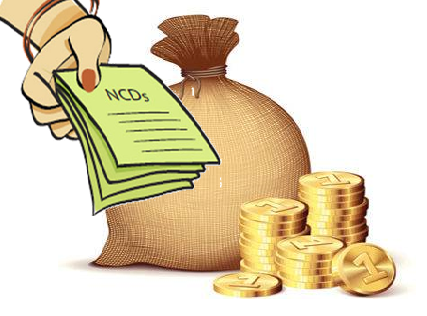
Non-convertible debentures (NCD) is a kind of debt instrument issued by a corporate or company with original maturity up to one year and issued by way of private placement.

The following is the process for NCD Issuance

ncd

  • Call and hold Board meeting to decide which type of the debenture will be issued.
  • In the case of issuing secure NCD, the company should check the conditions set out in the Rules 18 of the Companies Rules, 2014 and comply with the eligibility, rating requirement, maturity, limits and the amount of NCD, as per the directions or guidelines of Reserve Bank of India.
  • Further, appoint a Debenture Trustee (DT) for each issuance of the NCDs.
  • On the appointment of DT consent, shall be obtained from a SEBI registered Debenture Trustee. A Debenture Trust Deed in Form No. SH–12 or as near thereto as possible shall be executed by the Company for Debenture Trustees within sixty days of allotment of Debentures.
  • In Board Meeting. pass Resolutions for i) Approval of Offer letter for private placement in Form No. PAS–4 and Application Forms ii) Approval of Form No. PAS–5 (iii) Approval of Debenture Trustee Agreement and appointment of a Debenture Trustee (iv) Appointment of an expert for valuation v) Approval of increase of borrowing powers, if required; vi) To authorize for creation of charge on the assets of the company; vii) Approve the Debenture Subscription Agreement; viii) To fix day, date and time for the extraordinary general meeting of shareholders.
  • The draft of i) Debenture Subscription Agreement; ii) Offer Letter for private placement in Form No. PAS–4 and Application Forms; iii) Records of a private placement offer in Form No. PAS–5; iv) Debenture Trustee Agreement; v) Mortgage Agreement for the creation of charge on assets of the company, shall be prepared.
  • Notices of extraordinary general meeting with the statement of explanatory shall be issued.
  • Hold an extraordinary general meeting and pass a special resolution to authorize the Board to create a charge on the assets of the company.
  • File Form No. PAS–4 and PAS 5 in Form No. GNL-2, Offer Letter in Form No. MGT–14, Board resolutions, Special Resolution, Debenture Subscription Agreement, Debenture Trustee Agreement, in Form No. MGT–14 with the Registrar of Companies.
  • File Form No. PAS–3 (Return of allotment) with the Registrar of Companies after making allotment of debentures and File Form No CHG–9 for the creation of charge on assets of the Company.
https://lawsikho.com/course/diploma-entrepreneurship-administration-business-laws
click above

Compliance procedure for the corporate

Compliance

  •  Disclose the potential investors and financial position as per the standard market practices.
  • The auditors of the corporate shall endorse its eligibility conditions to their investors.
  • The requirements of all the provisions of the Companies Act, 1956 and the Securities and Exchange Board of India Regulations, 2008, or any other law that may be applicable, shall be complied with by the corporate.
  • The Debenture Certificate shall be issued within the period prescribed in the Companies Act, 1956 or any other law as in force at the time of issuance.
  • Issuers of NCDs of maturity up to one year shall follow the Disclosure Document brought out by the Fixed Income Money Market and Derivatives Association of India (FIMMDA), in consultation with the Reserve Bank of India.


LawSikho has created a telegram group for exchanging legal knowledge, referrals and various opportunities. You can click on this link and join:  

https://t.me/joinchat/J_0YrBa4IBSHdpuTfQO_sA

Follow us on Instagram and subscribe to our YouTube channel for more amazing legal content 


Download Now

Export From India To Pakistan Or Bangladesh By River

1

In this blog post, Surbhi Agarwal, a student of UPES, Dehradun, who is currently pursuing a Diploma in Entrepreneurship Administration and Business Laws from NUJS, Kolkata, deliberates on whther products can be exported from India to Bangladesh or Pakistan by river. 

surbhi

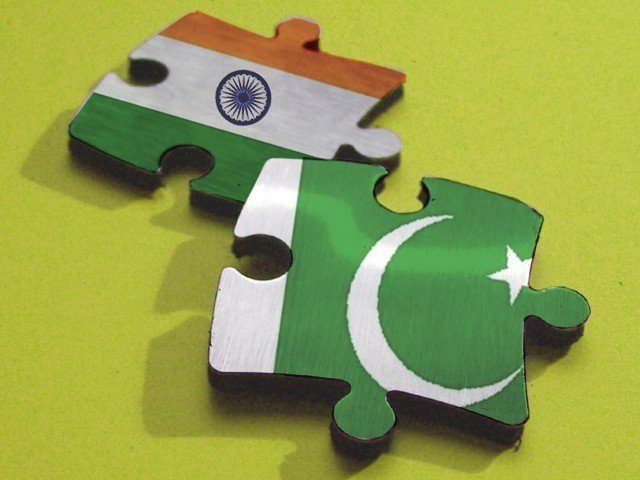
To increase the economic growth of the country, exports have been given priority and therefore, India enjoys lots of incentives due to the process of export and import. The major problem lies in the process of realizing them, as exporters have to approach multiple organizations for seeking sanction and each organization prescribes its own exclusive method of documentation as well as procedure from the stage of the claim till sanction.  During the time of export, exporters are required to pay adequate care and attention.  It is essential for the exporters to plan carefully in respect of incentives, even at the time of shipment, though their benefits are available only after completion of the shipment. India exports all the goods produced all over the country through the mode of sea, rail, road and air, except for a list of items that India has banned from being exported to all the countries. In this article, I will be limiting my discussion only to Pakistan and Bangladesh.

548768-indiapakistan-1368474879-358-640x480

Pakistan

India and Pakistan have maintained their economic relationship for a very long time, the occasional hostility between both the countries have not affected the trade relationship. India allows all the products to be exported to Pakistan, except for a list of items that India has banned from being exported to all the countries. There are seven ports in Gujarat from where trade takes place in Pakistan, which include Kandla, Sikka, Mundra, Pipavav, Dehej, Porbandar, Bedi and Okha. There are four modes through which India can export goods to Pakistan i.e., sea, rail, road and air. However, the relative importance of these modes changes over time. In 1995-96, rail was the most predominant mode for exporting goods to Pakistan, trade by rail accounted for 63 percent and trade by sea accounted for 33 percent of the total trade between India and Pakistan, but the trade between the countries changed substantially due to the opening of the road route and the liberalization of sea trade. The share of trade by rail fell to 15 percent, while that by sea increased to 60 percent. In 2006-07, the share of exports by sea was 87%, rail accounted for 8%, air route accounted for 3% and only 2.3 was exported by road. The cost of exporting goods through the rail is much higher than that of the sea so the rail route’s relative importance over the sea and road route has declined as it continues to be limited in its reach. There are some products which cannot be exported through the rail or road route and such products are exported with the help of the sea.

Problems faced in exporting products

74_big

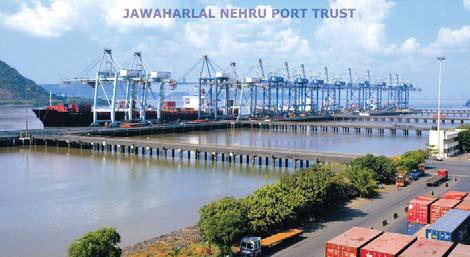
In Pakistan, sea transport is considered to be the most developed mode of transporting goods from India and maximum reforms have taken place at sea ports. However, there continue to be a number of inefficiencies in using the sea route for trade between India and Pakistan. Jawaharlal Nehru Port (JNP) is the largest container port in India as far as trade with Pakistan is concerned. The existing infrastructure at JNPT is not sufficient to cope up with expanding trade. Traders are of the view that there is a huge potential of trade between India and Pakistan, but the infrastructure needs to be upgraded. There are no direct shipping routes to Pakistan from key ports like Chennai, Calcutta and Cochin. Ships are routed through the heavily congested port of Sri Lanka. This adds up to 15 days to the transport time, whereas direct vessel can reach in four days.

A major problem faced by the traders on both sides is that some Indian banks do not recognize letters of credits from Pakistani banks, and vice-versa. There is a growing distrust on Pakistani L/Cs amongst the traders. The reason for distrust is the fact that some of the banks in Pakistan issue L/Cs without a proper scrutiny of importers, due to this even Indian bank do not recognize Pakistani L/C.

The movement of goods between India and Pakistan by sea is governed by the Protocol on Resumption of Shipping Services between India and Pakistan, 1975. The protocol has helped in enhancing trade between the two countries and given strength to the trade ties. The Shipping Protocol signed between the two countries was extremely restrictive because of clause 3 and 5 of the Protocol. The shipping protocol stipulates that neither country can lift third country liner cargo originating from the ports of either country and destined for ports in third countries and vice versa. That is, Indian ships are not allowed to carry cargo from Pakistan to any country other than India, nor can Pakistani ships carry cargo from Indian ports to any third country. This protocol has worked to the detriment of shipping concerns on both sides of the border.

Therefore, the sea route has always been operational; it went unnoticed due to the restrictive maritime protocol. This protocol allowed only Indian and Pakistani flagships to carry cargo between India and Pakistan. This arrangement restricted competition from foreign vessels, and therefore, resulted in high sea freight rates being charged by Indian and Pakistani vessels. The amendment of this protocol in 2005 brought sea trade between the two countries under global maritime arrangements, leading to greater competition, and therefore, to a considerable reduction in costs for sea-based trade between Mumbai and Karachi.

Bangladesh

BD-India-flag

India and Bangladesh have long shares common objectives for closer economic integration within the South Asia region and Trade between the two countries has grown rapidly since the early 1990s. A bilateral Free Trade Agreement (FTA) provides substantial benefits to Bangladesh consumers by giving them access to cheaper exports from India. Indian trade with Bangladesh has risen to $4.5 billion from $3.3 billion since last year. Trade between India and Bangladesh also take place through all the modes i.e., sea, rail, road and air. India exports all the goods to Bangladesh accept those goods which India has prohibited in all the countries. But the trade between India and Bangladesh is mostly carried out via land routes as it is the most convenient and cheapest mode. Big rivers like the Ganges and Brahmaputra flow across between these two countries, but they are used for transportation by Border States in limited ways, while the rest use the more conventional sea route to reach Chittagong sea port which is in Bangladesh. Air and sea routes were opened immediately after independence by Bangladesh. Air cargo between the two countries is used in the limited sense, as far as the sea route is concerned, its potential has not been explored much. Export between Indian and Bangladesh through the sea route is done only for the limited products.

Conclusion

Economic relations of India with almost all the countries have shown a great improvement within a few years. Trade relation with other countries are not only limited through rail or road, but through various modes, it is being exported. Pakistan receives products from India through all the routes, depending upon the product which is sent and to the Bangladesh, mostly land or rail route is preferred but now, as the relation between both the countries have become strong, India tends to export products from other modes also, like though sea route. It was not explored much, but it is in the ongoing process.

Download Now

Top 5 Transfer Pricing Rulings Of 2015 – 2016

0

In this blogpost, Sayan Mukherjee, a student of University of Calcutta, who is currently pursuing a Diploma in Entrepreneurship Administration and Business Laws from NUJS, Kolkata, writes about the top 5 Transfer Pricing rulings of 2015-2016.

sayan

Introduction

Development of multinational trade and commerce has triggered the growth of Transfer Pricing in India. The concept of Transfer Pricing, although being at the growing stage, yet its early reference is immemorial. Before going into the rulings under Transfer Pricing provisions, we need to understand the various insights of the concept.

Insights into Transfer Pricing rulings

Transfer Pricing

Basically, the word Transfer Pricing (TP) may be interpreted as the method of ascertaining the price of goods and services transacted between controlled or related legal entities within a company. It relates to the price at which the subsidiaries of a business sell to each other.

The related legal entities referred to in this context are termed as Associated Enterprises (AEs) defined u/s 92A of the Income Tax Act, 1961. It means direct/indirect participation in the management, control or capital of an enterprise by another enterprise.

The supposed price which is to be used in this regard is called Arm’s Length Price. According to Section 92F(ii) of the Income Tax Act, 1961- “arm’s length price means a price which is applied or proposed to be applied in a transaction between persons other than associated enterprises, in uncontrolled conditions.” The methods prescribed u/s 92C for determination of the arm’s length price required in every transaction between AE are mentioned below:

  1. Comparable uncontrolled price (CUP) method
  2. Resale price method (RPM)
  3. Cost plus method (CPM)
  4. Profit split method (PSM)
  5. Transactional net margin method (TNMM)
  6. Other method (applicable from FY 2011-12 onwards)

From the above definitions, we find that the concept is logical and simple. Multinational Corporations (MNCs) and big concerns tend to manipulate their profit margins intentionally as per the varying tax rates in different countries. They reduce their profits in countries where tax rates are high and vice versa. This global level manipulation for better net earnings is of great concern for the tax authorities as the governmental revenues tend to reduce in such scenarios. Keeping this in mind, the Ministry of Finance – Central Board of Direct Tax (CBDT) develops several weapons from time to time so that the manipulation can be curtailed and tax is properly ascertained on transactions between units of associated enterprises. These are called Transfer Pricing Rulings. The CBDT has also set up a Transfer Pricing Cell for conducting transfer pricing audits. The guidelines have been enclosed in the following legal vehicles:

  • The Income Tax Act, 1961, sections 92 to 92F;
  • Rules 10A to 10G of the Income Tax Rules, 1962;
  • Circular No. 12 of August 23, 2001;
  • Circular No. 14 of December 24, 2001;
  • Circular No. 06/2013 dated June 29, 2013;
  • Administrative Guidelines of May 20, 2003.

The Union Budget every year introduces certain changes in the TP provisions with the aim to align the Indian TP regime with the global standards.


The countdown

The most significant 5 transfer pricing rulings applicable in Indian context in the FY 2015-16 may be counted down as below:


Five

Taxpayers are required to maintain on an annual basis, detailed documentation relating to international transactions undertaken with AEs or specified domestic transactions (vide Rule 10D of the Income Tax Rules 1962). Mainly, there are two parts of such requirements-

Firstly, the mandatory documents that a taxpayer must maintain includes the ownership structure of the taxpayer, group profile, business overview and AEs, prescribed international transactions or specified domestic transaction details and financial forecasts. It further demands documentation of extensive TP study.

The second part of the Rules needs adequate documentation which substantiates the information documented in the first part. It also contains a recommended list of supporting documents including government publication, reports, studies, etc.

International transaction below INR 10 million and specified domestic transaction below 50 million (revised vide Finance Act 2015) are relieved from such requirements. Companies to which TP regulations are applicable are required to file their documents and tax returns on or before 30 November. Such documents must be maintained for a period of 9 years from the end of the relevant tax year.


Four

In respect of all international transactions or specified domestic transactions, it is mandatory for all taxpayers to obtain an independent accountant’s report. This must be furnished on or before 30 November. The form (Form no. 3 CEB) of the report was revised with effect from FY 2012-13 and includes new matters like corporate guarantees, issue of shares, deemed international transactions, etc. The report requires the accountant to give an opinion on documentation compliance by the taxpayer. Moreover, it certifies the correctness of an extensive list of prescribed information.

Three

The CBDT was empowered to formulate the safe harbour rules with a view to reduce the quantity of TP audits and lengthy disputes regarding comparability analysis under TP. The rules governing safe harbour point out the circumstances in which the authorities would accept the arm’s length price as declared by the taxpayer, without detailed analysis, if certain criteria are satisfied. The ‘eligible assesse’ along with different thresholds has been defined for transactions like – knowledge process outsourcing services, software development services, contract manufacturing of core and non-core auto components and transactions, etc. Moreover, the CBDT also notified that the rule would apply in the case of government electricity companies for specified domestic transactions, the most significant aspect being its publication in recent times which is expected to lift its low rate of response.

Two

A remarkable step in TP rulings taken by Indian government is regarding thin capitalisation. In the corporate world, a company is said to be thinly capitalised when it has more debt than equity. There were no rules that specifically set permissible debt-to-equity ratios in any TP code. But, the Indian government intends to introduce within 2 years, the General Anti-Avoidance Rules (GAAR) which incorporates the concept of thin capitalisation.

The proposed regulation does not include any capital gearing ratio unlike typical thin capitalisation regulations. Instead, it re-characterises debt as equity and vice versa where the arrangement among parties is:

  1. Not at arm’s length,
  2. Has less commercial substance,
  3. Means adopted which are not ordinarily for bona fide purposes.

The lack of capital gearing ratio allows discretion of the revenues while it ascertains whether a given capital structure is an impermissible avoidance arrangement.

One

Advance Pricing Agreements (APAs) have to be ranked at the top of all transfer pricing rulings in 2015-16. Right from its introduction in 1st July 2012 by the Indian authorities, APA has had an overwhelming response. Approximately, 550 unilateral applications have been filed in the past three years. As of 31 March 2015, the taxpayers and the government have signed 8 unilateral APAs and 1 bilateral APA while several more upcoming signings on its verge.

It is to be noted that APA rules don’t prescribe any threshold for application. Again, this mechanism is unavailable for specified domestic transaction.  APA shall be compulsorily binding on the taxpayers and its validity shall not exceed 5 consecutive years. Based on the value of international transaction, APA fee ranges between INR1 million to 2 million. The four phases of APA as per global standards are listed below:

  1. Pre-filing phase: Deals with pre-filing consultation meeting and involves no payment of fees.
  2. Formal submission phase: Application for APA stating the critical assumptions is made in required format. Filing fees are payable at this phase.
  3. Negotiation phase: Draft report prepared & provided to the competent authorities.
  4. Finalisation phase: Comments on draft APA, finalisation and effect giving to APA terms are dealt with in this phase.

As a part of APA, the taxpayer needs to prepare an annual compliance report (ACR) for every year. The ACR is to be furnished by 30 days of Income Tax Return filing, or within 90 days of APA (once entered into), whichever is later.

TransferPricing

Conclusion

India has thus witnessed some interesting transfer pricing developments in the FY 2015-16. Significantly, India has concluded its first bilateral APA with the Japanese within a record period of one and a half years. The rollback provision introduced in APAs has been a welcome step towards reduction of litigation. Another major controversy regarding ‘Issue of Shares’ (whether an international transaction was covered under Indian transfer pricing rulings) was finally settled. The government decided to accept the Mumbai HC decision in favour of the taxpayers. Again, the introduction of the use of multiple-year data and the range concept (in line with global leading practices) increased the scope of transfer pricing in India. The government also announced a risk-based approach, negating the transaction-value-based methodology, for selecting the relevant cases for audit.

Hence, it will be interesting to see how the legislation acts to modify the Indian transfer pricing regulations as committed under the G20 Summit in line with the Base Erosion and Profit Shifting (BEPS) initiatives.

Download Now

Essential Features of GST

2
offline gst app

This article is written by Rini Mathew, from School of Law, SASTRA University, and Prachi Bhatia, from ILS Law College, Pune. 

Introduction

Goods and Service Tax Bill is the 122nd Constitutional Amendment Bill initiated by the Upper House, Rajya Sabha, is a game changing historical reform in the tax regime of the country. It creates a harmonized system of taxation by subsuming all indirect taxes under one tax which includes Central taxes like Central Excise duty, Additional Excise duty, Service tax, Additional Custom duty, Special additional duty and State level taxes like, VAT or sales tax, Central Sales tax, Entertainment tax, Entry tax, Purchase tax, Luxury tax, etc. This uniform tax regime was introduced earlier in 2000 by Prime Minister Vajpayee, but few hurdles were created by the Indian National Congress backed by the left parties. The rates of GST are decided on the principle of revenue-neutral-states (RNR). This reforms Indian Economy by developing a common Indian market and reducing the cascading effects of tax on the cost of goods and services. This will impact the tax structure, tax computation, tax structure, tax payment, compliance, credit utilization leading to a complete revamp of the current indirect tax system.

Constitutional Scheme of Indirect Tax before GST

Article 265 provides that no tax can be collected or levied except by authority of law.  Article 246 lists down the subject matters on which state and centre can legislate. The list I of the seventh schedule also known as Union List (UL) gives Parliament exclusive power to legislate on the given matters. List II is a State list (SL) giving exclusive powers to state legislatures. List III is a Concurrent List laying down subject matters on which both can legislate. 

Before the advent of GST, the source of revenue for the central government were customs duty (entry 83 of UL), central excise duty (entry 84 of UL), and service tax (entry 97 of UL). Central Sales Tax (CST) was levied by the central government but collected by the government of the state of origin.

State governments filled their pockets from excise duty on alcoholic liquors, opium and narcotics (entry 51 of SL), octroi and entry tax (entry 52 of SL), electricity tax (entry 53 of SL), tax on sale and purchase (entry 54 of SL), taxes on entertainment, luxuries, amusements, betting and gambling (entry 62 of SL). CST was also a major source of revenue.

Constitutional Amendment for GST

Constitution (101ST Amendment) Act, 2016 was passed to give GST constitutional backing.   

Following provisions were introduced through this amendment-

Insertion of Article 246A empowered Parliament and state to make laws relating to respective GST imposed on them. The laws with respect to inter-state supplies were reserved for Parliament. 

Art. 269A provides for the manner of distribution of revenue between the centre and the state collected from inter-state supplies.

Under Art. 279A President is given the power to constitute GST Council, a joint forum of the Center and the States.  It also elaborates on the composition of the council.

Art.366 added important definitions. Clause 12A defines ‘goods and service tax’, clause 26A defines ‘services’, and clause 26B defines ‘state’ with reference to art. 246A, 268, 268A, and 279A.

Why was GST introduced?

The reasons for the implementation of GST are as follows-

Web of taxes- The taxpayer was entangled in the web of various indirect taxes imposed on him. The tax was levied at the center, state and as well as at municipal level. The burden of this three-tier tax structure troubled taxpayers for the longest time.

Double Taxation- A single transaction was exposed to multiple taxes imposed by different authorities. Example: to watch a movie in the theatre, entertainment as well as service tax was payable. Service tax was collected by the central government and entertainment tax by the state.

The complexity of compliances- The process of compliance was cumbersome.  In the previous tax regime, taxpayers had to pay different authorities at different durations. 

A number of taxable events- Tax was levied at different stages. Excise duty was levied by the central government at the manufacturing stage. Entry tax was collected by the State on the entry of goods. State VAT was applicable to the sale of goods within the state. Octroi was then collected by municipal authorities. There was a tax at each stage of goods movement.

Remove the Cascading Effect- Cascading effect is also known as the tax on tax. The tax was charged on cost inclusive of tax. Tax paid as excise wasn’t allowed as a credit to set off against the taxes payable at the state level and vice versa.

Taxes introduced by GST

  1. Central Goods and Services Tax (CGST) 
  2. State Goods and Services Tax (SGST)
  3. Integrated Goods and Services Tax (ITGST)
  4. Union Territory Goods and Services Tax (UTGST)

Taxes Subsumed By GST

7 central taxes and 8 state taxes saw dusk with the dawn of GST. 

Central Taxes

State Taxes

  Central Excise Duty entry 

State VAT

Duties of Excise (medicinal and toilet preparations)

Central Sales Tax 

Purchase Tax

Additional Duties of Excise (Goods of special importance)

Entry Tax

 Luxury Tax

Additional Duties of Excise (Textiles and Textile products)

Entertainment Tax (except those levied by the local bodies)

Additional Duties of Customs (CVD)

Taxes on lotteries, betting and gambling

Special Additional Duty of Customs (SAD)

Taxes on advertisements

Service Tax


Salient features of GST

Equal distribution of powers to Union and State Legislature

Our constitution has provided the autonomy to States to impose taxes to meet their financial needs. Centre cannot amend their power which falls in State List until states want to do so GST provisions have also adhered to the same. Union Government will be vested with the power to make laws in respect of supplies in the course of inter-state trade or commerce. Similarly, State Government shall levy intra-state transactions including services.

Creation of GST Council

Within 60 days after the enactment of the bill, GST Council shall be formed. It shall consist of representatives from Centre as well as State. It will make recommendations to the Union and the States on model Goods and Service Tax laws. The model bill is put in public domain. This facilitates online registration, tax payment and return filing. State will also frame their respective legislations to enable them to implement GST, which will be in line with the Central GST legislation. Administration of GST will be responsibility of the GST Council, which will be the apex policy making body of GST.The GST Council, will consist of the Union Finance Minister, Union Minister of State for Revenue, and state Finance Ministers.

Compensation to States for loss of revenue

Parliament may, by law, on the recommendation of the Goods and Services Tax Council, provide for compensation to the States for loss of revenue arising on account of implementation of the goods and services tax for a period of five years. Parliament may, by law, provide compensation to States for any loss of revenue from the introduction of GST, up to a five year period.

Additional tax

The Centre to impose an additional tax of up to 1% on the inter-state supply of goods for two years or more. This tax will accrue to states from where the supply originates. The additional 1% tax levied on goods that are transported across states dilutes the objective of creating a harmonized national market for goods and services.  Inter-state trade of a good would be more expensive than intra-state trade, with the burden being borne by retail consumers.  Further, cascading of taxes will continue.

Other Features

  • Centre will levy IGST on inter-State supply of goods and services. Import of goods will be subject to basic customs duty and IGST.
  • GST shall be levied on any tax on supply of goods and services but it is silent about alcohol for consumption.
  • Upon notification by the GST Council, Petroleum and petroleum products such as crude, high speed diesel, motor spirit, aviation turbine fuel and natural gas shall be subject to the GST.
  • Removal of imposition of entry tax/ Octroi across India.
  • Taxes levied by State on movies, theatre etc. as Entertainment tax will be subsumed in GST, but levy of the same at panchayat, municipality or district level will continue.
  • Government’s access to substantial incremental revenues by levying GST on the sale of newspapers and advertisements.
  • No amendments were made to stamp duties, imposed on legal agreements by the state.

Comparison of 2014 and 2016 bill

Additional tax up to 1% on inter-State trade

An additional tax of up to 1% on the supply of goods will be levied by Centre in the course of inter-State trade or commerce. The tax will be directly assigned to the States from where the supply originates. This will be for two years or more, as recommended by GST Council, whereas the 2016 proposed amendment has deleted the provision itself.

Compensation to States

Parliament has prescribed a shorter time period for the compensation incurred by the States because of low revenue collected by the new regime.

Dispute resolution

2014 bill was not clear with the nature of the dispute, whereas the 2016 bill establishes a mechanism to adjudicate any dispute arising out of its recommendations.

Disputes can be between:

(a) The Centre vs. one or more States;

(b) The Centre and States vs. one or more States;

(c) State vs. State. This implies there will be a standing mechanism to resolve disputes.

Replacement of the term IGST

Under the 2014 bill, the GST Council had made recommendations on the apportionment of the Integrated Goods and Services Tax (IGST). However, the term IGST was not defined. The 2016 amendments replace this term with ‘goods and services tax levied on supplies in the course of inter-State trade or commerce’.

Inclusion of CGST and IGST in tax devolution to States

The amendments state that the CGST and the Centre’s share of IGST will be distributed between the Centre and States. This is just a restatement of the provisions in the 2014 Bill in clearer terms.

Analysis of laws replaced by GST

  • Central Excise Act, 1944 (CEA) and Central Excise Tariff Act,1985 (CETA)

Excise Duty was an indirect tax payable at the manufacturing stage. It is paid by the manufacturer as soon as the goods are manufactured. Excise duty has been subsumed under GST barring few items such as alcohol and petroleum. The CEA provided definitions related to excise whereas CETA provided for goods on which excise duty was charged and tariffs on them. Additional excise duty is levied on goods of special importance and special excise duty on special goods mentioned in the second schedule to the CETA.

Under GST, excise duty was bid adieu. The tax was levied on the supply of goods or services whether by manufacturer or any other person. CGST has taken place of excise and all the revenue from it goes to the central government. The rate of excise duty was 12.36% varied as per the kind of product whereas rates in GST is 5%, 12%, 18%, and 28% depending on the product. There was no composition scheme and reverse charge mechanism for manufacturers prior to GST. In earlier tax regime credit had to be availed on capital goods within two years but it has been removed in GST. 

  • Customs Act, 1962 and Customs Tariff Act, 1975

Custom Duty was applicable to the goods imported in the country and a few exported goods. It is collected by the central government and regulated by the Central Board of Excise and Customs (CBEC).  GST subsumed countervailing duty (CVD) and Special Additional Duty (SAD). Basic Customs Duty (BCD) was kept within the purview of GST. BCD is applicable to the imported goods under sec 12 of the Customs Act. IGST is levied on a supply made in the course of inter-state trade and commerce. Inter-state trade and commerce include import/export made in India and inter-state supplies. The imported goods are levied IGST along with BCD and other surcharges. BCD varies from 5% to 40%. GST law borrowed the concept of transactional valuation for charging GST. 

  • Service Tax Act, Chapter V of Finance Act, 1994

Service tax was exclusively applicable by the central government on services. Whereas, GST is applicable on both goods and services which is collected by both central as well as state government. The definition of “services” provided in sec 2(102) of CGST Act is wider and includes anything other than goods, money and securities. Service tax was levied on the provision of services while GST is charged on supply of services. 

  • Value Addition Tax, 2005

It was introduced on 1st July 2005 and replaces Sales tax. It was a state-level tax but is still applicable to key products like alcohol for human consumption, petrol and diesel. The VAT rates for goods and services were different in different states. The calculation of tax was done on value addition done in the process of production to consumption. The credit on tax was available under VAT. This was adopted in GST. VAT did bring uniformity in the taxation but still had some deficiencies. The GST took into consideration all the deficiencies like different tax rate, compliances burden, cascading effect etc and provided a better system.

  • Central Sale Tax Act, 1956 (CST)

Central Sale Tax was levied by the central government on inter-state sales. It was collected and retained by the state in which the goods are sold and the movement commences. It was an origin tax and stood in contrast with the VAT which was a destination tax. CST is now replaced with IGST. IGST collected for inter-state supplies by the central government is apportioned between the state and central governments. The revenue is apportioned to the Centre at CGST rate and the remaining amount goes to the consuming state.

Pre GST

Post GST

Central excise

Levied on- manufacturer

Taxable event- as soon as goods are manufactured

Collected by – Central government

(Including state VAT in which it is sold)

CGST

Levied on- manufacturer

Taxable event- when manufactured goods are supplies

Collected by – Central government

(Including GST if intra-state supply) 

Customs Act

Levied on- importer/exporter

Taxable event- when goods are imported in India and some exported goods

Collected by – Central government

IGST and BCD

Levied on- importer

Taxable event- when goods are imported in India

Collected by – Central government

Service Tax Act

Levied on- services

Taxable event- provision of services

Collected by – Central government

CGST, SGST/UTGST or IGST

Levied on- services

Taxable event- supply of services

Collected by – Central and state government( intra-state supply)

Central Government (inter-state supply)

VAT

Levied on- goods and services

Taxable event- purchase and sale of goods and services

Collected by – State government

SGST/UTGST

Levied on- goods and services

Taxable event- supply of goods and services

Collected by – State government/union government

CST

Levied on- inter-state sale

Taxable event- when goods are sold to a different state

Collected by – State government

IGST

Levied on- inter-state supply

Taxable event- when goods or services are supplied to a different state

Collected by – Central government (revenue apportioned with state government)

How GST transformed indirect taxation?

The changes that GST brought in are as follows-

  • Easy Compliance

All GST filings and compliances are computerized. The taxpayer can easily log in to https://www.gst.gov.in/ to pay the dues. It has removed all the unnecessary impediments like filing for different VAT in different states, different date of filing etc.

  • Reduced Taxes

Before GST, there was a long list of taxes that a person had to pay. Post its introduction the list got shorter and with many of the taxes erased, the cost of goods has considerably come down. The benefit of reduced taxes is a welcome change for consumers.

  • Regulation of the unorganized sector

GST introduced the concept of reverse charge mechanism. This puts liability on the registered suppliers to pay GST in case they purchase goods from unregistered suppliers. This has promoted registration of suppliers and regulation of the widespread unorganized sector.

  • Composition Scheme

Previous tax regime lacked the incentive to promote small businessmen. GST introduced a composition scheme in which lower tax was applicable on the turnover. Lower tax boosted the morale of the businessmen and manufacturers.

  • Reduced Corruption

GST is a technologically friendly law. The whole procedure of filing of taxes online introduced much-required transparency in the system. The clog was put on offline transactions which were a gateway for corruption. The unaccounted receipts were tackled by necessitating GST identification number (GSTIN) on receipt.

Exemptions under GST

The Bill excludes alcoholic liquor for human consumption from the purview of GST.  Further, GST will apply to five petroleum products i.e. (a) petroleum crude, (b) high speed diesel, (c) motor spirit (petrol), (d) natural gas, and (e) aviation turbine fuel at a later date, to be decided by the GST Council. Petroleum products are inputs for several other goods and exempting them from the purview of GST could lead to cascading of taxes.  This is because the input tax credit would no longer be available on such products.  This disruption in the tax credit chain would distort the GST structure and could also lead to leakages of revenues.[1] The 13th Finance Commission and the Department of Revenue had recommended that all petroleum products and alcohol be brought under GST.[2] The Commission had suggested that states could impose an additional levy on petroleum products and alcohol, in addition to GST.[3]

Advantages

Three major benefits from the GST. Firstly, it will increase the resources available for poverty alleviation and development. This will be the result as the tax base becomes more buoyant and as the overall resources of the Central and State Governments would increase. There will be a uniform distribution of resources irrespective of the state and its location. Secondly, this would facilitate ‘Make in India’, by making one India. The current tax structure unmakes India by fragmenting markets of the country along borders of states. These economic distortions are caused by the existing hurdles of the tax regime: Central Sales tax on inter-states sale of good, numerous intra-state taxes, giving abundant powers in the hands of the states to impose tax on various services, goods etc. All these hurdles shall be rectified by GST. Thirdly, dual monitoring structure of the GST, one by the States and one by the Centre.

For Central and State Governments

Simple and Easy Administration: GST replaces multiple indirect taxes at the Central and State levels. Backed with a robust end-to-end IT system, GST would be enable simpler and easier administration.

Better tax compliance: GST will result in better tax compliance due to a robust IT infrastructure. There is an in-built mechanism in the design of GST that would incentivize tax compliance by traders due to the seamless transfer of input tax credit from one stage to another in the chain of value addition,

Higher revenue efficiency: Lead to higher revenue efficiency as GST is expected to decrease the cost of collection of tax revenues of the Government, and will therefore

For business and industry

Ease of doing business: In the indirect tax system, taxes were levied at multiple points and locations. The type of tax means higher prices for everyone in the chain. There were also differential state taxes. The GST avoids such anomalies and creates a single market and a single price which makes it easier to do business.

Uniformity of tax rates and structures: The introduction of the concept of one India, one market will decisively alter the economy for the better. GST will ensure that indirect tax rates and structures are common across the country, thereby increasing certainty and ease of doing business. In other words, GST would make doing business in the country tax neutral, irrespective of the choice of place of doing business.

Easy compliance: A robust and ample IT system would be the foundation of the GST regime in India. Therefore, all services such as registrations, returns, payments, etc. would be available to the taxpayers online, which would make compliance easy and transparent.

Removal of cascading: A system of seamless tax-credits throughout the value-chain, and across boundaries of States, would ensure that there is minimal cascading of taxes. This would reduce hidden costs of doing business.

Improved competitiveness: Improves competitiveness for the trade and industry by reducing transaction costs of doing business would eventually lead to an improved competitiveness for the trade and industry.

Gain to manufacturers and exporters: The subsuming of major taxes both in Central and State in GST would reduce the cost of locally manufactured goods and services. This will boost the Indian exports by increasing the competitiveness of Indian goods and services in the international market. The uniformity in tax rates and procedures across the country will also go a long way in reducing the compliance cost.

For the consumer

Single and transparent tax proportionate to the value of goods and services: Under GST, there would be only one tax from the manufacturer to the consumer, leading to transparency of taxes paid to the final consumer.

Relief in overall tax burden: The overall tax burden on most commodities will come down, which will benefit consumers because of efficiency gains and prevention of leakages

Miscellaneous

As a boost of GDP of India: Implementation of laws should be for the public interest and the proposed GST, will enable in gain of additional GSP growth of 1% to 1.5% because balanced growth in production as well as consumption could lead to sustainable growth.Sustainable growth cannot achieved by the country without increasing the consumption power of majority of the population.

Less Corruption: With high transparency in the tax regime and levy of tax will result in less corruption.

Disadvantages

GST fails to deal with tax on alcohol, petrol, petroleum products etc.

Woes of manufacturing states: For States with manufacturing industries, creation of uniform tax regime will mean an outflow of tax revenue along with goods and services produced there. GST provides no incentive for manufacturing States. Initially, the worries of the manufacturing States were not been addressed properly by the Union Government but now the compensation shall be given for the loss of revenue up to 5 years. GST further distorts the basic structures of fiscal federalism.

Conclusion

Sometimes, we are insufficiently appreciative of how much the country has achieved in coming to this point with the GST. As the Prime Minister suggested, credit should go to all stakeholders at the Centre and the States for having worked towards the GST. The time is ripe to collectively seize this historic opportunity; not just because the GST will decisively alter the Indian economy for the better but also because the GST symbolizes Indian politics and democracy at its cooperative, consensual best.

References

[1]Report of the 14th Finance Commission, Chapter 13, „Goods and Services Tax‟, February 24, 2015.

[2] Comments of the Department of Revenue on the First Discussion Paper on GST, January 2010.

[3] Report of the 13th Finance Commission, Chapter 5, „Goods and Services Tax‟, Ministry of Finance, December 2009.

  • GST, concept and status by CBIC
  • Introduction to Indirect Taxation, ICSI
  • Constitution (101 Amendment) Act, 2016
  • https://www.gst.gov.in/

LawSikho has created a telegram group for exchanging legal knowledge, referrals and various opportunities. You can click on this link and join:

Follow us on Instagram and subscribe to our YouTube channel for more amazing legal content.

Download Now

Power Of Tax Authorities To Demand Tax Retrospectively

0

In this blog post, Vikram Chandhuri, a Student of Department of Law, Calcutta University, who is currently pursuing a Diploma in Entrepreneurship Administration and Business Laws from NUJS, Kolkata, discusses the power of tax authorities to look into past transactions and demand tax.

10697244_10204173558992530_8336789223246973127_o

The tax authorities’ power to look into past transactions and demand tax is known as “Retrospective Taxation”.  The word “Retrospective” means something related to the past.  Retrospective Taxation means taxing past transactions with the new laws. With the help of this type of taxation, the government of a country can tax any transaction which was done even before the passing of the new law.

To understand it, let us take one example. If one transaction was taxed at 10% in the year 2010, and the tax rate changes to 13% in 2012, then the Income Tax Authorities can demand that the previous transaction should also be taxed at the rate of 13% by giving themselves the power of ‘Retrospective Taxation’. This allows it to look into previous transactions, and make corrections.

tax--621x414

The power of tax authorities in India

The Government of India introduced the Retrospective Taxation System in 2012 by amending the Income Tax Act, 1961 and announcing that the amendments would be in effect retrospectively from 1st April, 1962. This meant that the Government could now look into previous transactions and demand tax and this decision was based on the Vodafone Tax Case between the Government of India and the British Telecom Major, Vodafone.

Vodafone tax case

Sometimes DTAA (Double Tax Avoidance Agreement) are signed between two countries to attract foreign investments. Now, India had signed a DTAA with Mauritius and according to this agreement, the taxpayer can pay in either of the two countries. Now in the case of Vodafone, there was no capital gains tax in Mauritius and they had easily avoided paying any tax there.

365705413voda

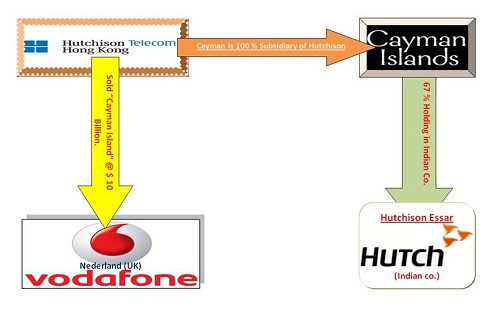
Hutchinson was a Honk-Kong based group which made its Indian investment through a listed company in Hong Kong, which in turn held shares in downstream companies in the Cayman Islands, which in turn held shares in companies based in Mauritius. As earlier stated, there was a DTAA signed between India and Mauritius. Thus, the ownership structure of Hutchinson was extremely complicated.

In 2007, Vodafone acquired 67% of Hutch-Essar, a joint venture between Hutchinson-Essar Group.  The acquisition was made by Vodafone International Holdings of CGP Investments (a company incorporated in Honk Kong but a resident of Cayman Islands for tax purposes) for a sum of Rs 55000 Crores from Hutchinson Telecommunications International Lmt. (HTIL)

It was clear that this type of complex transaction was made to avoid giving taxes to the Government of India. The Income Tax Department of India contested that as Hutch-Essar was an Indian company, the transaction was liable to tax capital gains under Section  9 (1)(i) of the Indian Income Tax Act, 1961. Even though CGP Investments were not a resident of India, the underlying assets were in India and the profit generated from the business was also in India. Therefore, the Income Tax department demanded a sum of Rs 11000 Crore. Vodafone contested this saying they were not liable to pay any tax as they were not residents of India, and saying that the deal was made outside India. After this Vodafone filed a Writ Petition in the High Court of Bombay, but the decision was ruled in favour of the Income Tax Department. Then Vodafone moved to the Supreme Court, and the decision was overturned, and was ruled in favour of Vodafone.

After that the Government of India, amended the law retrospectively thereby giving the Income Tax Authorities the authority to look into past transactions and demand taxes. This was done so that companies could not avoid paying taxes from Tax Havens like Cayman Islands. The Income Tax Department has slapped Rs 20000 Crore Penalty on Vodafone.

The other notable cases in relation to Retrospective Taxation are Nokia, Honda all facing huge amount of penalties due to Retrospective Taxation.

Impact of retrospective taxation

The Retrospective Taxation system introduced by the UPA Government in India had a huge impact. Although the Government could now earn a huge amount of revenue in taxes, it tarnished India’s reputation as a place for doing business. To change a country’s taxation system on a whim has resulted in a decrease of foreign investors in India. Foreign investors are only ready to invest when the taxation systems are certain. This amendment decision has created uncertainties in the business world.

The Government of India had established two committees to look into the matter of Retrospective Taxation. The first one was the ‘Parthasarathi Shome Committee’ which opined that the amendment was against the basic doctrine of law. The other committee was the ‘M. Damodaran Committee’ which said that this type of sudden changes should be avoided and that it is imperative for a nation to have certainty and continuity in its rules and regulations. Retrospective Taxation is also against the spirit of Double Tax Avoidance Agreements (DTAA).

This system of retrospective taxation should only be used in certain situations where the transaction has not been taxed anywhere in the world and has underlying assets in India. However the Income Tax Department has disregarded the judgement of the Supreme Court with ease by amending the Law. During the reign of the UPA Government the same law was used to raise a tax demand of Rs 10247 Crore on Edinburgh based Cairn Energy.

The retrospective taxation should be avoided as a principle as it creates confusion, uncertainty and lack of confidence in a nation’s ability to welcome foreign investments. Countries across the world such as Brazil, Greece, Mexico, Mozambique, Paraguay, Peru, Venezuela, Romania, Russia, Slovenia and Sweden have prohibited retrospective taxation.

The present situation in India

Tax

However the situation has changed. The new Finance Minister Mr. Arun Jaitley has said that investors want stability and predictability and they do not want to be hit by a surprise, and “therefore it is important that standards of fairness in taxation must be maintained.” Mr. Arun Jaitley was also of the opinion that retrospective taxation has only scared away foreign investors and that the previous Government had failed to collect any actual taxes.  Moreover, a high-level Committee under the Central Board of Direct Taxes (CBDT) has been set up to examine any new case based on the amendments introduced in 2012, in direct transfers to avoid further legal action. The Finance Minister Mr. Arun Jaitley has also assured that no fresh retrospective tax creating fresh liabilities will be imposed by the Government.

The Prime Minister of India, Mr. Narendra Modi has said that the controversial retrospective taxation was a thing of the past and that chapter will not be opened again. He has assured that for the next 10-15 years, the taxation system of India will be the same, and that the Government will take steps so that the taxation system is stable.

The Income Tax Department on February 4, 2016 has sent a reminder notice to Vodafone International Holdings BV seeking Rs 1400 Crores in taxes.  On one hand, the present Indian Prime Minister, has promised that companies will not be taxed retrospectively while on the other hand the Income Tax Department is demanding Rs 1400 Crores from Vodafone on the basis of retrospective tax.

Conclusion

The Finance Minister Arun Jaitley had promised that no fresh liabilities caused by retrospective taxation will be imposed by the Government in the case of Direct Taxes.  There is a great difference between the words and the actions of the Government. When the Amendment was passed giving the Income Tax Department to demand tax retrospectively, it was hugely criticised by the business community. It created uncertainty and deteriorated the business environment. The taxation system of a country should be certain, and there cannot be any element of uncertainty.

The present situation in India is incredibly complicated. The Government needs to pass laws if they want to bring any change in the existing system. Direct Tax Codes should come into effect as soon as possible. The topic of retrospective taxation should be cleared immediately as it deters the foreign investors from investing in India.

Download Now
logo
FREE & ONLINE 3-Day Bootcamp (LIVE only) on

How Can Experienced Professionals Become Independent Directors

calender
28th, 29th Mar, 2026, 2 - 5pm (IST) &
30th Mar, 2026, 7 - 10pm (IST).
Bootcamp starting in
Days
HRS
MIN
SEC
Abhyuday AgarwalCOO & CO-Founder, LawSikho

Register now

Abhyuday AgarwalCOO & CO-Founder, LawSikho