Download Now
Home Blog Page 1693

Applicability Of Indian Accounting Standards On Companies

0

In this blog post, Pragalbhi Joshi, who is presently an Associate Editor at International Journal of Advanced Research in Law and Social Sciences and Libertatem Magazine and is currently pursuing a Diploma in Entrepreneurship Administration and Business Laws from NUJS, Kolkata, writes about the applicability of Indian Accounting Standards on companies.

AAEAAQAAAAAAAASxAAAAJDQxNzJlZjA1LTc2ZTAtNDJiOS05MzI3LTIwOGMzZmVhODRhMg

The Ministry of Corporate Affairs has notified Rules for Indian Accounting Standards and also provided a phase-wise roadmap with which, the Indian Accounting Standards shall converge with IFRS. Due to this, India is on a higher pedestal when it comes to financial reporting. The MCA has issued a notification dated 16 February, 2015 announcing the Companies (Indian Accounting Standards) Rules, 2015 for applicability of Indian Accounting Standard (Ind AS).  The applicability of this Indian Accounting Standard is based on the listing status and the net worth of the company. All companies, except for Banking companies, Insurance Companies, NBFCs and those listed on SME exchanges. However, the companies should have a net worth of Rs. 250 crore or more.

cd611504-9de0-4d07-938f-83da088b7af1

The Classes of Companies that need to comply with Ind AS have been specified in the Rule 4 of the Companies (Indian Accounting Standards) Rules, 2015 in order to prepare their financial statement and about auditors of such companies while they prepare their audit report. Section 2(40) of the Companies Act, 2013 gives the definition of “Financial Statements”.[1]The Ministry of Corporate Affairs has notified Rules for Indian Accounting Standards and also provided a phase-wise road map with which, the Indian Accounting Standards shall converge with IFRS. Due to this, India is on a higher pedestal when it comes to financial reporting. The MCA has issued a notification dated 16 February, 2015 announcing the Companies (Indian Accounting Standards) Rules, 2015 for applicability of Indian Accounting Standard (Ind AS).  The applicability of this Indian Accounting Standard is based on the listing status and the net worth of the company. All companies, except for Banking companies, Insurance Companies, NBFCs and those listed on SME exchanges. However, the companies should have a net worth of Rs. 250 crore or more.

Phase I: Obligation to comply with Indian Accounting Standard from 1st April, 2016

According to Rule 4(1)(ii) of the Companies (Indian Accounting Standards) Rules, 2015 the companies mentioned below have to follow Ind AS from April, 2016:

(a) Companies which are listed in India or in the process of listing on Stock Exchange in India or outside it and have met the net worth of Rs. 500 crore or more.

(b) Unlisted Companies that have a net worth of more than 500 crores.

(c) Parent, subsidiary, joint venture or an associate company of the above.

To put it in other words, this Ind As shall at first be applied to all companies (Listed or Unlisted) which have a net worth of Rs. 500 crore or more in which the accounting period begins on or after 1st April, 2016. The companies meeting the above said threshold for the first time as on 31st March, 2017 shall apply for the financial year 2017-18.1.

Phase II: Compliance of Ind As from 1st April, 2017

Compliance

In accordance with Rule 4(1)(iii) of the Companies (Indian Accounting Standards) Rules, 2015, the following companies need to comply with the Accounting Standards which begin on or after 1st April, 2017:

(a) Companies that are listed or in the process of getting listed on any of the Stock Exchange in India or abroad and has a net worth less than Rs. 500 crore;

(b) Unlisted companies having net worth more than 250 crores but less than 500 crores.

(c) Any subsidiary, holding, associate or joint venture of the above.

Thus, from April, 2017, the Indian Accounting Standard shall be applicable to all the listed companies, whereas there is a limit on the unlisted companies. The companies meeting the above threshold on 31st March, 2018 shall apply the Ind As from the financial year of 2018-19 onwards. An important point to note here is that comparative figures for the preceding years is required in both the phases ending on 31st March 2016/2017 or thereafter.

No net worth criteria is mentioned for holding, subsidiary, joint venture or associate companies and so, the smaller companies can also be covered in this category to apply Ind AS. Section 2(57) defines “net worth” as the principle shall apply if:

(a) Net worth be calculated according to:

  1. the stand-alone financial statements of the company as on 31st March, 2014; or
  2. first audited financial statements which end after 31st March,2014;

(b) for companies falling under any of the thresholds given in Phase I and above for the first time after 31st March,2014, the net worth shall be calculated on the basis of first audited financial statements ending after the date in respect of which it meets thresholds.

Companies where rule for application of Ind AS is not applicable

The following companies need not prepare the financial statements according to the Ind AS:

  1. i) Banking, Non-Banking Companies and Insurance Companies.
  2. ii) If the securities of a company is listed or in the process of being listed on the SME Exchange. It is defined in Chapter XB of the Securities and Exchange Board of India (Issue of Capital and Disclosure Requirements) Regulations, 2009.[2]

iii) Overseas subsidiaries, associates, joint ventures of an Indian company are not required to prepare its stand-alone financial statements as per the Ind AS. They are required to prepare such stand-alone financial statements according to the requirements of the jurisdiction. However, since the parent company has to report and prepare the Ind AS accounts, so, even they will have to prepare it.

If a company starts following Indian Accounting Standards for specific criteria, then, it shall have to follow this Standard for all the financial statements made subsequently. It is not limited by the fact if any of the criteria given in the rule does not apply to the said company. However, the companies that are not required to follow the Ind AS shall have to comply with the Accounting Standards given in Companies (Accounting Standards) Rules, 2006.[3]

Footnotes

[1] http://taxguru.in/company-law/mca-notifies-roadmap-applicability-indian-accounting-standards-ind.html

[2] https://notes.aubsp.com/accounts/mandatory-compliance-of-ind-as/

[3] http://www.mca.gov.in/Ministry/pdf/Notification_20022015.pdf

Download Now

External Commercial Borrowing Regulations and FEMA Guidelines

0

In this blog post, Pragati Dwivedi, a student pursuing a Diploma in Entrepreneurship Administration and Business Laws by NUJS, analyses external commercial borrowing regulations and FEMA guidelines. 


FEMA guidelines suggest provisions for Indian companies to access funds from abroad by means like External Commercial Borrowings Regulations, Foreign Currency Convertible Bonds, Foreign Currency Exchangeable Bonds, Preference Shares, etc. External Commercial Borrowings (ECB) signifies commercial loans in the form of bank loans, buyers’ credit, suppliers’ credit; securitized instruments (e.g. floating rate notes and fixed rate bonds, non-convertible, optionally convertible or partially convertible preference shares) availed of from non-resident lenders with a minimum average maturity of three years.[1]

Automatic Route and Approval Route

Borrowers are permitted to park their ECB proceeds either through automatic route or the approval route. A brief on both the means are discussed below:

Automatic Route: Access of funds under the automatic route does not require approval either by the RBI/ GOI. Corporate including hotel, hospitals, software sectors, Infrastructure Finance Companies (IFC) other than financial intermediaries like banks, FI’s, HFC’s and NBFC’s can raise ECB. ECB can be raised from internationally recognized sources like International Banks, International Capital Markets, Multilateral Financial Institutions, etc.

Approval Route: Proposals falling under the approval route category include:-

  1. Lending for specific purposes by the EXIM Bank which varies from case to case.
  2. Banks and financial institutions engaged or having participated in the textile or steel sector restructuring packages; they work the way approved by the Government.hqdefault
  3. ECB to finance the import of equipment in relation to infrastructure for leasing them out to infrastructure projects, those having a minimum average maturity of five years.
  4. NBFCs which are characterized as Infrastructure Finance Companies (IFCs) for the purpose of on-lending to the infrastructure sector as described in the ECB policy by the Reserve Bank of India (RBI) (beyond 50% of their owned funds) which are also subjected to compliance of certain stipulations.
  5. Housing Company Bonds issue FCCBs (Foreign Currency Convertible Bonds).
  6. RBI notifies Special Purpose Vehicles or SPV or any other entity which are set up to finance infrastructure companies / projects exclusively.
  7. The co-operative societies which are financially solvent and are engaged in manufacturing.
  8. The SEZ developers that provide infrastructure facilities within SEZ.
  9. Corporates that are eligible under the automatic route and are not in the services viz. hotels, hospitals and software sector which can avail of ECB beyond USD 750 million per financial year.
  10. Corporates which are in the service sector for availing ECB beyond USD 200 million per financial year.
  11. Cases falling outside the purview of the automatic route limits and maturity indicated, etc. ECB can be availed from the recognized lenders as explained under Automatic Route.[2]

End Use Regulations

End Use Regulations as clarified under the Foreign Exchange Management Act. They include:

  • For the purpose of raising investment in new projects, for the purpose of modernization/ expansion of existing units in industrial and service sectors including the infrastructure sector; ECB’s can be raised for investment.images (2)
  • According to the guidelines issued on Indian Direct Investment in Joint Venture or Wholly Owned Subsidiaries (WOS), Overseas Direct Investment in Joint Ventures or Wholly Owned Subsidiaries can be made but subjected to such guidelines.
  • In the two-stage process: first stage acquisition of shares in the disinvestment procedure and in the mandatory second stage offer which is done to the public under the Government’s disinvestment programme of Public Sector Unit shares.
  • NBFCs categorized as Infrastructure Financing Companies (IFC) are permitted to avail ECBs including outstanding in existing ECBs up to 50% of their owned funds under the Approval Route.
  • The lending that is done to the good faith micro finance activity including capacity building by NGOs, self-help groups or for micro-credit, micro finance activities, etc.

Restrictions

Restrictions that are imposed on External Commercial Borrowings (ECB) regulations are as follows:

  • The utilization which can be done for on-lending or investment in capital market or acquiring a company (or a part thereof) in India by an investment in real estate sector, by a corporate, general corporate purpose, repayment of existing Rupee loans.
  • The issue of standby letter credit, FIs, and NBFCs from India relating to ECB, guarantee, letter of undertaking or letter of comfort by banks,
  • The borrower can create security against the ECB. Creation of charge over financial securities and immoveable assets such as shares in favour of the overseas lender is subjected to FEMA regulations under the ECB guidelines.


Other Provisions

Other relevant regulations in relation to the external commercial borrowings are as follows:

  • Borrowers are permitted to remit the funds to India or to either park the ECB proceeds abroad.
  • ECB proceeds which are parked in various liquid assets can be invested in Treasury Bills and other monetary instruments of one-year maturity and having minimum rating etc. Whenever the funds are required by the Borrower in India, the funds are invested in such a way that they can be liquidated
  • Whenever the ECB funds are pending utilization for permissible end-uses, ECB funds can be repatriated to India for credit to the Borrowers’ Rupee Accounts with banks (AD) in India.
  • Prepayment of ECB up to USD 500 million can be made by the AD banks without prior approval of RBI upon compliance of minimum maturity period which applies to the loan.
  • A fresh ECB can be raised and can be used for refinancing an existing ECB subjected to the fact that the fresh one is raised at a lower all-in-cost, and the outstanding maturity of the original ECB is maintained.
  • For the purpose of making remittances of instalments of principal, interest and other charges in conformity with the ECB guidelines, the designated AD bank has the general permission.
  • In compliance and consonance with the ECB guidelines, the Borrowers enter into an agreement with the recognized Lender without the RBI approval and obtain a LOAN REGISTER NUMBER (LRN) from RBI before drawing the ECB as per the procedure laid down in the policy.

Penalties Imposed

FEMA lays down a series of penalties of regulations in relation to the External Commercial Borrowings are not complied with. Section 13 of the Foreign Exchange Management Act (FEMA) deals with the Penalties on Contravention of Provisions under this act:

  1. If there is any contravention of any rule, regulation, notification, direction or order of the FEMA Act or there is contravention of any condition which is subjected to the authorisation of the Reserve Bank, the person doing the same shall upon adjudication be liable to a penalty up to thrice the sum involved in such contravention where the amount is quantifiable and in case the amount is not quantifiable up to two lakh rupees which can be extended to five thousand rupees for every day after the first day if the violation continues.download (7)
  2. The Adjudicating Authority while adjudging any violation under sub-section (1) may in addition to the Any Adjudicating Authority adjudging any contravention under sub-section (1), may if he thinks fit in addition to the penalty he will be subjected to for violation of the act can declare that in addition to the penalty which is imposed, the currency, security or any other money or security in respect of which the violation has been committed be liable to be confiscated by the Central Government and a further direction can be passed that the foreign exchange holdings in respect of which the violation is committed shall be brought back to India.

An explanation to sub-section (2) suggests that the word “property” for the purpose of this sub-section includes deposits in a bank in case the property is converted into such deposits; Indian currency where the property is converted into currency and also if any other property has resulted out of the conversion of the defaulted property in question.


Recent Updates

The government recently held that Reliance Infrastructure, Reliance Natural Resources, and Reliance Communication which are the three firms of the Anil Ambani group violated the overseas debt norms.  RNRL was also supposed to pay a penalty, but as the penalty was not paid, the matter was referred to the Enforcement Directorate. It was held that end-use violations were observed by the Reserve Bank of India in respect of two external commercial borrowing transactions by the Reliance Infrastructure- one of 360 million dollars and another of 150 million dollars.download (1)

The instant company had brought the proceeds which are raised through the external commercial borrowings to India, and they had kept them invested in debt mutual funds when the declared end-use was pending utilisation which is in direct and in gross violation of the existing ECB regulations. download (2)A total penalty of Rs. 124.68 crore was imposed on Reliance Infrastructure, and since the penalty was not paid in consonance with the regulations of Foreign Exchange Management Act, the violations were referred to the Directorate of Enforcement (DoE) for adjudication.

In order to serve the purpose of the project under the automatic route, RNRL Ltd., issued foreign currency convertible bonds of 300 million dollars out of which 275 million dollars were brought to India in the month of May 2007 and were parked in debt mutual funds pending utilisation. It is also alleged that in August 2008, an amount of Two Hundred and Seventy Five Million Dollars was invested in a wholly owned subsidiary in Singapore. The transaction having a cross-border angle, the Reserve Bank of India does not have a privilege of an investigation. The issue has been referred to the Directorate of Enforcement for undertaking an investigation into the matter. It has been ruled that a company which has been alleged for violation of external commercial borrowing regulation can only access ECB through approval Route.


[divider]

References:

[1] External Commercial Borrowings and Trade Secrets, RBI M. Circular accessed at http://iibf.org.in/documents/ecb-and-trade-credit.pdf on April 28, 2016.

[2] External Commercial Borrowings and Trade Secrets, RBI M. Circular accessed at http://iibf.org.in/documents/ecb-and-trade-credit.pdf on April 28, 2016.

Download Now

Nostro And Vostro Accounts – An Overview

0
In this blog post, Pavitra Palagummi, a Student at University College of Law, Osmania University, and pursuing a Diploma in Entrepreneurship Administration and Business Laws by NUJS, provides an overview of Nostro and Vostro accounts. 
my-pic


Introduction

Banking operations are going global these days. With the world becoming a global village, credit has to flow seamlessly. Further, banks should facilitate remittances and payments in all major currencies for commercial purposes. It is for this reason that banks open accounts with other banks to maintain foreign currency deposits and reserves so as to enable easy operations and clearances. In this regard, three types of accounts come into play- Nostro, Vostro, and Loro.


What are Nostro and Vostro Accounts

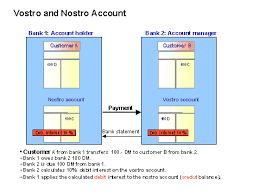
The word ‘Nostro’ finds its roots in the Italian word ‘Nostro,’ meaning ‘ours.’ Hence, a literal meaning of a Nostro account is- “Our account with you”. Nostro accounts are held in a foreign country (with a foreign bank), download (3)by a domestic bank (from our perspective, our bank). A Nostro account is an account that is opened by a bank with an overseas bank in the currency of the foreign country. The account is opened by a bank so as to facilitate easy clearing of their transactions in the foreign country.

Similarly, ‘Vostro’ is an Italian word which means ‘Your.’ So the ‘Vostro Account’ of the foreign bank with Indian bank in India is said as ‘YOUR Accounts with Us.’ Thus, a similar account opened by a foreign bank in an Indian bank is known as Vostro account. A foreign bank authorized to deal in foreign currency maintains accounts with the Overseas Bank to keep stocks of foreign currencies (home currency of the country in which the overseas branches/correspondents is situated) download (2)for the purpose of putting through the foreign exchange transactions. For example Bank of America maintains an account with a Bank in India in Indian Rupee. Such an account maintained in the foreign currency at the foreign center by a foreign bank is a ‘Vostro Account.’

While Nostro and Vostro are used in the bilateral correspondence between the two concerned banks, Loro is the reference which will be used when an account of a bank maintained with other banks is referred to by a third-party. Loro means ‘their account with you.’ For example, If State Bank of India, Mumbai has an account with Citibank, New York denominated in US Dollars then when Bank of Baroda has to refer to this account while corresponding with Citibank, it would refer to it as LORO Account, meaning ‘their account with you.’


Advantages of Nostro and Vostro Accounts

The advantage of these accounts is to minimize the time for transfer of funds. For example, a company in Indidownload (1)a to receive payment in US dollars can remit funds to India by instructing the bankers abroad to remit the funds to the Nostro Account maintained in that particular currency by the home bank where the current account is maintained. Once the funds are received in the Nostro account abroad, the bank will then credit the same to the account of the company here in India at the prevailing exchange rate.

RBI has mandated banks to closely monitor their Nostro accounts for better reconciliation. Similarly, for Vostro accounts, RBI has earlier mandated that stipulated that the Exchange Houses handling the transactions shall keep with the Authorised Dealer Category-I bank (under FEMA) a cash deposit in any convertible foreign currency equivalent to three days’ estimated drawings. By way of a circular dated 28.04.2016, RBI has done away with the requirement of maintaining collateral.

Thus, Nostro and Vostro accounts are accounts customary account maintained across the globe by banks to facilitate easy transactions between them in foreign currency.


Download Now

Investing In Mutual Funds In India

1

In this blog post, Ashutosh Singh, a student of Department of Law, University Of Calcutta, who is currently pursuing a Diploma in Entrepreneurship Administration and Business Laws from NUJS, Kolkata, writes about all that a foreigner needs to know about investing in mutual funds in India.

IMG_20160812_205016_1471015332191

Before we get into the complexities relating to norms for foreigners investing in Mutual Funds in India, we need to get certain basics clear, which are the definition and other key elements of Mutual Fund. The SEBI (Mutual Funds) Regulations 1993 define a Mutual Fund (MF) as a fund established in the form of a trust by a sponsor so that trustees can raise money through the sale of units to the public under one or more schemes for investing in securities in accordance with certain rules and regulations. So typically we have to emphasise upon the following –

DREAMSTIME - MUTUAL FUNDS CHOICES ILLUSTRATION

  • Mutual Fund – Every MF needs to be registered with SEBI structured as a Trust according to the provisions of the Indian Trusts Act of 1882 and the deed needs to signed by the sponsor and the trustees, only then can it be registered under the Registration act of 1908.
  • Sponsor – Is required having a sound track record and contributing 40% of the net worth of the Asset Management Company (AMC), he is also liable for his acts and that of others.
  • Trustees – Each MF must have an independent board of trustees 2/3rd of who have to be independent without any relation to the sponsors of the fund. They are required to maintain all the systems relating to the auditors and registrars in place before any scheme is launched; they also have to prevent any differential treatment between the associates of the fund and individual unit holders.
  • Asset Management Company – The sponsor or the trustees are required to appoint an Asset Management Company to manage the assets of the fund. They have to comply with the mutual fund regulations and SEBI guidelines, some of which include aspects such as – the AMC should at all times maintain a minimum net worth of a 100 million, the board of the AMC must have 50% such members who are not related in any manner either the sponsors or the trustees of the fund and also the Chairman of the AMC must not be a trustee of any mutual fund, etc.
  • Custodian – Every mutual fund under the mutual fund regulations is required to have a custodian appointed to carry out the custodial services of the fund. The precursor to being appointed a custodian includes the presence of the necessary infrastructure and organisational strength. It must also be made clear that the custodian must have no relation to the AMC and must be registered with SEBI under the Custodian of Securities Guidelines, 1996.

Now having discussed the basic structure, we move on with foreigners investing in mutual funds. There are basically three ways of securing investment under this head, they are –

Asset-Management

  1. Ownership of AMC and mutual fund

This happens when international players like Prudential of UK, Alliance , ANZ Grind Lays decide to set shop in the domestic market by having their own asset AMCs. In doing so, they have to be careful towards the foreign investment guidelines prescribed by the Foreign Investment Promotion Board (FIPB). Under the current rules this form of asset creation comes under the NBFC – non-banking financial activities in accordance with the sectorial capitalisation norms-

Foreign equity holdings Minimum capital requirement
Up to 51 % US $500000
51%- 75% US $ 5 million
75 % and above US  $ 50 million


What this cap on capital investments have done is that a lot of foreign investors have adopted the joint venture model of investment through the direct route and this requires no prior approval of the FIPB.


  1. Offshore mutual fund route

This method of investment is suited for those foreign investors who are not willing to enter the domestic market themselves but are willing to participate in the domestic capital market operations. They are done by setting up of funds in a tax favourable jurisdiction. The monies for this fund are raised from overseas investors and are invested into the domestic Indian mutual funds. The scheme is structured in such a way that all units are available to the overseas fund and then these funds are invested in securities in Indian companies. They AMC along with the overseas fund both need to be registered with SEBI. SEBI basically looks into the following criteria before granting sanction –     .

  1. The overseas fund must be a categorically a broad fund
  2. Approval of RBI and the Ministry of Finance under section 115ABof the Income Tax Act of 1961.
  3. The scheme under this category must report its net asset value on a monthly basis.
  4. The Investment Management Agreement must be recorded with SEBI.

This method of funding has been successfully undertaken by the UTI to raise funds from overseas investors and also includes in itself the benefits which are provided under the DTAA (Double Tax Avoidance Agreement) Mauritius route.

1408688755foreign-institutional-investor

  1. Foreign Institutional Investors (FII)

For investment through this route, prior approval of RBI is under the guidelines of the Foreign Exchange Management Act 1999. SEBI however provides a single window clearance under this route for all operations in the domestic market under the SEBI (Foreign Institutional Investors) Regulation, 1995. After obtaining permission under this, the FII are free to perform a wide array of activities like buy-sell securities issued by an Indian company, realize capital gains on investment made through the initial amount, subscribe to or renounce right offerings of shares, appoint a domestic custodian etc.

Now having mentioned the ways of obtaining foreign investment, we must throw some light upon the recent developments in this field on the basis of the UK Sinha Committee report on Working Foreign Investment, the basic contentions of the report are as such –

  1. The committee called for restructuring of the capital flow management system.
  2. It also called for a single window registration and investment administration process and a creation of a new category of investors called the Qualified Foreign Investor.
  3. Providing such a framework of qualified Depository Participants (DP) with a wide branched network responsible for enforcing OECD and standard KYC requirements.
  4. The committee also prescribed detailed background checks for such high capital DP’s operating in the country,
  5. It has also suggested the abolishing of NRI’s and FII’s as a separate investor class.

Globally countries including the likes of Brazil, South Korea and Turkey do not fragment their markets by distinguishing between the types of investors.

Benefits due to these recommendations in the Mutual Fund Market

 The Global Depository Participants would meet the KYC requirements

  1. The mutual funds would not have to go through the hassles of setting up of an offshore vehicle for marketing their products.
  2. The cost of compliance would come down significantly
  3. The Prevention of Money Laundering Act 2002 guidelines for suspicious transactions would be dealt with by the DP’s.


Download Now

Five Rescue Tools To stay Updated On Your Area Of Interest

0
Five Rescue Tools To stay Updated On Your Area Of Interest

Five Rescue Tools To stay Updated On Your Area Of Interest

When I was in my 2nd year of law school – I had asked a senior I respected – what can I do to ensure that I shall be really good at corporate law? How can I be the kind of person that a law firm will find indispensable?

My senior who himself was in 5th year at that time suggested that I start reading the Economic Times, or such other financial newspapers – where one could come across various types of transactions and then learn about them. I subscribed to some of these newspapers over the course of next couple of years and learnt a bit. A bit, not much.

I was very dissatisfied with the reading experience – the news was full of jargons, hype, and gospels rather than anything that one could learn. Sometimes some of the analytical articles made a lot of sense. The method I adopted to learn the basics of financial market was this – I would make a list of new terms and jargons I’d come across and then look them up on internet. This was a slow and tedious way of learning – and I felt the lack of a good narrative in these newspapers that could give real insight.

Consider this typical headline – ‘ABC company has won X million in damages from Y’. There would be little news value in the article, if any legal issues will be discussed they will be diluted to the extent of becoming nonsense, and there will be 100% sensationalism. It would not say whether this is the final decision, whether a number of damages awarded can be reduced in an appeal (so that readers need not immediately jump in awe at the magnitude of damages awarded), or through a subsequent settlement. Result: a lot of people are fed with incomplete, incoherent and irrelevant information, and some of them know that they receive ‘low-value content’ and develop a distaste for the conventional media

I always kept looking for better sources of news and knowledge – and I soon hit upon something on internet. Newsletters. I found such specialised and well written newsletters, feeds and news aggregators on the web that there was no point keeping my subscription to the financial newspapers. Even the newspapers have feeds that you can access for free on your computer.

How can you free yourself from this stream of limited information, which seek your eyeball only for selling advertisement and has no qualms about disguising advertisement as news or about wasting your time? How can you stay up-to-date in your areas of interest and have access to complete and relevant information?

 Internet is the answer.

However, while it is the only hope, it is also the number one reason of information overload in our lives. Internet is a beast that requires timing – once you mould the force of internet to suit your needs – you have a solution.

So how does one escape the time wasting traps that goes in the name of media as well as information overload that comes with internet, and still manage to access relevant information effortlessly?

It is an art that people master as they sift through millions of web pages, RSS feeds and newsletter, and over time and what really works for them. I can not suggest the perfect sources for you – what really works for you is something you have to find yourself.

I am, however, going to recommend five tools that you can use to tame the beast that is Internet. Sometimes I shall be recommending specific newsletters and RSS feeds for law students and practicing lawyers.

 The five best information management tools on the Internet:


  • RSS Feeds – RSS Feeds are the best way to keep yourself updated about the websites that you find useful and covers news or articles you are interested in. Most websites and blogs today come with an RSS feed (RSS stands for Really Simple Syndication), even the big newspaper and magazine websites – which means you can get the headlines delivered on your desktop, google page, browser frame, email box – wherever you want. Best the thing is that you see only the headline to start with – or maybe a few sentences at most. It is up to you to judge based on that information whether you want to read more. Even the terribly designed and maintained government websites such as from SEBI, RBI have RSS Feeds that can be really useful for a practitioner or a student who is interested in that branch of law.
  • Congoo – This is an interesting tool that builds a news site catering to your taste. Take a look at Abhyudaya’s financial news site here. You can choose from a wide range of available areas, and your website will cover the subects you are interested in keeping yourself updated. This serves multiple purposes – it keeps you updated, it keeps your friends updated (if they have similar or related interests), and helps you in showing others what you are interested in. It also helps you in building a web presence.
  • Google Alerts – Is there anything about which you want to miss nothing? Do you want to have all the news, articles, blogs, discussions of forums delivered to your inbox as soon as they are discovered by google bots? Then you need Google Alerts, which notify you about every piece of information which is put on the internet on your selected keywords (as and when Google’s search robot comes across it). Apart from tracking subjects and interest areas, I strongly recommend it as a stalking tool as well – which works on your friends and enemies alike. Want to discover the interests and web activities of a person? Set a google alert on them. Maybe your ex-has already done it on you.
    Google Alerts is highly customizable, you can choose which terms you want to track, and you can choose how often Google informs you about new information.
  • Twitter – This is a place for following people whose beliefs you are interested in or influenced by, or those who are influential in your practice area/subject area. It is a great place for building influence too. Start following the leaders in your industry/academic area right now – and they will ensure that you have access to the best of what they come across. Which, by definition, is good.
    However, do not make the mistake of following every random person and starlets or you will again end up with information paralysis – twitter can be addictive and can unleash inormation avalanches on you that will keep you away from work for days. Follow only those who cater to your real interests and will add value to your life.
  • Facebook – Do not miss this channel. Sometimes your friends and peers may share relevant information with you – and this social filter is a miracle. They will share only what they like – and not the tons of news that they read and found unconvincing or insignificant, unless they are promoting something of their own. Such links may include highly relevant information for your area of interest, friend circle, region or business. Watch out for updates from those who are smarter/well-informed/influential in your friend list and they will do the hard work for finding the right inormation for you to read on Facebook itself – where at least some of you spend significant time everyday commenting on status messages and liking photographs.
    This article was written with some major contributions from Abhyudaya Agarwal.

CLAT aspirants note that you can use these techniques to stay up to date with current affairs.

How do you stay up to date?

Download Now

Five Experiences as a First Year Student in a Law School

0
Five Experiences as a First Year Student in a Law School

Five Experiences as a First Year Student in a Law SchoolMuch has been written on how to prepare for law entrance exams, which are the elite law colleges, the pros and cons of selecting law, the future of this profession and myriad of other topics. However this article focuses on another very important aspect, the aftermath of declaration of CLAT, AILET and other law entrance results: that is the experience on entering the portals of a Law School for the first time.

As soon as the aspirants know which college they are going to join to pursue their prestigious Legum Baccalaureusdegree, it actually marks the beginning of their anxiousness, apprehension and fears. The dreamy eyed students do not know whether the Suited up world of Boston Legal lies ahead or is ‘tareekh pe tareekh’ the ultimate reality. This article highlights five experiences you go through in the First year of Law School

Seniors- Seniors Everywhere:

On entering a Law school, the first thing that comes to a student’s mind is the presence of 4 batches of seniors in their college. Because of this freshers generally go through a mixed bag of emotions: they feel excited but nervous too, they are a little anxious on the thought of meeting their seniors but they look forward to interacting with them too. However it is ultimately the seniors who tell you which book is an easy read, the trade tricks of fetching marks in various subjects, what mooting and adjudication is all about, which all are the places you can go to hang out with your friends, the do’ s and don’ts of College life . Freshers later on do realize that it is the seniors who are a genuine helpline for their journey in the law school.

Trust Me, I am a Law Student:

The first year of law school gives you an identity of your very own. When someone asks what course you are pursuing, you can proclaim your law student status with pride. You consider yourself to be among the elite group dressed in black and white. The thick heavy books, the bare acts, the case reporters and various legal databases give you the proud feeling of entering into an honourable field so different from the courses and degrees of your peers. The joy you feel on flaunting Latin or legalese in front of your friends who are not from the legal background is inexplicable.

Intellectuals All around:

The first year of Law school makes you realize that debates, discussion and arguments will be a very important part of your life in the years to come. You start getting acquainted with the world of contentions and deceptions. On witnessing the moots, debates and discussions you really get impressed to observe how well read and well informed good speakers are, which triggers an inspiration to read thoroughly and speak confidently. Terms like Moots, Adjudication, PD’s, and Client Counselling which were earlier not known to you soon become an essential part of life. Moots and the aura around it is very intimidating. Not knowing the basics of mooting before hand can be very disturbing for anyone who wishes to leave an impact during their law school life. This online course can help with everything related to mooting.

Making so many assignments, synopsis and appearing for exams with the help of last minute study, makes you an intellectual too.

Adjustment:

The first year of college teaches you a lot of adjustment thus preparing you for harsh and competitive life ahead. Studying and living with people from every nook and corner of the country with different cultures, habits and aims, teaches you how important it is to adjust and adapt to move ahead in life. After coming from the safe protected cocoons called home you feel you have to learn to accept life and the challenges it throws at you courageously. Hostel life comes with responsibility which ideally comes with maturity. If there is one clear evolution path to adulthood, then hostel life provides it. One really learns how to make personal decisions, manage one’s life and maintain a budget. Hostel life is one that brings a triad of the good, the bad and the ugly.

Life’s what you make it:

The first year of college really does make you capable enough to understand that you are the creator of your life and it is you yourself who is the best judge and critic of your abilities. In the beginning you might feel lost, not knowing what your abilities are but by the end of the year you start identifying and recognizing yourself. You learn independence and create your own identity. You go through so many experiences, some good, some bad, happy moments and embarrassing ones too which altogether make you a stronger and better person. Law school does not only teach you the abc’s of Law, it teaches you what life is.

Article is written by:

Sunanda Singh Bisht

Batch of 2018 , Dr. RMLNLU

Download Now

Can Funds Received Through DRs And FCCBs Be Treated As FDI?

1

In this blog post, Hitender Sharma, who is currently pursuing a Diploma in Entrepreneurship Administration and Business Laws from NUJS, Kolkata, discusses whether funds received by the Indian Company vide issuance of DRs and FCCBs  are treated as FDI.

dr

What is Depository Receipt (DR)?

  1. Depository Receipt means a negotiable security issued outside India by a Depository Bank, on behalf of an Indian company, which represent the local Rupee denominated equity shares of the company held as deposit by a custodian bank in India.
  1. An Indian company may issue its Rupee denominated shares to a person resident outside India being a depository for the purpose of issuing Depository Receipts , provided the Indian company issuing such shares has an approval from the Ministry of Finance, Government of India to issue such DRs  or is eligible to issue DRs in terms of the relevant scheme in force or notification issued by the Ministry of Finance, and is not otherwise ineligible to issue shares to persons resident outside India in terms of these Regulations, and the DRs  are issued in accordance with the scheme for issue of Foreign Currency Convertible Bonds and Ordinary Shares (Through Depository Receipt Mechanism) Scheme, 1993 and guidelines issued by the Central Government there under from time to time.

Process of issue of Depository Receipt (DR)

  1. When an Indian company wants to create a depository receipt abroad, the company will generally hire an Advisor to understand the relevant regulations, and will then choose a domestic custodian Bank.
  2. The company will decide how many shares will be represented by the depository receipt, referred to as the depository receipt ratio, and will find a  broker in the selected foreign country willing to purchase the shares to be held by the custodian bank.
  3. A broker in the selected foreign country will purchase shares of the Indian company, and then the domestic bank will register the shares on behalf of the broker.
  4. Once the Bank issues depository receipts, the foreign broker can have the shares listed on a local exchange in the foreign country, such as the New York Stock Exchange, as a DR and can sell those shares domestically.

Form of Depository Receipt

There are two forms of depository receipts.

  1. American Depository Receipt ( ADR )

Depository Receipt listed and traded on exchanges based in the United States are called the American Depository Receipt.

2. Global Depository Receipt (GDR)

Depository Receipt listed and traded on Stock exchanges based in non-U.S. markets such as London and Singapore are called Global Depository Receipt.

What-are-Foreign-Currency-Convertible-Bonds-FCCBs

What are Foreign Currency Convertible Bonds (FCCBs)?

‘Foreign Currency Convertible Bond’ (FCCB) means a bond issued by an Indian company, expressed in foreign currency, the principal and interest of which is payable in foreign currency and convertible into ordinary shares of the issuing company in any manner, either in whole, or in part.

FCCBs are issued in accordance with the Foreign Currency Convertible Bonds and ordinary shares (through depository receipt mechanism) Scheme, 1993 and subscribed by a non-resident entity in foreign currency.

What is Foreign Direct Investment (FDI)?

1461305746-FDI

  1. FDI means investment by Non-Resident entity/ person Resident Outside India in the capital of an Indian company in accordance with schedule 1 of Foreign Exchange management ( Transfer or issue of security by a person Resident outside India) Regulations, 2000.
  2. Foreign investment is recognized as FDI only if the investment is made:
  • in equity shares,
  • fully and mandatorily convertible preference shares
  • and fully and mandatorily convertible debentures
  1. FDI policy does not permit issuance of any optionally convertible security.
  2. The FDI policy provides that the pricing of the securities to be issued to the foreign investors should be decided upfront as a figure or based on the formula that is decided upfront.
  3. The FDI policy also provides that the price at the time of conversion should not in any case be lower than the fair value worked out, at the time of issuance of such instruments, in accordance with the extant FEMA regulations [valuation as per any internationally accepted pricing methodology on arm’s length basis for the unlisted companies and valuation in terms of SEBI (ICDR) Regulations, for the listed companies] without any assured return.
  4. Reserve Bank of India (RBI) has put in place a specific pricing mechanism according to which the above mentioned eligible securities can be issued to the foreign investors. Therefore an Indian company cannot issue securities on such terms that foreign investor may exit with pre-determined returns.
  5. Any security allowing assured returns would be considered debt and will not be considered as FDI.
  6. Partly paid equity shares and warrants issued by an Indian company in accordance with the provision of the Companies Act, 2013 and the SEBI guidelines, as applicable, are also treated as eligible FDI instruments w.e.f. July 8, 2014 subject to compliance with FDI scheme.
  7. Any foreign investment into an instrument issued by an Indian company which gives an option to the investor to convert or not to convert it into equity or does not involve upfront pricing of the instrument as a date would be considered as ECB and would have to comply with the ECB guidelines.

Procedure for receiving Foreign Direct Investment in an Indian company

An Indian company may receive Foreign Direct Investment under the two routes as given under:

i) Automatic Route

FDI is allowed under the automatic route without prior approval either of the Government or the Reserve Bank of India in all activities/sectors as specified in the consolidated FDI Policy, issued by the Government of India from time to time.

ii) Government Route

FDI in activities not covered under the automatic route requires prior approval of the Government which are considered by the Foreign Investment Promotion Board (FIPB), Department of Economic Affairs, Ministry of Finance..

The Indian company having received FDI either under the Automatic route or the Government route is required to comply with provisions of the FDI policy including reporting the FDI to the Reserve Bank as prescribed.

Whether investment in the form of DRs and FCCBs is treated as investment?

  1. Now the question as to whether the funds received by the Indian company vide issuance of DRs and FCCBs are treated as FDI or not is to be examined in the light of FDI policy.
  2. Foreign investment is recognized as FDI only if the investment is made in equity shares, fully and mandatorily convertible preference shares and fully and mandatorily convertible debentures only. FDI policy does not permit issuance of any optionally convertible security as mentioned above.
  3. There is a specific pricing mechanism put in place by RBI for issuance of securities to the foreign investors.
  4. The policy objective is not to allow any assured return to the foreign investors and the investment should be in the form of equity share upfront of other instrument convertible in to equity share over a period of time as per the policy.
  5. DRs and FCCBs pass these tests as provided in the FDI policy. DRs are basically foreign investment in the form of equity shares issued outside India by a Depository Bank, on behalf of an Indian company which is covered under the FDI policy. Similarly FCCBs are foreign currency convertible Bonds invested in Indian company. Since these bonds are convertible in to equity shares over a period of time as provided in the instrument, therefore they are covered under FDI policy.

Therefore, inward remittances received by the Indian company vide issuance of DRs and FCCBs are treated as FDI and counted towards FDI.

Download Now

Regulatory Requirements For Opening LOs/BOs/POs In India

0

In this blog post, Archishman Chakraborty, who is curently pursuing a Diploma in Entrepreneurship Administration and Business Laws from NUJS, Kolkata, explains the regulatory requirements for opening liasion, branch and project office in India.

New-Guidelines-regarding-establishment-of-Liaison-Office-Project-Office-Branch-Office

In India, establishment of liaison, branch or project office are regulated in terms of Section 6(6) of the Foreign Exchange Management Act, 1999 read with Notification No. FEMA 22/2000-RB dated May 3, 2000. Section 6(6) of Foreign Exchange Management Act, 1999 states:

Without prejudice to the provisions of this section, the Reserve Bank may, by regulation, prohibit, restrict, or regulate establishment in India of a branch, office or other place of business by a person resident outside India, for carrying on any activity relating to such branch, office or other place of business.

In exercise of the powers conferred by sub-section (6) of Section 6 of the Foreign Exchange Management Act, 1999, the Reserve Bank has formed the Foreign Exchange Management (Establishment in India of Branch or Office or other Place of Business) Regulations, 2000 to prohibit, restrict and regulate establishment in India of a branch or office or other place of business by a person resident outside India.

Regulation 3 of the Foreign Exchange Management (Establishment in India of Branch or Office or other Place of Business) Regulations, 2000 prohibits establishing branch or office in India, states:

No person resident outside India shall, without prior approval of the Reserve Bank, establish in India a branch or a liaison office or a project office or any other place of business by whatever name called: Provided that no approval shall be necessary for a banking company, if such company has obtained necessary approval under the provisions of the Banking Regulation Act, 1949.

Regulation 4 prohibits establishing a branch or office in India by citizens of certain countries:

No person, being a citizen of Pakistan, Bangladesh, Sri Lanka, Afghanistan, Iran or China, without prior permission of the Reserve Bank, shall establish in India, a branch or a liaison office or a project office or any other place of business by whatever name called.

Regulation 5 allows a person resident outside India to establish a branch or a liaison office in India, by applying to the Reserve Bank in form FNC 1 for permission to establish a Project or Site Office in India, on fulfilment of certain criterions regarding funding of the project.

RBI-FEMA

Regulation 6 empowers a person resident outside India to carry on or undertake any of the activity relating to execution of the project as mentioned in Schedule 1 and 2, whereas Regulation 7 allows remittances of surplus of the project outside India on production of appropriate documents.

On July 1, 2015, the Reserve Bank of India published a Master Circular No. 7/2015-16, to consolidate the existing instructions on the subject of “Establishment of Branch/Liaison/Project Offices in India by Foreign Entities” at one place.

According to this Master Circular, any application made to the RBI in the FNC 1 form, can be considered under:

  1. Government Route
  2. Reserve Bank Route

A profit making track record for preceding 5 and 3 financial years has been prescribed for both BOs and LOs respectively, with BOs having a net worth of not less than USD 100,000 or equivalent and LOs not less than USD 50,000 or equivalent.

The application for establishing BO/LO in India should be handed over by the foreign body through a designated AD Category – I bank to the General Manager, Foreign Exchange Department, Central Office Cell, Reserve Bank of India, New Delhi Regional Office, 6, Parliament Street, New Delhi-110 001, India, along with the prescribed documents that includes :-

  • Certificate of Incorporation in English / Registration or Memorandum & Articles of Association attested by Indian Embassy / Notary Public in the Country of Registration.
  • Latest Audited Balance Sheet of the applicant body.

Applicants who are unable satisfy the eligibility criteria and who are basically subsidiaries of other companies can put in a Letter of Comfort from their parent company as per annexure 2. However, it is subject to the condition that the parent company should satisfy the eligibility criteria as given above. The designated AD Category – I bank ought to exercise due diligence towards the applicant’s background, antecedents of the promoter, nature and location of activity, sources of funds, etc.  It should also ensure compliance with the KYC norms before forwarding the application together with their comments and suggestions to the Reserve Bank of India.

NCP_Filial_Vernetzung

The Branch / Liaison offices established with the approval of the Reserve Bank of India will be allotted a Unique Identification Number or a UIN. The BOs/LOs shall also obtain Permanent Account Number (PAN) from the Income Tax Authorities on setting up the offices in India.

A Liaison Office can take charge of the following activities in the territory of India:-

  1. Representing the parent company/group companies in India.
  2. Promoting export or import from or to India.
  • Promoting technical/financial collaborations between parent/group companies and companies in India.
  1. Acting as a communication channel between the parent company and Indian companies.

Generally, the Branch Office should be engaged in the activity in which the parent company is engaged in.  Some of the activities permissible to be undertaken by the BO are:

  1. Export / Import of goods.
  2. Rendering professional or consultancy services.

iii. Carrying out research work, in areas in which the parent company is engaged.

The Reserve Bank of India has granted general permission to companies of foreign countries to establish their own Project Offices in India. However, it is based upon the condition that they have secured a contract from an Indian company to execute a project in India, and that

  1. the project is funded directly by inward remittance from abroad; or
  2. the project is funded by a bilateral or multilateral International Financing Agency; or

iii. the project has been cleared by an appropriate authority; or

  1. a company or entity in India awarding the contract has been granted Term Loan by a Public Financial Institution or a bank in India for the project.

However, if the above criteria are not met, the foreign entity has to approach the Reserve Bank of India, Central Office, for approval.

Setting up of Project Offices by foreign Non-Government Organisations/Non-Profit Organisations/Foreign Government Bodies/Departments, by whatever name called, are under the Government Route. Accordingly, such entities are required to apply to the Reserve Bank for prior permission to establish an office in India, whether Project Office or otherwise.

Download Now

Foreign Direct Investment – Difference Between FERA And FEMA

0

In this blog post, Anumeha Saxena, who is currently pursuing a Diploma in Entrepreneurship Administration and Business Laws from NUJS, Kolkata, explains the differences between the Foreign Exchange Regulation Act, 1973 and the Foreign Exchange Management Act, 1999 in terms of Foreign Direct Investment. 

fera-fema

The Foreign Exchange Regulation Act, 1973 (hereinafter FERA) came into force in 1974 and aimed to regulate all Indian exchanges and transactions with foreign countries. It is important to note that at the time of enactment of the legislation, India faced a dearth of foreign exchange. When the government tried to conserve it further with stringent rules, the import and export were gravely affected. Criminal instead of civil penalties, broad powers being vested on the Enforcement Directorate to arrest any person, seize documents, control over all matters pertinent to foreign exchange etc., led to reduced transactions in foreign exchange and securities.

The Foreign Exchange Management Act (hereinafter FEMA), 1999 developed as a panacea to the then existing regulatory regime. While the FERA intended to regulate, FEMA seeks to manage the forex.


Different philosophies

The basic difference is evident from the following fact that under FERA, any transaction in forex or with a non-resident would be prohibited unless generally or specially permitted. The structure stands changed under the FEMA where all current account transactions are permitted unless prohibited and all capital account transactions are prohibited unless otherwise permitted.

Admittedly, both the FERA and the FEMA asserted the role of the Reserve Bank of India and the Central Government as regulators. Further, the presumption of extra-territorial jurisdiction as provided in Section 1 has also been encapsulated in the FEMA. The provisions of both are applicable to the whole of India. However, there are two exceptions:

  • The provisions are also applied to all branches, offices and agencies situated outside India if these are owned or controlled by a person who is resident in India;
  • If any person to whom FEMA applies, commits any contravention outside India, all the provisions, rules and regulations under this law would be applicable to such person even the contravention has been made outside India.

Additionally, the Directorate of Enforcement enforces the provisions relating to search and seizure etc. under Section 37, FEMA and it enjoyed similar powers under the FERA too.


Differences in the legislations

However, FEMA has numerous substantial variations over the FERA, which have been enumerated and elaborated below. In order to ease imports and exports, the FEMA is a far simpler legislation comprising of just 49 Sections in contrast with the 81 provisions which were present in the FERA.

Further, the presumption of intention and abatement present in a reverse onus clause in the FERA when a person is found to be in possession of forex above the permitted amount have not been replicated in the FEMA.

A host of definitions, for instance, capital account transaction, current account transaction, person, service etc, were not defined in the FERA but have been defined in the successor FEMA under the Section 2(e), (j), (u) and (zb) of the FEMA respectively.

forex-trading-3

Under the FEMA, the RBI has a controlling role in management of foreign exchange. As it is not possible for RBI to directly handle forex transactions, it directs authorized persons to manage the same as per the directions issued by the RBI.[1] RBI is empowered to give directions as per Section 11 of the FEMA and the same are circulated through the AP (DIR) circulars wherein AP stands for Authorized Person and DIR Denotes Directions. The definition of an authorized person had a narrow scope and the same has been altered in the new legislation to include banks, money changers, offshore banking units in Section 2(c), FEMA. The delineation of powers enjoyed by such authorized persons is provided in Section 10, FEMA.

The definition of a resident under the FERA was different from the one provided in the Income Tax Act. However, the definition has now been made consistent with the Income Tax Act. A non-resident under the Income Tax Act, 1961 would have the same status under the FEMA as well. However, a person considered a non-resident under the FEMA might not necessarily have the same status under the Income Tax Act, 1961. Under the FERA, the residential status of the person was identified on the basis of his intention alone, rather than his physical presence.

The FERA which was criticized for its stringent penalty provisions faced a complete alteration. Any offence under the legislation was a criminal one, which was punishable with imprisonment as provided under the Code of Criminal Procedure, 1973. Under the aegis of the FEMA, offence is considered civil and is accompanied with the payment of a sum as a penalty as provided under Section 13 of the FEMA. Provision of imprisonment becomes operative only when one has failed to pay the requisite penalty. The nature of such imprisonment is civil and not criminal and it operates when the penalty has not been paid by the contravening party 90 days after the date to pay the penalty becomes due, as per Section 14 of the Act. Further compounding of offences, not provided under the FERA forms a part in FEMA as given in Section 15 of the Act and the Enforcement Directorate possesses the power to do so.

c11a5b8e-de70-40d7-99fa-539609c163e9-1-1465203134573

There has been a change in the authority which hears the appeals. The appeal against the order of the Adjudicating Officer went before the Foreign Exchange Regulation Appellate Board and further on to the High Court. Under the FEMA, the appellate authority is the special Director (Appeals). Appeal against the order of the adjudicating authorities as well as the special Director (Appeals) is before the Appellate Tribunal for Foreign Exchange, and from there the appeal would be before the High Court.

On a relatively minor point, the FERA did not have an express provision which focused on the right of an impleaded person to avail of legal assistance. However, as per Section 32, FEMA, right of an appellant to be assisted by a legal practitioner or chartered accountant, is recognized.

The FERA is often criticized for its conferral of wide powers on police officer, not below the rank of a Deputy Superintendent of Police to search and seize, but the same has been reduced in the FEMA.

The FERA generally permitted returning Non Resident Indians to hold their investments and assets outside India under various notifications; hence, they could deal with these assets in the manner they considered appropriate after they became resident. This was subject to the fulfilment of the conditions that the assets be acquired legitimately, without violation of the provisions of FERA while the person was resident abroad and the returning NRI has stayed outside India for at least one year continuously. This condition of one year’s continuous residence is not present in the FEMA. Further, Section 6(4) does not mention re-investment of income or sale proceeds of assets abroad after the person becomes the resident of India, which was explicitly mentioned under the FERA. Since there exists a requirement to surrender foreign exchange which represents the income on assets held outside India, all such income and sale proceeds have to be deposited with the authorized person within seven days of their receipt. In this regard, the FERA appears to have been more lenient than the FEMA.

While the change of regime from FERA to FEMA has narrowed the application in some instances and broadened in some others, it is important to note that the restrictions on the drawal of forex for carrying out a current account transaction stands removed. It is subject to the condition that the Central Government may, in public interest and in consultation with the RBI, impose such reasonable restrictions for these transactions as may be prescribed. Further, the FEMA has deleted the hurdles on transactions in forex relating to trade in goods and services except for those enabling provisions which permit the Central Government to impose reasonable restrictions in public interest.


Footnote:

[1] Section 10, Foreign Exchange Management Act, 1999.

Download Now

Major Changes In FDI Policy In 2015-16

0

In this blog post, Aditya Kumar, who is currently pursuing a Diploma in Entrepreneurship Administration and Business Laws from NUJS, Kolkata, examines some of the significant change, which have been made to the Consolidated Foreign Direct Investment Policy, 2015 (FDI Policy).

FDI_2

The FDI Policy is published each year by the Department of Industrial Policy and Promotion (“DIPP”), Ministry of Commerce and Industry and is updated from time to by the DIPP through press notes that are issued as amendments to the FDI policy.

The year 2015-16 saw some significant changes to the FDI Policy and the following are the important developments for the year 2015-16:

  1. Publication of guidelines for FDI in E-Commerce.
  2. Liberalization of FDI in the pension sector.
  3. Liberalization of FDI in the insurance sector.

Publication of guidelines for FDI in E-Commerce

The guidelines issued by the DIPP regarding the treatment of e-commerce companies in India (“E-Commerce Guidelines”) such as Amazon, Flipkart, Snapdeal etc. has been a subject OF much discussion since the guidelines were issued. There has been a lot of debate about the impact of these changes and how exactly how the different stakeholders including e-commerce companies and the consumers will be affected by this change.

 51609839

What do the E-Commerce Guidelines provide?

  • Definition of e-commerce: The E-Commerce Guidelines define an e-commerce as the “buying and selling of goods and services including digital products over digital and electronic network.

  • Areas where FDI is permitted: The E-Commerce Guidelines provide that 100% FDI is permitted under the automatic route in a marketplace model e-commerce and prohibits FDI in the inventory based model of FDI. This clarifies further that e-commerce companies such as Amazon and Flipkart are meant to pure marketplaces and therefore these entities are prohibited from owning the inventory of goods and services that is finally sold to the customers.

  • Other important conditions: There are a number of additional conditions that have been provided for in E-Commerce Guidelines, this post however will only focus on some of the more significant conditions.

  • Cap on vendor sales: The E-Commerce Guidelines provides that no e-commerce company is permitted to allow any single vendor or its group companies to sell more than 25% of the e-commerce entities total sales. This restriction has provided SOME serious issues for e-commerce companies to deal with as companies such as Flipkart and Amazon which primarily sell most of the products on their platform using a single major vendor that easily exceeds this 25% threshold. The original intension behind this condition is to ensure that the distinction between vendors and marketplaces such as Amazon is maintained and that FDI is only used to fund the marketplace model of e-commerce companies and not the vendors that supply goods to them. The corollary however is that such a guideline may force the e-commerce companies to act in a non-economically efficient manner. For example, if a vendor does sell more than the limit specified in the norms due to the sellers on time delivery, quality of the product etc., then e-commerce companies will be forced to reduce the amount of sales that emanate from this efficient vendor and instead diversify their vendors who may not provide the same sort of service or goods. In such a scenario, the ultimate victim would be the consumer who is deprived of a quality product.
  • Influencing sale price: The E-Commerce Guidelines restricts e-commerce companies from directly or indirectly influencing the price of the goods or services that are offered on their platform. This means that the massive sales that are offered by e-commerce companies may see a decline in the future. There are already examples of e-commerce companies delaying or cancelling plans for a sale since they may be found in violation of this condition.


Liberalization of FDI in the pension sector

The Government of India liberalized FDI up to 49% under the automatic route in the pension sector. As per the guidelines, foreign investment is allowed in the pension sector subject to the following conditions:

  • The foreign investment is allowed as per the Pension Fund Regulatory and Development Authority (PFRDA) Act, 2013.
  • Whenever the foreign investment involves control or ownership by the foreign investor or transfer of control and ownership of an existing pension funds from resident Indian citizens and/or Indian companies owned and controlled by resident Indian citizens to such foreign investing entities, government approval would be required. The meaning of ownership and control has been provided for in the FDI policy which states that “control” includes “the right to appoint a majority of the directors or to control the management or policy decisions including by virtue of their shareholding or management rights or shareholders agreements or voting agreements”.

FDI010021

Liberalization of FDI in the insurance sector

  • The Government of India liberalized FDI in the insurance sector by permitting up to 49% foreign investment under the automatic route in the insurance sector including:
  1. Insurance Companies
  2. Insurance Brokers
  3. Third party administrators
  4. Surveyors and loss assessors
  5. Other insurance intermediaries appointed under the provision of the Insurance Regulatory and Development Authority Act, 1999.
  • There are a number of additional conditions that have been provided for in case of such investment, however this post will only focus on some of the more significant conditions detailed below:
  • An Indian insurance company is required to ensure that ownership and control remains in the hands of resident Indian entities.
  • The foreign investment up to 49% will be subject to verification by the Insurance Regulatory and Development Authority.

Download Now
logo
FREE & ONLINE 3-Day Bootcamp (LIVE only) on

How Can Experienced Professionals Become Independent Directors

calender
28th, 29th Mar, 2026, 2 - 5pm (IST) &
30th Mar, 2026, 7 - 10pm (IST).
Bootcamp starting in
Days
HRS
MIN
SEC
Abhyuday AgarwalCOO & CO-Founder, LawSikho

Register now

Abhyuday AgarwalCOO & CO-Founder, LawSikho