Download Now
Home Blog Page 1706

What Structuring Advice Will You Give To An Indian Entrepreneur Who Wants To Expand In The United States?

0

In this blog post, Mamta Ramaswamy, a student pursuing her Diploma in Entrepreneurship Administration and Business Laws from NUJS, Kolkata, provides structuring advice to an Indian entrepreneur who wants to expand to the United States.This article is written only for educational purposes and does not constitute a legal advice.

Download Now

When Should You Incorporate A Society?

0

In this blog post, Somesh Tiwari, who is currently pursuing a Diploma in Entrepreneurship Administration and Business Laws from NUJS, Kolkata, gives a historical overview of the evolution of societies and how this evolution has led to a change in the purpose for which societies are formed. He further goes on to discuss when a society should be incorporated.

IMAG1812

The fundamental reason or need to incorporte a society can be narrowed down to the cause; it is to attain a specific cause through symboitic coordination among a group of people. A society therefore functions through the collective collaboration of a specific group of people who want to achieve a certain goal for benevolent purposes.


Purpose For incorporating a society

Under the Indian Societies Act 1860, a society can be formed for any literary, scientific or charitable purposes, or any other such purpose defined under Section 20 of the Act. It is usually a specific cause that brings people together to form a society. It can be a local society which collectively represents the cause for which people of that specific local area are concerned, or it can be a national society functioning on interstate basis. Now, the Indian Societies Act is a pre-independence era Act which has already been amended numerous times. Therefore, the reasons for which a certain society was formed back then may vary from today due to the evolution of society, plus there have been numerous economic changes which affect how a society functions. What we also have to bear in mind is that the cause and reason for incorporating a society may also be different. The purpose can be anything as long as it coincides with the provisions of the Indian Societies Act; there must be at least seven members in order to form a society as per the Act. An incorporated society is outside the governmental dominion, which basically means the state or the central government cannot regulate the workings of the society. It is governed by the memorandum of association which is signed by the members of the society. To elaborate, society works in a symbiotic manner, thus the elementary purpose is resolving problems faced by people with the help of people within specific masses of people in an individual political unit. It could be for the protection of a shared belief or representation of the art and culture of certain communities. Therefore, purpose is what unites and drives a certain set of people to come together and symbiotically enhance their reach in terms of their beliefs, which fundamentally forms their society.

Evolution of societies from the 18th century leading to change in purpose

8768463

It is believed that the concept of society firmly hit ground around the 18th century due to change in the economic infrastructure which resulted in the major escalation in the earning of the common masses, plus the liberalization of the western world. This era saw big scientific advancements in the world leading to a certain section of people not agreeing with the methodology of the church. They wanted a rather different approach towards specific subjects. These people with a common approach realized that their influence on the world at large is limited if they stand against the church individually, they understood that only when they unite together for their cause will they be able to make a certain impact in the world.

In the early 19th century, due to the 1st World War, the structure of society disintegrated, it saw a collapse in regimes followed by individuals with a will to voice their opinions. Everything in that period revolved around war and its effects. By the mid 90’s, the theory of Bowling Alone was given by Robert D Putnam. In his theory, he “surveys the decline of social capital in the United States since 1950. He has described the reduction in all the forms of in-person social intercourse upon which Americans used to found, educate, and enrich the fabric of their social lives. He argues that this undermines the active civil engagement which a strong democracy requires from its citizens.”After the decline in the early and the mid-19th century, the purpose of forming a society changed again but this time in the late 90’s, people became more aware of their rights and thus became active in the political sphere. When such individual from came together for cause of common interest, it subsequently lead to a low revival of the societies. This era saw the steady rise in communitarianism; the connection between individuals and the community became better because people interactions increased due to common interests.

But, this is not the 18thor the 19th century. The purpose of forming a society may not be entirely different but their agendas may vary from time to time. The purpose of modern society still remains to efficiently solve issues of people on a collective level, but the fulfilment of this agenda has not been devoid of challenges. The laws have been amended numerous times and there have been bills passed to improve the inter-state functions of societies. Every state has enacted its own law for the purpose of suiting its regional needs.

Conclusion

individuals-societies

Therefore, to incorporate a society, there has to be a sense of purpose, a commonality without which the entire structure of a functioning society is disintegrated. The reason of an entire community moving towards a specific goal with collaborative effort and commitment is the driving force of a society. Once a certain group reaches that level, and is eager to put in effort for a common benevolent cause, a society can be established.

But the collaborated efforts should not be loosely structured and the purpose behind establishing a society should be upheld with decorum and the sanctity of such purpose must be maintained throughout. These efforts should be aimed at resolving conflicts with efficiency and achieving a sense of greater good of the world.

Download Now

An Overview of Must-have Clauses in an Advisors Agreement

0

In this blog post, Amjith Mavilattu Anandhan, an Associate at Triyama Legal, Pune and a student pursuing his Diploma in Entrepreneurship Administration and Business Laws from NUJS, Kolkata, provides an overview of clauses that need to be included in an Advisor’s Agreement. 

unnamed


Introduction

Business structures in India have undergone revolutionary changes and overhaul in the past few decades. As a result of which traditional approach and outlook towards the business have faded and been replaced by growing dynamism. An analysis of the above-mentioned changes shows that the structuring of business has become more liberal and creative. The modes of commencement have had vital replacements, and this along with the global “fresh-industry” trend has encouraged myriad young and fresh minds to take up industrial challenges and risks. Then came the outbreak of what is known as “Start-ups.” Start-up business models have been welcomed and accepted mindedly by the market. Though quite a few start-ups have tasted success in a short span of time, for example-start-ups in intra-city transport and e-commerce market, the challenges that they have to encounter are manifold. The luxury of not having prior market experience or knowledge has made the start-ups taste the bitter industrial guard at times. There emerged the idea of “Advisory-board”.safeman_business

Advisors are those people who have at their brain store one of the most valuable assets in a market play, i.e., none other than the specialized knowledge, expertise and on field experience. The value addition of an advisor becomes necessary when the entrepreneur has little or no knowledge about the market reactions though the entrepreneur has an ideal business plan or profit gaining mechanism. An advisor is approached and asked to serve by the budding entrepreneurs when they have ideas and framework in hand to commence a company, but their forward vision is blurred and uncertain. Thus, one of the best options and one of the popular choices is to engage a well-experienced industrialist, entrepreneur, or an expert to guide on critical aspects to minimize the initial inertia arising from the fear of market. Advisors lend their advice on reactions that the business can cause in the market and how to tackle negative reactions and unexpected business blocks. Apart from those above, an advisor gives a face value to the business and helps expand the business circle as well as the network. However, the start-ups face the heat when they are to decide upon the compensation payable to the advisor. In normal circumstance, start-ups might not be able to pay a fixed sum or remuneration due to the limited capital resources. As a result of which most of the start-ups in the current market era tend to strike a deal where in the advisors are offered equity as the form of compensation to the services rendered. The first hurdle that the entrepreneurs have to cross is to zero in about the equity to be offered coupled with the services expected and the role of the advisor. This leads entrepreneurs to the need of an agreement between the Advisor and the start-up. As one says, agreements arose when there is a need to draw the line of limitation. A result of which is known as the ‘Advisor’s Agreement.’


Must Have Clauses In An Advisor’s Agreement

Services and the Nature of Services

Unlike a service provider in a service agreement where a particular service is being offered, accepted, promised and delivered upon consideration; the services rendered by an advisor cannot be specifically and exhaustively laid down in the agreement. This inability arises from the nature the entrepreneur might be required to approach the advisor for an unexpected turn of events in the business. Though inability as mentioned above usually exists an advisor is asked to guide advice on investment decisions, networking, and market reading. So it is important to mention all the general advice that may arise under normal circumstances but obvious in a flexible manner so as to include a provision to expand the same at times of need.

Term and Termination

The period for which  the service is required from an advisor is another uncertain element, and the difficulty of fixing the term of service escalates dramatically in the case of start-up businesses. At the same time, it is very important for any agreement to contain a certain lock-in period so as to avoid unnecessary losses. Equally important aspect is to set a period or to pre-determine the period for which the services are required from an advisor. From the point of view of an advisor, it is very important that he knows the time period for which he is required to render service.

Under this particular provision of the agreement, the mode of termination before the agreed period is also to be made. Notification clause comes in handy this juncture and finds place as a sub-clause to the term and termination clause.


Compensation

As already mentioned; the popular choice of the day is equity-based compensation. This necessarily implies that an advisor is not usually paid remuneration or entitled to cash compensation. Almost all the start-ups have adapted this way of compensation policy, and this is expressly mentioned in the agreement. Companies Act, 2013 has mandated every shareholder to buy shares for or at minimum face value. So the vogue in this regard is allotting the shares on face value. This provision is crucial in the advisor’s agreement as this is the clause which determines the monitory relation between the founders and the advisor.Coins-stacked-up


Expenses

It is seen in practice that an advisor might be required to travel for the company and the advisor might incur expenses in the course of rendering services to the company. It is obvious that the advisor has to be compensated for the expenses or in other words it is important to reimburse the advisor for the expenses accrued to the advisor for or on behalf of the company. Thus, there comes the expenses clause; normally under the compensation clause or as a part of compensation clause. This clause contains the mechanism or mode of reimbursement and the circumstances under which an advisor would be reimbursed. Another important facet is that this particular clause lays down the limit of reimbursement so as to bring in reasonableness from the part of the company as well as the advisor. This clause has to be inserted in the agreement so as to avoid all split views regarding reimbursements. So, this is a handy clause for the advisor to know his limits as well as the nature of expenses for which the advisor would be reimbursed.


Nature of the Relation Between the Company and the Advisor

An advisor in any manner is not considered as the employee of the company, neither the advisor assumes the nature of a service provider or a share holder who holds sweat equities. Under this circumstance, it is very important that the relation between the company and the advisor has to be perfectly outlined and defined. This avoids tussles over the allowances that may arise when the advisor claims in another capacity or when the company turns around and start treating the advisor in a capacity which deviate from that of the initial agreement. The post and presence of an advisor can easily be mistaken and be construed in some other way.


Confidentiality Clause

Information in wrong hands and at unfortunate times becomes deadly and can cause un-liquidated damages and losses that cannot be estimated. One of the valuable assets that a company has to protect is the information regarding the company policies and strategies. So it is important that it has to be protected from leakage within the team. This brings us to the confidentiality clause, where the parties agree not to share the information obtained from the course of business to an outsider or a third-party. This particular clause restrains the advisor form sharing the information of the company for which renders his service or advice.


Dispute Resolution

Dispute resolution clauses such as that of Arbitration clauses have become a necessary concomitant in almost all bilateral agreements in the business circle. It aims at the speedy settling of disputes and avoids the hectic process in the court of law.


Governing Law and Jurisdictionmaxresdefault

The apex court of India has laid down opposite and apposite views while interpreting the arbitration clause in agreements in case of domestic and international resolutions.  It is pertinent to note here the strict interpretation formula that the Supreme Court has reiterated over time in myriad decisions; this policy of the apex court gives weight to the expressions and words that are being used to lay down the dispute resolution mechanism, governing law, as well as jurisdiction clauses in agreement. Under these circumstances, it is important to add in clear and plain terms the governing law as well as the jurisdiction of the court where the parties who intend to pursue the case in case the arbitration fails or does not opt for a case arbitration.


Conflict of Interest

It is possible that the advisor so engaged by the company faces a conflict of interest. To be clear in that aspect, one must consider an example where the advisor is asked to be part of a company which is the prime competitor of the already engaged company. Then in that circumstance, it is possible that the advisor may put the interest of both the companies in jeopardy.


Inventions Assignments or Intellectual Property

It is important to expressly lay  down the rights vested in the advisor in dealing with the assets and companies which include intellectual property or invention assignments. Thus, this particular clause emphasizes the extent to which the advisor has the right and access over properties as mentioned above of the company.


Download Now

How Can Founders Of A Trust Earn Money?

1

In this blog post, Salang Ishan Sharma, an Advocate in Punjab And Haryana High Court, Chandigarh who is currently pursuing a Diploma in Entrepreneurship Administration and Business Laws from NUJS, Kolkata, discusses how the founders of a trust earn money.

3795

Definition of trust

According to Section 3 of the Indian Trusts Act, 1882, a trust is defined as “an obligation annexed to the ownership of property, and arising out of a confidence reposed in and accepted by the owner, or declared and accepted by him, for the benefit of another, or of another and the owner”.

In general terms it is an equitable and beneficial right or title to land or other property, held for the beneficiary by another person, in who resides the legal title or ownership, recognized and enforced by the Court of Chancery. An obligation arising out of the confidence reposed in the trustee or representative, who has the legal title to property conveyed to him, that he will faithfully apply the property according to the confidence reposed or, in other words wishes or guarantor of the trust.[1]

trust (1)

Nature of trusts

It is a duty which binds the person to deal with the property over which he has control, for the benefit of persons, of whom he may himself be one, and anyone of whom may enforce the obligation.

Constitution of trusts[2]

A trust is completely constituted by the settlor either:

  1. Effectively transferring certain property to trustees and declaring the trusts on which the trustees are to hold such property, or
  2. Declaring that certain property vested in them is to be held henceforth by them


The essential requirements of a trust[3]

D_12869873271 00

A trust must have the following essential elements:

  • a settlor (the person who creates the trust)
  • the assets to put into the trust
  • a trust deed (the legal document setting up the trust)
  • one or more trustees (those in charge of administering the trust)
  • beneficiaries

The law requires that the settlor must intend to create a trust in order for a trust to exist. Therefore a valid trust cannot come into being by accident.

Issues to consider for trusts

  1. The property to be subject to the trust must be certain
  2. The precise extent of the beneficial interests must be certain

For certainty as to the objects or persons to be benefited by a trust, these must be:

  1. Expressly designated or
  2. So defined that they are capable of being ascertained


Purpose

There are various situations in which a trust may be set up, and not all of them are related to making a Will. For the purposes of making a Will, trusts are usually set up for one of the following reasons:

  • To hold assets on behalf of a child until they reach the age of 18. Doing so allows for the property or money to be properly managed until the children are old enough legally to take possession of it. Some types of trust allow the beneficiary to receive an income from the property.
  • To reduce the Inheritance Tax liability. Putting assets into trusts can, in some cases, reduce or even eliminate the inheritance tax liability for that asset; it can also help to keep the value of the estate within the nil-rate band.
  • To provide for your spouse while keeping the estate intact to be passed to your children.
  • To protect the family home from being sold in order to pay for residential care.

For advice on how a trust could work in your specific circumstances, you should speak to a legal or financial professional.

Classification of Trusts[4]


  1. Express trust

It is created by a settlor, who transfers property to a trustee for a valid trust purpose. The trustee then distributes the trust property to a beneficiary pursuant to the terms of the trust. This could be under a will or by way of a trust deed or even under a document not under seal or orally.   What matters is that there is intention and conduct creating the trust. An express trust is also referred to as a declared trust.


  1. Implied trust

An implied trust arises from the presumed as opposed to the expressed intention of the owner of the property. So, for example, if property is transferred to A to be held on certain trust which fail there is a presumption that A hold the property in trust for the owner’s estate. Sometimes these are also called presumptive trusts or resulting trusts.


  1. Private trusts

A trust is said to be private if it is for the benefit of an individual or a class of individuals which the law refers to as a defined but limited group of beneficiaries. By its nature it can be enforced by the individual or individuals. It is private even though there may be some benefit conferred thereby to the public at large. It is for the benefit for certain private individuals and for general public.


  1. Public or charitable Trust

On the other hand, a public trust promotes the public welfare as an object and is public even if it incidentally confers a benefit on an individual or class of individuals. The public trust is only enforceable by the Attorney-General or an officer appointed by him for that purpose or by two or more persons who can show that they have interest in the trust with the express consent of the Attorney-General. So, it is an organization that manages money for a particular charity or group of people who are poor or in need of help. Also Public trusts, on the other hand, are governed by central legislations such as the Religious Endowments, 1863, the Charitable Endowments Act, 1890, the Charitable and Religious Trusts Act, 1920, the Registration Act, 1908 and by state legislations such as the Bombay Public Trust Act, 1950.


Modes of earning money for founders of a trust

Hands exchanging money

As Trust is formed for a welfare purpose and the mode of earning can either be in the form of:

  • Donations- It shall be in the form of pubic donations or private donations which are made voluntarily to the trusts without any force or forgery ;
  • By giving on lease, rent, Mortgage, license to the said Trust property for generation of income;
  • For the service of maintaining Beneficiaries property which is being given to the trustee for taking care of the beneficiaries property;
  • A trustee has no right to remuneration unless a provision for such remuneration has been laid down in the instrument of the trust. Thus, if the founder of a private trust wishes to earn money through a trust as its trustee, he or she must lay down express provisions for the same in the trust’s instrument.
  • In case of any commercialization then in that case income generated from such commercialization.
  • Contracting with a client in relation to interest earned on client monies.[5]
  • Dividends received in lieu of investments which are made by the founders or the owners of the trusts.

Benefits of setting up a trust[6]

tax-avoidance

Here are some common benefits and objectives of using trusts:

  • Avoiding taxes: A common tax-saving trust is an irrevocable life insurance trust. After you die, the proceeds from your life insurance policy (the death benefit amount) are added back into your estate, often turning an estate that isn’t subject to federal estate taxes into an estate that needs to write a substantial check to the IRS!

However, an irrevocable life insurance trust shelters life insurance death benefit proceeds from estate taxes. After setting up the trust, you still have life insurance, and your beneficiary or beneficiaries still receive the proceeds from your policy upon your death. But now, estate taxes may not be a problem.

  • Avoiding probate: By keeping certain property out of your probate estate, you may be able to avoid many of the hassles, costs, and lack of privacy concerns related to probate.
  • Protecting your estate (and your beneficiary’s or beneficiaries’ estate): One of the primary uses of trusts is to protect your property even after it becomes someone else’s estate.

For example, suppose that you want to leave $500,000 to your only son, but you’re concerned that before you can say, “sail around the world,” he will have spent the entire half million.

You can use a trust to parcel out the money to your son as you see fit. The trust can give him a little bit each year for some duration, and then a final lump sum at some age when you think he’ll be mature enough to protect the money as if he had actually earned it himself.

Or you can add conditions to how the money in the trust is dispersed, such as your son receives a little bit of money until a certain age, and then he gets the rest only if he graduates college or meets some other criteria you determine when you set up the trust.

  • Providing funds for educational purposes: Trusts can make money available to your children, grandchildren, other relatives, or even non-relatives (your employees’ children, for example) for educational purposes, such as college tuition and living expenses.

You can set up and fund trusts that parcel out money for educational purposes with a no-school, no-money restriction.

  • Benefiting charities and institutions: You can help out charities by setting up some type of charitable trust that may, for example, annually give money to the charity while you’re still alive, give a larger amount upon your death, and then continue to make regular payments out of the remainder.

You can even set up a charitable trust to make regular payments to the charity for some amount of time but eventually “give back” whatever is left to you or, if you’ve died, to someone else in your family. Alternatively, you can set up a charitable trust to work the other way — pay you while you’re still alive, and upon your death, the remaining amount in the trust goes to the charity.

Winding up of a trust

When the primary beneficiary of the trust dies, any remaining trust assets can be distributed to other named beneficiaries, or to charity if preferred, according to the instructions given in your Will.

Footnotes:

[1] http://thelawdictionary.org/trust/

[2] https://www.lexisnexis.com/uk/lexispsl/privateclient/document/393819/5FN9-GY41-F18D-H32K-00000-00/Nature%20and%20classification%20of%20trusts%E2%80%94overview

[3] http://www.howtolaw.co/understand-trusts-392075

[4] http://www.kenyalawresourcecenter.org/2011/07/classifications-of-trust.html

[5] https://www.charteredaccountants.com.au/secure/myCommunity/blogs/PaulM/professional-standards-blogs/106/interest-earned-on-client-money-held-in-a-trust-account

[6] http://www.dummies.com/how-to/content/benefits-of-setting-up-a-trust.html

Download Now

Can An NGO Be Merged With Another NGO?

0

In this blog post, Tanisha Agarwal, a student of Institute of Law, Nirma Universtiy, Ahmedabad, who is currently pursuing a Diploma in Entrepreneurship Administration and Business Laws from NUJS, Kolkata, deliberates on whether an NGO can be merged with another NGO.

tanisha agarwal

Mergers and Acquisitions in India are governed by the Companies Act of 2013 which broadly explains the concept of a ‘merger’ without expressly defining it. A ‘merger’ is a combination of two or more entities into one; the desired effect being not just the accumulation of assets and liabilities of the distinct entities, but organization of such entity into one business.[1] Mergers and acquisitions among companies worldwide and in India have been increasing in the past few years. However, mergers in the non-profit sector have been very few in number. Nonetheless, this question can be answered in the positive. Primarily what is to be kept in mind is the structure of the NGO i.e., how has it been incorporated. In India, non-governmental organizations can be set up under various laws. They can be registered as societies, trusts, or non-profit companies, speaking broadly. Merging two non-profit companies would be a simple task, and would have to be done in accordance with the Companies Act, 2013. Merging other kinds of NGOs is slightly more difficult but isn’t unheard of.


Merger of two societies

merger

A large number of societies in India are incorporated either under the Societies Registration Act, 1860 or their respective state societies registration Acts.  This Act was passed by the British and was primarily based on The Literary and Scientific Institutions Act, which was passed in England in 1854.[2] Section 12 of the central Act provides that whenever the governing body of a society feels that it is advisable for the society to amalgamate with another society, such governing body may submit the proposition to the members of the society in a written or printed report, and may convene a special meeting for the consideration thereof according to the regulations of the society. However, no such proposition shall be carried into effect unless such report shall have been delivered or sent by post to every member of the society ten days previous to the special meeting convened by the governing body for the consideration thereof, nor unless such proposition shall have been agreed to by the votes of three-fifths of the members delivered in person or by proxy, and confirmed by the votes of three-fifths of the members present at a second special meeting convened by the governing body at an interval of one month after the former meeting.

Thus, an NGO registered as a society inter-alia is empowered to decide on its merger with another society, with previous approval of the registrar. However, a decision in this regard should be taken by the Cooperative Society in a special general meeting called for the purpose with two-thirds majority of the members present and voting for the resolution moved for the purpose. The Andhra Pradesh Cooperative Societies Act, 1964 is the only Act which prescribes the minimum quorum required to convene this meeting. As per this Act, the minimum quorum which can constitute the said meeting must be two fifth of the total number of members of each society.

Several states have made amendments to the main Act and provisions for merger, if any are governed only by the respective states and not centrally as the Act is silent on this part. The various ways of merging two societies in a few selected states are as follows:

Telangana

Section 9 of the Andhra Pradesh (Telangana Area) Public Societies Registration Act, 1350 provides that by a “special resolution”, a society may alter the provisions of the memorandum with respect to change of objectives, to amalgamate itself with another society, or divide itself into two or more societies. For this, you need to convene two special meetings of the general body. Two-thirds of the members should approve the change in both the meetings.[3] Two-thirds of the members have to approve the change in both the meetings (Section 9). The time gap between the two meetings is not given. However, this is generally one month. Any alteration should be reported to the Inspector General of Registration and Stamps, Andhra Pradesh. The Government can pass an order to merge two societies or dissolve the society. However, in all the cases, the Government has to write to the society. In case of merger or division, the Government has to write about the proposal. In case of dissolution, the Government has to issue an order giving reasons for dissolving it. In both the cases, the Government should also consider any arguments by the society against the proposed order within a reasonable time.[4]


Andhra & Rayalaseema

Societies Registration Act, 1860 as amended by President’s Act No.10 of 1954 is applicable in this region. You can alter the objects of the society, or merge with another society. Two general body meetings are to be convened (at interval of one month). Three fifths of the members have to approve the change.[5] The Government can issue an order to merge two societies or divide or dissolve the society.[6] However, in all the cases, the Government has to write to the society. In case of merger or division, the Government has to write about the proposal.

Arunachal Pradesh, Assam and Bihar

Societies Registration Act, 1860 is followed wherein to merge with another society, two general body meetings will have to be convened and three-fifths of the members have to approve the change.[7]


Delhi

Two general body meetings need to be convened at an interval of one month. Three-fifths of the members have to approve the merger.[8] The change of name will turn out to be operative only when sanctioned by the Registrar (Section 12A). The change in name will not upset any rights or obligations of the society. It will also not disturb any legal proceedings by or against the society (Section 12B).


Gujarat

The conditions for merger are the same as stated in the preceding paragraph except that the alteration of memorandum of association shall not take effect until it is sanctioned by the Registrar who shall, before granting such sanction, satisfy himself that the alteration is not such as would have the effect of making the society ineligible for registration under this Act.[9]

In case two societies having operations in two separate states wish to merge, they should first be registered under the Multi State Cooperative Societies Act, 2002. They can merge by a resolution passed by a majority of not less than two thirds of members present and voting at a general meeting. The said resolution must contain all particulars of the amalgamation (Section 17(3)). The society concerned having extent of operation in more than one state must give notice on the subject in writing to all the members and creditors and irrespective of anything to the contrary contained in the bye-laws or contract, the members and creditors shall have the choice of withdrawing their shares, deposits or loans within a period of one month from the date of service of the said notice (Section 17(4)). The members or creditors who failed or declined to exercise their option within the specified period of one month shall be deemed to have agreed to the proposals contained in the said resolution (Sec.17(5)). The said resolution will not take effect until the assent of all the members and creditors has been obtained (Section 17(6)(a)).

Merger of Trusts

Trust

There is no central Act that governs trusts, but each State has enacted its own Act that governs trusts. Section 50A(2) of the Bombay Public Trusts Act allows two or more public trusts to be amalgamated or merged into one single legal entity by framing a common scheme of management or administration. Private trusts do not enjoy the same status and benefits as those of an NGO/public trust. Moreover, most of the trust deeds contain an amalgamation clause which proves useful in cases where two public trusts are to be merged. It should be noted that there are no provisions for merging a public trust with a society.


Merger of non-profit companies

Companies incorporated under Section 8 of the Companies Act, 2013 (Section 25 of the 1956 Act) are non-profit companies. These may be founded upon social or religious purposes for the welfare of all. These may be incorporated for the promotion of commerce, art, science, sports, education, research, social welfare, religion, charity, protection of environment or any such other object. The company registered under this section shall enjoy all the privileges and be subject to all the obligations of limited companies. Section 8(12) provides that a company registered under this section can amalgamate only with another company registered under this section having similar objects. However, in case such a company wishes to merge itself with a company of another kind, Section 4 provides that it can seek approval of the Central government to alter its memorandum or articles and after complying with the conditions as prescribed.

Thus, a merger between two NGOs is not impossible at all if certain legalities and procedures are taken care of and complied with. There have been several NGO mergers worldwide and the reason is that it is an effective way to deliver better services at a lower cost. Often times, it also saves the weak NGOs that are finding it difficult to fund themselves. What is needed is more awareness that these kind of arrangements are possible, and a positive approach towards the same.

Footnotes:

[1]Nishith Desai Associates, Mergers and Acquisitions in India, available at: http://www.nishithdesai.com/fileadmin/user_upload/pdfs/Research%20Papers/Mergers___Acquisitions_in_India.pdf(Last visited May 31, 2016).

[2]Societies Registration Act, available at:http://www.mca.gov.in/Ministry/actsbills/pdf/Societies_Registration_Act_1860.pdf(Last visited May 31, 2016).

[3]Section 9, Andhra Pradesh (Telangana Area) Public Societies Registration Act, 1350.

[4]Id.

[5]Section 12, Andhra Pradesh Societies Registration Act, 1860.

[6]Sections 23 and 24, Andhra Pradesh Societies Registration Act, 1860.

[7]Section 12, Societies Registration Act, 1860.

[8]Id.

[9]Section 4, Gujarat Societies Registration Act,  1978.

Download Now

What Clauses Should You Check While Joining An Incubator?

0

In this blog post, Neha Tandon, a student of Svkm’s Pravin Gandhi College of Law, Mumbai and pursuing a Diploma in Entrepreneurship Administration and Business Laws from NUJS, Kolkata, analyses Incubators and the clauses to be added while joining Incubators. 


FullSizeRender


What Is An Incubator?

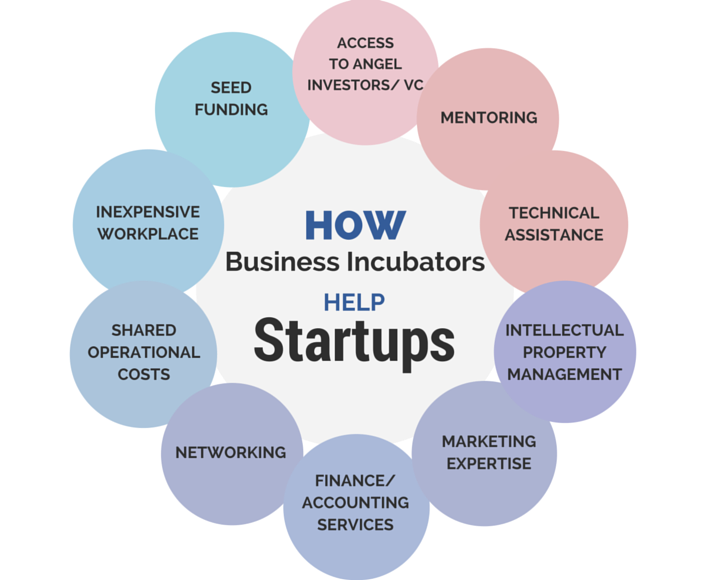
An incubator is a company that helps startup companies to develop. They provide startups with services like management training and office space to develop. The primary focus of a business incubator is speeding the growth and success of startup companies.

Advantages Of An Incubator

The benefits of an incubator are:

  1. An incubator provides assistance in setting up a corporate legal structure.
  2. In an incubator-startup relationship, people exchange ideas and discuss the pros and cons of the business set up.entreprneurrship_101_incubator_homephoto
  3. As entrepreneurs run incubators, they can be very supportive mentors for a startup due to their knowledge and experience in the field.
  4. One of the biggest advantages of being a part of an incubator is that one can make a strong business network.
  5. Business incubators can introduce entrepreneurs to bankers, lawyers and venture capitalists who can be very helpful when it comes to financial and legal aspects of their business.
  6. Business incubators can provide entrepreneurs with office space and provide them with administrative and other support services.
  7. Some business incubators also have their own capital to invest in startup ventures.
  8. People who work at incubators are often described as team players.  If an entrepreneur is an introvert and has difficulty in communicating with others and public speaking, then an incubator will help him improve in these areas tremendously.
  9. The atmosphere at an incubator is encouraging as it is a host to several similar encouragement groups along with success stories.

Disadvantages Of An Incubator

The disadvantages of an incubator are:

  1. Some incubators place strict requirements on the Founder concerning their location for some period of time.
  2. Working with an incubator includes high pressure. If one does not have a habit of working in high pressure and dealing with criticism working with an incubator can be a problem.know-how-business-incubator-can-help-launch-blog-image-2
  3. Incubators tend to favor the younger people more than older people. One of the reasons for the same is because they are more affluent and they possibly already have an extensive network around them, and they are likely to be interested in starting up companies that require longer runway or capital.
  4. If an outsider is investing money along with your money there comes, a responsibility on the incubator and not everyone has the ability to manage funds.
  5. Incubators will be shareholders in your company this means that they will take 2-10% of the stock of the companies.
  6. Working with a third-party is not easy. Therefore, working with an incubator will take the time that you could spend working on your project.

What Clauses Should You Check While Joining An Incubator?

Not all incubators are the same it is therefore very important to do your research well on what the incubator is likely to offer? What are your own requirements? What is the kind of investment that is involved while joining an incubator? And most importantly, whether the whole package is meeting the needs of your company or not. It is important to look at the fact that does the incubator have experienced mentors that will be beneficial for your startup. The location of an incubator should be such that it suits your requirement as it will make it easier to work together.

Consulting an alumni who have already worked with an incubator is always beneficial. Therefore, one must rate their experience with the incubator so that one gets a better idea while making a choice.

Incubators that have invested in startups as expected they should be informed about the significant activities that have been executed by the startup. These activities will include financing, acquisition offers, and periodic financial reports of the company’s performance. Incubators may require the startup to obtain written consent from them before entering into critical transactions for example selling the company, issuing securities to employees.safeman_business

Incubators would include anti-dilution right and thus by this kind of right the shares which have been issued to them cannot be diluted until the priced financing is obtained where the company issues preferred stock.

Preemptive rights are the rights which allow incubators to purchase their proportional share in future funding. This means that if they own 5% of the company at the time of signing the agreement they can take 5% of the company’s future financings as long as they are willing to pay whatever is set in that round. Along with anti-dilution rights and preemptive rights, the incubators with strong investor component will include some additional form of investment rights so that they may be capable of purchasing an additional fixed amount of securities at a later date while they also insure that they maintain their ownership percentage. Marketing terms should be clear for the purpose of the public image of a startup. Incubators which have diverse expert panels are likely to have the terms inclined to their interests.

Along with all the above rights confidentiality rights are also   Included which means a mutual responsibility and an obligation to keep the information exchanged between both the parties confidential. The startup must ensure that the terms of confidentiality are understood well by them, as many times it is the idea on which the startup work once they enter an incubator.


Conclusion

The concept of incubators is quite interesting, and the chances of success of a startup are high as incubators have entrepreneurs who are very well experienced. Incubators provide startups with financial, marketing, legal services and along with that there is an advantage of expanding business network which is very important for the success of a company. In a startup-incubator relationship, the terms and conditions should be specified at the beginning which will be beneficial for both the startup and the incubator and further it will avoid any misunderstanding.

If startups take the criticism of incubators in a positive sense, the startup-incubator relationship can be very successful.


 [divider]

BIBLIOGRAPHY

http://www.fastcompany.com/3027636/4-major-benefits-of-startup-incubators

https://www.allbusiness.com/startup-benefit-business-incubator-19567-1.html

http://thenextweb.com/entrepreneur/2011/04/04/the-pros-and-cons-of-joining-a-start-up-incubator/#gref

https://www.entrepreneur.com/article/235980

http://blog.ipleaders.in/clauses-check-joining-incubator/


Download Now

Shivam Dubey, legal executive at Cyril Amarchand Mangaldas, on how an online diploma from NUJS gave him the much needed practical knowledge

1

photo

Shivam Dubey is a legal executive with Cyril Amarchand Mangaldas; Mumbai and is currently looking after general corporate law. Prior to this, he has worked as a legal intern at Nishith Desai associates, Bangalore. He has also interned with many prestigious organizations like A&Z partners, J Sagar associates, Fox Mandal etc. He has done is B.A LLB (Hons) from School of Law, Christ University, Bangalore. He has several publications to his credit. He has even contributed to the iPleaders blog. Apart from a corporate law career, he is passionate about social causes. He has volunteered with Shaktishali Mahila Sangathan Samiti or SMSS, an NGO in Madhya Pradesh which works for the upliftment of backward and marginalized sections of the society like children, women, sehriya tribes, minorities, disabled, etc.

He completed the NUJS Diploma in Entrepreneurship Administration and Business Laws in 2014. We asked him about his experience with the course and he had many good things to share about. So we decided to share it with you all as a success story. Over to Shivam:

I joined the NUJS diploma in Entrepreneurship Administration and Business Laws while I was in the third year of my law school. I got to know about this course through a friend of mine. He told me that it’s a very practical course and covers aspects which are not covered in law school. When I browsed through the website, I found the course syllabus and curriculum to be very well structured.

My purpose of joining the course is certainly fulfilled; it has given me the much needed practical knowledge of law.

All modules in the course are designed with emphases on practical knowledge. The concepts are not explained theoretically but in a practical manner. I personally found the module on business structuring, institutional finance, and raising investment to be most beneficial for me. I am able to utilize this knowledge in my current job also.

I learnt drafting and documentation to a great extent from this course. What is the exact format, what all points to cover, what sort of agreement should be covered in a corporate transaction, details like this provided in the course are very practical and handy.

My future plan is to have a career in corporate law only and in future, I want to be a partner at a reputed law firm. The skills that I adopted from this course are commendable. I feel that the knowledge gained from this course would come handy then also.

I have mentioned the diploma in my CV and LinkedIn profile. I was also asked questions about this course during my interview for the current job. I believe this adds value to my profile.

I have already recommended this course to several persons and will continue to recommend it to others. I feel this course is very beneficial for people from a legal background and for MBAs as they also require the basic knowledge of business laws.

Download Now

States In Which The MSMED Facilitation Is Operational

1

In this blog post, Nitin Jeswani, a student of National Law University, Odisha and pursuing a Diploma in Entrepreneurship Administration and Business Laws from NUJS, Kolkata, analyses the operationality of MSMED Facilitation in different States. 

AAEAAQAAAAAAAATfAAAAJGZkYjdhMDAxLTdlM2YtNDBiNy1iMzYzLTY4OTllM2JiMTM4NA


Introduction

The Late Prime Minister Pandit Jawaharlal Nehru was mainly responsible for initiating the development of the MSMEs sector. It was his vision which sought to develop the core industry and have a supporting sector in the form of small-scale enterprises.[1]MSME-e1452579997430

The MSMEs, i.e., the Micro, Small and Medium Enterprises are considered to be  instruments for economic growth and are held responsible for promoting evenhanded development all over the world. In most of the economies of the world these MSMEs constitute about 90% of the total enterprises, they have a major share in exports and industrial production and are often given credit for creating a very high rate of employment growth.[2] The role of MSMEs in India is vital in boosting the overall industrial economy. For this our legislators have enacted a piece of legislation namely, ‘The Micro, Small and Medium Enterprises Development Act, 2006’ which mainly focuses on the promotion, development, and enhancement of the competitiveness of Micro, Small and Medium Enterprises. “It is estimated that in terms of value, the sector measures up to 39 percent of the manufacturing output and around 33 percent of the total export of the country.”[3]


MSME Facilitation Council

The Micro, Small and Medium Enterprises Development Act, 2006 talks about the facilitation MSME-Textilecouncil. Section 18 of the Act refers to facilitation councils, wherein it clearly conveys that if any dispute regarding the amount due for any goods supplied or services rendered by the supplier under the provisions of the Act would be referred to the Micro and Small Enterprises Facilitation Council.[4]

Section 20 of the said Act authorizes the state governments to establish one or more Facilitation Councils through notifications defining their scope and jurisdiction.[5] States tend to establish the councils in accordance with the provisions of the Micro, Small and Medium Enterprises Development Act with the same intent as provided in the act.


Importance of MSME Facilitation Council

The MSMED Act mainly focuses on the welfare and protection of the micro, small and medium industries and for this it provides a lot of facilities.  The Facilitation Council is one such facility and it acts as an instrument of alternate dispute resolution. “The Council acts as a Conciliator or Arbitrator for final settlement of the outstanding dues between the parties and meets once in a month (which depends on state to state). Every petitioner units have to submit their application in the prescribed format and in a form to the Council for the realization of outstanding dues from the buyer units’ act.”[6]msme-worker-23-6-14

The intention behind the setting up these councils was to provide an instrument of arbitration so as to facilitate trade and commerce and to bring in a body that can resolve the disputes arising in relation to these industries and thus making them function properly.[7] The aim is to save precious time and money by preventing the industries from being subjected to prolonged court proceedings.[8]

The major problem faced by the MSMEs is the delayed payment made by the buyer to the supplier. These suppliers are usually small traders who require liquidity to run their business but delayed payments hinder the liquidity. To deal with the said problem these Facilitation Councils were established so that these traders could get their payments as soon as possible.


Status of MSME Facilitation Council in Different States

TH27_SMALL_UNIT_2024639f“Out of 29 states and 7 union territories, there are only 14 states in which these Facilitation councils are functioning that to just on paper. In the states of Haryana and Jammu & Kashmir and in Andaman & Nicobar, there is no such concept of MSME Facilitation Council. In the remaining states and union territories, the constitutionality and functionality of these Facilitation Council is still due (in about 19 states). In states like Gujarat and Odisha, proper meetings of these councils are not held which show that these councils are functioning only on paper. In the states of Gujarat, Haryana, Himachal Pradesh and Punjab there are very few cases that are registered with the council”[9] which shows a major fault in their functioning.

The number of sick MSMEs is increasing drastically as the pattern of this increase can be seen through the yearly reports of RBI. The improper functioning of these Facilitation Councils is a major cause for this increasing number.


Conclusion

One of the major proportions of the GDP of India is of the MSMEs. These industries have a major share in the Indian economy and can contribute even more if the different State Governments of India take adequate steps in the proper functioning of the facilitation councils. These councils were established with very appropriate intentions due to the ignorance of different State Governments the intent behind their establishment is defeated. If the Government of different States don’t take proper steps soon, the number of sick industries will increase which will greatly affect the Indian Economy. The problem of delayed payment is increasing drastically forcing these industries to shut down as it is very difficult for them to cope up as liquidity in business is very vital to them.


[divider]

References:

[1]ChakravarthiAnand, Dr. RaoBallaAppa, Indian Journals.com, Role of MSMEs in Economic Growth of India, http://www.indianjournals.com/ijor.aspx?target=ijor:xijmms&volume=5&issue=8&article=008, Online ISSN : 2249-8834, 22 January, 2016.

[2]Venkatesh, J; Kumari, R Lavanya. International Journal of Entrepreneurship & Business Environment, ROLE OF INDIAN MICRO, SMALL AND MEDIUM ENTERPRISE’S DEVELOPMENT: A BANKING PERSPECTIVE, http://search.proquest.com/openview/f6ec556bf8c704787848225f60be543b/1?pq-origsite=gscholar, ISSN (Print):2279-0918, (Online):2279-0926, Vol. 3, 2014

[3] Ibid.

[4] Section 18, The Micro, Small and Medium Enterprises Development Act, 2006.

[5] Section 20, The Micro, Small and Medium Enterprises Development Act, 2006.

[6]Directorate of Micro, Small and Medium enterprises, http://mssewb.gov.in/facilitation.

[7]Apporv Singh, Importance of MSME Facilitation Councils, IPLEADERS, http://blog.ipleaders.in/collapse-of-industries-despite-the-presence-of-msmed-act-msmed-act-failure-of-msmed-act/, January 2016.

[8] Ibid.

[9] Status of the “Cases of Delayed Payment” filed in respective Micro and Small Enterprise Facilitation Councils of all States/UT as on date, DEVELOPMENT COMMISSIONER (MSME) MINISTRY OF MICRO, SMALL & MEDIUM ENTERPRISES, http://www.dcmsme.gov.in/publications/msefcStatus.htm.


Download Now

Online Registration Under The MSMED Act

2

In this blog post, Virgil Braganza, a student of ICFAI Law School, Hyderabad, who is currently pursuing a Diploma in Entrepreneurship Administration and Business Laws from NUJS, Kolkata, discusses the procedure for online registration under the MSMED Act.

IMG_12367519615856

Background

“MSME stands for micro, small and medium enterprises and any enterprise that falls under any of these three categories. MSME enterprises are the backbone of any economy and are an engine of economic growth, promoting equitable development for all. Therefore, to support and promote MSMEs, the Government of India through various subsidies, schemes and incentives promotes MSMEs through the Micro Small Medium Enterprises Development Act. To avail the benefits under the MSMED Act from Central or State Government and the Banking Sector, MSME Registration is required.”[1]


Scheme of the Act

msmed

The Micro, Small and Medium Enterprises Development Act, 2006, most commonly known as the MSMED Act was aimed at helping and developing early stage businesses and start ups. Now the first thing to understand here is what micro, small and medium enterprises are.

As per the Definitions of Micro, Small and Medium Enterprises, manufacturing enterprise is defined as the enterprise engaged in the manufacture of production of goods pertaining to any industry specified in the first schedule to the (Industries Development and Regulation Act, 1951). The Manufacturing Enterprises are defined in terms of investment in Plant and Machinery.[2]

Meanwhile, service sector is defined as the enterprises engaged in providing or rendering of services defined in terms of investment and are in equipment.[3]

The MSMED Act was framed with the following objectives

  • To enhance the competitiveness of MSM enterprises
  • To facilitate the promotion and development of micro, small and medium scale enterprises (MSM enterprises)
  • To concentrate on the related matters of MSM enterprises
  • To extend the scope of benefits from SSI undertaking and ancillary industries to MSM enterprises.[4]

The benefits to Micro and Small Enterprises under the MSMED Act


  1. Protection against delay in payment from buyers and right of interest on delayed payment

The MSMED Act contains provisions that impose severe disadvantages for delay or non-payment of bills – which can be strategically very useful for registered startups/SMEs in recovering their payments on time. The two features are “Payment of compound interest at thrice the bank rate” and “Interest for delay to MSME cannot be deducted from income of customer”.

2. Preference in procuring Government tenders

In March 2012, the Central Government released a policy (SME Procurement Policy) stating that it would reserve a minimum of 20 percent of its procurement requirements from micro and small enterprises registered under the MSMED Act. The reservation requirement will be mandatorily applicable to all Central Government ministries, departments and public sector undertakings controlled by it (collectively referred to as the Central Government Entities) from 1st April, 2015, but Government departments have already started making arrangements to source from SMEs.

3. Time-bound resolution of disputes with buyers through conciliation and arbitration

Registered MSMEs have an easy dispute resolution method with respect to non-payment and interest related matters as well. MSMEs can make a reference of such matters to a Micro and Small Enterprises Facilitation Council created under the Act. The Council is required to first attempt to assist the parties to resolve the dispute through a process known as ‘conciliation’. If conciliation is not successful, the Council can dispose the dispute through arbitration, by organizing arbitration itself or referring it to another arbitral institution. The provisions of the Arbitration and Conciliation Act, 1996 shall apply for the above purposes.


Few others are:

  1. Concession in electricity bills
  2. Reservation policies to manufacturing / production sector enterprises
  3. Stamp duty and Octroi Benefits
  4. Reimbursement of ISO Certification Expenses
  5. Easy availability of finance from Banks, without collateral requirement


States in which online Registration under MSMED Act is permitted 

There are thirty districts in India in which online registration under the MSMED Act is provided. They are “Agartala (Tripura), Agra (Uttar Pradesh), Ahmedabad (Gujrat), Allahabad (Uttar Pradesh), Bangalore (Karnataka), Chennai (Tamil Nadu), Cuttack (Odhisa), Gangtok (Sikkim), Goa, Guwahati (Assam), Haldwani (Uttarakhand), Hubli (Karnataka), Hyderabad (Telangana), Imphal (Manipur), Indore (Madhya Pradesh), Jaipur (Rajasthan), Jammu-Tawi (Jammu and Kashmir), Kanpur (Uttar Pradesh), Karnal (Haryana), Kolkata (West Bengal), Ludhiana (Punjab), Mumbai (Maharashtra), Muzaffarpur (Bihar), Nagpur (Maharashtra), New Delhi, Patna (Bihar), Raipur (Chhattisgarh), Ranchi (Jharkhand), Solan (Himachal Pradesh), Thrissur (Kerala).”[1]

There are twenty-two states in Indian and two union territories that provide online registration under the MSMED Act for Micro, Small Medium Enterprises.


Udyog Aadhaar for MSME

160105092

“The process of obtaining MSME registration will be simplified by the introduction of the Udyog Aadhaar for MSME in India. Prior to the introduction of the Udyog Aadhaar, to obtain MSME or SSI Registration, two filings namely, Entrepreneur Memorandum-I (EM-I) and Entrepreneur Memorandum-II (EM-II) had to be filed. With the introduction of Udyog Aadhaar, the process of obtaining SSI or MSME registration has been drastically simplified.”[6]

The online Udyog Aadhar registration process has been created with an aim to encourage online filing of Entrepreneurs Memorandum (also known as MSME registration) for Micro, Small and Medium Enterprises. The online Udyog Aadhar registration process will simplify the registration process with an online and simple one page registration form. In the form, the MSME will self certify its existence, bank account, business activity details, employment and ownership details and other information.


Documents and information required for online Udyog Aadhar registration

  • Aadhar Number – 12 digit Aadhar number issued to the applicant should be filled in the appropriate field.
  • Name of Owner – The applicant should fill his/her name strictly as mentioned on the Aadhar Card issued by UIDAI. For example, if Raj Pal Singh has his name as Raj P. Singh, the same should accordingly be entered, if the name does not match with the Aadhar number, the applicant will not be able to fill the form further.
  • Social Category – Applicant’s Caste: General/Schedule Caste/Schedule Tribe/ Other Backward Castes. The proof of belonging to SC, ST or OBC may be asked by appropriate authority, if and when required.
  • Name of Enterprise – Name of the legal entity to conduct business. One applicant can have more than one enterprise doing business and each one can be registered for a separate Udyog Aadhar and with the same Aadhar number.
  • Type of Organisation – Type of Business entity or Legal entity.
  1. Proprietorship
  2. Partnership Firm
  3. Hindu Undivided Family
  4. Private Limited Company
  5. Co-Operative
  6. Public Limited Company
  7. Self Help Group
  8. Others (Limited Liability Partnership)
  • Postal Address – Address of the business including mobile and email address.
  • Date of Commencement – The date on which business was started
  • Previous Registration Details – Details of previous MSME registration, if applicable should be entered here.
  • Bank Details – Details of bank account of the company including IFSC Code and Bank Account Number.
  • Major Activity – Major area of activity of the business – manufacturing or service.
  • NIC Code – The appropriate NIC Code should be entered from the National Institute Classification (NIC) handbook.
  • Person employed – The total number of people employed in the business.
  • Investment in Plant & Machinery/Equipment – Amount of money invested in terms of machinery and equipment by the business.
  • DIC – Details of the District Industry Center nearest to the business, if required. (The list of DI’s has been provided above).

The steps are more or less the same in every state since the online Udyog Aadhar form is a standard form across India.


Conclusion

The growth of Micro, Small and Medium Enterprises in India has lead to the formation of certain rules and enactments, MSMED Act being one of them. Ever since the enactment of the Act, there have been several amendments for the benefit of the Micro, Small and Medium Enterprises in India. Registering under the MSMED Act is not a mandatory duty. However, it is highly advisable to do so. The enterprises registered under the Act avail a lot of benefits as mentioned above and they are not entitled to them if they haven’t registered. Earlier, there were two Enterprise Memorandum forms. Now they have been replaced by one simple Udyog Aadhar form. Udyog Aadhar is only for running units. There is no need to apply for upcoming units.[7] The government has taken drastic steps to help the Micro, Small and Medium Enterprises. This has encouraged a lot of entrepreneurs to set up their enterprise and has in turn also helped the economy grow.

Footnotes:

[1] MSME Registration, indiafiling ,http://www.indiafilings.com/msme-registration.php# , (last visited on 26th May, 2016).

[2] Definitions of Micro, Small and Medium Enterprises, http://msmehyd.ap.nic.in/Definitions.htm , (last visited on 25th May, 2016).

[3] Ibid.

[4]Programmes for MSME, http://msme.gov.in/WriteReadData/Whatsnew/Programees%20for%20MSME%20Final%20Title.pdf , (last visited on 28th May, 2016).

[5]Websites and Email IDs of all MSME DIs, http://dcmsme.gov.in/msme-do/MSMEdi.pdf, (last visited on 27th May, 2016).

[6]UdyorAadhaar for MSMEs, http://www.indiafilings.com/learn/udyog-aadhaar-for-msmes/ , (last visited on 26th May, 2016).

[7]UdyogAadhar Registration, udyogaadhar.gov.in, http://udyogaadhaar.gov.in/UA/UdyogAadhar-New.aspx, (last visited on 27th May, 2016).

Download Now

Why Is Google Headquartered In Ireland?

1

In this blog post, Sucharita Ghosh, a student of Surendranath Law College, University of Calcutta, Kolkata, who is currently pursuing a  Diploma in Entrepreneurship Administration and Business Laws from NUJS, Kolkata deliberates on a very interesting question, which is ‘why is Google headquartered in Ireland?’ 

1470584951689

The term “to Google” is so popular these days that the company is actually worried about losing its trademark rights if the term becomes so  generic like ‘Escalator’ and ‘zipper’ which were once trademarked.

Now -a-days, Google is almost synonymous with internet. We can’t even imagine our life without it. Everyone from 8 to 80 use the services provided by Google such as Google search, Google Chrome, YouTube, Hangout, Gmail, Google +, Google Docs, Android OS and many more. Years after years Google has developed enough online applications for its users to enable them to do anything they need only using Google. It has become our collective mental crutch. Google has allowed us to travel the globe within seconds and access a plethora of information from our desk. Presently, Google is undoubtedly the most popular and exciting company in the world today.

google-headquarters

The company Google.Inc is an American multinational technology company specializing in Internet-related services and products. These include online advertising technologies, search, cloud computing, software, email services, social networking services, photo editing applications, instant messaging, video chat etc. The company Google.Inc began in 1996 as the brainchild of Sergey Brin and Larry Page, two Ph.D. students of Stanford University with the aim to organize the world’s information. They incorporated Google as a private company on September 4, 1998. The Initial public offerings followed on August 19, 2004. Its outset was “to organize world’s information and make it universally accessible and useful” and its unofficial slogan was “don’t be the evil”

 This company established their main headquarter in Mountain View, California, nicknamed the Googleplex. Around the world, Google has many offices in many countries. It operates from 70 offices in more than 40 countries. Google’s European headquarter is in Ireland. It established their head-office at Dublin.

Ireland is the most attractive European business hub. Not only Google but many large companies like Apple, Facebook, Twitter, LinkedIn, Microsoft, Yahoo etc. have established their head-office there. Statistics shows that

  • 9 out of 10 world-leading technology and internet companies,
  • 8 out of 10 leading online game companies and platforms,
  • 8 out of 10 world-leading Pharmaceutical companies,
  • 15 of the top 20 world-leading Life Science companies,
  • Over 50% of the world’s leading Financial Services firms have established their head office there.

Google has several reasons to choose Ireland for setting up headquarters there. This company is not only famous for finding information, but also for its brilliant business strategies. The main reason behind choosing Ireland as headquarter is the low tax rate.


Lowest tax rate

The company Google is exceptionally efficient in their tax management system. The company is earning billions of profit by using tax avoidance strategies.The corporate tax in Ireland is only 12.5%, which is less than half of the current UK level of 28% and US 35%, which help them to earn more profits by paying small income tax.

They have adopted various strategies to reduce tax.  Google is using strategies known as “Double Irish Arrangement” And “Double Irish with Dutch Sandwich”.


Double Irish Arrangement

The double Irish arrangement is a tax strategy that some multinational corporations used to lower their corporate tax liabilities. This strategy used payments between two related entities in a corporate structure to move income from a higher-tax country to a lower tax jurisdiction. It relies on the fact that Irish tax law does not include transfer pricing rule as does the United States and those of many other jurisdictions. Specifically, Ireland has territorial taxation, and does not levy taxes on income booked in subsidiaries of Irish companies that are outside the state. But now, the Irish government has shutdown the shelter for the new companies in 2015, though those already engaging in the arrangement have until 2020 to find another arrangement.


Double Irish with Dutch Sandwich
Double Irishi

Google is adding another technique to further reduce their tax burden, which is known as ‘Dutch sandwich’ to the tax lawyers.

This ‘double Irish with Dutch Sandwich’ is a tax avoidance technique involving the use of a combination of Irish and Dutch subsidiary companies to shift their profits to low or no tax jurisdiction. It involves sending profits first through one Irish company, then to a Dutch company and finally to a second Irish company headquartered   in ‘Tax Heaven’.

So, now let’s see what is Tax Heaven?

A tax heaven is a jurisdiction where particular taxes, such as an inherence or income tax are levied at a low rate or not at all. If the taxes are paid in the tax heaven jurisdiction, companies can avoid taxes in their home jurisdiction because the tax has already been paid in the lower tax rate jurisdiction. Tax heaven maintain secrecy by avoiding public disclosure of financial statement to foreign tax authorities.


How Google is avoiding billions of taxes?

With the help of above discussed techniques, Google is escaping from paying lump sum amount of taxes, which are helping them to reduce tax up to 90%.

Let’s discuss how it works.

643bec98339f8d1ca242764d1ff5fede

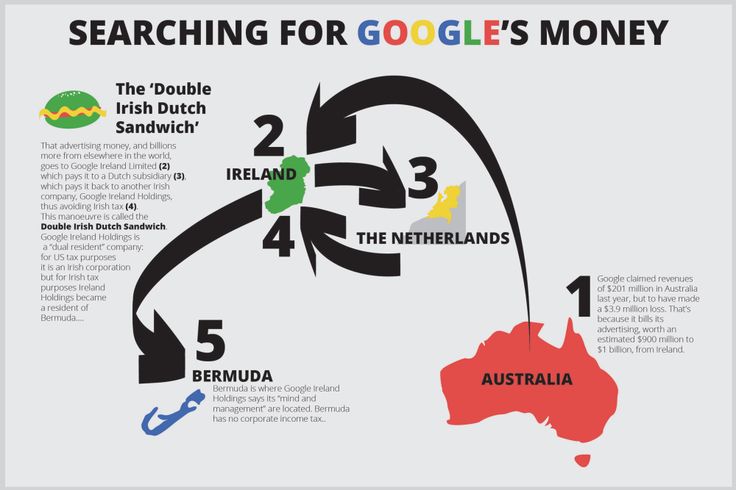
Google opened a large office in Ireland called Google Ireland Ltd. It is not a pure empty shell company. Near about 2000 people work on that company. Google has another subsidiary called Google Ireland Holding. It has no physical office. The company is fully managed from Bermuda, a well-known tax heaven, where tax rate is 1%. Google licenses intellectual property such as internal property, brands, names, technology and patent rights etc. to this Irish company for a small fee. Google’s another subsidiary company, Google Ireland Ltd. is created with 88% of Google’s overseas revenue, yet this company pays taxes of less than 1% because it pays several billion dollars annually back to Google Ireland Holding in royalty payments. It may seem like Google is illegally avoiding Irish tax. That would be true if the payments remained within the boundaries of Ireland. But they don’t. Google Ireland Ltd. doesn’t pay Google Ireland Holding directly; rather it sends payment to another subsidiary Google Netherland Holdings BV, a company with no employees, and which exists only to accept these payments. Now, if the money stays in Netherlands, it would be taxed under Dutch rules. But, the brilliant tax management system of Google sends almost all its money from Google Netherlands holdings to Google Ireland holdings.

For example, a customer buys advertisement from Google USA. Then Google USA will pay to Google Ireland Holding for managing its intellectual property rights. Google Ireland holding then will send it to Google Ireland Ltd. This company will shift it to Google Netherlands BV and according to Dutch laws, its money holding will be paid back again to Google Ireland holding, which is totally managed from Bermuda, which located in the tax heaven.

In this way they are saving billions of taxes…

Not only tax reasons, there are many other reasons which led Google to select Ireland for establishing it’s headquarter. These are:


Irish weather

Though the low tax rate is the main reason, but the Irish weather is one of the key reasons for Google to choose Dublin as headquarter.  Ireland’s wet damp climate plays a significant role in helping keep energy cost for the company down. Google has managed to reduce the amount of the energy it uses worldwide to cool down its data system to just 12% of its energy bills. The chilly climate of Ireland makes the data processing center more energy efficient and hence greener to cool down its server.


Location

Location is another important reason why Google set up its headquarter outside US. Ireland is one of the most open and globally connected countries in the world. Dublin is considered to be an attractive location for multinational workforce as it is the key gateway to Europe, Middle East and the USA. This country is the closest EU country to USA. And it is very well connected to the US on a personal, business and political level.

Euro zone

Another advantage of the country, Ireland is it is a member of EU. It falls under the Euro zone, which is the most stable currency in the world.

Young, talented multilingual workforce

One of the many reasons companies choose to locate in Ireland is the availability of a well-educated, young, English-speaking workforce who have a positive can-do attitude and a strong commitment towards excellence and teamwork. Ireland has the youngest workforce in Europe, with 35% under 25 years of age. Combined with the indigenous workforce these ‘new Irish’ ensure a plentiful supply of highly qualified workers with excellent technical, flexible and customer service capabilities. This country stood well in terms of availability of skilled labour and openness to new ideas.

Not only that, Dublin has hospitality in its DNA. The city has a reputation for being one of the most hospitable and friendliest places in the world. This city offers a great quality of life too. It has very supportive regulatory environment. Research & Development support, weak IP and Tax Laws, availability of government subsidies, all attributes has made Google choose this city.

In conclusion, it will not be unjust to say that, not just one, but there are several reasons for big companies like Google to choose Ireland for setting up their head office outside US. From this above discussion we can find the key reasons behind shifting Google’s headquarter in Ireland.

References

https://en.wikipedia.org/wiki/Google

https://en.wikipedia.org/wiki/Tax_haven

https://en.wikipedia.org/wiki/Double_Irish_arrangement

https://www.quora.com/Why-have-Google-and-Facebook-chosen-Dublin-for-their-European-headquarters

http://www.irishcentral.com/news/irish-weather-is-a-key-reason-why-google-moved-their-hq-there-184668471-237555171.html

https://www.enterprise-ireland.com/en/Start-a-Business-in-Ireland/Startups-from-Outside-Ireland/Why-Locate-in-Ireland-/Six-Reasons-Your-Start-Up-Should-be-in-Ireland.pdf

http://www.bloomberg.com/news/articles/2010-10-21/the-tax-haven-thats-saving-google-billions

http://www.forbes.com/sites/taxanalysts/2013/11/06/if-ireland-is-not-a-tax-haven-what-is-it/#6164916d3355

https://www.theguardian.com/business/ireland-business-blog-with-lisa-ocarroll/2011/mar/24/google-ireland-tax-reasons-bermuda

http://thenextweb.com/insider/2011/11/26/what-attracts-big-tech-companies-to-ireland-hint-its-not-just-low-taxes/


Download Now
logo
FREE & ONLINE 3-Day Bootcamp (LIVE only) on

How Can Experienced Professionals Become Independent Directors

calender
28th, 29th Mar, 2026, 2 - 5pm (IST) &
30th Mar, 2026, 7 - 10pm (IST).
Bootcamp starting in
Days
HRS
MIN
SEC
Abhyuday AgarwalCOO & CO-Founder, LawSikho

Register now

Abhyuday AgarwalCOO & CO-Founder, LawSikho