Download Now
Home Blog Page 1707

Annual Compliance Of A Private Trust In India

1

In this blog post, Varun Chauhan, an Associate at Dhir and Dhir Associates in the Project Finance Team, New Delhi with the Corporate Advisory and Loan Structuring Team who is currently pursuing a  Diploma in Entrepreneurship Administration and Business Laws from NUJS, Kolkata, writes about private trust in details and then goes on to elaborate on the annual compliance of a private trust in India. 

IMG-20160807-WA0000

Charitable organizations in India can be structured and incorporated as one of the following three forms:

  1. Trust
  2. Society
  3. Non-Profit Company under Section 8, The Indian Companies Act, 2013 (erstwhile Section 25 Company under The Indian Companies Act, 1956)

This article will discuss the first form, i.e. ‘Trust’ and more specifically a Private Trust, in detail, its types, formation, requirements, objective and annual compliance.

trust (1)

Trust is defined under Section 3 of the Indian Trusts Act, 1882, as “An obligation annexed to the ownership of property, and arising out of a confidence reposed in and accepted by the owner, or declared and accepted by him, for the benefit of another, or of another and the owner.”

A Trust is a kind of arrangement which originates from a settlement between the Settlor/Author (owner of the property) and the Trustee (the transferee) for the beneficial interest of a third person called Beneficiary. This arrangement relates to the administration of property which is known as Trust Property for the benefit and enjoyment of the Beneficiary of the Trust. This arrangement gives rise to the concept of split-ownership[1] where the Trustee becomes the legal owner and the Beneficiary becomes the beneficial owner.

A Trust Property can be movable and immovable and the Settlor/Author of the Trust Property can create/declare a Trust during his lifetime (inter vivos declaration) or even after his death through a will.

An Author can be anyone who is not legally insane or of unsound mind. But in case of a minor, permission from the court is required for him to be an Author. On the other hand, a minor can’t become a Trustee as he is incapable of effecting contracts on behalf of the Beneficiary.

As already mentioned, a Trust is created for the beneficial interest of the Beneficiary. We can broadly classify trusts into two categories on this basis:

  1. Private Trusts
  2. Public Trusts

Where the Trust is created for the benefit of a specified person or class of persons, it is known as a Private Trust. On the contrary, where the Trust Property is administered for the benefit/enjoyment of general public or a fluctuating class of persons and not just limited to a selective group, it is known as a Public Trust. As such, a Private Trust need not be charitable or religious in nature as opposed to a Public Trust.

Private Trusts are governed by The Indian Trusts Act, 1882 and when it is created by a will, it shall be subject to the provisions of The India Succession Act, 1925.

In case of a movable Trust Property, there is no need to execute a written document between the Settlor/Author and the Trustee and mere transfer of such property, coupled with the declaration to that effect, denotes a valid Trust arrangement. Whereas a written Trust Deed needs to be executed on a non-judicial stamp paper of reasonable value (as per the State laws) and it should be signed by the Settlor/Author and the Trustee.

A Private Trust which is created or declared inter vivos needs to be registered under the provisions of the Registration Act, 1908, provided the trust property is immovable. There is no requirement under law to register a Private Trust created through the will of a deceased person. Also, unlike the Public Trusts, a Private Trust is not granted any exemptions under the Income Tax Act, 1961, though the trustee is liable to file annual tax return as per the provisions of the said Act.

In view of the discussion herein above, there are following requirements for creation of a valid Private Trust in India:

  1. Settlor/Author: A person who is the owner of a property and wants to create a Trust for benefit of a particular person or group of persons.
  1. Trustee: A person in whose favour the Trust Property is bequeathed upon by the Settlor/Author and a Trust is created by declaration inter vivos or by a will.
  1. Beneficiary: The person or class/group of specified persons for whose beneficial interest the Trust is created.
  1. Objective: Any Trust is created with a particular objective. Such objective should be stated clearly under the terms of a Trust Deed or verbally when there is no Trust Deed.
  1. Trust Property: There must be property (movable/immovable) which the Settlor wants to bequeath upon the Trustee for creation of a Trust.
  1. Trust Deed: A written document which is duly signed by the Settlor/Author and the Trustee, specifying the Objective and Beneficiary of the Trust so created.

Such Trust Deed is not required where:

  1. the Trust Property is movable and;
  2. the Trust is created through a will.
  1. PAN: For the Trustee to pay tax on behalf of the Beneficiary(ies), it is required to apply for a Permanent Account Number (PAN). The application should be made before the Assessing Officer, in duplicate, in Form No. 49A.
  1. TAN: If the Trust needs to deduct tax at source for its employees or other staff engaged to manage or administer Trust Property, then it needs to apply for Tax deduction Account Number (TAN) before the Assessing Officer, in duplicate, in Form No. 49B.
  1. FCRA Registration: Every Trust needs to apply for registration under Section 6(1), Foreign Contribution (Regulation) Act, 2010 (“FCRA”), if it is desirous of accepting donations from foreign sources.
  1. Separate account for Foreign Contributions (FC A/c): If the Trust wants to receive foreign donations and is registered under FCRA, it needs to open a separate account for this specific purpose.
  1. Separate set of records for foreign contributions: Every organisation/individual needs to maintain separate set of records exclusively for the receipt and utilization of foreign donations/contributions.
  1. Approval from RBI: In case where the beneficiary is a non resident, prior approval from RBI is required to that effect.
  1. TIN Registration: If a Private Trust deals with the trading and manufacturing of goods and services, even when the motive is not to earn profit, it needs to apply for Taxpayer Identification Number (TIN) before the Excise and Taxation Department of its respective State. Such TIN is used for filing VAT and Service Tax Return subsequently.

After formation of the Private Trust, it needs to comply with the following under various laws like The Indian Trusts Act,1882, The Income Tax Act, 1961, FCRA, Central Sales Tax Act, etc. and various State legislation:

Compliance

  1. Compulsory Audit of Accounts

When the total income of a Private Trust exceeds the limit given under the Income Tax Act, 1961 for non-taxable income (Rs. 1,50,000 for FY 2016-17), it should be compulsorily audited by a Chartered Accountant.


  1. Annual Return of Income

After the accounts of the Trust are being audited by the Chartered Accountant, the audit report should be filed along with the Annual Return of income under Form ITR-7 on or before the due date.

  1. Report of Foreign Contributions

Every Trust which receives foreign contributions needs to submit a report, duly certified by a Chartered Accountant and accompanied by an Income and Expenditure Statement, Receipts and Payments Account and Balance Sheet within 9 months of the closure of the financial year, to the Secretary, Ministry of Home Affairs, Government of India, New Delhi. A ‘Nil’ Report needs to be submitted if no such contribution is received during the last financial year.

  1. Submission of Annual Account Statement of FC A/c

Duly certified copy of the Account Statement of FC A/c needs to be furnished within 9 months of the closure of financial year along with Report mentioned above in point 3.

  1. Issue of Certificate of TDS

Where any Private Trust is deducting tax at source for payment of salaries to the staff or employees (kept for managing the Trust Property), it needs to furnish certificates of TDS to the persons on whose behalf TDS was being collected. It should be done within 1 month from the date of closure of the financial year.

  1. Publication of Accounts in newspaper

Where annual income or receipts of the Trust (generated from the Trust Property) exceeds Rs. 1,00,00,000 (INR One Crore).

  1. Filing VAT and Service Tax Return

If the gross turnover of a Private Trust exceeds Rs. 15,00,000 (INR 15 Lakhs)[2] , it is liable to file VAT and Service Tax Return in the prescribed format. VAT is to be deposited in every three months. The procedure to file Service Tax and VAT Return can be accessed through link given in the footnote no. 3.[3]

Footnotes:

[1] Article titled ‘FEMA aspects of Private Trusts’, can be reached at: http://www.rashminsanghvi.com/downloads/foreign_exchange_law/FEMA/FEMA%20aspects%20of%20private%20trusts.htm , last viewed on May 15, 2016.

[2] Article titled ‘A brief on VAT’, can be reached at: http://ctax.kar.nic.in/what_vat/About%20vat%20nnew.pdf , last viewed on May 20, 2016.

[3] Procedure for filing VAT and Service Tax: http://www.svtuition.org/2013/01/procedure-of-filing-vat-return.html


Download Now

An Overview On Private Trust In India

2

In this blog post, Shruti Sharma, a Legal Associate at BetterPlace Safety Solutions Pvt. Ltd. who is currently pursuing a  Diploma in Entrepreneurship Administration and Business Laws from NUJS, Kolkata, gives a brief overview on how to start a private trust in India. 

Capture1

Trusts are being formed for the various purposes and can prove to be an effective vehicle for succession and for estate planning. Private trusts are governed by Indian Trust Act, 1882 which is applicable to the whole of India excluding the States of Jammu and Kashmir and the Andaman and Nicobar Islands. Moreover, this Act doesn’t apply to Waqf, Hindu Undivided Family, charitable endowments, etc.


Introduction

The concept of “Trust” can be traced back to the ancient times when human used to set up Dharamshalas, medical institutions and educational institutions, construct water tanks and bathing ghats, plant trees etc. but later on with the advent of new era, the concept of “trust” emerged for various reasons.


Definition of trust

Trust

The word “Trust” has been defined under Section 3 of the Trust Act ,1882 as “an obligation annexed to the ownership of property and arising out of a confidence reposed in and accepted by the owner, or declared and accepted by him, for the benefit of another or of another and the owner.” It means transfer of property by the owner to another for the benefit of third person along with himself.


Who can create a trust?

As per Section 7 of Indian Trusts Act, 1882, a trust may be created by the following:

  1. Every person competent to contract(as per Section 11 of Indian contract Act, 1872);
  2. By or on behalf of minor with the permission of a principal civil court of original jurisdiction;
  3. Hindu Undivided Family;
  4. Association of Persons (AOP);
  5. Company


Who can be appointed as a trustee?

Trustee_LgHP_011

A trustee can be a person:

  1. To whom the settlor has transferred his property;
  2. Competent to contract;
  3. Insolvent, minor or insane cannot be trustee;

A trustee should have a right to reject the trusteeship but if a person accepts trusteeship, he assumes all rights, duties and liabilities of a trustee.

https://lawsikho.com/course/diploma-entrepreneurship-administration-business-laws
Click Above

Responsibilities of a trustee

  1. Execute trust: He needs to execute a trust and is bound to fulfil the objectives of a trust by following the directions given by the author.

2. Protect title to trust property: He is bound to protect the title to the trust property by maintaining and defending suit. Moreover, he is required to take proper and reasonable steps to preserve the property and the title attached to it.

 3. Reasonable care: A reasonable care is expected from the trustee as a prudent man while dealing with the property. He should maintain and deal with the property as his own.

 4. Keep account and information: He needs to keep clear and proper/accurate account and information of the trust property. Moreover, he may ask the beneficiary to furnish complete and correct information relating to the amount and state of property at all reasonable times.

 5. To convert perishable property: Trustee needs to protect the property and if it is of perishable nature, to convert it into a permanent and profitable character.


 Who can be a beneficiary?

  1. Every person who can hold property;
  2. Company, corporation ;
  3. Unborn person;

beneficiary

Rights of a beneficiary:

  1. Rents and profits: Beneficiary has a right to the rents and profits of the trust property subject to trust instrument/deed.
  2. Execution of a trust: In case where no trustee is being appointed or their death, the beneficiary may file a suit for execution of the trust.
  3. Compel trustee: Beneficiary can compel the trustee to do a particular act or not to do an act to prevent breach of trust.


What is a private trust?

It is a trust created for the benefit of an Individual or a group of individuals or any legal person who is capable of holding property.


Different types of trusts

Basically there are two kinds of trusts in India Public and Private trust. The basic difference between the two is that in the former, the interest is vested in an uncertain and fluctuating body of persons whereas in the latter, beneficiaries are definite and ascertained individuals.

How to create private trust in India?

The instrument by which trust is declared is called instrument of Trust, and is generally known as Trust Deed.

Generally, there is no statutory requirement to create trust by any instrument. Various case laws have been decided in this regard. In the case of Radha Swami Satsung v. CIT, (1992) 193 ITR 321 (SC), it has been held that no formal document is required to create a trust but still it is desirable to create trust in writing in the case of will or where an immovable property is Rs 100 and upwards.

As per section 5 of the Indian Trusts Act, a private trust related to an immovable property must be created by a non-testamentary instrument in writing , signed by the author of the trust or the trustee and must be registered under Section 17 of Registration Act. Therefore, every non-testamentary instrument declaring trust must be registered. This registration will be mandatory even if the instrument declaring trust is exempted from registration under Registration Act, but a Private trust declared by a will does not require registration.

The following are the requisites for creation of trust:

  1. Declaration by the author/settlor of the Trust or someone on whose instance the trust comes into existence and such declaration must be unequivocal and binding on him.
  2. Transfer of ownership by the author of the trust to the trustee for the beneficial enjoyment by the beneficiary.
  3. Trust property.
  4. The purpose/object of the trust must be clearly and precisely specified.
  5. The beneficiary who may be particular person or persons.

As mentioned earlier, the settlor/author of the Trust and the trustee should be competent under Section 11 of the Contract Act and the trustee should also consent to make it a valid trust. Moreover, once a valid trust is created and property is transferred, it cannot be revoked afterwards. Moreover, if any provision regarding revocation is provided in the trust deed, then the Sections 60-63 of the Income Tax Act comes into play and the income of trust will be considered as his personal income.


Taxation of Private Trust

private-trust-taxation

Taxation for private trust varies as per the scenario, being an independent entity it is taxed separately.

There are two situations on which the income of trust is taxed:

  1. Shares of a beneficiary/specific trust: In this situation, the income is received by the trustee as a representative assesse on behalf of a beneficiary. For example, Mr. Shyam will receive 20% of the total income of the trust. Therefore, in this situation, the tax is recovered as per the rate applicable to the total income of the beneficiary.

 2. Discretionary trust: In this case, the shares of a beneficiary are not known as there is more than one beneficiary. Here, the income is determined by the trustees rather than by a representative. Therefore, the income of the trust is assessed at the maximum marginal rate.


When does a trust cease to exist?

  1. When the purpose/object of trust completely fulfilled
  2. When the purpose become unlawful or illegal;
  3. When the trust expressly revoked;
  4. When the purpose of the trust becomes impossible by destruction of the trust property or by any other cause.


Trust v. Will

  1. Confidentiality: Unlike will, trust can never be disclosed in media.
  2. Modification: Trust deed can be amended/modified easily as compared to Will.
  3. Probate: To create trust, no Probate is required unlike Will.


Present scenario regarding trust

  • To allow trusts to make investment in shares and bonds of listed companies, government has recently decided to announce a proposal to amend the Indian Trust Act, 1882.
  • Trusts are recognized under the Hague Convention.
  • Non-residents and discretionary trusts have been provided an exemption from mandatory filling of income tax returns electronically.


Conclusion

At last we can conclude by stating that trust is a concept which revolves around three parties i.e. the author, the trustee and the beneficiary/beneficiaries having respective rights and legal obligations assigned to them by trust deed in relation to the trust property.

There are many advantages added to trust in terms of taxation, welfare of family members, public benevolence and many others. Therefore, if all the requisite legal procedure is adopted and trust is formed, then it is beneficial for each of them.


LawSikho has created a telegram group for exchanging legal knowledge, referrals and various opportunities. You can click on this link and join:  
 
https://t.me/joinchat/J_0YrBa4IBSHdpuTfQO_sA

 
Follow us on Instagram and subscribe to our YouTube channel for more amazing legal content
Download Now

Complaints to the Registrar of Companies

1
cyber complaint

In this blog post, Pooja Vasandani, a student pursuing a Diploma in Entrepreneurship Administration and Business Laws from NUJS, Kolkata, describes the procedure to complain about irregularities to the Registrar of Companies. 


complaint


Introduction

Registrars of Companies (ROC) appointed under Section 609 of the Companies Act covering various States and Union Territories are vested with the primary duty of registering companies, and LLPs floated in the respective states and the Union Territories ensuring that such companies and LLPs comply with statutory requirements under the Act. These offices function as registry of records, relating to the companies registered with them, which are available for inspection by members of public on payment of the prescribed fee. The Central Government exercises administrative control over these offices through their respective Regional Directors.[1]

The Registrar of Companies (RoC) plays a pivotal role in facilitating and promoting business culture. No company, under the Companies Act, 2013, can come into existence without the approval of the RoC. The registrar provides the certificate of incorporation, which in law, is considered as conclusive proof of the existence of a company. A company, once born, cannot die unless its name is struck off the register of companies. The office of the RoC is a huge repository of data on more than six lakh companies that operate in India.

The Companies Act, 2013, regulates the registration of Companies and Limited Liability Partnership (LLP) in India and Rules made thereunder and is administered by the Ministry of Corporate Affairs through offices of the Registrar of Companies (ROC) in each State.

Registrars of Companies (ROC) at different states and Union Territories have the primary duty of registering Companies and LLPs floated in their respective jurisdiction and ensuring that such Companies and LLPs comply with statutory requirements under the Companies Act and Limited Liability Partnership Act.

These offices function as registry of records, relating to the companies and LLPs registered with them, which are available for inspection by members of public online via www.mca.gov.in.


How is a company registered by the RoC?

A company cannot come into existence on its own. It needs a certificate of incorporation, which is issued by the RoC after completion of various statutory formalities. As part of the drill, the promoters are required to submit various documents to the RoC which include the Memorandum of Association (MoA), Articles of Association (AoA), pre-incorporation agreement for appointment of individuals as directors/ managing director and a declaration by an authorised person (a high court lawyer or a chartered accountant) that all the requirements of law relating to registration have been complied with.money4-300x168

After verifying the documents, the RoC enters the name of the company in the register of companies and issues a certificate of incorporation. The RoC also issues a certificate for commencement of business. All public limited companies are required to obtain this certificate before starting the business.

The association of a company with the RoC never ends. For instance, a company may need to change its name, its registered office or objectives. In all instances, it will have to intimate the RoC after completion of the prescribed formalities.


Why should the RoC keep such information?

A company is an artificial person and has an existence that is independent of its members and promoters. It also has certain attributes. The MoA defines these attributes—like name, registered office, objects, liability, capital, etc. The objects clause states why the company exists and what it can do. A company cannot undertake activities not authorised by the objects clause. For instance, Indian Oil Corporation (IOC) cannot start constructing hotels without making appropriate changes in the objects clause and informing the RoC.

The information is significant for persons wishing to deal with a company. Legally, any person dealing with a company is supposed to know about its business, the board of directors, registered office, capital, liability, directors, powers of directors, etc. If a person overlooks these basic facts, he does so at his peril. The company cannot be held liable for the unauthorised acts of its directors. Anyone can seek information about a company from the RoC after paying the prescribed fee.[2]


Filling complaints against a Company

In the case of any default by a Company, an aggrieved person can file a complaint against the said company or an investor with the Registrar of Companies or with the Ministry of Corporate Affairs. Voter-list-AFPUnder sub-section (4) of Section 206 of Companies Act, 2013, a representation can be made by “any person” alleging that the business of the company is being carried on for a fraudulent or unlawful purpose or not in compliance with the provisions of this Act or the grievances of investors are not being addressed.

Under sub-section (1) of Section 206 also, the RoC sends out a written notice to a company on the basis of “any information” received by him. Hence, the RoC has the power to carry out an inquiry into such allegations irrespective of the identity of the person complaining against the company. The only requisite is that of the satisfaction of the Registrar; he should be satisfied that such furnishing of information/ explanation or inquiry is necessary.


Steps to file a complaint

Now with technology expanding as fast as it is, filing a complaint is as easy as filing a form online on the Ministry of Corporate Affairs website.

  • On MCA Website go on MCA Services > Complaints, there you will find an option of Create Investor Complaint; click on that it will provide you with Investor Complaint Form. Fill in all the necessary information and submit your complaint online.
  • There is also an option of Create Service Related Complaints, clicking which you can fill out the form and submit your complaint online.
  • The form has to be filed as per the guidelines mentioned in the form and has to provide all the mandatory data required.
  • Once done with the form fill up, one has to complete the Check Form and Pre-scrutinize the form. While doing this, the internet connection must be proper, and he/ she must be connected with the MCA21 portal.
  • Then log in to MCA21 portal using the registered user login id created while filing the form.
  • Once logged into the MCA21 portal, use the E- form upload functionality under the E- Forms tab on the portal, to upload the Investor Complaint Form.[3]
  • Once the form is uploaded, the complainant must note down the Service Request Number for any future complaints.

The abovementioned steps must be followed to file a complaint against a company or an investor of the company. Upon seeing the form, one can say that the form is very detailed with the types of complaint. It provides a good scope of complaints, which can be filed under its umbrella. For example, one can complain about, Non-filing of return of cessation of a director in Form 32, Shares or dividend, Debentures or bond, Fixed deposits, Miscellaneous non-receipt, Director aggrieved by his cessation in the company, others like the complaint of serious nature.

Filing a complaint with the RoC is exhaustive in nature covering every aspect related to a company or investor. In the case of serious complaints related to the same, a separate option is present. Thus this is the most effective and efficient mode of filing complaints and redressal against a company or investor.


Other modes of Redressal

One could, on the contrary, go to the Securities and Exchange Board of India for collective investment schemes. However, this was regulated by SEBI till January… (these powers ceased to exist after January). Company deposits can be regulated by various authorities like deposit schemes of manufacturing companies is regulated by the Ministry of Corporate Affairs (MCA) and schemes of non-banking financial companies (NBFCs) are overseen by the Reserve Bank of India.

Sajid Mohammed, Partner, PDS Associates, says there is no method to ensure the deposit amount is returned. All a depositor can do is put pressure on the company to pay. Company deposits are unsecured instruments and, therefore, in case the company defaults, these depositors are last in the scheme of payments. Despite this, one has various options to raise the matter with authorities. A complaint can be filed with the MCA online; one can keep a track of these complaints. You can file a complaint with the Company Law Board, or file a civil suit.

The RBI Act, 1934, empowers the CLB to order the repayment of deposits accepted by an NBFC. For this, one has to submit Form 4 in duplicate, along with a photocopy of the deposit receipt issued by the company and a demand draft of Rs. 50 at any of the CLB benches in New Delhi, Kolkata, Mumbai, and Chennai.

An offence related to acceptance of deposits is a cognisable offence under the Code of Criminal Procedure, 1973. For such grievances, you can also approach the consumer court under Section 12 of the Consumer Protection Act. Remember to include relevant papers that substantiate your claim. Depositors can also file a suit under Section 245 (not notified yet) of the Companies Act, 2013, before the National Company Law Tribunal.

“Addressing your grievance to MCA, along with the Registrar of Companies, is the best option. In the case of listed companies, SEBI can also be addressed in the complaint,” suggests Vaidyanathan. If a company defaults, you might be left in the lurch. A case in point is the recent default on deposit payments by a couple of Yash Birla Group companies—deposits of Rs 214 crore haven’t been paid to about 8,000 investors. Here, the redressal mechanism isn’t very clear. Ramesh Vaidyanathan, a managing partner at Advaya Legal, says, “Investors can file complaints under the Maharashtra Protection of Interests of Depositors Act. This Act allows arrest and attachment of properties to protect depositors/investors.”[4]


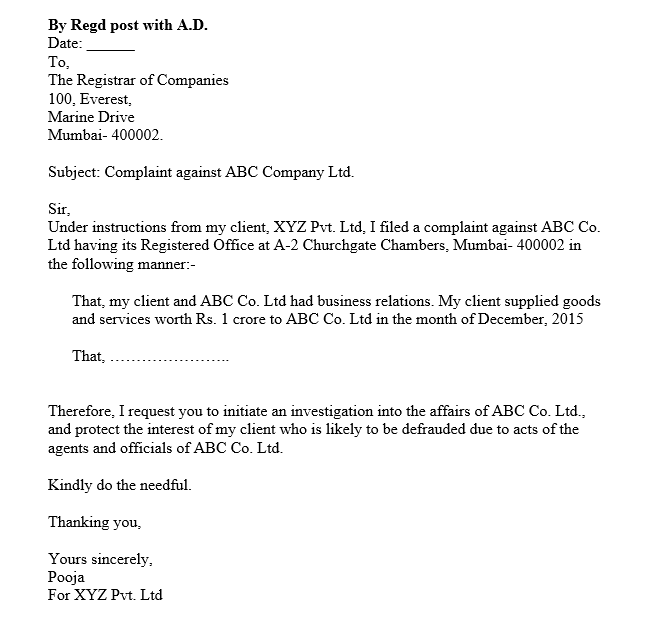
An example of the manner in which the complaint can be filed is given below:-


[divider]

References:

[1]http://www.mca.gov.in/MinistryV2/contact.html

[2]http://archive.financialexpress.com/news/a-look-at-the-roc-and-its-role/150970/2

[3]http://www.mca.gov.in/MinistryV2/complaints.html

[4]http://www.business-standard.com/article/pf/dealing-with-company-deposit-frauds-114021900482_1.html

Download Now

Procedure To Change The Name Of A Private Company

0

In this blog post, Ankit Sahoo, an Associate with Hammurabi and Solomon, Delhi and a student pursuing  a Diploma in Entrepreneurship Administration and Business Laws from NUJS, Kolkata, describes the procedure to change the name of a private company. 

Ankit Sahoo


Introduction

The name of a company is regarded as the identity of a company, both public and private. The Memorandum of Association (MoA) of the company consists of the name clause of the company; hence change in name ultimately results in the alteration of the MoA. The name that is adopted at the time of incorporation of the name can be changed later on. This can be done with the approval of the shareholder and Ministry of Corporate Affairs (MCA). The approval of the shareholders is required through a special resolution plus permission from the MCA is required. expert-witnessThe change of name of the company shall not have any effect on the legal existence as a corporate entity, i.e., changing the name of the company will not create a new entity. Therefore, we can say that change of name of the company shall not:

  • Affect any rights or obligations of the company
  • Render defective any legal proceeding by or against the company
  • Affect any legal proceeding by or against the company pending in the old name of the company

A company by being registered under the Companies Act, 2013 (from now on known as ‘the Act’) inherits the concept of corporate personality or attains the status of the separate legal entity. The company being a separate legal entity has its name and seal. All the officers of the company are the representatives of the company, it being an artificial person.

The Act mandates a public company to entail the word ‘Limited’ at the end of the company’s name whereas in the case of a private company the words ‘Private Limited’ is to be added at the end.[1] A company after its incorporation can later change its name if it wants to. The company has to follow the procedure stipulated under the Companies (Incorporation) Rules, 2014. Sec.13(2) & (3) of the Act deals with the alteration of the MoA on the name clause. A company requires approval from the registrar of companies under the Ministry of Corporate Affairs. However, no approval is required when there is only an insertion or deletion of the word “private” in the new name. This is the case when a public company converts into a private company or vice versa.


Step – I (Board Resolution)

A notice has to be drafted along with its agenda for the Board meeting, and the same has to be issued in not less than seven days from the date of the meeting. The notice has to be sent to every director at his registered address, in handwritten form by hand delivery or by post or electronic means. [2] The proposal for the change of name of the company and the suggestion of the new name must be put forth in the board meeting. Subsequently, two resolutions have to be passed in the meeting namely:

  • Firstly, to authorize a Director or Company Secretary of the company to make an application to the registrar of the companies for ascertaining the availability of the proposed name.
  • Secondly, pass a resolution to convene an extraordinary general meeting (EGM) (No Objection Resolution) for approving the newly proposed name and making necessary changes in the MoA and AoA.


Step – II (Application for Reservation of Name)

The authorized Director or Company Secretary of the company has to make an application to the Registrar to reserve the proposed name. The application has to be made in Form INC-1 along with the applicable fees prescribed in the Companies (Registration offices and fees) Rules, 2014, i.e., Rs. 1000.[3] The selection of the company name should be in accordance with Rule 8 of the Companies (Incorporation) Rules, 2014.

The Form INC-1 is available on the MCA website in an electronic format. This can be downloaded from the site, and the form has instructions available in it which becomes very helpful for the applicant. The details for changing the name have to be filled Part B, C & D of the Form. A copy of the Board Resolution also has to be attached with the Form. Once the ROC approves the proposed name, the same is valid for 60 days.


Step –III (Extraordinary General Meeting)

A resolution to convene an EGM has already been passed in Step – I. The Board has to call an EGM now, and the notice for the same has to be sent twenty-one days before the date of the meeting either in writing or through electronic mode in such manner as may be prescribed.[4] The notice of the meeting has to be given to that entire list of persons as mentioned in Sec. 101(3) of the Act. Plus, the notice of the EGM must specifically mention the intention to pass a special resolution.83253175

The notice has to be annexed with an explanatory statement which essentially specifies the nature of the concern or interest in respect of every director or manager, key managerial personnel and relatives of these persons mentioned.[5] The statement should also provide such other information which would enable the persons to understand the meaning, scope, and implication of the business item that would be discussed thereon, the change in the name of the company in our case.[6]

As we are talking about a private company, a quorum of two members to be personally present for the meeting is required. The quorum for a public company is different, but as we are talking about changing the name of a private company, in particular, we would stick private company itself. To pass a special resolution, the votes cast for the resolution should be three times the number of votes cast against the resolution[7]. The main reason behind calling an EGM and passing a special resolution is to approve the change of name of the company plus approving the alterations in MoA and AoA.


Step – IV (Filing of Resolution with the Registrar)

In accord with Sec.13(6) any resolution that is passed to alter the MoA of the company, the same has to be filed with the registrar. All the special resolutions are to be filed in Form MGT.14. This form can be downloaded from the MCA website. The form contains the instructions which can be referred to while filing. It should be noted that Form MGT.14 has to be filed along with the prescribed fee referred in the Companies (Registration offices and fees) Rules, 2014 within 30 days from the date of passing of such resolution.


Step – V (Approval from the Central Government)

Finally, an approval an application has to be filed to the Central Government for the alteration in the MoA for the change of name of the company. The application has to be made in Form INC 24 with the requisite fee of the Companies Rules, 2014. Rule 29 of the said Rules categorically mentions that a change of name shall not be allowed to a company which has defaulted in filing its annual returns or financial statements or any document due for filing with the 63596359478731111843440669_stamp-of-approval-612Registrar or which has defaulted in repayment of matured deposits or debentures or interest on deposits or debentures.

The said Form is again available on the MCA website in an e-format and the same has to be filed with a requisite fee as referred in the Companies (Registration offices and fees) Rules, 2014.

Now that all the formalities are met, the company has to wait for the new incorporation certificate that would be provided to it in Form INC 25 from the registrar of companies. Once the same is received the company’s name is officially changed.


[divider]

References:

[1] Sec 4(1)(a) of the Act

[2] Sec. 173(3) of the Act.

[3] Rule 9 of the Companies (Incorporation) Rules, 2014

[4] Sec 101 (1) of the Act.

[5] Sec. 102 (1)(a) of the Act.

[6] Sec. 102(1)(b) of the Act.

[7] Sec. 114(2) of the Act

Download Now

Uttam Sharma, associate at Sharma Kajaria and company, on how an online diploma from NUJS helped him get his current job

0

IMG-20160805-WA0017

Uttam Sharma is an associate with Sharma Kajaria and company; Kolkata and is currently looking after corporate commercial litigation. Prior to this, he has interned with many prestigious law firms. He has done is L.L.B from the University of Calcutta.

He completed the NUJS Diploma in Entrepreneurship Administration and Business Laws in 2014. He had a very fulfilling experience with the course and has many good things to share about. So we decided to share it with you all as a success story. Over to Uttam:

I joined the NUJS diploma in Entrepreneurship Administration and Business Laws while I was in the final year of my law school. I got to know about the course through an online advertisement.  When I browsed through the website, I found some study material and videos about the course which I found really interesting.

On further research, I found that NUJS diploma has the best course curriculum compared to similar courses available in the market. The most interesting part was the way everything was presented and I got impressed just by going through the contents.

Also, since I was in my final year at that time, I thought it would be beneficial to be associated with a big name like NUJS and having an additional qualification from there.

I feel that this course opens new avenues for law students as they can learn lots of things from this course and expand their skill set.

My purpose of joining the course was fulfilled and it has been a wonderful journey for me as I was able to secure my current job because of this course.

All the modules in the course are designed in an impeccable manner but I personally found the module on tax laws to be most beneficial for me. As there is not much focus on tax laws, SEBI and other business related matters in the law school curriculum, this course helped me in those areas and I am able to utilize this knowledge in my current job. I also developed my drafting skills and knowledge about business laws through this course.

The mentorship assistance provided in this course is very helpful for students as well as for mentors, I’m also  a mentor for one of the groups. This has helped me improve my skills and knowledge, as I am asked lots of questions by the group members and I have to research and refresh my knowledge in order to answer those questions. This helps me improve my skills as well.

In future, I plan to continue litigation and I feel that the knowledge gained from this course would help me further also, as it has given me a basic knowledge about lots of things and everything has become a lot more easier for me now as compared to what they were earlier.

I have mentioned the diploma in my CV and LinkedIn profile. I was also asked questions about this course during my interview for the current job.

I have already recommended this course to several persons and will continue to recommend it to others.  In fact, I had also recommended this course to one of my friends who did the course along with me.

I feel that anyone from a legal background like law students will certainly benefit from this course. Entrepreneurs and businessman will also benefit from this course, as they don’t have knowledge about laws most of the times and this course can give them the basic knowledge about laws. Even people doing C.S. would benefit from this course. Overall, my experience with the course has been great; it is a great learning opportunity.

Download Now

Kavya B.S, a practicing lawyer, on how the NUJS diploma gave her the much needed practical knowledge of law

0

IMG-20160805-WA0010

Kavya  B. S is currently a practicing lawyer, she previously worked as an associate at IP Lex global services, which offers end-to-end legal solutions in the areas of patents, trademarks, copyrights, and intellectual property. She has done her LLB from Bangalore Institute Of Legal Studies and has interned with many prestigious law firms.

She completed the NUJS diploma in Entrepreneurship Administration and Business Laws in 2016. Over here she talks about her experience with the NUJS diploma course, and how it helped her career so far. Over to Kavya.

I joined the NUJS diploma in Entrepreneurship Administration and Business Laws while I was in the final year of my law school. I found this course while searching the internet, I saw a video advertisement of the NUJS diploma course and I was very impressed by it, I liked the way things were explained. I looked into the course syllabus and realized that lot of emphasis was given on practical insights into the subjects. I wanted to join the course and I had a tough time convincing my parents, they were skeptical about the effectiveness of an online course. Finally, I convinced them and I join the course almost one year after I first saw the advertisement and my expectations from the course were  not just met but exceeded.

My own experience with internships taught me that as an intern it’s very difficult to get someone’s attention, the much-needed guidance and handholding are missing.

While interning I realized that people don’t come forward to teach you, you have to figure out things yourself and with the kind of theoretical knowledge, we gain from law schools it’s very difficult it survive in the corporate law field. Acquiring practical skills is most important but also the most difficult. This course bridged that gap and provided me with the much needed practical knowledge and has built up my confidence.

The webinars in this course are very helpful; they put you in direct contact with the most reputed people in the field and give you an insight into their perspective on different concepts.

The most important skill that I gained from this course is writing skills, I learnt to write things in a simple way without complicating the subject. Now I’m able to write on complex legal subjects in a simple easy to understand manner. My drafting skills also improved to a great extent from this course. I even learnt to appreciate and read laws with a perspective of applying it practically, which is very crucial for a lawyer.

The module which I personally found to be most informative was the one on raising investment; it gives an idea about overall functioning of the company, equity financing, debt financing etc.

In one of my jobs, we were dealing with a company which was inoperative since incorporation and we were looking into the financing of that company. The knowledge I had acquired through this module helped me a lot in researching and contributing to that case.

My future plan is not limited to a corporate job or a high paying salary. I want to reach out to the masses and instill confidence in them about the justice system. I want to give something back to the society. I feel writing can help me in this vision, I enjoy writing the most and I want to write a lot. What I learnt from this diploma course would certainly help me in my future visions also. It has taught me to put across my thoughts in a structured manner. I get to publish my work on the iPleaders blog, so it has given me a platform to reach out to a larger audience.

I have mentioned this diploma in my LinkedIn profile and my CV as it adds value to my profile.

I would be more than happy to recommend this course to anyone, I have already referred it to a cousin of mine who is doing CS as many aspects of CS are covered in minute detail in this diploma. Entrepreneurs, startup owners, lawyers or anyone who wants to gain some knowledge about the law can also benefit from this course.

Download Now

Structuring Advice To A US Entrepreneur Who Wants To Expand His Business To India

0

In this blog post, Harsh Moorjani, a student pursuing his final year LLB at Government Law College, Mumbai and a Diploma in Entrepreneurship Administration and Business Laws from NUJS, Kolkata, provides structuring advice to an US Entrpreneur who wants to expand his buisness to India.

unnamed

Introduction

The 21st century has changed the dimensions of the world; we are now experiencing the dawn of a new age that is “The Start-up Age”.

Not long ago businesses were carried out in the domestic market, and the ultimate aim was to penetrate the local market to maximize profits. With the advent of “Globalisation”, businesses and individuals have gone cross-border, exploiting the plethora of opportunities on territories beyond their jurisdictions.download

With new businesses and ventures cropping up every minute, the threat and pressure faced by existing companies have quadrupled. Existing businesses are turning to untapped and unexplored territories to maximize profits, the recent visits by CEO’s of giant technological companies like Apple, Dell, Microsoft to India is a testament to it, whereas start-ups are pushing the industry standards beyond limits and imaginations giving the business leaders a run for their money. As businesses are expanding and emerging at a rapid pace, it is imperative to structure them appropriately for their future viability.

The author will first discuss the different Business Structures in India available to the US entrepreneur coupled with their benefits and drawbacks. Based on the observations, the author will give suitable advice to the US entrepreneur and will cater to his business needs. Finally, the author will give an appropriate conclusion as to his opinion on the ideal way to expand business in India.


Business Structures Available to an US Entrepreneur in India

As the current government promotes India as a Global hub for business via “Make in India” campaigns and by relaxing bureaucratic procedure &norms, thereby minimizing the legal hurdles faced by foreign investors, it is natural that entrepreneurs look at India to expand their business as they once did in China.

There are three main business structures in India and two new hybrid structures that have emerged in India. An overview of each are as follows:-

Sole Proprietorship: This is the most rudimentary and easiest form to carry out a business, where the person who carries out the business is the sole owner. This is an unincorporated form of business without separate legal existence. In other words, it does not differentiate between the business and the sole owner. An US entrepreneur starting out as a small business setup with his capital and minimal debt can consider this form of legal structure. This model is used to start-up a business where one person showcases the key talent, skills, and experience.There are many benefits to this form of business as there no legal formalities or registration, the entrepreneur being the sole owner has complete control and has multifarious tax benefits. The owner benefits wholly from the profits.

Raising capital for business expansion remains a difficulty in this model. There is no perpetual succession in this form as death or insolvency dissolves the business. The main drawback is an unlimited liability and the risk of attachment of the sole owner’s personal property to satisfy the business claims. Based on the above observation this model is not suited where there are two or more founders. A classic example of the sole proprietorship model is eBay, which started out as a small online set up in 1995 and later became a mega online corporation expanding its roots in India.

Partnership: This is a concept of partnership where two or more individuals come together to carry on business for the motive of profit sharing. A partnership deed is required to be signed and registered with the Registrar of partnerships, making it a little more structured than a sole proprietorship.iStock_000004470299Medium-Planning-Clipboard-770x417

The cap limit on the number of partners is 20 and partnership deed governs their duties, liabilities, base remuneration, etc. In the eyes of the law, a partnership is not a separate legal entity, however, for the purpose of the tax, the firm name can be used. Cost-Effectiveness, Structuration and easy winding up processes are the benefits of this model.

The drawback is the unlimited liability of the partner to the creditors’ claims the firm defaults on their debts then the partners are liable personally since a partnership firm cannot be sued, but only its partners can be sued. Investors are not keen to invest in this kind of model with such liabilities.The general route taken is to convert to a Limited Liability Partnership (LLP).                                      

Corporation: An US entrepreneur who has a clear vision for his organization should opt to form a private limited company, which is the most sought after structure as it checks all the legal norms and procedures and gives the organization a distinct identity.In India, the Companies Act, 2013 governs this model. A corporation draws a distinction between the shareholders and directors of the company, unlike the previous models. The cap limit on the number of shareholders in a private limited company is 200 and incorporation requires minimum two shareholders and directors.

The benefits of this model are the capacity to raise capital as investors keep a check on their investments and can sell their stocks if the business fails. The liability of the directors and shareholders is limited except when the court lifts the corporate veil to analyze who is responsible for the wrongful act. Perpetual Succession is also a feature of this model.

The drawback is the cumbersome legal pre-requisites and the tedious winding up procedure. A corporation is not meant for experimentation. It is for those who have farsightedness and possess clarity as to their business goals. In recent times American Companies like Microsoft, Levis have heavily invested in India, whereas start-ups like ZoomCar are also paving the way for American start-ups in India.

Limited Liability Partnership (LLP): If one uses a Private Limited model with a Partnership model, it results in an LLP. Like a company an LLP is a separate Legal Entity and the Limited Liability Partnership Act, 2008 regulates this model.

More or less its characteristics are that of a private limited company, although certain obligatory compliances like maintaining registers etc. have been relaxed for an LLP and the winding up procedure is less cumbersome compared to a private limited company.

One Person Company: Lastly, the Companies Act, 2013 introduced a concept called One Person Company which allows a single person to run a private limited company with a single shareholder or a single director and possesses major characteristics of a private limited company.


Road Map for the US Entrepreneur

The ultimate decision of choosing the appropriate business structure vests with the entrepreneur. He can take a suitable decision bearing in mind certain key factors such as:

Liability: If the entrepreneur wants minimum personal liability than sole proprietorship and partnership have to be struck off the list. Corporation, OPC, and LLP then seem a viable option.

The degree of Control and Experimentation: If the entrepreneur is the sole owner or wanting a maximum degree of control and lacks clarity as to the business goals then sole proprietorship would be ideal, the partnership would also seem a viable option with two or more co-founders. OPC is also an alternative but at the cost of complying with certain statutory norms.img-fog-info

Raising Capital and Borrowing Loans: Now if the entrepreneur wishes to raise capital and borrow loans, then LLP and Corporation seem the ideal preference since investors can conduct due-diligence and as these models require strict compliance with statutory norms, giving certain confidence to the investor about the safety of his investment.

The analysis gains further impetus on foreign loans, as they are prohibited in partnership and proprietorship models. However, for a company, foreign investment is allowed whereas in the case of an LLP approval is required for the same.

It i s strongly recommended to opt for a ‘ private limited model’ as opposed to an LLP which is a relatively new concept, holding the investors back due to lack of clarity resulting in hesitancy to invest.

Taxation and Legal Formalities: Lastly, rigid legal norms need to be followed by an LLP, OPC, and Corporation. The tax levied upon them is at a higher rate as compared to proprietorship and partnership models wherein compliance with statutory norms is less obligatory.


Conclusion

Although an LLP or Corporation model appears most viable for a US entrepreneur, it finally depends on the entrepreneurs business needs and prevailing circumstances.

If the entrepreneur’s goal is to expand his business and is seeking investment for the same, the ideal model would be to opt for an LLP or a Corporation.

One can only recommend, not compel. It is the entrepreneurs business vision that will help him choose the appropriate model.

Download Now

Structuring Advice To A Big FMCG Company Headquartered In Delhi, INDIA For Opening A BPO In The Philippines

0

In this blog post, Ashok K. K. Vasudevan, the Managing Director at Festo Global Production Centre, India and a student pursuing a Diploma in Entrepreneurship Administration and Business Laws from NUJS, Kolkata, provides structuring advice to an FMCG Company in India who wants to open a BPO in Philipines. 


Picture1

History Of Philippines As A Destination Country For Setting Up A BPO(1)


In the Philippines, one of the fastest growing sectors is the Information Technology – Business Process Outsourcing (IT-BPO) Industry.  This aspect contributes significantly to the growth and development of Philippines.images

The year 1995 was a milestone year for the Philippines when the Special Economic Zone Act, which established the Philippine Economic Zone Authority and was passed by the Philippine Congress.  This Act attracted foreign investors to look keenly at the Philippines as a key destination country for setting up Business Process Outsourcing (BPO) Units.  The Philippines as a country acquired over 3% of the global BPO market by the year 2005, by which time, the BPO sector accounted for 2.4% of the country’s Gross Domestic Product (GDP) which also indicated a great potential for generating employment.  Only considering this sector alone, Philippines was able to provide employment to one million workers by the year 2010 and accounted for 27% of all new jobs.


Different Organizational Structures Which Are Available For Setting-Up A BPO In Philippines(2)

Different business structures can be considered for setting up a BPO in the Philippines and these different options have been listed below:

  • Single/Sole Proprietorship
  • Partnership
  • Stock Corporation
  • Branch Office
  • Representative Office
  • Regional Headquarters (RHQ)/Regional Operating Headquarters (ROHQ)


Pros And Cons Of The Different Organizational Structures Which Are Available For Setting Up A BPO In Philippines(2)

Single/Sole Proprietorship: This set-up is best suited for small Filipino-owned businesses.  In this case, the business structure is defined by individual ownership of all assets and thereby this applies to all profits derived from the business going to the individual owner/sole proprietor.  This also brings in unlimited personal liability on the shoulders of the individual owner/sole proprietor, which can also be seen as a disadvantage for this kind of business structure.

Partnership: The Partnership business structure is best suited for small to mid-sized businesses.  However, this structure favors or proves advantageous to Filipino citizens, as foreigners are required to have a higher minimum capitalization requirement.  This kind of business structure can be general or limited and requires registering with the Securities Exchange Commission (SEC).

Stock Corporation: A corporation can either be a stock or non-stock corporation.  As their names indicate, stock corporations issue shares of stock, while non-stock corporations do not issue shares of stock.  A stock corporation is a for-profit organization in which the ownership of the corporation is expressed by the shares of stock.  The owner of the shares of a corporation is called a stockholder or shareholder.

The stock corporation is the most flexible business structure.  A corporation is its own juridical person, and it must have at least five (5) and no more than fifteen (15) incorporators.  It is mandatory to be registered with the SEC.  If it is at least sixty percent Filipino-owned, then it will be considered as a Filipino corporation.

Branch Office: A branch office is considered as an extension of a foreign corporation and as such does not have its own legal personality. However, this kind of business structure can derive income from the Philippines. There is a requirement for minimum paid-up capital, which is US $ 200,000.  However, this can be reduced to the US $ 100,000, if the organization is engaged in activities involving advanced technology or if it has at least 50 direct employees.

Filipino call center agents attend to US clients at the new branch of Advance Contact Solutions incorporated a call center facility that opened 1,600 jobs for call center professionals during the inauguration in Quezon city suburban Manila, 31 October 2007. The Philippines is expected to rake 13 billion USD in revenue or global market share of 10 percent and 600, 000 new jobs as President Gloria Arroyo endorsed  05 November the "Offshoring and Outsourcing Roadmap 2010" initiated by  the Business Processing Association of the Philippines.  AFP PHOTO/ROMEO GACAD T (Photo credit should read ROMEO GACAD/AFP/Getty Images)

Representative Office: A Representative Office will be a foreign corporation that is governed by the laws of the country where its parent company is located.  It cannot derive income from the Philippines and is fully subsidized by its head office, so only withholding taxes are required to be paid.  The initial capital requirement is US $ 30,000.  This is a good option for companies that want to maintain full control of their organization.

Regional Headquarters (RHQ)/Regional Operating Headquarters (ROHQ): Just as in the previous case, Regional Headquarters (RHQ) and Regional Operating Headquarters (ROHQ) are also considered as foreign entities.  Whilst RHQs are not allowed to derive income from Philippine sources, and the ROHQs are allowed to derive income from the Philippines.  The RHQ has a required annual capital of US $ 50,000 for operating expenses, and the ROHQ has a one-time required capital of US $ 200,000.


Advice To The FMCG Company Headquartered In Delhi For Opening A BPO In The Philippines 

The previous sections elaborated on the different business structures and the pros and cons for each of these business structures for setting up a BPO in the Philippines.  Before we arrive at a conclusion for choosing the best option of a business structure for the Indian company headquartered in Delhi to open a BPO in the Philippines, it is important to evaluate what kind of BPO set-up would be suitable in this case.

BPO Set-up: With reducing costs playing a significant role in the current business scenario based on the prevailing economic condition and due to lower costs of producing specific goods or services in another country, outsourcing has become a common business strategy for many multi-national firms. Typically, there are two prevailing/common practices of outsourcing, and they are:

  1. Third party Outsourcing
  2. Captive Market

Both of the above options differ with each other on the levels of risk management, cost effectiveness or the necessity for management control.  In the Philippines, there are observations made that third party outsourcing is more prevalent as opposed to captive markets.iStock_000004470299Medium-Planning-Clipboard-770x417

Third Party Outsourcing: The Third Party Outsourcing could either be “Project Based Outsourcing (PBO)” of having a “Dedicated Development Centre (DDC)”.  In the case of PBO, it is primarily used for business activities which have irregular frequencies of work or one-off projects. The normal costing method can be adopted with time as variable costs and material costs as fixed costs. A DDC is primarily used in business cases where there are long-term goals to be achieved such as developing technology or software.  This model is preferred when the resources requirements are lower in the outsourced country than in the home country and could provide a fall back option.  In this case, the customers (multinational firms) are charged for fixed fees.

Captive Markets: This option is normally preferred when the core or crucial business activities are required to be run at cheaper costs.  The rationale for adopting such a set-up would be to cater to long-term strategic plans and also involving high levels of managerial control.  In this “Captive Markets” set-up model, the business practices and operations are still within the control of the multi-national company, which mitigates the risk of disclosure of sensitive information outside the company.


Conclusion

Based on the above inferences in different ways of setting up a BPO in the Philippines and assessing the different pros and cons, my recommendation to the Indian company headquartered in Delhi for setting up a BPO in the Philippines would be as follows:

  • Adopt a “Captive Market” set-up model to establish a BPO in Philippines: Assuming that the Indian FMCG Company has the required levels of market knowledge and analytics, it can adopt a “Start from Scratch Model” whereby the company will have to develop all its resources in the Philippines.  This involves the beginning of the model, which is the purchasing of property and equipment and due diligence lasts up to the point of running the BPO Centre itself.  The acquisition of property and equipment could be done by connecting with a third-party liaison in the Philippines.
  • The BPO of the Indian FMCG company can be set-up as a “Representative Office”: Under this set-up, it cannot derive income from the Philippines and is fully subsidized by the head office in Delhi and so only withholding taxes are required to be paid.  For such a set-up, the initial capital requirement would be US S30, 000 and would also give the Indian company full control of their organization in a cost-effective manner.


As a summary, evaluating the different models and options to set-up a BPO in the Philippines, it is recommended for the Indian FMCG company which is headquartered in Delhi to establish a BPO in the Philippines by setting it up as a “Representative Office.”  This warrants a minimum capital requirement as compared to another model of setting up as a “Branch Office” in the Philippines.  By running it as a “Captive Centre BPO” and as a “Representative Office”, the Indian company also will be able to mitigate the risk of disclosure of sensitive information as well as maintain full control of their organization in the Philippines.  This recommendation would also facilitate the general characteristic of an FMCG business with “low margins”, by keeping the costs low in running a BPO in the Philippines and with minimal investment in a captive center format, with full management control.


[divider]

References

  1. http://investphilippines.gov.ph
  2. http://businesstips.ph/
  3. https://en.wikepedia.org/(1)
  4. http://filepino.com/business-advice/(2)
  5. http://www.gov.ph
Download Now

10 Must-Have Clauses In The Articles Of Association That Are Not Prescribed By Default Under Companies Act

0
In this blog post, Patrick Gomes,  a student pursuing his LL.B (2nd year) from NLC, Mumbai and a Diploma in Entrepreneurship Administration and Business Laws from NUJS, Kolkata, lists the ten must have clauses in the articles of Association.
Patrick photo

Introduction

Documentation of the Article of Association (AoA) and the Memorandum of Association (MoA) is one of the most important steps in the formation of a Company. Whether it may be a Private Limited Company or a Public Limited Company, the initial formation starts with the making of the AoA & MoA. Though the registration of the company is another part of the formation of the company but the constitution of the company solely depends on the AoA & MoA.

Corporate Governance and the regulation of the listed Public Limited Company is more stringent than that of the Private limited company & other unlisted Public Limited Companies. Hence, it is required to constitute a better AoA for the benefit of the company and for the employees associated with it.

A normal article of association includes only the basic requirements through clauses which a company should have. But certain clauses which are not introduced in an article of association which are more relevant are given below.


Clauses


Protection from Shareholders interest: Shareholders are the investors of the company and said to be the owners of the company and in comparison to it their participation is very less than that of the management. Some of them only attend certain shareholder meetings, and the rest do not do so. Thus, this clause helps to understand the requirement of all the shareholders (minority shareholders) in the decision-making process when they find that the managers (including majority shareholders who participate in the company affairs) of the company are not performing their parts and doing something which is not beneficial for the shareholders. Thus, shareholders are the ones who can take appropriate decisions to make the steps clear. Thus, the protection of the legitimate interest of the minority shareholders is necessary.download


Protection of employees and protection from the employeesThis clause is also required for the protection of the employees and protection from the employees who are not performing their part in a proper manner. There are employees from the top management to the lower management in a company and the decision-making process always flows from the top. Thus, certain decisions which violate corporate governance should be avoided, and thus the employees who are taking the decision and performing the job should also make a note that the work which they are performing is correct or not. Sometimes it may happen that the work which is assigned may not be correct from a Corporate Governance point of view and thus should be avoided.

Protection of outsiders who enter into contracts with company & consumersThis clause would help the company to avoid such contracts which would lead to violations. The management has the right to enter into contracts on behalf of the company, and such rights should be taken care of. The Management should not misuse such rights, such that if they misuse such rights and enter into contracts, this would lead to the violation as per Corporate Governance Statutes. A Company who enters into a contract with an outsider and defaults the payments wherein such defaults may result in endangering the company’s goodwill in the market. The company should not produce such products which are hazardous to the consumers. The Management of the company should also keep in mind about safety standards. A company specifically engaged in manufacturing consumer goods should adhere to the safety standards of the products which are produced by the company and which are made for the consumers for their consumption.

Protection of the public at largeA Company should always try to make products which are not hazardous in nature. The safety of the environment should be a must, as environmental degradation would lead to a problem for the company. A Company should take safety measures so as not to harm the public at large in the surroundings. Thus, companies who are engaged in several hazardous products, research and development, laboratories, etc., should always make a note that such production or operations should be smooth with the adoption of safety measures, and steps should be taken to safeguard the Environment. The release of hazardous gasses would create problems for the people in the nearby vicinity. Thus, it’s the responsibility of the company to take safety measures in such areas of operation.download (1)

To promote profitabilityThe main motto of the company is to generate profits and not only to generate it but also to utilize it for the expansion of the company. Thus, it is the duty of the managers of the company to run the business in a manner where profits are generated out of the business. Hence, profitability matters the most for any company especially for a public company as most of the investors depend on the performance of the company, i.e., profits of the company.

To promote decisiveness and efficiency of the business organizationThe mangers should take appropriate measures to be firm in the business of the company. The managers of the company should try to increase the growth of the company and should make a note that the businesses of the company are not affected in any manner. This would lead to the stability of the company, and the operation would be smooth. Any violation would lead to several proceedings which would make the company suffer and sometimes may also lead to the closure of the company. Thus, the managers should not only focus on that part but also should try to increase the productivity of the company.

Minority Shareholders rights on important decisions of the companySeveral shareholders buy shares of the company. These shareholders are also called the investors and owners of the company. Some of them hold significant shares of the company and some minor. One of the major concerns is that the minor shareholders are not given much participation and rights in the company affairs, and therefore their interests are not of major concern in the interest of the company. Thus to provide such interest to the minority shareholders this clause is necessary for the articles of association as it gives the rights to the minority shareholders to participate in the affairs of the company. When taking small or big decisions if the minority shareholders feel that these decisions are important then they can step in and make the decision. Minority shareholders should be given rights to take important decisions along with the managers of the company. They should also be given active participation in the benefits of the company and should not be left ignored from the matters of the company.

Rights to appoint Directors and receive information: The shareholders should be given rights to appoint Directors (Managers) and receive information wherever they feel is important and such information should be provided by the managers of the company from time to time as per the requirement for the benefit of the company. The shareholders have the right to get the information about the company affairs and other matters which they feel are important which may be carried out by the managers of the company.understanding-the-memorandum--articles-of-association


Prescribe powers of the DirectorsThe Directors are also called the managers of the company who look after the affairs of the company and thus they have several powers to perform the business of the company and make important decisions on behalf of the company. Sometimes these powers can be misused for personal gains and interest. To avoid such circumstances, it is required to implement this clause in the articles of association so that the powers of the Director would be restricted, both in the cases of directors with additional powers and directors who only have general powers in the operations of the company. The powers should be prescribed, and certain powers should be provided in certain cases to one director and not to all the directors.

Issuance of ESOPs: Some of the companies issue ESOPs to the employees. But it would not have been possible for the company to issue ESOPs unless it is specified in the articles of association and thus this forms a significant clause in the articles of association. The company can only issue ESOPs to the employee as per the guidelines given by The Companies Act, 2013. This clause should be mentioned in the articles of association. The structures for the issuance of the ESOPs are decided by the Directors of the company in a meeting.


Conclusion

All the above clauses form significant clauses wherein a company should adopt an appropriate measure of Corporate Governance as the rules have become more stringent in cases of listed public limited companies than that of other public & private limited companies. To have smooth operations in the competitive market, the clauses described in this article is required for the company to avoid loopholes in their corporate governance structure.


Download Now

Co-founders’ Agreement And The Housing.com Dispute

0

In this blog post, Tapan Patnaik, Senior Manager at Flipkart Internet India Pvt. Ltd. who is currently pursuing a Diploma in Entrepreneurship Administration and Business Laws from NUJS, Kolkata, discusses how a co-founders’ agreement could have helped in the Housing.com dispute.

tapan

Background of Housing.com

Housing.com is a map based search portal that started into the real estate business of selling and renting real estate properties. Established in June 2012, the company had 12 founders, all of who were IIT, Bombay alumnus. The company was one of the very first in India to marry geographical analytics and transparent property listing. The company changed from housing.co.in to housing.com by buying the domain name from San Francisco based entrepreneur Peter Headington for 1 million dollars and also bought the hotline for 03-333-333-333. The company got a funding of a total of over 750 crore in funding from venture capitalists like Helion Partners, Softbank and Nexus. It started its operations in Mumbai on June 2012 and later on expanded to Pune, Bangalore, Gurgaon and Hyderabad in March 2015 under a new branding and logo. Lauded for its simplistic yet refined UI design and a huge database of house and users, Housing.com was seen as the next poster boy of the booming e-commerce industry in early 2015. However the company ran into trouble with one of the founders, Rahul Yadav had a public spat with the board, thus resigning and then withdrawing his resignation and later on being fired by the board members.

Housing.com is now currently only dealing with sale of properties with CEO Jason Kothari leading it and only 9 of its 12 founders remaining. It is based out of 40 cities with over 6000 brokers on board.

Issues faced during Housing.com dispute

housing

  • The co-founders had quite a few scenarios of conflict of interest during the whole episode of power struggle at Housing.com. The major despite flash points are as listed below :-
  • Then CEO Rahul Yadav first resigns in April 2015 on account of differences with the board and then goes public with his opinion about investors. Later he rolled back his resignation after an apology was submitted.
  • Rahul Yadav, allocated his personal stake of 5% (approximating to 150 – 200 Cr) to the then 2250 employees of the company without any approval of the board or co-founders.
  • In Jan, 2016, the restructured board decides to issue phantom stocks to the employees as earlier declared resulting in Rahul Yadav’s share still remaining with the investors, further resulting in discontent among the employees and the founders.
  • There was no legal binding on Rahul Yadav to not start a competing startup against Housing.com.
  • The company had 12 founders which in itself had all the makings of a complex board and company structuring.


How a Co -Founders Agreement would have helped in the case of Housing.com dispute

co-founder-agreement1

A clear and precise co-founders agreement could have gone a long way in protecting the interest of the company as well of the other co-founders and employees and avoided the much maligned public wrangling with the investors. The following are the some of the points that could have been effectively covered in the co-founders agreement:

  1. Housing.com had 12 founders of the company. However it only had 2 directors of the company. So in an absence of co-founders holding majority of the shares, it was difficult to have any say in the operations of the company.
  • The shareholding pattern was to be clearly defined once the business was to adopt a formal structure of business.
  • The company could have been started post a legal consultation as an LLC.
  • The roles and responsibilities of every co-founder were needed to be clearly defined from the inception of the company.
  • Time, commitment and remuneration of each of the founders to be explicitly defined across.
  • Decision making pattern in case of key decisions of the company.
  • Overall goal and vision of the business.
  • Business definitions and milestones for the company overall.
  1. The way to define the ownership based on equal distribution or on the basis of effort or on the basis of capital invested or on the basis of critical contribution of each of the founding members was sorely missing in the agreement if any. Also vesting of shares was not defined with any timelines.
  2. Shareholding pattern or restructuring of the equity stake in case of one of the co-founders leaving or firing of one of the co-founders. The option to give up stake in Housing.com should have been first made by Rahul Yadav to the board members and founding members and in case they did not buy, he should have got the option to offer the same to other employees of the company or 3rd party buyer. This was not the case that was observed in here. Precisely, the Right to First Refusal clause was not available on the agreement at all. Also a strong Memorandum of Association was found to be missing in this case.
  3. Confidentiality clause in the contract to be signed by co-founders was sorely missing in this case. This was a reason why internal discussions with board members and subsequent communications were leaked to the media without any legal consequences for the then CEO of the company.
  4. Non-solicit clause was also missing which could have had a great bearing on Housing.com. As a result, there was an exodus of critical resources once Rahul Yadav exited the company.
  5. There was no agreement as to under which condition can a co-founder be fired from a company. Hence as a result, it was seen that the CEO was forced out under undefined scenarios by the investors of Housing.com.
  6. Non-compete clause was something that could have been included to protect the greater interest of the company which would forbid an existing founder to pursue a competing business or firm as such. (Agreement in restraint of trade as specified in Section 27 of Indian Contract Act would have been an added check).


References:

https://en.wikipedia.org/wiki/Housing.com

http://forbesindia.com/article/30-under-30/housing.com-born-out-of-its-founders-house-hunt/37151/2

http://www.businesstoday.in/magazine/corporate/rahul-yadav-housing.com-ceo-behind-strategy-cult-following/story/219415.html

http://seedcamp.com/2011/09/seedhack-founders-collaboration-agreement.html

http://vakilsearch.com/blog/start-up-founders-agreement

http://www.forbes.com/sites/bhrigupankajprashar/2013/11/13/how-to-create-a-meaningful-founders-agreement/#19c086f312f4

http://blog.nextbigwhat.com/founders-agreement-startups-297/


Download Now
logo
FREE & ONLINE 3-Day Bootcamp (LIVE only) on

How Can Experienced Professionals Become Independent Directors

calender
28th, 29th Mar, 2026, 2 - 5pm (IST) &
30th Mar, 2026, 7 - 10pm (IST).
Bootcamp starting in
Days
HRS
MIN
SEC
Abhyuday AgarwalCOO & CO-Founder, LawSikho

Register now

Abhyuday AgarwalCOO & CO-Founder, LawSikho