Download Now
Home Blog Page 1708

Impact Of SEBI Alternative Fund Regulation On Investment In India

0

In this blog post, Vanshaj Mehta, a student of Institute Of Law, Nirma University, who is currently pursuing a  Diploma in Entrepreneurship Administration and Business Laws from NUJS, Kolkata, discusses the impact of SEBI Alternative Fund Regulation on Investment in India.

66307_4753724880488_15440519_n

In India, Alternative Investment Funds (AIFs) are defined in Regulation 2(1)(b) of the Securities and Exchange Board of India (Alternative Investment Funds) Regulations, 2012.[1] It refers to any privately pooled investment fund, (whether from Indian or foreign sources), in the form of a trust or a company or a body corporate or a Limited Liability Partnership (LLP) which are not presently covered by any Regulation of SEBI governing fund management (like, Regulations governing Mutual Fund or Collective Investment Scheme) nor come under the direct regulation of any other sectoral regulators in India- IRDA, PERDA, RBI. Hence, in India, AIFs are private funds which otherwise do not come under the jurisdiction of any regulatory agency in India.[2]

alternate_investment

An AIF means any fund established or incorporated in India in the form of a trust or a company or an LLP or a body corporate which:

I) is a privately pooled investment vehicle which collects funds from investors, whether Indian or foreign, for investing it in accordance with a defined investment policy for the benefit of its investors; and

II) is not covered under the Securities and Exchange Board of India (Mutual Funds) Regulations, 1996, Securities and Exchange Board of India (Collective Investment Schemes) Regulations, 1999 or any other regulations of the Board to regulate fund management activities.


Types of AIF

D_12869873271

AIFs are categorized into the following three categories based on their impact on the economy and the regulatory regime intended for them:

Category I are those AIFs with positive overflow consequences for the economy, for which certain impetuses or concessions may be considered by SEBI or Government of India; such support by and large puts resources into new businesses or early stage endeavors or social endeavors or SMEs or foundation or different segments or regions which the legislature or controllers consider as socially or monetarily alluring. They can’t take part in any influence with the exception of meeting transitory subsidizing necessities for not over thirty days, on not more than four events in a year and not more than ten percent of the corpus. e.g., Investment funds, SME funds, Social Venture funds and Infrastructure funds. Offering impact to the declaration by Union Finance Minister on blessed messenger financial specialist pools in the Union Budget 2013-14, SEBI in June 2013 has affirmed a system for enlistment and control of heavenly attendant pools under a sub-classification called ‘Holy messenger Funds’ under Category I-Venture Capital Funds.

Category II are those AIFs for which no particular motivators or concessions are given. They do not embrace influence or acquiring other than to meet the allowed everyday operational prerequisites, as is indicated for Category I AIFs, e.g., private equity or obligation store.

Category III are assets that are considered to have some potential negative externalities in specific circumstances and which embrace influence, all things considered, These assets exchange with a perspective to make fleeting returns. These assets are permitted to put resources into Category I and II AIFs also. They get no particular motivating forces or concessions from the administration or whatever other Regulator. e.g., mutual funds (which utilizes assorted or complex exchanging techniques and puts and exchanges securities having different dangers or complex items including recorded and unlisted subordinates).


Significant impact

The assets business in India has seen earth shattering uptick with the recently chosen government driven by Prime Minister Mr. Narendra Modi. The present expert business environment being introduced has prompted idealism from outside financial specialists towards the India story.

The financial specialist voracity for India hazard has been hearty and that has prompted solid raising support for a few level 1 GPs with track records. In the event that 2014 can be taken as an indication of things, India centered assets are in for a fascinating blend in 2015. The degree of gathering pledges in the second 50% of 2014 has prompted a dry powder overhang crosswise over various venture procedures. 2015 ought to see store administrators with expanded spotlight on organizations and optional exchanges.

The new government is focused on building up a stable administrative and assessment atmosphere that is helpful for outside venture. The administrative administration keeps on being streamlined with unwinding of estimating standards for outside direct speculations, clarity in connection to put/call choices, defense of the remote portfolio venture administration and recommendations for further liberalization of venture tops.

Planning an asset is not only an activity in organizing. It resembles being a designer which is not quite the same as being a basic architect. For India-centered assets, not just information of Indian administrative and expense structure is required, but a profound understanding into cross outskirt lawful and charge administrations is also important, notwithstanding when you are not raising assets from abroad.

sebi-625_625x300_51440419852

The venture reserve industry unmistakably is by all accounts in an altogether different market today. Creative structures have shifted from the conventional ‘visually impaired pool model’ are quickly turning into the standard thing. A portion of the subjects that proceed in 2015 are the movement from ‘mixed together premise’s’ of raising assets to ‘independently oversaw accounts’, bargain by arrangement cooperation (select in/quit) and vow sort structures. These progressions are firmly connected to the lessened LP resistance for conventional terms and full charge structures for visually impaired pool stores.

In May 2012, SEBI stepped to totally upgrade the administrative system for residential assets in India and presented the Securities and Exchange Board of India (Alternative Investment Funds) Regulations, 2012 (AIF Regulations). In addition to other things, the AIF Regulations have opened parkways for different asset venture systems for raising coastal pools of capital in India.

Be that as it may, from an administrative perspective, the glare from the controller to the option speculations space has been at its top. Taking after the Global Financial Crisis, there has been a pestilence development in law making concentrated on the optional administration industry. A director to an option speculation store should now battle with more noteworthy oversight and responsibility to both the controller and the financial specialists. While bespoke terms are intended to keep up financial specialist invitingness, given the late perceptions by controllers in advanced locales, sight must not be lost on the exposure standards and trustee driven principles that are presently statutorily ordered.

A parallel advancement in this association has been the late change in the Indian duty administration. Taking after the Vodafone judgment, the Parliament of India presented rules for the tax assessment of additions emerging on the roundabout exchange of capital resources. The Parliament all the while presented the General Anti-Avoidance Rule which permits Indian duty powers to re-describe exchanges on grounds of absence of business substance in addition to other things.

The movement in legitimate worldview in which a speculation reserve works requires that consideration be given to articulating exposures in asset reports (counting and recording the monetary substance) and keenly arranging venture resource possessions. As far as we can tell, reserve documentation is basic to secure asset chiefs (GPs) from presentation to lawful, charge and administrative dangers. Reserve advice are currently required to devise creative structures and exhort speculators on terms for meeting financial specialist’s (LP) desires on ads, administration and keeping up GP discipline on the explained venture system of the asset. All these are to be done in similarity with the changing lawful system.

Footnotes:

[1] http://www.sebi.gov.in/cms/seb2i_data/attachdocs/1337599839661.pdf

[2] http://www.arthapedia.in/index.php%3Ftitle%3DAlternative_Investment_Funds_(AIFs)

Download Now

How To Start An Online Media Company?

3

In this blog post, Sonia Shinde, the Senior Manager of Operations at Pcura Consulting Pvt. Ltd. who is currently pursuing a Diploma in Entrepreneurship Administration and Business Laws from NUJS, Kolkata, gives a brief overview about the procedure to start an online media company in India.

IMG_20160805_182037_edit

Media is one of the most broadly means of communication to gain information.  Media includes broadcasting mediums like newspapers, magazines, television, radio, mails, mobile phones, fax, internet, etc. We use media on a daily basis; it’s like a part of our life. Today people use web based / online media as it is easier to communicate and access any information from anywhere through this platform.


A media company can be in form of television channels, print, online or radio platforms that provide news, information or entertainment on the topics of our choice in various languages in order to attract millions of subscribers. This in turn makes the media company to raise their profits. Let’s have a look at what it takes to have our start a media company.


It takes 4 steps to start company

Business Plan on Blackboard

  1. Business plan:

You need to plan your business; plan includes market research, and how you will generate funds and a Strength, Weakness, Opportunity, Threats (SWOT) analysis.

  1. Write your plan:

After your first round of planning, it’s time to write your plans for the business.

  1. Register domain name and set up your website:

Chose a domain name which is already available and ready to use. Once you get your domain name, the process of building a business website design begins.

  1. Legal:

A number of steps need to be followed to make your company legal.

One has to go through legal formalities in order to start a company or an online Media company in India. A business can be registered as a Sole Proprietorship, Partnership, Public/Private Company, Limited Liability Partnership (LLP), One Person Company.

  1. Sole Proprietorship:

It is a single man firm with unlimited liabilities. The simplest way to start a business is to have service tax registration or VAT registration and open current bank accounts. Sole Proprietorship is good for startups which are trying new ideas of business and their budget is less than 5000 rupees.

2. Partnership Firm:

At least 2 people are required to start a partnership firm. The firm needs to have a registered partnership deed with a current bank account and a VAT / Service Tax registration. Partnership Firms can be started when there are partners with common vision of business who is ready to share profits.

3. Private Limited Company:

It needs to have a minimum of 2 Directors with a minimum capital of 1 lakh rupees. It’s best for startups seeking funds from investors. Private Limited Company works is suitable for long term business, where ideas are proven to be profitable and can also attract investors by selling their shares to investors.

4. Limited Liability Partnership:

It is a mix of Private Limited Company and Partnership Firm. It needs minimum 2 partners. It has higher compliance requirements as compared to an ordinary Partnership Firm. Choose Limited Liability Partnership when your budget constraint to less than 10,000 and you also want to enjoy the perks of setting up a company.

5. One Person Company:

It is like a Private Limited Company but only one person involved. In this type of company, you don’t want to be a partner with anybody, but can enjoy the benefits of a company.

Legal Procedure to start an online media company

e8fe221efafa0b50e48e73fe8f597c51

  1. Register Domain Name:

Get a unique domain name for the online media business by paying registration fee. One needs to submit valid address and ID proofs.

  1. Get Federal Tax ID Number:

This is when you want your online business to be a separate legal entity. You need to get a federal tax ID number form Indian Revenue Services (IRS). IRS keeps a track of your business transactions.

  1. VAT / Service Tax:

A company must apply VAT to its applicable products and pay taxes to the government for services.

  1. Memorandum of Understanding with Vendors / Contractors:

You need to be very precise and stringent while drafting Memorandum of Understanding with all vendors /contractors so as to prevent forged services. It’s possible that you may sometimes not sell or offer services/products directly and hence are not aware of authenticity of same. This may generate legal issues so you need to be careful while contracting. Therefore, add a disclaimer to all your services / products to get shielded from legal liabilities.

  1. Investment in Data Security:

Invest in cyber security as this helps in safeguarding your customers’ financial transactions. A failure to protect customers’ data could cost you a sum of up to 5 crores in terms of fine.

Other important steps as follows:

  • Trade Mark Registration:

This is more important for web based / online business. Register Brand or Logo with “Trademark”.

  • Website Terms & Conditions:

You need to take care of the website’s legal terms and conditions such as privacy policy, disclaimer, and third party data.

  • Vendor Agreement:

An agreement needs to be drafted by enlisting requirements such as payment policy, refund, taxes applied to the services/ products from vendors.

Download Now

Should You Run A Business As Sole Proprietorship?

1

In this blog post, Tusharika Bhattacharya, who is pursuing her Company Secretary Finals from Institute of Company Secretaries of India and is also pursuing a  Diploma in Entrepreneurship Administration and Business Laws from NUJS, Kolkata, discusses the advantages and disadvantages of running a business as a sole proprietorship. 

13659026_10153848499484091_7608070778322538484_n

For anyone who is keen on starting a business of their own, they must analyse and study the legal skeleton of the business they wish to choose before they start their own. Broadly, there are four types of legal structures: sole proprietorship, partnership, LLP or a company.  Each of these structures will have their own advantages and disadvantages. Thus, it is of utmost important to know the meaning of sole proprietorship, its advantages and disadvantages.


What is a sole proprietorship?

proprietorship

‘Sole’ means single whilst ‘proprietorship’ means ownership.  Sole proprietorship is the oldest, simplest and most common form of business   entity. In order to gain the benefits of tax, the owner and business are kept one and the same.  Sole proprietor is a business that is owned and controlled by one person; he possesses the entire authority and responsibility with respect to the business. He can hire employees and pay them salaries, but legal responsibility is on the sole proprietor. The main advantage of such an arrangement is that the owner gets all the profit. However, at the same time he is personally liable for all the debts. Sole proprietor is not a distinct business entity, rather the business and entity. For example, no separate tax returns are required to be filed by the business.

The sole proprietorship is useful and suitable under the following circumstances;

  1. When the nature of business is simple.
  2. When financial risk is less.
  3. When there is no need to take huge debts
  4. When the product’s market is small
  5. When the capital is minimal
  6. When the owner wants to have full control over decision making


 Procedure to form a sole proprietorship

Sole proprietorship is the easiest form of running a business because no separate registration is required in this case. The only thing you must take care of is that you need to ensure that you have the specific license to your line of business. In order to open a bank account for the sole proprietorship, RBI’s KYC norms mandate any of the following two documents:

  1. Certificate / license issued by the municipal authorities
  2. Sales and income tax returns
  3. CST/VAT certificate
  4. Registration/licensing document issued by the proprietary concern by the central government
  5. Banks may also accept IEC issued to the proprietary concern by the office of DFGT
  6. The complete income tax return in the name of sole proprietor where the firm’s income is reflected by income tax authorities.
  7. Utility bills such as electricity, telephone bill in the name of proprietary concern

 Advantages of a sole proprietorship

  1. The most important advantage of this business is that the business owner has absolute control; he can make decisions that are quick and be flexible with his policies.
  2. The second important advantage is that profits flow directly to the proprietor’s personal tax; they cannot be made subject to another level of taxation which means that profits will not be taxed at the business level. Sole proprietor retains complete control over the finances of the business which gives a very strong incentive to work for the business.
  3. The third advantage states that the business can be dissolved as informally as it was begun.
  4. The fourth advantage states that the sole proprietor business maintains close relationship with both employees and customers.
  5. The fifth advantage is that it can maintain business secrecy. In any form of business structure secrecy is of utmost importance and sole proprietorship makes it is very to maintain confidentiality.
  6. Last but not the least, any person who want to set up a shop and begin dealing with customers can get it done without the intervention of the government, bureaucrats or lawyers.


Disadvantages of a sole proprietorship

  1. In a sole proprietorship which is run by a single person, it is difficult to raise capital; lack of separation of the business from the proprietor hinders the flow of capital and thus expansion of business slows down. Loans from friends and family are generally taken in this case.
  2. No perpetual succession, it exists only till the owner exists.
  3. Lack of credibility.
  4. It cannot add partners


 Suitable business under sole proprietorship

This form of business is suitable for the businesses which involve low risk, small financial resources, the capital requirement is small and the risk involvement is not heavy, like automobile repair shops, small bakery shops, tailoring shops, etc. It is most suitable for businesses like selling grocery items, stationery, furniture, garments telephone booths, making jewellery, haircutting, cycle or mobile repair shop.


One Person Company: A hybrid of sole proprietor and the corporation

webinar

The concept of a One Person Company was a very popular concept in U.S.A. The formation of a single member Limited Liability Corporation, China introduced One Person Company in 2005. According to Turkish Commercial Code since 2012, a joint stock company or limited liability company may be established with one or more shareholders. The code also sets forth certain obligations and conditions for such companies. In addition, limited liability companies and joint stock companies can have a board of directors that consists of only one board member. Single Member Companies Rules, 2003 of Pakistan provide for incorporation of single member company. In India, it got introduced through the new Companies Act, 2013 in Section 2(62).

One Person Company form of business has been provided with concessional /relaxed requirements under the Companies Act, 2013 which will be discussed. With the implementation of the Companies Act, 2013, a single national person can constitute a Company, under the One Person Company (OPC) concept.

The concept of One Person Company exists in many countries. United Kingdom is the first country which paved the way for the formation of a one man company through a precedent set in its famous case Saloman v. Saloman & Co. (1897) AC 22. Section 7 of the UK Companies Act, 2006 deals with the method of forming a company. It provides that – (1) A company is formed under this Act by one or more persons— (a) subscribing their names to a memorandum of association (see section 8), and (b) complying with the requirements of this Act as to registration (see sections 9 to 13). (2) A company may not be so formed for an unlawful purpose.


OPC in India and its impact

opc1

In the last few years, the increase in the use of information technology and computers and the emergence of the service sector has been tremendous, thus giving the entrepreneurs an opportunity of participating in the economic activity. Such economic activity may take place through the creation of an economic person. The committee thus recommended that law should recognise the formation of a single economic entity in the form of One Person Company. OPC in Indian entrepreneurship has revolutionised the way corporate world works, especially by fostering the micro businesses and entrepreneurship with its simple structure which can be registered with one member and one director. The OPC in India is still in its early stages and would require some more time to mature and be accepted in the business world. It is indeed a launch pad for such entrepreneurs to showcase their capabilities in the global arena. The One

Person Company definitely carries an advantage for small businessmen, traders and artisans since they can make use of it with less risk.


OPC v. Sole Proprietorship: the better option

The biggest disadvantage of One Person Company in comparison to sole proprietorship business is that of tax liability, an OPC is taxed at 30% on its net tax liability of the financial year. Sole proprietorship’s income gets clubbed into the individual’s income and then taxed in the hands of sole owner which means that in case of proprietorship business, income will be taxable based on the slab rates that are applicable to individual and tax deduction under different sections of income tax act will also be available. A person in lower tax bracket will be benefited by having a proprietorship business as compared to the 30% tax rate of One Person Company. Other benefits accruing to the sole proprietor is that it can get started without any registration which enables the sole proprietor to close down the business without much legal compliance. However, in the case of OPC, the sole owner has to follow legal procedures to get out of the business and close the business. The requirement of minimum paid up capital is Rs. 1000000 whereas, in sole proprietorship business, such requirement is not there. The formalities of board meeting, general meeting, audits and other compliance will be increased for One Person Company in comparison to sole proprietorship business. The cost of books of accounts will be increased and more work will be required for these compliances in case of a One Person Company because of which registration fees also increases.

For anyone who wants to run a small business, it is still more viable to run a sole proprietor but if anyone is aiming for long term solution with more credibility and is ready to take on the legal compliance requirements and cost, than they can start an OPC.

Download Now

Can A Society Acquire A Trust?

0

In this blog post, Shubhangini Debi, a student of ULC, Gauhati University, Assam, who is currently also pursuing a  Diploma in Entrepreneurship Administration and Business Laws from NUJS, Kolkata, analyses if a society can acquire a trust in India.

PicsArt_1459088572850When any organisation devotes its funds for the public welfare, it is known as a Non-Profit Organisation (NPO). This can include schools, colleges, hospitals, religious organisations, etc. There are mainly three common forms of non-profit organisations: Trusts, Societies and companies incorporated under Section 8 of the Companies Act, 2013. Before we get to the answer to the question at hand, let us first understand the two most important components of this question i.e., trust and society.


Trust

Trusts are the oldest form of charitable organisations. Section 3 of the Indian Trusts Act, 1882 defines trust as ‘an obligation annexed to the ownership of property, and arising out of a confidence reposed in and accepted by the owner, or declared and accepted by him for the benefit of another or of another and the owner’.

The person who reposes, or declares the confidence is called the ‘author of the trust’. The person who accepts the confidence is called the ‘trustee’. The person for whose benefit the confidence is accepted is called the ‘beneficiary’. The subject-matter of the trust is called ‘trust-property’. The ‘beneficial interest’ of the beneficiary is his right against the trustee as the owner of the trust property and the instrument by which the trust is made is called the ‘instrument of trust’ or the ‘trust deed’.

flt

As provided under Section 7 of the Indian Trusts Act, 1882, ‘a trust can be created by any person who is competent to contract.’ This means even a minor can create a trust after taking permission from the Principal Civil Court of original jurisdiction. As per Section 10 of the Act, every person capable of holding property may be a trustee. Even an alien can be a trustee, but he/she must be a domicile in India. The trustee is not the owner of the trust property, but the beneficiary is or will be once the property is transferred to him. The trustee has only the possessory rights of the property until the trust expires.

Trusts have been classified into many kinds from different point of view. But generally they are classified under the following heads:

  • According to the nature of the duties of the trustee, i.e. simple trust and special trust.
  • According to their object, i.e. private trust and public or charitable trust.
  • According to the mode of their creation, i.e. express trust, implied trust, constructive trust, resulting trust, precatory trust and secret trust.
  • Trusts not covered by the classification, e. trust of imperfect obligation, purpose trust, discretionary trust and protective trust.

The two most commonly known types of trust are private trust and public trust. Private trusts are formed for the benefit of a family member (including an unborn child in the mother’s womb) or a few set of known people, whereas a public trust is formed for the benefit of the public.

Societies

img_full_66048

Societies are of recent origin. They are of relatively modern form. Formation and governance of a society is more difficult than a trust but easier than a company. According to the Societies Registration Act, 1820, any seven members who subscribe to the Memorandum of Association can register a society. The membership of the society may be kept open (or by invitation) to anyone who subscribes to its aims and objectives, for which a fee may or may not be charged.

Societies in many states are governed by the Societies Registration Act, 1820 in its original or amended form. However, many states have now passed their own laws for regulating societies within their territory and these laws have replaced the original laws of the Societies Registration Act, 1820.

However, according to the Co-operative Societies Act, 1912, at least 10 persons who are above the age of 18 years must be members of the society to be able to register it under the Act. This provision of ten members is not applicable if the registered society is a member of another society. Each society will be governed by a committee – a committee is the governing body of a registered society to whom the management of its affairs are entrusted. The various officers of a society includes a Chairman, Secretary, Treasurer, member of committee or other persons empowered under the rules or bye laws to give directions in regard to the business of the society [Section 2(e)].

Section 18 of the Co-Operative Societies Act, 1912 provides that ‘the registration of a society shall render it a body corporate by the name under which it is registered, with perpetual succession and a common seal, and with power to hold property to enter into contract, to institute and defend suits and other legal proceedings and to so all things necessary for the purposes of its constitution.’ Hence a society can be said to be a juristic person after its registration.


Can a society acquire a Trust?

After going through the relevant Sections of both these Acts i.e. Indian Trusts Act, 1882 and the Co-operative Societies Act, 1912, there are certain facts that have come to light. The first question that comes to mind is whether a registered society is a person or not (in this case a juristic person)? As per Section 18 of the Co-operative Societies Act, 1912, a society becomes a corporate body after its registration just like a company becomes a corporate body after its incorporation under the Companies Act, 1956. The characteristic features of a corporate body enable the company to function as a juristic person allowing it to sue or be sued in its name, to hold property, to have a common seal, etc. Same is the case for a society. Once a society is registered under the Co-operative Societies Act, 1912, it becomes a corporate body which enables it to function like a juristic person and sue or be sued in its name, hold property, have a common seal, etc. Hence, we have established that a society is a juristic person.

The second question that we need to understand is whether a society can create a trust?  Section 7 of the Indian Trusts Act, 1882 clearly mentions that any person competent to contract can create a trust. Since we have already established that a society is a juristic person and is competent to be a party to a contract, it will not be wrong to state that it (the society) can create a trust.

Thirdly we have to determine if a society can be a trustee, a beneficiary, either or both? Section 9 of the Indian Trusts Act, 1882 says that ‘every person capable of holding property may be a beneficiary; likewise section 10 states that ‘every person capable of holding property may be a trustee’. By now it is clear that even a juristic person is capable of holding property. This means that a society can be a trustee as well as a beneficiary.

The word ‘acquire’ means “to buy, obtain or take possession of for oneself’. As a beneficiary, a society has no need to acquire a trust property. Once the purpose of the trust is fulfilled, the trustee transfers the property to the beneficiary and the beneficiary becomes the owner of the trust property. At this point the property does not remain a trust anymore. The role of a trustee is to take care of the trust property on behalf of the beneficiary. Only the possessory rights of the property are vested in the trustee. He is not the owner of the property. So as a trustee, a society will only be vested with the possessory rights to the property. These rights bind the trustee (in this case a society) with some duties and responsibilities which it has to follow to successfully execute the trust deed. It cannot keep the property for itself as its personal property [Chapter 3 of Indian Trusts Act, 1882]. Thus, a society cannot obtain for its own self a trust property, either as a trustee or as a beneficiary.

After thorough research and careful reading of the two Acts, i.e. the Indian Trust Act, 1882 and the Co-operative Societies Act, 1912 it can be concluded that a society cannot acquire a trust property. It can however acquire a property for itself which will count as an asset or the personal property of the society, in which case the full ownership rights of the property will be vested in the society.


Download Now

How Co-Founders’ Agreement Could Have Helped in TVF Dispute

0

In this blog post, Sanjna Vijh, a student of Bharati vidyapeeth University, Pune, who is currently also pursuing a Diploma in Entrepreneurship Administration and Business Laws from NUJS, Kolkata, writes about The Viral Fever legal battle of founders and how a co-founders’ agreement could have helped in avoiding the co-founders’ dispute.

photograph 53022

A lot of partnerships fail due to the conflicts between the partners or the consequences could take an ugly turn when the partnership is coming to an end due to the clash of ideas between the partners or money related disagreements between them.


TVF Case

A popular online entertainment channel, The Viral Fever (TVF), a sole proprietorship of Mr. Arunabh Kumar has been dragged into a legal battle of founders. Founder Arunabh has been sued by Prashant Raj, a friend and fellow alumnus from IIT Kharagpur. As per the news articles, Prashant Raj is making an exit and demanding compensation for his share of work with TVF[1].

unnamed

The lawsuit for specific performance of an oral agreement, allegedly executed between the parties in 2012, was filed in the High Court of Bombay. The plaintiff claimed that he was offered a position of Partner & Director – Operations, and Strategy & Business Development by Arunabh. He further claims that in this capacity, as per the agreement, he was allotted 4% equity in the company, producer’s fee of 7.5% on projects and Rs. 30,00,000/- p.a. salary from October, 2012.

Justice Roshan Dalvi has ruled that the parties settle the dispute by compensating the plaintiff for his services rendered as per the rule of Quantum meruit i.e. as much as he deserves, or what one has earned but he won’t be offered any equity. Dissatisfied by the ruling, Prashant Raj has filed an appeal[2].

How a co-founders’ agreement could have helped

co-founder-agreement1

In the current state of affairs, a co-founders’ agreement between Mr. Arunabh and Mr. Prashant Raj would have settled the dispute rather amicably. A co-founders’ agreement governs the professional relationship of founders which states various important clauses such as monetary share, decision making process, dispute resolution etc.

In the TVF dispute, the existence of an oral agreement led to a lot of contemplation and confusion as to the terms to settle the dispute. The quantum of consideration could not be rightly ascertained for the services rendered as the duties of Mr. Prashant Raj were not specified. The dispute was also attempted to be resolved by mediation initially which ended up in a lawsuit ultimately. If the founders had entered into a co-founders’ agreement, it would have been an easier settlement saving Mr. Arunabhkumar the legal drama and would not have landed TVF in a soup. However, this might make for a new concept of show for TVF.


Footnotes:

[1]http://economictimes.indiatimes.com/small-biz/startups/the-viral-fevers-cofounders-battle-it-out-in-court-against-each-other/articleshow/49546234.cms

[2]https://indiankanoon.org/doc/72772857/

Download Now

Structuring Advice To An Entrepreneur From The Middle East Who Wants To Expand His Business To India

0
In this blog post, Kaushik Neogi,  a student pursuing his LL.B (4th year) from Delhi Metropolitan Education, affiliated to Guru Gobind Singh Indraprastha University and a Diploma in Entrepreneurship Administration and Business Laws from NUJS, Kolkata, describes some basic legal structures an entrepreneur ought to keep in mind while expanding his business from the Middle East to India. 
IMG_1551

Introduction

The Indian Government which opted for major economic reforms in the year of 1991, to open its restricted and over-protected market regulatory policies to the world, became the triggering point and laid down foundations for a new business friendly India. Since then, the Indian Economy has grown at a tremendous rate and today is termed as one of the major and fastest growing economy in the world. Within the span of these 25 years from 1991-2016, India’s interactions with foreign companies and businesses have resulted in the Indian market to be considered as one the most attractive investment market in the world after China. To maintain the status and progress of the country the laws and regulations governing the market are constantly monitored and updated by the government, to keep on providing a free and fair Indian Market to the world.

Advice 1

My first advice to an entrepreneur from the Middle East wanting to expand his business to India will be a general advice on the present ways for all Foreign Businesses to enter India.[1]

As per the present laws and regulations a foreign company has two options to enter India to do business, which are:

  • By setting up a Non-Corporate entity –
    • As a Liaison Office
    • As a Branch Office
    • As a Project Office
  • By setting up a Corporate entity –img-fog-info
    • As a Wholly Owned Subsidiary
    • As a Joint Venture with Indian Partner
    • As a Foreign Institutional Investor

Advice 2

My Second advice to the entrepreneur from the Middle East will be on the various activities permitted and the various restricted activities under the ways mentioned above for a foreign business to enter India. This should help the Middle Eastern entrepreneur choose the best suitable structure in accordance with the desired activity to be carried out in India by the entrepreneur.

In case of Non-corporate entities[1]

Liaison Office: A liaison office also referred as a Representative Office is not allowed to carry out any business activity and is prohibited from earning any income in India. So a liaison office acts only as Research & Promotional Platform for the parent company in the Indian market and plays the role of an intermediary between the parent company and Indian companies.

Branch Office: The foreign companies who are carrying out either Trading or Manufacturing outside India can set up branch offices in India subject to specific approval from RBI. Such branch offices of foreign companies in India can:

  1. carry out import/export of goods;
  2. act as a selling and buying agent of the parent company in India;
  3. carry out research in the Business areas of the parent company and provide Consultancy and Professional Services in India;
  4. help make Financial or Technical Collaborations between the Parent company and Indian Companies;
  5. can act as a Foreign Airline or Shipping company;iStock_000004470299Medium-Planning-Clipboard-770x417
  6. can provide technical support to the products of the parent company in India; and
  7. can provide in India services to Develop software and information technology.

Branch offices of a foreign business are restricted to carry out any retail trading business and direct or indirect manufacturing or processing business in India. However, all profits made by the branch office subject to applicable taxes are freely remittable from India.

Project Office: With respect to project offices of foreign businesses in India there is general permission granted by the RBI for foreign companies to secure a project office in India. Provided that they have a contract secured to execute a Project in India.
It is Further required that the project:

  1. has been approved and has received clearance by an Appropriate Authority; or
  2. has to be directly funded by inward remittance from outside India; or
  3. has to be funded by a bilateral or multilateral international financing agency; or
  4. has to be funded by term loan granted by a public financial institution or a bank in India for the project to be carried out in India to the entity or company in India who has awarded the contract.

In case of Corporate entities[2]

Wholly owned subsidiary: Considering the options for a foreign business to make most of the Indian market, the most beneficial and flexible option would be to set up as a corporate entity by forming a wholly owned subsidiary and Incorporating either a Private Company or a Public Company with the Registrar of Companies under the Companies Act, 2013[3] with accordance to FDI Policies[4]. The benefits of setting up a wholly owned subsidiary are:

  1. wide options to acquire funding such as through foreign and local debts, internal accruals and equity;
  2. Indian transfer pricing will regulate the company; and
  3. no prior approval is required for repatriation of dividends.
  4. various tax benefits.

Joint Venture with Indian Partner: Generally, a joint venture between foreign businesses or foreign nationals and Indian nationals or businesses are governed by the same laws used to govern domestic Indian companies. One option under joint venture can also be referred as LLP (Limited Liability Partnership). Where a foreign national, foreign LLP or foreign business partners with a LLP of India.[5]For this the Indian LLP, national or business need to comply with all laws, rules, guidelines and regulations regarding foreign exchange in India.

Foreign Institutional Investor[6]: Under this FII’s (Foreign Institutional Investors) in compliance with SEBI guidelines and regulations and the guidelines, rules, and laws related to Foreign ExchangeManagement, Act 1999, can carry out investment in all kinds of securities listed or be listed on the stock exchange in India.
Hopefully with the information provided above the entrepreneur shall be able to lock on the most suitable entry option on the desired business activity to be carried out in India.

Advice 3

My final advice to the entrepreneur from the Middle East will be on the setup procedures and regulations for the various entry options to India[7].

In case of Non-corporate entities[8]

To set up a Branch Office/Liaison Office (BO/LO) Form FNC[9] Needs to fill with RBI. Applications under Form FNC are then considered under two categories:

(i) Automatic Route in sectors having the permission to accept 100% FDI;00-061_INDIA_Middle_East
(ii) Government Route in sectors where 100% FDI is not allowed.

Further additional requirements regarding the track record & net worth of the foreign entity shall be met as per the regulations set by the Reserve Bank.

“Permission to set up Liaison offices is initially granted for 3 years, and this may be extended from time to time by the Authorised Dealer in whose jurisdiction the office is set up. The Branch / Liaison offices established with the Reserve Bank’s approval will be allotted a Unique Identification Number (UIN) (www.rbi.org.in/scripts/Fema.aspx). The BOs / LOs shall also obtain Permanent Account Number (PAN) from the Income Tax Authorities on setting up the offices in India.”[10] Also, a certificate from Registrar of Companies is required to establish a place of BO/LO/PO in India

In case of Corporate entities[11] – 

For a foreign business to establish a place of business in India eForm, Fc-1 should be filed having the Digital signature of the Authorized Representative of the foreign company[12] with the Registrar of Companies (ROC). shutterstock_180080384_2152151474For this, a mandatory Digital Signature Certificate should be acquired by the Authorized Representative of the foreign company in India through the Associate DSC Section on the website of Ministry of Corporate Affairs[13]. Following is a list of procedures for the Incorporation of a Company in India:

  1. A Director Identification Number should be applied for.[14]
  2. Availability of the desired name for the company should be checked with the ROC.
  3. The Memorandum of Understanding & Articles of Association of the company should be prepared and shall be duly stamped by a court.
  4. The Memorandum and Articles shall then be signed by the first subscribers.
  5. The Filing of the Articles and Memorandum along with other Requisite forms with the ROC.
  6. Waiting for the approval of ROC.
  7. After Approval received from the ROC, certificate of incorporation shall be obtained.

Further depending on the desired business activities of the company to be conducted in India following compliances may be needed to be complied with regards to PAN (permanent account number), TAN (tax deduction account number), Service Tax, VAT (value added tax), Excise Registration, and IEC (import export code).

In the case of an LLP, “Any Foreign LLP can establish its place of business in India by filling Form 27 (Registration of particulars by Foreign Limited Liability Partnership (FLLP)). The eForm has to be digitally signed by authorized representative of the FLLP. There is no mandatory requirement to apply and obtain DPIN or DIN for Designated Partners of FLLP, but the DSC of the authorized representative is mandatory.”[15]

Conclusion

After Considering the various options and compliance requirements for a foreign national or business to expand to India, I would advise the entrepreneur from Middle East to expand his business by way of incorporating a private company as a wholly owned subsidiary, as to gain maximum freedom and use of the Indian market although the incorporation procedure is much more tedious and time-consuming than that of setting up a Non-corporate entity, but the powers in terms of operations and control over the company are far greater and useful in ways of Corporate entities.


[divider]

References:

[1]https://www.rbi.org.in/scripts/FAQView.aspx?Id=100

[2]http://www.investindia.gov.in/entry-options/

[3]http://www.mca.gov.in/MinistryV2/companiesact.html

[4]http://dipp.nic.in/English/acts_rules/press_notes.aspx

[5]http://www.mca.gov.in/MinistryV2/registration_faq.html

[6]https://www.rbi.org.in/scripts/FAQView.aspx?Id=26

[7]http://www.investindia.gov.in/entry-procedures/

[8]https://www.rbi.org.in/scripts/FAQView.aspx?Id=100

[9]https://rbidocs.rbi.org.in/rdocs/Forms/PDFs/FNC260315.pdf

[10]https://www.rbi.org.in/scripts/FAQView.aspx?Id=100

[11]http://www.investindia.gov.in/entry-procedures/

[12]http://www.mca.gov.in/MinistryV2/RegisterNewComp.html

[13]http://www.mca.gov.in/mcafoportal/showAssociateDSC.do

[14]http://www.mca.gov.in/MinistryV2/din.html

[15]http://www.mca.gov.in/MinistryV2/RegisterNewComp_LLP.html

[1]http://www.investindia.gov.in/entry-options/

Download Now

Mediation in India

0
mediation in india
In this blog post, Shambhavi Kumar, a student of Jindal Global Law School, Sonipat, provides a brief overview of the rise of mediation in India. 

12745836_973229136085387_5201199340001088602_n


What is Mediation?

In 2002, Section 89 of the Indian Code of Civil Procedures was amended and has given way to alternative dispute resolution methods such as arbitration, mediation, conciliation and pre-trial settlement methodologies.

Mediation is usually defined as “A voluntary process by which parties involved in a conflict, in the presence of a neutral third-party, negotiate to arrive at a settlement satisfactory to both parties.”mediationmen
The above definition very clearly states that the process of mediation is voluntary. This means that no party can be threatened into participating in the process. Remembering this, if we inspect the idea of alluding cases for necessary intervention, it appears to be repetitive and damages the very premise of the intercession procedure.


Indian Courts on the Process of Mediation


In certain types of cases, the courts can make it mandatory for the parties to be given an option of mediation. The judge, thus, has a great responsibility of referring only the appropriate cases for the process of mediation. The case should be deemed as appropriate for the process of mediation if and when the judge can ascertain that elements of settlement exist in the case. A case can be referred to the process of mediation, whenever the judge believes that there is a possibility of the settlement if the case is referred to the process of mediation, or if the parties voluntarily choose the mediation. Both the parties should be aware of the rights available to them and should be informed and prepared for entering into negotiations to reach a settlement or agreement that will satisfy the needs of both the parties.

Mediation in India Currently 

At present, in India, mediation applies to divorce cases and other matrimonial disputes.

On 22 February 2013, the Supreme Court of India passed a judgment that laid down the following guidelines for courts while dealing with matrimonial matters:

  1. “Regarding Section 9 of the Family Courts Act, the Family Courts shall make all efforts to settle the matrimonial disputes through mediation. Even if the Counsellors submit a failure report, the Family Courts shall, with the consent of the parties, refer the matter to the mediation centre. In such a case, however, the Family Courts shall set a reasonable time limit for mediation centres to complete the process of mediation because otherwise the resolution of the disputes by the Family Court may get delayed. In a given case, if there is good chance of settlement, the Family Court in its discretion, can always extend the time limit.0-250x250
  2. The criminal courts dealing with the complaint under Section 498-A of the IPC should, at any stage and particularly, before they take up the complaint about hearing, refer the parties to mediation centre if they feel that there exist elements of settlement and both the parties are willing. However, they should take care to see that in this exercise, rigor, purport and efficacy of Section 498-A of the IPC are not diluted. Needless to say that the discretion to grant or not to grant bail is not in any way curtailed by this direction. It will be for the concerned court to work out the modalities taking into consideration the facts of each case.
  3. All mediation centres shall set up pre-litigation desks/clinics; give them wide publicity and make efforts to settle matrimonial disputes at pre-litigation stage.”[1]

In India, mediation is slowly gaining recognition as a dispute settlement mechanism.  Now before the court gives a divorce case a decree, the parties are given a chance for reconciliation. Studies show that 10-15% marital disputes get solved in mediation centres.[2] Divorce issues like settlement, maintenance and custody of the child are deemed perfect for the process of mediation.

Section 9 of the Family Court Act states that the court can take the assistance of counsellors to resolve marriage related disputes, as it is the duty of courts to make the best effort to resolve the disputes under this section. In case the counsellors are unable to help resolve the dispute then the courts should refer such cases to mediation centres, as a complete effort to resolve the dispute.

Many mediation centres are setting up ‘Help Desks’ at places within the court complex, this is helping bring forward the concept of pre-litigation mediation in India. The recent statistics gives an insight that the Delhi High Court Mediation Centre and Delhi Government Mediation and Conciliation Centres have been successful in resolving many marital disputes. Such centres are gaining success and popularity, very fast, in the sector of pre-litigation mediation. Pre-litigation mediation in India can be made as a standard way of resolution of marriage related disputes with sufficient publicity and effort; the parties will also be saved from the various problems that arise after a divorce.news6276

In the case of Ramgopal & Anr. v. State of Madhya Pradesh & Anr.[3], the court asked the Law Commission and the Government of India to do research, to determine if the punishments for the offenses mentioned under Section 498-A of the Indian Penal Code that is currently none compoundable can be made compoundable. If these offenses are made compoundable, then the courts can order the parties involved in such disputes to consult the mediation centres.

Mediation is gaining popularity as a method of dispute resolution, very fast. This is also increasing the number of people who rely on the process of mediation for resolution of disputes. Based on this Indian courts may consider venturing out into other alternate dispute resolution mechanisms.

Mediation as a process can be used to resolve various areas of disputes, most of the civil cases can be referred to mediation for resolution. Matters related to rent, partition, recovery of money, labour, damages, specific performance, recovery of money, injunction, declaration, dispute between a landlord and a tenant, case of dishonoured cheques, claims related to motor accidents, etc., are some examples of types of cases that are suitable for the process of mediation.  There are also criminal offenses like those mentioned under Section 320 of the Code of Criminal Procedure that can be resolved through the process of mediation.


Areas Where Mediation Can be Made Mandatory in India


Estate: This is a matter which is very closely connected to family matters. Mediation is a great option for such matters as this process can easily resolve family matters and will also help the people escape the lengthy process of litigation. Mediation might also help bridge pre-existing gaps and revive the familial ties. The process of mediation can address issues like distribution or poor communication or lack of communications among the heirs.puzzle

Landlord and Tenant: The relationship between a landlord and a tenant is a very complicated one. The relationship complicates itself, further than the usual delays in payment of rent. The relationship complicates itself when there are misunderstandings on the interpretation of the lease agreement between the two parties with regards to the meaning of various provisions and legal rights of both the parties. Disputes arise out of such misunderstanding and force the parties to take such disputes to court, and there is no guarantee that the judgment of the courts is the best solution to the problem. The judgment will fall for one of the two parties and will defiantly not guarantee a better rent amount to the landlord or a better tenant, or improvement in living conditions for the tenant. A court procedure also consumes a lot of time and money and in this time the tenant finds another residence and the landlord finds a new tenant. Mediation, on the other hand, can be used to obtain a mutual understanding of the clause and improving the relations between the parties.

Mediation can help them to look at issues differently, generate options that they might not have considered before. Since the settlement arrived at through the mediation process puts the agreement in writing, all parties know the nature of the agreement. Also, the entire process is confidential and unbiased.

Disputes arising between consumers and merchants: In the world, many businesses don’t know how to resolve disputes, in case things don’t go as expected.  Many times the two parties get annoyed as both have their priorities set on various levels, and it feels like they cannot even communicate in the same language. These disputes lead to the parties going to court, which usually does not resolve the real dispute but increases it.

Tort issues between neighbours: Mediation helps to resolve disputes among neighbours voluntarily and economically.  A trained and unbiased conflict Manager helps to resolve disputes safely and confidentially for a mutual benefiting result.

The traditional methods of dispute resolution through litigation and complaints in the police, usually ignore the underlying problem. Many complaints are of no avail, as neighbours get caught up in proving the other party wrong, causing their personalities to hinder in the process.

Mediation helps to get to the actual dispute in less time and with less money spent. It helps them realize and talk about what they feel about the situation. Sometimes disputes like noise, vandalism, parking space, pet control and other conflicts over money and property can be solved just by directly talking to the neighbour.


Conclusion


Mediation is a safe, informal and confidential method to resolve issues involving simple and complex contract disputes, payment disputes, cases based on miscommunication, matter pertaining to product satisfaction as well as safety issues, matters relating to service satisfaction issues, employment disputes, insurance disputes, debt disputes, disputes relating to Personal injury, civil rights and small claim matters.


[divider]

Bibliography

Articles

  1. High Court of Uttarakhand, Concept of Mediation, available at http://highcourtofuttarakhand.gov.in/pages/display/212-concept-of-mediation (last visited 5 August 2015)
  2. Bijoylashmi DasHarsimran Singh, India: Commercial Arbitration In India – An Update, available at http://www.mondaq.com/india/x/284570/Arbitration+Dispute+Resolution/Commercial+Arbitration+In+India+An+Update (last visited 5 August 2015).
  3. Uma Ramanathan, Solutions and plans of Mediation as an ADR Method, available at http://www.mediate.com/articles/RamanathanU3.cfm (last visited 5 August 2015).
  4. Mediation and Conciliation Project Committee of Supreme Court of India, Mediation Training Manual of India, available at http://supremecourtofindia.nic.in/MEDIATION%20TRAINING%20MANUAL%20OF%20INDIA.pdf (last visited 5 August 2015).
  5. Anil Xavier,Mediation: Its Origin & Growth in India, Hamline Journal of Public Law & Policy, available at http://www.arbitrationindia.org/pdf/mediation_india.pdf (last visited 5 August 2015).
  6. Mediation Conciliation Rules, to be published in Part IV of Delhi Gazette Extraordinary, High Court of Delhi, available at http://delhimediationcentre.gov.in/MediationConciliation.htm (last visited 5 August 2015).


Cases

  1. Srinivas Rao v D.A. Deepa, Special Leave Petition (Civil) No. 4782 of 2007.
  2. Ramgopal & Anr. v. State of Madhya Pradesh & Anr., NO.14745/2010.

[1] K. Srinivas Rao v D.A. Deepa, Special Leave Petition (Civil) No. 4782 of 2007.

[2] See i.d.

[3] Ramgopal & Anr. v. State of Madhya Pradesh & Anr., CRLMP. NO.14745/2010.

Download Now

Child Abuse at Work and Its Remedies

0

In this blog post, Sakshi Jain, student, Amity Law School, Lucknow Campus writes about child abuse in the commercial and domestic field and also the remedies to cope up with it.


IMG_Sakshi Jain


Children are often abused by the one whom they trust the most. Child Abuse is the mental, physical or sexual mistreatment of child or children by their parents, relatives or caretakers. When the caretaker or the guardian of the children neglects or does not take care of them, this acts also amounts to Child Abuse. A child can be sexually or mentally abused in his home, school, organization, workplace or communities. Children are the shining stars of the future world and if any act or omission to act harms a particular child by his parent or caretaker, this results in Child Abuse. Children are abused in their young age, and this creates an impact for life on their mind.download

The World Health Organization (WHO) defines child abuse and neglect as “includes all forms of physical and emotional ill-treatment, sexual abuse, neglect, and exploitation that results in actual or potential harm to the child’s health, development or dignity. Within this broad definition, five subtypes can be distinguished – physical abuse; sexual abuse; neglect and negligent treatment; emotional abuse; and exploitation [1]

The main essentials of child abuse are physical abuse, sexual abuse, neglect and negligent treatment, emotional abuse, and exploitation.

Physical abuse includes physical force against the children. It includes beating, shaking, burning, strangling, etc. This physical punishment affects the brain of the children very easily and creates difficulties for their survival and development. Mere slapping and beating up a child amounts to abuse because it injures the dignity of the child even though the consequences of it is not visible.

Sexual abuse is non-consensual sexual contact done forcefully. It is a forceful and undesired sexual behavior by one person against another. In this case a child.

When proper care and attention is not given to the child under the age of 18 years, it is assumed that the child is neglected and is treated negligently by their parent or guardian. Neglect can be of financial, medical, emotional, supervisory, etc. Neglected children are psychological, mentally, and physically weak to grasp things quickly.child-born-into-child-prostitution-in-india

In general term, exploitation means “the fullest most profitable use of something.” Therefore, when the child is treated unfairly to extract benefit from their work amounts to child abuse. Children are used as a tool for means and livelihood by adults. These activities hamper the innocence of the child, and children fear the world as they begin to see the world in a negative aspect.

Child abuse at the workplace is a very sensitive topic as the percentage of child abuse is increasing day by day. Children are the future asset of the country, and they are to be treated and educated well for the progress of the society and the country. It is the duty of the parent or guardian to bring them up well. Child labor in hazardous places is banned in India but in certain organizations, the employers may not be aware of their responsibilities as how to protect the young people working for them.

Child means a person who is less than 18 years of age. It excludes the person who is or has been married. Irrespective of being young, due to the pressure of the family or financial instability, young children are compelled to work at a very lower age. Beggars push their children to beg for material goods or money in front of everyone. They are unaware of the fundamental right which is guaranteed by Constitution of India, i.e., Right to Education. Due to this lack of awareness, they push their children into this begging business or in some domestic housework. In domestic or commercial workplaces, children are treated like animals which violate their right to live with dignity. Mostly physical abuse takes place in the workplace where children are beaten up until remarkable work has not been achieved. Therefore, it needs some awareness and care so that this sort of abuse is stopped. Both male and females can be sexually abused at the workplace. That is why it has become mandatory to set up a sexual harassment cell within the organization. However, there are no provisions for children working in domestic places on safety at the workplace. Most of the child abuse cases are not registered because of the socio-political scenario of the country.


Effects

Child abuse has its adverse effects on the physical, mental and emotional heath of the child. Child abuse includes treating children as a machine just to extract benefits from them. The graphs of child abuse are increasing day by day. This does not only affect the health of the child but also the growth of the country. These two are inversely proportional to each other. When the rate of child abuse rises, there is a fall in the growth rate of the country.beggar1

Emotional: Child abuse might affect the child emotionally.  Children who are constantly humiliated, ignored, neglected, and not treated as human beings suffer from emotional abuse. When a child is emotionally abused, they lack confidence in themselves or become anxious. They try to escape from the world. They do not have a close relation with their parents and relatives as they confine themselves to a limited zone. Children who are abused, treat other people the same way. They behave nastily towards other children or animals. Emotional abuse affects a child so deeply that it might take a long time for them to overcome it.

Physical: Physical abuse is when a child is beaten up, strangled, or shaken up by the adults. The physical effect sometimes is not visible, but internally, it affects the child deeply. Physical abuse results in a bone fracture, bleeding, bloating, impaired brain development, etc. Adults who are the victim of child abuse during their childhood, are much likely to suffer from physical ailments such as asthma, arthritis, high blood pressure, etc., in certain cases, there is also chances of cancer at a later stage.


Remedies

Policy creation: In every organization, a policy should be made for the benefit of the children. Employers should select a child-centered zone, with a safe environment so that they can work freely over there. Safety and welfare of the child are paramount for achieving country’s progress. Employers must know that children need attention to do their work.

Employers practice: The aim of every employer should be, to make a framework within all practices. The framework must include tasks according to the qualification. Perks and benefits should also be included to motivate them to work more effectively and efficiently.177530

Safety within the organization: Safety may be of any type. Young employees should not be allotted work in a hazardous area which directly harms the health of the children. Safety from sexual harassment should also be present so that no employee will feel uncomfortable in working his/her part. According to the provision, every organization is bound and liable to set up a sexual harassment cell within the organization for the safety of employees. Work provided to the young employee must be the concern of their level of satisfaction.

Children are the most innocent creature of God.  They are very vulnerable, least powerful to cope up with the external surrounding. That is why they are the one to whom most care should be given.


Report a Complaint

Whenever a case pertaining to child abuse at the workplace comes up, a complaint should be lodged at the nearest police station. A complaint must be put up in the police station so that action can take place immediately.


Conclusion

Child abuse at workplaces is increasing day by day. Children are harassed to an ultimate level. Due to family pressure and financial conditions, they are pushed to work for their family. A person is treated as the child when he/she is less than 18 years of age. The government has taken the initiatives to control this kind of abuse; all these are for the commercial business. A lot of abuse takes place in houses, where the landlords make use of children for their purpose and make them work from day to night. But the government is still working on this part so that the domestic abuse could also be minimized in our country. Article 21 of Indian Constitution itself guarantees right to live with dignity to every citizen of India. Therefore, children should not be taken for granted and cannot be used as a tool of entertainment for the rich people.

[1]http://www.who.int/topics/child_abuse/en/

Download Now

An Analysis of the Essential Religious Functions Test

0

In this blog post, Shambhavi Kumar, a student of Jindal Global Law School, Sonipat, analyzes the essential religious functions test.

12745836_973229136085387_5201199340001088602_n

Introduction

Article 25 of the Indian Constitution[1] Guarantees the freedom to practice, profess and propagate any religion. It reads as follows: “Freedom of conscience and free profession, practice, and propagation of religion.

(1) Subject to public order, morality, and health and the other provisions of this Part, all persons are equally entitled to freedom of conscience and the right to freely profess, practice and propagate religion.

(2) Nothing in this article shall affect the operation of any existing law or prevent the State from making any law.

(a) regulating or restricting any economic, financial, political or other secular activity which may be associated with religious practice;
(b) providing for social welfare and reform or the throwing open of Hindu religious institutions of a public character to all classes and sections of Hindusreligiousfreedomact

Explanation I, the wearing and carrying of kirpans shall be deemed to be included in the profession of the Sikh religion

Explanation II, in sub clause (b), the reference to Hindus shall be construed as including a reference to persons professing the Sikh, Jaina or Buddhist religion, and the reference to Hindu religious institutions shall be construed accordingly.”[2]

This freedom, however, is subject to certain restrictions as stated in Article 25(1). In the case, Acharya Maharajshri Narendra Prasadji Anand Prasadji Maharaj and Others v. The State of Gujarat & Others[3], the Court said that the rights in any organized society cannot be absolute. There must be consistency between the enjoyments of one’s rights with the enjoyment of others’ rights. The Court observed that no particular fundamental right could exist in a water-tight compartment in complete isolation. The fundamental rights of a person must co-exist in harmony not only with the enjoyment of the fundamental right by others or with the enjoyment of some other fundamental right but also with the valid and reasonable exercise of powers by the State, keeping in mind the Directive Principles of State Policy[4] for the promotion of social welfare.


Prevention of Acts Done in the Name of Religion

No act can be done, in the name of religion, which is to public order, morality or the health of the public. Several laws have been passed for the furtherance of such reasonable restrictions on practice, profession, and propagation of religion. One such legislation is Section 34 of the Police Act[5]. This law prohibits indecent exposure of one’s person in a public place as well as cattle slaughter. Such acts cannot be justified on grounds of the practice of religious rites. Similarly, untouchability and trafficking of human beings, such as in the case of Devdasis[6], cannot be practiced in the name of religion. These restrictions are rights guaranteed under Article 19(2) of the Constitution[7]. Also, the right to propagate religion does not include forcibly converting anyone to one’s religion.

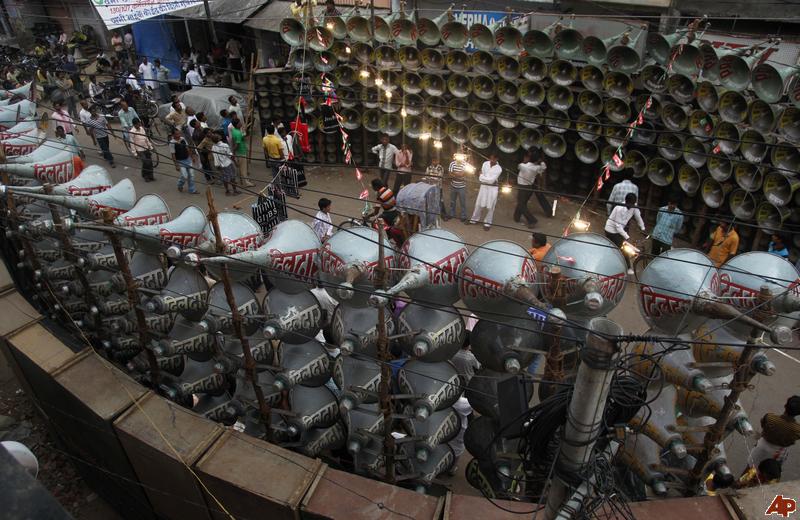
The practice of one’s religion is subject to the essential religious functions test. One aspect that has come under this test in more than one religion, Hinduism, Islam and Christianity, is the use of loudspeakers. The legislation imposing this restriction is the Noise Pollution (Regulation and Control) Rules, 2000[8] which has been framed by the Government of India by the powers conferred on it by the Environment (Protection) Act, 1986[9].

The essential religious functions test, when applied to the use of loudspeakers renders, is a non-essential practice. Several judgments have been passed in this favor.ncp

Proponents of using loudspeakers say that it is part of the devotees’ religious duty, conferred by the Shastras, to sing and listen to Bhajans. It is also necessary to inform others of the time for Namaz through the recitation of the Azaan by the muezzin of the mosque.

However, in the olden times, when the various faiths came into being or evolved and when their respective holy books were written. Every religion encourages its followers to spread its teachings, and modern instruments can make this process easier as well as more effective. However, no religion encourages forcing of unwilling people to be subject to expressions or displays of religious beliefs.

Lord Krishna, in the sacred text of the Bhagavad Gita, states that the Gita “should never be imparted to a man who lacks penance, nor to him who is wanting in devotion, nor even to him who lends not a willing ear; and in no case to him who finds fault with Me.”[10]It is also specified in the text itself that preaching of the Gita must be done only among devotees.”[11]
It has been specified that the gospel should only be delivered to one who enjoys listening to it and one who has patience for the same. It must never be forced upon one who does not want it.

The Holy Quran reads “Lakum Deenokum Walia Deem”[12]which means that one’s religion as well as religious belief is one’s own and each must stay happy with their religion as well as belief. It never mentions, making other people listen to gospels of your faith through the use of loudspeakers.

A similar instance occurs in the Bible. Jesus, in the Gospel, when sending out the Twelve to preach, he asked them not to take anything with them, neither a bag, staff, bread, money, extra tunic, etc. This means that the Gospel does not promote the use of modern equipment for propagation.[13]

Based on the above sacred texts, we can say that in a country like India, which sports such diverse cultures and religions, the use of loudspeakers for preaching religious beliefs and Gospels, is not backed by religious teachings and hence not essential features of religion. Hence, the limitation presented by the implementation of the Noise Rules cannot be said to be unreasonable. This view has been upheld in the judgment passed by the Supreme Court stating “banning the unsolicited use of loudspeakers at inconvenient times is in conformity with religious tenets.”[14]

The Supreme Court affirmed this view in the case Forum, Prevention of Envn. And Sound Pollution v Union of India (UOI) and Anr.[15]

The Court in also held that it is not prescribed in any religion that prayers must be performed by disturbing and disrupting the peace of others neither does any religion preach that prayers should be conducted using voice amplifiers or by beating of drums.[16] india-noise-pollutionloud_speakers

These judgements are inconsistency with Article 25 of the Indian Constitution as these limitations fall within the exceptions stated in subsection (1) of the same article as use of loudspeakers is violative of public health and also violates the fundamental right to life and liberty guaranteed under Article 21, which includes the right to peaceful, comfortable and pollution-free life. While we have the right to freedom of speech[17], others have the right to listen or to decline to listen. No one can be forced to listen, and no one has the right to trespass into the ears and minds of others through his or her voice. “If anyone increases his volume of speech and that too with the assistance of artificial devices so as to compulsorily expose unwilling persons to hear a noise raised to unpleasant or obnoxious levels then the person speaking is violating the right of others to Article 19 and cannot be pressed into service for defeating the fundamental right guaranteed by Article 21.[18]

Other cases that have upheld the right to live in an atmosphere free from noise pollution is part of the right to life and personal liberty guaranteed by Article 21 of the Constitution include Free Legal Aid Cell Shri Sugan Chand Aggarwal alias Bhagatji v. Govt. of NCT of Delhi and Ors.[19] and P.A. Jacob v. Superintendent of Police, Kottayam.[20]

Hence, we can conclude that the use of loudspeakers for the propagation of religious beliefs is not essential for the practice of religion due to which it does not pass the essential religious practice test. Also, this practice violates the right to pollution-free environment conferred onto others under Article 21 of the Constitution.


[divider]

Footnotes:

[1] Constitution of India,  Act 1 of 1950 §25.

[2] See id.

[3] Acharya Maharajshri Narendra Prasadji Anand Prasadji Maharaj and Others v. The State of Gujarat & Others SCC 1975 1 SC 11.

[4]Constitution of India, Act 1 of 1950, § 36-51.

[5] Police Act, Act 5 of 1861 §34; “… and it shall be lawful for any police- officer to take into custody, without a warrant, any person who within his view commits any of such offenses, namely: – First.- Slaughtering cattle, furious riding, etc.- Any person who slaughters any cattle or cleans any carcass; any person who rides or drives any cattle recklessly or furiously, or trains or breaks any horse or other cattle…”

[6]Devadasi system is a religious practice in parts of southern India, including Andhra Pradesh, whereby parents marry a daughter to a deity or a temple. The marriage usually occurs before the girl reaches puberty and requires the girl to become a prostitute for upper-caste community members.”; available at http://iml.jou.ufl.edu/projects/Spring02/Chattaraj/genesis.html

[7] Constitution of India Act 1 of 1950, §19(2); Protection of certain rights regarding freedom of speech, etc.

(1) All citizens shall have the right

(a) to freedom of speech and expression;

(b) to assemble peaceably and without arms;

(c) to form associations or unions;

(d) to move freely throughout the territory of India;

(e) to reside and settle in any part of the territory of India, and

(f) omitted

(g) to practice any profession, or to carry on any occupation, trade or business

(2) Nothing in sub-clause (a) of clause ( 1 ) shall affect the operation of any existing law, or prevent the State from making any law, in so far as such law imposes reasonable restrictions on the exercise of the right conferred by the said sub-clause in the interests of the sovereignty and integrity of India, the security of the State, friendly relations with foreign States, public order, decency or morality or relation to contempt of court, defamation or incitement to an offence.

[8]Noise Pollution (Regulation and Control) Rules, 2000.

[9]Environment (Protection) Act, Act 29 of 1986?

[10] The Bhagavad Gita.

[11]See id.

[12] The Quran.

[13] The Bible.

[14]The Speaking Tree, The Times of India, dated 7.10.2005.

[15] Forum, Prevention of Envn. And Sound Pollution v Union of India (UOI) and Anr., AIR 2006 SC 348.

[16] Church of God (Full Gospel) in India v. K.K.R. Majestic Colony Welfare Association and others, SCC 2000 SC 7 282.

[17]Constitution of India, Act 1 of 1950 §19.

[18] In Re: Noise Pollution – Implementation of the Laws for restricting the use of loudspeakers and high volume producing sound systems with Forum, Prevention of Envn. And Sound Pollution v. Union of India (UOI) and Anr., AIR 2005 SC 3136.

[19] Free Legal Aid Cell Shri Sugan Chand Aggarwal alias Bhagatji v. Govt. of NCT of Delhi and Ors. AIR 2001 Delhi 455 (D.B.).

[20] P.A. Jacob v. Superintendent of Police, Kottayam, AIR 1993 Ker 1.

Download Now

Dispersal of Unlawful Assembly – An Overview

0

In this blog post, Shambhavi Kumar, a student of Jindal Global Law School, Sonipat, provides an overview on the acts pertaining to the dispersal of unlawful assemebly. 

12745836_973229136085387_5201199340001088602_n


Introduction

Article 19(1)(b)[1] of the Indian Constitution confers onto the citizens the right to assemble. However, there is always a possibility that an assembly might turn unruly, causing damage not only to property but also to life. Such an unruly assembly is termed as “unlawful assembly.”

This paper aims to discuss the methods of dispersal of an unlawful assembly and in the process; it explores what exactly constitutes an unlawful assembly as well as steps taken for prevention of such an assembly.

Unlawful Assembly

Section 141[2] in The Indian Penal Code defines “unlawful assembly.” The following are the ingredients for an assembly to be labelled as an “unlawful assembly”:delhi
Assembly of five or more persons: There must necessarily be more than four persons sharing the common object. When there is no evidence to prove that the fifth individual shared the same object; it cannot be considered an unlawful assembly with the remaining four persons.

In the case of Amar Singh v. State of Punjab[3], at the onset, seven people had been charged under Sections 148[4] and 149[5] Of the Indian Penal Code. The Sessions Court acquitted two of the accused and another by the High Court. No one other than these seven was mentioned to have been involved in the crime. The conviction of the remaining four was held not to be sustained. Hence, the acquittal of three of the accused people led to the remaining four to not be convicted under the Sections 148 or 149. The identity of all the members of such an assembly does not necessarily need to be established.

Existence of a common object among all the members which they should be aware of: They must have knowledge of it and agree to it. There should be a present and immediate purpose to carry out the common object. There does not need to be evidence of premeditation or preparation to impute a common object on the Explanation to Section 141 of the Criminal Procedure Code. The common object, however, must be discovered. Common object as required by Section 141 is not the same as that required by Section 34. In this regard simply being present with members of an unlawful assembly isn’t enough to prove that he or she had the same common object as the unlawful assembly. Other direct or circumstantial evidence must be there to justify the existence of a common object.

The common object can be inferred by observing the conduct of the said assembly. This includes the nature of the assembly, the arms used by them as well as its behaviour at the scene of occurrence or before it.

In Lallan Rai and Ors v. State of Bihar[6] The Court held that the requirement of the law is that the person who has the common object must be present at the place of occurrence.

The common object of the assembly should qualify for at least one of the five that are mentioned in section 141: 

(a) Overawing by use of criminal force: Overawing by superior influence or by fear is not illegal. It is termed illegal only when accompanied by a show of criminal force. When a person is frightened into doing something that he, otherwise, would not do or refrain from doing what he otherwise would do; he is thought to be overawed. The show of force caused by this fear is termed to be overawed by the show of criminal force.
For this clause to be applicable, it is necessary for the assembly to have the common object to overawe, simply having the effect of overawing does not attract its application.

(b) Resisting legal process: Any resistance to the implementation of the provisions of law or the carrying out of any legal process is considered to be illegal. If the common object of an assembly is perfectly legal, then it cannot be deemed to be illegal.

(c) Committing “Mischief” or “Criminal Trespass”: Section 425[7] and 441[8]of the Indian Penal Code define the terms “mischief” and “criminal trespass” respectively. “Offense”[9] means something punishable, either under the Code or any local or special law with imprisonment for six months or upward, with or without fine. The restriction defining the minimum punishment is applicable only to offenses under the local or special law.
If a group of seven boys illegally seizes a herd of goats and leads it to a nearby lake, they cannot be said to be a part of an unlawful assembly their act does not qualify as mischief or as any of other offense stipulated in the clause.

(d) Taking or obtaining of criminal force possession of the property by use: No one is to vindicate his or her right to possess any property by recourse to criminal force. This right is subjected to limitations mentioned in Sections 97[10] to 106[11] Of the Indian Penal Code. It is available against offenses only, not against any lawful act.
In cases where the right is only in doubt, it becomes necessary to recourse, to force, to protect it; this clause would apply, and any assembly gathered to further such a purpose would be considered an “unlawful assembly.”

(e) Compelling any person using criminal force into doing something he is not legally bound to do: This is a very comprehensive clause and applies to all rights possessed by a man, irrespective of whether they do or do not concern enjoyment.

Explanation: An assembly may be lawful at the time of its inception but may subsequently turn unlawful. This turn of events occurs the moment one member calls on others to assault X and in response, the rest of the party starts chasing X who was running away from them. No proof of preparation or premeditation is necessary to impute a common object to members of an unlawful assembly.

Section 143[12]of the Indian Penal Code lays down the punishment for the members of an unlawful assembly.


Dispersal

The dispersal of such an assembly is dictated by Sections 129, 130, 131 and 132 of the Code of Criminal Procedure, 1973.

Section 129 describes the dispersal of assembly by use of civil force.

“(1) Any Executive Magistrate or officer in charge of a police station or, in the absence of such officer in charge, any police officer, not below the rank of a sub-inspector, may, command any unlawful assembly or any assembly of five or more persons likely to cause a disturbance of the public peace, to disperse; and it shall thereupon be the duty, of the members of such assembly to disperse accordingly.2012_Malaysia_Bersih1
(2) If, upon being so commanded, any such assembly does not disperse, or if, without being so commanded, it conducts itself in such a manner as to show a determination not to disperse, any Executive Magistrate or police officer referred to in sub-section (1), may proceed to disperse such assembly by force, and may require the assistance of any male person, not being an officer or member of the armed forces and acting as such, for the purpose of dispersing such assembly, and if necessary, arresting and confining the persons who form part of it, in order to disperse such assembly or that they may be punished according to law.”


Hypothetical Examples

Recently, the town of Jhagdapur witnessed incidences of communal violence between Muslims and Hindus residing in that area. Not many days after the last recorded incident, in the neighbouring town, Mirkat, about 50 kilometres away from Jadgapur, a group of twelve Hindu boys, all carrying hockey sticks were marching up to a residential area occupied mostly by Muslims. The officer in charge of Mirkat Thana, the closest police station, ordered this group to disperse. According to Section 129(a), it is the duty of the members of this assembly to disperse which they did to avoid being forced to disperse and getting arrested or confined by the police.

On a given date, a group of 60-70 protesters demonstrating against an allegedly corrupt politician, accused of having a wealth of black money, marched towards his residence shouting and carrying posters bearing the slogan “Kala dhan wapas karo warna hum khud hi le lenge” (“return the black money or else we will take it back ourselves”). The protesters settled outside the said politician’s residence and showed no signs of dispersing. After a few hours, around 8-9 of the protestors picked up stray stones and rocks from the roadside and started flinging them at the house causing damage to the property. The rest of the protesters continued chanting their slogan while more of them joined the pelters and showed no signs of dispersing. At this, the police monitoring the area resorted to baton charge or lathi charge to disperse the crowd. Persons who were pelting the stones at the residence were arrested by the police to be punished according to the law.teacher bihar 130306
In this case, the use of force for dispersal of the assembly by the police is justified as the members, more than 5, had a common object which was illegal, i.e., mischief on account of damage to the property, rendering the assembly as unlawful. The fact that rest of the protestors continued sitting and chanting showed the unwillingness of the assembly to disperse. Hence, Section 129(b) is applicable for dispersal of such an assembly.
If in the same case, the protestors had not flung stones and not damaged property then the similar action of the police would not be justified as the peaceful assembly could not be classified as an unlawful assembly as under Section  141.


Cases


In the case, Nagraj v State of Mysore[13], a Sub-Inspector of Police in Mysore State was alleged to have severely beaten a person X, and when requested by Y to excuse X while forcibly taking him away, fired at two people. The appellant, the sub-inspector, claimed that while he along with a constable were taking X to the Police Station after arresting him, twenty or thirty people attacked them to rescue X. Ignoring his advice to refrain from violence, the crowd asked him to wait for Y to arrive, which he refused. On his refusal, and on the arrival of Y the crowd threatened apprehending danger to his and the constable’s lives, the appellant at first fired in the air, in response the people pelted stones at him and grappled with him, resulting in two shots being fired, injuring two people. The Court held this action of the sub-inspector using force to disperse an unlawful assembly by Section  129.

In Re-Ramlila Maidan Incident v Home Secretary And Ors,[14]Ramdev Baba, along with his followers, were agitated against corruption and demanded that the then ruling government, the UPA government, make efforts to bring black money illegally parked by tax evaders in foreign bank accounts back into the country. The Delhi Police claimed that Baba Ramdev instigated his followers to resort to violence, compelling them to take action. Late in the night the Police informed him that permission to set camp was withdrawn, and it would lead to detention. At around 12.30 a.m., a large number of police and armed force personnel reached the location, the Ramlila Maidan. The forces resorted to violence against the sleeping demonstrators. The Supreme Court took suo moto action against this incident. The use of violence was not justified as the protestors were sleeping and the assembly could not have qualified as an unlawful assembly, and hence, Section 129 was not applicable.

Section 130 states the use of armed forces to disperse assembly.rtr480s9

“(1) If any such assembly cannot be otherwise dispersed, and if it is necessary for public security that it should be dispersed, the Executive Magistrate of the highest rank who is present may cause it to be dispersed by the armed forces.

(2) The Magistrate may require any officer in command of any group of persons belonging to the armed forces to disperse the assembly with the help of the armed forces under his command, and to arrest and confine such persons forming part of it as the Magistrate may, direct, or as it may be necessary to arrest and confine in order to disperse the assembly or to have them punished according to law.

(3) Every such officer of the armed forces shall obey such requisition in such a manner as he thinks fit, but in doing  so, he shall use as little force, and do as little injury to persons and property, as may be consistent with dispersing the assembly and arresting and detaining such persons.”

In the case, Re-Ramlila Maidan Incident v Home Secretary And Ors,[15]Personnel of the Rapid Action Force as well as the Central Reserve Police Force were called upon for dispersing the assembly of protestors gathered at Ramlila Maidan.

Section 131 states the power of certain armed force officers to disperse assembly.

“When the public security is manifestly endangered by any such assembly and no Executive Magistrate can be communicated with, any commissioned or gazetted officer of the armed forces may disperse such assembly with the help of the armed forces under his command, and may arrest and confine any persons forming part of it, in order to disperse such assembly or that they may be punished according to law, but if, while he is acting under this section, it becomes practicable for him to communicate with an Executive Magistrate, he shall do so, and shall henceforth obey the Magistrate as to whether he shall or shall not continue such action.”

Chapter VII of the Manual of Military law deals with the Duties of the military in aid of the civil power. Section 3[16] defines unlawful assembly and riots, Section 4[17] deals with the dispersal of unlawful assemblies and Section 5[18] Specifies the possibility of the use of force for dispersal of such assemblies.

Section 6 states the role of the military in the dispersal of unlawful assemblies. It reads as follows:

“When the civil authorities are incapable of dispersing such an unlawful assembly by the use of all the resources at their disposal, they can seek the aid of the armed forces, if it is necessary for the public security that such assembly should be dispersed. The executive magistrate of the highest rank who is present may cause it to be dispersed by the armed forces (Cr PC, 1973. s. 130(1)).”

  1. Protection against prosecution for acts done under preceding sections.

“(1) No prosecution against any person for any act purporting to be done under Section  129, Section 130 or Section  131 shall be instituted in any Criminal Court except-1453062570-4966

(a) with the sanction of the Central Government where such person is an officer or member of the armed forces;
(b) with the sanction of the State Government in any other case.

(2) (a) no Executive Magistrate or police officer acting under any of the said sections in good faith;
(b) no person doing any act in good faith in compliance with a requisition under Section  129 or Section  130;
(c) no officer of the armed forces acting under Section  131 in good faith;
(d) no member of the armed forces doing any act in obedience to any order which he was bound to obey,

Shall be deemed to have thereby, committed an offense.
(3) In this section and the preceding sections of this Chapter, –

(a) the expression “armed forces” means the military, naval and air forces, operating as land forces and includes any other Armed Forces of the Union so operating;
(b) “Officer,” about the armed forces, means a person commissioned, Gazetted or in pay as an officer of the armed forces and includes a junior commissioned officer, a warrant officer, a petty officer of’ the armed forces a non-commissioned officer and a non-Gazetted officer.
(c) “member” about the armed forces, means a person in the armed forces other than an officer.”

In the case, Nagraj vs. State of Mysore,[19] the appellant, a sub-inspector accused of using force wrongfully against an assembly, claimed that the assembly was unlawful and that he would receive protection under Section 130 of the Code of Criminal Procedure. The Sessions Court made a reference for quashing of the commitment, stating that a Magistrate could not have taken cognizance of these offences in the absence of a sanction from the State Government with reference to positions the  provisions of Sections 132  and  197[20]of the  Code of Criminal  Procedure.  The High Court rejected this reference for quashing of the commitment order given by the Sessions Judge and allowed the appeal, allowing the sub-inspector to use the protection offered under this section.


Use of Force

The principle governs the use of force both in law as well as in police procedures that force should be used only when necessary; even then it should be minimum as well as in proportion to the circumstances and situation. It should also be discontinued immediately when the danger to life and as well as to property subsides.

The United Nations standards bind India on account of being a member. These standards form the basis of several laws. The United Nations Basic Principles[21] state that the use of force for dispersal of non-violent unlawful assemblies must be avoided and minimum force must be used if unavoidable. Only in the case of violent unlawful assemblies should firearms be used given that less dangerous means of dispersal are unavailable, this use of firearms should be to the minimum necessary extent. Model Rules on the use of force by the police against unlawful crowds as adopted by the Inspectors General of Police Conference, 1964[22] states “Minimum” necessary force should be used to achieve the desired object. Force should be regulated according to the circumstances of each case. The object of such use of force is to disperse the assembly and no punitive or repressive considerations should be operative while such force is being used.”[23]245257-campacola3
According to the law, only the executive magistrate or the officer- in-charge of a police station can order the use of force. It must resort to only against an unlawful assembly or one likely to disrupt public peace showing no signs of dispersal. The executive magistrate can also seek the assistance of armed forces to disperse such an assembly. Even in such cases, the force used by officers must be as little as possible and cause minimum possible injury to person and property in accordance with Section 99 of the Indian Penal Code specifying that in any case, harm more than necessary for defence cannot be caused since law enforcement agencies have right of private defence similar to ordinary people

The Police Code of Conduct[24] Specifies that method of persuasion, advice and warnings must be used as far as practicable. Only if it becomes unavoidable should force be used, and it must be the minimum required in the given situation and circumstances. The procedure governing the use of force has been outlined in the respective police manuals of different states. The Kerala Police Manual, 1970 contains a detailed step by step procedure with regards to the dispersal of unlawful assemblies.[25]


Prevention

Section 144[26] Of the Criminal Procedure Code deals with measures for prevention of unlawful assemblies. This section empowers Magistrates to prohibit the formation of unlawful assemblies of five or more persons. This power is given to prevent sudden outbreaks of rioting particularly by groups of armed persons that have a common motive of disrupting public peace and tranquillity.
On the passing of an order under Section 144, all concerned are expected to implement the order unless modified or rescinded by a forum having competent jurisdiction. One consequence of its implementation is dispersal of an unlawful assembly, if required, then by use of permissible force. An order passed under Section 144 applies to both an ‘actual’ unlawful assembly as well as to a ‘potential’ unlawful assembly. This is the scope of application as well as enforcement orders passed under this section.


[divider]

Footnotes:

[1]Constitution of India, Act 1 of 1949 §19(1)(b), “All citizens have the right to assemble peacefully and without arms. This right is subject to reasonable restrictions in the interest of the sovereignty and integrity of India and public order.”

[2]Indian Penal Code, Act 45 of 1860 § 141,“Unlawful assembly.—An assembly of five or more persons is designated an “unlawful assembly” if the common object of the persons composing that assembly is—

(First) — To overawe by criminal force, or show of criminal force, 1[the Central or any State Government or Parliament or the Legis­lature of any State], or any public servant in the exercise of the lawful power of such public servant; or

(Second) — To resist the execution of any law, or of any legal process; or

(Third) — To commit any mischief or criminal trespass, or other offense; or

(Fourth) — By means of criminal force, or show of criminal force, to any person, to take or obtain possession of any property, or to deprive any person of the enjoyment of a right of way, or of the use of water or other incorporeal right of which he is in possession or enjoyment, or to enforce any right or supposed right; or

(Fifth) — Using the criminal force, or show of criminal force, to compel any person to do what he is not legally bound to do, or to omit to do what he is legally entitled to do.
Explanation.—An assembly which was not unlawful when it assem­bled, may subsequently become an unlawful assembly.

[3]Amar Singh and Ors v. the State of Punjab, AIR 1987 SC 826.

[4]Indian Penal Code, Act 45 of 1860 § 148, “Rioting, armed with deadly weapon.—Whoever is guilty of rioting, being armed with a deadly weapon or with anything which, used as a weapon of offence, is likely to cause death, shall be punished with imprisonment of either description for a term which may extend to three years, or with fine, or with both.”

[5]Indian Penal Code, Act 45 of 1860 § 149, “Every member of unlawful assembly guilty of offence commit­ted in prosecution of common object.—If an offence is committed by any member of an unlawful assembly in prosecution of the common object of that assembly, or such as the members of that assembly knew to be likely to be committed in prosecution of that object, every person who, at the time of the committing of that offence, is a member of the same assembly, is guilty of that offence.”

[6]LallanRai and Ors v. the State of Bihar, 1962 Supp. (3) SCR 848.

[7]Indian Penal Code, Act 45 of 1860 § 425, “Mischief.—Whoever with intent to cause, or knowing that he is likely to cause, wrongful loss or damage to the public or to any person, causes the destruction of any property, or any such change in any property or in the situation thereof as destroys or diminishes its value or utility, or affects it injuriously, commits “mischief”. Explanation 1.—It is not essential to the offense of mischief that the offender should intend to cause loss or damage to the owner of the property injured or destroyed. It is sufficient if he intends to cause, or knows that he is likely to cause, wrong­ful loss or damage to any person by injuring any property, wheth­er it belongs to that person or not. Explanation 2.—Mischief may be committed by an act affecting property belonging to the person who commits the act, or to that person and others jointly.”

[8]Indian Penal Code, Act 45 of 1860 § 441, “Criminal trespass.—Whoever enters into or upon property in the possession of another with intent to commit an offence or to intimidate, insult or annoy any person in possession of such property, or having lawfully entered into or upon such property, unlawfully remains there with intent thereby to intimidate, insult or annoy any such person, or with intent to commit an offence, is said to commit “criminal trespass”.”

[9] Indian Penal Code, Act 45 of 1860 § 40, “…the word “offense” denotes a thing punishable under this Code, or under any special or local law as from now on defined. And in sections 141, 176, 177, 201, 202, 212, 216 and 441, the word “offence” has the same meaning when the thing punishable under the special or local law is punishable under such law with imprisonment for a term of six months or upwards, whether with or without fine.

[10]Indian Penal Code, Act 45 of 1860 § 97, “Right of private defense of the body and property.—Every person has a right, subject to the restrictions contained in section 99, to defend—

(First) — His body, and the body of any other person, against any offense affecting the human body;

(Secondly) —The property, whether movable or immovable, of himself or any other person, against any act which is an offense falling under the definition of theft, robbery, mischief or criminal trespass, or which is an attempt to commit theft, rob­bery, mischief or criminal trespass.”

[11]Indian Penal Code, Act 45 of 1860 § 106, “Right of private defence against deadly assault when there is risk of harm to innocent person.—If in the exercise of the right of private defence against an assault which reasonably causes the apprehension of death, the defender be so situated that he cannot effectually exercise that right without risk of harm to an innocent person, his right of private defence extends to the running of that risk.”

[12]Indian Penal Code, Act 45 of 1860 §143, “Whoever is a member of an unlawful assembly shall be punished with imprisonment of either description for a term which may extend to six months, or with fine, or with both.”

[13]Nagraj v the State of Mysore, 1964 AIR 269.

[14]RamlilaMaidan Incident vs.Home Secretary, Union of India (UOI) and Ors., (2012)5SCC1, 2012CriLJ3516.

[15]See id.

[16]Manual of Military Law § 3, “Unlawful assembly and riot. —Before examining the nature and extent of aid required to be rendered by the Army for the maintenance of law and order, it would be useful to know the technical meaning of the terms “unlawful assembly” and “riot.”

Unlawful assembly.—An assembly of five or more persons whose common object is to—

(a) overawe by criminal force, or show of criminal force, the Central or any State Government or Parliament or the Legislature of any State or any public servant in the exercise of his lawful power; or

(b) resist the execution of law or any legal process; or

(c) commit any mischief or criminal trespass, or other offense; or

(d) obtain possession of any property or to stop a right of way or to prevent lawful use of water or to enforce any right or supposed right against any person in enjoyment of such property or thing, by means of criminal force or show of criminal force; or

(e) compel any person to do what he is not legally bound to do, or to omit to do what he is legally entitled to do, using criminal force or show of criminal force.

An assembly which was not unlawful when it assembled may subsequently become an unlawful assembly (IPC.s.141),

A person who being aware of the facts which render an assembly unlawful intentionally joins it or continues in it is said to be a member of an unlawful assembly (IPC.s.142).

Riot. —Whenever force or violence is used by an unlawful assembly or by any member thereof, in the prosecution of the common object of such assembly, it becomes a riot (IPC.s.146).”

[17]Manual of Military Law § 4, “Dispersal of unlawful assemblies. —The law governing the dispersal of unlawful assemblies is contained in Chapter X (ss. 129 to 132) of the Cr PC, 1973 (2 of  1973). Any executive magistrate or officer in charge of a police station or, in the absence of such officer-in-charge, any police officer, not below the rank of a sub-inspector may command any unlawful assembly or any assembly of five or more persons likely to cause a disturbance of the public peace, to disperse; and it becomes the duty of every member of such an assembly to disperse accordingly (Cr PC, 1973. s. 129 (1)).”

[18]Manual of Military Law § 5, “Use of force to disperse unlawful assemblies. —If, upon being so commanded, any such assembly does not disperse, or if, without being so commanded, it conducts itself in such a manner as to show a determination not to disperse, any executive magistrate or officer in charge of police station referred to in para 4 above, may proceed to disperse such assembly by force, and may require the assistance of any male civilian for the purpose of dispersing such assembly and, if necessary, for arresting and confining the persons who form part of it, in order to disperse such assembly or that they may be punished according to   law (Cr PC, 1973. s. 129(2)).”

[19]See supra, note 13.

[20]Code of Criminal Procedure, 1973 § 197, “Prosecution of Judges and public servants…”

[21]U.N Basic Principles for the Use of Force and Firearms, § 13, 14.

[22]Commonwealth Human Rights Initiative, Standards and Procedure for Crowd Control, July 2005, available at http://www.humanrightsinitiative.org/programs/aj/police/papers/standard_procedure_for_crowd_control.pdf

[23] Model Rules on the use of force by the police against unlawful crowds.

[24]Code of Conduct for the Police in India, Principle 4.

[25]Kerala Police Manual, 1970, “The police must invariably secure the presence of a magistrate where it anticipates a breach of peace

  • The decision to use force and the type of force to be used is to be taken by the magistrate
  • Once the magistrate gives the order for the use of force, the extent of force to be used will be determined by the senior-most police officer
  • The extent of force used must be subject to the principle of minimum use of force
  • Use of force should be progressive ñ i.e.; firearms must be used as a last resort if tear smoke and lathi charge fail to disperse the crowd
  • Common tear smoke which causes no bodily injury and allows recovery of affected persons should be used
  • When the crowd is large, and the use of tear smoke is likely to serve no useful purpose, the police may resort to lathi charge
  • Lathi charge can only begin if the crowd refuses to disperse after suitable warning
  • A Clear warning of the intention to carry out a lathi charge should be given through a bugle or whistle call in a language understood by the crowd. If available, a riot flag must be raised. If the police officer-in-charge is satisfied it is not practical to give a warning, s/he may order a lathi charge without warning.
  • Lathi blows should be aimed at soft portions of the body and contact with the head or collarbone should be avoided as far as practicable
  • The lathi blows must not cease until the crowd is completely dispersed
  • If the crowd fails to disperse through the lathi charge, the magistrate or the competent officer may order firing
  • The fullest warning in a clear and distinct manner must be given to the crowd to inform them that the firing will be effective
  • If after the warning, the crowd refuses to disperse the order to fire may be given
  • The police are not on any account allowed to fire except on a command is given by their officer. A warning shot in the air or firing over the heads of the crowd is not permitted.
  • An armed force should maintain a safe distance from a dangerous crowd to prevent being overwhelmed, or increasing the chances of inflicting heavy casualties
  • Aim should be kept low and directed at the most threatening part of the crowd
  • Firing should cease the moment the crowd shows signs of dispersing
  • All help should be rendered to convey the wounded to the hospital
  • Police officers must not leave the scene of disturbance before satisfying themselves beyond reasonable doubt about the restoration of tranquillity.
  • The police should maintain an accurate diary of all incidents, orders, and action along with the time of occurrence. This will include an individual report by all officers involved in the firing.
  • The number of fired cartridges and the balance of unfired cartridges should be verified to ensure ammunition is accounted for.”

[26]Code of Criminal Procedure,1973 § 144,”Power to issue the order in urgent cases of nuisance of apprehended danger.

(1) In cases where, in the opinion of a District Magistrate, a Sub- Divisional Magistrate or any other Executive Magistrate specially empowered by the State Government in this behalf, there is sufficient ground for proceeding under this section, and immediate prevention or speedy remedy is desirable, such Magistrate may, by a written order stating the material facts of the case and served in the manner provided by section 134, direct any person to abstain from a certain act or to take certain order with respect to certain property in his possession or under his management, if such Magistrate considers that such direction is likely to prevent, or tends to prevent, obstruction, annoyance or injury to any person lawfully employed, or danger to human life, health or safety, or a disturbance of the public tranquility, or a riot, of an affray.”


Download Now
logo
FREE & ONLINE 3-Day Bootcamp (LIVE only) on

How Can Experienced Professionals Become Independent Directors

calender
28th, 29th Mar, 2026, 2 - 5pm (IST) &
30th Mar, 2026, 7 - 10pm (IST).
Bootcamp starting in
Days
HRS
MIN
SEC
Abhyuday AgarwalCOO & CO-Founder, LawSikho

Register now

Abhyuday AgarwalCOO & CO-Founder, LawSikho