Download Now
Home Blog Page 1709

Karta of a Hindu Joint Family – Powers and Responsibilities

0

In this blog post, Shambhavi Kumar, a student of Jindal Global Law School, Sonipat, analyzes the powers and responsibilities of the Karta of a Hindu Joint Family. 

12745836_973229136085387_5201199340001088602_n


Introduction

The position of the ‘Karta’ or the ‘manager’ of the Hindu joint family finds its roots in the ‘Patriarch’ of the ancient family units. The term ‘Karta’ has been defined in the case of Suraj Bunsi Koer v. Sheo Persad.[1]

“Manager – Property belonging to a joint family is ordinarily managed by the father or another senior member f the family: The Manager of a joint family is called Karta.” [2]The absolute powers of the ‘Patriarch’ have now evolved into superior powers that are accompanied by similar responsibilities. These powers and responsibilities are several and quite multifaceted. The power of alienation of a Karta is limited since alienation can only be done in exceptional cases. The other powers of the Karta, however, are almost absolute.


Power of Alienation of Joint Property


No individual member of a coparcenary has the power to alienate joint family property without the consent of all other members. However, the Dharma Shastra recognizes that in some circumstances a member has the power to dispose of the  joint family property. Mitakshara Law explicitly states this; wherein – “….even one person who is capable may conclude a gift, hypothecation or sale of immovable property, if a calamity (apatkale[3]) affecting the whole family requires it, or the support of the family (kutumbarthe[4]) renders it necessary, or indispensable duties (dharmamarthe[5]), such as obsequies of the father or the like, made it unavoidable.”[6]Family

The Mitakshara Law, in this aspect, has, over the years, been modified on the following two facets: –

  • This power can only be exercised by the Karta and no other member.
  • The joint family property cannot be alienated for any reason other than the following three:
    • Apatkale: Legal necessity can be varied, and it is not possible to define it precisely. It, colloquially speaking, includes all things deemed necessary for family members. It, however, needs to be shown that the alienation of the property was for the satisfaction of such a need. In Dev Kishan v. Ram Kishan[7], the Karta, under the influence of one other member of a Joint Hindu Family mortgaged and sold the property for the illegal purpose of marriage of two minor daughters. Their contention was that the act was done in furtherance of a legal necessity. The court, in this case, held that the act was done in furtherance of an unlawful purpose, as the act was in contravention of the Child Marriage Restraint Act, 1929[8], hence, it was not a lawful alienation.
    • Kutumbarthe: Anything done for the benefit of the Hindu joint family property constitutes a benefit of the estate. One view, which is no longer valid, included defensive construction. The Supreme Court has observed that it also includes anything done for positive benefit.[9] The test is a thing that a prudent person would do for his property.
    • Dharmamarthe: Religious obligations consists performance of acts which are of a religious, pious, or charitable nature. The example of Dharmamarthe given by Vijnaneshwara entailed the expression “or the like”. This includes all indispensable duties like sradha, upananyana and the performance of any other necessary sanskars, for the furtherance of which, the karta may alienate the whole property. The power of alienation for charitable or pious purposes is only a portion of the property (movable or immovable).

Alienation for the above three purposes is binding on all family members, even minors.[10] Alienation for any purpose other than the three stated above is not void. It is voidable at the instance of any one of the coparceners. This was decided by the Gauhati High Court in CIT v Gangadhar Sikaria Family Trust[11] where the court held that the transfer not for the purpose of legal necessity or benefit of the estate is voidable, not void ab-initio.[12]


Separate Property

 A Hindu may possess separate property even if he is a part of the joint family.[13]Such a property must be self-acquired.[14]It is his personal property, and nobody else belonging to the coparcenary has any right in it. It passes onto his heirs in case of intestate death. It does not get transferred to members of the coparcenary.

The difference between the Dayabhaga and Mitakshara Schools with reference to the power of alienation invested with the Karta is that in the Dayabhaga School, the Karta must render accounts whenever demanded by any of the coparceners under Mitakshara Law, he must only render accounts in case there are charges of fraud or misappropriation against him.


Other Powers

  1.  Powers of Management: The powers of management of the Karta are absolute.[15] He can manage or mismanage the property, family affairs and business any way he likes without being questioned by anyone. He cannot be liable for positive failures. He can discriminate between family members. However, he cannot deny maintenance or occupation of property to any member of the coparcenary. The possibility is a check on the Karta’s absolute power. Affection and natural concern for the family members and the faith and confidence of the members in him is considered the most important check on his powers. zeejudge

  2. Right to Income or Remuneration and Expenditure: The income of the joint family property, in its entirety, must be given to the Karta. It is then his responsibility to allott the funds to members and to fulfil their needs. “The income of the Karta is considered expenditure incurred in interest of the joint family, in the interest of and wholly and exclusively for the purpose of the business of the Hindu undivided family, is not a deductible expenditure under the Income Tax Law[16] in computing the income of the Hindu undivided family.”[17] The Karta controls the expenditure of the funds. The scope of his power to spend extends only to family purposes, i.e., management, protection of estate and residence, realization, maintenance, marriage, education, religious ceremonies, etc.[18]
  3. Right to Represent Joint Family: The Karta represents the family in legal, religious and social matters.[19]His Acts are binding on the members of the family. The family does not have corporate existence; it acts only through its Karta. It has been held that if a Karta contracts debts in order to carry on a family business, he renders the entire family property, along with shares of the other members of the family, liable for such a debt.[20]
  4. Power Of Compromise: The Karta can compromise disputes regarding the family property and/or its management, family debts as well as other transactions. A malafide compromise can be challenged in a partition. The Karta can even compromise a suit pending in court, and the members will be bound by it. However, minor coparceners can use Civil Procedure Code.[21], whereby the compromise has to be approved by the court if one of the parties is a minor.
  5. Power to Refer a Dispute to Arbitration: The Karta can refer a dispute to arbitration. If the award is valid, it becomes binding on all members of the joint family.
  6. Power to Contract Debts: The Karta exercises an implied authority by which he can contract debts or pledge the credit of the joint family for family or business purposes and pay interest on it.[22]Such debts are binding on the entire family if the following conditions are fulfilled:
    • Debts for business purposes: The debts must be incurred in the ordinary course of business.
    • Debts for family purposes: Family purpose, in this context, has nearly the same meaning as a legal necessity, the benefit of estate and performance of indispensable and pious duties. The creditor must prove that the loan in question had been taken in the ordinary course of business, for family purposes or that he did make bona fide and proper inquiries regarding the existence of the need, in case he wants to hold the whole joint family liable for the debts.

  1. Loan on Promissory Note: A loan taken or a promissory note executed by the Karta for the business or any family purpose, gives rise to the possibility of all members of the family to be sued, even though they may not be parties to it. Each member’s liability, however, is limited to the extent of their share in the property.[23] The Karta, on the other hand, is personally liable.
  2. Power to Enter into Contracts: The Karta can enter into contracts which will be binding on the family. The contract is specifically enforceable against the family also.

https://lawsikho.com/course/diploma-entrepreneurship-administration-business-laws
Click Above

Responsibilities

The most basic duty of a Karta is to provide food, shelter, clothing, etc. to the members of the joint family. His several responsibilities include:

  1. Maintenance: All coparceners, from the head of the family to the junior most members, have the inherent right to maintenance. It is the responsibility of the Karta to maintain all the members of the family. “Those who would be entitled to share the bulk of property are entitled to have all their necessary expenses paid out of its income.”[24] If he unjustly excludes a member from getting maintenance or if he does not maintain a member properly, he can be sued for both, the maintenance and arrears of maintenance.
  2. Marriage: The Karta is responsible for each unmarried members’ marriage, especially the marriage of daughters since it qualifies as a sacrosanct duty in Hindu law. The expense of the marriage is taken out of the joint family property. If the expenses are met externally, they must be reimbursed out of the joint family funds.[25] smb_responsibility

  3. Accounts At the Time of Partition: Partition brings the joint family status to an end. Under Mitakshara Law, it means:

  • Severance of status and interest: It is an individual decision; wherein a member wants to sever himself from the joint family and enjoy undefined and unspecified share separately.
  • Actual division of property: The specified shares do this. It is a consequence of the declaration of desire to severe. It is, however, a bilateral action.

Opening of accounts refers to the inquiry of the assets of the joint family assets. An inventory is prepared. This includes all items of the family property. The Karta under the Mitakshara Law is required to disclose the accounts only if there are charges of misappropriation, fraud or conversion of assets or property of the joint family against him. In the absence of proof of misappropriation, fraud or conversion against the Karta, the coparcener pursuing the partition cannot demand the disclosure of the past dealings of the Karta with the joint family assets and property.[26] However, if the coparcener who is suing for the partition is wholly excluded from the enjoyment of the property, he can ask to look into the accounts. After severance of status, the Karta must render accounts of the expenditures and income in a manner similar to that in which a trustee or agent has to render accounts. This implies that the Karta has to account for and report all profits.

  1. Representation: The Karta is the sole representative of the family vis-a-vis the government as well as all other outsiders. It is because of this position that he must perform several responsibilities and liabilities on account of the family. He must pay taxes and all other dues.[27] He can also be sued on behalf of the family for his dealings.


LawSikho has created a telegram group for exchanging legal knowledge, referrals and various opportunities. You can click on this link and join:

https://t.me/joinchat/J_0YrBa4IBSHdpuTfQO_sA

Follow us on Instagram and subscribe to our YouTube channel for more amazing legal content 


Bibliography

Primary Sources

Statutes

  1. Child Marriage Restraint Act, 1929
  2. Indian Income Tax Act, 1922

Case Laws

  1. Suraj Bunsi Koer v. Sheo Persad, 1880 ILR 5 Cal 148
  2. Dev Kishan v. Ram Kishan, AIR 2002 Raj 370
  3. Balmukund v Kamlavati, AIR 1964 SC 1385
  4. VVV Ramaraju v Korada Malleswara Rao, (1999) 2 HLR 257 (AP)
  5. CIT v Gangadhar Sikaria Family Trust, (1983) 142 ITR 677
  6. Mukhtiar Singh v Amarjit Singh, 1975 Cur LJ 121
  7. S. Sairam v. P.S. Ramarao Pisey, AIR 2004 SC 1619
  8. Bhaskarn v Bhaskaran, (1908) ILR 31 Mad 318.
  9. Jugal Kishore Baldeo Sahai v. CIT, (1967) 63 ITR 238
  10. Jitmal Bherumal v. Commissioner of Income Tax, (1962) 44 ITR 887.
  11. Narendra Nath Roy v Abani Kumar Roy, AIR 1938, Cal 78
  12. Singriah v Ramanuja, AIR 1959 Mys 239 (DB)
  13. Gopal v. Trimbak, AIR 1953 Nag 195
  14. Ananda Charan v Jhatee Charan, AIR 1935 Cal 648
  15. Nagarmal v Bajranlal, 1950 77 IA 22
  16. Ram Autar v Beni Singh, AIR 1922 Oudh 135.
  17. Krishnanand v Raja Ram Singh, AIR 1922 All 116.
  18. Chandra Kishore v. Nanak Chand, AIR 1975 Del 175
  19. Ghuia Devi v. Shyamlal Mandal, AIR 1974 Pat 68
  20. Lalitha Kumari v Rajah of Vizianagram, AIR 1954 Mad 19.

Secondary Sources

Books:

  1. Poonam Pradhan Saxena, Family Law Lectures Family Law II, 3rd Edition, Lexis Nexis.
  2. Mulla, Principles of Hindu Law, 17th Edition, Vol.1, Butterworths India.
  3. M. Gandhi, Hindu Law, 2nd Edition, Eastern Book Company.
  4. Werner F. Menski, Hindu Law Beyond Tradition and Modernity, Oxford University Press.
  5. Maynes, Treatise on Hindu Law and Usage, 14th Edition, Bharat Law House.
  6. Ramesh Chandra Nagpal, Modern Hindu Law, 2nd Edition, Eastern Book Company.
  7. K. Mitra, Mitra on Hindu Law, Orient Publishing Company.
  8. Darret J., Duncan M. “Essays in Classical and Modern Hindu Law” Vol.2, Universal Book Traders.
  9. Paras Diwan, Modern Hindu Law, 16th Edition, Allahabad Law Agency.

Online Sources

  1. Ankita Gupta, Karta/Manager, and His Legal Position: Socio-Legal Study, available at http://www.manupatra.com/roundup/341/Articles/Karta%20and%20his%20Legal%20Position.pdf
  2. Manisha, Concept of Karta in Joint Hindu Family, available athttp://www.lawyersclubindia.com/articles/Concept-of-Karta-in-Joint-Hindu-Family-4678.asp
  3. Pragati Ghosh, 5 Most Important Duties and Liabilities of a Manager of a Joint Hindu Family, available at http://www.shareyouressays.com/117196/5-most-important-duties-and-liabilities-of-a-manager-of-a-joint-hindu-family
  4. Roopa Gargava, Position of Karta and the effect of Amendment of section 6 of HSA, 1956 in 2005, available at http://www.legalserviceindia.com/articles/karta_hsa.htm
  5. Rajini Singh, Position of Karta and the effect of Amendment of section 6 of HSA, 1956 in 2005, available at http://jurisonline.in/?p=18386

Databases:

  1. Manupatra
  2. SCC Online
  3. Jstor
[divider]

Footnotes:

[1]Suraj Bunsi Koer v. Sheo Persad, 1880 ILR 5 Cal 148

[2]Mulla, Principles of Hindu Law § 236.

[3]Legal Necessity

[4]Benefit of Estate

[5]Religious obligations

[6]Mitakshara Law

[7]DevKishan v. Ram Kishan AIR 2002 Raj 370

[8]Child Marriage Restraint Act, 1929

[9]Balmukund v Kamlavati, AIR 1964 SC 1385

[10] VVV Ramaraju v KoradaMalleswaraRao, (1999) 2 HLR 257 (AP)

[11]CIT v GangadharSikaria Family Trust  (1983) 142 ITR 677

[12]Mukhtiar Singh v Amarjit Singh, 1975 Cur LJ 121.

[13]Mulla, Principles of Hindu Law § 222.

[14]P.S. Sairam v. P.S. RamaraoPisey AIR 2004 SC 1619

[15]Bhaskarn v Bhaskaran,(1908) ILR 31 Mad 318.

[16]Indian Income Tax Act, 1922 § 37(1).

[17]Jugal Kishore BaldeoSahai v. CIT (1967) 63 ITR 238; JitmalBherumal v. Commissioner of Income Tax, (1962) 44 ITR 887.

[18] Narendra Nath Roy v Abani Kumar Roy, AIR 1938, Cal 78.

[19]Singriah v Ramanuja, AIR 1959 Mys 239 (DB)

[20]Dr.Gopal v. Trimbak AIR 1953 Nag 195

[21]O.32, Rule 7 C.P.C

[22]AnandaCharan v JhateeCharan, AIR 1935 Cal 648; Nagarmal v Bajranlal 1950 77 IA 22; Ram Autar v Beni Singh, AIR 1922 Oudh 135.

[23]Krishnanand v Raja Ram Singh, AIR 1922 All 116.

[24]Maynes, Treatise on Hindu Law and Usage.

[25]Chandra Kishore v. Nanak Chand AIR 1975 Del 175

[26]Ghuia Devi v. ShyamlalMandal AIR 1974 Pat 68

[27]LalithaKumari v Rajah of Vizianagaram, AIR 1954 Mad 19.

Download Now

Discrepancies In Nomination Papers: An Overview

0

In this blog post, Shambhavi Kumar, a student of Jindal Global Law School, Sonipat, provides a brief overview on discrepancies found in nomination papers. 

12745836_973229136085387_5201199340001088602_n


Introduction

The process for seeking election to a legislative body such as the Lok Sabha or the Rajya Sabha starts with the process of filing nomination papers. Nomination papers set forth the details which allow the returning officer to judge whether the person nominated has the qualifications to contest elections. It also provides voters with information about a candidate.  In India, anyone can be nominated for contesting an election through nomination papers, provided they comply with the requisite procedure.286788_95072663

Comparing this with the United States of America we find that the use of nomination papers are of two types. Nomination petition and nomination papers. A candidate of a major political party can enter the November election[1] by securing access to the primary ballot, by filing a nomination petition and winning his party’s nomination. Nomination papers, however, are used by candidates of minor political parties or political bodies, which are distinct from political parties, to enter the November election. A nomination paper as used in the United States is similar to the Indian nomination papers having particulars such as  the Preamble – stating the name of the minor political party or the political body and the county; Candidate Information;  the Signatures of Electors; and  the Affidavit of a Qualified Elector affirming the contents of the nomination paper. Nomination papers must be signed by qualified electors totaling 2% of the maximum votes received by a candidate in the previous election.[2] This comparative view shows how cumbersome a process it is even to get nominated in the United States.

In India, this process is a lot easier with a registered political party candidate needing only one proposer and a candidate from a party which is not recognized requiring only ten proposers. This paper will take a brief overview of the nomination process before considering the question of discrepancies in Nomination papers and the effects of such discrepancies.


The Process

An election notification starts the process of filing nomination papers. An election notification is issued calling for the election of representatives from a constituency.  As per Section 30 of the Representation of People Act, 1951 (hereinafter The act), the Election Commission must then issue a notification in the Official Gazette laying down the important dates regarding the process of nomination, such as last date of filing nomination papers (7 days from the issue of the election notification), date of scrutiny of nomination, last date of withdrawal, dates of polls and the date of completion of the election process.nomination-paper-b-26-12-20

The Returning Officer must then give a public notice inviting nominations as per Section 31 of the Act. Section 32 provides that anyone is eligible to be nominated subject to certain caveats. Section 33 deals with the procedure for filing nomination papers. It must be filled containing all the prescribed details and must be submitted to the returning officer at the place designated in the notice issued under Section 31 between 11 pm and 3 pm duly signed by the candidate and proposer or ten proposers in the case of a candidate fielded by an unrecognized party. [3] A candidate can file as many as four nomination papers, and his nomination will be accepted as long as one out of the four is valid.[4]


Role of the Returning Officer and Scrutiny of Papers

The returning officer plays a key role in the process of nomination. He has three major functions concerning the nomination process. He issues a notification inviting nominations under Section 31 as well as specifying the place for submission of nomination papers. He receives nomination papers under Section 33. He scrutinizes nomination papers under Section 36.  He has to ensure all nomination papers comply with the provisions of the act, and he has the power to reject nomination papers under certain conditions.Voter-list-AFP

On the date of the scrutiny of nomination papers the candidates, one proposer of each candidate, the election agents and one other person duly authorized by the candidate are the only persons who can be present for scrutiny of nomination papers along with the returning officer.  They shall then be allowed to scrutinize the nomination papers of all other candidates.  The returning officer decides on all objections brought forward to him or may decide on any discrepancy on his own. He can make a summary inquiry and by such reject the paper on the following grounds:

  1. Inconsistency with constitutional provisions such as Articles 84, 102, 173 among others.
  2. Noncompliance with any of the requirements of Sections 33 or 34 of the Act.
  3. If the signature of the candidate or proposer on the nomination paper is not genuine. [5]

Discrepancies Identified

A discrepancy could be of two types.  One so substantial so as to merit rejection of the nomination paper. The other would be typing mistakes, or printing mistakes, or spelling errors or something similarly trivial.  A substantial defect warrants rejection.  However, a trivial mistake does not.[6] A trivial mistake can be rectified, and the nomination paper can be accepted (Section  33 (4)). However, that is not the case if the discrepancy is a substantial one. Consider incidents of substantial defects.

The omission of age in the nomination paper is a substantial defect.[7]  Rejection of nomination of the candidate who name was not found in the electoral role specified in his nomination papers was held to be valid.[8] Omission to mention parliamentary constituency is a defect of a substantial character. The returning officer cannot ignore it and allow it to be corrected. He must reject the paper.[9]

Section 33 B of the Act said that candidates need not disclose any information other than that which is sought by the act. The effect of this was that candidates did not have to submit affidavits regarding criminal cases against them. In Union of India v Assn. For Democratic Reforms,[10] the Supreme Court held that all candidates had to submit affidavits giving detailed information about any criminal cases against them. This right does not come from the statute but the constitution. The people have a right to know this information about a prospective candidate and the statute cannot limit it to Section 33 B.  Section 33B was thus held to be ultra vires of the constitution.  Thus failure to submit an affidavit regarding criminal cases, or concealing anything about it or giving incomplete information is a substantial defect and grounds to have the nomination paper canceled.

Consider incidents of defects which are not substantial enough to warrant rejection.

Writing now gong, instead of now gone Assembly Constituency in the nomination paper was held to be trivial and not a ground for rejection of the paper.[11] Being nominated by a government servant doesn’t vitiate the nomination paper and the election. [12] The difference in age of candidate in election roll and nomination paper, is not a valid ground for rejecting nomination paper. [13]

These are cases where mistakes were discovered before polling. Consider the cases given below where mistakes were discovered after completion of the election process.1438773285-6831

In K. Venkatachalam vs. A. Swamickan and Anr[14] a sitting Member of the Tamil Nadu Legislative Assembly was disqualified owing to a defect in his nomination papers.  The appellant, in this case, claimed in his nomination paper that he was a registered voter in the Lalgudi Assembly Constituency of Tamil Nadu. The respondent, however, scrutinized the entire electoral role of the said constituency, and it was discovered that the appellant, Mr. Venkatachalam was not a voter of that constituency. The High Court held him lacking qualifications and liable to be disqualified. The appellant did not dispute this. His only contention was that the High Court could not pass an order under article 226 of the constitution as the matter was time barred under article 329 of the constitution (where election petition is the only remedy available). The Supreme Court here held that this matter came under articles 191 and 193 of the constitution and did not come under Article 329. Here the order of the high court was upheld, and the appellant was disqualified.

In Lila Krishnan v Mani Ram Godara and ors[15],the appellant had her election set aside as legislator of the Fatehabad Constituency in Haryana by the high court on grounds that the respondent’s nomination papers were improperly rejected.  The case came before the Supreme Court because of the appeal by the appellant. In the instant case, the respondent in his nomination paper had listed two of his proposers as entry number 126 and 177 in the electoral role. However, the electoral role had the same two people listed at number 26 and 77.  What is pertinent to note that the respondent himself, nor his proposer or agents were present at the time of the scrutiny of the nomination papers? The Returning officer noticed the discrepancy between the form and electoral role and rejected the nomination paper. The Supreme Court held that the rejection was valid. Section 33(4) empowers the returning officer to correct typing mistakes and accept the form. Since the respondents were not there to correct the apparent mistake, the returning officer acted correctly in rejecting the nomination papers seeing the discrepancy between the paper and the electoral roll.


Conclusion

Having analyzed the process of filling nomination papers in India, I conclude that it is relatively easy to contest elections in India.  Considering the discussion in the paper, the process of nomination is certainly a lot easier in India than it is in the United States of America.  The positive aspect of the system in the USA is that only very serious candidates can appear for elections and not too many candidates are thus able to apply.  The drawback, however, is that the nature of the process causes the candidate to incur a lot of expenses and thus it makes it very difficult for someone not having a lot of resources to contest elections. The positive part in India is that almost anyone can contest the election, whether backed by a political party or not.  The drawback is that sometimes there can be too many candidates for one seat, or many frivolous candidates standing for elections.  The process is very fair, however. The process of filling nomination papers provides information on candidates which can be used by voters in making a choice. Similarly, the scrutiny of every candidate’s paper before every other candidate makes the process very transparent, something which is a requirement of any democratic process.  Having considered the position in the United States as well as the position in India, I conclude that the nomination process in India is fairer and more desirable for a country like India as it allows every citizen a realistic chance of standing in elections, while being a very transparent process which does not allow any room for discrimination on the basis of means. Whether this leads to free and fair elections for all candidates is a different question altogether.


[divider]

Bibliography

Commentaries

  • N. Chaudhary, Election Laws and Practice in India, ( 3rd edn, 2009 Orient Publish Company)
  • C Jain And Dr. Kiran Jain, Chawla’s Elections Law and Practice, (8th edn, 2004 Bahri Brothers )

  Cases

  • Bhom Raj V Devi Singh Bhatti
  • Dev Kanta Baroah v Kusharam Nath
  • Dharampal Singh v. Jasma Devi
  • Venkatachalam vs A. Swamickan And Anr
  • Karkrishnalal v Babulal Marandi
  • Lila Krishnan v Mani Ram Godara and ors
  • Prahlad Dass Khandelwal v. Narendra Kumar Salve
  • Raj Krishna Bose v. Binod Kanungo
  • Union of India v Assn. For Democratic Reforms
  • Viveka Nand Giri v. Nawal Kishore Sahi


 [divider]

Footnotes:

[1] Elections to major public posts such as governor, senator, attorney general among others are held in November in the United States of America.

[2] Armstrong County, Pennsylvania, United States of America http://www.co.armstrong.pa.us/departments/public-services/elections-votersregistration/running-for-public-office  ( Last accessed on 10th September 2014  )

[3] See R.N. Chaudhary, Election Laws and Practice in India, ( 3rd edn, 2009 Orient Publish Company) 295

[4]See P.C Jain And Dr. Kiran Jain, Chawla’s Elections Law and Practice, (8th edn, 2004 Bahri Brothers ) 1248

[5] See ibid 1259

[6]Karkrishnalal v Babulal Marandi (2003 )  8 SCC 613

[7]Bhom Raj V Devi Singh Bhatti, AIR 1989 Raj 142

[8]Dharampal Singh v. Jasma Devi AIR 1989 P&H 64

[9]Prahlad Dass Khandelwal v. Narendra Kumar Salve AIR 1973 SC 178

[10] (2002) 5 SCC 294

[11]Dev Kanta Baroah v Kusharam Nath  AIR 1961 1125

[12]Raj Krushna Bose v. Binod Kanungo AIR 1954 202

[13]Viveka Nand Giri v. Nawal Kishore Sahi AIR 1984 856

[14] Available at http://indiankanoon.org/doc/1539298/ ( Last accessed 10th September 2014 )

[15]AIR 1985 SC 1073

Download Now

Human Rights Violation Of the LGBT Community

0

In this blog post, Sunidhi, a student of the Rajiv Gandhi National University of Law, Patiala writes about the LGBT community. The blog post highlights their human rights and atrocities committed against them.

7


Introduction

LGBT stands for Lesbian, Gay, Bisexual, and Transgender. Homosexuals are referred to people who are attracted towards a person of the same sex as their own. They have sexual desires different from heterosexuals. The term is not restricted to a lesbian, gay, or a bisexual person but it can be used for anyone who is not heterosexual or cisgendered.

Human Rights

Too often the human rights of LGBT people are regarded as a “gay issues” and sidelined as a result. LGBT rights are human rights.

Article 1 of the UN Charter, promotes respect for all human beings without any prejudice.

Article 2 of Universal Declaration Human Rights states that everyone is equally entitled to the rights and freedoms specified in the declaration without any discrimination towards anyone.44

Experts in 2006 formed the Yogyakarta Principles, in Indonesia, to stop organized attacks on the LGBT Community. The Yogyakarta Principles are a universal guide to human rights which affirm binding international legal standards with which all States must comply.

The constitutional provisions such as Article 14 guarantees equality before the law. Article 21 guarantees life and liberty to everyone without any discrimination.

Despite these laws incidents like the ‘Orlando Massacre’ happen and many innocent lives of the LGBT community are lost.

Atrocities Against the LGBT Community

June 12, 2016, Orlando Gay Nightclub Shooting

The recent incident of Orlando Massacre was one of the most deadly mass shooting by a single gunman. It was one of the deadliest incidents of violence against LGBT community. In this attack on Pulse, a gay nightclub, in the USA, 50 people died, and 53 people were injured in that attack one of them was the gunman.

Gay Pride Parade, Jerusalem, 2015

A Jewish man stabbed six people belonging to the LBGT community. In 2005, he had also committed a similar crime.

Central Station, Moscow 2014

In 2014, the Central Station, the gay nightclub was repeatedly attacked by the police officials. In the end, the nightclub was shut down because of repeated violence by police. The police showered bullets in the nightclub as well as gassed it.

DIY Club, Yerevan, Armenia, 2012

The gay-friendly bar was firebombed and spray-painted with swastikas.

Backstreet Cafe, Roanoke, Virginia, 200055

Another incident in America, where a single gunman started shooting in a gay nightclub killing one and injuring six others.

Otherside Lounge, Atlanta, 1997

In this violent attack on the LGBT community, the bomber declared that he wanted to send a message to USA politicians against their tolerance and support to LGBT. In this incident, a lesbian bar was nail-bombed wounding five people.

Upstairs Lounge, New Orleans 1973

In this incident, 32 people were murdered in a fire. The matter was never solved, and the guilty were never punished, and the politicians suppressed the matter to silence.

There have been many other incidents of cruelty against LGBT community that were never highlighted.

Stand Against Such Incidents

Same-sex marriage has been legalized in the USA since June 26, 2015. This ruling was given by the Supreme Court of USA in Obergefell v. Hodges in 2015. Despite legalizing same-sex marriage no substantial action has been taken by the USA to protect them. The day after the Orlando Massacre a bill was proposed regarding strict gun rules in the USA but it was rejected by the Senate the same day, and no strict action was taken for the protection of  the LGBT Community.

Indian Law

Section 377

Section 377 states that “Whoever voluntarily has carnal intercourse against the order of nature with any man, woman or animal, shall be punished with imprisonment for life, or with imprisonment of either description for a term which may extend to ten years, and shall also be liable to fine.

This section makes it a punishable offense for homosexuals to indulge in sexual intercourse with the person of the same-sex or with an animal. The harsh terms used by the law like, “carnal intercourse against the order of nature” show how insensitive Indian law is towards the feeling of this community.

Judicial Approach77

In 2009, the Delhi High Court in the case of Naz Foundation v. National Capital Territory of Delhi decriminalized Section 377. But in 2013, the Supreme Court of India reversed the decision of Delhi High Court and again made it an offense. Supreme Court stated that it does not have the power to repeal Section 377 as the power to repeal the law is vested in the Executive. Therefore, it reinstated Section 377. In 2014, a review petition was filed, but it was turned down by the Supreme Court, reiterating the same views.

Bill To Decriminalize Section 377

A bill was introduced in the Lok Sabha to decriminalize Section 377 of IPC by Shashi Tharoor, but a vote of 71-24 rejected it. In India, despite ratification of International documents regarding equal human rights of all without any discrimination, such biased laws prevail that stop LGBT from living their life the way they want.

Being homosexual is one’s choice, what they do privately is not a part of their public life. No one should have a right to interfere in their private life. It is claimed that decriminalizing Section 377 is not possible because it is against public decency. An act which is done in a private place, with the consent of the two people, indulged in it, becomes a cause of public indecency.

There are numerous Indian as well as International laws to protect homosexuals, but it is very shameful that not a single law has been executed to save them from the atrocities continuously faced by them, except in a few countries where homosexuality has been legalized.

It is time, we realize that they are also human beings and they also have the same human rights. Hence, strict laws should be implemented for their protection.


Download Now

A Crtitical Analysis on the Need for Change in Indian Environmental Laws

0

In this blog post, Sunidhi, a student of the Rajiv Gandhi National University of Law, Patiala has suggested few improvements in Environmental Law of India. The blog post highlights how laws of another country can help in improving Indian environmental laws.

 7


Introduction

The destruction of the environment, as it has been elsewhere, is quite apparent in India, too. Environmental pollution is a major challenge to the civilized law. Law, as the means of social control, was unknown in ancient India; but environmental consciousness was not absent in the people. Every individual in the society observed dharma as a part of life, which taught them to worship nature.mmadigital_FLAC_Environmental-Law-and-Planning

Classical texts like Manu Samhita, Brihat Parasar Samhita, Brihaspati Samhita, etc., prescribed punishments for offenders for destroying trees, animals or for polluting water.[1] Medieval people lost sight of the need for the preservation of the environment. However towards the end of 19th century, under the supervision of colonial masters, India passed some legislations which indirectly contributed towards the preservation of the environment. Presently, in India, more or less, 200 legislations deal directly or indirectly with environment pollution and degradation. But the environment is continuously degrading despite these laws, as there are many loopholes in it.

Suggestions

Prudent environment management is the need of the hour.  A few suggestions relating to planning and for improvement of legal as well as enforcement mechanism may be given here which if operationalized may prove relevant and viable to lessen the pollution problems.

The comprehensive preservation, protection, and development of the environment in India may be vested upon three agencies, namely National Environment Commission, Central & State Pollution Control Board and Environmental Court. The commission will be responsible for developing the environmental policy, advising Ministry of Environment and Forests about appropriate changes in law, framing rules and regulation under the present legislations after undertaking continuous research. Boards will act as the monitoring, investigating and enforcing agencies. Special Courts may be set up at regional levels; wherein judges will be assisted by experts. At the central government level, the MoEF will co-ordinate the three agencies, without interfering in their independence and facilitating in financial and administrative matters.[2]environmental-law

The legislature, based on the German Environmental Code[3], should frame one consolidated environmental code, instead of enacting various laws dealing with diverse environmental aspects. It would prevent the overlapping of provisions. The code should enumerate constitution, powers, and functions of all the agencies, so, that functional and jurisdictional overlapping can be avoided. People from different fields of knowledge, who are directly or indirectly involved with the environment should be appointed instead of political and preferential appointment.

It is necessary to enhance the quantum of fines so that it has a deterrent effect on the large corporate bodies. It is equally essential that the code should direct transnational corporations to follow same standards of safety which are expected to be observed in the host country. Whenever a corporation commits any environmental crime, its officials must be held liable, and care should be taken that the innocent should not be punished. This would have the effect of increasing the responsibility of the management.

Environment Impact Assessment is still in its nascent stages. A separate legislation may be enacted on the lines of the U.S. National Environmental Policy Act of 1969, which could provide EIA a statutory requirement for all polluting activities or proposed development plans. The entire process should not be done in a state of secrecy but be amenable to public scrutiny and review by judicial bodies. EIA needs to be institutionalized and standardized and public participation by involving NGOs be made mandatory so as to ensure administratively and public acceptability of anticipatory activities in the project.

To make environmental auditing more meaningful, it is necessary that it should be backed up by some suitable legislation. The Companies Act may be amended suitably providing for compulsory inclusion of a statement on the environment in the annual reports of the companies. The industry should be properly educated regarding the usefulness of auditing in reducing manufacturing costs by organizing orientation programs.

Economic steps could be a useful instrument of preventive environmental policy if used in the right framework. Economic Instruments may be applied for the compliance of standards as well as an incentive to promote adoption of environmentally benign alternatives or technologies. In other words, taxes in proportion to emission loads or proportion to the excess profit made through non-observance of laws may be imposed. The polluter could react to such taxing with a mix consisting of tax avoidance through reduction of emissions, substitution of inputs or production processes, etc. An environmental fund may be set up. It would include contributions of government, mega corporations, environmental and the general people of the country. In the case of environmental disasters, it would facilitate immediate payment to victims to avoid long-term effects of trauma.download

A better approach for deriving standards will be to carry out a trade-off between the cost of pollution control and the concomitant cost of environmental damage. The combination of the two results in a minimum net cost which identifies the optimum degree of control. This approach will be economically efficient and will take into consideration available technology. It will be flexible at the same time as technology will improve, the cost function will always lead to new and better standards. It will incorporate primary consideration of health which is implicit in the evaluation of the damage function.[4]

The existing anti-pollution laws, though effective on paper, suffer from practical difficulties, defeating the legislative object. Hence, changes must be made at appropriate places, taking the clue from the law of other countries. Various organizations and agencies must be encouraged to lend their support towards the setting up of a clean pollution free environment.


‘The earth is the mother, and we are her children…

Human destinies are inseparably linked with that of Earth.

It is, therefore, our duty to maintain the nature of Nature.

It is in our self-interest, if nothing else.’

[divider]

Footnotes:

[1] NK Chakrabarti, Environment Protection and the Law, 1994, p 22.

[2] Indrajit Dube, Environmental Jurisprudence: Polluter’s Liability, 2007, p 156.

[3] German Civil Code is an umbrella legislation which covers almost every aspect of the environment.

[4] Kailash Thakur, Environment Protection Law & Policy in India, 2007, p 416.

Download Now

It Changed Everything I Knew About Startups

0

In this blogpost, Sastry Tumuluri, CEO, Digital Self Defence Infosec, writes about his experience while he was doing the Startup Leadership program.

sastry

For seven months, every other Saturday, I used to wake up at 3:30am, take a bus from Chandigarh to Delhi. I’d attend SLP sessions, after-session meetups and return by a late train or bus – reaching home at around 2am.1

Why did someone in their 50s, running a startup that left very little time to spare, subject themselves to this punishing schedule? Was there was something special about SLP that made it worth it? A Short answer – Yes!

Recommendation from a well-respected Group:

I got to know about SLP through friends in the Morpheus Gang – a group known for their dynamism and high performance. After a bit of research, I took the plunge.

The fellows – the new normal:

For the first time, I was in a room full of people for whom normal meant getting off the beaten track, taking big risks and making their mark. Most of them set very high standards for themselves and others.

I had a lot of questions in mind. Questions like:

  • Did we get the best possible speakers?
  • Is it just another gyan session that I can google up?
  • Were the examples discussed even applicable anymore?

Running the sessions – not merely attending them:

Each of us got to be a “CEO” of a session at least once. We had to study the topic in advance, send preparatory material to the fellows, invite speakers/mentors/experts for the session, iterate on the session format, etc. Not only did we get to interact a lot within the group, but we also got involved deeply – as opposed to “just showing up for the session”.

Covering the whole gamut of startup topics:

Each session was tailored to address one or two startup related topics. Coverage was extensive. Lean startups, term sheets & related legalese, digital marketing, design & UX, Funding pitches and more. Different formats like panel discussions, gamification sessions, mentoring sessions, field visits to validate ideas, workshops and role-plays were all used to keep these superbly engaging. Getting to know great speakers and mentors was definitely a big bonus.


The takeaways:

Despite all my past experience, I felt a dramatic transformation on what I thought about startups and how they can be run. It would’ve been easy to judge each session and feel dissatisfied with all the things that could’ve been better.  As they say, “if you look hard enough, you will find what you are looking for.” I was looking for value, and I found a truckload of it.


The network – an amazing unfair advantage:

Given the high standards of selection – it is natural that the global SLP network has super achievers and great leaders among them. It is a great privilege to be among them, and to be able to reach out to them when needed. This is indeed a no small advantage for an SLPian – over others.


In a summary, SLP has been and continues to be a great personal journey. I liked it so much that I became a Program Leader at SLP Delhi this year.

If you think you are a potential leader or have a deep desire to build something, you should look up SLP. I highly recommend it.

Applications are open till 15-August. http://startupleadership.com/pages/admission/#apply


Download Now

Is Command over English important for lawyers?

0
Why Should You Perfect Your English?

English is not just a language; for a lawyer, and a law student, it is a tool!Why Should You Perfect Your English?

Language can make or break a career. Once legendary Prof. N. L. Mitra had asked this in a class I was attending “Why do you think law firms gladly hire law students like you at a much higher salary than any other entry level job in the country?” After some cumulative head scratching by us, he gave us the answer himself: your command over the language.

Now remember, Prof. Mitra is just not another academic who has settled in the law school industry to live a charmed life and bask in the glory of setting up NLU Jodhpur. Apart from making it a success that it is now, he has also become a partner in one of the top and trusted firms in the country. He really knows what he is saying. People with good command over English are valuable to law firms. Knowledge of English works like an entry barrier, you can not join the big league unless how you speak and write is really up to the marks.

Anything less than flawless English is not good enough.

And it is not just law firms, it is pretty much anything you may do as a lawyer. Those with good command on English will do better than the rest. You maybe a staunch nationalist and resent having to learn English, but sorry, you are disadvantaged if your English is not good enough. People will even assume that you have low levels of intellectual ability. No matter how wrong they are, it will restrict your professional success. That’s how it works here, from interviews to get into college societies to job applications – you are slaughtered for less than perfect English.

Writing flawlessly is more important than speaking flawless English.

As far as a law student is concerned, usually writing perfect English is way more important than speaking. Making a mistake while speaking is still one thing, but making the same mistakes in writing is going to kill your reputation.

When I joined NUJS, fresh from a Bengali medium school where I studied for all my life until that point, I could not speak much English. My grammar was good, and vocabulary outstanding, because I had learnt these things by heart for the law entrance exams. Very quickly I learned how important it is to write error-free English.

Everyone has their pet mistakes that they think are correct usage. Friends do not point out of politeness, and strangers judge.  One of the most important tools I had used to get rid of the mistakes was lists of Frequently Made Mistakes – which I found in English textbooks and the Internet. Till date, I can not say that I make no mistakes, but even if I do, those mistakes will be very, very rare and I always try to eliminate them.

Bad English will kill your reputation, and no one will take you seriously. People get distracted by errors, such as grammatical or spelling errors (even if they make the same mistakes themselves) or wrong usage of words and phrases. It can cost you a lot, so please pay attention. Identify and weed out mistakes, one by one. You could have a mission of identifying at least one mistake in your English every day. The point is to have a steadily improving knowledge of grammar.

I have a great vocabulary, now let’s show it off! (These guys are headed straight for hell)

The other killer mistake I find many people who have otherwise a good knowledge of English making is using arcane English! The worst thing is that these people seem to think they write better English than others because they are using words that are unknown to most people (and exotic, perhaps?) or because their sentence structures are very complex! This is just madness.

Do you want people to read what you are writing? Then make it easy for them to read. Use the most simple language. Make a rule for yourself: I shall write only simple sentences for the next one month. That should help you to cure this disease. Use a word that you would expect a 15-year-old kid to know unless you are writing an academic paper or constitution of your secret society! After all, 90% people stop learning new words when they become 15.

So is that what Command over English  is?

However, while flawless English is necessary, but that is still not what Prof. Mitra means when he says “Command over English”. That’s a different and more advanced ball game. A lawyer’s task is often to be a nifty crafter of words that achieve targeted goals. Sometimes it is the attention of a regulator, other times sympathy of an arbitrator, or it could be approval of a board of directors. Everything, and most importantly, huge sums of money hang on balance on your word when you are a corporate lawyer at the highest level. Are you ready to take your command over English to that level? You must address the basics first.

I shall write more specifically on how and what sort of English you can use for Memos, Legal notes, exam papers, conference papers and so on in a follow-on post. If you are not already a subscriber, sign up for updates from this blog on top right corner of this page, and submit your name and email address.

If you like this post, don’t forget to share it on Facebook or Twitter!

Download Now

What is Investment Banking – from Liar’s Poker and Wall Street Meat

0
Liar's Poker and Wall Street Meat - Big Time Investment Banking Through the Looking Glass

Liar's Poker and Wall Street Meat - Big Time Investment Banking Through the Looking GlassAre you familiar with the overwhelming euphoria the media experiences every year come recruitment time at IITs and IIMs? The stars of this yearly drama are launched internationally as professionals commanding highest salaries paid to graduate from anywhere in the world. The best salaries range somewhere around 150,000 to 250,000 US dollars per year – which is equivalent to a whopping one crore rupees in India! Well, what do these guys do? The sky is the limit – but what is it like when you aim to reach the sky and get up close? The newspapers and TV channels normally fail to explain, but these jobs are offered at some of the best investment banking firms in the United States. The two books we have chosen for this post, as promised, Liar’s Poker and Wall Street Meat describe the inner functioning, the politics, and the criteria for success in investment banking which thrived in the 1980s.

Explaining the business of Investment Banks

The best-known investment banks are the biggest and most profitable money making machines in the world, such as Goldman Sachs, Morgan Stanley, J. P. Morgan Chase, Merrill Lynch, etc. While the word ‘bank’ is still attached to them, the functions that investment banks perform are very different from the ordinary banks that we know of, which primarily specialise in lending money to people or companies who need it, and accepting deposits (like fixed deposits, savings accounts) from those who have excess of cash, and performing some minimum value-added functions such as issuing credit cards, help the customers perform transactions over the internet, etc.

Investment banks advise their clients on several matters and design instruments that can generate investments and consequently, profits – they advise companies on how they could could raise money by issuing shares, or bonds, or they manage tremendous amounts of money of different kinds of institutions, which could be insurance funds, pension funds, or rich individuals (who are known as high net-worth individuals or HNIs).

How investment banks are involved in your life

Often, a portion of the money you contribute for your pension, when you retire, or for your insurance premium, goes to such pension and insurance funds, which are advised by investment banks on how they could use the money in areas where there is going to be a huge amount of growth, so as to make the money multiply. A number of funds with these institutions is huge, as it is the aggregate of a huge number of individuals’ money. That is why certain insurance plans and pension funds are able to pay you in the event of a contingency, and reap rewards for themselves at the same time.

Salomon Brothers

Salomon Brothers thrived in the 1980s in a special business known as bonds trading, that is, buying and selling bonds. The frequency and volume of such transactions increased manifold after a decision made by Paul Volcker of the US Federal Reserve to allow interest rates to fluctuate, determined only by market forces without any intervention from the central banking agency. At present in the US, or in India for that matter, an interest rate is controlled by the central bank.

Explaining Bonds Trading

We know that in case of shares, it is a feeling of how a company will perform in the future (arrived at through various methods of calculation and analysis, but we shall not go into that here) which enables us to estimate as to whether the price of shares will rise, and whether we should buy or sell the share of the company. So, the future performance of the company is the only relevant factor for making a decision to buy or sell a share. In the case of bonds, there is another relevant factor – interest rates.

An example of bonds trading

I shall use a simplistic example to explain how interest rates affect the price of a bond – if I buy a bond of any company at US $100, which will pay a 10% interest on the amount borrowed on that bond (that is, $10) when the market rate of interest was 10%, and the market interest rates rise subsequently to 20%, then I can get the same return ($10) if I buy a bond of $50. Hence, the bond that I bought initially at $100 will be worth around $50.

The world of bonds

Bonds may be issued by companies or governments (national, state or at the local municipal) operating in countries all over the world. A company or government in one country can issue bonds in another country as well. So, as we see, the total number and kinds of bonds available in the market could be a very vast number. A good investment bank would have to keep track of all the bonds that were out there in the market. They employ a very large number of researchers so that they have an idea about the price of which bonds could go up, and which one may come down at any given time.

Salomon’s modus operandi

Salomon Brothers was extremely good at predicting the price movements of bonds. Of course, this was done by highly qualified people using complex mathematical models. When they thought that a decision they made was bad, they quickly advised a client to buy the-the bonds held by Salomon, stating (against their own belief) that they believed very strongly that their prices would rise. Subsequently, when the loss occurred, the client would be ‘blown up’, and would always hate the institution for that reason. But the market was very big, and there were always other clients to approach for selling bonds, and Salomon did not suffer for this in the long term. The best bond traders in the bank were adept at this and proud to call themselves ‘Big Swinging Dicks’.

Creation of a new niche market by Salomon

The Salomon Brothers success story reached its pinnacle when they started improvising on something really ordinary – mortgage loans of ordinary home buyers. In simple terms, when you buy a house upon taking a loan from a bank, the loan will be known as a mortgage. If you fail to repay the money to the bank as per the stipulated time period, the bank will have the right to sell your house off and recover the debt from the amount realised from the sale.

Tracing the seeds of the financial crisis of 2008

The mortgages of a large number of home buyers were combined together, and then broken up into different components of small amounts (much like a 10 or a 100 rupee share of a company) and sold by Salomon Brothers to their clients. This started a revolution by creating an entirely new market and established Salomon Brothers firmly at the top of investment banking in bonds.

The process described above – of combining housing loans and then breaking them up into smaller components and selling them to different buyers – is known as securitisation, and as a technique, has received a lot of criticism for its contribution, alongside several other factors, to the present financial crisis.

The Predator’s Threat

The 1980s, as we have already seen in the post on Barbarians at the Gate, was an era where junk bonds are in vogue and extremely useful for smaller companies to take over huge institutions, sometimes one many times larger than the predator in net worth. Junk bonds gave the power to ordinary individuals to take on the might of large institutions.

One such predator was Ronald Perelman, who became famous almost overnight, after his takeover of the well-known brand Revlon. He wanted to acquire Salomon Brothers afterwards. His financier was none other than Salomon’s biggest competitor and the financier of the RJR Nabisco deal described previously – Drexel Burnham Lambert, propelled by the greatest mastermind of securitisation ever: Mike Milken.

As already explained, if Salomon Brothers was taken over, there are high chances that its management may face less favourable terms of employment, irrespective of how senior they are in the hierarchy. Therefore the management of Salomon Brothers desperately wanted a rescue. Ronald Perelman was looking to purchase 14 percent shares from a shareholder called Minorco, and would then attempt to acquire another 11 per cent, which if successful, would threaten the job of the person who headed Salomon Brothers – John Gutfreund.

Why Salomon Brothers could be taken over

This risk faced by Salomon Brothers, however, is not faced by every mom and pop store (in India, known as a kiranawala) or a partnership business. The risk is faced only by those institutions whose shares are traded on the stock markets (public limited companies). Salomon Brothers had lately become a corporation, and its shareholding was not closely held (unlike most of the Indian public limited companies, where normally promoters rule the roost by keeping at last 51%, or the controlling stake with themselves) and was hence vulnerable to a takeover by a person who wanted to acquire its shares.

Warren Buffett’s rescue plan

Warren Buffett, known as the Oracle of Omaha, was approached to rescue Salomon Brothers. He, till today, is world’s most famous investor, and is almost always approached by a failing institution, although he may decide not to help it. In this case, Warren Buffett could have been a simple white knight, who could have purchased some of the shares of Salomon Brothers, which would have reduced the the shareholding of Perelman proportionately and would have placed a fixed amount of shares in safe hands, as Warren Buffett would not sell his shares to Perelman.

However, Buffett was given a more remunerative package. There had been a stock market crash in the United States in 1987, which means that Salomon Brothers’ business was severely affected. Therefore, buying shares for Buffett may not have been a very good option, since if Salomon Brothers did not do well subsequently, the share price would not rise. Dividend on the shares would also be subject to the decision of the Salomon Brothers’ management.

Introducing the convertible bond

Therefore, Buffett bought a hybrid instrument, which is neither a share nor a bond, but has some of the properties of both. Until some time, it would have the features of a bond – he would be paid a fixed amount of interest every year. He was given 9 years within which he could decide if he wanted to convert this bond into shares.

This had an added advantage – if Salomon Brothers did well after 9 years, the prices of his shares would rise steeply. This ensured him security, and chance of high profits. In fact, the book states that even if Buffett had immediately converted his bonds into shares, he would have made a profit of a whopping 126 million dollars!

The risk which Buffett still faced

The only risk was if Salomon Brothers had gone bankrupt, in which case Buffett would have to be repaid his money from the assets of Salomon Brothers, which would include a sale of their offices, and their other investments. In that event, there could have been a chance that he did not get all his money back. However, on hindsight Buffett’s decision to support Salomon was definitely a wise one, as it did not go bankrupt.

Could Salomon have avoided the threat?

Salomon Brothers had known that Minorco wanted to sell its shares – so it could have attempted to ‘buy-back’ the shares from Minorco. In that event, Ronald Perelman would not have been able to acquire the 14 per cent from it. However, Salomon’s management did not pay heed to that threat. Hence, it had to act suddenly in the face of Perelman’s threat. It offered very easy and profitable terms to Warren Buffett. The costs of the same were borne by the shareholders of Salomon.

Wall Street Meat

Liar’s Poker was for bonds, and we now fast forward to the dot com boom of the 1990s – when investment banking firms needed specialised and experienced people to advise them on how the stocks (shares) of companies dealing in different kinds of hardware, software and electronic goods and related technology would perform. Investment banking firms hired engineers with experience in such industries for this purpose. Wall Street Meat offers glimpses into the business model of investment banking firms, through a peek into an investment bank named Paine Webber, which has now been acquired by the Swiss Bank UBS.

Being #1 Analyst

There was a tendency amongst firms to have analysts in increasingly specialised areas. Analysts would be proud to be ranked first by reputed magazines such as Institutional Investor in their chosen field. Ironically, upon further inquiry one would find out that it was so because there were only one or two other firms which had an analyst in that sub-industry.

The Chinese Wall as the barrier to insider trading

The Chinese Wall refers to an internal barrier within the same institution to the flow of information. In the case of investment banks, the analyst wing, which predicts the performance of stock prices and an industry sector, is not aware of some of the details that the investment banking department knows. This is in order to prevent allegations of insider trading – that is, buying or selling of shares on the basis of information which the general public is not aware of. The practice of insider trading is sought to be prohibited so that every in the stock market trades on the basis of the same set of facts which are available to the general public.

The department of an investment bank which is actually involved in a business deal – say, a merger, would have intricate details about how the deal could make the company better off. If such information was known to the general public, then the prices of the company’s shares to which the information relates would be significantly affected. Trading on the basis of such information, which is not available to the general investor community is called insider trading and is prohibited under the law.

If the analyst wing makes recommendations of which shares to buy on the basis of knowledge of these details, it can be accused of insider trading, unless it discloses the information based on which it is estimating the stock prices. The analysts’ wing cannot disclose these details as all the parties and their advisors (that is, investment banks, lawyers, accountants, etc.) involved in a deal are usually required to enter into an agreement requiring them to keep the details confidential. Therefore, the only way it is possible for an investment bank to run an analysts’ wing and simultaneously get involved in doing deals is by maintaining an artificial barrier between the two wings.

Where are the legends now?

The most famous operators of the dot-com boom in 1990s were Henry Blodget, of the famous investment bank Merrill Lynch (which has now been taken over by Bank of America during the financial crisis), Frank Quattrone of Credit Suisse First Boston (where the great dealmaker Bruce Wasserstein had once worked) and Mary Meeker from Morgan Stanley.

Frank Quattrone, who used to make US $160 million during his heyday, and Henry Blodget got into trouble with the Securities and Exchange Commission of the US for securities fraud. Henry Blodget was banned from participating in the securities market, and has therefore shifted to writing on business trends. Mary Meeker is the only one who is flourishing and still in the same industry.

Salomon Brothers was eventually acquired by Citigroup in 1998, and Paine Webber was acquired by the Swiss bank UBS in 2000. J. P. Morgan (which had acquired the failing UK bank of Bear Stearns) and Citigroup were the leaders of the bond market in 2009, as per Economic Times.

We read about how profitable convertible debentures were for Warren Buffett, when he lent his aid to Salomon Brothers. In the Indian market, Dhirubhai Ambani, the founder of Reliance Industries, who also single-handedly catapulted it onto the world stage, had used the convertible debenture on a number of occasions to raise money for his company from the public, although Reliance was not under threat of a takeover. As Reliance performed exceedingly well, its shareholders were handsomely rewarded by the profits it made.

With that, we arrive at the end of this post. A lot of exciting trivia could not be covered here, and so readers are advised to read the books as well so that they may relish the stories even better. Do come back next fortnight, as we cover the story of Skadden – one of America’s largest law firms.

Download Now

5 Reasons to Consider Clerking at Moot Courts

0
5 Reasons to Consider Clerking at Moot Courts

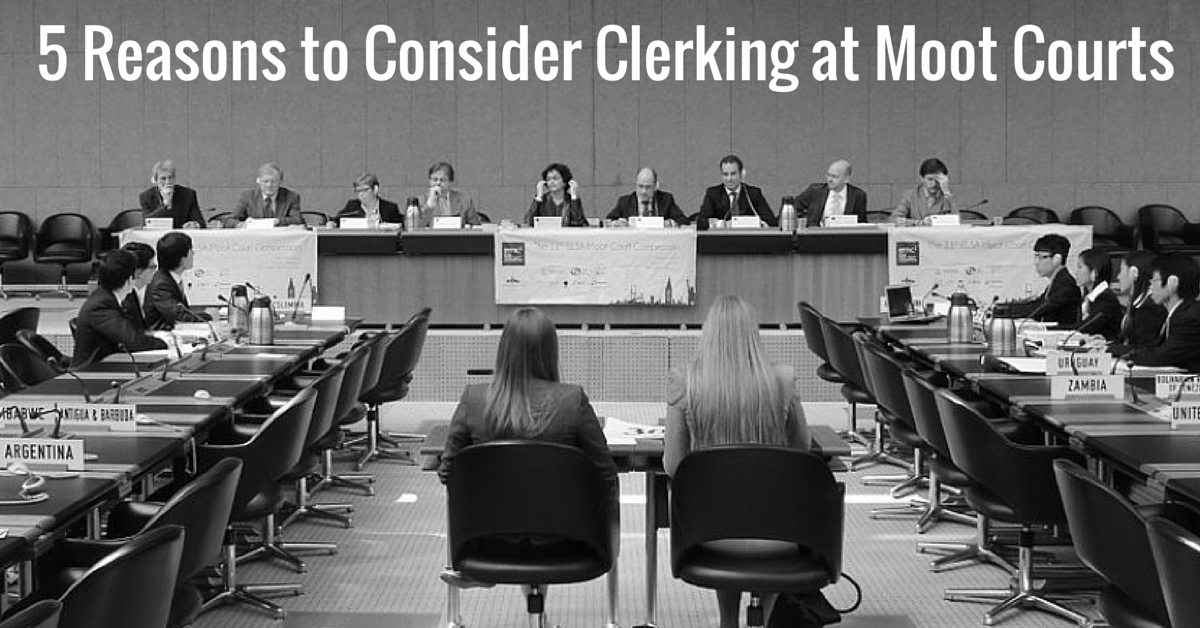
5 Reasons to Consider Clerking at Moot CourtsLife in a law school offers a lot of opportunities. These opportunities help us learn and grow as a lawyer. Every law school hosts a lot of activities. Be it debates, MUNs or moot court competitions. As time passes by, we realize what our true calling is. Some prefer litigation whereas others prefer the corporate sector. Life in a law school gets pretty busy when we are doing all the right things. Utilisation of time in a productive way is very important. We all know how debates work or how MUNs help us gain confidence and become more aware of the current affairs. But, when we enter a law school, the term “moot court” is new to all of us and this term needs to be fully understood.

Moot court is an extracurricular activity in every law school. There are a lot of national and international moot court competitions where the students get to learn a lot. Moot courts form a very important part of a law student’s life. A moot court is where one sees the practical application of what we study within the four walls of a classroom. Participation in a moot court as a clerk or as an advocate/ lawyer should definitely be on your checklist. As a law student, it is imperative that your Curriculum Vitae has experiences or duties that reflect the all- rounder in you. One has to be pretty active to keep up with the curriculum and maintain a good record of extracurricular activities as well.

In this article, we shall talk about the various reasons why we should consider clerkship for moot courts. Obviously, your first thought would be that clerkship is not that important and it is much more rewarding for you to actually be an active participant in the moot court as a lawyer. Well, being a clerk is totally different from being a lawyer. You may think that clerkship is not as important, but the truth is that the smart guy would know how to get benefits from any position that guy may have. Not everyone can be a lawyer in a moot court. Not everybody has that required set of skills. But, does that mean that those people who have a sharp mind but, have problem voicing their opinion should be left out? Mooting is much more than two teams arguing in front of the judges. All the work that goes into making the moot court competition happen is done by the clerks. All the paperwork is handled by the clerks.

You need to dip your toes in, first. You cannot directly dive into a new world. Clerkship in a moot court is like dipping your toes in the swimming pool instead of diving in the deep end. You need to be prepared.

So, to cut the long story short, here is a list of 5 reasons why you should at least consider clerkship for a moot court–

1) Learning Process- The moot court is a new world. There is so much to learn. The behaviour of the lawyers, the manner in which one is supposed to interact with the learned judge, how the case is to be presented and so on. Right from the time the hearing starts, the process of learning commences. As a newbie, the option for clerkship in a moot court should be wide open. It is a great way of observing an activity that is totally alien to you.

2) Practical Knowledge- Sure, you are really regular with your classes and you ace every theory test. But, do you know what the practical application of the laws is like? What the process is like? How cases are argued, presented? You cannot truly know the answer to these questions if you do not associate yourself to the moot court in any way! You have to be a part of something to understand it completely. Observation is key.

3) Gather Contacts- Even if you are a clerk, you do get to interact with the judges and the team of lawyers. Make contacts. Networking is important. In life, you need to make the best of what you have. The position of a clerk can be so useful when you know how to use it right. Make smart choices and treat all positions of responsibility with equal zest!

4) Be a Part of the Process- So what if you missed the opportunity of being a lawyer for the case? You could always be a part of the process by being a clerk. Make use of that chance! You could learn so much by observing and keeping alert. Pay attention to what happens in a moot court and commit the entire process to memory. Of course this can be a tremendously hard job which demands considerable experience. If you are looking to minimize some effort and ace the mooting game, check this course out here.  This way, when it is you behind that podium, you would know what not to do.

5) Behind the Scene Action- For the common people, the court (moot or the actual courts) are all about glitz and glamour. But, only the ‘inside’ people know how the magic happens! Clerkship is no joke. It involves a lot of work. You get to see how the entire process works and you get to make a contribution in its completion as well.

As a person of the world, you need to keep all your options open. Especially when you are trying to find your calling and have not completely made up your mind. Try not messing up. Sure, you have a little time to make up for lost opportunities but you should know that no two opportunities are the same. You need to keep on expanding your horizons and keep looking for new experiences.

The above article is written by Sukhmani Singh

Download Now

5 Things I Learned As An Intern With Mr. Gopal Subramanium

0
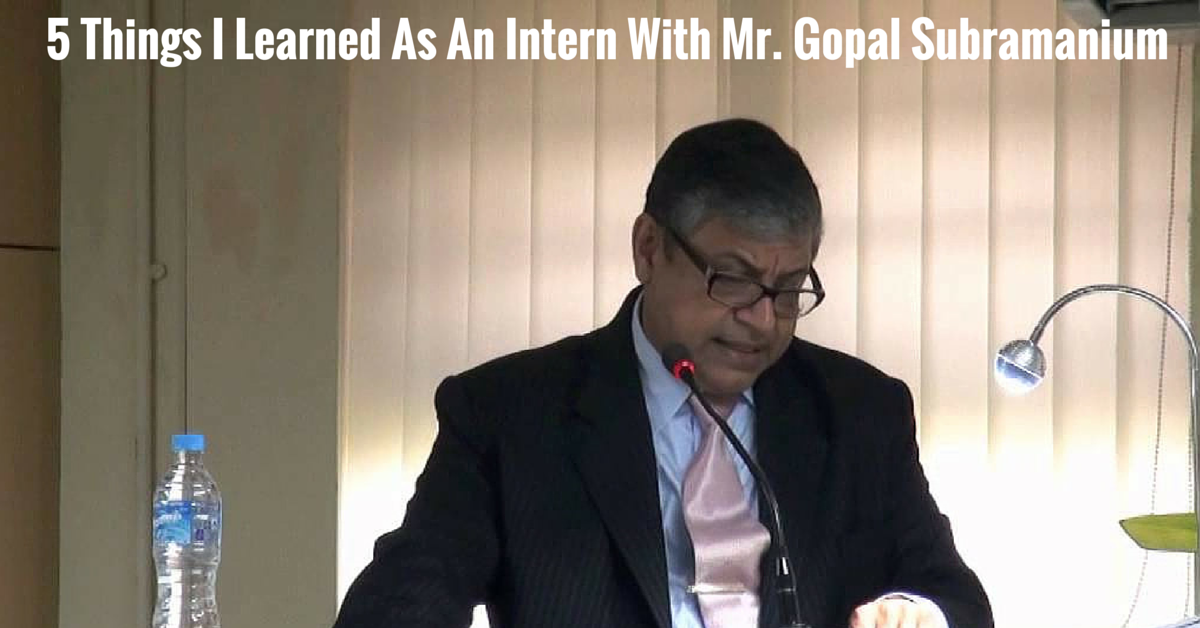
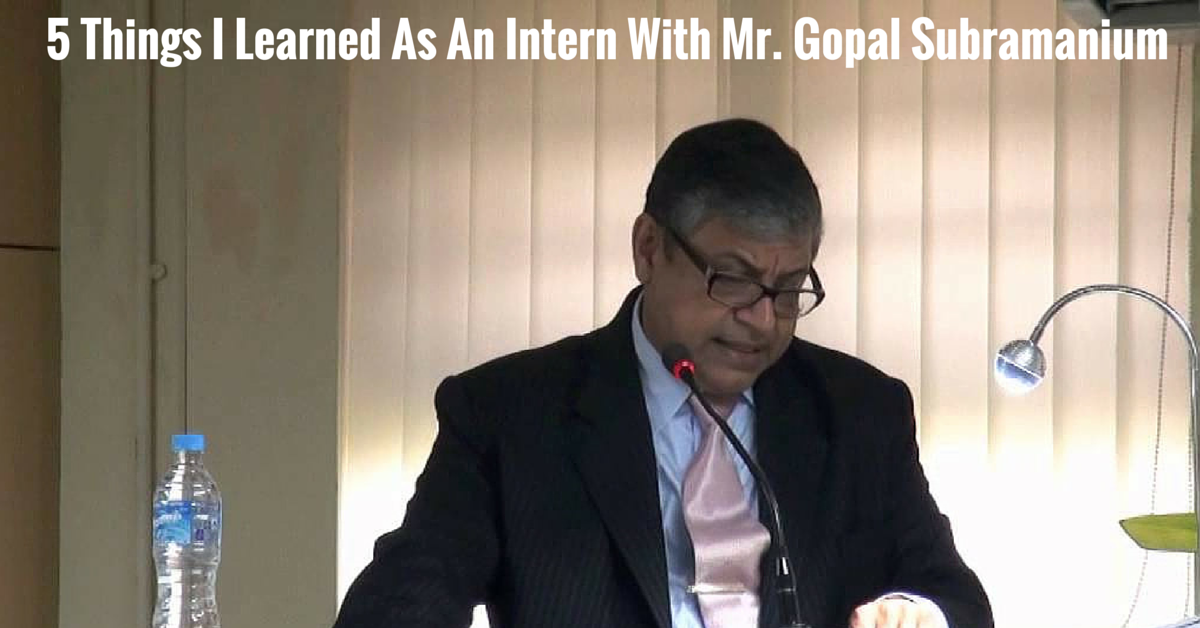
5 Things I Learned As An Intern With Mr. Gopal Subramanium

5-Things-I-Learned-As-An-Intern

This article has been written by Arpit Sinhal from HNLU Raipur.

My journey to law school began in July 2012 when I joined HNLU Raipur. With time I realized that it is not only the theoretical knowledge which makes us a successful lawyer but the practical aspects of it which carves out the true quality of a lawyer in us. An internship with Mr. Gopal Subramanium exposed me to a man who represents a good balance of the different aspects of legal practice.Here is a brief summary of what unfolded during my time at this office.

The Initial Struggle: Determining what kind of experience I should aspire was the most difficult task for me. The only thing which was present in my mind was that it should be an altogether different experience form my earlier experiences. And as I had interned with NGOs earlier I figured out that internship with a social rights Advocate will be the most enriching experience for me. Searching for the top five Advocates of the Supreme Court, I felt that there isno substitute for Mr. Gopal Subramanium.

Application Procedure: In my third semester I applied for the winter internship in the chambers of Mr. Gopal Subramanium on his official email address followed by a few phone calls at his office. I got a confirmation mail two weeks before the time of joining the internship.

Experience: This internship experience with Mr. Subramanium was thoroughly enriching as it gave me a unique experience which contributed to foresee my career path. Several things which I learned in his chambers are not limited and can never be defined on a piece of paper. There are many instances which will remain with me for my lifetime. This was the best internship I had till present. However, its useful to share some of the highlights of the internship:

What I picked up:

The first and foremost thing which I have learned is that it is not the law that we learn in an internship but it the experience of the person from which we learn and his/her working style which helps us determine a course for ourselves.
A lot of research work was provided to me by all the juniors and Sir himself during the internship. Having carried out the research inspite of my intial doubts about my ability to do so,gave me confidence that there is no area of law, which cannot be researched, if one spends sincere and enough time on the task.
Thirdly, I learned that when we work with a Senior Advocate, it does not matter how intelligent or hardworking we are, because that is the key factor required in any prestigious institution, rather what is required is how sincere and smart we are. We need to have a common sense about how things can be handled in the worst situation. Someone has rightly remarked that law is nothing but the strict common sense.
Unlike moot court competitions, when we stand in the Supreme Court in front of the Hon’ble Judges, it is not our intelligence which we present to the judges, but it is all the practical aspects and possibilities which can arise if the matter is decided in our favour. Because it is the not about winning a moot court competition, rather it is someone’s life on stake which needs to be saved in all circumstances.
The last and most important thing which I learned in his chamber is that during litigation it is not only the matter of money for which we argue a case, rather it is someone’s rights and duties for which we argue. And a major part of the money which we earn, should be spent on the needful people. Mr. Gopal Subramanium spent most of his money by being an Amicus Curie in many landmark cases. So it is not only about money which we earn in the society, but the respect which we earn in the society, which keeps us happy and provides us an inspiration to continue our work.
Overall it was an amazing experience to be a part of his chamber. The tasks provided by Mr. Subramanium were pertaining the ongoing and recent research works. I am excited about the contributions I have made.

We have to be very professional when we work with such a prestigious chamber. Though it was very formal, yet working with the juniors and administrative staff was very friendly and encouraging.

Suggestion: There is only one advice I would like to put forward: whatever you are scared of, just throw yourself into it. Never hesitate about anything, keep on working in one direction and you will rock the world.

Currently Mr. Gopal Subramanium is the Senior Advocate of the Supreme Court of India. He served as the Solicitor General of India from 2009 to 2011. He argued various landmark cases such as terrorist attack on Indian Parliament in 2001, Rajiv Gandhi’s murder case etc.


Download Now

How Does MIT (An Educational Institution) Hold Shares Of Bose Corporation?

0

In this blog post, Sunidhi, a student of the Rajiv Gandhi National University of Law, Patiala has written about how MIT became a major shareholder of Bose Corporation.


7


Introduction

A Share is a certificate of investment in a company. Shares are also known as stocks or equities. A public limited company, registered with a Stock Exchange, can issue shares to the public to raise capital. The person holding shares is known as a shareholder.

Shares have a face value. The face value multiplied by a total number of shares forms the share capital. Shareholders receive the dividend on the money invested by them in the share capital. The shares are of two types divided by voting rights. One class of shares i.e. equity shares have voting rights whereas preference shares do not have voting rights.


Can an Educational Institute Buy the Shares Of a Company?

The shares can be bought in many ways such as investment by an individual or collective investment. Collective investment means many individuals or companies pool their resources and buy shares or invest in some other asset collectively. Collective investment is becoming more and more prominent these days due to various benefits attached to it. In this type of investment, all the shareholders accumulate their funds and invest it in the most feasible option through a professional fund manager. The major benefits of buying shares through this way are that the risk and cost get divided among all the investors.151012_INV_GivingShares

The answer to the above question depends on upon the type of educational institute it is. There are two types of educational institutions:

  • Non-Profit Institutions
  • For-profit institutions

The Non-Profit Institutions are those whose main motive is to provide education to the students. The income of these institutions is either equal to their expenditure or excess of income over expenditure. These institutions do not generate profits, but if in case they generate any excess amount then they invest it in the development of that institution only. The basic purpose of such an educational institute is for the welfare of society by shaping the young minds and not to earn profits by investing in shares. These institutions also get tax benefits for being public trusts. Since these institutions have no motive to earn a profit; they cannot invest in the shares of a company.

The For-Profit Educational Institutions are the corporations that usually have shareholders. It is the business of these organizations to provide education as a service. Hence, they sell education. Their sole aim is not only to provide education, but their aim is to provide education and generate profits for their shareholders. These institutions can issue shares for the purpose of getting funds for expansion. For example, Strayer University is one of the oldest For-Profit educational institutions founded in 1892. In 1996 it issued shares to raise capital.download (1)

Since these educational institutions are organizations for profit, they can buy shares of any company, registered with a stock exchange.

Indian Position

In India, the government does not provide full autonomy to For-Profit institutions. Despite many restrictions, there are considerable numbers of For-Profit educational institutions in India. The reason being, education was and is considered a key area that still needs government attention, patronage and hence control. The basic purpose of educational institutions has been stated in the Central Universities Act, 2009.

Section 6 of the said Act states that the object of the University shall be to disseminate and advance knowledge by providing instructional and research facilities; to take appropriate measures for promoting innovations in teaching- learning process; to pay special attention to the improvement of the social and economic conditions and welfare of the people, their intellectual, academic and cultural development.[1]

The basic purpose of educational institutes is not to make money but to provide education to the society. Its main motive is to prepare the students for their development and better job prospects for the future as well as the development of the nation by providing brilliant minds to lead the nation.

In India, most of the educational institutions are registered as public trusts i.e. no motive for profit earning. The income of an institution registered as public trust is not taxable. Therefore, such non-profit educational institutions cannot invest in shares of a company.


How did MIT Become A Shareholder of Bose Corporation?

Did you know that MIT holds a major part of the shares of Bose Corporation? The exact details have been kept confidential by them.

Massachusetts Institute of Technology

Massachusetts Institute of Technology (MIT) is a Not-For-profit, private research university in Cambridge, Massachusetts. MIT did not buy the shares of Bose Corporation. Amar Bose gifted his shares to it and thus made MIT a major shareholder of the Bose Corporation. Although the shares were in the form of non-voting shares, this did not affect the position of Amar Bose as it did not take away his voting powers. Also, MIT cannot trade these shares with a third-party.image

These shares are a source of revenue for MIT. MIT will have funds to continue its research work in the form of dividends declared by the Bose Corporation every year if it declares any. This gift was an expression of gratitude by Amar Bose and the funds in the form of cash dividends will be used by MIT to sustain and advance MIT’s education and research mission.

Hence, a Not-For-profit educational institute cannot invest in the shares of a company, but it can enjoy the rights attached to the gifted non-voting shares.


[divider]

Reference:

[1] Section 6, The Central Universities Act, 2009.

Download Now
logo
FREE & ONLINE 3-Day Bootcamp (LIVE only) on

How Can Experienced Professionals Become Independent Directors

calender
28th, 29th Mar, 2026, 2 - 5pm (IST) &
30th Mar, 2026, 7 - 10pm (IST).
Bootcamp starting in
Days
HRS
MIN
SEC
Abhyuday AgarwalCOO & CO-Founder, LawSikho

Register now

Abhyuday AgarwalCOO & CO-Founder, LawSikho