Download Now
Home Blog Page 1720

10 Rights That Every Woman In India Should know

0

In this blogpost, Sakshi Jain, a student of Amity Law School, Lucknow Campus writes about ten laws that every Indian woman should know.

women-rights-india

Women are the most precious gems of the society. Protection of women should be one of the key priorities of the laws of any country and the society at large. Various laws are made for protecting and safeguarding the interests of women. In the 21st century, women are increasingly seen to be excelling in diverse fields and are utilizing their potential in the best possible way. There are certain laws and amendments to such laws that every woman in India should be aware of. When a woman is well aware of her rights, only then can she raise her voice against discrimination and abuse and can fight it back. As we all know ‘where it is right, there is a remedy.’ So every woman should know her rights as it is indeed her right to know all the rights provided to her by the Parliament.

Right against sexual harassment

Sexual-Harassment-of-Women-in-Workplace

Sexual harassment lowers the dignity of a woman and makes it uncomfortable for her to live in the society. Women also feel unsafe in the organization they work for because harassment can come be done by anyone i.e. peers, co- workers, higher authority, etc. When a woman faces harassment in any organization, it comes in the way of her work and restricts her from reaching the potential goals and targets set by her. Women are climbing the ladder to success in a similar pace as compared to men. It is not necessary that only lower paid employees are harassed. Highest paid women employees are harassed too in an organization. So, when sexual harassment is done in the work environment, it lowers the esteem of women and disallows them to carry on their work with efficiency and optimum productivity.

Bullying a woman and questioning the character and dignity of women is a punishable offense under Section 294, 254 and 509 of Indian Penal Code, 1860. Under Ontario Human Rights Code, Sexual Harassment is “engaging in a course of vexatious comment or conduct that is known or ought to be known to be unwelcome”. It also says that every person has the right to be free from discrimination based on sex, and it includes sexual harassment.

The Hon’ble Supreme Court issued guidelines to create a sexual harassment committee to resolve all the matters of harassment within an organization. The committee must be headed by a woman and participation of at least 50% of women is a must.One of the members of the committee should be from women’s welfare group. Every institution should have a Sexual Harassment Cell for the welfare of the employees.

Right to maternity benefits
pregnancy_girl_large_600

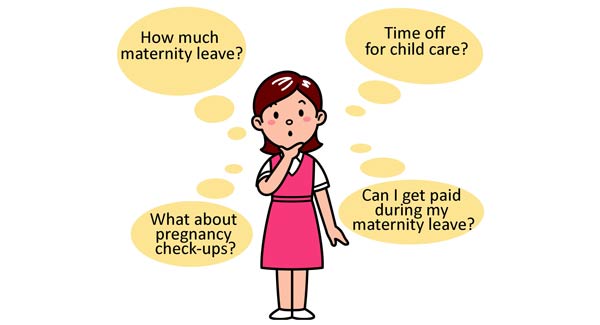
Benefits for the pregnant women, before and after the birth of a child are governed under the Maternity Benefits Act, 1961. Maternity Benefits grant a paid leave to all the women before and after her pregnancy.This Act was enacted by the Parliament because many cases of breach of contract were reported due to pregnancy.So this Act came into force for safeguarding the interests of women and the organization. This Act applies its to every factory, mining, and plantation industry. It further extends to any shop or establishment within the territory of India. For Maternity Benefits, following should be kept in mind:

  • The organization must have 10 or more employees working with it.
  • It is necessary to work with the organization for not less than 12 months.
  • Prior notice i.e. before seven weeks should be given to the head of the department or institution.
  • The leave can be taken six weeks before the expected delivery date.

Every woman is entitled to receive the maternity leave with full pay for 12 weeks before delivery, six weeks after delivery and additional benefits like a bonus, allowances, etc. should be given to her. Under the Maternity Benefits Act, no employer can employ a woman after six weeks of her delivery or miscarriage. It is illegal to dismiss her on account of not being present there during her pregnancy. No employer can take the advantage of her pregnancy and alter the terms and conditions during maternity leave. In Indrani Chakroverty v. Idiom Consulting Ltd, 2012, Indrani Chakraverty sued Idiom Consulting Ltd for forcing her to relocate to Bangalore and cutting down her half salary on discovering her pregnancy, The Delhi High Court directed the company to compensate Rs. 7.5 lakh to Indrani.

Recently, women and Child Development minister, Maenka Gandhi made a proposal to the Labour Ministry for extending the dates of Maternity leave from 12 weeks to 26 weeks in private sectors only. The motive behind this was that around 48% of the women leave their jobs due to pregnancy and further responsibilities.

Sex determination

81844ecadaffe5934e0d61930eba47a1-300x300

Sex Determination is illegal and banned in India under Pre-Conception and Pre-Natal Diagnostic Technique Act. Pre Natal Sex Determination was increasing day by day. The main aim for banning sex determination was the increasing rates of abortion as well as falling sex ratio in India. Because of Sex Determination, female foetuses were killed and due to this, there was an imbalance in the sex ratio. This law was introduced in the Parliament in 1994 and came into force in 1996. The Act makes it illegal to determine the sex of the foetuses. The law does not only focus on banning the practice of sex determination but also any advertisement which promotes for pre-conception and pre-natal determination of sex. The Act makes sex determination an offence, and anybody who does it will be punishable and liable to fine too. Ultrasound clinics and genetic counseling centers cannot be used for conducting pre-natal sex determination expect for diagnosing the abnormalities or sex related genetic diseases.


Free legal aid

Free legal aid means giving free legal service to the poor and needy people who are unable to afford the cost and service of an advocate for the conduct of any case or legal proceedings in any court or tribunal. Free legal aid itself means giving legal service free of cost to the needy people of our country.  Free legal aid is mentioned in Article 21 and Article 39A of the Constitution of India. Article 39A states that “The State shall secure that the operation of the legal system promotes justice, on a basis of equal opportunity, and shall, in particular, provide free legal aid, by suitable legislation or schemes or in any other way, to ensure that opportunities for securing justice are not denied to any citizen by reason of economic or other disabilities.”

The state is responsible for safeguarding the interest of the poor and needy. It is the duty of the State to see that the poor are getting the benefit of this provision and if not, then the State is liable for the arrangement.  In Hussainara Khatoon v. the State of Bihar, it was held that if the accused is not being able to afford the legal service, then he has the right to avail it at the cost of the State.

Section 304 of Code of Criminal Procedure, 1973, states that if the accused does not have any mean to afford a lawyer, the court must provide one for the defense of the accused at the expense of the State. The main difficulty is that people do not know their rights for their protection under the law. So, there should be proper awareness so that poor people can come to know about their rights. A woman can demand a lawyer whenever she goes to the police station for filing her complaint or recording her statement. In Khatri II v. the State of Bihar, it was held that a lawyer must be provided for a full-time service i.e. from the beginning of the proceedings till the end of it.

After the ruling given by the Delhi High Court, whenever a case of rape is reported to the police station, it is the duty of the head authority to pass on the report and details to Delhi Legal Service Authority, and then the service authority will provide a lawyer for further proceedings.


Right to privacy

Article 21 of the Indian Constitution says, “No person shall be deprived of his life or personal liberty except according to procedure established by law.” Right to life is enshrined in Article 21 which means living life with dignity. It does not mean mere survival or living like an animal. Right to life means a lot more than mere survival and makes a man’s life more important and meaningful.

Right to life includes right to privacy. Every individual has their space and privacy in life and infringement of it is punishable. A woman’s life should not be made for entertainment. Under Section 164 of Code of Criminal Procedure, a woman who had been raped can record her statements before the magistrate and no one will be allowed to attend the session. She can also lodge a complaint in the police station with a police officer and a lady constable. The statement should be taken in such a place where the information will not pass to a fourth person. It will be the responsibility and duty of the police officer to make the information confidential. Right to privacy encourages a woman to file a complaint and to give all the details about the incident. They feel safe and comfortable as they are protected under the law.


Right to equal pay

2016-04-27-1461780963-8040068-gendergap01

“Equal Pay for Equal Work,” our Constitution guarantees right to equality to every citizen of the Country. Right to equality is mentioned under Articles 14-18 of the Constitution of India. We are equal as per the law, and no one is above the law. The concept of equality in pay i.e. equal pay for equal work is the part of Article 39(d) of Directive Principles of State Policy. The aim of equal pay is equal distribution of resources of production among the citizens. Resources should not be limited to a few hands. The term equal pay includes basic salary and other benefits such as bonus, allowances, medical facilities, etc. It was done to make India a welfare society and wipes out discrimination from our country. Article 39(d) states that there is equal pay for equal work for both men and women. Discrimination should be eliminated on the basis of sex. After the law makers have mentioned equal pay in the Constitution, Equal Remuneration Act came into force in 1976 with the same aim, ‘equal pay for equal work.”

When the potential of doing the work by men and women is the same, then both should be paid equally. Being a woman does not lead to lesser payment in comparison to men. In Randhir Singh v. Union of India AIR 1997 SC 3014, the Hon’ble Supreme Court held that although the principal of equal pay for equal work is not expressly declared in our Constitution to be a fundamental right, it is certainly a constitutional goal under Article 14, 16 and 39(d) of the Constitution. Equal pay for equal work includes daily wage workers, temporary employees, and permanent employees.


Right to confidentiality

Women have a reputation in the society which should not be destroyed by any mean. When a rape victim lodges a complaint in the police station, it is the duty of the police officer to keep the identity of the victim confidential. Section 228-A of Indian Penal Code makes disclosure of the identity of the victim in certain offenses punishable. Offenses under Section 376A, Section 376B, Section 376C, Section 376D and Section 376E of Indian Penal Code are offensive and punishable for the disclosure of identity. Neither the police nor the media can publish or print any matter which may make known the identity of the victim.


Section 228-A (3):

Whoever prints or publishes any matter about any proceeding before a court on an offense related to disclosure of identity without the previous permission of the court shall be punishable with imprisonment for two years and shall also be liable to fine.


Right to virtual complaint

Women fear humiliation and bullying done to them by the society. In certain cases, women are not secure in the police stations as well. It is very difficult to seek justice in such an environment where women itself are not safe. In some places in India, cops are not co-operative and deny lodging the complaint. To put limits upon all these actions, Delhi Police issued guidelines that any woman can lodge a complaint via mail or registered post. If she cannot go to the police station, then she can send a written complaint through mail or post addressing it to a senior police officer. A rape victim can lodge a complaint, and no police station and cop can deny registering her FIR. Women feel unsafe while lodging a complaint so as to preserve her reputation in the society and also the fear of the culprits. So, virtual complaint protects women’s interest and reputation.


Right against arrest

image05

Women have the right not to be arrested after sunset and before sunrise. Many crimes have been recorded when women were arrested at night. So, the Hon’ble Supreme Court issued the guideline of not to arrest women between 6:00 P.M. and 6:00 A.M. It is also mentioned that women cannot be arrested even if a lady constable is present there between sunset and sunrise. But in case of emergency, cops can arrest a woman only when they have a written notice from the magistrate to arrest. When arrested, women should be locked up in a room separate from the men.


Right of not being called for interrogation

Women now do not have to go to the police station for interrogation. Section 160 of Code of Criminal Procedure makes it clear that women cannot be called to the police station for investigation. If the police have to investigate, then they have to go to her residence and interrogate her there in the presence of a lady constable and her family or friends. The investigation is a duty of the police officers, but the law made it clear that it should not hamper the dignity of women. Section 160 of Code of Criminal Procedure clearly states that any person, male being not more than 15 years and women do not have to attend the investigation in the police station whereby, police himself have to go to the residing place of women to interrogate.




Download Now

Circumstantial Evidence – Sole Basis for Conviction Or Not

0

In this blog post, Nalini Chandrakar, student, Hidayatullah National Law University, and Vineet Kumar, Student, National Law University of Odisha, write about whether circumstantial evidence can be taken as the sole basis of conviction or not—proving the statement with few landmark cases.


Introduction

“Men may tell a lie, women may a tell lie, but circumstances do not tell a lie.”

When someone commits a crime he makes sure that there would be no evidence left that can prove him guilty making the case an open and shut case. But then, even if you are playing smart like purchasing witnesses, removal of weapon used to commit the crime, etc., one cannot change the circumstance revolving around the whole case, and that becomes the strongest evidence to prove the guilt of the accused. criminal-evidenceOne should be aware of the fact that whenever a case is presented before the court, the evidence turns out to be the eyes and ears of justice. The task to differentiate between the two—victim and the culprit is never a cake walk for the judge as he was not present when the crime took place. Hence, evidence plays a vital role in determining whether the accused is guilty or not.


Analysis of the Term Evidence

Evidence is that piece of documents and information which is presented before the judge to reach a conclusion. According to Section 3 of Indian Evidence Act, 1872[1] —

  • All the statements which the Court permits or requires to be made before it by witnesses, about matters of fact under inquiry; such statements are called Oral evidence;
  • All the documents including electronic records produced for the inspection of the Court; such documents are called documentary evidence;

Further, there are various forms of evidence such as[2] Oral evidence, Documentary evidence, Primary evidence, Secondary evidence, Real Evidence, Hearsay evidence, Non-Judicial evidence, Direct evidence and Circumstantial evidence.


What do you mean by Circumstantial Evidence?

circumstantial-evidencePeter Murphy defines it as “evidence from which the desired conclusion may be drawn but which requires the tribunal of fact not only to accept the evidence presented but also draw an inference from it.”[3] Circumstantial Evidence is also known as indirect evidence. There’s always a myth lying behind circumstantial evidence that it’s evident enough to prove someone guilty of his act as the evidence is based upon the circumstances rather than direct evidence which has the upper hand in this. However, when there is an absence of direct evidence the case solely depends on the circumstantial evidence. Now, it’s the work of the jury to critically analyze the validity of circumstantial evidence as it’s a string connecting the facts to recreate the crime scene in a court room. Circumstantial Evidence is used both in civil and criminal matters but mostly in criminal matters.evidence

For example,  A, B and C are three friends living in the same apartment. One day, A hears some noise coming from B’s room when he recognizes that B is not alone in the room C is also there, and some argument is going on between them. After a few minutes, A hears the voice of B shouting for help, as soon as he runs towards the door of B’s room, C comes out of the room with a knife in his hand covered with blood and B  lying dead on the floor.

Here  A has not seen C killing B in front of his eyes but has found C holding the murder weapon and coming out of the room. Therefore, the testimony of A becomes circumstantial evidence from which it can be inferred that C murdered B. The panel of judges must determine whether A’s statement is credible or not.

On the second aspect – If A has seen C killing B right in front of his eyes then his testimony would have become direct evidence for the jury to penalize the criminal.


Essentials of Circumstantial Evidence

Evidence plays a vital role in delivering justice to the innocent. However, one should take care of any evidence which is going to be produced before the court. As it must fulfill the essential elements of being admissible in court. A case can be solely adjudged by circumstantial evidence if the following essentials are fulfilled[4]

  • The circumstance from which the guilt is established should be proven;
  • That each one the facts should be according to the hypothesis of the guilt of the accused;
  • That the circumstances should be conclusive in nature and tendency;
  • That the circumstances ought to, to an ethical certainty, truly exclude each hypothesis except the one projected to be evidenced.
  • The evidence should prove the guilt of the culprit beyond a reasonable doubt.

Similarly in the case of Bodh Raj vs. State of Jammu and Kashmir[5]

  • The circumstances from where conclusion of guilt is to be drawn ought to be established. The circumstances involved ‘must’ or ‘should’ and not ‘may be’ established.
  • The facts, therefore, established ought to be as per the hypothesis of the guilt of the accused.
  • Circumstances ought to be conclusive in nature and tendency.
  • They ought to exclude each attainable hypothesis except the one to be tested.
  • There should be a complete sequence of proof so as to not leave any affordable ground for the conclusion in line with the innocence of the defendant and should show that the act must have been done by the defendant.

Application of Circumstantial Evidence the case of Jessica Lal

The Jessica Lal murder case is one of the most cited, debated and controversial cases where the Apex Court’s decision was based on the circumstantial evidence as the witnesses had turned hostile. Initially, the trial court had acquitted the accused on the ground of hostile witnesses and lack of strong evidence. Delhi High Court reversed the judgment and held Manu Sharma (the accused) guilty of murdering Jessica Lal, who was a bartender at a restaurant in Qutub Colonnade in the capital city, and was shot by Sidhartha Vashisht alias Manu Sharma, the son of a senior Congress Party politician and former Union minister, when she refused to give him liquor as the bar was closed.[6]download

“After several days in hiding, Sharma surrendered to the authorities in Chandigarh. In an interview with the police that was subsequently broadcasted on national television, Sharma confessed to the murder. This confession was later retracted, and a plea of non-guilty was petitioned at the trial. During the trial, the three critical eye witnesses recanted earlier statements made to the police, and twenty-nine witnesses of lesser importance did the same. One of the eye witnesses, Shyan Munshi, changed his testimony so much so that his revised statement was used as exculpatory evidence by the defense”.[7] This way, a case that could have been easy to prove started looking like a fake one at the very ground and acquired a dramatic phase. The trail court delivered its verdict on the grounds of such evidences produced and did not go beyond them, or deep to know the role of the accused and acquitted Sharma and eight other co-defendants of all charges in February 2006, though it accepted Manu Sharma’s presence on that night at the restaurant along with the other accused as having been proved. The trial judge commented after the outcome that:

“The court has acquitted them because the Delhi police failed to sustain the grounds on which they had built up their case. The police failed to recover the weapon which was used to fire at Jessica Lal as well as prove their theory that the two cartridges, emptied shells of which were recovered from the spot, were fired from one weapon”[8].

The case acquired such a high-profile character that the then President Dr. Abdul Kalam received a petition of 200, 000 names collected by journalists at NDTV, appealing against the judgment.

Delhi High Court, deciding on the appeal from this case investigated into the circumstantial evidence and found that the cartridges found belonged to the accused and stated that  the lower court had been lax in not considering the testimony of witnesses such as Bina Ramani and Deepak Bhojwani, stating regarding the treatment of the latter’s evidence that

“With very great respect to the learned judge [Bhayana], we point out that this manner of testing the credibility of the witness is hardly a rule of appreciation of evidence. … Obviously, this reflects a total lack of application of mind and suggests a hasty approach towards securing a particular end, namely the acquittal”.[9]

The accused was sentenced to life imprisonment together with a fine of Rs.50,000 to be paid to the family of the victim. The Apex Court upheld the judgment of the Delhi High Court and the Bench comprising Justices P. Sathasivam, and B. Swatenter Kumar held that the presence of the accused at the scene of the crime had been proved through the ocular testimonies of several witnesses. The circumstantial evidence connecting the vehicles and cartridges used at the site of the crime to Manu Sharma as well as his conduct after the incident (he first absconded but surrendered later) proved his guilt beyond reasonable doubt.[10] Manu Sharma’s counsel, Ram Jethmalani, argued before the Apex Court that non-disclosure of one of the ballistic reports to Manu Sharma by the prosecution had hindered the ends of justice. The Bench, however, disagreed, saying that no prejudice has been caused to the accused’s right to fair trial because of this non-disclosure. The Supreme Court held that the High Court, as the appellate court, had all the necessary powers to re-evaluate the evidence presented before the trial court as well as the conclusions reached. Therefore, the High Court, in this case, had given cogent and adequate reasons reversing the order of acquittal.[11]


[divider]

Footnotes:

[1] Indian Evidence Act, Ratanlal & Dhirajlal, Lexis Nexis Butterworths Wadhwa, 21st Edition, Nagpur

[2] http://www.legalindia.com/different-kinds-of-evidences-witnesses-under-the-indian-evidence-act/

[3] S.R. Myeni, The Law of Evidence, (Hyderabad: Asia Law House 2007), 20

[4] State of UP vs. Ravindra Prakash Mittal, AIR 1992 SC 2045

[5] AIR 2002 SC 316

[6] 2001 III AD Delhi 829

[7] Public Outrage and Criminal Justice: Lessons from the Jessica Lal Case, Brendan O’Flaherty, Rajiv Sethi (Accessed at http://www.columbia.edu/~rs328/Jessica.pdf)

[8] All accused acquitted in Jessica Lal murder case, The Hindu, 22 February 2006

[9] “Key witness in Jessica case dubbed liar by HC,” Rediff. PTI. 19 December 2006

[10] Conviction confirmed in Jessica Lal case, Frontline (Vol. 27 – Issue 10) (May 8-21, 2010) (Accessed at http://www.frontline.in/static/html/fl2710/stories/20100521271013400.htm)

[11] Cri Appeal No. 179 of 2007

Download Now

Pledging Of Shares – An Overview

1

This blog post written by Saanvi Singla, a student of University Institute of Legal Studies, Panjab University, explains the concept of pledging of shares.

Screen Shot 2016-07-16 at 9.43.02 am


Introduction

Pledging of shares is just a refined form of the familiar term of “girvi rakhna”. Banks and many Financial Institutions in the market provide loans against the shares, and they call them “collateral.” Pledging of shares to obtain a loan is not a new concept in the market. In short, when a promoter wants to raise funds for the development and well-being of his company or personal needs, he pledges his shares with a financial or a non-financial institution better known as NBFC’s.


Legal Understanding of Pledging of Shares

Before understanding the concept of pledging of shares we have to understand it legally. It is mainly covered under three laws, i.e., the Indian Contract Act, 1872, the Banking Regulation Act, 1949 and External Commercial Borrowing Guidelines.

Indian Contracts Act, 1872

Section 172 of the Indian Contract Act, 1872 gives us the definition of a Pledge. It states that the bailment of goods as security for payment of a debt or performance of a promise is called ‘pledge.’ The bailor is in this case called the ‘pawnor.’ The bailee is called ‘pawnee.’[1]

According to this definition, a pledge creates only the right of possession while the pawnor has the title of the property.

The Companies Act, 2012 does not place any restriction on amount or manner of pledging of shares. The Act has not prescribed any minimum percentage of share to be held by the directors. But the Article of Association of a company can prescribe the qualification shares of a director. It is a very nominal figure which is immaterial to the movement of the share price.

1396035439231Regulation 36 of the SEBI Regulations, 2009 provides that when a company is making a public issue, the promoters or directors should be holding at least 20% of the shares with a lock in period of minimum three years. After the lock-in period of 3 years, the promoters or directors are free to sell their shares. So if the holding of promoters is below 20% after the lock-in period, it will not violate the norms of SEBI.

Banking Regulations Act, 1949

Section 19(2) of the Banking Regulations Act, 1949 provides that no banking company should hold the shares of any other company whether in the form of pledge, mortgagee or absolute ownership that is more than 30% of the paid up capital of the respective company or 30% of the company’s paid-up capital and reserves, whichever happens, to be less. The shares of a company are taken by a bank or any other financial institution as security in the following cases:

  • Overdraft facility against recorded and affirmed shares of any open restricted organization.
  • Overdraft of shares of a listed company against recorded and affirmed shares of any open restricted organization.

Nowadays most of the shares are held in the form of Demat. There are two main depositories in India – NSDL and CDSL and both have equally competent software’s to create a pledge and its invocation that are listed in the statement as two columns named “Free” and “Pledged.”

For many years now, lending against shares was a common practice amongst promoters. As prices were rising, there was no or rather a little risk. NBFC’s and banks were comfortable in lending such type of loans. These types of loans were lent for one to three years and carried a margin of two to three times, which means that the value of shares pledged was 2-3 times the amount of the loan. For banks and NBFC’s, it is a low-risk business as they can charge a mark –up of 3-4 % over the Prime Lending Rate (Prime Lending is the interest rate at which banks lend to favored customers—i.e., those with good credit—but this is not always the case). Hence, the lender has to ensure that his market risk is covered as the shares being pledged should be liquid enough to ensure the timely recovery from the borrower.

Before the Satyam debacle, there were no disclosure norms made by SEBI (Securities Exchange Board of India) for the promoters to disclose their pledged shares. In developed countries like USA, directors as well as promoters are required to disclose their pledged shares. There the pledging of shares by promoters, or insiders, as collateral for a loan is equivalent to a sale of the stock to the pledge. In the UK this is covered under Insider Trading Regulations.20160119_171500_20150119-Mint-Pledge-480Px

As banks or NBFC’s give loan taking the shares as collateral, the promoters are required to make some payment or pledge some more shares whenever the price of the share comes down to a certain level in the secondary market. (A secondary market is a market where investors purchase securities or assets from other investors, rather than from issuing companies themselves. The national exchanges – such as the NSE and BSE are secondary markets in India.)

The lender of the loan keeps the right to sell pledged shares in the market. As a result of this, promoters always have the risk of hostile takeover. Hence, certain disclosures were necessary regarding the pledging of shares by promoters as pledging of shares could result in a change of ownership if the promoter is unable to redeem those shares by repaying the shares. This is critical, as many investors consider promoter holding and management structure of the company as a critical aspect of their investment decision. When promoters of big companies raise money by pledging their shares, they pledge away their voting right, and hence it becomes a risk factor. This reduction in shareholding deteriorates the company’s valuation. Beside this, in the event of promoters not being able to repay the loan on time, the lenders dump the shares in the market in huge quantities to recover their dues which have a cascading effect on the price of shares.


Pledging of Shares by General Shareholders

Whenever an investor or a shareholder needs a loan from a bank or financial institution, he/she can pledge the shares to the lender for availing the loan. Unlike a promoter, a small investor is not required to disclose that he has pledged his shares. For taking a loan against shares, the investors have to collateralize the shares (in DEMAT FORM) to the bank.


Guidelines for Pledging of Shares under the Banking Regulation Act, 1949

31320_20160617-MrktCmpss-480pxUnder Section 19 (2) of the Banking Regulation Act 1949, it is provided that no banking company shall hold shares in any company whether as pledge, mortgage, or absolute ownership of an amount exceeding 30% of the paid up capital of that company or 30 % of its own paid-up capital and reserves, whichever is less . The shares of any company are taken as security by the banks and financial institutions in following cases:

  1. Overdraft facility against listed and approved shares of any public limited company.
  2. Pledge of shares of listed companies as an additional or collateral security for a loan or overdraft given against other prime security.

Availment of Loans by NRIs through Pledging of Shares

NRIs can take a loan by pledging shares, though they have to take the permission of the RBI. The application has to be made through the same bank in which the NRO/NRI account is opened[2] or being held.


Conclusion

Consequences relating to the pledging of shares may appear to be routine paperwork, but it is beyond filling of forms since a better understanding of practical fundamentals helps the person to avoid risks, ensures better compliance and makes the task easier. A promoter is a person who is in ultimate control of the company and formulates its operating plans, and he is the first to be aware of its good or bad future. The SEBI guidelines prescribe restrictions on the increase in promoters holding after a certain limit but contain no prescription of minimum promoters holding. This leaves the promoter with the scope to sell or pledge even 100% of his shares with an ordinary disclosure. Such companies are always at risk of a sudden crash which leaves the investors awed3.


[divider]

Footnotes:

[1]‘ https://indiankanoon.org/doc/722832/

[2] http://www.caclubindia.com/articles/pledging-of-shares-2246.aspca

3 http://taxguru.in/company-law/pledging-shares.html

Download Now

Chit Fund – An Overview

2

This blog post written by Saanvi Singla, a student of University Institute of Legal Studies, Panjab University, provides an overview of the chit fund scheme and the laws that govern chit funds. 

 Chit-Fund

Introduction

Everyone wants to save money. A method or a company that promises return on a person’s investment in a short span of time is not a new concept. Chit Fund is one such method. Chit fund is a saving scheme that is very popular amongst different types of people like homemakers, business person, etc. Chit Fund is the low-risk method through which you can save money.


What is a Chit Fund?

Chit fund is a saving scheme that is prevalent in India. A chit fund company is a corporation that governs, handles, or deals with such a chit fund, as defined in Section 2(b) of the Chit Funds Act, 1982. According to Section 2(b) of the Chit Fund Act, 1982:

“Chit means a transaction whether called chit, chit fund, chitty, kuree or by any other name by or under which a person enters into an agreement with a specified number of persons that every one of them shall subscribe a certain sum of money (or a certain quantity of grain instead) by way of periodical installments over a definite period and that each such subscriber shall, in his turn, as determined by lot or by auction or by tender or in such other manner as may be specified in the chit agreement, be entitled to the prize amount”.FUND_tif_GL2477EE7__914640e

Standardized financial institutions can conduct such schemes, or it can be in the form of unorganized schemes which are held between friends or relatives. In some kinds of chit funds, the savings are for a specific goal. Chit fund has proved to be useful throughout India, but the state of Kerala has benefitted from it the most.

In Kerala, chitty (chit fund) is a common practice done by all sections of the society. A company by the name of Kerala State Financial Enterprise exists under the State Government of Kerala, whose primary business activity is the chit. The concept of Chit fund came into the eyes of people in 1800’s when Raja Rama Varma, ruler of erstwhile Cochin state gave a loan to a Syrian Christian trader, by keeping a certain portion of it for himself for other expenses, and later he drew that money for the principle of equity.


How does a Chit Fund work?

Chit funds operate in different ways, and this can lead to many dishonest tactics that can be practiced by many private firms. The essential element of conducting a ‘Chit’ is a group of people called subscribers. The manager, i.e., the company or person conducting the chit fund — brings all the people together and conducts the chit. The manager is also responsible for the collection of money from subscribers, governing over the auctions, and keeping the records of the subscribers. He gets a fixed amount (generally 5% to 6% of the gross chit amount) monthly for his efforts for organizing the chit. Other than that, the manager has no distinct privileges; he is just a chitty subscriber and manager.chitfund

A simple formula depicts the pattern of the chitty:

Monthly Premium × Duration in Months = Gross Amount 

For example, Rs. 1000 * 50 = Rs. 50,000/-. (Where Rs. 1000 is the highest monthly contribution needed from a subscriber, 50 months is the duration the chit fund will last and Rs. 50,000 is the maximum sum guaranteed. The duration should be equal to the number of subscribers, as there must be (more or less) one subscriber to receive the prize money every month.)

The chit starts on a pre-decided date; every subscriber comes for the auction. As per the Kerala Chit Act, the minimum prize money of an auction is limited to 70% of the Gross Sum assured that would be Rs. 35,000 in the above-mentioned an example.

When there is more than one person who is willing to take the above mentioned minimum sum, lots are conducted, and the ‘Lucky Drawer’ gets the prize money for the respective month. If no person is willing to take the minimum sum, then a reverse auction will be conducted where subscribers open-bid for lower amounts; that is from 50,000 > 49,000 > 48,000, and so on. The person who bids the lowest amount will get the bid amount.ecb9f7db-d2b5-4fa2-8a6f-cc43ea6b0381

In both the cases the auction discount, i.e., the difference between the gross sum and auction amount, will be equally distributed among the subscribers or it is deducted from their monthly premium. For example, if the auction is settled on a sum of Rs. 40,000, then the auction discount of Rs. 10,000 (50,000 – 40,000) is divided by 50 (the total number of subscribers), and everyone will get a discount of Rs. 200. The same practice is repeated every month, and every subscriber has a fair chance of receiving some amount of money.

Due to this reason chit funds are considered as microfinance organizations.


Types of Chit Funds

There are various kinds of chit funds. Some of the major ones include:

  • Organized Chit Funds: In North India, a common type of chit fund is where small paper slips with each members name are gathered in a box. When all the members come together for a monthly or a weekly meeting, the one who is in charge—in front of all the present members—picks a paper slip from the box. The member so selected gets that day’s whole collection. Afterward, that person’s name slip is removed from the box. After that, the previously selected person comes to the meetings and pays his/her share, but his/her name will not be selected again.
  • Special Purpose Funds: Some chit funds are organized as a saving scheme for a much-specified purpose. For example, the Diwali sweets fund, which has a very specific end date which is about a week before Diwali. Neighborhood ladies all pool their savings each week. They use this collected sum to buy and prepare sweets in bulk just before the Diwali festival, and they distribute the sweets amongst all the members. Preparation of Diwali sweets can be a time consuming and costly affair for individuals. Such a chit can reduce the cost and relieves the members from extra work in the busy festival season. Nowadays, such special purpose chit funds are conducted by jewelers, kitchenware shops, etc. to promote their goods.
  • Online Chit Funds: With the arrival of e-commerce in India, Chit funds are being organized online as well. Online chit funds organize auctions online, and subscribers can pay their monthly contributions and receive the prize money through online transactions including electronic funds transfer system. Each member gets an online account to manage and circulate chit funds.


Risk Involved with Chit Funds

Every kind of investment has its risks. The same rule applies to chit fund.  Some of the major issues are as follows:chitfund-2

  • The biggest risk involving a chit fund is the misuse of the pooled funds by the manager. This can lead to a Ponzi scam.
  • The other type of risk is when members stop paying the dues and have already taken the first bid.
  • The third type of risk is when the discount rate is rigged, and a desperate member ends up paying a higher discount.

Due to these issues, it is advised to invest in a registered chit fund scheme. The Ministry of Corporate Affairs has a very exhaustive list of registered chit funds. Considering the above-stated risks, it is advisable to invest in chit funds very carefully.


Laws that Govern Chit Funds

Chit funds in India are governed by various State or Central laws. Organized chit fund schemes are required to be registered with a Registrar or Firms, Societies, and Chits. The chit funds are governed according to the following laws:

  • Union Government – Chit Funds Act, 1982 (Except the State of Jammu and Kashmir)
  • Tamil Nadu Chit Funds Act, 1961
  • The Chit Funds (Karnataka) Rules, 1983
  • Delhi Chit Funds Rules, 2007
  • Maharashtra Chit Fund Act, 1975thediplomat_2016-04-22_19-04-04-386x258
  • West Bengal Protection of Interest of Depositors in Financial Establishments Bill, 2013
  • Prize Chits and Money Circulation Schemes (Banning) Act, 1978

The Reserve Bank of India (RBI) is the regulator of banks and other non-banking financial companies, but it does not control the chit fund business. Despite the fact that chit funds accept deposits, the term ‘deposit’ as defined by the Reserve Bank of India Act, 1934 does not comprise the subscription to chits. However, the RBI can always guide State Governments on the regulatory aspects of the creation of rules or exemption of certain chit funds. The latest guidelines provided by the RBI regarding the Chit are given in RBI/2014-15/636.

As the regulator and controller of the securities market, SEBI regulates and manages collective investment schemes.  But the SEBI Act, 1992 specifically precludes chit funds from their definition of collective investment schemes.[1]

Prevention of Money Laundering (Amendment) Act, 2012 has recognized Chit Funds in Section 2(l).

Under Prize Chits and Money Circulation Scheme (Banning) Act, 1978 (PCMCS) ‘Conventional Chit, ‘ i.e., the chit mentioned above has been defined in Section 2(a). In this act, another type of chit has also been defined under Section 2(e) named as ‘Prize Chit’ and it is banned in the territory of India. Prize chit is different from conventional chit as prize chit involves the sale of certificates, units, and other instruments and there is an admission fee also, whereas, conventional chit does not contain any of those features.


Conclusion

Chit Fund is a good way to save money. It is short term in nature, and the amount is not exorbitant. It can be organized in a very informal manner and can be designed according to one’s needs. Despite all these reasons one has to be careful about the kind of chit fund on is participating and with whom. After the Saradha Group financial scandal, the Supreme Court has passed many guidelines on the governance of the Chit Funds.


[divider]

Reference:

[1] http://www.prsindia.org/theprsblog/?p=2678

Download Now

Legal Provisions For Road Accidents In India

2

In this blog post, Disha Pareek, a student of RGNUL Patiala writes about the legal provisions in India for tackling the problem of road accidents which is growing at an exponential rate.

Untitled

With the development of civilization and a tremendous change in lifestyles of Indians, there is a steep rise in the number of vehicles plying on the roads. Due to busy lives, people are careless about their driving. Road accidents contribute a lion’s share to the death and disability.

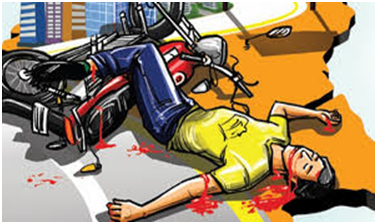
A Road Traffic Accident (RTA) can be defined as a crashing between vehicles, or between any pedestrian and vehicle, in which involvement of at least one running vehicle is a must.[1] India witnesses at least one road mishap every minute, and every 4 minutes, death due to road accident takes place.  As per a government statistics-

CAUSE DEATH TOLL (per year)
Road accident Nearly 5 Lakh (injured)


Crashing of vehicles 1.4 Lakh (died)


Road accident 16 (per hour, dead)


If we look at the report of Maruti Suzuki,[2] it states that every year about one Lakh Indians die in road accidents due to negligent and rash driving and the steep rise in the number of vehicles.


Major reasons

sf

There are a lot of reasons, but some of the primary reasons are

  • The legal age for driving in India is 18, but since there is no compliance with the law, even minors who do not have sufficient maturity drive vehicles, and the parents allow this. And the consequences have to be borne by the innocent pedestrians, the latest case being the hit-and-run case by a minor who killed a man in Delhi with his Mercedes.
  • Many people, primarily the younger generation crosses the speed limit and speeding is one of the major causes of deaths on roads
  • Drunk and reckless driving is another major cause, and this is one such cause which contributes the most to daily deaths.
  • Television too has affected the youth. The youth, by imitating the actions and stunts shown on television without proper guidance, they end up either injuring or killing something.


Laws on motor vehicle in India

17

Motor Vehicles Act, 1988

When a road accident takes place, it involves a liability (both civil and criminal), and this Act deals with the issues of such accidents. It provides with all the related rules and guidelines. The Motor Vehicles Act came into force in the year 1989.


Main provisions

  • Section 3 of the Act mandates that without having a driving license which should be effective and which authorizes a person to drive the vehicle,[3] nobody should be allowed to drive

But there must be a strict procedure while granting a license and the concerned authorities must check beforehand that the person is capable of driving

  • Section 4 is in a way related to Section 3 as it provides the age limit, which is 18 years, to drive legally.
  • The Act also imposes a responsibility in the context of Sections 3 and 4 so that they strictly observe the laws. Therefore, neither the owner nor the person in charge of the vehicle shall allow a person who does not qualify the essentials of Sections 3 and 4 to drive.
  • Anybody who wants to get a vehicle must have knowledge about the registration of the same.

Under the Motor Vehicles Act from Section 39-65, the whole procedure for registration of a vehicle has been laid down, which also includes different provisions relating to diplomats, central government officers, etc.


 Section 132: things to be done at the time of road accident (Driver’s duty)

After an accident has taken place, the first and foremost duty is of the driver himself. He should not get panic and run away from the scene of the accident but should responsibly wait for the police officer for a reasonable time, though a ‘reasonable time’ differs from case-to-case.

The problem in India is that here the money quotient plays an important role, and there have been cases where the rich either run away or steer clear of the charge. For instance, the case of Hema Malini is the recent example in which the emergency treatment was given to her instead of the child in the other car who was severely injured. Even section 134 of the Act requires immediate action by the driver or the person in charge to take the injured person to the nearest hospital, and inform the police as soon as possible. There is a separate chapter on the non-compliance of the provisions of the Act from Sections 177 -210 where all the details have been provided.


Compensation to the aggrieved party

As per the provisions of the Act, the aggrieved party has 3 modes by which he could get compensation.

  • Principle of “No Fault Liability[4]”: it means that even without any fault of the person causing the accident, he shall be liable, and the claimant (injured party) need not plead before the court to prove any fault/negligence on driver’s part. And he will get a fixed sum of Rs 25000 in the case of permanent disablement and Rs 50000 in case death has occurred.
  • The second principle is in case of Hit-and-run’[5] case, the statute provides that when a person causes an accident he should give his name and license number to the authorities concerned, but when such identity is disguised, meaning that the person runs away from the place, in that case there is a provision of paying a fixed amount of Rs 25000 and Rs 12500 in case of death and disability respectively from the funds of the government.
  • Lastly by Section 163A of the Act that is structured formula basis’: here also the claimant need not prove rashness of the driver. In this case, the vehicle’s owner or the authorized insurer has to compensate and the identity of the accused must be known in this case.

Criminal liability under Indian Penal Code

  • The first provision that imposes criminal liability on the accused is Section 304A that is, when due to the rash or negligent act of the driver, an accident is caused, that person shall be punished with imprisonment of the term which may extend to 2 years or fine.[6]

Here, the major criticism is the proof of the entire fault or negligence on the part of the offender and that the offender’s action was the direct and immediate cause of the collision/accident. Many a time, even after the person’s fault, his immediate involvement is difficult to prove. And the offense being non-bailable, injustice is done to the victim/family many times.

  • An act of rash driving even without causing any harm is punishable under IPC, provided that act endangers human life or safety. This will be punishable with either an imprisonment of three months or a fine of Rs 250.[7]

New Motor Vehicles Bill, 2015

The Ministry of Road, Transport, and Highways[8] has decided to propose a bill to reform and amend the current Motor Vehicles Act, 1988 and according to the proposal, recommendation of more fines has been made along with stringent punishment to the offenders. The new bill does not give many powers to the state.

 

Loopholes in the law

  • In any law, there is always scope for reforms. In the Motor Vehicles Act, 1988 the powers are under the Central government, but given the difference in the development and infrastructure of every state, each state should have powers to frame their rules and penalties accordingly.
  • The current fines are peanuts for the affluent people, and they do not mind paying exorbitant fines. Therefore they should be increased but at the same time, it should suit the poor.
  • The procedure of getting a driver’s license needs change. Firstly, it should be made online so that it becomes convenient and it should depend on the capability of the each driver and not his connections.


  • There should also be monthly assessment to test the physical competence of the driver. By all these measures a lot of contribution can be made to avoid accidents and deaths.

Role of different people

zdfvsfg

When there is an accident, there are various key players whose role becomes prominent.

  • The role of traffic police: a traffic police have tremendous responsibilities; half of the accidents could easily be handled if the police do its job carefully.

But unfortunately, due to corruption is the main reason for the setback, anybody even a minor is allowed to drive just by offering a bribe and due to this everybody easily violates traffic rules.

The need of the hour is to make the current rules stricter, and if a traffic police does not perform his duty, a strict action must be taken against him.

  • The role of family and parents is a crucial one. They should from the very beginning teach their children not to violate traffic rules, and the minors should never be allowed to drive. This can help to lessen such mishaps.
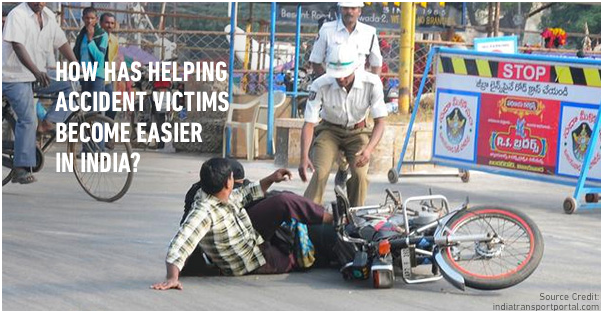
  • Duties of the bystanders: they have the most important role to play, but it is observed that people hesitate to help the victims of accidents, and they have different apprehensions. For instance, they hav\d to disclose their identity and were harassed by police officials and had to visit courts without any fault of theirs.

Even when the bystanders take the victims to hospitals, the hospital administration detains them. People also are hesitant to bear transportation and other costs for a stranger. Most of the bystanders are unaware of who to call and what immediate action to do and thus they do not take action.


Present situation for the Good Samaritans

xbb

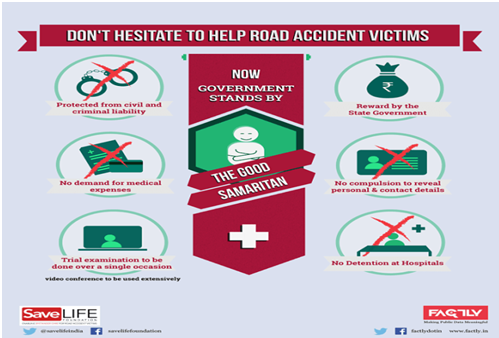
An NGO ‘Save Life Foundation’ filed a petition in the Supreme Court of India in Save Life Foundation v. Union of India[9] to enable the bystanders to help the victims in a hassle-free manner. And following the court’s order guidelines were issued by the government.

The guidelines are:

  • He has no obligation to answer any questions as soon as he takes a victim to the hospital and he can also leave the hospital.
  • He is also not obliged to reveal his name/identity.
  • As an encouragement to other citizens, the person should be rewarded by the state government.
  • To provide hassle-free legal proceedings, the person should be heard in only a single hearing in the court.
  • If police or doctor harasses a Good Samaritan, they should be sternly punished.


Footnotes:

[1] Transport Research Wing, Ministry of Road Transport and Highways, Road Accidents in India 2014, New Delhi: Ministry of Road Transport and Highways, Government of India; 2014.

[2]http://www.marutisuzuki.com

[3] Section 3, the Motor Vehicles Act, 1988

[4] Section 140, Motor Vehicles Act, 1988

[5] Section 161, Motor Vehicles Act, 1988

[6] Section 304A, Motor Vehicles Act, 1988

[7] Section 336, Indian Penal Code, 1860

[8] K. Balchand, Hefty penalty coming for driving offense, The Hindu, March 2012

[9] WP No 235 of 2012


Download Now

How To Become A B&B Host In India

1

In this blog post, Sunidhi, a student of the Rajiv Gandhi National University of Law, Patiala writes about the process of becoming a Bed & Breakfast host in India. The blog post explains about Incredible India Bed & Breakfast establishments and AIRBNB.

7

Introduction

Bed & Breakfast, popularly known as B&B, refers to an accommodation where a traveler is provided with overnight stay and breakfast at a private residence. The traveler stays with the host family as a family member. B&B was prevalent throughout the world since the beginning of 21st century, but it became popular in India at the time when Commonwealth Games, 2010 was hosted by India.

The main aim is to provide a clean, hygienic and affordable place to tourists where both the Indians and the foreigners can stay, including an additional advantage for foreigners to stay with an India family and to experience and enjoy the Indian customs, traditions, culture and food. But with the passage of time, tourism has expanded leading to the shortage of accommodation and in the short run, this problem cannot be solved by constructing new hotels as it has a long gestation period. So, B&B became the most suitable solution due to short gestation period and needed for smaller investment.


B&B v. Hotel

11

The basic difference between the two is that:

  • The traveler’s breakfast is already charged in the cost of the room in a B&B whereas a hotel charges extra money for the breakfast.
  • B&B provides more personalized services and a quality experience from check-in to check-out as compared to a hotel.
  • B&B provides free parking to the guest whereas hotel takes extra money for the same.
  • B&B has more stringent cancellation laws as compared to hotels because they have low inventory and high demand. So, they ask for a deposit or half of the cost to be paid in advance whereas hotel provides 24 hours before cancellation. Also, the hotel does not ask for any advance payment.
  • Snacks & beverages are provided free of cost in a B&B whereas the hotel even charges for a water bottle.
  • B&B provides home-made food, unlike hotels.


Incredible India Bed And Breakfast Establishment

It is an initiative by Union Minister of Tourism, India to promote B&B in India for a comfortable and memorable stay for both the Indian and the foreign tourists. It sets the procedure to register oneself as a B&B host and explains the guidelines to be followed while registering oneself as a B&B host.


Legal procedure 


Registration

16

The potential host has to fill an application form and send it to office of the regional director of India Tourism along with:

  • Passport size photograph of the applicant(s) and Aadhar card number.
  • Demand draft of Rs 5000/- for Gold and Rs 3000/- for Silver. (The Regional Classification Committee inspects B&B establishment and then according to the services and facilities provided by the host classifies it as Gold or Silver.)
  • Police Verification Report stating good reputation of the host and family members.
  • Photographs of the premises (including Rooms, kitchen, lobby, bathroom, etc.) to be rented out.
  • A self-declaration stating all the requirements have been fulfilled, and information provided in attached documents is true to his/her knowledge.
  • Layout Plan of all the floors intended to be used as a B&B.
  • Proof of Ownership
  • Proof of Residence
  • The family background note of the potential host.

All the documents should be self-attested by the applicant before sending it to the authorities.

The authorities scrutinize the application and revert in 30 days either with an approval or denial of registration.


Guidelines

The applicant should keep in mind the following guidelines before filing for registration:

  • The applicant should be himself/herself residing in the same residence with his/her family.
  • The applicant can rent out minimum one room and maximum six rooms. Each room can have maximum two beds for adults.
  • The travelers shall be informed in advance about the charges and type of breakfast served.
  • Once an applicant applies for classification he has to abide by the date set by the Regional Classification Committee and no deferment is allowed.
  • The Regional Classification Committee do the classification by the number of services provided by the applicant and the quality of services provided by the applicant.
  • The classification is valid for two years only.
  • The B&B host has to maintain standards at all the times as the Chairman can authorize a surprise inspection any time without any prior notice.
  • The rate of taxes on property, water and electricity, will not be charged at commercial rates.
  • The application can be rejected for registration if the applicant is convicted of a punishable offense or is an undercharged insolvent.
  • If the applicant has any grievance regarding classification or change of facilities, etc. he has to inform the authorities within 30 days of application.
  • The applicant can neither maintain a front office nor indulge in any other commercial activity relating to tourism.
  • No activity that violates the privacy of the traveler is allowed.


AIRBNB

 belo-1200x630-a0d52af6aba9463c82017da13912f19f

What is AIRBNB & how it works?

AIRBNB is a private online accommodation company that started working in 2008. It provides accommodation to travelers throughout the world and now it has started operating in India as well. It does not own any room of its own but has created a platform for those who have can and wish to accommodate travelers at their place. It registers hosts who provide accommodation to the travelers and helps the travelers find a place to stay in their desired city and location. It connects the host and the traveler and enables them to communicate and avail the service of a host by charging a service fee for the same.


How to become an AIRBNB host in India?

The applicant has to obtain a registration certificate from the tourism industry to become a B&B host in India (as explained above). Once the applicant receives the approval to become a B&B host, he/she can register with AIRBNB to become an AIRBNB host. It does not charge any registration fees, but it charges a ‘service fee’ just like commission levied for every transaction between a traveler and the host, completed through AIRBNB. Once the applicant registers with AIRBNB, it publishes the details (services provided, charges, etc.) of the host on its website as provided by the host. Also, the host has to follow the code of conduct set by AIRBNB regarding its responsibilities towards the guest and the standard of service. Hence, once the applicant obtains registration certificate, it becomes a legal establishment.

Download Now

Brand New Bill Against Trafficking Of Persons

0

In this blog post, Sakshi Jain, a student of Amity University, Lucknow Campus critically analyzes the ‘Trafficking of Persons (Prevention, Protection & Rehabilitation) Bill, 2016′ introduced in May 2016.

AAEAAQAAAAAAAAL8AAAAJDRiZDM3Y2E0LTYwN2UtNGUzMS1iMGJmLWU2ZDNlNzZmNGNjMw


Human trafficking is the trade (sell and purchase) of human beings for the purpose of sexual slavery, bonded and forced labour or for any commercial sexual exploitation and prostitution. Under human trafficking, men, women or children are made believe that the concerned person will provide them with a good job in a different country or place. They blindly believe the traffickers and are then sold by them to other people. May 25th is celebrated as International Missing Children’s Day to honor missing and abducted children. A survey has found that in every 8 minutes, a child goes missing, and it has been held that there has been an increase of almost 84% over the last 14 years. 45% of such missing children are untraceable.


About the new bill

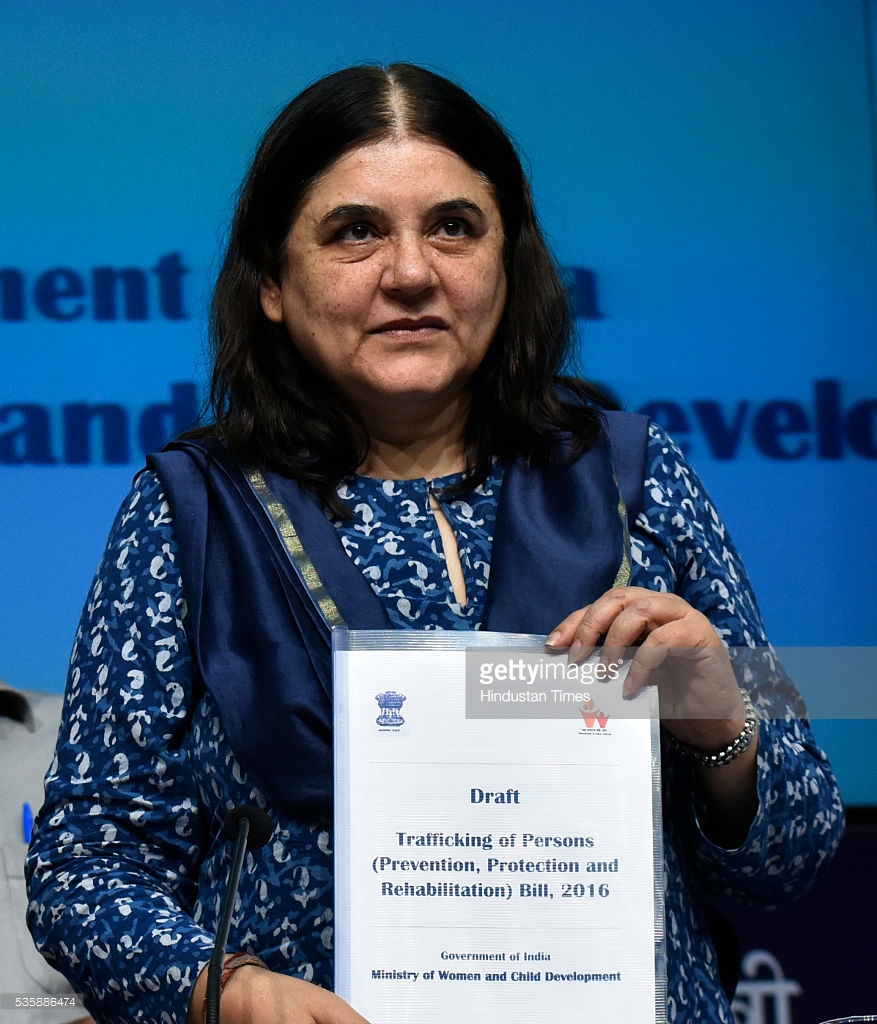
Smt. Maneka Gandhi, Minister of Women & Child Development, released a draft of Trafficking of Persons (Prevention, Protection & Rehabilitation) Bill, 2016 in May 2016. The bill aims to create a strong social, legal, economic and political environment against trafficking of a person. It also includes related matters under trafficking. This bill has been drafted and released for the suggestions and criticism of the experts. Smt. Maneka Gandhi makes it clear that the bill is designed for the victims of trafficking, and it differentiates between the two terms ‘trafficker’ and ‘trafficked’. The bill is drafted in order to cover the loopholes which exist in the present laws. This bill also contains provisions for funds for rehabilitation centers for the victims of trafficking.

To know more about the laws for protection against human trafficking in India in brief, please refer to the video below:

The bill has addressed various aspects of trafficking and its punishments have been laid down under Section 370 to Section 373 of Indian Penal Code, 1860. This bill aims at dealing with the offenses which have not been dealt previously under any Act or law.  It suggests the penal provision for acts such as the disclosure of the identity of the victim of trafficking and its witness, use of a narcotic drug or psychotropic substance or alcohol for the purpose of trafficking, use of a chemical substance or hormones for the purpose of exploitation.  It also provides Protection homes and special homes for short and long term rehabilitation support to the victims. For speedy trial and to avoid delay, the proposed bill provides for establishing special courts in each district court. Compensation is provided to victims of trafficking under this proposed bill. It is made mandatory to report the complaint to a police officer, public servant, or any other employee of the protection homes or special homes having the custody of trafficked victims in the concerned district or state. The Act has provisions for the constitution of Anti-trafficking committees to oversee the prevention, protection, and rehabilitation of the victims.

The bill treats survivors of the trafficking as victims and provides due care to them. Proper shelter and rehabilitation is given to them. Special courts are set up for dealing with the cases registered under trafficking. UN Office on Drugs and Crime says that after East Asia, South Asia and India are the countries with the largest growing and second largest region for human trafficking.

According to the National Crime Records Bureau, 5,466 human trafficking cases were registered in 2014.[1]Rural people including poor, women and children are being taken to big cities by the traffickers and sold into domestic work or sex work. They also sell them to workshops. All the work done by those in such workshops are unpaid, and they are treated like animals.

Whoever uses any narcotic drug or psychotropic substance, or alcohol, for the purpose of trafficking shall be punished with an imprisonment for a term, which shall not be less than seven years but can extend to ten years and shall be liable for fine of not less than one lakh rupees (Section 16). The same punishment is prescribed for the person whosoever uses chemicals or hormones on trafficked women or children for the purpose of early sexual maturity and exploitation. (Section 17)

Provision under the Constitution of India

human-trafficking1

Article 21 of the Constitution of India guarantees the right to life and personal liberty under the procedure established by law. Every person has a right to life and personal liberty. Therefore, trafficking of a person needs to be prevented, and the victims need care, protection, and rehabilitation.

Article 23(1) of the Constitution of India prohibits trafficking of a human being and compelling a person into begging or any other forms of forced labor and makes it a punishable offense.

 Prohibition of traffic in human beings and forced labour

(1) Traffic in human beings and beggar and other similar forms of forced labour are prohibited, and any contravention of this provision shall be an offense punishable by law.[2]


Provisions under Indian Penal Code, 1860

Under Indian Penal Code, 1860, Sections 370 to 373 of the code deals with human trafficking. It defines it as:


Section 370 – Buying or disposing of any person as a slave 

Whoever imports, exports, removes, buys, sells or disposes of any person as a slave, or accepts, receives or detains against his will any person as a slave, shall be punished with imprisonment of either description for a term which may extend to seven years, and shall also be liable to fine.


Section 371- Habitual dealing in slaves

Whoever habitually imports, exports, removes, buys, sells, traffics or deals in slaves, shall be punished with 1[imprisonment for life], or with imprisonment of either description for a term not exceeding ten years, and shall also be liable to fine.


Section 372 – Selling minor for purposes of prostitution, etc

Whoever sells, lets to hire, or otherwise disposes of any person under the age of eighteen years with intent that such person shall at any age be employed or used for the purpose of prostitution or illicit intercourse with any person or any unlawful and immoral purpose, or knowing it to be likely that such person will at any age be employed or used for any such purpose, shall be punished with imprisonment of either description for a term which may extend to ten years, and shall be liable to fine. 2

Explanation I —When a female under the age of eighteen years is sold, let for hire, or otherwise disposed of to a prostitute or to any person who keeps or manages a brothel, the person so disposing of such female shall, until the contrary is proved, be presumed to have disposed of her with the intent that she shall be used for the purpose of prostitution.

Explanation II —For the purposes of this section “illicit inter-course” means sexual intercourse between persons not united by marriage or by any union or tie which, though not amounting to a marriage, is recognised by the personal law or custom of the community to which they belong or, where they belong to different communities, of both such communities, as constituting between them a quasi-marital relation.

Section 373Buying minor for purposes of prostitution, etc.

Whoever buys, hires or otherwise obtains possession of any person under the age of eighteen years with intent that such person shall at any age be employed or used for the purpose of prostitution or illicit intercourse with any person or for any unlawful and immoral purpose, of knowing it to be likely that such person will at any age be employed or used for any purpose, shall be punished with imprisonment of either description for a term which may extend to ten years, and shall also be liable to fine.

  1. Explanation I — Any prostitute or any person keeping or managing a brothel, who buys, hires or otherwise obtains possession of a female under the age of eighteen years shall, until the contrary is proved, be presumed to have obtained possession of such female with the intent that she shall be used for the purpose of prostitution.

Explanation II —“Illicit intercourse” has the same meaning as in section 372.[3]

The offense under this proposed bill is a non-bailable and cognizable offense. This is governed by Code of Criminal Procedure, 1973 but Section 19 of the bill specifies that a person can get bail under the bill when the special public prosecutor has been given an opportunity to oppose the application and the court has reasonable grounds for believing that the accused is not guilty and that he is not likely to commit any offence while on bail.

Chapter X of the Bill explains confiscation, forfeiture, and attachment of property. Any person who has been accused of using narcotic or chemical substance under Sections 16 and 17 of the bill or Sections 370-373 of IPC and the accused has shall be concealed, transferred or dealt with the property owned or in possession him in any manner which may result in frustrating any proceeding , the special court may confiscate the property.

The person accused under Sections 16 and 17 of the bill or Sections 370-373 of IPC has used the property for the commission of that offense, shall stand forfeited by the government.


Presumption

The special court will presume that the accused has committed an offense under the bill if he is prosecuted for committing or abetting to commit any offense under Sections 16 and 17 of the bill, or under Sections 370-373 of IPC unless the contrary is proved.

The provisions of Code of Criminal Procedure shall apply to the proceedings before the special court under the bill. Section 360 of the Code of Criminal Procedure, 1973 and provisions of the Offenders Act, 1958 do not to apply to persons found guilty of having committed an offense under this bill if that person is above the eighteen years of age.


Criticism

The bill was released by Maneka Gandhi for suggestions and criticism. Many experts criticize the drafted bill. They claim that the bill is toothless and has brought nothing new to the previous laws and statues. The bill has the same features as it the Immoral Traffic (Prevention) Act, 1956. The similarities include the mandatory provision for all the placement agencies to register under the said bill. The new bill also proposed mandatory registration of the agencies. But all the agencies are being registered under the Immoral Traffic Act, 1956 Section 29 of the bill inculcates anti-trafficking funds for the victims of trafficking, but it fails to explain its utilization. It has not been clarified as to how the funds will be allocated, how it will be used, how it will be managed, etc. The bill has further been criticized as an unrealistic bill.

 535886474

Conclusion

Trafficking of a human being is a serious offence. It violates the right of every individual to live with dignity under Article 21 of the Constitution of India.  Article 3, paragraph (a) of the Protocol to Prevent, Suppress and Punish Trafficking in Persons defines Trafficking in Persons as the recruitment, transportation, transfer, harbouring or receipt of persons, by means of the threat or use of force or other forms of coercion, of abduction, of fraud, of deception, of the abuse of power or of a position of vulnerability or of the giving or receiving of payments or benefits to achieve the consent of a person having control over another person, for the purpose of exploitation. Exploitation shall include, at a minimum, the exploitation of the prostitution of others or other forms of sexual exploitation, forced labor or services, slavery or practices similar to slavery, servitude or the removal of organs[4]. This bill talks about the broad concept of the human trafficking but lacks in terms of coping up with the current issues. Many children are made bonded labourers and girls are put into the prostitution business. Hence, a strong move should be taken by the government to overcome this problem.

Footnotes:

[1]http://indianexpress.com/article/india/india-news-india/india-unveils-first-ever-comprehensive-draft-anti-human-trafficking-law/

[2] Indian Kanoon

[3] Indian kanoon

[4]https://www.unodc.org/unodc/en/human-trafficking/what-is-human-trafficking.html


Download Now

Medical Negligence – Breach Of Patients’ Trust

0

In this blog post, Sakshi Jain, a student of Amity Law School, Lucknow Campus, writes about the concept of medical negligence, discussing in details the scenarios in which a doctor’s action in his professional capacity would be considered medically negligent and the legal defences that a doctor take in case he/she is accused of medical negligence.

Medical-Negligence


Doctors are termed as life savers on earth. They have been given a place next to God. There is a certain amount of trust that people repose in doctors that they will not behave negligently during the treatment. The care should be of a very reasonable nature. If the doctors act negligently, then this will result in the breach of trust.

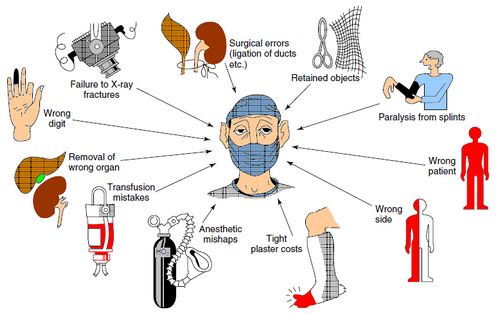
Indian society is becoming increasingly aware about patients’ right[1] It is the duty of the doctor to treat his patients well and with due care and if any mishap occurs, then the authority and doctors will be liable for compensation. That is why, due to medical negligence, many hospitals and doctors are facing complaints regarding mismanagement, poor facilities, erroneous treatment and negligence.

Negligence is the breach of a legal duty to care which a doctor owes to his every patient. The law mandates a certain amount of care which every doctor should undertake. Therefore, the breach of legal duty helps initiate action against negligence. When a person offers medical advice to another, it is impliedly understood that he has a skilled knowledge about the concerned health issue and will take care of it. In the case of State of Haryana v. Smt. Santra, the Hon’ble Supreme Court held that every doctor “has a duty to act with a reasonable degree of care and skill”.[2]

It is the duty of every doctor to treat their patients carefully, but it does not mean that every person is perfect on his own and cannot make mistakes. Sometimes, even the most renowned specialists make mistakes in the process of treatment or diagnosing the disease.  Thus, it is to be proved that the act was done negligently and without taking due care. However, if it is proved that the act was not done negligently and was just a mere mistake or misconception on the part of the doctor, then they will not be held liable. Doctors can be held liable for negligence only if one can prove that he/she is guilty of a failure that no doctor with ordinary skills would be guilty of, if acting with reasonable care.[3]

Doctors are liable individually or vicariously when they charge fees for their service but cannot be held liable when no fee is charged by them. Service is the main ingredient for constituting medical negligence, and service has the same meaning as defined in Section 2 (1) (O) of Consumer Protection Act, 1986. In Dr. Laxman Balkrishna Joshi v Dr. Trimbak Bapu Godbole, the Supreme Court held that if a doctor has adopted a process with due care and in the areas he specializes in, then a mere mistake would not be enough to constitute negligence.

When a doctor is exercising an ordinary degree of skill in which he has a specialized knowledge, then he would not come under the preview of negligence if any of his acts constitute a minor mistake for which he took reasonable and due care. So, the patient cannot blame the doctors if they have not been totally cured for which the doctor has worked in a manner suitable for the betterment of the patient.

In certain cases, the Latin maxim Res Ipsa Loquitur will apply which means, the thing speaks for itself.  In these circumstances, the accused does not have to prove the wrong done by the doctor. In these cases, the things will speak for themselves, and the doctor will automatically be held liable for his negligent act. This principle was applied in the case of Dr. Janak Kanthimathi Nathan v. Murlidhar Eknath Masane[4].

Provisions under the Indian Penal Code, 1860

Medical-negligence_landing

Section 304A of IPC, 1860 defines death caused by negligent act. It is a criminal negligence and also a punishable offense under Section 304A of IPC. The Section states that:

Whoever causes the death of any person by doing any rash or negligent act not amounting to culpable homicide, shall be punished with imprisonment of either description for a term which may extend to two years, or with fine, or with both. There is a difference between the liability in civil laws and liability in criminal laws. Under civil laws, it is based on some damages occurred under the tortuous liability which is a civil wrong but under criminal law, the degree and the amount of negligence are the most basic factors to be considered. Section 304 A is a criminal offense for any rash or negligent act which is punishable by two years of imprisonment.

But the doctors cannot be held criminally liable for an act for which they took due and reasonable care. It must be shown by the accused that the act was done negligently or the doctor was incompetent while performing his duties. Therefore, a mere mistake cannot put doctors behind bars.

Section 80 and 88 also deals with the defenses which can be claimed by the doctors accused of criminal liability.

Section 80 – An Accident in doing a lawful act

Nothing is an offense which is done by accident or misfortune and without any criminal intention or knowledge in the doing of a lawful act in a lawful manner by lawful means and with proper care and caution.

This Section would save the doctors from the criminal liability if the act was done by accident or act was a result of any misfortune. But the condition here is that there should not be any criminal intention for doing that act. The other condition is that the act was done in a lawful manner. When the particular act is done unlawfully, the person cannot be granted the benefit of this section.

Section 88

Nothing which is not intended to cause death, is an offence, by reason of any harm which it may cause, or be intended by the doer to cause, or be known by the doer to be likely to cause, to any person for whose benefit it is done in good faith, and who has given a consent, whether express or implied, to suffer that harm, or to take the risk of that harm.

When the consent was given by the patient to do a particular act, then the doctors will not be held liable if he has done it in good faith. Volenti non fit injuria is the maxim which speaks when a person voluntary, with his consent, makes any decision and cannot claim for compensation if any injury occurs to them. Therefore, these two sections save the doctors from any criminal liability when done in good faith, with the person’s consent, without any criminal intention, and in a lawful manner.


Breach of trust of patients

Medical-negligence (1)

Medical negligence is increasing day by day, and no initiative is made to cope with it.On May 2016, a Delhi-based private hospital, namely Maharaja Agrasen Hospital was held liable for medical negligence and was ordered by National Consumer Disputes Redressal Commission to pay compensation of Rs 64 lakhs to the child’s mother, Pooja Sharma. The complaint was against the medical practitioners who did not take care of the premature baby of nearly five weeks who was under the care of the hospital authority. The infant was not screened properly which resulted in the displacement of the infant’s retina.

 Another case is the case of Yeshwantrao Chavan Memorial Hospital, against whom the complainant’s (Balasaheb Dhendge) family filed a complaint about negligent surgery which in turn resulted in him to lose his leg. Dhendge is a marginal farmer of 30 years who was admitted to the hospital on 16th September 2015.  Dhenge’s family was compensated with Rs. three lakhs in the form of financial assistance.

Another case is from Rampur, Uttar Pradesh. The head of the baby was severed or separated out of the body during delivery. The doctors forcefully pulled out the infant from the womb which resulted in the separation of head from the body. The name of the doctors and staff members involved was not disclosed. Therefore the matter was not taken further into account.


Conclusion

Medical negligence occurs when there is a breach of trust which the people have on the doctors. Nowadays, doctors are not practicing with ‘due and reasonable care’ which has further resulted in the damage and injury to the general public. Medical negligence is a punishable offense under Section 304A of IPC. Medical negligence requires certain skills and professional knowledge. So when the doctors do an act, there lies a duty to take the requisite care. Any negligent act amounts to medical negligence. But according to this criterion alone, the doctors cannot put behind bars. For an offense under Section 304A of IPC, it must be proved that the act was done carelessly and without any detailed knowledge and skill. Therefore, no negligent act takes place if it was done with proper care. Hence, the doctors are bound to act in a careful manner and if not, it may result in the breach of trust of their patients.

Footnotes:

[1]. http://www.vakilno1.com/legal-advice/law-medical-negligence-india.html accessed on 26th May 2016

[2] (2000) 5 SCC 182:: AIR 2000 SC 3335

[3] (1955) SLT 213. In: Nathan HL. Medical Negligence. London: Butterworths; 1957.

[4] 2002 (2) CPR 138


Download Now

Discrimination Against Men

1

In this blog post, Sakshi Jain, a student of Amity University, Lucknow Campus writes about injustice to the male section of our society. This article explains how males are victims of discrimination in a similar way as females are and how the society turns a blind eye towards male victimization since the society has a preconceived notion that it is only the females who can be abused and harassed by males and not vice-versa.

 mancriminate


Manscrimination

We often hear about cases of injustice against women or sexual harassment to females at workplaces. If injustice is being done, there is a preconceived notion that injustice is being done to the female. It usually never occurs to people that harassment can be done to males as well. But nowadays, cases have come to people’s notice where harassment to males is being done and no justice is given to them because it is been assumed that the male is wrong on his part and the female gets the preference to it. May it be a case of dowry, sexual harassment at work places, Section 498 of IPC, grant of maintenance to wife and children after divorce and many more cases, women are given priority and men get oppression by the society.  There is a gender bias against males in certain cases. A number of laws are made for the protection of female but no such laws are there for the males and this makes them the victim of the society.  There are various social movements and NGOs which works for the rights of men. Furthermore, harassment isn’t just sexual but can be mental as well.


Dowry and cruelty laws

Misuse-of-section-498A-IPC

Dowry is prohibited under Dowry Prohibition Act, 1961. Demand for dowry is a punishable offense and dowry death is also a punishable offense under Section 304 B of IPC.  Nowadays, dowry laws are being misused by the wives to harass and torture their husbands. The high rate of suicides being committed by males is predominantly due to harassment by wives. Dowry law is a weapon in the hands of the wives to protect themselves from their husbands and his relatives. But what should be done if these laws are misused by wives to torture their husband and cause them mental cruelty? In Sanjay vs. Anita[1], the Bombay High Court held that a false complaint against the husband and his relative by the wife amounts to mental cruelty to husband and thus becomes a ground for divorce by the husband.

The Section 113B of India Evidence Act, 1879 says that if a married woman commits suicide within the 7 years of marriage, it is assumed by the court that the suicide was abetted by the husband or his relatives and shall be punishable under Section 304 B of IPC. This section discriminates against men as without any evidence, it is to be assumed that the death is abetted by the husband or his relatives.

Before July 2014, Section 498A of IPC allows the direct arrest of the husband or his relative, whose name has been mentioned in the complaint, without any arrest warrant or any investigation. A mere complaint registered under Section 498A puts the concerned persons behind bars without any investigation. Section 498A is a non-bailable offense. But removing this discriminatory provision against males, the Supreme Court in its order in 2nd July 2014, stopped this automatic arrest without any warrant or investigation for a complaint registered under Section 498A of IPC.  In August 2010, the Hon’ble Supreme Court directed the government to amend Section 498A of IPC and makes it a bailable offense due to rising cases of false complaint by a wife against her husband and relatives.

Married women cannot be punished as an abettor. In Yusuf Abdul Aziz vs. the state of Bombay[2], the validity of Section 497 of IPC was challenged before the court stating that this creates biases and injustice against the male section. But it has been held that women cannot be held liable for abetting adultery.


Divorce

Divorce is dissolving the marriage by either of the parties. Divorce can be initiated by any differences or misunderstanding between the spouse. Earlier wives approach the court for divorce under the pressure of cruelty, an illicit relation of her husband with other women, dowry demand or dowry death and much more. But with the passage of time, things are changing and now husbands are getting harassed by their wives and many petitions are filed in the court by the husband. Some wives harass and insult their husbands in public as well. In Dastane vs. Dastane[3], the wife harassed her husband and made his life miserable. She insulted him in front of his friends and screamed at him saying she doesn’t want the Dastane family to no last forever. These acts amount to mental cruelty against him and divorce was initiated by the husband.


Male sexual harassment is the rise

The case of male sexual harassment at the work place is on a rise. It is not only females who are harassed at the work place but males also get harassed by their co-employees or superior at their work place. Nobody wants to believe it because it is not a serious issue for everybody. But indeed, it is a serious issue for the male victim. This is because males don’t point their figure due to their ego. Many people believe that harassment is limited to females and cannot go beyond this sphere. It’s not women, but males too who are victims of sexual harassment. In a recent survey of 2015 by the Economic Times- the Synovate survey, it has been reported that almost 19% of males working in Bangalore, Chennai, Delhi, Kolkata, and Mumbai have been the victim of sexual harassment at work place. In today’s workplace, men are vulnerable to sexual harassment as much as women. It is a very serious issue and steps should be taken to overcome this. Indian society does not believe this concept because of their social beliefs that male cannot be get abused or harassed.


Real Life Cases

2077fd4f145576bedf49a3ddd093cf33

  • There was a case from Mumbai, where a girl, Maryanna Abdo posted a picture of a guy on the social media and claimed that he masturbated in front of her in public. She requested the public to find that guy so that she can take some action against him. But after the investigation, it had been proved that the statement of the girl was not true. She just wanted to harass the guy.
  • Another incident took place in New Delhi in August 2015. Here, Jasleen Kaur, a student of St. Stephens College posted a picture of a guy in his royal Enfield motorcycle and said that he passed some abusive or obscene comments on her. She also claimed that he harassed her in the public area. After the investigation, Jasleen was found guilty as she misused the power given to her by law. All these real examples prove that males are being harassed by females. Harassment may not be in a physical form. Mental harassment can also be done to males.

Earlier, males did not come forward and opened up about the cases of sexual harassment that they faced. But in recent years, they have come forward and have taken a stand for themselves.

  • In an instant case, a guy shared his worst experience of sexual harassment at work place. The guy worked at a job consultancy firm. He was one of the older employees working in that firm. The girl always leaned towards that guy as compared to his other colleagues or other employees. The girl as a superior always checked his work and if mistakes are found, she used to correct them. One day, working late, she approached him and said that she liked him. But the guy in a very formal way replied that he is not interested. After this incident, the girl behaved coldly towards the guy. But again after a few days, both were working together late night. The girl came up to the guy topless top and the guy did not know how to react. She came up to him and said she was paying him when he was of no use to her. He felt like he is not fit for the job and resigned next day from that office.


Conclusion

Article 14 of the Constitution of India guarantees the right to equality to all the citizens of India. But the priority and preference is given to women over men in certain cases. A number of cases have been registered and recorded against the sexual, physical or mental abuse of male. It is not only females who face discrimination but males can face a similar form of oppression. Many females take the advantages of the rights given to her. False abuse the rights given to them and register false cases against the husband and his relatives. Males are sexually abused at work places. The number is increasing day by day. Men cannot be abused is the assumption of the society and that is why they are not ready to accept it. But many males have spoken up about their worst experience of sexual abuse at the work place. The society and law are doing injustice to the male society. We live in a country where everybody is treated equally and should have a dignified means of life. Therefore, doing injustice to one section of society and justice to other is not acceptable in the country like India. Hence, a voice should be raised against the sexual abuse of both men and women and inequality should be eliminated from our country.

Footnotes:

[1]AIR 2007 P-H 136, (2007) 147 PLR 594

[2] 1954 SCR 930

[3]1975 AIR 1534, 1975 SCR (3) 967


Download Now

All You Need to Know About the Krishi Kalyan Cess

1

This blog post written by Saanvi Singla, a student of University Institute of Legal Studies, Panjab University, highlights the meaning, scope, purpose, and applicability of the newly imposed Krishi Kalyan Cess.


Krishi-Kalyan-Cess


Introduction

Many changes took place in the Finance Bill, 2016. Among the most highlighted ones were the increase in Service Tax from 12.36% to 14%, removal of Education Cess and Secondary and Higher Education Cess and the inclusion of the Swachh Bharat Cess (SWC) and the Krishi Kalyan Cess (KKC). Swachh Bharat Cess and Krishi Kalyan Cess are applicable at 0.5 % on all taxable services. This leads to a total tax of 15% that will be levied on all taxable services.

The proposed rate of the Goods and Services Tax (GST) is around 17-18%. So it can be seen that service tax rate is being moderately increased to reach the proposed level of GST[1]. Krishi Kalyan Cess has been made applicable from the 1st of June 2016.


What is a Cess?

A cess is a kind of tax that is levied to raise funds for a specific purpose by the government. The examples of a cess are Education Cess and Secondary and Higher Education Cess. It was specifically utilized for the funding of primary and higher secondary education, respectively.

According to Article 270 of our Constitution, the cesses imposed by the Parliament for a specific purpose need not be shared with any state governments. If a certain amount is left unspent, then that amount is carried forward to the next year. It is mandatory for the Centre to share revenue from other taxes, but in the case of cesses, the Centre is allowed to retain the whole amount.


What does the Krishi Kalyan Cess mean?

Krishi Kalyan Cess is levied for the purpose of financing and promoting initiatives to improve agriculture or any other relating purpose. The proceeds received through this cess will be credited to the Consolidated Fund of India. The Government can utilize these funds after due consideration of laws made by the Parliament. Krishi-kalyan-cess-326x206

It is a cess which will be collected by the provisions provided in Chapter VI of the Finance Bill, 2015. It will be charged on all taxable services at a rate of 0.5%.

The provisions made under Chapter V of the Finance Bill, 1994 and the rules made, including those relating to refunds and exemptions from tax, interest, and imposition of penalty shall apply to the levy and collection of the Krishi Kalyan Cess on taxable services, as they apply in relation to the levy and collection of tax on any such taxable services under the said chapter or the rules made.


From which date is the Krishi Kalyan Cess applicable?

Krishi Kalyan Cess has been made applicable since the 1st of June 2016. Krishi Kalyan Cess will not apply to the services that are covered under the “Negative List” and “Mega Exemption List”. According to the Notification No. 22/2015, Krishi Kalyan Cess will not be applicable on services that are exempted from the levy of Service Tax.

Rule 5 of Taxation Rules, 2011 will refer to the applicability in the cases on ongoing contracts as of 1st June 2016. So, if the payment is made before the said date, this cess will not be applicable.


How will the  Krishi Kalyan Cess be calculated?

Krishi Kalyan Cess will be calculated in the same way Service Tax is calculated. So, Krishi Kalyan Cess will have the same taxable value as that of Service Tax. Krishi Kalyan Cess will be calculated on the amount of the service provided and not on the Service Tax. An example for a better understanding of the calculation of Krishi Kalyan Cess is given below:

For a service worth Rs. 100, we will have to pay Rs. 14 for Service Tax at 14%, Rs 0.50 for Swachh Bharat Cess at 0.50% and Rs. 0.50 for Krishi Kalyan Cess at 0.50%.

So the total payable amount on the service of Rs. 100 is Rs. 114 + 0.50 + 0.50 = Rs. 115.


Is it necessary to mention about the Krishi Kalyan Cess separately in an Invoice?

Krishi Kalyan Cess will be imposed, charged, collected and paid to the Central Government independent of the Service Tax. However, this needs to be mentioned separately in an invoice. It has to be accounted for separately in the books of account and has to be paid separately under a separate accounting code.


Where can I find legal provisions for the Krishi Kalyan Cess?

Krishi Kalyan Cess was introduced in the Union Budget of 2016-17. A statutory provision was made under Chapter VI, Clause 158 in the Finance Bill, 2016 for levying of this cess.


How will the Krishi Kalyan Cess money be utilized? images

The proceeds gathered from the Krishi Kalyan Cess will be exclusively used for financing initiatives for the improvement of agricultural techniques and welfare of farmers. The proceeds collected through the Krishi Kalyan Cess will be accumulated in the Consolidated Fund of India and the Central Government after due consideration of the laws set by the Parliament regarding the utilization of this money for its specified purpose.


Is the Krishi Kalyan Cess applicable on the service of Reverse Charge Mechanism?

Krishi Kalyan Cess will apply to the service of Reverse Charger Mechanism as it applies to all taxable services. So, Krishi Kalyan Cess is applicable along with Service Tax on the services that are availed and covered under the Reverse Charge Mechanism.


What will be the liability in the case of Reverse Charge Mechanism when the services availed are before 1st June 2016, and the payment for those services are made after 1st June 2016?

In this case of Reverse Charge Mechanism Rule, 7 of Point of Taxation Rules will apply. According to them, the cess is considered as an application on the day the payment is made. Hence, in this case, Krishi Kalyan Cess will apply.


If a service is covered under Abatement, then what would be the effective rate of tax?

Services on which tax is levied at a certain percentage will attract Krishi Kalyan Cess on the same percentage of the value as provided under the Notification No. 26/2012, so this notification will apply in the same way to Krishi Kalyan Cess as it does to Service Tax.

krishi-kalyan-cess (1)

Is Cenvat Credit on payment of the  Krishi Kalyan Cess permitted under Cenvat Credit Rules, 2004?

Yes, Cenvat Credit is available for the payment of Krishi Kalyan Cess and will be utilized only for the payment of Krishi Kalyan Cess. Due to this reason, separate accounts are to be maintained. One can also claim a refund for the filling of Krishi Kalyan Cess.

Refund for Krishi Kalyan Cess shall be allowed to the exporter of services and the exporter of goods as there is no restriction of its availability.

Is the Krishi Kalyan Cess same as the Krishi Kalyan Surcharge?

No, Krishi Kalyan Cess and Krishi Kalyan Surcharge are entirely different in nature.

In order to provide a stable and predictable tax structure and to reduce black money, it was announced in the Union Budget that a domestic taxpayer can declare his undisclosed income or income represented in the form of any asset can be shown by paying a tax of 30% and surcharge on the existing tax at 7.5% and a penalty of 7.5% which becomes a huge total of 45%. Such a declaration will have immunity from future prosecution.

The surcharge of 7.5% in the above scenario is known as Krishi Kalyan Surcharge and will be used in the upliftment of the agriculture and rural economy[2].


Conclusion

The whole idea behind the introduction of Krishi Kalyan Cess is noble with an intention to improve and upgrade overall agrarian economy, which constitutes a huge portion of the Indian GDP. However, it doesn’t help the various initiatives taken by the government which is aimed at simplification of the business process.

Central Government needs to provide enough ease to projects like Make in India, Startup India for doing Business. Krishi Kalyan Cess is likely to disturb these initiatives due to its complexity as this will lead to an addition to the cost of goods and will ultimately result in an increase in the rates of goods and services.

The Central Government is making a lot of effort to introduce the Goods and Services Tax (“GST”) in India. The logic of introducing and removing new levies every year under the banner of new and different types of cesses seems unnecessary at this stage.

So we can see that Krishi Kalyan Cess has its advantages and disadvantages. But if this cess is used in an appropriate manner, then it can be very beneficial to the agrarian society.


[divider]

References:

[1] http://www.pradhanmantriyojana.co.in/krishi-kalyan-cess-kkc/

[2] http://www.profitbooks.net/krishi-kalyan-cess-kkc/

Download Now
logo
FREE & ONLINE 3-Day Bootcamp (LIVE only) on

How Can Experienced Professionals Become Independent Directors

calender
28th, 29th Mar, 2026, 2 - 5pm (IST) &
30th Mar, 2026, 7 - 10pm (IST).
Bootcamp starting in
Days
HRS
MIN
SEC
Abhyuday AgarwalCOO & CO-Founder, LawSikho

Register now

Abhyuday AgarwalCOO & CO-Founder, LawSikho