Download Now
Home Blog Page 1729

Rights Of A Minor In A Partnership

0

In this blog post, Pramit Bhattacharya, a student of Damodaram Sanjivayya National Law University writes about how a minor can become a part of a partnership. The post also highlights the rights and liabilities of a minor after being admitted into a partnership, and also discusses the position of a minor after he attains majority.

1451539_599879256736892_1144192258_n


A minor is a person who hasn’t yet attained the age of majority according to the Indian Majority Act of 1875.[1] Section 3[2] of the Indian Majority Act states that a person who is domiciled in India will attain majority at the age of eighteen.

Section 30 of the Indian Partnership Act[3] governs the admittance of a minor into a partnership. This section deals with the rights and liabilities of a minor who is admitted into a partnership and is entitled to the benefits of a partnership. A deeper reading of the provision, specifically sub-section (1)[4] Of the provision makes it very clear that a minor can’t be a full-fledged partner in a partnership. But with the consent of all the partners, a minor can be admitted to the benefits of a partnership.


Minors – Admitted only to benefits

simple deal

The general principle which has been laid down in Section 11[5] of the Indian Contract Act, 1872, states that a person has to attain the age of majority and should be of sound mind and not disqualified to enter into a contract to be a competent party. The Indian Partnership Act, 1932 was drafted by a Special Committee. Before the enactment of this statute, the provisions relating to partnerships was enshrined in the Indian Contract Act itself. While drafting the Act, the Special Committee felt that no major changes were required in the Partnership Act, and they believed that there was no reason to deviate from the principle of incapability of a minor to enter into a contract as provided by Section 11 of the Contract Act. Following this, the Committee did not allow minors to become a partner in a partnership, although they allowed a minor to be admitted to the benefits of a partnership.[6] In the judicial pronouncement of S.C. Mandal v. Krishnadhan,[7] It was observed that under Section 4 of the Indian Partnership Act, a firm means a group of person who has entered into a contract of partnership among themselves and reading it with Section 11 of the Indian Contract Act, it can be interpreted that a minor cannot be a part of the contract of partnership. A minor can only be admitted to the benefits of a partnership, and that partnership has to exist independently. Also, there cannot be a contract between two minors.  In simple words, there should be a partnership between two major partners before a minor can be admitted to its benefits.

In the case of H.R.G Ram v. Commissioner of Income Tax,[8] It was held by the High Court of Allahabad that any partnership deed which divides the obligations and rights between the major and minor partners equally will be invalid as it will be in contravention of Section 30 of the Partnership Act because in such a case not only the benefits are given to the minor, but liabilities are also being imposed upon the minor. There was some confusion regarding this proposition of law as in some cases, different high Courts of the country opined that even if a minor is made a full-fledged partner in a partnership firm, the partnership deed is to be interpreted in a liberal manner, and the obligations of the minor will be limited to the extent provided in Section 30 of the Partnership Act.

But in the landmark case of Commissioner of Income Tax v. D Khetan and Co.[9]The Apex Court made the legal stand clear on this issue by stating that where a minor is made a full-fledged partner in the firm, the firm could not be registered by the Income Tax Department. In case the Income Tax Department do register such a partnership firm, a new contract is to be made where the minor is admitted only to the benefits of the firm, and the original contract will be rendered invalid by registration of the new contract. Therefore, the proposition of the law is very clear. The partnership deed has to make it specifically clear that the minor is admitted only to the benefits of the firm and is not personally liable for the losses. In the judicial pronounce of Banka Mal Lajja Ram & Co. v. Commissioner of Income Tax, Delhi,[10] It was held by the Court that even if the other partners consent, a minor still can’t become a full-fledged partner in a firm through his or her guardian. In the case of CIT v. Kedarmall v Keshardeo,[11] it was held by the Court that a contract deed is valid when a guardian enters into a partnership on behalf of the minor, provided the minor is not made liable for the losses of the partnership, and the Guardian still had the right of being the guardian of the minor when the contract was entered into. Also, the income of a minor from a partnership will not be considered for the purpose of income tax.

Rights and liabilities of a minor

Sub-section (2)[12] of section 30 of the Partnership Act states that a minor is entitled to share of profits and the property of the firm which may have decided at the time the minor was admitted to the benefits of the partnership.  Under this provision, a minor also has the right to access and inspects the accounts of the firm. But this right is limited to the access and inspection only of the accounts of the firm and not any other document of the firm. Under sub-section (3) of the provision, it is stated that the minor is liable to the extent of his share in the partnership and cannot be made personally liable for the losses of the firm. In the case of S.C Mandal v. Asutosh Ghose,[13] It was held by the Court that the creditors of the firm can only recover the amount from a minor to the extent of his share in the firm, but they can’t sue the minor personally. The full-fledged partners do not enjoy this benefit as they can be made personally liable. In the case of S.R Patil v. C.N. Sedalge,[14] It was opined by the Court that a minor who has been admitted to the benefits of a partnership can’t be declared insolvent even if the other partners are declared as insolvent.

Sub-section (4) of the provision states that the minor can sue other partners to get the benefits of the partnership, but this right to sue is limited by the provision. The minor gets the right to sue other partners to recover the benefits only if the minor sever all ties with partnership firm. This provision further states that in the case the minor sever all ties with the firm, valuation of his share is to be done by section 48[15] of the Act, as far as possible.


Position of minor on attaining majority

Under sub-section (5) of the provision, the minor has two options on attaining majority. Either he can sever the connection with the firm or become a full-fledged member. The minor has to make the decision within six months of attaining majority. If he chooses to become a full-fledged partner of the firm or sever the ties with the firm, he will have to give a public notice specified under section 72[16] of the Act. In the case that no public notice is given by the partner, he will be considered as a member of the partnership. The minor also continues to enjoy the rights which he enjoyed as a minor till he reaches a decision. Sub-section (6) of the provision states that burden of proving that the minor had no knowledge about the fact that he was entitled to enjoy the benefits of the firm lies on the party who alleges such facts. Clause (a) of sub-section (7) states that when a minor becomes a full-fledged partner, such minor will now be held liable not only for the future liabilities of the firm, but will be liable for those obligations also which were incurred by the firm from the date the minor was admitted to the benefits of the partnership. Clause (b) states that the share of the minor after he attains majority will be the same which was given to him when he was a minor. This is because, when the minor chooses to become a full-fledged member of the partnership, there is no break in the partnership and it continues as it is.

Sub-section (8) of the provision states that when the minor decides that he’ll not become a full-fledged member of the partnership, he will be liable for the obligations and liabilities of the firm until the time he gave a public notice stating that he wouldn’t continue as a partner in the partnership. After severing the ties with the firm, the minor may file a suit to recover the benefits he was entitled to. Sub-section (9) of the provision states that nothing is given in sub-section (7) and (8) will affect Section 28 of the Act which states that if a party has misrepresented some fact, he’ll be liable for holding out. Therefore, if a minor even after leaving the partnership represents himself as a partner, he’ll be estopped from denying it later.

Footnotes:

[1]http://admis.hp.nic.in/himpol/Citizen/LawLib/C0141.htm

[2]Age of majority of persons domiciled in India 

[3]https://indiankanoon.org/doc/1921150/

[4] Ibid.

[5]http://comtax.up.nic.in/Miscellaneous%20Act/the-indian-contract-act-1872.pdf

[6]http://www.legalindia.com/minority-and-partnership/

[7](1922) 49 Cal 560,570

[8] [1950] 18 ITR 106 (All)

[9]AIR 1961 SC 680.

[10]AIR 1953 Punj 270 (DB).

[11]AIR 1968 Assam 68

[12]http://www.mca.gov.in/Ministry/actsbills/pdf/Partnership_Act_1932.pdf

[13]AIR 1915 Cal 482.

[14]AIR 1965 SC 212.

[15] MODE OF SETTLEMENT OF ACCOUNTS BETWEEN PARTNERS

[16] MODE OF GIVING PUBLIC NOTICE.

 

Download Now

Patent Law in India and the Pharmaceutical Industry

0
Medical Devices Rules

In this blog post, Pramit Bhattacharya, a student of Damodaram Sanjivayya National Law University writes about intellectual property rights in the pharmaceutical industry. The post discusses patent law in India and also highlights the concept of product patent. The post also talks further talks about how the Patent Act will affect the pharmaceutical industry.

1451539_599879256736892_1144192258_n

With the rapid advancement in technology, the pharmaceutical industry has benefited a lot. Every day, new life-saving drugs are being introduced in the market. Intellectual property rights in the pharmaceutical sector is regulated by the law of patents. India has its own patent laws, and it is also a party to GATT. This has helped the law of patents to become more efficient.

With the introduction of the Patents Act in 1970, pharmaceutical companies were allowed to patent their process of manufacturing drugs. The patents were valid for seven years. With the introduction of GATT,[1] due to India becoming a signatory to it in 1994 many changes occurred in the Indian Market. It was now mandatory to comply with GATT as well as the TRIPS[2] Agreement. Not complying with these standards meant that the defaulting party would no longer be a member of the WTO[3] (World Trade Organization). The pharmaceutical industry also had to meet the minimum standards which were provided under TRIPS. Hence, not only process patent, but product patent was also introduced, and the period of patents was increased from 7 years to 20 years. India got some extension to introduce these new measures as it got the benefit of being a developing country.

Patent Law in India

patent-law

The introduction of product patent has been one of the most significant contributions of the TRIPS Agreement. The Patent Act, 1970 also played a major role in taking India to the global patent arena. As India was a developing country, it took a bit of time to implement the TRIPS Agreement, subject to some conditions mentioned in Article 70 (7)[4] and  70 (8), of the agreement. These two sub-clauses talk about “transitional arrangement.” Sub-clause (8) stated that India has to provide a means to companies to by which the patents could be filed. It also stated that if any member of the WTO has granted a patent right to the product and the product has also obtained marketing rights for it; India also has to provide a patent to that product. Through the first amendment in the Patent Act, 1970, India introduced the system of transitional arrangements.

Some major amendments were also done through the second amendment in the year 2000. Amendments such as an extension of the term of a patent, subject matter of patents, and compulsory licensing system was done.[5] In 2005, a third amendment was also done to the Act. This amendment introduced the product patent regime in some areas including the pharmaceutical industry.[6] The fee structure, penalty provisions, filing procedure, etc. were also changed through this amendment.

Effect of product patent

Earlier, there was the system of “process patent” in the pharmaceutical industry. Process patent means that only the process used to manufacture a particular drug can be patented. The drug cannot be patented under this system. Other manufacturers had to use some other method to manufacture the drug. But with the introduction of the “product patent” regime, even the product (drug) could be patented. Other companies cannot manufacture the same drug once it has been patented. Section 5 (1) was removed from the Indian Patents Act, which spoke about process patent in the pharmaceutical sector.[7]This meant that from January 2005 product patent was also made applicable to the [pharmaceutical industry. It also included those applications which were made during the transitional phase.[8] There was a fear that due to the introduction of product patenting, drugs would become very expensive and would be out of the reach of the common man. Before the third amendment was done, many companies freely used different processes to manufacture the same drugs. But after the third amendment of 2005, these options[9] are being followed by the companies-

For Patent-expired or Non-patented Drugs – continue supplying to the export and domestic market.

For Patented Drugs

  • Manufacture the drugs through compulsory licensing.
  • Undertake R&D for creating new drugs.
  • Work together with other companies to create new drugs.

But what was feared earlier, that the cost of drugs would go up did not happen. Indian Pharmaceutical sector adapted very fast to the changes which were made in the patent law. Indian Companies started dominating the market even more after the TRIPS Agreements were implemented. Of the twenty largest pharmaceutical companies in the sector, sixteen are controlled by India and only four are MNCs.[10]The market share of the MNCs reduced even after product patent was introduced in 2005.[11] In many cases, foreign companies started opening subsidiaries in India and sold their drugs through them. India is favored because the R&D cost in India is very low when compared to other countries.

What can be patented?

Section 2 (1) (j) of the Patent Act[12] states that invention means a new product which is capable of industrial application. If any party had the knowledge of the invention or is used or sold by any party, within or outside India, then patent for that invention or product will not be granted. If the invention is in the knowledge of some other person, then the invention wouldn’t be considered as exclusive, and the validity of the application for seeking a patent will be void. The application for the patent has to be filed before the invention comes to the public knowledge. The term “new” which is used in respect of a product has worldwide applicability. So if there is any document or record which shows that the invention has already been disclosed, used or patented by some other person, a patent for the product will not be granted in India.[13] Nevertheless, there are certain kinds of innovations which do not fall under the category of inventions. Section 3 states those innovations which do not fall under the category of inventions. Some of them are-[14]

  • Any invention which is contrary to the well-established natural law or is frivolous in its claim.
  • A method of agriculture of horticulture.
  • A process for the medical treatment of human being and animals.
  • A presentation of information.
  • An invention whose use is against public morality or public order.
  • A discovery of a new property or getting to know a new use of a known property.

Ever-Greening Strategies

article-2305474-190927FC000005DC-856_634x286

To protect their financial interest, many companies came up with a strategy known as “ever-greening.” In the case of ever-greening companies make some small change to the existing product, like using the same molecular formulae but using a different structure, adding some new ingredient in the drug without changing the effect of the drug, etc.

Also, many companies either buy out their competitors of file frivolous infringement of patent suits to maintain their position in the market. These kinds of strategies increase the price of the medicines and make the medicines difficult to afford for the middle class and poor patients.[15]

In India also the Supreme Court refused to grant a patent to Novartis, in the case of Novartis AG v. UOI.[16] Novartis is a foreign company and wanted to get one of their drugs. Indian Companies raised an objection stating that a very similar product was already patented, and hence, this particular drug could not be patented. Novartis contended that it was a new invention since there were certain changes made to the drug. The Court stated that the drug did not pass the test laid down by Section 3 (d) of the Patents Act, and hence patent will not be granted. This section states that the mere discovery of a new form of a known substance which does not increase the efficiency of the product will not be considered as an invention. The Apex Court observed that Section 3 (d) was valid and also opined that just making some minor changes in a known product will not increase its efficiency and make it an invention.

Compulsory Licensing

Compulsory Licensing system is one of the most essential featured of the patent law. Section 84 of the Patent Act states that compulsory licensing can be provided only after three years has lapsed from the time when a patent was granted. Compulsory licensing can be granted in the following cases-[17]

  1. The invention which has been patented is not available to public at an affordable price.
  2. The reasonable requirement of the public with respect to the patented invention has not been satisfied.

The first compulsory license in India was granted in the case of Bayer v Natco[18] in 2012. In the case of compulsory licensing, the company who gets the license can develop the drug and sell it at a lower price.

Effect of the changes in the Patent Act on pharmaceutical industry

Pharma

After the changes which were brought in the India Patent Act, the need to balance protection of patents and maintaining the competition between the pharmaceutical companies arose. The new product patent regime which has been implemented in India since 2005 may lead to s situation of monopoly. Before the concept of product patenting was introduced, generic companies gave a lot of competition to major companies. The generic companies produced the drugs at low cost which forced the big companies also to sell their product at low cost, if they wanted to survive in the market.[19] But the introduction of the concept of product patenting has changed the scenario. In such a situation, the competition law will also play a major role to avoid a situation of monopoly in the market. The Competition Act of 2002 seeks to prevent monopoly in any field.[20] Three type of competition issues can arise in the pharmaceutical sector. They can be in the form of mergers and acquisition and mergers, collusion, and misuse of a strong market position. These can increase the cost of medicines to a very high level where it will become very difficult for the poor patients to buy medicines. Therefore, for the welfare of the society, it is very crucial that balance is maintained between protection of intellectual property and competition between the companies.

Concluding Remarks

Making a new drug and introducing it in the market is a very expensive job. The company who are making new drugs always look to protect their business and financial interest by patenting the products. For better growth of the industry, it is important that the investors feel secure in investing their money into that sector. The Patent Act provides that security to the pharmaceutical companies. However, it is also necessary to ensure that there are some safeguards also so that a few companies do not take over the market in the name of intellectual property rights. The safeguards are necessary for the welfare of the society as a whole.

Footnotes:

[1]https://www.wto.org/english/docs_e/legal_e/gatt47.pdf

[2]https://www.wto.org/english/tratop_e/trips_e/t_agm0_e.htm

[3]https://www.wto.org/

[4]https://www.wto.org/english/tratop_e/trips_e/t_agm8_e.htm

[5]http://wtocentre.iift.ac.in/Papers/3.pdf

[6] Ibid.

[7] Inventions where only methods or processes of manufacture patentable: [Omitted by the Patents (Amendment) Act, 2005], http://ipindia.nic.in/ipr/patent/patent_Act_1970_28012013_book.pdf

[8]Article 70 (8) of TRIPS provided the opportunity to the inventors to get their product patented once the product patent provision is included in the Patent Act, during the transition period.

[9]http://www.undp.org/content/dam/india/docs/five_years_into_the_product_patent_regime_india%E2%80%99s_response.pdf

[10] Ibid.

[11] Ibid.

[12]http://ipindia.nic.in/ipr/patent/patent_Act_1970_28012013_book.pdf

[13]http://www.ipproinc.com/admin/files/upload/09e84b64ad31880686136a2b5bf05dcf.pdf

[14] Ibid.

[15]http://www.plosmedicine.org/article/authors/info%3Adoi%2F10.1371%2Fjournal.pmed.1001460;jsessionid=1F22D17E0D00F1163CD3F42051F437EE

[16]Novartis AG v. Union of India (2007) 4 MLJ 1153

[17]http://www.lawctopus.com/academike/intellectual-property-rights-in-pharmaceuticals/

[18]C.L.A. No 1 of 2011

[19]Abhimanyu Ghosh &Kabir, Balance of Competition and Intellectual Property Laws in the Indian Pharmaceutical Sector, Journal of Intellectual Rights, Vol. 12, May 2007

[20]http://www.cci.gov.in/sites/default/files/cci_pdf/competitionact2012.pdf


LawSikho has created a telegram group for exchanging legal knowledge, referrals and various opportunities. You can click on this link and join:  

https://t.me/joinchat/J_0YrBa4IBSHdpuTfQO_sA

Follow us on Instagram and subscribe to our YouTube channel for more amazing legal content 


Download Now

Essentials Of A Contract Of Indemnity

0

In this blog post, Pramit Bhattacharya, a student of Damodaram Sanjivayya National Law University, writes about the concept of indemnity and agency. The post talks about the essentials of the contract of indemnity, the rights of the indemnity holder, and the indemnifier. The post also discusses the relation between agency and indemnity.

1451539_599879256736892_1144192258_n


Indemnity can be considered as a sub-species of compensation. And therefore, a contract of indemnity deals with compensation in cases of contracts. The responsibility to indemnify is taken voluntarily by the indemnifier, and even the mere possibility of occurrence of a loss will make him liable. The loss should arise due the conduct of the indemnifier or any third party. A contract of indemnity should also have the essential elements of a contract like free consent, legality, etc. So in the case of indemnity, the promisor is under the obligation to save the promisee from any kind of loss due to the promisor’s own conduct or conduct of any other party.

In the case of an agency, the principle that one person cannot carry out all transactions all alone, so he should have an opportunity to facilitate his business wherein he is represented by another person when dealing with a third person.


Concept of Indemnity

Financial stability, business success and insurance concept: stacked golden coins covered by red umbrella isolated on white background with reflection effect

In general, indemnity can be defined as “protection against losses.” Indemnity is a protection or security against a loss. Contract of Indemnity is governed by Section 124 of the Indian Contract Act, 1872,[1] which falls under Chapter VIII of the Act. Under this Section, the definition of a contract of indemnity is given as a contract “by which one party promises to save the other from loss caused to him by the contract of the promisor himself, or by the conduct of any other person, is called a “contract of indemnity.”


Essentials

There must be two parties and, there should be an agreement between them wherein the promisor promises to save the promisee from any kind of loss. This is the most vital element in the contract of indemnity. The loss occurring may be due to the conduct of the promisor or any other third party. The provisions of the Act restrict the loss to an extent because it is restricted to a human agency only and an act of God is not covered under the contract of indemnity. Marine Insurance, fire insurance, etc. also fall into the category of the contract of indemnity.[2]


Rights of Indemnity Holder

Section 125 of the Act governs the rights of the indemnity holder.

  • The indemnity holder will have the right to recover any amount he was compelled to pay in a matter or a suit to which the promise of the indemnifier applies. For instance, A and B enter into a contract that A will indemnify B if C sues B in a particular matter. Now, C sues B and B had to make some payment. According to the contract, A will have to make good all the payment which B made to C in relation to that matter.
  • The indemnity holder is also entitled to recover any cost which he might have to pay to any third party. But the indemnity holder should have acted prudently and under the directions which were given by the indemnifier. In the judicial pronouncement of Adamson v Jarvis,[3] Adamson was an auctioneer and under the instruction from Jarvis he auctioned some cattle. It was later known that Jarvis wasn’t the real owner of the cattle. The real owner of the cattle filed a suit against Adamson. The Court held that Adamson could recover the cost he incurred from Jarvis because he acted as per the instructions given by Jarvis.
  • The indemnity holder also has the right to recover nay sum that he may have paid under any suit or compromise provided it was not contrary to the instructions of the indemnifier.


Rights of the Indemnifier

Although the rights of the indemnity-holder have been mentioned under the Act, the rights of the indemnifier haven’t been mentioned expressly under the Act. In the judicial pronouncement of Jaswant Singh v. Section of State,[4] it was opined by the Court that the rights of the indemnifier are similar to the rights of a surety. Rights of a surety have been stated under Section 141 of the Act. The indemnifier, upon indemnification, will be entitled to all the protection which the indemnified person was entitled to. The principle of subrogation comes into play here. The principle of subrogation follows the principle of substitution. Once the promisor pays the amount of compensation, he replaces the indemnified person.


Enforceability of Contract of Indemnity

In India, no provision expressly states that when a contract of indemnity will become enforceable. The judicial decisions are also conflicting with respect to the issue of enforceability. The case of O.J. and Sons Ltd. v. Gopal Purushottam[5] is one of the earliest cases in India where the right to be indemnified before paying was recognized. But the trend and the Courts have changed a bit. In the cases of Gajanand Moreshwar,[6]Shiam Lal v. Abdul Salal,[7] and K. Bhattacharya v. Namo Kumar,[8] the Court was of the opinion that the indemnified party can compel the indemnifier to pay so that he can meet a liability without waiting to actually discharge the liability. The principle followed is that the indemnified party shall never be called to pay. The obligation of the indemnifier starts as soon the loss becomes absolute.


Contract of Agency

http://www.dreamstime.com/royalty-free-stock-images-agency-contract-image10100409

In the case of a contract of agency, one person represents some other person when dealing with third prties and transacting with them. The person who authorizes someone else to work on his behalf or represent him is known as the principal. The party who has been authorized is known as the agent. The relationship that subsists between them is known as an agency. In the case of an agency, the principle has to give his express or implied authority to represent him and carry on the activities on his behalf. But an agency can be created through estoppel or ratification also. In a case of an agency by estoppel, the third party may be lead to believe that one person is acting on the behalf of the other, because of the conduct of the parties. In the case of an agency by ratification, one party does not have the authority to represent the other when entering into a contract with a third party or carrying on any activity. But the transaction is adopted by the principal later. This is known as ratification. In the case of an agency, no consideration is needed to be paid. It is not necessary to pay some remuneration or commission, and the principal will be held responsible for the acts of the agent even when no remuneration is paid to the agent. The agent must work according to the instructions of the principal. A fiduciary relationship exists between the agent and the principal, i.e. of trust and confidence. The principal has the duty to reimburse the agent for his expenses, and he must also indemnify the agent against any kind of loss which has been incurred while carrying out the agency business.


Indemnity and Agency

Under Section 222 of the Indian Contracts Act, it is stated that the agent must be indemnified for the activities which have been carried out lawfully on the behalf of the principal. For instance, X, an agent, who is in Spain gets the instruction from Y, the principal, who is in India to enter into a contract with Z and deliver certain goods to Z. Subsequently, Y does not send any goods to X, and the contract is breached because X couldn’t deliver them to Z. Z sues X for the breach. X informs the principal about the suit and the principal authorizes the agent to defend the suit. The agent incurred certain expenses to defend the suit. Y, as the principal will have to indemnify the agent. Another example can be given to define the principle. A, the principal asks B, the agent, to enter into a contract with C and buy 100 sacks of rice. Later A refuses to take the delivery of the sacks. C sues B for the damages and B had to compensate C. A is under an obligation to indemnify B for the damages he suffered.

The case of Adamson v. Jarvis[9] mentioned earlier can also be a classic example of indemnity in case of an agency. The auctioneer sold the cattle under the instruction of Jarvis. But Jarvis was not the true owner of the cattle. Adamson had to pay the damages to the real owner. But as an agent who was working lawfully on the instructions of the principal, he was entitled to be indemnified.


Concluding Remarks

Simply put, in the contract of indemnity one party needs to make good any damage or loss suffered by the other party due to the conduct of the promisor or any third party. Having a simple indemnity clause in a contract would not always answer liability issues because the law does not encourage those who try to shift their own liability onto other or seek to avoid liability. The main reason behind this is that the negligent party shouldn’t be allowed to shift all the liability on another party.

Footnotes:

[1]http://comtax.up.nic.in/Miscellaneous%20Act/the-indian-contract-act-1872.pdf

[2]http://informationbible.com/article-essentials-and-legal-rules-for-a-valid-contract-of-indemnity-181150.html

[3](1827) 4 Bing 66: 5 LJ (os) (CP) 68: 29 RR 503.

[4]14 BOM 299

[5] [1728] ILR 56 CAL 262.

[6]A.I.R. 1942 Bom, 302, at 304.

[7]1931 ALL 754

[8]1899 26 CAL 241.

[9] Supra 3

Download Now

Influence Of GST On The Indian Economy

0
offline gst app

In this blog post, Pramit Bhattacharya, a student of Damodaram Sanjivayya National Law University, gives a comprehensive analysis of the Goods and Service Tax Bill (GST), 2014  and its impact on the economic system of India.

1451539_599879256736892_1144192258_n


With the proposal of the Goods and Service Tax (GST) Bill or officially the Constitution (122nd) Bill, 2014 in the Parliament, the government of India is seeking to remove all indirect service tax which is levied on the consumers by the Centre and the State and implement a national Value-Added Tax through the length and breadth of the country. The Government is looking forward to the GST by the end of 2016. The introduction of the GST will create a comprehensive and all-embracing tax base where, not taking in account some minimum exemption, almost all the goods and services will be taxable.

The introduction of GST will herald a new era in the Indian economic system. The introduction of the GST will give way to a common Indian market. It also seeks to reduce the cascading effect of indirect taxes which is at present prevalent in the current economic structure. In a nutshell, the introduction of GST will completely overhaul the current indirect tax system. Not only will it have a bearing upon the Tax structure, but it’ll also modify the Tax Computation, Compliance, tax incidences, and Reporting. GST will have a pervasive effect on the business operations, impacting almost all aspects including pricing of services and products, accounting and modification of the supply chain.

Understanding GST

Transition-to-Goods-and-Service-Tax

GST is a consumption tax which is based on the value added concept. In simple terms, the consumer will have to pay the tax only once, with the price of the goods remaining the same. GST will eliminate the cascading effect of taxation which the consumers face under the current sales tax and service tax. Keeping the federal structure of governance in India, it has been proposed that both the Centre and the State will concurrently levy the GST (CGST and SGST). The basic principles would be the same for the CGST and the SGST and across SGSTs for separate states. It is also proposed that the GST will follow the destination principle, wherein the exports would be zero-rated, but the imports would be subject to tax payment. When the trade and commerce are within India, i.e., interstate, an integrated GST (IGST) will be applied (cumulative of SGST and CGST of the destination)

 It has also been proposed that an additional tax of 1 % will be levied with respect to the supply of goods; in addition to the IGST. The revenue generated from this tax will be assigned to the origin state. This additional tax is proposed for the period of 2 years initially.[1]


Significant Features of the GST

  • One of the most important characteristic of the GST is that the authority to make any laws or levy any taxes in the course of “interstate” commerce and trade will be vested only with the Central Government. The State will have authority only over “intra-sate” trade and commerce.
  • An IGST will be levied on inter-state trade and commerce. In the case of import of goods, they’ll be subjected to both IGST and customs duty.
  • GST will incorporate in itself-

At the Central Level-

  1. Central Excise Duty
  2. Additional Excise Duty
  3. Additional Custom Duty
  4. Service Tax
  5. Special Additional Duty
  6. Central Surcharge and Cess’

At the State Level-

  1. VAT
  2. Entertainment Tax (Entertainment Tax on Municipality, Panchayat and District level will be continued)
  3. Entry Tax
  4. Purchase Tax
  5. Luxury Tax
  6. Octroi
  •  Exemption from GST
  1. Alcoholic liquor supplied for human consumption
  2. Petroleum products like high-speed diesel, crude, aviation fuel, motor spirit, natural gas (Although they shall also be subject to GST if and when the GST Council notifies).
  • GST may be levied to advertisements and newspapers.
  • Stamp duties, typically imposed on legal agreements by the state, will continue to be levied by the States.
  • The GST Council will be responsible for the administration of GST. The Council will act as an apex policy making body for GST, and the council will comprise of State and Central Ministers who hold the portfolios of the finance department.
  • It has also been proposed to remove Octroi/Entry tax across India

Advantages of GST

oem-name0

  1. GST will provide a wider tax base. GST will also eliminate classification disputes.
  2. As mentioned earlier also, one of the major advantages of having GST will be to remove the multiplicity of taxes and the cascading effect.
  3. With the introduction of GST, compliance procedures will be simplified, and tax structure will make allowance for better regulations.
  4. The duality of administration of Centre and State taxes will be harmonized, and it’ll lead to the reduction of compliance and duplication cost.
  5. It is also proposed that the compliance procedure will be automated. This will lead to efficient working and also reduce errors.
  6. Exports will become more competitive as exports will be zero rated. More the exports, better the GDP.


Impact of GST

GST if introduced will stand out as one of the most significant fiscal reform in the economic structure of India. GST is expected to harmonize the administration of taxes at the Central and the State level and thus simplifying the structure of consumption taxes. A significant redistribution of tax across goods and services will also take place depending upon the final rate and base of GST. The services which under the current regime falls under both the Central and the State list will see a reduction in taxes levied on them, which in turn will increase demand. The supply chain of operations will also be fundamentally changed with the introduction of GST. Under the current regime, the supply chain is designed in such a way that the burden of Central Sales Tax is minimized. These designs are subprime from the economic and strategic point of view. The elimination of the Central Sales Tax will provide business houses to optimize their supply chain and reduce the costs.


Impact on manufacturing and retail sector

  1. Increased flexibility in obtaining credit on goods and services.
  2. Reduction in production and procurement cost due to the full credit of taxes on interstate sale.
  3. Imports will become cheaper due to credit on import taxes.
  4. Elimination of Entry tax along with additional compliances will reduce a huge burden.


Hospitality and Entertainment sector

  1. The multiplicity of taxes will be reduced as VAT, Service Tax, Luxury Tax and Entertainment Tax will be eliminated.
  2. Simplifies levy and valuation on composite transactions. Thus, will reduce litigation challenges and related costs faced by companies in this sector.


IT and telecom sector

  1. Classification disputes on software, SIM Cards, AMCs, and Franchise Fees will cease to exist.
  2. Levy and valuation on composition transaction will be made easier.


Service sector

  1. Better credits can be availed across various goods and services.
  2. No segregation will be done between manufacturing, trading and services for availing credit.


Banking and finance sector

  1. Interest on loans will be taxed under the GST.
  2. Credit pool will increase due to the availability of GST credits.
  3. The rise in tax rate from around 12% will increase to more than 20% which may increase the cost of banking and operations (negative impact).


Infrastructure and real estate

  1. Supplies o SEZs to be zero rated and hence SEZs will benefit a lot from GST.
  2. Under the GST regime, composite contracts may fall under the head of “services.”
  3. Total tax incidences will increase on certain product under the GST such as steel and cement.

GST is not a new tax, but a replacement tax. The major step forward which can be achieved by introduction of GST is the mechanism to mediate inter-state credit. The GST regimes focuses on a central compensation system. The integrated GST will replace the CST, with the originating state charging IGST on sale. Now, this IGST can be taken as a credit at the destination place, and can be used to pay IGST, CGST or SGST (in such order of preference). In simpler words, the loss which is caused to the destination state under the current regime by tax paid in another state which is being adjusted against tax payable to the destination state will be made good by the Centre. This will help in the growth of market across the individual state. The rationale behind such mechanism is to act as a catalyst for increased revenue and production. This system of input tax credit in inter-state sales is a major salutary feature of the proposed GST model.

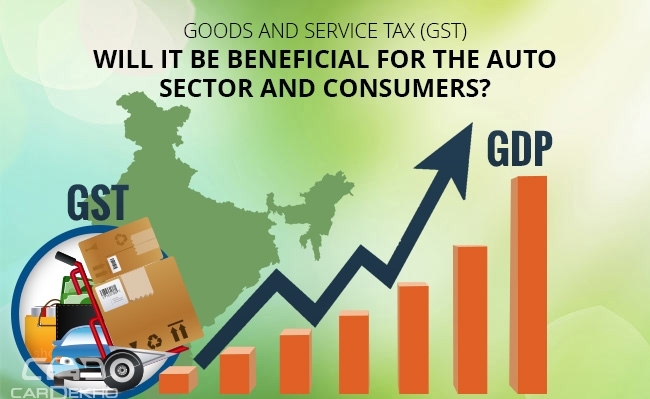
All said and done; GST has still not seen the light of the day. The idea may seem innovative, but such innovation is not of present times. The idea for GST was conceived in the year 2000 and 16 years have passed, but no implementation of the idea has yet been done. If at all GST is implemented a study done by the National Council of Applied Economic Research (NCAER) also suggests that India will indeed make progress on implementation of GST and could expand India’s growth of gross domestic product by 0.9-1.7 %[2]. The removal of Central and State taxes will help in reducing taxes and will also aid in filing costs and expanding business in a profitable manner. This would attract more investors and as a result, the gross domestic production will increase. Simplification in tax norms through the implementation of GST can also help in improving tax compliance and increasing tax revenues.

Footnotes:

[1]http://www.ey.com/IN/en/Services/Tax/EY-goods-and-services-tax-gst

[2]http://www.referencer.in/GST/Files/GST_NCAER_Report.pdf

Download Now

The Geospatial Information Regulation Bill, 2016

0

In this blog post, Pramit Bhattacharya, a student of Damodaram Sanjivayya National Law University writes about the new Geospatial Information Regulation Bill, 2016 which seeks to regulate and govern all kind of geospatial data. The post highlights the different aspects of the bill and discusses their impact on India’s integrity and sovereignty.

1451539_599879256736892_1144192258_n


The Geospatial Information Regulation Bill, 2016 has been drafted by the Government of India, which seeks to regulate and control the procurement, distribution, and broadcasting of any kind of geospatial information which can affect the integrity, sovereignty and security of India in any manner. The bill is applicable not only to citizens of the country but also to citizens outside the country, on aircrafts and ships which are registered in India, also persons who are engaged in government service. According to the draft, it will be compulsory to take permission from the government before any geospatial information can be published, broadcast or acquired.


Geospatial Information

map4

The definition and the ambit of “geospatial information” are very wide according to the draft. The definition of geospatial information has been given in such a way that it includes any images or data received through space or any aerial platform. The aerial platforms include satellites, balloons, aircrafts, airships, any unmanned aerial vehicle, etc. The definition also has under its ambit any kind of data which shows any physical feature, boundaries, phenomenon, etc. of the earth. Maps, charts, surveys, terrestrial pictures, etc. also falls under the definition of geospatial information according to the bill. The definition given provided in the bill is so vast that it’ll cover almost everything like GPS enabled devices like cell phones, car navigation systems, drones, balloons, satellite imagery, etc. Not only this, print media like newspapers, magazines and books will also fall under the purview of the definition. Such a wide definition will make the situation very complicated if the bill becomes a law. Almost everyone will have to seek a license from the government to even retain and use the geospatial information. The impact of such a regulation will be widespread. For instance, if a geospatial journal or magazine, say National Geography or Discovery want to publish anything which is even remotely related to some geospatial information, they’ll have to take the prior permission of the government. The editors, publishers and subscribers will also have to take the permission of the government since they will either acquire or broadcast the geospatial information. Any person doing any research related to any geographical issue will also have to take the consent of the government.


Jurisdiction

The jurisdiction which is being given under the bill is also wide. The bill gives an extra-territorial jurisdiction, and if made into a law, it’ll be applicable not only to people residing in India but also to people who are residing abroad. This kind of jurisdiction may not be feasible at all. The main question which arises here is that why would a foreign entity want to submit to a jurisdiction of such an Act which seeks an extensive regulation in distribution and publication of data and information. This may have a negative impact and trade and commerce. This kind of severe regulation will discourage those business houses to set up business in India, which has anything to do with the use of geospatial information (for example foreign cell phone companies whose devices are GPS enabled or car manufacturers who provide a navigation system). The bill talks about licensing all the entities who use any kind of geospatial data. The bill also states that this licensing would be done by a bureaucratic committee, and the data or information would be scrutinized after the data is collected and before it is distributed.


The Authorities

The bill states that an Apex Committee will be set up which will look into the implementation, regulation, and governance of the Bill, which will be in accordance with the policies. A Security Vetting Authority will also be set up and the main aim of this Security Vetting Authority will be to carry out scrutinization and vetting of any kind of geospatial data from the security point of view and provide license and permission to the users to procure, publish, distribute, and broadcast the information, as per the regulations which have been framed. An Enforcement Authority will also be constituted which will look into the enforcement of terms and conditions of the license which has been provided to the user. The Enforcement Authority will have the power to confiscate all the data or resources which have been used for publication or distribution in violation of the Act. The Enforcement Authority will also have the power to impose penalties and revoke or suspend the license of the violators. To hear the appeals against the decisions of the Security Vetting Authority and the Enforcement Authority, an Appellate Authority will be set up, and any person who wishes to appeal against the order or decision of the Appellate Authority can further appeal to the High Court. Thus, to summarize, there will be four authorities to regulate and govern the Act-

  • The Apex Committee
  • The Security Vetting Authority
  • The Enforcement Authority
  • The Appellate Authority

The Apex Committee will have the power to delegate its responsibilities but not delegate the regulatory powers. It is the sole authority which can make regulations with regards to the Act. The Apex Committee will comprise of three members. Given the wide ambit of the Act, the authorities may find it very difficult to implement the Act properly. Also having these many authorities for the implementation and monitoring of a single Act can lead to conflict within themselves also.


Licensing

licenses7

Any person who wants to use geospatial data in any manner, whether to acquire such data, broadcast, publish or distribute such data will have to make an application to the Apex Committee and also to the Security Vetting Authority to obtain the license required to acquire, distribute, publish, or broadcast any geospatial data. A license will also be required if the data is to be used outside India. The license can be suspended or revoked any time by the authorities if the use of any information is in contravention of the Act. The licensee will be supplied with security vetted information, and only that information can be used by the licensee. The licensee shall also display the insignia of clearance by the Authority while using the information. If any loss or damage occurs due to the use of the security vetted information, the licensee will be held liable for such loss. Any person who has acquired any geospatial data before the commencement of the Act will also have to take the permission of the authorities. Such person should make an application to the governing bodies within one year of commencement of the Act for the grant of a license and the permission to retain such data. The governing body has to grant a license or reject the application within three months of receipt of an application.

The issue here is that there are no rules and regulations which state the criteria or requirement for granting or rejecting of license. There is arbitrariness in the granting and revocation of license. There is also no system of check and balance to monitor the activities of the Authorities. This may lead to a lot of arbitrariness on the part of the Authorities. The Bill also states that if the application for the license has been rejected by the Authorities, then the person who applied for a license cannot use or retain any geospatial data with him. This clause also has an ambiguity about it. The Bill does not provide for the way in which such data or information would be disposed of.


Penalties

Screenshot (6)

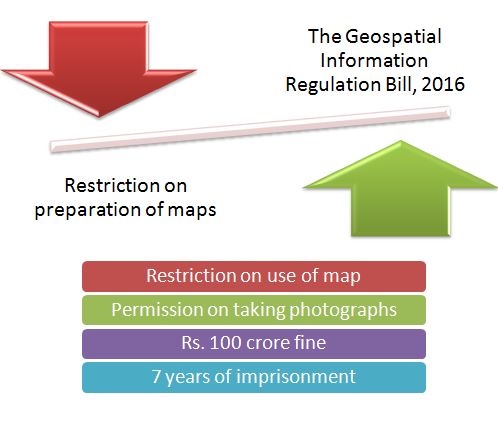
The draft provides for penalties and fines in case of illegal use of geospatial data. If a person fails to pay the penalty, then such amount would be recovered from the defaulter in the form of land revenues and the defaulter’s license will also be suspended until the penalty is paid. The penalties specified under the draft are exorbitant. The penalties range from Rupees 1 crore to Rupees 100 crore in case of illegal use or distribution or publication of geospatial data. There is also a provision for a penalty which ranges from Rupees 10 lacs to Rupees 100 crore in case India’s map I wrongfully depicted or the license is misused.

It can be said that the proposed bill and the Information Technology Act may be at conflicts because the IT Act deals with any kind of digital data. The IT Act also states that in a case there is a conflict between it and any other Act, the IT Act will prevail. But the bill of the proposed Act also said that in a case of conflict it’ll propose over any other law. This kind of loopholes can be a serious drawback and can make implementation and regulation of the Act very ineffective.


Concluding Remarks

As mentioned earlier, the scope of the bill is very wide. Rather, to wide. Too much law and regulations can also be harmful. The bill needs to be amended to reduce the scope of the definition and make it more streamlined. In order to cover every aspect, it has been given such a broad ambit that instead of regulation it may lead to obstacles and hindrance for the field where geospatial information and data is a necessity. A developing country like ours needs policies to spread information and not laws and policies which are punitive and regressive.

Download Now

Use of DNA Fingerprinting in Indian Criminal Law

1
genes
Image Source: https://bit.ly/2u178Fl

In this blog post, Abhiraj Thakur, a 1st-year student of NALSAR University of Law, Hyderabad, writes about the DNA fingerprinting technology which is widely used to secure convictions. This technique being reliable and accurate should be adopted at full scale in India. However, our country still suffers from some issues which thwart the use of DNA fingerprinting in Indian Criminal Law.

Abhiraj


What is DNA?

DNA_300_300_90DNA (Deoxyribonucleic Acid) is the primary hereditary material in a human body. The Human DNA has a double helix structure. Most of the DNA is found in Nucleus of the cell called the nuclear DNA, and some are found in mitochondria called the mitochondrial DNA (mtDNA). It complexes with proteins to form chromosomes which contain our genes and all genetic information.[1]

The DNA Fingerprinting technology is one of the foremost and most reliable technologies used in USA and UK in identifying individual culprits through their respective unique DNA patterns. In 1984, Sir Alec Jeffreys, of UK discovered that no two people could have the same DNA sequence.[2] Although more than 99% of the DNA is the same in all humans, there are some particular strands that are unique between two individuals having the same sequence. Sir Jeffreys was the first person to discover this. This led to the birth of DNA Fingerprinting. The potential of DNA Fingerprinting in the investigation of crimes was quickly realized. In 1986, this method to solve the rape and murder mystery of a teenage girl Dawn Ashworth near Leicester. The suspect Richard Buckland was exonerated, and the real criminal Colin Pitchfork was found guilty. It was the first case in which DNA technology was used.[3]


Benefits

Accuracy

In a crime scene, there is always a possibility of finding the DNA of people other than the criminal. In such a scenario the, a majority of investigative agencies today rely on DNA fingerprinting to find out which DNA is that of the criminal. Also in cases where a mixture of a blood sample or other samples is found at the crime scene. DNA technology today has sufficiently evolved so that it can identify each of the blood of each from a mixed sample. This has greatly helped in securing convictions in rape cases. download (3)

For example, if a girl is raped by, let say, six persons, DNA fingerprinting can identify the DNA sequence of every individual and comparing it with the suspects, we can catch the criminals. In such cases, each of the people whose DNA pattern matches with the sample gets convicted and of those whose DNA sample does not match is proved not guilty and acquitted.


Reliability

Today, There is greater acceptance of DNA evidence over Narco Analysis because DNA evidence does not lie. The narcotic analysis is a subjective method. A lot of subjectivity is there in it. It is possible for people to fool it. People can lie but DNA cannot. Earlier there were statistical doubts that two persons may have the same DNA sequence. But as the technology is advanced, it has now been proved that no two persons can have the same DNA sequence. Narco analysis is not always reliable and is not accepted as evidence by the courts.[4]

Apart from crimes, it is also extensively used for on- criminal purposes like paternity tests, seed stock identification, the authenticity of consumer products, and medical diagnosis.


Limitations

Identical or Monozygotic twins have the same DNA sequence. Therefore in such cases, the law enforcement agencies remain skeptical of relying on DNA fingerprinting to deal and identify the real criminal. Also, a question arises in regard to such twins, can they be convicted only by the DNA Evidence? This is the biggest limitation of DNA evidence. Two identical twins do have the same DNA. So in such case where one of them has committed a crime, they cannot be convicted by DNA evidence. But in such cases, the simple fingerprint will help to convict the real criminal. It is because there is a slight difference between the finger prints of the identical twins. But in the courts of law, full fingerprints only are acceptable because clever counsels raise questions on partial fingerprints as they can match with others.


Usage in India

DNA testing as evidence is not covered under Indian Evidence Act 1872 and Criminal Procedure Code 1973. The method of DNA profiling used today in India is based on polymerase chain reaction (PCR) and uses short tandem repeats (STR). These techniques have revolutionized the speed and efficiency of the DNA test. These techniques are very reliable and are in vogue in various countries. Dr. Lalji Singh is considered to be the “Father of DNA fingerprinting” in India, He developed and used the technology in India for the first time in 1988.


Problems with Usage in India


Handling of Samples

The admissibility of DNA evidence depends on upon accurate and proper collection, preservation and documentation which can satisfy the court. As was seen in the infamous OJ Simpson case, improper handling of DNA evidence can lead to the acquittal of the accused. The procedure of collection and preservation is very important. The sterile gloves and forceps must be used. If we use our hand in the collection process, our DNA will get mixed up with it.forensics

Today in India the police constables are untrained in how to collect DNA samples. In foreign countries, when a crime occurs, first the forensic investigators and scientists go to the crime scene to collect forensic data. But here in India, first an untrained constable goes there. Acting on intuition, he washes up the body and removes it. He in this process destroys vital DNA evidence. So they must be trained to handle forensic evidence and to properly collect it and seal it. But even when there is some contamination, it can be found out in the test result; we can see a faint band of DNA of the person whose DNA has been mixed up and a strong band of DNA of the real criminal. But such contaminated evidence is not accepted as evidence in the courts.


Storage of Samples

In UK and US, the samples of DNA are stored in National DNA Database. The police have very limited powers to retain the DNA recovered from crime site; their job is confined to just collection and deposition. Unlike in India where the police have unchecked powers to collect and retain the DNA of suspects even after acquittal. This raises concerns about many over fears that it may lead to misuse of DNA database and may divulge the privacy of the individuals. Of suspects even after acquittal. dna-testing

DNA of all convicts should be stored in the database so that the multiple offenders can be apprehended easily. Moreover, in countries like the UK, the government is trying to create a database of all people, not just convicts and acquitted but also of other innocent people. The purpose of such databases is not just for crime investigation rather it will be helpful for research in medicine.


Lack of Test Centers

In foreign countries, there are enough facilities for the DNA testing. People can get DNA fingerprinting done anywhere as there are a lot of institutions. Even for something like $10000-$12000 they can do the full genome sequencing[5]. But in India, there are not many facilities. For doing a DNA, test people have to go all the way to Centre for Cellular and Molecular Biology or CCMB in Hyderabad. This may not be feasible for everyone. With due regard to the efficiency of this technology, there should be sub-branches of this institution in every district of the country. If not possible, it must be made sure that people from all parts of the country can readily have DNA testing.


Violation of Constitutional Rights

There have been quite many ethical concerns regarding DNA tests. Some people allege that it violates the right to privacy, right to life and right against self-incrimination according to Article 20 of Indian Constitution.

The most famous case involving the use of DNA fingerprinting in India is of ND Tiwari. ND Tiwari a famous politician was alleged by Rohit Shekhar to be his biological father. In the subsequent paternity case, many legal issues surrounding the DNA Testing emerged- such as if paternity is conclusively proved (100%) by DNA Testing, whether the persons have the right to keep the result of such tests private etc.

Indian law says that one cannot be forced against his/her will to give DNA evidence. But today in certain cases, courts are forcing suspects to undergo DNA tests. As in the ND Tiwari case, all these arguments were raised. But the court forced ND Tiwari to give his blood sample in the larger interest of the public. Courts can force people to give their blood samples to meet the demands of justice.


These are the few burning issues with the use of DNA printing technology in India. The future of DNA Technology is no doubt very bright. There has been a revolution with regards to the technology. In the time to come, it will prove very helpful in convictions of the offenders. There has already been rigorous research going on in the technology around the world; India shall by no means lack behind in it.


[divider]

Footnotes

[1] http://www.cdfd.org.in/servicespages/dnafingerprinting.html

[2] Ibid

[3] http://news.bbc.co.uk/2/hi/programmes/newsnight/8245312.stm

[4] Selvi & Ors. Vs. State of Karnataka & Anr. On 5 May 2010

[5] Full genome sequencing is a laboratory process that determines the complete DNA sequence of an organism’s (in this case human’s) genome at a single time.

Download Now

Non-Solicitation and Non-Poaching Agreements

0

In this blog post, Shubham Khunteta, a student of National Law University Odisha, writes about important agreements entered into by businesspeople to prevent their talented human resource from job hopping and to save their business from any unfair competition. It specifically talks about Non-Solicitation and Non-Poaching agreements which are very crucial for any business.

 Employment-Contract-Agreement-425x272

Introduction

Today, we are living in the age of competition where to succeed in the market; people tend to use shortcuts to sustain themselves, get achievements and earn laurels. There is a general tendency of people to prevent others from carrying on their work either necessarily or unnecessarily depending on the loss they might portend to. But, here we are not concerned with each and every tendency of such persons except the tendencies to interfere, damage other persons by certain revelations that might be the core way of the operation of the person, of poaching certain personnel to enrich oneself unjustifiably with the secrets of the person. The core exchange and principle here is “unjustifiable enrichment” at the cost of others.

By persons, I am referring to individuals like professionals or other employees, companies, firms, etc. In this paper, we will be talking about the rights of the persons to prevent something which they consider to be detrimental to their interests.

employment_contract_glassesFor example, when individuals are terminated from their employment and subsequent to that these individuals carry out certain activities similar to or related to that of their ex-employment, either directly on their own by starting a similar activity or indirectly by selling or supplying certain trade secrets or confidential information for consideration of job or other benefits from the future employer, which they, during their course of employment gathered and collected. Similarly, employers may, under the garb of prevention of such trade secret or confidential information prevent the employee, for fixed period post-termination, from taking up a job in a similar employment corporation so as to reduce compromise of such sensitive information. This might trigger a violation of the employee’s constitutional rights of life, liberty and his statutory right to employment)[1].

These things are observed in day-to-day commercial activities where one person often tries to protect one’s interest, whether reasonably or unreasonably, as the case may be. In law, disputes often arise on issues which pertain to violations of the nature of constitutional and statutory rights of individuals, statutory rights of companies and firms to protect their interests by preventing and forbidding other persons like employees, partners, et al. from copying or imitating the firm’s unique copyrighted documents or spill the beans of a patented product. Business owners enter into agreements with other companies/firms to forbid poaching of each other’s employees that may come under the grey area of Competition law as concerns regarding concentration of competition mount up.

In the above-introduced section, the significance of the term ““reasonability” in actions and “compliance with directions of law or agreements entered into” erupts. Now, the question that would be dealt with below concerns the validity of above arrangements, principles of law followed by the adjudicating authorities to differentiate between the reasonable and unreasonable restrictions imposed in the contractual arrangements and the impact that befalls on the affected parties.

The two prominent clauses often entered into by the companies and the firms-

  1. With their employees (Non-solicitation clause)
  2. With the other similar businesses of businesses and firms (Non-poaching clauses)


Non-Solicitation Agreement

download (2)This clause is usually entered into as a part of a contract of employment or agreement b/w partners. It is entered into for the purpose of restraining the other party, i.e. an employee/former employee or a partner from solicitation of customers and employees of the company for his benefit and against the interest of the company during and post-employment. The clause is imperative to companies as it is often seen that the employees pursue and persuade the clients and other employees of the company to endanger the employer’s business unjustly and enrich himself at the employer’s expense. Enforceability of such clauses is a question of fact depending and varying on case to case basis.

Now, the question that arises for contemplation is- What constitutes reasonable and legal non-solicitation clauses?

The solution lies in the interpretation of the clause with reference to cases.

Standards to establish non-solicitation

  • Merely approaching customers and employees of the previous employer would not be read as solicitation until actions are done or orders are placed under such representation.[2] Such actions and orders would be borne out by records.
  • The validity of such clauses can be adjudged from the restrictions imposed as regards distance, time limit, protection and non-usage of trade secrets and goodwill.
  • Acts of solicitation committed by alleged persons like former employees take such active shape that it prompts the customers of the former employer to discontinue their contract with the former employer and enter into a contract with the former employee or inhibit other persons from entering into the contracts with the former employer[3].
  • The clause would not be reasoned as being in restraint of trade under Sec 27 of the Indian Contract Act liable to be void unless the same is unconscionable or wholly one-sided. The character of such a clause is also reckoned from the form of contract and superiority of persons making it.

6a00d8341c921353ef01a5117d35ce970cIt implies that negative covenants like non-solicitation clauses may be acknowledged as void in case of a contract of employment post-termination between the employer and the employee as these contracts are usually standard form contracts where one party is at an inferior bargaining position as they can either take the employment or leave the employment whereas this might not be the case in partnership agreements as each party here negotiates with the strengths of their positions.[4].

  • In GEA Energy System India Ltd. v. Germanischer Lloyd Aktiengesellschaf[5], the dispute was related to an agreement b/w two joint partners. The Plaintiff here sought to prevent the defendant, who terminated the JV agreement, from setting up a similar business in India. The Madras High Court considered it to be partial restraint as the JV agreement didn’t absolutely restrain the defendant from carrying on any business. But, the significant point also considered by the court here in addition to partial restraint to strengthen and validate the plaintiff’s submission was that the JV partners had equal bargaining power and the terms weren’t one-sided.
  • Sec 27[6] [of the Indian Contract Act] does not restrict reasonable non-solicitation agreements post-termination of employment. These agreements entered into between the employer and the employee should not hamper the growth of employee but should, however, secure the interests of the employer.


Non-Poaching Agreement

This agreement is executed between two employers in which they consent not to solicit or poach each other’s employees. This agreement accentuates the significance of human resource in the constantly evolving society. Human resource is the backbone of any organization which can rally or derail the progress of any business.

Satisfaction of such resource, especially the highly qualified professionals guiding the direction of business, is usually manifested by the business in the form of high remuneration and various incentives which help them in the realization of their goals. If this human resource is not properly acquainted and provided with the proper amenities required by them, then it might lead to them changing their jobs and consequently affecting the interests of the business. The competitors often lure this human resource through various means, which might foil the progress of the company and affect it badly. To prevent it, businesses often enter into such agreements with their competitors to prevent such mishaps and to carry out their business as flexibly as they can without fear of such allurement or voluntary switching of jobs of the employees.

Social engineering concept

Non-poaching agreement per se does not violate Section 27 of the Contract Act as it does not limit an employee from seeking and/or applying for any job/employment. What this class of agreement does instead is simply command that one competitor should seek the consent of the other before hiring that other competitors’ employee/s.

In a case[7], the Delhi high court opined that the defendant holding confidential information and data of a bank can’t be an excuse and the veil to curb the defendant’s rights to seek and search for better employment. The injunction, as demanded by the plaintiff, will perpetuate forced employment. It would create a situation of ‘once a customer of plaintiff, always a customer of plaintiff.’ Such agreements would constrict the professional and intellectual freedom of the employees.

The doctrine of restraint of trade does not apply during the employment but comes in the picture after the employment contract comes to an end. In a case[8], it was held by the Supreme Court that a man is entitled to exercise any lawful trade or calling as and where he wills, as long as it is not against public policy or interest. But the court added a rider to it as an exception that when an employee might reveal the confidential information of the previous employer, such clause is justified. poaching

In a case[9], the Delhi high court held that the negative covenants clause like ‘restriction from engaging or undertaking employment for 12 months post-termination’ perpetuates economic terrorism and creates conditions feasible for ‘bonded-labor.’ Such clauses violate Section 27 of the Indian Contract Act and thereby are unenforceable and void. Interchangeability of service is not an accepted norm of service jurisprudence, and an injunction can’t disallow employee’s right to terminate their contracts. Seeking an injunction was only with the extraneous motive to prevent employees from changing employers. Rights of employees to have better conditions and job opportunities elsewhere can’t be curtailed.

Usually, such agreements are also alleged by the parties to be violative of The Competition Act, 2002 especially, Section 3 which prohibits agreements that are anti-competitive in nature and have adverse effects on competition in India. However, non-poaching agreements usually don’t fall under Sec. 3 because it does not ban lateral hiring, but as a substitute, sets guidelines to be followed in case of such hiring[10]


Conclusion

It is understood that both the individuals and businesses grapple in the competitive environment and try to offset and lever the liability to the maximum possible extent through certain agreements. Here, the law only comes with an iron hand when the protection turns into the exploitation of others, unreasonableness trumps reasonability and affects the fundamental and core interests and rights of others which are highly cherished and guarded by law. Absolute restriction in the economic activities would stand the scrutiny of law and is liable to be quashed whereas partial restriction would stand the tests of reasonability and the doctrine of restraint on trade.

So, ultimately, one can protect oneself without infringing on the rights of others. Adjudication authorities often try to strike a balance between the commercial interests of business as well as economic rights of individuals and arrive at a decision by measuring it on the yardstick of reasonableness, equity, and interests of the affected parties.


[divider]

Footnotes

[1] <http://www.nishithdesai.com/fileadmin/user_upload/pdfs/Research%20Papers/Employment_Contracts_in_India.pdf>accessed on 13/6/2016

[2] FLSmidth Pvt.ltd. v M/s.Secan Invescast (India) Pvt.ltd (2013) 1 CTC 886

[3] Embee Software Pvt. Ltd. v. Samir Kumar Shaw AIR 2012 Cal 141.

[4] Wipro Ltd. v. Beckman Coulter International SA 2006 (3) ARBLR 118 (Delhi)

[5] (2009) 149 CompCas 689 (Madras)

[6] See, Sec 27 of Indian Contract Act, 1872

[7] American Express Bank Ltd. Vs. Ms. Priya Puri (2006) IIILLJ 540 Del

[8] Gujarat Bottling vs. Coco-cola company AIR 1995 SC 2372

[9] Pepsi Foods Ltd. and others vs. Bharat Coca-Cola Holdings Pvt. Ltd. and Ors. (1999) IILLJ 1140 Del

[10] <http://www.manupatra.co.in/newsline/articles/Upload/091CA8F9-A438-4323-9170-7BC5182387F5.pdf>accesed on 13/6/2016

Download Now

Irretrievable Breakdown of Marriage – A Ground for Divorce?

1

In this blog post, Abhiraj Thakur, a 1st-year student of NALSAR University of Law, Hyderabad, writes about the concept of irretrievable breakdown of marriage as a solid ground for divorce. The author uses various case laws to solidify his views. 

Abhiraj

When a relationship is not going good and is unnecessarily maintained on papers, where the feelings of trust, love do not exist, and no scope of recovery of relationship is there it is better to end the relationship, incompatibility is often a major reason for unhappiness. When friends can end their relationship, why can’t a couple?”[1] 

Marriages in India have always been considered more than just a union, in fact as defined, marriages in India are considered a sacrament.[2] For the reason that the institution of marriage is considered so sacred, for something like divorce to be accepted and be given legal and social recognition was quite a big step. Divorce Law in India still follows the ideology that only in the cases of extreme problems should marriages be dissolved and that too only after every other means of reconstitution the union is exhausted.


Theories of Divorce

download (1)Divorce Law in India is based on two theories:

  • The Fault theory: The Fault theory refers to the dissolution of marriage on the grounds of either party to the marriage committing a matrimonial offense, like adultery, desertion, etc., or has been suffering from mental disorder. In toto, there are nine grounds under this theory to get a divorce under the Hindu Marriage Act, 1955.
  • Mutual Consent theory: Mutual Consent theory is the concept that if two individuals have the discretion to get married, then they should also be allowed to move out of the union if they wish to do so. It is enumerated under Section 13iA and 13iB of the Hindu Marriage Act, 1955.

What the Indian Law fails to address and cater to is the situations of marriage when all the sanctity and meaning of it has broken down with no fault of either of the parties, yet there is no provision in law to seek a divorce. This is what is called as the No-Fault Theory of Divorce or Irretrievable Breakdown of Marriage.


History of Irretrievable Breakdown as a Ground for Divorce

The concept of irretrievable breakdown of marriage was for the first time introduced in New Zealand where it was recognized that it needn’t be necessary for there to be some fault or other for a spouse to want to opt out of a marriage and hence the law has to recognize and cater to that requirement.

downloadIn England, it was the case of Masarati v. Masarati[3] That had opened the gate for the theory and the court of appeal had held that “today we are perhaps faced with a new situation as regards the weight to be attached to one particular factor that is the breakdown of marriage” and the House of Lords 1943 decision in Blunt v. Blunt[4] made it increasingly accepted that no public interest was served by keeping legally in existence a marriage which had in fact broken down.

The Muslim Law too gives both the husband and the wife the right to give Talaq and recognizes the breakdown theory.

In the Mortimer Committee’s report, the breakdown of marriage is defined as: “such failure in the matrimonial relationship or such circumstances adverse to that relation that no reasonable probability remains for the spouses again living together as husband and wife”.[5]

The Law Commission of England in a report had said that there are two objectives to good divorce laws:

  • To buttress rather than undermine the stability of marriage
  • When regrettably a marriage has broken down, to enable the empty shell to be destroyed with maximum fairness and minimum bitterness, humiliation and distress.[6]

The idea being that though marriage is a union of two individuals and is about companionship and love, the option to opt out of it and dissolve the union should also be available with the same amount of dignity and ease, rather than be put in a situation where a fault has to be brought out to prove to the court as to why the marriage wouldn’t work.

There are two theories that are prevalent in Divorce Law in India, i.e., the Fault Theory and the Mutual Consent Theory. Even though they cater to a large part of the divorce-seeking couples, it is imperative to provide provisions wherein there has been, for example, such emotional damage to marriage, something that a couple might not want to disclose to people outside their marriage, and there’s no hope or chances of reconciliation. They should have the choice and the ability to dissolve the marriage and part ways without having to go through the ordeals of the legal system and having to appeal to higher courts as till now it has only been the higher courts that have shown the authority to be able to dissolve marriages on the grounds of irretrievable breakdown.


Irretrievable Breakdown in India

The concept of irretrievable breakdown of marriage is a lot more problematic in the context of the Indian society because the institution of marriage in India has a lot more sentiment and divinity attached to it. For a society that looks at marriage as a sacrament[7] And has evolved from looking at marriage as eternal love and promise, the idea of divorce wherein partners want a dissolution for no particular reason is quite hard to digest.


Recognition by Supreme Court of India

In the case of Naveen Kohli v. Neelu Kohli[8] The parties had gotten married in 1975, within a few years, the marriage had turned sour, and there were allegations of cruelty, adultery. The husband alleged that he’d found his wife in a comprising position with another man, and the wife had alleged that he had a concubine. The wife initiated several civil and criminal proceedings against husband indicating her resolve to make his life miserable, the husband also initiated some legal proceedings and was living separately from the wife for more than ten years. Thus, it was evident from the facts of the case that the marriage has been wrecked beyond redemption.online-divorce-india

The trial court had held that the allegations were of such nature that there was no cordiality left between the parties and thus no possibility to reconnect the chain of marital life between them. Hence, it found that there was no alternative but to dissolve the marriage. Though the High Court took the stand that the trial court had erred in granting a divorce, the Supreme Court upheld the trial court’s decision that the matrimonial bond is beyond repair.[9] “When the marriage becomes a fiction, the legal tie has to be severed.”


Can it be a ground for divorce?

In the case of Vishnu Dutt Sharma v Manju Sharma[10], It was submitted on behalf of the husband that the Supreme Court had, in earlier cases, dissolved a marriage on grounds of irretrievable breakdown. The court observed that the earlier cases had not taken into account the legal position as laid down in Section 13 of the Act.[11] The judgment held that a mere direction of the court in earlier cases, without considering the legal position, was not a precedent to be followed by the courts. The court observed that the granting of the divorce on grounds of irretrievable breakdown would mean adding a clause to Section 13 of the Act through a judicial verdict. 30 blogs to help you get through a divorce

It held that adding a new clause making irretrievable breakdown of marriage grounds for a divorce could only be done by the legislature, not by the courts. Taking this into consideration, the Supreme Court rejected Sharma’s plea for dissolution of the marriage on grounds of irretrievable breakdown of marriage.[12] The court further said that though the irretrievable breakdown of marriage was recognized in Neelu Kohli’s Case, the divorce was granted on grounds of cruelty.


The legislature does not make laws every day, but the courts hear cases…

The Indian judiciary keeping due regard to the nature of marriage under Indian personal laws and relying on developments of the concept of divorce though has recognized irretrievable breakdown of marriage, but it still can’t be exercised as a ground to get a divorce as it lacks legislative recognition. With the rapid changing social scenario of the country, marked by the spread of Western ideals and adoption of different outlook towards the institution of marriage, irretrievable breakdown of marriage is a progressive change to the field of personal laws. The impact of not having it as a ground for divorce in the country must be a thing to be looked for with concern in our country.


[divider]

Footnotes

[1] Justice Krishna Iyer, Aboobacker v. Manu, AIR 1971 KLT 663

[2] Paras Diwan, Family Law, 6th Edition, 2001

[3] [1969] 1 WLR 393, CA; both the parties to the marriage had committed adultery. Thus the court on the wife’s petition observed breakdown of marriage and granted a divorce.

[4] [1943] AC 517, HL

[5] Paras Diwan, Modern Hindu Law, 17th Edition, 2006, pp. 68-77

Vijender Kumar, Irretrievable Breakdown of Marriage: Right of a Married Couple, Vol.5: No.1, NALSAR Law Review, 15, 2010

[6] Paras Diwan, Family Law, 6th Edition, 2001, pg. 29

[7] Paras Diwan, Family Law, 6th Edition, 2001

[8] AIR 2006 SC 1675

[9] Jaya V.S., Irretrievable Breakdown of Marriage as an Additional Ground for Divorce, Vol. 48: 3, Journal of Indian Law Institute,  439, Pg. 440, 2006

[10] Civil Appeal NO. 1330 OF 2009, Supreme Court of India

[11] http://infochangeindia.org/women/judicial-interventions-and-women/sc-flip-flops-on-irretrievable-breakdown-of-marriage.html

[12] Supra Note 10


Download Now

The Need for Dental Insurance in India

1
ESIC

In this blog post, Abhiraj Thakur, a 1st-year student of NALSAR University of Law, Hyderabad, writes about the scenario of oral healthcare in India concerning dental insurance. This blog post explores the how and why concept of dental insurance that is absent in India and looks at some effective oral healthcare models from which we can learn.

Abhiraj


The human body is no doubt one of the finest creations of nature. It being a complex system of elements helps us to perform a broad range of activities and make human beings the most successful species on the planet. This system thus seeks our attention towards its constant maintenance for to function effectively. One of the components of this system is our teeth. There’s no need to highlight the importance of teeth for us. Many of us must have had the experience of that pain due to dental problems; it sends shivers to our spine.

Today the market has filled all sorts of cakes, chocolates, pastries, donuts, shakes and what not and these items feature of the top priority list of children and many times for adults as well. As a result, dental problems have become as common as many other diseases today. Our visits to a dentist have become much more frequent today. Such as we have ‘health insurance plans’ that cover the expenses of our medical treatments after accidents as well as regular health checkups, having a ‘dental insurance’ that covers both seems to be a very good idea.


Benefits of a Dental Insurance

Dental-InsuranceBefore coming to context of India, let’s have a cursory look on some of the major advantages of a Dental Insurance Plan:

  1. Cost Effective: Data from various resources indicate that dental insurance plans prevalent all over the world today are comparatively cheaper to health insurance schemes, and so a large section of the population can easily afford it. The greatest example is of USA where on an average a health insurance plan costs $90,000 a year whereas a dental insurance plan costs $14,000.
  2. Whole scale Coverage: Like a Health insurance plan, a Dental insurance plan covers not only accidental dental treatments but also the expenses of regular dental check-ups and treatments such as root canal, etc. that are performed in the ordinary course of life and not due to damage from accidents. Thus, the benefits arising from a dental insurance can be reaped at the earliest as nowadays dental problems have become frequent among all age groups. In many cases, dental insurance covers as much as up to 75% of the treatment cost which can be helpful in preventing excessive loosening of our pockets.


Dental Insurance in India

The hard truth is that there is no such thing as ‘dental insurance’ in India. Treatment of teeth are covered under ‘health insurance’ by many companies and only the expenses of accidental tooth damage are taken care of. There are no reimburses provided for regular dental checkups or non-accidental treatments. Even these health insurance are provided by a limited number of companies in the country, so about care for teeth, the situation is bleak in India.


Reasons for Not Having ‘Dental Insurance in India.’

There cannot be one single reason for such a failure, but various reasons have operated over a course of time which has led to such a situation:

Policy Problems

Misconception of the concept of ‘Public Health Dentistry.’

In the field of dentistry, Public health dentistry has assumed a greater importance than anything else. Public health dentistry refers to the practice of providing affordable dental health services to the general population. In India also such a scheme was planned to be enacted under the oral health care. The greatest problem in this regard is that while most of the European and North American countries have well-defined oral health care scheme, India lacks it. There was no plan made for public health dentistry under the first oral health policy that was drafted way back in 1985. The provision of organizing ‘dental camps’ throughout the nation was the most remarkable feature of this policy. However, the practice has from the last three decades suffered from gross mishandling and led to a concoction of the term public health dentistry. Even today most of these camps are organized under poor conditions and in most camps adequate treatment is not provided to the patients, in fact, they are subsequently referred to private hospitals where they are asked to pay hefty fees and as a result, most of them prefer not to undergo any treatment.

Photo by Matt Cashore Use of this image prohibited without authorization and/or compensation To contact Matt Cashore: 574.220.7288 574.233.6124 cashore1@michiana.org www.mattcashore.com

Implementation Constraints

Internal Corruption happened in dental healthcare industry when government doctors catered with the responsibility of treatment of dental patients in dental camps deliberately do not provide them treatment. They refer them to private hospitals; they do this on charging illicit amount of money. As a result, it has contributed to the failure of the policy.

Structural Problems

Non-effective ‘Dental Plan’: Lack of Uniformity

The countries where the dental insurance is in vogue have effective dental plans for it. The 1985 oral health policy recommended for dental insurance but the same was covered under the ‘health schemes’ and not separately. The policy further was devoid of any guidelines to the private companies for the implementation of dental health schemes. As a result, it became totally discretionary for the companies to implement such a policy. Even today there is no uniformity in providing dental plans among the companies. Nations like UK and USA have dental policies that lay down a reasonable set of common features which the employers need to follow in order while providing dental plans to the employees.

Few of the well-recognized dental plans prevalent in the world are:

  • PPO Model: It is referred to as ‘Preferred Provider Organization’ plans. Under this scheme to provide cost-effective dental insurance, the company providing the plan to employee contracts a specific dentist which over a period provides services to the employees at low-cost. These category of dental plans are helpful for regular checkups of gums and tooth and are cost-effective in long run.
  • DHMO Model: It is referred as ‘Dental Health Managed Institution’ Models. Under this scheme, the insurance provider contracts with a vast number of dental organizations so as to provide cheap dental treatment. It covers costly dental treatments such as dental surgery etc.
  • Indemnity based Dental Insurance: Under this, the person insured is allowed to see any doctor for treatment provided the doctor accepts the terms of the insurance of the company. These are usually employed in cases of preventive measures to prevent tooth decay.

dental_hygiene1None of these models are currently at work in India, which is the biggest cause of no dental insurance in the country. The lack of importance to the issue of oral health care by the government becomes quite evident from the formulation of healthcare policies for the public. An example is the lack of any policy for standardization of dental procedure in the country. The cost of same dental treatment in India varies significantly in different parts of the country; this also acts as an impediment in formulation dental insurance policies.

Failure of Dental Education on Substantive grounds

Under the current dental education scheme that is regulated by the Dental Council of India. A majority of dental schools in India charge fees which is higher than other MBBS colleges in the country, as a result becoming a dentist for a major chunk of interested individuals becomes a matter of earning and no particular regard is given to dental awareness in the country. Also, the recent measures of introducing private entities in the field of dental education by most of the states have not helped the cause. As a result of the economic burden on an individual dentist, the dental camps are utilized for personal rather than public benefits.


International Scenario: Lessons to be Learned

  1. No Dental Camps: In USA, both federal and state governments regularly take various measures such as of price ceiling so as to keep the perks of dental healthcare within the reach of low-income people, that form a significant proportion of a national population. The state-funded dental schools operate at efficient levels providing quality education at a reasonable price. Also, there is no mishandled concept of dental camps in the USA, in fact, the federal government works in collaboration with states to open a large number of dental clinics in rural areas. 31255479-cartoon-character-of-teeth-with-globe
  2. Community Dentistry: In UK, community dental services are a vital part of government health schemes, to make the greatest number of people avail the services of dental healthcare. Under the scheme, free of cost dental checkups are provided throughout the country by ‘community dentists’. These dentists voluntarily offer services and are paid under the scheme. The private stake is limited in dental education.
  3. Effective Inclusion: In Netherlands, the state has focussed on dental health care in a much more efficient manner than any other country in the world. Each and every Dutch citizen needs to be enrolled under the ‘National Dental Insurance Policy’ by the age of 19 years.


Thus, we see where India still lacks any comprehensive dental insurance policy; many countries of the world have effective dental plans in force. Suffering from both structural and policy problems the scenario of dental healthcare in our country does not look good. When it comes to healthcare of the citizens, it is the state that needs to take the initiative at the earliest.

Download Now

Surrogacy Contracts And The Indian Contracts Act

0

In this Blog post, Abhiraj Thakur, Student NALSAR University of Law tries to answer the question “Are Surrogacy Contracts in consonance with the Indian Contract Act, 1872?” And further examines the different elements of a surrogacy agreement in light of the 1872 Act.


Abhiraj

Surrogacy, with advancements in medical technology and increasing need-based demand, has become increasingly popular,[1] Thereby, necessitating the regulation of conduct between parties through the formation of agreements, who by the very nature of it, are likely to grow increasingly attached to the fetus or abdicate responsibility upon birth. Hence, the surrogate and intended parents seek to determine aspects like compulsory prenatal visits, coverage of medical expenses, assured guardianship upon birth,[2] inter alia, through contractual clauses, for both Commercial[3] and[4] Surrogacy.

In the Indian context, owing to lack of legislative clarity on the state’s position on Surrogacy Contracts, it becomes essential to understand the scope of enforceability of both, altruistic and commercial surrogacy contracts concerning the Indian Contract Act, 1872.


Element Of Consent – Section 14

The essentiality of consent[5] being free and unvitiated for any contract as defined and laid down in Sections 13 and 14 of the Indian Contract Act 1872, becomes highly relevant in the Indian context wherein Commercial Surrogacy has not been deemed illegal.

Testing Consent against Section 16(2)

ConsentIn India, often poor women in vulnerable situations ‘consent’ to such agreements to escape poor economic conditions or are pressurized by their relatives to carry the child of a couple incapable of reproducing.[6]  In the former case, unless a presumption of inequality of bargaining power[7] or other forms of undue influence[8] is raised which goes unrebutted, the consent is held free. Mental distress caused by the need for money is held not to be sufficient to negate consent by the courts.[9]

Whereas in the latter, if the facts indicate that the blood or marital relationship was such that possibility of dominance existed, a presumption of undue influence is raised. This implies that it will be presumed that the ones seeking the contract to be enforced in fact used their position to dominate the surrogates’ will[10] and by Section 19-A, the surrogate will have the right to recede the contract.

Inability to Gauge Consequences- A Voluntary Risk

Further, it is argued that surrogacy, due to its very nature, leads to changes in the will to part with the child. Consent is necessarily predicated upon the ability of a party to comprehend the nature and consequences of the act that they wish to undertake. Consent which is also indicated by intention needs to be present continuously in a long term contract.[11] The implications of giving up a baby are incomprehensible by the surrogate at the time of concluding the contract. In the landmark Re Baby M case[12], the court noted,

“Under the contract, the natural mother is irrevocably committed before she knows the strength of her bond with her child. She never makes a totally voluntary, informed decision, for quite clearly any decision before the baby’s birth is, in the most important sense, uninformed, and any decision after that, compelled by a pre-existing contractual commitment”.[13]

Hence, the surrogate may during the gestation period, develop deep attachment and undergo a ‘change of heart’.[14] This line of argumentation presumes that all surrogates lack the ability to give consent as they 385801-abare deciding to engage in an activity, the future consequences of which are unassessed, but known.

However, the doctrine of freedom of contract[15]– a touchstone of classical and modern contract law theories and the basis for state enforcement of private contracts necessarily presumes that parties, by deciding the law for themselves, undertake the risk of sticking to it despite a ‘change of the heart.’ To entail oneself personal autonomy, parties face the trade-off of potential regret.[16] This doesn’t create any rational differentiation for surrogacy contracts from other long-term contracts.


Unconscionability Principle- Section 16(3)

The recognition of this freedom principle merely invalidates a change in the decision as an excuse for non-performance; it, however, does not prevent the court from the protection of weaker parties especially in light of unequal bargaining power.

Section 16(3) applies to instances that the courts determine to be ‘unconscionable’ by the facts.[17] In the particular case of surrogacy contracts, this can be adjudged by procedural matters such as inability on the part of the surrogate to read the terms or harsh exemption clauses preventing liability of the fertility clinic, etc. It can also be derived by substantive elements like exceptionally low payment or some explicitly harsh terms. These terms can be indicative of exploitation of the vulnerable, cases that often arise in India being a popular destination especially for foreign parties due to the availability of cheap surrogates, and can be grounds for deeming undue influence being present.[18]

However, it is important to not characterize the very nature of surrogacy as an unconscionable bargain, an argument often advanced by feminist scholars opposing such contracts.[19] Since such an argument stands against the fundamental premise of a contract and disregards truly altruistic forms of surrogacy and cases when women choose to opt into it to experience the joys of childbearing or gratuitously.


Legality of Object – Section 23

The question whether surrogacy contracts are forbidden by any law or opposed to public policy needs to be answered separately.

constitutional-law

Commercial Traditional Surrogacy – Forbidden by Law?

The law does not expressly recognize surrogacy, but views traditional surrogacy[20] As the adoption of the surrogate’s child by the intended parents, so, it needs to be examined in light of the Hindu Adoptions and Maintenance Act, 1956. Section 17 of the said Act expressly forbids the payment of any sum or any rewards in consideration for adoption. In Baby Manji Yamada v. The Union of India[21], a landmark Indian surrogacy case, the position taken by the courts was that such an arrangement was viewed as adoption under the law. In Jan Balaz v. Anand Municipality[22] As well, the German couple- intended parents, in this case, were only allowed to take their twins to Germany, who were born out of surrogacy in India, upon completion of adoption formalities. Hence, in commercial traditional surrogacy contracts, the effect is one of committing an act forbidden by law, thereby making the object illegal.

However, courts in decisions above, adopted a pro-contract and pro-commercial approach, indicating that the legislature brings surrogacy contracts in the realm of Indian Contracts Act while issuing further guidelines, so as to not affect their enforceability, but merely regulate them. More recently, in P Geetha Nagar v, Kerala Livestock Development Board[23], the court clarified that surrogacy is not illegal in India and noted India’s significance as a ‘surrogacy destination.’ The courts have recognized the immense economic gain accruing.

Thereby, while a strict reading of the law prohibits such contracts, the precedent has upheld them even in light of Section 23.

Public Policy Considerations

A concern raised by many objectors is that altruistic surrogacy in itself is an immoral bargain as it fails to serve the best interests of the child since the baby is separated from the birth mother, and commercial surrogacy, specifically amounts to ‘baby-selling’ by commodifying and devaluing women and children.[24] The Supreme Court gave these public policy considerations significant weight in the Baby M case[25], and the court felt that there was inherent something harmful about the practice of surrogacy.[26]

Baby's feet on mothers hands. Horizontal Shot.

Under the Indian Contracts Acts, Section 23 lays down that an agreement is unlawful if it is opposed to public policy. The Supreme Court has interpreted this to apply to agreements injuring public interest or public welfare.[27]

However, there is far less tangible evidence of a material link between permitting surrogacy and public interest, especially considering that the essence of the surrogacy contract lies in a dealing involving two parties affecting their rights on the child. While it is much desired that the courts weigh the best interests of the child, the contract in itself falls short of becoming a public policy concern. Further, it ‘s hard to fit such contracts in any of the recognized ‘pigeon-holes’[28] Of circumstances opposing the public policy.[29]

Indian courts have as well upheld all forms of surrogacy contracts, and in fact recognized reproductive rights as part of the right to privacy.[30] The Universal Declaration of Human Rights in Article 16(1) recognizes the right to marry and found a family. However, in Jan Balaz v. Anand Municipality[31], Justices K.S. Radhakrishnan and A.S. Dave stressed on the necessity of special legislation to govern several issues of public welfare and policy importance that arise in such disputes, like rights of a surrogate mother, guardianship, responsibilities of the fertility clinic, etc. Need for regulation is pressing, but the position of the law is that that, in itself, does not affect the enforceability of surrogacy contracts.

Thus, we see there is a cause for respecting surrogacy contracts as they pass the tests for the existence of essentials of a contract. While ubiquitous claims of disproportionality and inability to gauge consequences exist, these fall short of being specific to surrogacy contracts and fail to create cause for disrupting the system of contractual obligations. These contracts stand to deserve full enforceability since the law needs to respond to new social patterns, rather than abandoning them, and eventually stagnate.


 [divider]

Footnotes

[1] DasGupta, S. (n.d.). Globalization and Transnational Surrogacy in India. Lexington Books 2014, United Kingdom.

[2] Surrogacyindia.com. (2016). Documentations, Contracts at SurrogacyIndia. [online] Available at: http://www.surrogacyindia.com/Contracts.html [Accessed 9 Apr. 2016].

[3] Surrogacy refers to an agreement between the parties wherein the surrogate is given money for merely carrying the baby. See: Fertilityconnections.com.au. (2016). Surrogacy – Fertility Connections. [online] Available at: http://www.fertilityconnections.com.au/surrogacy/ [Accessed 9 Apr. 2016].

[4] Altruistic Surrogacy refers to surrogacy without any financial gain to the surrogate for carrying a child, only ‘out of pocket’ expenses like medical expenses, travel and time out of work are covered. See: Fertilityconnections.com.au. (2016). Surrogacy – Fertility Connections. [online] Available at: http://www.fertilityconnections.com.au/surrogacy/ [Accessed 9 Apr. 2016].

[5] Section 10, Indian Contract Act 1872.

[6] Braho, H. 2015. Motherhood Surrogacy: Progress or Exploitation?. European Journal of Sustainable Development, 4(2).

[7] Lloyds Bank v. Bundy, 1975 1 QB 326.

[8] Section 16, Indian Contract Act 1872

[9] Raghunath Prasad v. Sarju Prasad, AIR 1924 PC 60.

[10] Lancashire Loans Ltd. v. Black, 1934 1 KB 380.

[11] Margalit, Y. Redefining Parenthood – From Genetic Essentialism to Intentional Parenthood. SSRN Electronic Journal.

[12] 537 A.2d 1227, 109 N.J 396.

[13] Id at para 100, p.434.

[14] Margalit, Y. (n.d.). In Defense of Surrogacy Agreements: A Modern Contract Law Perspective. SSRN Electronic Journal.

[15] Pound, R. 1909. Liberty of Contract, 18 YALE L. J. 454.

[16] Schuck, P. 1988. Some Reflections on the Baby M Case, 76 GEO. L.J. p.1793.

[17] Wajid Khan v. Raja Ewaz Ali Khan, 1891 18 IA 144.

[18] A. Schroeder Music Publishing Co. v. Macaulay, 1974 1 WLR 1308.

[19] Andrews, L. 1988. Surrogate Motherhood: The Challenge for Feminists. The Journal of Law, Medicine & Ethics, 16(2), p.72.

[20] Traditional Surrogacy, differing from Gestational Surrogacy, involves the use of the surrogate mother’s egg to procreate.

[21] 2008 13 SCC 518.

[22] Civil Appeal No. 8714 of 2010.

[23] WP(C).No. 20680 of 2014.

[24] Wolf, S. 1992. Surrogate Motherhood: Politics and Privacy. Larry Gostin. Ethics, 102(3), p.671.

[25] Re Baby M, 537 A.2d at 1247.

[26] Id at 1248, 1250.

[27] Ratanchand Hirachand v. Askar Nawaz Jung, 1991 3 SCC 67.

[28] These include contracts of marriage brokerage, the creation of perpetuity, interference with the administration of justice, wagering contracts, against friendly foreign states, trade with the foreign enemy, restraint of trade, price escalation, and interest clauses, among others.

[29] Fender v. John Mildmay, 1938 AC 1.

[30] B. K. Parthasarthi v. Government of Andhra Pradesh, AIR 2000 AP 126.

[31] AIR 2010 Guj 21.

Download Now
logo
FREE & ONLINE 3-Day Bootcamp (LIVE only) on

How Can Experienced Professionals Become Independent Directors

calender
28th, 29th Mar, 2026, 2 - 5pm (IST) &
30th Mar, 2026, 7 - 10pm (IST).
Bootcamp starting in
Days
HRS
MIN
SEC
Abhyuday AgarwalCOO & CO-Founder, LawSikho

Register now

Abhyuday AgarwalCOO & CO-Founder, LawSikho