Download Now
Home Blog Page 1791

Suyash Manjul, RMLNLU graduate and litigator on how he benefited from NUJS business law diploma

2

12124598_10206705887900803_1332586595_o

Suyash Manjul is a graduate of RMNLU, Lucknow and completed NUJS diploma in Entrepreneurship Administration and Business Laws in 2014 and is currently litigating at the Lucknow bench of Allahabad High Court.  He is also involved with a startup which is in nascent stage right now.

As a part of our exercise of talking to students and alumni where founders directly take structured feedback, we asked Suyash how the course helped him so far in his career. He had lots of good things to talk about. We decided to share it with all of you as a success story. Over to Suyash.

[divider]

When I took up the course, I was litigating. I enrolled for the NUJS diploma in Entrepreneurship Administration and Business Laws to gain comprehensive knowledge about business laws. Before taking up the course I had written an eBook about business laws that was downloaded over 5000 times. That’s when I realized that I want to know more about certain aspects of business law.  I found the Diploma in Entrepreneurship Administration and Business Laws course to be very useful as it covered most of the issues on which I needed to improve my knowledge and skills.

In my current role as a litigator I come across a lot of entrepreneurs who have questions about company formation, obtaining various licenses, company structures and this diploma course helps me answer such questions very clearly. Also, currently I am collaborating with a few others to start a very promising startup. I’m very confident that the the Diploma in Entrepreneurship Administration and Business Laws will help me there with a number of crucial things. I’m also associated with different online legal forums and blogs where I get lot of questions from people about business laws and my learning from the Diploma course comes very handy at this time.

The in-depth knowledge provided in the NUJS Diploma in Entrepreneurship Administration and Business Laws is really useful for lawyers like me. I found the course structure to be very interesting and useful; especially the modules on taxation and compliance were amazing. I myself did not use the career services yet but I’m sure that they will  be useful for students seeking a career in corporate law. I believe that as litigation practice changes in years to come, the course will help me further.

I have recommended the NUJS Diploma in Entrepreneurship Administration and Business Laws course to lots of people whom I know professionally and personally.  I believe that this course is not just useful to people who want to start their own business of any type, but it is very relevant for lawyers, CA and CS in their practice in light of the startup boom in our country.

Download Now

Jhanak Singh, Associate at Seth Dua & Associates on how she benefited from the NUJS business law diploma

0

IMG-20151006-WA0010

Jhanak Singh completed NUJS diploma in Entrepreneurship Administration and Business Laws in 2012 while studying at Amity Law School, Noida. She is currently an associate with Seth Dua & Associates (SDA), a leading Indian law firm head-quartered at New Delhi. After finishing her LLB, she went on to do her LLM from University of Minnesota, and join law practice as a corporate lawyer at Seth Dua. She is also part of the advisory board of a startup based in London.

As part of our ongoing program to reach out to our alumni and learn from how the course did or didn’t help them (so that we can make it even better) we asked Jhanak how the course helped her so far in her career. She had many positive things to talk about. We decided to share her experience with all of you as a success story. Over to Jhanak.

When I enrolled for the NUJS diploma in Entrepreneurship Administration and Business Laws, I was in my third year of graduation.  I decided to take up the course after looking up the course structure which I found to be very practical and useful for a law student who wanted to be a corporate lawyer. In fact, it was reading the syllabus that made me realize that I really wanted to do this course. At this time I was also doing my CS, and along with regular legal studies, I was worried whether I will be able to do justice to an extra course. However, I managed to find a few hours on the weekends, and this investment of a little time really paid off.

After completing my graduation and the NUJS diploma I decided to go abroad for further studies. After exploring many universities I chose to pursue my LLM from University of Minnesota, U.S.

During my application for admission in LLM at the University of Minnesota, I had mentioned the diploma from NUJS in my resume and I believe it helped me in my selection. The NUJS diploma in Entrepreneurship Administration and Business Laws has helped me learn the practical aspects of business laws which are different from what is taught in the college.

IMG-20151006-WA0009

I have successfully completed my LLM from the USA.  At the university, I was part of Mergers & Acquisitions team and learned about corporate laws and documentation.

I was also asked various questions related to this NUJS diploma course during my job interview at Seth Dua & Associates (SDA).  I have couple of other diplomas also, but the job interview was for a business lawyer and I feel that the NUJS diploma in Entrepreneurship Administration and Business Laws really helped me to stand out. I was asked questions about this diploma course in every interview I have given so far and that’s why I feel that it really helps.

During the course I particularly liked the module on M&A and Joint Ventures because the course presented these concepts from a different perspective than what was taught in college – which was mostly sections and case laws. This course covered the strategic and management angle. Learning about drafting various clauses and negotiation was also quite useful.

I was skeptical as to how practical things can be taught in an online course. However, it was a very practical approach compared to the theoretical concepts that we are taught in law college. I also found the section on FEMA (Foreign Exchange Management Act) to be very useful. In fact, at some points, especially before my interviews, I felt that I would love to take up the course one more time to refresh my knowledge.

For the next couple of years, I plan to work with a law firm and then decide to continue with law a firm or join any corporate as legal counsel eventually. Also, I’m on the advisory board of a startup based in London and I believe that this Diploma course has helped me to understand and address the concerns of a startup business.

My experience during the course was amazing and the team was very supportive.  I still eagerly wait for the NUJS newsletters and find them to be enlightening.

Download Now

Ventures And Adventures In Law: Kian Ganz and LegallyIndia

0
Ventures And Adventures In Law: Kian Ganz and His LegallyIndia

This article is being republished from A First Taste of Law. It was originally published in 2010.

Ventures And Adventures In Law: Kian Ganz and His LegallyIndia

So, when you find that the dream jobs that everyone run after are not actually that exciting, and involves pushing papers which you personally find quite meaningless, and your creative energy or entrepreneurial mind is not satisfied at all by the monthly bank deposit in form of salary, what do you do? Well, I am sure there can be a bevy of correct answers to this question, but Kian Ganz had a crazy answer. He left his job at Clifford Chance at London, took up journalism, worked for The Lawyer for a while and then finally travelled to another continent and set up a first of its kind legal news website in India. It has been slightly more than six months that LegallyIndia.com is online, and it is by now a website almost everyone in the Indian legal world knows about.
LegallyIndia is a not only a portal that publishes news concerning the lawyers, law students and others connected to the legal world, but it has also proved to be a forum with considerable exchange of opinion happening on issues that often go undiscussed otherwise due to the lack of opportunity to speak up (LI let readers comment without disclosing their identities).

Given the fact that LI is still in a very early phase of evolution, it has already dared to kick up some serious dirt. Apart from hiring stories, corporate restructuration news and well-researched articles on law firms, LI has been providing us with insight on work conditions of associates in law firms, interviews of megalomaniac Bar Council officials, legal reforms in India, opening up of the legal sector, strategic alliances between Indian and international law firms, and all of these written in great style.

It has also been covering stories related to law students, including articles on internships, higher education, and scholarships. I am grateful to Kian personally for carrying out a few stories about the fee hikes in law schools, especially NUJS.There is no doubt that LegallyIndia is doing well: its number of visitors is jumping up every day, major feeds in the web world are providing LI content, and it is actually being discussed among lawyers and law students. LegallyIndia also seems to have caught the imagination of the international new seekers interested in the Indian legal market. LI seems to be regularly followed by a junta on lawyers working in major law firms in the UK and the US. In fact, once a partner of one one of the biggest US law firms (who was visiting NUJS) was trying to tell us about Above the Law (a legal blog or BLAWG in the US) during a lecture in our class. Finally, he settled the issue by saying that Above The Law is the LegallyIndia of USA.

KianGanz

While we think that LI has a great future ahead, Kian is quite concerned about the present. He found time to meet me in Bombay one evening out of his extremely busy schedule. As we feasted on some Parsi dishes at the lovely Cafe Universal at Fort, he told me that LI is yet to break even in terms of financial success. I don’t think that would be very far away given the brand name he is building.

Apart from having a head start in this area, his stories are extremely well written and hit the issues on the right note. He works with sincere commitment and professionalism that others will find difficult to reproduce. His experience at the legal tabloids in the UK will also be a factor. It’s true that at present scope for financial growth is limited given the ‘no advertising for lawyers/law firms’ rule of the Bar Council, but if Indian firms have to go global (as BCI emphasises of reciprocity, I understand that they mean they want Indian lawyers to go global if global law firms are allowed in India), they will find this rule difficult to stick to. Also, there is the market for the advertisement of legal publications (including law books and software) and other lawyer related services provided by non-lawyers. Law related advertising sector is yet to develop in India, and I would bet LI will see a lot of action on this front given the sort of traffic it is attracting.

While LI may be flourishing, was it a good idea for Kian personally to leave a firm like Clifford Chance to take up legal journalism? Does it make economic sense to leave the coveted post of an associate at the biggest law firm in the world to pursue journalistic adventures? Well, it doesn’t look to me like he has lost out on the pecuniary side completely. In the short run, he may have to meet his expenses out of his savings, but let’s just say he is into something much bigger.

When I thought I shall interview Kian, the subject I had on my mind was LegallyIndia. After talking to him for a while, though, it became evident that there is more to the Kian Ganz story than just a legal news website. He has been able to take up his passion as his profession, and that is something many budding lawyers dream to achieve. Did this take a lot of planning? What gave him the confidence to leave a tried and tested career path to venture into unchartered territories? Is not a career at a law firm like Clifford Chance intellectually challenging enough? Kian had simple answers to all these questions – “There is definitely a lot that is challenging about law, both intellectually and in many other ways, but ultimately the career path of being a lawyer at a big firm just did not appeal so much to me. I had also always enjoyed writing and been fascinated by journalism so I thought I’d give it a shot before I was too old to experiment with my career.” He also added that practicing in law is definitely a good grounding for whatever one may choose work on in there in life, especially so in India. “To be honest, my ‘career path’ and ending up here was mostly just caused by unpredictable combinations of circumstances and choices. I definitely could never have imagined running a legal publication in India a year or two ago. And it’s definitely been far more exciting and challenging than I expected” said Kian.

He is so far the only provider offering niche news to the entire Indian legal community, which is huge both in terms of a number of lawyers and revenue earned. He might be the catalyst in his own way in the evolution of the Indian legal system with his responsible journalism (as he brings up issues that mainstream media neither understand nor care about). Also, though there is some risk, he is also looking at some resounding economic success in the long term. Kian is bullish on Indian legal market because of its great fundamentals, and I am bullish on LegallyIndia as the man behind it is fundamentally great.

I had asked him a few questions over email, to which he had some really interesting answers. I am sharing them below:

What made you choose law as a career? At what age did you make this decision?

I picked law because I felt that it was a useful and interesting profession to get into. However, as a 16/17 year-old, I had very vague ideas about what this would actually mean in practice. I think for most it’s very hard to make such decisions at such a young age and be fully aware of all implications, for any career.
When you joined a law school, did you want to practice at the bar or did you want to be a transactional lawyer from the beginning?
I studied law as an undergrad when I did not really know what I wanted to do with it. Like much of my year, and like many of the Indian law school graduates now, joining a law firm seemed like somewhere that offered a lot of exciting options – plus good money.

Why did you join Clifford Chance?

I joined CC mainly because of the international network and the opportunities for working abroad.

Did you have any previous experience in writing or reporting?

Some, but mostly just as a hobby and out of personal interest.

How was it to work at The Lawyer?

It was a steep learning curve in the beginning but it was a great grounding in journalism, writing lots of different kinds of articles, stories and styles.

How did you come up with the idea of Legally India?

I was covering the India from London for The Lawyer and it seemed like a very dynamic market that had huge scope for more reporting. I also felt that there would be many interesting stories to tell. That and the general enthusiasm in the UK legal scene for everything Indian was definitely infectious.

Any advice to those law students who are ready to look beyond the obvious career choices and want to do out-of-the way things, especially to do with coverage of legal news or writing?

I think Indian law students, more than those in the UK or US, are a lot more entrepreneurial and willing to experiment with career choices already. Law has spawned a large number of entrepreneurs and people successful in a number of different professions in India. If you want to do something, a law degree will not hold you back. And of course, India is probably the last major jurisdiction where lawyers can still set up their own corporate law firms and have the opportunity to build something successful. That is very exciting in itself. The Indian legal market is still in major flux and no one really knows what it will look like in 5 or 10 years. If you look at the UK or US, there are dozens of sectors and thousands of people employed in industries that work with or for law firms in one way or another, including legal journalism. That does not yet exist here but I believe there is massive scope.

Any comment on the Indian legal publishing industry? Where do you see LegallyIndia in the future?

I hope that the legal press can be a positive influence on the Indian legal industry. Having accurate information about the market available is important for the legal market to grow and provide the best legal services possible to clients. I also hope that it will open doors to the world of law for those who are interested.
I hope for Legally India to become the trusted source of such information about the market, as well as be an enjoyable platform for Indian lawyers to interact.

Any negative experience as a legal journo in India?

Negative experiences, no not as such, but many firms and partners are not used to talking about themselves or they wonder why anyone would be interested in reading news about them. It’s a learning experience on both sides.

Any advice or message for the Indian students planning to join law firms in the UK?

It’s not the best time right now althoug opportunities still exist. However, the overseas recruitment boom of a few years ago is definitely on hold for now. Most UK firms are still licking their wounds and making do with much reduced headcounts, while revenues and profit figures are still not stable.
Recruiting heavily from Indian campuses is therefore not at the top of their mind anymore.
Nevertheless, it is probably always worth trying, just make sure that your application is spotless and very targeted to the firm in question. In your cover letter, explain precisely what you could add to the firm and what makes the firm different from others.

Download Now

A Caffeine Alert for Lawyers

0
Confessions Made During A Hangover And A Caffeine Alert for Lawyers

Confessions Made During A Hangover And A Caffeine Alert for Lawyers

“Death is an inescapable hangover”

As I write this, I am suffering from a caffeine hangover. Wait, am I going to write about that now? Isn’t this blog related to lawyers and law-related issues?

If you are thinking this, you surely have no idea about law firms. Every law firm I have seen so far had a coffee machine in the precincts, normally a very expensive one. Coffee is almost inevitably the lifeline the hapless lawyers fall back on to keep themselves awake during ever stretchable office hours: be it in the morning, lunch hour or late night slogging sessions. I admit, I probably would not have been able to survive in a law firm without coffee for more than a week during my internships (generally the most boring and unexciting work is given to interns) – either they will drive me away for sleeping when I was supposed to go through papers, or I shall go mad and run out of the firm shouting and foaming from my mouth. Coffee has been a life saver, something that every average lawyer in law firms look forward to. And as it is the serious questions of keeping yourself awake while you are doing due diligence, people tend to guzzle espresso, the deconcocted liquid bliss. The first time I was mildly uncomfortable from having too much coffee was in a law firm. That time I had a mild headache after back to back expressos and I didn’t think too much about that. In fact, I never thought drinking coffee can be harmful to the smallest degree till I searched for ‘caffeine abuse’ on google last night!

Simply put, yesterday I had too much coffee and experienced a very strange and uncomfortable high. Well, what’s the big deal? The thing is, I never expected to be high from caffeine. I am a coffee lover (or used to be, I don’t think I am going to touch it soon). I also like to think of myself as a hardcore coffee drinker. Although I don’t drink it regularly when I am in college, but I surely visit those coffee shops like Barista or CCD once in a while. Nevertheless, my favourite was till now the doppio (double espresso shot) at Aqua Java. Sometimes I will ask them to put some vanilla ice cream in my espresso which turns it into Viennese coffee which is not on the menu otherwise. Yesterday, I had my first cup of coffee (a strong milky brew available at Just Baked, the Biskfarm outlets in Kolkata) with my breakfast on my way to IMS, where I was supposed to conduct a workshop on Speed Reading. I came back to the same place for a quick lunch and had some cold coffee this time. Finally, around 6 in the evening I thought of rewarding myself with some top class espresso at my favourite Aqua Java outlet at Mani Square.

First I ordered Doppio with ice cream, and as that extremely tasty thing was over in just a matter of a minute, I felt the necessity drink the authentic bitter espresso before I left. It is on the way back from there, almost after half an hour after the last doppio, I felt my steps to be slightly unsure. Till then, though, it was not anything troublesome, but still it caught me totally off-guard – who expects to be so high from coffee that your steps become uneven? I almost couldn’t believe myself as I was trying to cross a busy road when at a point of time I suddenly felt like I swayed too much for a second and felt as if I am about to fall down. Now, that never happens even when I am drunk on alcohol. I think the reason is simple: when I consume alcohol, I am prepared for the high. This one was like a bolt from the blue.

Even once I got back to my room in the hostel, things kept getting worse. I was finding it difficult to keep my eyes open as if I am drugged. Neither could I sleep, it was like I was forced to go through a very uncomfortable nightmare. I didn’t even find the strength to change or take the wallet out of my pocket before I slept. I felt my heartbeat becoming a little too faster as I mentally tried to calm myself down. I spent almost an hour in a stupor till someone came and knocked on my door waking me up a bit. I was so uncomfortable at that point of time that I could not even sleep any more. Instead, I switched my computer on and started reading up on caffeine.

It turns out that caffeine is not as harmless as we mostly tend to think. Consumed regularly, it has effects similar to other drugs which are often overlooked. It has withdrawal symptoms if one stops taking it suddenly. It is not rare at all that people were needed to be admitted to ICU after caffeine abuse. An overdose of caffeine can lead to high blood pressure, breathing difficulties, and even neurological trauma.

So, did you think coffee could be taken lightly? I won’t do that after this experience (my head is still throbbing, after a good 30 hours since the last coffee consumption) especially because I am scared of hang-overs, and caffeine doesn’t get out of the system as fast as alcohol does, making the hang-over much more prolonged. I don’t know when I am going to feel like drinking coffee again, but surely I will be more economical about coffee guzzling when I am in a law firm next time.

Here is something that you can explore, under medical supervisions of course, that is less harmful and much more effective than coffee: Modafilin. Look this up on internet before you try it though, and make an informed decision!

Download Now

A Fresher’s Guide to Handling Ragging: what to do

0
A Fresher's Guide to Handling Ragging: It's Easy If You Know What To Do!

How to handle Ragging? This once popular post is being republished from A First Taste of law that has now shut down.

jenisha-parekh-how-to-handle-ragging

This post has been written by Jenisha Parekh, with certain inputs from Ramanuj Mukherjee.

I distinctly remember that my parents were overwhelmed with worries and anxieties when I was supposed to leave for college. One of their major worries was ragging. Well. It’s not difficult to understand why. Haven’t you heard all those horrific ragging stories? About how people had to leave the colleges of their choice due to ragging? Probably you should not believe all of them, but well, let’s face it: no matter how much the law schools boast of having strict anti-ragging policies, ragging (or the politically correct version of it called positive interaction) takes place in every law college, and even the most elite law schools. Maybe more in the elite law schools, for most of them are residential. Ragging may pick up a very different dimension and scale if you have to live with your seniors within the same hostel, away from your parents or family who would usually support you in times of trouble.
Need you be worried?

The good news is that usually the ragging that takes place in law schools is not the sort of ragging that is reported by the media. Note that never any horrific incident from one of the elite law schools have been reported yet. Most law schools have a strict anti-ragging policy, and committees in place to investigate and deal with any complaints. In fact, since the recent Supreme Court Judgments and the tough legal stance taken by the government, law schools have been a little paranoid about ragging. As a result, you shall hear in most of the law schools that there is ‘no ragging, just positive interaction’ which helps the seniors and the freshers to get to know each other.

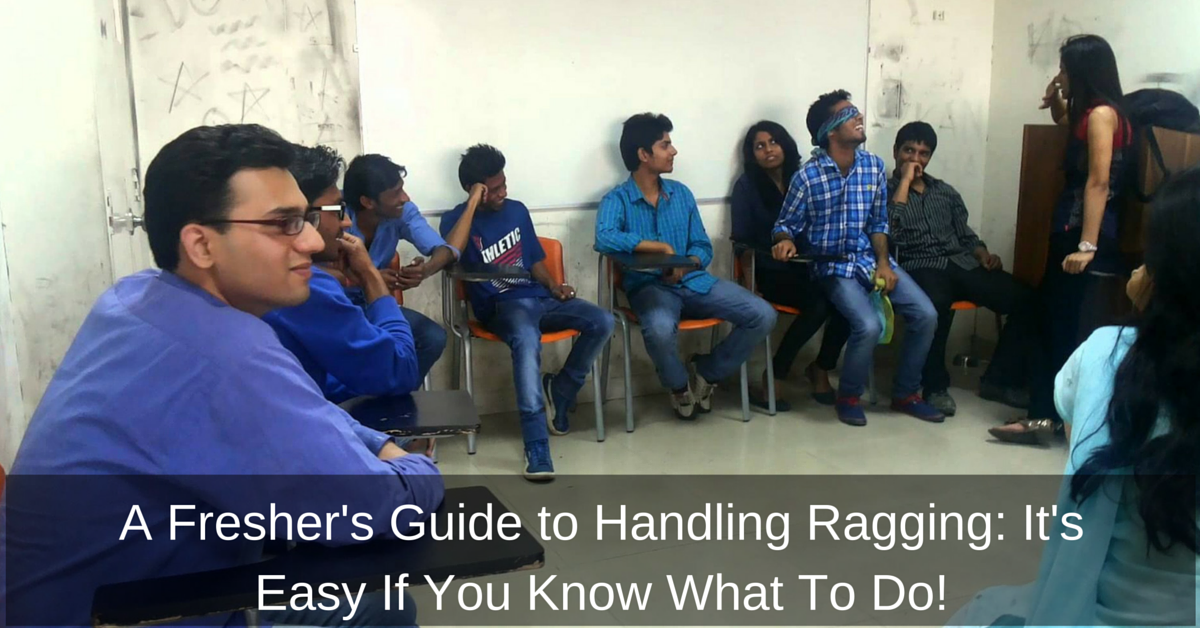
Usually, during ‘positive interaction’, the freshers may be asked to dance/sing/imitate someone/give an answer to awkward questions. Generally everyone is asked to introduce themselves. This may be followed by a group of seniors asking a series of questions – the questions often border on outrageous, offending, funny. Most of the times, it is all clean fun and does not end up in the humiliation of the junior being ragged. But well, not everyone is the same and some people do tend to cross a line. In a law school at least, I would expect a senior to show you the way even if you find yourself in an awkward situation. If other seniors cross a line, most often one of their peers will get things under control. It is very rarely that one may find oneself in one of those truly tragic situations, where you are mistreated or badly behaved with. Well, it is generally nothing that you can not handle with grace, given that you understand the psychology that goes behind ragging, arrogant seniors and mentally prepared for this kind of situations. It is just another social situation where you are interacting with a bunch of strangers, who not necessarily have anything against you, but will like to prove their superiority in front of you and their peers. You can let them have their way as long as it is not insulting or humiliating for you, and if crosses a certain line, you’d have to take a different strategy. At least now, the law and the general sympathy is very much on your side, so I do not see any need to panic!

A Fresher's Guide to Handling Ragging: It's Easy If You Know What To Do!

What are the types of ragging you may face?


We have divided different types of raggings/positive interactions in a few categories based on degree and the intention of the seniors:

  • Good intention, fun interaction: the most common form of ragging in law schools. This is what positive interaction should be. Seniors ask funny, intelligent questions. Gives group tasks. Asks people to sing and dance. This is a nice way of getting to know your seniors, and classmates too. Most likely you shall be part of one of these sessions, just do whatever you are asked to do. Probably you shall enjoy it too unless you are very sensitive/introvert. Realise one thing, no one is forcing you to do anything, and you know that no one will prevent you from walking away. But that will leave a bad impression on everyone else; people will see your reaction as socially unacceptable.
    I have seen students getting offended by the smallest of tasks like dancing, which is quite unwarranted. Yes, it may put you out of your comfort zone, but that is the whole point. It is a socially challenging situation for you, but this is one of the best environments for you to learn how to deal with such pressure. In real life, you shall face a plenty of humiliating situations – with teachers, in front of your boss, maybe when the result comes out – would you cry and run away and hide? If you raise a hue and cry about such small things, you will definitely come under the scanner for being too ‘fussy’ and ‘snobbish’. Not only in college, but in all social circumstances. Moreover, your seniors will not like you and you do not need that! It is actually due to this positive interaction that you end up sharing a great bond with those same seniors! I have seen many freshers taking full advantage of these positive interactions by entertaining the seniors well and giving them an impression of being a sporty junior. It is safe to do as directed in such harmless sessions of positive interaction.
  • Stupid senior, trying to establish his superiority: This can get frustrating. You see a dumb guy, trying to act smart or prove a point. Play along as long as they are not getting abusive. If you think they are doing it too much, be very tactful, and leave soon. Maybe take their permission before you leave. Well, you don’t have to show them their place, not yet. Maybe after a couple of months if they keep badgering you, go for it.
  • A group of feminist women: they will catch hold of you, and after asking the general stuff like what’s your name, how many siblings they will start asking you things like do you think women are better than men? Do you think a man should beat up his wife if she engages in adultery? And other questions in that line. Say only politically correct things. If you do not know what is politically correct, just say, “I believe in equality.” Just that.
  • A bunch of drunken guys: Tricky. Very tricky. Say that you need to go to toilet, or that you are getting a call from dad, and disappear. You don’t want to be there for long. If you can’t escape, keep quiet. Don’t say more than one or two word, that too only as answers. Just keep quiet and get away at the earliest opportunity. If things go out of hand, just run. Next day these guys will probably apologise anyway, but you need not depend on a drunk man’s sense of civility.
  • Sadist, frustrated people: There are always some people who are miserable themselves and are hell bent on making others miserable. These guys jump up in joy when they see the freshers: a clueless, helpless lot, easy preys. They ask people to hump the wall, walk on the cornice, or to kiss an electric bulb. Force people to drink and smoke. These are the people who are the real reason we needed to have an anti-ragging law. Well, in the law schools that I know about such behaviour is not acceptable. If someone asks you to do such things, outright refuse to do it. They will probably be abusive too, if you indeed have the misfortune of meeting such people. Try to be as polite as possible, leave the place as soon as you can. They are unlikely to do too much, as there is enough pressure from all quarters against such activity. You can even drop a mail to me; I’ll get you in touch with people in your law school who can help you.

I will be very surprised if any senior this year prove to be so stupid as to get drunk and beat up juniors in name of ragging, given that they have 90% chance of getting expelled for the same. Nevertheless, I’d rather that you are prepared for the worst. If you are physically manhandled, or hit – what should you do? Run away, of course! Makes no sense to fight it out, just seek help of a reasonable senior. If you know no one, inform the security guards, you have them in all law schools. They will call the warden. If such a situation occurs, don’t bother to think that your seniors will not like you because you complained. Most people will in fact respect you for you did not let people walk over you when they were unreasonable.

In lesser cases, when safety is not in immediate danger, it is not unusual to be in a dilemma as to whether one should inform the college authorities or stay silent for the sake of not locking horns with the seniors. In such cases, it is wise to discuss the matter with your batchmates. Also, not all seniors would support such acts, so help can come from those quarters too. If the issue is not resolved amicably with the help of batchmates and other seniors and if the violence persists, then it would be appropriate to approach the authorities.

Further, I shall discuss some quick tips as to how freshers should conduct themselves for the first few months of college to avoid the limelight for wrong reasons, as that might lead to more sessions of ‘positive interactions’. Have a good impression or no impression at all, but do not form a bad impression! Be careful while conversing with people, including your batchmates. Do not make politically incorrect statements, like demeaning people coming from a particular city, region, religion, etc. It is very important to be careful with your words as people might twist even a simple unintended non-slanderous statement that is made! Once you fall in this trap, regular sessions of positive interaction are definitely in store for you.

Cardinal rule for those who want to avoid ragging: avoid attention. Do not stand out. Be the most inconspicuous and boring person. If you have a goatee, get rid of it. No funky hairstyle for a month. If you are a stud, keep your studliness in check J you can let it blossom after a couple of months, once the onslaught of positive interaction is over!

On the whole, be smart and social in your interactions with people. If you feel that positive interaction goes overboard in what might be serious ragging, then you do not need to be a mute victim and accept it. However, while deciding whether positive interaction is acceptable, it is important to be reasonable and not be over sensitive.

Best of luck!

Download Now

Startup Saturday Kolkata: Legal Edition

0
On Entrepreneurs, Law and Technology: Start-up Saturday Legal Edition

This article from 2010 is being republished from A First Taste of Law, and all those of us who attended Startup Saturday in the past in search of inspiration, are going to feel nostalgic reading this. Especially the lawyers!

startup-594091_1280

You may or may not have heard of Start-up Saturday, you may or may not know about opportunities in the legal field for start-ups, the bottom-line is that a generation of legal entrepreneurs is emerging. If you don’t want to be caught by surprise, read on. The post is brought to you by Ashwini Sharma, a 4th-year law student and underground rapper from NUJS.

Did you ever have dreams of making it big as an entrepreneur? Does your idle mind ever make business plans though you never get around to implement them? Do you believe that knowledge alone is not enough, what matters is how it is used? Does a great idea inspire you, or bring a smile on your face? If the answer to any of these questions will be yes, and you have never attended a Startup Saturday, you are missing out on something.
Lab 1 of Globsyn Business School saw another edition of Startup Saturday on January 10, 2010 that enabled young and would-be entrepreneurs to come together and share their ideas and experiences at startup companies, some of which they run themselves, and at other start-ups they work.

India is coming up with its own brand of entrepreneurs who dare to buck the trend of joining established institutions and instead attempt to mark their own niche territory amidst formidable firms and business houses. Recognising the potential of a whole generation of enthusiastic entrepreneurs emerging across India to excel in their chosen callings, Headstart Network had come up with the idea of creating a platform which would allow such young guns to come and showcase their individual efforts and allow them to come in touch with other similar like-minded individuals and entrepreneurs. Startup Saturday was the outcome and it has kicked off several events where entrepreneurs meet and discuss the feasibility, viability and future prospects of their startups.

According to Ramanuj, “I attend Start-up Saturday because it is a great learning opportunity for me. On every session, I meet some people who can give me new ideas that I can implement in the projects I am doing. Sometimes I can see a new opportunity that I would not have even known to exist otherwise.” It is a consensus among regulars at this event that it is one of the very few events in India where start-up owners or people providing services to start-ups can network. No wonder this event in increasing in popularity, and now being held in 6 different cities in India.

On Entrepreneurs, Law and Technology: Start-up Saturday Legal Edition

The event in Kolkata may not be as high profile or well-attended as the one in Mumbai, but it still draws a wonderful crowd of engineers, finance guys, seed funders, web developers and of course, lawyers (we wouldn’t be discussing here otherwise, shall we).

Coming straight to the point now that we know what is Start-up Saturday about, the January edition was clearly dominated by lawyers. Does that strike you as odd? Lawyers practise in courts, businessmen come to them only when they need to make a contract or to sue the counter-party, isn’t it? You can also seek their help for raising funds during mergers, but what is the connection between young lawyers/ law graduates/ law students and entrepreneurs? Well, to those who are wondering, we are planning another edition where we shall introduce some more legal start-ups. Please come, we will love to see your bewildered expressions! You have no clue how much fun it is.

Sorry for the digression! The January edition of Startup Saturday Kolkata was focused on two new startups in the legal field and consequently saw a comprehensive deliberation on entrepreneurial opportunities in the legal world, both for legal start-ups as well as the opportunity to technological start-ups in the legal field. I was invited by an over-excited friend and decided to go despite my uber-reluctance. However, after attending the event, I can safely say that my decision was made for the better.

Several other followers of Startup Saturday, as well as first-time attendees, were present at the event. The event brought together Rohit Das, an NUJS alumni who left India’s top law firm AMSS to start his own firm Rohit Das & Associates which has been slowly and steadily establishing its offices in major cities of India (5 so far). Also present through voice conference was Kian Ganz, a lawyer from UK who initiated legal journalism in India with the ever-so-popular Legally India website, catering to an almost 1 million lawyer community of India by providing legal news of every kind and colour, from college moots, bar election results to major law firm deals and corporate mergers. The discussion was moderated by Ramanuj Mukherjee, an NUJS student whom the readers of this blog may be familiar with.

The discussion was focused on the challenges faced by startups in the legal field and the personal experiences of those who have made it through initial hiccups. It also centred around on involvement and role of technology, or rather, the lack of it in the legal industry. Ramanuj argued that introduction of technology related to billing, data protection and public relations could increase the productivity of associates of Indian law firms. Rohit Das waxed eloquence on the distrust of the average Indian lawyer for anything that is digital. He brought out the poor acceptance of computers and computer-related technology by Indian firms and the obvious effect of the same on delivering quick and efficient legal service.

While Indian Lawyers are amongst those at the very bottom of the learning curve when it comes to technology, it presents a great opportunity to those who can identify the right opportunities to provide technology of value to lawyers and educate them by demonstrating the effect of good technology on profits. On the other hand, lawyers need to open up to technology more, and realise that a computer typed plant, Supreme Court Cases (SCC) CD or an online legal research database like Manupatra is not the last frontier of technology. Technology may help lawyers not merely by making information around the world available at the click of a button, but can also be intricately harnessed for the purpose of delivering quicker and better quality client service.

Kian Ganz had much to share as he is seeing the Indian legal industry from close proximity after a stint at Clifford Chance, one of the biggest law firms of the world. He elucidated on the practices observed by UK law firms as compared to Indian ones. If future is to be predicted by looking at the development that took place in more mature legal markets such as that of UK or USA, as the legal indutry grow in India, in terms of size and depth, there would be such as technology, Public Relations, management and consultancy, recruitment agencies focussing solely on legal industry.

The next focal issue that came up was the large disorganised legal sector brought home by the fact that there was hardly any initiative by lawyers to start law firms that can turn out to be future cradles of legal whizkids. It was observed that the way the legal sector is centred around sole legal practitioners and their training of junior lawyers inside their chambers was in fact acting as an impediment to the emergence of India as a solid nesting ground for legal eagles because junior lawyers were hardly paid enough to sustain their enthusiasm and quest for legal excellence.

We have heard before that one should start a legal career at the bar, but this time we heard something very different: that law firms provide better scope for personal development as well as expansion of the legal mind for young lawyers. After hearing Kian and Rohit, both of whom started their careers at law firms, I am myself convinced about this.

The consensus arising out of the discussion was captured very well by Kian Ganz when he said: “It is clear that in the coming years there will be plenty of new opportunities opening up and it is heartening to see that entrepreneurs are sensing this and are turning their eye on the legal sector.”

But this was not the be all and end all for the event. Questions were thrown from the present and attentive audience consisting of Start-up Saturday followers and entrepreneurs regarding legal practice, legal services and quality lawyers. One important aspect addressed was how start-ups can obtain quality legal service from lawyers and law firms. Financing a start-up at the initial stage may be difficult, and incurring legal costs is very often unthinkable. Nevertheless, legal assistance at this level maybe crucial as one enters into contracts that will define the future of the company. Legal advise at this stage can save a lot of pain later on. Rohit said that many upcoming firms will be very willing to provide services to such clients at affordable rates looking forward to a good relationship as the law firm will certainly benefit if the start-up grows at a healthy rate and keep coming back for futher legal services. He also said that services maybe rendered in exchange of equity in some cases.

Startup Saturday has a section called “lightning pitches” which allows a chance for anyone in the audience who wished to talk about a new idea or theme or any other entrepreneurial attempt. Anyone interested from the audience was invited to speak for five minutes on any idea that they were fiddling with in their minds or any other product that they have launched already. I quickly decided to showcase my attempts in promoting Desi Hip Hop/Rap in front of the seasoned and budding entrepreneurs. Soon enough I was on the podium delivering a short and compact presentation on the underground movement of Desi Independent Rap Music and Rap Batting Culture and my efforts to promote the same among Indians through internet. Though all the ideas that I touched upon were still in my head, the audience was very supportive as well as appreciative of whatever I had to say and I was extremely gladdened by the warm and positive response that I was bestowed with by those present.

In short the event successfully brought together young entrepreneurs and allowed them a chance to present their initiatives and enter into a healthy debate and discussion. Start-up Saturday is a pioneer in bringing together entrepreneurs to provide them with a stage to highlight their initiatives as well as bring together like minded people for further networking and bonding. Kian Ganz would put it this way – “I thought it was a very valuable and interesting way of connecting industries to the entrepreneurial community.”


Download Now

What do corporate lawyers do: takeover defences and cold steel

1
Cold Steel: Learn to Love Corporate Law and A Takeover Defence called Stichting

This is being republished from A First Taste of Law.
Cold Steel: Learn to Love Corporate Law and A Takeover Defence called Stichting

As promised in our previous post introducing this series on books that will change the way you think about a corporate lawyer, this is the first post of the star-studded lawyer series on ‘Cold Steel’, a book on the high-profile merger between Mittal Steel and Arcelor. This book has much to teach about the corporate world if one is looking for the right sort of information, and it efficiently describes the drama that goes behind the scenes, and give a glimpse of the ecstatic career highlights of the corporate lawyers who move and shake things in the financial world. We believe that before excelling yourself, you need to know the existing excellence first. We picked ‘Cold Steel’ for the first post on this series because it deals with a fabulous story, and can be very inspiring for a law student or a greenhorn lawyer. Irrespective of whether you have read the book or not, you will enjoy and gain from this post if you are an aspiring corporate lawyer, or will identify with what we are writing if you are already working as one. We also hope that we shall be able to give you enough reasons to read the book itself at some point.

Read this post 1) for a preview, and to learn what a corporate lawyer or an aspiring one should look out for while reading, if you plan to read the book eventually, or 2) if you don’t plan to read the book in foreseeable future, just to learn about the corporate maneuvers involved in this titan of a deal, and to get a basic lesson on takeover lawyering.

If you ever read the book, don’t get put off by lack of a contents page to guide you at the beginning of the book, or the fact that each chapter begins with the date and the venue of the discussion, giving no clue as to what its contents are. The book is, in any case, a page turner, as soon as you begin reading. It also embeds amazing takeover methods and law related to them, and therefore, is a great and entertaining resource for learning actual practices. As we write, we shall take care to not compromise the suspense and surprise that readers deserve when they read the book.

Rendezvous with the titans

Cold Steel is one of the most recent books on high-value transactions. It begins in the second half of 2005 – a time when the world steel industry was experiencing a great boom. The participants in this are well-known steel makers – Mittal Steel and Arcelor, the two biggest steelmakers in the world. L.N. Mittal, even before the merger, has been called the Andrew Carnegie of Steel.

Both of the tycoons who are involved in this drama, Mittal and Arcelor chief Guy Dolle were present at the auction for a Ukrainian steel company around the Orange Revolution period. Dolle had a hunch that Mittal may want to acquire his company. This set up a background for a long drawn battle of wits and corporate strategy, which takes a central role in the book right from the beginning. While both companies wanted the Ukrainian company badly enough, Arcelor had a dual agenda – if it could not win, it wanted to bid up the price to such a high level that even if Mittal Steel won the auction, it would leave a significant dent in Mittal’s coffers, thereby disabling it from going after Arcelor.

Mittal’s Reasons for the Acquisition

On the other side of the board, Arcelor’s strategy gave Mittal a strong reason to take over Arcelor, as he needed to prevent repetitions of what happened in Ukraine. If he could buy Arcelor, its presence in bids would not increase his costs of buying companies like it had in the past. This was very important to Mittal as his modus operandi was to buy loss-making companies cheap, turning them around, and making sky-high profits in the process. This is a unique strategy in the corporate world; turning sinking ships into cash cows is not everybody’s ballgame. Thus, Mittal’s meteoric rise as a billionaire did not surprise anyone.

The most important reason that Mittal wanted the two companies to merge is that together they could control 10 percent of the world’s steel output, and thus enjoy increased bargaining power with suppliers. He, therefore, took the initiative to acquire Arcelor.

Dolle and his lawyers

Dolle was concerned just about everything about Mittal – he was not sure about whether the companies from two vastly different cultures such as Arcelor and Mittal Steel could work together. His concern on this front was legitimate, as statistically more than half of all mergers are known to have failed. Often, the differences in culture and work ethics are the key factors which result in the success or failure of a merger. Dolle coined a somewhat derogatory term for Mittal’s monetary prowess – monkey money, which backfired and resulted in adverse publicity for Arcelor’s management.

Apprehensive of Mittal’s intentions, and desperate to prevent a takeover, Arcelor instructed one of America’s largest and a very profitable law firm – Skadden, Arps, Slate, Meagher and Flom (generally referred to as Skadden), which has 24 offices worldwide, and whose specialization in takeovers is sometimes considered unparalleled.

Height of Corporate Secrecy

Yoel Zaoui of Goldman Sachs, the world’s biggest investment bank, asserted that the transaction is going to be ‘the battle of the century’ and emphasised on security, giving all the participants codenames – borrowed from mythology or planets the solar system, to maintain secrecy. Mittal Steel hired a specialist communications team to deal with the media and the public. Considerable attempts were made by both sides to influence the media to favour their side of the deal, and several restrictions were imposed by Arcelor to prevent information leaks from its boardrooms. It was important to move fast – if a whiff of what went on in one board room reached the other, it could prove to be fatal to all efforts.

Arcelor’s Corporate Ammunition: Takeover Defences

In the corporate world, hostile takeovers are the nightmares of every manager and entrepreneur. No one likes to be at the wrong end of such a takeover and lose control over a profitable company. Naturally, over time lawyers have come up with strategies to prevent a hostile takeover, which is basically a takeover without the consent of the management. These strategies are called takeover defences.

While the management of Arcelor could prevent the onslaught by Mittal in a host of ways, it had to be careful in its choice of a takeover defence, as Arcelor was a listed company – and any overprotective tactics could have made shareholders and other potential investors of the company believe that the management was not acting in the best interests of the company, and thereby drive its share price down.

Let us take a quick look at the available defences:

  • The poison pill

The poison pill defense was first created and deployed by an American lawyer Martin Lipton (of Wachtell, Lipton, Rosen and Katz) when he was advising the company which manufactured the famous Jack Daniel’s whiskey. The defense was quickly adopted by other firms later. It is a powerful and frequently used in takeovers, although today most jurisdictions heavily regulate it. India and the United Kingdom do not allow it to be used.

This is a potent but dangerous defence weapon, as it cuts two ways, and the wielder of the weapon loses much of its value. In this case Arcelor had a power to issue additional shares to the Luxembourg government, and could do that in such a way that no matter how much control Mittal tried to acquire by buying shares in a hostile bid, the government would have the ability to block major decisions. Thus, Arcelor would make itself unattractive to potential investors, and would lose some of its autonomy so that Mittal lost interest in the company.

  • White Knights and Buy-backs: The search for saviours

The management of a company which faces a takeover always fears that it will lose its office and associated perquisites. In its eagerness to protect its position, it often looks for what is known as a ‘white knight’, an entity which is friendly to the management and hence will not replace the management even after taking over the company.

Arcelor’s search for a white knight pretty much sent it globetrotting. It involved Severstal, a Russian steel company headed by Alexey Mordashov, and Thyssen Krupp of Germany. However, Arcelor’s merger with Thyssen Krupp would be difficult to complete as there were significant competition law issues in the European Union on account of overlap of operations. That move was discarded for this reason.

The next step Arcelor was mulling was issue of shares to Russian industrialist Alexey Mordashov of Severstal, which would severely increase the number of shares Mittal required to gain control of Arcelor. At the same time, Arcelor wanted to have a buy-back of some of its shares, so that it could ensure that shareholders who wanted to sell their shares for a profit, could sell them back to the company, instead of selling them to Mittal and giving him control of Arcelor. However, unfortunately for Guy Dolle, shareholders saw through the plan as being not in the interest of the company, and did not approve of the move.

This was not all. Severstal was eager to seal a merger with Arcelor, and advised by investment bank ABN Amro and the international law firm Allen & Overy, tried its best to prevent any progress from Mittal. Negotiations between Severstal and Arcelor made it to a fairly advanced stage, and preliminary agreements of an arrangement between the two were concluded.

The Stichting : The stichting was by far, the most potent defence used by Arcelor. Scott Simpson, who is amongst some of the best andhighest earning corporate lawyers in Europe, is said to have used this defence successfully in a prior instance, while defending Gucci from Louis Vuitton (our readers may recall the fabulous watches, handbags, purses and jewellery manufactured by these high-end luxury brands).

The defence is every bit as exotic as it sounds. It involves regulatory arbitrage, where one uses one legal system to gain benefits in another, at its creative best. In this case, Arcelor had acquired a Canadian Steel Company by the name of Dofasco. Scott Simpson’s stichting involved transferring Dofasco to a Dutch ‘trust’, necessitating that Dutch law will now govern how the Canadian property is dealt with. Transfer to the Dutch ‘trust’ made it impossible for Mittal to dispose it off as under Dutch law Mittal can no longer control the operations of this entity, even if he took over Arcelor.

The rationale behind this is simple – Mittal is interested only in Arcelor, and no other unwanted goodies. Mittal will borrow some money from outside sources to acquire Arcelor. If Mittal acquires Arcelor, he would be interested in selling Dofasco off so that he is able to generate some money to pay his debts back, and for getting rid of Competition issues in North America – the stichting will create trouble with Competition authorities because both Mittal Steel and Dofasco have operations there. Competition regulators are very circumspect while sanctioning a merger of two big operators in the same sector, because they believe that the two can then abuse their position and adversely affect other competitors.

Fortunately for Mittal, the stichting too did not prove to be fatal – he still managed to get clearance from competition authorities in North America. But the defence was successful in two big ways – Mittal Steel could no longer sell Dofasco to pay off the debt it incurred in buying Arcelor, and it helped in generally increasing the price that Mittal paid for acquiring Arcelor shares, in addition to all other measures designed to achieve that goal. Skadden had played its part.

  • Diplomats and Law Professors

A major international deal is likely to have serious political and regulatory implications. It is important for corporate lawyers to forewarn their clients of the issues that lie ahead. In this case, there was the issue of convincing the Luxembourg government, which was in the process of passing a new takeover law, that the new law which was made was not particularly unfriendly for Mittal’s bid. He had been advised on this by a famous American law firm – Cleary, Gottlieb, Steen and Hamilton. The Skadden duo – Scott Simpson and Servan-Schreiber, who were acting against him for Arcelor, engaged law professors to make recommendations towards enacting a law which would look neutral on the face of it, but in effect, be unfavourable for Mittal. To prevent this, Mittal had to ensure a series of meetings with Luxembourg politicians.

Competition law issues are a cause of concern in all international mergers. Competition law has often been used internationally to delay or completely block merger deals. Therefore, it was important for Mittal to convince competition authorities from the EU, the US as well as Canada. He managed to get clearance from Neelie Kroes, the dreaded EU Competition Commissioner, infamous for blocking the merger of General Electric with Honeywell Corporation, another high-value amounting to USD 45 billion.

Readers may note that India does not have an elaborate pre-merger law yet – the merger provisions of the Competition Act in India are yet to come into force, but once they do, corporate lawyers planning M&A will have to take them into account as well.

  • Curious Christening Quibbles

An interesting achievement in the negotiations is the settlement of the name of the merged entity – Arcelor Mittal. Mittal wanted it to be Mittal Arcelor, and Arcelor wanted it to be Arcelor Mittal. Negotiations seemingly stymied when the Arcelor side broke the ice by pointing out that the name Arcelor Mittal would have the same initials as Mittal’s son, Aditya Mittal, who would in future successor to Lakshmi Nivas Mittal.

  • Closing the deal

Despite the famous and dramatic telephonic threat issued by Mittal to Dolle (which also features on the back cover of the book) that he would be going directly to the shareholders with the offer, the takeover was ultimately not hostile. In fact, it was the one recommended one by the Board of Directors.

  • Impact on Shareholder Value

Shareholder value at the end of the deal had definitely increased as the price Mittal was willing to offer for one share increased from 28 Euros to 40 Euros per share. Michael Zaoui, the Morgan Stanley investment banker hired by Arcelor, himself advised Arcelor that they could be more favourable in their consideration of Mittal’s offer. The Skadden team had been successful in ensuring best value for shareholders.

  • Fast forward

Enter 2008, and the world witnessed a terrible recession – one of the earliest issues of the newly launched business magazine Forbes India in 2009 carries Mr. Mittal on the cover page with an article (http://business.in.com/article/boardroom/mr-steels-moment-of-truth/92/1) on him, seriously questioning as to what was going to happen to his company. He had amassed around 27 billion in debt, a lot of which was in order to acquire Arcelor. The second half of last year, however, has seen the company’s financial results improve significantly on account of recovery in the world markets.

  • Afterthoughts

Several questions arise at the end of this drama. Apart from the strategies involved, one might think – why did Mittal win? Pure strategy is not the only reason for his victory. He made a lot of compromises on the way – he increased his bid amount drastically, radically transformed the corporate governance of his own company – his family and he had disproportionately higher voting rights, as compared to the other shareholders of Mittal Steel, which was reformed by him. The circumstances and way in which these changes were made is exciting to say the least.

One last word before this long post is to end. The above account is by no means exhaustive, and a lot of more exciting material awaits you, should you decide to read the book, as it is infinitely more thrilling than this account. I hope that this helps in getting you initiated. Do come back next week, for a write up on the next book in the series – highly acclaimed Barbarians at the Gate.


Download Now

4 Scams That Rocked Indian Politics in 2011

0
4 Scams That Rocked Indian Politics This Year

This is being republished from A First Taste of Law which has been shut down.

4 Scams That Rocked Indian Politics This Year

Here is a post from Jay Sayta, an NUJS first year student, who has been writing extensively on gambling laws of India elsewhere.

Scams, scams and more scams – that is what has dominated newspaper headlines over the past few months. However, with the ‘unearthing’ of each new scam, I am getting convinced that the whole process of asking politicians responsible for such scams to step down is a facade to mollify the people and the media. I shall now look into the various major scams that have been ‘unearthed’ this year and will evaluate on hindsight how much has been done except asking the politician so responsible to offer the customary resignation. Does the real power-holders of this country go scot-free even after clear links of their connivance in various scams?

  1. IPL Scam:
    The action that was taken: Lalit Modi, the IPL commissioner axed. The matter is now being probed by the Enforcement Directorate and other tax agencies. Shashi Tharoor, former MoS External Affairs had to resign after it turned out that his fiance Sunanda Pushkar may have gotten sweat-equity in an IPL team due to his lobbying.
    However, it would be interesting to note, that not as much as a finger has been pointed out at Mr. Sharad Pawar, the most powerful man in the BCCI.
    Though Pawar’s daughter, Supriya Sule was accused of holding equity in City Corporation, a company unsuccessfully bidding for the Pune IPL team, he has never being accused of being a part of any financial irregularities, while Modi has been accused of various financial irregularities which include favouring certain companies in awarding contracts related to the IPL.
    Pawar has had the final say on all cricketing matters in India in the last few years. Pawar has himself held many prominent positions in the BCCI and most of the BCCI-IPL office-bearers at present owe him their allegiance. Given these facts, would it be hard to come to the conclusion that Lalit Modi could not carry out a heist on a grand scale without knowledge of Pawar
  2. Common Wealth Games Scam: Again, a multi-billion dollar scam involving various irregularities and a few regularities in contracts and tenders awarded in connection with the Common Wealth Games. Fingers pointed mainly at CWG Organising Committee Chairperson Suresh Kalmadi.
    The Action that was taken: Suresh Kalmadi resigned as the Secretary of the Congress Parliamentary Party pending investigations. The matter now being probed by the CBI, CVC, IT and a host of other agencies.
    The logical question that comes to one’s mind: How can such mind-boggling amounts involving an event of considerable importance to India are laundered by a single person or a single organising committee without the connivance/tacit agreement/blessings of top Ministers, the UPA chairperson and opposition leaders?
    Fingers have been pointed at many important people in the CWG scam, but no action is likely to be taken. Since people have already been mollified with the resignation of Kalmadi, our leaders are now waiting for the dust to settle down.
  3. 2G spectrum scam: Various irregularities and reports of blatant favouritism by former Telecom Minister A. Raja in the allocation of 2G spectrum licences to various telecom companies. Again, this is multi-billion or perhaps a multi-trillion dollar scam.
    Action taken: A. Raja forced to quit after mounting public pressure. Matter investigated by various agencies. The Supreme Court is also looking into the matter. A Joint Parliamentary Committee Probe is being vociferously demanded.
    Again, the same question lingers: Was Raja capable of acting on his own in such a scandal of unspeakable magnitude? It appears that the PMO was aware of certain irregularities but could not take any action.
    Thus, it would not be incorrect to assume that DMK Patriarch M.K. Karunanidhi (who is openly backing Raja) and certain other top bureaucrats and politicians are hand-in-glove in this scandal, but then, it is clear that no fingers will be pointed at them.
  4. Adarsh Housing Society Scam: Another instance of shameless land-grabbing, where top Maharashtra politicians, including former Chief Minister Ashok Chavan and top defence officials were accused of grabbing flats in the ‘Adarsh Housing Society’ meant for Kargil war widows and our war heroes located in the posh Cuffe Parade area of Mumbai. Much environmental and defence regulations were routinely flouted in allowing the construction of this Society. Clearances were allegedly provided by the then Chief Minister Chavan himself, who ensured that those who handled and cleared the Adarsh files were allotted flats there.
    Action taken: The Congress high command forced Chavan to resign following the public outrage. Again, CBI and other agencies will be investigating the matter. It is apparent that there is no interest to pursue other Minister’s and top officials involved in the scam.
    However, those having even slight knowledge of Maharashtra politics would know that the resignation given by Chavan is just a ‘temporary’ one. Chavan is likely to be reallocated to some Central or State Ministry or assigned some gubernatorial duty, once the dust settles down, as is the customary political practice in Maharashtra.
    It may thus be recalled that in the aftermath of the 26/11 attacks, Shivraj Patil was asked to resign as Union Home Minister but was subsequently allocated the post of the governor of Punjab (after a ‘hibernation’ period of a few months to allow the public outrage to mellow down). Even Vilasrao Deshmukh who resigned as Maharashtra CM (after his inefficiency in the manner of handling the 26/11 situation became apparent) was made the prestigious Union Industries Minister after the controversy diminished. Former Chief Minister Narayan Rane, who has many corruption cases pending against him, is currently heading the lucrative Revenue Ministry of Maharashtra.
    The inferences drawn by me in this article are neither startling nor new. I am sure that every ordinary Indian of average intelligence would have thought about this rot in the political system and the connivance of top political leaders in corruption, but people have reacted indifferently towards these allegations of corruption. The popular perception is; “The entire system is corrupt, what can I change? And anyways, these corruption charges do not affect me in any way. I have a lot to work hard for, so why bother?”
    But politicians, beware, yeh public hai, sab janti hai, don’t test the people’s patience, otherwise the day won’t be far away, when the average Indian’s tolerance and indifference towards corruption will turn into outrage and mass movements.


Download Now

Minimum Public Shareholding in Public Companies in India

0
Minimum Public Shareholding- What to Worry About

This is being republished from A First Taste of Law which has now shut down.

Minimum Public Shareholding- What to Worry About

The new minimum public shareholding norms have been discussed previously on this blog here. It had been mentioned in the post that the Listing Agreement would have to be amended in order to bring the mandatory requirement of 25% public holding into effect. A circular to that effect has been issued by SEBI. The relevant provision is Clause 40A of the Listing Agreement, which has been amended. As per the new Circular, the amended provision states that:

“The issuer company agrees to comply with the requirements specified in Rule 19(2) and Rule 19A of the Securities Contracts (Regulation) Rules, 1957.”

To understand this in context, we need to revisit the framework. The Securities Contracts Regulation Act (SCRA) imposes an obligation to comply with the conditions of listing agreement with the stock exchange (Section 21) and imposes a penalty in Section 23. The addition of the above sentence to Clause 40A, therefore, imposes the obligation on the company to maintain the minimum public shareholding requirement, violation of which could result in a penalty.

Manner of increasing shareholding under Listing Agreement

A company which is required to achieve the minimum level of shareholding may do so in 3 ways:
  1. By issue of shares to public through a prospectus.
    This will increase the issued share capital of the public company. The issued share capital should be within the authorized share capital.
  2. By offer for sale of shares held by promoters to public through the prospectus.
    This process will result in dilution of the stake held by the promoter in the company. This will not result in an increase of its authorized or issued share capital.
    Both the above methods are elaborately dealt with in the SEBI (Issue of Capital and Disclosure Regulations), 2009 known as the ICDR Regulations. However, the third method is interesting. It mentions:
  3. By sale of shares held by promoters in the secondary market.
    This is an interesting method and is not a conventional route to raise finance. It offers for direct listing in the secondary market, allocating the shares in the primary market.
    Use of this method requires the approval of a ‘Specified’ Stock Exchange of the company and is subject to conditions imposed by the exchange. However, the requirement of a prospectus for the sale has not been specifically mentioned.

It should be noted that the issue of shares to the public must be through a prospectus as per Section 73 of the Companies Act. The definition of a prospectus under Section 2(36) of the Companies Act is wide enough to include any document which purports to invite subscriptions from the public. The Act mandates certain disclosures to be made in the prospectus, and non-disclosure of a material fact can attract civil and criminal liability. These provisions exist to protect the interest of the public investors.

However, the SEBI Circular only states that the issue of shares on the secondary market is subject to the conditions imposed by the Stock Exchange. If stock exchanges do not impose the requirement of a prospectus, the prospective shareholders will have to rely on the aggregate of all filings to the stock exchange made by the company during its tenure of listing. That would hardly be an effective substitute for a prospectus.

Hence, if the Stock Exchanges do not impose the requirement of a prospectus to be made available for secondary listing, such a method of share issuance may not be legal and could be violative of the Companies Act.

Download Now

Entry of foreign law firms in India

0
Foreign Firms, a Judgment, Blogging and theunwillinglawyer

This is being republished from A First Taste of Law, which has now shut down.

Foreign Firms, a Judgment, Blogging and theunwillinglawyer

Have you heard of theunwillinglawyer? Yes, with no space in between, at blogspot.com. He has been writing some fabulous stuff about law schools and NUJS in particular under that pseudonym, and never revealed his identity. I would like my readers to discover some of his posts simply because they are interesting, extremely analytical, and has the two rare qualities I value (like everyone else sensible): rarity/exclusiveness and usefulness. In fact, that makes his stuff very valuable.His blog is also a test case for all those law students out there planning to start a blog that can help them reach an audience and build a brand of their own. If you want to write a blog that is read more than by few of your friends, the key is in being relevant in what you write, and still being able to make your content exclusive.

Recently theunwillinglawyer wrote on a very thorny issue of foreign law firms in India and the judgment that came from Delhi High Court on the subject. I believe that gives me a perfect opportunity to introduce him to the readers of my blog if they are not already familiar with him. Click on this link to read his original post. You will find a few questions I asked him.

  • As a law student, do you think foreign law firms have a role to play in an Indian legal scene?

I have interned at around 6 firms (most of them having pan-Indian presence) in last 4 years at law school, many times I have been asked to assist associates in drafting etc., in one such internship I came across an affidavit filed by a foreign law firm on behalf of the client at NY District Court, while I went through the affidavit I found that the quality as well as presentation greatly varied from the draftings that we get in India even at the SLP level in SC, what I want to say is that (unfortunately) the work performed by foreign firms is better qualitatively than their Indian counterparts, (disclaimer: my exposure to the work done by foreign firms is only a handful draftings and very few briefings).

If foreign law firms are allowed in India the obvious effect would be that the big four in Indian legal scene (AMSS, AZB, Trilegal & Khaitan) would have to match up to the quality of work done by even the puny entrants (and the magic circle), this would mean that legal sector as whole would get a boost in terms of work culture and quality. Law students would get to work at international standard and would be anointed with global work practices (not just all-nighters, but also how to compose proper ‘contents page’ of documents and not just scribble the page numbers). Thus, entry of foreign law firms would definitely help India legal sector to judge itself in global standard and would ensure better service to consumers who can pay.

  • Why did you chose to write on the subject (foreign firms in India)?

Given the buzz surrounding the subject after the Lawyers Collective case and the hype which is generated in law school after every announcement by law minister about liberalizing the legal sector, I decided to learn more on the subject and the more I read I became enamored with the idea (and also the constant flip-flop by the govt.), so I decided that I should share a personalized summary of the case with others as a starting point to, may be, pique interests of others also.

  • Do you think the judgment is justified? Would you like to see a change in the law?

Well, the judgment hung on the interpretation of term ‘practice the profession of law’. The court held that it would include non-litigious matters like drafting, advising client etc. I looked at dictionaries and a thesaurus for the terms and personally find no fault with the literal interpretation given by the court, practice the profession would not mean just practice in court but all aspects relating to profession that would definitely mean advising etc.

I am personally a great advocate of minimal control by bar association in legal field except in the area of entry in profession and professional ethics, I think there should be bar exam and to ‘practice the profession’ in India all should pass the bar no matter whether he passes out from NLS or Yale. The law as it stands today is alright it just needs a bit of fine-tuning, also a starting point to open up legal sector would be to use the principle of reciprocity, if US allows NLU grads to practice in the US without bar exam, our government should also allow the same but if the US keeps its market closed behind bar exam is it too much to ask India to open its legal field to all LLB pass outs from anywhere in the world.

I would like to remind that as of now BCI does allow foreign LLB pass outs to sit for an exam on Indian law and then enroll in Indian bar, in that way one cannot say that Indian market is closed. Also are the foreign firm lawyers afraid that they won’t be able to crack that entrance, I am sure that they can easily pass the test, so why the fuss, also say if Allen & Overy wants to set shop in Mumbai, why not recruit Indian lawyers from India and use its foreign people as shadow partners, that way they can get around the law (this idea is not mine and was actually proposed by a friend in a discussion with a partner of a mid-sized foreign law firm). So if I may reiterate the law is fine it just needs a bit of tuning.

  • Can you summarise what sort of people will find your blog interesting, and who should read it?

People interested in legal affairs and legal education will find my blog interesting. Also, those who want to read about the law in a light hearted manner are my target audience. I suggest my peers that are law students to read my blog as many posts are on legal education and examination patterns, the changes and my (mostly) neutral take on them.

Download Now
logo
FREE & ONLINE 3-Day Bootcamp (LIVE only) on

How Can Experienced Professionals Become Independent Directors

calender
28th, 29th Mar, 2026, 2 - 5pm (IST) &
30th Mar, 2026, 7 - 10pm (IST).
Bootcamp starting in
Days
HRS
MIN
SEC
Abhyuday AgarwalCOO & CO-Founder, LawSikho

Register now

Abhyuday AgarwalCOO & CO-Founder, LawSikho