Download Now
Home Blog Page 1841

Personal Bankruptcy or Insolvency laws in India

6
personal bankruptcy

This post is written by Anumeha Karnatak, a student of National Law School of India University, Bangalore during her internship with iPleaders, on personal bankruptcy or insolvency laws in India.

PERSONAL BANKRUPTCY IN INDIA

“ Being broke is temporary, but being poor is eternal.”

-Rich dad poor dad

In India, there are two statutes dealing with personal insolvency (including proprietorships and partnerships). One is Presidency Towns Insolvency Act, 1909, applicable to the erstwhile presidency towns of Bombay, Calcutta and Madras. The other one is Provincial Insolvency Act, 1920, applicable to the rest of India. The district court has the jurisdiction to try cases pertaining to insolvency under the Act. When an order of insolvency is passed, all personal properties of the individual are vested in the Official Assignee appointed by the government of India, who then realizes it and allocates it among the creditors of the insolvent. An insolvent person is barred from enjoying several civil rights. Further, criminal proceedings can also be initiated against the insolvent. In Bharath N Mehta v. Mansi Finance Ltd, the court opined that the criminal proceedings inititated against the insolvent under certain provision of the Negotiable Instruments Act cannot be stayed even if the same debt formed the basis of a civil proceeding initiated under any of the aforementioned Acts. In India, a creditor can institute insolvency proceedings against the debtor by filing an insolvency petition in any competent court. Following are the conditions, as laid down in Shivchandra v. Swarna Silk House that must be satisfied by the creditor:

• That he is a creditor of the debtor.

• There exists a legally enforceable ascertained debt between the debtor and the creditor.

• That the debtor has committed an act of insolvency as suggest under the Act.

Also, under the Act, any person competent to enter into a contract can be declared as insolvent.

https://lawsikho.com/course/insolvency-bankruptcy-code-ibc-nclt-sarfaesi
Click Above

A concept slightly different from insolvency in bankruptcy which is very popular in the western countries. A bankruptcy is when a person voluntary declares himself as an insolvent and goes to the court. On declaring the person as ‘bankrupt’, the court is responsible to liquidate the personal property of the insolvent and distribute it among the creditors of the insolvent. This process is rather amicable which seeks to avoid the threatening calls and gestures of the creditors. It provides a fresh lease of life to the insolvent. However, declaration of personal bankruptcy also has its own disadvantages. Following are some prominent ones:

• Societal stigma is faced by the insolvent. In India, bankruptcy or insolvency is considered as extremely demeaning. People hesitate in declaring bankruptcy because of the fear of being ostracized by the society.

• The insolvent person lose credibility in the eyes of future creditors. His repaying capabilities are often questioned and he develops the image of a defaulter. He remains on the CIBIL list for 10 years during which it becomes almost impossible for him to take loans.

• In India, the whole process is time-consuming because of slow functioning of the courts. As per the World Bank data the time to resolve insolvency in India in years is 4.3.

Aforementioned are some of the reasons why people filing for personal bankruptcy are lesser in number here than in the US where 1.59 million people filed for bankruptcy in the year 2010. Since the global slowdown of 2008, the number of people filing for bankruptcy in the US has increased manifold. The figure rose from 8,01,840 in 2007 to 1.06 million in 2008.

Further, the Indian laws dealing with personal bankruptcy are largely inadequate and outdated. People still continue to adopt traditional out-of-court settlement methods which are less time consuming such as waiving the interest on loan or restructuring it or settling with partial payment. The country has witnessed an overhaul in the number of personal loans taken by individuals to finance education, housing, marriage etc. in recent times. Credit card users have also increased. Thus what we need today is a more comprehensive and up-to-date legislation to deal with bankruptcy cases in India.


LawSikho has created a telegram group for exchanging legal knowledge, referrals and various opportunities. You can click on this link and join:  

https://t.me/joinchat/J_0YrBa4IBSHdpuTfQO_sA

Follow us on Instagram and subscribe to our YouTube channel for more amazing legal content 

 
Download Now

Phonographic and Public Performance licensing in India

3

670px-Disco_Dancers.svg

Phonographic Performance License

Under the Copyright Act, 1957, it is mandatory to take a phonographic performance license for playing pre-recorded music in a public place, irrespective of commercial or non-commercial nature of the establishment or event.  Any communication or playing of pre-recorded music in commercial establishments like hotels, bars, cafes, gyms, restaurants, offices, shopping malls, airplanes and taxi or non-commercial places like college campus for concerts, fetes, festivals, etc requires license from the Phonographic Performance Ltd (PPL).

PPL grants license to television, radio, telecom companies and organisations for using pre-recorded music. Moreover PPL grants license to establishment for playing background music or in events. An entity or establishment should take a separate license for playing of music in events like concerts, stage, dance-floor, and even for brand promotion activities, shows, etc.

https://lawsikho.com/course/diploma-intellectual-property-media-entertainment-laws

If any entity plays pre-recorded music in a public place without taking PPL license may constitute violation of Copyright Act and is a cognisable and non-bail able offence.

How to obtain a PPL license?

A PPL license for playing background and event music can be obtained by applying in an appropriate format with license fees to the appropriate regional office of PPL. License for mobile, internet, radio and television can be applied at the Mumbai Head Office.

List of PPL offices can be obtained here: http://www.pplindia.org/contactus.aspx

Public Performance License

Another license that is important for establishment where music is communicated through live performance by musicians and singers, for example bars, pubs, events like concerts, shows, etc, and communication of the live performance through broadcasting medium and mechanical means like TV, internet and radio. It is important for the owner of the premises to take the license where such music is played.

The Application form for obtaining the license can be accessed here: http://www.iprs.org/Forms/Live%20Performance%20Form.pdf and http://www.iprs.org/Forms/General%20Licencing%20Form.pdf

The Tariff for Public Performance License can be accessed here: http://www.iprs.org/cms/Tariffs.aspx


Lawsikho has created a telegram group for exchanging legal knowledge, referrals and various opportunities. You can click on this link and join:  

https://t.me/joinchat/J_0YrBa4IBSHdpuTfQO_sA

Follow us on Instagram and subscribe to our YouTube channel for more amazing legal content 

 
Download Now

Building Bye Laws in Delhi

0

What are building bye laws and how are they essential?

Building bye-laws are generally made under the power given by a statute to urban development bodies, like Delhi Development Authority to ensure planned development in a particular area. The building bye-laws generally regulate the height, architecture, sanitary and safety measures, etc to maintain minimum standards for construction in a particular area. Having an effective building bye-law prevents environment degradation and safety hazards and make the cities a better place to live in for its residents.


Is there any specific guideline for construction in Delhi?

Construction, demolition and alternation of any building within the areas under Delhi Development Authority is guided and regulated by the Building Bye-Laws for Union Territory of Delhi, 1983, notified under the power granted in sub-section (1) of Section 57 of Delhi Development Act, 1957.


Important definitions

Building Line– The line upto which the plinth of a building adjoining a street or an extension of a street or on a future street may lawfully extend. It includes the lines prescribed in the Delhi Master Plan or specifically indicated in any Scheme or Layout Plan, or in these Bye-Laws.

Floor area ratio or floor space index (FAR or FSI) – It is the ratio of the total floor area of a building and multiplied by 100 with respect to the total area of the land. For example an area where the approved FSI is 3.0 that means that the total area of the building that can be constructed is three times the area of the plot.

Covered AreaGround area covered immediately above the plinth level covered by the building but does not include the spaces covered by;

a) Garden, rockery, well and well structures, plant nursery, water-proof, swimming pool (if uncovered), platform around a tree, tank, fountain, bench, chabutra with open top and unenclosed on sides by walls and the like;

b) Drainage culvert, conduit, catch-pit, gully-pit, chamber, gutter and the like; and

c) Compound wall, gate, slide swing canopy, areas covered by Chhajja or like projections and staircases which are uncovered and open at least on three sides and also open to sky.

Set Back LineA line usually parallel to the plot boundaries or centre line of a road and laid down in each case by the Authority or as per recommendations of Master/Zonal Plan, beyond which nothing can be constructed towards the plot boundaries, excepting with the permission of the Authority.


Plinth AreaThe built up covered area measured at the floor level of the basement or of any storey.


Land Types

In Delhi as per model development code, there are 10 types of land use categories: Residential, Commercial, Industry, Ridge/Regional Park, Recreational, Transportation, Utility, Government, Public and Semi-Public facilities and Agriculture and Water Body. These categories are further sub-divided into zones for better categorisation. While residential premises are allowed in the commercial area, the reverse is not permitted. The detailed land usage restrictions and detailed zoning categories can be accessed at: http://www.dda.org.in/planning/docs/17.DEVELOPMENT_CODE.pdf


Getting a building permit. What kind of applications need to be made?

Initial application: If anyone has to erect or re-erect a building or make alteration to an existing building in a residential plot or other buildings, the person has to give a notice in writing in a prescribed manner (Form-I; Appendix A; Bye-Law No. 6.1) to the Delhi Development Authority (DDA) along with other necessary documents and permit fees.

Form 1 can be accessed here: http://www.dda.org.in/planning/docs/Annexure%20%27A%27.doc

Detailed list of documents needed for application can be accessed here: http://www.dda.org.in/about_us/pop_ups/handbook%20bldg.pdf


Starting of construction: The owner/applicant of the building has to give a 7 days’ written notice before commencing of construction in a prescribed form ((Form III, Appendix ‘B’, Bye Law No.7.2.1) to the DDA. The owner must obtain an acknowledgment of the notice from the DDA. The Form can be accessed here: http://www.dda.org.in/planning/docs/ANNEXURE%27B%27.doc


Plinth level permit: On completion of construction of the plinth level, the owner /applicant give a notice in prescribed form (Appendix B-1, (Building Bye-laws 7.2.2) along with other necessary documents and permit fees. The form can be accessed here at: http://www.dda.org.in/planning/docs/ANNEXURE%27C%27.doc


Completion – cum-occupancy certificate: On completion of the construction, the owner/applicant must give a notice in prescribed form ((Appendix B-3) Bye Law No.7.5.2.) along with other necessary documents and permit fees. No one should occupy the building before getting an occupancy certificate. The form can be accessed here at: http://www.dda.org.in/planning/docs/ANNEXURE%27D%27.doc

Detailed list of documents needed for application can be accessed here: http://www.dda.org.in/about_us/pop_ups/handbook%20bldg.pdf


The validity of the building permit remains for:

  • For residential, industrial & commercial (upto 4 storied building.) – 5 years
  • For large complexes and multi storied buildings and institutional buildings. – 5 years


After expiry of the validity period, the original plan needs to be revalidated by writing a letter for revalidation along with requisite fees.


Where to apply?

Application can be made at Building Section Counter, D-Block, Ground Floor, Vikas Sadan, New Delhi-110023 between 10 AM and 1 PM on all working days.

Download Now

What happened to the once-revered Blackberry? The downfall and current scenario

0

Last year, people everywhere were shocked at hearing news about the downfall and takeover of BlackBerry. But for those who had been carefully following the market, this came as no surprise. It was not something that was sudden, rather a sleeping demon that had been feeding on itself since the past six years.

Rewind to 2007.BlackBerry was the apple of everyone’s eye, until the actual Apple phone was launched. The stock prices of BlackBerry were stable at more than $140 per share, and it failed to recognize the iPhone as a threat. The iPhone did what BlackBerry had failed to do – woo the consumer, and not concentrate on just the professional. Both BlackBerry and Microsoft did not see the iPhone as a threat, saying that without a Qwerty keypad, a phone was just not good enough for e-mails and thus shut out the business class and the professionals. But slowly, the iPhone began to take over the market, and Blackberry began to slip. In September 2011, as Apple was geared up to launch the iPhone 4S, BlackBerry’s internet service suffered a complete blackout for several days, drawing a lot of flak from consumers. Not only this, the company had to lay off over two thousand employees due to growth problems.

Blackberry set out to redeem itself. Thus began the story of BlackBerry 10. This was a source of trouble from the very beginning. Even before the launch, there were allegations of trademark infringement on the platform, which was originally named BBX. This led to the renaming, leading to a delay in launch. From December 2011 it had to be postponed to sometime in 2012. Whatever anticipation and hype the company had managed to create because of the excitement of a new platform died in the wait. As if this was not enough, the CEOs of the company, Mike Lazaridis and Jim Balsillie resigned, leaving the company in charge of Thorston Heins. In March 2012, for the first time in years, BlackBerry showed a net loss. The signs were there for all to read. It did not help that Heins’ plans for ‘restructuring’ included laying off more than double the number of employees laid off in 2011, replacing executives who had been with the company for years and delaying BlackBerry 10 for yet another year.

Finally, somehow, BB 10 was launched with two new smartphones –the BlackBerry Z10 and Q10. The Z10, the first BB 10 phone, showed a marked departure from BlackBerry tradition. It did not have a Qwerty keypad, had a state-of-the-art HD display and around 70,000 apps. The Guardian carried an article talking about BlackBerry’s renaissance. It quoted Frank Boulben, formerly of Orange, “It could be the greatest comeback in tech history, the carriers [mobile networks] are behind us. They don’t want a duopoly.” It seemed as if BlackBerry might be turning over a new, positive page. The BlackBerry 10 launch event was also witness to the announcement that the official name would be changed from Research in Motion to Blackberry. A symbolic new page too.

But Blackberry’s troubles were far from over. Between the massive drainage of effort BB 10 had taken to launch – two years and fifteen acquisitions – and Google’s Android and Apple’s iPhone, BlackBerry’s share fell to a measly 5 percent. Balsillie, at one time a CEO and a leader of the company, himself sold all his shares. Lazridis too dumped 3.5 million shares – shares of the company he was a co-founder of. Was any other sign needed after this?

On 12 August 2013, the company released a statement saying it was open to be purchased. On the same day, Prem Watsa also resigned from the board. He was the foremost shareholder. In September, plans about laying off 4500 employees were rumoured, and BlackBerry declared a CAN$1 billion operating loss. On September 23, the company signed a letter of intent. Fairfax Financial Holdings were to acquire BlackBerry at $9 a share. Fairfax was led by Watsa. John Chen was appointed CEO after Heins was laid off. On October 15, 2013, BlackBerry tried to pull a desperate reassurance trick. It published an ‘open letter’ in nine countries, which was nothing more than a paid advertisement, really; trying to reassure consumers that BlackBerry was still a reliable brand. More than anything else, this reflected the depth of the mire BlackBerry was entangled in.

From over $140 in 2008, shares had fallen to less that $14 by March 2012. Fairfax had hurriedly announced acquisition, but could not show enough financials for it. The grapevine said that BlackBerry was considering breaking up the company and selling it in pieces. Bloomberg reported Albert Fried and Co. analyst Sachin Shah saying that breaking up the company will be more profitable indeed. By Nov 4 2013, Fairfax could not come up with the money. Other buyers were showing interest, but apparently BlackBerry was off the table. There were talks of raising a billion dollars and rebuilding the company. This had a huge effect on the stock market, with BlackBerry shares plunging more than 18 percent in light of this new development. Fairfax now is not taking over the company, but has invested in a bond deal and a shakeup of the management. Fairfax opted to invest approximately $250 million in the form of debentures.

As of now, BlackBerry is struggling to rebuild itself. In the face of successful and growing Google and Apple shares, it is difficult to see how that is possible. The company is now picking up executives who have experience in restructuring. On Jan 6 2014, it was announced that Ron Louks has joined the BB team as ‘President of devices and emerging solutions’; Louks was intitially the Chief Technology officer at Sony Ericsson, later the chief strategy officer at ailing HTC and finally went on to become CEO at open NMS.

Whether BlackBerry can rebuild itself again or nor is something everyone is waiting to see. John Chen still insists that the company is ‘well-positioned for the future.’ But whether it is a case of self confidence as a step to success or an ostrich burying its head under the sand remains to be seen.

Download Now

Google Adwords and trademark infringement claims globally

1

Why the hype about AdWords?

Google is one of the most successful search engines on the Web. On an average day, the number of times someone in the world goes to Google to resolve a query is a whopping 5,922,000,000. With such great numbers, businesses who are looking to advertise online line up to woo potential consumers on Google. It is a win-win situation. Google provides great traffic, while the advertisers provide Google with revenue. So much so, that Google’s total advertising revenues in 2012 were USD $42.5 billion. Google’s advertising is done through Google AdWords. It offers pay-per-click advertising. When a Google search engine user types certain keywords in the search box, the relevant advertisements appear on top of and/or on the side of the results. With the amount of traffic that Google generates, it is an effective way to get noticed. IIFP, for example, is a Google AdWords success story. The Indian Institute of Financial Planning used AdWords successfully to raise awareness in the country and in creating brand awareness too.


What’s going wrong

However, of late, Google AdWords has been facing the wrath of advertisers. Numerous suits have been filed against AdWords for fraud, click fraud and trademark law. The start of the idea itself was with a dispute. Bill Gross of Idealab originally had this advertising idea. Google wanted to buy it, but the deal could not be finalized. In 2000 Google launched its own AdWords. The similarity between Gross’ model and AdWords attracted a lawsuit. IdeaLab’s portfolio company was brought out by Overture, which was eventually bought by Yahoo. Google ended up settling the dispute out of court for 2.7 million shares.


Some landmark cases

There are various cases regarding trademark law, like Google Inc. v American Blind and Wallpaper Factory Inc. In such cases problems arises because Google allows advertisers to link their advertisements to keywords that they do not own. Thus competitors of American Blind can place terms like ‘American Blinds’ or ‘Decoratetoday’ as triggers for their advertisements. Google, in its defense, said that search results and advertisements are clearly demarcated on the page, with the advertisements coming under the ‘Sponsored Links’ head. The main question to be considered here was that whether use of these keywords was causing confusion among consumers between the trademark holder and the competitor. The Court noted that the fact that the degree of attention paid to online advertisements os less, therefore this may work in American Blind’s favour. Eventually, there was a settlement between Google and American Blind. It was a mixed bag result, as the judge believed that some points were in favour of American Blind, but Google benefitted mostly from the settlement.Eric Goldman called it “a stunning victory for Google”, as American Blind agreed not to sue as long as Google followed current trademark policy. In fact American Blind ended up paying Google $15k because of negligence in the discovery process. But, Google’s demand for a summary judgement was not fulfilled because it could not adequately prove that there is no confusion caused.

Google has also been sued for fraud in cases like Goddard v. Google, Inc. in which it was established that Google is not responsible for suggesting fraudulent websites through its AdWords tool; according to Section 230(c ) of the Communications Decency Act, according to which, ‘No provider or user of an interactive computer service shall be treated as the publisher or speaker of any information provided by another information content provider.’

One of the most infamous cases that Google has to face concerned three French companies, which alleged that Google was performing trademark infringement by selling trademarks as keywords. The judgement was given by the ECJ (Justice of the European Union) in favour of Google, saying that Google has the right to sell such keywords. However advertisers can bring a suit in case there is a confusion caused among consumers; i.e. if they are unable to differentiate whether the advertisement is a part of the copyright owner’s business or not.


Scenario in India

In India, Consim Info Pvt. Ltd. filed a similar case against Google. Consim owns trademarks Bharatmatrimony, www.tamilmatrimony.com, www.telegumatrimony, www.bharatrimony.com, www.bengalimatrimony.com, www.muslimmatrimony.com, and sued Google for selling these as keywords. The Madras High Court decided in favour of Google, saying that these words were descriptive of services and hence there was no violation of the trademark. Section 35 of the Trademarks Act 1999, says that a bonafide description of trade is a fair defense for using protected words. Hence according to Madras HC judgement, Google would be safe as long as exact keyword is not used by a rival advertiser. For example, if there is a company called ‘BestPillowsEver’ then ‘Comfy Pillows’ can use ‘Best Pillows’, ‘Best ever pillows’ and ‘Best’, ‘Pillows’ as keywords but not ‘BestPillowsEver’. Consim then filed a case with the CCI (Competition Commission of India). The CCI is investigating these allegations. These are quite similar to the anti-trust investigations against Google in Argentina

In Eximcorp India Pvt. Ltd. V. Google India Pvt Ltd, the Competition Commission of India ruled that ‘Prima facie, this is an individual consumer dispute having no bearing on competition in India.’ In this case, Eximcorp had alleged that Google was misusing its dominant position. Payments to Google for advertising through AdWords are made by the process of bidding per click, but it upto Google’s disretion whether to place the advertisement on the first page or second page or so on of the search results. Google’s practices were called discriminatory and non-transparent, but the CCI dismissed the allegations as Eximcorp was not able to justify them.


Tips for advertisers and copyright owners

Google’s own policy upon the subject is that it investigates complaints put forward by owners of trademarks.

Google will investigate and may restrict the use of a trademark within ad text. Ads using restricted trademarks in their ad text may not be allowed to run. This policy applies worldwide.

Exceptions: Here are some cases when the policy for ad text doesn’t apply in the way described above:

  • Ad campaigns targeting the United States, Canada, the United Kingdom, or Ireland may use a trademark in ad text if the ad is in compliance with our policy on resellers and informational sites.
  • Advertisers can use a trademarked term within ad text if they are authorized, meaning that the trademark owner sent Google the necessary form allowing an advertiser’s particular account to use a certain term.
  • An ad can use a trademarked term in its text if either of these conditions is true:
    • the ad text uses the term descriptively in its ordinary meaning rather than in reference to the trademark
    • the ad is not in reference to the goods or services corresponding to the trademarked term.”


Google’s policy says that under following circumstances you can use the copyrighted terms in advertisements:

  • If you are the trademark owner yourself
  • If you are a third party/ If you are another advertiser : If you are an agency or a subsidiary who wants to use the trademark term as a keyword then the trademark owner has to submit his assent for you using their trademark. This is to be done using the trademark authorization form. Alternatively, the owner of the trademark can issue a notice which should be forwaded to [email protected].
  • If you are a reseller site: This is location specific. Google’s policy says that “Ads that comply with this policy and that target the United States, Canada, the United Kingdom, or Ireland, can use trademark terms within those regions without explicit authorization from the trademark owner. Ads targeting any other region are not eligible to run with a restricted term in the ad text. However, advertisers who have authorization directly from the trademark owner will automatically be allowed to show ads with the trademark within the ad text in any region.”


Download Now

Sexual Harassment at Workplace: Legislations in different countries

0
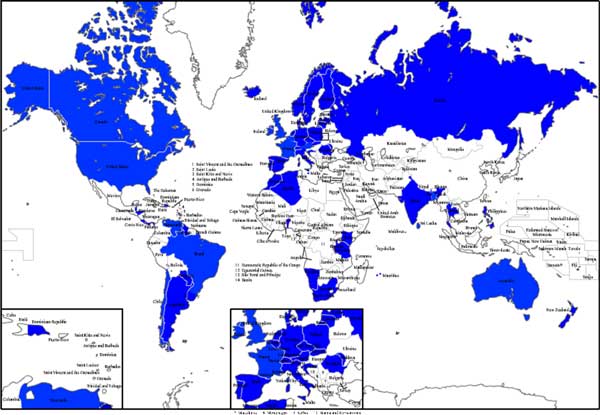
The countries marked in blue are the ones that have laws for prevention of sexual harassment

International understanding of sexual harassment

The United Nations General Recommendation 19 to the Convention on the Elimination of all Forms of Discrimination against Women defines sexual harassment of women to include:
“such unwelcome sexually determined behavior as physical contact and advances, sexually colored remarks, showing pornography and sexual demands, whether by words or actions. Such conduct can be humiliating and may constitute a health and safety problem; it is discriminatory when the woman has reasonable ground to believe that her objection would disadvantage her in connection with her employment, including recruitment or promotion, or when it creates a hostile working environment.”


Sexual Harassment at Workplace Laws around the world

Over 50 countries have prohibited sexual harassment at work through national legislation or labour codes. India became one of these countries in 2013. The countries that have enacted such legislations are as follows: Algeria, Argentina, Australia, Austria, Bangladesh, Belgium, Belize, Benin, Brazil, Britain, Canada, Chile, Costa Rica, Croatia, the Czech Republic, Denmark, the Dominican Republic, Fiji, Finland, France, Germany, Guyana, Honduras, Iceland, India, Ireland, Israel, Italy, Japan, the Republic of Korea, Kenya, Latvia, Lesotho, Lithuania, Luxembourg, Malta, Mauritius, Morocco, Namibia, the Netherlands, New Zealand, Norway, Panama, Paraguay, the Philippines, Poland, Portugal, Romania, Russia, Slovakia, South Africa, Spain, Sri Lanka, Sweden, Switzerland, Thailand, Tanzania, Uruguay, Venezuela.
It is interesting to see how different countries have different understanding of sexual harassment – which is to a great extent influenced by their culture and understanding of gender equality.


Legislations in some countries

India:

The Sexual Harassment of Women at Workplace (Prevention, Prohibition and Redressal) Act, 2013 was passed by both the LokSabha and the RajyaSabha and got the assent of the President recently and has become law. This Act deals with protecting women from harassment in the workplace and providing a safe environment. India took 50 years to come up with a definition for what constitutes sexual harassment in the workplace, courtesy of a Supreme Court judgment 12 years ago.(Visakha v. State of Rajasthan). The act uses the definition of sexual harassment as laid down in Visakha. Section 15 of the Act determines the level of compensation to be paid to the woman who has been sexually harassed. The main criticism of this law is that it is not gender neutral. According to this act, only a woman can file a complaint. Also, sexual harassment is a crime under the Indian Penal Code and the penalties range from 1 to 3 yrs imprisonment and/ or fine. You can know more about the law and various compliances related to it by taking up this course which is created by National University of Juridical Sciences. You can also learn about implementation of sexual harassment laws by taking up this course.


Australia:

Under Australian Law, a person who sexually harasses someone else is primarily responsible for their behaviour. However, in many cases the company also be held vicariously liable for sexual harassment by the employees, agents and contractors, unless it can show the steps that it took to prevent the sexual harassment from occurring. Under the Sex Discrimination Act, the employer must take all reasonable steps to minimize the risk of discrimination and harassment occurring. The Sex and Age Discrimination Legislation Amendment Act 2011 amended the Sex Discrimination Act 1984 in May 2011 to expand the protections against sexual harassment.The victim can make a complaint to the Australian Human Rights Commission in case he/she has been sexually harassed. The Commission will then investigate the complaint and will try to resolve the complaint through a process of conciliation, during which it will help the two parties involve by acting as an impartial person. If the complaint is not resolved, then the victim can take the complaint to Court.


Britain:

The Acts that are applicable in Britain if you are subjected to sexual harassment at work are the Sex Discrimination Act and the Employment Rights Act. The Sex Discrimination Act makes it unlawful for employers in Great Britain to subject someone to sexual harassment. The act also makes it unlawful to harass a transsexual person because they intend to undergo, are undergoing, or have undergone gender reassignment. Sexual harassment itself is prohibited by the Sex Discrimination Act but, in many instances, it will be accompanied by other forms of unfavorable treatment such as not being recruited, criticism of work, lack of promotion, enforced transfer and ill health or dismissal. The Employment Equality (Sex Discrimination) Regulations 2005 amended the Sex Discrimination Act in 2005. The new law extends the protection of sex discrimination rules to cover sexual harassment.


Zimbabwe:

Sexual harassment is considered to be an unfair labour practice according to the Zimbabwe Labour Relations Act. The country has a national gender policy to deal with such issues. As it is an unfair labour practice, victims of sexual harassment can report offences through the Labour Officers who are in charge of conciliation of employment-related disputes and unfair labour practices. The victim may also appeal to the Labour Court.A victim of sexual assault also has the right to press separate criminal and/or civil charges against an alleged perpetrator.


Brazil:

In 2001, the Brazilian Government enacted a criminal law (Law No 10.224) defining sexual harassment as an embarrassing conduct performed by a worker in a superior hierarchical position against someone hierarchically inferior at work, in order to obtain advantages or sexual favours. The law made sexual harassment a crime with imprisonment from one upto two years. This legislation has set Brazil apart from most countries where harassment is dealt with under civil law.


Germany:

Under the Protection of Employees Act, Employers and managers shall be required to protect employees against sexual harassment at the workplace and also both male and female employees can file a complaint if they are sexually harassed. Employees affected shall have the right to complain to those responsible in the enterprise or the department if they feel that they have been sexually harassed. The employer has an obligation investigate the complaint and take appropriate measures to prevent the harassment from continuing. If the employer fails to do so, or applies measures which are obviously inadequate, the employees who are harassed shall have the right to suspend their activity at the workplace concerned, without loss of wages or salary, for as long as this is necessary for their protection.


Denmark:

Sexual harassment is defined as, when any verbal, non-verbal or physical action is used to change a victim’s sexual status against the will of the victim and resulting in the victim feeling inferior or hurting the victim’s dignity. Man and woman are looked upon as equal, and any action trying to change the balance in status with the differences in sex as a tool, is also sexual harassment. In the workplace, jokes, remarks, etc., are only deemed discriminatory if the employer has stated so in their written policy. Women are viewed as being responsible for confronting harassment themselves, such as by slapping the harasser in the face. Law number 1385 of December 21, 2005 regulates this area. 


Spain:

The Spanish Labour Act provides certain guarantees against sexual harassment. These rights include protection against physical or verbal conduct that may constitute sexual harassment. Under a recent amendment, s. 54.2.g of the Labour Act considers sexual harassment at work place as a breach of the employment contract and hence it is valid clause to dismiss the harasser.


Sources

http://www.mywage.org/zimbabwe/main/decent-work-check/fair-treatment/sexual-harassment

http://blogs.reuters.com/india/2012/11/23/sexual-harassment-bill-need-for-a-gender-neutral-law/

http://www.avoiceformen.com/feminism/feminist-governance-feminism/indias-new-sexual-harassment-at-workplace-law/

http://www.ituc-csi.org/IMG/pdf/Harcelement_ENG_12pgs_BR.pdf

http://www.equalityhumanrights.com/advice-and-guidance/your-rights/gender/sex-discrimination-your-rights-at-work/

http://ndemoliner-law.com/2011/05/10/sexual-harassment/

http://news.bbc.co.uk/2/hi/americas/1253870.stm

http://www.internationalexperts.com/index.php/research/item/sexual-harassment-in-spain-s-employment-laws

http://www.humanrights.gov.au/sexual-harassment-information-employers

http://www.humanrights.gov.au/sexual-harassment-information-employees

http://www.ilo.org/dyn/natlex/docs/WEBTEXT/39143/64941/E94DEU02.htm#a10

http://www.wikigender.org/index.php/Sexual_Harassment_Legislation#Denmark

http://www.whatishumanresource.com/sexual-harassment-different-countries

http://www.unece.org/fileadmin/DAM/stats/gender/publications/Multi-Country/SexualHarassmentReport.pdf

Download Now

Right to Information and Statistics State-wise.

0

1

“…Democracy requires an informed citizenry and transparency of information which are vital to its functioning and also to contain corruption and to hold Government and their instrumentality accountable to the governed”

 (Preamble, RTI Act 2005)

The Right to Information Act 2005 grants every citizen the right to seek information subject to provisions of this Act from every public Authority about the various tasks and activities performed by them. The Preamble of the Act presupposes that for a democracy to be functional effective and efficacious an informed citizenry and transparency of information held by the government are sine qua non, as it keeps the government and its instrumentalities accountable to the citizen and helps contain corruption. The Act essentially focuses on maximum disclosure and minimum exceptions.  Section 25 (2) of the RTI Act stipulates that “Each Ministry or Department shall, in relation to the Public Authorities within their jurisdiction, collect and provide such information to the Central Information Commission or State Information Commission, as the case may be, as is required to prepare the report under this section and comply with the requirements concerning the furnishing of that information and keeping of records for the purposes of this section”. But there have been many commissions that haven’t been updating their records and reports on the number of complaints.

  • RTI Statistics State Wise as per the annual report of the State Information Commission Annual Report
  1. 1.      Central Information Commission (CIC): The Central Information Commission performs the task of compiling the data on the total number of RTI Applications received. The CIC compiles the information that it receives from the various state information commissions, public authorities etc. The last report that the CIC compiled was in the year 2011- 12. The graphs below are taken from this report.
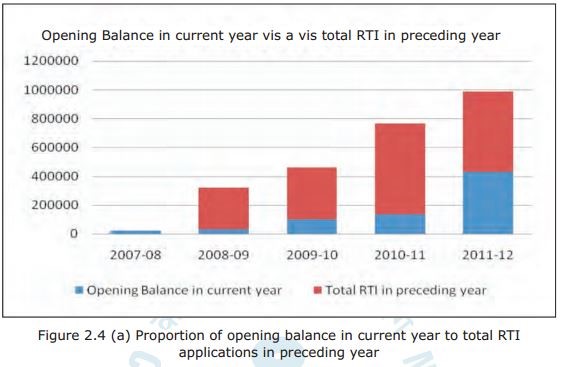
2

In the year 2011-12, the total number of new RTI applications received were 6,55,572. The number of pending cases that have been brought forward to the next year were 4,30,425. Therefore, the total number of cases add up to 10,85,997.  This number cannot be considered to be the total number of applications as there are various organisations and ministries that have not submitted their annual returns on the number of RTI requests they received. Around 53,419 requests for information were rejected by the various authorities for different reasons.  The percentage of rejection also increased from 5.2% in the year 2010-11 to 8.1% in the year 2011-12.  As seen in the above graph, the total number of RTI applications has been increasing. In the year 2011-12, as against 33922 appeals and complaints registered in CIC for disposal, 23112 appeals/complaints were disposed. The report also shows the names of the companies/ organisations that had received the most number of requests. The top 5 in the year 2011-12 are as follows:

I.            Department of Posts

II.            Employees Provident Fund Organization

III.            Delhi Police

IV.            Bharat Sanchar Nigam Limited

V.            State Bank of India


  1. West Bengal: The last updated Annual Report on the website of the West Bengal Information Commission was prepared in the year 2008-09. According to that report, the statistics relating to RTI are as follows:
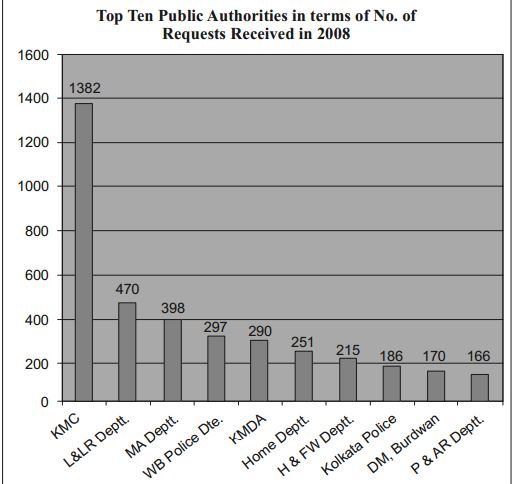
3

The above figure shows the top ten public authorities in West Bengal in terms of the number of requests. In the year 2008-09, the Kolkata Municipal Corporation or KMC received the maximum number of requests under the RTI Act, 2005 and the West Bengal Rules, 2006.
4

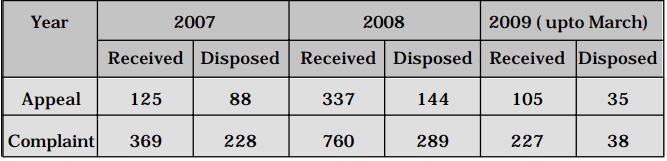
According to the report of the commission, the pendency in the rate of the complaints has also significantly reduced. In the year 2007, the number of pending complaints was 446 and in the year 2008, it fell to 295. In the year 2009, this number reduced further as the number of pending complaints fell to 103. The Commission also states that the number of pending appeals has also reduced. The total number of registered applications in the period 2008-09 was around 7,216.

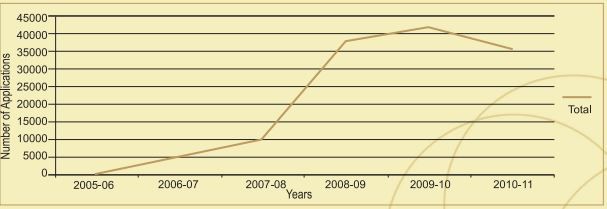
  1. Orissa: The last report published by the Orissa State Information Commission was filed for the year 2010-11. A total number of 35,649 RTI applications were filed during this period.
3
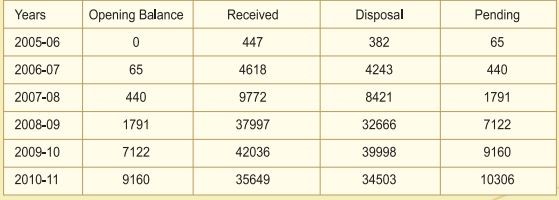
The above graph shows the total number of RTI applications filed in the state of Orissa. The total number of applications in the period 2009-10 were greater than it was in the period 2010-11.  Out of these 35,649 applications, 34.503 were disposed of, which amounts to 96.78% of the total applications.
4

Orissa during 2010-11 had around 10,306 pending applications and this number has been on the rise ever since the RTI Act began being implemented

4.      Bihar: The last report published by the Bihar State Information Commission was for the period 2011-12. The Bihar Information Commission also makes a list of applications received by every University in the state. According to that list, the most number of applications were received by the Magadh University at Bodhgaya with 338 and the least number of applications were at Chanakya National Law University, Patna with 0. In total, the Government (Aided or run) Universities received around 1340 RTI applications during the period 2011-12.  The total number of requests received during this period were 60,553.

5.      Chhattisgarh: The Chhattisgarh State Information Commission last published its report in the year 2011 for the period 2010-11. During that period, it received around 10,400 applications. In the state of Chhattisgarh, 2351 women i.e. 4.81% of the total RTI applications sought information under the RTI Act, 2005. No other Information Commission has published data about the gender- wise breakup of the number of applications. In Chhattisgarh, 2.49 % of the RTI Applicants belonged to the BPL Category.

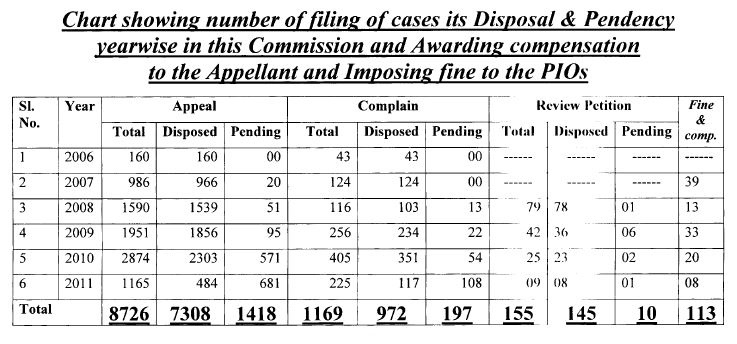
6.      Jharkhand: The Jharkhand State Information Commission had a consolidated report for the period 2007-2008 to 2010-2011. In the state of Jharkhand, the Chief Justice of the High Court made rules for carrying out the provisions of the RTI Act which is known as the Jharkhand High Court (Right to Information) Rules, 2007. The chart below shows the total number of applications and the disposal and pendency rates for the complaints and also the appeals.
9

7.      Uttar Pradesh: The Uttar Pradesh State Information Commission has not released any such report that is mandated under section 25[1] of the Right to Information Act, 2005.

8.      Andhra Pradesh: The Andhra Pradesh Information Commission started functioning on November, 2005. Since its inception, the Commission has disposed of 62760 cases in total. The Commission has not released any reports but has made available some statistics on its website. From January 2011 to October 2012, it received a total of 28,672 RTI applications and it successfully disposed of 18,524 of these applications. The number of cases pending since November, 2005 are 16552.

9.      Tamil Nadu: The Tamil Nadu State Information Commission has never published any Annual Report since its inception.

10.  Kerala: The Kerala Information Commission regularly published reports till the period 2010-11. But the Commission has never revealed the number of applications received by it in any of its reports.

11. Karnataka: The Karnataka Information Commission’s last report was published for the period 2011-12. The total number of appeals that were received during this period were 8814 and out of this, 164 applications were sent in by the people below poverty line (BPL). The Commission disposed of 7768 of the total complaints. Karnataka is one of the few states that shows separate statistics of the BPL applications.

Capture

12.  Goa: The Goa Government has enacted some rules for the appeal which are called the Goa State Information Commission (Appeal Procedure) Rules, 2006. The Commission has failed to fulfil the requirements mandated by the section 25 of the Right to Information Act, 2005 by not publishing any report since its inception.

13.  Maharashtra : The Maharashtra State Information Commission is the only  state commission to publish a report for the peiod 2012- 13. The report is published in the regional language of Marathi.

14.  Gujarat: The Gujarat Information Commission has again failed to publish any report as mandated by Section 25 of the Right to Information Act, 2005

15. Rajasthan: The last report of the Rajasthan State Information Commission came in the year 2011-2012.

16.  Madhya Pradesh: The Madhya Pradesh State Information Commission has again not published any Annual report as required by Section 25 of the Right to Information Act, 2005.

17.  Haryana: The Haryana State Information Commission has also not published any report since its inception.

18.  Punjab:  The Punjab State Information Commission recorded 59,168 RTI applications that were filed during the period 2009-10. The Commission has not released any report after that.

19.  Himachal Pradesh: The Himachal Pradesh State Information Commission in its report for the period 2011-12 states that the total number of applications filed with the various public authorities under the RTI Act, 2005 were 72191. With regards to the appeal, the following chart shows the number of appeals per district.
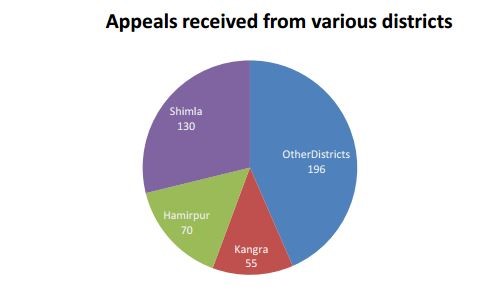
520.  Uttarakhand: The Uttarakhand Information Commission has also not prepared any report as required by Section 25 of the RTI Act, 2005.

21.  Sikkim: The Sikkim Information Commission also does not have any Annual report.

22.  Assam: The Information Commission of Assam last published its report in the year 2009. In the report, it produces statistics of different categories.

23.  Meghalaya: The State Information Commission published its last report in the year 2012. The total number of complaints in the state was 43 and out of this, 39 complaints were disposed of.

24.  Mizoram: Mizoram last published its report for the period 2011-12. According to that report, the total number of requests filed were 1274.

25.  Manipur: The Manipur Information Commission has also not published any report since its inception.

26.  Tripura: The Tripura Information Commission has also not been publishing any report since its inception.

27.  Nagaland:
15

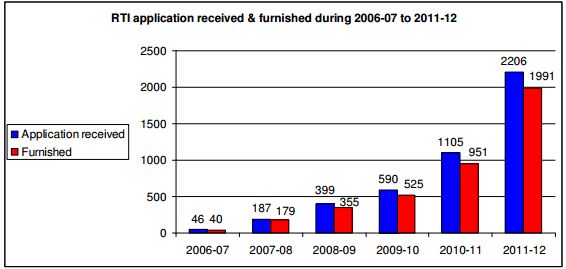
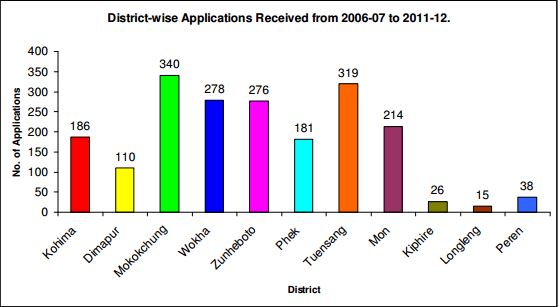
The Nagaland State Information Commission in its report published for the period 2011-12 has put up this chart showing the number of applications filed in the state since 2006-07. The number of RTI Applications filed are clearly on the rise every year. The chart below shows the number of applications filed district wise.  The District of Mokokchung witnessed the most number of RTI applications with 340.
16

28.  Arunachal Pradesh: The Arunachal Pradesh Information Commission has last published its report for the period 2006-07. Since the inception of the act in October 2005 to October 2007, the total number of requests for information received was 555.

In the year 2012, the Commonwealth Human Rights Initiative (CHRI) published a study on the topic ‘The Use of Information Laws in India: A Rapid Study’. This study was based upon the reports published by the Central and the various State Information Commissions in the year 2011- 2012. The study brought about a number of statistics on the use of the Right to Information Act, 2005 and also submitted its various recommendations to the Government. The main findings of the study are as follows:

  • During the year 2011‐12, there were a total of 20.39 lakh (2.03 million) RTI applications that were submitted to the public authorities under the Central Government and in the 10 states which were included in the study which included the state of Jammu & Kashmir.


  • The Annual Report of the CIC does not contain any data about the number of RTI Applications received  and disposed of in the Parliament. There is also no data about the receipt and disposal of RTI applications in the State Legislatures.


  • There is no information about the receipt and disposal of RTI Applications in the Supreme Court and the High Court of Delhi in the Annual Report in the CIC. The State Information Commissions of Andhra Pradesh, Bihar, Chhattisgarh, Karnataka, Meghalaya, Nagaland and Jammu and Kashmir have published RTI Application statistics for High Courts and Courts in their states.


  • In the state of Chhattisgarh, 2351 women i.e. 4.81% of the total RTI applications sought information under the RTI Act, 2005. No other Information Commission has published data about the gender- wise breakup of the number of applications. In Chhattisgarh, 2.49 % of the RTI Applicants belonged to the BPL Category.
    • In Chhattisgarh, 2.49% of the RTI applicants belonged to Below the Poverty Line (BPL) category. No other Information Commission has captured this data category in its Annual Report. However how many of these BPL applicants actually received the requested information is not known.
    • In Maharashtra, 11,246 BPL applicants (1.76% of the total no. of successful applicants) received the information they requested. However the total number of applications submitted by BPL persons during this period is not known. In terms of sheer numbers, successful BPL applicants in Maharashtra were 10 times more than the total number of BPL applicants in Chhattisgarh.
    • The Chhattisgarh State Information Commission has also captured data about applicants from traditionally disadvantaged communities such as Scheduled Castes (SCs – 3.38%) and Scheduled Tribes (STs – 3.06%). This data provides good feedback for the State Government to focus its public education efforts towards these disadvantaged communities – a statutory requirement under Section 26(1) of the Central RTI Act.
    • In Chhattisgarh, the only State where the urban-rural breakup of RTI applicants is available, a little more than a fifth of the applicants (21%) were living in villages. About 79% of the RTI applications were filed by urban residents.
    • Although nothing in the RTI Act requires Information Commissions to capture the age profile of RTI applicants in their report, the user data published by the J&K State Information Commission indicates that a substantial number of information seekers in that State may be young students. The University of Kashmir is reported to have received the highest number of RTI applications (1043) during the last years 2009-12.[iv] It is reasonable to expect that a substantial number of these applicants may be young students.
  • The Revenue and Urban Development Departments topped the list of departments/public authorities that received the most number of RTI applications in the States of Karnataka and Maharashtra. In Andhra Pradesh, the Chief Commissioner, Land Administration whose mandate includes functions similar to that of Revenue Departments in other States topped the list. In Karnataka the Revenue and Urban Development Departments together accounted for more than 50% of the RTI applications received.
  • Rural Development Departments (with or without the charge of Panchayati Raj) figure amongst the top 5 in 7 other States, namely, Andhra Pradesh, Bihar, Chhattisgarh, Karnataka, Maharashtra, Meghalaya, and Nagaland. [v]
  • The Police Department topped the list in Mizoram. The Home Department, including the police, topped the list in Chhattisgarh while in Maharashtra its counterpart occupied the second position. The Delhi Police and the Director General of Police in Andhra Pradesh also figure in the top 5 list. Rajasthan and Jammu and Kashmir are the only States where neither the Home Department nor the Police Department figures amongst the top 5.
  • The State Public Service Commissions in Mizoram and Rajasthan figured amongst the top 5 indicating that most of the applicants might be employment seekers or serving officers.
  • The Jaipur Development Authority and the University of Kashmir are the only public authorities outside of ministries and departments that topped the list amongst all 11 jurisdictions covered by this study.
  • The Ministry of Finance received more than a fifth (20.41%) of the total number of RTI applications submitted to various public authorities under the Central Government.
  •  The Government of the National Capital Territory of Delhi received more than 10% of the total number of RTI Applications accounted for in the Central Information Commission’s Annual Report.


[1] Section 25 of the Right to Information Act, 2005 provides as follows :

“ 1. The Central Information Commission or State Information Commission, as the case may be, shall, as soon as practicable after the end of each year, prepare a report on the implementation of the provisions of this Act during that year and forward a copy thereof to the appropriate Government.


Download Now

The Indian Police Act and Police Reform in India

0

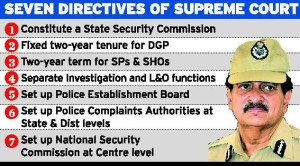
hy05Seven_Directiv_1448255f

“Independent India must choose whether we will have a people’s police or a ruler appointed police, or in other words whether the people should rule or whether the parties should rule. The Constitution has laid down that the people should rule, so the police must also be the people’s police”

–          Khosla Commission in 1968

It is the Constitutional duty of the State to provide an impartial and efficient police service that will help to safeguard the interests of the people. Under the Indian Constitution, policing is a state subject and hence the state Governments are responsible for providing an efficient police force. Most of the states in India have separate legislations dealing with the control of police in that state. The Indian Police Act was enacted by the centre in the year 1861. According to Section 23 of the act, it shall be the duty of every police-officer promptly, to obey and execute all orders and warrants lawfully issued to him by any competent authority; to collect and communicate intelligence affecting the public peace; to prevent the commission of offences and public nuisances; to detect and bring offences to justice and to apprehend all persons whom he is legally authorised to apprehend, and for whose apprehension sufficient ground exists; and it shall be lawful for every police-officer, without a warrant to enter and inspect, any drinking-shop, gaming-house or other place of resort of loose and disorderly characters.

Most of the state legislations on policing are based on the Indian Police Act itself. This act was legislated for making the police a more efficient instrument in curbing, controlling and detection of crime and criminal activities. The Police Act gives each State Government the power to establish its own police force. The UPA Government, when it came to power in 2009 had announced its intention to bring in police reforms in India, but nothing has happened so far. A Human Rights Watch and People’s Watch Report in 2009 claimed that around 1.8 million people are being subjected to torture in police custody across the country. Most of the states enacted a legislation for administration of police only after the Supreme Court decision of 2006. Prior to it, only 4 states had these legislations. These states were Maharashtra (The Bombay Police Act, 1951), Kerala (Kerala Police Act, 1960), Karnataka (Karnataka Police Act, 1963) and Delhi (Delhi Police Act, 1978).

®    The Supreme Court Decision of 2006

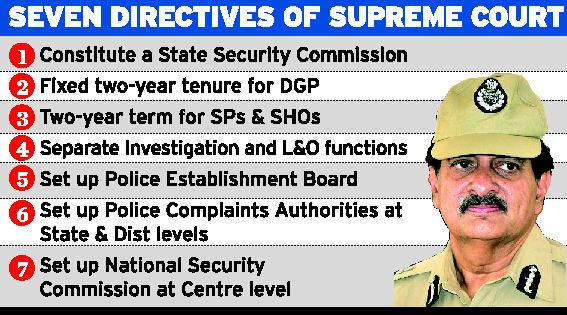
The Supreme Court in the 2006 case of Prakash Singh v. Union of India issued directions to state and central governments and tried to address the problems in the present police laws. The Supreme Court in its order asked the states to constitute State Security Commissions to ensure that the state governments do not exercise unwarranted influence or pressure on the police; to lay down broad policy guidelines, and to evaluate the performance of the state police, enact a new legislation if they do not have one. After these guidelines were issued, many states enacted specific legislations for the police force. But there have been some states who have still not complied with these guidelines of the Supreme Court. The states of Andhra Pradesh, Arunachal Pradesh, Goa, Jammu & Kashmir, Jharkhand, Madhya Pradesh, Manipur, Mizoram, Nagaland, Orissa, Tamil Nadu, Uttar Pradesh and West Bengal still do not have any legislation in place. Some of these states have bills pending in their respective state legislatures.

https://lawsikho.com/course/certificate-criminal-litigation-trial-advocacy
click above

®    A Critique of the Indian Police Act

The Indian Police Act of 1861 was legislated by the British right after the revolt of 1857 to bring in efficient administration of police in the country and to prevent any future revolts. This act has continued despite Indian being transformed from a British colony to a sovereign Republic. The National Police Commission, 1979-81 (NPC) felt the need for reform and hence it went on draft a Model Police Act in its Eighth Report submitted in 1981. Unfortunately, this proposed bill, which was developed as a response to the context of the times, and addressed to end some of the ills that plague policing has not been adopted by any state. Nevertheless, it has served as the template for nascent initiatives for many who are trying to replace the out of date Police Acts in their states with more relevant legislation.[1] A few glaring examples from the recent history of the erosion of the rule of law or of major violations of citizens’ rights resulting from the wrong type of political control over the police are the anti-Sikh riots of 1984, demolition of Babri Masjid on 6-12-1992, inaction in registering or pursuing cases of corruption, scams and frauds involving politicians. The police was also blatantly misused for political purposes during the Emergency (1975-1977). This problem of political interference was also dealt with by the NPC in its 1979 report. The National Police Commissions in 2000 identified indiscriminate arrests by the police as a chief source of corruption. The Report said the power of arrest must be used only in the rarest of rare cases and that an allegation of commission of an offence cannot constitute as a ground for arrest.

The lack of any effective accountability mechanisms and periodic review of performance is causing the police to lose confidence of the public. Another problem is that the widespread indiscipline and cavalier attitudes towards law and procedures are eroding the faith of people in the police. The people nowadays have little or no trust in the police. The Police Act, 1861 vests the superintendence of the police directly in the hands of the state government. At the present time, the Head of Police (Director General/ Inspector General) enjoys her/his tenure at the pleasure of the Chief Minister. S/he may be removed from the post at any time without assigning any reasons. Such a state of affairs has resulted in wide-spread politicization of the police where increasingly, allegiance is owed not to the law but to the ruling political elite. Another problem with the present legislation is that the only independent authority with the capacity to oversee or investigate police excesses is the National Human Rights Commission (NHRC). The Commission has the power to only advise the Government. If any state government refuses to accept the NHRC’s advice, there is no provision in law that empowers the Commission to force the government to implement its advice. It can of course approach the higher courts and seek directions. The NHRC had issued four summons to the Director General of Police, Bihar, over the last eight months for the two wrongful arrests of activists, only to be met with a wall of silence. The Government had set up the Soli Sorabjee committee to suggest police reforms and they came up with a draft bill which was never passed by the Parliament, for unknown reasons. Even the J.S Verma Committee which was set up after the Nirbhaya Rape case suggested police reforms. There is a need to bring in police reforms so that the police can be made accountable by the citizens. More power in the hands of the police will not help, but more responsible use of the abundant power that they already have. The Police Act, 1861 needs to be replaced with legislation that reflects the democratic nature of India’s polity and the changing times. The Act is weak in almost all the parameters that must govern democratic police legislation.


LawSikho has created a telegram group for exchanging legal knowledge, referrals and various opportunities. You can click on this link and join:  

https://t.me/joinchat/J_0YrBa4IBSHdpuTfQO_sA

Follow us on Instagram and subscribe to our YouTube channel for more amazing legal content 


Download Now

Current Issues in Indian Pharmaceutical Industry

3

Acquisitions and Regulatory Mechanisms

Indian pharmaceutical companies gained their stature by selling generic drugs in a market previously dominated by MNCs. However, post-2005 it became difficult to sustain their growth, with the advent of product patents. Reverse engineering of patented drugs became extremely difficult with the advent of product patents.


#1 – Exits from the sector by key players:

The companies are exiting the business in entirety  or selling certain brands , so we have complete and partial acquisitions. While those companies which are being acquired completely are exiting the business to invest in other non-related sectors like energy , financial services. Those which are selling only certain brands leading to partials acquisitions are the ones which aspire to stay and grow in the pharmaceutical sector itself. The pharma industry is plagued by many top-notch industry bigwigs quitting the sector. Ranbaxy was sold to a Japanese company  Daichii Sankyo for US $4.6 bn in 2008. Abbot bought Piramal healthcare for US $ 3.7 bn making it the market leader and it gained access to 350 brands of Piramal healthcare & trademarks. Since 2001, 100 % FDI was allowed in the Pharmaceutical sector both in Brownfield & Greenfield investments.   However mostly brownfield investments have taken place. A controlling share was acquired by Sanofi-Aventis in the unlisted Hyderabad company Shanta Biotech.

The reason why these companies are exiting is because their base was built in a protected market where generic production was their staple source of revenue. However post-2005 they have realized the issues they are facing now that they must directly compete with international players, even if they have less resources to spend on research and development.

Also not all Indian companies have a structured marketing chain like some of the foreign brands have in the global market. The mouth watering valuations of the companies are lucrative enough for the owners to give it a thought. The problem is that it is difficult for these companies to grow selling only generic drugs and neither do they have the money or the infrastructure to produce new, original drugs on a mass scale. While Sun Pharma is looking at the energy sector as it has untapped potential and growth opportunity , the owners of Ranbaxy – the Singh brothers already had Religare- an investment company & Fortis – a successful chain of hospitals. Thus, the money that these pharma companies will get from selling of their units will be invested into something that has a better return and will probably take less time than developing R&D and passing through the gestation period before these new drugs even if approved will take to become a top-selling one.

However, with the Indian companies bailing out, it is possible that the price of low-cost generic drugs will go up both in the Indian and probably also the global market .

A few companies have not entirely exited from the pharma sector, but have tried to focus on their core products. For example, JB chemicals , a company valued at 871 cr sold its most successful brand “doktor mom” on which it became a runaway success story in Russia, because its revenue did not match its spends. The money JB chemicals got through divesting its business in Russian medical market to Johnson & Johnson will help the company grow. The step was taken expecting to help the company invest into R&D and also to help increase the stock value of the company in the long run.


#2 – Government regulations

One point of concern is the regulatory framework. Under Indian law, all drugs which qualify as ‘bulk drugs’ must have an end-price that is regulated by the government – the recent DPCO 2013 (Drug Price Control Order)  seems to have increased the number of bulk drugs from 74 to 348. This may prove to be a deterrent to Indian pharma corporations leading to a lot of exits.


#3 – USFDA checks

Recently Ranbaxy had to pay $500 million fine as a result of its non-compliance of generic drugs. This is what essentially has sparked off the USFDA (United States’ Food & Drug Administration) to go in for more surprise checks and even open up an additional office at Hyderabad (to check if Indian pharma companies which export to the US are compliant with US law and manufacturing standards). Though allegations have been made towards it for taking on Indian pharmaceutical companies more harshly than those of its other global counterparts, it cannot be denied that India is one of the topmost places for generic drug production. It accounts for about 40% of the generic products in the US market.


Survival strategy for Indian companies

There are certain hindrances to the development of Indian pharma Industry , especially in the wake of the sell-offs that have happened off late.

Indian companies are facing competition from generic medicine producers from developing countries. Selling only generic drugs will not yield enough for their growth and sustenance. The Indian companies are looking towards developing innovative drugs. Right now the bulk drugs contribute to a minority of their income but it may increase and open up a new dimension. The ‘generic’ model is slowly getting changed as more and more companies are gradually carrying out R&D in original drugs. Some of the pharma companies like Dr.Reddy’s, Glenmark had already started investing money in the R&D sector as early as 90’s. Today 40% of Dr.Reddy’s production counts for original drugs and 60% for generic drugs. Companies such as these had an added advantage for companies like Piramal which was based on 100% generic production.  Also the DPCO will lead to a stricter government control at least till a certain extent. Those companies which can risk and keep itself going even in the wake of cut-throat competition by MNC’s and stand the regulatory issues will become grow well and probably give the MNC’s a run for their money but that is only when the ‘original’ drugs will do well while maintaining their status-quo in the generic market. This has already been observed in respect of certain companies who are already competing with the MNC’s in the market share for off-patent drugs. Their successful growth can be estimated by the fact that currently the companies are selling out are getting an amount getting  multiple times the amount of their sales.

Those who do not want to take the risk may indulge in sell-outs once they get a lucrative enough offer. Small to mid-size corporations who are still committed to the sector may have to sell out one of their most successful brands and if they prioritize growth. The sector will especially be difficult for any new entrants. The R&D capacity needs to be diverted from reverse engineering generic drugs towards innovation.


South-East Asia and other emerging trends for Indian pharma companies

However, in spite of all troubles there have been certain developments which can probably help the sector survive and probably make it big in unexplored markets. Also concerns about certain issues have been raised by certain authorities.

However on the brighter side, the South-East Asia market has opened up a  new window for the Indian pharma companies. The finding is the result of a recently carried out survey by the Associated Chambers of Commerce and Industry (ASSOCHAM). They offer cheap R&D opportunities as well as no regulatory uncertainty. Red-tapism in India slows down the process of approval and it typically takes more than year to get the drugs approved by agencies like USFDA, EU.  These two reasons coupled together result in a win-win situation for the pharma companies. Also one more additional benefit is that these countries have a similar patient population and disease profile.


Government measures to prevent domestic pharma companies

However a standing committee of the parliament (April 2013) in the 110th report on FDI in pharmaceutical Industry is seeking a blanket ban on FDI in the pharmaceutical sector as it will surely affect the price, availability of the drugs and  is proving to be disadvantageous for the Indian Pharma industry. If this report is taken into account it will certainly boost up the Indian Pharmaceutical Sector.

This will help India go back to the market which existed before the 2005 amendment resulting in a protected market environment for domestic players.

ASSOCHAM has written to the Health Ministry to prevent the slowdown of the clinical R&D in India which is one of the primary reasons that a lot of Indian companies are thinking of shifting their operations to South-East Asia.


Download Now

Legal issues in Joint Development Agreements

23
joint development

How to derive revenues out of land ownership

land-for-sale-signA person owning a piece of land has various alternatives to get revenues out of it (apart from leasing it out or using it as a commercial property). First alternative is to wait for the price of the land to appreciate and retain it for a good amount of time. Second alternative is to get a building constructed. For that an owner will have to not only arrange for the additional finance required for the construction, but he will also have to get approvals and look after the construction activities. He might not have the requisite expertise, time and money to complete the construction. A builder on the other hand if is willing to construct one, might have to block his funds so as to purchase the piece of land in the first place, because purchasing the land constitutes a large part of the total investment. He might fall short of the funds required for the expenditure that needs to be incurred. The third alternative is a solution to the problems faced by these two entities i.e. A Joint Development Agreement. This is an arrangement between an owner of the land and a builder where the land owner contributes the land and the developer undertakes the responsibility of obtaining approvals, property development, launching and marketing the project with the help of his financial resources. As beneficial it is, it’s not devoid of any limitations. The landowner in these cases, has to wait for a long time till the construction is complete. During this period, real estate market might suffer changes. The amendments in Income Tax Act impacts the builder and landowner. Prospective buyers have to take due precaution while purchasing flats which are under such form of agreement.


Joint development models

Developing agreement models are of various types

  • A land owner may come into an agreement with a developer only to develop the land under a fixed consideration which may be in cash or kind. The developed area is divided into plots and sold as plots only. Here again the Land owner may be owning the land as ‘Capital Asset’ or as’ Stock in trade’. Here the developer only gets paid for his services.
  •  One or more land owners may enter into an agreement with a Developer to construct a Building and then to share the Built up area in a definite proportion. Here again the Land owner may be owning the land as ‘Capital Asset’ or as’ Stock in trade’.
  • A land owner may contribute his land to a partnership firm and then the partnership firm acts as the developer and develops the land. On the completion of the project profits are shared.

The variation might be on other grounds too. The nature of the structure may be commercial or residential; the percentage of the benefit of land owner may be different and the time of passing on the benefits or project period may differ. The form of arrangement will decide the statutory obligations arising out of it.

How the joint development mechanism works

#1 Profit sharing and price determination

Depending upon the land price, the joint development ratio is decided among the parties. In most situations, the builder will agree to allot a few flats to the landowner and will pay a token advance. In consideration for this, the landowner will part with a portion of undivided share (UDS) of land in favor of the builder or his nominee and will also allow the builder to construct and sell the agreed number of flats.The developer is given right to seek prospective buyers, fix sale prices for his share of the flats.

A certain percentage of constructed area is set aside for the owner. Usually he gets a 30-40% share in the total outcome.  In the case of sharing revenue from the built-up space, it is the responsibility of the developer to develop the parcel of land jointly with the land owner and sell or lease the built-up space to third-party purchasers/lessees and share the proceeds in an agreed ratio. Owner is entitled to either disposes off the constructed area or may decide to retain the share of his built up area, or sell it at a later stage. The remaining portion i.e. the flats are sold by the builder as per his interest by entering into separate agreement with the prospective owner on his own capacity and not on the basis of GPA holder of the owner.

https://lawsikho.com/course/diploma-advanced-contract-drafting-negotiation-dispute-resolution
Click Above

#2 Property ownership and license to construct

The developer himself does not buy the land/property from the owner.The developer is not the transferee or buyer of the flats as per the Transfer of Property Act, 1882 under the Joint Development Agreement. The sole ownership lies with the owner of the land, but the landowner grantsthe developer along with development rights, a license to enter the land for the purpose of development but not as a transferee/buyer. The license/authority to enter the land is typically given by way of a power of attorney issued in favor of the developer.The general power of attorney should be registered on appropriate value stamp paper with the concerned authorities (registrar) in order to be legally binding on both parties. The stamp duty payable for this kind of GPA given to the builder under a joint development agreement is Rs 1,000. This may vary from state to state.The license gives way to the developer to gain approvals and raise debt by way of mortgage or appoint third parties for advertisement. This power of attorney granted without permission can be revoked by the person granting it unless it’s issued as a part of discharging contractual obligations. In such case revocation would lead to breach of contract.

Once the plan is approved, the owner should get an allocation agreement done recording the constructed area which comprises his share and the area going to the developer. Once the building is ready and the allocation agreement is done, it is better that a deed of declaration is executed recording the constructed area, which would reflect the area constructed for the site owner under the joint development agreement.

#3 Continuous cooperation between the owner and the builder

For the purposes of transfer of the constructed space by the builder, the co-operation of the owner is highly essential. Once the construction of the flat is constructed and occupancy right is granted by the competent authority to the owner, the owner will himself execute the sale deed in favour of the flat buyers. The developer will have the right for specific performance which shall be specifically enforceable in a court of law if the land owner fails to cooperate with the developer in selling/leasing the built-up space on the land.However, in case of breach of the terms of the development agreement, the land owner would have the right to revoke the power of attorney.


Follow the links below to know more on the related topics:

Intellectual Property Issues In Joint Ventures

An Overview On The Working of Dispute Resolutions Provisions In Joint Ventures


LawSikho has created a telegram group for exchanging legal knowledge, referrals and various opportunities. You can click on this link and join:  

https://t.me/joinchat/J_0YrBa4IBSHdpuTfQO_sA

Follow us on Instagram and subscribe to our YouTube channel for more amazing legal content 


Download Now
logo
FREE & ONLINE 3-Day Bootcamp (LIVE only) on

How Can Experienced Professionals Become Independent Directors

calender
28th, 29th Mar, 2026, 2 - 5pm (IST) &
30th Mar, 2026, 7 - 10pm (IST).
Bootcamp starting in
Days
HRS
MIN
SEC
Abhyuday AgarwalCOO & CO-Founder, LawSikho

Register now

Abhyuday AgarwalCOO & CO-Founder, LawSikho