Download Now
Home Blog Page 1561

All you need to know about Model Nikahnama

0

In this article, Shivendra Pandey of National Law University Odisha discusses on Model Nikahnama.

What is Nikahnama

Nikahnama or the contract of marriage is a document which entails all the details of the marriage contract for example Name of the groom and bride and their personal and family details, their economic status, the most important terms of ‘mehr’ (dower) or consideration, the form in which mehar has to be payed, time, and other details.

All the conscionable terms and details can be included in the “Nikahnama” due to which it is very important. Muslim Personal Law Board also referred as AIMPLB has passed a standard form of Nikahnama to be followed. However, it is not binding.

Purpose of Nikahnama?

As per the “Muslim Law” a marriage is a form of civil contract. A Nikahnama acts as a written form of contract. It acts a proof of marriage in fact, it is the backbone of a marriage. As it carries all the details related to the marriage contract between bride and groom which entered while the solemnisation of marriage. It acts as a key to resolving issues arising out of marriage. It is pertinent to note that All India Muslim Personal Law Board (AIMPLB) first passed voluntary guidelines for a model “Nikahnama” in the the year 2005 however they did not have a binding effect.

Why we need a ‘Model Nikahnama’?

Nikahnama is the foundation of a marriage. It is pertinent to note that All India Muslim Personal Law Board (AIMPLB) first passed voluntary guidelines for a model “Nikahnama” in the year 2005, however, they did not have a binding effect. At present there is no “Model Nikahnama” which has a binding effect on all marriages. Nikahnama has got huge attention especially due to the current “Triple Talaq” debate because a “Model Nikahnama” binding on all marriages in the country will help women secure a better status in the Muslim society. It has been widely observed that without any Model Nikahnama marriages are solemnised with lot of erroneous data.

On the role of Qazis, Supreme Court observed in All Assam Muslim Marriage & Ors. vs State Of Assam And Ors:

Qazis are not empowered under the law in India to issue certificates of marriage or divorce. Their presence during either of the events does not validate the events and their absence does not invalidate them”.

Even families intentionally provide wrong data in the nikahnama for their short term benefits which in future turn out to be an apple of discord. Sometimes when there is an information missing in the Nikahnama the plaintiff has to settle with the remedy decided by the court and it also gives a stronger party to dominate the weaker one.

Due to these errors in the data it becomes a herculean task for the Courts to settle disputes.

There is a need for more lucid and well defined guidelines which are binding on all the couples marrying under the Muslim Law/Shariat law. Even families intentionally are unaware of a lot of terms in the ‘Nikahnama’ which later turn out to be a cause of conflict. There is a dire need to eradicate this serious issue. There should be well trained or at least there should be a minimum qualification to be a Maulvi witnessing the marriage.

Nikah Nama in Controversies

Nikahnama has become a burning issue due to the recent controversies over the ‘validity of the concept of “Triple Talaq” in marriage under the Muslim Law’. The As per a lot of scholars such model of “Nikahnama” should be developed which prohibits “Triple Talaq” should not be allowed some have even suggested that both husband and wife should be given the option of “Triple Talaq” but it’s a minority view. AIMPLB recently accepted that “Triple Talaq is wrong but valid” Muslim Board. Supreme Court has frequently advised the AIMPLB to clear its stance on Triple Talaq, polygamy and nikah halala practices.
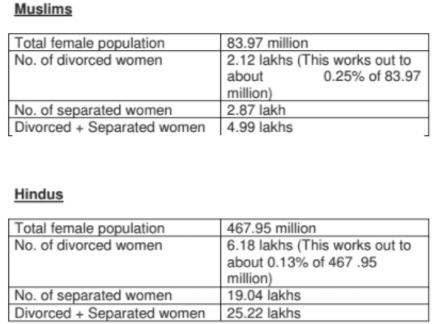
Data according to Census 2011, India

As per the data aforementioned it can be easily inferred that Muslim women are proportionately two times prone to divorce than Hindu women. This shows the ill effect of concept of “Triple Talaq”. The constitutional validity of practice of ‘Triple Talaq” is under the sub judice. Hon’ble Supreme Court concluded historic hearing but reserved its verdict. The constitutional bench was headed by judges hailing from different religious communities hindu, muslim, christian, sikh and parsi. The Court’s verdict will have long lasting lasting effect on the whole judicial system of the country. This judgment has the potential to change the face of Indian judiciary.

What will be the benefits of a “Model Nikah Nama”?

Its possible benefits

  • It will bring uniformity in the Nikah Namas.
  • It will expedite the judicial process.
  • It will simplify the Maulvi task.
  • It will help simplify the terms of the marriage.
  • It will gradually minimise the chances of any erroneous data.
  • It will protect any party any party from taking undue advantage of the other party.
  • It will encourage women to seek judicial redressal.

Conclusion

Under Muslim Law, marriage has been considered as a pious civil contract. “No sacrament but marriage has maintained its sanctity since the earliest time. It is an act of ibadat or piety for it preserves mankind free from pollution […] It is instituted by divine command among members of the human species”. A valid contract is which puts contracting parties at equal status but as per the present practices in marriage women are put at stake they have to face hardships. There is ample available data which proves that the condition of Muslim women is grave in Indian society and there is ugent need to take steps to ameliorate the grave condition of Muslim women in the country. It’s the state obligation to protect and ensure equality among its citizens. Religious beliefs and practices have to evolve with time because

Change is the law of nature”.

References:


Download Now

Arguments against Implementation of Uniform Civil Code

6
uniform civil code

In this article, Ashok Samal of HNLU gives arguments against Implementation of Uniform Civil Code.

Article 44 of the Constitution of India talks about the implementation of a Uniform Civil Code throughout the territory of India. Implementing Uniform Civil Code would mean that all the personal religious laws shall be kept at bay and a uniform personal law governing areas of marriage, divorce, inheritance etc. shall be formulated. This law shall not keep in its ambit personal law regarding any religion or culture and it shall be the same for all persons irrespective of their caste, creed or colour.

This is probably the most debated topic in recent days and is full of controversies too. While a large number of citizens favour it, a similar number of people are showing their general discomfort with the idea. The supporters of the move argue vehemently by saying that the presence of different personal laws creates a clouded atmosphere of confusion and is also hard to follow. The people who are against it point out several flaws with the concept and thus present various arguments against it. We will be discussing some of these arguments today.

UCC in the Constitution and other Laws

Article 44 in Part IV of the Constitution of India says that “The State shall endeavour to secure for the citizens a uniform civil code throughout the territory of India.”

The article being placed in the Directive Principles of State Policy, is not binding or mandatorily enforceable on the government or the people. Major opposition to the idea was the reason behind this Article being placed in the DPSP’s.

The slow implementation of UCC has started from the period of British India, when Lord William Bentick tried to suppress unjust religious practices such as the tradition of Sati Pratha.

Some of the laws that were passed to bring about religious stability and gender equality are as follows:-

  • Indian Succession Act, 1865,
  • The Indian Marriage Act, 1864,
  • Hindu Widow Remarriage Act, 1856,
  • Married Women’s Property Act of 1923,
  • Hindu Inheritance (Removal of Disabilities) Act, 1928.

The UCC tries to bring in about a reform of the same sort by neutralising the redundant provisions of each personal law and replace them with more time compliant laws.

Practices being dispute

Some practices that are found contrary to humanitarian laws are liable to be restricted once UCC is implemented. These laws are mostly of the minority class. But the idea behind UCC is to take out the best from all the personal laws and integrate it to formulate one uniform law that will be enforceable on all and will be welcome by all as it won’t dispute anyone’s law and every minority would be able to absorb in the new law. Before the implementation of laws like Hindu Widow Remarriage Act of 1856, Married Women’s Property Act of 1923 and the Hindu Inheritance (Removal of Disabilities) Act, 1928, hindu women had close to no rights, so the passing of these laws was a significant move and permitted Hindu woman the right to property. The legislature intends to follow the same suit and do the same for all personal laws and formulate an uniform law for all of the citizens of India that would guarantee their rights in accordance with modern times.

The law commission has recently taken out a survey comprising of a detailed questionnaire for the people to answer which puts forth several questions on specific personal laws and their place in the modern society. The questionnaire in detail can be accessed here from this link.

These are some of the practices of personal laws that might not find any place in UCC.

  • ‘Talaq-e-bidat’ – In this kind of divorce a muslim man can easily divorce his wife by saying the word ‘talaq’ more than one time in a single ‘tuhr’(a time period between two menstrual cycles) or in a period of tuhr after consummation.
  • Triple Talaq
  • ‘Nikah halala’ is an example of another religious practice ostensibly based on the Quran. Shah Bano’s plea in the landmark judgment of Ahmed Khan v. Shah Bano Begum (1985 SCR (3) 844) describes it as:

“Further, once a woman has been divorced, her husband is not permitted take her back as his wife even if he had pronounced talaq under influence of any intoxicant, unless the woman undergoes nikah halala which involves her marriage with another man who subsequently divorces her so that her previous husband can re-marry her.”

Who are against UCC

Considering the background behind UCC and the issues it promises to resolve, those who have been opposing the idea are vocal about their opposition to the said amendment, saying that it is particularly unconstitutional and it takes away the cultural and religious rights of other minorities as well, which was promised to them by the founding fathers of the constitution.

  • Naga Community

The naga minority community is also reportedly upset by the implementation of UCC. The Nagaland Bar Association has markedly warned that the implementation of UCC would bring about clear trouble for the culture and dignity of the Naga people.

They, in a letter addressed to the Prime Minister stated that,

“It will cause social disorder, and if  a Uniform Civil Code is introduced covering the entire country, it shall cause so much hardship and social disorder to the Nagas as the personal and social life of the Nagas are quite distinct from the rest of people in the country.”

  • Few Political Parties

Some other political parties are also against the move of the implementation of UCC. They also support the minority issues by saying that it is a clear violation of the minority rights. They also put forth some very important points towards the impossibility of the implementation of UCC. Their main issue lies in the fact that its implementation of a country of diverse cultural diversity would be virtually impossible.

One of the continuing fears that lies with the muslim community at this moment is that the implementation of UCC is a deep rooted conspiracy directed at One of the prevailing fears associated with the UCC is that its implementation is a conspiracy aimed at setting aside the views of the minority communities and mandatorily imposing Hindu Personal Law on all citizens of the nation.

  • Muslim Community

About the questionnaire taken out by the law commission, there has been clear and evident rejection by the muslim community as the All India Muslim Personal Law Board completely disregarded the Law Commission’s questionnaire on the UCC and decided to boycott it.

All India Muslim Personal Law Board’s General Secretary Mr. Maulana Wali Rehmani said that,

“Uniform Civil Code is divisive and will lead to social unrest, and that It is against the spirit of the Constitution, which safeguards the right of citizens to practice their culture and religion,”.

The minorities view reflects the viewpoint that if need comes the Union Government can take out a public referendum on the issue of triple talaq and not just hold what the majority views are on the issue. The view is that it’s a part of muslim personal law and thus only Muslims shall be allowed to decide on the issue and not persons of every religion and community.

Arguments against the implementation of UCC

There are several arguments and standpoints against the implementation of a Uniform Civil Code. We will be discussing some of these arguments in vibrant detail here:-

A move against secularism.

In India, a country with diverse languages and traditions, expecting people of diverse culture and traditions to act on the same laws, based on a uniform system is somewhat preposterous.

The argument is based on the fact that India takes pride in its integrity within diversity. For maintaining diversity, we need to respect every minority communities personal choices and laws. That is what has led this nation to live in peace for such a long duration of time. The question that we need to ask ourselves is that whether the violation of personal laws is acceptable or not. We should also be practical while going about this issue. The impracticality of this issue lies in the fact that there are 14.2% Muslims in India and any move towards implementing UCC has received heavy opposition and criticism from their side. So it is an injustice to them by imposing majority Hindu views on them. A secular India is what the founding fathers promised when they formulated the Constitution and that is what the minority is demanding for. The government must respect the emotions of the minority population and thus decide on whether to infringe upon the personal law or not.

In the landmark judgment of S. R. Bommai v Union of India the honourable Supreme Court explained the concept of Secularism as,

“The Constitution has chosen secularism as its vehicle to establish an egalitarian social order. Secularism is part of the fundamental law and basic structure of the Indian political system.”

Infringement of personal religious laws.

The Muslim community vehemently opposes the move by the government and they all say that UCC would violate their personal laws gravely and would thus result in irreversible damage to their religion and the laws therein.

A strong argument which goes against the implementation of the Uniform Civil Code is, the very idea of assimilating all the personal laws into a uniform code will infringe the constituents of personal laws of most of the minority religion. 

The dilemma between good and bad

The minority community raises a very pertinent question that what is the place of the government to decide what laws need to be reformed and what laws fit perfectly within the skeleton of UCC.

It is actually a very diligent question that they raise. For the current government to fully implement a workable Uniform Civil Code, it is necessary that they formulate a code that is acceptable to all the communities, but that is best left to imagination as it is an impossible job. All the communities vehemently oppose any, however small it may be, interference with their personal laws and the government plans to completely dissolve it.

Besides, what laws the government would want to absolve, it would have to justify that those laws violate basic human rights and thus need to be abolished for proper governance.

The implementation of UCC would try to bring about a long needed change and an end to plenty of confusion that is mandatorily needed, but due to some of the disadvantages it offers, it has become hard to implement it, even though decades have passed since it was proposed for the first time.

Download Now

Specific Performance of Contract and its enforceability

3
specific

In this article, Yash Kansal discusses Enforceability of Specific Performance of Contract.

Introduction

The Law of Specific Relief in India was originally codified by Specific Relief Act, 1877. The provision of this enactment was considered by the Law Commission in its Ninth Report which was later replaced by the present act of 1963. The Specific Relief Act, 1963 deals with the remedies granted at the discretion of the court for the enforcement of individual civil rights. In case of breach of contract, the general remedy available to the aggrieved party is compensation or damages of loss suffered. For this, a civil suit is filed against the guilty party who had made the default in performance of its duty or obligation as per the terms of contract under the statutory provision of Section 73-75 of Indian Contract Act 1872. However, sometimes pecuniary compensation does not satisfy the plaintiff so he may ask for specific relief. For example if somebody unlawfully dispossess a person without his consent having peaceful possession over the property then specific relief may enable him to have the possession of same property instead of claiming pecuniary compensation.

The act provides the following kinds of Specific Relief

  • Recovery of possession of property
  • Specific performance of contracts
  • Rectification of instruments
  • Rescission of contracts
  • Cancellation of Instruments
  • Declaratory decrees
  • Injunction

Specific Performance of Contracts

Specific performance means enforcement of exact terms of the contract. Under it the plaintiff claims for the specific thing of which he is entitled as per the terms of contract. For example, if A agrees to sell certain shares to B of a specific company which are limited in number and after the payment made by B, if A refuses to sell the shares then B is entitled to recovery of those shares.

According to Section 10 of Specific Relief Act 1963 in the following conditions specific performance of the contract is enforceable:

  • When there exist no standard for ascertaining actual damage: It is the situation in which the plaintiff is unable to determine the amount of loss suffered by him. Where the damage caused by the breach of contract is ascertainable then the remedy of specific performance is not available to the plaintiff. For example, a person enters into a contract for the purchase of a painting of dead painter which is only one in the market and its value is unascertainable then he is entitled to the same.
  • When compensation of money is not adequate relief: In following cases compensation of money would not provide adequate relief:
  1. Where the subject matter of the contract is an immovable property.
  2. Where the subject matter of the contract is movable property and,
  3. Such property or goods are not an ordinary article of commerce i.e. which could be sold or purchased in the market.
  4. The article is of special value or interest to the plaintiff.
  5. The article is of such nature that is not easily available in the market.
  6. The property or goods held by the defendant as an agent or trustee of the plaintiff.

In Case of Ram Karan v. Govind Lal [1], an agreement for sale of agricultural land was made & buyer had paid full sale consideration to the seller, but the seller refuses to execute sale deed as per the agreement. The buyer brought an action for the specific performance of contract and it was held by the court that the compensation of money would not afford adequate relief and seller was directed to execute sale deed in favour of buyer.

Similarly, it was held by the court where the part payment was paid by plaintiff and defendant admitted that he had handed over all documents of title of property to the plaintiff. Sale price in an agreement is not low and defendant had failed to establish that said document was only a loan transaction then the agreement is valid and defendant is liable to perform his part (M. Ramalingam v. V. Subramanyam)[2].

https://lawsikho.com/course/diploma-advanced-contract-drafting-negotiation-dispute-resolution
Click Above

Contracts which cannot be specifically enforced

According to Section 14 of Specific Relief Act 1963, there are certain contracts which cannot be specifically enforced and these are:

  • Where compensation in money is an adequate relief: Here the court will not order specific performance of contract as it is expected that the plaintiff will bank upon the normal remedy for breach of contract i.e. remedy of compensation. For example contract of mortgage of immovable property (Rambai v. Khimji)[3], contract of sale of goods (Bharat v. Nisarali) [4], contract of repair of premises etc.
  • Where a contract runs into minutes or numerous detail: These contracts includes contract which depends upon the personal qualification or the violation of the parties or is of such nature that the court cannot enforce specific performance of its material terms. In Robinson Davison [5], it was held by the court that the contract to perform in concert depends upon the personal kill of defendant’s wife, and the contract cannot be specifically enforced due to her illness. The other example is construction contract where the detailed terms of contract are not explained.
  • Contracts of determinable nature: Determinable contract means a contract which can be determined or revoked or put to an end by a party to the contract. For example in case of partnership at will any partner can retire by giving notice in writing to other partners and can dissolve the firm.
  • Contracts which involve the performance of continuous duty which court cannot supervise: Earlier under Specific Relief act, 1877 the continuous duty which court cannot supervise is considered over a period of 3 years which was omitted under Specific Relief Act, 1963 and no time limit restricted for the performance of a continuous duty. These include contract of appointment of employees for continuous service or contract to execute sale deed every year. In Central Bank v. Vyankatesh [6], the defendant was required to execute deed every year for the period of 25 years and contract is held to be specifically unenforceable.
  • Contract of arbitration: According to Section 14(2), a contract to refer present or future differences to arbitration shall not be specifically enforceable.

However, Section 14(3) contains certain exception and the following kinds of contract are specifically enforceable

  1. A contract to execute a mortgage or furnish other security for repayment of any loan which the borrower is not willing to repay at once, the court would grant specific performance to execute mortgage or to give any other security.
  2. A contract to take up and pay for any debentures of a company.
  3. A contract to execute a formal deed of partnership at will when the business has already commenced.
  4. A contract for the construction of any building or the execution of any other work on land if;
  5. Detailed or the terms of the contract has been sufficiently explained & the court can determine the exact nature of building or work.
  6. The plaintiff has a substantial interest in performance of the contract and compensation in money is not an adequate relief.
  7. The defendant has in accordance with the contract, obtained possession of whole or part of the land on which the building is to be constructed or other work is to be executed.

LawSikho has created a telegram group for exchanging legal knowledge, referrals and various opportunities. You can click on this link and join:
https://t.me/joinchat/J_0YrBa4IBSHdpuTfQO_sA

Follow us on Instagram and subscribe to our YouTube channel for more amazing legal content

References

[1] A.I.R. 1999 Raj. 167

[2] A.I.R. 2003 Mad. 305

[3] AI.R. 1950 Kutch 86

[4] 20 Cal W.N. 1020

[5] (1871) L.R. Ex. 269

[6] A.I.R. 1949 Nag 286

{ [1-6] with ref. to Law of Contract & Specific relief act 1963 by R.K. Bangia}


Download Now

What is the liability of payment gateway when there is failure of payment online?

2
payment gateway

In this article, Ravi Prakash Shukla who is currently pursuing Diploma in Entrepreneurship Administration and Business Laws, from NUJS, Kolkata, discusses the Liability of Payment gateway when there is a failure of payment online.

Payment gateways provide merchants with a software and connectivity that is essential in order to allow real time secure data transmission for the processing of the credit or debit card information and payments on the website or on an application designed for mobile platform.

In order to comprehend the liability and rights of a payment gateway, we need to know how they function. When using a payment gateway, the customers are prompted with a secure payment page when they are checking out, When the customer submits the payment request from a website or ERP or a third party application, he is led to a payment gateway page. The information is passed securely by k-ecommerce to a payment gateway. Then the payment gateway tokenizes the sensitive information and it is thereafter sent to the merchant’s acquiring bank. The processor then sends an approved or denied failed message to the payment gateway; the response received by the payment gateway is then pushed to k-ecommerce tables. The payment information is acquired and then applied to Microsoft Dynamics

In exchange of the service provided by a payment gateway, the merchant has to pay a particular small fee to the gateway. Hence, There exists an agreement between the merchant and the payment gateway. Subject to this agreement, the payment gateway is liable to send to the bank account of the merchant/customer, all the amounts due from the transaction, minus and fees, reversals, invalidated payments or any failed transaction amounts. It is often mentioned in the agreement of various payment gateways that in case of liabilities, the gateway will only be liable for the amount of damage done; In other words, its liability will not exceed the damage caused.

The payment gateway however will not be liable; except provided in the agreement of a particular payment gateway, for any loss occurring, including negligence arising from customer’s failure to adequately integrate or activate the merchant account, fraudulent transactions processed through customer’s payment gateway account. Or even the disruptions experienced in the transactions including DDOS attacks, software virus, Trojans, worms, bombs or any other unscrupulous means or the limitation of any hardware used to process the payment request.

The Third party products and services

The payment gateway is also not liable for any third party products and services; unless expressly mentioned in the agreement. Also it has no liability in case of fraud involved in utilizing the third party products and services.

Indemnification

The payment gateways shall indemnify, hold the customer, or any of the customer’s officer harmless from any third party claims, actions, proceedings and suits. (Including the attorney’s fees and litigation charges. However these services do not apply in the following cases: –

  1. if the transaction agreement have been modified by parties other than the payment gateway.
  2. If the transaction services are used in conjecture with data, wherein the use of such data signifies infringement claim.
  3. Customer’s failure to adequately install the patches or update the software’s relevant to the payment gateway as provided by the particular payment gateway.
  4. If the customer uses the payment gateway in a way that is inconsistent or against he service documentation.

Customer’s use of the payment services on a platform, hardware not authorized by the payment gateway.

Customer’s warranty

In addition to all the mutual warranties enclosed in the agreement, the gateway also provides warranty to the customer. Each party warrants the other party that it has the essential rights and power to execute the agreement and perform the obligations therein., Also that no authorization from a third party is required.

Particular Gateway Warranty

As the name suggests, every payment gateway has its own service documentation in which various clauses are written as regards to the service provided. It is often confirmed by the payment gateway that the transaction services provided to the customer herein conform to the specification set forth in the service documentation of the particular payment gateway. The document can however be amended by the payment gateway at their discretion. This warranty will not be available if –

  1. Any transaction services or products provided herein under are used in material variation with this agreement or service documentation.
  2. any transaction services or products have been modified without the consent of the particular payment gateway.
  3. Any defect in the transaction services is caused by the malfunctioning customer’s hardware or software or work environment.

Furthermore, customers are made to acknowledge that such transactions are network-based services, which are often subject to outrages, interruptions, attacks by delay parties and delays.
In addition to all the mutual warranties enclosed in the agreement, the gateway also provides warranty to the customer. Each party warrants the other party that it has the essential rights and power to execute the agreement and perform the obligations therein., Also that no authorization from a third party is required.

In the event Customer discovers that any Transaction Services or products are not in accordance with the representations and warranties made in the service document and the terms mentioned therein by the payment gateway, and report such non-conformity to the concerned payment gateway or if the Transaction Services are subject to outages, interruptions, attacks by third parties and delay occurrences, The payment gateway shall use commercially reasonable efforts to make good the material interruptions and will provide adjustments, repairs and replacements, within its capacity, that are necessary to enable the Transaction Services to perform their intended functions in a reasonable manner. Customers are often made to acknowledge that the payment gateway does not warrant that such efforts will be successful. If the efforts put in my the payment gateway are not successful, Customer may immediately terminate this Agreement. The foregoing shall constitute Customer’s sole remedy, and The Payment gateway’s sole liability, in the event of interruption, outage or other delay occurrences in the Transaction Services. Authorize.Net does not warrant the services of any third party, including without limitation, the Merchant Service Provider, bank or any third party processor.

The payment gateway however will not be liable; except provided in the agreement of a particular payment gateway, for any loss occurring, including negligence arising from customer’s failure to adequately integrate or activate the merchant account, fraudulent transactions processed through customer’s payment gateway account. Or even the disruptions experienced in the transactions including DDOS attacks, software virus, Trojans, worms, bombs or any other unscrupulous means or the limitation of any hardware used to process the payment request.

Almost all payment gateways have an agreement that is acknowledged by the customer  /merchant and agreed upon by him. This agreement by be caleed by various names like The service agreement or Liability agreement or the confidentiality agreement.
Then also there is the Disclaimer that always follows, it is mentioned in the service document or the website or the app.
Its language is as follows:-

“This Service is being provided in order to facilitate access to our customers to pay their bills online, or make payments through an electronic and automated collection and remittance service (the “Payment Gateway”) hosted through “XYZ” (the ‘Payment Service Providers’). “XYZ” makes no representation of any kind, express or implied, as to the operation of the Payment Gateway other than what is specified for this purpose. The User expressly agrees that his/ her use of the aforesaid online payment Service is entirely at his/her/their own risk and responsibility of the User.”[1]

Liability in case of Identity Theft

The question of liability is also decided on the fact whether the customer is using a Card Present or a (Card not Present) (CNP) transaction.

If the transaction is a card present transaction, (It is verified if it satisfies the following conditions) –

  • both the merchant and the customer are following EMV protocols (which means that the customer is using an EMV compliant credit card and the merchant accepts the payment from the customer via an EMV compliant terminal) and the customer has used a PIN as a method of verification
  • or, in a non-EMV compliant transaction, the customer has showed the merchant  his ID or the signature provided have matched the signature on the ID

In that case, the merchant will be protected from the chargeback. In this kind identity theft, the issuer is the party on which the liability will fall upon.

Whereas, In a card not present (CNP) transaction, if the merchant supports 3D Secure in his or her e-commerce, the merchant will not be held liable in any cases of identity theft.

In spite of all these concerns, Payment gateways still prove extremely important for e-commerce. Though it is quite possible to connect direct to a processor but working with a payment gateway often gives more added values. That gives you advanced levels of security; innovation, flexibility and you do not have to be PCI complaint. When you choose the right payment gateway, you shall have the entire control over the payment method and the mode of payment and the process therein. Hence, In case of Failure of payment, the payment gateway may not always assume liability as discussed above, it depends on case to case, it definitely is a more secure option that directly processing of payments.

 [1] http://www.bisleri.com/payment-gateway-terms-and-conditions/

Download Now

Dishonouring of a bank cheque : Legal recourse

0
cheque

In this article, Sahali Manna of KIIT Law School discusses Dishonouring of a bank cheque and its legal recourses.

Introduction

As money has its own exchange value and is transferable, it has become the most common medium of exchange. The Negotiable Instrument serves as a substitute for money. We can say that Negotiable instrument is a piece of paper which entitles a person to a sum of money mentioned in it, that is freely transferable.

Promissory Notes, Cheques, Bills of Exchange, bearer bonds, bank notes etc are some examples of such negotiable instruments.

In India, the law regarding negotiable instrument is governed by the Negotiable Instruments Act of 1881.The most important section in this act is section 138 that deals with Dishonouring of a cheque”.

There are few important questions regarding Dishonouring of a cheque, which the article will answer.

What a cheque is, and how a cheque is dishonoured?

It is the most common medium of payment through banks.

Sec 6 of NI Act defines “cheque” as, “a bill of exchange that is to be drawn on a banker and which cannot be issued without a demand.”

There are three parties to a cheque –

  1. The Drawer: The person who is issuing the cheque.
  2. The Drawee: in case of cheque it is always the banker on whom the cheque is drawn.
  3. The payee: the person to whom the cheque is to be paid.

Reasons why a cheque may be dishonoured

  1. One of the essential of a valid cheque is that it should be signed by the drawer but in case there is an over writing or if the signature does not match then it may lead to cheque bounce.
  2. If there is any doubt of the cheque being genuine.
  3. If an account is closed or there is insufficiency of fund.
  4. Mismatch in account number may even lead to cheque bounce.
  5. Death, insolvency and insanity of the customer presenting a cheque at a wrong branch.

What is the limitation for complaint on a cheque that is dishonoured?

The complaint should be filed with the appropriate court within 30 days of such grievance.But, due to conflicting opinions, the Supreme Court of India has considered the principle of limitation explained in Saketh India ltd and ors.v. India Securities ltd and held that the day on which such cause of action arises should be excluded.

Where is a case of cheque bounce initiated?

There was an amendment in 2015 regarding the jurisdiction of filing the case of dishonoured cheque.According to the new amendments of 2015  of the NI Act the jurisdiction of filing such complaint is the place where the drawee bank is situated. But an aggrieved person can always seek remedies under IPC and CrPC.  In the case of  Dashrath Roopsingh Rathod Vs. State of Maharashtra & Anr, the bench said: In this analysis, we hold that the place, site or venue of judicial inquiry and trial of the offence must logically be restricted to where the drawee bank is located

What is the court process for filing a case?

Step 1

If a cheque bounces the payee is required to send a letter (Demand notice) within 30 days of such bouncing to the drawer stating that proceeding under NI Act will be initiated against against him if he does not pay the amount within 15 days. There is no prescribed format of this notice, its purpose is to inform the drawer, that a case can be filed against him in case he is unable to pay the said amount. A demand notice should contain statement that the cheque was presented within its period of validity, statement of debt, the information regarding dishonour of cheque and finally stating that the amount needs to be paid within the next 15 days of receiving such notice.

Step 2

Even after receiving such demand notice, the drawer does not pay the money, a complaint can be filed to the magistrate where the drawee bank is situated.

Requirements

A complaint, oath letter and photocopy of all the documents (cheque, memo, notice copy and acknowledgement are required to file the suit.

Court fees

If the amount of the cheque is under Rs. 50000 then Rs. 200 is to be paid, if it is Rs. 50000 to Rs. 200000, then Rs. 500 and, if it is above Rs. 200000 then Rs. 1000 is required to be paid.

THINGS TO REMEMBER

  • Delay in filing a complaint after the lapse of 30 days can only be excused by the magistrate in exceptional circumstances.
  • The cheque for gift or donation is not covered under sec. 138 of N.I Act.

What is the liability of the joint account holder in a cheque bounce case?

No one can be held criminally liable for the act of another” – said by the Supreme court of India. Only the drawer of the cheque can be held liable for the offence under section 138 of the NI Act as held by the S.C in the case of Mrs.Aparna A. Shah v. Sheth Developers pvt.ltd and Anr.

According to the ingredients for an offence U/S 138 which was laid down in the case of Jugesh Shegal v. Shamsher Singh Gogi, it is legally impermissible to hold someone criminally liable because of the action of a third person. The principle of vicarious liability will not apply in the context of criminal liability unless it is an exceptional situation.

Who is liable for an offence U/S 138 if the offence is committed by the company itself?

There is no ambiguity if a drawer of a cheque is an individual, but if the drawer of a disputed cheque is a company or a firm or a corporate body, it is difficult to find out who can be charged for the offence.

A company includes a  partnership firm or any other corporate body.

If a company is committing an offence u/s 138 then the person who at the time when the offence was committed was in charge and was responsible to the company for conducting the business shall be deemed to be deemed to be guilty and punished accordingly – this has been explained in the case of N.Rangachary v. Bharat Sanchar Nigam Ltd.

The responsibility lies with the accused to prove that

  • the offence was committed by the company without his knowledge.
  • Or he has exercised due diligence to prevent the cheque dishonour.

Exception

If the central government or the state government or a financial corporation owned or controlled by the owned or controlled by the central or the state government has nominated a director he is immuned from the prosecution for offence of the company.

The word “in charge of the company” has been explained the caase of Giridhari Lal v. D.N. Mehta AIR 1971 SC 2162. It has been held that in overall control of the day-to-day business of the company or the firm.

The company, and the person in charge of or officer of the company may be prosecuted independently or jointly- Sheoram Agarwal v. St. of MP AIR 1984 4 SCC 352.

Vicarious Liability- Exception to the general rule of criminal Law

There lies no vicarious liability in criminal law but s.141 of the said act creates a vicarious  liability. It makes a person criminally liable  for someone else’s action.

What the holder of a bounced cheque issued by a company is supposed to do?

The director of an accused company may take the defense that the cheque related to a particular project or division of the company has been issued by the director without authorization from the board of the directors of a company.

The S.C clarified in the case of N.Rangachary that it is not possible for the holder of a cheque to be aware of the matters related to the “arrangements within the company in regard to its daily management, daily rountine etc.”

According to this judgement the directors of a company are prima facie in the position of being “in charge of affairs”.

Hence, it will be resonable for a holder of a bounced cheque issued by a company to name all the directors (excluding the independent directors) of the company as accused (in addition to the company) in the complaint.

If the holder of the cheque does not know the names of all the directors he must ask a company secretary to conduct a search on the website of Ministry of Company Affairs.

Is it necessary to issue a notice to directors of a company regarding the offence U/S 138 of the N.I Act?

No. It has been decided in Krishna Texport and capital Market Ltd v. Ila.A. Agarwal and others that it is no longer required to issue notices to the directors of a company. After determining the names of the persons who are in charge and are responsible for the conduct of the business of that company shall be included an accused in the complaint even if though he has’nt recieved any notice.

Points to remember regarding the prosecution of directors

  • Specific statements shall be made alleging you of the directors is neccessery in the complaint.
  • It shall be stated that the directors concerned was in charge of and responsible to the company for conduct of the business of the company.

Liability of the independent directors

The N.I Act does not specify anything about the liability of the independent directors. Independent directors are never in charge of the conduct of the business in a company, hence, they are not responsible to the company for the conduct of the business of the company unless there are strong facts which is contrary to the usual nature of the independent directors.

Sec 149(12) of Companies Act 2013 states

Notwithstanding anything contained in this Act,—

(i) an independent director;

(ii) a non-executive director not being promoter or key managerial personnel, shall be held liable, only in respect of such acts of omission or commission by a company which had occurred with his knowledge, attributable through Board processes, and with his consent or connivance or where he had not acted diligently.

Important note

It is necessary to accuse the company otherwise it can’t proceed against the directors of that company. So, in case a cheque issued by a company is bounced, it is important to send notice to the company and file the proceeding against it.

Can a power of attorney holder file a complaint of dishonour of cheque?

In case of  G. Kamalakar v. M/s Surana Securities Ltd. & Anr the Supreme court of India held that the power of attorney holder can initiate a case of cheque bounce under certain conditions :

A power of attorney holder can initiate a complaint on behalf of a principal and may also depose it on behalf of him provided that the principal had personal knowledge of such complaint. It is not necessary for the principal to be present in person, the attorney holder can testify on his behalf. And the principal should specifically empower him where the power is to be sub delegated for initiating the action U/S 138 of NI.Act.

Conclusion

From the above discussion it is clear that the NI Act plays a major role in modern day transaction. And sec 138, 141 plays a very important role in understanding who can be prosecuted and when and in which circumstances vicariously liability can be applied.

REFERENCES

1.Rohini Aggarawal,Mercantile & Commercial Laws, Reprint 2014, TAXMANN’S Publication

  1. A Quick Guide to Action On Bouncing of Cheque, Anil Chawla Law Associates LLP

3.http://www.mondaq.com/india/x/433334/trials+appeals+compensation/Section+138+Negotiable+Instruments+Act+1881+An+In+Depth+Analysis

4.http://www.vakilno1.com/legalviews/landmark-supreme-court-judgment-sec-138-negotiable-instruments-act.html


Download Now

Can marriage between maternal uncle and niece be a valid marriage in India?

1
Registration of marriage

In this article, Sirmaur Sudhakar of Kiit law school, Bhubaneswar discusses Can marriage between maternal uncle and niece be a valid marriage in India?

Concept of Marriage

The term marriage has been defined by different people in different ways. Even the sociologists are not able to agree on a single meaning. Marriage can be defined as a legally recognized social contract between two people, traditionally based on a sexual relationship and having a permanence of the union. While in creating an inclusive definition, one should also consider variations, such as whether a legal union is required, or whether more than two people can be involved i.e.,polygamy. Some other variations on the definition of marriage might include whether spouses belong to same sex or are of opposite sexes, and how one of the traditional expectations of marriage (to produce children) is understood today.

The relationship between the institution of marriage and the institution of family is of great interest for the sociologists because, marriages are what create a family, and families are the most basic social unit upon which society is built.Marriage and family create status roles that are sanctioned by society.

How is marriage contracted

Different religions have different personal laws pertaining to the marriage. The validity of a Hindu Marriage, registration of Hindu Marriages, Restitution of Conjugal rights, Judicial Separation, Nullity of Marriage, divorce, etc, have been provided under the Hindu Marriage Act, 1955. The Hindus are uniformly governed by one single system of law-the codified portion of Hindu law. The Hindu Marriage Act is included under the Hindu law.

The Hindu law recognizes prohibition on the basis of blood relationship, called Sapinda relationship.

What is the ambit of the Hindu Marriage Act

The Act applies

To any person who is Hindu by religion in any of its forms or development, including  a virashaiva, a Lingayat or a follower of the Brahmo, Prathana or Arya Samaj;

to any person who is a Buddhist, Jaina or Sikh by religion, and

To any person domiciled in the territories to which this Act extends who is not a Muslim, Christian, Parsi or Jew by religion, unless it is proved to any such person would not have been governed by the Hindu law or by any custom or usage as part of that law in respect of any of the matters dealt with herein if this Act had not been passed.

A few important definitions discussed under Section 3 of the Hindu Marriage Act, 1955-

Custom and Usage– signifies any rule which, having been continuously and uniformally observed for a long time, has obtained the force of law among Hindus in any local area, tribe, community, group or family.

Full blood and half blood– two persons are said to be related to each other by full blood when they are descended from a common ancestor by the same wife and by half blood when they are descended from a common ancestor but by different wives.

Uterine blood– two persons are said to be related to each other by uterine blood when they are descended from a common ancestor but by different husbands.

The marriage in Islam, or Nikah, is not a sacrament as in Hinduism rather it is a civil contract between a man and woman to live as husband and wife. Muslim marriage is also a devotional act I.e., ibadat. The Prophet said that marriage is obligatory for every physically fit Muslim, that marriage is equal to jehad (holy war) and that he who marries completes half his religion, while the other half is completed by leading a righteous life.

The Christian marriage is governed under the Christian Marriage Act, 1872. While the marriage of a christian with a non-christian under the Indian Christian Marriage Act, 1872 is valid.

For the marriage of Parsi, the Parsi Marriage and Divorce Act has been made. A Parsi cannot marry a non-Parsi under Parsi law, though he or she may enter into such a marriage under the Special Marriage Act, 1954.

Conditions for a valid marriage Under Hindu Law

The Hindu Marriage Act has laid down several conditions for a valid marriage:

  • The consent for the marriage should be free.
  • The boy must be at least 21 years old and the girl at least 18 years.
  • Parties should be of sound mind.
  • Neither party should have a spouse living at the time of the marriage.
  • The parties should not be in a prohibited relationship i.e., aunts, cousins, uncles, etc.
  • The parties should not be Sapindas of each other.

Under Muslim law

  • The parties must be of sound mind.
  • Parties should have attained puberty.
  • The girl must have completed 15 years of age and the boy atleast 18 years of age.
  • To qualify for a Muslim marriage both parties must be Muslims.

Under Christian law

  • The Indian Christian Marriage Act applies to marriage between two Christian individuals. The conditions under this Act are almost similar to HMA.
  • Neither person should have a spouse living at the time of marriage.
  • The groom must be at least 21 years of age and the bride at least 18 years.
  • The two parties I.e., the bride and the groom need a licensed person as well as two witnesses.
  • Finally, they need to speak certain words in front of these persons.
  • After this, they will be married couple as per the law.

Under Parsi law

  • The Parsi Marriage and Divorce Act Lays down the following conditions:
  • The Parsi traditions have to be followed for the marriage.
  • “Ashirvad” ceremony must take place in the presence of a priest and two Parsi witnesses.
  • Just like the Hindu Marriage Act, no prohibited Relationships.
  • Age requirement is same i.e.,21 for the groom and 18 for the bride.

What is Sapinda relationship and when two persons are said to be Sapinda of each other?

The answer to this question has been discussed under the Section 3 of the Hindu Marriage Act, 1955.

The term “Sapinda relationship” with reference to any person extends as far as the third generation(inclusive) in the line of ascent through the mother, and the fifth(inclusive) in the line of ascent through the father, the line being traced upwards in each case from the person concerned, who is to be counted as the first generation.

Two persons are said to be “sapinda” of each other if one is a lineal ascendant of the other within the limits of sapinda relationship, or if they have a common lineal ascendant who is within the limits of sapinda relationship with reference to each of them.

What is “degrees of prohibited relationship”?

It has been defined under the Section 3(g) of the Hindu Marriage Act, 1955.

Two persons are said to be within the “degrees of prohibited relationship”-

  • if one is the lineal ascendant of the other; or
  • if one was the wife or husband of a lineal ascendant or descendant of the other; or
  • if one was the wife of the brother or of the father’s or mother’s brother or of the grandfather’s or grandmother’s brother or the other; or
  • if the two are brother and sister, uncle and niece, and and nephew, or children or brother and sister or of two brothers or of two sisters.

What are consanguineous marriages

When one marries biologically related or blood relatives then it is consanguineous marriage.

Types of consanguineous marriage:

1) First cousins- uncle’s son marries auntie’s daughter or vice versa.

2) Maternal uncle marries his niece (sister’s daughter).

What are the problems with the consanguineous marriage

  • Studies showed that consanguinity could increase the incidence of many blinding disorders like leber congenital amaurosis, Usher syndrome etc.
  • It could increase the risk of inheriting any one of the 4968 (autosomal recessive) genetic diseases.
  • It leads to death of infants before, during or immediately after birth, increased incidence of birth defects, increased susceptibility to disease etc.

Can marriage between maternal uncle and niece be a valid marriage in India

Under Hindu law, marriage between prohibited degrees of relationship and sapindas is prohibited. The marriage will be considered as incest if it takes place between relations of sapindas. Therefore, the marriage among Hindus is prohibited  but if the customs allows so then it would not be considered as invalid.

Under Muslim law, on account of consanguinity one cannot marry one’s mother or grandmother how high soever, one’s daughter or grand-daughter how low soever, one’s sister, full consanguine or uterine, one’s niece or grand-niece how low soever, or one’s paternal or maternal aunt or great-aunt how high soever.

In the Parsi given the community’s small size and the strict rules about marriage and membership to Parsi community it is not surprising that marriage between uncles and nieces sometimes occur but not nearly as often as they used to be. Such type of marriage is voidable and not totally invalid among them.

The Christian Marriage Act, 1872 says that no certificate of marriage shall be issued if there are any impediments of consanguinity or affinity.Further, section 88 of the Act lays down that ‘Nothing in this Act shall be deemed to validate any marriage which the personal law applicable to either of the parties forbids him or her to enter into’.

Conclusion

In northern India, Hindus have outlawed consanguineous marriage by avoiding the same ‘gotra’ or patrilineal relationship between the probable bride and the groom. Whereas, in southern Indian there are communities which practice consanguineous marriages. The uncle-niece (especially a man and his elder sister’s daughter) marriage exists. The ritual named Maman Kalyanam (uncle niece marriage) remains in practice in Tamil Nadu. The principle involved is that of return-the family that gives a daughter expects one in return, if not now, then in next generation. The effect of such marriages is to bind people together in relatively, tight-knit kin groups. It is not illegal as it is their custom.The legality of Uncle-niece marriages was confirmed in the Hindu Code Bill of 1984. Some Sophisticated South Indians consider uncle-niece marriage outmoded. Because of the consanguineous marriage in Tamil Nadu according to Mohan Kameswaran, senior consultant ENT surgeon, Chennai, six out of 1000 children had hearing loss in the year 2013.

References

The Hindu Marriage Act, 1955.

The Parsi Marriage and Divorce Act, 1936.

The Christian Marriage Act, 1872.

Family law by Paras Diwan.

www.thehindu.com

https://blog.ipleaders.in/incest-legality/

www.ijsr.net


Download Now

How to lodge a complaint about food adulteration

2
food adulteration

In this article, Ashima Bhargava of Amity Law School Lucknow discusses How to lodge a complaint about food adulteration.

When food products are adulterated, they bring down the nutritional value of the food and paves way for different types of health hazards. Food adulteration is a very big problem in our country. A lot of people surreptitiously adds harmful chemicals, acids, or any form of liquid (that may be injurious to health) to the food just to increase the quantity and lower the quality.

According to section 2(a) of the PREVENTION OF FOOD ADULTERATION ACT, 1954, an article of food is said to be adulterated if:

  • It contains any other substance which affects or is so processed as to affect injuriously the nature, substance or quality thereof;
  • Any inferior or cheaper substance that has been substituted wholly or partly in the article so as to affect injuriously the nature, substance or quality thereof;
  • Any constituent of the article that has been wholly or partly abstracted so as to affect injuriously the nature, substance or quality thereof

Explaining it in a more understanding form, ‘substance’ may be any anything which may be in the solid form or the liquid form, of inferior quality, that may affect the people if it is mixed with the products in the food, or when the good items are abstracted from the food and some unhealthy thing is mixed to make the food injurious to health. Article may be considered as food which is being adulterated.

HOW FOOD ADULTERATION HAPPENS

In India, there are about 70% deaths related to food adulteration. Because people are not aware of such things especially the illiterate ones, they have no idea that how the food is being mixed with other harmful chemicals and they unknowingly consume such food item. Everyone should be made aware of these activities taking place nowadays, campaigns should be organized to create public awareness for the security of the people. The police should be vigilant and take measures to stop the food toxicity and aim for safe food for the people to reduce the number of deaths and innumerable health problems.

PENALTIES WHICH GOVERNMENT IMPOSES ON PEOPLE WHEN THEY COMMIT THE OFFENCE OF FOOD ADULTERATION

Under Food Safety and Standards Act, 2006, following penalties are imposed upon the people who commit food adulteration. Section 50,51,52,53,54,55,56,57,58,59 states the penalties:

  1. Any person who sells to the purchaser’s prejudice any substance which is not according to how the consumer actually demanded or is not according to the provisions demanded, shall be liable to the penalty not exceeding five lakh rupees.
  2. Any person who whether by himself or by any other person on his behalf manufactures for sale or stores or sells or distributes or imports any food item for human consumption which is of lower quality or sub-standard, shall be liable to a penalty which may extend to five lakh rupees.
  3. Any person who whether by himself or by any other person on his behalf manufactures for the sale or stores or distributes or imports any food item for human consumption which is misbranded i.e. the food item which is in not accordance with the statutory requirements of the act, or brands the food in a misleading way, shall be liable to a penalty which may extend to three lakh rupees.
  4. Any person who publishes or is a party to a publication of an advertisement which falsely represents the quality of the food or give false guarantee of the food shall be liable to a penalty which may extend to ten lakh rupees.
  5. Any person who whether by himself or by any other person on his behalf manufactures for the sale or stores or distributes or imports any food item for human consumption which contains any matter which is decayed or extraneous, shall be liable to a penalty which may extend to one lakh rupees.
  6. Any person whether by himself or by any other person manufactures a food article with the intention of selling it to the consumer, under unhygienic or unsanitary conditions, shall be liable to a penalty which may extend to one lakh rupees.
  7. If any person distributes an adulterant which is not injurious to health, the fine may be one lakh rupees and if that adulterant is injurious to health, the fine may exceed to ten lakh rupees.
  8. Whoever contravenes to any of the provisions of the act, shall be liable to pay the penalty which may extend to two lakh rupees.
  9. Any person whether by himself or any other person manufactures a food article with the knowledge of selling it to the consumer, sells un unsafe food which can injure the person or lead to the death of the person shall be liable to pay the fine which may exceed to ten lakh rupees and may be imprisonment for not less than seven years.

COMPENSATORY REMEDIES THAT THE VICTIM OF FOOD ADULTERATION CAN AVAIL.

  1. As per the Food Safety and Standards Act, 2006, following remedies can be availed to the victims under section 65 of the same act stated above;

  • Any person who by himself or any other person manufactures a food article which may be injurious to the consumer or his death shall be made liable to pay the victim a fine which may be exceed to

i) not less than five lakh rupees in case of death;

ii) not exceeding three lakh rupees in case of grievous injury;

iii) not exceeding one lakh rupees in all other cases of injury.

Provided that the compensation need to be paid at the earliest before six months and in case of death, an interim relief should be sent to the victim’s family within a period of thirty days.

PROCEDURE TO COMPLAIN

Whenever any person comes to know or sees any other person committing food adulteration, the consumer can file his complaint at;

Tier 1: manufacturer/ shopkeeper

Tier 2: Local Health Authority of India or district commissioner of the food safety Authority of the state/ union territory

List of all the local health authorities of the states and union territories:

S. No State Name Address Contact Details Email
1. Andaman & Nicobar Island Dr. Shipra Paul Commissioner of Food Safety, Andaman & Nicobar Administration ,DHS Office,Port Blair-744104. Tel: 03192-233331,

Fax: 03192-232910, 230599

[email protected]
2. Andhra Pradesh Mrs. Y. V. Anuradha, IAS Commissioner of Food Safety, Institute of Preventive Medicine, Narayanaguda, Hyderabad, Andhra Pradesh – 500095 Tel: 040-24650365

Fax: 040-24653771

[email protected],

[email protected]

3. Arunachal Pradesh Sh. Hage Kojeen, IAS Commissioner of Food Safety, Civil Secretariat Building, Room No. 6, 2nd Floor, Block No. 4, Itanagar, Dist. Papum Pare, Arunachal Pradesh – 791111 Tel: 0360-2212420

Fax: 0360-2215850

[email protected]
4. Assam Smt. Varnali Deka, IAS Commissioner of Food Safety, Health & Family Welfare Department, Assam Secretariat, Block-D, 04thFloor,Dispur, Guwahati – 781006, Assam Tel: 0361-2237488

Tel-Fax:

[email protected]
5. Bihar Sh. Rajneesh Kumar Mahajan, IAS Commissioner of Food Safety, State Data Center, State Health Society , Bihar Pariwar Kalyan Bhawan Sheikhpura, Patna – 800014, Bihar Tel: 0612- 2280039, 2280099

Fax: 0612-2280078,2280122

[email protected],

[email protected]

6. Chandigarh Sh. Anurag Agarwal, IAS Commissioner of Food Safety, Room No. 411, 4th Floor, Chandigarh UT Secretariat, Delux Building, Sector-9, Chandigarh-160017. Tel: 0172-2740216,2740008

Fax:0172-2740337

[email protected]
7. Chhattisgarh Shri P.V.Narasingh Rao, IFS Commissioner of Food Safety, Food & Drug Administration, Block – A, 04th Floor, Indravati Bhawan, Naya Raipur, Chattisgarh-492002 Tel. 0771-2235226

Fax: 0771-2511988

[email protected]
8. Dadara & Nagar Haveli Sh. Umesh Kumar Tyagi, IAS Commissioner of Food Safety, & Development Commissioner, Secretariat, Silvassa, Dadara & Nagar Haveli-396230. Tel:0260-2632126 [email protected]
9. Daman & Diu Sh. Umesh Kumar Tyagi, IAS Commissioner of Food Safety, Secretariat, Fort Area, Moti Daman & Diu- 396220. Ph. 0260-2230473 [email protected]
10. Delhi Dr. Mrinalini Darswal, IAS Commissioner of Food Safety, Department of Food Safety, GNCT of Delhi, 8th Floor, Mayur Bhawan, Near Shankar Market, Connaught Place, New Delhi-110001. Tel: 011-23413488

Fax: —


[email protected]

11. Goa Sh. Salim A. Veljee Commissioner of Food Safety, Director of FDA, Government of Goa, Dhawantari, opposite the Shrine of the Holy Cross, Bambolim, Goa-403202 Tel: 0832-2459226, 2459230

Fax: 0832-2459223

[email protected]
12. Gujarat Dr. H. G. Koshia Commissioner of Food Safety, Food and Drugs Control Administration, Block No. 8, 1st Floor, Dr. Jivraj Mehta Bhavan, Gandhi Nagar- 382010, Gujarat Tel: 079- 23253417, 23253399

Fax: 079- 23253400

[email protected]
13. Haryana Dr. Saket Kumar, IAS Commissioner of Food Safety, Food &Drug Administration, Mission Director,NRHM,Department of Health,Government of Haryana,SCO-94,1st and 2nd floor,Sector-5,Panchkula,Haryana Tel: 0172-2583189,2583557 [email protected]

[email protected]

,

14. Himachal Pradesh Sh. Prabodh Saxsena, IAS Commissioner of Food Safety, Secretariat, Shimla-171002, Himachal Pradesh. Tel: 0177-2621904 [email protected],

[email protected]

15. Jammu & Kashmir Dr. M. K. Bhandari, IAS Commissioner of Food Safety & Controller, Drugs & Food Control Organisation,

From May-Oct

C- Block, Old Secretariat, Srinagar,

From Nov-Apr

State Food Health Authority, Patoli-Mangotrian, Jammu- 180007, J&K

Tel: 0194-2471558

Telfax: 0191-2471559

controllerdrugsfoodjk@yahoo.


16. Jharkhand Sh. K. Vidyasagar, IAS Commissioner of Food Safety , Department of Health & Family Welfare, Nepal House, Doranda, Ranchi- 834002, Jharkhand. Tel.: 0651-2490583, 2491033

Fax: —

[email protected]
17. Karnataka Dr. Rathan U Kelkar, IAS Commissioner of Food Safety, Public Health Institute, Sheshadri Road, Bangalore-560001 Tel: 080-22354085, 22874039,22210248

Fax: 080-22201813

[email protected],

[email protected],

18. Kerala Ms. Navjot Khosa, IAS Commissioner of Food Safety, Office of Commissioner of Food Safety, Thycaud P.O., Thiruvanthapuram-695014 Tel:0471-2322833, 2322844

Fax: 0471-2322855

[email protected]
19. Lakshadweep Sh. Ashok Kumar, IAS Collector cum Development Commissioner & Secretary (Health), Union Territory of Lakshadweep, Kavarati-682555, HPO Kochi. Tel: 04896-262256

Fax: 04896-263180

[email protected],
20. Madhya Pradesh Dr. Pallavi Jain Govil, IAS Commissioner of Food Safety, & Controller (Food & Drugs Administration), Idgah Hills, Bhopal-462001, Madhya Pradesh Tel-Fax: 0755-2665385, 2665036 [email protected]
21. Maharashtra Dr.Harshdweep Kamble, IAS Commissioner of Food Safety, Food and Drugs Administration Maharashtra, S.No.341, Bandra Kurla Complex, Madhusudan Kalelkar Marg, Bandra (East), Mumbai-400051. Tel: 1800222365, 022-26592361 [email protected]
22. Manipur Sh. P. K. Singh IAS Commissioner of Food Safety, Govt. of Manipur, Room No. 220, Second Floor, Annexe Building, North Block, Manipur Secretariat, Imphal 795001. Ph: 0385-2440255 [email protected]
23. Meghalaya Sh. Y. Tsering, IAS Commissioner of Food Safety, Room No. 315, Additional Secretariat Building, Shillong, Meghalaya- 793001 Telefax: 0364- 2222016 [email protected],

[email protected]

24. Mizoram Dr. K. Ropari Commissioner of Food Safety Health & FW Department, Directorate of Health Services, Government of Mizoram, Dinthar, Aizawl – 796009, Mizoram. Tel: 0389- 2313721

Fax: 0389-2300189

[email protected]
25. Nagaland Sh. Motsurhung Patton, IAS Commissioner of Food Safety, Directorate of Health & Family Welfare, Kohima –797001, Nagaland Tel: 0370-2270457

Fax: 0370-2270062

[email protected]
26. Odisha Sh. Ravindra Pratap Singh, IAS Commissioner of Food Safety, 01st Floor, Old NRHM Building, Behind Capital Hospital BBSR Unit No. 6, Bhubaneshwar, Dist. Khordha, Odisha – 751001. Tel: —

Fax: —

[email protected]
27. Puducherry Sh. B. R. Babu, IAS Commissioner of Food Safety, Local Administration Department, Chief Secretariat, Goubert Avenue, Puducherry-605001 Tel: 0413-2233306

Fax: 0413-2334484

[email protected]
28. Punjab Sh. Hussan Lal, IAS Commissioner of Food and Drug Administration, Punjab Near Civil Hospital, Kharar, District SAS Nagar (Mohali), Punjab Ph: 0172-2266931

Fax: 0172-2266936

[email protected]
29. Rajasthan Dr.B.R. Meena Commissioner of Food Safety, Directorate of Medical, Health & Family Welfare Services, Govt. of Rajasthan Swastya Bhavan, Tilak Marg, C-Scheme,Jaipur, Rajasthan – 302005 Tel-fax: 0141- 2229858 [email protected]
30. Sikkim Dr. K. Bhandari Commissioner of Food Safety, Health Care, Human Services and Family Welfare Department, Tashilling, Gangtok-737102, Sikkim Tel-0352-202633

Fax:0352-2204481

[email protected]
31. Tamil Nadu Ms. P. Amudha Commissioner of Food Safety, 5th floor of DMS Office Building,359,Anna Salai,DMS Campus,Teynampet,Chennai-600006 Tel: 044-24351051

Fax:044-24350967

[email protected]
32. Tripura Sh. Rakesh Sarwal, IAS Commissioner of Food Safety, & Principal Secretary, Dept. of Health & Education (School), , Secretariat, Capital Complex, Agartala-799006, West Tripura. Tel: 0381-2414127

Fax: 0381- 2418032

[email protected]
33. Telangana Sh. Rajeshwar Tiwari, IAS Commissioner of Food Safety, Directorate of Institute of Preventive Medicine, Telangana State, Narayanaguda, Hyderabad.500 029. 9100105795 (Whatsapp Number) [email protected]

[email protected]

34. Uttarakhand Sh. Om Prakash, IAS Commissioner of Food Safety, 4-Subhash Road, Secretariat, Dehradun-248001, Uttarakhand. Tel: 0135- 2712066

Fax: 0135-2714106

[email protected]
35. Uttar Pradesh Sh. Hemant Rao, IAS Commissioner of Food Safety, Dept. of Food Safety & Drug Administration, 9, Jagat Narain Road, Lucknow, Uttar Pradesh-226018 Tel:0522-2258101, 2237940


Fax:0522-2258102

[email protected],

[email protected],

36. West Bengal Smt. Godhuli Mukherjee, IES Commissioner of Food Safety & Secretary Health & Family Welfare Department, Swasthya Bhawan, 3rd Floor, Wing “B”, GN-29, Sector -V, Salt Lake , Kolkata -700091. Tel No: 033-23330301

Tele Fax: 033-23575566

[email protected],

Tier 3: Consumer Forum

Consumer forum is present at three levels, namely at the district level, state level and the national level. The complaints has the original jurisdiction at the district level and appellate jurisdiction at the state and the national level.

Consumers can also connect to FSSAI( The Food Safety and Standards Authority of India) which is a statutory body to supervise the rules and regulations which are stated in the Food Safety and Standards Act. recently launched an online platform called the ‘Food Safety Voice’ where consumers can register their complaints and food safety issues about adulterated food, sub standard food, unsafe food, labelling defects in food and misleading advertisements related to various food products.

CONCLUSION

Food adulteration in today’s world is taking place at a large scale. Lot of people are being affected by it, many are dying also. Although the FSSAI is there to act as statutory body to look after that the people are adhered to the rules and regulations prescribed in the Food Safety and Standards Act, 2006 but are there proper implications of the laws mentioned in the act? Are the people aware of the consequences of the adulterated food? Like these, many questions arises in the mind of the reader so stop that frequent questions coming to your head, we need to be more careful now. Whatever food we eat we should complete knowledge of the same. And also direct those people who cannot study or cannot understand things, In this way we will help people to know that what food is unsafe for them or will cause injury to them.


Download Now

How to prevent criminal/offender from escaping India

2
impounding

In this article, Priya Venkatesun discusses How to prevent criminal/offender from escaping India.

After committing a crime, fleeing away from the country seems to be a feasible option to many offenders. This can be a major setback in realising the justice system of the country. Time and again criminals have left the country to escape prosecution. The country then had to extradite the person from the foreign land. A recent example would be the quest by India to extradite the business tycoon, Vijay Mallya. Extradition is a very cumbersome and expensive process for the country. Realising the adage “prevention is better than cure” this article deals with how to prevent criminals from escaping India. This would save the country from undergoing the procedure to extradite the person.

One way to prevent a criminal from escaping the country would be to impound the documents required for the person’s escape. “Impound” as defined in law is “to take possession of a document or thing for being held in custody in accordance with law”. Impounding documents required to leave a country will prevent a criminal to fly to another country. Passport is one such essential required to leave a country.

In case the person has a passport, all he needs to do is apply for visa in the other country. The home country might not know of such an application and if the visa is approved, the person may leave the home country. Many criminals have left the country to some other country, as leaving the country becomes easy once you have visa. Here comes the need to impound an offender’s passport.

Code of Criminal Procedure deals with Impounding of documents (Section 104). Passports Act, 1967 specifically deals with the impounding of passports (Section 10 (3)). Therefore, it can be established that the best way to prevent one from leaving the country would be by impounding his/her passport.

Situations when passport impounding may be important for offenders or someone whose presence is required for investigation/trial

When is it necessary to impound someone’s passport? To be called an offender, the person must be someone against whom a FIR or complaint is filed. Before that stage is reached, someone cannot be called an offender. However, their presence may be required to provide evidence before a court or to cooperate with the police during investigation.

At the same time, the right to go abroad enjoys constitutional protection, because it has been held to be a part of the Fundamental Right (which any person in India can enjoy) to life and personal liberty (Article 21 of the Constitution), as per the case of Satwant Singh Sawhney Vs. D. Ramarathnam. The only way it can be taken away is by a procedure established by law. This procedure established by law has been laid down in the Passport Act, 1967. The aim of the Act is “to provide for the issue of passports and travel documents, to regulate the departure from India of citizens of India and for other persons and for matters incidental or ancillary thereto.”

Hence, categories of people in respect of whom passport can presumably be impounded for criminal prosecution, investigation or evidence purposes are:   

  1. People against whom FIR or complaint is filed
  2. People against whom summons or warrant is issued
  3. People who are not accused but who are required to be present as witnesses or cooperate with the investigative machinery
  4. People against whom summons or warrant is issued and they are avoiding service of process
  5. People against whom a criminal trial is underway and they are not arrested, or they have been released on bail
  6. People who are released on probation (i.e. they are convicted and serving sentence)

Circumstances when passport can be impounded (of an accused or convicted person)

The passport can be impounded if the holder of the passport or travel document has, at any time after the issue of the passport or travel document, been convicted by a court in India for any offence involving moral turpitude and sentenced in respect thereof to imprisonment for not less than two years (Section 10 (3) (d) Passports Act, 1967). It can also be impounded if proceedings in respect of an offence alleged to have been committed by the holder of the passport or travel document are pending before a criminal court in India. (Section 10 (3) (e) Passports Act, 1967), and if it is brought to the notice of the passport authority that a warrant or summons for the appearance, or a warrant for the arrest, of the holder of the passport or travel document has been issued by a court under any law for the time being in force or if an order prohibiting the departure from India of the holder of the passport or other travel document has been made by any such court and the passport authority is satisfied that a warrant or summons has been so issued or an order has been so made (Section 10 (3) (h) Passports Act, 1967). The law therefore has made provisions to check an offender or an alleged offender from leaving the country. A court can also revoke the passport or travel documents under this Act. Therefore, there is a law in place to keep a tab on criminals wanting  to escape the country.

Is it possible for people to commit a crime and leave the country before conviction?

According to Section 10 (3) (e) of the Passports Act, 1967, Passport Authority can impound a person’s passport if proceedings for an alleged offence are pending before a court. Therefore, leaving the country after committing a crime but before conviction can also be curbed.

Not all criminal’s passports are impounded by the passport authority. They impound the passport of a person only when it comes to their notice that the person is an offender satisfying conditions under 10 (3) of Passports Act. The court only has powers to revoke the passport (Section 10 (7) and Section 10 (8) Passports Act, 1967). The Hon’ble Supreme Court of India in Suresh Nanda vs. CBI observed that while the police may have the power to seize a passport under Section 102(1) Criminal Procedure Code, 1973, it does not have the power to impound the same.A person whose passport has been seized cannot travel outside the country. In Suresh Nanda’s case it was difference between seizure and impounding was stated. It said “A seizure is made at a particular moment when a person or authority takes into his possession some property which was earlier not in his possession. Thus, seizure is done at a particular moment of time. However, if after seizing of a property or document the said property or document is retained for some period of time, then such retention amounts to impounding of the property/or document.” The same case also observed the power of  the police to seize the passport and its extent. It was stated in the said case “Hence, while the police may have power to seize a passport under Section 102 Cr.P.C. if it is permissible within the authority given under Section 102 of Cr.P.C., it does not have power to retain or impound the same, because that can only be done by the passport authority under Section 10(3) of the Passports Act. Hence, if the police seizes a passport (which it has power to do under Section 102 Cr.P.C.), thereafter the police must send it along with a letter to the passport authority clearly stating that the seized passport deserves to be impounded for one of the reasons mentioned in Section 10(3) of the Act. It is thereafter the passport authority to decide whether to impound the passport or not. Since impounding of a passport has civil consequences, the passport authority must give an opportunity of hearing to the person concerned before impounding his passport.

Impounding of a passport can only be done by the passport authority under Section 10(3) of the Passports Act, 1967. Neither the police nor the court can impound one’s passport, the only option is for the police to write to the passport authority. Once a notice along with the passport is sent to the passport authority by police, after a fair hearing from the other side, the passport authority on its discretion may impound the passport of the offender.

Impounding of passport has to be done by the passport authority. Therefore, many a time when the convict’s passport has not been revoked by the court, or impounded by the passport authority, it remains with him. Having a passport eases out the process of leaving the country. Then the person has a choice of leaving the country which he further exercises. Hence the necessity of impounding the passport is realised.

Download Now

Why is betting on horse racing legal in India?

2
horse racing

In this article, Shrey Chakraborty discusses why is betting on horse racing legal in India?

“Dice verily are armed with goads and driving hooks, deceiving and tormenting, causing grievous woe. They give frail gifts and then destroy the man who wins, thickly anointed with the player’s fairest good. The gambler’s wife is left forlorn and wretched: the mother mourns the son who wanders homeless. In constant fear, in debt, and seeking riches, he goes by night unto the home of others,”

The above stated are translated verses of Rigveda. It speaks of men who have lost their homes, families and everything they ever had as a result of gambling. In Manu, gambling has been recognized as completely prohibited activity in the economy because it would destroy truth, honesty and wealth. Albeit, gambling has been a part of every economy since ancient times, it is something which the State doesn’t really promote. It is not uncommon for the State to completely prohibit gambling and betting. While the States that did permit this vice, made sure that it is happening within their control. As a result, they ensured to get a share out of every activity which was taking place in their kingdom.

In India, the position of gambling and betting with respect to various sports remains to be a gray area. This article would be elaborately dealing with horse racing as a mode of betting and gambling. It would further be explaining as to the position of law on the betting on horse racing and why is it legal while the other forms of gambling are illegal. The article would further delve into the legislative competence on betting and gambling and would also shed light on a few renowned case-laws in order to bring clarity in the position of law.

What is the position of law on gambling in India?

Time and again, the Indian Courts have held that gambling is an activity which deters the growth of the economy and causes a loss of a man’s income. The Courts have always reasoned that activities which involve gambling or betting causes economic harm to the public welfare. This is because gambling involves wagering on an event, whose happening or non-happening is not certain.

As per the new Encyclopedia, gambling has been defined as – “the betting or staking of something of value, with consciousness of risk and hope of gain, on the outcome of a game, a contest, or an uncertain event whose result may be determined by chance or accident or have an unexpected result by reason of the bettor’s miscalculation.”

As seen above, gambling is a kind of contract which involves a certain kind of risk and based on the outcome of that risk, the contract will be advantageous or disadvantageous to the party. Such contingent contracts are defined in the Indian Contract Act, 1872.

A contingent contract by way of wagers is deemed to be a void contract but not illegal. What does that mean? In simple terms, if a contract is void, that contract cannot be enforced by either of the parties. However, simply because a contract is void, it does not connote that the parties cannot enter into such contracts. Thus,  such a contract will not be entertained in a court of law but that doesn’t bar a person from entering into a void contract since it isn’t illegal.

The essence of each wagering contract is that each party has a chance of winning as well as losing. This has been deliberated by Justice Hawkins – “It is essential to a wagering contract that each party may under it either win or lose, whether he will win or lose being dependent on the issue of the event and therefore remaining uncertain until, that issue is known.”

So, in every wagering agreement, it is essential that there is a risk of losing as well as winning. If we take that away from the contract, the contingent nature of the contract will no more be there, making it not a contract by way of wager.

Example – A owns a lot of horses in India and has a wagered on quite a lot of horse races and won them mostly. B, A’s friend, is a novice and has recently started wagering on horse races. A approaches B to for wagering on a horse race. A suggests him to put his money on one of his horses, which A knows to be sick. B, in good faith, puts his money on that sick horse. This will not be a contract by way of wager because there is no element of risk or uncertainty.

Thus, in this example, the contract entered by A and B will be void but not illegal.

There are many forms through which people gamble and some of the games based on gambling are – Poker, Rummy, Bingo, Big Six Wheels etc.

Gambling in India is heavily restricted but there are a few exceptions to this. In India, Sikkim and Goa are the only two states that permit gambling in a restrictive form. However, The Goa, Daman and Diu Public Gambling Act, 1976 authorises five star hotel and on offshore vessels, with the prior permission of the State Government. Similarly, the Sikkim Casino Games (Control and Tax Rules) 2002 authorises to carry gambling under the control of the State Government. On the other hand, there are other state legislations that prohibit gambling in their states such as  – The Bengal Public Gambling Act 1887, The Bombay Prevention of Gambling Act 1887, The Delhi Public Gambling Act 1955 etc. These acts are enacted with an object of restricting gambling in their states.

Why are there different laws with respect to gambling in India?

As seen, there are several state laws in India which either prohibit gambling or they permit gambling in a restrictive manner. But, why is it so? Why are there different laws which govern the subject of gambling in India? And why do these laws differ when it comes to permitting or prohibiting gambling?

The answer lies in the Seventh Schedule of the Constitution of India. As per List II of the Seventh Schedule, the legislative competence in the subject matter of betting and gambling rests with the State Governments. This means that every state gets to decide and enact the laws accordingly, when it comes to the subject matter of betting and gambling and the Central Government cannot intervene in the subject matter of betting and gambling. This is because, as per List II, the power to legislate on that subject rests exclusively with the State Governments. The State Governments are not only vested with the power to legislate on the subject matter of betting and gambling but the State Governments are also vested with the power to legislate when it comes to the subject matter of taxing betting and gambling. So, Central Government won’t intervene even when it comes to the subject matter of taxing the activities of betting and gambling.

This is the reason why there are diverse laws in India when it comes to the subject matter of gambling. There are 29 states in India and each of these states have their own laws when it comes to gambling and betting. The Constitution has vested the power with all of these State Governments to decide the laws pertaining to gambling and tax them accordingly. Since Constitution of India is the grundnorm, the Central Government cannot go against it.

However, this does not mean that the State is vested with an absolute authority with respect to the legislative competence in the subject matter of betting and gambling. If a lottery is organized by the Government of India or the Government of that state, then the Central Government is vested with the authority of legislating on that subject as per List I of the Seventh Schedule of the Indian Constitution.

Why is betting on Horse Racing legal in India?

Horse racing is one of the sports in which gambling is very prominent. It is not something which is illegal in India. Its legality has been challenged before the courts as well and the Supreme Court held it to be legal. The question which comes to one’s mind is that if gambling is prohibited in India (most of the states), then why is gambling, which is a prominent activity in horse racing, not prohibited in India. It is very natural for a person to encounter with this question.

This question was first addressed by the Supreme Court in the case of State of Andhra Pradesh v. K. Satyanarayana and ors. In this case, the Court ruled – “In fact in all games in which cards are shuffled and dealt out, there is an element of chance, because the distribution of the I cards is not according to any set pattern but is dependent upon how the cards find their place in the shuffled pack.”

In this, the Court has tried to draw a line between the games based on chance and the ones based on skill. This was done in order to separate Rummy (which is predominantly a skill based game) from the other games of pure chance such as Roulette or a Lottery. On the other hand, Horse Racing is not a game of pure chance, rather quite the opposite of that. Whether a horse wins the race is not purely a based on the chance but is determined by several other factors such as – pedigree given to the horse, adequate training received by the horse as well as his rider, nature of the race, the health of the horse etc. Based on these numerous factors, the horse gets a chance of winning the said race.

Therefore, it would not be incorrect to say that betting on horses in a race also involves certain kind of skill which one must possess to get a favourable outcome. It involves assessment of the contestant’s physical skills and abilities as well as the use of other evaluative skills.

The legality of betting on horse racing is based on a similar principle as this one. Horse racing, as mentioned above, is not a mere game of chance. It requires a lot of skills and one has control over the results. It is because of this reason betting on horse racing is not illegal in India. In the principal case of Dr. K.R. Lakshmanan v. State of Tamil Nadu, the Apex Court held that horse racing is neither a part of gaming nor is it gambling as envisages under the State legislations. In this leading case law, the court ruled that horse racing is a game of skill and cannot be deemed to be a game of pure chance and it is not illegal to bet on horse racing.

The three judge bench observed as follows: “In view of the discussion and the authorities referred to by us, we hold that the horse-racing is a game where the winning depends substantially and preponderantly on skill.”

Which is the regulating body of horse racing?

In India, the nodal authority of horse racing is Turf Authority of India. This authority is comprised of 5 main race clubs namely:

  1. Royal Calcutta Turf Club at Kolkatta
  2. Royal Western India Turf Club, Ltd. racing at Mumbai and Pune
  3. Madras Race Club racing at Chennai and the hill station of Ootacamund
  4. Bangalore Turf Club Ltd at Bengaluru
  5. Hyderabad Race Club at Hyderabad

Apart from the club mentioned above, there is also one in Mysore (Mysore Race Club Ltd.) and one in Delhi ( Delhi Race Club (1940) Ltd.), All of these clubs are separate entities which have their own committees governing them. This means that they have separate membership and eligibility criteria. Once a member of this, a person can bet on the race legally. To view the membership criteria, click here. The procedures pertaining to the membership differs from club to club. One of the club’s procedure is given here. There are also a few off-course betting centers. To view them, click here.   

Conclusion

As seen from the discussion in this article, the position of law is quite clear. Betting on horse races remains to be legal in the eyes of law. There are numerous state legislations in India which either ban or permit betting on horse races. Goa and Sikkim are the only two states which have authorized betting in their states.

There are less than 10 Horse Racing clubs in India which have been engaging in betting and gambling and some of them even permit off-course betting. However, the Indian Government never really encouraged the practice of betting and gambling.

Betting in India, although is an age old practice but is an activity which is much frowned upon. Indian society never truly accepted betting and gambling as part of the society and that is the reason that even today only 2 states in India permit betting and gambling.

“Play not with dice: no, cultivate thy cornland. Enjoy the gain, and deem that wealth sufficient. There are thy cattle, there thy wife, O gambler, so this good Savitar himself hath told me.”

Download Now

What is there to learn in mooting?

0
mooting

This article is written by Ramanuj Mukherjee, a former NUJS graduate who topped law entrance back in 2006. He has recently launched the first comprehensive online course for mooting with a revolutionary new approach that can help you to be a champion mooter.

What is there to learn in mooting?

What do you need to learn to become a mooting champion?

I have never been a mooting champion. I have gone from being thrown out of the court to representing my University in one of world’s most prestigious arbitration moot, and in the process I have seen first hand what goes into making some of the best mooting teams and experience the journey in development that mooting really is. I have judged many moots since I graduated, and seen some of the best mooting talents in India perform in my court. Also, some of my closest friends have been true mooting champions, and I have known them very closely.

No, cross that. I have lived with them, broke bread with them and partied with them. I have been part of tense moments and breakthrough victories. I have employed them, I have even dated one and I have certainly contributed to the making of a few. I dare say, I really have seen what it takes to be a mooting champion.

I strongly believe that mooting is a journey that every law student deserves, but not by being throw into the ocean, but with proper training and guidance. Unfortuantely, there is no real training or guidance available for vast majority of law students when it comes to mooting.

The one or two workshops that are held in a few of the law colleges are hardly sufficient to even understand let alone perform well in the moot. Vast majority of law students get eliminated in the internal selection rounds itself, gets demoralized and never moots again. I could have been one of them, except for that I fought back and one way or the other clawed my way into the NUJS mooting team of my time.

Another large chunk of law students quit mooting after their first brush with a real moot, where they get eliminated in the qualifying rounds itself.

Why is that? Why is there no better way to learn mooting than trial and error? Why is it that those people who develop a few skills earlier than others are destined to dominate for next 5 years while others fade away after one or two tries? What if there was great training for mooting available for one and all?

These questions bothered me even when I was in college. Back then itself, I attempted to launch a course on mooting. After putting in considerable amount of work, it never went ahead and we never launched it. However, I knew that the need is really there and somehow as someone who struggled to find guidance early on in law school, it was a personal agenda for me to launch a mooting course.

Finally with able support from Anant Malviya, another mooting enthusiast who has been working on this since last 3 years, we are finally able to launch a fabulous mooting course that we are really proud of.

However, while making this course, we really had to confront this question. What is there to learn to become a mooting champion? What is there to learn in mooting? Isn’t it something that is reserved for people who are already debating champions and natural speakers? Is it something you can even learn and win?

We believe, from our experience, that it is something one must learn. Even an advantage of natural public speaking ability is only temporary and not going to carry you all the way. One must learn various aspects of it.

Just like you can learn to drive a car, or swim, you can learn to moot. And it is very easy with the right kind of guidance.

Let’s get you started by telling you what are thing things that you need to learn.

How to read a moot problem

Any successful mooter will tell you to read the mooting problem multiple times as soon as you get it. Understand the importance of each and every fact. If you have a team, do a joint reading of the problem and debate out the significance of various facts with each other. Underline, mark up, make notes. Read up to see if there is any law on your side or against you. Then get back and read the problem again. That’s how you begin to read a moot problem. There is a lot more to it, of course, apart from going through it with a comb.

How to identify issues that matter

Most respectable moots will already give you some defined issues. Many may not. In any case, understanding the legal, moral, ethical and practical issues, even beyond what is stated literally in the problem is critical to the performance of champion teams. Usually the team that contextualizes the problem the best is able to do the best research, frame the arguments that are in right spirit and have the best shot at winning the moot.

How to frame arguments

Identification and framing of arguments is part science and partly art. It is just like the ability to catch fallacies and weak arguments. Very few people ever learn to do it, not only in the larger world but even those who manage to go to a law school. Not only in mooting, but this is what separate the great from the average in the legal profession.

How to prepare and practice a moot speech

This is where the winners and mere good researchers who will not win the moot get diverge in their path. This is what counts as good execution before the day in the court. This is critical, and those who are not able to prepare a speech or practice are rarely able to win a good moot no matter how much law they know, how good natural speaker they are or how quick they think on their feet.

What are the different stages of mooting and what challenges a mooter goes through in each stage

Many rookie mooters think that mooting is a case to win for your client. Actually it is not about winning. You can win the moot even if you client would have lost in real life. Remember, mooting is a show. It is a show of your lawyerly skills, research, oratory, organization and generally being awesome in the court. The only way to be awesome in all situations is to know what to expect and prepare for everything. You don’t want anything to surprise you and throw you off balance.

How to create a powerful speaking strategy

A speech is not enough. You are never going to be able to deliver the speech the way you crafted it. Judges will interrupt you, you will be waylaid by some false facts, you will run out of time, the other side may lie about facts and law, and you will find everything unfair. Well, not if you have a strategy in place. Nobody wins a moot without giving due importance and time to creating a bulletproof speaking strategy.

How to go about research and what kind of research will set you apart

Everyone will do some research. People spend sleepless nights researching for their moots, and then get surprised in the court by questions from judges that they have no answers to. It happens with almost everyone, until you learn how to take charge of the court. Until you learn how to set up the judges and what research you need to do for that.

How to write a winning memo

You can learn everything, but if you don’t learn this you will always fall short. It is not just about writing arguments. There are so many technical aspects to writing a memo that it is crazy. You get market for everything, from the right use of authorities, to footnoting to even the formatting. Even pagination makes a difference here. A good memo goes a long way for a mooter.

Well, there are tons and tons of other things I could tell you about which you need to master as you learn how to win a moot.

Below is a detailed syllabus of what we cover in our mooting course. If you can find a way of teach yourself these things, which most champion mooters in fact do, you will go very far in mooting. Or, you can just help us to run you through all these effortlessly, through our online mooting course – the “Mooting School”.

Mooting School Course Syllabus

Module 1: Getting started with mooting – what you need to know  

  • Introduction- What is mooting all about
  • Different kind of moots
  • To moot or not to Moot
  • How acing mooting will benefit your legal career
  • Challenges one faces while mooting
  • How internal university mooting is different from inter-university mooting competitions
  • How international moots are very different from national level moots
  • How to choose the right moots
  • Battle formation for mooting – how to pick the right team
  • What are the stages of mooting and what would a mooter go through in a moot
  • Checklist for winning a moot

Module 2: How to prepare your moot speech

  • How to introduce yourself to the bench
  • How to formulate your arguments
    • Inductive and deductive arguments
    • Independent and interdependent arguments
    • Recognizing, testing and countering arguments
    • Reasoning v. argument
    • IRAC Method
    • Toulmin method of argument
    • Policy arguments
    • Developing and testing arguments
  • How to present your argument to the bench
  • Why you must be familiar with possible counter arguments
  • How to deal with counter arguments
  • What to do if your side has a weak case
  • How to address others in the court in your speech
  • Organizing your Speech
  • Best way to prepare for oral arguments
  • Framing issues where it is not specified
  • Speaking strategy
  • How respondents approach differs from that of applicants
  • Last 12 hours before the oral rounds

Module 3: Researching for a moot

  • How to do research  
  • Using research databases
  • Tools  
  • Organizing your research
  • Use of Authorities: Articles & Books
  • Primary authorities  
  • Secondary authorities
  • Weight of authorities
  • Research Checklist

Module 4: Understanding and framing powerful arguments

Module 5: Inside the court – Handling the situation

  • How to listen to, evaluate and understand the bench
  • Provoking Questions
  • Answering Questions
  • Evading and conceding
  • Responding to your opponent & moving between issues  
  • How to grab the attention of the bench
  • How to refer to the memorial during your speech
  • Time Management
  • Concluding
  • Court Manners  
  • Active and Belligerent Benches
  • Model Oral Round execution  
  • Improvising your speech
  • Court Etiquette  
  • Demeanor
  • Role of Last Speaker
  • Rebuttal and Surrebuttal

Module 6: How to speak in the court

  • Tonality
  • Voice modulation
  • Dramatics/ theatrics in court
  • Should you be witty? Everybody loves humour
  • Energy
  • Body language, gesticulation and hand movements
  • Styles of speaking
    • story telling
    • evoking emotions
    • when to concede
    • taking morally superior stand
  • Interrupting judges or other side in court
  • How to practice your speech
  • Difference in speaking in international rounds vis-a-vis Indian rounds
  • How to make the most of a rebuttal

Module 7: Memo Architecture

  • Formatting Guidelines for Memo prizes
  • Using Templates: How to find the right template for your memo and how to modify it
  • Essential elements of moot memorial
  • How to go about the table of authorities
  • How to prepare an outline of your memorial
  • How to write the First Draft
    • Drafting your Issues
    • Drafting of Arguments  
    • Drafting Prayer
  • How to give the Midas Touch to your memo
  • What not to write in the memo  
  • Writing Style
  • Drafting Compendium

Module 8: Memo Mechanics: Understanding Technical Aspects of Memo Formatting

  • Checklist for memo formatting
  • Managing the format for Issues and Paragraphs separately.    
  • Preparing the Draft.
  • Headers, Sections and Page Breaks.
  • Analysis of Wining Memos.
  • Formatting & Marking Citations.
  • Word Tricks  

*The course modules are subject to changes and feature additions without prior notice


Download Now
logo
FREE & ONLINE 3-Day Bootcamp (LIVE only) on

How Can Experienced Professionals Become Independent Directors

calender
28th, 29th Mar, 2026, 2 - 5pm (IST) &
30th Mar, 2026, 7 - 10pm (IST).
Bootcamp starting in
Days
HRS
MIN
SEC
Abhyuday AgarwalCOO & CO-Founder, LawSikho

Register now

Abhyuday AgarwalCOO & CO-Founder, LawSikho