Download Now
Home Blog Page 1580

Enforcement of Foreign Awards in India

0
foreign awards

In this article, Noopur Kalpeshbhai Dalal who is currently pursuing M.A. IN BUSINESS LAWS, from NUJS, Kolkata, discusses Enforcement of Foreign Awards in India.

Introduction

The Enforcement of a decree, whether foreign or domestic, is governed by the provisions of Civil Procedure Code, 1908 (CPC) in India. There are two ways to get a foreign judgement executed in India. Firstly by filing an Execution petition under section 44A of the Civil Procedure Code, 1908 or second by filing a suit for the foreign judgement or award.

Section 2 (6) of the Civil Procedure Code deals with the enforcement of the awards or judgements passed by any Foreign Court. According to section 2 (5) of the Civil Procedure code, a ‘foreign court’ means a court which is situated outside India and which is not established or governed by the Central Government of India. A Judgement or decree or award passed or given by such foreign court is called a Foreign Judgement. Thus judgements which are delivered by any court in USA, France, England, Canada, Germany, Japan, China etc. are said to be foreign Judgement.

Rules for enforceability of Foreign Judgments and Awards in India

  • The enforcement and binding of the judgements delivered by the foreign courts can be understood in details as below:
  • The following sections of the Civil Procedure Code, 1908 deals with the provisions related to the enforcement of the Foreign Judgements in India.

Section 13 of the Civil Procedure Code, 1908

According to the provisions of section 13 of CPC, every foreign judgement or decree has to pass the tests as laid down under this section. Section 13 of the Act exemplifies the principle of Private International Law which means that any Court in India shall not enforce a foreign judgement if such judgement is not passed or awarded by a competent court abroad. The provisions of section 13 of the act are substantive and not simply procedural law.

Section 13 lays down that a foreign judgement becomes inconclusive and is unenforceable under the following circumstances:

  1. A foreign judgement which is not delivered by a competent court;
  2. A foreign judgement which is not delivered on the basis of the merits of the case;
  3. A foreign judgement in which it appears on the face of the proceedings to be delivered by taking an incorrect view of the international law or by refuting the applicability of an Indian Law in the case in which such Indian Law is applicable;
  4. A foreign Judgement which was delivered by a foreign court in conflict with the laws of natural justice;
  5. A foreign judgement which was obtained with an intention of fraud;
  6. A foreign decree which is found to be in breach of any law which is prevalent in India.

The above exceptions for enforceability of foreign judgements in India can be better understood with the help of the decisions as given by the Honourable Supreme Court of India, Honourable High Courts, and other Courts. Each of the above stated exceptions to section 13 is discussed comprehensively below:

Foreign judgement which is not delivered by a competent court

In the below mentioned cases the courts have held that the foreign court had no jurisdiction and thus the foreign judgement/ award id not enforceable

R. M. V. Vellachi Achi v. R. M. A. Ramanathan Chettiar, AIR 1973 Mad 141

In this case the plaintiff had filed a petition against one of the three partners of a Money lending firm in Singapore demanding a sum of money due from him, claiming the execution of the ex-parte decree passed by the Singapore government against the respondent. However the Respondent has alleged on the point that since he is a partner in the firm and was also not physically present during the hearing of the case in the Singapore high court, the decree passed by the foreign court cannot be enforced in the Madras High Court. The plaintiff in response to the said argument held that the respondent being a partner of the firm has accepted various suits on behalf of the Firm in Singapore Court and thus has accepted the jurisdiction.

The Court in the said case held that it was the firm which has accepted the jurisdiction of the Singapore Court and not the partner in his individual capacity. Thus, based on the above stand Madras High Court held that the decree against the respondent is not executable under section 13 of the Civil Procedure Code, 1908.

K.N. Guruswami v. Muhammad Khan Sahib, 9 August, 1932

In the above cited case the appellant had filed an appeal for the effect of an ex-parte judgement passed by a foreign court. The appeal was made on the defendants who were carrying on the business in partnership in a foreign state and the firm had issued a promissory note. In the said case the appellant had requested for the acceptance of a decree which was passed by a foreign court ex-parte against the defendants.

The Court in the above case held that mere by entering into a contract into a foreign state does not imply the acceptance of the decisions and jurisdiction passed by the Courts of that Country. Thus, it was held that the decree passed against the defendants was without any jurisdiction.

Inference

Based on the understanding of the above cited cases under Section 13 of the Civil Procedure Code, 1908 the following inferences can be laid down,

In the cases of Actions in personam any foreign court can pass a judgement or award against an Indian Person, who was served summons but had chosen to remain ex-parte to the case. But the said foreign judgement or award may be executable against such Indian person in India only if the below mentioned conditions are accomplished:

  1. When the said Indian person is the subject of the foreign country in which the judgement or award is delivered against him even on prior occasions;
  2. When he is the resident of the foreign country when the action was initiated against him;
  3. When the Indian person chooses a foreign tribunal or Court to take actions in the capacity of a plaintiff, in which Court he is sued upon;
  4. When the party to suit appears voluntarily in the hearing of the case;
  5. When any agreement has bound the Indian person to submit himself to any court or forum in which the decree is delivered.

In the above mentioned cases the Court can accept the jurisdiction of a foreign court for passing of a decree against the defendant (Indian Person).

Foreign judgement which is not delivered on the basis of the merits of the case,

D.T. Keymer vs P. Viswanatham Reddi, AIR 1916 PC 121

The Judgement passed by the Bombay High Court is considered to be a landmark judgement. In the said case, a suit was filed by the plaintiff for claiming money from the defendant as a partner of a particular firm, in the English Courts. The Court has undergone certain interrogations on him in which he did not answer and such omission to answer was struckoff by the Court and a Judgement was passed against him. When the said judgement was brought to an Indian Court for enforcement the defendant claimed that the decree was not passed on the merits of the case and so it is not conclusive as per section 13 of the Civil Procedure Code, 1908. The said case was brought to the Privy Council, where the Honourable High Court held that as the defence of the defendant was struck down by the foreign Court and treated as no defence from the end of the defendant for the said claim, the decision was not conclusive and thus the said decree passed by the foreign court is not enforceable in India as per section 13 of the Civil Procedure Code, 1908.

Y. Narasimha Rao v. Y. Venkata Lakshmi, (1991)3 SCC 451

In the above case, the Supreme Court held that the decision of a case should be a result of the consent of all the parties to the case. The requirement of consent is only fulfilled if the respondent on his will has duly served in the case and has voluntarily submitted his reply or has accepted the claim or jurisdiction of the court or has agreed to the passing of the decree by the Court either by appearing in the hearing or without appearing in the hearing.

The Court in this case further held that mere reply against the claim under the protest and without submitting to the jurisdiction or appearing in the Court either in person or through any representative, the decision cannot be considered to be taken on merits of the case. 

S. Jayam Sunder Rajaratnam v. K. Muthuswami Kangani, AIR 1958 Mad. 203

In the above case the Court held that though the Foreign judgement or decree was passed ex-parte but it was passed taking into consideration the evidences and based on the interrogation in the hearings the said award shall be considered to be conclusive and passed on the merits of the Case.

Wazir Sahu v. Munshi Das, AIR 1941 Pat. 109

In the above case it was held by the Honourable Patna High Court that just because one of the issues under dispute was not dealt with, it does not conclude that the findings of the case and the decision delivered there upon was not on the merits of the case.

Inference

Based on the understanding of the above cited cases under Section 13 of the Civil Procedure Code, 1908 the following inferences can be laid down,

An Award or decree delivered by a Foreign Court against an Indian defendant who has chosen to remain ex-parte in the said case, can be made enforceable against him if the same is passed by taking into consideration the leading evidences and investigation undertaken during the case.

A foreign judgement in which it appears on the face of the proceedings to be delivered by taking an incorrect view of the international law or by refuting the applicability of an Indian Law in the case in which such Indian Law is applicable,

Anoop Beniwal v. Jagbir Singh Beniwal, AIR 1990 Del. 305

The above citied case refers to a matrimonial dispute between two parties. In the said case the plaintiff had filed a divorce petition against the defendant under the English Court on the basis of the relevant provisions of the Matrimonial Causes Act, 1973 (English Act). The grounds of divorce were that the respondent had behaved in an unreasonable manner with the petitioner it was not possible to live further with the respondent. The decree was passed by the English Court and was brought to the Indian Court for enforcement. The respondent claimed that since the decree was passed by the English Court it was not passes taking into consideration the Indian Laws. However the Indian Court under section 13 of the Civil Procedure Code, 1908 held that there is a similar ground for divorce in cases of cruelty in the marriage association as per the provisions of the Indian Hindu Marriage Act. Therefore the English Court had taken the decision based on the similar grounds and therefore there was no refute to recognize the Indian Act. Thus the Judgement passed by the English Court was enforceable in India.

Panchapakesa Iyer v. K.N. Hussain Muhammad Rowther, AIR 1934 Mad. 145.

The above case refers to a family property settlement dispute, wherein the foreign court granted probate of the will in the favour of the executors. The Property was majorly located in the jurisdiction of the foreign court and some of the part of the property was also located in India. The wife of the testator filed a claim against the executors of the will for share in the said property. The suit of the widow wife was heard and a decree was passed by the English Court and a part of it was satisfied.  

For the remaining part the widow assigned the property in favour of the plaintiff. The above case was held in the Indian court for enforcement of the decree passed by the English Court by the Defendants. The Indian Court in this case held that as the property under the Indian Jurisdiction was the subject matter of the suit, it is under the jurisdiction of the Indian Law and the English Court cannot refute the Indian Law and thus the said foreign judgement is not enforceable in India.

Inference

Based on the understanding of the above cited cases under Section 13 of the Civil Procedure Code, 1908 the following inferences can be laid down,

  1. A Foreign Judgement or Award passed by a foreign court for the claim of an immovable property situated in India cannot be enforceable as it refutes the International Law.
  2. A Foreign Judgement or award which is passed in contradiction of an Indian Law and which refutes the recognition of an Indian Law cannot be made enforceable in India. However a proper contract or treaty with such foreign country is made for foreign jurisdiction then in that case the foreign decree can be made enforceable.

A foreign Judgement which was delivered by a foreign court in conflict with the laws of natural justice

Hari Singh v. Muhammad Said, AIR 1927

In the above case the Indian Court held that the foreign court had not appointed a guardian for the minor defendant and further the judgement of the case was delivered ex-parte without the knowledge of the minor. Even on the minor becoming major the defendant had not come to know of the suit being pending against him and a decree passed by the foreign court for the said suit. Thus on the basis of the said facts it was held by the Indian Court that the decree passed by the foreign court was against the laws of Natural Justice and cannot be made enforceable in India as per section 13 of the Civil Procedure Code, 1908. Therefore the said case was held inconclusive.

Lalji Raja & Sons v. Firm Hansraj Nathuram

 In the above cited case the Honourable Supreme court had held that just because a suit is passed by a foreign court ex-parte does not mean the said foreign award or judgement is passed against the laws of Natural Justice.

I&G Investment Trust v. Raja of Khalikote

In the above case the Court held that though the summons were issued against the defendants but the same were never served to the defendant and an ex-parte judgement was passed by the foreign court and the proceedings were against the laws of natural justice.

Inference

Based on the understanding of the above cited cases under Section 13 of the Civil Procedure Code, 1908 the following inferences can be laid down,

A Foreign Court which passes a judgement or decree must be comprising of impartial persons and must be of fair view and not against the laws of natural Justice. Unless all the conditions of reasonable and fair judgement is fulfilled as per the laws of Natural Justice a foreign decree or award is not enforceable in India.

A foreign judgement which was obtained with an intention of fraud

Maganbhai Chhotubhai Patel v. Maniben, AIR 1985 Guj. 187

The Court in the above case held that as the plaintiff had misled the court about the place of his residence (domicile) the foreign decree which is delivered on the basis of this false representation the said foreign judgement is inconclusive and cannot be enforced in India as per section 13 of the Civil Procedure Code, 1908.

Satya v. Teja Singh, AIR 1975 SC 105

The court in the above case held that as the plaintiff has obtained the decree from the foreign court by misleading the foreign court with regard to the jurisdiction of the suit though the said suit cannot be dealt by the foreign court, thus such foreign judgement obtained by fraud is inconclusive and not enforceable as per section 13 of the Civil Procedure Code, 1908.

Sankaran v. Lakshmi, AIR 1974 SC 1764

The Honourable Supreme Court of India in the above case has held that although it is not permissible for the court to show its mistake, it can be shown that it has been misled. There is an important difference between the two terms mistake and trickery. The decision of a case can be set aside if the Court was imposed upon or misled to give a judgement.

Inference

Based on the understanding of the above cited cases under Section 13 of the Civil Procedure Code, 1908 the following inferences can be laid down,

In case the foreign court is misled or the plaintiff has lied to any foreign court based on which the foreign decree has been passed. Then such Judgement may not be enforceable in India as per the section 13 of the Civil Procedure Code, 1908.

A foreign decree which is found to be in breach of any law which is prevalent in India

T. Sundaram Pillai v. Kandaswami Pillai, AIR 1941 Mad. 387.

 The court in the above case had held that the foreign judgement was obtained by the defendant by breaching the provisions of the Indian Contract Act. At the time of entering into the contract the defendants were minor and thus the contract is void ab intio. Thus the Judgement passed by the foreign court based on the said contract is breaching the provsions of the Indian laws relating to the Contract act and thus it is inconclusive and not enforceable in India as per section 13 of the Civil Procedure Code, 1908.

Inference

Based on the understanding of the above cited cases under Section 13 of the Civil Procedure Code, 1908 the following inferences can be laid down,

A foreign judgement or award which is passed by a foreign court and is found to be breaching the provisions of an Indian Law, then such foreign award is not enforceable in India. But if in case a contract is based on provisions of the proper law of the contract then it is enforceable in India.

Conclusion

Thus from the above, it can be inferred that if a judgement is passed by a foreign court against an Indian person, the decree or award may not be enforceable against him due to the operation of section 13 of the Civil Procedure Code, 1908. In the said cases the plaintiff is required to come to the Indian Court either to get the foreign judgement executed or to file a petition under section 44 A of the Civil Procedure Code, 1908 or should file a fresh suit for the enforcement of the judgement. Once the said judgement is recognized by a foreign court, then the procedure for enforcement of the said judgement from a superior court as per section 51 of the Civil Procedure code, 1908 will be initiated.


Download Now

Dispute resolution under Companies Act, 2013

0
companies dispute resolution

In this article, Mohammed G A who is currently pursuing M.A. IN BUSINESS LAWS, from NUJS, Kolkata, discusses dispute resolution under the Companies Act, 2013.

A dispute resolution mechanism is an organized process that addresses disputes or grievances that arise between two or more parties involved in business, legal, or societal relationships. Under the Companies Act 1956, there were a number of dispute resolution forums/bodies to provide judicial settlement in a wide range of business issues and the Indian Companies were required to approach these multiple forums for resolving their disputes based on the subject matter in dispute. This resulted in a backlog of number cases, protracted litigation time, which was considered as major impediments to ease of doing business in India.

With a view to streamlining the process, the Companies Act 2013, has effectuated a single forum for adjudication most of the disputes related to companies in India. Further, over the last few years, Government of India has taken a number of steps in reforming its dispute resolution machinery, to ensure the speedy and efficient disposal of corporate/commercial litigations in India. The establishment of Commercial Courts, amendments in the Arbitration and Conciliation Act, passage of Insolvency and Bankruptcy Code, 2016, (“Bankruptcy Code”), constitution of the National Company Law Tribunal (NCLT) and notification of Companies Mediation and Conciliation Rules, 2016 reflects a complete overhaul in the dispute resolution machinery in India’s Corporate Litigation.

The scope of this article pertains to reviewing and critically examining the key changes in the regulatory framework governing dispute resolution by undertaking a comparative analysis of the Companies Act 1956 with the 2013 Act. Brief reference shall be made to the rules, notifications, circulars and orders issued by the ministry of corporate affairs (‘MCA’) pursuant to the 2013 Act. In this regard the article seeks to answer the following main research questions:

  1. What are the key differences in the positions under the 1956 and 2013 Acts with regard to dispute resolution?
  2. How far the dispute resolution mechanism changed under the 2013 Act?
  3. Has the regime under the 2013 Act fulfilled its objective of providing an effective dispute resolution mechanism under the companies Act?

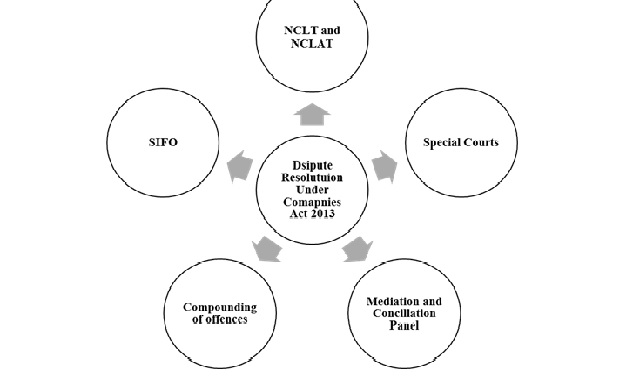
The various dispute resolution mechanisms/forums under the Companies Act, 2013 have represented below:

companies dispute resolution

National Company Law Tribunal and Appellate Tribunal (Sections 407-434)

  • The setting up national company law tribunal (NCLT) and National Company Law Appellate Tribunal (NCLAT) is a paradigm shift with the objective of establishing a single forum to adjudicate all disputes relating to companies India.
  • The idea of setting up a single forum dealing with all the matters under the Companies Act 1956 was not new and was introduced earlier by the Companies (Second Amendment) Act, 2002 which provided the legislative framework for the Constitution of NCLT. However, the constitutional validity of the NCLT and NCLAT was challenged in Thiru R. Gandhi, President Madras Bar Association V. Union of India[i], wherein the Madras High court held that certain characteristics of the tribunal violated the constitutional principles of separation of powers and independent of the judiciary by vesting essential judicial functions in a non-judicial body consisting of non-judicial members. However, the Supreme Court of India on 11th May 2010 gave a ruling that the provisions of Companies (Second Amendment) Act, 2002 pertaining to transfer of several judicial and quasi- judicial powers under the Act to NCLT are constitutionally valid while holding that the qualifications of technical members and the Composition of selection committee of such members as prescribed in the statute had defects and required correction.
  • In one more judgement in Madras Bar Association vs Union of India[ii] the Hon’ble Supreme Court found that defects as found in Companies (Second Amendment) Act, 2002 also existed in the provisions of the Companies Act, 2013.

After Much debate the government on June 1, 2016,[iii] issued notifications, bringing into effect several sections of the Companies Act 2013, and setting up NCLT and NCLAT.  The NCLT will have 11 benches initially, two at New Delhi and one each at Ahmedabad, Allahabad, Bengaluru, Chandigarh, Chennai, Guwahati, Hyderabad, Kolkata and Mumbai. The NCLT will comprise a president and judicial and technical members, as necessary.

  • The new tribunal would prove an effective and efficient alternative forum to the wide variety of forums/bodies entrusted with enforcement of the company law.  NCLT will replace the Company Law Board (‘CLB’), The Board for Industrial and Financial Reconstruction (‘BIFR’), Appellate authority for industrial and financial corporation (‘AAIFR’) and High Court. The Company Law Board (‘CLB’) is mainly concerned with the shareholder actions relating to oppression and management and miscellaneous aspects such as a change in registered offices, approving share issuance at discount to face value, and investigation of the affairs of the company by an inspector. The Board for Industrial and Financial Reconstruction (‘BIFR’) was established under the purview of the Sick Industrial and Companies (Special Provisions) Act, 1985, for revival and rehabilitation of potentially sick industrial undertakings and for liquidation or closure of non-viable and sick industrial companies.
  • The high court deals with Specific matters under the Act of 1956, mainly, compromise, amalgamation, merger, reduction of share capital, winding up of a company, statutory appeals from the CLB and constitutional writ petitions against orders of BIFR and Appellate authority for industrial and financial corporation (‘AAIFR’).

The table represents the various types of matters which are going to be or proposed to be dealt by the NCLT,

companies dispute resolution

*The provisions for granting these powers have not been notified yet.

Consequences of the introduction of NCLT

  1. Establishment of NCLT has led the consolidation of all the company related matters pending before the various forums such as such as CLB, BIFR and different high courts across the country under one roof and the powers hereto undertaken by these forums will be now carried out by the NCLT. Thus NCLT provides one stop solution for adjudication of company matters
  2. In pursuant of Section 422 of Companies Act, 2013, the NCLT and NCALT are mandated to dispose-off applications filed before it within a period of 3 months from the date of filing. However, an extension of 90 days may be granted by the President of NCLT or Chairperson of NCLALT for the disposal of the matter.
  3. Presently, the high courts are burdened with matters including winding up of proceedings. Transfer of such proceeding to NCLT is expected to reduce the burden. Furthermore, as the appeal from an order of NCLT will lie before the NCLAT, there will further reduction in the burden of high courts, considering that earlier appeal from the CLB was filed before high Court.
  4. With the notification of the provisions of Bankruptcy Code, NCLT would form a forum which offers a completely novel and improved process for the liquidation of Companies in India.

However, not all the provisions related to NCLT and NCLAT have been notified and the Government also appears to have taken a phase-wise approach towards enforcing this framework by transmitting certain matters under NCLT jurisdiction for the time being.

A simple appellate procedure under the Companies Act 2013

  • The Companies Act, 2013 has simplified the appellate procedure, by limiting the number of appellate authorities to two, through which application or petitions can be filed and thereby, ensuring quick and final settlement of disputes.  An aggrieved person against the order of NCLT may appeal to appellate tribunal i.e., NCLAT and all appeals from the NCLAT shall be directly filed with the Supreme Court against any question of law. This may be contrasted with the dispute resolution system under the 1956 Act, which grants statutory appellate jurisdiction to the High Court in respect of decisions passed by BIFR and AAIFR.
  • These appeals are generally heard by a Single Judge of the High Court and a party may file a further appeal to the divisional bench of that High Court followed by a final appeal to the Supreme Court. A new provision by way of Section 422 has also been introduced in the Companies Act, 2013 which unequivocally states that any proceedings presented before the tribunal or appeals filed before the appellate tribunal shall be disposed of as early as possible and the tribunal shall make every possible effort to dispose of the proceeding within three months from the date of presentation before the tribunal or filing of appeal.

Special Courts (Sections 435 – 438)

  • The Central government has been empowered to establish ‘Special Courts’ for the speedy disposal of certain offences punishable under the Companies Act, 2013, with imprisonment of two years or more,  by notification to establish or directly designate to set up Special Courts[i]. The objective behind setting up these courts is to let magistrate courts attempt try minor violations, and that grave offences ought to be managed by Special Courts. To achieve this objective the MCA has notified the provisions dealing with ‘Special Courts’ vide its notification dated 18th May 2016[ii].
  • Further, by another notification[iii] dated 18th May 2016, MCA after obtaining the concurrence of the respective Chief justices of the High Court, has designated eight courts as “Special Courts”. These would be in State of Jammu and Kashmir, Maharashtra, Goa, Gujarat, Madhya Pradesh, West Bengal, and Union territories of Andaman and Nicobar Islands; Dadra and Nagar Haveli and Daman and Diu.  In addition Central Government by further notifications has designated Special Courts in the National Capital territory of Delhi[iv]; States of Rajasthan, Chhattisgarh, Punjab, Haryana, Manipur, Union Territories of Chandigarh and Puducherry, and Districts of Coimbatore, Dharmapuri, Dindigul, Erode, Krishnagiri, Namakkal, Nilgiris, Salem and Tiruppur[v]; and State of Meghalaya[vi]. As per the notifications, these courts have been designated for the purposes of the trial of offences punishable with imprisonment of two years or more in terms of Sec 435 of the Companies Act 2013.

Constitution of Special Court

A Special Court Shall consists of a Judge who shall be appointed by the Central Government of India in consensus with the Chief Justice of High Court within whose jurisdiction the Judge to be appointed is working. A person being appointed as Special Court Judge must be holding the office Session Judge or an Additional Session Judge immediately before such appointment.

Offences Triable by Special Court

According to the Section 436 of the Companies Act, 2013, below mentioned offences are triable by Special Courts,

  • Offences for which the Companies Act, 2013, accommodates imprisonment of two years or more;
  • Cases sent by a Magistrate (where he believes detention is unessential) for any offence deliberated under the Companies Act, 2013. This provision will come into force when a person is arrested and kept in custody, and it creates the impression that the inquiry cannot be finished within of 24 hours period as required under the Code of Criminal Procedure, 1973 (CrPC) and there are justifications for believing that the charges or information is established, and detainment is authorized by Magistrate for a period of not more than 15 days (if authorized  by Judicial Magistrate) or 7 days (if authorized by Executive Magistrate), as the case may be. In such cases, the Special Court has the same force as the Magistrate having ward to attempt such case;
  • Take acquaintance of an offence under the Companies Act, 2013, without the suspect being committed to it for trial upon examination of the police report of the facts constituting such offence or if a complaint if filed on that behalf
  • Try at the same trial in addition to an offence under the Companies Act, 2013, an offence for which a suspect may be charged under CrPC.
  • The Special Court may try summary proceedings for any offence under Companies Act, 2013, which is punishable with imprisonment for a term not more than three years. However, in the case of any conviction during this summary trial, a sentence of imprisonment should not exceed more than one year.

All offence under the Companies Act shall be triable by the Special Court having jurisdiction over the area of the registered office of the company in relation to which the offence is committed. The provisions of the CRPC, 1973 shall apply to the proceedings before a Special Court. The Special Court shall be deemed to be a Court of Session and the person conducting a prosecution before a Special Court be deemed to be a Public Prosecutor.

Mediation and Conciliation Panel (Section 442)

  • In general parlance, mediation means an intervention of some neutral third party in a dispute with an intention to resolve the dispute.
  • The Constitution of Mediation and Conciliation panel was the new provision which was inserted in the Companies Act, 2013. Sec 442 of Companies Act 2013 authorises the Central Government to maintain a panel of experts to be called as mediation panel for the purpose of effectuating mediation between parties during any proceedings pending before Central Government or NCLT or NCLAT.
  • This provision has come into force with effect from 1st April 2014 vide its notification dated 26th March 2014 by MCA[vii]. On 9th September 2016, MCA notified the Companies (Mediation and Conciliation) Rules, 2016 which provides rules and guidelines for empanelment as Mediators or Conciliators. The Rules ensure that the Panel acts in good faith, by specifying certain ethics that should be followed by every member of the Panel, these include, upholding principles of natural justice towards the parties, especially by keeping in view of the relationship of faith that should be maintained throughout the proceedings[viii].
  • According to this provision, the parties to the dispute may voluntarily apply to the relevant authority i.e., Central Government, NCLT or NCLAT (as the case may be) to refer the matter to the Mediation Panel. Alternatively, the Central Government, NCLT and the NCLAT before which any proceedings are pending may, on its own, refer any matter pertaining to such proceedings to the Mediation Panel. The Mediation Panel shall dispose of the matter within three months from the date of reference. However, disputes relating to investigations initiated under Chapter XIV of the 2013 Act i.e. those involving serious and specific allegations of fraud, or misfeasance and malfeasance of the officers of the company, or cases involving prosecution for criminal and non-compoundable offences cannot be referred to mediation conciliation panel
  • The goal of all mediation is to facilitate the parties to arrive at an amicable settlement and at the same time it ensures the protection of confidentiality of information of the parties to the dispute and prohibits the use of such of the information in any other proceedings. Also, the mediation process is cost effective and less time consuming when compared adjudication before Courts, Tribunals or even arbitral tribunal.
  • If the mediation is successful, it may result in a settlement agreement with the consent of all parties and the same shall be submitted by the panel to the relevant authority and the aggrieved parties can file its objections before relevant authorities. If the settlement does not arrive between the parties to the dispute then panel may refer the matter back to the relevant authority for adjudication of the matter.

Compounding of certain offences (Section 441)

  • Compounding of an offence is a settlement mechanism, by which, the offender (Company or an officer thereof) is given an option to pay money as a replacement for of his prosecution, thereby avoiding a prolonged litigation (Bradford Investments Plc. (No.2), Re, 1991 BCLC 688). It is a short cut method to circumvent litigation and to bring an end to a default.
  • The MCA vide its notification dated 1st June 1, 2016, notified Section 441 of Companies Act, 2013, dealing with “Compounding of Certain offences”[ix]. The concept of compounding of offence is not new, Section 441 of 2013, Act is a re-enactment of Section 621A of the Companies Act, 1956.It provides for compounding of certain offences involving the imposition of fine as punishment and it provides a silver lining for settlement of offences out of court within a short time frame.

Three major developments/changes brought by Section 441 are,

  1. Offences punishable with (a) imprisonment or fine; or (b) imprisonment or fine or both; shall now be compounded with permission of Special Court.
  2. Presently, any offence punishable with fine only, cannot be compounded, if the inquiry against such company has been initiated or is pending under 2013, Act.

The financial limit for compounding of offence by Regional Director has been elevated from INR 50,000 to INR 5 Lakhs.

Compoundable offences and authorities authorised to Compound the offence

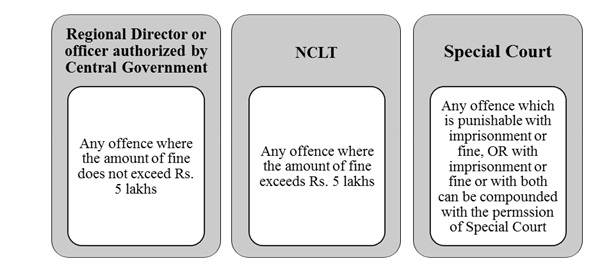
Any offence punishable with fine only and where the maximum amount of fine which may be imposed for such offence does not exceed five lakh rupees may be compounded by the Regional Director. Any offence punishable under this Act with fine only and where the maximum amount of fine which may be imposed for such offence exceeds five lakh rupees may be compounded by the NCLT. The offences which are punishable by fine or Imprisonment; fine or Imprisonment or with both may be compoundable with the permission of Special Court. The same has been represented below:companies dispute resolution

Non-Compoundable offences

Compounding of offences is not possible in the following circumstances:

  1. If either the investigation against the company or officer thereof has been initiated or is pending [Third Proviso to Section 441(1)].
  2. Where similar offence committed has been compounded and period of three years has not expired [Section 441(2)].
  3. Any offence which is punishable under this Act with imprisonment only OR with imprisonment and also with the fine; cannot be compounded [Section 441(2)]

Analysis of Section 441 viz-a-viz Section 621A

Third proviso to Section 441(1) of Companies Act, 2013 provided that the offence cannot be compounded where either the investigation has been initiated or is pending. However, under the 1956 Act, no such provision was there and the offence could have been compounded during the period of investigation also

Serious Fraud Investigation Office (Sections 211 and 212)

Serious Fraud Investigation Office (SFIO) is a multi-disciplinary fraud investigation agency established under Ministry of Corporate Affairs. It consists of experts in the field of the capital market, accountancy, information technology, forensic audit, law, investigation, company law, and taxation for detecting and prosecuting or recommending for prosecution white-collar crimes/frauds. SIFO was constituted by the Government of India on 9 January 2003, since then it continues as a non-statutory body of the Ministry of Corporate Affairs[i].

The Companies Act 2013, gave a statutory recognition to SFIO by establishing the SIFO and empowering it to act as a nodal agency for investigating of frauds in the affairs of the company under Sections 221 and 212, respectively, which were notified by MCA 26th March 2014[ii]. In 1956, Act there was no specific provision for SIFO and the investigation by SIFO was done only on the request by MCA. SFIO is conferred with the powers of a magistrate and issue orders for the arrest of a person.  The terms and conditions of service of Director, experts and other officers of SIFO are specified in Companies (Inspection, Investigation and Inquiry Rules), 2014.[iii]

Conclusion

From the above data is clear that Government of India has taken various measures to amend the legislation and introduced the new provisions in the Companies Act, 2013 and address public concern over corporate accountability and responsibility. This establishment of NCLT and NCLAT will reduce, a multiplicity of litigations, ensure speedy and efficient resolution of company related disputes in India. However, not all the provisions related to NCLT and NCLAT have been notified and the Government also appears to have taken a phase-wise approach towards enforcing this framework by transmitting certain matters under NCLT jurisdiction for the time being.

Further, the new provision in the 2013 Act with regard to the compounding of offences, Special court, and the establishment of mediation panel, provision of statutory status to SIFO is a boon and all concerned companies hope for speedy settlement of disputes. This new provisions under the Companies Act, 2013, would help India to improve its global ranking, in World Bank report as the country for ease of doing business.

[i] http://www.sfio.nic.in ((Accessed on 25 Feb 2017)

[ii]http://www.mca.gov.in/Ministry/pdf/CompaniesActNotification26March2014.PDF (Accessed on 25 Feb 2017)

[iii] http://www.sfio.nic.in/fAQ.aspx ((Accessed on 25 Feb 2017)

[iv] http://www.mca.gov.in/Ministry/pdf/AmendmentAct_2015.pdf (Accessed on 23 Feb 2017)

[v] http://www.mca.gov.in/Ministry/pdf/NotificationOrder_19052016_1.pdf (Accessed on 23 Feb 2017)

[vi] http://www.mca.gov.in/Ministry/pdf/NotificationOrder_19052016_2.pdf (Accessed on 23 Feb 2017)

[vii]http://www.mca.gov.in/Ministry/pdf/designationofSpecialCourt_28072016.pdf (Accessed on 23 Feb 2017)

[viii] https://www.mca.gov.in/Ministry/pdf/Notification_05092016.pdf (Accessed on 23 Feb 2017)

[ix] http://www.mca.gov.in/Ministry/pdf/Noti_SplCourt_18112016.pdf (Accessed on 23 Feb 2017)

[vii]http://www.mca.gov.in/Ministry/pdf/CompaniesActNotification26March2014.PDF (Accessed on 24 Feb 2017)

[viii]http://www.mca.gov.in/Ministry/pdf/CompaniesMediationandConciliationRules_10092016.pdf (Accessed on 24 Feb 2017)

[ix] http://www.mca.gov.in/Ministry/pdf/Notification_02062016_I.pdf (Accessed on 24 Feb 2017)

[x] (2010) 11 SCC 1

[xi] 2015) 8 SCC 583

[xii] Notification No. S.O. 1934(E), S.O. 1935(E) & S.O. 1933(E) dated June 1, 2016

Download Now

What laws apply to a public charitable trust in India? Process compliance, best practices, and applicable law.

2
trust

In this article, Kshitij Datta Rishi who is currently pursuing M.A. IN BUSINESS LAWS, from NUJS, Kolkata, discusses What laws apply to a public charitable trust in India? Process compliance, best practices, and applicable laws.

Introduction

Before we understand the laws applicable to the public trusts in India, we need to understand the difference between the various non-profit organizations societies, Section 25 companies &, trusts in India.

Types of non-profit organizations

Societies

  • During the 19th century close to the 1857 event, various groups and organizations were established in the country on contemporary issues of arts, politics, science & literature. Later to give legal standing to such organizations, the Societies Registration Act was enacted in India in 1860. This act allows the formation of any literary, charitable and scientific Society for any such purpose as described in Section 20 of the Act. Under the Act, any group of seven persons who agree to follow a Memorandum of Association (MOA) can register a Society.
  • Such Memorandum should include the name of the society, the purpose and the details of the members. Also, this should be accompanied by a set of Rules and Regulations.
  • Post India’s Independence, based on the adaptation orders 1948/50, the Act continued to remain on the statute but came under the legislature of State governments and various amendments have happened to the same in different states

Section 8 companies (under the Companies Act, 2013) or the old 25 Companies (under the Companies Act, 1956)

The section 8 of the Companies Act, 2013, allows a mechanism through which a Company can be registered with a limited liability if such company is formed for promoting arts, science, commerce, protection of environment or any other useful object provided it intends to apply the income and profits in promoting the underlying objects. Also, that the members cannot be paid any dividends from the profits.

The objective of this structure is to provide a corporate outlook to such companies while exempting them from heavy legal/regulatory requirements.

To register such a Section 8 company, the process is similar to registering or other companies in exception of an additional license requirement specific to this Section 8 company

Trust, Endowments, and Waqfs

  • As per Section 3 of The Indian Trusts Act, 1882, ‘A “trust” is an obligation annexed to the ownership of the property, and arising out of confidence reposed in and accepted by the owner, or declared and accepted by him, for the behalf of another, or of another and the owner.’
  • The party/person who designates the confidence is called ‘author of trust’ (testator), the person who accepts such confidence is called ‘trustee’ and the person for whose benefit the mentioned confidence is accepted is ‘beneficiary’.
  • Essentially, these types of organizations are legally created as modes of property settlement/arrangement dedicated for definite charitable and religious purposes. The basis of their formation is the presence of a property or an asset which has been donated by the will maker for a specific purpose, religious or social. Charitable and religious institutions are special kinds of Trusts which have clear non-secular intent. Waqf is another variant of Trust where the donor is a Muslim.
  • Their incorporation, organizational structure, and distribution of functions and powers are governed by the provisions of the specific law under which they are registered.

Broadly, these organizations can be registered legally in the following five ways:

  1. Registering before the Inspector General of Registration/ Charity Commissioner under the respective State Public Trusts Act e.g. the Rajasthan Public Trusts Act, the Gujarat Public Trusts Act, the Bombay Public Trusts Act,1950etc.;
  2. By seeking interference of civil courts to lay down schemes for governing a Trust under Sections 92 and 93 of the Civil Procedure Code;
  3. Registration of the trust deed (of a Public Charitable Trust) under the Registration Act, 1908;
  4. Notifying an organization in the list of Charitable Trusts and Religious Endowments which are supervised by the Endowments Commissioner of the State or by a Managing Committee formed under the Charitable Endowments Act, 1890 or under other State laws on Hindu Religious and Charitable Endowments; and
  5. Creating a Waqf under the provisions of the Waqf Act, 1995.
https://lawsikho.com/course/diploma-companies-act-corporate-governance
Click Above

Trusts can be differentiated into Public and Private. Persons, groups, companies etc. on the receiving end of trusts are called beneficiaries. The types of beneficiaries distinguish public trust from a private trust.

  • Private trust beneficiaries are generally closed groups, individuals, companies but beneficiaries of public trust are always not defined, that is public at large. This Public trust is an organization that is formed with the primary motive of charity to public.
  • A trust can be created by written deed, will or it can even be created by word of mouth. However, in case of immovable property as the subject, the trust can be created only by non-testamentary instrument signed by author of trust and is registered, or by will of author. Therefore, ‘Will’ is not necessarily required to be registered, even though it may pertain to immovable property.
  • The primary instrument of forming a trust is the Trust Deed, which is made on non-judicial stamp papers of prescribed fee and is signed by the trustee(s) for submission to the concerned Registrar. For this, since the trust is based on the principle of asset transfer, the registrar or sub-registrar having authorized to register properties has the authority to register this Trust Deed. For this reason, Trust Deed of the proposed Trust may be registered with the registrar of properties or Tahsildar, followed by the endowment of the same at the district level in the collectorate. In case of metropolitan regions/cities, this process is carried out with separate offices of registrar of properties and endowments.

The Trust Deed should contain various details including the names of authors, the names of trustees; settlers of the trust; the names if any, of the beneficiaries or whether it is the public at large; name and address of the trust; objects of the trust; specifics on the appointment, removal or replacement of a trustees, their powers, rights & duties and powers; the method and mode of determination of the trust among others.

Comparison between Society Trust and Section 8 Company

  Society Public Trust Section 8 Company
Act/ Legislation Societies Registration Act of1860 Public Trusts Acts like the Bombay Public Trusts Act of 1950 Companies Act of 1956
Jurisdiction State where registered  State where registered State where registered
Authority Registrar of societies Charity Commissioner Registrar of Companies
Registration As Society (and also as Trust in Maharashtra and Gujrat) As Trust Memorandum and Articles of Association
Number of Persons needed to register Minimum seven; no upper limit Minimum two Trustees; Minimum2 shareholders/ Minimum 2 directors
Board of Management Governing Council or Body/ Executive or managing Committee Trustees Board of Directors/ Managing Committee
Mode of succession on Board of Management Usually election by members of the General Body Usually by appointment Usually election by members of the General Body

Now that we have understood the basic types of non-profit organizations, it is important to also understand what is meant by charitable organizations.

Charitable Organization

  • Charitable organizations are organizations established for charitable purposes. These are non-profit organizations; however, it must be realized that not all non-profit organizations are charitable organizations. Some of the charitable organizations may be established by companies primarily as a part of their tax planning strategies.
  • The main responsibility of any charitable organization is to work towards benefit of the public by focusing on causes that help the public at large. Along with this, all the operations performed by these organizations should be legal and their policy should be in line with the general public policy.

Charitable Purpose

  • Public charitable trust must be created for the larger benefit of the public. Similarly, Societies may be registered for charitable purposes. Section 8 companies as described previously are formed for the limited purposes of “promoting commerce, art, science, religion, charity or any other useful object.
  • In legal terms, the concept of “charitable purpose” may differ a bit from the dictionary definitions of the term.
  • As per Section 2(15) of the Income Tax Act, 1961, the term Charitable purposes include “relief of the poor, education, medical relief, and the advancement of any other object of general public utility.” In addition to this, Finance (No.2) Act, 2009 added the “preservation of environment (including watersheds, forests, and wildlife) and preservation of monuments or places or objects of artistic or historic interest” under the purview of the term charitable purposes.
  • Apart from this, Finance Act, 2008 restricted the definition of “charitable purpose,” by mentioning that if the “advancement of any other object of general public utility” involves undertaking any business activity, trade or commerce, or providing any related service for a condition or a fee, it will not be considered a “charitable purpose.”
  • The Finance Act 2010, retrospectively effective from April 1, 2009, provided some relief by setting up a threshold and exempting the aggregate amount of receipts from such activities up to one million rupees. An organization, established for and running programs for education, relief of poverty and medical support were not affected by the amendments of 2009 or 2010.

Under the state laws, as per the Section 9(1) of the Bombay Public Trusts Act, 1950, charitable purpose includes:

  1. Education
  2. relief of poverty or distress
  3. medical relief
  4. provision of facilities for recreation or other leisure time occupations, if the said facilities are provided in the interest of public benefit and social welfare.
  5. the advancement of any other object of general public utility, but does not include a purpose which relates exclusively to religious teaching or worship.”

As can be realized above, the definition of charitable purpose is broad enough to cover activities other than working towards providing direct relief from poverty or calamities.

Laws applicable to Public Charitable Trusts in India

Before we go into specifics of Public charitable trusts, a few important points must be considered regarding the charity sector:

There is no individual legislation or a law, which comprehensively governs the charitable organization sector and similarly there no single regulator in this sector in India

  • Based on the choice of persons forming the charity and the purpose, a charitable organization can be formed in various ways and may be subject to different acts of legislation
  • Separate legal provisions exist at state and national levels
  • Nonprofit organizations are also not permitted to be involved in any ‘political activity’. Under the Bombay Public Trusts Act, even ‘political education’ remains outside the scope of ‘charitable purpose’.
  • India, to maintain being a secular state, does not allow distinction of color, caste and creed in formation of any charitable organization. However, it is still possible to create a valid trust for the benefit of a specific section of the community. But then this kind of trust would not be allowed any income tax exemption
  • As discussed in the point above, religious trusts established for the benefit of a specific religious communities are also not allowed to benefit from income tax exemptions

Laws governing the formation/registration of such Public Charitable Trusts in India

The first law in India Trusts came into force in 1882 and was known as the Indian Trusts Act, 1882. This ACT was basically for management of Private Trusts.

  • As opposed to the central law from private trusts, a charitable institution formed as a Public Trust in individual states is, governed by the Public Trust Act applicable in the relevant State. As an example, the public charitable trusts formed/ registered in the state of Maharashtra are governed by the Bombay Public Trusts Act, 1950.
  • Similar act is operational in state of Gujarat. For such trusts, Rajasthan, has a Trusts Act of 1959 and Madhya Pradesh had an Act of 1951. In certain southern states , there are endowments Acts (eg. Andhra Pradesh), while a many of the northern and north-eastern states in India have no trust Act at all.
  • Even New Delhi-has no trust Act. In such cases, if no Public Trust Act exists in that state, then the public trusts in these states are governed by the Indian Trusts Act 1882.

Based on the ruling from the case of Hanumantram Ramnath (Bom), it can be concluded that even though the Indian Trusts Act, 1882 does not specifically apply to public charitable trusts, there are three bare minimum requirements to create a charitable trust. These are:

  1. A declaration of trust – binding on settlor,
  2. Setting apart of a definite property and the settlor depriving himself/herself of the ownership, and
  3. The beneficiarie(s)- for which the property is thereafter to be held,

It is important that the transferor of the property by the settlor or that the author of the trust must be competent to sign a contract. Along with this, the trustees should also be persons who are competent to sign a contract. It is also very critical that the trustees identified should signify their acceptance for acting as trustees to make the trust a legally valid one.

Specific acts for different states governing the Public charitable trusts or similar endowments have been mentioned in the list towards the end of the article.

Applicability of Income Tax Act 1961 to Public charitable trusts

Public charitable trusts are exempted from income tax. These exemptions provided to the public charitable trusts are specified in the Section 11, Section 12, and Section 13 of The Income Tax Act.

  • Section 11 of the Act provides details of the modes of exemption from income tax to such public charitable trusts
  • Section 12 mentions about exemptions for the contribution of income of the trust
  • Income of trusts from these contributions
  • Voluntary contribution received by a trust created wholly for charitable or religious purposes or by an institution established wholly for such purposes
  • Section 13 of Income Tax Act gives the details related to forfeiture of exemption of income tax by public charitable trust

All trusts are obligated to file annual reports. These returns of income should be filed with the relevant authorities having jurisdiction of the state where the trusts are registered. Income of the authors of trusts can be taxed as personal income under Sections 60 – 63 of the Income Tax Act, 1961 in cases where the trust deed has a provision for revocation of trust.

Section 80G provides details of the privileges available to the donors of public charitable trusts. Under this section, an individual donor is granted specific deduction if donations are made to such kind of public charitable trusts. To be able to provide this benefit to its donors, a public charitable trust is required to obtain a valid certificate. For obtaining this certificate, a trust is required to give application with form 10G along with the trust deed to the income tax office. The primary prerequisite to obtaining this certificate to provide benefit to the donors is that the income gained from the property of the trust should only be used in charitable purposes (as described earlier). The specific conditions to be fulfilled by the public charitable trusts to obtain this certification are:

  • The trust should be a public charitable trust, the benefit is not for private trusts
  • The trust should be registered under the relevant laws of the state and also, with the income tax department
  • Any income or contribution of the trust should not be not applicable for exemption under Section 11, Section 12, Section12A and Section12AA of the Income Tax Act. If this is the case, the trust should not use donations for private business and should maintain separate books of accounts
  • The bylaws and objectives of the trust should be for charitable purposes only
  • The trust should be having regular maintenance of accounts and regular audit of the same
  • There should be no irregularity in filing of income tax returns

Applicability of the Foreign Contribution (Regulation) Act, 2010 to Public charitable trusts

Public charitable trusts that receive foreign contribution or donation from foreign sources are required to obtain registration under Section 6(1) of Foreign Contribution Regulation Act, 2010. Such a registration under the ACT is called an FCRA registration.

To be eligible for applying for the FCRA Registration a trust should match certain criteria,

  • A public charitable trust seeking foreign contributions for definite cultural, economic, social, religious or educational programs may obtain FCRA registration or receive foreign contribution through “prior permission” route
  • The trust must have also been in existence for a minimum of three years at the time of making the FCRA application and should not have received any foreign contribution before applying for the same without the Government’s approval
  • Additionally, the trust seeking registration should have spent at least Rs.10,00,000/- over the last three years on its aims and objectives, excluding any administrative expenditure. To prove the same, Statements of Income & Expenditure, duly audited by Chartered Accountant, for last three years must be submitted

After the application is done, various additional criteria are checked before the FCRA registration is provided. However, even after the registrations, the trusts should be careful in accepting the grants from foreign entities as these could be risky in terms of their source of funds or the purpose of these funds may go against the public/ nations wellbeing.

Other Applicable Laws for Trusts

  • Religious Endowments Act, 1863
  • Charitable Endowments Act 1890
  • Hindu Religious and Charitable Endowments Act 1951
  • Charitable and Religious Trusts Act, 1920
  • Official Trustees Act, 1913
  • Registration Act, 1908
  • Civil Procedure Code, 1908
  • Indian Stamp Act, 1899

Wakfs

  • Mussalman Wakf Validating Act,1913
  • Mussalman Wakf Act, 1923
  • Mussalman Wakf Validating Act, 1930
  • Wakf Act, 1995

Some relevant State Acts

  • Bombay Public Trusts Act, 1950 and Bombay Public Trusts Rules, 1951
  • Andhra Pradesh Charitable and Hindu Religious Institutions and Endowments Act, 1987
  • Bihar Hindu Religious Trusts Act, 1950
  • Karnataka Hindu Religious Institutions and Charitable Endowments Act, 1997 and Karnataka Hindu Religious Institutions and Charitable Endowments Rules, 2002
  • Orissa Hindu Religious Endowments Act, 1951
  • Kerala Travancore-Cochin Hindu Religious Institutions Act, 1950
  • Rajasthan Public Trust Act, 1959
  • Tamil Nadu Hindu Religious and Charitable Endowments Act, 1959
  • The Madras Hindu Religious And Charitable Endowments Act, 1951
  • Uttar Pradesh Charitable Endowments (Extension of Powers) Act, 1950 and Charitable Endowments (U.P. Amendment) Act, 1952
  • United Provinces Charitable Endowments Rules, 1943
  • Religious Endowments (Uttar Pradesh Amendment) Act, 1951

References

  • Societies, Trusts/ Charitable Institutions, Waqfs and Endowments: Social Capital – A Shared Destiny
  • Handbook on Laws Governing formation and Administration of Charitable Organizations in India – CA Rajkumar S. Adukia
  • FCRA Registration for Trusts and NGOs – India Filings


LawSikho has created a telegram group for exchanging legal knowledge, referrals and various opportunities. You can click on this link and join:

https://t.me/joinchat/J_0YrBa4IBSHdpuTfQO_sA

Follow us on Instagram and subscribe to our YouTube channel for more amazing legal content 

 
Download Now

The controversy underlying foreign seat and place or venue of arbitration

0
rules of arbitration in India

This article is written by Ishanvi Mishra, pursuing a Certificate course in Arbitration: Strategy, Procedure and Drafting from lawsikho.com, and Dipti Khatri.

Introduction

Due to focus on speedy relief, priority to party autonomy and limited interference by courts, arbitration is becoming one of the most sought-after modes of dispute resolution mechanism. Domestic law is clear on the subject as to supervisory jurisdiction over these arbitrations, but as far as International Commercial Arbitration is concerned there is still some ambiguity.

The party autonomy allows the Parties to select their own procedural law, that is to be followed during the proceedings. But this does not mean that International Commercial Arbitrations are allowed to take place in a vacuum. Sanction of law is still a necessity for rules decided by parties to be enforceable. “Lex arbitri[1] i.e. the law of the seat or place of arbitration is the relevant law which will govern the procedural and other crucial aspects of Arbitrations.

Why did the Bombay HC in Addhar judgement get it wrong?

Addhar Mercantile Private Limited, v. Shree Jagdamba Agrico Exports Private Limited[2], (“Addhar case”) decided by the Bombay High Court, dealt with application under Section 11(6) of Arbitration and Conciliation Act, 1996, invoking arbitration agreement (that read “23. Arbitration in India or Singapore and English law to be apply”), and seeking appointment of an arbitrator. The learned counsel for the appellant argued that the choice of seat of arbitration to be Singapore along with English law for the proceedings would be derogating from Indian law, as both parties are incorporated in India.

TDM Infrastructure Private Limited v. UE Development India Private Ltd[3] (“TDM case”) was heavily relied on, in which the Apex Court decided that the intention of the Legislature was to not allow Indian nationals to derogate from Indian law, while interpreting Section 28 of the Arbitration and Conciliation Act, 1996. It was further argued by the appellants that since the agreement had a choice between India and Singapore as seat, and since both the parties are from India, they should not be allowed to derogate Indian law. The learned counsel for the respondent, raised objections to the court’s jurisdiction, by contending the possibility for two Indian parties having the right to have the seat of arbitration at Singapore and apply English law[4].

The Bombay High Court while placing heavy reliance on TDM case held that since the Parties are incorporated in India, they should not be allowed to derogate from Indian law. The Court constituted the arbitral tribunal in India, to decide the matter in terms of Section 28 (1) (a) of the Arbitration and Conciliation Act as per substantive law. “… If the seat of the arbitration would have to be in Singapore, certainly English law will have to be applied…” is observed by the Bombay High Court in para 8 of the judgement. It would seem that the Court opined that the bar placed on Indian nationals by section 28 of the Arbitration and Conciliation Act is on choosing foreign law for arbitrations in India only, and that it would be allowed for Indian parties to have foreign seated arbitration with applicable foreign law. However, further along the judgement the Court opined that the Indian parties cannot have a seat of arbitration in Singapore and choose foreign law (para 12). The Courts solely relied on the TDM case while deciding this case and laid down the law clearly.

What went wrong? How did the Bombay HC rely so heavily on the TDM case?

It should be kept in mind while reading the judgement that the arbitration clause that gave choice between India & Singapore as the seat of arbitration, is quite uncommon. Moreover, the sole reliance on the TDM case by the Bombay High Court is ill-conceived while exercising jurisdiction under section 11 of Arbitration and Conciliation Act, 1996, as other judgments of the Courts in the country were not taken into account while deciding this case. What also failed to be noted by the Hon’ble Court was that a corrigendum was added to the judgment in the TDM case, and therefore any decision given by the Court was not for any other purposes, but only for determining the jurisdiction under section 11. The Supreme Court, in the TDM case majorly dealt with the issue of whether or not the matter was within the meaning of 2(f) of Arbitration and Conciliation Act, 1996, an ‘international commercial arbitration’ and therefore triggered the jurisdiction of the Supreme Court, to constitute an arbitral tribunal. Not particularly or directly dealing with the issue of whether or not Indian parties can choose a foreign arbitration and apply foreign law, the Supreme Court only made observations on the scope of section 28 of the Arbitration and Conciliation Act. Therefore, the judgment in TDM case cannot be construed to be a conclusive decision on this issue. The heavy reliance placed by the Bombay High Court on the TDM case casts a question on the merits of the judgment in Addhar case, on this issue[5].

Issue of Seat & Place/Venue of arbitration

In International Commercial arbitration, the question arises as to which substantive law would govern the arbitration process.  To answer, generally validity of the arbitration agreement and seat or place is considered. Venue is considered simply to be a geographical location as per the convenience of the parties. However, seat decides the actual appropriate court which would have the exclusive jurisdiction to decide the case. Where a seat is specified in the agreement, generally the procedural aspects of that country are considered. However, where the parties have failed to choose the specific law, it is governed by the law of the place of arbitration. The challenge of an award is then required to be done in the Court where the seat of arbitration is located and that Court is considered to have supervisory jurisdiction.

However, after the recent amendments the Part I is to be made applicable under certain situations. Section 9 which relates to Interim Relief, Section 37(1) (a) which relates to appeal to orders, Section 27 (Court assistance for evidence) is applicable even in the foreign seated arbitration.

In Enercon Indian Ltd. and Ors. v. Enercon Gmbh the dispute arose of the non- supplies under the International property License Agreement (IPLA). It stated that the venue would be London and the governing Law would be the Indian Arbitration and Conciliation Act, 1996. The question arose whether London Court could have concurrent jurisdiction where the venue was in London. The Hon’ble Supreme Court of India distinguishing between the seat and venue of the arbitration held that “the express mention in the judgment that London was the venue of the arbitration does not lead to the conclusion that it was the seat of arbitration. Once the seat has been decided, Indian Courts will have supervisory jurisdiction and the English Court will not have jurisdiction. It is thus, not necessary for the seat and venue to be the same. The hearing even if it is taking place at a different place, the chosen seat of arbitration will remain unaffected.

However, in the absence of straight jacket provision relating to Arbitration and Conciliation Act, 1996 the controversy which has still not been resolved includes whether can two Indian parties choose the foreign seat of arbitration? The Court have tried to settle the position through a plethora of cases in the recent years however, there is no clarity provided on the same.  The Madhya Pradesh High Court in the Sasan’s case stated that party autonomy would be considered in deciding the matter. However, again the Supreme Court’s reluctance to answer on the same has let the issue unanswered.  As the Supreme Court established a foreign nexus to the dispute and allowed foreign arbitration between the two parties outside India.

Why the controversy regarding seat/venue of arbitration still remains?

In the Sasan’s Case, where the dispute arose out of a mine development agreement there were two parties Reliance-owned Sasan Power Ltd, and NAAC America (Agreement I). Later on after two years, the North America Coal Corporation India (NACC India) was formed, whereby all rights and liabilities under Agreement I were transferred from NAAC America to NACC India (Agreement II).Thus, the Supreme Court concluded that the parties had entered into two agreements (i) the bi-party agreement which was entered between the foreign element and an Indian entity; and (ii) a tripartite agreement between the foreign entity and an Indian entity, where the rights and obligations were given to the Indian entity. The Supreme Court in asserting its Judgment came to the conclusion that there was foreign element involved and thus, allowed the parties to be governed by the foreign law and appointed foreign seat. Therefore, the main questions relating to whether Indian parties can opt for a foreign seat at the autonomy of the parties were unanswered.  Supreme Court was reluctant in addressing and setting aside the judgment of the Madhya Pradesh high Court thereby leaving in the instance of a dilemma. They stated that the

“…. the question whether two Indian companies could enter into an agreement to be governed by the laws of another country would not arise in this case. So long as the obligations arising under the AGREEMENT-I subsists and the American company is not discharged of its obligations under the AGREEMENT-I, there is a ‘foreign element’ therein and the dispute arising therefrom. The autonomy of the parties in such a case to choose the governing law is well recognized in law.”

Position prior to Sasan’s Case

Prior to this, the issue has been considered in various recent Judgments. In the case of TDM Infrastructure Pvt. Ltd. V. UE Development India Ltd. that by looking at the legislature’s intention it can be concluded that Indian nationals opting for the foreign seat would derogate the Indian Law and would be against the public policy. The Judgment stated as follows:

“It held that Section 28 is imperative to Section 2(6) of the provisions of the Act. Therefore, the intention of the Legislature is that the Indian Nationals should not derogate Indian Law”. It would be called to be against the public policy of India.”

To further explain what they mean by “opposed to public policy” the Court relied on the case of Oil and Natural gas Corporation Ltd. v. Saw Pipes Ltd. It held that if it is contrary to the fundamental policy of Indian Law; the interest of India; justice and morality and patent illegality it would amount to be against the public policy. Further, the scope was enhanced in the case of Phulchand Exports Limited v. O.OO. Patriot where it was stated that Section 48 would also carry the same meaning as that of given in the Saw Pipes Case.

The Court again relied on TDM Infrastructure in the case of Addhar Mercantile Private Limited v Shree Jagdamba Agrico Exports Pvt. Ltd. (Addhar Mercantile) which was related to Section 11 of the Arbitration Act. In this case, the  Court made the parties to follow the substantive Laws of India even though the parties had an agreement to contractually agree to an “ arbitration in “India or Singapore’’ with substantive Law to be taken as English Law.

Further, in Reliance Industries Limited & Anr. v Union of India, the arbitration was challenged on the ground that it was seated outside India. However, the Court without touching on this ground only upheld the foreign seated arbitration between two Indian parties.

The Supreme Court opined as follows:

“It stated that it was too late to state that the seat of arbitration is not analogous to an exclusive jurisdiction clause. Once the parties have mutually agreed that the seat will be in London, it can no longer be the content of the parties that Part I of the Arbitration agreement will be applicable”.

Also, in the case of Videocon Industries Ltd. v. UOI it was stated by the Supreme Court that appellants have nowhere claimed exemptions under the Indian Law and therefore, they see no reason why Indian Law should be exempted. Thus, the Court no where mentioned about the ‘foreign seat’. Their only concern was ‘exemption from the Laws of India’.

Further, again the same contentions were raised in the case of Delhi Airport Metro Express Pvt. Ltd. which demonstrated the uncertainty in determining the issue of whether the two parties can choose the foreign seat of arbitration. Again seeking hold of the TDM Infrastructure Case, BALCO and Aadhar the Court reached at Further, even if two Indian parties successfully obtain a foreign arbitration award, it is still possible to delay enforcement proceedings in India by claiming that the award violates public policy.

However, earlier Supreme Court in the Bharat Aluminium Company Ltd. v. Kaiser Aluminium Technical services Inc. has held that seat of arbitration inevitably imports the acceptance of the party to the substantial law of the other Country. Also, the Court made an observation that no parties can circumvent the substantive Indian Law and will not have an overriding effect contrary to the provisions of the contract.

Thus, where the above two cases establish that argument can take place abroad; the judgment of Madhya Pradesh High Court has raised the controversy again. The Reliance Industries Judgment and the Sasan’s Judgment suggest totally contrary position to that of the above case.

Is there a conclusive takeaway from these precedents though?

Even though the Supreme Court of India failed to definitively resolve the issue whether two Indian parties are permitted to choose a foreign seat in their arbitration agreements and a case can be made out in favour of such an agreement allowing foreign-seated arbitration on the basis of Sasan, Atlas, Balco and Reliance judgements. These judgements are also in consonance with the international jurisprudence on this matter which allow domestic parties to choose a foreign arbitration seat.

International Jurisprudence on allowing domestic parties to choose a foreign arbitration seat

In England, for example, section 3(a) of the Arbitration Act, 1996 explicitly recognizes the autonomy of parties to decide their seat. Similarly, Singapore does not place any restriction on the parties’ ability to choose a seat by adopting Article 20(2) of the Model Law (PT Garuda Indonesia v Birgen Air [2002] 1 SLR(R) 401 at [36])[6]. In PT Garuda Indonesia, parties entered into an aircraft lease agreement which stipulated Jakarta as the seat of arbitration. Parties conducted hearings in Singapore and awards were rendered which clearly stated that it was rendered in Jakarta. Garuda filed a notice of originating motion in Singapore to set aside the award which was granted. The other party applied to have the notice of motion set aside. The Court of Appeal found that the parties had only agreed to a change in the venue of the hearing and not the seat of arbitration and that there was a distinction between the two. It observed that the place of arbitration did not change merely because the tribunal held the hearing at a different place; it only changed where the parties had expressly agreed to it. On this basis, the court found that there was no basis to file a challenge to the award in Singapore. Though this judgement Singapore proved itself to be a much more arbitration friendly jurisdiction, than compared to what India currently is, because it doesn’t give clear liberty to Indian parties to pick foreign seat, without considering it as a derogation from Indian law.

Recent Amendment adding to the controversy

While the recent amendments have been brought in 2015 with the aim of reducing the judicial intervention and bringing about the effectiveness, however, it has not concluded on the point of whether interim reliefs by the Indian Court can be granted in a foreign seated International commercial arbitration. As, the International commercial arbitration should include at least one non- Indian Party. However, the present act does not talk about the interim relief of the same.

Conclusion

Due to the decisions like TDM and Addhar, Indian parties are still hesitant to choose a foreign seat as an element of uncertainty persists by these judgements, and due to the absence of clear decision by the Supreme Court, some courts might follow these decisions, and therefore fate of the agreement fully depends on the interpretation made by the Court. The Indian parties who hope to enforce their awards outside India may still be relatively much more confident in choosing foreign-seated arbitration, due to the lesser likelihood of the challenge on public policy. India has been making consistent efforts in promoting arbitration as an effective method of dispute resolution, in order to lessen the burden on the commercial courts. But, this uncertainty with respect to foreign seats of arbitration for domestic parties is anomalous, and this uncertainty may deter the parties while considering means of dispute resolution. This is the reason for parties to structure their agreement through holding entities in different countries, making them a foreign party, in order to avoid the risk of getting the arbitration agreement deemed unenforceable due to a foreign seat of arbitration. Indian courts or Legislature can promote India as arbitration friendly jurisdiction by removing this uncertainty of law and allow party autonomy in this regard as well. It would mark a big step forward by making laws in India consistent with its counterparts around the world, such as England and Singapore.

References

  1. Can two Indian parties opt for a foreign seat of arbitration: An unresolved question http://www.trilegal.com/pdf/create.php?publication_id=14&publication_title=can-two-indian-parties-opt-for-a-foreign-seat-of-arbitration-an-unresolved
  2. Post Balco Developments, Mondaq,
  3. Seat versus Venue, http://www.financialexpress.com/archive/seat-versus-venue/1229641/
  4. International Commercial Arbitration, Law and Recents Developments in India, Nisith Desai Associates http://www.nishithdesai.com/fileadmin/user_upload/pdfs/Research%20Papers/International_Commercial_Arbitration.pdf
  5. Can Indian parties choose foreign seat of arbitration? Supreme Court’s Sasan judgment fails to resolve uncertainty http://barandbench.com/can-indian-parties-choose-foreign-seat-arbitration-supreme-courts-sassan-judgment-fails-resolve-uncertainty/

[1] THE “APPROPRIATE COURTS” IN FOREIGN SEATED ARBITRATION: AN INDIAN PERSPECTIVE Singhania And Partners, https://singhania.in/arbitration-outside-india-international-arbitration-lex-arbitri-foreign-seated-arbitrations-for-indian-parties-legal-precedents-on-foreign-seated-arbitration/ (last visited Aug 7, 2020)

[2] Addhar Mercantile Pvt. Ltd. v. Shree Jagdamba Agrico Exports Pvt. Ltd., (2015) SCC OnLine Bom 7752 [hereinafter “Addhar Mercantile”].

[3] TDM Infrastructure v. UE Development India Pvt. Ltd., (2008) 14 SCC 271 [hereinafter “TDM Infrastructure”].

[4] The Unresolved Controversy – Can Two Indian Parties Choose Foreign Seated Arbitration And Foreign Law To Resolve Their Disputes? – Litigation, Mediation & Arbitration – India Welcome to Mondaq, https://www.mondaq.com/india/trials-appeals-compensation/604208/the-unresolved-controversy-can-two-indian-parties-choose-foreign-seated-arbitration-and-foreign-law-to-resolve-their-disputes (last visited Aug 7, 2020)

[5] The Unresolved Controversy – Can Two Indian Parties Choose Foreign Seated Arbitration And Foreign Law To Resolve Their Disputes? – Litigation, Mediation & Arbitration – India Welcome to Mondaq, https://www.mondaq.com/india/trials-appeals-compensation/604208/the-unresolved-controversy-can-two-indian-parties-choose-foreign-seated-arbitration-and-foreign-law-to-resolve-their-disputes (last visited Aug 7, 2020)

[6] Can two Indian parties choose a foreign seat for arbitration? Kluwer Arbitration Blog, http://arbitrationblog.kluwerarbitration.com/2016/01/21/can-two-indian-parties-choose-a-foreign-seat-for-arbitration/?doing_wp_cron=1596781800.9159450531005859375000 (last visited Aug 7, 2020)


Students of Lawsikho courses regularly produce writing assignments and work on practical exercises as a part of their coursework and develop themselves in real-life practical skill.

LawSikho has created a telegram group for exchanging legal knowledge, referrals and various opportunities. You can click on this link and join:

Follow us on Instagram and subscribe to our YouTube channel for more amazing legal content.

Download Now

Post-grant opposition and revocation proceedings under the Indian Patent Act

0
patent

In this article, Kanishka Chakrabarti who is currently pursuing M.A. IN BUSINESS LAWS, from NUJS, Kolkata, discusses Post-grant opposition and revocation proceedings under the Indian Patent Act.

Introduction

  • Patent is a right that is exclusive which is granted to the original inventor for an innovative product or a novel process that provides a unique way of doing something or that which provides for a novel technical resolution to a problem. It provides an exclusive right to the inventor to manufacture, sell his invention or product. Therefore it is very crucial that a patent is only bestowed to those inventions which validate the exclusive right and comply with the criteria stated above.
  • A patent, once granted, does not imply that the same will stay unchallenged by any party during its life. In spite of the granting of a patent, it can be put to trial by certain persons on various grounds, either through a post-grant opposition or by way of revocation proceedings.

Opposition to Patent

There are provisions under the Indian Patent Act pertaining to oppositions. They are put in place to ensure that unfair obtaining of patents and claiming inventions which are trivial or insignificant are prohibited.

An opposition proceeding can be termed as an administrative process under the authority of the Patent office which permits a party to challenge a patent.

  • Oppositions can be filed at various stages which is contingent upon the phase of the patent, either at the pre-grant stage (in order to obstruct unlawful grant of patent) or at the post-grant stage. Thus, oppositions are of two types under the Act, pre-grant oppositions, and post-grant oppositions.
  • India signed the Trade Related aspects of Intellectual Property Rights (TRIPS) Agreement on 1st January, 2005. Subsequently Section 25 of the Act was amended to adhere to the agreed terms of TRIPS, which provides for an integrated system of pre and post grant oppositions.
  • As the scope of this project is restricted to post grant oppositions and revocation proceedings, we will be concentrating on these aspects and will not be discussing the pre-grant opposition in elaborate detail.

Post Grant Opposition

  • A Post grant opposition can be raised after a patent is granted, provided that such opposition is filed before the expiry of 1 year from the date of publication of allowance of the patent.
  • As per the Act, any ‘person interested[1]’ and wishing to oppose a patent, can file a notice of opposition addressed to the Controller ensuring that the notice fulfills the criteria provided under Section 25 of the Patents Act, 1970. The ‘person interested’ definition provided under the Indian Patent Act includes a person who is engaged in, or in promoting, research in the same field as that to which the patent relates. An ‘interested person’ also includes any organization that has manufacturing/trading/financial interest in products that relate to the product that has been patented.

Post grant oppositions can be filed on the basis of a number of reasons as stated in Section 25 (2) of the Patents Act.

It is to be noted that a number of conditions under which a patent can be opposed post-grant are similar to the reasons provided under section(s) related to revocation proceedings.

The grounds are as stated hereunder:

  • Invention was publicly known or practiced prior to the claim of priority date.
  • The invention has been published or filed prior to the filing of the applicant
  • Invention on which claim is made has been published before.
  • Applicant obtains the patent through wrongful means.
  • Invention is obvious and is devoid of any novel step.
  • The ‘invention’ does not amount to an invention as contemplated under the act, or is not patentable.
  • The specifications do not adequately describe the invention or the means through which the same can be performed.
  • Failure to disclose to the Controller the information required under Section 8, or has done so fraudulently.
  • Convention patent application has not been filed within one year of filing the first application in a convention country.
  • Specifications do not, or wrongly reveals source of biological material utilized in the invention.
  • Invention was foreseen in light of knowledge available within any local or native community in India or elsewhere.

Important differences between Pre-Grant Patent Opposition & Post-Grant Patent Opposition

It is to be noted that even though one had opposed a patent at the pre-grant stage, nothing prevents him from filing an opposition at the Post-grant stage.

Pre-Grant Opposition Post-grant Opposition
Can be filed by any person. Can be filed by only ‘person interested’.
Infringement cannot be alleged as the patent has not been granted. As patent has already been granted, infringement proceedings can be started.
Does not explicitly give the Patent Applicant a right to hearing. Provides the Patent Applicant an opportunity to be heard.
Does not directly allow the party opposing a right to be heard. A request has to be made for the same and the rules do not provide for how the hearing is to be conducted. The discretion of providing the opponent an opportunity lies with the Patent Controller, who may or may not provide the same based on what he feels are the merits of the opposition. The Opponent’s right to be heard is irrespective of the merit of the opposition.
No fees required for filing opposition. Fees required to file opposition (Rs. 1500 in case of natural person and Rs. 6000 in case of any person other than a natural person) and overall a costly process.
The process is faster. Process is lengthier owing to hearings, and by extension thereof delays, extensions etc.
Decision can only be challenged by way of a writ petition. The Controller’s decision is open to challenge by way of appeal to IPAB.

  • On granting of a patent and before the expiration of a 1 year period from the date of publication of grant of patent, any ‘person interested’ can file a notice of opposition to the Controller. In the event that the patentee wishes to challenge the opposition, he shall submit a counter-reply statement at the office concerned, detailing the reasons and grounds on the basis of which he believes that the opposition should be dismissed. He can also furnish evidence in support of the same. Further, the opponent in turn can file counter-evidence or reply, the scope of which is to be limited to the patentee’s reply.
  • The Controller thereafter shall form an Opposition Board (consisting of three members) which will carry out a detailed scrutiny and investigation of the patent and submit their findings and recommendations to the Controller within three months of receipt of relevant documents.
  • The Controller shall fix a date of hearing and intimate the same to the patentee and opponent.
  • On the date of the hearing, the parties are to present their respective arguments, and the Controller shall, on the basis of the arguments and the findings of the oppositions board decide the matter.
  • The controller shall convey his decision to the parties and provide the reasons on the basis of which he arrived at the same.

The Supreme Court, in the case of Cipla Ltd. vs. Union of India & Ors.[2], has laid stress on the principles of natural justice during the opposition process as well as the importance of the recommendations of the Opposition Board. The Supreme Court has opined that the Opposition Board’s recommendations must be made available to the parties concerned in order for the parties to effectively argue their contentions before the Controller at the time of hearing. The Court has stated that even though the Act and the Rules do not mandate the Controller or the Opposition Board to provide copies of the recommendation to the parties, as the report is a crucial document in the decision making process, the principles of natural justice should prevail.

Revocation Proceedings

  • All persons (except patentee) are required to seek permission from the patentee for utilizing any of the exclusive rights conferred to the patentee. However, this does not mean that such parties cannot challenge the validity of the patent concerned. Apart from post-grant opposition, revocation is another option that lies with ‘person interested’ (among others) to question the legality of a patent.
  • Under Section 64 of the Indian Patents Act, a patent may thus be revoked on, (i) petition of a person who is the person interested or petition of the Central Government or (ii) a counter claim in a suit for infringement of patent.
  • It is to be noted that the forum would differ in the above cases, for any person interested or the central government the petition would lie before the Intellectual Property Appellate Board, and in case of the person making counter-claim in a suit for the revocation of the patent concerned, it would have to be before the High Court.[3]

Conditions under which Revocation Proceedings can be initiated

  • An invention with same complete specifications has already been claimed, and has been granted patent.
  • The patent was granted to a person who was not entitled to apply for the same.
  • Patent was wrongfully obtained in violation of rights of another party/petitioner/person through which patent has been claimed.
  • Subject of the claim does not amount to invention.
  • Invention claimed is not new; is publicly known, publicly used in India before the priority date or was published in India or elsewhere in the documents referred in Section 13 of the act.
  • Invention is obvious or lacks any inventive step.
  • Invention is not of any use.
  • The specifications are inadequate, so far as describing the invention or method of usage is concerned.
  • Scope of claim or complete specification is not clearly defined.
  • Patent obtained through incorrect or false proposal or representation.
  • Subject of the claim is not patentable under the purview of the Patents Act.
  • Invention claimed was secretly used in India before the date of claim.
  • Applicant has not been able to disclose information required under section 8 or has furnished information was known by him to be false.
  • Applicant has contravened direction for secrecy under Section 35.
  • Leave to modify specification under Section 57 or Section 58 was obtained through fraudulent means.
  • Complete specification doesn’t state, or states erroneously the source or geographical origin of biological material used in the invention.
  • Invention claimed was foreseen in light of the knowledge available within any local or native community in India or elsewhere.

However, it should be noted that the grounds laid down in Section 64 (1) of the Indian Patents Act is not exhaustive.

Further, Section 65 provides that the Central Government may revoke a patent after ascertaining that the invention relates to atomic energy and no patent on the same can be granted as per the relevant provisions of the Atomic Energy Act, 1962.

Also, under Section 66, if the Central Government deems that a patent or the manner in which the rights to the same are being exercised is detrimental to the interests of the public or the state, then such patent can be revoked, albeit an opportunity to the patentee is to be given, with respect to his right to be heard.

Under Section 85 of the Patents Act, a person interested or the Central Government may apply to the Controller for revoking a patent with respect to which compulsory license had been granted, if within two years of its grant,

  1. if it has not worked in the territory of India, or
  2. the public’s reasonable requirement from such patent has not been fulfilled, or the invention has not been made available to the people-at-large at a reasonable level of affordable pricing.

Instance of Revocation under Section 66

  • Avesthagen Ltd. had been granted a patent on a product consisting of Jamun, Lavangpatti and Chandan which was proposed to be used for treatment of diabetes. Avesthagen’s filing for patent in the said product in the European Patent Office (EPO) was turned down under the ground that it infringed upon Traditional Knowledge Digital Library (TKDL).
  • The Central Government of India, on finding out about the same, revoked the patent that was granted to Avesthagen by the Indian Patent Office under Section 66 of the Indian Patents Act, i.e. on the patent being prejudicial to the interests of the public and being mischievous.
  • Avesthagen’s argument that while it was traditional knowledge, but the fact that when used in this particular combination they show an accelerated effect did not hold water, as the Central Government argued and proved that the fact that these plants were used for management of diabetes was known for centuries, and it was obvious that their extracts would perform the same function. Held, a patent cannot be granted for re-validating a traditional knowledge.

Important points of comparison between Post-grant Opposition & Revocation

Scope Post-grant opposition Revocation
Relevant Section 25 (2) 64, 65, 66, 85
Locus Standi Person Interested Person Interested / Central Govt., / Supposed Infringer in a  Counter Claim
Appropriate Forum Patent Office Intellectual Property Appellate Board / High Court
Relevant point of time After the grant of patent but before the expiry of one year from the date of publication of grant of a patent. After grant of patent and during its subsistence.
Reasons Limited to grounds provided under Section 25 (2) Reasons stated under Section 64, 65, 66 and 85 are not exhaustive.


Conclusion

  • It is interesting to observe that criteria to be fulfilled by a challenger in case of post-grant opposition are comparatively stricter than in case of pre-grant opposition. However, subsequently, as compared to post-grant opposition, the criteria applicable for revocation proceedings appear to be relaxed. The proceedings under Section 25 (2) and Section 64 are two different and distinct proceedings. There is nothing in the Act to prevent an unsuccessful party in an opposition proceeding under Section 25 (2) to proceed under Section 64 for revoking the patent.
  • The two-tier opposition process combined with the revocation proceedings has proved to be overwhelming for genuine innovators, more so in the pharmaceutical industry. As a pharma giant and one of the fastest growing economies in the 21st century, India is struggling to balance adherence to TRIPS, multiplicity of suits and looking after interests of the general public.
  • Oppositions as a mean of invalidating patents find favour particularly owing to lesser expenses and quick resolution as opposed to revocation proceedings, which generally is a much more long drawn process. As stated above, pharmaceutical companies in particular file a large number of oppositions, but lately other industries too have started to sit up and take notice of the advantages of filing oppositions to nip in the bud susceptible patents.

Popular grounds under which most oppositions are filed are ‘novelty’ and ‘inventive step’. Lately, procedural grounds are also being alleged as a key factor for denying patents. [4]

The Delhi High Court, in the Chemtura Case[5] stated that the requirement of updating the Controller about the status does not equate to merely stating the countries of filing or the status whether it is “pending or dismissed”. Further, the requirement is not fulfilled by informing once regarding filing of similar applications outside the country; rather the obligation is a continuing one to inform the Controller about any changes in the status from time to time.

The Supreme Court has clarified in its judgement in the case of Dr. Aloys Wobben & Anr. Vs. Yogesh Mehra & Ors.[6] that as per Section 64 of the Patents Act, revocation can be sought by either a counter claim in suit for infringement OR by filing a revocation petition before the IPAB, the challenger cannot attempt to simultaneously proceed against the patentee in both the matters. Attempting to seek one of the remedies would bar him from availing the other.

The Supreme Court, aware that multiplicity of suits was often a tool for cash-rich litigants with less than honest interests formulated guidelines, viz.

  1. If an infringement suit has been filed and a counter-claim for revocation is made, it is the High Court that would decide upon revocation. The defendant in the suit for infringement is barred from filing a revocation petition with the IPAB (so far as it deals with the same matter).
  2. Similarly, as a corollary, if a revocation petition is filed with the IPAB against a patent, and a suit for infringement is filed pertaining to the same patent, the defendant in the suit was disentitled from seeking revocation of patent while filing his counter-claim. The revocation petition with the IPAB would be decided.[7]

Differing standards of obviousness?

  • ‘Obviousness’ or ‘lack of inventive step’ is a common element that finds a place as a basis of rejection of patent in both opposition and revocation. However, on closer inspection of the provisions relating to them respectively, it can be noted that the word “clearly” finds a place in Section 25 (1) (e) and 25 (2) (e) [pertaining to pre-grant and post-grant opposition respectively] but not Section 64 (1) (f), i.e. relating to revocation proceedings.
  • This implies that while the person opposing in post grant opposition before the Controller needs to establish without doubt the lack of an ‘inventive step’ but while appearing in front of the IPAB (or High Court) the same extent of ‘proof’ need not be the case.
  • The question of whether an inventive step is involved is both a question of law and a question of fact and while the Controller need not necessarily possess a legal background, the same is not the case with IPAB (one member required to have legal background)& the High Court.  Perhaps it is owing to this fact that the intention of the legislature was such that the Controller need not refuse/strike down a patent unless he is fairly certain that there was no inventive step involved, with respect to the IPAB/High Court, it is assumed that the rationale will be explained and heard to a greater degree than in front of the Controller.

Therefore, it can be concluded that a challenger who files an opposition citing lack of an inventive step, requires a higher degree of proof, in order for him to successful, as opposed to revocation proceedings.

As a corollary, in case of revocation proceedings, the court should not issue a decision in favour of the patentee based on giving benefit of doubt.

[1]Section 2 (1) (t) of the Indian Patents Act.

[2] SC, Civil Appeal No(s).8479-8480 of 2012

[3]Section 104 of the Patents Act provides that no suit for infringement can be brought before a court lower than a District Court having jurisdiction to try the matter, and in case of a counter claim for revocation made by the defendant, the same must be transferred  to the High Court.

[4]http://www.lakshmisri.com/Uploads/MediaTypes/Documents/L&SWebsite_IPR_TopDisc_GunjanSharma.pdf

[5] Chemtura Coporation vs. Union of India & Ors. In the High Court of Delhi, CS (OS) No. 930 of 2009.

[6] Civil Appeal No. 6718 of 2013 decided on June 2, 2014 (Citation presently unavailable).

[7] http://www.livelaw.in/enercon-case-supreme-court-simplifies-patent-revocation-procedures-avoid-multiplicity-proceedings/

Download Now

Corporate governance of insurance companies in India. Process, compliance, best practices and relevant law

1
insurance

In this article, Jisnu Dutta who is currently pursuing M.A. IN BUSINESS LAWS, from NUJS, Kolkata, discusses Corporate governance of insurance companies in India. Process, compliance, best practices and relevant law.

Corporate governance of insurance companies in India. Process, compliance, best practices and relevant law

  • The general business structures of the companies allow the managers to run the business under the guidance of the board members who in turn is answerable to shareholders of the company. Managers look into day to day business where as board will oversee manager’s job periodically with reference to set agreed goal and policy guidelines.
  • The share holders have right to select director which ensures that most powerful directors are also answerable to the shareholder. However, in Indian scenario a typical organizational structure is often observed when the major share holder also act as a board member and manager.
  • A company runs on the basis of perpetual succession to satisfy each and every stakeholder. The illustrative list of such stakeholder shall include customer, supplier, employee, manager, share holder, Government. Each and every party or stakeholder has one thing in common, that they have economic interest in a company.
  • To satisfy their economic interest all the stakeholder gets into any or different kind of contractual or economic linkage with a company as permitted under the law. This economic interest could be fulfilled lawfully or unlawfully and also can be fulfilled in a biased way so to impair the due benefit of other deserving stakeholder.

Corporate governance is the process to prohibit fulfillment of economic interest unlawfully or unethically or in a biased manner towards any particular stakeholder.

  • Ethical satisfaction of different economic interests is guided by either by set rules which encompass broad act (Example : income tax act in relation to Govt), company culture and practice (Example :Rewarding effective employee) or specific contracts (Example: Purchase agreement in relation to customer) in first part together with existence of supervisory body confirming the company action is in line with the Act ,culture or contract in second part and transparency providing the scope to review by any stakeholder in the  third part.
  • Corporate governance is the continuous process of maximizing shareholders equity ensuring fairness to all other stakeholders including employee, supplier, distributer, customer, banker, Government, project effected people etc. Corporate governance is a precondition for long-term success of an organization. This not only encompass the for profit companies but also include benevolent institution like nonprofit trust, educational institute like universities, administrative bodies of game or cultural activity
  • Corporate governance is more important in the financial sector because financial companies act as intermediaries between investor and borrower. Failure of these companies to govern their business in a morally expected way would have long lasting impact on economy forcing it to contract. Insurance sector is a subclass in financial sector. The insurance sector in India is regulated by IRDAI (Insurance Regulatory and Development Authority of India).

Insurance provides necessary safeguard towards unforeseen adverse future events. Insurance business uses the concept of risk pooling and probability of occurrence of loss event. Insurance is a legally binding agreement between insurer and insured that transfers part or full of risk from a policyholder to an insurance provider in return of premium paid by policy holder.

  • Corporate governance in insurance sector is guided by the corporate governance guideline issued by IRDAI. IRDAI issued comprehensive Corporate Governance Guidelines on 18.05.2016 which will be applicable on insurance companies from FY 2016-17.
  • The revised guidelines cover the broadly covers Corporate Governance practices, appointment of MD/ CEO and other Key Management Persons (KMPs) and the appointment of statutory auditors of insurers. The guidelines also contemplate to oversee the compliance position in regard to the adherence of corporate governance guidelines.
  • Those Corporate Governance requirements of companies which were listed in the Stock Exchanges wad guided by the requisite compliance to Clause 49 of Listing Agreement of the Stock Exchanges. The Indian insurance companies are not listed in stock exchanges till date but IRDAI advised insurers to familiarize themselves with Corporate Governance structures and requirements appropriate for listed entities.

The IRDAI guideline squarely put the responsibility of good governance upon the board of insurance company where as IRDA will also oversee the maintenance of the stipulations in this regard. These guidelines are additional to the related provisions of the Companies Act, 2013 and any other laws or regulations framed there under. Where the requirements of these guidelines are in conflict with other rules or guideline as per statute the stricter guideline shall be followed.

The guidelines address various requirements broadly covering the following major structural elements:

  • Overall Governance structure
  • Constitution of Board of Directors
  • Broad tasks of BOD.
  • Control Functions to be exercised by board
  • Formation of different mandatory committee and their function
  • Disclosures requirement
  • Outsourcing policy guideline
  • Relationship with stakeholders
  • Reporting to IRDAI for compliance
  • Whistle blowing policy
  • Evaluation of Board of Directors including Independent Directors

The following pictorial gives overall picture of the corporate governance in action as envisaged by IRDAI policy

insurance

Overall Governance structure

Broadly this guideline outlines the required structure of board of director to be adopted by insurance company, the manner by which they will exercise control through the appointment of actuary, auditor, remuneration committee, policy holders protection committee. They will have to adopt whistleblowing policy adequately safeguarding the whistleblower where as board or IRDA can have information regarding irregularities existing inside. The insurer shall submit report to the compliance of guideline to IRDAI.

Constitution of Board of Directors

The Board of Directors of insurance companies/corporations shall have minimum three independent directors. Though, this criterion is relaxed for insurance companies at their initial years. They can have two independent directors in the board in cases they have not crossed five years from the grant of Certificate of Registration to them.

  • Any independent director shall have to fulfill the conditions stipulated under Section 149 of the Companies Act, 2013. Independent director shall be issued appointment letter which will lay down the terms and conditions, duties, responsibilities, payable sitting fees, etc. In case the number of independent directors falls below the required minimum as laid down, such vacancy needs to be filled up before the immediate upcoming Board meeting or three months from the date of such vacancy, whichever is later, under intimation to the Authority.
  • In case, the Chairman of the Board is a non-executive director, the Chief Executive Officer shall be a whole time director of the Board. As required under Section 149 of the Companies Act, 2013, every insurer shall ensure that there is at least one woman director in the Board .The Board will create standards of ethical behavior which will help the employee to effectively resolve conflict. Board at macro level shall be committing to a corporate philosophy and governance that will also provide for the level of risk adoption properly linked to its investment policy and strategy to mitigation any additional risk.
  • The board shall be held responsible for the action of the insurance company though Board can delegate its authority to different committee or executives. The composition of board shall be towards fulfilling different expectation from various stakeholders. The board shall review corporate policies from time to time to ensure the policy takes care of emerging needs and shall be adequately modified to become suitable with passage of time.

The Insurance Act prohibits an insurance intermediary/agent to be the director of an insurance company (except with prior approval of the IRDAI) .A financial intermediary sells policy to policyholder and therefore if put in board  he may not be able to take a objective view because of his association with selling of policy and thereby earning commission.

Disclosures requirement by the board

Appropriate procedures and rules shall be maintained by the insurance company in the matter of conduct of board meeting and their committees. In this regard the Secretarial Standards of ICSI as issued from time to time and relevant provisions of the Companies Act, 2013 shall be complied with.

Broad tasks of BOD

The Board in consultation with the Key Management Persons should establish and duly evaluate strategies and policies to address the following broad range of areas.

  • Financial projections on the capital requirements, estimated revenue, expenses and projected profitability with the objective to meet the expectations of policyholders and shareholders.
  • Full compliance with the Insurance Act and adherence to secondary legislations.
  • Broader policy for resolving conflicts of interest between stakeholders.
  • Fair treatment of policyholders and employees.
  • Establishing adequate business disclosures procedures.
  • Establishing channel enabling whistleblower to raise their voice. Adequate protection to whistleblowers.
  • Developing a corporate culture that rewards ethical behavior.

Control Functions to be exercised by board

Board should also put on place the following control mechanism,

  • Suitable and stringent mechanisms for quantification of agreed risk level, identification of present risk level, identification of additional investment opportunity or ways to mitigate additional risks.
  • Board is responsible for compliance and hence processes must be in place for ensuring compliance to not only applicable laws and regulations but also adherence to the policies approved by the board.
  • Creation of an internal audit function who will review and assess the effectiveness of policies and ensure company’s adherence to internal control mechanical as well as its disclosures on strategies, policies or procedures to its stake holders.
  • Formation of sustainable organizational structure must ensure that the control function remains independent from business operation.

Formation of different mandatory committee and their function

  • Board, with the objective to preserve adequate board time, may delegate significant corporate responsibilities to different committees of directors after laying down overall objective, role and responsibilities. Board may form such committees to effectively monitor the company as a whole.
  • IRDAI advises all insurers to mandatorily establish Committees for Policyholder Protection, Risk Management, Investment, Audit, Nomination and Remuneration, Corporate Social Responsibility (only for profit earning insurers).
  • However, though not mandatory, additionally the board may form Committees such as Asset-Liability Management Committee, Ethics Committee, etc.

Audit Committee (Obligatory)

  • In line with direction contained in Section 177 of the Companies Act, 2013 every Insurance company/corporation shall be required to constitute an Audit Committee.
  • The function of Audit Committee is to oversee the accounting methods for preparation of financial statements, statement of cash flow and disclosure on annual and quarterly basis. Audit committee will also see the adherence to financial reporting standards by the insurance company and ensure dissemination of correct facts and figures. Audit committee may also set-up requisite procedures and processes to put in place required checks and control mechanisms.
  • An independent director of the Board will act as chairperson of Audit Committee. She should have an accounting/finance/audit experience and may be a person with strong financial analysis background.

Investment Committee (Obligatory)

  • An Investment Committee shall be set up by the Board of Insurance corporation .The committee shall comprise of the Chief Executive Officer Chief Risk Officer, Chief of Investment, the Actuary of insurer and at least two Non-Executive Directors.
  • This Committee shall be responsible for recommending investment policy and strategizing the operational framework for investment operations of insurance company.
  • The policy should have its focus on Asset Liability Management (ALM) supported by stringent internal control systems. The investment policy and operational framework shall encompass liquidity aspects as necessary for smooth operations, compliance with prudential regulatory norms applicable on investments, risk management function to ensure matching yield on investments and protection policyholders’ funds.

Risk Management Committee (Obligatory)

  • Insurance is understood to be risky business as it assumes and distributes risk. successful running of insurance company is squarely dependent on how well the different risks are managed across the organization.
  • Insurers are required to set up a risk management committee to formulate and monitor company’s risk management strategy in pursuit of developing an effective risk management system.
  • Chief Risk Officer (CRO) shall guide and supervise risk management function.Different roles in the risk management committee shall be organized in such a way that it could monitor all the risks across all lines of business of the company and the Chief Risk Officer shall have direct access to the Board.
  • Instead of focusing only on compliance this risk management committee shall focus on adding value to the business. This function should closely work with the finance function, without losing its independent and objective view required to assess and evaluate capital, finance and other operation related decisions.

Policyholder Protection Committee (Obligatory)

IRDAI is to protect policyholders’ interests as mandated by statute. IRDAI therefore, in turn, stipulates adoption of healthy market practices in terms of sales, marketing, advertisements, promotion, publicity, redressal of customer grievances, consumer awareness and education through promulgation of various secondary legislation. The list of relevant Regulations/Guidelines/Circulars is as appended below:-

  • Regulations for Protection of Policyholders’ Interests, 2002
  • Insurance Advertisements and Disclosure Regulations, 2002
  • Guidelines on Advertisements, Promotion & Publicity of Insurance Companies and Insurance Intermediaries in May 2007.
  • Guidelines on Grievance Redressal by Insurance Companies in July 2010 and Handling of Complaints/Grievances of Policyholders, April 2015
  • Master Circular in the matter of Insurance Advertisements’August, 2015
  • Guidelines on Public Disclosure for insurance companies
  • Different Circulars on Handling and Disclosure of the Unclaimed Amounts of policyholder.
  • Guidelines on Electronic Mode/online mode of Payments for Claims

Nomination and Remuneration Committee (Obligatory)

  • IRDAI specifies to constitute the Nomination and Remuneration Committee in line with the provisions of Section 178 in Companies Act, 2013. Some of the Insurance Companies which have two independent committees one for Nomination and other for Remuneration may merge these two Committees with the Board approval, under intimation to IRDAI. The two companies shall be merged within 180 days from the date of issue of these corporate governance guidelines issued on 18.05.2016.
  • The Nomination and Remuneration Committee shall be responsible to go through the declarations of intending applicants before their reappointment/ appointment/election as directors by the shareholders at the General Meetings. In addition to this, the Committee shall also scrutinize the applications of aspirants for appointment as the Key Management Persons.
  • In the remuneration part, the Committee is required to determine on behalf of the Board or shareholders to determine remuneration or compensation packages for the CEO, the Executive Directors, Key management Persons of the company in adherence to the insurance company’s policy on remuneration or other relevant documents as deemed fit.

Corporate Social Responsibility Committee (Obligatory)

  • Companies Act, 2013 in Section 135 stipulates constitution of a CSR Committee subject to fulfillment of certain conditions as mentioned in the above mentioned section. Similarly, Indian Insurance Companies has to set up a CSR Committee if the insurance company earns a Net Profit of Rs. 5 Crores or excess during last financial year passed.
  • Further the ‘Net Profit’ shall be as shown in the financial statement of the Indian insurance company prepared in accordance with insurance act 1938.Any profit from any foreign branch or dividend from any other Indian company which is already complying section 135 of companies act shall not be included in the net income. Neither the net income is required to be recomputed as per the provisions of companies act.

Disclosure Requirements

The IRDAI (Preparation of Financial Statements and Auditors’ Report of Insurance Companies) Regulations, 2002, have prescribed certain disclosures requirement to be shown in the face of financial statements. Authority is also considering inclusion of additional disclosure requirements to be made by insurers at periodical intervals.

Before finalizing of such additional disclosures, In the meantime, the Board is required to ensure that the following information is prepared as per the relevant standards/formats to the extent available and the impact of any changes therein are also disclosed in the annual accounts:-

  • Qualitative and Quantitative information about financial and operating ratios of the insurance company’s such as commission and expenses ratios, incurred claim etc.
  • Required solvency margin vis-à-vis the actual solvency position of the insurance company.
  • Insurers operating in life insurance business should disclose persistency ratio of policies offered by them
  • Financial position including growth rate and current financial performance of the insurance company
  • Descriptive commentary on the inside risk management organization.
  • Details of claims intimated, claims disposed off and pending claims with details of period the data pertains to.
  • Pecuniary relationships or transactions between Non-Executive Directors and the insurance company requires to be disclosed in the Annual Accounts.
  • Element wise Disclosure of remuneration package(including incentives or ESOP) of MD & CEO and all other directors and Key Management Persons
  • Payments/Advance made to any of the group companies from the Policyholders Funds
  • Any other material information which have an impact on the insurer’s financial position.

Outsourcing policy guideline

  • All outsourcing arrangements shall be as par the Board approved outsourcing policy & every outsourcing arrangements shall have to be approved by Committee of Key Management Persons.
  • The Board or the Risk Management Committee have to be periodically apprised about different outsourcing arrangements entered into by the insurance company along with the confirmation about compliance to existing internal policy while making this outsourcing agreement.
  • Company’s core functions shall not be outsourced by any insurance company except in cases where the same is specifically permitted by the IRDAI. Every outsourcing contract shall specific provision ensuring confidentiality of business data, processes and outputs where these data were used .Data shall continue to have ownership with the insurance company /corporation. The outsourced agency is required to hand over the data and all software programs/models etc on termination of the outsourcing arrangement in orderly manner.
  • The management of the insurer shall have to monitor and review the performance of agencies to which different noncore jobs have been outsourced .The management is required to review at least once a year and file the report to the Board.

Reporting to IRDAI

  • Insurers shall have to examine that how much compliance they are performing with respect to with these guidelines. The insurer have to take immediate action to achieve compliance in cases where already compliance is not made. It is expected that all the necessary compliance structure shall be put in place to ensure total compliance with the guidelines issued. This shall be effective from the financial year 2016-2017. In cases where such compliance is either too difficult to achieve or is not possible for any particular reason, the insurance companies shall have to write to the IRDAI for additional guidance in this regard.
  • Company Secretary is required to be designated as the Compliance officer of each insurer whose duty shall be to monitor continuing compliance with these guidelines.
  • Annual Report of insurance company shall have a separate certification from the Compliance Officer ( company secretary as mentioned above) in the format given in Annexure 8 of the guideline.

All insurers have to file a report on compliance status in respect to these Corporate Governance guidelines on annual basis. This report is required to be filed within 3 months from the end of financial year, i.e., before 30th June. The report is to be filed as par the format in the Annexure 9 of the guideline.

Whistleblower Policy

Insurers are advised to adopt an effective “whistle blower” policy, where-by employees can raise concerns internally about anticipated irregularities, governance related issues, or any other matter including financial reporting. These may also include a mechanism so that employee can confidentially report to the Chairman of the Board / Committee of the Board / Statutory Auditor.

Evaluation of Board of Directors including Independent Directors

  • As stipulated under Schedule IV of Companies Act, 2013, independent directors are required to meet at least once in a financial year to evaluate the performance of non-independent directors. Similarly, Independent Directors shall be evaluated by the non-independent directors of the Board as given in the Schedule.
  • The guideline also provides for Role of CEO & other senior functionaries, Role of Appointed Actuaries, External audit and Appointment of Statutory Auditors, Relationship with stakeholders in detail.
  • This corporate governance guideline is applicable to all insurers from FY 2016-17 which is expected to induce ethical governance in the business of insurance in India.
Download Now

Arbitrability of disputes where Fraud is alleged

0
fraud

In this article, Gourav Khatri who is currently pursuing M.A. IN BUSINESS LAWS, from NUJS, Kolkata, discusses Arbitrability of disputes where Fraud is alleged.

Meaning and current position

  • At present the scenario of Arbitration in India is that if the parties have agreement between parties which is valid, the Court can’t interfere into the context of the Agreement. Also, the Court is bound to refer the dispute to Arbitration.
  • The Arbitration and Conciliation Act, 1996 does not specify the class or categories of the cases or instances where the matters have been identified which can be entertained in Arbitration or not.
  • Since, it is not specified in legislation and also the fact that Arbitral Tribunal does not have the same powers as the Civil Court has like examination of evidence, cross objection etc., therefore, the Courts in several judgements have specified in particular cases the parties can’t enter into Arbitration even if the Arbitration Agreement is valid. (Landmark Judgement: Held in Booz Alen Case).

Ayyasamy v. A. Paramasivam and Ors. Case study

Facts of the case

  • Partnership deed for carrying hotel business and this partnership has been running a hotel with the name of Hotel Arunagiri located at Tirunelveli, Tamil Nadu.
  • An arbitration clause was there in the deed which bound the parties to solve the dispute by arbitration.
  • The Appellant was entrusted with administration, the Respondents alleged that the Appellant had failed to make unvarying deposits of money into the joint operating bank account and had unfairly tapped off an amount of INR 10,00,050. In a separate raid conducted by the CBI on premises of the Appellant’s relative, an amount of INR 45, 00,000 was snatched and suspected to have been given by the Appellant for business of the hotel.
  • A civil suit was filed by the defendant looking for a statement that as partners they are entitled to participate in the administration of the hotel and also a relief of permanent injunction restraining the defendant form interfering with their right to participate in the administration of the hotel.
  • The appellant, on receiving the summon raised an objection and made an application under A&C, Act of 196 raising the objection that the suit is not maintainable as there was an agreement which contains an arbitration clause and according to which the dispute has to be solved by the arbitration and it is mandatory for the court to refer the matter to the arbitration.
  • To this the respondent replied that there was fraud on the part of the appellate which cannot be adjudicated by the arbitration and referred the judgement in the case of N. Radhakrishnan v. Maestro Engineers and Ors.
  • To this the appellate argued that the judgement laid down in the case of N. Radhakrishnan v. Maestro Engineers and Ors. was found to be per incuriam by the court in the case of Swiss Timing Ltd. v. Commonwealth Games 2010 Organising Committee  in which it was held that the under section 11 of the A&C Act, fraud can be adequately taken care of even by the arbitrator.
  • The trial court dismissed the application of the Appellant relying upon the judgement in N. Radhakrishnan v. Maestro Engineers and Ors.
  • Thereafter, the appellant filed a revision petition before the HC repeating his contention that judgement in N. Radhakrishnan v. Maestro Engineers and Ors. was held to be per incuriam in the judgement in Swiss Timing Ltd.
  • The HC has also chosen to go by the dicta laid down in N. Radhakrishnan with the observation that the judgement in N. Radhakrishnan is rendered by a Division Bench of two Hon. Judges of this court and in Swiss Timing Ltd.  The order was passed by a single Judge of this court.
  • Now in the appeal before the SC the question which needs to be determined is – whether the view of the HC in following the dicta laid down in the case of N. Radhakrishnan, in the facts of this case, is correct or not.
  • The A&C Act, does not make any specific provision which excludes any category of disputes terming them to be non-arbitrable and it has been laid down in numerous of cases that the scope of judicial intervention, in the cases where there is arbitration clause which is clear and unambiguous, would be very limited and minimal. As, section 8 contains a mandate that were an action is brought before a judicial authority, where the subject is of an arbitration agreement, the parties shall be referred to the arbitration. The only exemption to this is when the authority finds prima facie that there is no valid arbitration agreement.
  • Section 16 empowers the arbitral tribunal to rule upon its own jurisdiction, including ruling on any objection with respect to the existence or validity of an arbitration agreement. As per Section 16(1), the decision of arbitral tribunal that a contract is null and void shall not mean that the arbitration agreement is also null and void. The arbitration agreement or clause is treated as a separate agreement than the contract.
  • Section 34(2)(b) and Section 48(2) provide as one of the grounds for challenge in respect of the enforceability of an award on the ground that the dispute is not capable of settlement by arbitration under the law for the time being in force.
  • From the combined readings of section 5, 16 and 34 of the A&C Act, it can be inferred that it has to be shown that there is a law which makes subject matter of a dispute incapable of settlement by arbitration and according to section 5 of the act, it is clear that there should not be any judicial intervention if there is a valid arbitration agreement between the parties. Also the validity of the arbitration agreement/clause has to be decided by the Arbitral Tribunal only (As per Section 16 of the Act). This has been also laid down in the judgement of Kvaerner Cementation India Ltd. V. Bajranglal Agarwal and Anr.
  • Further in the case of Abdul Kadir Shamsuddin Bubere V. Madhav Prabhakar Oak it was held by the court that the serious allegations of fraud are sufficient ground for not making a reference to arbitration. The court in this case referred the judgement laid down in the case of Russell v. Russell in which it was laid down that in case where fraud is charged, the court will in general refuse the dispute to arbitration but in case the objection to arbitration is there by a party charging the fraud, the court will not accede it until and unless a prima facie case of fraud is proved.
  • It was also observed by the court that, where there are serious allegations of the fraud, the dicta contained in the above-mentioned judgement are understandable but mere allegations of fraud in pleadings cannot be a ground to declare the matter as incapable of settlement by an arbitrator.
  • Further in the case of Booz Allen and Hamilton Inc. v. SBI Home Finance Limited and Ors. it was held by the court that the cases where the subject matter falls exclusively within the domain of public for a(right in rem), such disputes cannot be decided by the Arbitral Tribunal but by the courts only and the disputes where the subject falls under the private for a (right to personam) are arbitrable. This is not, however, a rigid or inflexible rule.

The court set down the following examples of non-arbitrable disputes,

  1. Disputes relating to rights and liabilities which give rise to or arise out of criminal offence;
  2. Matrimonial disputes relating to divorce, judicial separation, restitution of conjugal rights and child custody;
  3. Matters of guardianship;
  4. Insolvency and winding up;
  5. Testamentary matters, such as the grant of probate, letters of administration and succession certificates; and
  6. Eviction or tenancy substances governed by special statutes where a tenant enjoys special protection against eviction and specific courts are conferred with the exclusive jurisdiction to deal with the dispute.

In the case of Vimal Kishore Shah v. Jayesh Dinesh Shah, the court added the seventh category to the six non-arbitrable categories set out in Booz Allen case which was relating to trusts, trustees and beneficiaries arising out of trust deed and the Trust Act.

It was held by the courts in the case of Natraj Studios (P) Ltd. v. Navrang Studios that the arbitration agreements between the parties whose rights are regulated by rent control legislation will not be recognized by the court of law.

Further, where the dispute is under the Consumer Protection Act, 1986, it was held by in the case of Skypak Courier Ltd. v. Tata Chemical Ltd. that the existence of an arbitration clause will not be a bar to the entertainment of a complaint by a forum under the Consumer Protection Act, 1986. The same was reiterated in National Seeds Corporation Ltd. v. M. Madhusudan Reddy and Rosedale Developers Pvt. Ltd. V. Aghore Bhattacharya.

Therefore, the position that emerges both before and after the decision in N. Radhakrishnan is that the courts have given the effect to the binding precept incorporated in Section 8 in the judgements laid down by the courts in the case of P. Anand Gajapathi Raju v. P.V.G. Raju, Hindustan Petroleum Corporation Ltd. v. Pinkcity Midway Petroleums, Sundaram Finance Ltd. v. T. Thankam, Pink City and Branch Manager, Magma Leasing and Finance Ltd. v. Potluri Madhvilata. It was further held by the court that once there is an arbitration agreement between the parties, a judicial authority before which the action is brought is under a positive obligation to refer the parties to the arbitration by enforcing the terms of the contract. There is no element of discretion left with the court but to compel the parties to arbitration.

The position in UK, where arbitration is valued as an effective form of dispute resolution is also same. As in UK, according to Section 24(2) of the Arbitration Act, 1950, the court could review the authority of a tribunal to deal with the claims involving issues of fraud and determine those claim itself. However, under the English Arbitration Act, 1996, there is no such restriction and the arbitral tribunal has the jurisdiction to consider and rule on issues of fraud.

According to the basic principle and the object behind Arbitration and Conciliation Act, 1996, the arbitration is essentially a voluntary assumption of an obligation by contracting parties to resolve their disputes through a private tribunal where the intention of the parties is expressed in the terms of their agreement and out of which, the parties had the knowledge of the efficacy of arbitral process can be inferred. Therefore, it is the duty of the court to refer the parties to arbitration so that the purpose and object of Arbitration and Conciliation Act, 1996 could not be destroyed.

Further, this principle should guide the approach when a defence of fraud is raised before a judicial authority to oppose a reference to arbitration. The arbitration agreement between the parties stands distinct from the contract in which it is contained, as a matter of law and consequence. Even the invalidity of the main agreement does not ipso jure result in the invalidity of the arbitration agreement. Parties having agreed to refer disputes to arbitration, the plain meaning and effect of Section 8 must ensue.

According to the 246th Law Commission Report, two views in this regards have been expressed, one is in favour of civil courts in case of serious fraud and other view in favour of Arbitral Tribunal. This brings into force that the Law Commission has recognized that in case where there is serious fraud, it has to be dealt by the Civil Court and in case where there is fraud simplicitor, it can be determined by the Arbitral Tribunal.

Therefore, if the court finds that there are serious allegations of fraud which make virtual case of criminal offence or where the allegations of fraud are so complicated that it becomes absolutely essential to be decided by the civil court, the civil court can side-track the agreement by dismissing the application under section 8. It can also be done in case where there is forgery/fabrication of documents in support of the plea of fraud. However, reverse position of this would be that where there are simple allegations of fraud touching upon the internal affairs of the party and it has no implication in the public domain, the arbitration clause need not to be avoided.

In the present case, as per the facts the SC didn’t find fraud to be so serious which the arbitrator cannot take care of. Therefore, the SC revised the judgements of the lower courts, allowed the appeal and referred the parties to arbitration.

The Supreme Court observed that the doctrine of separability and kompetenz-kompetenz (embodied in Section 16 of the Act) helped the arbitral tribunal retain powers to adjudicate upon matters without court intervention. The SC attempted to strike a balance in the considerations of arbitrability of fraud. It held that while matters that involved allegations of “serious fraud” would not be arbitrable, matters that had “mere allegations” of fraud were arbitrable.

According to the facts in the present case, the Supreme Court didn’t find the fraud to be so serious which the arbitrator cannot take care of. Hence, the Supreme Court changed the judgements laid down by the lower courts and allowed the appeal and referred the parties to the arbitration. It was observed by the SC that, section 16 of the Arbitration and Cancelation Act helped the arbitral tribunal to retain its powers to entertain the matters without intervention of the court, as the doctrine of severability and kompetenz-kompetenz are embodied in section 16 of the Arbitration and Conciliation Act. The Supreme Court had tried to balance the dispute of arbitrability of fraud by laying down that the matters where fraud is of serious nature would not be arbitrable and where there are mere allegations of fraud would be arbitrable.

The supreme court also drew the difference between allegation which are simple in nature and the allegations which demand evidence which is complex in nature and requires to be proved beyond reasonable doubt, which can only be done by civil court and not by an arbitrator. Therefore, the matters of fraud which are not so complex and are just mere allegations would be arbitrable and the court is bound to refer those matters to arbitrator. According to the SC, the Swiss Timing case and Radhakrishnan case were on different subject matters therefore, the Swiss Timing case didn’t have precedential value as compared to the Radhakrishnan case.

The controversy over arbitrability of fraud has been now settled as the Supreme Court has now laid down by ending the dispute regarding the applicability of the principle which was laid down in Swiss Timing case over the principles laid down in Radhakrishnan case. The Supreme Court laid down the approach that has to be followed by the court while dealing an application under Section 8 of the Arbitration and Cancellation Act where the contention of fraud is alleged.

Further, it was also laid down by the Supreme Court that where the courts are dealing with international jurisprudence on the matter of arbitrability, the courts have to decide while considering other common law jurisdictions, should evolve towards strengthening the institutional efficacy of arbitration.

Whereas this verdict is a wanted step and in the exact direction, however it would still leave the grit regarding the gravity of the swindle to the idiosyncratic resolution of the court. Therefore not only would scam be obligatory to be specifically pleaded, the fraud pleaded would mechanically require to be of a serious and severe nature. The Court has also delicately stated that accusations of swindle can be adjudicated upon in courts when the person against whom such allegations are flattened desires to be tried in court. This will be a supplementary factor to be dignified by courts in deciding applications for locus to arbitration. It will also be decisive for courts to dissect if fraud is directed at the arbitration agreement, thereby inculpating the agreement (and the resultant arbitration, the same being creature of the arbitration agreement), as contra-distinguished from the main contract.

The verdict acts as a fail-safe judgment as it takes into interpretation universally-accepted principles of kompetenz kompetenz, separability and party autonomy as the epicenter of settlement, and accords due respect to ordinary business reasoning underlying arbitration clauses in contracts. It reinforces the intention of the judiciary to be a partner in arbitral proceedings and offer backing, both in an active and unreceptive manner, where questions arise with respect to reference to arbitration.

Outcome of Judicial Pronouncements

  • Whereas this verdict is a wanted step and in the exact direction, however it would still leave the grit regarding the gravity of the swindle to the idiosyncratic resolution of the court. Therefore not only would scam be obligatory to be specifically pleaded, the fraud pleaded would mechanically require to be of a serious and severe nature. The Court has also delicately stated that accusations of swindle can be adjudicated upon in courts when the person against whom such allegations are flattened desires to be tried in court. This will be a supplementary factor to be dignified by courts in deciding applications for locus to arbitration. It will also be decisive for courts to dissect if fraud is directed at the arbitration agreement, thereby inculpating the agreement (and the resultant arbitration, the same being creature of the arbitration agreement), as contra-distinguished from the main contract.
  • The verdict acts as a fail-safe judgment as it takes into interpretation universally-accepted principles of kompetenz kompetenz, separability and party autonomy as the epicenter of settlement, and accords due respect to ordinary business reasoning underlying arbitration clauses in contracts. It reinforces the intention of the judiciary to be a partner in arbitral proceedings and offer backing, both in an active and unreceptive manner, where questions arise with respect to reference to arbitration.

Conclusion

Keeping the above judgements in mind, we can conclude with the fact that wherever such disputes are there which consist of the both nature civil as well as criminal and where the dispute is a subject matter to Arbitration due to valid arbitration clause, the Courts can only entertain, if the nature of the matter is grave and evidence are required to prove the dispute and taken on record.


Download Now

India’s current policy regarding Bilateral Investment Treaties

0
BIT

In this article, Gautam Kumar Swain who is currently pursuing M.A. IN BUSINESS LAWS, from NUJS, Kolkata, discusses India’s current policy regarding BIT.

India’s current policy regarding bilateral investment treaties

A bilateral investment agreement (BIT) is an accord establishing the terms and conditions for private investment by nationals and companies of one country in another country. Details and scope covered under BIT’s are as follows:-

  1. Its applicability

A General concept is that the Indian BITs apply to existing and future investments in accordance with the date on which India entered into the BIT. Few exceptions to this rule are BIT’s with countries like Egypt, Sweden and Romania have limited scope and their applicability is only to investments which arise after treaty came into existence. It even allows Foreign investor whose country is not having BIT with India, can invest by creating a Special Purpose Vehicle(SPV)/ Special Purpose Business (SPB) in a country which has BIT with India.

  1. Fair and Equitable Treatment and Full Protection & Security of the investors

FET creates minimum standards of treatment for the investors which have to be followed by India. It orders the host to have a stable and derogatory legal framework regulating investments which should meet the expectations of the investors. Four pillars upon which FET stands are the protection of legitimate expectations of investors, transparency and stability, non-denial of justice and the banning of coercion and harassment.

FPS aims to protect the investors from physical violence which can also be against the assets of the investments. Exceptions BIT’s are with countries like Egypt, Ghana, Sri Lanka, Australia, etc. which have only “Protection and Security” not “Full Protection and Security” clause.

  1. National treatment and most favored nation treatment for the investors

The principle of “National Treatment” is the perfect part of all the Indian BIT’s but the “Most Favored Nation Treatment” is not present in the “CECA”( Comprehensive Economic Co-operation Agreement) with Singapore and “CEPA” (Comprehensive Economic Partnership Agreement) with Korea. The Principle of National Treatment assures that a foreign investor is treated at equal with any domestic investor and shouldn’t be part of any unfair or unjust treatment whereas MFN clause allows the investors to claim any favorable right which is allowed to any other State having BIT with India. But both the MFN and National Treatment clauses are not absolute in nature.

  1. Expropriation

As recognized the hosts have limited conditions of depriving foreign investors of their investments.

A legal action of dispossessing investors from their investment should satisfy following conditions:

  1. it should have public interest,
  2. it should not be biased or irrational,
  3. it should have been conducted by following due process and
  4. it must be accompanied by adequate compensation.

Expropriation is of two types,

  1. Direct Expropriation: Where the host nation takes the title of the confiscated asset.
  2. Indirect Expropriation: It happens where there is a meaningful and lasting or long drawn out interference with the investment which deprives the investor of a host of incentives.

Indian constitution only allows direct expropriation as per Article 300A.

  1. Dispute settlement mechanisms, both between Countries and between an investor and a Country

Essential factor that makes BIT important for investors which allow investors to adopt arbitral proceedings against a State without approaching its own As per Indian BIT’s, investors can access ICSID (International Centre for Settlement of Investment Disputes) or can approach for arbitration under UNCITRAL (United Nations Commission on International Trade Law) rules. As India is not a party to ICSID convention, the Foreign investors can access Additional Facility Rules of ICSID for dispute resolution.

Different types of Trade Agreement

Trade agreements generally target economic collaboration which consists of removal of disputes, removal of trade barriers, protection of investments and investors, influencing the economy of scale, influencing combined financial productivity etc. There is an order of trade agreements from simple to a complex unification of economies into a familiar market. The least complicated are TIFA (Trade & Investment Framework Agreement) and BIT.  TIFA establishes the foundation for economic cooperation and removal of outstanding disputes between two countries. In BIT, two countries decide the conditions of private investments by citizens and firms of two countries.  After TIFA and BIT, next are PTAs and FTAs in line. PTA (Preferential Trade Agreements) aims at lowering trade barriers whereas FTA (Free Trade Agreements) reduce the tariffs and make them least possible. After PTAs and FTAs, CEPA and CECA were introduced in the hierarchy. Those cover trade, investment, services, intellectual property rights, fair competition etc. The main difference between CEPA and CECA is the partnership in CEPA is acknowledged to be more inclusive than co-operation. Fourth categories of trade agreements bring down all tariffs and trade obstructions to all time low and combine two economies into one common market are the most complex adaptation. Examples of such assimilation are EFTA (European Free Trade Association) and EEA (European Economic Area).

India’s history with BIT

  • BIT’s encourage foreign investors to invest in a Country and thereby contributing towards overall developments and advancements in the economy.
  • India’s previous model agreement of 1993 had a more expansive ‘assets-based’ definition for investments. In its new model agreement, India has adopted an ‘enterprise-based’ definition of investment which necessarily equates investment, with an enterprise incorporated in the home state. The purpose of having an enterprise-based approach was to narrow the scope of protected investments and reduce the potential liability of the state under ISDS (Investor-State Dispute Settlement) claims.
  •  India signed its first BIT in 1994 with the United Kingdom. During the signing of first BIT, the aim was to offer favorable conditions and agreement based protection to the foreign investors and investments. For example, the India-Singapore CECA provides exemption on import duties for investment in infrastructure sector. India has suffered many losses in BIT-related disputes with regard to White Industries Case, for e.g. Cairn Energy dragged India to India-UK BIPA.
  • Previously, India Govt. had created a Model BIT2 in 2003 also known as “2003 Model” which served as a relevant document for negotiation between India and other countries for few years. Cases like White Industries case, where White Industries was awarded an amount of USD 4.08 million and Cairn Energy who started international arbitration under India-UK BIPA (Bilateral Investment Protection and Promotion Agreement) wherein it sued India for a compensation of USD 5.6 billion acted as an eye-opener for India to make necessary amendment to the BIT model.

India’s important BIT decisions

The Dabhol Case

In this incident, Enron, an American Company made an investment in India through its Dutch ancillary, to build and operate a power plant in India with a sole view of selling power in India. Then Govt. of Maharashtra tried to abort the project demanding that non-competitive bidding process was used for the project. Thereafter, Enron call upon arbitration clause under the Dutch-India BIT, as a result of which India had to pay a significant sum.

White Industries Australia Limited Vs. India

In 2011, India’s Coal India Limited had then entered into a long-term agreement with White Industries, an Australian mining company for the supply of necessary equipment for the development of a coal mine near Piparwar in Bihar. A dispute on bonus, penalty payments and the quality of extracted coal emerged. In this case, the award was against India as India were accused of contradicting productive means to its Australian investor and thereby breaching its terms and conditions to the India-Australia BIT. This case gave rise to new standards in BIT law like ‘effective means’ clause which would ensure investor to seek protection under a BIT. But it took almost White Industries nearly ten years to enforce the decree due to long delays in Indian Judicial system (the reason for the same has been elaborated in “IMPORTANT FEATURES OF NEW BIT”). The White Industries decision was quite significant for India in many ways as it sends out a clear and strong signal that any form of expropriation of an investment or repudiation of justice under a BIT, to which India is a party, the concerned Investor can have the arbitral remedy. It ultimately showed that India cannot remain slack about its administrative and legislative systems while dealing with foreign investments.

India’s new bit model

  • India’s new model bilateral investment agreement created in December’ 2015 provides the framework for new negotiations with trading partners such as the USA which is based on the 260th report of Law Commission of India. Although the new draft doesn’t include all recommendations by the Law Commission but suggestions like includes protection of investment as an objective were included.
  • The model draft favors both domestic and foreign investors. New concepts of requiring arbitrators to be impartial, independent and free from conflict of interest, clarity in arbitral proceedings etc.  have been introduced in the new model.  Moreover, India is hoping to use the model agreement to renegotiate existing treaties including the ones with several European countries.
  • There have been concerns regarding India’s model treaty adopting the safe approach. India has signed BIT’s with 83 different countries. As per UNCTAD (United Nations Conference on Trade and Development), 17 ISDS cases were filed against India of which India lost one case and won nine. Seven cases are still lying pending.

The new model revealed by the govt. doesn’t balance the protection of foreign investment with India’s right to control and was diametrically opposed to the governments’ favorite activities to solicit foreign investors as “Make In India” and “Digital India”.

Negotiating abilities of India

As per Wolfgang Alschner, a post-doctoral research fellow in international law at the Graduate Institute in Geneva “ a successful negotiation is the one which varies as little as possible from a proposed model”. India had been rule-maker in many of its BIT’s negotiation. A Model treaty is not considered as an entire document for BIT’s, it is bargaining power which is the ultimate depending factor. At the moment due to enormous market potential, India is in good bargaining position as there are many investors who want to invest in India and India can set the framework in which the interested investors can come in.

Important features of new BIT

  • India’s adoption of “enterprise based” definition of investment covers up the problem India faced in “assets based” definition where every kind of asset whether movable or immovable can qualify as the investment and can enjoy protection under treaties, irrespective of whether such assets can contribute to the development of host countries. “Enterprise based” usually excludes intellectual property.
  • The enterprise based definition allows an investor to be incorporated as legal entity according to domestic law to qualify as a protected investor. But when the issue of compulsory licenses (CLs) of patented drugs does come into the picture, the model treaty refers to the specification set by the TRIPs (Trade-Related Intellectual Property Rights) agreement under WTO.
  • Article 2.4[iii] of the model treaty mainly addresses issuances of mandatory licenses persistent with the international commitment of the Parties with regard to WTO Agreement which implies that CLs will no longer be classified as protected investments given they are issued in unison with the WTO agreements.
  • As per draft models, tribunals will have to obey the decision of the Indian Courts as Indian Courts are the better entities to judge whether CLs have been issued complied with domestic law or not but as per final model the tribunal can examine whether the CLs has been issued in conformance with WTO’s agreements on trade connected matters of intellectual property rights.
  • The tribunals will be less obedient to Indian courts because the concern needs to be decided in agreement with international law only.
  • The most antagonistic clause of the new model is the MFN (Most Favored Nation) status. MFN clause was to make sure that a nation is not differentiated or discriminated as against other nation. The level of investment protection across different countries varies with different BIT’s in existence.
  • MFN arrangement has granted linking of various BITs which allows the foreign investors to choose the BITs which allows maximum benefits to its investors.  This provision allows investors from country “X” to claim identical favorable treatment that host country offers in another BIT to say another country “Y” even if “X” is entitled to different levels of protection.
  • For example, the Australian firm in White Industries case constructed a favorable clause from the Indian-Kuwait BIT to claim damages. The Australian firm argued that India had not provided them with “effective means” to accomplish the ICC award. However, they alleged that “effective means” provision had been included in the India-Kuwait BIT and the same was not provided to the Australian firm, thereby accusing India of discriminating against Australia as Kuwait has been provided with same but not Australia. MFN clause had not been incorporated in the India’s model treaty which many cited as a direct consequence of the White Industries Case.
  • Fears regarding “problematic” provisions promises made in treaties to be converted into newer or renegotiated agreements through the MFN clause have compelled India to drop the same from the model treaty. India’s approach of excluding MFN clause is inviting mixed reactions from every corner. Investors can use MFN as a tool to counterbalance any other elements in a new BIT which pursue to reduce investor protection, by simply conferring other BIT that has stronger investor protection.
  • For example, if host defines FET (Fair and Equitable Treatment) clause more restrictively, investors can invoke MFN clause and can rely on older FET definition in pre-model BIT.

Fair and Equitable Treatment clause has been invoked by investors and accounts for a bulk of fruitful claims in investment arbitration.

In model treaty, Article 3.1 on FET states: “No party shall subject investments made by the investors of the other party to measures which constitute a breach of traditional international law through:

  1. Disapproval of justice in any judicial or bureaucratic proceedings; or
  2. Fundamental breach of due process; or
  3. targeted discrimination on clearly unwarranted grounds such as gender, race or religious belief; or
  4. evidently abusive treatment such as coercion, duress and harassment.
  • To prevent misuse, the model treaty links FET to customary international law as the same provides a minimum standard of protection to investors. Every breach needs a violation of customary international law for a claim to be justified. Linking of FET to international law provides greater scope to the regulatory authority of governments as against broad clarifications by investment tribunals. But the currently drafted clause in the model treaty gives rise to the risk of expansive interpretation. FET can be interpreted in a extensive manner when the government has agreed to protect the nominal investments of a foreign investor in the country.
  • The new model treaty’s ‘enterprise based’ definition tends to safeguard all the investments made by the affiliates of a foreign company which has invested in India through a single enterprise. The model treaty makes it compulsory for foreign investors to first wear out domestic remedies before ensuing international arbitration. Advancing to domestic courts is a requirement made mandatory in several investment agreements. Arguably, the investor doesn’t have to go through the hollow process and can directly proceed to an arbitral tribunal.

The draft model stated that host state can seize investments of foreign investors directly as per Expropriation clause which was missing in the previous draft. Indirect expropriation of foreign investment is hardly followed by allocation of the value of investment by the State. Removal of the requirement of allocation of the value of an investment and limiting the test of indirect expropriation to considerable or perpetual dispossession of foreign investment was the right thing to be mentioned in the new model.

Investor obligations and transparency clause have also been toned down by the new model treaty. It has also deserted the feasibility of India to launch counter-claims against the investor, as were allowed in the earlier drafts of treaty. For the greater security of host countries concerns, it is useful to lay down that a breach of the obligations set on the investor would cause in the investor losing the advantages of the treaty preservations including ISDS and the same would allow the host state to demand to compensate against the investor. Treaty demands the investors to deliberately include recognized standards of corporate social responsibility. A country can charge responsibilities on investors in particular sectors under the domestic law without imposing conditions all at once on all investors. On transparency, the model treaty has an arrangement on clarity in arbitral proceedings as per Article 22.

Drawbacks of the model treaty

Following are the points which framed India’s defensive-minded approach in its new model BIT,

  1. Like the previous model treaty, the new treaty also re-establishes absolute support for the Indian Judicial system. It frequently assigns the need for ‘exhaustion of local remedies’.  The model clearly states that the foreign investors can raise a treaty argument with India and likewise, an Indian investor can lodge claim against a foreign state only after approaching local courts and removing feasibility of domestic decision, which can also be an alluring invitation for foreign investors as the 245th Law Commission Report states that Indian Judicial system is overstretched by large accumulation of cases.
  2. The model also amends the restraint period for such disputes, requiring the cases to be filed before local courts within one year of obtaining knowledge of the disputed claim. As per new model, Investors will have to wait for more five years before looking for arbitrated resolution which results in irrational delays and fundamental problems of quality of judgment.
  3. Eradication of ‘Most Favored Nation’ clause from the new policy which was expected by countries like the U.S.A looks like an uncompromising approach to the model.
  4. Furthermore, exclusion of taxation from its acumen is a clear expression of the Government’s reaction to several conflicts with firms like Vodafone, Nokia and Cairn on tax related matters.
  5. The Model has allowed rigid grievance redressal mechanism like local remedies, lesser limitation, compulsory waiting period etc. as a result of diverse disputes faced by India in its previous BIT’s.
  6. There is no specific reference to ‘FET’ clause which is commonly included standard of protection in investment treaty disputes. Instead of ‘FET’ clause, the model BIT protects against “scopes which constitute a breach of customary international law”.
  7. The BIT protections doesn’t apply to steps taken by local government.
  8. The model definitely excludes treaty protection for pre-investment activities related to the establishment, acquisition or growth of any investment.
  9. The model BIT includes a broad dismissal of benefits clause, excluding the benefits of the BIT provided to investments or investors.
  10. The model BIT includes general exceptions, as mentioned in GATT Article XX which are related to public morals and public order, health, abiding by laws and regulations, the environment and cultural protection.

India’s new model is an improvement over the previous model but still it stumbles in appearing to decide that India will remain a largely capital-importing economy, that too with greater negotiation power on its side.

Implications

The main implication as expected would be on the ongoing India-USA BIT bargaining, as India’s model is quite different from U.S.A. One of the major hurdles in the current model is the absence of ‘pre-establishment’ protection, which will help the USA to be protected before an investment is made. The U.S.A’s model consists of ‘MFN’ clause, it recognizes that taxation scopes could result in confiscation of foreign investment, it doesn’t recognize ‘enterprise-based’ definition of foreign investment and does not need the exhaustion of local remedies before starting or adopting international arbitration. The USA had already signified that it has a doubt regarding India’s new model BIT which in turn is making it difficult for Indian delegators to assure their American counterparts to accept the Indian model.

The problems that India can face while deciding future course of action is:

  1. If India starts renegotiating BITs based on the new model, India will have to do same with many African and Asian countries where India is the current beneficiary.
  2. If a country refuses to renegotiate India have to consider whether to carry on or terminate the agreements because if terminated the country can still use survival clause which ensures BIT for next 15 years.
  3. Newly negotiated BITs based on new model will spell doom for Indian importers as they will have less treaty protection for investment abroad as outward foreign investment from India has increased seriously over past few years.

On July 6’2016, it was confirmed by the Dutch Govt. that Indian authorities are seeking termination of the older BIT signed in 1995. As many as 57 countries like UK, France, Germany, Spain and Sweden have also received the termination notice from Indian delegates. Remaining countries like China, Finland, Bangladesh, Mexico etc. were requested to sign a joint explanatory statement to clarify the doubts in the treaty texts to avoid expansive interpretations by arbitral tribunals. The termination order sends to various countries doesn’t end the protection to the existing investments as the treaty contains a ‘sunset’ clause which extends protection for more 15 years.

Post-Brexit, UK govt. had been trying to create a closer BIT with India. In contrast, the Cairn Energy case had compelled the Indian authorities to explore a new BIT. The chances of entering into a BIT with the UK are bigger than that of with the EU.

India’s investment scenario has changed considerably as it is no longer considered as an importing nation. Since 2005, Indian companies are expanding their global footprint by investing abroad. As per new BIT model, Indian investors are increasingly exploring investment protection tools in those jurisdictions which are generally noticed to have greater likely risks and uncertainties related to the regulatory framework and political climate.  The model’s success will depend on India’s delegates ability to use this model while negotiating new treaties or renegotiating existing ones, while not compromising on its economic goals and interests.

References:

1.Wikipedia

  1. http://www.gktoday.in/iaspoint/current/draft-model-indian-bilateral-investment-treaty/
  2. https://thewire.in/66558/deconstructing-indias-model-bilateral-investment-treaty/

4.https://thewire.in/22423/india-seeks-protection-with-new-model-bilateral-investment-treaty/

5.https://casi.sas.upenn.edu/iit

6.www.nisithdesai.com

  1. http://www.hlregulation.com

Download Now

Enforceability of Non-Disclosure Agreements in India

2
Non Disclosure agreement
Non Disclosure Agreement


Non Disclosure agreement
Non Disclosure Agreement

In today’s world, with the impetus given to the Intellectual Property a Non-Disclosure Agreements (NDA) has become an obvious necessity.  Be it, a proprietary software, a patent or just documents – an employer, to stay relevant need to make sure that their confidential information should remain within their domain and not end in the hands of their competitor. In the current world, a slight edge over a competing business could mean a world of difference and an entity should not be made to lose it for lack of a NDA.

The concept of trade secret was defined in Ambiance India Pvt. Ltd. v. Shri Naveen Jain [1],  where it was held that ” a trade secret is some protected and confidential information which the employee has acquired in the course of his employment and which should not reach others in the interest of the employer. However, routine day-to-day affairs of employer which are in the knowledge of many and are commonly known to others cannot be called trade secrets. A trade secret can be a formulae, technical know-how or a peculiar mode or method of business adopted by an employer which is unknown to others.

Even though the Indian Contract Act, 1872 (Contract Act) does not explicitly envisage a NDA, the same could be considered as ‘restrictive’ agreements in terms of Section 27 of the Contract Act[2] and hence void. The only exception being in the case of sale of goodwill of a business whereby a buyer may be refrained from carrying on a similar business, within specified local limits, so long as the buyer, or any person deriving title to the goodwill from him, carries on a like business therein, provided such local limits are reasonable.

https://lawsikho.com/course/labour-law-hr-managers

Negative covenant enforceable during the term of employment

In the case of Niranjan Shankar Golikari [3]  the Apex Court held Negative covenants operative during the period of the contract of employment when the employee is bound to serve his employer exclusively are generally not regarded as restraint of trade and therefore do not fall under Section 27 of the Contract Act. Meanwhile, in Wipro Ltd. v. Beckman Coulter International S. A[4]  the court held that negative covenants between employer and employee contracts pertaining to the period post termination and restricting an employee’s right to seek employment and/or to do business in the same field as the employer would be a restraint of trade and therefore, a stipulation to this effect in the contract would be void.

Is an NDA in restraint of trade?

The Bombay High Court in VFS Gobal Services Pvt Ltd [5] held that a clause prohibiting an employee from disclosing commercial or trade secrets is not in restraint of trade. The effect of such a clause is not to restrain the employee from exercising a lawful profession, trade or business within the meaning of Section 27 of the Contract Act.

While the Delhi High Court in Mr. Diljeet Titus, Advocate v. Alfred A Adebare and Ors.[6] restrained the Defendant from misappropriating the information including the lists of clients and other information forming the database of the firm, in Burlington Home Shopping Pvt. Ltd. v. Rajnish Chibber[7]  granted injunction restraining the Defendants from using the compilations, database comprising the list of the clients and in Escorts Const. Ltd v. Action Const.[8], restrained Escorts from manufacturing, selling or offering for sale the Pick-N-Carry Mobile Cranes that were a substantial imitation or reproduction of their industrial drawings.

Conclusion

From the above line of the decisions we can see the courts have tried to draw a line between the rights of the employer and employee. In cases where the confidential information or trade secret is at stake and the same is not available in the public domain then an employer can enforce an NDA, provided that the employee cannot be confronted with decision of either working for the employer or remain idle. An NDA could be enforced only if the restraint imposed was only with respect to not using the confidential information they acquired from their employment and not with respect to carrying on a similar service.


Get all the templates, formats, step by step guides, checklists and information you need related to employment laws in one place, free of cost. we have simplified compliances, record-keeping, contracts, policies, disputes and litigation for you. Never struggle with employment and labour law again in your life. Click here to download the  Legal handbook for HR managers.
 

LawSikho has created a telegram group for exchanging legal knowledge, referrals and various opportunities. You can click on this link and join:  

https://t.me/joinchat/J_0YrBa4IBSHdpuTfQO_sA

Follow us on Instagram and subscribe to our YouTube channel for more amazing legal content 


[1] 2005 (81) DRJ 538

[2] Section 27 of the Contract Act provides that ‘every agreement by which anyone is restrained from exercising a lawful profession, trade or business of any kind, is to that extent void.’

Exception 1: Saving of agreement not to carry on business of which good will is sold – One who sells the goodwill of a business may agree with the buyer to refrain from carrying on a similar business, within specified local limits, so long as the buyer, or any person deriving title to the goodwill from him, carries on a like business therein, provided that such limits appear to the court reasonable, regard being had to the nature of the business

[3] Niranjan Shankar Golikari v. The Century Spinning and Mfg. Co. 1967 AIR 1098

[4] 2006 (3) ARBLR 118 (Delhi)

[5]  VFS Global Services Private v. Mr. Suprit Roy 2008 (2) BomCR 446.

[6] 2006 (32) PTC 609 (Del.), On termination of employment, the defendant took away important confidential business data, such as client lists and proprietary drafts, belonging to the plaintiff.

[7] 1995 (35) DRJ 335, The Court went on to hold that such database in fact amounted to a copyright and thereby deserved protection.

[8] AIR 1999 Delhi 73

Download Now

Structuring advice to software startup who wants to receive Foreign Direct Investment

0
FDI startup

In this article, Brijesh Bhatt who is currently pursuing M.A. IN BUSINESS LAWS, from NUJS, Kolkata, discusses structuring advice to software startup who wants to receive FDI.

Structuring advice to software startup who wants to receive Foreign Direct Investment

Let us first understand what types of major legal business structures are available in India and what are their advantages and disadvantages:

Sole Proprietorship

Sole Proprietorship is the simplest and easiest form of business structure. This form of business is owned and operated by the same person i.e. the person running the business and the person owning it are the same. The owner and business in this form has same liability. Also, income from business is considered as income of its owner and it is taxed at the same rate at which tax is applicable on Individuals. Thus, for tax purpose also owner and business are considered as one. Due to its simplicity, a large number of small business adopts this form of business structuring such as shopkeepers, consultants, small traders, etc.

 Following are the advantage of Sole Proprietorship

  • Owner remains in complete control of his business
  • Income from such business is at disposal of its owner and he can use the income in any manner he deems fit.
  • Sole Proprietorship can be wound up quickly.

Following are the disadvantages of Sole Proprietorship

  • This type of business structure has limited access to funds. Funds can be borrowed for the business basis personal capacity of the owner and his ability to repay the debts.
  • Owner of the business has unlimited liabilities.
  • This type of business does not attract talent. Talented people avoid working with Sole Proprietorship firms.
  • It has no succession, business ceases after the death of owner.

Partnership [1]

Partnership is the form of business where two or more persons agree to share the profits of business carried on by all or any of them acting on behalf of all of them. Sharing of profit is an essence of partnership. It is not necessary that all the partners carry out business of partnership firm, any of the partners can carry out business on behalf of the partnership firm. In India partnership is governed by The Indian Partnership Act, 1932.

Partnership is formed by minimum two persons, there is an agreement between the partners to share profits from business and also the losses incurred by the partnership firm during the course of its business. Partnership agreement can be written or oral.

Following are the advantages of a Partnership

  • Partnership firm is easier to form, registration of partnership deed is optional, hence forming partnerships takes lesser time.
  • Partnership firm has more capital availability in comparison of sole proprietorship as there are more than one partner and they can contribute more capital. Further, they can get enhanced credit as they can apply for loan jointly and their loan limit will be considered jointly. Banks/NBFCs also considers partnership safer than proprietorship for the purpose of lending.
  • More talent pool is available to partnership firm in comparison to proprietorship firm as two persons or more are the partners/owners in the partnership firm. Different persons can contribute different skills set and ideas.
  • Like sole proprietorship firm, partnership firm is also flexible it is easier to form and can be wound up quickly.
  • Sharing of loss, losses can be shared amongst the partners.

Following are the disadvantages of Partnership

  • Like sole proprietorship, in partnership firm, partners also have unlimited liability. Their personal assets can be attached for default of firm or any illegal act of any of the partners. In partnership firm, all the partners are jointly and severally liable.
  • Since all the partners are the owners there are the chances of conflict as there may be difference in the functioning style of each partners. There may also be conflict amongst the partners on policy decisions which may turn out to be harmful to the firm.
  • Each partner is considered as the agent of the firm, hence any partner by his act or omission can bind firm and other partners. Due to this binding effect if a partner takes any incorrect decision it may ruin entire firm and/or its partners.
  • There is no continuity of business the firm may be dissolved if any partner resigns or dies.

Limited Liability Partnership (LLP)

LLP is the form of business structure which provides the ease of doing business like partnership and offers limited liability like limited liability company. LLP can be described as partnership firm with benefits of the company. LLP is governed by the Limited Liability Partnership Act, 2008 and the main features of LLP as per this Act, are as under:

  • LLP will be a body corporate, distinct from its partners. Any two or more persons desiring to do lawful business for profit can form LLP, by getting LLP registered with registrar of LLP.
  • Relationship between the partners of LLP, inter-se or LLP with its partners will be governed by LLP agreement. Partners are free to choose the terms and conditions of LLP agreement.
  • LLP shall have minimum two patterners and minimum two individuals as designated patterner. Out of two designated partner one must be resident of India. Rights and obligations of designated partners are prescribed in the Act.
  • LLP is required to maintain statement of account as regards its true value and assets, and solvency report and is also required to report them to the registrar of LLP.
  • LLP may be wound up either voluntarily or as per the orders of Company Law Tribunal.
  • The Indian Partnership Act 1932, shall not be applicable to the LLP.

     Following are the advantages of LLP

  • Liability of each partner is limited to its contribution. LLP is liable upto its assets. Also other partners are not liable for unlawful and unauthorized acts of other partners.
  • LLP offers greater flexibility partners can decide on number of partners and their contribution on LLP business. Further there is no mandatory requirement for all the partners to attend meetings.

  Following are disadvantages of LLP

  • Many states in India do not permit business entity by way of LLP.
  • LLP cannot bring Initial Public Offer (IPO) and list on the platform of stock exchange. In the event owner of LLP desire list it they have to get the LLP converted it into the company.
  • LLP has less credibility than corporation in perception of public at large considers LLP at par with the partnership firm.

Company [2]

Company incorporated under The Companies Act, 2013 is a separate legal entity. Company can do business in its name, and company can sue in its name.

Following are the main advantages of a Company

  • Duly incorporated company has perpetual succession. This means even after the death of its member’s company continues to carry out its business and hold its assets and discharge it labilities. Even after change of its directors or management the company continues.
  • Ownership of the company is being held by its owner in the form of shares. Shares are movable assets hence the ownership of the company can be transferred easily as per terms of its articles of association.
  • The company can hold property and other assets in its name and these property and assets will not be treated as the property or assets of its members. Company can open and operate bank account in its own name.
  • The company can raise capital easily in comparison of partnership or proprietorship. Lending Institutions prefer company over other forms of business.
  • The company is juristic person, hence as juristic person the company has the capacity to sue. Similarly, the company can be sued by the third parities.
  • The company is governed by the Companies Act, 2013 which ensures better governance and smooth functioning of the company.

Following are the disadvantages of a company

  • In comparison to proprietorship, partnership, LLP the company is costly to incorporate. Moreover, the day to day functioning and meeting compliance is also a costly affair. Thus, this form of business requires more capital.
  • Since the company is regulated by the Companies Act, 2013, it requires to undertake more compliance such as filing of returns, conduct of board meetings, preservation and submission of the records.
  • In this form of the business as the directors are different from the shareholder or the owners of the company, there may be lack of control by the owners.
  • The winding up of the company’s business is tedious and time consuming task. It is difficult in comparison of the other forms of the businesses.

For understanding the suitable form of company, let us also understand what are the different types of company which can be incorporated under the Indian Companies Act, 2013:

Private Limited Company

  • There are minimum two or more members are required to incorporate private limited company. There cannot be more than two hundred members in the private limited company. Similarly, the private limited company requires minimum two directors and the number of the director cannot be more than 20. Private Limited company requires minimum paid up capital of One Lakh Rupees.

Small Company

  • It is the company other than public limited company whose paid up capital does not exceed Fifty Lakh Rupees, or such other amount as may be specified by the Government, but not exceeding Five Core Rupees or whose annual turnover does not exceed Two Crore Rupees.
  • However, any holding or subsidiary company or section 8 company will not be treated as small company. Thus, only private limited company can be small company. There are various compliance exemptions provided to the small company under the Companies Act, 2013 such as holding only two board meetings, returns can be signed by Company Secretary or single director.

One Person Company (OPC)

  • OPC can be incorporated by one member only. At the time of incorporating in the memorandum of association, the member is required to disclose the name of one person who would act as member in the event of his death so that the perpetual succession of the OPC continues. OPC can have one director. There are various exemptions provided to OPC similar to small companies.

Dormant Company

  • As per the Companies Act, 2013, the company which is registered for doing business in future or the company which holds intellectual property or assets in its name and has no significant entries in its books of accounts can be classified as doormat company.

Foreign Direct Investment (FDI)

  • FDI generally refers to investment made by non-resident Indian business or individual in business in India. This investment can be made by owning business or acquiring controlling stake. FDI investment has lasting interest than mere an investment by an investor. A company receiving FDI not only gets access to capital but also gets access to technology and management style of investee company/group.

Now, relevant Foreign Direct Investment (FDI) rules prevailing in India,

Ministry of Commerce & Industry Department of Industrial Policy & Promotion, Government of India from time to time prescribes FDI policy, with the objective of attracting and promoting FDI in order to supplement domestic capital, technology and skills, for accelerated economic growth. FDI, as distinguished from portfolio investment, has the connotation of establishing a ‘lasting interest’ in an enterprise that is resident in an economy other than that of the investor[3].

Eligible Investee Entities for FDI in India[4] – Entity wise eligibility details are as under:

Incorporated Company

As per FDI policy Indian Companies can issue capital against FDI. Thus it is amply clear that at an entity level FDI in incorporated company is permissible and no restriction on receiving FDI by the company.

Partnership Firm/Proprietary Concern [5]:

FDI in these entities are allowed subject to following conditions and permission,

  • A Non-Resident Indian (NRI) or a Person of Indian Origin (PIO) resident outside India can invest in the capital of a firm or a proprietary concern in India on non-repatriation basis subject to the following conditions;
  1. Amount is invested by inward remittance or out of NRE/FCNR(B)/NRO account maintained with Authorized Dealers/authorised banks.
  2. The firm or proprietary concern is not engaged in any agricultural/plantation or real estate business or print media sector.
  3. Amount invested shall not be eligible for repatriation outside India.

Investments with repatriation option: NRIs/PIO may seek prior permission of Reserve Bank for investment in sole proprietorship concerns/partnership firms with repatriation option. The application will be decided in consultation with the Government of India.

Investment by non-residents other than NRIs/PIO: A person resident outside India other than NRIs/PIO may make an application and seek prior approval of Reserve Bank for making investment in the capital of a firm or a proprietorship concern or any association of persons in India. The application will be decided in consultation with the Government of India. (iv) Restrictions: An NRI or PIO is not allowed to invest in a firm or proprietorship concern engaged in any agricultural/plantation activity or real estate business or print media.

In view of the above provisions, it is clear that FDI in Partnership and/or Proprietorship FDI is by and large not allowed.

Trust [6]

FDI is trust is not allowed, except Securities and Exchange Board of India registered Venture Capital Fund or investment vehicle.

LLP [7]

FDI in LLPs is permitted subject to the following conditions:

  1. FDI is permitted under the automatic route in LLPs operating in sectors/activities where 100% FDI is allowed, through the automatic route and there are no FDI-linked performance conditions.
  2. An Indian company or an LLP, having foreign investment, is also permitted to make downstream investment in another company or LLP in sectors in which 100% FDI is allowed under the automatic route and there are no FDI-linked performance conditions.
  3. FDI in LLP is subject to the compliance of the conditions of LLP Act, 2008.

Entry Route for FDI [8]

Investments can be made by non-residents in the equity shares/fully, compulsorily and mandatorily convertible debentures/fully, compulsorily and mandatorily convertible preference shares of an Indian company, through the Automatic Route or the Government Route. Under the Automatic Route, the non-resident investor or the Indian company does not require any approval from Government of India for the investment. Under the Government Route, prior approval of the Government of India is required. Proposals for foreign investment under Government route, are considered by FIPB.

Route of FDI on software

Let us examine whether FDI on software comes under Automatic Rout or Approval Route. Let us first consider prohibited sectors, following are the prohibited sectors for FDI [9]

  1. Lottery Business including Government/private lottery, online lotteries, etc.
  2. Gambling and Betting including casinos etc.
  3. Chit funds
  4. Nidhi company
  5. Trading in Transferable Development Rights (TDRs)
  6. Real Estate Business or Construction of Farm Houses.
  7. Manufacturing of cigars, cheroots, cigarillos and cigarettes, of tobacco or of tobacco substitutes
  8. Activities/sectors not open to private sector investment e.g.(I) Atomic Energy and (II) Railway operations (other than permitted activities mentioned in the guidelines).

Foreign technology collaboration in any form including licensing for franchise, trademark, brand name, management contract is also prohibited for Lottery Business and Gambling and Betting activities.

Now let us examine the sectors in which FDI is under approval route and/or FDI has sectoral cap[10]

Agriculture, Plantation Sector,  Mining of metal and non-metal ores, Mining – Coal & Lignite, Manufacturing, Broadcasting Carriage Services ( Teleports, DTH, Cable Networks, Mobile TV, HITS), Broadcasting Content Service – Up-linking of Non-‘News & Current Affairs’ TV Channels/ Down-linking of TV Channels, Airports – Greenfield, Airports – Brownfield, Air Transport Service – Non-Scheduled, Air Transport Service – Helicopter Services/Seaplane Services, Ground Handling Services, Maintenance and Repair organizations; flying, training institutes; and technical training institutions, Construction Development, Industrial Parks -new and existing, Trading – Wholesale, Trading – B2B E-commerce,  Duty Free Shops, Railway Infrastructure, Asset Reconstruction Companies, Credit Information Companies,  White Label ATM Operations, Non-Banking Finance Companies,  Pharma – Greenfield, Petroleum & Natural Gas – Exploration, activities of oil and natural gas fields, Petroleum refining by PSUs,  Infrastructure Company in the Securities Market, Commodity Exchanges, Insurance,  Pension, Power Exchanges.

  • In case of government/approval route for taking FDI Foreign Investment Promotion Board (FIPB), Department of Economic Affairs (DEA), Ministry of Finance or Department of Policy and Promotion is required.
  • Thus, from the above it is clear that software does not fall under any of the list, hence software service can get FDI under automatic route.
  • Now let us consider various legal business structuring options which software business can consider at its implication on FDI:

Proprietorship/Partnership

If the software business considers structuring itself as proprietorship/partnership, then in such event the business will not attract talented manpower for developing software, nor it will be easy for them to arrange capital for infrastructure facility for software development. Even, in cases where the partnership/proprietorship manages manpower and capital there are very high chances that they will not get FDI, as first and foremost no overseas investor will invest in business model which is uncertain and there is no perpetual succession and the investor will not be assured of lever of compliances followed by the partnership/proprietorship firm. Further, FDI rules do not allow FDI in such form of business directly, and the permission is subject to various restrictions as detailed above which makes it virtually impossible to get FDI in partnership/proprietorship.

LLP

In this form of business structuring software business will be in fare better position as regards manpower, capital and perpetual succession, moreover LLP can attract FDI form non-residents. However, as per prevailing FDI policy, LLP can get FDI subject to conditions contained in FDI policy.

Private Limited Company

In the event software business structures as Private Limited Company it can get suitably qualified manpower as talent is more attracted to the company in comparison. Further the company get access to adequate capital for its initial business set up, after which it can get in touch with non-resident FDI investors for FDI in their company basis their performance. It is also pertinent to mention here that prevailing FDI policy of India has not placed any restriction on FDI by company which falls under automatic FDI route.

Conclusion as to structuring advice

In view of the above discussions as regards major types of business entities and rules governing FDI in India, it is advisable for software business who desires to receive FDI should incorporate a private limited company under the Companies Act, 2013. FDI by private limited company has to come across least number of laws and regulations for receiving FDI.

[1] Source: The Indian Partnership Act, 1932

[2] Source the Companies Act 2013

[3] Section 1.1 of Consolidated FDI Policy Circular of 2016

[4] Section 3.2 of Consolidated FDI Policy Circular of 2016

[5] Section 3.2.2 of Consolidated FDI Policy Circular of 2016

[6] Section 3.2.3 of Consolidated FDI Policy Circular of 2016

[7] Section 3.2.4 of Consolidated FDI Policy Circular of 2016

[8] Section 3.4.1 of Consolidated FDI Policy Circular of 2016

[9] Section 5.1 of Consolidated FDI Policy Circular of 2016

[10] Section 5.2 of Consolidated FDI Policy Circular of 2016

Download Now
logo
FREE & ONLINE 3-Day Bootcamp (LIVE only) on

How Can Experienced Professionals Become Independent Directors

calender
28th, 29th Mar, 2026, 2 - 5pm (IST) &
30th Mar, 2026, 7 - 10pm (IST).
Bootcamp starting in
Days
HRS
MIN
SEC
Abhyuday AgarwalCOO & CO-Founder, LawSikho

Register now

Abhyuday AgarwalCOO & CO-Founder, LawSikho