In this blog post, Nabarun Roy, Superintendent of Central Excise and Customs, Export Refund Section, Central Excise, Kolkata – I Commissionerate, Kolkata under the Dept. of Revenue, Ministry of Finance, Government of India, who is currently pursuing a Diploma in Entrepreneurship Administration and Business Laws from NUJS, Kolkata discusses the taxation structure of Special Economic Zones in Rajasthan.
A Quick Guide On Applying To Set Up A SEZ (Special Economic Zone)
In this blog post, Ipshita Chatterjee, a student pursuing a Diploma in Entrepreneurship Administration and Business Laws by NUJS, describes the process of setting up a SEZ.
How is it to intern at an NGO: Experiences Of a Law School Student
The following post describes the experience of a first-year law student interning in a NGO. You need to check out this page if your interest is in finding good legal internships.Long time since you have seen a good post on internship here. Srishti Aishwarya, who just finished her first year in NUJS has been doing an internship. She was kind enough to share her experiences and thoughts about interning with an NGO.
When I joined the law school, the first thing that struck my “wanna be” “gonna be” lawyer’s mind as resembling “professionalism” was the whole notion of “Internship”. That made me go nuts to get a good internship as we are supposed to do at the end of first year. After whole lot of hoopla and deliberation with regard to organization and place to intern , I finally managed to bag my first internship in an NGO as we are supposed to do in 1st yr, 3 months in advance. Like a crawling infant anxious to walk, I was more than keyed up to join the “office” of XXXX (a legal NGO, name removed by editor) with date and time fixed in April in anticipation of my joining in may!
I made an announcement to every acquaintance and relative of mine that I have to intern in holidays and it will start right after I come back. But when the D-day arrived, the funniest thing happened; I missed it! On the day when I was supposed to join, I didn’t get up before noon. When I got up I realized that it’s too late to go to the office.
Finally, I joined the internship the very next day. I was there exactly on time showing my sincerity and kind of what I thought as commitment towards the work and expecting the same in return. This expectation was because of my notion of “professional” efficacy and accuracy, exuberating “official” air kind of working style. But I had to get rid of my preconceived notions when the ambience illustrated the fact of ineptness and imprecision.
The only thing that made me feels that its office was the racks containing files out there. What I expected was lots of responsibility and lots of work to do as one can generally expect when one “works”. I wanted to learn things and do things, but there was no work forget about learning.
To begin with when I came in, I was assigned some work that was later on dismissed by the “boss” as not worth doing and by that time I had actually started doing it punctiliously and seriously which turned out to be kind of time pass for them so as to keep the intern engaged over something or other.
Since, it was my first day, I was kind of jittered and thus did whatever work they gave to me seriously, even when seems to be something crass. One reason for it was that, I had lots of expectations and secondly it takes the time to get the hang of the system and to know what is relevant and what is not.
After dismissing my disappointment and adjusting to the fact that nothing exactly like my preconceived cognition of “professionalism” or work exists, came to the turn of going to the high court. The initial feeling of exhilaration while walking down the altar soon dwindled and finally vanished after witnessing the signs of staggering working style, the ineptness of the system. The lawyer with whom I am working was able to sketch my perplexed and shocked state and tried to solace me by saying that “ Don’t worry, it’s your first visit to the high court!”. But my level of uneasiness by seeing the swarming throng, the whole noisy melee which I was unable to comprehend, and all dressed in black and the whole hustle bustle out there, led to inculcation of an urge inside me to see something in shades other than what resembled the black and white cinema! Anyways, yet I managed my way to the courtroom through that throng while trying to adjust to the ambience.
Although I cannot comment much about the experience in courtroom as I found myself unable to comprehend what is actually happening in court which can be credited to the inaudible voice of the arguing lawyers who choose not to use mike, I managed to satisfy myself by the fact, that I was able to see the proceedings and know what courts are like exactly.
But the way lawyers carried themselves and the whole system made me ponder while coming back after a tiring day that whether law school creates exceptions and we as their students wear such a garb of perfectionism that evince penchant towards corporate, professional cosmopolitan world rather than the ground realities as underlined by the rank and files which functions in a staggering and shabby fashion, especially the lower echelon of the system or the system stands as an exception in itself.
The stark difference between what the law school offers and the expectations which it gives rise to and the system which is actually at work or the fact that working style of the organisation I am working in or the visit to the high court is not matching up to the earlier outlook of perfection led to a kind of perplexion within, making me try to get a balance between what I expected and what I saw as reality.
I won’t like to comment about the diversity that India sustains in form of regional and communal motifs, but it definitely illustrates the diversity and differences in the fabric of working system, while on the one hand stands corporate world, mechanized, perfect way of working, manifesting efficacy and on the other hand stands the tottering system that strive at the pace of tortoise, elucidating corruption along with bungling. It either makes you quit the system or moulds you and makes you a part of it, so the threadbare system stands as it ever did.
The whole cognition of internship is circumscribed by the notion of learning. That is why we are supposed to work with NGOs, Trial Courts, High Court and Supreme court and the law firms.
I don’t have the experience of courtroom internships or of working with the law firm as in 1st yr we work with NGO, so I’m availing the opportunity to comment about NGO internship. The NGO internship did not offer me many opportunities to work and learn, it is just that it gives you some exposure of work. Till the end of 1st yr, a student is just limited to college and before that to school, engaged in study and various competitions. Working with an NGO gives a faint idea about what work can be like, otherwise it’s just wastage of time credited to as I said earlier lack of work.
In an NGO what people end up doing most of the times is to make a fool of themselves (I have heard similar kind of account of many people!) for one month for the sake of a certificate in abidance of the system of law school.
At least for 1st year I can recommend that it will be preferable if they are allowed to do some constructive work during vacation and giving an account of the same rather than binding them with the fixed format of internship and making them succumb to the incompatibility (read, lack of work as well) of the system, as after all its learning that matters and not the format!
Where should a law student intern in first year of law school
It is in the first year of law school that every law student feels most enthusiastic and excited about every mundane feature of the life of an average law school student. Internship is no exception. In any case, in terms of potential for pure fun, internship in the first year is most promising. Though in this post my focus will be on first-year internships, but many of the things I write here largely apply to 2nd year and sometimes 3rd-year internships as well. A discussion on the internships at a more advanced stage can be found here on this post.
Most of those in the batches just two years senior to mine did not bother to do any internship in their first year. In fact, for most of us the first year internship will not matter when we are in the fifth year. By the time one reaches the fifth year, one would probably have done some 10 different internships already and you do not have the place in your 2 page CV to mention all of them. You may be very excited about an internship in your first year, but a few years down the line it will be very unlikely that you would think your first year internship is worthy of being put into your CV.
It is highly unlikely that you shall secure the sort of internships that most employers value as a first year law student, and even if you do through some contacts (well, no one seriously thinks that law students in their first year itself will be great interns. Even if they will be, they will probably do better when they study law for a couple of years and then come), chances are that you shall be ignored on most parts over there, unless you are a genius or something. And if you are a genius, I dare say you need not intern at such a place right in your first year in the first place.
In my understanding, the best use of the first year internship is different than the others. Most people focus on exposure to law and getting a job in their internships. The objective of the first year internship should be a bit different. To start with, as a newcomer in the legal world, you need to use this internship to develop your ideas and understandings of the legal world. The first year is too early to decide what you want to do at the end of five years, but you can start the process of thinking and eliminating. This is the time you start thinking where you fit in the various types of legal persona – do you see yourself being a legal activist five years down the line? Will you be one of the advocates crowding the High Courts in black robes?
If you thought you want to be a judge someday, can you match the picture you had in mind with the sleepy looking judge trying to cope with his work amid all the chaos of the court?It is also the time for you to interact with law students from other law schools and law colleges. Inevitably, you shall form generalised opinions about everything – lawyers, senior advocates, their juniors, National Law Schools, bribery in the courts, politics at the bar: if you keep your eyes open, your first year internship could be your initiation to the legal world.
If you are smart, you shall start calculating – the ingredients and measures of success and failure, what is achievable and what is not. How does real lawyers think, how they tackle their problems, why running a chamber or a firm is not just knowing and reading law but a huge project of management and what the people at large think of the lawyers – as you observe these things, the nascent idea that you have about a legal career will change. It may very well happen that you shall start seeing your regular tests and projects and end-semester results in a different light after that.
Well, if you are confused now, that was not my intention at all. To make amends, I shall focus on simplifying things here onwards in this post. Simply put, there can be three broad objectives of an internship in the first year.
Firstly, it is likely that if you are in a law school, then you are required to do an internship for a minimum of 4 weeks (in some law schools 6 weeks). You have to submit a certificate when the college reopens, so make sure you have one. In most cases, first years are required to intern with NGOs, and many find willing NGOs to part with an internship certificate very easily. In any case, most people work in NGOs simply because law school curriculum recommends so.
My experience is that in most law schools this rule is not strictly enforced. In case it is, and you do not want to work at NGOs, you have my sympathy. I shall leave you to think how you shall manage a certificate without working at an NGO while I tell you about the alternatives you should consider. (However, if you want to do some serious social work and get an exposure to NGOs, this is a good opportunity.)
Many students come with the preconceived notions of how they are going to defend poor people against tyranny and contribute their share in changing the world. Now is the time you start asking yourself a few critical questions. Is that what really you want to do in your professional life? If yes, how do you see yourself achieving it? How do the NGOs in India function? Would you like to be a part of them as an employee? I myself thought, after interning at two very renowned legal NGOs, that I could probably put my legal acumen to better use in some other sort of place. I say this without any prejudice to those noble souls who find it in themselves to work solely for the betterment of society, many of them have done excellent work (though most are useless).
The second objective after obtaining certificates is having fun. For me, in my first year, this was the primary concern. I wanted to spend some of my 10-weeks summer vacation at home, and the rest travelling. So my first internship was with an NGO in Kolkata (HRLN). The second one was in Dehradun (RLEK) where I managed to travel to 5 states on different occasions as a part of my work. I met a lot of interesting people, saw interesting places and had fascinating personal experiences during this time. As I think back, I realise that this second internship was a fundamental eye opener to me in many respects, especially when it comes to personality development.
I know people who have interned in Ladakh, Nicobar Islands and other beautiful locations in the North Eastern states. My internship at RLEK Dehradun involved weekly travel. The idea is to have fun, and expose yourself to a variety of experiences.
Thirdly, you need to learn what you don’t want to do. It is likely as you work with NGOs and/or at courts, you shall come across multitudes of incompetent, hopeless and dishonest people. No need to be disheartened, you shall meet a lot of fascinating people too. You must use this opportunity to decide what you want to become. It is often easier to decide what you don’t want to become, and as you are at the very beginning of a legal career, you have the luxury of eliminating instead of having to take your pick right away. And as I said earlier, use this as an opportunity to learn about the legal world.
Here are the most important 5 questions which you should try to ask yourself:
- How do lawyers think when they deal with a legal problem? How do they reach their conclusion?
- What do you think are the attributes of a good lawyer? Are all the good lawyers excellent speakers/writers/thinkers/creative/conservative/dominating/humble/good managers?
- How realistic are your ideas and understanding of the legal world?
- Do you think you can do this kind of work all your life, keeping in mind the compensations given?
- Do you think law students from another college/law school are or even a particular law student is doing better than others generally? If yes, what sets them/him/her apart? Can you emulate it in your own way?
My recommendation for a first year law student is a monthlong internship with a trial lawyer. You shall be working on subjects that you shall study immediately as you come back for your second year in all probability, that gives you an edge later. Also, you get maximum exposure to a very significant side of law practice early. It involves substantial legal thinking. Just try to make sure your lawyer will give you some work. I know quite a few famous lawyers who take in interns (some even pay them a token sum) every year but gives them no work at all. Unless if you are happy with that situation anyway, figure these things out ahead of applying.
The other recommendation is to go for a research internship. Go intern at a place where you will have to do a lot of research and writing. These are the skills that you will need most as a law student and lawyer. At iPleaders, we have some great research internship opportunities. To get an idea about how it can help you, read this quora thread: https://www.quora.com/How-is-it-to-intern-at-iPleaders-Is-it-true-that-ones-ability-to-research-and-write-transforms-after-interning-there
You can apply by sending a mail to [email protected]
How to choose where to intern
Written by Ramanuj Mukherjee, being republished from A First Taste of Law archives.
I should have started writing this long back. Anyway, my 20th day in Bombay is no worse a date than others to start recording on this blog some of my experiences and thoughts about internships. I am not going to write merely my experience at the firm where I am working right now, but also to share my general experience about internships.Why would you want to read these posts (this and the following ones on internship)? Firstly, after reading this you can expect to get a glimpse of the pains and pleasures one may encounter during an internship, especially away from home. Secondly, I plan to share how I maximize the benefits of an internship. Thirdly, I want to record here how I had fun in Bombay, intern-style! High chances you may not care about all that. I still believe you shall find this post to be interesting because I had fun writing this.
I look forward to my internships. An internship means holiday, new city, new people, travelling in the weekends. New challenges at the work place, exposure to the cutting edge of the practice of law. Freedom, responsibility, worries. New place, finding accommodation, then shifting somewhere else right in the middle as things don’t work out. I have even fallen sick and returned home ahead of schedule during an internship. Nevertheless, an internship can be a greatly exciting adventure – at least most of my internships were.
Of course, everything starts from getting an internship. Here’s one thing to be cautious about – don’t do an internship just because you got it. Choose your internship. If you are from a national law school, choosing is quite easy as long as you keep your eyes and ears open. If you are from a regular law college, you may have to work more to get the right internship. My mantra is: find out where you want to work and then find out what works with them. How do they want you to apply? What kind of work do they do? What is their recruitment policy? Would you like to work at that place in future? Do you really want to do serious work during this internship or is just chilling with friends is your target? What kind of work environment do you like? Are you ready to slog till 2 in the morning, because everyone in some of the best (and best paying) firms would do exactly so? Do you want to just add a nice work experience to your CV (for example, to increase your chances of getting a training contract from a London firm), or are you looking for an internship that can be converted into a job? You should think of these things before you decide to go for an internship.
Thus, you narrow down on a few places of your interest. Apply. Follow up. Be persistent. Don’t give up easily, call them up a few times if necessary. Show interest. Tell them why you are good. It has got to work out sometime, somewhere. However, it is most likely to work out if you keep yourself informed. Find out which firms are likely to expand? Which are the small firms with a lot of potential? Basically, look out for an opportunity, and for gods sake, this is important 🙂 don’t miss it when you see it.
Now you might have noticed that the previous paragraphs contain quite a few questions that are potentially flustering. Of course, these are not the only ones. You shall also encounter questions like: are these guys going to pay me? Where do I stay in Bombay (or worse, Gurgaon)? Would my relative in Delhi let me stay at his house for four weeks? How do I rent a flat in Bangalore from Cuttack? Well, the list is endless. Some answers can be found from Google, others only you can answer. Make sure you look for the answers. Look up if the firm has a website. Most international firms have details of internship programme on their website as well as a rigid web-based application procedure. Few Indians firms will also have the same. In any case, look up the firm on google for some background research. If you find out the name of a partner under who you might have to work, do some research on him as well, that may be a great help in the long run.
To tell the truth, most people I know just send about 15 applications to 15 random firms and hope someone will confirm an internship. In most cases someone does. Then they just go and try and fit themselves there. However, I am not very sure how effective this trial and error method is. First of all, you may land up in a place which is not the kind of place where you should be (and believe me, there are all sorts of firms) or even worse, you may find yourself in a firm in which you would have done better if you knew what the place is all about. Do not depend on the internet only for this background research, do ask your seniors and friends who might have already interned or worked there. Otherwise, you may be able to avoid getting stumped by some of the questions I listed here, but only temporarily.
The questions come back to haunt with multiplied fortitude at very inconvenient times. Remember that with new law schools coming up everywhere and the number of good students seeking internships going up steadily, you are in for unprecedented competition. Unlike in the past, a lot of good/smart students have been opting for a legal career. You may not have realised, but you are up against all of them. More I talk to people about it or try getting internships for myself, my conviction that getting a serious and promising internship is not remaining a cakewalk as it used to be for students from the top3-4 national law schools is getting strengthened. It is high time you plan your internships, or at least spare some thought about it.
In most cases, everyone wants to intern at the few big and mighty firms. If you want to intern at a place like that, you must plan ahead of time and plan well. Also, don’t let these questions stop you from acting fast as correct timing is essential for getting the sought-after internships. Just keep considerations in mind while you look for an option as all of these can turn out to be crucial. All I am saying is, know your options.
For example, when I chose my current internship, I considered the following things:
- I have already done 3 corporate internships at 3 different firms. Two of them the biggest and the third a mid-size law firm. Should I intern at another similar law firm? Should I go back to the ones where I already interned?
I know I shall get an internship with a couple of these big firms if I want, through my placement committee in college later on. Before that, I wanted to have some different kind of experience, just to find out if I am better suited for something else. I chose a very small maritime arbitration firm which is very professionally managed and has a good reputation. It is managed by national law school alumni, so I knew my potentials, aspirations and expectations as a law school student will be understood. - I am trying to decide where I am finally going to work after I graduate. I am in the beginning of my fourth year. So it is time to take a call whether I want to be a transactional lawyer at a big firm, or a smaller place where I have better growth opportunities. Should I close doors on litigation? My current internship puts me in a better position to answer these questions.
- I wanted to come to Bombay, see the city that makes and crushes dreams every day and houses the stock exchange. I had to meet some friends too.
- Maritime law is one of those cool niche areas which is not yet overcrowded. International firms seem to value experience in shipping law.
So here I am.
More is to come, soon, I promise.
If you are interested in internships, you probably also want to read this article by a friend of mine.
Is There Someone Who Can Make The Legal Kolaveri?
“Why this Kolaveri Kolaveri Kolaveri di”.. this song need no introduction. “Damn, it’s so cool”, “the song is awesome”, “its so funny”, “It’s a rage” etc. etc., pick your line.
The rage this song created and its unprecedented circulation on facebook/ blogs/ twitter forced me to listen to this song. Though you might be humming this song all the while and searching for the meaning of words mentioned in it, did you bother to think that why this song is such a big hit?
Apart from the fact it’s funny, catchy etc. etc., the song has been sung in a very casual way. Apparently there was no written lyrics for this song and the singer went on with the flow of music.
Why am I blabbering all this?
Take a moment and think what is likable about the song. The appeal of it is not just in the sound, or the singing. Apart from the catchy, simple tune and casual lyrics, what catches our fancy is that the beaming singer in the video is being himself. He is taking a regional tick, the kind of English speaking that many people will mock and scoff at, and making it his own. He is cool being the crass, hardly-manages-to-speak-some-English-words guy, singing of his rage at being ditched and his broken heart, with an endearing panache, and being totally comfortable with what he is doing. There is no pretension, no acting, no cleverness – but an infectious grin on his face.
There is nothing that comes across as artificial in the video – no effort to make it look professional or cool. The coolness is in the informality and spontaneity of it all. Do you think it would have been as good a video if the friends were not in there, having fun and talking while the singer sang and constantly beamed and signaled at them?
The song break free of all inhibitions (a normal lyricist would die before writing something like cow-u cow-u holy cow-u) and free itself from the clutch of the formal style of music.
Why am I still blabbering?
Isn’t Kolaveri such a big hit because we are tired of all the made-up, artificial, professional and clever stuff? The moment someone gave us the opposite, a good catchy tune presented in a way that is antitheses of traditional music producing wisdom, the whole nation went crazy about it. Good doesn’t have to be classy, costly, difficult, extraordinary skillful or even professional. The goodness doesn’t come from any of that impressive stuff.
Maybe we need to stop for a moment here and think of the advantages of spontaneous, careless fun – and some of us may be able to incorporate that spirit in our work. Drop the pretension and professionalism, and enjoy our work more, and make sure the people working with us can be spontaneous too. Good, but not pretension. Efficient, and cool – but not formal – that could be the new mantra. If everyone is busy doing just the opposite, being the formal, professional epitome of tradition and class, it will be even more rewarding to break the trend. As long as we know what we are doing and are comfortable with setting our own standards, and creating our own subcultures. Kolaveri is all about that out-of-the-box new subculture.
Why is it that everyone in legal profession everyone sound impressive and intelligent (and boring) and rarely interesting? Some people can follow that culture, but is there someone who can make the Kolaveri of the legal world?
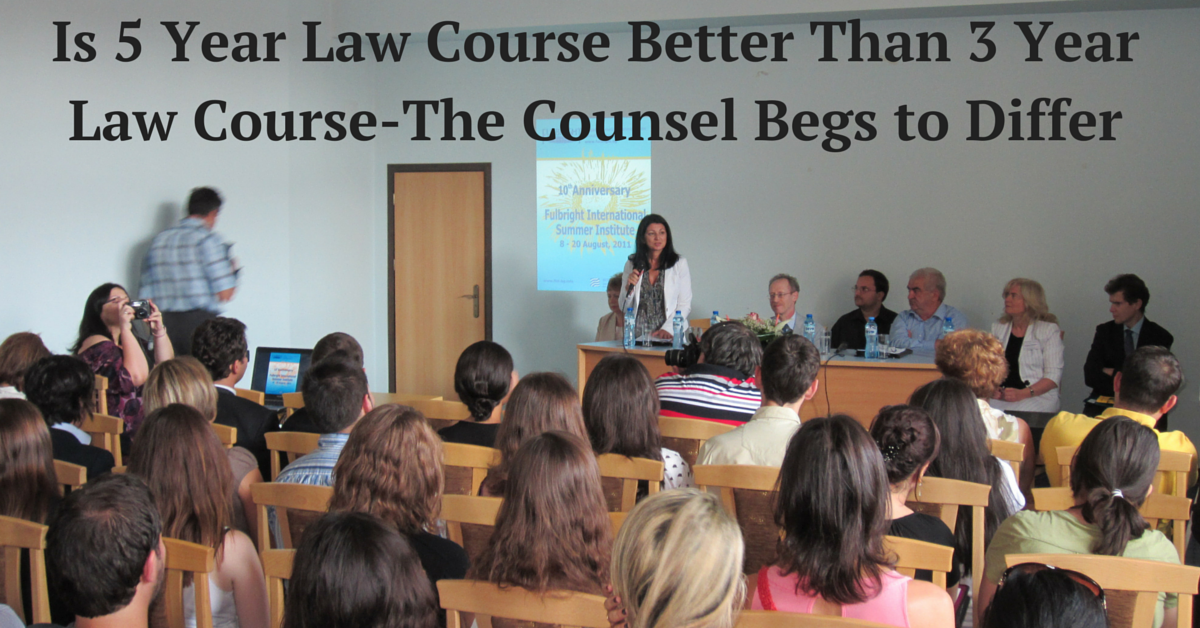
Is 5 Year Law Course Better Than 3 Year Law Course – The Counsel Begs to Differ
The journey of Indian Law Schools from Institutionalized mediocrity to becoming centers of excellence in professional higher education has been fast. In just a decade or so law has emerged as a sought after career option for thousands of students out there.
In India, there are 16 premier National Law Universities established or State Law Universities set up by Governments of Tamil Nadu and Karnataka, each set up under a separate Act of State Legislature. We also have Departments or Faculties or Schools of Law in the Central, State, Deemed or Private Universities. Further, there are hundreds of aided and unaided, government and private law colleges affiliated to these universities.
The LLB Course is available in two formats for two different audiences – 5 year integrated LLB for class 12 pass outs and 3 year LLB course for graduates from any stream offering another chance to all those who missed out opportunity to pursue law post 12th class.
Like any other 12th class pass out, I was unsure about my career choices as well post 12th class and ended up in the commerce field doing Bachelors in Commerce(B.Com) which also enlightened me on the scope and perimeters of laws established in our country which got me hooked and booked.
That’s when I decided to take up law post my graduation and pursue the 3 year LLB course which was a advantage for me since I was well acquainted with the ethics and tactics of management and business thanks to my choices.
The 5 year LLB course is suitable for students who prefer and have a knack for a legal career right from the start. Most of the top universities like National Law Universities, Symbiosis Law School and Amity Law School offer this course exclusively. To make my point obvious, in my experience I feel mentally it’s much easier to go through 6 semesters than 10(5year course has 10 semesters).
And once you opt for the 3 year LLB course, one gets the chance to soak up the best of both worlds i.e., you have the experience of two degrees and two college’s which the 5 year course would fail in providing.
The subjects and the provisions covered in both the courses are almost the same which include intellectual property rights, criminal law, international law, family law etc. except in the 5 year course the students start with the basics depending upon the course they have opted for like B.A LLB, BBA LLB, B.COM LLB, while in the 3 year course the subjects covers the advance level of the subjects in the course.
The opportunities and the legal presence in our country has undergone a strategic change over the few decades, now-a-days the law aspirants not only figure themselves in the courts but mark their presence in various corporate houses, law firms, law agencies, litigation and administrative services and many more.
So here is the time to make it large, law is a responsible profession and matured graduates taking up law after their first degree is as good as it gets! So, I firmly believe three years on law after graduation is not a bad option at all.
This is to all the law aspirants out there, no room for regrets for you even if you’ve already attended one convocation party.
Lawyered!
Article is written by Shreya Jain, a student of ILS Pune
How important is legal research to lawyering?
This article is being republished from A First Taste of law archives and is written by Harshavardhan Ganesan.
At the very outset, I must admit that when I entered law school 4 years ago, I had no idea what people meant by research. In fact, I would go so far as to confess that the first two years of my law school life went into trying to figure out what the term ‘research’ meant. Finally, enlightenment dawned on me by virtue of 3 separate but unique incidents, but more on that later. The basic, fundamental question this article wishes to answer is this- “How to Research in a way that is most useful, efficient and a tad bit thought-provoking”. Questions are easy; answers on the other hand, are not.
Let’s look at some of the problems law students, or in fact members of any disciplinary field face, when it comes to research. Lack of basic resources, lack of knowledge on how to use the resources, laziness, hangovers, and overall the negative connotation attached with the word. Research is usually seen as a humdrum process that is the law student equivalent to stacking files alphabetically. This attitude needs to change. First, we all need to realise that research does not have an end in itself; it is part of a bigger picture (Usually moot courts, research papers, seminars, real-life cases etc.) The importance of this knowledge is it helps researchers to realise that their contribution is not with regards a specific provision, or an interpretation of a particularLatin term, but their contribution in fact spreads wide and affects the entire nature of the dispute before them or their seniors as the case may be. In other words, research is but a means to an end. Second, Research is a necessity, inevitability, inescapability and in legal terms, a sine qua non to become a great lawyer.
It is at this junction, that I should share, the first instance, which helped me become a good researcher. Studying in ILS Law College, we really weren’t exposed to much research in the first couple of years. There was some donkey work to do for seniors once in a while, and a few exclusive moot court competitions dedicated to first and second year students, but nothing much beyond that. This left me, a compulsive workaholic, at an extreme disadvantage, because although I entered into the halls of ILS with great enthusiasm, the truth was, there really wasn’t much to do. I realised that there was going to be no spoon feeding at this institution, and if I wanted to achieve something, I needed to take work load on myself. This vow to me occurred a little too late, AFTER my internship at the offices of Mr. Satish Parasaran, son of the ex-attorney general K.Parasaran, and brother of the current solicitor general Mohan Parasaran. I was asked to research upon a particular point of law, namely whether intermediaries could be held for trademark infringement. I realised that the question was simple and I had understood it well. I knew what was expected, but I had one problem. I had no idea where to start! It was only through constant prodding, and questioning (Much to the chagrin of the associates there I am sure) did I figure out, and develop a research methodology.
I realised then, that whatever the reason for the initial lack of interest in legal research, something changes when law students head out for legal internships during the summer. That’s because they’re asked to research—again and again and again. So, while we as law students may or may not grow to love legal research, we need to understand that it’s a critical skill we must acquire.
In fact, upon returning from the internship, I realised that legal research was the biggest skill I should have but failed to acquire in my first two years in law school. Some realise this earlier than me, I hope you are one of them.
Well, the obvious question then is, how do YOU research? My research methodology (That’s just a fancy name for my posture on my lazy boy with a packet of chips and a red bull) consists of 3 parts, that I fondly call USR:
Understand the legal/Factual question at hand
Search for the best source(s) to support your contention
Read as if there is no tomorrow
USR (No reference to the previous USSR or the USA is intended) is my personal sure shot way of understanding and knowing the law. Let’s go step by step.
For some law students and even attorneys, research is Manupatra or Indian Kanoon. Good legal research, however, is much more than a research system; it’s a process. Good legal research is intertwined with analysis, understanding, and application. While finding the law is important, “one has not truly found the law until he understands it,” as one prominent law librarian has noted. A research system can’t do that for you. That is exactly why Step 1 of USR is about understanding the law. Read commentaries, or articles which describe not only the point of law that you are searching for, but also all related concepts.
For e.g.: If the legal question is, whether is a schizophrenia ground for unsoundness of mind vis-a-vis Section 84, apart from merely reading case laws which support or oppose this contention, it is important to understand what schizophrenia is, what unsoundness of mind means, what the effect of a general defence is, who is the burden of proof on etc.
Answering such periphery questions will abet answering the fact/ point of law in question. Without understanding the law, one cannot hope to expound it, and such illustration will only be half-baked.
Alright, so we have finished reading the basics of the point in question, as well as all inter-related aspects. So we are good to go right? Well, only partially. The question is, where did you do your research from? Blogs? Commentators? Law Commission Reports? Your senior’s notes?Wikipedia?
Of course there is a hierarchy, of how to go about your research, and what sources you should use to (a) Understand the law and (b) Cite in documents. Most people fail to grasp this basic, but subtle difference. In order to understand the law, it is permissible, nay, encouraged to read blogs, articles, even (Dare I say it) Wikipedia, merely to understand the broad picture. I use the term ‘broad’ in a very broad way. Consider it a watered down version of a virgin mojito. Once the basic and allied concepts are ingrained in the brain, step it up a notch, and start reading commentaries, journals, and judgements that support your view.
I learnt this lesson the hard way. When I was interning in New York (Resume` show off time), I was asked to research the effect of Section 34 of the Indian Arbitration Act, in International Commercial Arbitrations. I was really excited, largely in part to my interest for arbitration. I went through multiple articles and commentaries online, but still failed to find the precise point of law I was looking for. Then, Eureka! There it lay, the sentence that I could have not drafted better, sitting right there on the screen. It was a temptation that I gave into. I cited a blog (The Indian Arbitration Blog I think it was called). Usually this wouldn’t have been such a big deal, but my draft opinion was included prima facie by the associate, who had her doubts about the inclusion of the blog, and then sent the same to a senior partner. I still remember the feeling I had when the senior partner told me in the politest of tones with the nicest of words, that I cannot cite a blog in an opinion that was supposed to be a part of a brief to be submitted to the Court of Appeals Judge!
The point of the story is this, know what to cite, and where to cite it. The blog or even a Wikipedia article might have the golden egg that you are desperately looking for, but unless you wish to lose your job (Or in some jurisdictions, like Westeros, your head) you absolutely must not give in to the urge. Much rather, see if they have cited that particular sentence to any piece of legal literature. If they have, cite the literature ONLY after going through the same. Research is hard work, but it is also extremely satisfying once you have made a water-tight case for yourself.
This brings me to my third and last step. Read. It sounds simple enough, but it is much easier said than done. Let’s take a simple example. “Substantive laws do not have retrospective application.” This sentence is cited to 6 different authors and commentators. Our initial tendency and urge is to merely cite the first, or the most ‘authoritative’ author (An unknown standard in an unwritten code determined by Indian Law students). This tendency is a pitfall in the field of legal research. The more advised step to take would be to read the various commentators’ point of view, analysis and justification and then cite the same. The biggest treasure cove that a law student has in any article is not the bare text of the article itself, but the citation section. It is literally an endless search for more and more authorities, which leads to more and more knowledge, more and more conviction and eventually better work.
I confess that I lied at the beginning of this article. The third incident I spoke of was in fact neither unique nor distinct, but a sum total of all the countless hours I have spent researching for all the Moots, Research Papers, and Articles that I have participated in. I have tried my best to share my experiences on how best to research with all of you, but the truth is that each person has an individual style, and manner of research. I know many people who have much more organised ways of researching, which include segregating every article or commentary they read into various headings, sub-headings and sub-sub-headings. Stick to what works for you.
Abraham Lincoln’s quip about a book he read could easily be applied to legal research—
“People who like this sort of thing will find this the sort of thing they like.”
The truth is, however, that whether you like it or not, legal research is a critical part of lawyering. Don’t underestimate its importance.
I strongly and firmly believe that USR is a good place to start. Novation and Modification is your prerogative. I know I modified my USR. What did I do? The Joker says
“If you are good at something, never do it for free.”
I plan to implement those words today.

CLAT and NLU Delhi: Cut-off Comparisons and Preference List
Republished from 2010 A First Taste of Law archives.
After the much nail-biting, the CLAT and NLU Delhi Results are finally out. As we had predicted, the NLU Delhi cut off was not much higher than 100 (it was 102 for the General Category, as can be seen from results here).The final cut off wouldn’t be above 100 once subsequent lists are out.
The highest score in CLAT was 165, in line with our prediction of 160-165. The cut-off for NLS, Bangalore was at 152, very close to our estimate of 150. For NALSAR, Hyderabad it was 148 and 145 for NUJS, Kolkata, marking the overall cut-off for the top 3 law schools at 145. This was slightly above our estimate of 140, but still quite close as an indication. If I have assessed things right, the cutoff for NUJS should come down a couple of marks as some people won’t take up their seats.
Incidentally, I was taking a look at the other cut off predictions:
- LST – 145-160 for top 3 law schools.
- Clatguru.com (don’t miss this): “If you expect a score of 155 or more out of the maximum 200, you should be hopeful of getting a seat in one of the eleven national law colleges.” What an accurate prediction.
- Prime also went for wide ranges: NLS Bangalore = 160+, NALSAR Hyderabad = 152 – 160, NUJS Kolkata = 145 – 152. Well, now I see the advantage of predicting a very wide range rather than specific cut-offs – you are going to get something right!
Our hearty congratulations to all those who made it through the CLAT or, and the NLU Delhi exams! And for those who didn’t, they shouldn’t lose heart. Colleges such as Government Law College, Mumbai, Amity Law School, New Delhi, and a number of other law colleges all over the country offer fabulous opportunities for any person who is seriously interested in pursuing law. Students who start from another university but sustain interest in law and work consistently towards it shall definitely make it as big as anyone else from another university anywhere in the world. Remember, succeeding in the CLAT or NLU Delhi Exam is not the end, it is just the beginning. And if any of you is still insistent upon doing law from a National University could choose to take a year off and reappear for the CLAT in 2011.
Ok, finally here is our ranking for law schools, so that you can easily make our admission decisions
1. NLS, NUJS, NALSAR, NLUJ
2. NLUD
3. GNLU, NLIU
4. ILS, Pune
5. Symbi
6. HNLU, RMLNLU, NUALS
7. NLU Orissa
8. RGNLU, CNLU
This ranking is based on Ramanuj’s overall assessment of the opportunities and exposures that these institutions offer, recruitment included. It’s not open for debate. If a law school is not mentioned, it would come somewhere afterwards the ones mentioned here.
Coldreading and The Art of Great Conversation
This article was written by Ramanuj Mukherjee, and being republished from the First Taste of Law archives.
Sometimes it is a difficult decision to make – what should I write? There are several ideas in my head – like “How to perform well in a project viva/interview” or “Two secrets to sleep better and stop being sleepy all the time.” However, I decided that I shall not get the exam season get better of me and I shall write on a skill which is lot more interesting – the skill of making another person think that you understand them really well. The skill is called – ‘coldreading.’
OK, think about it – do you ever feel like no one really understands you, but some of them just pretend as if they know everything about you? Stop reading, think about it.
Did you just think “yes, that happens to me sometimes!” well…that happens to everyone. Asking a question like this is called coldreading by mentalists, a kind of magicians who specialize in mind tricks. This is a very controversial skill, psychics who claim to talk to ghosts and have supernatural powers that they use to predict things are usually coldreading. Those who are good at it can not be caught.
However, this has made a great subject of study for the psychologists. Dating gurus often teach coldreading to make conversations interesting and engaging. To be a coldreader you need not proclaim that you have extraordinary powers, you can just make another person feel that you understand them very well, which can be used to comfort friends in distress, or generally, to make another person feel good. After all, there is no better flattery to an intelligent being than another intelligent being genuinely understanding them or making and educated attempt to understand. This is also a great way to start learning to effectively observe people.
I think the best way to start with cold reading is to understand the Barnum effect. Read this paragraph below:
You have a great need for other people to like and admire you. You have a tendency to be critical of yourself. You have a lot of unused capacities which you have not turned to your advantages. While you have some personality weaknesses, you are generally able to compensate for them. Your sexual adjustment has presented some problems for you. Disciplined and self-controlled outside, you tend to be worrisome and insecure inside. At times, you have serious doubts as to whether you have made the right decision or done the right thing. You prefer a certain amount of change and variety and become dissatisfied when hemmed in by restrictions and limitations. You pride yourself as an independent thinker and do not accept others” statements without satisfactory proof. You have found it unwise to be too frank in revealing yourself to others. At times, you are extroverted, affable, sociable while at other times you are introverted, wary, reserved. Some of your aspirations tend to be pretty unrealistic. Security is one of your major goals in life.
source: http://www.denisdutton.com/cold_reading.htm
These are observations general enough to apply to almost everyone. This is how astrology is sold. This is why some Facebook quizzes actually seem to be good. There are certain traits, characteristics, experiences that people like to attribute to themselves and if you suggest to them that they possess those, they readily agree. Not deceptively, but genuinely. There is a part of their brain that wants to believe that they have those traits, and that finds support in your statements, which are put on the table as genuine observations by you. So they will jump at it and agree that you are right. As a price, they will be happy to recognize your special ability to understand them 🙂
If you want to try cold reading, there are a few things that you should be aware of:
- Be vague without sounding vague: You have to be vague, but the subject should not feel that what you are saying is too vague. How can you achieve that? Just say: I have a feeling that you are about to make a big decision in your life. Well, the truth is we are always making decisions, and at any moment one of those to-be-made decisions seem to be biggest to make. You do not say how big, therefore the subject is reminded of the decision he or she is making – and they are made to think about it. If they are thinking about it, they may end up sharing it with you soon.
- Be general, but make it sound specific: people hate it when they know you are generalizing about them. But when you tell them generalized things as if it is really special, they love it if you are stereotyping them positively. You must say general things at the beginning of cold reading, like the statements in the paragraph above – like all astrologers do. from general, you can transition into more specific things depending on the cues the subject give. However, the best thing to do is to be able to say general things that the subject perceives as special to him.
There are certain things that people do not share with others. Especially with strangers. People tend to think that such information is special to them and no one else knows. Nonetheless, that information can be general – like most people are worried about getting overweight, it’s just that people don’t talk about their own weight gain very often. The good thing is if you can coldread something about a person that he really rarely shares, then he is bound to be surprised.
Let’s see: Women are very conscious about weight gain, and they don’t like it so they don’t talk about weight gain. They definitely talk about weight loss programme, cool diets etc., but they will not admit even to women, unless they are close enough to share a secret, the details of how they have gained weight lately. Plus they try to hide signs of weight gain. So this is a good subject.
Just two things, if the woman is obviously and visibly overweight, this won’t work. And you better not sound unkind or insensitive, otherwise god saves you. Say “I don’t think you need worry so much about gaining weight – it’s normal to gain a little – you can expect to have weight fluctuations at this age.” This way, you can sound supportive and also surprise her by telling her that you know she is worried about weight gain. She will identify with it and add meaning depending on at what level she is worried about it. If she is really worried, her reaction will be clear and obvious. If she is not that worried – reaction may not be spectacular but she will mildly agree with you.
Do you think those who are fit are not insecure about weight gain? absolutely wrong – the fit people are struggling to maintain fitness – and they are the most worried lot.
Let’s look at another situation. Think of a person who is not very good in a social situation. he knows it and he is anxious about it – but he would not think that other people knows about this anxiety because he never shares it. On the other hand, it is easy to identify a person who is not exactly a ‘fit’ in a social situation and is feeling out of place. If you tell this person that you used to feel like a social misfit sometimes back and then you have managed to overcome it, you will have undivided attention and admiration of this person. - Be casual: The subject of coldreading need not be serious or life-altering things. It is best done in day to day conversations in a casual way. “It looks like you are really interested in cooking.” Maybe the person is not really interested, she never cooks (this is the worst case scenario here) – so she’ll say that. Then you should be able to casually clarify that you meant good cooking by others – not necessarily her own cooking. Now that’s transitioning from specific to general which needs a lot of panache and smoothness in a character to be convincing. The best way to achieve this is to be completely casual and laugh about it all the time!
- Say positive things: a subject is likely to be more accommodating when you are saying positive things about him, rather than negative or neutral things. By making negative and neutral observations, you trigger inherent skepticism of a person, and this has the exactly opposite effect of Barnum Effect. Even if they genuinely have such a trait as you suggested, they will contest it. Tell the person what he wants to hear and you have him.
- Take Inputs from the Subject before you coldread: rational people want to rationalize everything -they don’t believe in what they can’t rationalize. If they find some easy way to rationalize what you are doing, they will accept it. This is why in some cultures people would attribute absence of mushrooms for lack of rain – it is beyond them to find a rational explanation as to why it is not raining, so they are ready to accept some superstitious story as an explanation. If you are coldreading, people would want to rationalize your behavior. The quicker they find a rational sounding answer, they will accept that apparent explanation. This is why palmists read your palm with a magnifying glass before they do coldreading – to lead you onto a trail of rationalization. If they coldread without taking any inputs, no one would believe them. You can take inputs without making stupid claims like you have magical powers – just talk to the person for a while – and make her feel that you are getting some information from her that she is not actually saying – by observation. It will still freak them out, but you don’t have to suffer the ignominy of claiming supernatural powers.
If any of you try cold-reading – do let me know. Its for fun – please don’t use this knowledge to mislead or cheat people. Rather, catch those who do it. And have lots of interesting conversations – cold reading really opens people up and excites themselves about their own life.


Allow notifications