Download Now
Home Blog Page 1687

Regulations Surrounding Board of Directors

0

In this blog post, Aakansha Bansal, a student pursuing her Diploma in Entrepreneurship Administration and Business Laws from NUJS, Kolkata, discusses the important regulations that surround Board of Directors.

IMG_5930

What is Board of Directors (BODs)?

The Board of Directors is a group of directors within the company who are elected to represent the stockholders of the company so that the corporate management related strategies and policies can be established. It is also empowered to make important decisions regarding major issues related to the company.

Why does a company need Board of Directors?

Every company needs a board of directors because of the following reasons-

  1. It ensures independence and accountability.
  2. For devising Corporate Strategies.
  3. It enhances the credibility of the company as the BODs is responsible for the protection of the stakeholder’s interests.
  4. To fulfill the requirement of corporate governance.


iStock_000000419014Medium

Powers of Board of Directors

The Board of Directors is flooded with immense powers. Section 179 of the Companies Act, 2013 enumerates the Powers of Board. Some of the powers mentioned in the said section are as follows-

(a) to make calls on shareholders in respect of money unpaid on their shares;

(b) to authorize buy-back of securities under section 68;

(c) to issue securities, including debentures, whether in or outside India;

(d) to borrow monies;

(e) to invest the funds of the company;

(f) togrant loans or give a guarantee or provide security in respect of loans;

(g) to approve financial statement and the Board’s report

Need of regulations on the Board of Directors

The powers entrusted to the Board are not arbitrary. To protect the interest of stakeholders and to ensure justice, it is of great importance that powers exercised by the board are well regulated. Even the proviso of Section 179 of the Company Act, 2013 states that the powers exercised by the board shall be subject to the Act itself, memorandum and articles of the company or any regulations not inconsistent with the regulations already made by the company in general meeting.

Regulations

 regulations

  1. Duties of directors under the Company Act, 2013-

Following are the duties and responsibilities stipulated by the Indian Companies Act of 2013 under section 166-

  • A director is to act in good faith in furtherance of the company’s benefit and not for his personal gains.
  • A director is not allowed to assign his office, and if in case he does so, such assignment shall be void.
  • A director is to act in accordance with the Articles of Association (AOA) of the company.
  • A director shall exercise independent judgment and take reasonable care while performing his duties.

Important- There is a penalizing provision also under section 166 of the Company Act 2013. It says that a director not obeying his duties shall be punished with a fine which varies from One Lakh Rupees to Five Lac Rupees.

  1. Securities and Exchange Board of India (SEBI)-

sebi-625_625x300_51440419852

  • Prohibition on Insider Trading-

Insider Trading is a trading of a public company’s stock or securities by an individual having access to unpublished price sensitive information.

Unpublished Price Sensitive Information” means any information which is not known to the general public and the information on becoming known will directly or indirectly affects the price of the securities of the company in the market.

Regulation 3 of SEBI Regulations seeks to prohibit Insider Trading. It provides that no insider shall either on his behalf, or any other person can deal in the securities of the company when he is in possession of any unpublished price sensitive information. The insider is even prohibited from communicating, counseling or procuring, directly or indirectly any unpublished price sensitive information to any person unless it is required to be done in the ordinary course of business or profession.

The directors and substantial shareholders are bound to disclose their holdings to the company periodically.

Important- SEBI also provides for the punishment in case any person is found to be indulged in Insider Trading.                                                                                             SEBI may- (a) impose a penalty of not more than Rupees 25 Crores or three times the amount of profit made out of insider trading, whichever is higher.  (b) initiate criminal prosecution.

  • Clause 49-

Clause 49 of the Listing Agreement by Securities Exchange Board of Indiaseeks for the improvement of Corporate Governance and prescribes for the norms under which the companies are mandated to operate.

It applies to all the Listed Companies. It provides that the company must mandatorily have minimum 50% non-executive directors on its Board, and there must be at least one woman director. Also, in case the chairman of the company is a non-executive director, then one- third of the Board must comprise of Independent Directors. In case the chairperson of the company is not a non- executive director, then at least one- half of the Board must comprise of Independent Directors.

It also provides for the establishment of Audit Committee and Nomination and Remuneration Committee by the Company. These committees should necessarily comprise of independent directors.

The presence of Independent Directors in the Company helps to protect the interest of the shareholders, and it also ensures that the Board is not biased to any particular shareholder or stakeholder.

The penalty will also be attached in case the Company fails to appoint Independent Directors as per its requirement.

  • Whistleblower policy-

Initially, it was not a mandatory provision. However, now it has been made compulsory on the part of the Company to establish a vigil mechanism to safeguard the interest of personnel availing it.

A whistleblower is a person who exposes any activity or information which is illegal or unethical on the part of the company.

bl18SLATE_ONE_jpg_1793684g

  1. Related Party Transaction-

A transaction between two persons who are already related to each other even before entering into that deal is called related party transaction. A related party includes business associates, shareholders group, a subsidiary of the company, etc.

Related party transactions are regulated to prevent directors from earning personal gains at the cost of the shareholders. All Material Related Party Transactions shall require the approval of the shareholders through a resolution and the parties to the transaction which are so related shall be abstained from voting on such resolutions.A transaction with the related party would be considered to be material if it exceeds 10% of the consolidated annual turnover of the company.

However, transactions which are taken place at arm’s length price in the ordinary course of business are not regulated.

A director is obliged to disclose his interest to avoid criminal consequences. For example, a particular director or directors may have some personal interest in the matters which is under discussion in the Board meeting. The interested director is required to disclose his interest and shall abstain himself from voting on the matter in which he is interested.

Important- All directors or other employees who are authorized to enter into a contract on behalf of the company, enters into any material Related Party Transaction in violation of the provisions of the Company Act 2013 can be fined with an amount which may vary from 25000 Rupees to 5 lac Rupees. In case the company is a Listed Company then the punishment can include imprisonment up to 1 year also.

  1. Corporate Governance-

The general rule is that the directors of a company enjoy the benefit of having limited liability. However, there have been many instances when the directors or officers in default are made personally liable for the company’s acts. This is a very important aspect of Corporate Governance.

Corporate Governance stipulates the way according to which the company is required to work. It prescribes the manner in which the company is governed. Directors not acting within their framework shall be liable to make good to the shareholders or other affected persons.

Corporate Governance is primarily concerned with protection of shareholder’s interest, employees, and public at large.

Various laws, regulations, and notifications have been enacted which act as an instrument of Corporate Governance. There shall be a separate section on the Corporate Governance in the Annual Reports of the company along with the detailed compliance report on Corporate Governance.

  1. Secretarial Standard on Meeting of BODs-

Institute of Company Secretaries of India has laid down Secretarial Standard -1 (SS-1) on “Meetings of the Board of Directors”.

The Standard seeks to prescribe principles which enunciate the manner in which Board of Directors should conduct their meeting. Therefore, these standards regulate the conduct of Directors to a great extent.

Corporate-Social-Responsibility-CSR

  1. Corporate Social Responsibility (CSR)-

The Indian Company Act, 2013 has made it compulsory for certain companies to observe the provisions of Corporate Social Responsibility. The Companies need to examine the morality of their business.

CSR is a company’s initiative to take responsibility towards the society at large. It ensures that all the stakeholders are fairly treated.

Every Company whose net worth is at least Rs. 500 crores, or turnover of Rs. 1000 crores or a net profit of Rs. 5 crores during any financial year is mandatorily required to allocate at least 2% of its profits to CSR initiatives.

Any company functioning in violation of the above provision shall attract criminal consequences.

Conclusion

It cannot be denied that power without regulation will in no time turn into arbitrariness. If the person is given powers, he shall also be burdened with some regulations or obligations so that he exercises his powers in a reasonable manner and the interest of general public.

Keeping in mind this view, the Companies Act along with other organizations has come up with the provisions which regulate the conduct of Board of Directors. The provisions which have been discussed above seek to protect the interest of the stakeholders and public at large. These regulations ensure that the directors are not enjoying personal gains at the cost of the interest of the society or of the shareholders.

If you want to learn more about COMPANIES ACT, 2013 you can take up this course that is created by iPleaders in association with National University of Juridical Sciences (NUJS), Kolkata which is regularly ranked as one of India’s top three law schools.


 

Download Now

Positions That Are Eligible For Executive Compensation

0

In this blog post, Angela D’souza,  a student pursuing her LL.B (4th year) from School of Law, Christ University, Bangalore and a Diploma in Entrepreneurship Administration and Business Laws from NUJS, Kolkata, enlists and elaborates on the positions that are eligible for executive compensation.

photo-small

The growing number of corporations in the country often results in a dearth of qualified staff, especially those deemed to be fit to occupy managerial positions. Organizations competing tend to devise means to attract, retain and motivate the workforce of the organization. One such method is that of executive compensation.

Executive Compensation is the compensation paid to executives of business corporations. It primarily comprises of the salary, bonus, long-term incentives and prerequisites. The concept of executive compensation gained significance after the economic liberalization of 1993. With the rise of India as a hub for international investment, increased trade and commerce has resulted in the springing up of several commercial organizations. With it came in an increased demand for qualified workforce and hence the idea of executive compensation gained momentum.

Historically, executive salaries in India had been low and were stringently regulated by way of Government regulations. However, these caps were regularly raised until there was a gaping wage disparity between the employees and those at managerial positions. It was at this juncture that the need for a fixed cap was felt. The advent of the Companies Act and subsequent amendments helped achieve this goal.

executive-compensation

The Companies Act 2013 and Executive Compensation: Who is entitled?

Though the Companies Act has undergone several amendments, it would be beneficial to consider the 2013 Act which is currently in force. However, at first, it is essential to understand as to who is qualified or eligible for executive compensation. The essential provisions with regard to executive compensation are contained in Chapter XIII of the Companies Act, 2013.

Section 196 essentially states who would comprise of managerial personnel entitled for executive compensation under Chapter XIII of the Act. By Section 2 (51), the key managerial personnel would include:

  • The CEO or the managing director or the manager.
  • The Company Secretary.
  • The Whole-time director.
  • The Chief Financial Officer
  • Any other officer as may be prescribed.

The Chief Executive Officer means an officer of the company, who has been designated as such by it [Section 2 (18)] while a manager is an individual who has the management of the whole or substantially the whole of the company. However, the definition of a manager u/s 2 (53) further states that such manager will be subject to the superintendence of the Board of Directors. On the other hand, a managing director is defined by Section 2 (54) as a director who by the AoA or an agreement with the company or by a resolution of the general meeting or Board of Directors is entrusted with substantial powers of the management and the affairs of the company.

A Chief Financial Officer means a person appointed as a Chief Financial Officer of the company [Section 2 (19)], while a whole-time director as defined under Section 2 (94) is a director in the whole-time employment of the company.

remuneration_img

The Companies Act 2013 and Executive Compensation: Computing Remuneration

Section 197 provides for the overall maximum managerial remuneration and managerial remuneration in case of absence or inadequacy of profits. Clause 1 states that the total managerial remuneration by a public company to its directors in any financial year should not exceed eleven percent of the net profits of that company in that financial year. The net profits should be calculated in the manner prescribed in S 198 of the Act, and such remuneration should not be deducted from the company’s gross profits.

At this juncture, it is essential to note that the term ‘director’ in this case would include the managing director and whole-time director. It is also essential to note that a general meeting can only raise the cap of eleven percent after the prior approval of the Central Government.

Further, it should be noted that the remuneration payable to anyone, a managing director, whole-time director or a manager should not exceed five percent of the net profits of the company. Also, the remuneration payable to directors who are neither managing nor whole-time directors should not exceed one percent of the net profits if there is a managing or whole-time director. In case there is no managing or whole-time director, the remuneration cannot exceed three percent of the net profits.


Download Now

Liability Of The Director Of A Private Company Under The Income Tax Act

0

In this bog post, Amit Halder, who is currently pursuing a Diploma in Entrepreneurship Administration and Business Laws from NUJS, Kolkata,discusses the liability of the director of the private company under the Income Tax Act.

liability

A company, irrespective of whether it’s a public limited company or a private limited company, must have directors who manage the day – to – day affairs of the company. A company has a separate legal entity and has the power to sue and be sued, but it does not have the capability to think. For its assistance, the directors are appointed in this behalf. The members are the actual owners of the company, but they neither have the capacity nor the ability to interfere with the management of the company who have plentiful shareholders. The directors are appointed by the members to handle the dealings of the company. There are many directors appointed for a company, collectively they are known as the Board of Directors. A director must be a person and cannot be a firm, association or a body corporate. Any named Partner or so may appoint him.

shutterstock_89791522


Directors can be divided into two main categories, one being a Managing Director and the other being a whole-time Director. A managing director is a person who has power with the ability to manage the affairs of the company whereas a whole-time director is a person who devotes his mental as well as his physical labour for the benefit of the company. The directors are endowed with certain duties along with liabilities towards the company. The directors are solely responsible for any mishap caused to the company out of negligence. They must abide their duties with due diligence. They are empowered with certain powers which they must use with proper care. The decisions made by the directors are very crucial. Hence, they must make their decisions in good faith and without any personal interest. The directors are the superior head of the company, and their decisions bind all others officers. The powers exercised by the directors are assigned by the company through its memorandum or article, but it must be in compliance with the Act. The directors also supervise the issues related shares. Their powers include fixing the date of various meetings like the General Meeting, Annual General Meeting, and other statutory meetings. One of the most important duties of the director arises at the time of winding up. The directors are bound to give notice of such to its shareholders and must appoint a liquidator as per the law prescribes. The creditor’s interest are also protected as the directors himself meet the creditors of the company.

maxresdefault (2)

The directors are solely responsible for their acts. If a forgery is done jointly then the directors who commit such act are responsible jointly and if it is individually done then the individual director is responsible for such an act. The director is a dependable member of the company and can only be dragged to a tribunal if he is found guilty but an outsider must file the suit. The directors are part of the company, so it is necessary that an outsider has to bring the suit. The outsider can be a shareholder or a creditor. It is found that when they are found guilty the company though it has a separate legal entity cannot bring a suit against them nor do justice to it. It can only be done in the tribunals.

The directors are the commanders of the company; its fate depends on their decisions. There are many Indian Laws which directly attributes the person who is in charge of the business. Sections 178, 179 and 180 of the Income Tax Act 1961, deal with the liability of the directors. Section 178 provides that at the time of winding up any person can be appointed as a liquidator. The liquidator has no right to set aside any amount in respect of assets for paying any outstanding taxes or any sum due to any creditor. The liquidator must provide any such information to the Assessing Officer for further inquiry. On being satisfied, the liquidator with the permission of the officer will take further steps for repayment. If the liquidator is found guilty, then he shall be responsible for such act and is liable for repayment of such debts. Then Section 179 says that directors including a retired director are responsible if the taxes are not cleared for the previous year of any private company. The amount of taxes outstanding is to be paid by the directors unless he proves himself innocent. This section also emphasizes that in cases where a private company is converted into a public company the directors cannot be held responsible if the taxes are not paid only if the conversion is done before 1st April 1962. Section 180 of the Income Tax Act, 1961 deals with the royalties or copyright fees which are paid for literary or artistic work. It says that if an author takes more than twelve months in completing his assignments, in such cases, if any payment is made during that time or an advance payment is made, such payments are not subject to refund. The author cannot be liable in any respect.

income-tax

A director has many liabilities towards the company and cannot be made liable for any act which is valid. The Companies Act, 2013 provides that a director cannot draw a loan from the company except if the article provides so. If the director does not repay the amount withdrawn as loan, then he can be made liable under this Act. The Income Tax Act, 1962 provides that like every earning person a director is bound to pay taxes including income tax and sales tax. Failure in which may invite penalties. The revised Companies Act, 2013 also provides that a director cannot be made liable for entering into an agreement with cash as a consideration. In certain cases, if the consideration is anything other than cash then a Special resolution must be passed in this respect.

A company and its directors cannot be separated. They are considered to be a different side of the same coin because if a company run into losses, it is for the negligence or incapacity of the Director and vice-versa. A director must be transparent in respect to his work. His is not responsible for any personal act but only responsible if the act is void in the eyes of the law. If there is no specific punishment prescribed for the crime in respect of a company, then the defaulter is liable to a fine not less than fifty thousand rupees and which may extend to five lakh rupees.


Download Now

Copyright Infringement Through Internet

0

In this blog post, Sakshi Samtani, a student of K.C. Law College, Mumbai, who is currently pursuing a Diploma in Entrepreneurship Administration and Business Laws from NUJS, Kolkata, talks about copyright infringement through the internet.

FullSizeRender (1)

Copyright is gaining utmost importance globally. America earned 89 billion dollars from the copyright industries which consisted mainly of the Movie and Music industries. It is of extreme importance that this lucrative commodity gets the protection it deserves. With regards to sharing of files, infringement of copyright occurs mainly because of the disability of the music and movie industry.

Intellectual property is inclusive of innovations, inventions, scientific discoveries, industrial designs, trademarks, logos, business processes, literary and artistic works and knowledge which are all results of the creator’s intellectual application. Several elements of intellectual property can be protected under Copyright Laws. The product shape can be protected as industrial design, the brand name inscribed is protected as a trademark, and the internal parts of the products can be protected as a patent, as is the case with billionaire company Apple which patented their Apple Computers.

The copyright law enacted as The Indian Copyright Act, 1957 grants protection to five bodies of works which include literary works (e.g., Brochures, Manuals, Blog Posts, Articles, Website content and any other material used for marketing, software, databases etc), Artistic works (Paintings, Drawings, and Photographs), music work, sound recordings, cinematograph movies, works of drama such as dance choreography, skits, drama and so on.

copyrightallrightsreserved

Section 51 (a)(ii) of the Copyright Act states that “the act of infringement is when, a person without any licence by the registrar or the owner of the particular copyright, does an act that is in the contravention of the conditions of licence or condition imposed by a competent authority under this Act permits for profit any place to be used for the communication of the work to the public where such communication constitutes an infringement of the copyright in the work, unless he is unaware as and had no reason to believe that the particular communication to the general public would result in copyright infringement.”

These days, Internet service providers give instructions to their servers to transmit and store the data of users across the network. This move helps the ISPs to have grounds to pin liability on any third party if any infringement has taken place. To be liable for a copyright infringement, it is important to show that the ISP benefitted financially from it in some way. ISPs earn a high amount even when they showcase some illegal material that has been copyrighted because of the advertisements that were part and parcel of the material shown. So, an ISP is only held liable when they transmit the illegal material and also when they store it.

IP Rights are usually granted by law to create a sustainable system which gives rise to innovation by handing over certain rights which are exclusive to the creature of the innovation. This is also a catalyst for the creation of more intellectual property that would finally benefit the economy. Protection of intellectual property aids in maintaining a balance between the interest of the public and the needs of creators or innovators.

Liability of copyright is placed on three concepts which are direct, vicarious and contributory infringement. Direct infringement happens when a person violates any right that is exclusive to the owner of the copyright. Vicarious liability occurs when a person does not prevent infringement when he should and as a right must do so, and he benefits from the infringement taking place. Strict liability is the basis of these two concepts, and a person will be held liable regardless of his intent and state of mind. The third concept Contributory liability happens when a one takes part in the act of direct infringement and knows of such illegal activity. A question that always arises is ‘what is the standard to be held to fix the service provider’s responsibility?’

internet

An internet service provider (ISP) is criminally liable when he commits an act of infringement or when he abets another in infringement of copyright in a body of work, or any other right which is covered in the ambit of the Act. The commitment of such an act leads to the punishment which is imprisonment which can extend up to a year, or a fine or in some scenarios both are applicable. The Act states that liability can be removed on the ISP’s if it can be proved that they were unaware that copyrighted material was being held in storage or transmitted via their servers. This is the only exception to such liability.

In India,the liability of the service providers has not been expressly covered by the Indian Copyright Act. If the service provider can prove that he did not know of the occurrence of the alleged act and that he had taken steps to prevent this, the Information Technology Act, 2000 prevents them from being held liable. However, the provision must be tightened and prescribe liability limits on the service providers.

unnamed

The Information Technology Act must address the financing of such transactions and the link between the ISP and a third party because this is important to establish the identity of the person who is violating the law. Contributory infringement which is an American concept could also be enacted into the Indian Act so that any third person having knowledge or indirectly participating in the infringement can also be held liable. In India, as long as the service provider shows that they have conducted reasonable due diligence, then they are in the clear. However, the Act does not clearly define due diligence so conducting such diligence could be a disastrous idea as it can lead to a lack of privacy and policing. There is a demand to have a better system in place and clarify the meaning of the words “due diligence” because the main function of the ISPs is to build the internet and not police it.

There are certain remedies if an infringement has taken place.  Take down notices if the infringement has taken place online, businesses have the option of writing to an ‘intermediary’ putting a request to remove the content. On receiving the request, the intermediary has 36 hours to take it down from the servers. The main remedies for copyright infringement are having an injunction taken out against the circulation of the infringed material, and monetary damages or an account of the profits which were made through the sale of infringing copies. However, if the infringer can prove that on reasonable grounds he had no knowledge that such work was copyrighted, then the only effective remedy that can be put in place is taking out an injunction against the erring person. He will not be held liable to pay damages or show an account of profits.

To prevent the infringing party from arguing that he was not aware such material was copyrighted, the owner of such material must show a claim to the copyright on his work by attaching a copyright notice.

A standard copyright notice would include the copyright sign © along with the name of the entity/individual, and the year of creation of the work, followed by the words “All rights reserved. Any authorized distribution, circulation or republication of a part of the whole of the book or pamphlet or any other will be liable to action under the applicable law”.

When awaiting the final decision on the proceedings of a legal case, a temporary injunction can be taken out. They can also be granted in the absence of the offender (ex parte). A couple of relevant injunctions are the John Doe orders and the Anton Pillar orders. A John Doe order is an injunction which gets passed against unspecified offenders. This is incredibly useful when it is difficult to identify the offender quickly or when the violation is happening at multiple locations at the same time. This order is binding once it has been issued. A good example of the John Doe order is the case of the movie Singham. (Reliance Big Entertainment v. Multivision Network and Ors.) (Del HC)

Anton Pillar orders give the owner the authority to enter the premises of the infringer to inspect documents and articles or to remove such documents and articles from the custody. The purpose of this order is the prevent the offender from destroying the copyrighted evidence. This is why this order also known as an ex-parte order is issued without even hearing the offending party’s case. These orders are highly useful in software piracy cases.

Recently, Kickass Torrents, a very popular torrent site has been taken down. The American government arrested the founder of the website, a Ukrainian named Artem Vaulin. He was charged with criminal copyright infringement. However, in India, the piracy industry is still very much intact. Because of piracy, the film industry in India loses a ton of money, something to the tune of Rs. 18,000/- crores and about 60,000 people lose their jobs every year!


Download Now

Essentials Of A Listing Agreement

0

In this blog post, Abhishek Kumar, a student of law at Delhi University, who is currently also pursuing a Diploma in Entrepreneurship Administration and Business Laws from NUJS, Kolkata, discusses the essential clauses in a listing agreement.

DSCN7046

The basic document which is executed between the company and the stock exchange (when the shares of the company are listed on any stock exchange) is the listing agreement. It is like an employment contract in which the broker is hired to represent the principal, but no real property is transferred between the two.

Different from a conventional agreement

According to law, the agreement is an act where two parties consents to the commission or omission of an act for mutual consideration which can be oral or in writing. It involves the express consent of both the parties.
However, Listing Agreement does not involve an actual involvement of two people. Here, in Listing Agreement entered with the Stock Exchanges, execution is done only by the Director on behalf of the Company, but the signature of the party representing the Stock Exchange is not found.

What is it?

Listing means an admission of the securities to dealings in a recognized stock exchange. There are separate listing departments to grant approval for listing of securities of Companies in accordance with the provisions of the Securities Contracts (Regulation) Act, 1956, Securities Contracts (Regulation) Rules, 1957, Companies Act, 1956, Guidelines issued by SEBI and Rules, Bye-Laws and Regulations of the Exchange. Companies entering into this agreement with the Exchange have to make certain disclosures and perform certain acts. Listing departments monitor their compliances with respect to the agreement.

for-employees-non-competes-important-clauses-350x233
Important Clauses

Clause 16 – Notice for corporate action

  • Give notice to SE stating the date & purpose for register closure or of the record
  • SE to be intimated at least 7 days before such closure or record date.

-for purposes of the declaration of dividend or

-the issue of right or bonus shares or

-the issue of shares for conversion of debentures or of shares arising out of rights attached to debentures

-Close register of transfers once a year at time of AGM

  • The company on whose stocks, derivatives are available or whose stocks form part of an index on which derivatives are available shall give a notice period of 30 days to stock exchanges for corporate actions like mergers, de-mergers, splits and bonus shares.
  • Company not to have a gap of fewer than 30 days between two book

Clause 19 – Notice for board meeting to consider the prescribed matter

  • At least 2 working days in advance of a Board meeting to decide the matters of the clause.
  • No prior intimation is required about Board meeting in respect of the issue of bonus shares if the issue is not on the Agenda of the board meeting.

Clause 20 -Outcome of board meeting under clause 19

  •  To intimate the outcome of the board meeting (as intimated under clause 19) immediately on the day of board meeting once concluded.
  • Further, the company, shall intimate to the Exchange the date on which dividend shall be paid/dispatched.

20160714dividendOXYS
Clause 20A – Declaration of dividend

  • The Company has to declare and disclose the dividend on per share basis only.

Clause 22 – Credit of bonus shares

  • The company shall intimate to the Exchange the date on which bonus shares, declared, if any, would be credited/dispatched.

Clause 21 – Interest on debentures, bonds, redemption amount of redeemable shares

  • At least 21 days in advance, of the date on and from which the amounts will be paid.


Clause 24

  • That it shall file any scheme or petition proposed to be filed before any Court or Tribunal; Auditor’s Certificate also needs to be filed.
  • To ensure that any scheme of merger or acquisition, etc., does not violate or override the provisions of Securities Laws.

Clause 28 – Change in the form or nature of listed securities or change in the rights/ privileges thereof

  • Give 21 days prior notice.
  • Apply to exchange for listing of the securities as changed, if exchange so requires

Clause 31 – Submission of copies of annual reports, AGM/EGM

  • Six Copies of the annual reports, notices, resolutions and circulars relating to new issue of capital.
  • 3 copies of all the notices, call letters, etc.,
  • Copy of proceedings at all Annual and Extraordinary General Meeting of the Company
  • Three copies of all notices, circulars, etc., issued or advertised in the press in connection with any merger, amalgamation, reconstruction, reduction of capital, the scheme of arrangement.


annual_report

Clause 32 – Disclosures in annual report/change in name

The Company is required to make the following disclosures in the Annual Report:

  • To publish Consolidated Financial Statements in the annual report in addition to the individual financial statements. Further, Audit of Consolidated Financial Statements by the statutory auditors of the company and the filing of Consolidated Financial Statements audited by the statutory auditors of the company with the stock exchanges shall be mandatory.
  • Disclosures in compliance with the Accounting Standard on “Related Party Disclosures”.
  • Cash flow statement along with the Balance Sheet and Profit and Loss Account.
  • All listed companies which decide to change their names shall be required to comply with the following conditions:
    • A period of at least 1 year should have elapsed from the last name change.
    • At least 50% of its total revenue in the preceding 1 year period should have been accounted for by the new activity suggested by the name.

Clause 33 – Amendment in memorandum of association and articles of association

  •  The Company is required to submit to the Stock Exchange certified copy of amended
  • Memorandum and Articles of Association of the company

Clause 35

  • Within 21 days from the end of every quarter, file the shareholding pattern of the company with the Stock Exchanges.

Clause 36 – Disclosure of price sensitive information

  • Events such as strikes, lock-outs, etc., disruption of operations due to natural calamity, the decision regarding the issue of shares, forfeiture of shares, alteration of shares, cancellation of declared dividend, merger, amalgamation, demerger, giving off, voluntary delisting and other material decisions.
  • The Company has to intimate to the Stock Exchange about the material events which will have a bearing on the performance / operations of the company as well as price sensitive information both at the time of occurrence of the event and subsequently after the cessation of the event.

Clause 40(a)

  • The provision requires a company to maintain on a continuous basis, the public shareholding of at least 25% of the total number of issued shares of a class or kind, for every such class or kind of its shares which are listed.

Clause 41 – Notice for board meetings and other submissions on finance

  • The quarterly financial result of the company is required to include details of promoters and promoter group shareholding including the details of pledged shares, as specified in the Annexure.
  • To make an announcement to SE regarding quarterly unaudited financial result within 15 minutes of closure of Board Meeting.
    To publish unaudited/audited financial results in one English daily newspaper circulating in the whole of India.
  • Companies shall be required to furnish Segment wise Revenue, Results and Capital Employed along with and as a part of the quarterly financial results
  • On a whole, this clause states that the listed companies have to disclose detailed results in a month from quarter-end. Clause 41 aims to rationalize formats for submission of financial results. The unaudited results limited review report also has to be submitted. The companies with subsidiaries have the option to publish standalone or consolidated results. This option cannot be changed during the year.

Clause 47(a)

  • Appointment of Company Secretary to act as Compliance Officer who will be responsible for monitoring share transfer process and report to company’s Board of Directors at each meeting.

Clause 47(c)

  • To ensure that the RTA or the in-house share transfer facility produces a certificate from Practicing company secretary certifying that all share certificates have been issued within one month of the date of lodgment for transfer, sub-division, consolidation, renewal, exchange or endorsement of calls/allotment monies and a copy of the same shall be made available to the Exchange within 24 hours of the receipt of the certificate by the Company
  • Submit the Clause 47(c) RTA report from the end of each half of financial year within 24hrs of the receipt of the same from PCS to the SE.

corporate-governance

Clause 49 – Corporate governance

Formulated for the improvement of corporate governance in all listed companies; discussing its various aspects with regards to:

  • Board of Directors and Composition of Board
  • Code of Conduct of Directors to be published on the website
  • Audit Committee and its composition and frequency of its meetings.
  • Mandatory review of certain information by Audit Committee.
  • Subsidiary Companies
  • Disclosures
  • CEO/CFO certification
  • Report on Corporate Governance
  • Compliance
  • Approval of Appointment of CFO

Clause 54

  • To maintain a functional website containing basic information about the company e.g. details of its business, financial information, shareholding pattern, etc.
  • The Company also agrees to ensure that the contents of the said website are updated at any given point of time.

Consequences for default

  • Suspension
  • Delisting
  • Penalties


Download Now

Mergers Under The Companies Act, 2013

0

In this blog post, Nimisha Srivastava, a student of Gujarat National Law University, Gandhinagar, discusses mergers under the Companies Act, 2013.

5

Chapter XV of the 2013 Act, Sections 230 to 240 deal with “Compromises, Arrangements and Amalgamations.” In this chapter, the Act consolidates the applicable provisions and related issues of compromises, arrangements and amalgamations; however, other provisions are also attracted at different stages of the process. Merger means combining of two or more entities into one, which results in merger of all the assets, liabilities of the entities under one business. The dissolution of company/companies involved in a merger takes place without winding up. The possible objectives of mergers are manifold- economies of scale, acquisition of technologies, access to sectors / markets etc.

World Business teamwork puzzle pieces

Procedure

The memorandum of association of the companies seeking to merge, should give power to companies to amalgamate. Also, the creditors of the companies must approve the merger scheme. Notice of merger along with merger proposal and valuation report etc. needs to be served upon creditors, shareholders, and various regulators (MCA, RBI, CCI, Stock exchanges of listed companies, IT authorities and other sector authority likely to be affected by merger.) Shareholders and creditors are given option to cast their vote through postal ballot. Tribunal can order meeting of creditors if application is made to the Tribunal under section 230 for the sanctioning of a compromise or an arrangement for merger or amalgamation. Objections can be raised by shareholders who hold 10% or more equity or creditors whose outstanding debt is 5 % or more of the total debt as per last audited balance sheet. Prior certification from auditors saying accounting treatment is in consonance with accounting standards needs to be filed with stock exchanges (for both listed and unlisted companies).

Board of Directors need to approve the draft proposal after which application will be made to respective High Court (State where registered office is located) in Form no. 36. After the approval mentioned above, the scheme will have to be filed with the Official Liquidator, RoC and the Central Government. In the event of there being “no objection,” this will be deemed as approve. The 2013 Act has established National Company Law Tribunal which will handle all the matters related to company law and replace the HCs.

After the Court order, its certified true copies will be filed with the Registrar of Companies.

The assets and liabilities of the acquired company will be transferred to the acquiring company in accordance with the approved scheme, with effect from the specified date. As per the proposal, the acquiring company will exchange shares and debentures and/or cash for the shares and debentures of the acquired company. These securities will be listed on the stock exchange.

listed-companies

Merging of listed Co. With unlisted Co.

 If a listed company merges with an unlisted company under the Act, then unlisted will by default not become listed. The option is given to the transferee company to remain unlisted till it is listed or applies for listing, provided the shareholders of the merged listed company are given an exit opportunity. It also provides that provision should be made by the NCLT for an exit route for the shareholders of a transferor company who decide to opt out of the transferee company by making payment amounting to the value of the shares and other benefits.

Fast track mergers

The Act provides for Fast track mergers[1] in cases of merger between:

  1. two or more small companies or
  2. between a holding company and its wholly-owned subsidiary company or
  3. such other class or classes of companies as may be prescribed;

Under the procedure for fast track mergers, the notice of the proposal to the Registrar, official regulators and persons affected by the merger has to be sent within thirty days. They can provide their objections and suggestions. The merger proposal has to be approved by member holders of 90% shares at the general meeting and majority representing nine-tenths in value of the creditors at the meeting convened by giving 21 days notice. The notice to the meeting to members and creditors has to be accompanied by merger scheme and declaration of solvency.

The transferee company has to file merger scheme (within 7 days of meeting) and declaration of solvency with ROC. Objections of ROC or official liquidator have to be communicated to Central Government within 30 days in writing. Central government has time period of 60 days after receiving merger proposal to file objections before tribunal which will consider whether the scheme is appropriate for fast track merger or not.


Cross border mergers

The Act also permits ‘Cross border mergers’ between Indian and foreign company located in a jurisdiction notified by Central government in consultation with RBI. [2] The consideration of a merger, which will also be subject to the approval of the RBI, could either be in cash or depository receipts, or partly in cash and partly in depository receipts.

Demerger

Demerger includes transfers, pursuant to the scheme of arrangement by a “demerged company” of one or more undertakings to any resulting company in such a manner as provided in section 2(19AA) of the Income Tax Act, 1961.  The rules prescribe that the difference in the value of assets and liabilities in the books of a demerged company will be credited to its capital reserve or debited to its goodwill. Moreover, the difference in the net assets taken over and shares issued as consideration will be credited to the capital reserve (excess) or debited to goodwill (deficit) in the books of the resulting company.

A certificate from a Chartered Accountant will also be required to be submitted to the NCLT to the effect that the accounting treatment is in compliance with the conditions so prescribed.

minority

Minority shareholders

Minority shareholders are provided with an exit mechanism, when majority shareholders (90% or more) notify their intention to buy shares of such holders. Minority shareholders may also offer their shares suo- motto to majority shareholders. The buyback option will be at the price determined by registered valuer according to SEBI’s regulations.

Footnotes:

[1] Section 233, Companies Act, 2013

[2] Section 234, Companies Act, 2013.

Download Now

Countries Barring Zero-Rating Policy: Why?

0

In this blog post, Pragati Dwivedi, who is currently pursuing a Diploma in Entrepreneurship Administration and Business Laws from NUJS, Kolkata, explains why countries are barring the zero-rating policy adopted by Internet Service Providers.

9

The debate over the underlying principle of Net Neutrality had certainly raised the issues relating to the data equality in consonance to the requisite regulation on Internet. There exists a legal framework about net neutrality in different countries; wherein duty has been posed on the Internet Service Providers not to discriminate the treatment of usage or prioritization of traffic among various services. In pursuance to the larger interest of the consumer and safeguarding the freedom of expression, it thereby necessitates the role of the Regulating Authorities to ensure that there shall not be any curtailment of innovation or abusive discrimination in access to networks. The authors of this research paper would comprehend that in the absence of the proposed rules, the telecom companies would devise tiered services and charge differential prices which shall consequently hamper the interest of the consumers. The growing competition among the service providers resulted in the abuse of the dominant position, thereby raising the economic threshold for the new entrants. The contention sought by the ISPs showcased their interest in the share of profits earned by the data providers to meet their infrastructural costs which evidently witnessed such arrangements made in this regard with the dominant players for providing improved services in return. But this resulted in discrimination against others which could not meet up the demand of the service providers and as a result disrupted services resulting in loss of customers. Thus, the authors would indulge in the aspects relating to internet freedom and the role of the regulating agencies to ensure that there prevails a healthy competition in the market, thereby promoting economic equality and development. A comparative analysis would also be drawn with the legislations in various countries in this regard and the ramifications of the applicability of this principle of net neutrality concerning Indian perspective.

net_neutrality1_600x400

The internet which is sought to be the reflection of our society provided us with a platform creating new opportunities through innovation. It has fostered the supremacy of the ideas wherein it has been described as an information network operating between the users and the content providers. Further, delving upon the debatable principle of Net Neutrality been defined by TRAI as the concept whereby applications are processed and delivered without any prior discrimination by the intermediate service providers.[1]The situation has culminated to the extent that such concern couldn’t be neglected as it has embarked upon the course of public interest in this regard as internet fulfills the eligibility of the public resource having no ownership rights. Though, with the technical advancements there has been an assorted increase in the internet traffic pressurizing the service providers to invest sizeably in the infrastructure to cope up with the requisite demands. Then again, these telecoms are facing stiff competition from the Over-the-Top (OTT) services leading to undesirable revenue distribution generated from the users. The Telecom Regulatory Authority of India (TRAI) has even released a consultation paper on such OTT services defining the concept and the inherent functioning of the existing legal framework.[2] The objective of such paper was to highlight the disruptive changes in the services in pursuance to the regulatory framework imposing restrictions on the discriminatory practices and thereby stretching upon the aspect of net neutrality in this regard. The duty has been imposed on the State to ensure non-discriminatory method for the distribution of natural resource like spectrum, which would necessarily result in safeguarding the public interest.[3] The countries of Chile, Norway, Netherlands, Finland, Iceland, Estonia, Latvia, Lithuania, Malta and Japan have barred the zero rating policy because most of these countries have found zero rating a discriminatory practice which threatens access to an open, neutral internet.[4]

YourStory_Zero_Rating-2

Zero-rating is a practice where mobile operators (like Airtel) do not charge end consumers for access to specific websites or apps (like Flipkart.com), but instead charge the latter for the data consumed by consumers in accessing the website or app.[5]  Zero-rating practices run contrary to net neutrality. ‘The main aim of net neutrality law is to guarantee free access to the internet. The telecommunication law of this country allows cutting off the subscribers, but only in the limited circumstances. It prohibits the ISPs and the telecom companies “from blocking, obstructing or delaying in any way, services and other internet and telecom traffic, unless necessary for reasons of congestion management, security, continuity of the network, etc.”[6] “This blocking shall only be lawful, when necessary, to protect the integrity and security of the network or users’ terminals.”[7] “The one significant exception to the net neutrality provision against throttling is a religious exception.”[8] “This exception allows internet users to request an ISP to filter their internet traffic by blocking certain services and applications based on ideological grounds.”[9] The law also strictly and explicitly prohibits the price discrimination practices adopted by the Dutch Telecommunication Companies.


How Zero-Rating and Net Neutrality affects Consumers interests?

NetNeutrality-624x351

Net neutrality is a kind of network set up that calls for a need to have a neutral public network without any discrimination practiced by the telecom companies and the Internet Services Providers, in charging for their services. The entire idea of net neutrality involves arguing for bringing in a regulatory mechanism to protect the consumers from the abusive practices of the ISPs and Telecom Companies from their abusive practices.

The basic question from where the debate evolves is that “what exactly the problem is if the ISPs or TSPs are charging people for accessing data. To answer that question, the problem arises from the point, where these companies fix differential charges for different pages.”[10] And the main reason why the telecom companies are very much inclined towards the adoption of such a policy is that they want to cover their losses which have been a result of the innovation of over the top services like WhatsApp, Facebook, Skype, Viber, etc.,

With the increasing usage of these services, because of them being convenient, pocket-friendly and easy to access, the telecom giants have been facing a major setback with respect to the profits being extracted from the lucrative services that are usually offered by them to the general public. The telecom companies have also been continuously losing their customer base.

If the government enacts a law that that promotes Net Neutrality, the section that it would mostly be beneficial for is the general public. Firstly, the laws would restrict and limit the powers of the ISPs to regulate the data or services that the consumers/people would be able to use. This would grant the public, an unhindered data access system over the internet for the content, the access of which is lawful. “The practice is capable of killing the egalitarian nature of internet. Secondly, the ISPs would not be allowed to control the upload and download transfer rates while considering and based on what people access.”[11]

Thirdly, there would not be any “limitations set up by the ISPs with respect to the amount of data that one could upload or download” [12]online. This would not be thus, restricted by the differential pricing system for different sites. The only amount of money that the user would have to pay would be for the connection.

Apart from this, most importantly, the Net Neutrality laws would promote healthy competition in the indigenous and international markets. The telecom giants have been indulging in a new practice called Zero Rating, which, as per the policy makers, is anti-competitive as it allows the companies to charge the users extra for the data accessed which is outside the zero-rated apps. It would mean that “watching third party internet video over their open mobile internet plans instead of the zero-rated ones would eat up the monthly data allowances in the matter of few hours.”[13]

“The zero rating system would prove more disadvantageous particularly in the mobile internet access markets where the amount of data limits one can access is low.”[14] Thus, in order to protect such draconian price discriminatory practices of the Internet Service Providers and Broadband Service Providers, a regulatory framework is necessary, since, in the absence of such laws, there will be a heavy burden on the pockets of public and accessing internet would become an exceptionally costly affair, making it a luxury, and thus out of reach for the poor people.

With respect to anti-competitive practices, it becomes important to be acquainted with the much controversial issue of Facebook’s Internet.org Initiative, now renamed as Free Basics. This is a partnership between Facebook and six other companies that propose to provide affordable access to some selected internet services in some economies while enhancing efficiency and claiming to be facilitating the growth of new business models. This tie-up has been in controversy because the practice is violative of the principles of Net Neutrality as Facebook would be cherry picking the companies itself according to the criteria set by it. As a result, it would be discriminatory for the companies not on Facebook’s list. Here, Facebook would act as a gatekeeper having control over the data that could be accessed.

The appropriate laws on Net Neutrality would not just protect the interests of the consumers but would also come to the rescue of the new start-up projects. If the telecom companies are allowed to pick and choose the zero-rated apps or choose the data that can be accessed on low prices, the string of the markets would be passed on into the hands of the certain websites who would be able to pay handsome amount of money to these companies for making their respective websites easily accessible to the people at affordable prices, thereby making the access of other content chargeable. This would thus hamper the healthy competition in the markets, which would not just be infringing the rights of the budding entrepreneurs setting up their business over the Internet, but would also eventually be laying a burden on the pockets of the consumers.

The fact that OTT services have been able to bring an “alternative to the traditional services should not be discouraged, rather encouraged, as it promotes innovation in the local markets in the contemporary times.”[15] Thus, by keeping minimal but reasonable regulations, the Indian society would greatly encourage innovation. Another way of looking at this would be that minimal amount of regulations and innovation-friendly environment provided by the India, would certainly “attract a lot of foreign investment into the country, that would consequently expedite the process of development in India,”[16] The benefits of which would touch upon the mass population.

This is how the laws on net neutrality may protect the interests of consumers as well as that of “the small companies and start-ups that would be able to have a neutral platform keeping them at par with the well-established companies like Google and Facebook.”[17]


Conclusion: the way forward

Global Communication

The countries all over are contending to find the balance between the competing positions and the interests in the Net Neutrality debate, whereby at the same time substantiating the principle for larger public interest. This principle ensures the freedom of speech and expression, which in absence would entitle the internet service providers to disrupt the services and availing benefits arising out from it. The distressing effect would be the innovators and new entrants devoid of the platform to enhance their schemes befitting for the dominant players to control the market strategies without facing competition. The government in this regard can give free services on the internet which would be a positive discrimination and not in violation of the principle of net neutrality, thus permitted befitting the public interest. The application providers cannot be allowed to act as gatekeepers for using network operations even though used for the explicit public purpose. There arose the need for the regulatory authority to ensure the internet services to be non-discriminatory and openly accessible to enhance the potential of the users. The recommendation made by the committee for replacing the existing legal frameworks needs to be emphasized upon as the provisions of the governing Act has become redundant while dealing with the issues arising in this advanced technology, thus interim measures to be adopted for regulating the license conditions and the allocation of such resource. It is necessary both to secure the interests of the ISPs and the end users, but the netizens to be made a priority as it would resultantly lead to the promotion of the innovations, economic and technical development of the country. Thereby, transparency and neutrality need to be maintained while coping with the disruptions through advancement in the technical aspect in pursuance to the capacity building and active engagements with the interested parties, which would significantly change the manner in which people communicate today for better.

Footnotes:

[1] Telecom Regulatory Authority of India (TRAI) Recommendations on Issues related to Internet Telephony, 18th August 2008.

[2]The Consultation Paper on Regulatory Framework for Over-the-Top services, Consultation Paper No. 2/2015, available at http://www.trai.gov.in/WriteReaddata/ConsultationPaper/Document/OTT-CP-27032015.pdf, last accessed on 07/01/2016.

[3]Centre for Public Interest Litigation v. The Union of India, (2012) 3 SCC 1.

[4] http://timesofindia.indiatimes.com/tech/tech-news/Zero-rating-What-are-countries-doing-about-it/articleshow/47001571.cms

[5] http://timesofindia.indiatimes.com/tech/tech-news/Zero-rating-What-are-countries-doing-about-it/articleshow/47001571.cms

[6]Ibid

[7] Ibid

[8] Ibid

[9] Ibid

[10] Shreya Pandey, “Net Neutrality: India Perspective” –available at

www.manupatra.com  (last accessed on January 13th, 2016)

[11]http://blogs.timesofindia.indiatimes.com/toi-edit-page/the-net-benefits-of-neutrality-equal-access-to-the-internet-is-vital-to-create-new-entrepreneurs/ – (last accessed on 14/01/2016)

[12] http://www.philforhumanity.com/Pros_and_Cons_of_Net_Neutrality.html – (last accessed on 14/01/2016)

[13] Supra Note 24

[14] Supra Note 18.

[15] Response to the TRAI Consultation Paper on the Regulatory Framework for Over-the-Top Services – available at http://cis-india.org/telecom/blog/trai-response-paper.pdf  (last accessed on January 13th, 2016)

[16] Ibid.

[17]http://blogs.timesofindia.indiatimes.com/toi-edit-page/the-net-benefits-of-neutrality-equal-access-to-the-internet-is-vital-to-create-new-entrepreneurs/( accessed January 13, 2016).


Download Now

Provisions For General Prohibition Of Strikes And Lockouts

0

In this blog post, Hitender Sharma, a member of the Bar of the District Court Mandi Town, Himachal Pradesh and currently pursuing a  Diploma in Entrepreneurship Administration and Business Laws from NUJS, Kolkata, discusses the provisions for general prohibition of strikes and lock-outs.

2255 - Copy

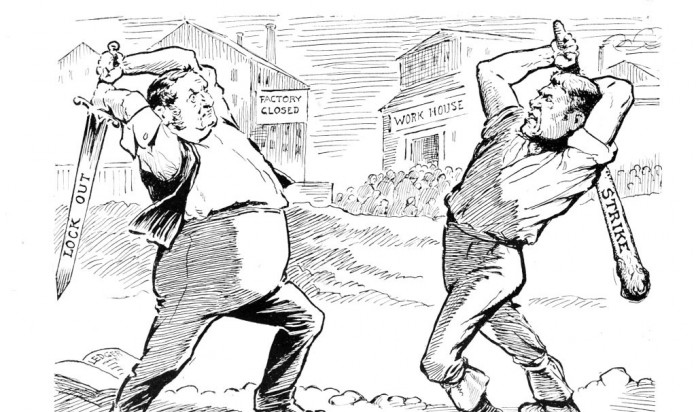
Strike and lockouts are democratic weapons used by workmen and employers respectively to ventilate their grievances and safeguard their interest. The strike is a weapon available to employees for enforcing their individual demands while the lockout is a weapon available to the employer to persuade workmen by the coercive process to accept his point of view.

strike

What are the provisions defining a Strike?

Webster’s dictionary defines the term strike as “the act of quitting work, done by mutual understanding, by a body of workmen as a means of enforcing compliance with demands made on their employer; a stopping of work done by workmen to obtain or resist a change in the condition of employment”.

Workmen adopt strike as a means to compel the employer to enforce compliance with their demands. Legal definition of strike is given under the Industrial Dispute Act, 1947 under section 2(g) and it defines strike as under:-

“Strike means a cessation of work by a body of persons employed in any Industry acting in combination, or a concerted refusal, or a refusal under a common understanding, of any number of persons who are or have been so employed to continue to work or to accept employment.”

The essential and important ingredient in the definition of strike is the cessation of work which means ‘abandonment’, ‘stoppage’  ‘omission of performance of duties by workmen, ‘hampering or reducing normal works’, hindrance to the working or suspension of work, discontinuing the employment or breaking contract of service or refusing or failing to return to or resume employment or refusing or failing to accept engagement for any work which the workmen are usually employed for. The refusal to work must be concerted or under a common understanding. Cessation of work must, however, be temporary and not forever. It must also be voluntary. Similarly, concerted action is also another important ingredient of the strike. Stoppage of work by worker individually does not amount to strike, and it should be by a body of workers under a common understanding.

lockout-video

What are the provisions defining a Lock-Out?

Webster’s dictionary defines the lockout, to be the withholding of employment by an employer and the whole or partial closing of his business establishment to gain concessions from employees. It is the action of an employer in temporarily closing down his undertaking or refusing to provide work at all, provided by so doing he is seeking to compel his employees to accept the demands either by him or other employers.

The legal definition of lockout is given in section 2(l) of the Industrial Disputes Act, 1947 and it defines Lockout as follows:

“lock-out” means the temporary closing of a place of employment, or the suspension of work, or the refusal by an employer to continue to employ any number of persons employed by him;

 The essential requirements of lockout are:-

  1. There should be some demand for which industrial establishment is locked out.
  2. The temporary closing of a place of employment/undertaking. The permanent closure does not constitute lockout.
  3. Intention to re-open or take the worker back if they accept the demand must exist.
  4. The employer and employees must be engaged in an industrial process carried out in an institution falling within the meaning of industry as defined in section 2(J).

It is only when an employer shuts down his place of business as a means of reprisal or as an instrument of coercion or as a mode of exerting pressure on the employees, or, generally speaking when his act is what may be called an act of belligerency there would be a lockout. If, on the other hand, he shuts down his work because he cannot, for instance, get the raw materials or the fuel or the power necessary to carry on his manufacturing or because he is unable to sell the goods he has made or because his credit is exhausted or because he is losing money, that would not be a lockout.


Provisions for general prohibition of Strikes & Lockouts

Sections 22 and 23 of Industrial Disputes Act, 1947 also contain provisions for a general prohibition of strikes and lockout. Regarding strike, Section 22(1) of the Industrial Disputes Act, 1947 provides that no person employed in a public utility service shall go on strike, in breach of contract—

  • without giving the employer notice of a strike, as from now on provided, within six weeks before striking; or
  • within fourteen days of giving such notice; or
  • before the expiry of the date of strike specified in any such notice as aforesaid; or

(d) during the pendency of any conciliation proceedings before a conciliation officer and seven days after the conclusion of such proceedings.

Section 22(1) prohibits going on strike by the workers except where above conditions are fulfilled. The issue of notice of strike is mandatory. The date of the strike must be within six weeks from the date of issue of strike notice. The day of the strike must not be within 14 days from the date of the notice. There can be no strike on any day before the date specified in the strike notice. Strike by workmen in violation of section 22(1) is illegal.

Section 22(2) of the Industrial Disputes Act, 1947 provides that no employee of any public utility service shall lock-out any of his workmen-

(a) without giving them notice of lock-out as hereinafter provided, within six weeks before locking out; or

(b) within fourteen days of giving such notice; or

(c) before the expiry of the date of lock-out specified in any such notice as aforesaid; or

(d) during the pendency of any conciliation proceedings before a conciliation officer and seven days after the conclusion of such proceedings.

Thus, Section 22(2) of Industrial Disputes Act, 1947 prohibits employer to declare lockout without complying with above conditions. Any lockout without complying with above conditions is illegal.

Where there is already in existence a strike or, as the case may be, lockout in the public utility service, the notice of lock-out or strike shall not be necessary but the employer or workmen as the case may be shall send intimation of such lock-out or strike on the day of which it is declared, to such authority as may be specified by the appropriate Government either generally or for a particular area or a particular class of public utility services.

It means that if there is already in existence a strike, the notice of lockout is not necessary and if there is already in existence a lockout, the notice of strike is not necessary. In such cases, the parties concerned have to send intimation of such lockout or strike to such authority as may be specified in this behalf by the appropriate Govt. on the day of which it is declared.

no

Provisions for general prohibition of strikes and lock-outs in General Industries

Section 22 of Industrial Disputes Act deals with the strike and locks out in public utility services while Section 23 deals with strikes and lockout in general industries or which are not public utility services. In industries which are not public utility services, the strikes and lockout may be declared by the workmen and employers respectively without giving any notice of strike or lockout.

However, there are certain restrictions according to Section 23 of Industrial Disputes Act, 1947 which provide that no workman who is employed in any industrial establishment shall go on strike in breach of contract, and no employer of any such workman shall declare a lock-out—

  • during the pendency of conciliation proceedings before a Board and seven days after the conclusion of such proceedings;
  • during the pendency of proceedings before a Labour Court, Tribunal or National Tribunal] and two months, after the conclusion of such proceedings; during the pendency of arbitration proceedings before an arbitrator and two months after the conclusion of such proceedings, where a notification has been issued under sub-section (3A) of Section 10 A ;
  • During any period in which a settlement or award is in operation, in respect of any of the matters covered by the settlement or award.

Provisions of Section 22 which govern strikes and lockouts in public utility services are not applicable to industrial establishments which are not public utility services while provisions of Section 23 are general in character and therefore apply to public utility services as well.

Section 23 provides that in the case of General Industries during the pendency of any conciliation proceedings before an officer conciliation strike or lockout can be resorted to. While section 22 dealing with public utility services provides that no strikes or lockout can resort to if any conciliation proceedings are pending before a conciliation officer.

Provisions for considering Strikes and Lockout as illegal

Section 24 of the Industrial Disputes Act, 1947 clarifies when a strike or a lock-out shall be illegal. It provides as follows:

  1. it is continued in contravention of an order made under section 10 (3) or
  2. It is commenced or declared in contravention of Section 22 or Section 23; or
  3. it is continued in contravention of an order made under Section 10-A (4-A)

According to Section 24 under clauses (2) and (3), the strike or lockout shall not be illegal if it is in pursuance of an industrial dispute that has already commenced and is in existence at the time of the reference of the dispute to a Board, an arbitrator, Labour Court, Tribunal or National Tribunal. The continuance of such strike or lock-out shall not be considered illegal, provided such strike or lock-out was not at its commencement in contravention of the provisions of this Act, or the continuance thereof was not prohibited under section 10 (3) or section 10-A( 4-A). A lock-out declared in consequence of an illegal strike or a strike declared in consequence of an illegal lock-out shall not be deemed to be illegal.

2

Provisions for penalty for illegal strikes and lock-outs

Penalties provided under Section 26 of Industrial Disputes Act for illegal strikes and lockouts also act as a deterrent against strikes and lockouts. There is a provision for punishment of imprisonment for a term which may extend to one month, or with fine which may extend to fifty rupees, or with both for an illegal strike. Similarly, there is a provision for punishment for imprisonment for a term which may extend to one month, or with fine which may extend to one thousand rupees, or with both for illegal lockout

The objective of Industrial Disputes Act is to regulate the right of workmen to strike and right of the employer for lockout without denying them their respective rights. This legislation has also provided machinery for peaceful investigation, settlement, arbitration and adjudication of the disputes.

Where such industrial legislation is not applicable, the contract of employment and service rules provides for are suitable machinery for resolution of the disputes. Where the law of contract for employment or service rules provides machinery for resolution of disputes, resort to lockout or strike as a direct action in contravention of contract or service rules is illegal.


Download Now

Comparison Between The Privacy Policy Of Snapchat And Instagram

0

In this blogpost, Bhavneet Vohra, a student of Vivekananda Institute of Professional Studies, Delhi, gives a comparative analysis of the privacy policies of Snapchat and Instagram.

bhavneet

Introduction

Before we move on to the distinction and similarities between the privacy policies of both the most popular and fastest growing mobile application, we also need to understand about some basics of these two applications.


An Overview of Snapchat

syFSpLD0

Evan SpiegelBobby Murphy, and Reggie Brown in September 2011 created an image messaging and multimedia mobile application. The Headquarters of the respective company are located in Venice, California. There were 3 major features that were offered by the application in the initial stage of development, which got updated and modified as per the changing needs, demands and feedback from the users. The three major features are as follows:

  1. Core functionality
  2. Messaging
  3. Stories and Discover


An Overview of Instagram

want42131-1yFW0T1472474635

Kevin Systrom and Mike Krieger launched Instagram in the year 2011 as a free mobile application. Not so similar to Snapchat, Instagram is also an mobile photo and video sharing and social networking service that allows all its users across the world to take pictures and videos, that can be shared both publically and privately on the app and moreover on various other platforms such as  FacebookTwitterTumblr, and Flickr. There are certain unique features and tools that are offered by the application for its users and which have been updated and modified keeping in view that accessibility and need of all its users across the world which can be listed as follows:

  1. Explore Tab
  2. Filters
  3. Lux- This particular feature allows you to adjust the exposure and contrast through a 100- pointer slider quickly. Apart from this, the brightness and saturation level can also be controlled by using this feature of
  4. Video
  5. Instagram Direct

 Information Technology (Reasonable Security Practices and Procedures and Sensitive Personal Data or Information) Rules, 2011 defines the legal provisions regarding the information and its collection, transfer, usage, and disclosure, etc.

  1. A collection of information. (Section 5)
  2. Sensitive personal data or information (Section 3 of the rules)
  3. Personal Information – Section 2(i)

means any information that relates to a natural person, which, either directly or indirectly, in combination with other information available or likely to be available with a body corporate, is capable of identifying such person.”

Now, since above we have duly covered the main features and tools of these most popular and trending apps of the era, we can now move to the legal provisions related to the same, which is the Privacy policies of both the Applications which are as follows:


BASIS SNAPCHAT INSTAGRAM
Information collected by them 1.      Usage Information

2.      Content Information- Content that is provided by the users of the app.

3.      Device Information- hardware model, operating system version, advertising identifier, unique application identifiers, unique device identifiers, browser type, language, wireless network, and mobile network information (including the mobile phone number).

4.      Device Phonebook

5.      Camera and Photos

6.      Location Information

7.      Log Information


1.      Information provided by us directly- like our username, email id, phone number, user content (photos, comments, etc. that we post), communication between the application and the user.

2.      Analytics Information- These tools collect information sent by your device or our Service, including the web pages you visit, add-ons, and other information that assists us in improving the Service.

3.      Log files information- The information automatically reported by your browser each time you make a request to access a web page or app.

4.      Device identifiers

5.      Metadata- The data that is technical in nature and is associated with the user content.


Information used by them
  • Develop, operate, improve, deliver, maintain, and protect our products and services
  • For the purpose of communication with the user
  • For monitoring and analyzing trends in usage
  • For the enhancement of safety and security procedures
  • Verification of identity and prevention of fraud.
  • For enforcement of terms of services and other usage policies.


  • To enable us to provide efficient access to information
  • For the provision of personalized content and information
  • Development and testing of new updated products, features and tools.
  • For diagnosing and fixing technical problems
  • To enable to automatically update the application from time to time as per the needs of the user and with changing trends and technology.


Sharing of the Information
  • With other Snapchatters
  • With all Snapchatters and the general public
  • With their affiliates- It refers to the entities within the Snapchat family
  • With Third Parties
  • With Service Providers, Sellers, and Partners
  • With Third parties for legal reasons
Instagram also generally shares its information that is provided by us and the user content with almost the same parties as of the Snapchat.
Children’s Privacy The services of Snapchat are not intended to be used by the children below the age of 13 As per the Privacy Policy of Instagram, services are not intended to be used by the children below the age of 13.


1

Conclusion

From the above article, we can relate to the privacy policy and can make a clear comparison between the two. We need to understand that these policies are made keeping in mind all the users across the world and not according to any pertaining law of any particular country. The Information Technology Acts and Rules differ from each other, in India, this trend is a little new, and there are many modifications and updates that need to be made as the law is ancient in this respect. These policies also differ for iOS and Android users.

 

Download Now

Planned Economic Reforms Related To The MSME Industry In India

0


In this blog post, Vyoma Mehta, a student of NMIMS, School of Law, who is currently pursuing a Diploma in Entrepreneurship Administration and Business Laws from NUJS, Kolkata, discusses the planned economic reforms related to the MSME Industry in India. 

vyoma

The Micro Small and Medium Enterprises (MSMEs), is well established in the economic and social development of the country. The MSME sector is a nursery of entrepreneurships, often driven by individual creativity and innovation, contributing to about 8 percent of the country’s gross domestic product- 45 percent of the manufactured output and 40 per cent of its export. The industry provides employment to about 60 million people through over 26 million enterprises producing over six thousand products.[1] The labor to capital ratio in MSMEs and the overall growth of the MSME sector is much higher than in the large industries. As it is observed from the way in which the MSME industry is contributing to the growth and development of the country, it can be said that the industry is imperative for the national objectives of growth with equity and inclusion. It would be an understatement to say that MSME sector in India is highly heterogeneous regarding the size of the enterprises, a variety of product and services produced and the levels of technology employed. Cutting across all sections of production and services, MSME sector is truly a strategic asset for the economy of the country.download (1)

The Indian small scale industries play an imperative role in the economic expansion of the country and have a vast approach for employment generation. Increasing small scale sector also results in decentralized industrial development, better distribution of wealth and investment and entrepreneur talent. The government has initiated several policies for the growth and development of small scale industries. Post liberalization the economic conditions of the country have created immense growth prospects for the small scale industries. The Ministry of Agro and Land Rural Industries and the Ministry of SSI have been merged into a single Ministry namely, Ministry of Micro, Small and Medium enterprises.[2] For the past fifty years, the small scale sector has played an essential role in the socio-economic development of the country. It has significantly contributed to the overall growth regarding the gross domestic product, employment generation, and exports. The MSMEs Act 2006 which was enacted broadly classifies enterprises regarding activities such as those engaged in manufacturing, production, and enterprises engaged in services.[3]

Policy Initiatives In Micro Small And Medium Enterprises

The main objective of Industrial Policy Resolutions was to promote industrial growth and also determine the pattern of state assistance to small industrial units for fulfilling socio-economic objectives. The promotion of industries has been regarded as an important element of the development strategy underlying Five Year plans. The industrial policy indicates the respective roles of the public, private, joint and cooperative sectors and also of the large, medium and small-scale sector and underlines the national priorities.

download (4)The advent of planned economy from 1951 and the subsequent industrial policy followed by Government of India, both government and planners earmarked a particular position of Micro, Small and Medium Enterprises in the Indian economy. Government’s objectives and intentions towards industry including small scale industry were announced through Industrial Policy Resolutions (IPRs). The resolution was announced in 1948, 1956,1977,1980,1990 and 1991 respectively.


Industrial Policy Resolution, 1991

The Government of India, for the first time, tabled the new small enterprise policy titled policy measures for promoting, strengthening and supplementing small, tiny and village enterprises in the Parliament on August 6, 1991.This policy widened the investment limit for the tiny sectors, removed the vocational restrictions and recognized business and industry related services as small industrial units on par with the tiny units. The Small and Ancillary Industries were exempted from licensing for all articles of manufacture, which were not covered by the public sector. The investment of 0.5 million and other location conditions was withdrawn.[4] All industry related services and business enterprises with an investment limit as those of tiny enterprises, irrespective of location, were recognized as small industrial units. A new scheme of integrated infrastructural development for small industrial units was provided with the participation of State Government and Financial Institutions.


The New Industrial Policy, 1999

The emerging economic scenario in the changed labialized and competitive economic environment necessitated structural and fundamental changes in the policy framework put in place of the development of SSI. The main objective of the Industrial Policy, 1999 was to create a congenial environment for the small industrial units to cope with the emerging challenges of globalization. To focus fully on the promotion and development of small industrial units, a separate Ministry of Small Industrial Units and Agro and Rural Industries was created. The policy initiatives were:[5]

  • The annual turnover limit for calculation of working capital limit for small industrial units was raised to Rs. 5 crores from Rs. 4 Crores.download (5)
  • The maximum ceiling limit for Composite Loan Scheme was increased to Rs. 5 lakhs.
  • To increase the flow of credit to small industrial units, a new credit insurance scheme was launched.
  • Small Industrial units producing goods in rural areas are allowed excise exemption on third party branded goods.
  • The definition of small and ancillary industrial units was revised by reducing investment limit in plant and machinery to Rs. 1 crore from Rs. Three crores.
  • Special package for the development of small and village industries in North Eastern regions was announced. The industrial units in the North Eastern Region were given exemption from excise duty for ten years from the date of commencement of production
  • Special emphasis was given to the units which have high export potential.

Through the ministry, Government has brought about changes in policies and development support that have to enable rapid and substantial development of MSMEs in India and given them a competitive edge over their global countries. Some programs and policies have been outlined here. The facilities can be categorized into three: Policy initiatives, Institutional support and credit dispensation. The following chart shows three categorized policies.


Schemes For Financing Micro, Small And Medium Enterprises

Reimbursement For Iso-9000 Certification Scheme

The scheme was started in March 1994, and it provides up to Rs. 75,000 per small industrial unit which acquired ISO-9000 Certification.[6] Since the inception of the scheme of ISO-9000 reimbursement, 4101 small industrial units to the tune of Rs. 1944 crore have been benefited up to Nov -2006.

download (6)Laghu Udyami Credit Card Scheme

Laghu Udyami Credit Card Scheme (LUCCS)[7], introduced in November 2001, has been implemented by the banks for providing borrower friendly credit facilities to small business.

Credit Guarantee Fund Trust Scheme For Micro And Small Industries

The scheme covers collateral free credit facility extended by eligible lending institutions to new and existing Micro and Small Enterprises up to Rs. 50 lakh per borrowing unit.

National Equity Fund Scheme (NEF)

The objective of NEF Scheme is to provide equity type support to entrepreneurs for setting up new projects in tiny / small industrial sector for undertaking expansion, modernization, technology up gradation and diversification of existing tiny, Small Industries and Service Enterprises and for rehabilitation of viable sick units. In this scheme, the cost should not exceed Rs. 50 Lakhs.[8]

Integrated Infrastructure Development Scheme (IIDS)

IIDS was launched in 1994 with the objective of providing basic infrastructural facilities like Power distribution network, Water, Roads, Telecommunication, Drainage and Pollution control facility, Banks, Storage and Marketing outlets, Common service facilities and Technological backup services, etc.


The MSMEs Development Act of 2006 is perhaps the most crucial of these recent policy changes. The growth of small scale industries can be evaluated in two ways: To compare the growth rates of units. Employment, output and exports of Small-scale industries in 2000 with that of the 1990s.To ascertain the change in the relative contribution of Small Scale industries to GDP, Exports and Organized Sector employment in the 2000s with that of 1990s.The small scale sector has grown rapidly over the years. The period of liberalization and the development the MSMEs sector constituted an important segment of our economy. MSMEs are a very important segment of the Indian industrial sector and would continue to play a crucial role in the Indian Economy in the future. It also brought in huge amounts of foreign investments into the country and provided employment opportunities for many people in the country which in its turn helped reduce the level of poverty in the country. A rewarding feature of economic development in India has been an impressive growth of modern MSMEs.


References:

[1] http://msme.gov.in/MSME-Strategic-Action-Plan.pdf (2016-05-31)

[2] http://www.ijbmi.org/papers/Vol(3)8/D038027040.pdf(2016-05-31)

[3] Supra Note 1

[4] http://www.zenithresearch.org.in/images/stories/pdf/2012/May/ZIJBEMR/3_ZIBEMR_VOL2_ISSUE5_MAY2012.pdf (2016-05-31)

[5] Supra Note 4

[6] Supra Note 4

[7] http://shodhganga.inflibnet.ac.in/bitstream/10603/43817/7/07_chapter%20-%20ii.pdf (May 30th, 2016)

[8] Id

Download Now
logo
FREE & ONLINE 3-Day Bootcamp (LIVE only) on

How Can Experienced Professionals Become Independent Directors

calender
28th, 29th Mar, 2026, 2 - 5pm (IST) &
30th Mar, 2026, 7 - 10pm (IST).
Bootcamp starting in
Days
HRS
MIN
SEC
Abhyuday AgarwalCOO & CO-Founder, LawSikho

Register now

Abhyuday AgarwalCOO & CO-Founder, LawSikho