Download Now
Home Blog Page 1695

Can NRIs Acquire Shares of Nidhi Company on Non-Repatriation or Repatriation Basis?

1
In this blog post, Hari Manasa Mudunuri, Student of  University College Of Law, Osmania University, and Diploma in Entrepreneurship Administration and Business Laws by NUJS, describes the acquisition of shares in a Nidhi Company by NRIs on a repatriation and non-repatriation basis. 

FullSizeRender-4


Introduction

Nidhi means Treasure and in India, a Nidhi Company is a type of an NBFC, notified by the Central government, which is regulated by the Ministry of Corporate Affairs and is registered as a company under the provisions of section 406, of the Companies Act, 2012. These companies are also regulated by the Nidhi Company Rules, 2014. The existence of such companies has been evident in India for a long time. They have been prevalent even when there was no structured banking system in the country. They are also called permanent funds, benefit funds, mutual funds, etc. as these companies are started by the coming together of members, with the objective to save. The members deposit their contributions for the mutual benefit of the entire membership to the exclusion of all others, and such deposits are used for lending to other members at reasonable rates (with security).


NIDHI Company

The Central Government formulated the Nidhi Rules, 2014 which provides that the provisions of Nidhi companies apply to:download (4)

  • Every company which had been declared as a Nidhi or Mutual Benefits under Companies Act.
  • Every company functioning on the lines of a Nidhi company or Mutual benefit society but has either not applied for or has applied for and is awaiting notification to be a Nidhi or Mutual Benefit Society under  Companies Act;
  • Every company incorporated as a Nidhi under the provisions of Section 406of the Companies Act, 2013.

Some General Requirements for Nidhi Company

  • A Nidhi company will be incorporated as a Public Company;
  • It shall have a minimum paid-up equity share capital of Rs.5,00,000/, and no preference shares shall be issued.
  • It shall have the words ‘Nidhi Limited’ as part of its name.

Foreign Exchange Management (Transfer or Issue of Security by a person Resident outside India) Regulations, 2000 prohibits FDI in Nidhi companies under Schedule IV. The schedule provides the following General Prohibition: Investments in shares or convertible debentures of an Indian Company engaged in following the type of activities are not permitted.

  • –  Chit Fund or Nidhi Company
  • –  Agricultural or Plantation activities
  • –  Real Estate Business
  • –  Construction of farm houses or
  • –  Dealing in Transfer of Development Rights (TDRs).

Purchase and sale of shares and debentures by NRIs on non-repatriation basis is subject to the following terms and conditions as provided in Schedule 4 of FEMA Regulations 2000- “Prohibition on purchase of shares/convertible debentures of companies engaged in the business of Chit Fund, Nidhi Company or company engaged in agricultural/plantation activities or real estate business or construction of farm houses or dealing in Transfer of Development Rights. Etc.’’


NRI

Definition of NRI under Regulation 2 (vii) FEMA Regulations:

“NRI shall have the same meaning assigned to him under the Foreign Exchange Management (Deposit) Regulations, 2000.”

NRI, defined under FEMA (Deposit) Regulations, 2000 as under:

‘Non-Resident Indian (NRI)’ means a person resident outside India who is a citizen of India or is a person of Indian origin.

NRIs can make direct investments in proprietary / partnership concerns in India as also in the primary issues of shares / debentures of Indian companies. They can also make portfolio investments, i.e. purchase of shares / debentures of Indian companies through stock exchanges in India. These facilities are available on both repatriation and non-repatriation basis.

However, a Nidhi Company can’t receive investments (FDI) from an NRI on a download (6)non-repatriation basis as an:

  1. Investment in new issues of equity preferences shares/convertible debentures of public/private limited companies
  2. Investment in non-convertible debentures of Indian Companies and repatriation basis:
  3. Investment in new issue of non-convertible debentures of Indian Companies


Repatriation and Non-Repatriation

 Repatriation is derived from the Latin word “Repatriate” which means go home. In general usage, it means the process of returning a person back to one’s place of origin or citizenship and can also mean the conversion of foreign currency back into the currency of the home country. The repatriation of NRI investments implies that an NRI can convert the investment into the foreign currency of the NRI’s home country. Whereas, non-repatriation based investment can’t be converted back to the currency of the NRI’s home country.download (7)

The RBI on 6th December 2003 announced that it is allowing NRIs and persons of Indian origin “to invest in the capital of an entity or a proprietary concern on a non-repatriation basis, subject to certain norms. The amount invested would not be eligible for repatriation outside India provided inward remittances have made it out of non-resident external or foreign currency non-resident account or non-resident ordinary account, the central bank said in a notification to authorized dealers. The RBI pointed out that the investments were subject to the condition that firm or proprietary concern should not be engaged in any agricultural plantation or real estate business, or not holding any immovable property to (or “intending to”) earning a profit or earning income. 


Conclusion

An NRI can’t invest in a Nidhi company. The objective of these companies is to inculcate saving habit and to be thrift among the members. Therefore, neither the RBI nor the FEMA regulations allow NRIs to invest in shares in Nidhi companies. The type of businesses a Nidhi Company can do is also restrictive which in turn reduces the scope for NRI investment in the same due to various regulations.


Download Now

Irretrievable Breakdown of Marriage – History, Applicability and Current Status in India

2

In this blog post, Aditi Sampat, Advocate at Nabco Enterprises Pvt Ltd and a student of the Diploma in Entrepreneurship Administration and Business Laws by NUJS, provides an overview on the concept of irretrievable breakdown of marriage. 

aditi-1

Introduction to Irretrievable Breakdown of Marriage

Marriages as is often said are made in heaven and solemnized on Earth. Marriage is the very basis of a social organisation. It is the foundation of a family and in turn society without which no civilization can exist.

Marriage is regarded as a sacrament under Hindu Law which is eternal and indissoluble. The law with regard to marriages has been codified by the Parliament as the Hindu Marriage Act 1955. Hindu Law strictly insists on Monogamy. Prior to the enactment of the Hindu Marriage Act, divorce was not a recognized means to put an end to a marriage, the only exception being where it was recognized by custom, which meant that the rules of dissolution of marriage and monogamy were subject to a valid custom to the contrary.download (3)

Under the Sharia law, marriage is a sanctified contract which is solemnized on the payment of Mehr from the husband to the wife. In the Muslim law, polygamy is not unconditionally conferred and is based on the precedent condition about the capacity of the husband to do justice between his co-wives.

Modern society has become quite complex coupled with changes in socio-economic conditions seconded by the disintegration of the joint family structure as well as rapid industrialization and urbanisation, education and employment. Moreover, the laws have given equal status and rights to women have had a tremendous impact on the institution of marriage which is no longer treated as an indissoluble union. There has been a considerable legislative and judicial interference in the gamut of matrimonial laws all over the world. Divorce, which was earlier regarded as an evil, has codified laws which are being substantially modified and liberalized.

In India, with regards to the Hindu Marriage Act and Special Marriage Act, the Government of India has attempted to include ‘Irretrievable Breakdown of Marriage’ as a ground of divorce as per the recommendations of the 71st report of the Law Commission of India.

Legally speaking, Irretrievable Breakdown of Marriage is defined as:

“The situation that exists when either or both spouses are no longer able or willing to live with each other, thereby destroying their husband and wife relationship with no hope of resumption of spousal duties.”

In other words, Irretrievable breakdown of marriage can be defined as such failure in the matrimonial relationship or such circumstances adverse to that relationship that no reasonable probability remains of the spouses remaining together as husband and wife for mutual comfort and support.
 

History of Irretrievable Breakdown of Marriage

The 71st report submitted by the Law Commission of India submitted in 1978 deals with the concept of Irretrievable Breakdown of Marriage. The Report is based on the prima facie question as to the extent and conditions on which Irretrievable Breakdown of Marriage can be included as a ground for divorce under the Hindu Marriage Act.

As per the Report in 1920, New Zealand was the first of the Commonwealth countries to introduce that a separation agreement of three or more years could become a ground to file divorce before the courts. In 1921, the first divorce on the ground of Irretrievable Breakdown of Marriage was granted by the Court in New Zealand. The Court held that “when matrimonial relations have ceased to exist, it is not in the interests of the parties nor in the interest of the public to keep the man and woman bound as husband and wife in law”. The Court also added that “in the event of such separation, the essential purpose of marriage is frustrated and its further continuance is not merely useless but mischievous”. This led to the formulation of the breakdown theory in Matrimonial law.download (2)

In England, the commencement of this theory was opened up in the case of Masarati v. Masarati, where both the parties to the marriage had committed adultery. The court of appeal, on wife’s petition for divorce, observed breakdown of marriage. The law commission of England in its report said, ‘the objectives of good divorce law are two: one to buttress rather than to undermine the stability of marriage and two, when regrettably a marriage has broken down, to enable the empty shell to be destroyed with maximum fairness, and minimum bitterness, humiliation and distress’. On the recommendation of the Law commission, Irretrievable Breakdown of Marriage was made the sole ground for divorce under section 1 of the Divorce Law reforms Act, 1973.

The Matrimonial Causes Act, 1959 of the Commonwealth of Australia provided for divorce on the grounds of breakdown of marriage.

In its report, the Law Commission observed that the provision of restricting divorce to matrimonial disability results in injustice in cases whether neither party is at fault or the fault is of such a nature that neither party wishes to divulge it and yet the marriage has ceased to exist. In other words, Irretrievable Breakdown of Marriage refers to a situation whether emotional bonds, respect, etc, which is the very foundation of a marriage have disappeared and only a façade in the name of marriage remains.

In conclusion, the Law Commission mentions the where a marriage has ceased to exist both in substance and in reality, divorce has to be taken as a solution to escape from a difficult solution. The provisions of such a divorce should be primarily concerned with bringing the parties and the children to accept the new situation and to work out a satisfactory basis for regulating relationships in the wake of the changed circumstances, rather than finding faults during the divorce proceedings.


Theories of Divorce

  1. Fault Theory – Under the Fault theory or the offences theory or the guilt theory, marriage can be dissolved only when either party to the marriage has committed a matrimonial offence. It is necessary to have a guilty and an innocent party, and only innocent party can seek the remedy of divorce. However the most striking feature and drawback is that if both parties have been at fault, there is no remedy available.
  2. Consent Theory – The consent theory accepts that parties to a marriage could together decide to end the relationship. This is the concept of “divorce by mutual consent.” The procedure for divorce under this theory is that the parties live apart for a specified period of time, and also require that such application be made in two stages, before the divorce is confirmed. Importantly, related but critical issues such as maintenance, distribution of common properties and custody of children are expected to be decided by the parties.
  3. No Fault Theory – The Institution of marriage being distinct as regards its socio-economic and legal footings, it will be unjust if the law ignores the importance attached it.

However, one must also take consideration of the fact that it is the choice of the parties to a valid marriage to understand the importance of the institution and to preserve its sanctity. With the changing requirements, attitude and aptitude, the society has drastically changed and it is very difficult for the married couples to cope with change. While adjusting in a new atmosphere in the matrimonial home, spouses may commit, knowingly or unknowingly, with or without intention, whether economical dependent or independent, some kind of mistakes which may lead to a communication gap between them and create havoc in the matrimonial home. Where both the parties of a valid marriage are at fault of any kind of matrimonial offence, it is difficult to prove which one is an aggrieved party.images (1)

According to the Doctrine of Recrimination, no remedy can be granted to the party who is at fault. It is imperative in law to have one party as innocent and another at fault to provide a matrimonial relief. In case of no fault theory of divorce, it is not necessary to prove which party is at fault. There may be many reasons based on which sweetness of matrimonial relationship is at risk. If the parties prove with reliable evidence on record that their marriage is beyond all possible repairs then law should understand the reality of the facts and should help the parties to the marriage which has broken down irretrievably.

The breakdown theory of divorce which is inherently attached with no fault theory of divorce represents the modern view of divorce. Under this theory, the law realises a situation and says to the unhappy couple: if you can satisfy the Court that your marriage has broken down, and that you desire to terminate a situation that has become intolerable, then your marriage shall be dissolved, whatever may be the cause. The marriage can be said to be broken when the objects of the marriage cannot be fulfilled. When there is not an iota of hope that parties can be reconciled, it can be considered as irretrievable breakdown of marriage.


Supreme Court’s Inherent Jurisdiction under Article 142 of Constitution of India

Our constitution confers wide power on the Supreme Court such as power to grant Special Leave against the orders or decrees from any court, or Tribunal in the country or to have exclusive jurisdiction to decide the disputes of the President or Vice President.

The law laid down by the Hon’ble Supreme Court is no doubt the laws of the land binding on all the courts in the country. The Constitution of India confers powers upon the Supreme Court to ensure that courts do not suffer from any jurisdictional difficulties to do justice between the parties before it.

Article 142 of the Constitution of India is one such provisions which empowers the Supreme Court to pass such “Decree or Order” as may be necessary for doing complete justice between the parties. Inside-court

In other words Article 142 supplement the powers already conferred upon the Supreme Court under the constitution to ensure that justice is done and in doing so, the court is not prohibited by lack of jurisdiction or authority of law.

The Supreme Court has exercised its power under Article 142 of the Constitution even in the case of matrimonial matters that has been pending for long time in the Tribunal/High Court. The reason is that the matter is adjourned from time to time on account of reconciliation between the parties, but ultimately that has not happened. Hence it is indeed an observation of the court that marriage status should, as far as possible, as long as possible and whenever possible, be maintained.

Relying on the judgement of the Hon’ble Apex Court in Sangamitra Ghose Vs. Kajal Kumar Ghosh, reported in 2007 2 SCC page 200, wherein it has been held as follows.

We are fully convinced that the marriage between the parties has irretrievably broken down because of incompatibility of temperament. In fact there has been total disappearance of emotional substratum in the marriage. The matrimonial bond between the parties beyond repair and that the marriage has been wrecked beyond the hope of salvage and therefore public interest and interest of all concerned lies in the of the recognition of the fact and to declare defunct de jure what is already defunct de facto.

In the case of Navin Kohli vs Neelu Kohli, the Supreme Court made a strong plea to the Union of India for incorporating irretrievable breakdown of the marriage as a separate ground for divorce under Section 13 of the Hindu Marriage Act 1955 and amending the Hindu Marriage Act.

It should be noted that no court in the country except the Supreme Court can grant divorce on the ground of irretrievable breakdown of matrimonial relationship.


Merits, Demerits and Criticisms of the Irretrievable Breakdown of Marriage

A law of divorce based mainly on fault is inadequate to deal with a broken marriage. Under the faulty theory, guilt has to be proved; divorce courts are presented concrete instances of human behaviour as bring the institution of marriage into disrepute. Because of the divorce of matrimonial offence, judges, and lawyers are sometimes reduced to the role of scavengers. The lawyers have to look for and expose and the judges are confronted with, the worst obscenities within a married life. It is therefore, not surprising that with the present adversary system all types of allegations are freely hurled across the courtroom. We need not stand on an old divorce law which demands that men and women must be found innocent or guilty.download (1)

One cannot say that it is an enhancement of the respondent for marriage if there are tens of thousands of men and women desperately anxious to regularize their position in the community and they are unable to do so. People should be able to marry again where they can obtain a death certificate in respect of a marriage already long since dead. The objection that irretrievable breakdown as a ground of divorce is vague has been already dealt with.
Irretrievable breakdown allows the spouses, or even one spouse, to terminate the marriage at will, thus transforming marriage from a union for life into one which can be ended at pleasure,

It is necessary to the basic principle that no man should be allowed to take advantage of his own wrong; a spouse who was responsible for the breakdown of marriage should not be able to rely on such breakdown in order to obtain a divorce against his or her partner’s will. By authorizing one spouse to divorce the other against the latter’s will after separation for a specific period, the law will have given statutory recognition for the first time to the principle that a person may take advantage of his or her own wrong.

The theory that one cannot take advantage of one’s own wrong has not been adhered to in the Hindu Marriage Act in the past. According to clause (ii) of sub section (1A) of section 13 of the Act, either party to a marriage, whether solemnized before or after the commencement of this Act, may present a petition for the dissolution of the marriage by a decree of divorce on the ground that there has been no restitution of conjugal rights as between the parties to the marriage for a period of one year or afterwards after the passing of a decree for the restitution of conjugal rights in proceedings to which they were parties. This provision clearly contemplates that even the party which has been in the wrong in so far as it has failed to comply with a decree for restitution of conjugal rights can also apply for a decree of divorce on the ground that there has been no restitution of conjugal rights as between the parties to the marriage for a period of one year or upwards after the passing of the decree for restitution of conjugal rights in a proceeding to which they were parties. Such a party, though at fault, would thus be taken advantage of its own fault. It cannot therefore be said that under the provision of the Hindu Marriage Act, as they stand at present, no person can be allowed to take advantage of his own wrong.

Thus, once the marriage has broken down beyond repair, it would be unrealistic for the law not to take notice of that fact, and it would be harmful to society and injurious to the interests of the parties if the legal bond is sought to be maintained notwithstanding the disappearance of the emotional substratum. Such a course would encourage continuous bickering perpetual bitterness, and may often lead to immorality. Where there has been a long period of continuous separation, it may fairly be surmised that the matrimonial bond is beyond repair. The marriage becomes a fiction, though supported by a legal tie. By refusing to sever that tie the law in such cases does not serve the sanctity of marriage; on the contrary, it shows scant regard for the feelings and emotions of the parties.

Since there is no acceptable way in which a spouse can be compelled to resume life with the consort, nothing is gained by trying to keep the parties tied for ever to a marriage that in fact has ceased to exit. Marriage is lifelong cohabitation in the home. When the prospect of continuing cohabitation has ceased, the legal tie should be dissolved.

Criticisms of the concept of Irretrievable Breakdown of Marriage: The concept of irretrievable breakdown of marriage to be made a ground for divorce under the Hindu Marriage Act, 1955 has been although a lot more debated but it has equally been criticised at various points by the state High courts and The Government of India.
Criticism by the High Court: High Court has in many cases, expressed disagreement with the suggestion that the Hindu Marriage Act, 1955 should be amended with a view to making irretrievable breakdown of marriage as a good ground for grant of a decree of divorce. The judges of the High Courts have expressed themselves against the introduction of irretrievable breakdown as a ground of divorce. One of the points made in the reply of the High Court is that it is extremely difficult to say that the husband and wife would never live together merely because there has been a rift between them and for the time being it appears that there may not be any prospect of their living together.images

The mere fact that there has been a rift between the parties or that they are for the time living apart does not mean that the marriage has come to an end. It is possible that what may appear to one person to be irretrievable may appear to another as not yet beyond repair. But such a state of things cannot be allowed to continue indefinitely, and there must arrive a point of time when one of the parties should be permitted to seek the judgment of the court as to whether there is or there is not a possibility of the marriage being retrieved.

Criticism by the Govt.: The Government of India, Ministry of Education, Department of Social Welfare, has expressed the review that making irretrievable breakdown of marriage a ground for grant of a decree of divorce is redundant in the light of the fact that sufficient grounds covering ‘irretrievable breakdown of marriage’ exist in the Hindu Marriage Act and the Marriage Laws Amendment Act, 1976, for the purpose of seeking divorced.


Current Political Status of amending the Hindu Marriage Act to include Irretrievable Breakdown of Marriage


As per the news report dated February 19, 2015 and July 12, 2015, the present NDA government might reverse the Marriage Law Amendment Bill 2013 which was introduced by the former UPA Government. Irretrievable Breakdown of Marriage had been incorporated as Section 13C in the Bill. The bill was passed by the Rajya Sabha on 26th August 2013, however could not be taken up for discussion in the Lok Sabha due to the change in the Government at the Centre.images (1)

Though the present Government had contemplated tabling the bill again, however the then Law Minister Mr Sadanand Gowda admitted that the Government was still considering the implications of the Bill as more than 70 representations had been received against the Bill.

Even though the Bill was drafted to remove the lacuna as far as Divorce law is concerned, groups opposing the Marriage Laws Amendment Bill contend that the Bill if passed will cause an increase in illegitimate and live-in relationships thereby destroying the institution of marriage and family values. Another fear, the groups have is an increase in the crime rate and undue litigation.

Given the present scenario, it appears that the Marriage Laws Amendment Bill will not see light of the day atleast in the near future, inspite of the Hon’ble Supreme Court time and again pressing for its inclusion.


[divider]

References:

  • http://www.thehindu.com/news/national/bill-to-make-divorce-easier-may-be-dropped/article6910089.ece
  • http://www.ndtv.com/india-news/law-ministry-puts-proposal-to-amend-marriage-bill-on-hold-780561
  • NALSAR Law Review on Irretrievable Breakdown of Marriage.
  • http://www.legalserviceindia.com/articles/irrbdom.htm
  • http://www.legalserviceindia.com/articles/break_mar.html

 

Download Now

An Overview On The Working of Dispute Resolutions Provisions In Joint Ventures

0

In this blog post, Mohammed Azharuddin, legal counsel at Borderless Access Panels Pvt. Ltd and a student of Diploma in Entrepreneurship Administration and Business Laws by NUJS provides an overview on the provisions for dispute resolutions in joint ventures. 

Azhar-Pic


Introduction

Joint venture deals are entered into significantly to increase the market reach and profit potential of any establishment. The deals are structured in a strategic manner so that the parties involved are greatly benefited. JV deals involve the parties to share knowledge, asset, know-how, and profits. It must, however, be noted that Joint venture deals are not mergers as mergers involve companies transfer of ownership. In certain scenarios owing to the regulations governing the mergers and accusations deals, companies prefer to enter quickly into joint venture deals to acquire intellectual property, resources, technology, confidential information, etc.Joint-venture

Some of the crucial advantages of having a joint venture deal are:

  1. Greater allocation of resources as the parties could mutually help out each other to assign the required amount of capital.
  2. The technical expertise involved in a project is greatly increased.
  • Larger and deeper penetration in markets which the reach is limited.

Types of Joint Venture Deals

  • Short-term engagements: These Joint Ventures are limited for a short period wherein the parties would collaborate to work with each other for terms ranging typically from six months to one year.
  • Full-term joint ventures: The Joint Ventures falling under this category last for a long duration typically ranging from five to ten years. These ventures cover a wide range of touch points and services to be provided along with products to be jointly developed.
  • Limited Function: The JV’s falling under this category would be limited in nature; this could mean a limitation on every aspect of the deal ranging from sharing of information to development or manufacturing of a product.
  • International Joint Ventures: International joint ventures entered with establishment over multiple jurisdictions have many cross-border transactions.


Now that the premises have been set in understanding what constitutes a joint venture and the types of Joint Venture in place, we shall specifically concentrate on the topic relating to the dispute resolution mechanism in Joint Venture agreement and The expertise in the event of any friction between the parties.


Dispute Resolution Mechanism

Having a Joint Venture deal apart from the profitability factor should [1]have effective dispute resolution mechanism as the stakes are very high, and any rift between the parties could lead to financial losses along with the ruptured reputation of business establishments. Hence, while entering into joint venture deals, it is important to keep the following factors in mind.property-joint-venture

  • the language of the documentation;
  • the convenience of the location;
  • the flexibility of the law in allowing the parties to regulate their affairs;
  • the efficiency and familiarity of the litigation process;
  • the perceived independence of the judiciary;
  • the ability to enforce any judgment or award that is rendered;
  • the level of damages and costs which may be awarded; and
  • the choice of representation that it available to the parties*

Some of the commonly sought after ways to resolve disputes in Joint Venture arrangements is through arbitration and mediation. Under the arbitration form of settlement, it is essential to have an arbitration clause in the JV agreement wherein an independent arbitrator would be appointed by mutual consent and the award passed by such arbitrator would be final and binding on the parties.

Since there were many countries, a party to the New York Convention on Recognition and Enforcement of Foreign Arbitral award, the establishments choose to take this route rather than  resolving the issue through litigation.

The advantages of resolving an issue with arbitration over litigation are:

  • Neutrality
  • Privacy
  • Enforceability of the Arbitral award.
  • Expertise of tribunal member.


Failed Joint Ventures Deals

India has witnessed many joint venture deals failing in the early 1980’s, most of these ventures belonged to the Automobile industry.

To begin with, in the year 1990, the joint venture of Kinetic group and Honda Motor Company was seen wherein Kinetic Group was made an offer by Honda Motor Company to buy out 51% of stake in Kinetic Honda Motors. The deal was finalized for a buyout with an offer of 35 crores. The JV later fell out due to not meeting the expectations of the consumers in a market which was selling high mileage motorcycles.PARTNERSHIP DISSOLUTION

The second JV deal which needs to be mentioned is the Wal-Mart and Bharti Enterprises deal. The initiation of this deal goes back to the year 2007 wherein Wal-Mart started its cash and carry management operations in India by entering into a Joint Venture with Bharti Enterprises; the Joint Venture was named Bharti Wal-Mart Private Limited. The venture went sour in the year 2013 due to various operational challenges and the stringent compliances which India had in place for foreign investors.

The third failed venture which needs to be mentioned is that if Tata Motors Ltd and Fiat Spa. The organizations entered into a joint venture agreement in the year 2006 in which TATA Motors was expected to use its distribution network to market Fiat’s cars. The deal had to be called off in 2012 due to TATA motors dismal performance in making fiat’s brand felt in the Indian Markets.


*International Resource Journal

Download Now

Small Businesses Mint Big Profits In Dubai

0

In this blog post, Faraz Salat, who has just completed his internship in the Dubai office of an international law firm where he researched on the incorporation of enterprises in the Middle East and European countries, writes about the investment process in Dubai which is largely applicable in the other Emirates of UAE.

profile pic

The UAE could be attractive for investors for a variety of reasons. UAE attracts good capital flow from the Gulf region as it has the most liberal trade regimes in the region. Having a diversified economy focused on a variety of industries from logistics, banking, tourism, real estate and manufacturing with a well-established infrastructure, a reliable banking system and a stable political environment give businesses an edge over other countries. With over 150 nationalities, expatriates observe their own culture and the country provides a safe and secure environment that boats a crime rate lowest in the world. UAE’s culture stems from Islamic traditions. Virtues of courtesy and hospitality are appreciated, and they reflect the warmth and friendliness of the local people. The society projects a significant tolerance towards varied lifestyles and by any stretch of the imagination, the UAE is a liberal society. Expatriates have the liberty to profess and practice their religion with dress code being liberal. Women are safe, and they move liberally through the city un-escorted, enjoying the freedom to be in a safe society. With all its rapid development, the UAE is closely linked to its heritage.

UAE Flag1

Cafeteria, grocery shops, retail outlets, gymnasium and many other trading and services businesses have now become commonplace due to large number of young salaried expatriates. Restaurants are open 24*7 with customers frequenting late in the night. The weekend in the areas of Bur Dubai remains happening and exciting throughout and the shopaholics haven that Meena Bazaar, Deira, etc. only add to the razzmatazz of Dubai. Businesses with investors from India, Pakistan, and the subcontinent have been dominating a sizable geography of Dubai dedicated towards shopping, entertainment, and food. With so many expatriates having a high disposable salary, a good standard of living, venturing into the above small yet profitable business must be considered for those looking for lucrative returns. Young expatriates who are bachelors rely on these restaurants which are popular by their geographical indication than their names; restaurants with their central themes on Punjabi, Bengali, Malabar, Pathani, Pakistani, Afghani, Lebanese, and et al have an exciting share in the diversified market. While having a samosa and chai in the morning, a friend once quipped that an investor can become rich in Dubai even by selling chai.

Basic requirement for all business activities in Dubai

19_1_Working_in_Dubai_565x215_tcm233-805014

The basic requirement for all business activities in Dubai are one of the three licenses, namely;

  • Commercial licenses for trading activity;
  • Professional licenses for few professions, services, craftsmen and artisans;
  • Industrial licenses for industrial or manufacturing activity

Licenses are issued by Dubai Economic Department (DED) and are subject to external approvals, which vary from the activity of the business. A restaurant or café, however small, will be inspected by an external authority such as the Dubai Municipality. Likewise, a gym may need external inspection and/or approval from Youth and Sports Welfare Authority before a license is issued. These businesses are governed by the New UAE Commercial Companies Law, Federal Law No. 2 of 2015; and the authority is the Department of Economic Development. There is no capital requirement and the above businesses can be formed as an LLC without a bank deposit certificate. You will need a local sponsor, who is required to be a UAE national and will own 51% equity share in your business. However, the profits will be totally yours and you may need to appropriate a fixed annual fee towards the sponsor which could start from AED 10,000 and vary subject to your business.

Guide for any business setup in Dubai

The below five steps are an easy guide for any business setup in Dubai mainland;

  • Find a local partner “sponsor”
  • Get the name and activity approval from DED
  • Find a business location and contract a tenancy agreement
  • Draft an MOA with the sponsor
  • Submit the MOA to DED

The tenancy agreement will need to be attested by the Dubai Land Department, and subsequently an Ejari certificate will be given, which will be required along with the MOA at DED office. The below list enumerates the requirements of an LLC.

Minumum number of shareholders The minimum number of shareholder required is two and maximum is fifty.
Requirement of shareholder who is a citizen A UAE national is required as a sponsor with 51% equity share in the business.
Minimum number of directors The minimum number of directors required is one and maximum is five.
Requirement of resident director or manager or company secretary The expatriate may act as the company manager and run its day-to-day affairs.
Auditing requirements No audit requirement in Dubai Mainland.
Company registration fee Approximately AED 3000 as Ministry of Economy fees.
Company license fee Approximate License fees:
Commercial License Fees:  AED 700
Industrial License Fees: AED 1100
Professional License Fees: AED 600
Tax liability No corporate, personal or capital gains tax
Approximate time period for company incorporation 2-5 weeks


Benefits for establishing a company in Dubai

Why-Invest-in-Dubai

Besides mainland, investors can start a business in a Free Zone. The key benefits of establishing a company here are;

  • 100% ownership by expatriates
  • No restrictions on currency
  • All capital and profits may be repatriated
  • No corporate, personal or capital gains tax
  • Efficient infrastructure & communications
  • Labor readily available

Dubai has over 30 free zones, and each has its specific advantages and business suitability. Companies in Free Zones can either be set up as single shareholder company such as Free Zone Enterprise or multiple shareholders such as Free Zone LLC. Business licenses that are issued here are;

  • Trade License
  • Industrial License
  • Service License
  • National Service License
    (Fees may vary from one zone to another)

The share capital requirements in Free Zones will vary on the purpose of the company, and it can be from AED 50,000 (approximately USD $13,600) to AED 300,000 (approximately USD $82,000) for majority of the Free Zones. A trade license can be given to perform more than one activity or various activities. An exhaustive list of activities is available with the free zone authority, and at the licensing stage, the investor can choose the activities for his business. One may even opt for general trading license, which is subject to restrictions on certain activities. Depending on the activity of the business, the authority of the relevant zones will also provide business space for offices, warehouse, showroom or any customized requirements.

All business activities from the very small to medium and to the very large are regulated. Perhaps, you may not find a pavement stall or roadside shopping with street food, mobile accessories shopping or any rampant cluster of frenzy trade like the Mohd. Ali road during the midnight of Ramadan, the Fashion Street and the Linking Road in Bombay, or anything closer to even the elite pavement of Colaba Causeway or the Khan Market in Delhi. Every activity, even the vending of tea is regulated and needs a license by due process of law. The authorities are welcoming and will go out of their way to provide relevant details on investment. Lastly, when in Rome, do as the Romans do.

Download Now

Dying Declaration – Importance In Burn Cases

0

In this blog post, Nimisha Srivastava, a student of Gujrat National Law University, Gandhinagar, writes about the importance of dying declaration as substantive evidence in burn cases.

1847368

The Supreme Court has recently ruled that in situations where more than one dying declaration exists, the Court should satisfy themselves as to which one reflects the truth.[1] The judgment came in a 27 year old case of burn victim who was set ablaze by her lover after she asked him to marry her. The Bombay High Court had convicted and sentenced the accused in 1989, by relying on two of three dying declarations given by the victim. The decision by Apex Court lays down the rules to avoid misuse of the provision by the relatives of the victim for harassing the accused in question.

A dying declaration is substantial evidence in cases where a person makes a statement related to the circumstances which resulted in his death. Hearsay evidences are usually not given any weightage by the courts because the person cannot be cross examined to verify the statements made by him. Dying declaration is an exception to the rule of hearsay evidence because if the person who has made the statement is the only witness available and his statements are not considered as dying declaration, then it would defeat the very purpose of Justice. Another reason is that, a person lying on his death bed hardly lies about the causes of his death. The dying declaration is the “most mystical in its theory and the most arbitrary in it limitations.”

bride-burning

It is based on the principle that dying declarations are made in the extremity when the party is at the point of death and every hope of the world has gone and every motive of falsehood is silenced, and mind is induced by the most powerful considerations to speak the truth. Dying declaration forms the sole basis of conviction if it is free from any kind of doubt and if it has been recorded in the manner as provided under the law.

Bride burning has been in prominence in recent past in India. Cases of burning woman have emerged due to dowry demands or domestic violence or mental cruelty. In few cases, the women commit suicide by self immolation due to these factors. In most of these cases, the prosecution’s case solely rests on the dying declaration given by the deceased. In these sorts of cases, it becomes difficult to gather evidence against the accused persons i.e. husband, his family and relatives. In words of Justice Krishnaiyer, ‘To discredit such dying declarations for shortfalls here or there or even in many places   is unrealistic, unnatural and unconscionable if basically there is credibility.[2] On the downside, there has been a trend of misusing dying declaration to falsely implicate the family of the husband, so it becomes hard to test whether the dying declaration given by the woman is trustworthy or not.

In India, Section 32 of the Indian Evidence Act, 1872 deals with cases related to where a person is dead or is not found.

Relevant facts

20241332

The principle behind this Section is that the statement can either be written or verbal, or relevant facts made by a person who is dead, or who cannot be found, or who has become incapable of giving evidence, or whose attendance cannot be procured without an amount of delay or expanse which, under the circumstances of the case appears to the court unreasonable are themselves relevant facts in the following cases:

  • When it relates to the cause of his death;
  • When it is made in the course of the business;
  • When it is against the pecuniary or propriety interest of the person making it;
  • When it gives opinion as to public right or custom or matters;
  • When it relates to the existence of any relationship;
  • When it is contained in any deed, will, or other document;
  • When it is made by several persons and expresses relevant feelings to matter in question.

In Paniben v. State[3], principles with respect to dying declarations were laid down. The deceased was sleeping all alone in the `osri’ of the House. The accused went there, poured kerosene on her person, and as the deceased got up, the accused lit the fire and left the `osri’. The accused in this case was the mother-in- law. Here, the court analyzed the existing jurisprudence on Section 32(1) and came to following conclusions:

  1. There is neither rule of law nor of prudence that dying declaration cannot be acted upon without corroboration.
  2. If the court is satisfied that the dying declaration is true and voluntary it can base conviction on it, without corroboration.
  3. The court has to scrutinize the dying declaration carefully and must ensure that the declaration is not the result of tutoring, prompting or imagination. The deceased had opportunity to observe and identify the assailants and was in a fit state to make the declaration.
  4. Where dying declaration is suspicious, it should not be acted upon without corroborative evidence.
  5. Where the deceased was unconscious and could never make any dying declaration, the evidence with regard to it is to be rejected.
  6. A dying declaration which suffers from infirmity cannot form the basis of conviction.
  7. Equally, merely because it is a brief statement, it is not to be discarded. On the contrary, the shortness of the statement itself guarantees truth.
  8. Normally, the court in order to satisfy whether the deceased was in a fit mental condition to make the dying declaration looks up to the medical opinion. But where the eyewitness has said that the deceased was in fit and conscious state to make this dying declaration, the medical opinion cannot prevail.
  9. Where the prosecution version differs from the version as given in the dying declaration, the said declaration cannot be acted upon.
  10. Merely because a dying declaration does not contain the details as to the occurrence, it is not to be rejected.

2309343612_e728c627a9-1-1

The court attaches great importance to a dying declaration, if properly recorded keeping in mind all the essential ingredients, it can form the basis of conviction. The court, through various judgments and pronouncements have expanded the scope of Section 32(1), laid down rules regarding the procedure of recording dying declaration, rules for admissibility etc. With respect to the growing incidents of atrocities among women, this piece of law provides the opportunity to deceased to seek justice from those who wronged her. It is a very sensitive topic involving various social, legal, ethical and moral aspects. There is a downside to this aspect that the over-enthusiasm in seeking the conviction of people and roping in relatives sometimes ends up weakening the prosecution against the real culprits. In some cases, in-laws and other relatives cannot be held responsible for the deeds of the husband, and cannot be held guilty for dowry death unless specific acts are attributed to them. Sometimes the family of the deceased in lieu of extorting money from the husband and his relatives misuses this provision. The court needs to see the facts in each case and after careful consideration only, when the dying declaration proves the guilt of the accused beyond reasonable doubt, convict the accused.

Footnotes:

[1]http://www.business-standard.com/article/pti-stories/courts-should-see-which-dying-declaration-reflects-truth-sc-116063000999_1.html

[2] Som Nath v. State Of Haryana, 1980 AIR 1226

[3] (1992) 2 SCC 474

Download Now

Judicial Activism – The Right To Privacy

0

In this blog post, Nimisha Srivastava, a student of Gujrat National Law University, Gandhinagar, writes about the right to privacy, which has been made a part of right to life under Article 21 of the Constitution of India by the Indian judiciary through Judicial Activism.

hqdefault

Privacy does not expressly form part of fundamental rights guaranteed to us under the Constitution of India. But judiciary has grown to give importance to this right because of growing invasions of privacy in different areas. In the Constitutional Assembly debates, we find two attempts to include two different forms of privacy in the Constitution. The first was moved by Kazi Syed Karimuddin, for inclusion of safeguards against arbitrary search and seizure. However, the amendment was shelved, inspite of Dr. Ambedkar’s support.[1]Somnath Lahiri moved the second amendment on communication surveillance, to protect privacy of correspondence within the fundamental right of liberty.[2] This attempt was also brushed aside, and therefore Constituent Assembly debates lack a case against inclusion of right to privacy.

6a00d8341bf67c53ef014e6008bc8c970c-800wi

The judiciary has interpreted the right to be a part of Fundamental Rights guaranteed under Part III of the Constitution by reading it into the right to free speech (Article 19(1)(a)) and the right to life and personal liberty (Article 21).[3] Since the 1960s, the courts have defined the right on a case-by case basis.

 In 1954 in the case of M.P. Sharma v. Satish Chandra[4] Supreme Court  held that “constitution-makers did not recognize the fundamental right to privacy, analogous to the American Fourth Amendment and the said right cannot be imported into the Constitution by some process of strained construction”. Therefore under this judgment, right to privacy was not a Fundamental Right.

The Supreme Court had an opportunity to look into the ambit and scope of right to privacy in Kharak Singh v. State of UP[5], where the minority took the view that privacy was an essential ingredient of personal liberty. The case questioned the power of surveillance exercised by police under the provisions of U.P. Police Regulations as being violative of Article 19(1)(d) and Article 21 and it was held (majority) that the attempt to ascertain movement of individual was not an infringement of any fundamental right.[6] The majority judges noted that that right to privacy is not a fundamental right but a facet of ‘right to life’ under Article 21.

Supreme Court recognised the importance of right to privacy in Govind v. State of MP[7], recognising the right to privacy as a fundamental right subject to restrictions of public interest. Mathew J reiterated the words of Lord Denning and noted that the right to privacy has to go through a case by case development.[8]It laid down the requirement for proving ‘compelling state interest’ for infringing Article 21, thereby recognising the right to privacy.[9]

In Collector v. Canara Bank[10], the Supreme Court said that right to privacy deals with persons and not places, and surveillance encroaching upon privacy must be for permissible reasons and in accordance with procedure established by the law. Further, the Supreme Court in PUCL v. Union of India,[11] held that right to hold a telephone conversation in the privacy of one’s home or office without interference can certainly be claimed as ‘right to privacy’. In this judgment, the Court ruled telephone tapping as violating Article 21 of the India Constitution, unless it was under procedure established by law and Article 19, if it is not covered by the exceptions provided in Article 19(2).[12]

The scope and ambit of the right of privacy came up for consideration before the Supreme Court in the case of R. Rajagopal v. State of T.N., popularly known as the Auto Shankar case. The publication of autobiography of Auto Shanker was in question due to the fact that it involved name of many public officials. Supreme Court allowing the publication, said the writings were based on public records, and therefore right to privacy is not attracted. The Court recognised two aspects of right to privacy 1)Tortious and 2)Constitutional.[13] The Constittuitional right to be let alone is implicit in the right to life under Article 21.

phonetapping(6)

In  Amar Singh v. Union of India[14],  the challenge was made on the “authorised” tapping of phone connections. The petitioner had meanwhile obtained a “gag-order” restraining the media from publishing the conversations. Supreme Court, refused to go in the merits of the issue, in view of the petitioner not having come to the Court “with clean hands”. In the case of Mr. X v. Hospital Y,[15] the Supreme Court was asked to decide upon the issue of disclosure by hospital with relation to medical condition of AIDS patient.  The Court noted, that since the disclosure was made to his fiancée whose life will be endangered by her marriage and consequent relations to the patient, the right to privacy was not infringed

Following the judgments given by the Hon’ble Supreme Court, three themes emerge:

(1) That the individual’s right to privacy exists and any unlawful invasion of privacy would make the “offender” liable for the consequences in accordance with law;

(2) That there is constitutional recognition given to the right of privacy which protects personal privacy against unlawful governmental invasion;

(3) That the person’s “right to be let alone” is not an absolute right and may be lawfully restricted for the prevention of crime, disorder or protection of health or morals or protection of rights and freedom of others.

The above judgments prove the point that though right to privacy is not expressly mentioned in the Constitution, implied meaning has been given to it by the judiciary. It is a right essential to existence of human being.

Footnotes:

[1] David J.Kessler, Sue Ross, and Elonnai Hickok, “A Comparative Analysis of Indian Privacy Law and the Asia-Pacific Economic Cooperation Cross-Border Privacy Rules”, 26 NLSI Rev 31 (2014).

[2]Ibid.

[3] Madhavi Divan, “The Right to Privacy in the Age of Information and Communications”, 4 SCC  J-12(2002).

[4]  [1954] SCR 1077

[5] AIR 1963 SC 1295

[6] BD Agarwala, “Right to Privacy a case by case development” 3SCC J-9(1996).

[7] (1975) 2 SCC 148

[8] Supra note 6.

[9] Supra note 1.

[10] A.I.R. 2005 S.C. 186

[11] 1996(9) SCALE.

[12] Chinmayi Arun, “Paper Thin Safeguards and Mass Surveillance”, 26 NLSI Rev 105(2014).

[13] Madhavi Divan, “The Right to Privacy in the Age of Information and Communications”, 4 SCC  J-12(2002).

[14] (2011) 7 SCC 69.

[15] (1998) 8 Supreme Court Cases 296.

Download Now

Eviction Of Occupants Of Highly Dilapidated Buildings

2

In this blog post, Mohammed Zain Khan, Founder and Managing Partner of One Legal, Advocates and Legal Consultants, discusses Section 353B and Section 354 of Mumbai Municipal Corporation Act 1888. The blog post provides an insight in brief on the provision and procedure for eviction of tenants/occupants of highly dilapidated buildings in the city of Mumbai.

266

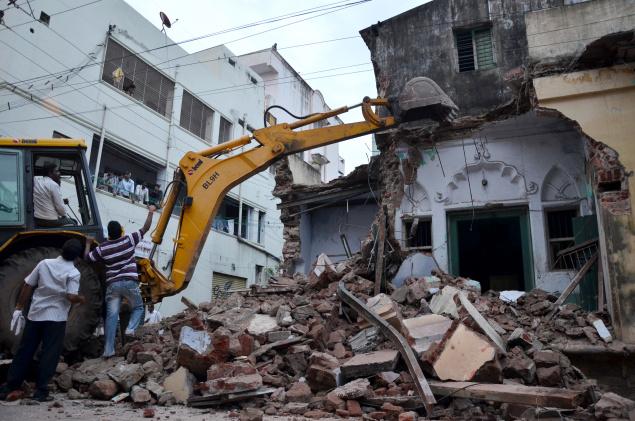
We often come across articles in the newspapers that dangerous, dilapidated buildings which have been declared unfit for human occupation by the Brihanmumbai Municipal Corporation (BMC) were still occupied by its tenants/occupants in spite of being aware of the fact that the buildings are risky and dangerous for occupation which has led to the collapse of the buildings thereby causing loss of life and property to the tenants/occupants and has also caused harm to the vicinity or surroundings of the building.

brihanmumbai-municipal-corporation-logo

In the dream city of Mumbai, owning a home is the privilege possessed by the very few and is a “dream of a lifetime” for most of the Mumbaikars. The robust development of the real estate sector at the hands of crony capitalist in the past two and half decades has led to the “Real Estate Revolution” in Mumbai but at the cost of unrealistic and astronomically high prices which are by far out of the reach of the most of the Mumbaikars, which ensures that the so called “dream of a lifetime” of owning a home in Mumbai always remains a “dream”.The astronomically high prices have also caused catastrophic changes to the real estate rental markets which has severely affected the affordability of the common man to even acquire properties/premises on a rental or a leasehold basis for self use.

Apart from the aforesaid reasons, lack of trust on the unscrupulous developers, many of whom have a history of cheating the susceptible tenants/occupants in the past, is the major reason for the tenant/occupant of the dilapidated buildings to occupy and hold their premises even at the cost of losing their lives and property but not opt for the redevelopment of their buildings. In view of this fact, time and again there has been occurrence of untoward incidents of building collapses in the city which has cast a responsibility on the Municipal Corporation for safeguarding the right and interest of the tenants/occupants of the dilapidated buildings and also the human life and property adjoining such dangerous buildings. Accordingly Section 353B, has been inserted in the Mumbai Municipal Corporation (MMC) Act, 1888 by amendment Act 6 of 2009 dated 14th March 2009.

Eviction

In pursuance of Section 353-B read with Section 354 of the MMC Act, 1888, the Municipal Commissioner has wide powers to issue notice and initiate eviction proceedings against the tenants/occupants of dilapidated buildings. Under Section 353-B, the Commissioner is empowered to issue notice to the landlord/tenants/occupants of a building which is more than 30 years old, calling upon them to furnish a structural stability report from a certified engineer thereby certifying that the said building is fit for human habitation. In pursuance thereof, if the structural engineer certifies that the said building is fit for habitation and directs repairs of the building then the landlord/tenants/occupants shall carry on the repairs to the satisfaction of the Commissioner. If the repairs are not carried out, the Commissioner may carry out the repairs and recover the dues from the landlord/tenants/occupants by demanding the same and if not paid, may recover it as the arrears of land revenue.

If in the event the structural engineer certifies that the building is a C-1 category cessed building and is unfit for human habitation, then the provision of Section 354 comes into force. Under Section 354, the Commissioner is empowered to issue notice to the landlord/tenants/occupants to vacate and pull down the dilapidated building. If there is failure to adhere to the notice, then the Commissioner may, after giving a week’s notice, evict them and demolish the dilapidated building. However, in spite of the aforesaid provision, in many instances the tenants/occupants refrain from evicting the dangerous building thereby frustrating the enabling provision under Section 354 of the MMC Act.

To find recourse to the dilemma, the BMC filed a petition before the Bombay High Court underling the difficulties faced by it in the implementation of notices issued under Section 354 for eviction. The petition was heard by the division bench of Justice Anoop V. Mohta and Justice A.A. Sayed. After hearing the petition at length, the Hon’ble Court passed a detailed order thereby issuing guidelines to the Corporation for eviction under Section 354.

The key features of the guidelines of the said order

21VZONGREG2-DEMOLI_1525377f

  • That the Corporation will independently inspect the dilapidated buildings before labeling them as C-1 cessed category buildings.
  • If the buildings are found to be highly dilapidated/dangerous C-1 category, then to issue notice to tenants/occupants and provide one weeks time to vacate the said buildings.
  • If the buildings are not vacated within a period of one week, the Corporation may disconnect the essential supplies to the building i.e disconnect gas, electricity and water supply of the building.
  • In spite of the aforesaid, if the tenants/occupants refuse to vacate the building then mild police force may be applied for eviction.
  • After eviction the Corporation can demolish the building.
  • The eviction can be initiated in respect of private/state owned buildings. The Hon’ble Court directed the Corporation/MHADA to provide alternative premises to the occupants in case the buildings are owned by Corporation/MHADA.
  • Most importantly, the Hon’ble Court directed the Corporation not to issue Commencement Certificates (C.C) in respect of buildings which are under the process of redevelopment and which have been demolished under Section 354 of MMC Act until there is an agreement between the Developer and the tenant/occupant of the premises under which the Developer agrees to provide a permanent accommodation in the newly constructed building or a settlement is reached between the Developer and tenant/occupant in respect of the demolished premises which has been furnished to the Corporation.
  • The Hon’ble Court also directed the Corporation to prepare a list of such C-1 category buildings and measure the carpet area of the premises situated in the building which will help to provide transparency in the process of redevelopment and prevent the irregularities committed by the Developers against the tenants/occupants in redevelopment of old and dilapidated buildings.

The above guidelines have brought much needed relief to the tenants/occupants who refrain from vacating their homes even at the cost of losing their lives due to the fear of losing their homes permanently to the unscrupulous Developers.

Download Now

Ideas And Breach Of Confidentiality

0

In this blog post, Nimisha Srivastava, a student of Gujrat National Law University, Gandhinagar, writes about ideas as a subject of copyright and then goes on to explain the breach of confidentiality in terms of ideas. 

Intellectual-property-copyright-net-ideas-vector-Converted-01

Ideas have no copyright as it can be only attributed to tangible things. In ‘Nimmer on Copyright’ we clearly find the author’s intention to protect ideas that have not found expression in a tangible form. Quoting from the book, ‘Assuming sometimes the writer has not reduced the story to written form and he orally narrates the entire story, there is no reason to accord the story any less of property status than if the story had been reduced to  writing.’[1] Law of confidentiality applies to oral communication also.[2]

lightbulb-businessman-250

The law of confidentiality has found its origins in the right to privacy. Indian courts have developed confidentiality as a tort.  Concept of confidence is based on trust between two parties. It is a legal obligation that is enforceable by law. Confidence is a broader right than copyright. The person on the receiving end of the information is under a duty to protect it and not use it for any other purpose. When no contractual relationship exists between the parties, the equity will make liable the party for misuse or unauthorized use or disclosure of information. The law on confidence in India is based on equitable principles. The first right in an unpublished work is to make use of the ideas in the work.

The leading and oldest case law on the subject is Prince Albert v. Strange[3]. In this case, the prince sought to restrain publication of certain etchings and lists of work by Queen Victoria on ground of personal confidence. It was held by the Court of Chancery that confidence is based on good faith. The breach of trust, confidence or contract will entitle plaintiff for an injunction.

In Segaer Ltd. v. Copydex Ltd.[4], Lord Denning gave confidentiality as an equitable remedy. Even if there is no such agreement in place, the other person cannot take unfair advantage of the information received in confidence. There shall be no prejudice caused to such person by making use of it without obtaining his assent. The case was referred in Intex Polymers v. Rajendra Tambe[5] where court said that it is unconscionable for a person who has received information in confidence to use it without the consent of the person whether express or implied.

In Fraser, breach of confidence was claimed in relation to an idea of a television series and which idea was “disclosed orally” and in confidence to the Respondents. The Respondents used that idea to create television series with other actresses. The Court held that the Court would prevent person who had received idea expressed “in oral” or written form from disclosing it for an unlimited period or until that idea becomes general public knowledge.

confidential-heading-on-letter

Saltman Engineering Co. Ltd. v. Campbell Engineering Co. Ltd.[6], the judgment said that if a defendant is proved to have used confidential information, directly or indirectly obtained from a plaintiff, without the consent, express or implied, of the plaintiff, he will be guilty of an infringement of the plaintiff’s rights even if no contract existed between the parties.

The law on the subject says that idea should be novel to be accorded protection.  In the case of Anil Gupta, the Delhi High Court while referring to the decision in Talbot v. General Television Corporation Pvt. Ltd.[7] went on to observe that the Law of Trade Secrets by Robert Dean take into consideration that the word novel is sometimes used simply to mean previously unknown but its more common meaning is that of inventiveness, or that of the information is unique, akin to “manner of manufacture”. They further remarked that ‘whether it is described as originality or novelty or ingenuity or otherwise, there must be some product of the human brain which suffices to confer a confidential nature upon the information. In the case, the idea per se with its minimalistic details was sufficient to make the same unique and confidential. In the judgment it was held that:

In the modern day, when the small screen has taken over the earlier means of mass communication like radio, idea/concept/script of a broadcaster has wider potentiality of capitalizing revenue and if that idea/concept or script is not protected then in a given case, a person who has conceived an idea to be translated into the reality TV show which could be key to its success with audience then channels with their enormous resources could always be in a better position to take the idea/theme/concept from any author and then develop at their own end and the original author of the concept will be left high and dry, in appropriate cases interlocutory injunction may be issued restraining such breach of confidentiality of the theme, concept or scripts otherwise it would be catastrophic for the TV industry. One has to bear in mind that persons who create an idea/concept or theme which is original, laws must ensure that such like people are rewarded for their labour. A concept for reality show on television was given to the company, which in this case is the respondents. Creator provides raw material to the entertainment industry, themes or concepts, originates from the person who has conceived the same, protection is vital for the functioning of the industry. Otherwise authors of the idea who are individuals, their ideas can be taken by the broadcasting companies or channels owning companies and the persons, who have conceived the same, would be robbed of its labour.’

The law on the subject also says that for an idea to be protected under confidentiality, it must be sufficiently developed so as to be realized as an actuality. This particular law was laid down in case of Talbot, which was referred to by the Hon’ble court in case of Zee Telefilms v. Sundial Communications.[8] A bare or vague idea does not warrant confidence. Ideas in the public domain are not protected by confidentiality.

Gossip-Men-w2500-h2500-1-1030x773

In Zee Telefims, the idea was developed into an expression in form of concept notes, character sketches, detailed plot of episodes etc. The same was held to be unique and confidential. The Bombay High Court held that the law of confidence is different from law of copyright. It is much broader than copyright as was said by the authority on copyright ‘Copinger and Skone-James on Copyright’. To quote from the said judgment ‘There can be no copyright of ideas or information and it is not infringement of copyright to adopt or appropriate ideas of another or to publish information received from another, provided there is no substantial copying of the form in which those ideas have, or that information has, been previously embodied. But if the ideas or information have been acquired by a person under such circumstances that it would be a breach of good faith to publish them and he has no just case or excuses for doing so, the court may grant injunction against him. ….Copyright is good against the world generally while confidence operates against those who receive information or ideas in confidence. Copyright has a fixed statutory time limit which does not apply to confidential information, though in practice application of confidence usually ceases when the information or ideas becomes public knowledge..”

Megarry J laid down three necessary conditions for the action of breach of confidence in Coco v. AN Clark (Engineers) Ltd.[9] He said:

Where there is information that is confidential, an obligation to maintain that confidence has come into being and the information has been used or disclosed without authority, an action for breach of confidence will lie.

The three conditions were reiterated in Beyond Dreams Entertainment Pvt. Ltd. & Ors., a recent Bombay High Court judgment where the plaintiff’s concept note and script for a TV show was turned down by the respondents. The respondents further went on to make a new show based on the same concept notes. The High Court enumerated three important elements for breach of confidence.

  1. First, it must be shown that the information itself is of a confidential nature. Three points are to be considered. I) is the identification of the confidential information itself. II), the information shared must be original and not in the public domain. III), the question is of handing over of the information in circumstances of confidence or in a relationship of confidence between the parties.
  2. Second, it must be shown that it is communicated or imparted to the Defendant under circumstances which cast an obligation of confidence on him.
  3. Third, it must be shown that the information shared is actually used or threatened to be used unauthorizedly by the Respondents.

Confidence casts a duty on other party to not to use it without the authority of the author.  Bombay high court in another recent decision of Urmi Juvekar Chiang v. Global Broadcasting News Limited[10] laid down the principles for breach of confidentiality:

(i) he (Plaintiff) had to identify clearly what was the information he was relying on;

(ii) he (Plaintiff) had to show that it was handed over in the circumstances of confidence;

(iii) he (Plaintiff) had to show that it was information of the type which could be treated as confidential; and

(iv) he (Plaintiff) had to show that it was used without license or there was threat to use it.

It is further noted that at interlocutory stage, the Plaintiff does not have to prove (iii) and (iv) referred to above, as he will at the trial. But the Plaintiff must address them and show that he has at least seriously arguable case in relation to each of them.”

Footnotes:

[1] Id. at  2-26.

[2] Fraser v. Thames Television 1983 2 ALL ER 415.

[3](1849) 47 ER 1302.

[4] [1967] 2All ER 415.

[5] IPLR 2005 Januray 48.

[6] 1948 65 RPC 203.

[7]1981 R.P.C. 1.

[8] 2003 (5) BomCR 404.

[9] [1969] RPC 41.

[10]2008 (2) BomCR 400.

Download Now

Standard Terms and Policy for Lending To SMEs By A Bank – An Overview

0

In this blog post, Hari Manasa Mudunuri, Student of  University College Of Law, Osmania University and pursuing a Diploma in Entrepreneurship Administration and Business Laws by NUJS, describes the standard terms and policy for lending to SMEs by banks.

FullSizeRender-4

Introduction

SME means Small & Medium Enterprises, or sometimes also called the MSMES- Micro, Small & Medium Enterprise. The SME sector is a fast growing sector in India. They have succeeded in providing employment, have a relatively low cost of capital, provide complementary services to the Industrial sector. Their contribution to the GDP is about 8% and 40% of exports. SMEs allow for inclusive growth in the economy.MSME-e1452579997430

However, the SMEs in India face some problems, which could arise due to the smaller scale of production, technological backwardness, marketing deficiencies, lack of proper sales & distribution channels, increased competition, arm twisting by MNCs, shortage of capital, etc.

Given the population perspective and potential for employment generation, the government has recognized the need to improvise, protect and uplift the small players in the market too. The central government enacted the Micro, Small & Medium Enterprises Development (MSMED) Act, 2006 to give impetus to the growth of the industry. The Act provides mechanisms to structure the sector to address any governance or operational issues faced by the SMEs. These enterprises can raise the finances through bank loans, friends or relatives, sister concerns, equity funding, trade, credit, subsidy on capital by the government, money lenders, NBFCs, etc.


General Objectives Of SME Loans

  1. To improve flow of credit and hassle free credit to the MSME Sector
  2. To formulate liberal norms of lending to the MSME sector, to ensure availability of adequate and on time credit.
  3. To devise an organizational structure at all levels for handling the MSME credit portfolio in a focused manner.
  4. To comply with guidelines received from the RBI.
  5. Hassle-free credit to Micro and Small Enterprises.
  6. Cluster-Based approach for financing MSE.
  7. Increased Coverage under credit guarantee scheme of CGTMSE.


Definition

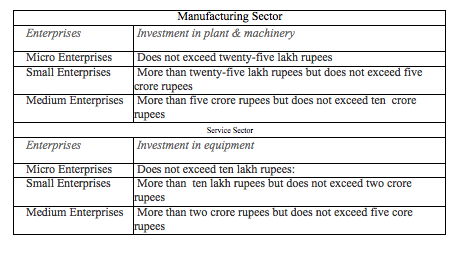
The Micro, Small & Medium Enterprise Development Act, 2006, has defined the term Micro, Small and Medium Enterprises into two classes:

  1. Manufacturing Enterprises
  2. Service Enterprises

(The  limit on  investment in plant and machinery/equipment for manufacturing/service enterprises, as follows):

Screen Shot 2016-08-20 at 12.57.23 am


RBI Guidelines

The RBI has issued a master circular containing the guidelines for commercial banks about the SME loans in India. The commercial banks include domestic as well as foreign banks operating in India. The Guidelines are.

  1. Advances to SME sector shall be calculated in computing achievement under the overall Priority Sector target of 40% of Adjusted Net Bank Credit (ANBC) or credit equivalent amount of Off-Balance Sheet Exposure, whichever is higher. [Where priority sector means a sector which impacts a large (weaker) section of the population.]
  2. Banks are advised to achieve a 20% year-on-year growth in credit to MSEs and a 10% annual growth in the number of micro enterprise accounts.
  3. To make sure that optimum credit is made available to micro enterprises, banks need to ensure that at least 60% of MSE advances should go to the micro enterprises. The target for lending to Micro Enterprises within the MSE sector will be calculated concerning the outstanding credit to MSE sector as on preceding March 31st. 

 Common guidelines/instructions for lending to MSME sector

  1. Banks are given instructions to compulsorily accept all applications from MSEM borrowers in India and to issue an Acknowledgment of Loan Applications.
  2. Collateral: Banks are instructed not to accept collateral security for loans up to Rs.10 lakh extended to the MSE sector. In case the MSE unit has a good track record, banks may extend the limit of allowance of a collateral prerequisite for loans up to Rs.25 lakh (after authorized approval).
  3. Composite Loan: Banks may sanction a composite loan limit of Rs.1 crore so that MSE entrepreneurs can avail of their working capital and term loan requirement through Single Window.

  4.  Specialized MSME branches: Public sector banks have been instructed to have minimum one specialized branch in every district. Further, banks have been allowed to classify their MSME banking branches having 60% or more of their advances to MSME sector so as to encourage them to come up with more specialized MSME branches for providing improved service to this unit as a whole. The provisions of the Interest on Delayed Payments Act, 1998 to Small Scale and Ancillary Industrial Undertakings are applicable for payment.
  5. Bank loans to SMEs are Classified Under Priority Sector by the ACT as:
    1. Direct Finance:
      1. Manufacturing Enterprises – The MSEs engaged in the manufacture or production of goods to any industry specified in the first schedule to the Industries (Development and Regulation) Act, 1951. The manufacturing enterprises are defined regarding investment in plant and machinery.
      2. Loans for food and agro-processing- Loans for food and agro processing will be classified under Micro and Small Enterprises, provided the units satisfy investments criteria prescribed for Micro and Small Enterprises, as provided in MSMED Act, 2006.
      3. Service Enterprises -Bank loans up to 2 crores per unit to Micro and Small Enterprises engaged in providing or rendering of services and defined regarding investment in equipment under MSMED Act, 2006.
      4. Export credit to MSE units -(both manufacturing and services) for exporting of goods/services produced by them.
      5. Khadi and Village Industries Sector (KVI) -All loans sanctioned to units in the KVI sector, irrespective of their size of operations, location, and amount of original investment in plant and machinery. Such loans will be eligible for classification under the sub-target of 60 percent prescribed for micro enterprises within the micro and small enterprises segment under priority sector.
    2. Indirect Finance:
      1. Loans to persons involved in assisting the decentralized sector in the supply of inputs to and marketing of outputs of artisans, village and cottage industries.
      2. Loans to cooperatives of producers in the decentralized sector viz. artisans village and cottage industries.
      3. Loans sanctioned by banks to MFIs for on-lending to MSE sector as per the conditions specified in RBI circular
  1. MSME Loan Policy covers all credit facilities to Micro and Small Enterprises (manufacturing and services) and other issues such as assessment of credit, margin norms, security requirements, coverage under Credit Guarantee Scheme, etc.

Guidelines on MSE Finance

All credit facilities to Micro Small Enterprises will be assessed as under. The sanctioning authority will consider all genuine requirements and it would be ensured that SME should not suffer for want of adequate credit.

Working capital requirements

Small (Manufacturing) Enterprises sector: Working Capital requirements of borrowers availing limit up to Rs.2 crore from Bank in the village and tiny Sectors ( now micro enterprises) are to be assessed as per TURN OVER Method.

hand holding coins and build coin graph

Working capital requirements of Small Enterprise units to be assessed at 20% of the Projected Annual Turn Over up to a limit of Rs.5crore. If the credit requirement based on production / processing cycle is higher than the one assessed by the turnover method, the same may be sanctioned. Working Capital requirements of Small borrowers in the trade sector availing limits up to Rs.5crore are to be assessed by the turnover method.

General Traders including Stockist: The stockist procures stocks against payment, for resale. They would own the inventory, and their working capital requirements are large. While the past trends of holding levels can be taken as indicators, flexibility in lending norms will be required as the trading activity is subject to fluctuations depending upon the volatility in the market. The credit requirements will be assessed by past indicators and future projections as at present. The current ratio should normally be 1.10. Collaterals should cover the entire exposure to the extent of 50% minimum subject to the borrower maintaining adequate paid stocks to cover the limit. In the case of Trading accounts normally there will not be any long-term debts and therefore, TOL/TNW ratio to be considered. TOL/TNW ratio up to 4:1 shall be accepted. However, in deserving cases relaxation up to 6:1 may be permitted by RLCC (DGM) and above


SME Loan Procedure in Andhra Bank

As per the RBI guidelines and the Central Act, all the 27 nationalized banks provide loans to SMEs. In this paper, I choose to analyze the SME loan procedure in Andhra Bank.

Andhra Bank provides a basket of schemes for the SMEs. They designed the schemes based on the diversity of the entrepreneurs engaged in the business and also design the schemes conformable with the schemes introduced by the GOI for improving the overall inclusive growth of the economy.  The following schemes are the schemes aimed at providing credit facility to the SMEs which factored, by and large, the overall requirements of the SMEs:

  1. Financing to MSEs- against property
  2. Term finance
  3. Non-fund based limits
  4. Artisan credit card scheme
  5. AB power tools (Shakthi)
  6. Technology up-gradation fund scheme
  7. Credit guarantee fund for small industries
  8. PavalaVaddi Scheme (4 % interest)
  9. AB doctor Plus
  10. Composite loan scheme
  11. Open cash credit
  12. AB Laghuudhyami credit card
  13. PM Employment Guarantee generation program
  14. National equity fund scheme of SIDBI
  15. Credit linked capital subsidy scheme for technology up gradation
  16. ALEAP &CGTSI for women
  17. Joint or Co- financing scheme


[divider]

References:

  1. smechamberofindia.com
  2. libf.org
  3. centralbankofindia.co.in
  4. http://www.andhrabank.in
  5. msme.gov.in


Download Now

Taxation On An Indian Resident Starting A USA Or Canada-Based Business

1

In this blog post, Poonam Sharma, an Advocate in Bangalore and a student pursuing a Diploma in Entrepreneurship Administration and Business Laws from NUJS, Kolkata, analyses the taxation process imposed on an Indian resident starting a USA or Canada based business. 


Scanned photograph


Introduction

The Income Tax Act, 1961(“Act“) is the governing law for taxation in India. It provides the mechanism for taxation of a resident and for non-residents (i.e. on the income generated in India or accruing on behalf of a source that is in India). A resident has been defined under Section 6 of the Income Tax Act, 1961. A resident may be an individual or a company or a Hindu Undivided Family or any other person who has its control and management situated in India. The status of residency is important as it determines the taxable income of the person.


Resident’ Test

The Act provides for three categories of individuals, resident and ordinarily resident, resident and not ordinarily resident and non-resident. For an individual to be considered as a ‘resident’ the following criteria must be fulfilled:

The first test of mere residency, states that an individual shall be considered a “resident” first if he fulfills the following conditions[1]:istock_000012781059xsmall

  • He is in India in the previous year for 182 days or more; or
  • He is in India for 60 days or more during the previous year and 365 days or more during four years immediately preceding the previous year.

However, the period of ’60 days’ as mentioned in clause (b) above shall be extended to a period of ‘182 days’ in cases of an Indian citizen or a Person of Indian Origin (PIO)[2] Who comes on a ‘visit’ to India during the previous year.

Along with satisfying the resident test, if such individual satisfies the following, he shall be considered a resident and ordinarily resident in India:

  • He has been resident in India in at least 2 out of 10 previous years immediately preceding the relevant previous year; and
  • He has been in India for 730 days or more during seven years immediately preceding the relevant previous year.

If such an individual does not satisfy any of the conditions under the resident test, he shall be considered to be a non-resident.

A company is said to be a resident in India if either of the following is satisfied by such company[3]:

  • It is an Indian company;
  • It’s place of effective management during the period of assessment is in India.

This change concerning place of effective management has been introduced by Finance Act, 2016. It has been explained to mean a place where key management and commercial decisions that are necessary for the conduct of a business of an entity as a whole are, in substance made.

To set up a business in the USA or Canada, an Indian resident may choose any of the very common options of either a corporation or a Limited Liability Company (“LLC”). One of the most important factors to setting up an entity in a foreign jurisdiction is the tax aspect. An Indian resident may consider setting up a sole proprietorship or a corporation, but such person must understand the tax implications of the type of entity to be able to make an efficient business investment.shutterstock_98297690

Once a business has been incorporated in the USA or Canada, such an Indian resident will be taxed at the standard US corporate tax rates on income from US sources effectively connected with the business and a 30% rate on US source income not effectively connected with the business. This is considered on a case to case basis whether the income earned by an Indian resident abroad would be effectively connected or not.

While India has a system of levying taxes by residency, the US levies its taxes by the source of income. This could lead to multiple levies or taxes on a person and discourage it to undertake any business activity. Hence, to avoid multiple levies of tax on the same income, the Government of India (“Government”) has entered into international treaties with countries outside India to ensure there is no double taxation on the citizens. Such treaties that are entered into with other countries are referred to as Double Taxation Avoidance Agreements (“DTAA”).


Double Taxation Avoidance Agreements

DTAA is entered into by the Government for the allocation of fiscal jurisdiction and to avoid double taxation of the same income. Section 90 of the Act provides a benefit to the assessee by the applicability of DTAA and hence avoidance of double taxation implications. One such treaty is the DTAA signed between India and USA on September 12, 1989, and came into force on December 18, 1990[4] (“India-US DTAA”).

The DTAA categorizes income into different heads such as business income, capital gains, royalty, dividend, and a fee for included services, interest, and other income. This article will specifically cover only the heads about business.

  • Article 7 of the India-US DTAA (Business Profits) states that the business profits of an enterprise are taxable in the state of residence, unless it carries on business in the other state through a permanent establishment (permanent establishment has been defined in detail, but it briefly means a fixed place of business through which the business of an enterprise is wholly or partly carried on). Profits may be taxed in the state of permanent establishment only to the extent attributable to:image_611C7F2E
    • that permanent establishment;
    • profits arising from the sale of goods or merchandise in the other state which are same or of a similar kind as those of the permanent establishment; or
    • arising from other business activities carried on in the other state which is same or similar kind as those in the permanent establishment.

Business profits have been defined to mean income derived from any trade or business including income from the furnishing of services other than included services as defined in Article 12 of India-USA DTAA (Royalties and Fees for Included Services) and including income from the rental of tangible personal property other than property described in paragraph 3(b) of Article 12 of India-USA DTAA (Royalties and Fees for Included Services).

  • Article 10 of the India-US DTAA (Dividends) in this case, states that dividend paid by a company resident in the US to a resident in India may be taxed in India. But dividend has its specific tax rates subject to which the tax should be paid.
  • Article 11 (Interest) states that interest arising in one state and paid to a resident of another state will be taxed in the latter state. In this case, interest arising in the US being paid to an Indian resident will be taxed in India.
  • Article 12 (Royalties and Fees for Included Services) states that services are arising in one state and paid to a resident of the other state, may be taxed in that other state.
  • Article 13 (Capital Gains) states that each state shall tax its capital gains as per its domestic law. There is a specific exception to this article made for Shipping and Air Transport.

The Government vides the DTAAs has attempted to provide relaxation to persons from the payment of tax on the same income multiple times. Although each country has a different DTAA entered into with India, the intention remains the same. This is also to encourage global business from within India. private-trust-taxationThese are some of the most important heads under which an Indian resident can structure his tax or plan his taxes and profit from his business. The Government has also gone a step further to make it fair to the person in either of the states under a DTAA, that if he feels he is being taxed doubly, he/it may present his case to the competent authorities present in the resident country. This is beside the remedies such person has under domestic law. Such a claim or case must be presented within three years from the date of the notice of such taxation. The competent authorities of each state shall be after that attempt to resolve the dispute by agreement such that it results in the elimination of double taxation.

Therefore, an Indian resident starting a business in the USA or Canada must consider all factors, especially tax before he ventures into an unknown territory.


[divider]

References:

[1] Section 6(1), Income Tax Act, 1961.

[2] Explanation to Section 115C (e) provides that a person shall be deemed to be of Indian origin if he or either of his parents or any of his grand-parents, was born in undivided India.

[3] Section 6(3), Income Tax Act, 1961.

[4], Available at http://www.incometaxindia.gov.in/Pages/international-taxation/dtaa.aspx.

Download Now
logo
FREE & ONLINE 3-Day Bootcamp (LIVE only) on

How Can Experienced Professionals Become Independent Directors

calender
28th, 29th Mar, 2026, 2 - 5pm (IST) &
30th Mar, 2026, 7 - 10pm (IST).
Bootcamp starting in
Days
HRS
MIN
SEC
Abhyuday AgarwalCOO & CO-Founder, LawSikho

Register now

Abhyuday AgarwalCOO & CO-Founder, LawSikho