Download Now
Home Blog Page 1713

Animal Abuse: An Inhumane Treatment against Innocent Ones

1
ANIMAL-CRUELTY

In this blog post, Sakshi Jain, student, Amity Law School, Lucknow Campus writes about animal abuse. Animals are also living creatures and laws are made to prevent them as they can’t fight for their right.

IMG_Sakshi Jain


All living creature have the right to live on this earth but some humans fail to understand this. The inhumane and cruel treatment done to animals is undoubtedly unbelievable. Just because they can’t speak and take a stand for their rights; it does not mean that they cannot feel unbearable and insensitive pain. All are God’s creation and every creature has its own purpose on this earth. Letting innocent ones suffer in pain, sends shivers down the spine of every soft-hearted person. Therefore, inhumane treatment of animals should be stopped as soon as possible.

Animal abuse and cruelty is a very concerning topic currently and is growing rapidly in today’s era. The Prevention of Cruelty to Animals Act, 1960 and the Wildlife Protection Act, 1972 are the laws that govern the safety of animals.


Cruelty to Animals under Prevention of Cruelty to Animals Act, 1960

Section 11(1) (a) to (o) of the Prevention of Cruelty to Animals Act, 1960 states the different kinds or forms of cruelty to animals. Within these sections, some offenses are cognizable and some are not cognizable.

According to Section 2(c) of Criminal Procedure Code, cognizable offenses are those offenses under stop-the-cruelty-of-animals-for-cosmetics-21702245which the police officer is empowered to arrest the offender without a warrant. Whereas, Section 22(l) of Criminal Procedure Code deals with a non-cognizable offense under which the police officer is not empowered to arrest the offender without a warrant. Section 11(1) (1),(n ), (o) and Section 12 are the cognizable offenses and the rest of the sub-sections under Section 11 are non – cognizable offense within Prevention of Cruelty to Animals Act, 1960.

Anyone can make a complaint against animal abuse at the nearest police station and the police officer is under the obligation to carry out an investigation into that complaint.  Under Section 34 of the Act, if any complaint is made, then he has the power to seize the animal and produce the same for examination before the nearest magistrate. Section 35 states that the animals are to be produced before the magistrate and if found seriously injured, then they must be taken to the infirmary for further care until they are fit for discharge.

Punishments

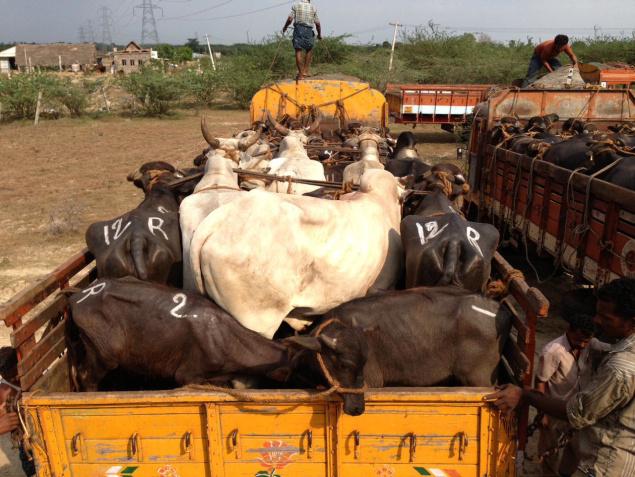
Animal Abuse is a punishable offense under Prevention of Cruelty to Animals Act. The offender (in his first offense) will be liable to pay a fine of Rs. Fifty and if in case, the same offense occurs within 3 months of the first offense, then the offender will be liable to pay a fine of not less than twenty-five and not more than hundred rupees or with an imprisonment for the term of three months or both. If it’s a second offense, then the offender’s vehicle shall also be seized.30THSEIZEDCATTLE_1568097f

Section 12 of the Act, penalizes practicing of phooka or doom dev among animals. It is the practice done on the cows or any milch animals for improving their lactation. It is illegal to practice these kinds of activities and is a punishable offense under the act. It is a cognizable offense amounting to a fine of rupees not less than one thousand or with an imprisonment for a term which may be extended up to two years or both.

The law provides that it is illegal to treat animals with cruelty or giving poisonous food to them, and is a punishable offense under this act. It is illegal to kill homeless or stray animals.  Section 11 of the Act, makes transportation of animals a punishable offense with a fine of Rs 100 or /and 3 months of imprisonment.

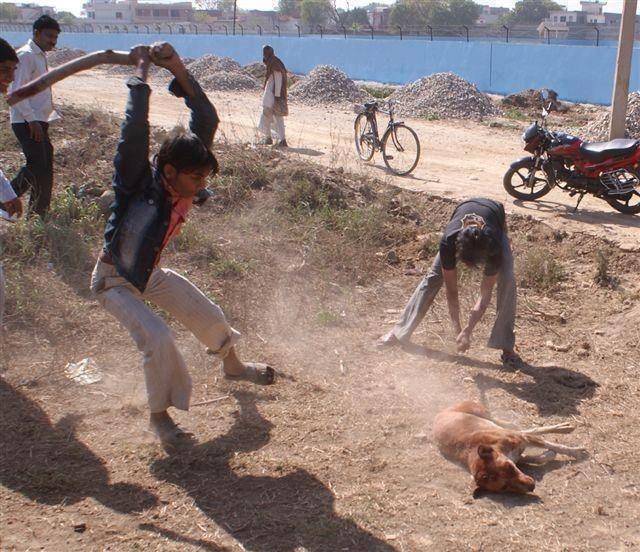
The Prevention of Cruelty to an Animal, 1960 prohibits any person from inflicting, causing, or if it is the owner, permitting, unnecessary pain or suffering to be inflicted on any animals.[1]Prevent-Cruelty-Towards-Animals

The act makes it illegal to beat, kick, harm, torture, and kill the animal. It is also illegal to override, overdrive or overload animals. The act punishes the people who make use of animals in any competition in which the animal may likely to be harmed or die. The owner of the animal will be held liable for not providing sufficient food or shelter to the animal or allow his diseased pet to roam around the street.


Indian Penal Code

Section 428 and 429 of the India Penal Code makes it illegal to cause injury and cruelty to animals.  It is a cognizable offense under this Act.

Section 428 of the India Penal Code states – “Mischief by killing or maiming animal of the value of ten rupees.—Whoever commits mischief by killing, poisoning, maiming or rendering useless any animal or animals of the value of ten rupees or upwards, shall be punished with imprisonment for either a term which may extend to two years, or with fine, or with both.” [2]

It deals with the punishment for committing mischief to animals by killing, poisoning or rendering them useless. The animals of the value of ten rupees and more come under the preview of this section. But under Section 429, the value of animals is above the value of Fifty rupees and more.

Section 503 makes intimidation, a cognizable offense. It states that anyone who threatens or intimidates any person taking care of the dogs is liable under the Penal Code and can be arrested without a warrant. Anyone can love and take care of animals according to their wish. No one can stop them from doing so. But if someone does, he/she will be liable for criminal intimidation under Section 503 of Indian penal code.


Constitution of India

Article 21 of the Constitution of India is the heart amongst all the fundamental rights and is very vast. Therefore, it is the liberty of individuals to take care or feed dogs and cannot be infringed or be questioned if done in a reasonable manner. Thus, caring, feeding or providing shelter to an animal is a natural and basic right of an individual.High-court_612-1463031277

Article 19 of the Constitution of India deals with the right to freedom of liberty. It guarantees the right to occupation of every citizen, and if someone is caring for animals as his occupation, then no one can stop them because it is their fundamental and legal right.

Article 48 of the Constitution also provides safeguards for the protection of animals. Article 48 deals with the prohibition of cow slaughter, calves or any other milk providing animals. Further, in 1974, Article 51A (g) was introduced which made it a duty of every citizen to protect and improve the natural environment including forests, lakes, rivers and wildlife and to have compassion for living creatures.[3]


Recent Updates

The Hon’ble High Court of New Delhi has issued an order on 18.12.2010 for feeding stray dogs by the local people. The order stated that “the Animal Welfare Board of India should identify, in consultation with the Residents Welfare Association, Area SHO and the Animal Welfare Organization working in that area, the spots/sites, which in its opinion, would be most suitable for the purpose of feeding dogs”. It further stated that the “Animal Welfare Board of India shall identify suitable sites in the colonies, the subject matter of these petitions, within four weeks from today. dogIt shall also try to cover as many more colonies as it can during that period”. The Hon’ble Court also directed that “the Delhi Police will ensure that no harm is caused to the volunteers of Animal Welfare Organizations feeding dogs in these localities provided that they feed them only during hours to be specified by Animal Welfare Board and provided further that as soon as suitable sites for feeding the dogs are identified, these organizations will feed dogs only on those identified sites and at hours specified by Animal Welfare Board”. [4]

Few people are aware of the laws relating to animal abuse. Even police officers are not aware of these laws; this makes the animals more helpless because they cannot fight for their right and are brutally killed by people. People sometimes beat or kick animals for fun. Even animals are used as a source of income to many people.

Jallikattu is an event held in Tamil Nadu as a part of Pongal celebrations on Mattu Pongal Day. It is one of the oldest blood sports, held in the village as a part of the celebration of Pongal. This game has resulted in a number of injuries and deaths. PETA made a complaint alleging this event to be illegal and amounting to animal cruelty. The Hon’ble Supreme Court in its judgment in May 2014, held Jallikattu as an illegal event and should be stopped as soon as possible as it amounts to cruelty towards bulls in that village. The court held that use of bulls in such festive events, harm the animals which are a punishable offense under Prevention of Cruelty to Animals Act, 1960.19fe41df4f38a6ec169307f8fa98a12a

Recently on 15th March 2016, eight puppies were killed by Poonnamma, based in Bangalore because their mother gave birth to them in a drain close to her house. It was a nuisance for her and the immediate action she took was to kill those eight little puppies. “I did this act to teach their mother a lesson and not to litter across my house”, said Poonnamma. The residents of the society and the NGO registered a complaint with Compassion Unlimited Plus Action (CUPA) and the Peenya police respectively on March 17th.  The Peenya police have registered the complaint under Section 93 of Karnataka Police Act; punishment for cruelty to animals, Section 11 of The Preventive of Cruelty to Animals Act, 1960 and Section 429 of Indian Penal Code. The case is still pending, and if found guilty, she could end up in prison for 5 years.


Conclusion

Animals are the most innocent creature on this planet. Abuse of animals is an inhumane treatment by any person to them.  Prevention of Cruelty to Animals Act, 1960 was enacted with the aim to protect animals and punish the one responsible for their inhumane treatment. Protection of animals is of an important concern because animals cannot fight for their rights. Hence, the Constitution of India also guarantees the preservation of animals within the territory of India. Abuse of animals is a cognizable and a non-cognizable offense under the various heads of Section 11 of Prevention of Cruelty to Animals Act, 1960. Various NGOS’s work towards the betterment of animals and fight for the right and protection of animals.


[divider]

Footnotes:

[1] https://www.animallaw.info/statute/cruelty-prevention-cruelty-animals-act-1960

[2] https://indiankanoon.org/doc/260462/

[3] . https://indiankanoon.org/doc/1644544/

[4] www.caretrust.in/Animal%20laws%20of%20india.pdf


Download Now

Rights Of An Arrested Person

0

In this blog post, Harsha Asnani, a student of NIRMA University, Ahmedabad writes about the rights available to arrested persons in India. The author discusses various legislations that govern the rights of arrested persons including the rights provided in the Constitution of India and Code of Criminal Procedure, 1973 and also some special rights to women in matters related to arrest.

Capture-1

“The horizon of human rights is expanding. At the same time, the crime rate is also increasing. Of late, this court has been receiving complaints about violation of human rights because of indiscriminate arrests. How are we to strike a balance between the two? A realistic approach should be made in this direction. The law of arrest is one of balancing individual rights, liberties and privileges, on the one hand, and individual duties, obligations and responsibilities on the other; of weighing and balancing the rights, liberties and privileges of the single individual and those of individuals collectively; of simply deciding what is wanted and where to put the weight and the emphasis; of deciding which comes first – the criminal or society, the law violator or the law abider;”[1]

For upholding the sanctity of these words in Indian legal framework, the legislators and the judicial minds have at innumerable instances tried to provide the arrested persons with certain rights to preserve the respect for human rights of liberty. There are various laws under which various rights have been provided to the arrested persons.


Right to know grounds for arrest

A man arrested awaits the judge to use his gavel to render a decision.

Article 22 of the Indian Constitution is the umbrella provision which provides a basic premise upon which rights of arrested persons have been based. The fundamental rights provided under this provision mandate that firstly, any person who is detained in custody shall be informed of the reasons for such an arrest. It is necessary that this right of being informed of the grounds for arrest be given to arrested person because it is only after such information is furnished to him, he or she will be in a position to take a proper legal recourse and apply for an application for issuing of a writ of habeas corpus. In the case of In re Madhu Limaye,[2] the Apex Court had observed where the arrested persons are not informed of the grounds for arrest, they become entitled to be released on a writ of habeas corpus.

In addition to Article 22, Section 50 of Code of Criminal Procedure Code states that every police officer or any other person who has, without warrant, arrested any other person shall communicate to the so arrested person with all details and particulars of the offense for which he or she has been arrested.

A subordinate officer who makes an arrest on orders by a senior police official shall be duty bound to furnish the arrested person with the substance of written order given by his superior specifying the offense or the cause due to which the other person is arrested. According to Section 55, non-compliance of this provision leads to an arrest being termed as illegal.

In cases where the arrest is made under a warrant, then such a warrant, according to Section 75, shall be shown to the arrested person and the grounds for arrest be notified to him. Instances, where a magistrate makes the arrest, nothing in any law shall prevent him from fulfilling all necessary conditions as mandated in Article 22, and hence the grounds for arrest shall be communicated to the arrested person.

The decisions of the Apex Court in the cases of Joginder Singh v. State of U.P.[3] and D. K.  Basu v. State of West Bengal[4] has led to the addition of Section 50-A to the Code of Criminal Procedure wherein it is the obligation of the police officer making an arrest to inform a relative or friend about the arrest of the concerned person. Whenever such a person is taken before the Magistrate, it is the Magistrate’s duty to get satisfied regarding this aspect.


Right to consult

legalaid

All arrested persons shall be entitled to a right to consult and be defended by a lawyer or legal practitioner of his choice. The right to seek legal aid not only includes an opportunity to consult but also provided with all reasonable facilities for exercising this right. In the case of Janardhan Reddy v. the State of Hyderabad,[5] it was held that in capital cases where the defendant is neither able to arrange for a counsel nor make his defence due to unavoidable circumstances such as illiteracy or ignorance, a recourse which is for the accused must be taken and therefore a counsel should be provided to him to defend himself. Although such recourse is not mentioned in any of the Indian legislations, it can be read along with the rules made and circular issued by the High Courts. However, the court has laid down two principles in this regard. Firstly, it is not recognised as a rule of law that a trial gets necessarily vitiated if the accused is not represented and secondly that an appellate court or a court of revision is vested with the power of interference if it is of the opinion that the inadequate representation of arrested person has lead to negation of trial.

This right has been given a form of constitutional mandate in the form of Article 39-A and 2. The Supreme Court has also placed a duty on the magistrates also to inform the accused of his or her right to free legal aid.


Being informed about the right to get released on bail

Section 50(2) of the Code of Criminal Procedure imposes a duty on the police officer making the arrest without a warrant in cases other than non-bailable offenses to inform the arrested person that he has a right of being released on bail and can arrange sureties for the same.


Right to silence

content_mg319-narco-tests-2

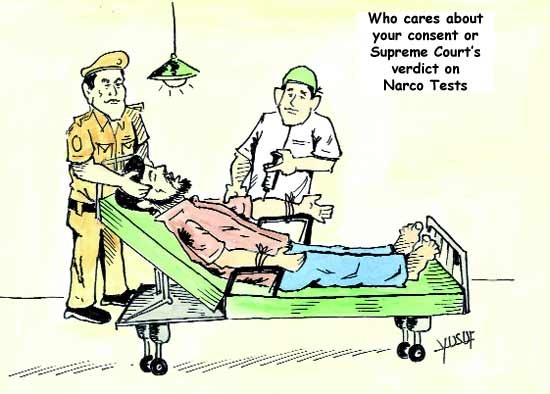
Article 20(3) of the Indian Constitution mandates that the no person arrested shall be compelled to give evidence or statements which are incriminatory in nature or become a witness against himself. In the case of Nandini Sathpathy v. P.L. Dani,[6] it was held that prohibition from forcibly extracting confessions from an accused entails the accused with the right to remain silent during the process of interrogation. In lieu with the same, the Supreme Court has held the use of lie-detector machines, brain mapping and narco-analysis as violative of Article 20 of the Indian Constitution.

Right to be taken to Magistrate within 24 Hours

As per Article 22(2), every such person so arrested by a police officer without a warrant or detained in custody will be taken before a magistrate within a span of twenty-four hours. A similar provision has been included in the Cr.P.C. in the form of Section 56. According to it, the unnecessary delay should be avoided. In the case Harimand v. Jailor,[7] it has been held that the accused shall be entitled to get released in cases where he or she has not been taken before the magistrate within 24 hours. This period of 24 hours shall exclude the time for journey or transportation. The aim behind enacting this clause is to prevent the extracting of confessions using forceful methods, prevent police stations from being turned into the prison, etc. and to get a speedy recourse to a judicial officer other than the police for redressal of matters related to bail.


Right to Trial

Every arrested person has the right to a free and an open court trial. It requires that the convictions should not take place in secret. Also, it must be ensured that trial is of speedy nature.


Right to be examined by a medical practitioner

doctor_examining_a_patient_clip_art_19487

In cases where a person is arrested on a charge, such that, at the time when he is presented before the magistrate or detained in custody, his medical examination would produce an evidence which can lead to his discharge or establish that he or she has not committed the crime, then the magistrate on request of the accused shall direct the examination of his body by an appointed registered medical practitioner.

Other rights provided to an arrested person under the Indian legal framework include right to be served with a custody memo, police final report, First Information Report on a free basis, making of arrest to be avoided if only suspicion exists, right to compensation for illegal detention or groundless arrest, right not to be kept in police custody if released on bail except in cases where the presence of accused is mandatory, right to medical aid or treatment if the arrested person falls ill in police lock-up, right to every woman to not to be kept in general prison, sub-jails or women homes to be made for such purposes. Special rights to women include right not to be arrested after sunset or before sunrise irrespective of the presence of woman constable; also, women need not necessarily be present in the police station during the process of interrogation.

Footnotes:

[1] Joginder Kumar v. State of U.P. AIR 1994 SC 1349

[2]1977 SCC  (4) 551

[3] 1994 SCC  (4) 260

[4] (1997) 1 SCC 416

[5] 1951 SCR  344

[6] 1978 SCC  (2) 424

[7]1954 CriLJ 1317


Download Now

Regulation Of Hate Speech In India

0

In this blog post, Abhiraj Thakur, a student of NALSAR University of Law, Hyderabad writes about the current laws in place in India that aim at curbing the vicious act of giving hate speeches to garner votes. The post also looks into the various problems that arise due to the inefficient implementation of these laws.

 Abhiraj


What is a hate speech?

Hate speeches are often characterized by their potential effects – “speeches that promote fear, incite violence, articulate, identify as divisive, indoctrinate prejudice and promote discrimination”. There is no unanimously agreed upon meaning of hate speech at this point. The general thought of hate or abhor incites a ‘social sound judgment’ which in the long run transforms into the conviction of the majority of the general public and frequently shows itself in the form of such loathsome verbalizations. As a rule, this sets the establishment for the incitement of common savagery.

hate-speech

India has, from perpetuity, been a land of a multiplicity of religions, castes, cultures, languages and ethnicities. The communal background to India’s partition characterized by mass genocide and the ever increasing multiplicity of religious identities has turned India into a nation where religious passions can be easily ignited. Therefore, when a political leader unleashes communal hate speech, it often threatens to eradicate the democratic and plural fabric of the country. Despite the fact that the need to preclude and avoid hate speeches is certain, rivals of scorn discourse limitations frequently contend that the forbiddance of hate speech may ordinarily bring about an encroachment of flexibility of expression, which could adversely affect political mindfulness and expression, academic investigation and honest to goodness reactions; alongside a few aesthetic expressions. In a heterogeneous society such as India, even though anti-hate laws that are in place for regulation impose a certain amount of restriction on the fundamental right to freedom of speech and expression guaranteed under Article 19(1)(a) of the Constitution, the Apex Court of the country has time and again upheld their constitutionality on the grounds of being a reasonable restriction aimed at maintaining public order under Article 19(2).

Election Laws governing hate speech

Hate_Speech_Hurts_rnoglj 

  • The Representation of People Act, 1951 (RPA)

Elections in India are controlled under the Representation of People Act, 1951(RPA). To guarantee that men with high moral qualities are chosen as the delegates of the general population of India, the RPA has set out certain standards of profound constituent quality and restricted certain demonstrations which slander the immaculateness of the elections. In the domain of the constituent scorn discourse banter in India, the applicable procurements of the RPA are Sections 123(3), 123(3A) and 125. According to Section 123 (3), advance for the sake of religion, station, group or dialect is a degenerate practice. Further, advancement or endeavor to advance ill will and scorn amongst various gatherings of individuals is both a degenerate practice under Section 123(3A) and a discretionary offense under 125.

  • The Model Code of Conduct (MCC)

mcc-140308063120-phpapp01-thumbnail-3

The RPA manages circumstances that emerge before the beginning of the elections and circumstances emerging after the announcement of the consequence of an election. The hate speech procurements under it are activated once decisions are over. The MCC or the Model Code of Conduct was created to manage such circumstances that emerge from the date of declaration of the timetable of election to the assertion of the outcome. The Election Commission of India, which is a protected body under Article 324 of the Constitution, has the force and obligation of the requirement of MCC. The MCC sets down wide rules in the matter of how the political gatherings and hopefuls ought to act amid a decision crusade. In the 1960’s, the political gatherings and also the EC achieved accord on the need and took after such rules so that free, reasonable and quiet decisions are directed to guarantee the dynamic working of the majority rule government in India. In the domain of the hate speech wrangle about, the MCC accepts guidelines such as Clauses (1) and (3) of Item 1 (General Conduct) of the MCC which denies gatherings and competitors from making any speech to familiar caste, religion or mutual affections for securing votes. Further, no gathering or hopeful can enjoy any action that may bother existing contracts or make shared hate or cause strain among various ranks, groups, religious or peaceful gatherings. In spite of such express procurements denying the utilization of incendiary dialect, equivocalness with regards to the enforceability of the MCC has frequently kept it from being a powerful obstruction against hate speech discourse.


Issues with RPA: Unwarranted liberal approach of Courts – the Hindutva judgments

Despite the fact that the RPA is an exhaustive Code inside which any rights guaranteed in connection with a decision or an elections debate can be found, the significance of legal elucidation can’t be reduced. Legal elucidation in India in instances of discretionary scorn discourse has been a horrid illicit relationship, and the legal thought process in India has encouraged this as opposed to controlling the development of degenerate practices, for example, loathe discourse. The melancholy side of such legal understanding, particularly in connection to Sections 123(3) and 123(3A) of the RPA, went to the fore in Ramesh Yashwant Prabhu v. P.R. Kunte.[1] This case included charges of degenerate practices against Prabhu, the then leader of Bombay and his “specialist” Bal Thackeray. They made deprecatory references to Muslims and further announced a war against the Muslims. The Supreme Court, however, presumed that the addresses made were infringing upon Section 123(3A), it exhibited a more liberal approach towards a portion of the germane issues. The court observed that a simple reference to any religion in a decision discourse does not bring it into the domain of Section 123(3) or 123(3A), since reference can be made to any religion with regards to secularism or to condemn any political gathering for victimizing any religious gathering or by and large for safeguarding of the Indian society. The court further included that the specific “use made of these words and the importance looked to be passed on in the discourse additionally must be seen.” Through such a judgment, the court gave a free hand to the political gatherings to act on their divisive governmental agendas under the clothing of secularism.

11babu

In yet another case of Manohar Joshi v. Nitin Bhaurao Patil,[2] Joshi had expressed in a discretionary discourse that “the principal Hindu state will be built up in Maharashtra”. Nonetheless, the court did not hold Joshi blameworthy for infringement of Sections 123(3) or 123(3A) of the RPA as in the court’s perspective, such an announcement was not a speech for votes on the premise of religion, however basically “the expression, best case scenario, of such a trust”. The previously stated judgments have frequently been utilized as a shield by political gatherings as an excuse to get away illiberal exercises, the act of scorn discourse being the most manhandled type of such exercises. Despite the fact that change is accessible through a decision appeal under the watchful eye of a High Court, the authorization of these procurements has been weakened extensively by the 1996 decision of the Supreme Court in the Manohar Joshi case.


Problems with MCC: Lack of statutory status

For the initial four decades of its presence, the recognition of the MCC was to a great extent left to the great feeling of the political gatherings. It remained an uninvolved record giving general rules. The MCC was planned to be taken after intentionally by political gatherings to keep up elections crusade on sound lines to guarantee peace during the election period. For whatever length of time that the Code stayed on paper and was not entirely upheld, there was no resistance. Be that as it may, when the EC energetically declared its intention to implement the MCC by taking stringent activities such as reprimanding the contender to scratching off by-elections for infringement of MCC procurements, it was met with firm resistance and frequently, the legitimacy of the MCC and the authenticity of the moves made under it were questioned. Since MCC does not have a statutory status, no legitimate outcomes can take after from the rupture of its procurements.


Reforms needed

We see numerous instances of breach of MCC in elections at all levels in our country, but the lack of statutory status of MCC reduces even a constitutional body like Election Commission to the condition of a hapless onlooker of the conspicuous infringement of the rationality and soul of the model code. It, along these lines, plays the key role in providing administrative support to the MCC to guarantee a strict usage of its procurements which will help in checking discretionary contempt discourse adequately and instantly. Additionally, a wide and upgraded translation of the nature and extent of forces of Election Commission is required. Article 324 of the Constitution provides that the superintendence, bearing and control of the behaviour of decisions to Parliament are vested in the EC. The expressions “superintendence, course and control” are of wide adequacy and must be deciphered to incorporate all forces important for the smooth and compelling behaviour of elections. In this manner, under Article 324, the EC can practice any force which is important to accomplish the goal of free and reasonable decisions, regardless of the fact that the Conduct of Election Rules, 1961 don’t particularly define such powers.

Thus, it is evident that there exist problems with the current electoral laws in our country which hamper their objective of regulation of hate speeches which in turn is a failure of the entire democratic process. A free and fair election forms the core of a democracy and for the largest democracy in the world it is definitely a matter of concern. Our Election Commission is unequivocally the most efficient in the world and it has time and again proved its worth by successfully conducting numerous elections in different states and for the entire country as well. However, at the same time we find there are a few loopholes to be plugged, especially when it comes to regulation of hate speeches during elections. This malpractice needs to be curbed at the earliest so as to transform our country from being a procedural democracy to also a substantive one.

Footnotes:

[1]Available At: https://www.google.co.in/url?sa=t&rct=j&q=&esrc=s&source=web&cd=1&cad=rja&uact=8&ved=0ahUKEwj14OiR5pzNAhXCG6YKHcAXBqAQFggdMAA&url=http%3A%2F%2Fsupremecourtofindia.nic.in%2FFileServer%2F2015-03-24_1427183283.pdf&usg=AFQjCNEXLt6cUiK_FVD2Dik6D_HwYpDq1A

[2] 1996 AIR 796, 1996 SCC (1) 169


Download Now

Admissibility of E-Evidence in Indian Courts

1
judges court gavel closeup on a laptop

This article is written by Abhiraj Thakur, from NALSAR University of Law, Hyderabad, Raghav Agrawal from Amity Law School, Delhi, (GGSIPU), and Muskan Sharma, from GLA University, Mathura.

Introduction

Electronic records given their nature have different rules as to their admissibility. Given that it is a field that is still being developed, the rules have been constantly developing and changing according to the interpretations given by the judges. Therefore a perpetual dilemma exists as to the mode and manner of admissibility of electronic evidence or records during the course of the trial. Section 65B of the Indian Evidence Act, 1872 has provision for procurement of an electronic certificate for admissibility of secondary electronic records. Two earlier conflicting judgments from the Apex Court led to confusion on the procedure of admission of electronic evidence as given under Section 65B of the Evidence Act, 1872. However, recent developments show that the Apex court has put a stop to the confusion with effect from its latest decision.

Given the importance of electronic evidence which is practically used in almost all trials, procedural uncertainty on admission would be a huge lapse in the interest of justice.

In the latest judgment (14th July 2020) the Supreme Court’s 3 Judge Coram in Arjun Panditrao Khotkar vs. Kailas Kishanrao Gorantyal in an attempt to interpret the section and put down a stop at the uncertainty, have finally settled the correct interpretation.

Background

Legal system is of the view itself that law cannot be stagnant and should adopt new mechanisms to understand the new parameters of crimes and wrongs happening in society, which was made clear by the case National Textile Workers’ Union vs P.R. Ramakrishnan & Others (1983). (See here)  The passing of Information technology Act (herein referred to as IT Act) paved the way for insertion of Section 65A and 65B in  Evidence Act on 17th October, 2000. The growing dependency on electronic modes of communication propelled the way to give recognition to admissibility to electronic evidence in all civil & criminal matters in India.

The first case that marked its presence in February 2004 concerning these sections was Suhas Katti’s case. (See here) In this case of Cyber Cell Chennai within 7 months of complaint by the victim on cyber bullying, the case was cracked and he was convicted. 

The IT Act was amended based on the United Nations Commission on International Trade Law (UNCITRAL). It was amended to allow admissibility of electronic evidence. 

Why e-evidence?

The human world today is digitized. Over the course of time, technology has seeped into every aspect of human life. From setting an alarm to wake up in the morning to knowing about the latest government policies, we make use of digital resources available to us. Everything, from communication to processing to documentation has gone digital. Law has not been immune to digitization. In case of India with the ever increasing e-commerce activities and e-governance initiatives from the state, the admissibility of e-evidence in the court of law has become a pertinent issue.

Indian law has for long, grappled with the issue of admissibility of e-evidence in the court of law. Instead of giving due regard to the increasing use of e-evidence around the world and incorporating it in the legal system, Indian courts have also remained sceptical of e-evidence, considering it to be of such nature that can easily be  tampered with. Today, a large variety of e-evidences are presented before courts in India every day, ranging from storage devices such as DVD or Hard Disk to mobile SMS or even a mail or website data.

E-evidence under the Evidence Act, 1872

Section 3 of the Indian Evidence Act, 1872 talks about what can constitute valid evidence in the court of law. Under clause 2 of the Section, it has been stated as “All documents produced for the inspection of the court.” It did not include an electronic form of evidence. However, witnessing the increase the presentation of electronic records before the court, Section 3 of the Act was amended in 2000. This was done to accommodate electronic records, and now the section reads as “All documents including electronic records produced for the inspection of the court.” Further, Sections 65A and 65B were introduced to make electronic evidence admissible in the court of law. An amendment was also done to Section 92 of the Information Technology Act of 2000.

Section 65B (see here) of the Indian Evidence Act (hereinafter Act) provides for the admissibility of electronic records.

It states that computer output is deemed document and admissible without further proof if it fulfils conditions of the section and no further proof of originality or production of the original shall be required thereof from it. Section 65B(4) calls for procurement of an electronic certificate from such authorized users of an electronic record, to be admissible in court. The question of the mandate of such a certificate is the focal point of debate of admissibility in this form of evidence.
Since it is not practical that servers containing evidence in electronic form be produced in court as primary evidence, Section 65B intends that mechanized copies be deemed as evidence to these records given certified by a responsible official with access and control of the computer record affirms the copy in the form of a certificate(as proof of authenticity).

Legislative Ambiguity

Though Section 3 of the Evidence Act was changed, no changes were made to the provisions under Sections 61 to 65 of the Act. Sections 61 to 65 deal with documentary evidence in the court of law. The provisions deal with documents or content of documents; no change was made to include electronic documents in that. Thus, the question that whether provisions enumerated under Sections 61 to 65 of Evidence Act would apply to electronic records baffled the Indian judiciary for a long time.

In the case of Utkal Contractors v. State of Orissa, this issue as to whether Sections 61 to 65 of the Evidence Act applies to electronic evidence was dealt with by the Supreme Court. The Supreme Court held that the intention of the legislature was clear for this omission to amend the provisions of Sections 61 to 65. It did not want it to be extended to electronic records. As a result, e-evidence is accepted only as a secondary form of evidence and not a primary form in Indian law.

Admissibility under the Evidence Act

Section 65 elaborately deals with the issue of admissibility of e-evidence. As it is only a secondary form of evidence, there are a few conditions with which e-evidence is accepted as valid evidence in Indian courts. Section 65B(1) states that anything contained in the form of an electronic record if is printed on paper or stored or has been recorded can be accepted as an admissible evidence only when it satisfies certain conditions laid down in subsequent provisions of Section 65B. These conditions can be briefly put in as:

Section 65 elaborately deals with the issue of admissibility of e-evidence. As it is only a secondary form of evidence, there are a few conditions with which e-evidence is accepted as valid evidence in Indian courts. Section 65B(1) states that anything contained in the form of an electronic record if is printed on paper or stored or has been recorded can be accepted as an admissible evidence only when it satisfies certain conditions laid down in subsequent provisions of Section 65B. These conditions can be briefly put in as:

  • Reliability of the source of electronic record

Section 65B(2) talks about the circumstances under which the computer from where electronic record has been produced can be deemed a reliable source. The computer needs to be of regular use, the one which was frequently used to store the information on the activity concerned. Also, the information derived from the computer must have been fed into it in the ordinary course of activity. Lastly, the computer must have been operating properly for the relevant period concerned.

  • Limiting the source:

When we talk about computers, several questions may arise due to the nature of the machine, such as, when many computers are connected to each other, which one is to be taken as the source of the evidence. Section 65B(3) removes such ambiguities. Among other things, it states that group or combination of computers connected over the period in question shall be considered as a single computer for the purpose of evidence. Also, if one or more computers act in a succession of each other over the period in consideration, they are also to be considered as a single computer.

  • Authorisation of the source:

The last condition that an e-evidence needs to satisfy to be admissible in courts is that of authorization or certification. Section 65B(4) states that when in any proceedings the nature of evidence is that of the electronic form, a certificate needs to be issued giving particulars of the device or anything dealing with Sub-section 2 of the Section. The certificate needs to be authorized by a person who holds a responsible official position about the particulars of the device. In most the cases, these people are IT professionals who hold certain expertise in the area of the device concerned.

Thus we see that there are many conditions which need to be fulfilled before an e-evidence can finally be accepted in the court of law. This has its advantages and disadvantages. While minimizing the possibility of falsification of evidence, many a times, it slows down the procedure making it very complex and also acts as an impediment in the course of justice.

Judicial development of e-evidence

Indian courts have, for a long time, been facing different forms of e-evidences in numerous cases and have tussled with the admissibility of it. High courts of different states have given conflicting judgments on the issue.

In the case of Ankur Chawla v. CBI, deciding on charges of corruption, the trial court had convicted the accused through a video CD, considering it to be valid evidence. However on an appeal, the Delhi high court reversed the judgment and raised suspicions over the admissibility of compact disks (CDs) as evidence in a court of law and considering the high probability of it being tampered with and faked, held it to be inadmissible in Indian courts.

About the validity of emails as evidence, in the case of Abdul Rahman Kunji v. State of West Bengal, the Calcutta High Court held that emails satisfying conditions under Section 65B to be admissible evidence in a court of law. Even intercepted phone calls recorded and presented in a CD were considered as valid evidence in the case of Jagdeo Singh v. State and Others.

Anvar P.V vs. P.K.Basheer & Ors

Supreme Court of India

Bench: R.M. Lodha, C.J.I., Kurian Joseph, and Rohinton Fali Nariman, JJ.

The use of the word “shall” and the presence of the non-obstante clause in sub-section (1) of Section 65B should make the requirements of the same mandatory and obligatory in nature. The same was to an extent re-iterated in Anvar P.V vs. P.K.Basheer & Ors (hereinafter Anvar P.V) and established by the court that “The Evidence Act does not contemplate or permit the proof of an electronic record by oral evidence if requirements under Section 65B of the Evidence Act are not complied with, as the law now stands in India.” The court relied on the maxim “Generalia Specialibus Non-Derogant” meaning the provisions of a general statute must yield to those of a special one and given Section 65B is a special law brought about by the IT act and hence it shall be governed by the procedure set in it rather than by general provisions (Sections 63 and 65).

Anvar P.V set to answer the questions posed by the judgment of State (N.C.T. Of Delhi) vs. Navjot Sandhu where electronic evidence was allowed to be admitted under general sections of secondary evidence (Sections 63 and 65) when a requirement of a certificate was not fulfilled. Coupled with some cases where a certificate was considered mandatory, the atmosphere was of uncertainty which Anvar P.V sought to clear.

The bench brought stability to the provision but that was not long-lived.

Shafi Mohammad vs. The State Of Himachal Pradesh

Supreme Court of India

Bench: Adarsh Kumar Goel and U.U. Lalit, JJ.

However the particular case of Shafhi Mohammad vs. The State of Himachal Pradesh (hereinafter Shafi Mohammad) led to uncertainty as the division bench swerved from the higher bench judgment of Anvar P.V.

The court held that the requirement of a certificate under Section 65B is not always mandatory and can be dispensed with, in the interest of justice. “The applicability of procedural requirement under Section 65B(4) of the Evidence Act of furnishing certificate is to be applied only when such electronic evidence is produced by a person who is in a position to produce such certificate being in control of the said device and not of the opposite party. In a case where electronic evidence is produced by a party who is not in possession of a device, applicability of Sections 63 and 65 of the Evidence Act cannot be held to be excluded.

In such a case, a procedure under the said Sections can certainly be invoked. If this is not so permitted, it will be a denial of justice to the person who is in possession of authentic evidence/witness but on account of the manner of proving, such document is kept out of consideration by the court in absence of certificate under Section 65B(4) of the Evidence Act, which party producing cannot possibly secure. Thus, the requirement of a certificate under Section 65B (h) is not always mandatory…”  

The Hon’ble Judges gave the reasoning that Section 65B was merely a procedural section and justified it by placing reliance on the judgment of Tomaso Bruno and Anr. v. State of Uttar Pradesh, in which a Three-Judge Bench observed that advancement of information technology and scientific temper must pervade the method of investigation.

Tukaram S. Dighole v. Manikrao Shivaji kokate (2010)(See here)

The VHS cassettes produced in question by the appellant had no further proof that they are reproduced from the original evidence and requested on the ground that since the VHS Cassettes produced are a public document under Section 74 of Evidence Act, no further authentication is required which was rejected by the tribunal.

In the case of Anvar P.V vs P.K.Basheer & Ors ( 2014) the court was of the view that the certificate mentioned under Section (65)(B)(4) is mandatory and doesn’t come with a choice. (See here) . It is a specific provision that prevails over general provisions of Section 63 and Section 65. This overruled the case of State (NCT of Delhi) v. Navjot Sandhu to the extent that certificate was now held to be mandatory. In the same case it was mentioned that oral admission on the content of the electronic evidence is not relevant unless the genuineness of electronic evidence is in question as mentioned in Section 22 of Evidence Act. The relevance of Section 45A ,role of the digital examiner under Section 79A of IT Act was also mentioned in this case. As the electronic evidence is more prone to be tampered with the rules mentioned in the Act should be given recognition. 

Sanjaysinh Ramrao Chavan vs. Dattaray Gulabrao Phalkay & Anr. (2015) (See here)

The court relied on the judgment of Anvar PV’s case and noted , “As the voice recorder is itself not subjected to analysis, there is no point in placing reliance on the translated version. Without source, there is no authenticity for the translation. Source and authenticity are the two key factors for an electronic evidence”

Tomaso Bruno and Anr. v. State of Uttar Pradesh (2015) (See here)

 The case substantiated the importance of electronic evidence and scientific mechanisms in the procedure of evidence recording.  It held Section 65A and 65B procedural and electronic evidence is admissible. 

Arjun Panditrao Khotkar vs Kailash Kushanrao Gorantyal and others (2020) (See here)

In this case a three judge bench headed by J. RF Nariman decided on the question and ambiguity on the various interpretations of Section 65(B)(4) and overruled the judgment of Shafhi Mohammad, upholding the view that certificate under this section is not one alternative among many others but a mandatory provision.

Many cases have also dealt with the necessity of such stringent conditions enumerated under clauses of Section 65B of the Evidence Act. In Dharambir v. CBI, the Delhi High Court upheld the necessity of provisions under section 65B, stating them to be for the betterment of law. The court also elaborated upon the contemporary provisions dealing with e-evidence in different countries of the world. In this regard, it is necessary to mention that in England, similar precautionary provisions as in Section 65B existed under Section 69 of The Police and Criminal Act of 1984. However, the Law Commission of England in its report among other things, reviewed Section 69 of the Act and recommended it to be unsubstantial and failing on the very grounds for which it was introduced, which was to improve the infallibility of evidence and promote justice. The Parliament of England took cognizance of the fact and Section 69 was finally repealed in the year 1999 through Section 60 of Youth Justice and Criminal Evidence Act.

The varying views surrounding section 65B of the Evidence Act have finally been settled in a recent judgment by Supreme Court. In 2014, while deciding the case of P.V Anvar v. P.K Basheer and Ors., the Supreme Court, taking a positivist line of approach held that as per the current legal framework at hand, Section 65B is very much mandatory, and the courts need to follow the procedure so enumerated in the Section. If any changes are sought for, it is the Legislature that has to take the initiative and not the courts who just follow the procedure laid down by law.

Producing Electronic Record as Primary Evidence

The court differentiated the documents produced by computer as both primary and secondary documents. The primary document would be the “original “electronic record” contained in the “computer” in which the original information is first stored and the computer output containing such information, which then may be treated as evidence of the contents of the “original” document”

The court made a provision which enabled the original computer evidence to be produced easily before the court to be admitted for the proceedings:

“Quite obviously, the requisite certificate in sub-section (4) is unnecessary if the original document itself is produced. This can be done by the owner of a laptop computer, a computer tablet or even a mobile phone, by stepping into the witness box and proving that the concerned device, on which the original information is first stored, is owned and/or operated by him.”

Producing Electronic Record as Secondary Evidence (Requirement of a certificate under Section 65B(4))

The copies of an original document are known as secondary evidence. In the case of electronic records, the court reiterated the settled proposition that the copies of Computer Output are to be taken as secondary evidence.

“….Original information contained in the “computer” itself and copies made therefrom the former being primary evidence and the latter being secondary evidence…..”

Regarding the secondary evidence, the court overruled the judgment as laid in Tomaso Bruno case that secondary evidence of the contents of a document can also be led under Section 65 of the Evidence Act to make CCTV footage admissible would be in the teeth of Anvar P.V., (supra) and cannot be said to be a correct statement of the law given how the judgment in the case was drawn without reference to a higher bench set precedent in Anvar P.V and reliance on the expressly overruled case of State v. Navjot Sandhu.

Court then also overturned the decision asset in the Shafi Mohammad Case given how it relies on cases which have been passed before the amendment of the Evidence Act which brought about section 65A and 65B and placed much reliance on the case on Tomaso Bruno (supra) which was also overturned earlier in the judgment.

Mandatory to Procure Electronic Certificate

The court considering the two decisions (Tomaso Bruno and Shafi Mohammad Case) which were found to be per incuriam and interpreting section 65B as a special provision held that the condition of procurement of an electronic certificate under Section 65B(4) is mandatory and upheld the decision of Anvar P.V.

If required, the court can summon production of documents if the certificate can’t be obtained

The court also iterated that the problem which was sought to be treated in the Shafhi Mohammad case i.e. production of a document that is not in possession of the party to the case can be solved within the given mechanism of the Evidence Act and the CPC. An application can always be made to a Judge for the production of such a certificate from the requisite person under Section 65B(4) in cases in which such a person refuses to give it.

The court allowed for the summons to be ordered against a person of authority or in possession of the ‘Computer Record’ in case of refusal or non-production of such document after the request of the party.

The court hence extended the scope of Section 165 of the Evidence Act and Order XVI of the Civil Procedure Code, 1908 (“CPC”) which deals with ‘Summoning and Attendance of Witnesses’ and similarly for CrPC to be applicable to Section 65B of the Evidence Act.

Time of Procurement of Certificate

Regarding the time of such procurement of certificate, it was stated that the requisite certificate can be directed to be produced by the learned Judge at any stage, so that information contained in electronic record form can then be admitted, and relied upon in evidence. The Hon’ble judges mentioned the importance especially in criminal cases that the accused be provided with all the evidence he so requires before the commencement of trial.

Critical Analysis

The two views which existed between the different pronouncements had their own merits and defaults. Where one was correct in law to implement stare decisis and implement the provision as to provide what was sought by the legislature (Anwar P.V), the other sought to remove the hindrance caused by the strict interpretation of the section in further interest of justice even going to the extent of disregard of well-set precedent (Shafi Md.).

Despite the judicial intent, the judgment in Shafi Mohammed Case can’t be taken as good law since procedurally it overpassed certain principles established by the common law.

  • The judgment heavily relied on the judgment of State v. Navjot Sandhu which was expressly overturned in Anvar P.V. Case. Furthermore, the majority of the judgments relied upon by the bench were passed before the amendment which brought Section 65B into the act.
  • The judge ignored the decision of the court in the Anvar PV case, didn’t even consider it and went on to deliver a judgment contrary to that laid in Anvar PV by a higher bench and hence conflicting the principle of stare decisis.
  • Another important principle which is followed in the interpretation of statutes is the maxim of Generalia Specialibus Non-Derogant which means that for the purposes of interpretation of two statutes in apparent conflict, the provisions of a general statute must yield to those of a special one. The court overruled the importance of Section 65B which is a special provision added to govern specifically electronic evidence. Applying this principle, Section 65B, a special provision shall prevail in case there is conflict over the procedure of admission of electronic records (over Section 63 which is in this regard a general provision). 
  • The judgment was bad in law since it strayed from the basic requirements of sound judgment and created confusion regarding the particular field.

Anvar P.V though a sound judgment which overturned the judgment of State v. Navjot Sandhu and finally brought clarity that Electronic Certificate under Section 65B is mandatory had its own flaws exposed during the judgment of Shafhi Mohammad.

The judgment though was procedurally sound; it ignored the reasons why the conflict arose.

In many cases, the electronic record is in the possession or under the authority of a person different from the person trying to admit the evidence. Hence the refusal to grant such a certificate by such a person abrogates the right of the accused and hinders complete justice. The accused has a right to be allowed to produce evidence in entirety. The mandate of the certificate with no other option to force the production of such records allowed the evidence in such particular cases to be insufficient. It is well within the ambit of Article 21 that a person gets to present their case with all the evidence and necessary for complete justice of the proceedings.

Anvar PV case didn’t resolve the problem which was faced by the parties though being structurally sound.

The latest judgment, in essence, observed all the cases in-depth and sorted out their shortcomings.

Firstly the confusion was cleared that certificate is mandatory which is a welcome decision.- Section 65B deals with secondary evidence in the form of electronic records. As we can see from Section 63, certain steps have been considered essential by the legislature to make secondary evidence credible for e.g. – section 63(1) calls for certified copies. Certification is one method that has been considered by the legislature to make secondary evidence credible so as to make it admissible alongside primary evidence. Hence it is not at all unreasonable in my opinion that a certificate is necessary for authentication of electronic secondary evidence otherwise there will remain no intelligible difference between primary and secondary evidence and also will be contrary to the principle of equality to treat electronically evidence above other types of evidence (physical).

Also, a bare reading of the provisions added by the amendment of the Act clearly shows the intent of the legislature to create specific provisions to govern the admission of electronic records. For e.g. Section 65A states that the contents of electronic records ‘may’ be proved in accordance with the provisions of Section 65B. It can be debated that with the use of the word ‘May’ in the provision, admission of electronic evidence under other general sections is not intended to be barred but the principle of Generalia Specialibus Non-Derogant can’t be ignored. The existence of special provision which has been exclusively added by the legislature is enough to show intent that they are meant to be governed under special provisions only. If there is a bypass to such procedural requirements then the principle i.e. special provisions prevail over general provisions gets defeated. Within Section 65B the use of the word “shall” leaves no confusion that any evidence to be admitted under Section 65B is to have a certificate to authenticate it.

Secondly, to resolve the point which was felt in the Shafhi Mohammed case i.e. that certificate production might not always be under the power of the party and hence is a hindrance in the submission of all necessary evidence and hence is conflicting with the rights of parties and the interest of justice, the court allowed for the person with so record in the possession or authorized to give such certificate be summon to court in case of noncompliance. This gives a remedy to the party which is unable to comply with the electronic certificate requirement. The effectiveness of summoning the electronic evidence is on par with the summoning of other physical evidence. It may suffer its own qualms like nonappearance but that can’t be attributed to specific default arriving out of this remedy. Delay in the admission of evidence is better than no admission at all.

The court in my humble opinion did find a middle ground between strict compliance as in mandate as given in Anvar PV and a still better verification than absolutely absolving of the provisional requirement under Shafi Mohammed.

Scuffle on Section 65(B)

A successful and uniform interpretation is still a far fetched dream as far as the admissibility of electronic evidence is concerned. Section 65(B), which talks about a computer output to be produced as an evidence of the case, which is acquired by the police held and edited to be produced in the court in some hardware or removable media, such evidence has to be the responsibility of someone in whose custody it was present. The confusing judgment given in Shafhi Mohammad v. State of Himachal Pradesh exempts a person who is producing the evidence and can easily manipulate the facts and prove to not be in the custody of said evidence. This easy pitfall in the law makes it highly susceptible.  Manipulation without liability is one of the many effects of this interpretation. In this cyber equipped world where hacking into the server and modifying the content will not bring surprise or shock to anyone the modified content can easily be presented.

Section 65(B)(4) clearly mandates the production of a certificate identifying the electronic record and the manner in which it was produced, giving the particulars of the device which produces the electronic record and a significant authority managing the device has to sign it. The purpose and statement is clear so such a wisely constructed section should not be subjected to erroneous interpretation. Yet Judiciary time and again presents such conflicting views while calling it a provision of admissibility of electronic records in Navjot Sandhu’s case to calling it in relation with mode of proof of the electronic record in Sonu v. State of Haryana. (See here)

It would be ignorance if judiciary neglects the technological aspect of production of electronic evidence as the evidence produced as a “computer output” which maybe a print out or a soft copy in technicality not original as the data stored in its original form would mark its presence in the sequence of “ones” and “zeros” not readable without its conversion by a suitable operating system of the computer, all related mediums will read the data in the similar manner. The same happens in the case of “audio” and “video” produced so needs to take responsibility of what medium he witnessed it through and what he saw and any queer device or method could be questioned by the court and held accountable in case of any manipulation.

In the Trisha defamation case (See here) in the Chennai Egmore AMM court gave due consideration to an important facet of the law that a judge cannot be a witness himself and in viewing the evidence through a removable media handed over to him without a trusted third party, the very part of law bends down.

There are many views that are affirmative or dissenting to any one judgment of the court, the scuffle may not end and continue to be back and forth if the legislature doesn’t interfere and clears the air around its legislative intent.

Breaking up of Judicial discipline 

The dilemma that we face when a two judge bench in Shafhi Mohammad’s case overrules a judgment passed by a larger bench i.e. three judges in Anvar P.V vs P.K.Basheer & Ors puts the judiciary in bad light. As it is noted , Benches of five Judges presided over by Bharucha, C.J. in Bharat Petroleum Corpn. Ltd.v. Mumbai Shramik Sangha and Pradip Chandra Parija v. Pramod Chandra Patnaik made clear that a two judge bench cannot refer to the correctness of a five judge bench by another five judge bench and for a two judge bench to refer to the correctness of a decision of three judges to a larger bench respectively. The very defeat of this idea is present in Shafhi Mohammad’s ruling.

Conclusion

We thus see that the mere mention of e-evidence in the statute cannot help the cause. The procedural glitches that have been induced with the inclusion of e-evidences need to be dealt at the earliest. With changing times, law too needs to keep pace with improvements in technology. While countries like England have realized and accordingly made changes in their law to improve the efficiency of e-evidences, India still is keeping the current scheme. The courts though, on occasions have dealt with the issue, but it is the Legislature that needs to come forward.


LawSikho has created a telegram group for exchanging legal knowledge, referrals and various opportunities. You can click on this link and join:

Follow us on Instagram and subscribe to our YouTube channel for more amazing legal content.

Download Now

Dishonour Of A Cheque And Legal Recourse

0

In this blog post, Sreeraj K. V., a student of Government Law College, Ernakulam, Kerala writes about the legal procedures to be complied with when a cheque is dishonoured. This blog post covers areas like the importance of cheque, dishonor of a cheque and its remedies and the legal recourse available with the help of certain laws in India.

IMG-20151029-WA0013_2


Introduction

All banks in India are being administered and their operations amended purely with the help of certain statutes, mainly by the Negotiable Instruments Act, 1881, the Reserve Bank of India Act, 1934 and the Banking Regulations Act, 1949. Now, let’s look into the various matters affecting a cheque as a major negotiable instrument and the legal formalities to be fulfilled by the parties when a cheque gets bounced or is dishonoured.


Cheque

BFA-Cheque

A cheque as a negotiable instrument has been clearly defined under Section 6 of the negotiable instrument Act. A ‘cheque’ is a bill of exchange drawn on a specified banker and not expressed to be payable otherwise than on demand, and it includes the electronic image of a truncated cheque and a cheque in the electronic form[1]. In simple words, a cheque is a document drawn by a person for another person to whom he has agreed to pay a certain sum of money within a certain period. Business transactions are growing at a rapid pace. So, it is difficult for a person to transfer liquid money to another person. In such situations, a cheque acts as a medium of transferring money from person to person so that the transfer will be safe and both the parties can save their time to a great extent.

Even though a cheque has many merits on one hand, transfer of money through the way of cheque needs some procedures to be followed.The person who issues the cheque (drawer) must have a bank account; the cheque must be given some liability to the recipient (payee) and in terms of money, there must be sufficient amount in the bank account of the drawer for the cheque to be issued and not to be dishonoured due to insufficiency of fund; and most importantly, it must be a crossed cheque so that only the payee can receive the amount and the misuse of cheque can be reduced.

Dishonour of cheque

cheque

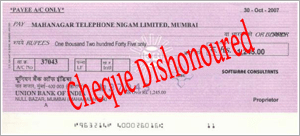
Business transactions of people is increasing day by day and the stability of maintaining bank balance has been fluctuating depending upon the financial needs of the people. If a person issues a cheque to another, he/she may not be aware of the current bank balance and thus the cheque may be dishonoured. In such situations, the drawer of the cheque is given a 30 days’ time for repaying the amount back to the payee. But after that period, if the drawer is not willing to pay the amount, the payee has an option to file a suit against the drawer for payment of the amount of the cheque as well as an amount of interest as compensation for the default caused by the drawer.


Legal recourse

When a cheque is dishonored, the bank will issue a ‘cheque return memo’ to the banker of the payee mentioning the reason behind the dishonor of cheque. The banker then transfers the cheque return memo along with the dishonored cheque to the payee. Then the payee may issue a notice to the drawer for the payment of amount within 15 days from the date of issue of the cheque and resubmit the cheque within 30 days from the date mentioned on the cheque on a belief that the cheque will not be dishonored this time. If the cheque is being dishonored again, the payee has the right to prosecute the drawer legally for the dishonour of the cheque. The payee can prosecute the drawer of the cheque only when the cheque has been issued towards the discharge of liability or debt by the drawer. If the cheque was issued as a gift or towards lending of loan for any unlawful purposes, the payee has no right to sue the drawer when the cheque gets dishonoured.

Law-Judgement

The Negotiable Instruments Act, 1881 deals with the cases of dishonour of cheques. According to Section 138 of the Act[2], dishonour of the cheque is a criminal offense and is punishable by an imprisonment of two years along with a monetary compensation as fine or both. This Section of the Act states that the dishonour of the cheque may occur when a person, for the payment of any liability or debt to another person, issues a cheque in favour of that person and due to the insufficiency of fund or if the prescribed amount exceeds the limit of amount to be paid from that bank, then the person is deemed to have committed the offence. The bank also has a right to stop the cheque facility to the person and even close his account when repeated offenses of cheque bounce occur.

In certain cases, the defaulter can appeal to the Sessions Court within one month from the date of judgment of the lower court. If both the parties are not interested in wasting much time, an out of court settlement is also applicable at any point. In many cases, the party files a separate civil suit against the defaulter for the recovery of the amount mentioned in the cheque along with a reasonable rate of interest as compensation.


Summary suits

In many circumstances, the defendant will have no defense of his own. In such a situation, the plaintiff can file a ‘summary suit’ under Order 37 of the Code of Civil Procedure, 1908[3]. Here the defendant will be given no chance to defend himself unless he procures permission from the court to defend. Summary suits are being filed mainly in civil matters based on recovery procedures. It includes promissory notes, bills of exchange and cheques. It does not have a form of criminal charge as it only focuses on the recovery of the debt or property from the defendant without much delay.


Amendment to the Act

negotiable-instruments-act-unitedworld-school-of-business-1-638

Even though Negotiable Instruments Act has been amended many times due to several reasons, the landmark amendments in the Act were done twice before the recent amendment done in 2015. The latest amendment adopts various principles regarding the jurisdiction of the courts in dealing with such matters. In many cases, the drawer will be in one place, and the payee will be far away from the drawer. In such cases, the parties find it difficult to go through the penal actions which follow. By the new amendment, the holder of the cheque can file a suit before a magistrate at his place of residence and the place where he tendered the cheque. Thus litigation expenses will be reduced, and the drawers of the cheque will be more careful while signing the cheque[4].

According to the newly implemented Section 142A, any case of the same nature, whether filed before or transferred before, shall go to the courts having jurisdiction under the new procedure[5].


Conclusion

Dishonour of the cheque is one of the major issues faced by the parties while transferring money through negotiable instruments. It will make the drawer liable even though he was unaware of the insufficiency of the fund in his account within a prescribed limit of time. But the law itself provides a reasonable time for them to repay back the amount to the payee. The default made after such a period has to be considered as a criminal act as it involves an unlawful intention of not paying back the money to the deserving party. Thus, the law makes it clear that the parties while signing a cheque have to be aware of the amount of money in their concerned banks.

Footnotes:

[1]Section 6 – Negotiable Instruments Act, 1881

[2]Section 138 – Negotiable Instruments Act, 1881

[3]Order 37 – Code of Civil Procedure – Summary suit

[4]Retrieved on http://www.business-standard.com/article/opinion/the-negotiable-instruments-amendment-bill-2015-115080900761_1.html

[5]Section 142 A – Negotiable Instruments Act, 1881, retrieved on http://www.business-standard.com/article/opinion/the-negotiable-instruments-amendment-bill-2015-115080900761_1.html


Download Now

Road Accidents And Legal Recourse To Be Taken

0

In this blog post, Sreeraj K.V., a student of Government Law College, Ernakulam, Kerala writes about road accidents and legal recourse to be taken once such accidents take place. This blog post includes the current status of India in connection with road accidents, provisions of the MV Act and also certain procedures that must be fulfilled by the parties immediately after an accident.

IMG-20151029-WA0013_2


Introduction

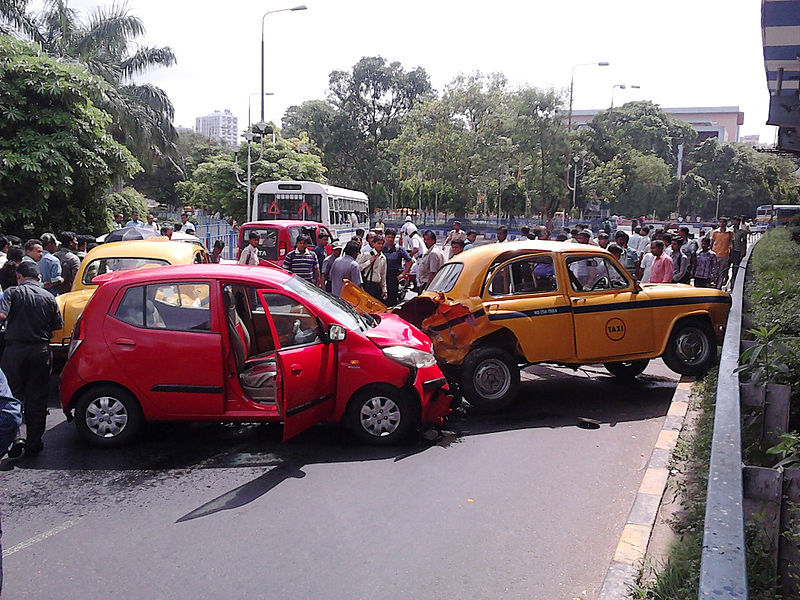
Road accidents have turned out to be a common issue in India in the recent times. India has seen the largest number of road accidents in the past few years. The main reason behind this phenomenon is that we show our decency in the society but not on the road. Rash and negligent driving, avoiding proper signals, drinking and drive, etc. lead to most of the accidents in India. Reports states that there is one death in every four minutes due to road accidents in India and 25% of such accidents have occurred to persons driving two-wheeler. This is a shocking report because it indicates how negligently we are behaving on roads. The report also states that Delhi is in the top position on the highest number of road accidents in India.[1]

800px-Multiple_Car_Accident_-_Rabindra_Sadan_Area_-_Kolkata_2012-06-13_01320

While looking into to the laws and statutes which ensure road safety as well as protection for the victims of road accidents, these laws include Motor Vehicles Act, 1988 and certain provisions of criminal law in the case of the death of the victim of road accidents. The Motor Vehicles Act prescribes certain important provisions which every driver should follow. It includes:

  • Section 112: Prescribes the maximum limit at which each class of vehicle can be driven.
  • Section 113: A person should not drive a vehicle exceeding the permitted weight it can carry.
  • Section 129: A person driving a motorcycle shall wear a helmet.
  • Section 134: Duty of a person in case of an accident and injury to a person including securing medical attention to the injured person and reporting to a police officer or at the nearest police station within 24 hours.
  • Section 185: Driving by a drunken person or by a person under the influence of the drug is prohibited.

There are also provisions under Section 279 of the IPC dealing with a rash and negligent driving as well as Section 304A dealing with causing death by negligence which is read along with Section 279 in the case of death of the victim of an accident. Now, looking into various reasons of accidents, it has to be stated that many of the drivers undertake rash and negligent driving, as well as the reckless drivers of buses and trucks, are in a habit of drinking. Under the influence of drugs, they drive their vehicle at high speeds by negligently avoiding traffic signals and hence causing road accidents and sometimes being victims themselves.[2]

Using mobile phones during the time of driving has also been common now-a-days. Government as well as the Motor Vehicles Department has provided strict regulations that a person must stop his vehicle towards the side of the road for attending a call or calling through mobile phones. But 90% of the drivers attend their phones while driving, mainly the taxi drivers who are in a hurry to pick their customers from different places. Not only them, but also car drivers, mainly elite class people, use their phones during the time of driving as they very well know that money will resolve every issue.

17

The attitude of the police at the time of an accident is quite surprising. Now-a-days, we see many people riding their bikes at a very high speed as well as in a rash and negligent way through highways as well as on roads where there is a high rush of vehicles. The impact of such accidents will be very high when compared to other accidents. The main factor behind such accidents is that, in such cases, these bike riders will be colliding with a vehicle which will be a bigger one, say a car or any other heavy vehicle. In such instances, no person shall admit that two-wheeler was at fault. Rather, they will blame the driver of the four-wheeler so that the driver of the two-wheeler can secure some compensation. For instance, there was an accident in the Bangalore-Tumkur highway where a person was in his car. A bike had suddenly come and collided with a car from behind. The people nearby as well as the bike rider blamed the car driver and he was forced to give compensation. There is a loophole in the traffic regulation laws which make the person is driving bigger vehicle liable for the accident without even looking into the nature of the accident. This is quite disappointing since the person driving the bigger vehicle does not get a chance to prove that the other person was at fault.


Legal recourse

During the time of an accident, the very first thing that a person should do is take the injured person to the hospital and provide him with proper medical attention to save his life. Then he may approach to the nearest police station seeking legal guidance regarding the matter and lodge a complaint against the person who made the fault. In many cases, the complaint will be against the driver of bigger vehicles as it is a commonly seen aspect in India. After lodging the complaint, the case may be registered at the concerned police station under various provisions of the Motor Vehicles Act, 1988 as well as various other criminal laws if needed. After registering the FIR, the vehicle/vehicles which caused the accident will be taken to the police station for proper fitness certification by the officials of the Motor Vehicles Department. During that time, driver/drivers involved will be called and their statements will be taken, and then the case will be forwarded to the concerned Motor Accidents Claims Tribunal (MACT). At that time, proper documents such as Registration Certificate of the vehicle, a copy of the FIR, post-mortem report if any person is dead, proper insurance papers, documents containing the age of the victim, proof of the income of the victim, etc. Have to be submitted. During the time of the trial, both the accused and the victim get a chance to plead and it is up to the insurance company to act accordingly in terms of the compensation to be given to the victim.[3]

Conclusion 

Road accidents are increasing at an alarming rate day by day and the police as well as the judiciary find it very difficult to resolve the cases in a short period. Latest statistics reveal that it takes around three to five years for the court to make a decision in a case concerned. Keeping this in mind, the government and the Judiciary planned to establish some courts dealing with the issues of road accidents. Now, we have Motor Accidents Claims Tribunal (MACT) all over India to deal with the cases of road accidents. The main goal behind the establishment of MACT was to decide accident related cases in a much faster way as compared to ordinary courts. But still, pending cases are very high as compared to the cases resolved. Certain other machinery such as alternative disputes resolution may also be applied for accident cases where there are fewer amounts of damages which can be resolved by way of compensation.


Footnotes:

[1] Retrieved on: http://sites.ndtv.com/roadsafety/important-feature-to-you-in-your-car/

[2] Retrieved on: http://www.shareyouressays.com/3161/552-words-essay-on-a-road-accident-in-india

[3] Retrieved on: http://www.vakilno1.com/legal-faq/mact-motor-accidents-claims-tribunal.html


Download Now

Use of Mediation during Divorce Proceedings in India

2

In this blog post, Saakshi Jain, student, Amity University, Lucknow Campus writes about Mediation, a must and compulsory process in India. This post also covers the need, advantages, and disadvantages of mediation and its impact on Indian divorces.

IMG_Sakshi Jain


Need for Mediation before Divorce Proceedings in India

Mediation is a part of conflict management of the Alternative Dispute Resolution method under Section 89 of the Code of Civil Procedure Code. The emerging concept of mediation centers is rising rapidly.

Mediation is a process of intervening between two parties to resolve disputes. It is an attempt made by a third party who is called a mediator. The mediator is one who is impartial, neutral towards both the parties. Mediators do not give a judgment but allow resolution of the disagreement or disputes between the parties. Under mediation, open communication is held between the parties so that both of them can clear their doubts and misunderstandings and with the help and suggestions of the mediator, come to a common conclusion. Many people before going to the court prefer to go first to the mediation center. Anyone can make a request for mediation by informing in advance through a written notice.

The mediation process is a long process because the mediator needs to analyze the problems and then find the solution to it.  Some of the cases may last for 30 days and some for 7 to 8 months. It depends on the case of the client. 252786-untitled-6

Mediation is a very flexible process as the parties to it decide their own suitable time. Mediation can be used in divorce, labor disputes or bargaining, real estate, and in other disputes so to avoid taking the case to court. Mediation is an informal process to resolve disputes, and the third-party is the mediator who clarifies the misunderstanding between the parties. The misunderstanding can be for a commercial, legal, family matters and many more purposes which need to be solved by an impartial mediator.

At the initial stage, both the parties are not comfortable with revealing their private life to another or a third person. So the communication skills of the mediator should be strong enough to make the parties comfortable and speak out their problems without any privacy problem. The mediator should begin by asking basic questions and when, the parties are comfortable, then only should the deep questioning begin. The communication skills of the mediator should be effective enough to fetch out the problem of the parties and work upon it. Earlier it was not the duty of mediation centers to reconcile the disputes of the couples. But with growing time, to remove the burden of the court and to give a broader look to the Indian judiciary, mediation centers are established and are running successfully.


Types of Mediation         

There are two types of mediation:

Mediation through court- Section 89 of the Code of Civil Procedure, 1908 deals with the mediation for pending cases in the court which are referred by the court itself.

Private mediation- Private service is given by qualified mediators. Free service is provided to the court or public members to resolve their disputes regarding any matter. Private Mediation is used to resolve the disputes pending in court and pre-litigation disputes.


Need for Mediation Centers

There should be a conflict resolving management in a country because every case cannot be of such nature to deal with courts. In many cases, there is only a misunderstanding which can be resolved through the mediation centers. There is no need of going to court.

Couple divorcing

In fact, the court is overburdened by its pending and upcoming cases. Litigation is a very slow process and takes the time to come to any conclusion. Therefore, there is a great need for mediation centers in India to solve minor disputes so that no litigation process is taken further. But if the parties are not satisfied with the conclusion of the mediation center and find that nothing is well, then they can move towards the court. Therefore, the basic and foremost need of mediation is to avoid going to court and resolve the dispute in a normal and confidential way.


Mediation in Divorce      

Nowadays, many cases have been registered among young couples for divorce. They fight for a small reason and make it a big one. Sometimes one feels that there is a huge problem, but when one sits backs and looks at it, the problem isn’t that huge, it’s just the two partners who make an issue out of it. Divorce can be initiated by either of the spouses. The major reason for this initiation is a lack of trust, love, care, respect, cruelty, etc. so when a couple feels that there is some possibility to save the relation, they approach the mediation center.cartoon-med

Mediation centers have their process of handling the case in their way. Hence, couples are first referred to go for mediation and then move towards the court.  Mediators are usually appointed by the court. The court appoints the mediators according to their qualifications for particular matters.


Advantages and Disadvantages

There are certain advantages and disadvantages to the mediation process for divorce.

Advantages: Mediation cuts the price and the long process of litigation. It is a confidential and ethical process and does not harm the sentiments of either party. A neutral person assists the matter and hence, derives a conclusion which fits perfectly for both parties. Therefore, it is a neutral process. Mediation is a simple and flexible process and does not need much formality to it.

Disadvantages: Under the mediation process, the mediator cannot compel or force either of the party to cooperate. It is one’s choice whether to co-operate or not. Hence, the divorcing couples should firstly try to solve the problem on their own and then only go for mediation if no results are found.


Duty of the Court

Section 9 of the Family Court Act, 1984 states the duty of the Family Court to make efforts for a settlement.-

  • In every suit or proceeding, endeavor shall be made by the Family Court in the first instance, where it is possible to do so consistent with the nature and circumstances of the case, to assist and persuade the parties in arriving at a settlement in respect of the subject-matter of the suit or proceeding and for this purpose a Family Court may, subject to any rules made by the High Court, follow such procedure as it may deem fit.
  • If in any suit or proceeding, at any stage, it appears to the Family Court that there is a reasonable possibility of a settlement between the parties, the Family Court may adjourn the proceedings for such period as it thinks fit to enable attempts to be made to effect such a settlement.
  • The power conferred by sub-section (2) shall be in addition to, and not in derogation of any other power of the Family Court to adjourn the proceedings. [1]hammer-court-IBNLive12

Section 9 of the Family Court Act, makes is it mandatory to settle a matrimonial dispute in relation to maintenance, child custody, divorces, etc., through the process of mediation. It also states to refer the parties to visit a mediation center with their consent. The family court can take the help of the counselors if needed for resolving disputes. Mediation centers should give a time limit for the completion of the conflict dispute to avoid further or unnecessary delay in the matter.

In the case of K. Srinivas Rao vs. D.A.Deepa [2], the apex court held that mediation is a must before a divorce. When any case occurs under Section 489A of IPC, the apex court directs the criminal courts not to deal with this complaint unless the matter is dealt by the mediation centers but in few cases where the cruelty amounts to be a very rigorous and a dangerous one, the criminal courts can take up the case without referring it to the meditation centers.  Further, it has been held that all the mediation centers should set up their own personal litigation clinics so that the matrimonial disputes can be resolved under this without going to court.

By the statistical data of Bangalore mediation, over 20, 000 cases of 30, 000 have been settled through mediation in the year of 2007 to 2014.


Conclusion

Mediation is a negotiation process. Parties who go through the mediation process participate directly and with free consent to this process. Resolving the disputes through a process which is under the supervision of a mediator is called mediation. The aim of mediation is to provide a fair, neutral, speedy decision or conclusion to the parties. Meditation can be done for any matter. But nowadays, the concerned topic is Divorce. Mediation for divorce is a must process and needs to be done before going to the court. Through mediation, the burden of the court becomes less and the parties can confidently make their point clear to each other.  Mediation is a non-judicial and informal process that needs to be done by the divorcing couples. Mediation centers do not pass the judgment but give the couples solutions to smoothly repair the cracks in their marriage.  After the mediation process, the divorcing couples may give another chance to their relationship or file a petition for divorce in the court.  After the mediation process, the divorce becomes a mutual divorce with the consent of both the spouse. Section 9 of Family Court Act, 1984 also states that before going to the court, the partners need to go through the mediation process. Therefore, mediation is a must for all the divorcing couples to give their marriage one more chance.


[divider]

Footnotes:

[1] https://indiankanoon.org/doc/1558811/

[2] Civil Appeal No. 1794 of 2013

Download Now

A Critical Analysis of the Incorporation of Most Private Companies in Mumbai

0

In this blog post, Harshit Singh Jadoun, a Third Year student of B.A. LLB(HONS) from Institute of Law, Nirma University, Ahmedabad and a Diploma in Entrepreneurship Administration and Business Laws from NUJS, Kolkata, analyses the reasons why a majority of companies in India are incorporated in Mumbai.

Profile


Introduction

India is no doubt playing a crucial role in the global market and is even emerging as a key player in implementing as well as executing policies inclusively. Establishing an enterprise requires various prerequisites to be taken care of with several formalities to be completed that are necessary according to law to be complied with. Apart from these procedures and practices, there are multiple factors that govern and regulate the outcome and performance of the corporation; location is inter alia one of the key factors that have a bearing upon the business of the venture. Mumbai_b1Every entrepreneur aims at positioning its undertaking at an economical place and where sufficient manpower is available to carry on the project effectively; therefore, a decision regarding choosing the location turns out to be a strategic and an important one. Mumbai is known as the commercial capital of India and its firm economic growth, geographical location and proximity to other cities (outside as well as inside India) due to the effective mode of communication and transportation fascinates industrialists and many freshers to establish their business in the city.

In this article, the author tries to highlight the reasons and the grounds as to why most private companies in India are incorporated in Bombay.


Location: An Essential Factor for Incorporating a Private Company

Incorporation of a company is the primary step in laying its foundation and giving a platform to the entrepreneur to initiate the business with the hope of achieving future economic prospect, but there are numerous risks that an entrepreneur has to undertake to establish his business by combating and overcoming all the menaces tangled in it. Albeit, business benefits, investment, and profits are sin qua non of a successful enterprise but choosing the appropriate location for the business stands equally at an indispensable footing with other factors concerned to make a lucrative venture. Resolution regarding the location of the business is very pertinent to all types of companies irrespective of its size; it has several impacts on the long-term economic growth of the company along with the cost of operation and consumers suitability.[1] money4-300x168

Usually, it is incongruous to alter or shift the location of the company once settled because it may result in considerable amount of loss to the companies and members associated with it. Moreover, the consumers attached to it may find it incompatible to get settled with the new location. Therefore, decisions once taken regarding the location is hard to undo.[2] Various prerequisites have to be taken into consideration before choosing up a location which is apt for the business, some of them being the availability of raw material, proximity to market, availability of labor, transport facilities, external economies, power, finance, etc.[3]


Mumbai as an Apt Location for Private Companies

  1. Financial Capital: The existence of various Indian stalwarts along with strong industrial base act as a hub for trade, business and industries and the contribution of the city to the economic growth and gross domestic product of the country leaves no stone unturned for it to not to be called as the financial capital of the country. Mumbai has two largest stock exchanges namely the National Stock Exchange and the Bombay stock exchange. The headquarters of Reserve Bank of India, Security Exchange Board of India and almost all major banks makes the city financially resilient which fascinates freshers to set up their enterprise irrespective of the risk involved. The city gained its importance from the time when a protected deep-sea harbor was discovered due to which East India Company bought the island from the crown and shifted its headquarters from Surat to Bombay. Businesspeople from Gujarat who are an expert in stock trading add their culture and skill and are prompt in reacting to the bids and offers in the market. Their plain lifestyle and lowest cost of operation in the world makes them a significant player in the financial world of the country.[4]9hindustan-construction-company
  2. Investment Policies and Incentives: The extensive industrial development in Mumbai appeals to both foreign as well as domestic investors. The policy framed by the State Government provides an ideal business climate by encouraging the investors to invest in various sectors of the state and contribute to the overall development of the economy. The robust infrastructure, skilled manpower and high professional ethics offers and conducive business environment and well-established sectors in engineering, automobiles, drugs, textiles, and biotechnology attract the largest quantum of investment. Mumbai is also said to be the land of opportunities due to a large number of employment opportunities that it provides through the service sector and grants various incentives and perks to the people employed which give stability to businesses, promoting investment and growth. The tax incentives bestowed by the State Government and the availability of major nationalized banks makes it easier to acquire timely funds by the entrepreneurs. Therefore, they are encouraged to set up their business in Mumbai. The city gives them a platform for huge segments of buyers and traders to make a trade which helps their business to prosper across major corners of the country.
  3. Robust Infrastructure: The heavy infrastructure with well-built institutions provides a reputable platform for the investors to invest due to established connectivity to every sector and place in the world. The city has consistent and cost effective telecom connectivity and to substantiate with some statistics the city consists of 11 percent of National Road Network along with 9 percent of the National Railway Network. The state airports handle 34 percent of India’s international passengers and cargo. Recently the State Government is planning to set up “Industrial Township Authorities” in the respective industrial areas of the state that will be responsible for managing common infrastructure with active participation from the industrial units located in the area.[5] The transport infrastructure being carried out in Mumbai by the Maharashtra State Road Development Corporation (MSRDC) is tremendous and has added a lot to the economic growth of the city. The corporation is bringing into existence several notable projects such as the Mumbai-Pune Expressway and many other flyover projects in Mumbai.[6] To name a few upcoming projects which will further bolster the infrastructure would be the Mumbai Trans Harbour Link (MTHL) Project, which would effectively reduce the commute time from South Mumbai to Navi Mumbai to 30 minutes, enhancing the entire traffic and development dynamics of the region,[7] Adding more to this CIDCO has proposed the Navi Mumbai International Airport, which promises to provide world-class facilities to passengers, aircrafts and airlines.[8] The power sector in Mumbai is given no less regard, due to the existence of major stalwarts like Tata and Reliance the city has an abundant power supply which adds a feather to the stout infrastructure of the city. 610_Eight-companies-eye-Mumbai-elevated-rail-corridor_Prachi-30-9
  4. Special Economic Zone: The central aim of the Government behind building these zones is to augment industrialization and foster economic growth parallel with sustainable development. The foremost advantage of the special economic zone in Mumbai is that they get tax rebates with fiscal incentives along with land at a reasonable price which makes it easier for the entrepreneurs to start-up their business at a sound rate.[9] There are uncountable benefits attached to the Special Economic Zone such as the promotion of economic activity, exports of goods and services, investment from domestic and foreign sources, the creation of employment and many others.[10] The Special economic zones unit in Mumbai provide an exemption from VAT on domestic sourcing of capital; there is income tax holidays on business incomes, 10% FDI is allowed for all manufacturing activities, customs clearances, easy access to the airport and railway authorities. Some of the SEZ established in Mumbai are SEEPZ (Santacruz Electronics Export Processing Zone), Khopata, Navi- Mumbai.[11]


Conclusion

Mumbai no doubt is a great hub for entrepreneurs and freshers as it offers great opportunities with resources to enter the world of business and compete with others already present. The city has always been considered to be the land of opportunities and has certainly changed the fate of many people. In the context of this manuscript, it can in no way be denied that the city has ascended the growth of private companies due to the unrestricted capital, resources that it bestows to the firms and companies. Certainly, there is a lot more that can be modified and developed in the city to make it more welcoming to the new companies and set up an environment compatible with their business set up.


[divider]

Footnotes:

 [1] Abhishek Nayak, Why are most private companies incorporated in Bombay? Ipleaders, http://blog.ipleaders.in/8116-2/, last seen 27/05/2016.

[2] Business Location (Introduction), http://www.tutor2u.net/business/reference/business-location-introduction, last seen 27/05/2016.

[3] Factors Influencing Industrial Location, http://teacherweb.ftl.pinecrest.edu/snyderd/APHG/Unit%207/Location%20Factors.htm, last seen 27/05/2016.

[4] T Thomas, Mumbai a global financial center? Of course! Business Standards, http://www.rediff.com/money/column/mumbai/20070427.htm, last seen 28/05/2016.

[5] Policies, Infrastructure Policies, Doing Business in Maharashtra, http://www.doingbusinessinmaharashtra.org/infrastructure_policy.aspx, last seen 30/05/2106.

[6] Ibid 5.

[7] Navi Mumbai Special Economic Zone, http://www.nmsez.com/infra.html, last seen 31/05/2016.

[8] Ibid 7.

[9] Advantages of SEZ Units in India, Business Maps of India, http://business.mapsofindia.com/sez/advantages-units-india.html, Last seen 31/05/2016.

[10] Ibid 9.

[11] Ibid 10.

Download Now

Anti-Hijacking (Amendment) Bill, 2016

0

In this blog post, Pranav Rudresh, Student of Lloyd Law College, Greater Noida and a Diploma in Entrepreneurship Administration and Business Laws from NUJS, Kolkata, writes about one of the recent laws amended by the parliament known as the Anti-Hijacking (Amendment) Bill, 2016.

IMG_20160415_145319347-e1461738121934-768x1024


Introduction

In 1982, an act was passed by the Parliament of India for suppression of unlawful seizure of aircraft’s registered in India[1] and was known as the Anti-Hijacking Act, 1982. According to the act, whoever on board aircraft in flight attempts by force or threat and intends to control the aircraft for unlawful purposes shall be charged with the offense to commit a hijack. The punishment under such charge, if proved, was life imprisonment and fine.

In December 1999, an Indian Airlines aircraft popularly known as IC-814 was hijacked while traveling on its way back to Delhi from Kathmandu, Nepal. Despite several attempts of negotiation with the hijackers, the Indian government was forced to release three terrorist namely Maulana Masood Azhar, Ahmed Saeed Sheikh and Mushtaq Ahmed Zargar. One of the passengers was killed while several others were injured. Later the case was investigated by the Central Bureau of Investigation (CBI), which charged 10 people, of which seven people were absconding including the 5 hijackers. The 3 people who were charged with helping the hijackers were awarded life imprisonment.KandaharHijacking

Yusuf Nepali, who was among the three people charged with helping the hijackers was awarded life imprisonment, the CBI had however moved the Punjab-Haryana high court seeking the death penalty for him, which was rejected by the court on grounds of his prolonged custody. Nepali was released from jail in April 2014 and later claimed that he was not a part of hijacking although CBI had proved his active participation in helping the hijackers.In December 1999, an Indian Airlines aircraft popularly known as IC-814 was hijacked while traveling on its way back to Delhi from Kathmandu, Nepal.

47967050Despite several attempts of negotiation with the hijackers, the Indian government was forced to release three terrorist namely Maulana Masood Azhar, Ahmed Saeed Sheikh and Mushtaq Ahmed Zargar. One of the passengers was killed while several others were injured. Later the case was investigated by the Central Bureau of Investigation (CBI), which charged ten people, of which seven people were absconding including the five hijackers. The three people who were charged with helping the hijackers were awarded life imprisonment.

All these events led to the question whether the death penalty should be imposed upon a person involved or related with hijacking. The bill was last amended in the year 1994, A few amendments were planned in 2010 but were unsuccessful in implementing.


The Anti-hijacking Act, 2016

Reforms in the Anti-hijacking Act, 1982 were presented, and first bought up in 2010 however the amendments couldn’t see much of daylight. It was this year in the month of May when the Anti-hijacking Amendment Act was passed in both houses successfully as well as it received the assent of the President. The Anti-hijacking Act, 2016 has been divided into three chapters mainly: The first chapter deals with the definition of hijacking and other things such as aircraft, hostage, military aircraft, etc. The second chapter deals with the punishment for the accused. Notably, the provisions of the Code of Criminal Procedure, 1973 has been enabled. Chapter 2 also describes the powers of the central government. It also defines the jurisdiction of the law. The third chapter contains the miscellaneous provisions such as the power to treat certain aircraft to be registered in Convention countries[2].The persons acting in good faith and doing anything required under their duties under this Act are protected under this Act against any suit.457157-407360-parliament

The new bill is with effect to the Hague Convention, 1971[3]and the Beijing Protocol, 2010[4]. Some of the important modifications in the new bill are:

  • Change in definition of the word “hijacking”: One of the most important amendments that have been mentioned in the Act is in Section 3; which changes the definition of the word “hijacking.” It is for the first time that in this bill the term “technological means” has been used. The law now defines hijacking as Whoever unlawfully and intentionally seizes or exercises control of an aircraft in service by force or threat thereof, or by coercion, or by any other form of intimidation, or by any technological means, commits the offense of hijacking”[5]. In the law of 1982, the term technological means has not been used. The Section 3(1) of the anti-hijacking act, 1982 defined hijacking as “Whoever onboard an aircraft in flight, unlawfully, by force or threat of force or by any other form of intimidation, seizes or exercises control of that aircraft, commits the offense of hijacking”.
  • Provision of capital punishment and Role of Central Government: Another notable amendment in the Anti-hijacking Amendment Act is the introduction of capital punishment. It has been mentioned in Section 4 of the Amendment Act that in case of hijack, if the accused has conducted any act of violence which may result in death of any of the passengers or crew members and the security personnel or any such other person not involved in the offence present in the aircraft, he may be liable for death penalty.The accused will still be charged with life imprisonment and fine, along with confiscation of his movable and immovable properties in case the accused is charged only of hijack. It is to be noted that Section 5 of the Act of 1982 had provisions of the death penalty for the accused however only in case killing of hostages such as passengers and crew members directly. The Section 6(2) of the Amendment Act also empowers the Central Government for investigation, arrest, and prosecution of any officer of the Central Government or National Investigation Agency (NIA) in the case of suspicion. Section 20 of the Anti-hijacking Amendment Act empowers the Central Government to lay down new rules if required and present before both the Houses of Parliament for discussion and approval before implementation while the house is in session. If the houses disapprove the presented rules, the law shall remain unaffected.Law for You (Custom)
  • Change of jurisdiction of the law to “Universal”: Another important amendment included in the Anti-hijacking Act, 2016 is the change of jurisdiction of the law.The law now covers provisions against highjacking of aircraft’s registered in India or consisting of Indian passengers or highjack committed by an Indian anywhere in the world. According to the law, if the hijacker is a resident of India, or if the hijacked aircraft is registered in India or if any foreign registered aircraft lands in India with the alleged offender still on board or when the aircraft is hijacked anywhere in the world, and an Indian citizen is on board, proceedings under Anti-hijacking Act may be applicable upon the hijacker. It has been mentioned in Section 7 of the amended act.


Conclusion

The Anti-hijacking Amendment Act, 2016 covers a considerable amount of improvements compared to the act of 1982 or the amendments made in 1994. With the implementation of this act, the Indian legislation surely tightens its stand against incidents related to hijacking as it brings both technology and manpower to work together more vigilantly for the safety of passengers. India has witnessed 19 highjacks so far and every time it has cost us something. Implementation of this law will impact India’s strong stand against incidents like highjacking. There are still certain points to be covered to make this law even stronger such as to allow the security forces to shoot down an aircraft which may be used as a missile or the power to concerned authorities or security forces to prevent take off for suspected flights.The new act has also been framed by the Beijing Protocol, 2010 which makes it noted globally as many countries frame their civil aviation laws by this protocol.

We can only hope that we don’t need to enforce these laws on someone shortly.


[divider]

References:

[1] Aircraft registered in India means any aircraft apart from military and police or custom services which at the time being have been registered in the jurisdiction of India. (Section 1(3) Anti-hijacking Act, 1982)

[2] Countries that have agreed and accepted the Hague Convention

[3] The Convention for the Suppression of Unlawful Seizure of Aircraft signed at The Hague on the 16th of December, 1970

[4]The Convention held at Beijing for Suppression of Unlawful Acts Relating to International Civil Aviation is a treaty by which nations agreed to criminalize certain terrorist actions against civil aviation in September 2010.

[5] Source: http://www.indiacode.nic.in/acts-in-pdf/2016/201630.pdf

Download Now

Praveen Kumar; a lawyer, a BBA and above all an organic farmer on how the NUJS diploma course is benefiting him

0

IMG-20160722-WA0023 (1)

In today’s world when people are turning their back to agriculture, an NLU law graduate says he is not interested in a corporate law career and wants to concentrate on his organic farming business.

Praveen Kumar did his BBA from MDU, Rohtak and LLB from Faculty of Law, Delhi University. Unlike his batch mates he is not looking forward to a corporate law career and wants to expand his organic farming business. He owns an organic farm in Rewari, Haryana and works with farmers from 15 to 20 villages around his farm. He educates them about organic farming and the benefits of it. He motivates them to take it up instead of conventional farming methods. He has a very wide network of farmers who have turned to organic farming after he made them realize the benefits of it.  He himself owns one of the largest organic farms in Rewari. As of now, he doesn’t market his products but he dominates the local farmers markets and the big mandis.

He is passionate about social causes and took up organic farming also because of this. He wants to uplift the farmers and give them a profitable way of livelihood, while ensuring that the environmental issues due to the usage pesticides and insecticide by  farmers is taken care of. As per him, organic farming is the only way to control the rising levels of pesticide and other harmful chemicals used in agriculture, which is destroying the environment as well as our health.

He is so passionate about social causes, the only reason why he took up law after his BBA was to help people. He never wanted a law career, but he wants to use his legal knowledge to help people and raise awareness about social causes. He says “The knowledge of law is empowering and without this power of knowledge, you really can’t do much for the society”. He runs an NGO named Community for Nation, which works with farmers, low-income groups and other marginalized sections of the society and educates them about different Govt and non-Govt welfare schemes they are entitled to and helps them avail the benefits of these schemes.

He recently completed the NUJS Diploma in Entrepreneurship Administration and Business Laws. We asked Praveen, what made him sign up for an online diploma course after a BBA and an LLB and here is what he had to say. Over to Praveen:

I joined the NUJS diploma in Entrepreneurship Administration and Business Laws while I was in the second year of my law school. I was looking for a course which would help me understand the business laws in detail and I took to the internet. I came across the advertisement of the NUJS diploma course while searching the internet. I found the course structure and the syllabus to be practical and detailed. Secondly, the tag of NUJS was attractive.

Apart from this, I was inspired by reading the success stories of students of this diploma course on the iPleaders blog, what attracted me most was the fact that not only students but lawyers and professional were taking up this diploma course from NUJS. I was sure that this course would be beneficial, otherwise, why would established people take this course.

By the time of joining the course, I had made up my mind that I will not be practicing as a lawyer and would concentrate on my organic farming business only. So I wanted a better understanding of business laws and entrepreneurship; how the laws are used while negotiating contracts, how to structure a business, labor laws etc.  When I came across the content of the course, I felt that it was in line with my needs and gave a good insight into business laws.

The course syllabus covered subjects such as business structuring, labor laws etc which are very practical subjects in terms of my business. The knowledge gained through this course helped me manage and plan my business better. Not just my business, the course helped me in my studies also. As I was in law school at the time of doing this course, it gave me an edge over others, in my class. I was already aware of topics which were yet to be covered in class and this knowledge helped me grasp the subjects taught in the class very well.

In future, I plan to launch a brand of my organic products and market them in big retail chains like eazyday, big bazaar etc. This course would come handy then, as I would be better-prepared to handle contracts, marketing my brand etc.

As of now I’m not able to use much of the learning from this course, as I deal with local farmers markets, mandis etc but this would be beneficial in future when I would be dealing with retail chains.

I would definitely recommend this course to any who wants to start a business. I would say anyone who wants to startup business or join their family business should do this course; so that they get to know about different aspects of business laws. This course is helpful to everyone because of its great content.


Download Now
logo
FREE & ONLINE 3-Day Bootcamp (LIVE only) on

How Can Experienced Professionals Become Independent Directors

calender
28th, 29th Mar, 2026, 2 - 5pm (IST) &
30th Mar, 2026, 7 - 10pm (IST).
Bootcamp starting in
Days
HRS
MIN
SEC
Abhyuday AgarwalCOO & CO-Founder, LawSikho

Register now

Abhyuday AgarwalCOO & CO-Founder, LawSikho