Download Now
Home Blog Page 1714

Overview and Critical Analysis of the Transgender Persons Bill, 2014

0

In this blog post, Harsha Asnani, student, NIRMA University, Ahmedabad analyzes the Transgender Persons Bill, 2016.

 

Capture

Introduction

Ostracized from the mainstream community coupled with the lack of any recourse on gender identification, one of the major chunks of India’s population, popularly known as the “transgender,” continues to face serious human and legal right violations. This issue has come into the limelight with the passing of the Supreme Court Judgement by a two-judge bench in the case of National Legal Services Authority v. Union of India which in the words of Justice K.S. Radhakrishnan had ruled that “recognition of transgender as a third gender is not a social or medical issue but a serious human right issue.” Concerned with this widespread, entrenched discrimination and lack of practical implementation of the said judgment, the Indian legislature has taken a major step to tackle this social exclusion issue.


Overview of the Transgender Persons Bill, 2014

The Rajya Sabha passed the Transgender Persons Bill, 2014 on April 24, 2015. The Bill consists of various rights on social, economic and political entitlements, privileges, and immunities for transgenders. It also entails several duties on educational and employment providing institutions to provide equal and inclusive opportunities to this unidentified community. In addition to this provisions have been made for enactment and implementation of necessary schemes in order to provide social security, rehabilitation, and recreation to the transgender. Providing safeguards and promotion of rights of transgender persons for attaining adequate living standards and conditions to enable them to live independently in the community is another peculiar feature of this Bill. vodafone-tax-case-hc-allows-penalty-proceedings-to-go-on

The introducers of the Transgender Persons Bill were of the opinion that the issue of transgenders should not be mixed with the lesbian-gay-bisexual issues because of diverging concerns of the two groups. The former suffers from a grave problem of lack of one’s identification in various walks of life whereas the latter’s problems are concerned with the acceptance of their sexual orientation by the social and legal community.


Rights Guaranteed under the Bill

Chapter II deals with the rights and entitlements that this act envisages to provide to the transgender. Firstly, it provides them with the right to equality regarding Article 14, 15, 16. Regarding Article 19, the bill provides an opportunity to the transgenders to have an equal basis as that of all other persons regarding expressing their views in matters that directly or indirectly affect them.

Concerning Article 21, this bill aims at providing a right to dignified life and personal liberty on an equal basis with that of people belonging to other genders. This includes right to live within a community and places of one’s choice, assurance of a free and unrestricted access to a range of in-house and community support services coupled with necessary assistance for supporting a living and inclusion within the community. Right to life within this bill also includes the right to respect for his or her physical and mental integrity and the right to protection from any subjection to torture, inhuman and cruel treatment, abuse, violence or exploitation. The interpretation of Right to life under this Bill has been extended to the right to home and family, i.e., no transgender child shall be forced to live away from his or her parents except under conditions where a competent court is of the opinion that it is in the best interests of child or where the parents or the immediate guardians of the child are unable to take care of him, or her then assign the custody of such a child to his or her extended family, or within the community in a family setting. images

Following the imprints of interpretation of Article 21 of the Indian Constitution other rights that have been included in this Bill are right to decent living conditions in matters related to healthcare, food and nutrition, counselling etc., right to shelter to those transgender children who have no families and without any means of livelihood and shelter, right to safe drinking water and sanitation facilities in all areas especially urban slums and rural areas, right to pension similar to that of other persons subjected to income limits, right to unemployment, allowances to transgenders suffering through the phase of unemployment provided that they are registered with an employment exchange agency for not less than two years and those who could not find any means of gainful employment or occupation.

The Act covers a very broad array of sectors wherein it envisions creating provisions to uplift the community of transgenders so that they can be brought at par with men and women.


Duties entailed on Various Agencies

The Transgender Persons Bill, 2014 levies a few duties on certain government agencies in furtherance of achieving the objectives as envisaged by this piece of legislation. It gives power to the government and local authorities to take necessary steps to establish proper means of accommodation for the people belonging to the transgender community. Also, the Government and local authorities need to ensure that the community services and facilities are available generally and on an equal basis to the transgender persons; that they are not subjected to torture or abuse either inside nor outside their homes.

Any Executive Magistrate, on receipt of the information from a person or a registered organisation who has a reason to believe that any act of abuse, violence or exploitation is about to be committed or has been committed against a transgender, shall take immediate steps to ensure that this act has been refrained from occurring and the victim is rescued and rehabilitated to a place of safe custody.transgender_graphi_2384810g
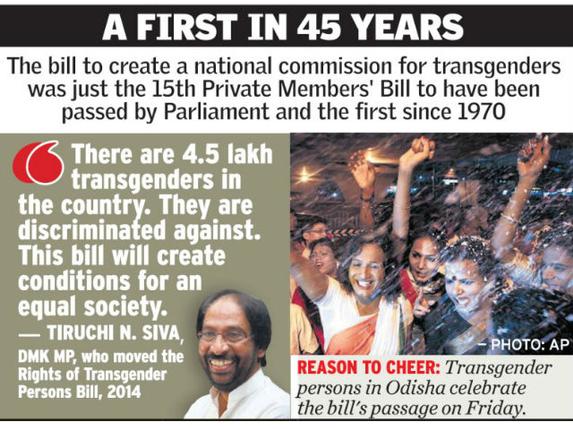
The police officers, on receipt of an information regarding any case of abuse, torture, exploitation, are obliged to make the victims aware of their rights under this proposed legislation which includes information regarding right to protection, right to filling complaint, right to free legal services as provided under the Legal Services Authorities Act, 1987 or any other services offered by the National or State Legal Services Authority information and particulars of the agencies working for rehabilitation of such transgender persons subjected to abuse, torture etc.

The educational institutions maintained, recognized or funded by the Government or other local authorities are mandated to admit transgender students and create no distinction or practice discrimination. Education also includes promoting opportunities for sports, recreation and leisure activities, creating reasonable accommodation as per individual’s requirements, creating a supportive environment in maximizing social and academic development for creating full inclusion. They are also required to ensure, monitor their participation and completion of education of all transgender children. Along with regular courses, adult education should also be provided to the transgender children.download

As far as employment opportunities of transgenders are concerned, the Government’s role is not only limited to creating schemes and programs to help transgenders in finding employment opportunities but also extends to vocational training and instituting mechanisms for providing loans with concessional rates of interest for promoting self-employment ventures and marketing their respective products. The employing agencies are also mandated to create no discrimination in matters related to employment, the right to appear for selection, etc.

Separate HIV Sero-surveillance Centres have to be set up to tackle various health issues related to sexual matters. These centers should provide free of cost sex reassignment surgery and a barrier-free access to such health care centers.

The Act requires the establishment of National and State level Commission for Transgender Persons which is assigned with various functions. These functions, in a nutshell, involve monitoring, supervising and reviewing the implementation and enforcement of all the provisions of this act or any schemes and programs made thereof. Chapter VIII deals with the establishment of Transgender Rights Courts for easy disposal of civil cases which are filed by transgender persons in respect of infringement of their rights under any law in force within the territory of India.


Shortcomings of the Bill

Although the Transgender Persons Bill, 2014 aims at covering all the loopholes in matters related to the treatment of transgender in the country but in response to this Bill, the Ministry of Social Justice and Empowerment had come with a few areas where this Bill stands to be disappointing. Firstly they are of the opinion that the Transgender Bill does not comprehensively reflect the existing literature over the rights of transgender. It is suggested that the Intersex people should also be included in the present bill as they also face such acute issues of recognition, healthcare, nutrition, etc. Secondly, self-identification is recommended by way of notarized legal affidavits so that they can be used to make necessary changes to the legal gender markers and hence not remain limited to general identity cards such as ration cards, PAN cards, etc. It is recommended that issuing of the transgender certificate be carried on by a Governmental authority as it will lead to setting up of gatekeepers or brokers at different levels. Further a separate chapter on healthcare should be brought up. Transgender should be recognized as socially backward groups, and affirmative action should be planned for their upliftment.

Special focus should be brought about to avoid higher drop-out ratios due to harassment and hostile environment in school. Counseling and training sessions should be organized for parents and teachers respectively for providing sensitisation. Adequate medical leaves are provided for sex reassignment surgeries, internationally accepted health practices be adopted.


Download Now

Economic Theory of Crime

0

In this blog post, Sreeraj K.V, a student of Government Law College, Ernakulam, Kerala writes about the economic theory of crime. This post includes a definition of the term economic crime, causes of economic crimes and its reasons as well as present Indian scenario regarding the rate of economic crimes. 

IMG-20151029-WA0013_2


Introduction

There is no specific definition given by any  Criminologists regarding the term ‘economic crime’. The most commonly accepted definition regarding the term is that economic crimes are done by the offenders mainly upon a motivation for economic gain. An economic crime is conceived of as an offense upon which individuals or group of individuals purposefully act in an illegal manner to gain financial returns. The main feature of these types of crimes is that the offenders in many cases won’t be able to distinguish between the reasons that persuaded them to do the crime and the realizations and justifications that follow them.[1]

Crime Causation

The reasons for the commission of an offense differ and a discipline like economics predicated on rational behavior may be disadvantageous in explaining a phenomenon largely viewed as irrational. Recent survey states that there are three central issues for the economics of crime:

  1. The effects of incentives on criminal behavior.
  2. How decisions interact in a market setting.
  3. Use of cost benefits analysis for implementing alternative policies to reduce crime.[2]293643_thumb

Many social scientists argue that crime is closely related to work, education, and poverty. Unemployment and crime are by-products or even measures of social exclusion. Many of the criminals often have limited education or possess limited labor market skills. Another major aspect regarding the commission of crimes is that many of the offenders consider crime as a paid employment where they can generate income. Some of the persons commit crime purely for meeting their needs. Thus, the economic theory of crime has focused on sanction effects and the relationship between work and crime. Apart from this, there are certain other factors which lead a person to commit a crime:

  • Expected gains from crime when compared with legal works
  • Chance of being caught and convicted
  • Extend of punishment
  • Opportunities in legal activities.[3]

Society plays a crucial role in deciding the character of a particular person. The character of the community will be readily reflected in a person’s character. Thus, the person who lives in a good and healthy society may have good character when compared to a person living in a slum or any such area. This statement was well established in Bonger’s theory of economic criminality. In this theory, William Adriaan Bonger stated that there is a causal link between crime and the prevailing economic and social conditions. He asserted that crime is social in origin and a normal response to prevailing cultural conditions. He contended that in a more or primitive society, survival requires more selfless altruism in the community.download

When capitalism emerges, there were social forces of competition and wealth, resulting in an unequal distribution of resources which also lead to individualism. Once self-interest and more egoistic impulses assert in a person, crime emerges. People with a low economic background would commit a crime out of need or out of a sense of injustice. Those who exercise power control and impose punishment, equating the definition of the crime, with harm or threat of harm to property and business interests of the powerful. Bonger also believed that crime in streets was a result of various conditions in which workers lived in competition with one another. He believed that poverty alone could not be a cause of crime but rather coupled with individualism, materialism, false needs, racism and the false thoughts regarding violence and

Once self-interest and more egoistic impulses assert in a person, crime emerges. People with a low economic background would commit a crime out of need or out of a sense of injustice. Those who exercise power control and impose punishment, equating the definition of the crime, with harm or threat of harm to property and business interests of the powerful. Bonger also believed that crime in streets was a result of various conditions in which workers lived in competition with one another. He believed that poverty alone could not be a cause of crime but rather coupled with individualism, materialism, false needs, racism and the false thoughts regarding violence and dominations among the people.[4]

According to Bonger, the following were to be the major reasons for the commission of an offense

  1. Financial necessitieseconomic-crime
  2. Poverty
  3. Lack of education
  4. Egoistic factors
  5. Inequality among the rich and the poor in the same community
  6. Lack of social security, etc.

An instance can be traced out from this theory, A, servant of B was working in B’s house for around two years. B refused to increase the salary or provided any financial or non-financial help to him. Due to lack of money and emerging financial needs, A kidnapped B’s son and demanded a sum of five lakh rupees. This instance can be treated as a crime committed purely by financial needs which was stated by Bonger in his “Economic Theory of Criminality.”

In India, crimes committed purely for financial needs are increasing at a faster rate than any other countries. Unequal distribution of wealth among the rich and the poor is one of the main reasons behind this phenomenon. Another reason is the increased rate of the population mainly in urban areas as well as people living in slum areas. Such situation results in the increased rate of crime as there emerges unwanted competition among the people living in those areas.


Conclusion

During the time when Bonger introduced the economic theory criminality, the theory was criticized by famous criminologists as well as economists of the time. The reason was that till then, crime and criminality were considered as something which involved personal interest as well as the physical and mental traits of the person who commits the crime. But things turned around when people started committing crimes for financial gains and to overcome financial needs. There gained the importance of Bonger’s theory as he was the one who stated that money plays a key role in the commission of certain crimes. In the present social scenario, economic offenses are gaining much importance as there is only one single notion for people, money. The need of money and other financial necessities of man leads him in committing certain crimes and not the person, but his personal, as well as social conditions, makes him a criminal. The situation can be prevented only by enhancing a stable development model in the society as well as providing certain financial benefits for neglected people mainly the backward financial individuals in the community.


[divider]

Footnotes:

[1] Retrieved on: http://www.encyclopedia.com/doc/1G2-3403000102.html

[2] Retrieved on: https://www.surrey.ac.uk/economics/files/apaperspdf/ECON%2003-00.pdf

[3] Retrieved on: https://www.surrey.ac.uk/economics/files/apaperspdf/ECON%2003-00.pdf

[4]Retrieved on: http://www.integratedsociopsychology.net/Crime-Sociological_Factors/1stMarxisttheoryofcrime-  WillemAdriaanBon.html

Download Now

Anti-Competitive Agreements

0

In this blog post, Harsha Asnani, student, NIRMA University, Ahmedabad writes about anti-competitive agreements under the light of Competition Act, 2002. The author also writes about the type of such agreements and remedies for the same.

Capture

Introduction

With dynamic trends in the new economic market scenario, there was an enactment of new Competition law regime in India. One of the major objectives of this law was to change Indian economic policies, removal of trade barriers and enforce pro-trade changes. All this would ensure fair competition in the market which would benefit both the consumer and ensure smooth functioning of the market at the same time not proving to be arbitrary. In furtherance of the same, it was necessary to ensure that the agreements entered by trading entities do not acquire an anti-competitive nature.

Therefore, while engaging in a business activity in India, the parties to an agreement although have the freedom of trade are prohibited from entering into agreements that are anti-competitive in nature. Anti- Competitive Agreements are those agreements that have their object in furtherance of or prevent, restrict or distort competition in India. Competition Act of 2002 defines the kind of anti-competitive agreements that cannot be made in India. According to Section 3 of the Competition Act, any agreements entered into are deemed to be anti-competitive if it falls into any of the categories as mentioned in the section.

Entities Covered under the Anti-competitive Agreements

Subsection (1) identifies the entities that are included in this section. These include agreements between:

  1. Enterprises0280da8
  2. Association of Enterprises
  3. Enterprise and Association of Enterprises
  4. Persons
  5. Association of persons
  6. Person and Association of Persons
  7. Person and enterprise
  8. Association of person and enterprise
  9. Association of enterprise and persons
  10. Association of persons and association of enterprises

The Competition Act Expressly prohibits any agreement that falls within any of the mentioned categories. Sub-section (2) expressly prohibits the entities mentioned above from entering into any agreements about production, supply, distribution, acquisition or control of goods or services which have the potential to cause harm or are likely to cause Appreciable Adverse Effect on Competition (AAEC) within India. AAEC can be defined as a phenomenon which is observed in the case of any of the provisions of this Act is contravened. It includes the negative effect that it creates on the market players and healthy competition in the market. The ambit of Section 3 is wide enough because it not only includes those agreements that are expressly stated but also implied agreements that come under its purview.


Categories of Anti-Competitive Agreements

These categories broadly include the following agreements, between two entities, engaged in trade of similar or identical goods or services:

  1. That directly or indirectly leads to determination of purchase or sale prices;
  2. That limits or controls production, supply, markets, technical development, investment or provision of services;
  3. That shares the market or source of production or provision of services by way of allocation of geographical area of market, or type of goods or services, or number of customers in the market or any other similar way;
  4. That directly or indirectly results in bid rigging or collusive bidding, shall be presumed to have an appreciable adverse effect on competition. Whether an agreement has an anti-competitive effect on the competition in India is to be decided by the Competition Commission of India. According to Section 19 of the Act, the parameters for judging or determining whether the agreement can have appreciable adverse impact on the competition include the following:
  5. Creation of barriers to new entrants in the market;
  6. Driving existing competitors out of the market;
  7. Foreclosure of competition by hindering entry into the market;
  8. Accrual of benefits to consumers;
  9. Improvements in production or distribution of goods or provision of services;
  10. Promotion of technical, scientific and economic development utilizing production or distribution of goods or provision of services.

However, an exception can be created to this rule. If the nature of agreements is that of increasing efficiency regarding production, supply, distribution, storage, acquisition or control of goods or services. In the case where the agreement has a direct nexus between cost and quality efficiencies and it benefits the consumers or compensates them for any actual or negative impact that the agreement is likely to cause, then such an agreement does not fall within this category.

Also the Competition Act, 2002 does not recognize those agreements which impose reasonable restrictions that restrict or protect infringement of rights as guaranteed under the Intellectual Property laws. In the case of Shri Ashok Kumar Sharma v. Agni Devices Pvt. Ltd it was held that a mere restriction on the use of the trademark would not be held as anti – competitive within the meaning of Section 3 or 4 of the Act.

Section 19(3) requires that the Competition Commission of India should give due regard to the factors as mentioned above while deciding whether it causes appreciable adverse effect or not. However, in the case of Automobiles Dealers Association v. Global Automobiles Limited & Anr.,[1] CCI held that while examining the said matter, it shall work on the principles of prudence in light of the factors as mentioned in Section 19 (3).

  1. 4b122b25-16c5-4725-90ba-9920c6304ffcAgreements among enterprises or persons at different stages or levels of the production, supply, storage, sale, price of trade of goods or services including the following:
  2. Tie-in arrangement – agreement which requires a purchaser to purchase some other goods as a condition to purchase the goods that he wants to purchase.
  3. Exclusive supply agreement – agreement that restricts a purchaser in any manner, directly or indirectly, from acquiring or dealing in the goods other than those of the seller or any of the other person.
  4. Exclusive distribution agreement – agreement which limits, restricts or withholds the output or supply of any goods or allocates the area or market for disposal or sale of the goods.
  5. Refusal to deal – Any agreement that restricts or is likely to restrict any person or class of persons, by any method, to or from whom the goods can be sold or brought.
  6. Resale price maintenance – Any agreement that in which the price for resale by the purchaser is stipulated by the seller unless it is clearly stated that the prices lower than those prices can be charged.

While determining whether the agreement falls within the category of anti-competitive one or not, the competition Commission can employ the yardstick of the rule of reason. According to the rule of reason as explained by the United States Supreme Court in the case of Board of Trade of City of Chicago v. The US,[2] any restraint is of an essence until it merely regulates and promotes competition. To determine this question, the Court must ordinarily consider the facts peculiar to the business to which restraint is applied, its condition before and after the restraint was imposed, the nature of restraining and its actual or probable effect.


Vertical and Horizontal Agreements

Although the Competition Act, 2002 does not recognize the categorisation of anti-competitive agreements into vertical and horizontal type, the language of Sub – Section (3) and (4) states that the former deals with horizontal agreement whereas the latter involve vertical agreements. Horizontal type of agreements is that where two rival enterprises at any same stage of production either fix prices or limit the extent of production or share markets. It is assumed that such agreements would cause a situation of AAEC. In the case of Sodhi Transport Co. v. the State of U.P.,[3] phrase ‘shall be presumed’ as used in Section 3(3) has been interpreted as a presumption and not as evidence in itself which is indicative of the party on whom the burden of proof lies. A popular example of such horizontal agreement is cartels.1413152742-8633

Vertical agreements include those agreements which are entered into by two enterprises at different stages of the production agreement for example between a producer and seller or between seller and distributor. The question of vertical agreements is determined by the court using the above-stated principle of the rule of reason. Both positive and negative impact of competition are analyzed using this rule.


Remedies to Anti-competitive Agreements

After an inquiry if the commission finds that the agreement in question falls within the category of Section 3, it can pass any of the following orders as the case may be:

  1. Direct the person, enterprise or association involved in the agreement to discontinue or re-enter such agreement;vodafone-tax-case-hc-allows-penalty-proceedings-to-go-on
  2. Impose such penalties on person enterprise or association, as it deems fit. Such penalties shall not exceed ten percent of the average turnover for the preceding three financial years
  3. In cases of cartels the penalties mentioned above shall extend to each producer, seller, distributor, trader or service provider included in that cartel and the amount of penalty could extend upto either three times of its profit for each year of the agreement’s continuance or ten percent, whichever is higher.
  4. Direct for modification of the agreement to the extent and in the manner as may be specified in the order of the commission.
  5. Payment of cost and issuing of directions to the enterprise to comply with the orders.
  6. Pass any such order or direction as it may deem fit.


[divider]

Footnotes:

[2](1918) 246 US 231

[3] AIR 1986 SC 1099

Download Now

What are Class Action Suits?

0

In this blog post, Harsha Asnani, student, NIRMA University, Ahmedabad writes about class action suits. The author also discusses the reasons why class action suits are taken as a legal recourse and the applicability of class action suits in India through the way of Companies Act, 2013.

Capture

Introduction

Class Action Suits refer to lawsuits in which one or more group of persons or plaintiffs file a case on behalf of a large number of injured parties, commonly referred to as the ‘class’. Class Action Suits are also known as multi-district litigation and mass tort litigation. These types of suits are filed in cases of consumer frauds, securities frauds, misconduct in corporate or employment related practices or in cases where injuries have been caused due to the use of defective products, medical drugs motor vehicles, etc. Class Action Suits in employment-related matters of may be filed where the employees have suffered from discrimination by age, gender or race, etc. These multi-party suits can also be made in cases of a massive accident where people have suffered widespread personal injuries due to a defective product.


Why Class Action Suits are taken as a Legal Recourse

Class Action Suits are taken up as a legal recourse in cases where a large number of persons have suffered similar injuries. It is possible that the injuries to individual persons are relatively smaller, and the aggrieved party may not find it desirable to file a case on an individual basis. Instead, if all these cases are combined, it would become expedient to do so.download

One of the major benefits of class action suit lies in its efficiency. Its practical implementation brings together hundreds of cases, which if dealt in the ordinary fashion, would consume a major chunk of court’s time and therefore diverting their attention from cases that require more attention. The decision that the Judge arrives upon, if decided in the favor of the defendant, prohibits the plaintiffs from filling any case over the same issue whereas if the representative plaintiff wins then, the defendant becomes liable for paying compensation. The amount, later on, gets transferred to the individual plaintiffs.

Class Action Suits become desirable in cases where the defendant party enjoys a higher status quo, and it becomes impossible for an individual plaintiff to institute a case against the other party in spite of suffering from grave injuries.

Due to aggregation of various petitions, the amount of cost involved in the entire litigation procedure falls drastically. Such suits further ensure that each party to the suit gets certain benefits. The amount so received may be less than the actual loss suffered. The decision of the court in the case concerned becomes binding on all the parties irrespective of whether they have attended the proceedings or have participated in the lawsuit. Where the parties agree to settle, the Judge needs to make sure that such an agreement proves to be fair for both the parties

Potential persons who may be affected due to the decision of the court in the class action are notified about the commencement of the suit. The court of appropriate jurisdiction instructs the class representative to take reasonable steps to inform all such persons about the suit. The people so informed have an opportunity to opt in or opt out of the case. It is noteworthy that class actions suits, unlike ordinary suits, involve a higher degree of research. Gathering of evidence is a tedious task in such suits.


Class Action Suits in India

In the Indian set up Class Action, Suits are not understood in the strictest sense as in the U.S. legal framework. The Indian Judiciary has relaxed the locus standi in certain cases especially in matters that are filed under Article 32 and 226 of the Indian Constitution. These cases include circumstances where a substantial question of human rights is involved. In addition to this, another instance where  India had witnessed a suit in lieu with class action suits was in the case of Bhopal Gas tragedy.vodafone-tax-case-hc-allows-penalty-proceedings-to-go-on

In this case, the Government of India, by acting as the parens patraie, aggregated the claims of all the victims and initiated a legal proceeding against the Company firstly in India and then in New York.


Class Action Suits under The Companies Act, 2013

Class Action Suits have been formally recognized under the Indian regime after enactment of Companies Act, 2013 vide Section 245.


Who can File Class Action Suits?

Companies Act, 2013 empowers two classes of persons to file class action suits:

  1. Members

In case of companies having shares;

  1. Not less than one hundred members of the company;
  2. Not less than 10%of the total members or whichever is less;
  • Any member or members singly or jointly holding not less than 10% of the issued share capital of the company.

In case of Companies not having share capital, not less than one-fifth of the total members.

  1. Depositors
  2. Number of depositors to be not less than one hundred;
  3. Not less than such percentage of the total number of depositors as it may be prescribed;
  • Any depositor or depositors to whom the company owes such percentage of total deposits of the company as may be prescribed

Against whom can the claim be filed

A class action suit can be filed against:

  1. Company,
  2. Any of its directors,
  3. Auditor,
  4. Expert, advisor, consultant, etc.


What Remedies can be Claimed?

Any member or depositor on behalf of such members or depositors may file a Class Action Suit. Following are the remedies that can be sought before the National Company Law Tribunal (NCLT):


  1. Restrain the company from committing an act which is beyond the powers of the articles or memorandum of association of the company;
  2. Restrain the company from committing breach of any provision of company’s memorandum or articles;
    • To declare a resolution as void for altering the memorandum or articles of the company or passed by suppression of the material facts or obtained by misstatement to the members or depositors;
  3. To restrain the company and its directors from acting on such resolutions;
  4. Restrain the company from committing any acts which are contrary to the provisions of the Act or any other law for the time being in force;
  5. Restrain the company from taking action contrary to any resolution passed by its members;
    • Claim damages or compensation on demand any other suitable action against:
  6. The company or its directors for any fraudulent, wrongful or unlawful act;
  7. An auditor including audit firm of a company for any improper or misleading statement of particulars made in the audit report or for any unlawful or fraudulent conduct.
  8. An expert or advisor or consultant for an incorrect or misleading statement made to the company.

Functions of the Tribunal

On the receipt of any such application following are the factors that the Tribunal should take into consideration:

  1. Whether the member or depositor is acting in good faith in making the application for seeking an order;
  2. Any evidence before it as to the involvement of any person other than directors or officers of the company on any of the matters provided in clauses (a) to (f) of subsection (1);
  3. Whether the cause of action is one which the member or depositor could pursue in his right rather than through an order under this section;class-action-lawsuit_640
  4. Any evidence before it as to the views of the members or depositors of the company who have no personal interest, direct or indirect, in the matter being proceeded under this section;
  5. Where the cause of action is an act or omission that is yet to occur, whether the act or omission could be, and in the circumstances would be likely to be—
  6. Authorized by the company before it occurs; or
  7. Ratified by the company after it occurs; (f) where the cause of action is an act or omission that has already occurred, whether the act or omission could be, and in the circumstances would be likely to be, ratified by the company
  8. Where the cause of action is an act or omission that has already occurred, whether the act or omission could be, and in the circumstances would be likely to be, ratified by the company.


Download Now

Capital Gains and Clever Structuring : The Vodafone Case

0

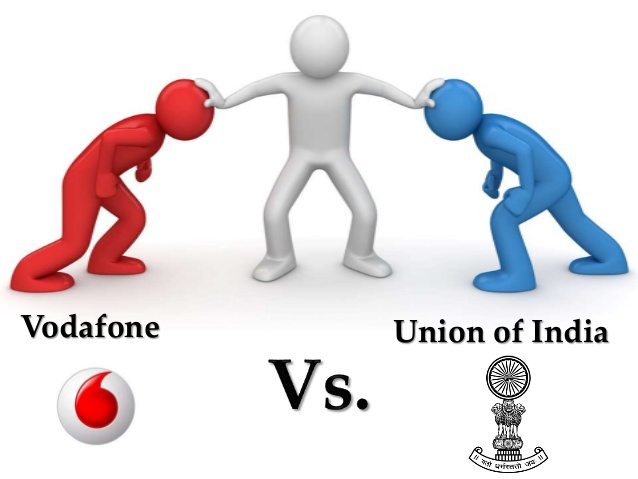
In this blog post, Gayatrisagar Chopra,  a student pursuing her BLS, LLB (5h year) from Pravin Gandhi College of Law, Mumbai and a Diploma in Entrepreneurship Administration and Business Laws from NUJS, Kolkata, critically analyses the investment structure used by Vodafone to minimize the burden of paying capital gains tax in the recent Vodafone v. Union of India case.

IMG_0202


The Case

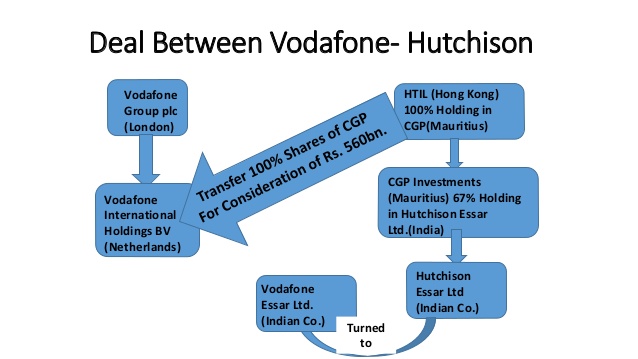
In the light of the case of Vodafone v. Union of India[1], the petitioner Vodafone (based in Netherlands) acquired Cayman Islands-based Company CGP Holdings Limited from Hutchinson Telecommunications International Limited. The deal was concluded at 11.1 billion dollars, as CGP Holdings controlled 52 % of Hutichison-Essar Limited (based in India) and had the option to buy 15 % more hence as a consequence of this acquisition Vodafone had effective control of 67% over Hutchison-Essar. The Indian Income Tax Authorities claimed that Vodafone was to pay capital gains tax on capital gains accrued due to the consequent control of Hutichison-Essar Limited. The amount of tax payable was estimated at 2.5 billion dollars.

the-vodafone-vs-union-of-indiaincome-tax-dept-8-638

Bombay High Court

The Tax Authorities filed a case against Vodafone in the Bombay High Court. The court held that a prima facie case was made out by the Tax Authorities of transfer of Capital Assets, and therefore accrual of Capital Gains and hence was liable to pay the Capital Gains tax. Hutchison- Essar being a company situated in India was seen by the Income Tax Authorities as the Target Company, and they contended that the purpose of the acquisition of CGP was to acquire effective control in Hutchison- Essar. Vodafone contended that the Tax Authorities had no territorial jurisdiction over the transaction as the acquiring company as well as the company acquired were not based in India.


tax-havens-recent-retrospective-amendments-in-income-tax-act-discussion-on-vodafone-vs-union-of-india-8-638

Supreme Court

Vodafone in its turn filed a Special Leave Petition before the Supreme Court. The Apex Court held that the Bombay High Court had erred in its decision and should have employed a “look at” approach instead of a “look through” approach. They emphasized on the theory of Corporate personality wherein the identity of the shareholder is distinct from that of the company. The Court said that the authorities must look at the transaction at its face value rather than the hidden intent behind it. The acquisition of CGP Holdings was not solely to gain control over Hutchison-Essar, but the gain in control was a corollary of the acquisition, which was not the purpose of the acquisition.


Capital Gains

Capital Gains Tax[2] under the Income Tax Act is tax payable on the “transfer of a capital asset situated in India.”[3] Capital Assets according to the Income Tax Act, 1961 is “property of any kind held by an assessee, whether or not connected with his business or profession.”[4]

According to Section 9 (1)(i) of the Act, which forms the heart of the controversy, income accruing indirectly or directly out of transfer of Capital Assets situated in India is deemed to accrue in India out of the hand of a Non-Resident. The Supreme Court expressed its view in this regard stating that the transfer of shares of CGP did not result in a transfer of Capital Assets.

vodafone-tax-case-hc-allows-penalty-proceedings-to-go-on

Structuring

According to the views expressed by the Supreme Court, there were two possible structures available for such a transaction to include a tax-free entity, to either include CGP or route the deal through Mauritius. Therefore, by structuring the deal through CGP, they have transitioned the business in a smooth manner. Thus, the sole purpose of the CGP acquisition was not to control Hutchison-Essar. This smart structuring through layers of Investment subsidiaries in tax-free jurisdictions saved Vodafone the payment of an exorbitant tax. Also, fanning the control through multiple companies and not a nodal structure helped Vodafone.


Conclusion

Thus, smart investment structures such as the one created by Vodafone help in avoiding large tax amounts in jurisdictions such as India where the taxation rates are high and taxation laws are extremely stringent despite measures like Double Taxation Avoidance and Advance Pricing.


[divider]

Footnotes:

[1][S.L.P. (C) No. 26529 of 2010, dated 20 January 2012]

[2] Section 45 Income Tax Act, 1961

[3] Section 9 Income Tax Act, 1961

[4] Section 2 (14) Income Tax Act, 1961


Download Now

Employer’s Liabilities under Labor Laws in India

0

In this blog post, Sreeraj K. V, a student of Government Law College, Ernakulam, Kerala writes about employer’s liabilities under Labor Law. This post includes provisions under the Industrial Disputes Act, Workmen Compensation Act as well as Employers Liability Act, which deals with the provisions relating to employer’s liability towards his workmen.

IMG-20151029-WA0013_2

Introduction

An employer, in simple terms, is a person or legal entity that controls or directs a servant or worker under an expressive or implied contract of employment and pays him/her salary or wages as compensation.[1] Employers include everything from individuals hiring a babysitter to Governments and business which may hire thousands of employees. In most of the western countries, Governments are the single largest employers, but most of the workforce is employed in small and medium businesses in the private sectors.[2]the-industrial-disputes-act-1947-1-728

Speaking legally, Section 2(g) of the Industrial Disputes Act deals with the term employer as:

  1. About an industry carried on by or under the authority of any department of the Central or State Government, the authority prescribed in this behalf, where no authority is prescribed, the Head of the Department;
  2. About an industry carried on by or on behalf of a local authority, the chief executive officer of that authority.[3]

Under the Workmen’s Compensation Act, 1923, section 3 of the Act provides for the liability of an employer to pay compensation to  the employee which includes:

  • If personal injury is caused to a workman by accident, arising out of and in the course of his employment, the employer shall be liable to pay compensation under the provisions of Chapter II of the Act:

Provided that the employer shall not be so liable – download

  1. In respect of any injury which does not result in the total or partial disablement of the workman.
  2. In respect of an accident which is directly attributable to –
  3. The workman was under the influence of drinks or drugs, or
  4. The wilful disobedience of the workman to the orders for the purpose of securing his safety, or
  • The willful removal or disregard by the workman of any safety guard or devices for the purpose of securing the safety of workmen.

Amount of Compensation

Subject to the provisions of the Act, the amount of compensation payable by the employer in case of an accident to the employee will be as follows:brick621

  • Where death results from the injury which, an amount equal to fifty percent of the monthly wages of the deceased workman, multiplied by the relevant factor; or an amount of fifty thousand whichever is more.
  • Where permanent or total disablement results from the injury, an amount equal to sixty percent of the monthly wages of the injured workman multiplied by the relevant factor; or an amount of sixty thousand or more.[4]


Employers Liability Act, 1938

One of the main objectives of the Act was to declare certain defenses which shall not be raised in suits for damages in respect of the injuries caused by the workmen. The Act makes certain provisions for the safeguard and good condition of work as well. Section 2(b) of the Act defines the term employer as well as certain other provisions of the Act, which provides for certain liabilities of the employer in case of the injury or damages caused to the workmen. The main aim of the Act was ruling out certain defenses to the employer arising out of the injuries and damages sustained by the workmen. The law also stands for the protection of workmen in safeguarding their interests which bring suits for damages occurred to them during their operation. Liability placard with night lights on background

Section 3 of the Act provides for defense of common employment barred in certain cases where employee causes personal injuries and its states that:

  1. By reason of the omission of the employer to maintain good and safe conditions of work, machinery or plant connected to his trade or business, or the omission on the part of any person in the service of the employer with the duty if seeing that such works, plant, and machinery are in good and safe condition, or
  2. Because of negligence of any person in the service of his employer who has any superintendence entrusted in him, while in the exercise of such superintendence; or
  3. Because of the negligence of any person in the service of his employer to whose orders or directions the workman at the time of injury was bound to conform and did conform, where the injury resulted on his having so confirmed.

There are certain other provisions of the Act which states that any suit for damages raised by any workman who had suffered from any personal injury due to non-maintenance of healthy conditions of work, good and sound machinery, equipment etc., or by reason of the negligence on the part of the persons employed by the employer, such suit shall not be failed by reason of employment of such workman with the employer.[5]

This Act has been repealed by ACT NO.23 of 2016.

Employer NOT Liable to Pay Compensation

Employers are not liable to pay any compensation under certain circumstances:

c460f3fd-3b3f-4a3b-9491-f1287077875d

  • The injury will not result in a permanent incapacity or incapacitates the workman from doing his normal works.
  • The injury is self-inflicted.
  • The death or disablement results from the injury were falsely claimed by the employee to be free of to the employer.
  • The injury was caused due to the consumption of alcohol or drugs by the employee during the time of his work.[6]

There are notable cases which dealt with the matter of liability of the employer in providing compensation to his/her employee. One among them is Dhropadabai and Ors v. M/s Technocraft Toolings, in which the Court stated that the claimant is entitled to compensation as the employee took his last breath during the time of his employment as well as at the place of his work. Even though the cause of death has no connection with his employment, the respondent is liable to pay compensation to the claimant as the death occurred during the employment of the deceased.[7]

Conclusion

It is common that whenever there arises an employer – employee relationship, there arises certain disputes among them as well. In such situations, the above-stated enactments provide certain guidelines to both of them so that they can arrive at a conclusion as well as in a settlement too. While looking into the liability of the employer for providing compensation to the employee, it will be clear that in one way or the other, the employee has undergone certain injuries or damages. There are many companies which look after their employees properly with adequate facilities as well as compensations and rewards whenever necessary. But there are certainly other areas wherein employees are treated in a much disappointing way. All such statutes stand for the good running of a business organization as well as for building up healthy relation among the employer and employee as well. Hence, both of them must be aware of their rights and responsibilities and not to violate the said statutes for their personal gains.

[divider]

Footnotes:

[1] Retrieved on: http://www.businessdictionary.com/definition/employer.html

[2] Retrieved on: https://simple.wikipedia.org/wiki/Employer

[3] Retrieved on: http://www.lawyersclubindia.com/experts/-employer-means-in-terms-of-section-2-g-ii-of-I-D-Act-39701.asp

[4] Retrieved on: http://admis.hp.nic.in/himpol/Citizen/LawLib/C280.htm#s3

[5] Retrieved on: http://blog.ipleaders.in/employers-liability-act-1938/

[6] Retrieved on: http://www.clic.org.hk/en/topics/employmentDisputes/mattersRelatedToEmployees_compensationOrdinance/work_relatedInjuriesAndTheRelevantCompensations/q2.shtml

[7] Dhropadabai and Ors v. M/s Techno craft Toolings CIVIL APPEAL NO. 8155 of 2014

Retrieved on: http://supremecourtofindia.nic.in/FileServer/2015-03-25_1427268447.pdf

Download Now

Analysis and Interpretation of the Arbitration and Conciliation (Amendment) Act, 2015

0

In this blog post, Sreeraj K. V, a student of Government Law College, Ernakulam, Kerala analyses and interprets the amendments to the Arbitration and Conciliation (Amendment) Act, 2015. This post throws light on the major areas of the new amendment to the Arbitration and Conciliation Act, its objectives, major cases which look into the said matter and provides a critical analysis of the newly amended Act of 2015.

IMG-20151029-WA0013_2

Introduction

Arbitration has been a preferred way of settlement of disputes globally as well as in India. Provisions relating to the resolution of disputes in the way of arbitration is contained in the Arbitration and Conciliation Act, 1996. It was time that urgent steps be taken to ensure quick enforcement of contracts, easy recovery of money claims, reduce the pendency of cases in courts and fasten the process of dispute resolution in the way of arbitration.[1]24_660L

The Arbitration and Conciliation (Amendment) Act, 2015, was passed by both the houses and received the assent of the President on the 31st of December 2015. The Act was notified in the Gazette of India and came into force on January 1st, 2016. The Lok Sabha, while clarifying the Bill clearly stated that it would not affect the pending cases unless the parties agreed otherwise. The new amendment towards the Act brings about certain clarifications in the form of Section 26 which was introduced to settle the issue that unless the parties agree otherwise, the new Amendment Act will not apply to the arbitrations that were initiated before the commencement of the Act. Section 12 of the Amendment Act states that it shall be deemed to be applicable from 23rd October 2015.

Apart from this, the Ordinance in its transformation to an Act does not see any other changes. The Ordinance has now been repealed. However Section 27 of the Act, saves all actions undertaken by the parties under the Ordinance. Hence, orders passed by the courts, arbitrations or any other actions commenced by the parties under the Ordinance will be valid in law, despite its repeal.[2]


Objectives of the New Amendment to the Act

There are mainly two objectives behind the amendment of the Arbitration and Conciliation Act which are as follows:

  • To make arbitration more investor friendly, cost-effective and suitable for expeditious disposal of cases.
  • To facilitate in making India a major centre for International Commercial Arbitration.[3]


Key Amendments

The Amendment Act has brought some of the major changes to the principal Act. A brief summary of the amendment are as follows:

  • Amendment to section 2(e): Definition of the term ‘court’ is amended to provide certain provisions of the Part I of the Act such as interim relief (Section 9), court assistance in taking evidence (Section 27) and appeal to interim relief under Section 9 (Section 37) shall also apply to International Commercial Arbitration, even if the place of arbitration is outside India, subject to an agreement to the contrary between the parties to the dispute. In such cases, the High Court will act as the ‘court’ in relief to such disputes.
  • Amendment to Section 7: An arbitration agreement in the way of electronic means will also be considered as an arbitration agreement in writing. Arbitration-l
  • Amendment to Section 8: If the judiciary finds that prima facie no valid arbitration agreement exists; the judicial authority may refer the parties to the arbitration on the action brought by the party to arbitration agreement on the person claiming through or under him. If the party is not having original or certified copy of arbitration agreement or is retained by the other party, the party can make an application to the court to call upon the other party to produce the said documents before the court.
  • Amendment to Section 9: The arbitral proceedings shall commence within a period of ninety days from the date of order. Once the arbitration tribunal is constituted, the court shall not entertain an application for interim measures unless it finds circumstances that may render remedy provided under Section 17 ineffective.
  • Amendment to Section 11: Appointment of an Arbitrator shall be made by the Supreme Court of India or the High Court instead of a Chief Justice of India or Chief Justice of High Court. The High Court is empowered to frame rules for the determination of fees according to the Fourth Schedule of the Act.
  • Amendment to Section 12: Ensuring neutrality of arbitrators, when a person is approached for an appointment as an arbitrator, he must disclose any information to prove his neutrality. A person having any such relationships as mentioned in the Seventh Schedule of the Act is not eligible for appointment as an arbitrator.
  • Amendment to Section 14: Termination of an arbitrator as well as the substitution of another arbitrator.
  • Amendment to Section 17: The Arbitral Tribunal has all the powers to grant interim measures which the court is empowered to have under Section 9 of the Act. Any order issued by the Tribunal will be deemed to be an order of the court for all purposes and shall be enforceable under the Code of Civil Procedures, 1908.
  • Amendment to Section 23: The respondent, in support of his case, may submit a counterclaim or a set-off, within the scope of the arbitration agreement.
  • Amendment to Section 24: The Tribunal shall hold an oral hearing for the presentation of evidence on day to day basis and shall not grant any adjournments without sufficient cause.
  • Amendment to Section 25: The right of the respondent to file the statement of defense have been forfeited, if he fails to communicate such a statement within the timeline agreed by the parties or the Tribunal without reasonable cause.
  • Amendment to Section 28: The Arbitral Tribunal while deciding and making an award, shall take into account the terms of the contract and trade usages applicable to the transaction.
  • Insertion of new provision – section 29A – The Tribunal shall ensure speedy completion of arbitration proceedings within a period of twelve months from the date of reference. However, the parties may extend the time not exceeding six months. If the award is made within six months, the Tribunal is entitled to receive additional fees as parties agree. The mandate of the arbitrator may be terminated if the award is not being made within the term of six months unless the court extends the time.
  • Section 29B: The new provision provides for fast-track procedures for conducting arbitral proceedings if the parties agree to such proceedings. In such cases, the award must be made within six months from the date of reference.
  • Amendment to Section 31: A sum directed to be paid by an arbitral award shall, unless the award otherwise directs, carry interest at the rate of two percent higher than the current rate, and shall be payable from the date of award to the date of payment.
  • Insertion of new subsection 2(A) in section 34: It provides an additional ground of patent illegality to challenge an arbitral award other than International
    Commercial Arbitrations.
  • Insertion of new subsection (5) in Section 34: An application for setting aside of an award is to be filed after issuing a prior notice to the other party.
  • Insertion of new subsection (6)in Section 34: A period of one year has been prescribed for disposal of an application for setting aside an arbitral award.
  • Amendment to Section 36: Mere filing of an application for setting aside an arbitral would not render that award unenforceable unless the court orders to stay on the operation of the said award on a separate application made for that purpose.[4]

While looking into various judgments held by the Supreme Court of India, it will be clear that the judgments were much effective in implementing the said provisions of the Act. One such case was the Bharat Aluminium and Co. v. Kaiser Aluminium and Co. (BALCO)[5], wherein the Court held that Part I of the Act was mandatorily applicable to all arbitrations held in India. Also, Part I applied to arbitration conducted outside India unless it was expressly or impliedly excluded.

This provision was applied in many cases till BALCO case’s judgment. In this case, the Court decided that Part I and Part II of the Act are exclusive of each other, and the Parliament intended that the Act must be territorial in nature, and section 9 and 34 will be applicable only when the seat of arbitration is in India. Even though this judgment was favorable for reducing judicial interference but it also led to some unwanted results. A foreign party would obtain an award in its favor only to realize that the other party or company has stripped its assets and converted themselves into a shell company. Parties to arbitration proceedings outside India will be able to approach Indian courts for interim measures even before the commencement of arbitration proceedings. 19-med

The Supreme Court further expanded the scope of public policy in the case of Renusagar Power Co. v. General Electric Company[6] by stating that Public policy means statutory provisions of Indian Law or even the terms of the contract. This was further expanded on ONGC v. Western Geo International Ltd[7] wherein the Court assumed the power to modify the subject matter of an award for violation of the ground of fundamental policy of the Indian Statute under Section 34(2)(b)(ii) of the Arbitration and Conciliation Act, 1996.  The Court held that if the arbitrators failed to make an interference which should have been made, or has made a prima facie inference, “then the adjudication made by an Arbitral Tribunal that enjoys a considerable latitude and play at the joints in making awards will be open to challenge and may be cast away or be modified…” (para 30).[8]

There is a very recent judgment on the neutrality of arbitrators by the Delhi High Court in the case of Assignia-Vil JV v. Rail Vikas Nigam Limited[9] wherein  the Court held that Section 12(5) of the Act “mandates” that if the arbitrator and the parties enjoy any of the relationship mentioned under the Seventh Schedule of the Act, they cannot be appointed as an arbitrator. In fact, the provisions of the newly amended Act will be applicable only to the cases that are commenced on or after October 2015. The provision includes—

Unless otherwise agreed by the parties, the arbitral proceedings, in respect of a particular dispute commence on the date on which the respondent receives a request for that dispute to be referred to arbitration.”

The court also stated that arbitration proceedings must be carried on by a person who is independent and impartial in nature and does not have any relationship between any of the parties which are mentioned under the Seventh Schedule of the Act.


Critical Analysis

Despite major efforts to consolidate the law and make effective changes to the previous legislation for achieving effective alternative disputes resolution, the 1996 Act paved the way for unprecedented litigation on the arbitration process. The process suffered substantial delay. In this background, the 2015 amendment aims to achieve two primary objectives. First, to expedite the arbitration process and second, to lay down certain guidelines and provisions for the judiciary to abide by, while disposing of applications before it.

Alternative dispute resolution, mainly focusing on arbitration, conciliation as well as mediation, has been an effective alternative to the traditional judicial system. In India, the prevailing system is that avoiding fast track judicial proceedings, the effective alternative way in the field of International Commercial Arbitration (ICA), etc. has been seen familiar. In this context, the changes affected by the new amendment may be considered as an opportunity lost to the lawyers as they find it useful in dealing with cases concerning commercial arbitration as well as defeating ICA in such cases. Today, we are experiencing unprecedented transactions across the borders, jurisdictions, and countries, with the advancement of Information Technology, therefore, International Commercial Arbitration needs greater importance. The amendment ought to have considered setting up quarantined international arbitration centers so that India can be an example in the line of certain other countries dealing with the same.arbitration[1]

The Arbitration Act of 1940 had a provision under Section 28 where the courts only could enlarge the time for making awards unless the arbitration agreement is provided with the consent of both the parties. At times, the parties request for a time extension, and it’s  mostly during the last hours of the time of expiry of such an award. This results in uncertainties, delays, and additional costs. The amendment of Section 29A mandates that court alone can extend the time. The courts have also been empowered to make certain additional directions while extending the time including the substitution of an arbitrator without annulling previous proceedings. This is an area where there is an increase in the court’s intervention in arbitral proceedings.[10]

The amendment brought to the 1996 Act is a positive step towards making the process of arbitration cost-effective, expeditious and a ‘party-friendly’ process. The new amendment leads to sort out certain practices leading to wastage of time, money and energy of both parties as well as to the arbitrators. The new amendment also brings a sense of independence and impartiality to the arbitrators when compared to the previous practices in the field of arbitration. It also ensures that the process of arbitration does not go beyond a reasonable limit of time and checks whether it is within the capacity of the arbitrator to make a possible solution. Such steps will provide self-discipline as well as a control on the case amongst the arbitrators. It must also be stated that the current amendment has travelled a lot more distance by reducing the excessive interference of the court in arbitral proceedings that has been a consistent effort by the legislature since the passing of the 1996 Act.[11]


[divider]

Footnotes:

[1] Retrieved on: http://www.legallyindia.com/blogs/the-arbitration-and-conciliation-amendment-act-2015

[2] Retrieved on: http://www.mondaq.com/india/x/455538/Arbitration+Dispute+Resolution/Arbitration+Conciliation+Amendment+Act+2015+passed+by+Parliament

[3] Retrieved on: http://byjus.com/free-ias-prep/arbitration-and-conciliation-bill

[4] Retrieved on: http://www.legallyindia.com/blogs/the-arbitration-and-conciliation-amendment-act-2015

[5]Bharat Aluminium and co. v. Kaiser Aluminium and co. (BALCO) (2012) 9 SCC 552

Retrieved on: http://blog.ipleaders.in/interim-reliefs-arbitration-conciliation-amendment-ordinance-2015/

[6]Renusagar Power Co. v. General Electric company 1994 Supp (1) SCC 644,

retrieved on:    http://blog.ipleaders.in/arbitration-and-conciliation-ordinance-2015/#_ftn7

[7]ONGC v. Western Geo International Ltd (2014) 9 SCC 263, retrieved on http://blog.ipleaders.in/arbitration-and-conciliation-ordinance-2015/#_ftn8

[8] Retrieved on: http://kluwerarbitrationblog.com/2015/01/07/ongc-v-western-geco-a-new-impediment-in-indian-arbitration/

[9]Assignia-Vil JV v. Rail Vikas Nigam Limited Arb.P.No.677/2015, retrieved onhttps://indiankanoon.org/doc/115973945/

[10] Retrieved on: https://tuljapurkars.wordpress.com/2015/10/28/arbitration-and-conciliation-amendment-ordinance-2015-a-critical-analysis/

[11] Retrieved on: http://www.mondaq.com/india/x/448666/Arbitration+Dispute+Resolution/Highlights+Of+Amendment+To+The+Arbitration+And+Conciliation+Act+1996+Via+Arbitration+Ordinance+2015

Download Now

Effect of Vicarious Liability under Indian laws of Contract

0

In this blog post, Sreeraj K.V, a student of Government Law College, Ernakulam, Kerala writes about the effect of vicarious liability under Indian laws of contract. This post covers areas like the definition, elements of vicarious liability, major cases dealing the matter as well as certain exceptions to this term.


IMG-20151029-WA0013_2

Introduction

Vicarious liability can be defined as such liabilities wherein a person will be held liable for an act done by someone else. In the field of tort, it is considered to be an exception to the general rule that a person will be liable for his own acts only. So that the liability of a person for the act of someone else may arise, it is necessary that there should be certain kind of relationship among both the persons and the wrongful act. This must be connected with their relationship.[1] 4201

Common examples of such liabilities are:

  • Liability of the Principal for the tort of his agent
  • Liability of partners for each other’s tort
  • Liability of master for the tort of his servant

In a case of vicarious liability, both the person at whose behest the act is done as well as the person who does the act is liable. Thus, employers are vicariously liable for the torts of their employees that are committed during their employment.[2]


Reasons for Vicarious Liability

There are several reasons for a person to commit an act which results in vicarious liability:

  1. The wealth of a defendant or his access to financial resources and in some cases had an unconscious influence on the development of legal principles.
  2. Vicarious liability encourages prevention of an accident by giving an employer a financial interest in encouraging his employees to take care of the safety of others.
  3. As employers gain from any profit from his employees, he also bears any losses caused by them.[3]

Under the Indian Contract Act, there is no special provision regarding the term ‘vicarious liability’. But the Act defines certain terms such as ‘principal’, ‘agent’ as well as various provisions relating to the principal and agent as well as their duties and liabilities. Section 182 to 238 of the Act states such provisions. It also provides provision regarding nature of principal – agent relationship as well as extends the liabilities of both principal and agent.[4] The Act, under section 183, states that no person can be an agent unless he attains the age of majority and has a sound mind. In the words of Lord Chelmsford, “it has been established by law that a master is liable to third persons for any injury or damage done through the negligence or unskillfulness of a servant acting in his master’s employ. The reason is that every act done by the servant in the course of his duty is regarded as done by his master’s order, and, consequently it is the same as if it were master’s act”[5]80510147-crop-600x338

For example, A has a car Driver B. If he negligently knocks down X, then A will be liable. But if he hires a taxi towards railway station and the taxi driver negligently hits X, then A will not be liable towards X because the taxi driver is not the servant of A but an independent contractor.  In every case involving vicarious liability, the doctrine of ‘Respondeat Superior’ (let the master answer) will be applicable. In every instance which leads to the situation of vicarious liability, the employer-employee or the principal-agent relationship will be the key factor. In such instances, the principle will be liable for the act done by his agent. There are three elements generally:

  1. Was the act committed within the time and space limit of the agency?
  2. Was the offense confidential, or of the same general nature as, the responsibilities the agent is authorized to perform?
  3. Was the agent motivated to any degree to benefit the principal by committing the act?[6]

In the Contract Act, it is up to the principal to prove whether the act committed by his agent does not come under the frame of their principal agent relationship and if he fails to prove so, he will be held liable for the act done by his agent under the head of vicarious liability. In India, there are various cases involving offenses done by the agent and the principal being liable for the same.Gavel1

In the case of State of Rajasthan v. Smt Shekhu and ors[7], the deceased and his brother were going on a bicycle and a jeep which was owned by Distt. Collector came from the opposite side and hit them which resulted in the death of the deceased. In this case, the Court clearly stated that definition of ‘vicarious liability’ means that one person takes or supplies the place of another so far as the liability is concerned. It means the liability of a person for the tort of another in which he had no part. The court also stated that an owner of a car would be liable for an accident caused by his servant during the time of his employment. From this statement, it was made clear that in this case, the respondent was held liable. In many other cases such as K.K.Ahuja v. V.K.Vora and ors[8], the Supreme Court held that vicarious liability would apply to companies also as the case dealt with the liability of a deputy manager of a bank in the issue of a dishonored cheque.


Exceptions to the Liability

There are certain exceptions granted to the principal from the acts done by his servant which comes under vicarious liability which include:liability

  • Act was done by the agent other than the one stated by the principal.
  • Act was done by the agent which does not come under the agency norms between them.
  • An act was done by the person before or after termination of the contract of agency.

Even though there are various other exceptions, these are the general exceptions levied under the provisions regarding vicarious liability in India.


Conclusion

The rule of vicarious liability can be clearly traced out from the famous doctrine of “qui facit per se per alium facit per se” which means he who does an act through another does the act himself. So a master will be held liable for the acts done by his employee even though he is unaware of the act. But someone who employs a contractor to work on behalf of that person is not responsible for any tort committed by the contractor in the course of execution of work except in certain exceptional cases. Formation of a principal-agent relationship is purely based on the trust which the principal has with his agent. Hence, the act leading to vicarious liability surely amounts to the infringement of that trust on the part of the agent. So agents are advised not to perform any such activities which result in an act which makes his principal liable. The principal, on the other hand, also needs to be very curious about the acts of his agent so that if he finds that the agent is not fit to continue his works, the principal can take several measures as to the termination of the agent from working under the principal. In companies, such immediate termination is not possible as there are certainly other issues regarding the appointment and termination of employees. In such instances, companies can adopt strict guidelines as to the code of conduct of the employees as well as their works so that they will be restricted from performing any acts which make the higher official liable.


[divider]

Footnotes:

[1] Retrieved on: http://www.legalservicesindia.com/article/article/vicarious-liability-in-india-1634-1.html

[2] Retrieved on: http://www.legalservicesindia.com/article/article/vicarious-liability-in-india-1634-1.html

[3] Retrieved on: http://www.legalservicesindia.com/article/article/vicarious-liability-in-india-1634-1.html

[4] Retrieved on:  http://comtax.up.nic.in/Miscellaneous%20Act/the-indian-contract-act-1872.pdf

[5] Retrieved on http://www.legalservicesindia.com/article/article/vicarious-liability-in-india-1634-1.html

[6] Retrieved on: https://en.wikipedia.org/wiki/Respondeat_superior

[7] the State of Rajasthan v. Smt Shekhu and ors I (2005) ACC 156

Retrieved on: https://indiankanoon.org/doc/58441/

[8]K.K.Ahuja v. V.K.Vora and ors  Criminal appeal no. 1130-31 of 2003

Retrieved on: http://www.lawyersclubindia.com/forum/SC-judgment-on-Vicarious-Liability-in-138-cases-10753.asp#.Vyhh7fl97IU

Download Now

Transfer of Shares in A Society – A Case Study of Maharashtra Ownership of Flats Act, 1963

4

In this blog post, Isha Singh,  a student pursuing her LL.B (5h year) Hons. fromRajiv Gandhi National University of Law, Patiala, Punjab and a Diploma in Entrepreneurship Administration and Business Laws from NUJS, Kolkata, provides and an overview of the Maharashtra Ownership of Flats Act, 1963.

IMG_9522


Introduction

The Maharashtra Ownership Flats (Regulation of the Promotion, Construction, Sale, Management and Transfer) Act, 1963 (Hereinafter referred to as “the MOFA”) was an attempt to mitigate all the unscrupulous practices pertaining to promotion, construction, sale, management and transfer of flats sold on an ownership basis within the State of Maharashtra.Law for You (Custom)

The Act defines a “flat” as:

“A separate and self-contained premises, which is used or is intended to be used as a Residence, Office, Showroom, Shop, Godown, carrying on of any industry or business including a Garage and the premises forms part of a building.

Explanation: Notwithstanding that provisions are made for sanitary, washing, bathing or other conveniences as common to two ‘or more sets of premises, the premises shall be deemed to be separate and self-contained.”[1]

Moreover, a “promoter” is one who is defined as follows:

“…a person who constructs or causes to be constructed a block or building of flats [or apartments] for the purpose of selling some or all of them to other persons, or to a company, co-operative society, or other association of persons, and includes his assignees; and where the person who builds and the person who sells are different persons, the term includes both.”[2]

The Sections 10 and 11 under MOFA jointly regulate the conveyance of title. Section10 mandates that as and when the minimum requisite individuals for a co-operative society or company have purchased flats, the promoter is required to submit an application, within the prescribed period, for the registration of the conglomerate of persons who take the flat either as a cooperative society or as a company.

This is followed by Section 11, wherein, the promoter shall take all the necessary steps to complete his title and convey, to the conglomerate of persons, registered either as a company or a co-operative housing society, who purchase flats, his right, title, and interest in the building and execute all the relevant documents thereof in accordance with the agreement. This period for the execution of the conveyance could either be agreed upon or if not, then the execution must be done in the prescribed period and documents of title, in the promoter’s possession or power is delivered.

Therefore, once the title is conveyed to the conglomerate of persons registered as a society, here is when the question of transfer of shares crops up, which is discussed in detail in the following paragraphs.

https://lawsikho.com/course/diploma-entrepreneurship-administration-business-laws
Click Above

Law Relating to Transfer of Shares of a Society in Maharashtra

Section 29 of the Maharashtra Co-operative Societies Act, 1960 and Rule 24 of the Maharashtra  Co-operative Societies Rules, 1961 and Bye-laws 37 and 38 are the major provisions concerned with the transfer of flats.

Procedure for Transfer: Compliance with Essential Requirements

Under Section 29 (2) (a) of the Maharashtra Co-operative Societies Act, 1960, a member has to hold the shares for at least a period of one year before he transfers his shares together with his interest in the flat. According to the Rule 24 of Maharashtra Co-operative Societies Rules, 1961 every transfer of shares, as a mandate, has to be as per the bye-laws adopted by the Society, order to be effective. Further important requirements for transfer are as under:chb-main

  • Clear fifteen days’ notice in writing is required to be given to the Society indicating therein the name of the proposed transferee, his consent and the value proposed to be paid by the transferee.[3] On receipt of this notice, the secretary of the society will place it before the meeting of the committee held next, pointing out whether the member is prima facie eligible to transfer his shares and interest in the capital or property of the society or not. If the committee is satisfied that the member is prima facie eligible to transfer his shares and interest in the capital or property of the society or ineligible therefor, it will direct the secretary to inform the member within three days.[4]
  • All dues and liabilities of the transferor due to the Society including any charge in favor of the Society on the share so transferred, are to be discharged[5];
  • Application in the prescribed form, for transfer of shares and interest in the capital/property of the society, along with the share certificate are to be submitted[6];
  • Resignation by the original member has to be tendered[7]
  • The application has to be submitted by the proposed transferee for membership of the Society[8]
  • Payment of Transfer fee as may be prescribed under the bye-laws of the Society, i.e., Rs.500[9]
  • Transfer premium at the rate fixed by the general body, but within the limit prescribed by circulars issued by the Government from time to time. As per the circular dated 20/12/1989 the transfer premium should not exceed 25,000/-[10]
  • A copy of duly registered agreement with appropriate stamp duty must be paid to the Society[11]
  • Declaration by the transferee to use the flat for residence purpose only, or state the reasons otherwise when use is apart from residential purpose[12]
  • An Undertaking by the transferor to discharge all liabilities to the Society[13]
  • If the transferor has availed of any loan for purchasing the flat from any bank, housing financing agency, no objection from that bank or housing financing agency is required to be submitted to the Society.[14]

Disposal of Transfer Applications

The Bye-Law no. 38 deals with the disposal of transfer applications. The Secretary should scrutinize the documents received and verify as to the conformity with the Act, Rules, and Bye-laws of the Society and place the same before the Managing Committee of the Society for its approval. If such application is rejected, the Secretary has to communicate the decision to the applicant within 15 days from the date of the decision or within 3 months from the date of receipt of the application, whichever is earlier. If the applicant does not receive intimation from the Society within 3 months from the date of submission of application, it is deemed that the application for membership is accepted.[15]


Restrictions on Transfer of Shares 

Under Section 29 (2) (a) of the Maharashtra Co-operative Societies Act, 1960, no share can be transferred unless the share has been held for one year before the transfer and it is made to no one else but the member of the society, or one whose application for membership has been accepted or one who is deemed to be a member of the society.


Transfer v. Transmission of Shares

Transfer of shares in a CHS together with the interest of the member in the flat allotted to him as a member of the society can be by way of sale or by gift whereas transmission takes place on demise of the member either according to the will of the deceased member or according to personal law of succession applicable to the deceased member, in absence of his valid will.

header_transfer_landIn case of transfer by sale, proper sale deed is required to be executed by and between the seller and the buyer, proper stamp duty as per the market value of such flat as specified in the Stamp Duty Ready Reckoner is required to be paid and the sale deed also needs to be registered as required under The Registration Act,1908. Further, as per the bye-law of the Society, transfer premium up to a maximum of ` 25,000/- is payable to the Society. Whereas in the case of transmission no such documentation is required and as such, no stamp duty is payable as well no transfer premium is payable to the Society.[16]


Conclusion

Every Society must have their bye-laws laid down so that compliance becomes easier in cases of transfers between members.


LawSikho has created a telegram group for exchanging legal knowledge, referrals and various opportunities. You can click on this link and join:  

https://t.me/joinchat/J_0YrBa4IBSHdpuTfQO_sA

Follow us on Instagram and subscribe to our YouTube channel for more amazing legal content 

 
[divider]

Footnotes:

[1] Section 2 (a), MOFA.

[2] Section 2 (d), MOFA.

[3] Rule 24(1)(b) of Maharashtra Co-operative Societies Rules, 1961.

[4] Bye-Law No. 37 (a) & (b) of Model Bye-Laws of Cooperative Housing Societies, 2014.

[5] Rules 24(1)(c) & 24(2) of Maharashtra Co-operative Societies Rules, 1961.

[6] Bye-Law No. 37 (e)(i) of Model Bye-Laws of Cooperative Housing Societies, 2014.

[7] Bye-Law No. 37 (e)(iv) of Model Bye-Laws of Cooperative Housing Societies, 2014.

[8] Bye-Law No. 37 (e)(ii) of Model Bye-Laws of Cooperative Housing Societies, 2014.

[9] Bye-Law No. 37 (e)(vii) of Model Bye-Laws of Cooperative Housing Societies, 2014.

[10] Bye-Law No. 37 (e)(ix) of Model Bye-Laws of Cooperative Housing Societies, 2014.

[11] Bye-Law No. 37 (e)(iv) of Model Bye-Laws of Cooperative Housing Societies, 2014.

[12] Bye-Law No. 37 (e)(v) of Model Bye-Laws of Cooperative Housing Societies, 2014.

[13] Bye-Law No. 37 (e)(vi) of Model Bye-Laws of Cooperative Housing Societies, 2014.

[14] Bye-Law No. 37 (e)(x) of Model Bye-Laws of Cooperative Housing Societies, 2014.

[15] Retrieved from < http://ctconline.org/pdf/chamber-journal/CJ_April_2013/CJ_April_2013_09.pdf> on 31.05.2016 at 23:19 hours IST.

[16] Retrieved from < http://ctconline.org/pdf/chamber-journal/CJ_April_2013/CJ_April_2013_09.pdf> on 31.05.2016 at 23:19 hours IST.

Download Now

Impact of Internal Emergency on India

0

In this blog post, Sreeraj K.V, a student of Government Law College, Ernakulam, Kerala writes about internal emergency and its impact on India. This article covers areas like various types of emergency contained in the Constitution of India, reason for the proclamation of emergency in India as well as its impact on our country.

IMG-20151029-WA0013_2

Emergency in India or at the global scale is not a new concept. In India, the proclamation of emergency during the time of the Indira Gandhi Government was a shock to other countries also. But no one could resist such situations as there are clear provisions regarding implementing an emergency when there arises such a situation in the country.


Types of Emergency

To protect the nation and its people from any unusual situations which may be likely to take place, Part XVIII of the Indian Constitution provides certain provisions of implementing an emergency which is framed under Article 352 to 360 of the Constitution which are:Screen Shot 2016-07-25 at 1.42.43 am

  1. National emergency (Art.352) – Emergency due to war, external aggression, and internal disturbances
  2. State emergency (Art.356) – Emergency in the case of failure of Constitutional machinery in the country.
  3. Financial emergency (Art.360) – Emergency in the case of any financial crises.

In India, there were certain internal disturbances due to the issues regarding a case filed by    Mr. Raj Narain, who was defeated by Indira Gandhi in the Parliamentary elections claiming that the defendant had done an election fraud and the PM was even cross-examined in the Court and was found guilty of her acts. Indira Gandhi challenged this decision in the Supreme Court, but the Court upheld the decision of High Court and ordered her to stop all her privileges as an MP and also debarred her from voting but conferred the right to continue as the PM.58225_S_emergency-L

Next day, Jayaprakash Narayan, a popular leader, conducted a rally in Delhi, and it resulted in various signs of inciting rebellion in the country. On the light of certain events, Indira Gandhi, on a complaint to the President, requested to issue a proclamation for state emergency in India. It resulted in the deprivation of all the civil rights of the citizen to bring back national peace and security.


Impact of Emergency in India

  • Deprivation of fundamental rights to the citizenhindu-report-on-emergency
  • All possible bans on media
  • Ruling out of certain other political parties
  • Political revolutions inside the country

Now looking at the matters affecting human rights of the people during the time of emergency, it has to be stated that it was one of the most arbitrary powers exercised by the Constitution as well as by the Government towards its people. Constitution, a most sacred document of fundamental rights subverted into the most ruthless manner possible.[1] Many places in India faced situations where military forces were assembled to stop people from forming groups and talking about matters that were not personal. One of the major functions assigned to the police and the military was to stop people from forming groups as well as arrest persons who looked or behaved suspiciously. No media was allowed to publish the news without censorship. All such instances resulted in the violation of certain fundamental rights as well as a pure case of human rights violation.


Constitutional Provisions

Article 352, 356 and 360 deals with provisions regarding the emergency. As mentioned earlier, there are three types of emergency. The effect of proclamation of emergency is clearly stated in Article 353 of the Constitution which reads as:Indira-Gandhi-with-Congress-leaders

  1. The executive power of the Union shall extend to the giving of directions to any State as to the manner in which the executive power thereof to be exercised.
  2. The power of Parliament includes the power to make laws conferring powers and imposing duties, or conferring powers and duties upon the union and officers, notwithstanding that it is one which is not entitled to the Union list.

Emergency not only gave immense power to Indira Gandhi but also to her son Sanjay Gandhi. He performed certain atrocities of sterilization covered under a reason of ‘family planning’. It must also be stated that the 38th to 42nd amendments of the Constitution was done during the time of emergency. Provisions under 38th amendment dealt with barring the review of the proclamation of emergency, judicial review of overlapping proclamation or promulgation by the Governors and of laws that contravened the Fundamental Rights. 39th amendment dealt with the protection of Prime Minister from Supreme Court actions resulting from election cases. 41st amendment stated that no actions must be taken against the President, Prime Minister or Governors during their term of office and the 42nd amendment gave unrestrained powers to the Government to make changes in the Constitution as well as to invalidate the Kesavanatha Bharathi judgment by the Supreme Court that Government has no power to change the Constitution.[2]

Indian-HeraldThere were a large number of protests and revolts in various parts of the country for winding up the emergency as well as for the formation of a new Government. But it took 21 months from 1975-77 to get a solution to the crises that Indian people faced. K.R.Sundar Rajan, then an assistant editor at the Times of India stated that “Indian democracy lay in serious jeopardy in 1975 when Indira Gandhi’s Emergency destroyed the country’s democratic framework. Fortunately, that long day’s journey into the night ended in March 1977”. Mr. Sundar Rajan was imprisoned during the time of emergency. He also stated that the emergency was reflected as the darkest hour in the fifty years of freedom.[3]


Conclusion

21 months of emergency proved to us that the Government has powers to make certain orders. Emergency affected Indira Gandhi, as well as the Government under her Governance badly but certain political strategies as well as plans and actions, made her the Prime Minister again. The main slogan of the Government was ‘Hatao Garibi’ which means eliminate poverty throughout their period of Governance. Many critics stated that the Iron Lady of India made one of the biggest mistakes in the history of India.


[divider]

Footnotes:

[1] Retrieved on: http://theviewspaper.net/emergency-the-darkest-period-in-indian-democracy/

[2] Retrieved on: http://indianexpress.com/article/explained/40-years-on-those-21-months-of-emergency/

[3] Retrieved on: http://www.rediff.com/freedom/30rajan.htm

Download Now
logo
FREE & ONLINE 3-Day Bootcamp (LIVE only) on

How Can Experienced Professionals Become Independent Directors

calender
28th, 29th Mar, 2026, 2 - 5pm (IST) &
30th Mar, 2026, 7 - 10pm (IST).
Bootcamp starting in
Days
HRS
MIN
SEC
Abhyuday AgarwalCOO & CO-Founder, LawSikho

Register now

Abhyuday AgarwalCOO & CO-Founder, LawSikho