Download Now
Home Blog Page 1715

Pornography and Its Legal Recourse in India

3

In this blog post, Sreeraj K.V, a student of Government Law College, Ernakulam, Kerala writes about pornography and its legal recourse in India. This post covers areas like the definition to the term ‘pornography’, its impact on the society, various remedies for regulation as well as steps taken by the Government in regulating cyber pornography in India.


IMG-20151029-WA0013_2


Introduction

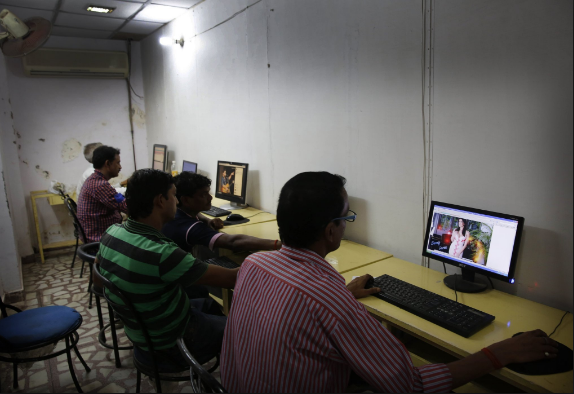
Man is the most rational living being in this world. His attitude changes from time to time. His likes and dislikes change accordingly. Same in the case of his sexual fantasies also. Reports state that around 60% of India’s youth are addicted to various adult videos as well as sites which provide such explicit contents. The Government, with the help of various statutes in this field, is trying to regulate the usage of such X-rated video sites by the people. Only a regulation from the Government will help in reducing this issue as such activities are done only inside four walls by the people. So it is not possible to interfere much in these matters as then a question arises that whether viewing such pornographic contents privately by an individual will affect the society and its people? For that, the answer will be a ‘no’.

The term pornography itself means any portrayal of sexual subject matters for the purpose of sexual satisfaction. It may be present in various Medias such as books, magazines, photography, postcards, sound recording, film, video or video games.[1] In India, we have the Information Technology Act, 2000 and also the Information Technology (Intermediary Guidelines) Rules, 2011 for looking into various aspects regarding the matter.363915-porn1

In the light of various issues regarding the excessive usage and exploitation of such pornographic videos, the Supreme Court observed that appropriate steps must be taken against such websites containing pornography especially child pornography. For this purpose, Section 79 of the IT Act may be adopted. It contains various provisions regarding certain conditions wherein various Internet Service Providers (ISP), and intermediaries are exempted from the culpability of certain uploads done by third parties. It makes an obligation on such intermediaries to exercise “due diligence” and to act according to the orders of the Court and the Government to gain immunity.[2] Section 79(3)(b) states that no exemption will be provided to the intermediaries if they fail “expeditiously” to remove such content within a reasonable period upon the information or notification by the Government or its agencies that such content is being used for unlawful purposes. Under the Information Technology Rules, 2011, it has been stated that the intermediaries must inform users not to host, display, share, upload or transmit any such information that contains pornographic or obscene content which may cause harm mainly to minors.

Nowadays we hear a lot about such incidents where a person intentionally uploads various private photos and images of their known one’s or even of strangers simply for the sake of mental satisfaction as well as for various other unlawful needs. Such acts may be clearly classified as Cyber pornography. Section 67 of the IT Act purely deals with cyber pornography and provides strict penal treatments against such persons who are involved in such acts. The Act of cyber pornography has been banned in many parts of the world but in India, under the Act, it has not been banned but has not been legalized too. Section 67 of the Act states that any publication, transmission of any information which contains pornographic or obscene contents or causing to be published or transmitted, will be punishable with up to 3 years’ imprisonment and a fine of Rs. Five Lakh.

Screen Shot 2016-07-25 at 1.11.06 amFrom the above, it may be stated that:

  • Viewing cyber pornography is not illegal in India, and its mere download does not amount to any offense.
  • Publication of such pornographic content is illegal.
  • Possession of such pornographic content is not illegal.
  • Transmission of such pornographic content through any electronic medium is unlawful.[3]

There were many plans by the existing Government in banning a large number of porn sites in India. But IT experts calls it a failure due to the reason that nobody including the Government can look into the private matters of an individual and if done, it may result in the violation of his fundamental rights. While referring to the Indian Penal Code, Section 292 deals with any act for the purpose of selling, hiring or publishing any books, pamphlets, paper, writing, drawing or painting of any object, shall deemed to be obscene, lascivious or prurient in nature or may likely to harm any other person, is liable for a punishment for a period of two years along with a fine or both. Section 354A of the Code also provides certain liabilities to a person who exhibits pornographic content to any women against her will. Such provisions state that explicit and exploitative usage of such content may result in certain penal liabilities.

https://lawsikho.com/course/diploma-cyber-law-fintech-technology-contracts


Effects of Pornography

Many surveys reveal that a person who is addicted to pornography has a change in attitude towards himself and his family.

  • Pornography which is usually viewed in private often leads to deception in marriage and which may, later on, affect their family life.
  • It may lead to adultery, prostitution and many unreal expectations that can result in dangerous promiscuous behaviour.
  • Pornography may lead to addiction, escalation, desensitization and acting out sexually by one person.[4]

Comp-3_00000-624x351In one sense or the other, pornography or publishing such explicit, obscene contents of a person without his/her consent can be considered as a pure case of human rights violation. The reason behind such a statement is that the consent of a person plays a major role in such acts. Experts also state that unless such acts involve the non-consent of the other person, it does not violate human rights.[5] Another important issue regarding the topic is child pornography. It was revealed that India is one of the best markets for publication of porn sites and such content mainly relating to child sexual abuses. It was stated in many surveys that children around 12 to 15 years are the primary victims of such inhumane activities. Many internet service providers are still being criticized for not closing down such child porn sites in India. [6]


Conclusion

As mentioned before, our Government planned to take action against around 900 sites in India, which contains porn and such related obscene videos and pictures. But it could not be implemented properly till date because there are no such provisions in any law relating to information technology which states that possession and viewing of such videos are illegal. Thus, the Government can make only a regulation on this matter rather than banning or abolishing it completely. We have to be well aware of that fact that viewing such obscene content creates various false expectations in our life as they are not real. Surveys reveal that people between the ages of 16 to 30 are mostly addicted to such porn sites. So primary steps have to be taken from their home itself. There must be a friendly relationship among the family members so that no one will be addicted to such explicit video sites. Also, various awareness programmes may be conducted for young people so that they can utilise their valuable time effectively rather than investing them in such unproductive materials around them.


[divider]

Footnotes:

[1] Retrieved on: https://en.wikipedia.org/wiki/Pornography

[2] Retrieved on: http://indianexpress.com/article/explained/background-and-legal-aspects-of-porn-block-on-internet/

[3] Retrieved on: http://blog.ipleaders.in/cyber-pornography-law-in-india-the-grey-law-decoded/

[4] Retrieved on: http://www.cyberlawsindia.net/index1.html

[5] Retrieved on: https://www.quora.com/Why-is-pornography-not-regarded-as-a-violation-of-human-rights

[6] Retrieved on: http://www.ethicalconsumer.org/commentanalysis/humanrights/pornography.aspx

Download Now

Norms for Registering a Company in India

1
company law

In this blog post,  Sreeraj K.V., a student of Government Law College, Ernakulam, Kerala writes about the norms for registering a company in India. The post includes areas such as the purpose of incorporation of a company, procedures to be followed, the effect of incorporation as well as the principle which has been laid down regarding the functions of a company. 

IMG-20151029-WA0013_2


Introduction

India is a mixed economy where there are both public as well as private limited companies which invest their time and money for the development of our country. The Companies Act, 1956 plays an inevitable role in providing certain rules and guidelines regarding the registration of both public as well as private companies in our country.  In India, the most commonly used corporate form is the limited company, unlimited companies are relatively uncommon. A company is formed by registering the Memorandum of Association as well as articles of association with the Registrar of the Companies of the State in which the main office is to be located. Not only the native companies but also companies abroad who are engaged in business activities in India are permitted to open branches in India strictly for the purpose of carrying out the following functions:

  • To represent the parent company in various activities in India such as buying/selling of agents in India.
  • To conduct various research works by the parent company so that the results will be made available to Indian companies.
  • To undertake export/import trading activities.
  • To promote various technical and financial collaborations with Indian companies.[1]

Incorporation of a Company

All companies working in India are incorporated by complying with certain procedures mentioned under Section 25 of the Companies Act. The first step for the formation of the company is obtaining the approval of the name of the company by the Registrar of the Companies (ROC) of the concerned State where the company is starting its registered office. The approval is provided upon certain conditions such as there must not be an existing company in the same name. The name must also end with the word ‘private limited’ for private companies as well as ‘limited’ for public companies.[2]


Stepwise Procedures for Formation or Incorporation of a New Company

  • Selection of the type of the company download
  • Selection of name of the proposed company
  • Application for the Directors Identification Number and Digital Signature
  • Drafting of Memorandum and Articles of Association
  • Stamping, digitally signing and e-filing various documents with the Registrar.
  • Payment of fees
  • Obtaining certificate of incorporation
  • Preparation and filing of prospectus/statement in lieu of prospectus and e-Form 19/20 for obtaining the certificate of commencement of business.
  • Obtaining a certificate for commencement of business.[3]

Memorandum and Articles of Association

Memorandum of Association, as well as Articles of Association, are the most important documents during the time of incorporation of a company. The Memorandum of Association can be stated as the Constitution of the company. It contains the scope of the company in conducting its business as well as the relationship of the company with the outside world. On the other hand, the Articles of Association contains certain rules and regulations which guide the internal affairs of the company as well as its objectives and purpose of incorporation. The ROC will provide the certificate of incorporation after the required documents are presented along with the prescribed registration fee, which is scaled according to the shares of the company prescribed in its Memorandum.Company Registration Services

The public company has an option of inviting the public for subscription to its share capital. The company has to issue a prospectus which provides information about the company to its investors.   There are certain other miscellaneous documents to be filed duly along with the Memorandum of Association as well as Articles of Association for the incorporation of a company, like:

  • Declaration of compliance, duly stamped
  • Notice of the situation of the Registered office of the company
  • Particulars regarding Directors, managers or secretary
  • Authority executed on a non-judicial stamp paper, in favor of any one of the subscribers to the Memorandum authorizing him to make necessary changes like a correction in the documents, if necessary.
  • The ROC’s letter indicating the availability of the name of the company.[4]

As mentioned before, all the provisions regarding the registration and incorporation of a company are stated under section 25 of the Companies Act. In India, the number of  companies registering so the Central Government has implemented online service regarding registration of companies. It makes the registration much simpler, easier as well as time effective when compared to the manual mode of registration.

The Act was last amended in 2013 and contained certain provisions such as mandatory attainment of Digital Signature, Directors Identification Number, Validity of the name approved by the ROC, preparation of both the Memorandum as well as the Articles of Association, application of incorporation in case of a private company, proper proof of identity of the Directors and certain other important information regarding the company.


Advantages of Incorporation of a Companyregister-a-company-in-india

  1. Corporate existence: After the incorporation, the company enjoys full rights as a separate legal entity, and becomes capable of functioning independently, as a corporate individual, apart from its members.
  2. Liability: Liability of the members is limited depending upon the amount of shares subscribed by them. In the case of a company limited by guarantee, the liability of a member is limited to the amount guaranteed by him.
  3. Transferability of shares: Shares can be transferred easily, without the consent of any other member.
  4. Perpetual existence and succession: A company incorporated never dies. The death or insolvency of the members does not affect the existence of the company.
  5. Capacity to sue and be sued: A company being a body corporate, can sue and be sued in its name.

Once the company is registered, it becomes a body corporate, the only method to end the company is in the way of winding up. The certificate of incorporation cannot be cancelled by the Registrar of Companies, even though it is irregular.


Doctrine of Ultra Vires

‘Ultra’ means beyond and ‘vires’ means powers. So the term ‘ultra vires’ means beyond the powers of a company. The company can perform only certain objectives which are stated in the object clause. It can also perform certain acts, which are incidental or consequential to the specific objects of the company. The object of this doctrine is to protect the interest of the investors and creditors by ensuring that the company does not utilize money on those acts, which is not contemplated by any creditors or shareholders of the company. This principle is clearly portrayed in the case of Lakshmana Sami Mudaliyar v. LIC of India.[5]


Conclusion

Registration and incorporation of a company plays an inevitable role in the Business and Economic sector in recent times. It can be stated that a company can enjoy no freedom of operations unless and until it is incorporated under the Companies Act by complying with all its formalities. The reason behind this can be stated as even the Government can look into matters of companies only when it is registered and has documented proof. The government can also provide certain benefits and concessions to those companies which are incorporated so that it can develop its own field of operations by implementing various developmental plans of a vivid nature.


[divider]

References:

[1] Retrieved on: http://www.legalserviceindia.com/company%20law/company_formation_procedure.htm

[2] Retrieved on: http://www.legalserviceindia.com/company%20law/company_formation_procedure.htm

[3] Retrieved on: http://www.newagepublishers.com/samplechapter/001586.pdf

[4] Retrieved on: http://www.legalserviceindia.com/company%20law/company_formation_procedure.htm

[5] Lakshmana Sami Mudaliyar v. LIC of India 1963 AIR Sc 1185

Download Now

Analysis of the Narcotic Drugs and Psychotropic Substances Act, 1985

0

In this blog post, Sreeraj K.V, a student of Government Law College, Ernakulam, Kerala analyses the Narcotic Drugs and Psychotropic Substances Act, 1985. This post covers areas like the importance of this Act in our country, certain provisions which regulate the usage of drugs as well as its possession and also possible remedies for overcoming substance abuse.

IMG-20151029-WA0013_2


Introduction

India has a vast history in consumption of drugs and other substances of the same nature. There is a mention about the consumption of cannabis in the Atharvaveda. So we can state that the consumption of alcohol as well as dangerous drugs has been prevalent since the Vedic age. Screen Shot 2016-07-25 at 12.18.30 amOne of the main reasons behind such widespread usage of drugs in India was that there were no special enactments for preventing people from the explicit usage of such substances except the Opium Act of 1857 and the Dangerous Drugs Act of 1930. The Narcotic Drugs and Psychotropic Substances Act, popularly known as NDPS Act, came into force on 14th November 1985.

The main intention behind the enactment of the Act was that till date there was no separate law for handling cases in connection with the explicit usage of drugs and other deadly substances enacted in India. The Act very effectively abolished the usage of dangerous drugs like cannabis, charas, and bhang and stopped its sales in India.

The Act abolishes the usage, production, cultivation or possession of any narcotic and psychotropic drugs and substances and it covers a wide area of operation as it applies to every citizen inside and outside India as well as persons working on ships and aircraft registered in India. Narcotic substances include all types of plant – based products such as opium, codeine and heroin and synthetic narcotics such as methadone and pethidine as well as cannabis, coca and cocaine.[1] Psychotropic substances include all such substances which affect the brain resulting in alterations in perceptions, mood, and consciousness.images

Under one of the provisions of the Act, the Narcotics Control Bureau was set up to monitor the usage of such drugs regularly and for taking correctional steps against such cases. The Act also provides authority to the Central Government to take adequate measures to prevent the consumption of illicit drugs and its abuse.  Section 8 of the Act provides for prohibition, control and regulation of certain operations such as production or cultivation of substances like coca plant, opium puppy or any cannabis plant inside India.

Article 47 of the Constitution of India provides the State to bring about the prohibition of certain intoxicating drinks and drugs which are injurious to health except for medical purposes. From this, it is clear that even before the enforcement of the Act, the Constitution made it well clear that consumption of such deadly substances will be held unlawful.


Importance of the Act

The importance of such an Act in the present Indian scenario is that there is a drastic pace in the usage of drugs and other narcotic substances mainly by teenagers.[2]  This causes serious health issues like cancer, lung disorders, etc. As the Act provides various powers and duties to both the Central and State Government officials, it helps them to implement certain action plans for preventing the usage of certain drugs depending upon the consumption level of such drugs either district wise or state wise. The Act also classifies the quantity of the prohibited substances regarding small quantity and commercial quantity. The quantity for possessing the drugs is determined depending upon the nature and character of each one.Drugs-Act-1728x800_c

For instance, in the case of cocaine, the small quantity is 2 grams, and commercial quantity is 100 grams. But for Ganja, it is 1 kg and 20 kg respectively. The period of punishment also changes depending upon the quantity of drugs possessed. A person has to undergo one-year rigorous imprisonment along with fine if the drug possessed is of a smaller quantity and it may extend to a period of 20 years along with a fine for possession of a lot of drugs.[3]

The Act also provides provisions for the implementation of various Special Courts exclusively dealing with cases involving possession or consumption of any substances which falls under the Act. Even the Act has its power to award capital punishment in some special circumstances. In the year 2008, two persons were sentenced to death by NDPS Special Court in Mumbai and Ahmedabad.[4]


Amendments to the Act

Till date, the Act has been amended thrice, firstly in the year 1988 than in 2001 and lastly in the year 2014. The final amendment to the Act included various new provisions and regulations in the use of narcotic substances and psychotropic drugs. It also confers many additional duties to the concerned officials regarding the investigation and production of evidence. The main reason behind such amendments is that there will be rapid changes in the society towards the consumption of drugs; the Law must be updated in such a way that it makes necessary changes in the society.drug-punjab_0

There were landmark judgments in the cases regarding possession and consumption of narcotic drugs and illicit materials. One among them was Mohanlal v. State of Rajasthan[5], wherein the Court provided various definitions to the word ‘possession’. It was held that the word ‘possession’ includes two concepts; first, it includes all such actions involving physical control or corpus, and second it includes the element of animus, i.e., mental intention which has reference to the exercise of the said control[6]. This word has importance in the field of drug abuse as while consuming or possessing such drugs; people are unaware of the legal consequences of such acts when brought into the court of Law.


Power of the Court and Police

Screen Shot 2016-07-25 at 12.26.50 amThe Act also provides certain powers to the court. A Metropolitan Magistrate or the Magistrate of the First class or any Magistrate of the second class of special courts specially empowered by the State Government in such cases, may issue a warrant against such persons whom he has reason to believe to have committed an offense coming under this Act. The Act also states that any person can be arrested or questioned by the appropriate authority without a warrant if there is a reason to doubt the accused. Section 42 of the Act states that an officer can legally search and arrest a person if he believes that the time required for a warrant will enable the person to hide or destroy such contraband. The officer should record such reasons before the search and inform the matter to his immediate superior within 72 hours. The Act also provides certain rights to the person who is being searched, i.e., right to have a Magistrate or Gazetted officer present during the time of search and the person must be informed of this right by the officer. A woman must be searched by another woman only (Section 50).drugs1

Section 42 of the Act states that an officer can legally search and arrest a person if he believes that the time required for a warrant will enable the person to hide or destroy such contraband. The officer should record such reasons before the search and inform the matter to his immediate superior within 72 hours. The Act also provides certain rights to the person who is being searched, i.e., right to have a Magistrate or Gazetted officer present during the time of search and the person must be informed of this right by the officer. A woman must be searched by another woman only (Section 50).[7]


Conclusion

The importance of this Act in the present scenario is that nowadays we hear a lot about consumption of drugs and such other illicit substances. Even the Government took a brave step by banning all such drugs like HANS, KHAINI, etc. But people are still consuming such deadly substances as they are still available in the market. Another problem arising out of this issue is that even the school going children have started consuming such illicit substances with the help of many middlemen between them and the suppliers of such drugs. Such situations have to be handled by the concerned authorities and also by the parents so that they stop using such drugs. No actions can be adopted by the authorities if there is no public participation in such issues. People living in residential communities may arrange certain awareness programs and periodical inspections at the places where they feel there is a regular consumption of such products. People can also form various action committees for abolishing the explicit usage of such items from the society as such acts do not affect a person alone, but the society as a whole.


[divider]

Footnotes:

[1] Retrieved on: https://en.wikipedia.org/wiki/Narcotic

[2] Retrieved on:https://www.betterhealth.vic.gov.au/health/healthyliving/drugs-teenagers

[3] Retrieved on: http://idhdp.com/media/400258/idpc-briefing-paper_drug-policy-in-india.pdf

[4] Retrieved on: http://idhdp.com/media/400258/idpc-briefing-paper_drug-policy-in-india.pdf

[5] Mohanlal v. State of Rajasthan Criminal appeal number 1393 of 2010

[6] Retrieved on http://supremecourtofindia.nic.in/FileServer/2015-04-17_1429263295.pdf

[7] Section 42, 50 – NDPS ACT 1985. Retrieved on: http://blog.mylaw.net/tag/ndps-act/

Download Now

Maritime Laws in India: Interpretation and Analysis

0

In this blog post, Sreeraj K.V, a student of Government Law College, Ernakulam, Kerala writes on the topic Maritime Laws in India: Interpretation and Analysis. This post covers areas like the importance of sea trade, various laws concerning ship trade and commerce and analysis of the Merchant Shipping Act, 1958.

IMG-20151029-WA0013_2


India has a vast history in dealing with sea trade as well as various trading and non-trading practices through the sea within and beyond the limits of the country. It was stated in various historical records that in ancient time, there were many merchants and traders coming to India and vice versa. Thus there has existed various laws, rules, and regulations in this field from time immemorial. After Independence, the Government looked into the matter seriously and enacted various laws and statutes to maintain a healthy, effective and constantly developing trade practices through the sea.300px-WorldShips1460._Indian_ships.

The Merchant Shipping Act, 1958 was enacted for certain regulations as well as development in this field. Apart from this Act, we had various laws implemented by the British Government such as the Inland Steam Vessels Act, 1917, the Coasting Vessels Act, 1838 as well as various other laws and statutes. But all such statutes were not according to the prevailing Indian System of Coastal trade. Thus, the Government implemented various fresh statutes for the enhancement of prevailing practices of coastal trade.

There are certain areas where the Government and its authorities can look into matters relating to offshore trade and shipping such as carriage of goods by sea, marine insurance, law of ownership and registration of ships,  ships sale and building contracts, ships financing and mortgage, ship dismantling, etc. The Government should also look into certain environmental matters where an increase in marine trade will increase the rate of pollution caused by the sea water as well as to the living organisms in it.


Merchants Shipping Act

The present Merchant Shipping Act was adopted from the Merchants Shipping Act, 1958. The Act lays down certain provisions on establishing a National Shipping Board, administration on Indian shipping, procedures for registration of ships, ownership of Indian vessels, certification process, etc. Looking to the Act in detail, Part I deals with provisions regarding titles under the Act as well as the date of commencement.

Part II deals with establishment and administration of the National shipping board and the mode of operation of workers under the Board.download

Part III deals with General administration, shipping offices, the establishment of mercantile marine Department, etc.

Part IV, V and VI deals with registration of ships and registration or certification of shipping officers as well as the establishment of shipping Development committees.

Part IX deals with provisions relating to safety. Certain provisions of Part XI also deal with Prevention of Pollution of Sea by the discharge of oil and oil mixtures. The presiding provisions of the Act deal with various powers of the Central Government, provisions on salvage and wrecking, provisions regarding the appointment of examiners in certain cases as well as penalties for violation of the procedures under the Act.[1]

download (1)The Act looks into each and every corner of maritime trade practices as well as administration and registration of ships. It also provides detailed guidelines on its control over foreign ships and vessels coming to India for various economic activities. In the case of British India Stream Navigation Co. v. Shanmughavilas Cashew Industries,[2] it was reported by the Supreme Court that, a statute extends territorially, unless the contrary is stated, throughout the country and extends to the territorial waters, and such places as the intention to that effect are shown. Indian Parliament has no authority to legislate on foreign vessels and foreigners in them on the high seas. No foreign ships or its owners are deprived of their rights by our statutory enactments expressed in general terms unless it provides that a foreign ship entering an Indian port or territorial waters and thus coming within the territorial jurisdiction is to be covered. Thus, Indian statutes are ineffective against foreign property and foreigners outside the jurisdiction. The principle is quoted in Section 2(2) of the Indian Merchants Shipping Act.[3]

There is yet another Act known as the Carriage of Goods by Sea Act, 1925. This act applies to the provisions regarding carriage of goods by sea under bills of lading or similar documents under the title from a port in India to any other port inside or outside India.  The Act implies certain rights and liabilities of the carriers.images

There are landmark judgments in this area. In the case of Research Foundation for Science v. the Union of India,[4] even though the case dealt with various environment impacts of ship breaking in the port of Alang in Gujarat, the case dealt with an issue of dismantling a foreign ship in India. The fact was that many foreign countries come to India only for the purpose of dismantling their ships. This causes serious health hazards to the people living nearby as the dismantling of ships results in the emission of certain chemicals which are injurious to health. The case gained mass public attention so that Government regulated the entry of ships purely for the purpose of ship breaking. The court also stated that it is up to the State Government as well as the concerned authorities and State maritime board.

There are certain guidelines mentioned under the Merchants Shipping Act that governs trade practices through seas, it involves:

  • A general trade license
  • A license for the whole or any part of coasting trade in India
  • A license for a specific period of voyage


Admiralty Jurisdiction

In simple terms, the word describes the jurisdiction of Courts in dealing with maritime claims, and the procedures relating thereto. This includes the arrest of ships, determination of claims of priorities and liabilities, etc. In India, to enable a claimant to approach the Admiralty Court for an arrest of a defendant’s vessel in respect of a maritime claim, he has to file a substantive suit in the concerned Admiralty court when the vessel was within the territorial limits.maxresdefault

Once the vessel is arrested, the owner of the vessel has to approach the court for trial proceedings, and the case will be hence decided. Thus, it can be stated that maritime laws are not static, and it continues to be developing according to the changing needs of trade practices across the seas. The Supreme Court and High Courts are very actively making certain rules and guidelines for the continued development of the law in this area.[5]


Conclusion

Maritime laws and the laws governing trade and commerce through the water plays an inevitable role in the area of development as they are one of the key areas wherein our country generates its revenue for the purpose of economic development. Various other statutes govern this area of the ship and its concerned trade practices. But the fact is that there are no strict regulations regarding the maintenance of vessels mainly the ones which are used for trade and export of certain materials from India to other parts of the World. The issue which took place at Alang port was one among many examples of misuse of our laws and statutes by foreign countries. Such actions must be regulated as it involves a big hazard to the people as well as the environment. Proper management mechanism on ship maintenance and breaking must be included by the State Maritime Boards so that the fitness level of the Ships remains unchanged and there will be adequate procedures for maintaining the ships such that it results in the increase of sea trade and commerce inside the country and among other countries as well.


[divider]

Footnotes:

[1] Retrieved on: http://www.dgshipping.gov.in/Content/PageUrl.aspx?page_name=ShipManualChap3

[2] Retrieved on http://www.pandiindia.in/ShippingMaritimeLaw.htm

[3] Retrieved on: http://www.pandiindia.in/ShippingMaritimeLaw.htm

[4] Research Foundation for Science v. Union of India WP (C) 657 of 1995, retrieved on https://indiankanoon.org/doc/548962/

[5] Retrieved on: http://www.pandiindia.in/ShippingMaritimeLaw.htm

Download Now

Find The Registered Address Of A Company On The MCA Website

3

In this blog post, B.P. Komal, a student of M.S. Ramaiah College of Law, Bangalore who is currently pursuing a  Diploma in Entrepreneurship Administration and Business Laws from NUJS, Kolkata writes about the procedure that needs to be followed in order to find the registered address of a company using the website of the Ministry of Corporate Affairs. 

IMG-20160721-WA0009.jpg 2

Introduction

A registered office is the official address of an incorporated company, association or any other legal entity. It will form part of the public record and is required in most countries where the registered organization or legal entity is incorporated. Under the UK corporate law, the legal address (which may not be the office address) of a firm that is entered in the official register of the registrar of companies, and to which all government and court communication are addressed. The location of this office must be within the jurisdiction in which the firm is registered, and any change in its address must be notified to the registrar within a specified period.

What is the Ministry of Corporate Affairs?

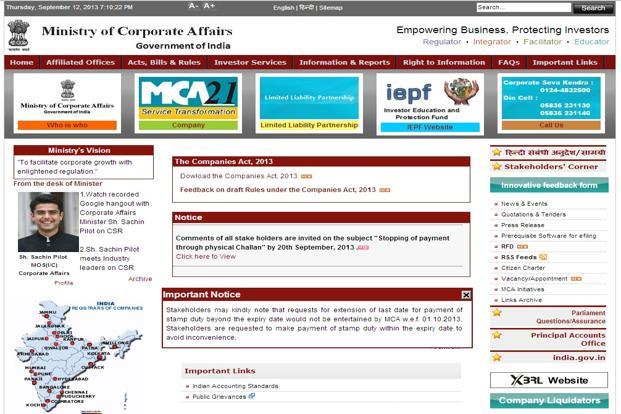
The Ministry of Corporate Affairs (MCA) is an agency of the Indian Government Ministry[1]. The Minister of Corporate Affairs[2] is the head of this agency.   The Ministry is primarily concerned with administration of the Companies Act 2013 , the Companies Act 1956, the Limited Liability Partnership Act 2008, the Competition Act 2002, the Monopolies and Restrictive Trade Practices Act 1969, The Chartered Accountants Act 1949 [As amended by the Chartered Accountants Amendment Act 2006] , the Company Secretaries Act, 1980 [As amended by The Company Secretaries Amendment Act 2006] , Cost and Works Accountants Act 1959 [As Amended By The Cost And Works Accountants Amendment Act 2006], Companies (Donation to National) Fund Act 1951, Serious Frauds Investigation Act, the Indian Partnership Act, 1932, and the Societies Registration Act 1860.

year-end-revie-ministry-of-corporate

The Ministry is also responsible for administering and regulating the competition and companies to prevent practices having an adverse effect on competition in the economy and corporate field, to promote and sustain competition in markets, to protect the interests of consumers through the commission set up under the Indian Acts.  MCA’s function is to empower business and protect the investors. Further, it acts as a regulator, facilitator, educator and an integrator. The MCA contains all the master data of all the companies setup throughout India. This setup helps to minimize or eliminate scams and frauds such as The Satyam Scandal[3] and others. The MCA website contains all the details of a company and provides several service options to its users. The website contains all the reports and data such as the LLP[4] information and the company statics.

https://lawsikho.com/course/diploma-companies-act-corporate-governance
Click Above

The MCA website contains the complete details of all the companies. In the MCA website, the companies are categorized, classified and then registered by the guidelines of the Ministry of Company Affairs. They have been categorized by the type of company, i.e. whether it is a private or a public company, governmental or non-governmental company. Further, it is sub-categorized by the registrar of companies.

How to find the registered address on the website?

corporate affairs ministry--621x414

The registered address of a company/ society/ association/ firm/ trust can be found on the Ministry of Corporate Affairs official web page[5]. The registration of all the above should be in compliance with the respective Acts and rules as per the Indian laws. The following steps will enable us to find the registered address of a company and other such details on the MCA website.

Step 1: Access to the homepage of MCA website.
Step 2: Select the MCA SERVICES block. Under the MCA SERVICES block, there will be a list of other options displayed.
Step 3: Click “Master Data” option and choose “View Company/LLP Master data” option.
Step 4: The above steps will lead you to a page where the Company/LLP name is to be typed and the CIN/LLPIN LOOKUP will pop-up with search options[6]

Step 5: On entering/ selecting the company name, the Company CIN/FCRN/LLPIN/FLLPIN will automatically appear. [7]
Step 6: Click “Submit” once the Company name and Company UID is filled. This will lead you to access all the registered information of the company including the details of the company’s registered address.

On following the above mentioned six steps carefully, one can access the registered address and other such details like the full name of the company, CIN, ROC code[8], registration number, the company category, address, capital, status with MCA, incorporation date, etc. These basic details can also be printed.
Other documents and information such as the Signatory details, Index of Charges,
Director in charge number(DIN), partnership details and details about the company services can be accessed on the MCA website under the master data of a company. Also, the public agreements and reports/data of a company can be viewed on the website page.


How to alter the registered address of a Company?

The registered address of a company or any other registered details can be changed/modified at any point of time in order to update the company details for documentation and authentication, by the company owner or any other individual associated with the company who holds the confidential login details of that company on the MCA website can alter the registered address. The modification of the registered details excludes the details of those related to debentures.

MCA

To change the registered address, there are a few guidelines under the MCA website as per the Acts and statutes of India which have to to be followed. One of the first steps is to e-fill the CHG-1 Form[9], Form 4 and Form 15 of the Ministry of Corporate Affairs. In case the company it is a foreign company that has to change its details, it has to do an e-filing of Form FC-2 and Form FC-3[10]. In case, e-filing is not practiced by a few companies, they can always download and print the form. The corrections are to be made in the modification/verification block and sent via speed post. According to the Companies Act of India, definition and guidelines relevant to the registration of a company are listed down which is in tern have to be adopted by the Ministry of Corporate Affairs. A few important sections of the Companies Act regarding the registration of a company will be touched briefly in this article for the basic understanding of the concept of Registration of Companies enlisted in the Ministry of Corporate Affairs website.

Firstly, Section 367 of the Companies Act, 2003 which about the certificate of registration of existing companies – ‘On compliance with respect to registration, and on payment of such fees, if any, as are payable under Section 403, the Registrar shall certify under his hand that the company applying for registration is incorporated as a company under this Act, and in the case of a limited company that it is limited, and thereupon the company shall be so incorporated.’ Secondly, Section 201of the Companies Act which indicates about Forms of, and procedure in relation to, certain applications-  ‘a general notice to the members thereof, indicating the nature of the application proposed to be made; Such notice shall be published at least once in a newspaper in the principal language of the district in which the registered office of the company is situated and circulating in that district, and at least once in English in an English newspaper circulating in that district; The copies of the notices, together with a certificate by the company as to the due publication thereof, shall be attached to the application.’ Thirdly, Sections 7, 12 and 16 which deal with Incorporation of a Company, Registration of a Company office and Rectification of company details, respectively. All these Sections which are listed down in Chapter II of the Companies Act, 2003, are relevant to the incorporation of the company and any matter incidental thereto.


Conclusion

The Ministry of Corporate Affairs since its inception in India it has greatly aided the verification and authentication of companies in India. It has been a very helpful tool for users, the government, secretaries of various companies, the chartered accountants, students and the general public. It has helped in the adoption of the latest technology for the fulfillment of procedures which in turn has proved to be an efficient tool for the growth of a developing country like India and its economy. The MCA website has proved to be an educator, director, promoter, protector of all the corporate affairs in India.


LawSikho has created a telegram group for exchanging legal knowledge, referrals and various opportunities. You can click on this link and join:  

https://t.me/joinchat/J_0YrBa4IBSHdpuTfQO_sA

Follow us on Instagram and subscribe to our YouTube channel for more amazing legal content 


Footnotes:

[1]Sovereign India.

[2] The Union government ministry

[3] Corporate Accounting Fraud Case –Satyam Computer Servicesscandal,2009

[4]LLP- Limited Liability Partnership.

[5]http://www.mca.gov.in/   – MCA web page.

[6]CIN – Company Information number
LLPIN – Limited liability partnership in India.

[7] FCRN- funds clarification reference number
FLLPIN- form for limited liability partnership in India.

[8] ROC- Registrar of Companies

[9] creation or modification of charge for other than debentures Form CHG-1

[10] Creation or modification of charge for Foreign Companies


Download Now

Structuring Ideas For Starting A Retail Shop In India

0

In this blog post, Dr. Sreekanth Devalraju, Manager at R.R. Health Care Private Limited and currently pursuing a Diploma in Entrepreneurship Administration and Business Laws by NUJS, Kolkata, writes about the strategies and ideas that need to be implemented while starting a retail shop in India.

297d2dd

Retailer, Retailing, and Retail Business

Retailer is a French word that has prefix ‘Re’ and suffix ‘Tailer’ which means ‘cut again’ . The retailer is any person or a business that sells goods and services to the consumer directly, as opposed to the term wholesaler, who normally sells the goods and services to another business. Retailing, therefore, involves the sale of goods in small quantities to the end users or ultimate consumers of the goods and includes all such activities that are needed for the sale of goods or services to the final consumer irrespective of the person who sells them. In the retail business, even if a manufacturer directly sells his goods and services to end-users or final consumers, such marketing activity to that extent will be identified and named as a retail business and retailing. Retail outlets are the ancient and widely spread system of selling goods that are established globally.

Retail Business in India -The Present Scenario

retail-top-img

Retail business in India is a little unorganized, and the business activities are not fine-tuned yet to reach the level of compliance with the set forth regulations. Although retail business segment contributes to being a major source of employment opportunities, the percentage of organized retail business in India is very low when compared to other nations. However, retail business in India is considered to be the most profitable segment that corresponds to be 470 billion US$, while the modern retailing with around 6% share and amounts to 26 billion US$. Retail business in India is estimated to reach at least 1.3 trillion US$ by 2018, with an estimation that the retail market in India will grow at an annual growth rate of 40% and reach  107 billion US$ in the years to come.

How to form a successful retail business

Forming a successful retail business is always a tricky aspect. One has to analyze meticulously and plan the resources needed for setting up of business and at the same time, it is also important for him/her to ensure that the business setup is in compliance with the regulatory aspects laid down in a country where the business is being carried out. First and foremost aspect is that the entrepreneur should have an in-depth understanding of the business area in which he is going to invest and intends to earn profits. His focus should be on running the said business for a long time. Hence he should have perfect vision and mission that helps him explore new ideas and strategies to resolve unexpected problems that are encountered by him in the due course of his journey. SWOT [Strengths-Weaknesses-Opportunities-Threats] analysis is the best way to analyze one’s stand and status on their strengths and weaknesses in a business area well before the entrepreneur begins his journey as a retailer. The SWOT analysis further focuses on the assessment of new opportunities in the business, required capital for investment and functioning of the new business, availability of financial resources and compliance on legal, social and political fields. It is also imperative that the aspirant conducts a good amount of background study or research on a particular idea of business, its marketing potential, targeted customers, etc., to come up with the most viable idea for a retail business.

Core Components for a Retail Business

3021865-poster-p-1-ex-google-wallet-creators-raise-7m-to-rethink-in-store-retail-data

In fact, one has to structure good and viable ideas for operating a successful retail business. Following are the core components of a retail business model that need to be addressed while structuring new ideas for business.

  • Core strategy
  • Strategic Resources
  • Partnership Network
  • Customer interface

1. Core Strategy:

Core strategy describes the basis of competency and relates to a business firm’s inherent capabilities to compete with its competitors. Three main elements of core strategy include:

  1. Business mission
  2. Product/market scope and
  3. Basis for differentiation


a. Business mission:

A firm’s business mission should focus on the very purpose of the firm’s existence and should provide a clear picture of the company’s strategies and actions to accomplish the set goals.

b. Product/ market scope:

A company’s product/market scope and markets on which it will concentrate should be defined well in advance since the products or services chosen for marketing has a high impact and plays a vital role in the success of firm’s business model.

c. Basis for differentiation:

The mindset of customers is always inclined towards new things, new products, and new services that are being marketed. It is important that the new business scheme or the new venture differentiates itself from its competitors in some way or the other that catches the eye of prospective customers. If a new firm’s products or services are not different from those of its competitors, customers will not opt for them. Firms often differentiate them by a cost, leadership strategy or a differentiation strategy.

2. Strategic Resources:

For any new business idea to get reduced to practice and ultimately to succeed depends mostly on the availability of resources. It is highly impossible to work out a strategy with a dearth of resources. Therefore, the success of a retail business model is substantially dependent on the resources the firm is holding. During initial stages, a firm’s resources may be limited to the competencies of founders, their plans to serve the market and the opportunities identified by them. Ideally, a firm’s strategic resources are their core competencies and strategic assets.

Core competency is a firm’s competitive advantage over its rivals. For example, if a bank’s core competency is to process a loan application within 24 hours, then the bank has a competitive edge of success over the other bank which does not provide such fast track loan approvals. On the other hand, strategic assets include tangible/intangible assets that are rare and valuable and owned by the firm. These assets may include plant, machinery, location, brands, patents, customer data, a highly qualified staff, and distinctive partnerships, etc.

3. Partnership Network:

Partnership network is another core component of a business firm and includes its suppliers and other partners. A supplier may be a company that provides required raw materials, parts or services to another company. For a retail business to go on smoothly, it is required that the firm maintains a cordial and collaborative relationship with its suppliers and it is also essential for the firm to encourage its suppliers by providing motivation to perform well. Apart from suppliers, firms should also partner with other key relations or other companies to ensure that their business model works. It is said that an entrepreneur’s ability to have a competitive edge over others depends on the extent of skills and cooperativeness extended by his partners to the firm.


4. Customer Interface:

The success of a retail business is dependent on the group of customers that the firm majorly targets. The way the firm chooses to interact with its clients decides the competitive edge it has over its rivals in the market. For example, Amazon.com markets books online through the internet while Barnes & Noble sells books through its traditional bookstores and online. There are two essential elements of a firm’s customer interface which include:

  1. Reaching target customers
  2. Fulfilment & support


a. Reaching its target customers:

For any retail business, a customer holds the key to success. Therefore it is imperative that the products/services marketed should be customer centred/ customer focused. This will, in turn, help the firm to achieve its goals in a retail business at a faster pace. A good business relation always starts with understanding and knowing the target customers in detail. More than just a customer service, it is needed to provide something in bonus and that would be the customer satisfaction. To be successful, the retail firm should “go the extra mile for the customer”, i.e., each time delivering just a little more than that the customers usually expect. Doing this, again and again, will make the business team interact with customers and help win their hearts and make them loyal over a period.


b. Fulfilment & Support:

It is always a point of concern that to what extent the product/service reaches the market or how it reaches the customer to his fulfilment and satisfaction. Firms should always focus on the way the product/service goes to the market since success in retail business is also dependent on the channels the company uses to provide support and service to the customers.

Formats of retail business

One of the key determinants of success in retailer business is the format that a firm adopts to present products and services to its customers. The format for retail business can be selected based on the kind of store design, products/services the firm wishes to provide and pricing approach that the firm follows. The key point is that the business format should be ideal to the target customers. Different kinds of retail formats that retailers adopt include mom-and-pop, Kirana stores, specialty stores, department stores, discount stores, convenience stores, hypermarkets, supermarkets, malls, category killers, e-tailers and vending machines.

Structuring ideas for a good retail business

Today, the Indian retail industry is in a dilemma given many challenges that threaten the true potential for growth of the retail business. Innovators are under continuous struggle to explore the best possible ideas to achieve potential growth in the Indian retail sector. Many new lessons were learned from the real experiences, and it was proved that a balanced approach to innovation could help retailers in India transform challenges into opportunities that provide successful, profitable and sustainable growth in the retail industry. Following are four key lessons that innovators provide, in bringing ahead the innovative perspective of Indian retail markets.

Lesson 1: A simple, well-executed idea can lead to successful innovation; large investments are not always necessary

Retail innovators proved that many simple and small ideas could work wonders and show greater impact as these simple and small ideas does not require a large investment, support from senior staff or excess of time to be expended. All that is needed is to adopt a balanced approach towards the innovation; that means while pursuing big ideas for business, development and implementation of small ideas need not be given up or sacrificed.


Case study: Tanishq Jewellery

31dcTFSHeiL._SX466_

Tanishq, a leading jewellery store was trying to explore an innovative concept that helps them to break into the fragmented jewellery market dominated by local jewellers. Tanishq identified few quality related and customer-related challenges that were posed by local jewellers. They include

1. Low prices:

Local jewellers always kept the prices very low to attract the customers but at the same time, the quality provided was very poor.

2. Long standing customer relationship:

Customers always preferred local jewellers over retailers due to their strong familial associations getting continued through years.


3. Unreliable quality checks:

An inexpensive and destructive technique was used to determine the purity of gold.


4. Personalized customer services:

Customized modifications were made at the customer’s convenience.


Tanishq Innovation:

Tanishq, therefore, introduced the “Karat Meter”, a simple innovation that helped to win the trust of consumers and credibility in the market.


Implications for Tanishq:

The implications for Tanishq from this innovative step are

  1. Ability to charge a premium: Transparent pricing and perception of higher quality enable premium pricing.
  2. Increased adoption among existing customers: Transitioned from being a place for one-off purchases to the jeweller of choice
  3. New Customer Acquisition: Developed a trusted brand, with customers willing to switch from local jewellers


Lesson 2: Successful innovations need not only be new and path breaking but can be an adopted model tailored to specific needs

Another important aspect is to explore several ways and means to develop innovations. But at the same time, the value of existing innovations should never be ignored. Enough care was taken by Indian retailers to address consumer/market needs, and they adopted several tested and practically validated innovations from global retailers and other successful industries. Retailers should not take a back step in adapting these innovations to their business.

Case study:  GreenDust TM

greendust

GreenDust adopted an innovation in reverse logistics to offer high quality branded refurbished products at 25-30% lower cost. GreenDust offers high quality, genuine, branded products at highly discounted prices. Added to this, GreenDust also provides world-class warranty and after sales services.

GreenDust Innovation:

GreenDust sells refurbished products and factory seconds. These are the goods that are defective in the appearance of the product that includes scratches and smudges, hence fail to meet the rigorous inspection criteria, but this does not affect the functionality of the product. These include carton damaged and discontinued products also. The business model of the company is to take the rejected /defective /unsold /returned products from OEMs, refurbish them, provide a year’s warranty from their side, and sell them as factory seconds through their brand, Green Dust.

Implications for Green Dust:

  1. 25%-30% discount on products to consumers with warranty
  2. Achieved 50% sales from untapped Tier 2/3 cities
  3. Acquired  60% repeat customer base
  4. Green Dust grew @ 9 times in last 2 years to revenues of over 500 Crores


Lesson 3: Supply-side innovation can lead to as high a consumer impact as Demand-side innovations do:

Conventionally it is believed that demand-side innovations have maximum consumer impact and more than 70% of retailers feel that innovations should be focused on demand-side levers such as product, price and format. Surprisingly, there are also some challenges in the supply-side that directly impact consumers. For example, these challenges may arise from supply chain segment (Inefficiencies translate into product stock-outs, lower product variety, etc.) or from the working crew (Attrition and declining quality of store staff) both of which greatly impact consumer experience. It is a real task for retailers to transform these challenges into valuable deliverables to the consumers through innovations in supply-side. At the same time it is also required to focus on innovations, just not limited to demand-side but furthermore focused on the supply side to achieve a sustainable and competitive edge.

Case Study: fabindia

fabindia-pic

fabindia’s supplier co-ownership model, though focused on the back-end, helped generate mass appeal for rural, ethnic and handloom products. fabindia moved to a model where suppliers are given ownership in the company rather than Supply Region Companies (SRC)

fabindia’s  innovation:

fabindia pursued the conflicting goals of profitability and social mission together. Its mission was to create sustainable employment for weavers and traditional handicraft artisans in rural India.  William Bissell created a unique business model, Community Owned Companies (COC). It is the second big revolution in India after Amul. It empowered the suppliers, and enabled their growth, along with the growth of the company. Artisans Micro Finance Private Limited (AMFPL) venture fund was initiated, which is a fully owned subsidiary of fabindia. Through this fund, Supply Region Companies (SRC) were set up which is owned partly (49 percent) by fabindia through AMFPL, and also partly, (26 percent)  by the rural artisans (These artisans are the main suppliers of fabindia).

Implications for fabindia:

  1. fabindia’s co-ownership model enabled self-sufficiency and financial independence of artisans.
  2. Nearly80,000 artisans as part of 17 SRC’s and this number is likely to grow to 100,000
  3. fabindia Limited increased its stake to 49% in SRC with suppliers holding at least 26%.
  4. Creation of
  5. Ethnic


Lesson 4: Innovations need to evolve and keep themselves relevant to continuously deliver value; it is not a ‘one-time’ effort

Several companies consider that innovation is a one-time opportunity, i.e., once implemented and found successful the focus of the company shifts to other priorities and the innovation loses its charm over a period and becomes stale. But to deliver sustainable impact, innovation should be a continuously evolving process on consumer and market needs, and if necessary the innovation needs to be evaluated and make alterations if required.


Case Study: Big Bazaar

big-bazaar-gift-voucher

Big Bazaar’s format innovation in late 90’s played a key role in transforming mass-consumer perception about modern retail. Consumers always used to think that the air conditioned stores are meant for selling goods at a high price and the charges they are paying are for the ambiance provided with fancy lights and English speaking sales personnel who are intimidating the customers.


Big Baazar’s innovation:

Smaller Aisles: Big Baazar created an atmosphere of a crowded marketplace enabling Indian consumers to feel at home.

Deals: Good deals and bundled goods were also provided to consumers.

Products in Bins: On par with local Kirana stores, loose products are kept in bins and sold on special schemes. This allowed consumers to touch wheat, rice, and other products and check for quality by themselves.

Granite Floors: Simple flooring allowed new consumers to be at ease and not be intimidated by large store format

Deals: Special schemes and bundled goods provided good deals to consumers – at par with Kiranas.

Evolution of various store formats: Continued to innovate its format and offered services to meet evolving consumer needs


Implications for Big Bazaar:

This flagship retail chain of the Future Group is on the verge of achieving a unique milestone in the history of world retail by being the first hypermarket format in the globe to rollout fastest 101 stores in a short span of seven years.

Conclusion

Indian retail brands

The Indian retail industry witnessed revolutionary changes during past few decades. Retailing in India has evolved across product variants and market segments over the time. Even smaller independent stores are upgrading regarding assortments, delivery, and ambiance. A great number of success stories are being recorded in the sectors of electronics, mobiles, computer accessories, jewellery, footwear, groceries, and textiles. This evolved change is riding on overall growth in income and consumption across the country, including the rural areas. The success of multiple format stores catering to different customer segments across geographies has proved the immense potential of Indian markets. Following various ways and means to adapt and adopt innovations, the tremendous expansion of retail stores to even smaller towns was possible thereby transforming overall scenario of retail markets in India. The invention of e-commerce further revolutionized the retail markets and created a new arena for the close conglomeration of suppliers and end-users for achieving huge profits. E-Commerce opened new avenues for retailers in India, and the online platform has evolved into a unique market by itself. Thus, opening a retail shop with right products, right pricing and promotional strategies along with sustainable and innovative perspective are always a very profitable proposition in India.




Download Now

Why Do We Need To Replace The Police Act Of 1861?

0

In this blog post, Sunidhi, a student of the Rajiv Gandhi National University of Law, Patiala writes about the Police Act of 1861. The blog post tells us why there is an urgent need to replace the current Act.

9


55% of the cases filed in India are against police officials. The service of the police is essential to the community so as to protect them and stop crime in the community. But if the majority of cases filed in a country are against police officials, then where should the general public reach for help?

unnamed

It is not only the misconduct of police officials that is the reason for such high rate of cases filed against them but also the outdated Police Act of 1861. This Act was formed after the Mutiny of 1857 by the Britishers to suit their needs, i.e. to rule and suppress Indians and not to serve Indians. This Act continues to govern police forces to this day in many states of India despite far-reaching changes in governance and India’s transition from being a colonized and suppressed nation to a free and sovereign republic.

This Act governs most of the police forces in India. Some states like Maharashtra, Delhi, Gujarat, etc. have enacted new legislations to regulate police forces in the state but the new police Acts are also based on this Act. Thereby, it has failed to bring a major change in the police system of these states.


Efforts of the National Police Commission

The National Police Commission (NPC), 1979-81 made an effort to bring change in the Indian Police system by preparing a draft of ‘Model Police Act’ in its 8th report. This proposed bill has never seen the light of the day. It was a commendable effort by the commission to address the plaguing issues in the Indian Police system.

The model highlights the change in the duties of police force in order to keep up with the changing scenario in India. It details out the imposition of more penalties on the delinquent officers in order to bring efficient results. It has tried to address the problem of accountability by referring to the laws of other nations.


Lacunae in the system

aug1524copbsi

The principles on which the Police Act is based are outdated and meant for oppressing Indians. Also, the police system is completely under the politicians. Therefore, it has been politicized by them to meet their selfish interests.

  • The superintendence of police has been vested in the hands of the state government i.e. politicians. The police chief (Director General/Inspector General) is appointed at the pleasure of the Chief Minister. Therefore, police chief may be removed from his/her post without even assigning a reason if he/she does not keep the politicians on his side. The result of this is that the police chiefs follow the policy of appeasing the politicians, and they follow those commands as well which are against their duties. Hence, the police officers remain servants of politicians only and not the public.

The tenure of the police chief should be fixed, so that an honest officer can work without the fear of transfer or removal from the post. To keep a check on the activities of police officials a statutory body called State Security Commission should be created. The NPC Model even suggested the composition of the committee to ensure efficient working of the committee.

  • The Head of the Police is appointed in a very secretive way. The politicians have full influence over this post; therefore, the post is politicized and given to a political patron instead of the one who deserves it. Therefore, there should be transparency in appointing a police officer for this post.
  • There is no independent body to file complaints against the misconduct of police officials. A civilian has nowhere to go if the police officials do not file his/her complaint or misbehave with him/her. The only place a civilian can approach is Human Rights Commission, but these are also not very powerful institutions to help a complainant as they also do not have the power to do anything, all they can do is make a recommendation to the government which the government can very easily neglect.

In countries like UK, South Africa there is an Independent Police Complaints Commission (IPCC). It supervises and investigates complaints against police officials. The IPCC has access to all the documents and station premises. The head of Commission is appointed after approval from all the parliamentary committees. There is a need to develop such a system in India.

  • Not a day passes in India when a complaint against police officer’s excesses is not reported in India. Indian police officers are infamous for their behaviour. They feign illness to delay the work, they abuse the complainant instead of helping him, sometimes connive with the accused to earn money and indulge in many other unacceptable activities.

To counter these activities, a stricter code of conduct and principles should be imposed on them. The code alone cannot bring desirable results; therefore, the penalties imposed on delinquent officers should be revised. At present, the penalties imposed on them are restricted to minor fines but it should be raised to outright dismissal, removal from service, reduction in rank, forfeiture of approved service, reduction in pay, withholding of promotion or increment, etc.

jygh

  • The terms of service of police are also not very acceptable. They have to work 365 days in a year; there is no provision of holiday for them. They are not even provided food while they are on duty. They have to perform their duty day and night. Any time a complainant may approach, and they have to help him/her. Therefore, this is a very frustrating and tiring job.

They are also human beings. They also need a day off from work to spend quality time with their family. This frustration will directly impact their duty. So, there is a need to make changes in their terms of services.

Hence, there is a need to bring major changes in the present Indian police system by enforcing a new Act to meet the needs of changed scenario.


Download Now

Redressal Mechanism Under Consumer Protection Act, 1986

3

In this blog post, Sreeraj K.V., a student of Government Law College, Ernakulam, Kerala writes about the importance of the redressal machinery under the Consumer Protection Act, 1986. The post discusses the importance of the Act, the functions of the grievance redressal commissions at various levels including their jurisdiction and powers.

IMG-20151029-WA0013_2

Consumers play a key role in maintaining the economy of India. Each and every person constitutes a consumer because each one of us is engaged in some form of exchange of goods or services through money as a medium. Gradually, there arise many kinds of disputes among the consumers as well as consumers and the sellers. In this context, it has to be stated that there lies a need for a statute which regulates the friction between the consumers and the sellers. For this purpose, Consumer Protection Act was enacted in the year 1986 to look after the various rights and duties of the consumers during the time of purchasing a product and even after that. The Act plays an important role in the fields where there arises an incidence of exchange of goods or services between two persons where money acts as a medium. The Act also provides certain guidelines as to what measures must be complied with during the time of such exchange, what are the various rights available to both the buyer and seller etc. It also provides certain provisions regarding the need and formulation of various ‘Consumer Redressal Centres’ both at the central as well as states level.

The Act lays down certain provisions regarding the definition of consumer, various consumer protection councils, and provisions in connection with various consumer redressal agencies in India as well as other miscellaneous provisions. Among this, provisions relating to consumer redressal agencies demand a lot of attention in the present Indian scenario. Many people are still not aware that there are such agencies working in favor of consumers in every district. Due to this reason, many of them are not getting proper solutions for their problems as consumers. Chapter III of the Act provides for the implementation of redressal agencies. Section 9 of the Act provides for ‘establishment of consumer dispute redressal agencies’ which include:

https://lawsikho.com/course/certificate-criminal-litigation-trial-advocacy
click above
  • A District forum established by the State Government in each district of the State by its notification.
  • A State Commission established by the State Government in each state by its notification and
  • A National Commission established by Central Government by notification [1]

 Consumer-Rights

District Forum

Each District Forum shall consist of a person who is or has been qualified as a District judge, as the President. There must be two other persons who are not less than thirty-five years of age and also possesses a degree from a recognized university. The persons must have adequate knowledge in the field of economics, commerce, industry, public affairs, and administration. The district forum must have the jurisdiction to entertain such complaints where the value of goods or services and the compensation, does not exceed Rs. twenty lakhs. The need for district forums for consumer redressal is that majority of the people who face any consumer rights violation are unable to file a complaint in a state or national forum because such f have to look at matters concerning various other district forums which result in a large number of pending cases. District forums are also enabled with a faster way of dispensing consumer redressal as the amount of claim is pretty less than that of State/National redressal forums which enables normal people to seek a solution for their problems.


State Commission

Each State Commission shall consist of a person who is or has been a judge of High Court as its president. The Commission also consists of not less than two members, who are above thirty-five years of age and also possesses a degree from a recognized university. The persons must have adequate knowledge in the field of economics, commerce, industry, public affairs, and administration. The Act also states that not less than fifty percent of the members shall be from amongst the persons having a judicial background. The State Commission has a jurisdiction to entertain cases where the value of goods or services or the compensation claimed, if any, exceeds the number of Rs. twenty lakhs but does not exceed Rs. one crore. It also entertains appeals against any District Forum within the state and also looks after any pending disputes or cases decided by any of the District forums in which the forums have exercised a jurisdiction not vested in them by the law, or has been exercised illegally or with any material irregularity.


National Commission

ncdrc

The National Commission shall consist of a person, who is or has been a judge of the Supreme Court, to be appointed by the Central Government, shall be the President, provided that no appointment shall be made except after the consultation with the Chief Justice of India. The commission shall consist of not less than four members of its executive committee who shall not be less than thirty-five years of age and must be graduates from a recognized university. They must also be specialized in the areas of commerce, economics, and administration. The jurisdiction of the commission shall extend to any case where the compensation amount might exceed Rs. one crore and the Commission shall also entertain appeals against State Commissions. The Commission also has the power to check any pending disputes or cases decided by any of the State Commissions where the State Commission has exercised a jurisdiction not vested in it by law or it has been exercised illegally or with any material irregularity.

Power of redressal forums

There are various powers for all of the redressal forums with regards to its jurisdiction. Some of them include:

  1. Examining, enforcing as well as summoning the witness on oath;
  2. Discovering and producing any material evidence;
  3. Receiving evidence on affidavit;
  4. Requesting for report or test analysis from the concerned authorities and laboratories;
  5. Issuing commission for examining the witness;
  6. Enforcing any other powers prescribed by the Central or State Government.


Limitation period

The District, State or National Forum for consumer grievance redressal will not entertain a case which is filed two years after the occurrence of the case unless the party/parties can condone themselves regarding the reasons behind the delay of filing within the specified period. Such a provision was formulated to increase the accuracy of the function of such forums and also for delivering fast redressal solutions to the parties.[1]

Conclusion

From various landmark judgments by the Supreme Court in connection with cases affecting consumer rights, it will be clear that there is an increase in the number of cases involving consumer protection when compared to the past. It indicates that people are now aware of their various rights as consumers. The Act not only covers the rights of the consumers but also provides certain duties for them too. It has been stated that it is the duty of a consumer to ask clearly about various characteristics and features of the product which he/she wishes to buy. The Act does not entertain certain malicious acts such as black marketing and selling a good above the prescribed rate of MRP. The doctrine of ‘caveat venditor’ (let the seller beware) has been changed into ‘caveat emptor’ (let the purchaser beware) so that the purchaser will also be aware of various features, merits and demerits of the good as well as protection of their rights themselves. There is still an emerging need of various other redressal machineries in this field due to the increased number of pending cases as well as for implementing alternative means in the field of consumer protection. The Act may be amended in such a way that it includes certain dispute redressal mechanisms like ‘Alternative Disputes Resolution’ as a core function of the said redressal agencies dealing with consumer rights.


LawSikho has created a telegram group for exchanging legal knowledge, referrals and various opportunities. You can click on this link and join:  

https://t.me/joinchat/J_0YrBa4IBSHdpuTfQO_sA

Follow us on Instagram and subscribe to our YouTube channel for more amazing legal content.


Footnote:

[1] Retrieved on: http://www.ncdrc.nic.in/1_1.html#_Hlk149662025


Download Now

Relevance of Expert Witness in Criminal Law

0

In this blog post, Mr. Sreeraj.K. V, a student of Government Law College, Ernakulam, Kerala writes about the relevance of an expert witness in criminal law. The post covers areas like the definition of an expert and expert evidence, various provisions of the Indian Evidence Act, importance and admissibility of expert evidence and also analysis of certain cases which proves the evidentiary value of expert evidence in India.


IMG-20151029-WA0013_2

In simple words, an ‘expert’ is a person who has a high level of skill or knowledge in a particular subject or field. In the field of law, an expert and his opinion as an expert witness in a case place a key role in deciding the case by the Court. Legally speaking, an expert is a person, who specializes in a field of knowledge, often technical, who may present his/her expert opinion without having been a witness to any occurrence relating to the lawsuit or a criminal case. computer-forensics-expertIt is an exception to the rule against giving an opinion in the trial, provided that the expert is qualified by evidence of his/her expertise, training or special knowledge. If the expert is challenged, the attorney for the party calling the ‘expert’ must show necessary background through questions in court.

If the expert is challenged, the attorney for the party calling the ‘expert’ must show necessary background through questions in court.  gavel

In the law of evidence, an expert witness is a person who is allowed to give opinion evidence as opposed to evidence of his perception. This is the case only if the witness is skilled in some appropriate discipline. An exception to the usual rule of practice whereby witnesses are heard one after the other and do not hear the evidence of the preceding witness is made of competing experts.[1] According to section 45 of the Indian Evidence Act, it provides for certain provisions as to the opinion of experts. ‘When the Court has to form an opinion on a point of foreign law, science or art, or as to identify handwriting, the opinions upon that point of persons specially skilled in such foreign law, science or art, are relevant facts. Such persons are called experts.[2] In fact, the provisions enumerated under Section 45 to 51 of the Indian Evidence Act which provides the relevancy of experts, and the opinion is exceptional to nature of the general rule that evidence is to be given to the facts only which are within

the knowledge of the witness. This exception is based on the principle that the court can’t form an opinion on the matters, which are technically complicated and professionally sophisticated, without the assistance of the people who have acquired special knowledge and skill on those matters. Conditions for the admissibility of expert opinion are:

  1. That the dispute can’t be resolved without expert opinion
  2. That the witness expressing the opinion is an expert.[3]

Duties of an expert

  • An expert is not a witness of fact
  • His evidence is of advisory character
  • An export deposes and does not decide
  • An expert has to furnish necessary scientific evidence to the judge so that he can frame independent judgments by application of such evidence.

There is a big difference between expert evidence as well as the evidence given by the ordinary person. An expert gives his opinion on a particular field of knowledge such as fingerprint, handwriting, etc. which is of an advisory character. The court can’t pass an order of conviction purely on this basis as it is not conclusive. An expert gives his opinion on his experience, skills, and knowledge in that particular field.  On the other hand, an ordinary witness states the fact in connection with that particular incident only. The opinion of a normal witness is non-admissible. The court may pass an order by the evidence given by the eyewitness. A normal witness provides facts of the incident what he had seen heard or perceived.[4]

Admissibility of expert evidence

Expert opinion will be admissible only when the expert is examined as a witness in the court. The opinion of the expert will not be admissible in the court unless the expert gives proper reasons for his opinion and it is being tested during the cross-examination by the adverse party. But to curtail the delay and expenses involving in securing assistance of experts, the law has provided certain provisions regarding the examination of scientific experts.expert-witness-pic-1

According to Section 293 CrPC, the report of certain Government scientific experts provided under this section will be held admissible as evidence in inquiry, trial or other proceedings of the court, if the court can summon or examine the experts. It is argued that after all, the expert is a human being and however impartial he may be, he will be producing certain evidence and opinions for the party which calls him to an extent. One of the rules of caution that all courts follow as regards expert opinion is that they must never surrender their free will or independence to an expert. In all cases, wherein expert evidence is needed, the court must after giving it proper importance, make up its mind on the issue upon which expert testimony is given.[5]

There are some cases which give us a clear picture regarding the importance and admissibility of expert and the evidence produced by them. In the case of Kishan Chand v. Sita Ram[6], the court stated that the opinions of the experts on the question whether the same person wrote two or more documents, or different persons are relevant.

expert-witnessConflicts of opinions of experts lead to the discretion of the Court in forming its decision looking into the signatures on such documents.[7] There are various other cases such as Ram Narain Singh v. State of Punjab[8], where the Court questioned the opinion of the expert by stating that both evidence provided by the normal witness as well as expert evidence are colliding. Thus, the prosecution was not able to prove its case against the accused person and hence the accused was held free. Such cases state that expert evidence can also be questioned in the court when they are in collision with the actual evidence or the evidence produced by a normal person regarding the case.

Conclusion

From the above, it is very clear that an expert and his evidence plays a crucial role in the case in which he/she has made an opinion. Usually, the opinion of an expert is taken in the fields of medical science, during the time of the death of a person, regarding the age of parties, cause of death, nature and kind of weapons used disease, injury, sanity or insanity of a person, etc. Now a day, DNA test is also used in fixing the paternity of the child in family law in connection with the maintenance and legitimacy of that child.[9] A witness, whether expert or not, must be competent in providing certain evidence or documents supporting his/her evidence only if he/she is competent to do so. Unless and until they are not, they will be not regarded as a proper witness under the tagline of experts. It is not mandatory that a court must look only into the opinion of one single person; the court has its discretion to examine one or more experts depending upon the facts and circumstances of each case concerned. As there are certain provisions regarding who has to be an expert under the Evidence Act, the Court will not find any difficulty in deciding the cases involving expert testimonies as the court itself is equipped with proper guidelines by the said statutes of our country. On the whole, an expert evidence makes a case or the facts of the case much more relevant that it was in the past. It also makes it clear that an act can be made more particular when it is corroborated by expert evidence.


[divider]

Footnotes:

[1] Retrieved on: http://legal-dictionary.thefreedictionary.com/expert+witness

[2] Retrieved on: https://indiankanoon.org/doc/1025384/

[3] Retrieved on: http://www.legalservicesindia.com/article/article/experts-opinion-and-its-admissibility-and-relevancy-law-of-evidence-1583-1.html

[4] Retrieved on: http://www.legalservicesindia.com/article/article/experts-opinion-and-its-admissibility-and-relevancy-law-of-evidence-1583-1.html

[5] Retrieved on: http://papers.ssrn.com/sol3/papers.cfm?abstract_id=1651148

[6] Kishan Chand v. Sita Ram AIR 2005 P-H 156

[7] Retrieved on: https://indiankanoon.org/doc/1025384/

[8] Raj Narain Singh v. State of Punjab 1975 AIR 1727

Retrieved on: https://indiankanoon.org/doc/1995089/

[9] Retrieved on: http://www.vakilno1.com/legalviews/role-of-experts-in-litigations.html

Download Now

Professional Misconduct under Advocates Act, 1961

0

In this blog post, Mr.Sreeraj.K.V, a student of Government Law College, Ernakulam, Kerala writes about Professional misconduct under Advocates Act, 1961.The post covers areas like the definition of the term misconduct, provisions under the Advocates Act as well as various important cases dealing with the matter.

IMG-20151029-WA0013_2


Introduction

A lawyer’s profession is meant to be a divine or a sacred profession by all means. In every profession, there are certain professional ethics to be followed by every person who is into such a profession. But there is a fact that professional misconduct is a common aspect not only in other professions but also in advocacy. In simple terms, it means certain acts done by the persons which seem to be unfit for the profession as well as which are against certain ethics in this field.ZxgdF

The term has been clearly defined in Black’s Dictionary as, the transgression of some established and definite rule of action, a forbidden act, a dereliction of duty, unlawful behavior, improper or wrong behavior. Its synonyms are misdemeanor, impropriety, mismanagement, offense, but not negligence or carelessness.[1]

From the definition, it is now clear that the act of professional misconduct is done purely with an intention of getting unlawful gains. The Advocates Act, 1961 and the Indian Bar Council plays a vital role in providing rules and guidelines regarding the working, code of conduct and such other matters concerning lawyers and advocates in India.

The attributes of a profession are:

  1. Existence of a body of specialized knowledge or techniques
  2. Formalized method of acquiring training and experience
  3. The establishment of a representative organization with professionalism as its goal
  4. Formation of ethical codes for the guidance of conduct
  5. Charging of fees based on services but with due regards to the priority of service over the desire of monetary rewards

Misconduct leads to acts which are unlawful in nature even though they are not inherently wrongful. Before the Advocates Act, 1961, we had the Legal Practitioners Act, 1879. There is no definition given for the term ‘misconduct’ in the Act, but the term ‘unprofessional conduct’ is being used in the Act. Some of the instances of professional misconduct are as follows:

  • Dereliction of duty
  • Professional negligence
  • Misappropriation
  • Changing sides
  • Contempt of court and improper behavior before a Magistrate
  • Furnishing false information
  • Giving improper advice
  • Misleading the clients in court
  • Notspeaking the truth
  • Disowning allegiance to the court
  • Moving application without informing that a similar application has been rejected by another authority
  • Suggesting to bribe the court officials
  • Forcing the prosecution witness not to say the truth.[2]


Advocates Act, 1961

The provisions of Section 35 of the Advocates Act deals with professional misconduct of lawyers and advocates in India which read as:unnamed

If a person is found guilty of professional misconduct; he shall refer the case to a disciplinary committee, shall fix a date of hearing and issue a show cause notice to the Advocate and the Advocate General of the State. The disciplinary committee of the State Bar Council, after hearing both parties, may:

  1. Dismiss the complaint, or where the proceedings were initiated at the instance of the State Bar Council, directs that proceedings be filed;
  2. Reprimand the advocate
  3. Suspend the advocate from practice for such a period as it deems fit;
  4. Remove the name of an advocate from the state roll of advocates.[3]


Misconduct is of infinite variety; this expression must be understood in a broad meaning such that it extends the meaning under natural law, and there is no justification for restricting their natural meaning. Section 49 of the Advocates Act empowers the Bar Council of India to frame rules and standards of professional misconduct. Under the Act, no person has a right to make advertisements or solicit; it is against an advocate’s code of ethics. He is also not entitled to any advertisement through circulars, personal communications or interviews, not demand fees for training and not to use name/service for unauthorized purposes.[4]


Contempt of Court as Professional Misconduct

Contempt of court may be defined as an offense of being disobedient or disrespectful towards the court or its officers in the form of certain behaviors that defies authority, justice, and dignity of the court.[5] In various cases involving contempt of court, the Court held that if any advocate or legal practitioner is found guilty of the act of contempt of court, he/she may be imprisoned for six years and may be suspended from practicing as an advocate  (In re Vinay Chandra Mishra).[6]The  court also held that license of the advocate to practice a legal profession might be canceled by the Supreme Court or High Court in the exercise of the contempt jurisdiction.PM-EVENTS_LOGO

There are many other landmark judgments regarding the cases involving professional misconduct of the advocates. In the case of V.C.Rangadurai v. D.Gopalan[7], the Court looked into the matter of professional misconduct in such a way that decision was made in a much humanitarian manner by considering the future of the accused in this case. Court held that “even so justice has a correctional edge, a socially useful function, especially the delinquent is too old to be pardoned and too young to be disbarred. Therefore, a curative, not cruel punishment has to be delivered in the social setting of the legal profession”. The court then held the decision in such a way that it looked at each and every aspect concerning the case as well as the parties concerned. It adopted a deterrent was of justice mechanism so that the accused person is awarded certain punishments as well as this leads to a warning towards such other people who intend to commit the acts of the same nature. The judgment turned out to be a landmark in the cases concerning professional misconduct as it delivered an effective judgment by not curtailing the future of the accused person.  In various other cases like J.S.Jadhav v. Musthafa Haji Muhammed Yusuf[8], the Court delivered the decision in such a way that it created a notion in the minds of the wrongdoers that offenders will be punished accordingly.

Conclusion

From the analysis of various cases and certain facts and circumstances, it will be clear that unlike any other profession, advocacy is regarded as a noble profession and professional ethics must be maintained before any other ways of the code of conduct and professional behavior. Courts have dealt with various cases of professional misconduct wherein attempt of murder by the advocate towards his client were also reported. Hence, there must be a rapid interference from concerned authorities so that a person with a criminal background will be kept away from this profession. Even though there are guidelines dealing with the social background of the person enrolling in this profession, i.e., the person enrolling must be free from any criminal cases, it does not prove that the person has a criminal nature of his own. So the Bar Council can implement certain rules and regulation such that the person who is showing criminal behavior must be awarded strict guidelines so that the person will no longer act unlawfully against his profession. There must be various career guidance and development programs conducted by the Bar Council immediately after the enrolment of advocates so that they will be aware of the do’s and don’t of this profession and there will be a better group of advocates in the coming decades.


[divider]

References:

[1] Retrieved on: http://www.legalservicesindia.com/article/article/professional-misconduct-by-lawyers-in-india-1621-1.html

[2] Retrieved on: http://www.legalservicesindia.com/article/print.php?art_id=1665

[3] Retrieved on: https://indiankanoon.org/doc/1460739/

[4] Retrieved on: http://www.legalservicesindia.com/article/article/professional-misconduct-of-lawyers-in-india-1665-1.html

[5] Retrieved on: https://en.wikipedia.org/wiki/Contempt_of_court

[6] In Re: Vinay Chandra Mishra AIR 1995 SC 2348.

Retrieved on: http://www.legalserviceindia.com/articles/sc_t.htm

[7] V.C. Rangadurai v. D. Gopalan and ors 1979 AIR 281

[8] J.S Jadhav v. Musthafa Haji Muhammed Yusuf and ors 1993 AIR 1535

Download Now
logo
FREE & ONLINE 3-Day Bootcamp (LIVE only) on

How Can Experienced Professionals Become Independent Directors

calender
28th, 29th Mar, 2026, 2 - 5pm (IST) &
30th Mar, 2026, 7 - 10pm (IST).
Bootcamp starting in
Days
HRS
MIN
SEC
Abhyuday AgarwalCOO & CO-Founder, LawSikho

Register now

Abhyuday AgarwalCOO & CO-Founder, LawSikho