Download Now
Home Blog Page 1727

The Concept of Quasi-Contract

0

In this blog post, Pramit Bhattacharya, Student, Damodaram Sanjivayya National Law University writes about the concept of quasi-contracts. The post talks about the difference between implied and quasi-contract, the notion behind the concept of quasi-contract, and the similarity and differences between contracts and quasi-contracts.

1451539_599879256736892_1144192258_n

Contracts are those promises coupled with agreements that have legal sanctity and can be enforced. When a contract is made, both the parties are legally bound to fulfill the conditions of the contract. In the case of a quasi-contract, a certain relationship between the parties arise which is very similar to a contract, and this relationship consists of rights and liabilities created by the law.


Contract

A contract is an agreement between two or more parties which is recognized by law and can be enforced. The law provides remedies to the aggrieved party if the conditions or promises stated in the contract are breached. In the case of a contract, performance or non-performance of a thing is considered as a duty. To be legally binding the promises must be exchanged for some consideration. The adequacy if the consideration does not matter, but the Court may look into it if there arises a case of coercion or fraud.

legal gavel and a business contract

For instance, there cannot be a promise to make a gift, because the donor is getting no consideration in return. Agreement to perform a promise can arise in three ways: standard form of contract, agreement and contract, and promissory estoppel.


Quasi-contract

The obligation arising out of a quasi-contract was first recognized by the English law. The Indian Contract Act, 1872 also follow the same elements which are followed by the English Contract Act. There is no definition given for quasi-contract in the Indian Contract Act. But the Act states that it in the case of a quasi-contract, certain relations are created which are very similar to contracts. But quasi-contract can be defined as a set of rights and liabilities between the parties even when there is no formal contract. The law creates this obligation to maintain justice and fairness between the parties. The law does not allow one person to enrich himself at the expense of the other. If the rights and obligations are not created (quasi-contract) one party would be unjustly enriched. Going by this, it can be said that a quasi-contract is kind of a remedy instead of being a pure contract. Formation of a quasi-contract allows the aggrieved party to recover the benefit which the enriched party has taken at his expense. Since a quasi-contract is a law made by law, there is no statement of consent between the parties. The obligation and rights which are placed on the shoulder of the parties are rather by law than by assent. [1]

Many times, a situation may arise that a legal obligation is placed on a person to uphold justice, even though, the person has not committed any tortious activity or has broken any contract.


For instance, X forgets c=some goods at Y’s place. Y’s is under a legal obligation to restore the goods to Y. this goes on to show that Y cannot enrich himself at the expense of X. such kind of obligations are described as Quasi-contractual Obligation. They are not actual contract in which the parties agree to enter, but are fictional agreements which are created between the parties by law so as to ensure equity.

In quasi-contracts the liability imposed is based on the doctrine of unjust enrichment. Quasi-contact is applied with regards to payment of services rendered or goods delivered or used. In such situations, the main question which arises is the liability of the person who got enriched. Since the basic concept of a quasi-contract is to prevent unjust enrichment, the liability of the enriched party is limited to the value of services rendered or cost of the goods used or delivered. Thus, the liability is limited to the amount of benefit only.


Implied-in-fact Contract and Quasi-contract

One of the main features of a quasi-contract is that there is no mutual consent between the parties. Quasi-contracts are often confused with implied-in-fact (or implied contract). The difference between a quasi-contract and an implied contract is that in the case of an implied contract even if there is no written statement of the fact that the parties want to enter into a contract, their actions and conduct imply that they have mutually agreed to enter into a contract.

For example, P goes to a restaurant for a dinner. The owner of the restaurant expects that P will pay for his food. P also knows that he’ll have to pay for the food which will be provided to him. Thus, the actions of the parties signify that they’ve mutually agreed to enter into an agreement, even though the agreement is not a written one. 460574257_XS

 

Notions behind Quasi-contracts

Quasi-contracts follow the principle of unjust enrichment, which came from the Roman Maxim,nemo debet locule tari ex aliena jactura which in simple language means that no man must grow rich because of one’s personal loss.[2]

Quasi-Contracts falls under Chapter V of the Indian Contracts Act, 1872[3] under the heading “Of certain relations resembling those created by contract.” Although the word “quasi-contacts” is not expressly mentioned, it can be interpreted that the framers of the statute pointed towards the concept of quasi-contract and doctrine of unjust enrichment only. In the case of Hari Ram Seth Khandsari v Commissioner of Sales Tax,[4] The Court also agreed to the fact that, although the term has been avoided in this chapter, this chapter is about the doctrine of quasi-contracts.

The concept of quasi-contract was first discussed in the case of Moses v MacFarlane[5] (an English case). In this case, Lord Mansfield stated that such obligation was based upon the law as well as justice to prevent undue advantage to one person at the cost of other.

In the case of SpolkaAkeyjna v Fairbairn Lawson CombeBarbor Ltd,[6] the Court stated that the obligations which arise in such situations where one person are enriched at the expense of another- the obligation does not fall purely either under torts law or contracts law. They fall under the concept of “restitution or quasi-contracts.”

To summarize, to evoke the concept of Quasi-contracts, three conditions are required to be fulfilled as stated by the Court in the judicial pronouncement of Mahabir Kishore & others v. the State of MP[7]:

  • There has to be an unjust enrichment due to receipt of a benefit.
  • The enrichment should take place at the expense of some other party.
  • The retention of such enrichment is unjust.


Similarity between a Contract and a Quasi-contract

The result of a contract and a quasi-contract are similar. The claim for damages under both is also similar. Section 73[8] of the Indian Contract Act that states that damages for quasi-contracts can be claimed which are same as for the breach of an express contract. The remedies available for a breach are also similar.[9]


Distinction between a Contact and a Quasi-contract

A quasi-contract can be considered as a constructive contract or an implication of law. It is just a fictitious contract, aimed towards providing a remedy to the aggrieved party, which is not the case in an express contract. In the case of quasi-contracts, the intention of the parties is not considered, but in the case of an express contract, the intention of the parties is very crucial as, without the intention to enter into an agreement, there would be no contract at all. In the case of an express contract, the duty of the parties defines the contract, which forms the terms of the contract. But on the other hand, in the case of quasi-contract, the duties are defined due the formation of a contract.[10] images

In words of Keener,[11] A quasi-contract is one which has been implied by the law, and it denotes the nature of evidence through which the aggrieved party can claim restitution. Though the party who has been enriched would not set out to assume any obligation, the law will impose it. In an express contract, both the parties have equal interests, but in the case of a quasi-contract, the contract comes into being because the interest of one party is affected.


Concluding Remark

As stated above, a quasi-contract is not a contract in the pure sense. It can be considered as a fictitious contract. This also may be the reason why the statute does not mention the term “quasi-contract” expressively, but indirectly covers the concept to prevent unjust enrichment. Therefore, the basis of a quasi-contract is very simple that a contract cannot override the requirement and sense of justice. When something is done for a person or a thing is delivered to him without a gratuitous intention, he is bound to make a compensation or restore the aggrieved party to his previous position.


[divider]

Footnotes:

[1]The State of Punjab v. Hindustan Development Board, AIR 1960 P-H 585

[2]13th Report, Law Commission of India, P.12; http://lawcommissionofindia.nic.in/1-50/report13.pdf

[3]http://comtax.up.nic.in/Miscellaneous%20Act/the-indian-contract-act-1872.pdf

[4]MANU/UP/1273/2003

[5](1760) 2 Burr 1005

[6]1943 AC 32

[7]Mahabir Kishore & others v. State of Madhya Pradesh, AIR 1990 SC 313

[8] Compensation for loss or damage caused by breach of contract

[9]Mulam Chand v. State of Madhya Pradesh, (1968) A.SC.1218

[10]& S Inv. Co. v. Coury, 593 P.2d 503 (Okla. 1979)

[11]A Treatise on the Law of Quasi-Contracts. By William A. Keener, Kent Professor of Law and Dean of the Faculty of Law in Columbia College. New York: Baker, Voorhis, and Company. 1893. 8vo

Download Now

Domain Name Disputes

0

In this blog post, Soumya Deshawar, a student of University of Petroleum and Energy Studies, analyzes the topic “Domain Name Dispute”. This blog explains the meaning of a Domain name dispute, how the Indian Legislation treats it, and how such a dispute can be avoided. It also provides the remedies for the same.

1394345_594314770623690_1874013676_n


Introduction

The dispute of domain name is a conflict which arises when more than one individual or group believe that they have the right to register a particular domain name. Most frequently, a domain name dispute would arise when a domain name comparable to a registered trademark is registered by an individual or association who is not the trademark holder. All domain name registrars must follow the ICANN’s Uniform Domain-Name Dispute-Resolution Policy (UDRP)

Domain-Name-Disputes

Indian Legislation

Cybersquatting has been defined as “an act of obtaining deceitful registration with an intent to trade the domain name to the legal owner of the name at a premium” according to the court in the case of Manish Vij v. Indra Chugh [AIR 2002 Del 243].


The Information Technology Act, 2000
of India talks about several cyber crimes and has set up a special Cyber Crimes Cell. However, the Act strangely ignores the problem of domain name disputes and cybersquatting. The only saving grace for sufferers of such felonies is that domain names may be regarded as trademarks based on usage and brand status and so fall under the Trade Marks Act, 1999. However, not all domain names are trademarks. Several cases of Rediff, Yahoo, and Satyam have laid down some guidelines as stated below- cyber_law_laptop_b3hmva

  • The offender should have sold/ offered its goods/ services in a way that misleads the public into thinking that the goods/ services of the respondent are in fact the plaintiff’s.
  • Misrepresentation by the offender to the community should be proved.
  • Loss/ probability of it should be proved.

Passing-off and Domain Name Disputes. Contrasting the action for violation of a trademark, under an action of passing off, the registration of trademark is not obligatory. Whereas that the action for violation is based on a legal right attained by the registration of a trademark, in an action of passing off it is vital that goodwill has been attained by usage of the trademark.


Options in a Dispute 


Prioritize Important Domains

It may be that numerous domain names have been registered in a number of jurisdictions. If so it is probable that it will prove to be an expensive affair to recover all the domain names. Hence, it may be wise to prioritize the domain names that one finds particularly offensive.

gTLDs_b91363208

Not Contesting the Registration

If the domain name is not vital, it may not be worth challenging. However, it is advisable to monitor the registration date and register the domain name if the holder lets the registration lapse.


Writing to the Registrant

It may be that a letter demanding the registrant to terminate and discontinue using the domain name may be sufficient to prompt them to transfer it for no compensation or for no more than out of pocket expenses, to avoid additional lawful action.

However, the registrant is not probably going to transfer the domain name if it is registered for a genuine reason or for the purposes of extracting a large sum of money from a trademark owner.  Negotiating a value for the acquisition of the domain name may perhaps be the commercially practical solution, as a speedy acquisition may prove inexpensive and faster than any lawsuit or dispute resolution process.


A Link to your Site or a Disclaimer

The possessor of the domain name may agree, possibly for a minor sum, to have a link that directs the internet traffic which has erroneously reached their site, back to one’s website. As an alternative, a disclaimer may be displayed on their website declaring that it is in no way linked to the person’s business or his website. This is more expected if the registrant has not registered the domain name in bad faith or is engaged in an unconnected trade which does not compete with the people.


Use the Internet Service Provider’s Terms and Conditions

The operator may be in breach of its ISP’s terms and conditions, particularly if the site is being used for unlawful or immoral purposes. A person could then bring this to the attention of the ISP and request them for suspending the site. Although the ISP can’t transfer the domain name to the person, the registrant may be more eager to transfer the domain name for a equitable sum if holding on to the domain proves to be more troublesome than it is value.


Dispute Resolution

An appellant in a UDRP proceeding must establish the following three elements to succeed: scales-1080x675

  • The domain name is indistinguishable or confusingly similar to a trademark or service mark in which the appellant has rights;
  • The registrant does not have rights or legitimate interests in the domain name;
  • The domain name has been registered and is being used in “bad faith”.

In a UDRP proceeding, a board will consider numerous non-exclusive aspects to assess bad faith, such as:

  • Whether the registrant registered the domain name mainly for the purpose of selling, leasing, or otherwise handing over the domain name registration to the appellant who is the holder of the trademark or service mark;
  • Whether the registrant registered the domain name to avoid the owner of the trademark or service mark from imitating the mark in a corresponding domain name, if the domain name holder has involved in an arrangement of such conduct;
  • Whether the registrant registered the domain name chiefly for the purpose of disturbing the business of an opponent;
  • Whether by using the domain name, the registrant has deliberately attempted to draw, for commercial improvement, internet operators to the registrant’s website, by generating a probability of confusion with the plaintiff’s mark.

The aim of the UDRP is to create an efficient process for resolving such clashes. It was intended that this process should be speedier and cheaper than a standard lawful challenge. The costs to hire a UDRP supplier to handle a complaint often start from around US$1,000 to $2,000.

If a party loses a UDRP proceeding, in many jurisdictions it may still get a claim against the domain name registrant under local law. If the registrant of a domain name loses a UDRP proceeding, he/she must file a complaint against the trademark owner within a period of ten days to avoid ICANN from transferring the domain name.

Requirements to bring an action under the UDRP

(1) Identical to or confusingly similar: The domain that is in question must be identical to or confusingly similar to a name, trade mark or service mark in which you have rights. Note that this can cover unregistered trademarks such as names of the personalities well-known.

(2) No legitimate rights or interests: The registrant must not have any legitimate right or interest of his own in the questioned domain name. Legitimate use is roughly when the domain name is being used (or being planned to be used) in connection with a bona fide offering of goods and services before the registrant of the trademark is aware of such a dispute.

Lawful distributors or licensees have been said to have legitimate rights, with unlawful users or those claiming to be an authorized site not having legitimate interests. But occasionally the arbitrator will give the registrant the advantage of the doubt, mostly when the domain is a generic word or the registrant by reason has a possible use. Other challenging areas in relation to legitimate interests are fan sites for celebs. These are usually thought to be legitimate not including the ones where they are being used for commercial advantage.

(3) Bad faith: The questioned domain must have been registered and used in evil faith. Both these essentials of bad faith must be demonstrated. The UDRP has set out a non- exhaustive list of what institutes bad faith. These consist of diverting users to other sites by creating a possibility of confusion; if the registrant has numerous domains registered; a method made to a party that would be interested in the domain demanding money or its worth significantly in excess of out of pocket expenditures; passive holding of a domain was held to establish bad faith if the impression that the domain was being open for sale was given and boards are progressively concluding that the domains are being held for sale; offering to sell the domain on an auction site has been interpreted as being in bad faith; however, on instances, the fact that a registrant has offered to trade the domain by auction, or accepted to negotiate a price when communicated about the dispute does not automatically establish bad faith for the purposes of UDRP; being tough to interact or undetectable has been interpreted as bad faith.


Court Action

This may well be the optimum course of action if no bad faith is exhibited, bad faith is hard to prove or one wants to pursue costs and/or compensations from the Registrant for their usage of his mark. It must be noted that due to the worldwide nature of the internet, care must be taken for ensuring that the court used is the most appropriate forum with the suitable choice of law.


Advantages of Court Action

Compensations or an account of profits can be given in court actions. Brand holders can also claim back the expenses of bringing proceedings, where successful. However, it is likely that many individual registrants may not have sufficient assets to cover the costs of losing in court, not to mention the difficulties of tracking the registrant down. The court also has the power to issue injunctions against any future registrations of offending domains or in emergencies if it is convinced that there is a real risk of damage to the claimant’s business.


Disadvantages of Court Action

In general, these consist of the cost and length of proceedings.  Conversely, where it is a clear case of cybersquatting, the problem can be dealt with by summary judgment thus decreasing delay and, if an application for recovery of costs from the squatter is successful, excluding the cost to the brand holder.

領土問題

Trade Mark Infringement

If the domain name does not have an active website or is not being utilized for the sale of goods or services, it may be tougher to establish that the trademark is being used “in the progression of trade”. It may also be hard to prove unfair advantage, although the up surged hits on a website could be assumed to increase the domain name’s worth. It may be easier to establish “detriment” to the distinguishing character or status of the mark.


Defamation

If defamatory material has been posted on a website, an action of defamation could be raised up. Conversely, it may be problematic to track down the person accountable and they may have limited means. Although the aggrieved one could claim that the ISP eliminates the defamatory material, failure of the ISP to eliminate it may make them answerable.


Purchasing

Registering every accessible domain name extension is not at all times possible or indispensable even for multinational organizations.  Registrations of ccTLDs and gTLDs must be targeted to the markets in which either the company will function or the trademarks will be used, or where the danger of infringement by cyber-squatters is quite high.  Many jurisdictions have registration requirements that make it very tough for organizations not functioning in that jurisdiction, or not holding trademarks being covered that jurisdiction, from registering a domain name there.  The danger of falling target to an expert cyber squatter is not much; however a rival business with the similar trademark rights falling in that jurisdiction may still attain the domain name before any person.


Register Common Misspellings

If a name is frequently spelt wrongly, it may be worthwhile to register the wrong spelling in order to avoid typo squatters.


Register the Domain Name as a Trade Mark

If a person does not already possess a registered trade mark, it is advisable for him to register his domain name as a trade mark. It is probable to be successful where the domain name is unique or has acquired a secondary meaning through prior use. Having a registered trade mark would support in any dispute resolution processes to recover a similar domain name from another registrant.


Consolidate Domains into One Company in the Group

It is a decent practice for a company to have the accountability for ensuring that all the domain names for a group are re-registered.


Active Monitoring

It is a great idea to actively control and check from time to time if any comparable domain names have been registered.  There are services existing which will actively monitor all fresh registrations and renew all the domain names.


Searches Prior to Registration

A search could be made to make sure that any newly registered domain names are not infringing any trademarks as a trade mark owner may be able to direct the transfer of the domain names, mainly if it is an undertaking in a related trade/business.

Download Now

Constitutionality of Media Trials

0

In this blog post, Pramit Bhattacharya, student, Damodaram Sanjivayya National Law University writes about the Constitutionality of Media Trials. The post also highlights the impact of Media Trials on the Judicial System and the society as a whole.

1451539_599879256736892_1144192258_n

Media can be regarded as one of the pillars of democracy. The media plays a very crucial role in shaping the opinion of the people about an event, and it can also change the perspective of the society, giving people a different viewpoint for interpretation. In the last couple of decades, with the advent of various forms of mass communication like television and the radio, the reach and impact of media have been enhanced. The reach and growth have been further increased by the advent of the internet. Newspapers are also a very popular form of newsgathering. These modern as well as technological modes paly a very vital role in molding the opinion of the people. But it important to understand that which such powers, comes some responsibility also.[1] freedom-of-expression

We all recognize the importance of media in a democracy. Media gets its freedom under Article 19 (1) (a) of the Constitution, which confers the freedom of speech and expression. In a highly mixed society like India, it is essential to have an independent and free media. The increasing role of media was appropriately put by Justice Learned Hand of the United Supreme Court when he said that “….the hand that rules the Press, the radio, the screen, and the far-spread magazines, rules the country.[2] Media often plays the role of a watchdog of the functionaries of the society and bring the wrongdoers into open. In many cases, the media has helped the judiciary, where due to the media highlight the Courts have taken a suo moto action.

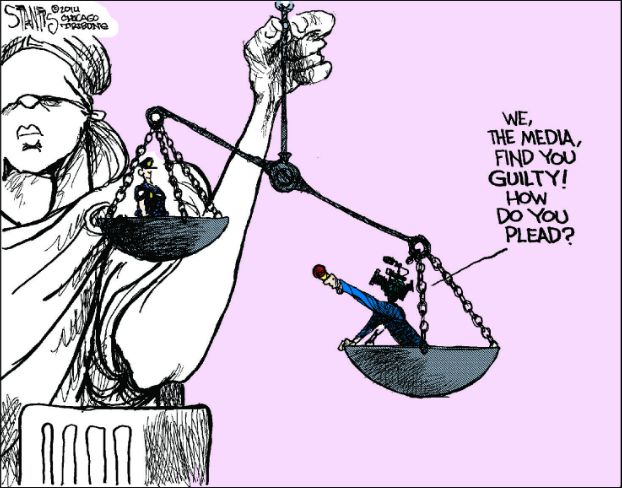
However, there is a flip side to the role of the media also. With the increased impact and growth of media, it is very crucial that the answerability and accountability of media are there because every freedom comes with certain duties and it is also an accepted fact that even some reasonable restrictions can be placed upon the freedom for the greater good. Many a time, to grab more readers and viewers, and to increase the TRPs, media houses often concoct and distort a story and present it to the society. They often violate the right to privacy of other parties for their professional gains and to sensationalize the issue. This blatantly violates the right of fair trial of the parties which has been guaranteed under the Constitution. There have been many instances where the media has conducted their trials through their reports and have given their verdicts before the Courts could reach a decision. This is known as “Media Trial.”

Some examples of Media Trial can be the Jessica Lal murder case, Priyadarshini Mattoo Murder Case, and the Nitish Katara murder case. The recent example of it can be seen in the Ayushi Talwar murder case. Trial by media creates an impression in the mind of society on the character of the parties irrespective of the decision given by the Court. The problem is worsened when an issue involves a celebrity or a big name, where media report can have a greater impact on the sentiments of the people. Between the advantages and disadvantages of media trial, the debate about the constitutionality of media trial goes on.


Impact of Media Trial


Freedom of Speech and Expression and Media Trial

Freedom of speech and expression plays a vital role in the formation of public opinion on various matters. Therefore, it can be said that freedom of speech and expression is the supreme of all liberties, as it allows a person to place his opinion among others.[3] Keeping this in view, in the case of “Express Newspapers (Bombay) (P) Ltd. V UOI[4] the Supreme Court stated that “freedom of the press is the heart of social and political intercourse. The press has now assumed the role of the public educator making formal and non-formal education possible on a large scale particularly in the developing world, where television and other kinds of modern communication are not still available for all sections of society. The purpose of the press is to advance the public interest by publishing facts and opinions without which a democratic electorate [Government] cannot make responsible judgments. Newspapers being purveyors of news and views having a bearing on public administration very often carry material which would not be palatable to Governments and other authorities.” This statement clearly points out to the fact that freedom of press and media is of utmost importance for the proper functioning of the democratic setup.1

In Printers (Mysore) Ltd. V CTO[5], the Apex Court stated that freedom of the Press is not a fundamental right which has been expressly guaranteed, but interpretation the Constitution implies that it is essential to give freedom of expression to the Press. In the judicial pronouncement of R Rajagopalan v. the State of TN,[6] the Court stated that this right extends to cases where public figures, public events, and issues are involved but a balance should be maintained between public events and private lives of people

Therefore, it is clear that the freedom of speech and expression gave to the Press is conferred by Article 19 (1) (a) of the Constitution, and since the Press does not stand any different from the other citizens of the country, no special restriction can be placed upon it.


Media Trial and Fair Trial

Indian-media-and-governmentMedia Trial can sometimes become a problem because it gives rise to two conflicting ideologies- a fair trial and freedom of Press. Both the concepts has an effect on the public lives. Freedom of public in the democracy gives the right to the freedom of Press. This is used as a justification for campaign and investigative journalism. On the other hand, a trial which is not affected by external factors, i.e., free and fair trial is a basic principle of the judicial system. A media trial may be prejudicial to the case of the parties, or it may influence the opinion of the court because to be very honest, no person is impartial and unbiased. It is human nature to be biased towards a certain view, and even a Court can fall into this trap. In many cases, the media exceeds its freedom of speech and expression by broadcasting and publishing materials which are prejudicial to the interest of the parties like the character of the parties, photographs, criticism of the witnesses, etc.

Article 14, 20, 21 and 22 gives various rights to a person through which he can exercise his right to free, and fair trial and the media cannot go beyond their rights to assert their rights. Needless to say, the right of having a fair trial is more important as it flows directly from Article 21 when read with Article 14. In a way, the right of having a fair trial is above freedom of speech and expression given to the Press under Article 19.

Media Trial and Right to be Represented

Sometimes, media trials create a lot of pressure on the lawyers, not to take the case of a party, which forces the accused party to go through the trials without having any defense. Take the case of Mohd. Kasab for instance. Yes, it was very evident that he was the guilty party. But did not he also deserve a fair trial? The media created a scenario where any lawyer who would have taken up his case seem like an anti-national. Isn’t this against the fundamental principles of natural justice? Every person is entitled to get the lawyer of his choice and defend himself in the court of law, and nobody can bar it from doing so. Another instance is when Ram Jethmalani decided to defend Manu Sharma. The criticism he faced from the media was immense, and it was stated that he was trying to defend the indefensible. Sometimes the media also presents a case in such a manner that if a judgment is given to contrary to that of the media trial, the judge who has given the verdict is made to look like as biased and corrupt.


Constitutionality of Media Trials


Freedom of Press

Article 19 of the International Covenant on Civil and Political rights, 1966 states that every person has the right to freedom of speech. However this right is subject to some duties and responsibilities and is subject to right and reputation of other individuals. In the judicial pronouncement of In Re: Harijan Singh and Anr and In Re: Vijay Kumar[7] The Supreme Court recognized media as an essential advantage in the democratic setup. Right to information and the right to broadcast is also conferred by Article 19 of our Constitution.

freedom-of-the-press-usaIn the case of Hamdard Dawakhana v UOI,[8] It was opined by the Court that right also includes the right to gain information and knowledge about matters that are of common interest. But the Supreme Court has also stated that a trial by media is opposite of the rule of law. But as the media is one of the foremost pillars of the democracy, their freedom can’t be curtailed, but can be restricted to a certain point.Balance should be maintained between the freedom of Press and the rule of law.


Immunity under Contempt of Court Act, 1971

Under this Act, pre-trial publications are given immunity against contempt proceedings, certain acts like the publication of any material by the media by the pre-trial stage can affect the interest of the parties involved in the trial. For example, in the case of Ayushi Talwar murder case, the media came up with a lot of reports like the character of the parties, the strength of the evidence etc. which proved prejudicial to the case of the parties. Despite this, these publications have been granted immunity. These publications may harm the justice system if they are not restricted to a certain level and if they are allowed to go unchecked.


Public’s Right to Know

The Supreme Court has stated that the main principle in giving the freedom to the Press it enjoys is that the public has the right to know what is happening in the society. The Apex Court elaborated on the principle and opined that the main function of the Press is to provide all-encompassing and objective information to the society which relates to country’s social, economic, political and cultural life. The media has an educative role to play while dispensing this function.[9] The Court also stated that the public has the right to know the “correct news” and the media shouldn’t make up stories to sensationalize matters.
b2ap3_thumbnail_media_bias

Highlighting the merits of the media in the Bofors Case,[10] The Supreme Court was of the view that those who know anything about the matter might come forward with information, it reduces crime through society’s disapproval of certain acts, and most importantly it leads to a public discussion of important issues.


Public Participation

Trial by media is often justified by giving the argument that the media highlights what is already there in the minds of the people. Media is also supported through the argument that in a democracy, having a transparent and accountable setup is of utmost importance. Without a free press, the society will go back to the time when proceedings were conducted in secret without the knowledge of the public. The media through its campaign journalism provides a platform to the public to express its opinion and hence ensure their participation.

Legal Norms and Journalistic Conduct

The Press Council is instituted under The Press Council Act, 1978. The main objective of the Council is to ensure the freedom of Press.[11] The Council also holds the authority to sanction punishment for irresponsible journalism.


Concluding Remarks

Trial by media can be regarded as a necessary evil. Many big scams were uncovered by the media, and the law merely followed them up. The media houses must be given credit where it is due for extracting information that was so well guarded. One of the other advantages of having a strong and free press is that people are now aware of their rights owing to the fact that they are being exposed to a lot of information. But the fact remains that media has to be a regulated in some way or the other. They cannot remain unchecked and do a trial which gains more publicity. The Supreme Court has also stated that it is acceptable that the media should be independent and free, but they can’t come in the way of Justice and exercise their freedom in such a way that it is prejudicial to the proceedings itself. The problem does not lie in media’s exposing the wrongs in the society. The problem arises when they go beyond the rights conferred to them and do things which they shouldn’t. The credibility of news media rests on unbiased, objective reporting. It is in the media’s interest to ensure that the administration of justice is not undermined.


[divider]


Footnotes:

[1]http://www.civilservicestimes.co.in/editorial-/current-national-issues/416-trial-by-media-looking-beyond-the-pale-of-legality-.html

[2]http://www.forbes.com/quotes/5916/

[3]Freedom of press in India: Constitutional Perspectiveshttp://www.supremecourtcases.com/index2.php?option=com_content&itemid=1&do_pdf=1&id=6752

[4](1985) 1 SCC 641 at p. 664, para 32.

[5](1994) 2 SCC 434

[6] (1994) 6 SCC 632

[7](1996) 6 SCC 466, paras 8, 9 and 10.

[8]1960 (2) SCR 671

[9]In Re: Harijan Singh and Anr.; In Re: Vijay Kumar, (1996) 6 SCC 466, para 10.

[10]KartongenKemiOchForvaltning AB v. State through CBI, 2004 (72) DRJ 693.

[11]Press Council Act, 1978, Section 13(1).

Download Now

Carbon Taxes – A Necessity?

0

In this blog post, Pramit Bhattacharya, Student, Damodaram Sanjivayya National Law University, writes about the concept of Carbon Taxes. The post looks into the meaning of a carbon tax. The post also highlights the effect of carbon tax on the economy. The issue of spending and cost with regards to the imposition of a carbon tax is also discussed in this post.

1451539_599879256736892_1144192258_n

Since the advent of the Industrial Revolution, when man learned to exploit nature for his benefit, the amount of Greenhouse gasses (GHG) in the environment has reached alarming levels. The social cost of exploiting nature almost indiscriminately was not taken into account at all, which lead to nature taking a complete turn. To counter the problem, protocols and agreements like the Kyoto and Montreal Protocol were signed.

Many economists and environmentalists came together and decided that some cost should be imposed on the use of natural resources and fuels such as coal, gas, oil, etc., to curb the deterioration of the environment. Following this, many developed countries started imposing “carbon taxes” in their territories mandatorily. Recently, the European Union levied a carbon tax on the Airlines Sector of India, and the taxes were only removed after India expressed its concern to the United Nations and they rejected the tax imposed by the European Union.[1]In the year 2010, India also imposed a carbon tax coal production (mining) and import of coal. The rate of tax levied is Rs 50/ metric ton.[2]


What is Carbon Tax?

“Climate change” can be said to be the biggest negative externality that is associated with the production of goods and services. It is one of the costs which is not considered at all and can turn out to be extremely damaging to the environment in the long run. To tackle this problem of climate change as a result of the unfettered exploitation of the environment, Arthur Pigou (eminent Cambridge Economist) suggested that the government should impose a tax on the production of goods and commodities which are equal to the social costs.[3]  carbon-tax

Carbon Tax can be defined as an environmental tax, that the government imposes on producers of goods and commodities who use natural resources or to be more precise fossil fuels like coal, gas and, petroleum in their production activities. When fossil fuels are used, carbon particles are released which pollutes the environment. This affects everyone and imposes a social cost on the society as a whole. This social cost is not reflected in the cost of production but nonetheless have certain consequences.

If the emission of pollutants is not checked, there will be no reason for producers to reduce emissions. To regulate the level of emissions, the polluter-pays principle is applied. Carbon Tax can be considered as a part of this principle.[4] It is a fee which depends on the emission of carbon which takes place either during the production process or while the product is being used. In some cases, the maximum emission level is also set, and going beyond that limit can attract heavy penalties.


Advantage of Having a Carbon Tax

In circumstances where the carbon tax is imposed, individuals or manufacturers are discouraged from the intensive usage of energy derived from fossil fuels. Also, it encourages the society to use less energy. For instance, people might start using more of public transportation or switch to CFL bulbs. In the case of a carbon tax, the higher the rate of tax, the greater the motivation for people to reduce emissions.


The Game Theory[5]

The Game Theory has not much got to do with law, but much to do with mathematics. It is a model of balancing conflict and cooperation to reach a rational decision. This theory plays an important role for a country like India to decide whether such taxes should be imposed or not.

The developed country of the world has two options. Either to impose the tax mandatorily or not to impose the tax. Now, whether a developing country (for example, India) should impose such tax or not depends on the decision of the developed nations. Because even if a developing country like India imposes the tax mandatorily, but the developed nations do not, it’ll not bring down the level of emissions and the tax will act as an additional and unnecessary burden on the citizen of the country.

Therefore, for a developing country like India, there’ll be no real benefit of imposing such a tax if other developed nations do not cooperate and impose it. At present only some of the countries in the European Union and Australia imposes a tax on the emission of carbon.

Economic Effect of Imposition of Carbon Tax

Any tax directly or indirectly affects the end consumer only. This holds true even for the carbon tax, as an imposition of the carbon tax will affect the final consumer. The producer will look to recover the amount he is paying a tax and will shift the burden of the tax on the consumer by increasing the cost of the product. The example of Quantas, an Australian Airline company can be cited here. They recovered the carbon tax imposed on them by the way of ticket surcharge. The total amount recovered from the customers was close to around $ 105 million.[6] Seen from the view of the economic system, this type of tax is not to generate any revenue but to change the behavior of the people. The negative impact of such a tax would be that every commodity will be sold for a higher price.dealing_in_different_currencies

The ultimate result will be a rise in inflation, a decline in standards of living and lesser opportunities of employment for the people of the country.[7] This type of situation, especially in a country like India, where the population is extremely high, along with high rate of poverty and an unstable economy makes no sense at all. And that too when the other developed countries are not imposing this tax. Imposition of a carbon tax in India may be a bad idea also because the idea in the first place is to encourage manufacturers to manufacture greener products. But at the present moment, the producers may not even have such advanced technology to manufacture such products. Also, the rate of emissions would not depend only on the imposition of a tax because emission of carbon is a very uncertain thing which depends on various factors.

The National Association of Manufacturer’s Report in the USA stated that if a carbon tax is imposed, it’ll result in a negative growth of the GDP of the country by 3.6% by 2053.[8] The average consumption of the citizen will also reduce which may impact the economy adversely. Talking about Australia, where the carbon tax is imposed mandatorily, the real GDP of the country may come down by 0.68, and consumer prices may rise by .75 %, and electricity cost may increase by 26%.[9]A Report which was prepared by the US Congressional Budget Office stated that such tax would also have a cascading effect and can hamper economic growth.[10]

Issue of Spending

A tax system which is neutral will be helpful in this case, which is beneficial for both, the economy and the environment. Denmark has approached the issue of a carbon tax in this manner. It provides subsidies and has reduced taxes to negate the extra burden of carbon taxes. Institute of Energy Research wrote a paper in which they mentioned that it is impossible to formulate a carbon tax system which is at the optimum level as the legislature cannot have all the possible information due to the uncertainty of climate.[11] There is a direct correlation between the economic development of a country and energy use. Carbon emissions are inevitable in this case. If taxes like these are levied, it’ll lead to low economic output. The imposition of such taxes would also lead to trade protectionism. For instance, if a country imposes a carbon tax it’ll result in a situation where cheaper imports will become a difficulty, which in turn would hamper the international trade of that country. The example of France can be cited here. France earlier proposed a carbon tax, but later the plan was scrapped as the government thought that imposing a carbon tax would place France in a disadvantageous position as compared to its other European neighbors.[12]carbon-tax-630

The Social Cost of Carbon emission is first, the direct impact which the emissions will have. Secondly, damage from the rise in sea level, and thirdly, the impact on human health. The only way forward it seems is to maintain a balance between the benefits derived because of the levy of the tax and the impact it would have on the economy. The criticism this approach faces is that the poor has to face the maximum burden, but contribute least to the problem.


Concluding Remarks

India has already imposed a tax on coal production and import, as stated above, where there is no such carbon tax even in some of the few developed countries. The best option for India would be to wait and watch.

The only way forward is to cooperate and work together with mutual understanding, because the matter of degradation of the environment is a very pressing one, and something has to be done about it. For a country like India, it’ll be best to see if other nations apply such taxes or not. In case, the imposition of such a tax does take place; a few incentives can be provided, for instance, lowering other kinds of taxes like Sales Tax and Value Added Tax on greener products.


[divider]

Footnotes:

[1]http://articles.economictimes.indiatimes.com/2013-10-08/news/42829450_1_carbon-tax-carbon-emissions-icao

[2]http://www.bloomberg.com/news/2010-07-01/india-to-raise-535-million-from-tax-on-coal-output-this-year-ramesh-says.html

[3]http://www.imf.org/external/pubs/ft/fandd/basics/external.htm

[4]http://www.econmodels.com/upload7282/27172cc93d8292880bf6d7eb8103cfd9.pdf

[5]http://www.lawctopus.com/academike/mandatory-carbon-taxes/

[6]http://www.theguardian.com/world/2014/mar/06/qantas-carbon-tax-bill-has-been-covered-by-ticket-surcharge

[7]http://www.cato.org/publications/commentary/carbon-tax-would-make-no-sense

[8]http://www.nam.org/~/media/ECF11DF347094E0DA8AF7BD9A696ABDB.ashx

[9]http://www.une.edu.au/__data/assets/pdf_file/0009/23877/econwp11-2.pdf

[10]http://cleantechnica.com/2013/05/25/carbon-tax-good-for-climate-and-economy-says-us-congressional-budget

[11]http://www.instituteforenergyresearch.org/2009/03/11/carbon-tax-primer/

[12]http://www.nytimes.com/2010/03/24/business/global/24iht-carbon.html?_r=1&

Download Now

Essentials Of A Contingent Contract

0

In this blog post, Pramit Bhattacharya, a student of Damodaram Sanjivayya National Law University, writes about the concept of contingent contract. The post discusses the essentials of a contingent contract and also discusses the difference between a contingent contract and some other type of contracts. The post highlights when a contingent contract can be enforced and when it’ll be void.

1451539_599879256736892_1144192258_n


According to section 2 (h)[1] of the Indian Contracts Act, 1872, a contract is an agreement in which two individuals enter and it is enforceable by law. In a contract, the party should give their free consent, should be competent to contract and the object and the consideration should be lawful. To form a contract, the agreement shouldn’t be declared as void. Thus, to form a valid contract, there should be two things- an agreement and its enforceability at law.

In regular course, the phrase contingent means “subject to chance.” In the Indian Contract Act also, the word means conditional. Future events are always uncertain. In the case of a contingent contract, the chances of happening of this uncertain event is ascertained and calculated and also the potentiality to deal with the event if they come to fore at all. The contracting parties may require that some obligation will be performed depending on the contingent event. The parties may agree that any right will be due, or any liability will be imposed on the happening of the contingency. Section 31 to 36 of the Act governs contingent contracts. Section 31 of the Act defines contingent contract as a contract between parties to do or not do something if some event which is collateral to the contract happen or does not happen. So, a contingent contract is also primarily a contract. But it is not an absolute or unconditional one. A contingent contract is dependent of the happening or non-happening of the event.


Essentials of a Contingent Contract

indian-contract-actlegal-aspects-of-business-45-638 

A contract to do or abstaining from doing something

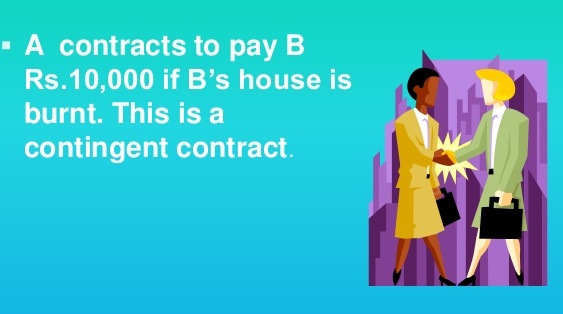
Section 32 and section 33 of the Act talks about enforcement of the contract on the happening of the event or the non-happening of the event respectively. The contract will be valid only if it is about performing or not performing an obligation. For instance, if X and Y enter into a contract that if X’s house is burnt, then Y will pay him Rs. 10,000 it’ll be a valid contingent contract.


Performance of the Contract must be Conditional[2]

The condition for which the contract has been entered into must be a future event, and it should be uncertain. If the performance of the contract is dependent on an event, which is although a future event, but certain and sure to happen, then it’ll not be considered as a contingent contract. Just the postponement of the happening of the event wouldn’t make it a contingent event. The event should be totally unpredictable for an individual and the happening or non-happening of the event shouldn’t be in the hands of the individual.


Event must be Collateral to the Contract

The event on whose happening or non-happening of the event on which the performance of the contract is dependent shouldn’t be a part of the consideration of the contract. The happening or non-happening of the event should be collateral to the contract and should exist independently. For instance, P enters into a contract with Q that P will pay him Rs. 5, 000 if Q’s car meets an agreement, but only if Q pays Rs 100 to P every month. In this case the obligation to pay Rs. 5000 will arise only when the car meets an agreement. This event is independent of the contract and is collateral to it.


Event shouldn’t be at the discretion of the Promisor

The event on whose happening or non-happening, the contract can be enforced should not depend on the promisor. In the judicial pronouncement of N.P.O Ballaya v. K.V.S Setty and Sons[3] it was held by the Court that where a person promised his lawyer that in case he wins the litigation, he’ll pay the lawyer his expenses related to tax and cost, the event would not be in the hands of the promisor and wouldn’t be at his discretion, because he cannot guide the litigation. To make a contract a contingent contract, the promisor should not have any power to control the events.


Difference between Contingent contract and other Contracts


wagering-contingent-contracts-5-638

  • Contingent Contract and Wager

There is a major difference between contingent contract and wagering contracts. A contingent contract is valid; a wagering contract is void.[4] In a wagering contract, money or its equivalent is given if the uncertain event is ascertained or determined correctly by the opposite party. The interest of the parties’does not lie in happening or non-happening of the event, but they are solely interested in determining the end result. For instance, A and B enter into a contract that A will pay B if there is a flood and B’s crops gets spoilt and is valid. In another instance, P and Q enter into a contract where P will pay money to Q is he correctly ascertains whether the flood will come or not. This is a wagering contract is void. In the first instance, the parties are interested in happening or non-happening of the event. But in the second instance, they are interested only in determining the happening or non-happening of the event and not interested in the event as a whole.

  • Agreement Subject to Contract and Contingent Contract

There is a difference between agreement subject to contract and contingent contract, as agreement subjected to contract is not a contract at all. In an agreement subject to contract, the parties are not bound by the contract until and unless a formal contract is executed between the parties, and such contract is formed by the willingness of the parties. A contract comes into existence only when an uncertain event happens. But in the case of a contingent event, the performance of the obligation is suspended until the happening or non-happening of the event. For instance, if X and Y agree that they’ll enter into a contract if Y’s house burnt down in a fire, this will be considered as an agreement subject to contract.


  • Impossible Act and Contingent Contract

If the parties get into an agreement to do an impossible act, it’ll not be a contingent event. For instance, if A enters into an agreement with B that he’ll pay B Rs. 10,000 if B brings back C to life, it is not a contingent contract and is void. In the case of a contingent contract, the main issue is that happening or non-happening of an uncertain event is presupposed, and not the happening or non-happening of an impossible event. “Possibility” of an event is very crucial in a contingent contract, but this element is absent in the case of impossible acts.

Enforcement of Contingent Contracts

Write a comprehensive note on the contingent or conditional contracts and in which circumstances these are enforceable

There are certain situations where the contingent contract can be enforced.

  1. On happening of the event – Section 32 states that if parties enter into a contingent contract, the contract can be enforced only on the happening of the event. Therefore, under this section, the contract is contingent on the happening of an event. The event has to occur before the obligation is discharged.
  2. On Non-happening of an event – Section 33 of the Act states that when parties enter into a contingent contract, subject to non-happening of an event, the contract can be enforced only when the happening of the event becomes an impossibility, and the contract can’t be enforced before that. For instance, if A and B enter into a contract that A will pay B a certain amount if a ship does not come back, then B can enforce the contract only when the returning back of the ship becomes an impossibility, like the ship sinks. There is no hope of the event now taking place.
  3. The event not happening within a fixed time – In the case of a contingent contract where it is agreed that if an event does not happen within a fixed time specified, then the contract can be enforced after the fixed time has elapsed, and the event has not happened. For instance, A and B enters into a contract that A will pay B a certain sum if a shipment doesn’t reach within a month. The contract can be enforced by B if the shipment doesn’t arrive within a month.


When Contingent Contract is Void

  1. If happening of the event becomes impossible – Section 32 also states that if happening of an event becomes impossible, the contract also becomes void.
  2. Conduct of a living person – Section 34 of the Indian contract states that when an event on which contract is contingent, the contract is to be deemed impossible if it is the future conduct of a living person.[5]In simpler words, if the event which is collateral to the contract is the future conduct of a living person and the person does any act which makes the happening of the event impossibility, then its void. In such as case the contingent contract cannot be enforced.


Concluding Remarks

For a contract to be a contingent, there are certain conditions which need to be fulfilled, because it is very evident that a contingent contract isn’t an unconditional an unqualified contract. The event should be collateral to the contract, and should not be under the control of any of the contracting parties.

Footnotes:

[1]https://indiankanoon.org/doc/1890444/

[2]http://icai.org/resource_file/16815Contingent.pdf

[3]AIR 1954 SC26

[4]http://mercantilelaws.blogspot.in/2012/05/distinguish-between-contingent.html

[5]http://comtax.up.nic.in/Miscellaneous%20Act/the-indian-contract-act-1872.pdf

Download Now

SC Makes It Easier For Good Samaritans To Save Lives

0

In this blog post, Pramit Bhattacharya, a student of Damodaram Sanjivayya National Law University writes about how the Apex Court has made it easier for the “Good Samaritan” to help the victims of road accidents. The timeline of the developments has been highlighted in the post. The guidelines given by the government has also been discussed in the post.

1451539_599879256736892_1144192258_n

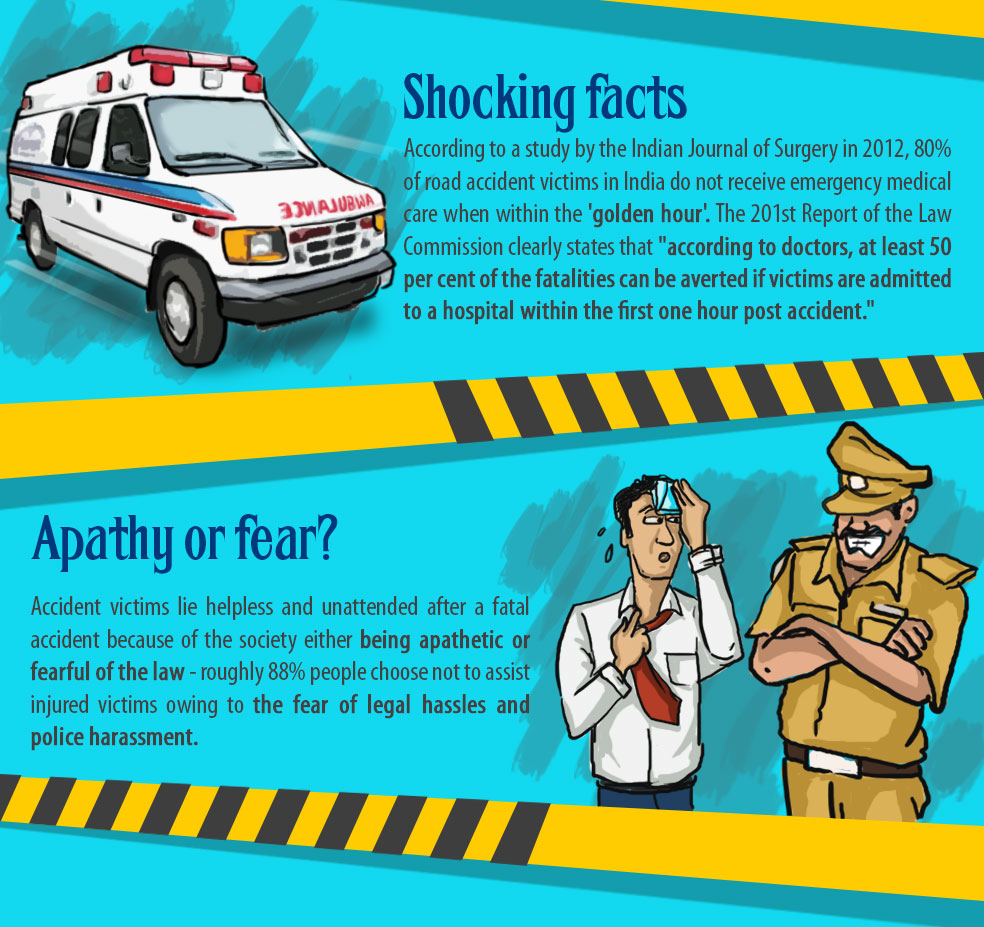
There are two very crucial questions regarding this issue. The first and the foremost is the high number of accidents that occur on roads in India. Every day around 350 people die in road accidents and crashes. Most of the victims suffer due to causes which can be prevented if the general populace puts in a bit of effort. These factors include accidents due to overloading, speeding, driving on the wrong side, drink driving, etc.[1] The second question with regards to the issue is that why are people not willing to help the road accident victims? Almost 75-80 % of the population are very hesitant when it comes to helping victims of road victims. This hesitancy is a mental belief in the minds of the public that even if they do a good deed, they will be involved in legal hassles, they’ll face police harassment, they’ll be detained in the hospitals and the police stations for a long time, and they would be called to the Court of law again and again. These were the finding of an NGO which goes by the name of SaveLIFE Foundation. This foundation is a non-governmental, non-profit and independent organization and their main aim is to bring improvement in road safety and emergency care.[2] The Law Commission of India also observed in its 201st Report that almost 50 % of the deaths could have been prevented had the victims got timely help from the bystanders.[3] Not only the Law Commission but the World Health Organization is also of the opinion that empowered and skilled bystanders play a very crucial role in saving the lives of the victims. The WHO also opined that the bystanders should come forward and help the victims as much as they can, and for them to come forward voluntarily without any hesitation, it is extremely important that an ethical environment and a supportive legal structure is present, where such bystanders wouldn’t be harassed.[4]

W6JAd2lu

Keeping this in mind, the SaveLIFE Foundation filed a PIL.[5] They conducted a study on the national level and by it the foundation submitted a report to the Court which stated that three out of four people are not willing to help victims of road accidents. The report also stated that 88 % of people were hesitant because of the long and complicated legal formalities.[6]


Timeline of the Developments

The PIL was filed by the Foundation in the year 2012. The PIL was filed with the aim of having a proper legal setup and guidelines in place which would protect the people who help road accident victims from unnecessary intimidation and harassment. The PIL also aimed at having efficient and proper trauma services across the nation. In furtherance of this PIL, the Apex Court in October 2013 appointed a three-member committee under the guidance of former Judge K. S. Radhakrishnan. The committee also comprised of scientist Nishi Mittal and former Secretary of Road Transport Ministry, S. Sundar. The Committee had to study the issues mentioned in the PIL and file a detailed report to the Court. The recommendations which were made by the Committee were also strongly supported by the Ministry of Road Transport and Highways through an affidavit in October 2014. Based on this, the Supreme Court directed the Ministry of Road Transport and Highways and Ministry of Law and Justice to issue such directions which were necessary to protect the people who help road accident victims, until a proper law was enacted by the legislature about this issue. In May 2015, the Ministry of Road Transport and Highways notified the guidelines.[7] The guidelines stated that disclosure of the identity of a person who helps an accident victim is voluntary. The guidelines also stated that such a person wouldn’t be liable for any criminal or civil liability. Furthermore, on January 2016, the Government also issued the Standard Operating Procedures to protect Good Samaritans from police harassment. These procedures included the examination of a person during a trial or by the police.[8] The problem with these guidelines was that they had no legal backing at all. They were just advisory in nature. It was difficult to implement the guidelines without any legal backing. There was still a fear among the people that these guidelines could well be violated by the authorities. But on 4th of March, 2016, the Apex Court at the hearing of the petition stated that the guidelines given by the Ministries would be binding throughout the country. On 30th of March 2016, the guidelines which were issued by the Centre was approved by the Supreme Court.


A Vital Step

good_samaritan_1

The judgment given by the Apex court is very significant because now it is as good as a law. If any party does not comply with the guidelines, it’ll be treated as the contempt of the Apex Court. Before the judgment was passed by the Supreme Court, these guidelines were merely advisory in nature and the authorities were not bound to follow the guidelines. After the judgment has been passed, these guidelines have become reliable for the people to bank upon. The Central and the State Governments now has the responsibility to implement these guidelines in efficient manners so that it can be helpful to the good Samaritans. Although these guidelines will act as interim measures till a proper law is made, this is still a very vital step to protect the interest of the people who help the victims of road victims.


The Guidelines[9]

good_samaritan_2

  • Any person who takes a victim of a road accident to a hospital can leave the hospital immediately without being asked any questions. Such people cannot be compelled to stay until and unless they are there in the capacity of an eye witness too. In such a case also only their residential address can be noted without being forced to stay.
  • Any person who has helped a victim of a road accident may also be awarded by the concerned State Government. This is to ensure that their efforts are appreciated, and other such people are also encouraged to help those in need.
  • A bystander who helps a road accident victim be not held liable for any civil or criminal matter.
  • When a Good Samaritan calls any emergency service or the police to the place where the accident has taken place, it is not necessary for him/ her to reveal the name or for that matter any such personal information.
  • It is also optional for such person to fill his or her personal details in the medico-legal form which is provided by the hospital.
  • Those officials or authorities who force any person to reveal their personal details or identity will face departmental and disciplinary actions.
  • When the bystanders voluntarily state that he or she was an eyewitness to the accident, then he/she can be examined by the police as a part of the investigation or be questioned in a trial. But this examination or questioning can be done only once, and the Standard Operating Procedure should be followed, so the person is not harassed again and again.
  • The examination which is being done should be carried out only under Section 284 of the CrPC[10] or through an affidavit under Section 296 of the CrPC.[11]
  • The witnesses can also be examined through video conferencing to make the procedure speedier and save them from any inconvenience.
  • These guidelines also direct the Ministry of Health and Family Welfare to issue further guidelines which bar private and public hospitals to detain the helper or ask them to pay the registration or the admission cost until and unless such a bystander is the family member of the victim who needs immediate treatment.
  • If any doctor fails to provide aid to the victim of a road accident when he has the duty to help the victim, it would be considered as “Professional Misconduct” which has been prescribed by the Indian Medical Council Regulations 2002, and appropriate action will be taken against such doctor.
  • All hospitals are required to put up a notice in English, Hindi, and the regional language of the particular State or the Union Territory and the notice will clearly state that no helping bystander is required to pay any money or furnish his or her personal details.
  • If the bystander requires an acknowledgment on the part of the authorities or the hospital that the victim was brought by him or her to the hospital, the authorities or the hospital are duty bound to prepare and furnish an acknowledgment document as per the procedures laid down.
  • All the hospitals, whether private or public need to implement these guidelines as soon as it is practicable. If the guidelines are not implemented within a reasonable time, action will be taken against such hospitals.


Concluding Remarks

Although people are hesitant to help the victims of a road accident, the introduction of these guidelines will act as a barrier against the harassment and inconvenience these people face. The helpers will also be encouraged by the incentive which is being provided to them for their kind act. A supportive framework like this will also reduce the number of death which happens due to road accidents and crashes, as people would be more willing to help the victims now.

Footnotes:

[1]http://scroll.in/article/757365/road-accidents-kill-382-in-india-every-day-1682-times-more-than-terrorism

[2]http://savelifefoundation.org/wp-content/themes/savelife/documents/SaveLIFE%20Report-Impediments%20to%20Bystander%20Care.pdf

[3]http://lawcommissionofindia.nic.in/reports/rep201.pdf

[4]http://apps.who.int/iris/bitstream/10665/43167/1/924159294X.pdf

[5] Writ Petition (Civil) No. 235/2012

[6]http://thewire.in/2016/03/30/sc-guidelines-now-protect-good-samaritans-who-help-road-accident-victims-26680/ ; supra 2.

[7]http://egazette.nic.in/WriteReadData/2015/164095.pdf

[8]https://savelifefoundation.org/wp-content/themes/savelife/Documents/GazetteNotification_SOPforGS.pdf

[9]http://www.jaagore.com/articles/know-your-police/helping-road-accident-victims-without-any-consequences

[10] When attendance of witness may be dispensed with and the commission issued

[11] Evidence of formal character on affidavit


Download Now

Need For Laws On Artificial Intelligence In India

1

In this blog post, Vineet Kumar, a student of National Law University of Orissa, and Nalini Chandrakar, a student of Hidayatullah National Law University writes about artificial intelligence and its need in India. The blog post also deals with the recent developments in artificial intelligence and its position in India.

347846-artificial-intelligence

Introduction

Humans have always attempted to find new ways to perform different tasks easily with least efforts. For this, new technologies have been developed and are still being developed, one of which is the technology of Artificial Intelligence. Though the concept of artificial intelligence originated way back around the 1950s, the field still requires a lot of research and development even in the developed economies of the world. The idea that humans could, at some point, develop machines that actually “think” for themselves and act autonomously has been embedded in our literature and culture since the beginning of civilization.[1]

Defined by Prominent Minds- In simple terms, artificial intelligence can be understood as a technology that the can behave, respond and act like humans and may also replace human species in different works, like driving. It is difficult to give a precise definition to the term “artificial intelligence”. As per Haugeland, it is “the exciting new effort to make computers think…machines with minds, in the full and literal sense”.[2] For instance, the mathematician named Akan Turing, who is most closely associated with the artificial intelligence, contributed to the development of Manchester Mark I computer and was involved in research aimed at the question of how to judge the intelligence of a machine. His speculation on the latter led to which is now called the “Turing Test.”

For Bellman, it is “the automation of activities that we associate with human thinking, activities such as decision-making, problem-solving, learning…”[3]Charniak and McDermett define AI as “the study of mental faculties through the use of computational model”.[4] And for Winston, it is “the study of the computations that make it possible to perceive reason and act.”[5]


Artificial Intelligence and Law

The Artificial Intelligence and Law, the domain of both, are enticing for AI analysis for many reasons. First, the law encompasses a tradition of examining its reasoning method. Second, a lot of legal data is quickly accessible and comparatively well structured, written and indexed. The Lawyers’ nowadays are technology savvy and have an interest in AI techniques and software system. Lawyers’ offices use tools that gather, filter, and structure legal arguments in an exceedingly efficient manner. The sooner works within the field like Lexis and WESTLAW be keyword based mostly. Within the domain of AI to law, the researchers have encountered attention-grabbing and troublesome issues of each the fields. The domain of AI and law is far more than an applications space. The sector touches upon problems at the terribly heart of AI reasoning, illustration, and learning. Topics like negotiation, decision-making, e-commerce, linguistic communication, information retrieval, extraction and data processing AI and Law may be a wealthy supply of issues and motivation for the interested researchers.

law-technology-court-robot-100597018-primary.idge

There are works in past regarding confronting of legal arguments that haven’t solely created programs that would lead to producing legal arguments. However, additionally, it has led to insights and advances within the logic of argumentation. The application-oriented works have often provided insights into the restrictions of existing techniques. There’s forever collaboration, not solely between Law and AI however additionally between AI and AI. Work on AI and Law has been notably fruitful within the last decade. Besides providing advanced laptop applications for the legal domain like knowledge-based systems and intelligent data retrieval, analysis on AI and Law has developed innovative knowledge base models for understanding legal systems and legal reasoning, which plays a vital role in the field of philosophy of law and legal theory. Today there is a robust need for group action analysis in AI and law among legal theory, but additionally, it’s required to cover the various branches of analysis in AI and law.

Michael Negnevitsky in the book “Artificial Intelligence: A Guide to Intelligent Systems” says that “the development of expert system created knowledge engineering: the process of building intelligent systems. Today it deals not only with expert systems but also with neural networks and fuzzy logic. Knowledge engineering is still an art rather than engineering, but attempts have already been made to extract rules automatically from numerical data through neural network technology”.


Recent developments

Though, practically speaking, robots are unlikely to replace lawyers in court, but they can prepare papers for hearings. Despite the early enthusiasm, the concept of computers and robots replacing human hands in legal reasoning tasks is yet to get a real shape. However, there are positive signs that a combination of technological advance and market forces may push the law firms and make them step into the AI stage. A recent study conducted by Jomati points out that, “technology can suddenly race ahead at astonishing speed”.[6]

AI based system has already been introduced in the field of journalism. The Associated Press news agency has devised strategies to automate the writing of corporate earnings reports with an AI system named Wordsmith. It spots designs, patterns and trends in raw data and then describes those findings in natural language. Applying the similar technique, legal documents can be produced, and such systems could also carry out many tasks given to the paralegals and junior associates. Another more sophisticated use of the AI technology can be done to provide strategic guidance. By trawling through past case records in no time, a system can find the optimum percentage at which an increased offer would lead to a settlement position in a case.

darpa-AI-675x437

Recently an Ohio-based law firm called Baker & Hostetler had recruited IBM’s AI Ross to handle and manage their bankruptcy practice.[7] It is based on IBM’s Watson, which is a cognitive computer with the capability of gaining knowledge about humans by noticing their interactions, experiences and perceptions.  In other words, it is based on the technique of human recognition.

In Japan, robots powered by the Watson technology are used by Nestle cafes to provide information about their products to the consumers. The US Defense Advanced Research Projects Agency (DARPA) is presently funding some artificial intelligence projects which could potentially equip governments with the most powerful weapon possible, i.e. the mind control.[8]


Position in India

WebLogo3

Currently, there are no defined laws or regulations that govern the field of artificial intelligence in India. Though India is making fast progress regarding technology, the scientists are yet to discover full potential and utilization of this technology. Some independent bodies exist with an aim to research and create machinery underlying the thought of intelligent behaviour.

One such organization is the Artificial Intelligence Association of India (AIAI). Founded in the year 2009, it is a non-profit scientific society devoted to advancing the scientific understanding of mechanisms underlying the thought and intelligent behaviour and their embodiment in machines.[9]

Indian innovations are yet to be implemented with this technique. The Centre for Artificial Intelligence and Robotics, which is a branch of DRDO, has developed the Network Traffic Analysis Software (NETRA). This software has capabilities to intercept and analyze the internet traffic via specified filters. Currently, this software is being used by RAW, IB, state-level law enforcement agencies and is piloted by Ministry of Home Affairs.[10] There is a need to realize the true potential of the Artificial Intelligence technology and implement it judiciously in different fields like defense, sports, infrastructure, etc.


Footnotes:

[1]Haugeland, J., (ed.) Artificial Intelligence: The Very Idea, MIT Press, USA, 1985, quoted in Stuart J Russell and Peter Norvig, Artificial Intelligence: A Modern Approach, Tan Prints (India) Pvt., New Delhi, 2002, p.5

[2]Philosophy of Artificial Intelligence: A Critique of the Mechanistic Theory of Mind, RajakishoreNath, p.21

[3]Bellman, R. E., An Introduction to Artificial Intelligence: Can Computers Think?, Boyd and Fraser Publishing Company, San Francisco, USA, 1978, quoted by Stuart J Russell and Peter Norvig, in Artificial Intelligence: A Modern Approach, p.5

[4]Charniak, Eugene & McDermott, Drew, Introduction to Artificial Intelligence, Addison-Wesley Publishing Company, Canada 1985, p.6

[5]Winston, Patrick Henry, Artificial Intelligence, Addison-Wesley Publishing Company, London, July 1984, p.2

[6]Civilization 2030: The Near Future for Law Firms

[7]indiatoday.In (May 20th, 2016)

[8]Hacking Without Borders: The Future of Artificial Intelligence and Surveillance, Maria Xynou, The Center for Internet & Society (Mar. 15th, 2013)

[9]aiai.org.in

[10]The Centre for Internet and Society


Download Now

Medical Treatment For Terminally Ill Patients’ Bill, 2016

1

This blog post, Surbhi Kapoor, a student of Amity Law School, Delhi IP University, talks about the newly proposed bill on medical treatment for terminally ill people. This bill gives provisions for legalization of passive euthanasia. The article analyses the development of the Bill from the 196th Law Commission Report to the 241st Report. Some drawbacks of the Bill have also been mentioned.

surbhi

The Medical treatment for terminally ill patient’s bill, 2016 was proposed by the ministry of heath and family welfare based on the recommendations of the 241st law commission. The bill deals with the legalization of passive euthanasia but does not talk about active euthanasia. Passive euthanasia means the life system of the patient that is supported for the continuance of life. In simple words, in passive euthanasia, no efforts are made to preserve the life of the patient. Passive euthanasia can further be divided into voluntary and non-voluntary. Under voluntary passive euthanasia, the patient is under such conditions that he can make decisions of his life and can give consent for euthanasia. However in no voluntary passive euthanasia, it is difficult to receive the consent of the patient. So the decision has to be taken by the medical practitioner of the patient or the close relatives. Their decision shall not be final and has to be approved by the high court.

Active euthanasia involves injecting a lethal substance to the patient to give the patient a painless death. Active euthanasia considered to be a crime all over the world (irrespective of the will of the patient) except where permitted by legislation, as observed earlier by Supreme Court1. Active euthanasia is a crime in India under section 302 and section 304 that deal with punishment for murder and punishment for culpable homicide not amounting to murder respectively.

euthanasia_1

A brief on 196th Report by Law Commission                                                                      

The report dealt with the withholding of the life support system of terminally ill patients which is legal is most of the countries. The bill had made recommendations that if the patients were incompetent, the doctor should obtain the consent of 3 other experts in the same field and form the patient and other close relatives about the same. The name of the experts would be given on a panelist. Then a period of 15 days would be given to the about file a case in the high court seeking whether the act was lawful or unlawful in the eyes of the court. The decision of the high court shall be binding on all the people. The letter filed would not require any formalities as in the normal process of filing a complaint with the high court require. The letter would be treated as an original petition and will directly be placed in front of the magistrate for decision. Here, the terminally ill patient if competent has the right to refuse treatment.“In our view where a medical practitioner is under a duty at common law to obey refusal of a patient who is an adult and who is competent, to take medical treatment, he cannot be accused of gross negligence resulting in the death of a person within the above parameters2.

Aruna Shanbaug case

Aruna-Shanbaug-Case

This was the first case in Indian history that discussed on length about euthanasia. The supreme court made it clear that passive euthanasia is permissible. It made clear that a close relative cannot take a decision on behalf of a terminally ill patient who is incompetent to make decisions. Aruna Shanbaug was in persistent vegetative State for about three decades, and there was the very little scope for recovery. She had been abandoned by her family and was being looked after by the staff of KEM hospital where she used to work before. In PVS state the brain stems work and are active while the cortex loses its functioning and activity. In such a state the brain is not dead. The important question before the court was that what would be the best decision for the patient when he/she is in PVS state. So this authority was vested in the high court. The emotions of the parents, spouse, or close relatives should not be given much weight as the decision should be in the best interest of the patient and no one else.


Approach to Competent Patient

If a patient is suffering from an irrecoverable disease and is undergoing terrible suffering and mental agony and does not wish to live using artificial means. The person would not want to send a lot of money for the treatment when he may not be totally recoverable. Article 21 what gives every individual a right to live does not get violated when the life support system us withdrew for the interest of the patient itself. No law can take away the right of a patient to die with dignity and care.In the words of Justice Cardozo, “every human being of adult years and sound mind has a right to determine what shall be done with his body and a surgeon who performs an operation without his patient’s consent commits an assault for which he is liable in damages.”4

Approach to incompetent person

If a person is unconscious and cannot communicate his will and is suffering from some life threatening disease that may be irreversible, he cannot be refused the right to die if it is in the best interest of the patient. Article 21 should not forbid the resort of passive euthanasia to an incompetent person

141af6b8-2f3a-4afa-9229-99b0e86c0cf4

Recommendations made by the Bill

The legal recognition of passive euthanasia has been pending since the 196th law commission report. The Supreme Court gave consent to the same under the case of Aruna Shanbaug v. Union of India5. Passive euthanasia is allowed in many countries and should have legal recognition in our countries as well. The bill is not objectionable from the legal or constitutional point of view. A competent adult person can take an informed decision. An incompetent person or a competent person who does not take an informed decision, the decision of the doctor or the relative will not be considered to be final. Notice to the high court has to be given for the same. The decision of the high court will be final. The high court will take the decision after obtaining the consent of 3 experts in the field, and the decision should be taken in the best interest of the people.

The medical practitioners should be given protection when they act according to the decision taken by the competent patients. The government should make palliative care available at affordable cost to all the terminally ill patients.


Limitations

There are some issues where the bill has failed to incorporate strict laws and execution of which can create problems. The patient needs to give an informed decision if he is competent to do so. However, issues were raised about the validity of these and the authenticity of such consent. Audiovisual recording of obtaining consent and the medical trail could be helpful in such cases, but the bill does not address any of such problems. The bill does not differentiate between patients who were competent while giving the decision of informed consent or those who expressed their view earlier in the form of a directive.

Under clause 3 of the bill, the decision of the patients competent to give their consent can give informed consent; their decision would be considered to be binding on the medical practitioners of the patient. However, the clause 9 states that the decision of the medical practitioner or the close relatives of the patient will not be binding on the medical experts. The decision has to go to the high court within 15 days. Then the verdict given by high court would be binding on the doctors and the relatives.

The definition of “terminal illness” can also include even mental health issues. Section 2 clause m that defines terminal illness such illness, injury or degeneration of physical or mental condition which is causing extreme pain and suffering to the patients and which, according to reasonable medical opinion, will inevitably cause the untimely death of the patient concerned, or (ii) which has caused a persistent and irreversible vegetative condition under which no meaningful existence of life is possible for the patient4. This definition can also include acute mental illness and agony. The choice of the High Court as a forum to obtain permission for the withdrawal of treatment from incompetent patients imposes a lot of burden on medical practitioners and the relatives and does not take into account that High Courts will not be able to deliver judgment in such cases.

If the bill gets approved, the medical council of India will have an active part to play. The medical council will have to prepare guidelines for the medical practitioners to see when they can withhold the medical treatment being given to the patient. The NGO common cause played an important role in the framing of the bill as the PIL filed in the Supreme Court mentioned that when a patient has reached a stage from where he cannot recover back, it is essential that he should be given the right to refuse any support material to die with dignity. The bill would restore the dignity of the patients.


Download Now

Ordinance – How The Executive Exercises Legislative Power

0

In this blog post, Shubham Khunteta, a student of National Law University Odisha, Cuttack, discusses about Ordinances- from its promulgation, repromulgation and validity, to its relevance, advantages and disadvantages in independent India.

lok_sabha_india_hd_images_computer_background

There are times when some temporary law is required to be passed with the objective of accessing and gaining some power over an area and regulate it immediately. Due to the parliament or state legislature not being in session at that particular time, such legislative powers are required to be exercised as a matter of urgency by some other competent authority such as the President, as the head of the Union. Furthermore, this power to promulgate an Ordinance conferred on the President is co-extensive with the power of Parliament to make laws and the President cannot issue an Ordinance which the Parliament cannot enact into a law.

Ordinance-making power is not a new feature added to the Indian Constitution. Articles 42 and 43 of the Government of India Act, 1935, gave equivalent powers to the Governor General. Members of the Constituent Assembly, having experience of misuse of such power, were justifiably cautious while including the same in the Constitution. Both Hriday Nath Kunzru and Professor K.T. Shah called for restricting the executive’s power to promulgate ordinances through greater oversight by legislatures. They were, however, overruled by Dr B.R. Ambedkar, who stated that ordinance-making powers were indispensable since the existing law at any time, might be incapable of dealing with a situation “which may suddenly and immediately arise”[1]. According to him, the only solution was to “…confer upon the President the control to promulgate a law which will assist the executive to deal with that particular situation because it cannot resort to the ordinary course of law…” when the legislature was not in session.

Ordinances can be said to be the fruits of executive power of law-making. As we are aware that the Parliament consists of the Lok sabha, the Rajya Sabha and the President, where President is the ultimate signatory to any bill passed by the Parliament to make it an Act, similar is the case with an Ordinance issued by the Government which needs to be signed by the President before it can be effective as law.


Issue of Ordinance and its Conversion into Law

BL17_flag_jpg_2207308e

Ordinances are issued by the Central government and the State Government concerning matters they have the power to deal with. These ordinances have to be signed by the President[2] and the Governor respectively to promulgate it or give it the enforcing and implementing power of the law, but the Governor shall not, without instructions from the President, promulgate any such Ordinance if-

(a) A Bill containing the same provisions would under this Constitution have required the previous sanction of the President for the introduction thereof into the Legislature; or

(b) He would have deemed it necessary to reserve a Bill containing the same provisions for the consideration of the President; or

(c) An Act of the Legislature of the State containing the same provisions would under this Constitution have been invalid unless, having been reserved for the consideration of the President; it had received the assent of the President[3].


Validity of the Ordinance

Ordinance passed by the executive has the same effect as that of an Act passed by the Parliament under Art 123(2) or a state legislature under Art 213(2). After this conclusion, the next question that arises is – Whether an ordinance can be struck down on the ground of non-application of mind or mala fides or that the present circumstances didn’t warrant the issue of the Ordinance?

The answer to the question was given by the Court in A.K. Roy v. Union of India[4] that the legislative power is subject only to the limitations prescribed under the Constitution and no other. So, if any law is passed by legislature which it is not competent to be so passed and which is violative of Part III of the Indian Constitution, it is ineffective.

It can be thus understood from the interpretation of the court of Art 123 and Art 213 of the Indian constitution, that ordinance making power of the executive is a legislative power and not an executive action or administrative decision. Thereby, it is assumed by the Courts that legislative discretion is properly exercised and that the propriety, expediency and necessity of a legislative act are for the determination of the legislative authority and of the courts; therefore keeping the motives of the executive beyond judicial scrutiny. So, power can be said to be plenary and there are no limitations on such power as that of the legislature except those to which the legislative power of the legislature is subject to.[5]

As an Ordinance stands on the same footing as that of an act of the Parliament, an ordinance should be arrayed with all the attributes of an Act of legislature, carrying with it all its incidents, immunities and limitations under the Constitution  There is however, a limitation to the aforesaid power wherein it is laid down that every such Ordinance promulgated by the President must be placed before both the Houses both its approval and that it would cease to operate at the expiration of six weeks from the re-assembly of the Parliament or if before the expiration of that period a resolution disapproving it is passed by both the Houses.[6] Similar is the case with an Ordinance passed by the State Legislature.

It can be inferred from above that any act done by the Executive or a State Legislature during the validity of the Ordinance would remain valid for all purposes even after the expiration of Ordinance unless it is brought down by the legislature to nullify the effect of such Ordinance Thus, rights created by the ordinance last even after the expiry of the Ordinance.

When can ordinances be issued?

As already stated above, an ordinance is temporary law, which requires to be approved by the Parliament or a State Legislature, as the case may be, within 6 weeks of the reassembly of legislature. Such temporary laws which are passed to maintain flexibility in the affairs of public importance at the time of emerging, extraordinary and immediate need for the passage of such law are called Ordinances and they have the same effect as that of an Act passed by the Parliament or a State Legislature. The question that arise now –

What is the ambit of ‘extraordinary, immediate need and urgency’ to promulgate an ordinance by the Executive bypassing the Parliament and a State Legislature?

Immediate need as stipulated in various ordinances-


Food security Ordinance 2011:

food-security-795x406

This Ordinance was promulgated with the objective to guarantee food and nutritional security and providing certain minimum foodgrains at the rate of Rs 1-3/kg to around 75% of the rural population and 50% of urban population and to provide cash in case the state fails to ensure such food supply. Since the Parliament was not in session to pass an Act, thereby it was taken to be an immediate need to provide food to the swarming millions of people by the promulgating of this ordinance.

Telecom Regulatory Authority of India (Amendment) Ordinance, 1997[7]:

This ordinance was promulgated to bring into existence TRAI with the objective as stated by the Minister in parliament being, “… we were facing difficulties in attracting private investment without an authority like the TRAI. Private investors… were not convinced about our ongoing processes of privatization and liberalization.” Important as it is to send out a signal of commitment towards a particular government policy, in this case liberalization of the telecommunications sector, it is hard to make the case that had immediate action by promulgating an ordinance. Had this action not been taken, private investment in the telecommunications sector would never have happened.[8]

The Securitization and Reconstruction of Financial assets and Enforcement of Security Ordinance (SARFAESI), 2002:

The then Minister for Finance and Company Affairs said one factor that forced the promulgation of the ordinance was the time that was being taken by the Standing Committee concerned to finalize its views on the Bill.

The National Tax Tribunal Ordinance promulgated in 2003

This was because various committees had recommended that such a tribunal be established, and as “…huge revenue is blocked in litigation because of pendency of appeal and reference is before the High Court, which has adverse effect on the national economy”.


Ancient Monuments and Archaeological Sites and Remains (Amendment and Validation) Ordinance, 2010[9]:

It was promulgated to meet a deadline imposed by the Delhi High Court[10] and to make provisions for validation of certain action taken by the central government for public purpose.

National Eligibility-cum-entrance test (NEET) ordinance 2016[11]:

NEET-SC

This ordinance was issued to overturn the Supreme Court order of conducting national level medical test for admission in reputed medical colleges from July 2016 and to defer such test to the year 2017 so that states can have a 1-year preparation period beforehand and students don’t get affected with such immediate conducting of the tests. The ordinance was promulgated on 24/5/2016[12].

Repromulgation of Ordinance

The Delhi High Court, in the case of Gyanendra Kumar and Anr. v. Union of India[13] and Ors, held that the repromulgation of ordinance by the government does not smack off unconstitutionality due to the following reasons-

  1. The Executive in the session of parliament laid the bills same in contents as the Ordinances, which, due to the overload of work in the parliament couldn’t come up for discussion, thereby warranting, in the opinion of the President, a need for repromulgation as the government followed due procedure and didn’t bypass the requirement of repromulgating the ordinance. The bill to the effect, had been laid before the parliament only to be not discussed due to heavy and other urgent and emergent work-load of the business of both the Houses in the aforesaid sessions.
  2. Action of Government in re-promulgating the 10 Ordinances definitely falls within the ambit and scope of the exception carved by the Supreme Court[14].

The Supreme Court in the DC Wadhwa case[15] observed that the power of a governor under Art. 213 to re-promulgate an ordinance is same as that of the President. However, while resorting to such emergency powers exercisable under Art 123 by the President and under Art 213 by a Governor, it can’t take-over the law making function of the Parliament and a state legislature respectively as that would be clearly subverting the democratic process that lies at the core of our constitutional scheme.

The aforesaid observations came to be recorded by the Supreme Court in view of the fact that an ordinance has to be replaced by a Bill which is to be introduced before the Legislature for its debate and then accepted and that without resorting to the said procedure if the Government resorts to the power of re-promulgating the Ordinances without bringing a bill in the House, that would amount to the executive taking over the law-making-power which is only vested in the Legislature and would therefore, amount to fraud of constitutional power[16].

Advantage of Ordinance

  1. The passage of ordinance is time-testing. It proved to be advantageous at the time-
  2. The government’s attempt to demonetize large rupee denominations in 1978 to prevent illicit money transfers,
  3. The creation of the TRAI in 1997 to raise private investors’ confidence in the ongoing process of liberalization and
  4. The ordinance to amend the Land Acquisition Act to kick-start stalled projects.

2. It is commonly used to meet the deadline set by the courts for certain implementations and defer certain diktats of the court like the recent NEET Ordinance, 2016 so as to avoid inconvenience and give relief to the states for certain period, but it should not be used to send a wrong message about the country’s democratic bearings as unilateralism needs no time to convert into authoritarianism.

3. The conferment of such power may appear to be undemocratic but it is not so, because the executive is clearly accountable to the legislature and if the President, on the aid and advice of the executive, promulgates an Ordinance in misuse or abuse of this power, the legislature can not only pass a resolution disapproving the Ordinance but can also pass a vote of no confidence against the executive.[17]


Disadvantages of an Ordinance

Ordinances have generally been based on political consideration rather than on principles of good governance like-

  1. The promulgation of the SARFAESI Ordinance in 2002, when the bill was being deliberated by the concerned Standing Committee, the promulgation of the Electricity Regulatory Commissions Ordinance in 1998, one day before the government had agreed to convene;
  2. The last government’s ordinance to shield convicted legislators is all instances when the Executive’s unilateralism sent a wrong message about the country’s democratic bearings.

{D8DAF4BC-4712-46CC-8A58-FDF5288E9A3C}

Conclusion

As can be understood and inferred from above, ordinance making power of the executive is the legislative power which can be exercised by it subject to the approval of the Legislature. The exceptions available to the legislative power of the legislature are concomitant to the exceptions available to the ordinance making power.

This power exercised by the executive sometimes seems to be indispensable to meet the deadline as required and to restrict the judicial interference on the executive acts so as to not allow judiciary to narrow the scope of separation of powers. Sometimes it is used to meet one’s political ends by intimidating and browbeating the political opposition, which was not the objective of the founders of the constitution of incorporating such provision in the constitution.

Therefore, it should be judicially reviewed if such need arises as was done in the D. K. Basu case[18] and the Krishna Kumar Singh case[19] where large number of ordinances promulgated and repromulgated again were struck down by the Supreme Court as no explanation was provided for promulgating the ordinance. So the Executive needs to strike a balance and has to be wary of the side effects of the ordinance on Part III of the Indian constitution and democratic setup of the country.

Footnotes:

[1] http://www.frontline.in/the-nation/ordinance-route/article4944717.ece Last visited on: 24/5/2015

[2] Art 123 of the Indian Constitution

[3] Art 213 of the Indian Constitution

[4] MANU/SC/0051/1981

[5] K. Nagaraj and Ors. etc. etc. v. State of Andhra Pradesh, MANU/SC/0343/1985

[6] Art 123 of the Indian Constitution

[7] Booz Allen and Hamilton, “ Foreign Legal and Regulatory landscape: Its effect upon the development and growth of e-commerce” pg. 41-42

[8] <http://www.prsindia.org/billtrack/the-telecom-regulatory-authority-of-india-amendment-act-2014-3320/>accessed on 23/5/2016

[9] <http://asi.nic.in/PDF_data/notification_ancient_monuments.pdf.> accessed on 24/5/2016

[10] <http://www.frontline.in/the-nation/ordinance-route/article4944717.ece>accessed on 23/05/2016

[11] <http://www.firstpost.com/india/neet-ordinance-supreme-court-jp-nadda-medical-council-of-india-2795128.html >accessed on  22/5/2016

[12] <http://timesofindia.indiatimes.com/india/President-Pranab-Mukherjee-signs-NEET-ordinance/articleshow/52411402.cms>accessed on 24/05/2016

[13] AIR 1997 Del 58

[14] AIR 1987 SC 579

[15] Ibid at 13.

[16] Supra at 3.

[17] Venkata Reddy vs State of Andhra Pradesh, MANU/SC/0372/1985


[18] Supra at 14

[19] Krishna kumar Singh vs State of Bihar, MANU/SC/0358/1998

Download Now

Steps for Registration of a Trademark in India

6
patent laws in india

In this blog post, Soumya Deshawar, a student of the University of Petroleum and Energy Studies, Dehradun, enumerates the steps for the registration of Trademarks in India. The post further provides the steps for the online search of a trademark, in detail with screenshots for the help of the readers. Also, the process of filing the opposition for the trademark has been provided in this blog post.

 1394345_594314770623690_1874013676_n


Steps for Registeration of a Trademark in Inida

Step 1: An application for the registration of a trademark is to be filed before the Registrar of Trademark. It should be filed at the Head Office or the Branch Office of the Trademark Registry Office corresponding to the place where the applicant carries on his/her business.  Then, the application is digitalized and formally checked.

The Trademark Registries in India are in Delhi, Chennai, Mumbai, Kolkata and Ahmedabad.


Step 2: The mark to be registered is then examined as to whether it is capable of being distinguished, whether or not it has been prohibited for registration by any law in force for the time being, whether the registration of such mark will cause confusion in minds of people due to the existence of a similar mark or not. The examination of all the applications for trademark registration is done at the head office of the Trademark Registry in Mumbai.


Step 3: The proprietor of a business can file an application for use by himself or by his business. It can be filed either in the name of the proprietor or in the name of the business.


Step 4: The class under which the proprietor wants his goods/services to be defined should be mentioned by him. This is done in accordance with the Fourth Schedule of the Trademarks Rules, 2002.


Step 5: The Registrar decides whether the application should be accepted for registration or not, and any evidence of use or distinctiveness. If accepted, he publishes it in the Trade Marks Journal, an official gazette of the Trade Marks Registry that is hosted weekly on the official website. The registrar’s decision is appealable to the Intellectual Property Appellate Board.


Step 6: The final step includes the payment of fees for the relevant trademark registration by the applicant.

The present fees for the application of a trademark, is INR 4,000. Also, the fees for expediting the examination of a mark, is INR 20,000 at present.


Following are the forms that are submitted with fees by the applicant in different cases (as mentioned):

  • Form TM-1: Application to register a trademark for a specification of goods or services included one class.
  • Form TM-2: Application to register a trademark for goods or services included in a class from a convention country.
  • Form TM-51: Application for the registration of trademark of goods or services falling under different classes
  • Form TM-52: Application for the registration of a trademark of goods and services from a convention country, falling under different classes.


Process for the Search of Trademark

To know more about trademark registration please visit 

The search of trademark in India may be done online by following the steps given below:

  • Select the option ‘Trademarks’ under the head ‘Public Search’.
  • The following screen will be obtained.

3


  • Now, in the “Wordmark” column, write the starting words of your mark that you want to search.
  • Under the “Class” column, mention the class in which your good or service lies.
  • Now, you will get to a page (as shown below) where all the names starting with your mentioned letters and class in the search will be displayed. You may go through the list one by one, or you may select all the marks by ticking the box on the left of the head “S.No”.

2

  • After this, scroll to the bottom of the page, and select the option “Report”. This will generate an instant report of the available similar/identical marks as shown below.

1

  • Now, you can search your mark easily by the “find on page.”
  • If you find a similar or identical mark, then:
    • If the mark is “Objected” or “Applied for,” then it is difficult to register your mark, and you should probably think of some other word for your goods or services. If the mark is “Registered”, then your mark can never get registered.
    • On the other hand, if the goods or services listed in the matching mark, then there are possibilities of your mark getting registered if the mark you have applied for is not a well-known mark.


Filing An Opposition

The Trademarks Act, 1999 provides that any person can file an opposition against a trademark within a period of three months from the date when the trademark is advertised or re-advertised in the journal. The notice of opposition can be filed with evidence, if any, along with the application.

An application for trademark registration can be opposed on relative or absolute grounds of refusal, as provided in sections 9 and 11 of the Trademarks Act, 1999.


Addresses of Trademark Registry offices in India:

Trade Mark Registry Office, Ahmedabad

15/27 National Chambers, 1st Floor
Ashram Road
Ahmedabad-380 009

Telephone: +(91 79) 26580567

Telefax: +(91 79) 26587163

E-mail address: [email protected]


Trade Marks Registry, Mumbai

Trade Marks Registry

Boudhik Sampada Bhawan

S.M.Rroad, Antop Hill,

Mumbai 400 037

Telephone: +(91 22) 24137701

E-mail address: [email protected]

Trademark Registration Office, Chennai

Assistant Registrar of Trade Marks
Trade Marks Registry,
Intellectual Property Office Building
G.S.T. Road, Guindy, Chennai 600032,
Ph : 044-2321992, 22322441, 22322442
Fax:044-24314751
Email: [email protected]

Intellectual Property Office, Delhi

Intellectual Property Office Building,
Plot No. 32, Sector 14, Dwarka,
New Delhi-110075,
Phone : 011-28034304, 28034305 28034306
FAX:011-28034301, 28034302
Email: [email protected]

Intellectual Property Office, Kolkata
Intellectual Property Office Building,
CP-2 Sector V, Salt Lake City,
Kolkata-700091,
Phone : 23671945, 1946, 1987,
FAX-033-2367-1988,
Email:- [email protected]


Download Now
logo
FREE & ONLINE 3-Day Bootcamp (LIVE only) on

How Can Experienced Professionals Become Independent Directors

calender
28th, 29th Mar, 2026, 2 - 5pm (IST) &
30th Mar, 2026, 7 - 10pm (IST).
Bootcamp starting in
Days
HRS
MIN
SEC
Abhyuday AgarwalCOO & CO-Founder, LawSikho

Register now

Abhyuday AgarwalCOO & CO-Founder, LawSikho