Download Now
Home Blog Page 1726

Overview Of The Income Declaration Scheme, 2016

0

In this blog post, Srishti Khindaria, a student of Amity Law School, Delhi, Guru Gobind Singh Indraprastha University writes about the new Income Declaration Scheme introduced in the Finance Act of 2016.

1184841_601046539971928_459524019_n

The Income Declaration Scheme, 2016 is contained in Chapter IX of the Finance Act, 2016 and provides an opportunity to all persons who have not declared their income correctly in the previous years to come forward and do so now. A scheme of similar nature was launched earlier too in 1997, known as the Voluntary Disclosure of Income Scheme (VIDS).  This new Income Declaration Scheme of 2016 will remain in force from 1st June 2016 to 30th September 2016, i.e. a period of four months.

The Prime Minister, too in the 21st edition of his Man Ki Baat on 26th June 2016 asked all citizens to declare by 30th September their undisclosed income, making it clear that this would be the last chance to avoid any problems which would follow after this window closes. Mr. Modi said on his monthly radio program “For those having undisclosed income, the government has provided a special chance to declare it by September 30.”[1]


Who can avail this scheme?

hqdefault (1)

This scheme is a window for all those who have not paid taxes or concealed assets in the past to come forward and declare their income and pay tax, surcharge and penalty totaling in all to forty-five per cent of such undisclosed income declared (further explained below).

This scheme shall apply to

  1. Any income or
  2. Any income in the form of investment in an asset located in India

Fair market value of the asset as on 1st June 2016 is deemed to be the undisclosed income.

  1. And acquired out of income that is taxable in India under the Income Tax Act
  2. For an assessment year before 2017-18.

What is the rate of tax that will be charged?

Under this scheme the income declares would be taxed at the rate of 30% plus a “Krishi Kalyan Cess”of 25% on the tax payable and a penalty at the rate of 25% on the payable tax , therefore 45% of the income declared under the scheme is taxed.


What is the process of declaration?

  1. A declaration can be made at any time from 1st June 2016 up to 30th September 2016 in Form-1.
  2. Post-filing the declaration the Principal CIT who has jurisdiction or the CIT shall issue an acknowledgment in Form-2 within 15 days from the end of the month in which the declaration under Form-1 was made.
  3. This acknowledgment will ensure that the declarant is not liable for any adverse consequences under the scheme on any income which has been declared under the scheme but found to be ineligible for declaration.
  4. The declarant shall have to furnish proof of payment of tax, surcharge and penalty in Form-3 to the jurisdictional Principal CIT/CIT.
  5. After this proof has been furnished by the declarant, the jurisdictional Principal CIT/CIT shall issue Form-4 within 15 days. Form-4 certifies that the declaration has been accepted.
  6. The last date for payment is 30th November 2016.

Screenshot (8)

In what cases is the declaration applicable?

The declaration is not applicable in all cases. As per the scheme the declaration for the assessment year 2016-17 or any earlier assessment year cannot be made in the following circumstances;

  1. Where a notice has been issued under section 142 or section 143(2) or section 148 or section 153A or section 153C of the Income Tax Act in respect of such assessment year and a proceeding is pending before the Assessing Officer. The notice must have been served upon the person on or before 31st May 2016 i.e. before the date of commencement of the scheme.

In the form of declaration i.e. Form-1, the declarant shall have to verify that he/she has not been served with any notice on or before 31st May 2016.

  1. The declaration cannot be made where a search has been conducted under section 132 or section 132A of the Income Tax Act, or a survey has been carried out under section 133A in the previous year and the time for issuance of a notice under section 143 (2) or section 153A or section 153C for the relevant assessment year has not expired.

In the form of declaration (Form-1), the declarant will also verify that these facts do not prevail in his case.

  1. Cases covered under the Black Money (Undisclosed Foreign Income & Assets) and Imposition of Tax Act, 2015 are also not considered valid.
  2. Any person in respect of whom proceedings for prosecution have been initiated under Chapter IX (offences relating to public servants) or under Chapter XVII (offences against property) of the Indian Penal Code, 1860 or the Narcotic Drugs and Psychotropic Substances Act, 1985 or the Prevention of Corruption Act, 1988 shall not be eligible to make a declaration under this scheme.
  3. Also, any person who has been notified under section 3 of the Special Court (Trail of Offences Relating to Transactions in Securities) Act, 1992 or any person in respect of whom a detention order has been made under the COFEPOSA (Conservation of Foreign Exchange and Prevention of Smuggling Activities Act), 1974 shall not be eligible for making declarations under the scheme.


Invalid declarations

Under the scheme a declaration shall be deemed to be void and never have been made in the following circumstances;

(a) If the declarant fails to pay the entire amount of tax, surcharge and penalty by 30th November 2016.

(b) If the declaration has been made by misrepresentation or suppression of facts or information.

Where the declaration is deemed to be void for the above-stated reasons it shall be deemed to have never been paid and all provisions, penalties and prosecutions under the Income Tax Act shall also apply if any tax surcharge or penalty has been earlier paid it shall not be refunded.

Effects of declaration

If a detailed valid declaration has been made then it will have the following consequences;

  1. The amount of undisclosed income which has been declared will not be included in the total income of the declarant for any assessment year under the Income Tax Act.
  2. The contents of the declaration shall not be admissible as evidence under the Income Tax Act and the Wealth Tax Act against the declarant in any penalty or proceedings.
  3. On assets disclosed in the declaration the declarant will receive immunity from the Benami Transactions (Prohibition) Act, 1988 provided that the asset with respect of which declaration of undisclosed income is made has been made transferred to the declarant or his legal representative by the Benamdar on or before 30th September 2017.
  4. The value of the asset declared shall not be chargeable to Wealth-tax for any assessment year(s).
  5. Such a declaration will not affect the finality of completed assessments, and the declarant shall not be entitled to claim re-assessment of any earlier year or any benefit or revision of any order or set off or relief in any appeal or proceedings under the Income Tax Act with respect to the undisclosed income or any tax, surcharge or penalty paid thereon.

Who is the declaration signed by?

The declaration is signed by the following

Status of Declarant Declaration To Be Signed By
Individual Individual; if the individual is absent from Indian then any person authorized by him.If the person is mentally incapacitated then his guardian or another person competent to act on his behalf.
Hindu Undivided Family (HUF) Karta; if the Karta is absent from India or mentally incapacitated from attending his affairs then by any other adult member of the HUF.
Company Managing Director; if for any unavoidable reason the managing director is unable to sign or the company does not have a managing director then by the Director.
Firm Managing Partner; if for any unavoidable reason the managing partner is unable to sign or if there is no such post then by any partner not being a minor.
Any other association The principal officer or any member of the association.
Any other person That person or anyone else competent to act on his behalf.


Where can the declaration be filed?

A declaration can be filed in one the following ways;

  1. Before the jurisdictional principal CIT/CIT in paper
  2. Online on the website of the Income Tax office using the digital signature of the declarant or through electronic verification code.

Conclusion

The tax to GDP ratio of India is one of the worst globally. Undisclosed income is ferreted away year after year and is currently estimated to run into trillions of rupees. And this scheme is seen as a bid by the Centre to recover this stash. This is a beneficial scheme for eligible taxpayers to declare undisclosed income which was not offered to the taxation authorities in the previous financial years.

Footnote:

[1]http://www.financialexpress.com/article/personal-finance/narendra-modi-wants-you-to-reveal-your-undeclared-wealth-all-you-need-to-know-about-income-declaration-scheme-2016/297545/

References:

  1. http://www.incometaxindia.gov.in/Pages/default.aspx
  2. http://www.incometaxindia.gov.in/communications/circular/circular16_2016.pdf
  3. http://www.incometaxindia.gov.in/communications/notification/notification32_2016.pdf
  4. http://www.incometaxindia.gov.in/communications/circular/circular17_2016.pdf
  5. http://www.incometaxindia.gov.in/Documents/IDS-2016/Form-1-User-Manual.pdf

 

Download Now

The Need For Uniform Civil Code In India

0

In this blog post, Srishti Khindaria, a student of Amity Law School, Delhi, Guru Gobind Singh Indraprastha University, talks about the need for a Uniform Civil Code (UCC)  which is laid down as a Directive Principle of State Policy under Article 44 of The Indian Constitution. The writer tries to debunk certain myths associated with the UCC and how certain judicial decisions such as the Shah Bano Case and the Sarla Mudgal have played a decisive role in showing the pressing need for a uniform code for the country.

1184841_601046539971928_459524019_n

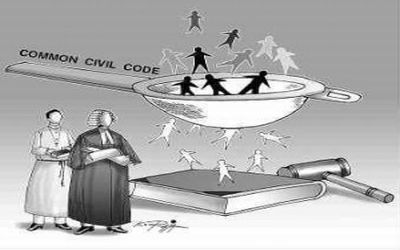
The term Uniform Civil Code (UCC) envisages administration of the same set of secular rules to govern people belonging to different regions and holding different religious beliefs. The term is used to denote a set of rules and regulations that govern all personal matters like; marriage, adoption, divorce, maintenance and inheritance- including matters related to property and personal status of citizens.

Article 44 of the Indian Constitution enshrines this principle as a Directive Principle of State Policy, it reads;

 “The State shall endeavor to secure for the citizens a Uniform Civil Code throughout the territory of India.”

Uniform-Civil-Code

Though the exact outlines of such of code are yet to be spelled out it should presumably incorporate the most progressive and modern aspects from all existing personal laws of various religions while disregarding those who are regressive. As things currently stand in India, different communities have different laws governing different aspects of their daily lives, i.e. the laws governing inheritance and divorce among Muslims would be different from those of Christians and Hindus.

The Uniform Civil Code (UCC) is seen as the sign of a progressive nation; it shows that the nation has moved beyond the traditional demarcations based on religion, sex, caste and place of birth. It is seen as a beacon to facilitate much needed social growth in India along with economic growth.However, there are many who advocate that with the implementation of UCC the secular fabric of our country would be threatened, and it would be a potential threat to the religious freedom, especially for minorities.


Why UCC Doesn’t Limit Religious Freedom?

Uniform-Civil-Code (1)

UCC does not limit the freedom of people to follow their religion; it means every person should be treated equally. Most of the personal laws have an inherent bias against the rights of women such as Unilateral Oral Talaq in Muslim Law, limited property rights of women in Christian Law or restitution of conjugal rights issue under Hindu Personal Law. This bias does not operate only against women, but also men.

The Hindu Marriage Act, 1955, is the only personal law that provides for alimony from the wife to the husband, even the Foreign Marriage Act, 1969, or The Special Marriage Act, 1954, which are supposed to be gender neutral have no provision under which the husband can demand alimony from his wife. Similarly, personal laws do not provide for inter-religious marriages[1] thus prove to be divisive in society. Some benefits may also be considered unconstitutional for example, the Hindu Undivided Family gets tax exemptions, and Muslims must not register gift deeds; such benefits are based on religion and thus unconstitutional.

Further, an extra burden is added on the judiciary when different communities are governed by different laws. Bringing in a Uniform Civil Code would help reduce it and also help simplify a lot of technicalities and inherent confusions that are attached to present personal laws. Thus, addressing loopholes present in pre-existing personal laws.

Another important advantage of implementing the Uniform Civil Code is that it will bring an end to dirty vote bank politics which is relied upon by a majority of the political class to meet their ends. This is because if all of the India has the same set of laws governing it, then the politicians will have nothing to offer to the community on religious grounds in exchange for votes. The Supreme Court of India also has time and again reiterated the importance of enacting a Uniform Civil Code. During the Constituent Assembly Debates, B.R. Ambedkar had also demonstrated his will to reform Indian society by recommending the adoption of a Civil Code of western inspiration and he went on to add;

“I do not understand why religion should be given this vast, expansive jurisdiction, so as to cover the whole of life and to prevent the legislature from encroaching upon that field.”[2]

Every modern nation which has truly embraced ‘Secularism’ has a Uniform Civil Code.

Shah Bano Case

Youth-Ki-Awaaz31

The conflict between religious and secular authorities over the issue of UCC eventually subsided, until the advent of the Shah Bano case in 1985[3]. This case was controversial in many aspects, chiefly because it allowed for alimony and maintenance to Muslim women beyond the Iddat (or waiting) period. In this case, the Supreme Court ruled for Shah Bano Begun under the provision of Section 125 of the Code of Criminal Procedure, which allows right to maintenance to a wife, and is applied to all citizens irrespective of religion.

“Under section 125 (1) (a), a person, who, having sufficient means, neglects or refuses to maintain his wife who is unable to maintain herself, can be asked by the Court to pay a monthly maintenance to her at a rate not exceeding five hundred rupees… ‘wife’ includes a divorced woman who has not remarried”[4]

The Supreme Court thus, allowed for maintenance of a Muslim woman post-divorce on a monthly basis. However, this became a largely debated controversy and in the wake of the Anti-Sikh riots of 1984, the minorities in India, felt a need to safeguard their interests and their culture, especially the Muslims, who are the largest majority in the country. Section 125 of the Code of Criminal Procedure was seen as a threat to pre-existing Muslim Personal Law and the All India Muslim Personal Law Board members campaigned for complete autonomy in their personal laws and further accused the government of promoting and imposing Hindu dominance over all citizens at the expense of the minorities of the nation.

The Union Government fearing loss of a bulk of its Muslim vote share, overturned the decision of the of the Supreme Court in the Shah Bano Case and a legislation- The Muslim Women (Protection of Rights on Divorce) Act, 1986 was passed by the Parliament with full majority, though it was strongly opposed, and the government faced severe backlash from Muslim Liberals and women’s organizations. [5]

Sarla Mudgal Case

In the case of Sarla Mudgal[6], the issue of bigamy and the conflict between pre-existing personal laws on the matters of marriage were brought in front of the Supreme Court. It invoked Article 44 of the Constitution. This judgment is considered a landmark decision that accentuated upon the need for a uniform civil code in our country.

The Supreme Court said that it appeared that even after 41 years the Rulers of the day are not in the mood to fetch Article 44 from the “cold storage” where it has been lying since 1949. The governments which had so far come and gone had failed to any serious effort towards a unified personal law for all of the India“When more than 80% of the citizens have already been brought under the codified personal law, there is no justification whatsoever to keep in abeyance, anymore, the introduction of Uniform Civil Code for all citizens in India.[7]

The apex court further observed that “It does not matter of doubt that marriage, succession and like matters of secular character can’t be brought within the guarantee enshrined under Article 25 and Article 26 of the constitution.” Further, in John Vallamattom v. Union of India[8], the Supreme Court again reiterated that a framing of a uniform civil code by the Parliament will be a great step towards removing contradictions of people based on ideologies and will lead to national integration.

The Road Ahead For Uniform Civil Code

The issue of implementation of a Uniform Civil Code has been severely politicized, with two upper sides that have now formed; the Congress along with Muslim conservatives versus the Right wing and Left. The debate over UCC is one of the most controversial issues in 21st century India with its manifold implications, mainly on the secularism of the country.

One of the major problems of implementing UCC is the diversity in religious laws of our country which differ by community, region, section, and caste. The seed of doubt in the minds of people- especially the minorities- that the religious ideologies of the majority religion will be imposed upon them is what needs to be eradicated, for an introduction of a draft of UCC and a subsequent smooth implementation.

Presently Goa has a common family law, also known as the Goa Civil Code. It is a set of civil laws that governs all Goans, irrespective of their religious beliefs; though it is quite different from a uniform civil code and has certain exceptions for some communities it shows that enactment of a uniform code is indeed quite feasible in India.

Bringing the UCC would help and reduce many technicalities and loopholes present in present existing personal laws, it was an aspiration of our Constitution makers. The Government must draft a common civil code with the view of all minorities and their best interests in mind; it must consult the Law Commission, National Commission for Women, National Human Rights Commission, Former Judges of Supreme Court, High Courts, Attorney Generals and Solicitors General. A sudden enactment might disrupt communal harmony. Thus a set of steady reforms is the must. The government must implement the uniform civil code in the true spirit of Article 44 of the Constitution.

Footnotes:

[1]http://www.oneindia.com/feature/why-india-urgently-needs-uniform-civil-code-2037892.html

[2]http://www.outlookindia.com/website/story/ambedkar-and-the-uniform-civil-code/221068

[3]Mohd. Ahmed Khan v. Shah Bano Begum (1985 SCR (3) 844

[4] Code Of Criminal Procedure, 1973

[5]http://www.youthkiawaaz.com/2012/06/the-shah-bano-case-a-landmark-case-in-indian-family-law/

[6]Sarla Mudgal, & others. v. Union of India,AIR 1995 SC 1531

[7]” http://centreright.in/2013/08/is-indianization-through-a-uniform-civil-code-a-communal-objective/

[8]  (2003) 6 SCC 611


Download Now

Do We Have The Right To Die?

0

In this blog post, Srishti Khindaria, a student of Amity Law School, Delhi, Guru Gobind Singh Indraprastha University, analyses the concept of the right to die on the debate over euthanasia. The blog post also analyses the implication of the Aruna Shanbaug case and also how The Medical Treatment of Terminally Ill patients (Protection of Patients and Medical Practitioners) Bill, 2016 could be of some help.

1184841_601046539971928_459524019_n


The Right to Life is enshrined under Article 21 of The Indian Constitution as a fundamental right guaranteed to each and every citizen of Indian. This right has been liberally interpreted by the courts so as to mean something beyond just mere survival and existence and the Supreme Court further went on to assert that this right is the heart of the fundamental rights enshrined under part III of the constitution. [1]

KDD00686UK

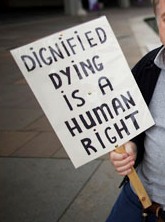
In India, the Right to Life has received the broadest and widest possible interpretation at the hands of the judiciary. It not only includes protection of a person’s life but also confers upon the citizens a right to live a dignified life. It takes within its ambit some of “the finer graces of human civilization, which make life worth living,” and it has expanded its scope to include the culture, tradition and language of the person concerned. Now the question that arises is if the right to life includes living with dignity would the right to end life with dignity also fall within this right? Many have argued that Article 21 confers upon an individual the right to live with the dignity it should also bestow upon individuals the “Right to Die.”

The right to die however contravenes the provision under section 309 of the Indian Penal Code as well as section 306. According to Section 309,

“Whoever attempts to commit suicide and does any act toward the commission of such offense, shall be punished with simple imprisonment for a term which may extend to one year [or with fine, or with both].

Those in favour of this section argue that it is based upon on the principle that lives of men are not only valuable to them but to the state too, which protects them. However, this provision has been questioned on moral and constitutional grounds not only by human rights activists but also the courts of law.

This question of law came up for the first time before the Bombay High Court in State of Maharashtra v. Maruti Sripati Dubai. The court held that right to life under Article 21 included the right to die, and it struck down section 309 of the Indian Penal Code as unconstitutional. Further in P Rathinam v. Union of India supporting the decision of the Bombay High Court in Maruti Sripati Dubai, a Division Bench of the Supreme Court held that right to die was included in Article 21 and also declared section 309 of the Indian Penal Code as unconstitutional.

In 1996, the case of Gian Kaur v. the State of Punjab came to the Supreme Court where abatement of the commission of suicide under section 306 of the Indian Penal Code was under question. The accused contended that any person abetting the commission of suicide by another is merely assisting them in enforcing their fundamental right under Article 21. However the Constitution Bench of the Supreme Court held that right to die is not included under Article 21 or the “right to be killed.” Any aspect of life which makes life dignified may be included but none that extinguishes it. And that the “right to die- if any- is inherently inconsistent with the right to life as is “death” with “Life”.”


The Debate over Euthanasia

Euthanasia is derived from the Greek words “eu” meaning well or good and “thanatos” meaning death. Therefore, euthanasia could be seen to mean good death. The Oxford dictionary defines Euthanasia  as “painless killing of a person who has an incurable disease or who is in an irreversible coma.”  According to the House of Lords Select Committee on Medical Ethics, it is “a deliberate intervention undertaken with the express intention of ending life to relieve intractable suffering”.

euthanasia_1

Euthanasia encompasses various dimensions; it could be;

  • Active EuthanasiaIt is brought about by an act, by introducing something that facilitates death. Direct and deliberate measures are taken to cause the death of the patient. For example, an overdose of painkillers
  • Passive Euthanasia No direct actions are taken. Instead, measures are taken to withhold or withdraw supportive measures i.e. death is brought about by an omission. For example, switching off the ventilator machine which is sustaining the life of the person.
  • Voluntary EuthanasiaIt takes place with the consent of the person who is about to die.
  • Non-Voluntary EuthanasiaIt includes cases where a person is unable to make an informed decision about living and dying or is unconscious, and someone else takes the decision on his/her behalf.

It also covers cases of children who are mentally ill and emotionally able to make decisions but not old enough in the eyes of the law to make such a choice so someone else must make it on their behalf.

  • Involuntary Euthanasia It includes cases where people not willing to die- i.e. those who choose to live- are killed anyway. It is usually termed as murder, but it may be possible to think of cases where such acts would be for the benefit of the person dying.

Such a request for premature ending of life has led to serious debates about the role of such practices and their impact on contemporary health care practices. This debate cuts out several dynamic and complex aspects such as ethical, legal, religious, human rights, economic, cultural and social.


Euthanasia in India and the Aruna Shanbaug case

In the Indian context, the demand for legalization of euthanasia gained notable attention only after the Aruna Shanbaug case. Demands were made before this case too, through several petitions submitted to different courts and Presidents. This was, however, the first case where the subject of euthanasia was entertained by any court.

Aruna-Shanbaug-Case

Aruna Shanbaug was a 24-year-old nurse from Karnataka working in King Edward Memorial Hospital in Mumbai. On the evening of 27th November 1973 while Aruna was on duty, hospital sweeper attacked her and tried to rape her. The sweeper sodomized- when he found out that she was menstruating her- in the most brutal of ways in the canine experiment room of the ways. He strangulated her by wrapping a dog chain around her neck. She was found the next morning, unconscious with blood all over her. It was suspected that due to strangulation blood supply to her brain had stopped and caused damage. She received serious injuries to her brain stem and cervical cord and pushed her into a PVS (permanent vegetative state). Aruna Shanbaug remained in a vegetative state for over 40 years in the same hospital and finally breathed her last on 18 May 2015.

The case was taken up as a writ petition filed in 2009 under Article 32 of the Indian Constitution by Pinki Virani- claiming to be Aruna’s next friend. [2] The court held that active euthanasia is a crime world over except where permitted by legislation. In India, active euthanasia is a crime under sections 302 & 304 of  IPC and physician-assisted suicide is a crime under Section 306 of IPC, which deals with abetment to suicide. The Supreme Court turned down the plea for euthanasia in her case but went on lay down guidelines for passive euthanasia in the ‘rarest of rare circumstances.’

The judgment however, is considered historic; its recommendations for allowing passive euthanasia are as follows:

  • Any petition for application Passive Euthanasia has to be filed with the relevant high court. The Chief Justice of that High Court would then constitute a Bench of at least two Judges who would decide whether or not to grant approval.
  • Before taking any decision, the bench should seek the opinion of a committee of three reputed doctors to be nominated by the bench. Preferably, one of the three doctors should be a neurologist; one should be a psychiatrist, and the third a physician.
  • The High Court Bench should issue the notice to the State and close relatives e.g. parents, spouse, siblings etc. of the patient and the next friend, in their absence.
  • The Court should supply a copy of the report of the doctor’s committee to them as soon as it is available.
  • After hearing pleas of all the parties, the High Court should give its verdict.
  • This verdict should be given at the earliest.

Further, Lodha J in the case of Naresh Marotrao Sakhre v. Union of India affirmed that Euthanasia or mercy killing is nothing but homicide whatever the circumstances in which it takes place.

The Medical Treatment of Terminally Ill patients (Protection of Patients and Medical Practitioners) Bill, 2016

Addressing the heavily debated issue of mercy killings and euthanasia the government has come up with draft Bill on passive euthanasia which shall grant terminally ill patients the right to withhold treatment. According to the draft, any terminally ill patient above the age of 16 is competent to decide whether or not he/she wants further treatment administered.

If a person is capable of making an informed decision about the course of his or her treatment and can effectively communicate it then such a decision is binding on the doctor treating the patient, provided the doctor too feels that the patient is making an informed decision and such decision has been communicated to his/her family.

 However, the bill is facing severe and bitter criticism; firstly many oppose the age of consent being set at 16, and secondly many doctors and experts feel that the draft Bill is a colossal disappointment. [3]


Conclusion

Though the government is trying to take legislative actions to legalize passive euthanasia, their actions seem misguided. The new draft bill only covers voluntary passive euthanasia in cases where the patient is above the age of 16 and, where the patient has capable of making an “informed decision.” It fails to provide proper care in cases where the patient may be incompetent- that is below the age of 16, unconscious, of unsound mind, brain dead, in a permanent vegetative state or a state of unconsciousness as the family members who want to withhold treatment will have to move to the High Court. This will add to the burden of the already overburdened courts, with about 3 million cases pending with them already. Further, our system only recognizes passive euthanasia which according to doctors has been abandoned by modern medicine.

Footnotes:

[1] Unni Krishnan v. State of Andhra Pradesh

[2]Aruna Ramchandra Shanbaug v. The Union of India  

[3]http://scroll.in/article/808096/draft-bill-on-euthanasia-says-16-year-olds-can-decide-on-withdrawing-life-support


Download Now

The Dark Realities Of Triple Talaq

4

In this blog post, Srishti Khindaria, a student of Amity Law School, Delhi, Guru Gobind Singh Indraprastha University, analyses the dark realities of the Triple or Oral Talaq system, and how it is being used as a tool to suppress women in the wake of the recent petition by the Bharatiya Muslim Mahila Andolan and the horrifying case of Saira Banu.

1184841_601046539971928_459524019_n


The word Talaq (Arabic for divorce) means “rejection” or “repudiation.” Under Muslim Law, it means immediate or eventual release from a marriage bond.  In a narrower sense, it could be associated with usage of certain words by the husband but is associated with all kinds of divorce, particularly repudiation by or on behalf of the husband. In Talaq, the husband pronounces the phrase “I divorce you” to his wife. A man is given the possibility to divorce his wife thrice, with the choice to take her back after the first two. After the third Talaq, the divorce is irrevocable, unless under Halala.

The first Talaq is known is Ahsan or best method of divorce, and it is believed by many jurists that this must be given by the husband to the wife in her Thur or menses-free time. Such a Talaq is revocable during the period of Iddat– the waiting period. Should the husband not do so, the divorce takes effect upon expiry of Iddat. However, the divorced couple has the choice to remarry at a later date.

A second Talaq by the husband is known as Hassan (good), following the same procedure adopted in Ahsan. And he may once again revoke the Talaq before the expiry of the Iddat period, and the divorced couple may remarry at a future date- after the expiry of Iddat– if they choose to.

However, when the Talaq is given for the third time by the husband to his wife, the marriage is dissolved. There is no period of Iddat, no room for later reconciliation and the divorce is irremediable. The divorced couple can only remarry if the woman marries another man who subsequently divorces her, that is, she consummates her marriage with another man. This system of an intervening marriage is called Halala.

350x

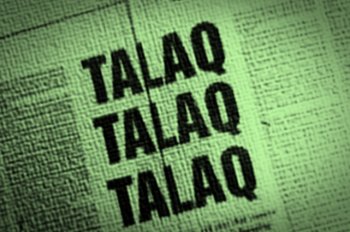
The system of Halala is often exploited, used a tool to overcome the Islamic prescription that prohibits remarriage of couples who have been divorced thrice. To many, it might seem amusing that a woman would wish to re-marry a man who has divorced her thrice already, but this is precisely where the harshness of another practice of Talaq known as Talaq-ul-Bidat comes to light. Talaq-ul-Biddat or Triple Talaq is where the husband repeats thrice “Talaq, Talaq, Talaq” or any similar connotations or adds the word “triple” to Talaq. This ends up having the same consequences as an irrevocable divorce and the marriage dissolves immediately. According to the Hanafi School of Thought Talaq-ul-Biddat is deemed “sinful and innovative.”[1]

Talaq-ul-Biddat is said to be an innovation undertaken to ensure that an incorrigibly acrimonious couple could part ways as quickly as possible. [2] Pointing to Quran 65:1, many Islamic scholars believe that a waiting period is essential between the three talaqs. However, the practice of Talaq-ul-Biddat or “triple talaq” at one sitting has been legally recognized historically and received consensus among the scholars fromfour Sunni schools of jurisprudence – Hanafi, Maliki, Hanbali, and Shafi. However, this consensus was broken by Ibn Taimiyah, a Hanbali scholar, who argued that three talaqs in one sitting counts as one. This “three equals one” position of Taimiyah was considered to be a minority view, but more than 20 countries have adopted it over the last century, with Egypt being the first. The Indian legal framework though still gives Triple Talaq validity.


The Fight against Triple Talaq in India

Several organizations- especially women’s groups- within our country have been fighting for the abolition of triple Talaq, calling it an “un-Quranic” practice, which is used as a tool to exploit women.India is one of the few countries that still recognizes oral and triple Talaq. The Muslim Personal Law (Shariat) Application Act 1937 governs personal laws of Muslims in our country. This personal law is uncodified and open to interpretation by the local clergy, thus adding to the agony of the women.

Very recently, the Bharatiya Muslim Mahila Andolan (BMMA), sought the support of the National Commission for Women to abolish the practice of triple Talaq owing to its widespread misuse, with instances such as husbands using emails and WhatsApp to divorce their wives, and around 50,000 Muslim women have signed a petition by the organization, to abolish this system of Triple Talaq.

8-Oct-2015-04-310x165

“Muslim law is not fortified in India, which means that there is no law. It is open to interpretation by anyone. This is the main reason why Muslim men can get away with almost anything. It has become easier for them to divorce their wives in the digital era. We are encountering some cases now where the men are using digital media to divorce their wives”, says Noorjehan Safia Niaz, founding a member of Bharatiya Muslim Mahila Andolan.[3] Today, women are divorced by their husbands for the flimsiest of reasons, ranging from wearing spectacles to not being a good cook[4] and digital media divorce has only added to the suffering. What adds to the agony is that even the clergy is unsure of the validity of divorce using social media. A survey of about 5,000 women across ten states conducted by the Bharatiya Muslim Mahila Andolan (BMMA) found that over 90% of these women wanted an end to the practice of polygamy and triple Talaq. And of the 525 divorced women surveyed, 78% had been given triple Talaq; and 76 of these women had to practice Halala i.e.consummate another marriage so that they could go back to their former husbands. [5]

Saira Banu case

The case of Saira Banu has also added fuel to the fire for the fight against triple Talaq. Her story, as reported by the media, is heartbreaking and gut-wrenching. Saira, braved a rotten marriage, an abusive husband and several forced abortions that lead to severe physical and metal agony, for over a decade. Then, last year, her “husband” sent her a letter at her parents’ home- where she had been staying for almost a year, and inscribed on that piece of paper were the three words: “Talaq, Talaq, Talaq.”

Saira Banu, a sociology graduate, instead of accepting her circumstances, decided to fight. But instead of approaching the court and ask that it order her husband to pay her maintenance, she has started an even greater fight. Saira Banu has boldly challenged the validity of her husband’s actions of kicking her out at his fancy using the triple Talaq formula. She had filed a petition in the Supreme Court seeking the illegal status of not just triple Talaq but also polygamy and Halala.

The All India Muslim Personal Law Board (AIMPLB) is against any such actions and says it is outside the jurisdiction of the Apex Court to intervene in Muslim Personal Law.[6] However, the AIMPLB has been criticized by several known jurists for clinging on to outdated, draconian laws and medieval customs.Moreover, the Muslim Personal Law Board defends a practice that is in its true sense un-Islamic in the name of Sharia. And it is high time that their bluff must be called. [7]

It is true that triple Talaq did receive a sanction, especially during the reign of the second Caliph Omar, but what has been done now by the self-severing Muslim clerics is that the letter of the law has been adopted, while its spirit; junked. The Caliph Omar pronounced triple Talaq as a final resort in cases where the woman wanted to walk desperately out of a bad marriage, and their husbands were delaying the divorce by misusing the long-drawn procedure prescribed by the Quran. So it was for the sake of the women that the Caliph Omar had given legal sanction to Triple Talaq back in the 7th century. But what present day clerics have done is to twist it to suit their patriarchal ends.

The Road Ahead

“I think it should be stopped. Many a time, husbands get drunk and just say Talaq thrice. Then the woman is just left nowhere. This is not right,” said a student on condition of anonymity to an NDTV reporter. Such a Talaq renders wives extremely insecure and vulnerable regarding their marital status, leaving them in a constant state of flux and after such a divorce women are shunned both by family and society.

thediplomat_2016-04-22_19-04-04-386x258

Saira Banu’s case provides a window into the lives of these victims and is a great opportunity to usher in a much-needed reform. The government and the Supreme Court must work towards appraisal of the condition of Muslim women. The Muslims Personal Law Board must be shown its place. Saira Banu must not meet the fate of Shah Bano, where the legislature succumbed to the heretical pressure groups within the community. The government must intervene.The bias in Muslim laws must be removed; a woman may seek a divorce from her husband under Khulla, but for this, she requires the permission of her husband whereas the man may simply utter Talaq thrice to obtain a divorce. It must be stated clearly that the Muslim Personal Law Board should fall in line with the modern secular law when it comes to the rights of women, or it should simply perish. It can’t be allowed to carry on with its whimsical and patriarchal ways in the name of securing the Sharia law at the cost of the basic dignity of women. Further, A high-level committee set up by the Central government to review the status of women in India has sought a ban on the practice of oral, triple and unilateral Talaq or divorce, as well as polygamy.


Conclusion

Lastly, the question that arises isif laws in countries- with majority Muslim population- like Egypt, Kuwait, Morocco, Iraq, Jordan, the UAE, Sudan, Yemen, the Philippines, and Syria have totally derecognized the concepts of triple Talaq and halala, then why should the All India Muslim Personal Law Board be allowed to parade these inhuman and illegal practices in the 21st century within a secular and democratic nation like India?

Footnotes:

[1]http://www.irfi.org/articles/articles_151_200/triple__talaq.htm

[2]http://scroll.in/article/806299/if-pakistan-and-21-other-counties-have-abolished-triple-talaq-why-shouldnt-india

[3]http://www.contributoria.com/issue/2014-11/54117a4bce8de2c86a00016f/

[4]http://www.contributoria.com/issue/2014-11/54117a4bce8de2c86a00016f/

[5]http://www.ndtv.com/blog/ban-triple-talaq-declare-muslim-personal-law-board-illegal-1396658

[6]http://timesofindia.indiatimes.com/india/Muslim-personal-law-outside-SC-jurisdiction-asserts-board/articleshow/51534701.cms

[7]http://www.ndtv.com/blog/ban-triple-talaq-declare-muslim-personal-law-board-illegal-1396658


Download Now

Surrogacy – Commercial Or Ethical?

0

In this blog post, Srishti Khindaria, a student of Amity Law School, Delhi, Guru Gobind Singh Indraprastha University, analyses how surrogacy is leading to serious troubles instead of solving problems in the lives of people and also how the government is undertaking certain legislative actions to safeguard the rights of surrogate mothers.

1184841_601046539971928_459524019_n

Some women due to certain biological or physiological conditions are unable to give birth to their off-springs. They thus go searching for alternative solutions and surrogacy is one of the most viable options. Advancement in the field of assisted reproductive techniques (ARTs) has revolutionized the process of surrogacy, thus making it the most sought after options. This system has been a ray hope to many infertile couples.

The word ‘surrogate’ literally means ‘substitute.’ It means that the genetic-biological mother is substituted by the surrogate mother. In common parlance, a surrogate mother is someone who is hired to bear a child, which is handed over to an employer at its birth. According to the Assisted Reproductive Technology (Regulation) Bill 2014 “surrogacy” means an arrangement in which a woman agrees to a pregnancy, achieved through assisted reproductive technology, in which neither of the gametes belongs to her or her husband, with the intention to carry it and hand over the child to the commissioning couple for whom she is acting as a surrogate. [1]

Surrogacy-Services-300x200

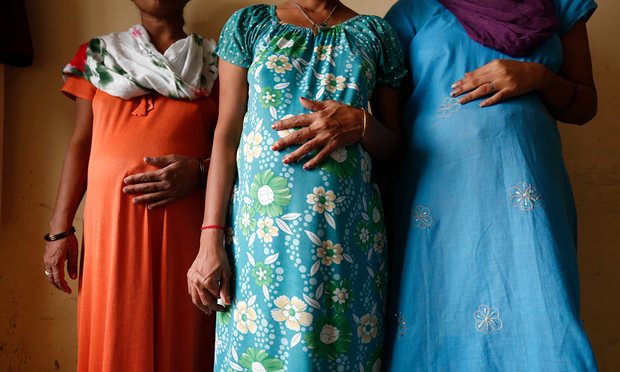
In the past, surrogacy arrangements were confined to close kith and kin, family or friends and usually a selfless deed. However, with an introduction of financial arrangements the ‘network of surrogacy’ has extended beyond the family, community, state and in recent times even the country, the industry has been commercialized to such an extent that surrogate wombs are now ‘recruited’ and ‘rented’ and agencies- that make huge profits- have cropped up. Such rapid commercialization raises fears of malpractices like black marketing, baby selling, and breeding farms. Some agencies have degraded pregnancy under surrogacy to a ‘service’ and the baby a ‘product’.

Troubles with Surrogacy in India

Surrogacy is estimated to be an industry worth nearly $2.3 billion; however surrogate mothers in India are less than tenth of what they would ordinarily get in any other part of the world. With a rapid surge in the number of IVF clinics, the absence of a rigid regulatory framework and ready availability of poor women who are willing to rent out their wombs, India has become an attractive option. However, all of this comes at a cost.

At one glance, surrogacy seems like a highly viable option, the poor surrogate gets much-needed money, and an infertile couple gets a child, but if we dig deeper, the real picture is much harsher. Due to lack of a legislative framework, both surrogate mothers and the parents are in most cases exploited, and commercial agencies and middlemen end up earning profits. There is no transparency and a high risk of getting tangled in legal hassles due to the unpredictable regulations regarding surrogacy in our country. Legal since 2002, commercial surrogacy has been open to grave misuse in India.

3500

Under the Artificial Reproductive Technology (Regulation) Bill a surrogate mother ‘is a woman who agrees to have an embryo generated from the sperm of a man who is not her husband, and the oocyte for another woman implanted in her to carry the pregnancy to full term and deliver the child to its biological parents(s).’

By this definition, any surrogacy contract which involves the woman using her oocyte or egg to bear the child along with that of the commissioning man would be illegal. Also by the definition of surrogacy under section 2 (zq) all fertile surrogate mothers will have to use necessarily technology used to infertility treatment- i.e. in-vitro technologies- even if pregnancy can be introduced by other methods such as artificial insemination, which is much safer. Further, there is not standardization of the drugs used, no proper procedure of documentation, lack of information to the surrogate mothers about the side-effects of the drugs used and no limit set as to the number of times a woman may go through such a procedure.

Surrogacy that crosses borders also leads to several problems of citizenship, nationality, parentage, motherhood and also rights of the child. There are several occasions where children are denied nationality in the country of their actual parents which could result in a long-winding legal battle as happened with German couple who had twin surrogate children or an Israeli couple who underwent a DNA test to establish their parentage, there are also several instances where at a later stage the child was abandoned by the intended parents and had to spend his/her life in an orphanage, which hampers the growth and well-being of the child.


Changes and Legislative Action


In light of the Assisted Reproductive Technology (Regulation) Bill, 2014

India, as mentioned earlier, has emerged as the booming market for surrogacy. Cheap medical facilities and advance know-how in reproductive technologies coupled with backward socio-economic conditions and lack of firm legislative frameworks have led to making Indian a popular destination. Reports suggest that the revenue from commercial surrogacy could be anywhere $500 million to $2.3 billion, annually. A major reason for this is the influx of foreigners availing such services in India. However, developments over the past few months may have a major impact on the outflows of this industry and also possibly help safeguard interests of surrogate mothers.

Firstly, the Union Health Ministry in 2015 sought a permanent ban on commercial surrogacy in India. And according to the guidelines issued by the Department of Health Research (DHR), the import of ‘human embryo’ except for research purposes has also been banned. This has been seen as a significant step in insuring the rights of surrogate mothers and the children they bear. The Health Ministry’s affidavit clearly states “The Government of India does not support commercial surrogacy”, and that surrogacy should be available to Indian married infertile couples only and not to foreigners.”

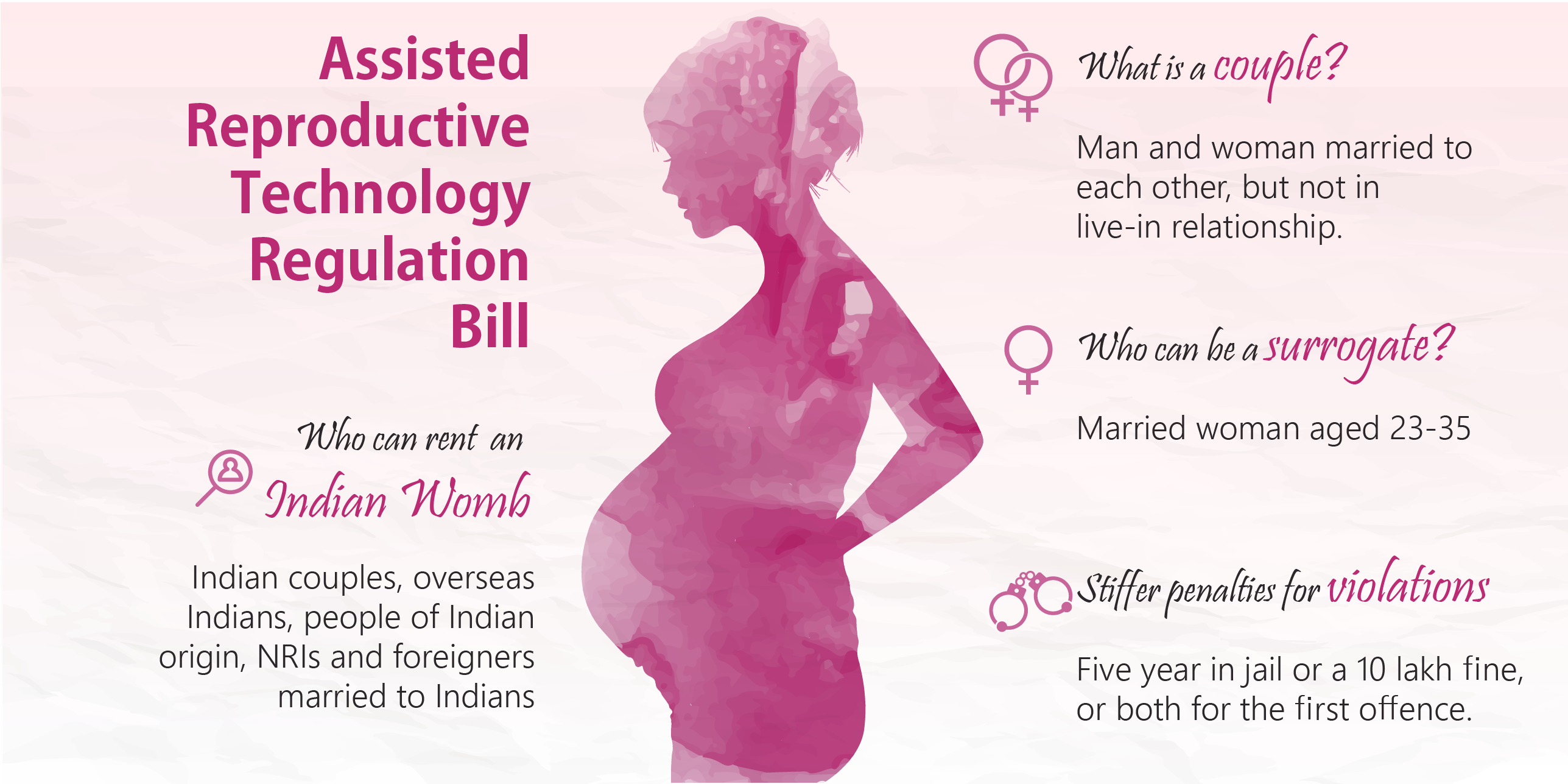
Also, the new Assisted Reproductive Technology (Regulation) Bill, 2014 has been released by the Health Ministry, which seeks to restrict ART services in India to Indians only. The bill follows previous legislations in 2008, 2010 and 2013; the law commission had also commented on a need for ART regulation and the Indian Council for Medical Research developed guidelines to compensate for the legislative vacuum.

According to Ministry of Home Affairs (MHA), guidelines dated July 9, 2012, surrogacy was restricted to foreign nationals or a man and woman who had been married for at least two years. However the new 2014 Bill lays down more stringent laws; surrogacy is now restricted to married Indian infertile couples only, thus debarring all foreign nationals other than married PIOs (Person of Indian Origin), OCIs (Overseas Citizen of India) and NRI (Non-Resident Indian). It also seeks to end all forms of commercial surrogacy.

surrogacy

Some of the other prominent provisions of the bill are as follows:

  • The bill by defining a couple as a “married man and woman” shuts doors on homosexuals and people in live-in- relationships.
  • The bill proposes to make mandatory for all couples who commission surrogacy to accept custody of the child/children irrespective of any inherent abnormality that may be present.
  • The couple shall also have to submit a certificate indicating that the child born through surrogacy is genetically linked to them and that they child shall not be involved in any pedophilia or pornography.
  • Married, single, divorced or widowed women are allowed to act as surrogates. The minimum age of a surrogate mother shall be 23 years and maximum 35 years, and she must have at least one live child of her own who is at least three years old. And that no woman shall be allowed to act as a surrogate for more than one successful live birth in her lifetime, and there must be a time gap of at least two years between the surrogate delivery and that of her child.
  • If a child is born to a foreign nation married to an Indian citizen by sperm/egg donation or surrogacy, then the child shall not be an Indian citizen, despite that fact that he/she was born in India. The child shall be entitled to Overseas Citizenship of India under Section 7A of the Citizenship Act, 1955.
  • The draft also includes various provisions to regulate the clinics that provide such facilities in India. It states that not ART clinic shall provide the couple with a child of pre-determined sex and no ART clinic, or bank shall provide any information about the surrogate or potential surrogate to anyone.


Conclusion

Such steps do seem like the way forward in safeguarding interests of all parties; the childless couple, the surrogate mother and the newborn child. These are essential to prevent exploitation, my middlemen. However, such drafts just on paper will not help, it is essential that a firm legislation is passed as soon as possible by the legislators of our country to ensure that surrogate motherhood which is seen as an ethical way to provide childless couples with children does not turn into a completely commercialized sector with no ethics or responsibility and severe exploitation of the surrogate mother.


Footnote:

[1]Assisted Reproductive Technology (Regulation) Bill 2014, Section 2 (zq)


Download Now

Plagiarism & Copyright Infringement – What’s The Difference?

0

In this blog post, Surbhi Kapoor, a student of Amity Law School, Delhi GGSIPU writes about the increasing menace of plagiarism in today’s academic world since research scholars have used this resort to complete their research work in a great magnitude.  The article mentions about all the laws that govern plagiarism, types of plagiarism and differentiates between plagiarism and copyright infringement which is commonly used interchangeably.

surbhi

Completing last minute assignments in schools and colleges is no more a big task. The credit for same goes to the internet and also books where tons of articles are available for reference. Though these articles are available only for secondary help, the students are expected to write in their words so that they get a sense of understanding of the topic. Isn’t that the reason why students are given research work? But most of us will agree that technology has made our life very easy. With the press of a few buttons like cut, copy and paste, it is now a small task to complete research work. But what about the authors whose primary research is copied by school and college students to complete their last minute assignments? The same technology is ruining the life of many research scholars as they suffer from being victims of plagiarism. Many times the scholars actually may not even be aware that their research has been used, and due credit has not been given to them. Plagiarism is considered to be a sin for college students as it defeats the purpose of writing research ideas. The creativity expected from students will only be the outcome when are original ideas of the author are published. Here, there is only one victim who is the copyright holder.

plagiarism

Plagiarism refers to the act of using or taking someone else’s work and then passing the same as own without giving due credit and recognition to the author. Plagiarism is all around us, and even then we fail to notice it. In this era where every technology is of prime importance, primary research and creativity can easily be exploited. The work available on the internet is vulnerable to plagiarism. There are two victims of plagiarism who are the copyright holders and the public who believe that the secondary work is the original work of the author.

India is a part of various international treaties to prohibit plagiarism. The copyright act reflects the Berne convention. This convention aims to protect the rights of authors by establishing various protection standards for their work. Similarly, India is a part of many other treaties such as Universal Copyright Convention, Geneva Convention for the Protection of Rights of Producers of Phonograms and is an active member of the World Intellectual Property Organization (WIPO) and United Nations Educational, Scientific, and Cultural Organization (“UNESCO”).

The Indian government has also taken a various step to protect plagiarism in the software industry, the music industry, and motion pictures though associations such as  National Association of Software and Service Companies (NASSCOM), National Initiative Against Piracy and Counterfeiting (NIAPC).

There can be very strong repercussions for plagiarized work that may not only harm the reputation of the plagiarist but also tangle him in a law suit. Plagiarism is an ethical sin.

Types of Plagiarism

plagiarism(1) 

  1. Copy and Paste

This is the most common type of plagiarism where no or very less effort is required to copy a part of any text and use it as a part of one’s research work without giving reference to the original author of the text. It is also very easy to test for copy-paste plagiarism with the help of various plagiarism check tools available on the internet.


  1. Idea plagiarism

If an author has written about something unique or on a creative idea on which nothing had been previously written, it must be clearly be credited to the author. Example – if someone has written about a very feasible way of rainwater harvesting, then before further using that technique in any other research work, the author of the primary research article should be credited.

  1. Word Switch

Many times people prefer to take a few lines from some source and try to change a few words from the sentence. This is also a very common type as here it is difficult for the online check software to detect plagiarism. However, this is still plagiarism. It is not essential to directly quote the sentence from a primary source. If by reading those sentences a layman can figure out about the original research article, then it shall refer to plagiarism.


Difference between Copyright Infringement and Plagiarism

slidedeckjenny-100923120044-phpapp02-thumbnail-3

Often plagiarism and copyright infringement are spoken interchangeably, but it is important to know that both are not the same thing.

Copyright infringement is illegal to use of work that is protected under the copyright law without due permission from the author. The author has exclusive rights to reproduction of the work. The duration of copyright varies depending on the work that is being protected. For original literature, musical drama artworks, the duration is a lifetime of the author and sixty years after the death of the author. For movies, photograph or government work the protection is for sixty years counted from the date of publication.  Any infringement of copyright does not only lead to civil remedies like an injunction, damages or a share of profit to the author and cost of legal proceeding but it is also a cognizable offense. The punishment can range from six months to three years with a fine ranging from Rs. 50,000 to Rs. 2, 00,000.If there are multiple complaints about subsequent offenses of plagiarism, there are provisions to increase the fine, and give harsh punishment. There are also provisions to file a complaint which is first information report (FIR) with the police and seize the infringed material without court intervention.Foreign national who want to copyright their work in India will be protected under the copyright act if their country is a signatory to the conventions that have been signed by India. They shall be protected through International Copyright order, 1999. Indian court pays special attention to protection of work of foreign authors such as software, motion pictures, etc[1].

A copyright owner has various rights such as

  • To publish his work
  • To produce or be able to reproduce the original work
  • Make multiple copies of the work
  • Prevent any unauthorized use of the copyrighted work

Plagiarism, however, is considered to be an ethical issue. Here, the work of the author is used without giving him due credit. Plagiarism does not only include exact works of the author, but it also incorporates the use of ideas of another person without giving credit to the original author. Section 57 of the copyright act give the author a special right to claim authorship of his work even without having copyright of the work.The punishment for plagiarism is that same as the punishment for copyright infringement. The punishments are mentioned under section 63 and 70 of the copyright act. These offenses are bailable offenses.

Further, Section 63 of the Copyright Act which deals with infringement as a criminal offense contemplates the same punishment for both the violation of Section 57 and copyright infringement. Considering this parity in the statute itself, the confusion between infringement and plagiarism is understandable.[2]

Plagiarism may not always be committed intentionally, but there can be no excuse for stealing another person’s ideas or research without acknowledging the author. With the increasing use of internet, it becomes essential to be cautious before using ideas from the internet. It is not just students who are misusing research work; there have been some instances were research scholars were found misusing research of other scholars. Those who write to earn a living should be extra vigilant not to make any such mistake. The record of Bharat Ratna C.N.R. Rao, scientific adviser to India’s prime minister and one of the nation’s most celebrated scientists, is marred by a cavalier approach to plagiarism and more than one instance of serious breach of academic ethics.[3] Another instance where seven Stanford University physicists, three of them Nobel laureates, wrote a complaint against various instances of plagiarism by BS Rajput, a physicist and then vice-chancellor of a University in Uttarakhand.  Such news gets widely reported in the academic world. For academic scholars, publishing is an integral part of their career. Plagiarism will result in loss of reputation and may ruin the academic career of the research scholar.

Footnotes:

[1]. http://www.mondaq.com/india/x/406982/Licensing+Syndication/Copyright+Law+In+India

[2]http://copyright.lawmatters.in/2011/09/101-copyright-infringement-and.htm

[3]http://thewire.in/3307/in-india-you-can-plagiarize-and-flourish/


Download Now

Intolerantly Tolerant India – The New Identity

0

This Blog Post has been written by Surbhi Kapoor, a Student of Amity Law School, Delhi GGSIPU. The article talks about the problem of communalism and religious intolerance that has existed in India for several decades even after living together for so many years. This article highlights these political issues and tries to give the judicial aspect of the same.

surbhi


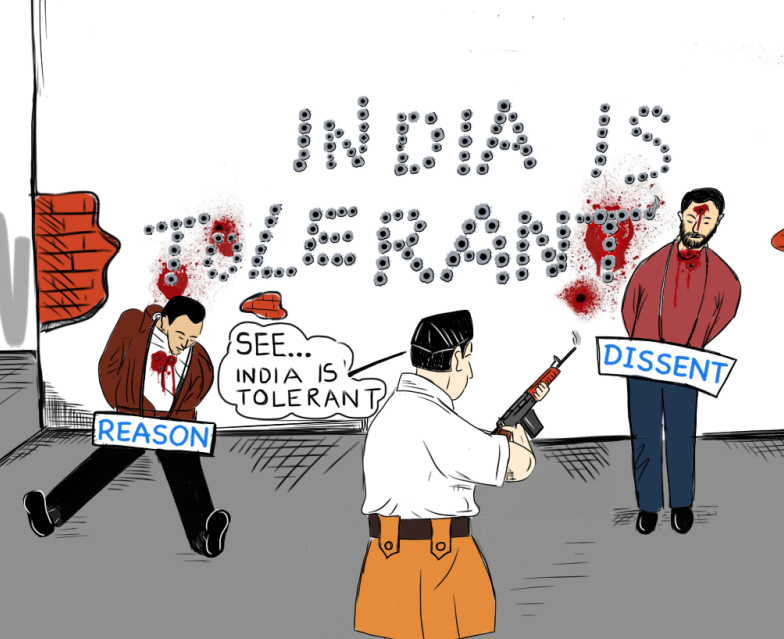
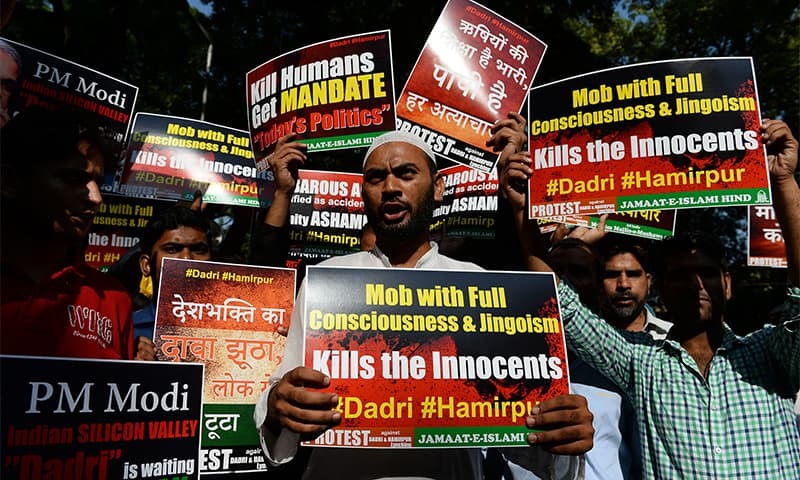
India is the country that gave birth to four religions that have lived harmoniously for decades, but they now stand divided on certain incidents that are termed as communal and political controversies. There have been few mishaps in the country that are termed as political strategies to disharmonize our secular nation. In the light of events like Dadri Lynching, Beef Ban, JNU sedition charge, various academicians returning their awards, there have been more debates in the country about whether India is intolerant or not rather than solving the core issues that gave rise to such incidents. This poses a serious threat to the very foundation of modern India.  Some of the political or rather culturally insecure groups are trying to change the democratic and secular structure of the country into a purist state.

intolerance

Communalism is one of the most serious problems that India has to face after freedom from colonial rule. In 2013, during the UPA regime, there have been 823 communal riots, and the number reduced to 561 in 2015 (till October) which is he NDA government. Even when the statistics depict a different picture, people believed in a mirage created the media and some parties.This problem, which has existed among the followers of two principal religious communities- Hindus and Muslims – many times raised a great challenge before the secular structure of India. Some of the acts done in the name of religion are shameful and take us miles away from freedom and democracy for which our nation fought for over 100 years.

There have been certain incidents in the country like in Dadri and with various rationalists elsewhere are regrettable and should not happen in any civilized society, but such incidents have been happening in the country since independence and few political parties along with media are making a hue and cry of the same. Repeat a lie a thousand times and it becomes the truth, this is what today media is doing to raise the issue of intolerance in the country.

I strongly condemn some of the slogans that impose a threat to national security raised at the JNU in a row of the event of Judicial killing of Afzal Guru. People who talk about breaking the country into pieces call it freedom of speech protected under Article 19, but neither the constitution nor any law in our country allows it as restrictions are placed on article 19(2).

Recently a number as large as 36 academicians and rational scholars have returned their awards to show their anger against growing intolerance in the country but a large chunk of the society fails to understand why this is happening in such a large number now when there have been more serious issues in the past like imposition of emergency in 1975 where forced sterilization took place in the mane of family planning. No person had the locus to move writ to the high court or challenge the legality of any order of detention[1] or during the Sikh riots were 3,000 Sikhs were killed in the capital according to Abuja Committee Report[2].

The major question that lies on this Sahitya Akademi award winners is that were those issues too small for them to return their awards or is it a publicity stunt to remain in the limelight. The ban on the slaughter of cow was highly criticized by some political parties that are trying to make political gain out of an economic issue. Unfortunately, the current government is blamed for such laws in the country even when they have been imposed by the previous governments. The regulation of cow slaughter comes under state list under India’s Constitution under the seventh schedule. The incident in Dadri where a man was allegedly killed for consuming beef is highly misfortunate and should not have happened. However the charge sheet does not mention beef anywhere, and the incident should not be politicized.

561e1a1daa8ca

The first case was of Mohammad Hanif Qureshi v. State of Bihar[3] in the year 1958 where the Supreme Court had to decide if the ban on cow slaughter in Bihar, Uttar Pradesh, and Madhya Pradesh were an infringement of the fundamental rights of the petitioner granted under Article 14, 19(1) g, 25 of the Indian constitution. The Court gave the contention that directive in Art. 48[4] allow the State to prevent the slaughter of cows and calves and other animals that are presently or will potentially be incapable of yielding milk or of doing work as a draught). The Court further mentioned that directive principles should run as subsidiary to the fundamental rights.

The Committee on National Integration had suggested some measures in 1969 regarding the manner of celebrating festivals to cultivate a sense of respect for religious beliefs and prevention of acts of desecration of idols or violation of customs observed by others. There should be a sense of peace and brotherhood among people to keep the anti-national and religiously conflicting ideas away.

The media should spread the message of brotherhood and secularism rather than try to politicize every petty issue. Repeat a lie thousand times and it becomes the truth. This should not be the agenda of the media to defame the current government that is working towards a smart and developed nation. Implementation of the uniform civil code that would bring uniformity in personal laws as it would bring every citizen of the country under one roof. To reduce the burden of the judiciary and to improve the secular concept of the country, it is mandatory to do away with personal laws.

Footnotes:

[1] ADM Jabalpur v. S K Shukla, AIR 1976 SC 1207

[2] Submitted under Justice Nanavati Report of inquiry to Ministry Of Home Affairs

[3] 1958 AIR 731

[4] The State shall Endeavour to organize agriculture and animal husbandry on modern and scientific lines and shall, in particular, take steps for preserving and improving the breeds, and prohibiting the slaughter, of cows and calves and other milch and draught cattle


Download Now

Laws Against Hacking In India

6

In this blog post, Surbhi Kapoor, a student of Amity Law School, Delhi IP University writes about hacking, a cyber crime covered under the Information and Technology Act, 2002. The article differentiates between a hacker and cracker, which not many people know. It also talks about laws against hacking in India, the essentials that constitute hacking and how a complaint against hacking should be filed.

surbhi


Introduction

As the country progresses towards a digital age where everything would be available with the click of a button, the threat of data and private information being stolen has constantly been disturbing. It is ironical to see that the most trusted source of information and a store for data can turn out to be a wide platform for some to steal information. The Information and Technology Act, 2000 (IT Act) covers all types of cyber crime committed in the country including hacking.

Hacking earlier used to refer to a crime under section 43 of the IT Act but at the same time, ethical hacking or better known as white collar hacking was considered legal. Ethical hacking is also being taught by various professionals at schools and colleges. So a need was felt to differentiate between good and bad hacking. Under the amendment IT Act in 2008, the word ‘hacker was removed from the act. The reason for the same was that ethical hacking is taught by a lot of professionals at various schools and colleges, and colleges cannot teach anything illegal. So the same word should not be used. The amendment rephrased section 66 and section 43 by removing the word hacking from the Act.

Hacking in India

Hackers

There have been numerous hacking attacks on Indian government websites where state government websites or defense websites have been hacked. Some time back, the Principal Comptroller of defense accounts website was hacked due to which defense officials could not access their salary information. The government, to reduce hacking of precise work, has agreed to the proposal of DEITY, which is the department of information and technology to stop using popular email ids for official purpose and has sanctioned a budget of Rs. 100 cores to safeguard the data. The websites of state governments have also been hacked in the past. The official website of Maharashtra government was hacked, and the hackers were not traceable.There have been some professional hackers in India who have taken huge amounts to hack data from websites. In the infamous case of Amit Tiwari, who was a global hacker, he has hacked more than 950 accounts since 2003 and was caught by the police only in 2014. This shows the lack of evidence and the difficulty in arresting a hacker.

https://lawsikho.com/course/diploma-cyber-law-fintech-technology-contracts
click above


Hacker Vs Cracker

images

There is a very slight line of demarcation drawn between the two words- hacking and cracking after the amendment of the IT act in 2008. Hackers are those people who are very good at computer programming and use their skills in a constructive way to help the government and various other organizations to protect their important information and company secrets. They try to discover loopholes in the software and find reasons for the same. They constantly try to improve the programs to improve the programming. They never intentionally damage the data. Whereas cracker id the one who intentionally breaks into the computer programs of others without having the authority to do so and has a malicious intention to harm the network security. However, there is a huge misconception about the two and both the terms are used interchangeably in today’s context even when they mean different.


The liability of the cracker 


Civil liability

Section 43A of the IT Act deals with the civil liability of cyber offenders. The section deals with the compensation that should be made for failure of protection of the date. His was introduced under the amendment of the act in 2008. The corporate responsibility for data protection is greatly emphasized by inserting Section 43A whereby corporate are under an obligation to ensure adoption of reasonable security practices. Further, what is sensitive personal data has since been clarified by the central government vide its Notification dated 11 April 2011 giving the list of all such data which includes password, details of bank accounts or card details, medical records, etc.

Penal liability

Penal liability of cracking arises when the intention or the liability of the cracker to harm the system or steal any important information gets established. If the cracker only trespasses the system without any intention to harm, it only remains a form of civil liability under section 43A. The criminal trespass can also result in other penal activities punishable under Indian Penal Code like cyber theft that can be punishable under section 378 of Indian Penal Code.

Essentials of hacking under section 66

Intention-whoever with a malicious intention breaks into the computer of the other to tamper or steal the data or destroy it has a wrong intention.

A wrongful act or damage to the data or tries to diminish the value of the data will cover under hacking.


Laws on hacking in India

Section 43 and section 66 of the IT Act cover the civil and criminal offenses of data theft or hacking respectively.

Under section 43, a simple civil offense where a person without permission of the owner accesses the computer and extracts any data or damages the data contained therein will come under civil liability. The cracker shall be liable to pay compensation to the affected people. Under the ITA 2000, the maximum cap for compensation was fine at Rs. One crore. However in the amendment made in 2008, this ceiling was removed. Section 43A was added in the amendment in 2008 to include corporate shed where the employees stole information from the secret files of the company.

Section 66B covers punishment for receiving stolen computer resource or information. The punishment includes imprisonment for one year or a fine of rupees one lakh or both. Mens rea is an important ingredient under section 66A. Intention or the knowledge to cause wrongful loss to others i.e. the existence of criminal intention and the evil mind i.e. concept of mens rea, destruction, deletion, alteration or diminishing in value or utility of data are all the major ingredients to bring any act under this Section.2

.The jurisdiction of the case in cyber laws is mostly disputed. Cyber crime does not happen in a particular territory. It is geography less and borderless. So it gets very difficult to determine the jurisdiction under which the case has to be filed. Suppose a person works from multiple places and his data gets stolen from a city while he resides in someother city, there will be a dispute as to where the complaint should be filed.


How to file a complaint about hacking

1844108

A complaint about the cyber crime can be filed at any cyber cell globally. There are various cyber crime cells in India; a complaint can be filled at any of these

Firstly write an application to the head of the cyber cell department and the complaint should contain the name, address, e-mail and telephone number.

Secondly, submit the following documents with the cell;

  1. Server logs- log files that get automatically with the server when files are opened. It saves a list of activities performed on day to day basis.
  2. Hardcopy and soft copy of the defected material- all the material that has been tempered with by the hacker needs to be submitted with the cyber cell as evidence.
  3. A hard copy of the original web pages and the defaced ones- copies of both the original and defaced material should be submitted so that it makes the work easy to locate the defaced or tampered material.
  4. Details of the control mechanism where the complainant needs to tell the details of those who had the access to the password and the computer.
  5. If there is any suspicion on any person, a list of the suspects should also be given for further reference that could help the cyber cell in investigation

Now days there are even provisions for the complainant to get the access of the complaint filed and to check the status online without going anywhere.


Conclusion

There is no doubt that hacking poses a serious threat to the virtual world. Not many people in the country are aware of this theft. There needs to be more awareness in the country regarding hacking and cracking. The laws made by the government are stringent but lack a bit of enforceability and awareness in the society. Most of the minor cases of hacking go unnoticed because people abstain from filing cases for petty crimes even when there is harsh punishment for it.Also, it is very difficult to track a virtual hacker due to lack equipment. Since hacking can happen anywhere in the world, it gets tough for the police to trace him and punish him in another country. The punishment can also be a bit more harsh to prevent people from indulging in such acts.


LawSikho has created a telegram group for exchanging legal knowledge, referrals and various opportunities. You can click on this link and join:  

https://t.me/joinchat/J_0YrBa4IBSHdpuTfQO_sA

Follow us on Instagram and subscribe to our YouTube channel for more amazing legal content 

 
Download Now

Oppression in the Corporate Sector- The Indian Perspective

0

In this blog post, Pramit Bhattacharya, Student, DamodaramSanjivayya National Law University writes about the problem of oppression in the corporate sector. This post discusses the provisions of law which deals with the issue. This post also highlights the scope of the law which deals with the problem.

1451539_599879256736892_1144192258_n

In India, the corporate sector faces a lot of problems in protecting the interest of the minority shareholders. Although, the problem is related to the minority shareholders, the real issue lies in controlling the majority shareholders. It is very vital that majority shareholders are prevented from dominating the minority shareholders and thus prevent mismanagement and oppression. To end this dominance, Indian laws now provides for the empowerment of the minority shareholders. The minority shareholders are also given some special powers.

Today, ownership and management have assumed a very separate role from each other. The owners are now unable to control the management effectively and efficiently. The running and operations of a corporate totally depends upon the Board or the Management and the owners have very less to do with the running of the company.

Talking about the issue of mismanagement and oppression in the Indian context, it can be said that the Board is not the Central figure in this problem. There is not much conflict between the owners and the management. The skirmish is between the minority shareholders and the majority shareholders. In such a case, it becomes difficult even for the management to find a solution because at the end of the day it is the dominant shareholders on whom control needs to be exercise, which becomes practically impracticable for the management.


Minority shareholders can be defined as a large group of people who are holding substantially fewer shares in the company as compared to majority shareholders, who hold a large chunk of shares in the company. For instance, suppose a company has 100 shareholders. 80 of them are holding only 20% of the shares. The rest 20 members are holding 80% shares of the company.


Old Companies Act, 1956

Under the old Companies Act, Section 397 governs the issue of oppression and mismanagement.Section 397 is based on Section 210 of the English Companies Act, 1948.[1] Before proceeding further, it is important to understand the relevance of Section 210 of the ECA, 1948. Section 210 of the ECA provides for an alternative remedy to wind up in case minority shareholders are being oppressed. This Section states that if any person feels that the activities are business are carried on in such a manner that it is oppressive to a part of members (including himself), then the Board of Trade may file an application in this regard to the Court. The Court after forming its opinion on the issue, and with a view to stopping such practices which are oppressive may make any order including regulating the affairs of the company or regulate the purchase of shares of the company, etc. images

Coming back to the Indian Statute, Section 397[2] allows a person to file an application to the Company Law Board for relief, in case there is any oppression.

Section 397 reads that if any member of the company feels that the activities of the business are being carried on in such a manner which is oppressive to any member (s) or is against public interest, the person may file an application to the Company Law Board, seeking a remedy, provided that the person is eligible to file the application under Section 399.[3]

If the Company Law Board is of the opinion that, indeed the business activities are being carried on in such a manner, the Company Law Board can pass an order which it thinks fit, with the view to stop such activities.

708304541-finishing-walking-away-workplace-meeting-organized-gatheringUnder this Section, the condition for maintainability of the application is very clearly mentioned. The activities of the company should be such that they are prejudicial to the interest of the company, or against the public interest, or is oppressive towards a part of members. The burden is on the applicant to prove that winding up of the company would be unfairly prejudicial to his interest, but prima facie, the facts clearly indicate that it would be justifiable to wind up the company on fair and equitable grounds. There are two conditions which are to be fulfilled to get relief under this Section. The first is that the person should have the right to file an application (he should be a minority as specified under the definition of “minority”). Secondly, there should be allegations to support winding up. In case there are no such allegations, an application cannot be filed under this Section.

In the judicial pronouncement of Killick Nixon Ltd. v Bank of India,[4] it was opined by the Court that it is not necessary that a personal prejudice has been caused to the applicant. The cause of action arises from the fact that the company was operating in such a manner that they were against the public interest, or oppressive and prejudicial to some of the members of the company. Oppression of other members can also be a valid locus standi.

Due to the use of the term “public interest” in the Section, the ambit of the Section is very wide. So the cause of action can be justified when the oppression is not taking place against any member of the company, but a third party is suffering. In cases of corporates, the concept of public interest in very important because operations of a company affect not only the “shareholders” of the company but other “stakeholders” also. It is argued that when a company is operating in society, it has some responsibility towards the society, and anyone who is impacted by the actions of the company and is reasonably connected with the enterprise, is a “stakeholder.”


Oppression Meaning

In India, the statute and the Courts have borrowed the definition of oppression from the words of Lord Keith, which he said in the case of Scottish Co-operative Ltd. v Meyer.[5] The definition given by Lord Keith was used in the Indian case of Needle Industries (India) Ltd Needle Industries Newey (India) Ltd.[6] According to Lord Keith oppression meant lack of morality and fair dealings in the affairs of the company, which may be prejudicial to some member of the company. majorityy


Scope of the Law

In the case of Shant Prasad Jain v Kalinga Tubes Ltd,[7]  the Apex Court gave its view on the requirements of filing an application under Section 397. It stated that it is not enough to show there is a just and equitable ground to wind up the company. It is necessary to show that the majority shareholders acted in such a way that it was oppressive towards the other party. The events have to be seen as a whole. The majority party should act in an oppressive way continuously, up to the date petition is filed. Their conduct should have been wrongful and harsh towards the minority shareholders. Just the mere lack of confidence between the two parties do not give rise to a cause of action. There should be an element of lack of probity and fairness in the dealings between them.

From the above statement, it can be said that the burden lies on the shoulders of the applicant. Through this judicial pronouncement the requirement of “continuous activities” have been added as a requirement. Thus, a one-off incident would not attract Section 397.


New Companies Act, 2013

act3Under the new Act (2013), Section 241 and 242 govern such cases. These two Sections are very similar to Sec 397 of the old Act. The only major difference is that Section 241 (1) (b) of the new Act has provided an additional ground for filing an application. It states that-

“ the material change, not being a change brought about by, or in the interests of, any creditors, including debenture holders or any class of shareholders of the company, has taken place in the management or control of the company, whether by an alteration in the Board of Directors, or manager, or in the ownership of the company’s shares, or if it has no share capital, in its membership, or in any other manner whatsoever, and that by reason of such change, it is likely that the affairs of the company will be conducted in a manner prejudicial  to its interests or its members or any class of members.”[8]

Interpreting this clause, it can be understood that this clause gives the minority shareholders a pre-emptive remedy. Under this clause, they can file an application to prevent any change in the original structure of the company, if they have the grounds to believe hat such a change would be prejudicial to their interests.


The legislature has tried to provide as much safeguard as it can to every shareholder of the company. The minority shareholders are also given some rights to protect their interests. Under the 1956 Act, the minority group was given specific rights exercising which they could convey their opinion to the management and the Board and also challenge the decisions of the majority shareholders.

There is a concept of minority “squeeze out” also in the corporate law. The concept follows the principle that the majority through various means try to obtain the share of minority shareholders and acquire administrative stronghold. In the old Act of 1956, Section 395[9] directly dealt with this issue. Under the new Act, this concept is dealt under Section 236.[10]

 The Company Act, 2013 tries to ensure that the rights of the minority shareholders are protected in as many ways as possible because their share in a company is no less important than the share of the majority shareholders. The law must strive to protect the rights of the minority group.


 [divider]

Footnotes:

[1]http://www.legislation.gov.uk/ukpga/1948/38/Section/210/enacted

[2]https://indiankanoon.org/doc/146869/

[3]https://indiankanoon.org/doc/152161/

[4] 1982 Tax LR 2547 (Bom).

[5][1958] 3 All ER 66.

[6] (1981) 51 Com Cas 743, 777.

[7](1965) 35 Com Cas 351.

[8]https://aishmghrana.me/2013/06/14/oppression-mismanagement/ ; http://www.lawctopus.com/academike/oppression-mismanagement-corporate-law/

[9]Power and duty to acquire shares of shareholders dissenting from scheme or contract approved by majority.

[10]Purchase of minority shareholding.

Download Now

Capital punishment in India – An Overview

0

In this blog post, Pramit Bhattacharya, student, DamodaramSanjivayya National Law University, gives an overview about the capital punishment in India. The post discusses the concept of  “Rarest of the Rare” doctrine and also highlights some landmark judgments with regards to the issue.

1451539_599879256736892_1144192258_n

The Death penalty is a process, where the life of a person is taken by the State by following the due procedure of law. Capital punishment is, in all cases, given for the most heinous of crimes. During recent times, there has been a global trend to abolish the capital punishment. However, India has yet not abolished the capital punishment (though the Court awards the capital punishment in rarest of the rare case). What makes the capital punishment a unique form of punishment is the nature of irreversibility attached to it. If any error has been committed to awarding the death penalty, it cannot be undone after the person has been executed. (Many people give this argument for abolishing the capital punishment.)

Although the death penalty has existed from time immemorial, the movement to abolish it has gained a lot of momentum in the recent times. This movement can be traced back to the works[1] Of one of the great criminologist named CessareBeccaria, who convinced many people that death penalty should be abolished because it is inhuman, useless and technically speaking, a public assassination. In the year 1846, Michigan became the first State to abolish the capital punishment, followed by Portugal and Venezuela in 1867. Abolition of the death penalty was also supported by the United Nations during the drafting of Universal Declaration of Human Rights in the year 1948.[2]

Around the world, 58 countries still practice awarding the capital punishment. 102 countries do not award capital punishment for any crime, i.e. total abolition.[3] According to the reports of Amnesty International China, Iraq, and Iran have awarded highest number of death penalties in the recent years. In Europe, the death sentence has been almost abolished completely, except The Republic of Belarus retaining it.[4]

To know more about death penalty in India and related landmark judgements, please watch the video below:

Position in India

Article 21 of the Indian Constitution states that no person shall be deprived of his life and liberty except according to the procedure laid down by law. Under Article 21, every person has the Right to Life which has been guaranteed by the Constitution.

The Indian Penal Code, 1860 provides for the provision of a death sentence for various offenses like criminal conspiracy, murder, waging war against the nation, dacoity and murder, etc. Various other legislations like the NDPS ACT and Unlawful Activities Prevention Act also provides for the death penalty.48718454

Under Article 72, the Constitution has created a provision for clemency of capital punishment. Under this Article, the President of India has the power to grant pardon, or commute or remit the death sentence in certain cases. Similarly, Article 161 provides for powers of the Governor of the State to grant clemency.

Also, when a Sessions Court awards the capital punishment, it must be confirmed by the High Court of the particular state, and then only the execution can be carried out.

These measures are necessary so as to remove any room for error. These days, awarding life sentence has become the rule, and death penalty an exception, which is awarded only in the rarest of the rare case. The case of Jagmohan Singh v State of U.P[5] Was the first case in which the court had the opportunity to discuss the Constitutionality of capital punishment. The council for the appellant put forth the argument that capital punishment takes away all the rights guaranteed under Article 19 (1) of the Constitution. The second argument which was given that the discretion of which capital punishment was awarded did not follow any fixed standard or policy. Thirdly it was argued that this unguided and unfettered discretion violated Article 14 of the constitution, which guarantees equality before the law. It was stated that in many cases, the situation arose that where two individuals had committed a murder, one was awarded the capital punishment, and other was awarded life imprisonment. The last argument which was put forward was that the law does not provide any guidelines which considers different factors and circumstances while awarding death penalty or life imprisonment.

Law Commission Report

A discussion on death penalty cannot be complete without taking into consideration the 36thReport[6]of the Law Commission of India, which was submitted by the Law Commission in 1967.

The Report stated that the issue of abolition or retention of capital punishment should be decided after balancing the arguments given in favor and in against of death penalty. A single factor cannot decide the question of abolition or retention of death penalty in the country. The Report also vocally stated that the question of protecting the society must be given prime consideration while deciding the issue.

https://lawsikho.com/course/certificate-criminal-litigation-trial-advocacy
click above

The Commission did consider the strong arguments given for abolition of capital punishment. They also considered the concept of irrevocability attached with the punishment of a death penalty. Nor did they ignore the fact that capital punishment was very severe, and a modern approach was required to deal with criminals. But considering the state of the nation, the Commission stated that, keeping in mind the way of upbringing of the citizen, the disparity level in educational and moral levels of the people, the vastness of the area, the diversity of the nation and the utmost need to preserve law and order, India cannot risk abolishing the capital punishment yet.

hands of a prisoner on prison bars

In the judicial pronouncement of Ediga Anamma v State of Andhra Pradesh[7], Justice Krishna Iyer commuted the death sentence of the accused to life imprisonment considering factors like gender, age and socio-economic background of the accused. In this case, the Court laid out that apart from looking into the circumstances of the crime, the Court should also look into the condition of the accused. This case was followed by some important developments. Section 354 (3) was added to the Code of Criminal Procedure, 1973 which stated that in cases where capital punishment was being awarded, the Court has to give special reasons for it. This made life imprisonment a rule, and death penalty an exception, which was the other way round earlier.

In 1979, India also became a signatory to the International Covenant on Civil and Political rights (ICCPR).[8] In the case of Rajendra Prasad v State of U.P[9] the Apex Court, however, stated that the question whether capital punishment should be abolished or retained was a question for the Legislature and not for the Courts to decide.

The case of Bachchan Singh v State of Punjab again brought up the question of the validity of capital punishment and in this case, the doctrine of “rarest of the rare” was formulated. The five Judge Bench stated that the taking of human life shouldn’t be encouraged even in the form of punishment except in “rarest of the rare” cases where no alternative method can be used and is foreclosed.

When the validity of capital punishment was questioned, the bench (majority decision) opined that capital punishment did not violate either Article 19 or Article 21 of the Constitution. They also pointed out to the fact that the makers of the Constitution were fully aware that the capital punishment may be awarded in some cases, and it was proved by the existence of the provision of appeal and provision of pardoning powers of the President and the Governor. It was also laid down that mitigating, and aggravating factors should be considered while deciding the matter.

In the judicial pronouncement of Mithu v. State of Punjab[10], mandatory death sentence, under Section 303[11] Of IPC was declared unconstitutional and deleted from the IPC. This section was based on the logic that any criminal who has been convicted for life and has committed a murder while in custody is beyond reformation and do not deserve to live.

The case of Machchi Singh v State of Punjab[12] elaborated the doctrine of “rarest of rare.” The Court gave guidelines regarding the things to be considered when deciding on the issue that whether the case falls under the category of “rarest of rare” or not. March-13-comic

The following are-

  1. Manner of Commission of the Crime: The Court stated that if the crime were committed in extremely brutal and diabolic manners so that it arouses the intense indignation of the society, it’d fall under the rarest of the rare case. Some instances were given like when the house of the victim is set to flame with the objective to burn him alive, or the victim is subjected to inhuman cruelty and torture, or when the body of the victim is chopped and mutilated, it’ll be considered as a rarest of rare case.
  2. Motive for Commission of the Crime: When the crime is committed in furtherance to betray the nation, or assassins are hired to kill the victim, or any deliberate design is made to kill the victim in a cold-blooded manner, it’ll also fall under the said category of rarest of the rare.
  3. Magnitude of the Crime: When the crime is humongous in proportion, for example, killing all the members of the family or a locality is done.
  4. Socially Abhorrent Nature of Crime:When the crime is such that it is socially abhorred, such as killing a person belonging to the backward classes of the community, or burning of a bride in case dowry wishes are not met, or murdering a woman to remarry again.
  5. Victim of the Crime: If the victim of the crime is a small child, who couldn’t have provided any reason to the accused to commit the crime, or the crime is committed against a helpless woman, or an old person, and if the victim was mentally challenged, or the victim was a public figure who was loved by the society, the crime will fall under rarest of the rare case.


In the case of Allauddin v State of Bihar,[13] The Court stated that in case the Court was unable to give a special reason for awarding the capital punishment, the Court should go for a lower sentence. In the case of Kehar Singh v Union of India,[14] Assassins of the then Prime Minister, Indira Gandhi, were sentenced to death. Kehar Singh was one of the conspirators who took part in the planning of the murder but did not commit it. The Court stated that even this fell in the rarest of rare category.scales-1080x675

The case of Santosh Kumar Bariyar v State of Maharashtra[15] Can be considered one of the cases where a major step towards abolition of the death sentence was taken. In the following case, the accused along with three other people kidnapped a person and then demanded a ransom of 10 lac rupees. When the demands were not met, the kidnappers killed the victim and chopped his body into pieces and then disposed of the victim’s body by throwing, the pieces are various locations. Although the manner in which the crime was committed was extremely brutal, the Court considered the mitigating factors and opined that the case was outside the ambit of “rarest of the rare” category. The reasoning of the Court was that the accused were not professional killers, and they committed the crime with the sole motive of collecting money. The Court opined that in such circumstances, there was a chance that they might be reformed and opted for the lesser punishment of life imprisonment.

In the year 2012, the judicial system had to suffer two major embarrassments.[16] The first instance was when fourteen retired judges asked for thirteen cases of capital punishment to be commuted admitting that the capital punishment was awarded out of ignorance or error in these cases. The second instance was where, the then President Pratibha Patil commuted the death penalty of a convict to like imprisonment, and it was later known that he had already died five years previously.

After these incidents, the protest against awarding of capital punishment gained more momentum. In 2012, Ajmal Amir Kasab was executed by the State for his involvement in the Mumbai Terror Attack. Then in 2013, Mohd. Afzal, the mastermind of the 2001 Parliament Attack was also executed. The verdict of the Nirbhaya Rape case was also given in 2013 where the accused were awarded death sentence; this decision also reignited the debate regarding the death penalty.


Concluding Remarks

India’s view on the issue of capital punishment is still very topsy-turvy. The debate is not only about the legality of the punishment but also include social and moral aspects. If the question of law is kept aside, two views can be given on the issue. The first view is the security of the society, and the public sentiments. The counter view is that it promotes the principle of “eye for an eye” which can’t be accepted in a civilized society. On one hand by retaining the death sentence, we may condemn someone to death, who turns out to be innocent. On the other hand, by giving a second chance to someone, we might be giving them a bullet to shoot us, just because they missed the first time.


[divider]

Footnotes:

[1]Dei delitti et DellePene (On Crimes and Punishment), written in 1764

[2]http://www.lawctopus.com/academike/death-penalty-an-overview-of-indian-cases/

[3]http://www.deathpenaltyinfo.org/abolitionist-and-retentionist-countries?scid=30&did=140#1976

[4]https://www.amnesty.org/en/search/?sort=relevance&q=DEATH+SENTENCES+AND+EXECUTIONS+IN&contentType=2564&documentType=Report

[5]Jagmohan Singh v. the State of U.P , (1973 1 SCC 20)

[6]http://lawcommissionofindia.nic.in/reports/report262.pdf

[7]EdigaAnamma v. State of Andhra Pradesh, AIR 1973 S.C. 774

[8]Article 6(2) of the ICCPR says:  “In countries which have not abolished the death penalty, sentence of death may be imposed only for the most serious crimes in accordance with the law in force at the time of the commission of the crime and not contrary to the provisions of the present Covenant and the Convention on the Prevention and Punishment of the Crime of Genocide.”

Sub- section 5 of the same Article says that no sentence of death shall be imposed on anyone under the age of 18 years and none can be carried out on pregnant women.

[9]1979 AIR 916

[10]Mithu v. the State of Punjab,  (1980) 2 SCC 684

[11]https://indiankanoon.org/doc/793437/

[12]Macchi Singh v. State of Punjab (1983) 3 SCC 470

[13]Allauddin v. State of Bihar, AIR 1989 SC1456

[14]Kehar Singh v. The Union of India,  (AIR 1962 SC 955)

[15]Santosh Kumar Bariyar v. the State of Maharashtra , JT2009(7)SC248

[16] Supra 2

Download Now
logo
FREE & ONLINE 3-Day Bootcamp (LIVE only) on

How Can Experienced Professionals Become Independent Directors

calender
28th, 29th Mar, 2026, 2 - 5pm (IST) &
30th Mar, 2026, 7 - 10pm (IST).
Bootcamp starting in
Days
HRS
MIN
SEC
Abhyuday AgarwalCOO & CO-Founder, LawSikho

Register now

Abhyuday AgarwalCOO & CO-Founder, LawSikho