Download Now
Home Blog Page 1732

The Legal and Conceptual Aspects of Anti-Dumping Laws Relating to India

0

In this blog post, Dhiren Sehgal, a recent graduate of Jindal Global Law School and currently a student of the Diploma in Entrepreneurship Administration and Business Laws course by National University of Juridical Sciences (NUJS), Kolkata and iPleaders, analyzes the legal and conceptual aspects of Anti-Dumping Laws with respect to India. 

DSC_3674


Introduction

As per the General Agreement on Tariffs and Trade (GATT), a multilateral agreement regulating international trade and commerce, which lays down the guidelines and principles to be followed by the member states to the agreement. In 1995, the World Trade Organization replaced the General Agreement on Tariffs and Trade (GATT) and had about 162 signatories as member nation states as of November 2015.

These principles are to be adhered to when it comes to imposing of anti-dumping duties and safeguard measures. This general agreement on tariffs and trade guidelines and principles have been incorporated into the national legislation of the member countries of the world trade organization.

importNow, dumping takes place when a product is sold at a relatively lower price by an exporter when compared to the exporter’s domestic market. However, the practice of dumping isn’t illegal or anti-competitive on the face of it, as the prices set by producers to sell do vary in different markets depending on the situations involving different demand and supply conditions. This sort of practice can be deemed anti-competitive or illegal when the discriminatory pricing leads to causing substantial or material injury or damage to the domestic market where the goods are being imported. In cases where a substantial or a material injury to the domestic market can be foreseen or has in actuality caused the injury then the concerned authority can initiate its investigative procedures and eventually impose anti-dumping duties.

An example of this would be, the Anti-dumping Duty imposed by the Indian government in order to protect the domestic iron and steel industries of India, the government has imposed an Anti-dumping Duty for six months on steel pipes, tubes and other imports from the country. The Anti-dumping Duty is reported to be between $961.33 – $1,610.67.

The application was moved to the directorate general for Anti-dumping and Allied Duties (DGAD) for the imposition by Indian Seamless Metal Tubes Ltd. And Maharashtra Seamless.


Legal Framework (India)  

The established legal framework for dumping activities has been laid down under the Customs Tariff Act, 1975. This act was amended in the year 1995 to incorporate the principles and guidelines established in the GATT, in the local laws of the nation. This amendment led to the inclusion of certain anti-dumping rules involving identifying, assessing and collecting the appropriate anti-dumping duty on dumped articles into the country and also for the determination of the injury caused to the domestic market. The customs tariff rules framed in 1995 form the basis for investigative procedures for anti-dumping activities and for levying anti-dumping duties on dumped articles. These laws have been incorporated in furtherance to Article VI of the GATT, 1994.

images (2)Section 9A of the Customs Tariff Act, 1975 amended in 1995 talks about instances in which the central government of India may impose antidumping duty after inquiring and determining the export price and the normal/original value of the article and the margin of dumping on cases to case basis. The central government of India under this section makes rules pertaining to identifying the articles to be held liable for any dumping duty and also shall provide for the manner for determination of the export price, margin if dumping and the normal value of the article in contention.

Section 9b of the Act talks about the Central Government of India levying dumping duty or any additional duty only in cases of a material or substantial damage to the domestic market. Material damage can be analyzed by the concerned authority in two ways by analyzing the effect of the volume of dumped articles imported into the country, which includes analyzing the influx of dumped imports in comparison with the production and consumption in India and how this import is going to affect the domestic market of India. Then comes the analysis of the effect of dumped imports on the prices of ‘like articles’ in the Indian market, this analysis includes analyzing the extent to which dumping is causing a decrease in prices in the Indian market or if in a way is preventing price increase which would’ve been possible otherwise. An example of when a material damage is considered would be China’s dumping of steel products in India as it caused material and substantial retardation of the domestic industry of India. 2C5D07D600000578-3235821-image-a-1_1442367026704

Section 9c of the Act revolves around appealing against the order of determination of dumping in relation to import of any article shall be directed to the Customs, Excise and Service Tax Appellate Tribunal constituted under section 129 of the Customs Act, 1962. An appeal shall be accompanied by a fee of fifteen thousand rupees, and an appeal has to be filed within ninety days of the date of the order. An appeal may be entertained after the expiry of the 90-day period if it can be proved that the appellant was obstructed by sufficient cause from filing the appeal in time.

The Ministry of Commerce is the deemed authority for investigations and recommendations, and the imposition and collection of the amount of duty to be paid will be headed by the Ministry of Finance respectively.


How do You Determine Dumping?

It occurs when the export price of any article which is being imported to India is less than the normal/original value of the article in the exporting nation.


What is Normal Value?

It is the price at which any article or good are sold, under ordinary trade circumstances, in the domestic market of the exporter’s territory or country. The act provides us with two methods for determining the normal value of any product, which are –

  • By comparing the export price to some other appropriate country. In this case, an appropriate country could be any country the goods are being exported to simultaneously by the exporter. For example, in the dumping case of China, China was exporting/dumping steel products in India and to the United Kingdom simultaneously. In this case, the United Kingdom would be the other appropriate country to tally the export prices with.
  • By taking the production cost in the country of origin and adding adequate costs of selling for profit purposes.


What Is an Export Price and How Do You Construct One in the Absence of an Export Price?

The price of the goods being imported into India paid for the articles imported by the first buyer in India is the export price of the article.

In cases where the export price is impossible to determine or isn’t reliable because of some agreement between the exporter and the importer, then in this scenario, the export price is evaluated on the basis of the price at which the imported article is resold to a buyer. In cases where the article isn’t resold in a similar condition as it was imported in, then the export price will be determined on a reasonable and logical basis.


What is Margin of Dumping?

images (4)It refers to the difference between the normal value of the product in the country it is being exported from and the export price of the product. This margin of dumping is normally calculated on the basis of comparing the average normal value with the average of prices of export transactions; another way is comparing the normal value and the export price on a transaction to transaction basis.

There are multiple factors affecting this comparison of the normal value and the export price, the prices of export value and the normal value of the goods have to be put on the same pedestal and then compared which is normally at the ex-factory stage. Factors such as the physical aspects, levels of trade, the quantity being traded, taxation regimes and the terms of sale, in way that affects price comparison of the normal value and the export price.

The cause of action when it comes to anti-dumping can only arise if there’s a market for the articles being dumped into India, there has to be an Indian industry producing ‘like article’ when being put into comparison with the article being dumped.


Material Injury to the Domestic Industry

To have a cause of action against the alleged dumping of articles into India, one of the key requisites that need to be established is ‘material industry to the domestic industry.’ The injury can’t be based or anticipated on threats, statements, and allegations. There has to be concrete evidence supporting and proving material or substantial injury. This material injury can be analyzed by the concerned authority in two ways by analyzing the effect of the volume of dumped articles imported into the country, which includes analyzing the influx of dumped imports in comparison with the production and consumption in India and how this import is going to affect the domestic market of India.

Then comes the analysis of the effect of dumped imports on the prices of ‘like articles’ in the Indian market, this analysis includes analyzing the extent to which dumping is causing a decrease in prices in the Indian market or if in a way is preventing price increase which would’ve been possible otherwise.


Competency to File an Application

6a00d8341bfae553ef0120a640a740970cOn receiving a written application from the domestic industry players, a dumping investigation can be initiated. However, a valid application has two prerequisite conditions which are to be fulfilled-

  • The domestic market producers filing the application should be holding at least 25% of the total production of the said article in the Indian domestic industry.
  • The domestic producers in express support of the application must account for more than 50% of the total production capacity of the said product by those supporting and those opposing the application for investigation.


What Constitutes a Domestic Industry?

Includes the totality of Indian producers of the ‘like article’ in question, or it can be deemed as those producers who are collectively producing a major chunk of the total output being produced in India. Importers of the like articles or those in relation to the exporters and importers of the like article are not deemed a part of the domestic industry.


Relief Recourses for the Aggrieved Industry

  • Anti-dumping Duties: it is a protectionist measure in the form of duty or tariff that is imposed by the domestic governments on foreign imports, to protect the domestic industry in question. This can be imposed on ad valorem basis which basically means ‘to the value.’
  • Lesser Duty: according to the GATT guidelines, duties more than the margin of dumping can’t be imposed. According to the Indian laws, the designated authority has to restrict the duty to the lower out of the dumping margin and the injury margin. The injury margin is basically the difference between the fair selling price of the domestic industry and the landed cost of the product in contention.

In cases where any exporter’s margin of dumping is below 2% of the export price, will be excluded from the anti-dumping duties, even when the injury and the causal link has been known. Also, the investigations against the exporter country shall be terminated in cases where the dumped imports are less than 3% of the total imports, provided that the sum of imports from all those countries, who are individually accountable for less than 3% of the total imports, should not be more than 7% cumulatively. This is known as the De Minimis margins.




Download Now

Oil Prices And Its Impact On India

1

In this blog post, Shubham Khunteta, a student of National Law University, Odisha, Cuttack writes about the speculative nature of crude oil prices and also discusses the laws regulating crude oil exploration, distribution and prices in India.

This morning, prompted by increasing concerns about terrorism, oil prices reached a record high as the cost of a barrel of crude is a whopping $44.34.  Wow, it seems shocking that a product of finite supply gets more expensive the more we use it.  Now the terror alert means higher oil prices, which oddly enough means higher profits for oil companies giving them more money to give to politicians whose policies may favor the oil companies such as raising the terror alert level.  As Simba once told us: “It’s the circle of life.”  – Jon Stewart

how-falling-crude-oil-prices-will-benefit-india

Introduction

Oil is considered to be one of the most essential commodities[1] around the world, especially in India due to its varied and excessive usage in the form of gasoline, kerosene, LPG, petrol and diesel, polythene etc.

Its importance can be gauged from the fact that spike in prices of some of the sources of refined crude oil like petrol and diesel can have a cascading impact on the lives of common men having low per-capita income and limited resources, who to a large extent depend on it to earn their livelihood by direct and indirect means in order to satiate all their needs. Crude oil and its conversion into various forms help the economy to smoothen and boost its pace and enliven the diverse lives in various forms.


India’s Policy on Crude Oil[2]

India conceptualized the New Exploration and Licensing Policy (NELP), during 1997-1998 and implemented it in the year 1999. This policy was brought into effect to explore the area of crude oil with the enhancement of participation amongst the private sector, public sector and foreign companies. Initially, after the liberalization process of 1991, India had opened up its core sector of hydrocarbons to such participation, which was not the case before as initially it was explored by big public sector companies only, like ONGC and Oil India Ltd. (OIL).

This participation was allowed to have-

  • More risk capital to conjure it up for exploration activity;
  • More capital Investment;
  • Technological equipment and expertise of private sector and foreign companies;
  • Reduce dependence on import of oil and resultant improve in cash flows and foreign reserves;
  • Fast exploration related activities etc.

Crude_Oil_31

India has dedicated specific laws like The Petroleum Act, 1934[3] to regulate petroleum products and for exploration of crude oil, government prepared National Exploration and Licensing Policy. Apart from the dedicated laws, there are general laws like The Essentials Commodities Act[4] or rules and regulations by the dedicated ministry or the Nodal authorities like The Directorate General of Hydrocarbons (DGH). The DGH usually deals with the regulations that govern market factors like price determination, rules for Oil Marketing Companies, etc, whereas exploration and production is overseen by the Ministry for Oil and Natural Gas. Oil and Gas sector is divided into 3 sectors and related laws in it are[5]

  • The upstream sector[6], also known as the exploration and production sector, deals with search, recovery and production of crude oil and natural gas-

-The relevant legislations are as follows: Oilfields (Regulation and Development) Act, 1948 for the basic regulation of oilfields and the development of mineral resources. It regulates the licensing and the leasing of petroleum and gas blocks by the Union Government. Petroleum and Natural Gas Rules, 1959 provides for matters such as, where and by whom applications for mining leases may be made, the terms upon which such licenses are granted, the maximum area and time frame for leases, etc.


  • The midstream sector is related to processing, storing, marketing and transporting of commodities like crude oil, natural gas and natural gas liquids.

-The Petroleum Act regulates imports into India, transfers within, storage, production, refining and blending of petroleum.

-There are also various regulations which are framed by the Directorate General of Hydrocarbons. Under the Petroleum and Natural Gas Regulatory Board Act, 2006 (PNG Act), there is a Regulatory Board established under Sec. 3(2) which is authorized to regulate the midstream sector and to promote fair trade and competition amongst oil and gas companies


  • The downstream sector includes oil distribution, oil refineries, petrochemical plants, retail outlets and natural gas distribution companies, etc. The relevant legislations are as follows:

-Petroleum and Natural Gas Regulatory Board Act, 2006 (PNG Act) to regulate the downstream sector activities like refining and distribution etc.

-Oil Industry (Development) Act, 1974 to make easy way for increased self-reliance in petroleum and natural gas through various measures such as providing financial assistance to the organizations engaged in development programs of the oil industry.

Administered Price Mechanism as a Means of Government Control

Oil prices in India are also to be seen from the perspective of interference by the government or free market prices. Initially, government interference was by way of Administered Price Mechanism (APM)[7], which was later struck down by the New Exploration and licensing policy, keeping in view the growing pressing needs of the sector like investment and profitability, which was earlier affected by APM wherein the Government regulated the price of products which was not compatible with and proportional to the market prices but was less of what wasthe trading price of crude related products in the market, which in turn affected the government finances and profitability of oil management companies. As a result, revenues needed for exploration related activities were stuck as companies were not able to generate risk capital.

APM products were generally essential commodities in demand, whose prices were set low by the Government at a time when their prices were high according to the market forces. APM regulated commodities are petrol and diesel, which are always in high demand. Prices of non-APM commodities are not in very high demand and priority by the government thereby not resulting in cost subsidies.

During the APM regime, the Government had to shelve out huge subsidies to offset high prices of essential commodities on consumer. However, after riddance from the APM, the Government deregulated the prices of petrol and diesel in a regulated manner[8].This was done with the view to generate investors’ interest in the oil sector. This indeed helped the government to inculcate interest of the investors and explorers. The OMCs found their books showing profits due to the charging of high prices from the customer by way of increase in taxes by the government at the time of plummeting oil prices so as to compensate for the shortfall in revenues by generation of cash.

This regulated deregulation is also leveraged by the government at present, i.e., the time of global fallout in prices, by selling petrol, at a price more than the cost incurred for exploration and refining with added taxes at high rates. The Central government, to increase its revenues and help the Oil Management Companies (OMCs) to recoup their profits which were earlier lost due to the provided subsidies, only marginally reduced the prices for the customers even when the oil prices plunged to around 30-40 dollars from the previous high prices of 120-130 dollars per barrel. This assisted the government to reduce its subsidy bill on oil imports and to help the OMCs by allowing it to sell it to the customers at marginally reduced market prices.


Determination of price components, break-up and divisions of the Petrol and the Diesel[9]

Here is a step by step breakup of the pricing formula for petrol:

Fuel Prices Component Break Up[10]
« Raw Crude Oil Cost – 55%
« Refining Cost – 6%
« Transportation, Freight, Dealer Commission etc – 7.5 – 8%
« Taxes – Excise, VAT, Cess, etc. – 30 – 32%

****April 2013.

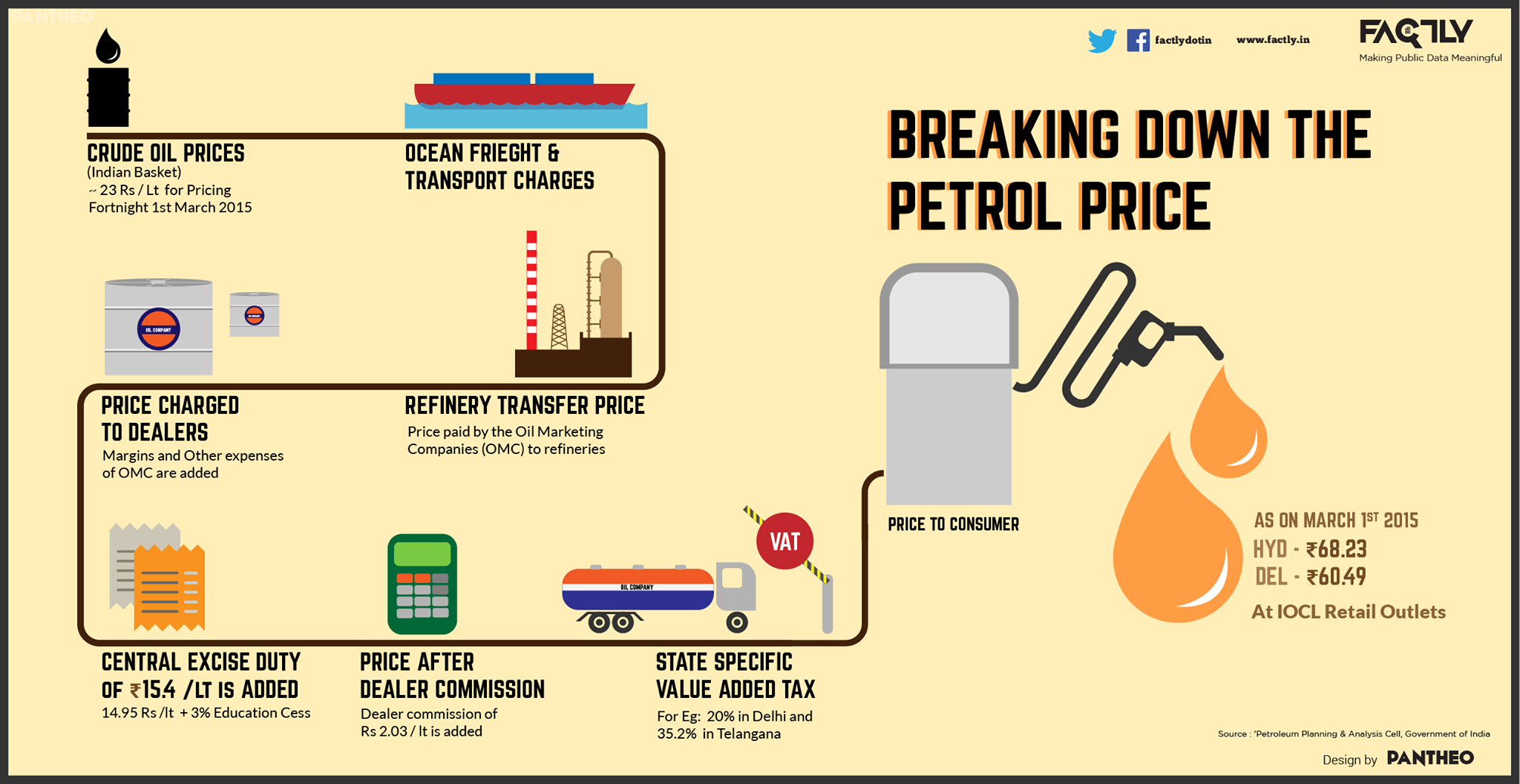
Indian-Petrol-Price-Breakdown-Infographic


For Instance in 2013, petrol break-up in Delhi was-

  1. Calculating Crude Oil Cost – Petrol
    Raw Crude Oil in Indian Currency: Rs. 37.5
  2. Calculating Cost of Processing
    Now, Crude Oil is Processed in Refineries – Approximate Cost is 10 – 12% of Crude Oil Cost = Rs. 4
    Add Transportation, Freight, Packing = Rs. 3
    Gross Cost After Refining Crude Oil= 44.5
  3. Calculating Final Price of Fuel
    Commission to Petrol Pump Owner = Rs. 1.5 to Rs. 2
    Excise Duty – Rs. 9.5 – Rs. 10
    VAT on Gross Price Including Excise * (@ 20%) – Rs. 11.2
    Final Price of Fuel- 67.2

* VAT – Rates of VAT varies on state on state. 20% VAT on Petroleum (Petrol) Products in Delhi. While Goa has just .1% VAT making it the lowest Petrol Prices in India. Some State Government even has 23% on Petrol and also additional cess of up to 3% on Fuel Prices.

Factors affecting the prices of crude oil in 2016, period when prices are at an all-time low of $ 20-30 per barrel[11]

img_56885af950385

  • Demand and supply[1]

-Increase in supply of crude oil due to newly found reserves of shale oil in US has escalated the production to an all-time high. OPEC (Organization of petroleum exporting countries) members, fearing the ending of their monopoly, and under pressure from Saudi-Arabia (one member of OPEC) are relentlessly producing oil to counter the production of US, which is driving prices extremely low.

-Decrease in demand in demand-driven countries like China and due to continuous development and use of renewable sources of energy

-Terrorists attacks on pipelines of crude oil reducing supply and resulting in increase in prices

  • Sentiment

-Sentiments also affect prices as the market reacts to it. For instance, if there is a rumor surrounding that demand is going to increase, then this can lead to increase in prices and vice-versa.

  • Rules and Regulation of specific countries

-As can be seen from the recent decision of Oil Producing and Exporting Countries (OPEC) members, led by the Saudi Arabia, to not reduce the supply of oil even after the increase in supply due to shale oil production in the US, resulting in supply glut and unprecedented low oil prices. After such decision by OPEC members and due to their high dependence on revenues from oil, it forced the US producers of oil to reduce the production as they were getting into losses due to persistent decision of OPEC to not reduce supply.

Conclusion

To conclude, it can thus be said that crude oil and its various forms are a major source of economic growth of any country and countries having such reserves can reduce their import bill on such oil to a  large extent if the demand is lesser than the supply of it in that country. In India, due to the crunch of such reserves, 70% of total imports is related to crude oil. As we know, the demand of crude oil is inelastic because even with the increase in prices there is not a proportionate decrease in demand. There can be an increase in demand in such circumstances under certain conditions.

So, at last, it can’t be said that the use of crude oil is expected to decline or vanish in the near future as it is a commodity that serves as an engine and backbone of all economies. Even if we see the development of alternate sources of energy, the investment in it remains high in certain countries, which may not allow considering their financial constraints, to switch to sources like renewable sources, etc.

Footnotes:

[1]Retrieved from:  http://www.manupatrafast.in/ba/dispbotC.aspx?nActCompID=28030&iActID=873

[2]Sakshi Parashar, Legal aspects of oil and gas sector Accessed: Manupatra (http://www.manupatrafast.com/articles)

[3]See, Petroleum Act, 1934

[4]See, Essential Commodities Act, 1955

[5] Retrieved from:  http://www.manupatrafast.com/articles/PopOpenArticle.aspx?ID=3b9928f3-1807-4916-b783-33b3c38992db&txtsearch=Subject:%20Oil%20And%20Gas

[6]http://www.psgdover.com/en/oil-and-gas/oil-gas-market-overview/oil-gas-upstream

[7]http://www.business-standard.com/article/specials/administered-price-mechanism-in-oil-sector-bane-or-boon-197052001002_1.html

[8]http://www.livemint.com/Politics/PQPRrimJveaUgDBlHs8QJP/The-crude-logic-of-regulated-deregulation.html

[9] https://www.quora.com/Commodities-Markets-How-are-the-petrol-prices-decided-in-India

[10] VM Entov, Mathematics of Enhanced Oil Recovery, Ed. 2004

[11]http://oilprice.com/Energy/Energy-General/Top-Five-Factors-Affecting-Oil-Prices-In-2015.html

[12]http://www.investopedia.com/articles/investing/072515/top-factors-reports-affect-price-oil.asp


Download Now

Right To Maintenance Of Muslim Women

0

In this blog post, Abhiraj Thakur, a student of NALSAR University of Law, Hyderabad writes about how the right of maintenance of Muslim women  has evolved over the course of time and what are the recent developments in it. He also writes about the harmonious interpretation of secular laws like section 125 CrPC along with gender discriminatory personal laws by courts for the protection of women from oppression.

Abhiraj

Indian society has perpetually been the site of a deadlock between gender equality and religious traditions. Religious traditions gain dominance over gender equality and consequently, the mitigation of injustice faced by a particular gender, usually women, gets marginalized for upholding majoritarian religious views.[1] An effective way to resist such marginalization is implementing progressive universal norms that supersede class, religion, and gender differences and uniformly apply to all. Only with such application can laws have positive outcomes regarding gender equality.

Rights-of-a-Muslim-Woman

One such progressive law is Section 125 of the Code of Criminal Procedure that is a uniformly applicable provision which provides civil remedies to enforce the fundamental obligation of a person to maintain his wife, children or parents so long as they are unable to do so. Ordinarily, the rights and duties under this section have an overriding effect over personal laws.[2] However, earlier this was subject to the exception of the Muslim Women (Protection of Rights on Divorce) Act, 1986 which is a self- contained statute that codifies the obligations of a Muslim husband and other relatives towards a Muslim woman and provides remedies for enforcing the rights of the woman.[3] This Act enshrines the Muslim law principle that a husband’s liability to pay maintenance to his divorced wife extends only till the Iddat period. Further, Section 125 can have no application to a Muslim woman unless both the husband and wife consent to be subject to it under Section 5 of the Act. The law has developed through judicial opinion, and it is now believed that there is no inconsistency between the Act and the Code.[4]

But now the judicial position has been cleared by the case of Shamim Bano v Ashraf Khan. The case is one such milestone as it interprets Section 125 of the Code of Criminal Procedure to be universally applicable to women regardless of personal laws’ dicta on the matter. Taking the lead from the popular Shah Bano case, the Supreme Court of India held that Section 125 would apply to Muslim women, and they would be entitled to maintenance irrespective of Mahomedan law’s views on the matter.

It has been held that Muslim women are entitled to maintenance through Section 125 of the Code before the divorce and after divorce; they can claim maintenance through the provisions of the Act.[5] The Article explores the build-up of jurisprudence for the protection of rights of Muslim women.

The Shah Bano judgment and aftermath

Youth-Ki-Awaaz31

The first case where this conflict of opinion first came to light was the historic judgment of Mohd. Ahmed Khan v. Shah Bano Begum and Ors.[6] In this judgment, a sixty-two-year-old Muslim woman was divorced by her husband by exercising his right to incontestable ‘talaq’. A constitutional bench of the Supreme Court held that a divorced Muslim woman is entitled to maintenance under Section 125 of the Code. The court relied on religious texts of Mahomedan law and Quranic interpretations to reach this conclusion and also stated that the husband cannot escape his liability to pay maintenance by payment of mahr or maintenance during Iddat period.

The orthodox Muslim community launched protests and agitations against this judgment as they saw it as interference in their personal law.[7] The Government, thus, caved in under pressure and unanimously passed the Muslim Women (Protection of Rights on Divorce) Act, 1986 which took precedence over the uniformly applicable Criminal Procedure. According to this Act, Muslim women had the right to maintenance from their husbands only for the Iddat period after which the burden of maintenance was transferred to her relatives or the District Waqf Board. Thus, the right to appeal under Section 125 was largely restricted to Muslim women and the law, which should have championed for women’s rights, became anti- secular[8] and anti- feminist due to the influence of politics and orthodoxy.[9]

This is the law on maintenance for divorced Muslim women at present. However, courts have tried to interpret widely the provisions of the Code and the Act to provide relief to Muslim women. Previously, the Supreme Court has relied on such harmonious construction, and it is pertinent to analyze these judgments to get a holistic understanding of the status quo on maintenance.

Need for harmonious interpretation of statutes

One of the most notable cases after the Shah Bano judgment is Danial Latifi and Anr. v. Union of India[10] where Shah Bano’s lawyer herself challenged the constitutional validity of the Act. In this judgment, the Supreme Court attempted to dispel the confusion of conflicting judgments that had arisen in the aftermath of Shah Bano. The Constitution Bench came to a compromise where it upheld the validity of the Act but decided that the provision for maintenance would be applicable equally to the Muslim community.[11] The Bench liberally interpreted Sections 3 and 4 of the Act and stated that a divorced Muslim woman is entitled to reasonable and sufficient provision for livelihood along with maintenance, and thus, the husband is duty bound to provide this within the Iddat period (as stated by the Act). However, it held that this maintenance is not limited to the Iddat period, and a Muslim woman is also entitled to maintenance for her entire life or until she remarries.[12] The court interpreted the Act to mean that the limitation in the Act was not on the nature or duration of maintenance but rather on the period within which such maintenance or provision had to be made. Thus, the Supreme Court tried to capture the spirit of Section 125 of the Code and secularly apply it to Muslim women. It iterated the need for uniformly applicable laws to prevent such instances of discrimination and unjust deprivation in the future.

However, one shortcoming in Daniel Latifi was that the court failed to realize the inaccessibility of Section 125 for Muslim women. While Section 125 proclaims to be uniformly applicable, the consent of both the wife as well as the husband is required to invoke it. Pragmatically speaking, the husband would not consent to be subjected to Section 125 of the Code when he can enjoy lesser liability under the Act. If a divorced Muslim woman is unable to maintain herself once the Iddat period is over, she cannot claim maintenance from her former husband and has to depend on her relatives or the State Waqf Board. Thus, in most cases, women are unable to invoke Section 125 of the Code, and this provision remains secular only in name.

Position settled after Shamim Bano case

In the Shamim Bano case, the Supreme Court has combined the interpretations espoused in Shah Bano and Danial Latifi and correctly held that Shamim Bano is entitled not only to Mahr, ornaments, and maintenance under Section 3 of the Act but also to maintenance for the post- Iddat period as the same has not been provided in the order granting mahr. Thus, the Supreme Court made a commendable effort to bring Muslim women on par with other communities. Additionally, the Bench sustained her application under Section 125 of the Code despite the fact that her husband, Ashraf Khan had not consented to the same. The court realized that if the application under Section 125 were dismissed, Shamim Bano would be remediless as the Magistrate’s order only ensured Mahr and did not give her any maintenance. Thus, foreseeing this situation as a travesty of justice, the court reasoned that Section 125’s parameters should be applied.

 Supreme-Court-on-Right-to-Maintenance-150x150

Thus the verdicts like Shamim Ara has improvised on Shah Bano and given legitimacy to the secular character of Section 125; this secular character has been helpful in protecting Muslim women from oppression at the hands of Male orthodoxy. However, the Muslim Women (Protection of Rights on Divorce) Act continues to be an obstruction to these efforts. Thus, it is necessary to clearly demarcate the extent of this Act by reserving it only for providing fair and reasonable Mahr and maintenance during the Iddat period. The cases like these have helped in reducing the monopoly of female discriminatory laws in matters of Marriage and much more.

For maintenance during the post-Iddat period, the legislature shall assume this duty to give Muslim women the uncompromising, secular right to file an application under Section 125 of the Code. Therefore, the legislature must amend the Act to restrict its application only for obtaining Mahr and to delete Section 5 which makes it mandatory to obtain the husband’s consent for obtaining maintenance under Section 125 of the Code. Such a result would work harmoniously as it takes into account religious differences but also gives primary importance to the welfare of divorced women.

Footnotes:

[1] Siobhan Mullally, “Feminism and Multicultural Dilemmas in India: Revisiting the Shah Bano Case”, 24 (4) OJLP 671 (2004).

[2] Umar Hayat Khan v. Mahboobunisa, 1976 CrLJ 395 (Kant).

[3] J. Y. V. Chandrachud, V. R. Manohar, The Code of Criminal Procedure 253 (Wadhwa, Nagpur, 18th Enlarged Ed., 2006).

[4] Shaikh Babbu v. Sayeda Marat Begum, 1999 CrLJ 4822 (Box).

[5] Abdul Rashid v. Farida, 1994 CrLJ 2336 (MP).

[6] (1985) 2 SCC 556.

[7] A.M., “The Shah Bano Legacy”, The Hindu, Aug. 10, 2003, available at: http://www.thehindu.com/2003/08/10/stories/2003081000221500.htm

[8] Rajashri Dasgupta, “Historic Judgment and After”, 22 (17) EPW 748- 749 (1987).

[9] Supra, n.1.

[10] (2001) 7 SCC 740.

[11] Feminism and multicultural p.673

[12] (2001) 7 SCC 740.


Download Now

Revisiting The Language Policy Of India

1

In this Blog post, Abhiraj Thakur, a student of NALSAR University of Law analyses the language policy of India as incorporated in the Official Languages Act of 1963. He further highlights a few shortcomings of the policy.

Abhiraj


With a population of over one billion speaking more than a thousand varied languages, India certainly is one of the largest multilingual nations in the world. With their origins in Indo-Aryan, Dravidian, Austro-Asian and Tibeto-Burman language families,[1] the plethora of languages spoken here represent perfectly India’s vast and diverse history. Indian leaders, while making the Constitution planned it thus that Hindi, with the Devanagari script, would be the most prominent language and would promote regional communication and unify the numerous cultures of India. Today, however, English and Hindi both share the same status as official languages.

The write up is a brief analysis of the Official Languages Act of 1963. The objective is to address certain questions about the language policy of India; first, the selection of various languages as ‘official languages’ and second, the prevalence of said languages in the Indian education policy. Finally, the importance of the Official Languages Act, 1963, and the tri-language formula about the Indian language policy is highlighted.

languages-in-india

Overview

The Constitution, adopted in 1950, necessitated that English and Hindi be utilized for conducting the Union’s official business for a time of fifteen years [s. 343(2) and 343(3)]. After that time, Hindi should turn into the sole official dialect of the Union. It demonstrated difficult to supplant English with Hindi, in any case, in light of substantive restriction from the southern states, where Dravidian dialects were talked. They felt that the central government was attempting to force the entire nation to use Hindi, including the south, and chose to keep using English, which they thought was more “adequate” on the grounds that, much unlike Hindi, it was not connected with any specific ethnic culture.[2]

The Parliament, in 1963, passed the Official Languages Act, which lawfully settled Hindi and English as the dialects utilized as a part of Congress, while leaving states and domains to pick their own formal languages. In 1976, the Act was changed to formulate the Official Languages Rules, which, too, were revised in 1987.[3]

 Summary of the Act

Section 3 of the Official Languages Act negates the 15-year-old lapsed period for the utilization of English. Subsection 3 allows the utilization of both dialects, Hindi and English, in resolutions, general requests, rules, warnings, authoritative or different reports or press discharges issued or made by the central government or by a service, division, office or company claimed or controlled by the central government. Subsection 5 of Section 3 states that until the legislatures of the states that haven’t adopted the English language as the official one pass a resolution for stopping the use of English for the purposes laid down by the Act, the provisions will continue to remain in force.

Section 5 of the states that the Hindi rendition of government acts will be viewed as definitive over the version in English. The Official Languages Act in this way seems to energize the utilization of Hindi over English. Section 6 of the Act unequivocally states that when a language other than Hindi is prescribed by any state assembly for the passed Acts, an identical interpretation in Hindi along with an English interpretation shall be published, and the Hindi version shall be the definitive one.

Under Section 7 of the Official Languages Act, the Governor of a State (except for Jammu and Kashmir) with the past assent of the President, may approve the utilization of Hindi or the official dialect of the State, notwithstanding English for the reasons of any judgment, declaration or request passed or made by the High Court for that State and for any judgment, announcement or request passed or made by in that dialect (other than English).

Themes

India-language-Policy-challenges-MarketExpress-in

The Three Language Formula

The three language formula is a policy that was formulated by the Education Ministry of the Indian government in the 1968 National Policy Resolution.[4] It provides that in all government schools across India, there shall be three languages to be taught: English, as a mandate; Hindi, too, is compulsory, both in Hindi-speaking states and non-Hindi-speaking states; and finally, the third language is the local language of the region where the school is located.

The three language formula has taken multiple forms in India on the basis of states and their own official and local languages.[5] While Hindi and English remain common to all, they change from first language to second and third languages depending on that particular state’s government. For example, while West Bengal’s local dialect Bengali is the closest to Hindi as compared to Malayali or Tamil, the government chose not to teach Hindi at all, as they considered Bengali a much more culturally rich language. In Kerala, however, the learning of Hindi as a language was made compulsory despite the drastic difference between it and the local language.

The basic purpose of the three-language formula was, apart from the overt objective of making widespread the awareness of Hindi and English as national languages, the obscure objective of increasing multilingualism in children across the country. Multilingualism, as has been scientifically proven, not only broadens a child’s horizons but also is conducive to them becoming more creative and more socially tolerant.

Language policy in India

When we talk about the language policy of India, the first thing to be mentioned is the difference between the national language and the official language of a country.  While national language refers to the language that is most widely used in cultural, political and in social realms, the official language refers to the language that is used for all of the government’s operations. The official language is pragmatic, wherein the national language is merely symbolic.

Hindi, as it is used today, is thought of as a national language due to its being the only language in use that is not state or region-specific. However, according to the Constitution of India, Hindi is only the official language of India.

Apart from these two partially “official” languages, India’s census records hold that there are 112 languages that are prevalent all over the country. Yet, only 22 of them are a part of the Eighth Schedule, which means that only twenty-four out of a total of a hundred and fourteen dialects are recognised as national languages. Though these 22 languages originate from all the different language families, there are still a number of languages like Bhili which are spoken by the most number of people in India barring Hindi which ought to be included in the list. The only likely reason for Bhili, among other such dialects, to be excluded is political intervention.

Education policy and the language policy

The Indian education system is multilingual in its character every sense of the word. Primary schools in Mumbai run in nine different languages, and those in Karnataka and West Bengal run in eight and fourteen languages respectively.[6] Most states, as was the goal of the education policy makers at the time of Independence, have their aim as developing and strengthening the multilingual characters of the system.

However, there are multiple problems in the implementation of the three-language system. The formula does not refer to either the mother tongue or the home dialect of a student, which are both imperative to the cognitive development of a child. Also, many states have implemented the formula only partially, choosing to take up only two languages as opposed to three, mostly consisting of English and Hindi. The existence of classical languages such as Sanskrit is scarce in most Hindi-speaking states.[7] Though the Eighth Schedule was expanded to include more languages, the educational system regarding languages has remained almost the same.

To conclude we can say the language policy in India is mainly dependent on the Official Language Act, 1963. The Kothari Commission formulated the language policies with the objective of unifying the country’s diverse cultures and dialects via a common ‘official’ language, which, at that point, was Hindi. However, due to failings of the three-language formula and also in the education policy of India in relation to languages, the original aim has morphed into having both English and Hindi as quasi-official languages. From the resistance by numerous states in implementing the said policies to shortcomings in the actual policy, the solution found by the Language Commission was a sort of temporary and remedial measure (allowing the usage of English for ten years) that has been continually extended and used instead of finding a more infallible and constant policy to suit today’s needs and objectives.

Footnotes:

[1] Dravidian languages”. Encyclopædia Britannica Online. Retrieved 10 December 2014.

[2] “There’s no national language in India: Gujarat High Court”. The Times of India. Retrieved 5 May 2014.

[3] Sisir Kumar; A History of Indian Literature, 500-1399: From Courtly to the Popular, pp.140-141, Sahitya Akademi, 2005, New Delhi.

[4] “Indian Education Commission 1964-66”. PB Works. 2015. Retrieved June 20, 2015.

[5] Introduction to Education Commissions 1964-66″. Krishna Kanta Handiqui State Open University. 2015. Retrieved June 18, 2015.

[6] “Board of Higher Secondary Education”. Board of Higher Secondary Education. 2015. Retrieved June 21, 2015.

[7] “National Policy on Education 1968” (PDF). Ministry of Human Resource Development, Government of India. 2015. Retrieved June 21, 2015.


Download Now

What Is A Reverse Onus Clause In Criminal Law?

1

In this blog post, Abhiraj Thakur, a student of NALSAR University of Law writes about reverse onus clauses in criminal law and lays down the reasons behind incorporating such clauses. He further deliberates on its implications in a criminal trial.

Abhiraj

To have a procedure of trial that is fair and equitable to all the adversarial parties is one of the fundamental principles of criminal jurisprudence. In the interest of justice, equity, and good conscience, there are certain inalienable principles that are laid down; that constitute the basic framework of how the justice system works in this area of law. One among these inalienable features of the criminal justice system is the principle of ‘Presumption of Innocence’. In simplistic terms, an accused brought to trial must be given a fair chance to be heard and cannot be presumed to be guilty of a crime till the prosecution can prove their guilt beyond reasonable doubt. In a single line, an accused is ‘innocent until proven guilty’. In the famous case of Woolmington v. Director of Public Prosecutions, this principle was referred to as ‘golden thread principle of criminal law’. Today, this principle finds place in the criminal jurisprudence of various common law countries such as the United Kingdom, Canada, South Africa, United States of America and India.

 Reverse Onus Clauses: Exception to the golden rule

While the presumption of the innocence of the accused is an age old doctrine enshrined in common law, and held in Indian law as well, jurists have created a rebuttal to the presumption of innocence wherein, an accused may be presumed guilty at the first instance, and the burden of proof is on the defence to prove his innocence or to create doubt about his guilt. A Reverse onus clause can be defined as ‘one that shifts the burden of proof upon the accused after the Prosecution proves the existence of a foundational fact that leads to the shift in burden.


 Position In India: Presence of Both Principles

Though not clearly laid down in any legislation, the Presumption of Innocence is a recognized principle of criminal law in India. Section 101 and 106 of the Indian Evidence Act of 1872 talk about the burden of proof, but not whether such burden is upon the Prosecution or Defense. However, The Indian Judiciary has recognized presumption of Innocence under Article 20 and 21 of the Constitution. In the landmark Maneka Gandhi[1] case, presumption of innocence was held to the fundamental right of the accused.

47573442

Reverse onus clauses under Indian Criminal Law

Along with the presence of golden rule, there exist certain classes of offenses. In such cases, the accused is presumed guilty, prima facie, and the burden of proof is shifted onto the accused to adduce evidence towards his innocence or to create reasonable doubt about his guilt.[2] In India, the presumption of innocence is rebutted in two cases – firstly, when there is express statutory provision reversing the burden of proof, and secondly, when the accused appeals against the judgment of a lower court wherein his presumption is that of guilt and not innocence. The most well-known example of a reverse onus clause in our country is Dowry Death.[3] In cases of dowry death, the culpable mental state of the accused is presumed, imposing a presumption of guilt, instead of the usual presumption of innocence. This rebuttal to the presumption in criminal law often creates problems and conflicts in law.


Reasons for Incorporating Reverse Onus Clauses

Along with IPC, reverse onus clauses are present in many other anti-crime statutes in India. Statutes such as Essential Commodities Act of 1955 and Foreign Exchange Management Act of 1994 (FEMA) assume culpable mental state (Mens Rea) of the accused. Some of the reasons forwarded by jurists for incorporation of reverse onus clauses and statutes are:

  1. Helpful in curbing grave offences:

The 47th law commission report of India suggested that there are certain crimes that gravely affect and harm society and so for such crimes it is necessary to dispense with the burden of the prosecution. The offences which the Indian judiciary has recognised as public welfare offences, it has deemed reverse onus clauses to be necessary to prevent such crimes. dowry death, falls within the second class of socio-economic offences. It was introduced as part of the Criminal Law Amendment Act No. 43 of 1986 as implementation of the 91st Law Commission Report[4].

  1. Deterrent effect:

Such express statutory provisions are often made to deal with grave socio-economic offences that directly or indirectly harm the public welfare. The burden of proof is generally shifted to gain convictions in such offences where deterrence considerations are greater. In that light, an example is dowry death. It is considered a grave social offence that affects standards of morality in society, and the deterrence to cruelty on account of dowry demands is justified.

  1. Judicial Convenience:

For reverse onus It is argued that it becomes more convenient and easy for the Prosecution to prove the basic fact that shifts the burden. In light of the difficulty of the Prosecution to enter private spaces like the home, and conduct investigations, search and seizures, the inconvenience of the Prosecution often becomes greater in criminal cases. For the sake of expediency and judicial economy, the lawmakers take this argument to reverse the burden.

  1. Judicially Valid:

Lastly, the stance of Indian courts on reverse onus clauses has evolved greatly. In case of KM Nanavati[5] upheld the basic human right of the accused to be presumed innocent in trial. This led to widespread debate on validity of reverse onus clauses in Indian law. The position was finally settled P. N. Krishnalal v. Government of Kerala[6]  where the court held that the presumption of innocence is not a constitutional guarantee and can be dispensed with by legislative imperatives and action. As reverse onus clauses have been held constitutionally valid by the judiciary, the lawmakers don’t hesitate in its inclusion.


Issues with reverse onus clauses

guilty-until-proven-innocent

Since the very inception, reverse onus clauses have been subject of much debate and controversies. Some of the major contentions raised by the jurists in opposition to such clauses are:


  1. Violation of Procedure established by Law:

It has already been laid in the Maneka Gandhi’s case that right to life and personal liberty can only be regulated by procedure established by law and that procedure must be just, fair and reasonable. Although In its doctrinal form, the reverse onus clause is justified as one which serves its legislative purpose, it becomes problematic due to judicial discretion and interpretation. More often than not, the evidential burden that is the standard of proof for the accused, when the onus is reversed, is raised to the threshold of a legal burden. Generally, the burden of the Prosecution is higher i.e., beyond reasonable doubt, while the burden on the accused is that of preponderance of probabilities. But due to judicial discretion, these standards are getting diluted with passage of time. If such standards are diluting then the procedure does not remain just, fair or reasonable. This makes reverse onus clauses volatile of procedure establishes by law.

  1. Self-Incriminating in Nature:

By virtue of Article 20(3) of the Indian Constitution, no person can be compelled to be a witness against himself. The scope of Article 20(3) has been elaborately dealt with by the judiciary in many cases. Widening the scope of the provision in the case of M.P. Sharma v. Satish Chandra[7] the Supreme Court held that the right against self-incrimination includes right to remain silent. In reverse when the onus of burden of proof is reversed, it creates a situation where the accused, now presumed guilty must adduce evidence beyond reasonable doubt to prove his innocence and be granted an acquittal. It thus violates the right to remain to silent of an accused which comes in the ambit of fundamental rights in the constitution.

  1. Potential Abuse:

It is very important while implementing reverse onus clauses, they must be weighed against the compelling public interest that they so deem to address. Often it is however seen that in order to achieve that public welfare, the legislation may create unnecessary reverse onus clauses and discriminate greatly between the accused of reverse onus offences and non-reverse onus offences contravening the principles of equality in the eyes of the law[8], and to an extent, being ultra vires of Article 14 of the Constitution[9]. In most bride burning cases, reporting is paltry and generally cannot prove the guilt of the accused conclusively. Most cases are registered under 498A[10] and the discretion of judges play a huge part in allowing the Prosecution to discharge their burden. For instance, in Maya Devi v. State of Haryana[11], the Prosecution could prove the basic fact of the meting out of cruelty on a preponderance of probabilities, giving great judicial discretion to deciding the limitation of time with respect to the phrase ‘soon before death’.

Reverse onus is one of the most contentious issues in the arena of criminal law, though at times they have served the purpose of curbing crimes but at the same time the possibility of their abuse cannot be disregarded. India incorporates both the principles of criminal law: presumption of innocence as well as reverse onus for some offences. The effectiveness of such clauses to have deterrence effect in long run will be an interesting thing to look for in times to come.

Footnotes:

[1] Maneka Gandhi v. The Union of India, 1978 (1) SCC 248.

[2] Section 4, Indian Evidence Act, 1872

[3] Section 304B, The Indian Penal Code 1860.

[4] 91st Law Commission Report, Law Commission of India, Ministry of Law and Justice, 1983.

[5] Supra Note 26.

[6] P. N. Krishnalal v. Government of Kerala, 1995 SCC (Cri) 466.

[7] M.P. Sharma v. Satish Chandra , AIR 1954 SC 300.

[8] Juhi Gupta, “Interpretation of Reverse Onus Clauses”, 5 NUJS Law Review, 2012, pp. 49-64, at 63.

[9] Article 14, Constitution of India.

[10] Section 498A, Indian Penal Code, 1860.

[11] Maya Devi v. State of Haryana, AIR 2016 SC 125.


Download Now

Preventive Detention – How Far Is It Justified?

0

In this Blog Post, Sakshi Bhatnagar, a student of National Law University Odisha, Cuttack writes about the controversial provision of preventive detention and ponders upon the question of whether the legislative intent for enacting the provision and the method of implementation of this provision are in sync with each other.

12019813_1167341736613639_2035022244513496011_n

The Indian Constitution, just as other constitutions of the world, provides certain rights to the Indian citizens regarding their freedom, to protect themselves and their property, to put forward their opinions and views on and matter etc. at times, the individual liberty crosses the limits and threatens the very existence of the State and at that point of time it fails to control the enjoyment of individual’s liberty. The framers of the Constitution were aware of the fact that these freedoms can be used by the individuals in an unlawful manner, to achieve their selfish interests and sometimes even to cause harm to others. Hence, certain clauses which mainly aimed at preventing such a situation were inserted in the Constitution. These clauses act as limits which restrict the application of these rights in a law full manner so that one’s actions do not harm others. The law of Preventive Detention is one of such preventive measures which acts as a restriction on the unlawful use of the freedoms provided under the Constitution.

The Black Law Dictionary describes Preventive Detention as confinement generally imposed on a defendant in a criminal case who has threatened to violate the law while awaiting trial or disposition or of a mentally ill person who may harm himself or others. Hon’ble Supreme Court of India has defined this term as an anticipatory measure and has stated that it does not relate to an offense while criminal proceedings are to punish a person for an offense committed by him.[1]

In the pre-independence era, preventive detention was used by the British regime as a tool to establish a strong foothold in India. After independence, the laws relating to Preventive Detention were enacted by the provincial legislatures, and the hopes of the freedom fighters were shattered when this measure was immediately put into force after the commencement of Indian Constitution at the central level. The Preventive Detention Act, 1950 was altered thrice, aiming to provide increased protection to the person detained under the Act. The Act enacted in the year 1950 came to an end in the year 1969 but sadly after that, no vacuum was created in this area. Presently, the Constitution confers on the Parliament the power to make law with respect to preventive detention for the reasons connected with defence, foreign affairs, or national security and the persons subjected to such detention, by the virtue of Entry 9 of List I. these are the grounds upon which the very existence of the nation is based and thus giving Parliament exclusive authority in this regard can be said to be justified. A similar kind of authority was provided to the Federal Legislature by the Government of India Act, 1935.

2015_8$largeimg227_Aug_2015_211955467

Further, Entry 3 of List II provides concurrent power on Parliament and the state legislatures to make laws relating to preventive detention in respect of the security of the State, maintenance of public order or maintenance of supplies and services essential to the community and persons subjected to such detention. It is not out of the place to mention here that this sometimes causes tension between the central and state legislatures as the provinces and states may not pass such a law suit where their rights and liberty and interests are to be sacrificed. There was a difficult situation in the country just before the commencement of Constitution, and there were diverse preventive detention laws passed by the provincial legislatures as the Government of India Act of 1935 also provided power to the provincial legislatures on preventive detention regarding maintenance of public order.[2]Thankfully, the current Constitution is an improvement of the 1935 Act and does not give any such exclusive power to state legislatures in this connection.

There is no doubt that as per the present Indian legal system, the preventive detention is the most contentious part of the fundamental rights and “if a person is arrested or detained under a law providing for preventive detention, then the protection against arrest and detention under Article 22(1) and (2) shall not be available”.[3] “The object of Preventive Detention is not to punish but to intercept to prevent the Detent from doing something prejudicial to the State. The satisfaction of the concerned authority is a subjective satisfaction in such a manner”.[4]

A layman often confuses the concept of preventive detention with that of punitive detention. There is always need to carefully distinguish the two concepts. Preventive detention is used as a measure of a crime that is likely to happen, but the punitive detention is punishment for illegal acts already committed. Hence, the basic distinction is that Preventive Detention is taken on the grounds of suspicion that some wrong act may be done by the person concerned.


Grounds of preventive detention

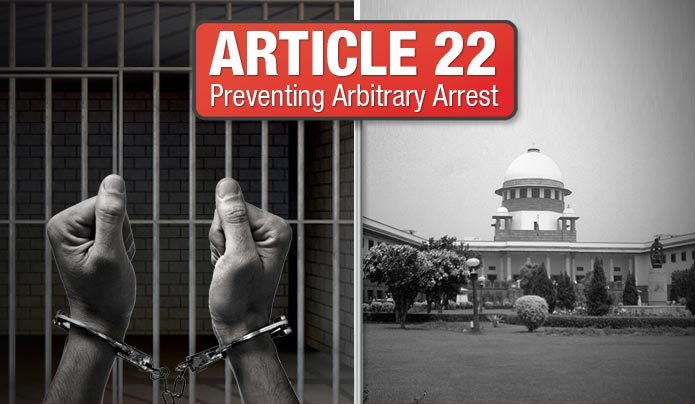
Article-22-of-the-Constitution-of-India

Article 22 provides safeguards relating to preventive detention under clauses (4) to (7). Preventive detention is resorted to in the following circumstances:

  • Security of state
  • Maintenance of public order
  • Maintenance of supplies and essential services and defense
  • Foreign affairs or security of India

These grounds seem alike from the perspective of a layman’s understanding as for an ordinary person; it is not easy to differentiate between these terms. A common man cannot distinguish between the security of state and maintenance of public order or law and order. All these terms seem synonymous to an ordinary citizen of India. Thus judiciary’s role holds a prominent position while differentiating these concepts.

As regards to the ground of maintenance of public order is concerned, the judiciary has placed the cases of injuring an individual with knife[5], causing assault to one individual and inflicting grievous injury to his right leg[6], causing undue harassment to respectable young ladies[7], shouting slogans like ‘Naxalites Zindabad,’ ‘Long Live Revolution’ and ‘Mao Tse Tung Zindabad’[8] etc. the important point to be noticed here is that these grounds lack any direct relation to the maintenance of public order, and still they have been dealt by applying the law of preventive detention. Commenting on the most debated difference between ‘security of the state,’ ‘public order’ and ‘law and order,’ Chief Justice Hidayatullah stated that security of the state is a narrower concept and public order. State security forms the part of the inner circle and then comes the public order. The outer circle consists of law and order.[9] This distinction holds an eminent position in the law, but the demarcating line gets blurred when it comes to some cases such as; when a person commits assault or murder of another person. Such as case is mainly concerned with the problem of maintaining law and order but it adopts a communal element when committed in a public place, leading to chaos in the society and disturbances in the community. When this happens, the case comes under the purview of maintenance of public order.[10] This overlapping, arising out of such circumstances gives the executive a free hand in controlling the law and order problem in the name of maintenance of public order by extra-ordinary measures. Under such situations, it may be suggested that maintenance of public order should be scrapped as a ground of preventive detention just as in England[11], The United States of America[12], Australia[13], and Pakistan[14].

When it comes to the security of a state, it is vulnerable to be threatened by war, external aggression or internal disturbance. This it ultimately affects the security of the country. And thus, it is covered separately in List III, Entry 3. This view is also backed by judicial decisions where persons were detained on the ground of security of a state.[15] Now when we talk about maintenance of supplies and services essential to the community as a ground of preventive detention, the view of the judiciary is that it could be covered under the ground of defense of the country and hence, the defense power of the Parliament can be extended to control it.[16]

The Question Arises:

On a study of the laws of Preventive Detention in India, it can be seen that all the grounds mentioned above are included in one single legislation. The question thus arises is that how far is it justified?  These grounds are covered by a single legislation by the virtue of The Preventive Detention Act, 1950 and the Maintenance of Internal Security Act, 1971, which directly provides the executive with a wider range of power to implement this extraordinary measure. In the case of executive action effecting preventive detention on two grounds, Hon’ble Supreme Court of India quashed the detention order on the ground that in the light of detention on two disjunctive grounds the authority making the detention order failed to apply its mind which was required by the Act.[17] In cases of preventive detention, the most valuable right of a person i.e. the right of personal liberty is at stake and thus there arises a need for the legislature to carefully and scrupulously enact a law relating to preventive detention.[18]

Extended Scope:

the original law has an attempt to cover all possible cases that could arise. But with time, both legislature and executive have extended the scope of preventive detention as a measure against unlawful activities. For instance, to curb the smuggling activities and to protect foreign exchange, the Parliament passes the Conservation of Foreign Exchange and Prevention of Smuggling Activities Act, 1974. The Act aimed at ensuring the security of state but the activities covered by the Act cannot be said to have a direct and immediate effect on the security of the state. The scope of Preventive Detention was also extended to control social boycott and excommunication[19], price control[20] etc. But the judiciary expressed its views against the executive action of trying to control food adulteration through preventive detention with an aim to maintain supplies and services essential to the community.[21] There were even suggestions to implement preventive detention laws for the prohibition of untouchability, evasion of taxes, etc. But such socio-economic issues ought not to be dealt with by using this extraordinary measure merely because the State failed in solving a problem.

Rights of Detente  and Grounds

762458146

As the measure of preventive detention severely affects the social and personal situations of the detent, certain rights have been given to the person detained under this law so as to prevent infringement of his/her fundamental rights. Article 22(5) can be understood in two parts. First is that the detaining authority has to communicate to the detained person on what grounds he has been detained. Secondly, it is the obligation of the detaining authority to ensure that the detained person is afforded the earliest opportunity of making a representation against the order of detention.

Disclosure of the Grounds of Detention to Court

The laws laid down under the Preventive Detention Act, 1950 by the virtue of Section 14 were very strongly retaliated in the matter of Gopalan vs. State of Madras[22] On the ground that it infringed all the principles of natural justice and also the rights provided by Article 22(5) of the Constitution. It was held by the Court that such a provision was allowed to stand as it could lead to a situation where there would be no material before the Court to determine whether the detention was legal or not, irrespective of the fact that whether the impugned grounds were sufficient or not.

Relevant Ground

For a ground to be a relevant one, it must have a rational connection with the object which is to be ultimately prevented from happening. For instance, in the case of Puranlal Lakhanpal vs. Union of India[23], the aim of the appellant’s detention was to prevent him from acting in a manner prejudicial to (i) the security of India and (ii) her relations with foreign powers. The ground in the question was that the appellant had addressed a press conference that was attended by a large body of correspondents of the press of various foreign countries and making a speech that contained several false statements about the conditions of the people of Kashmir. Such a ground was considered relevant and to have a rational connection to prevent the activities prejudicial to the security of the country and foreign relations.

Vague Ground

While delivering judgment in the case of State of Bombay vs. Atma Ram[24], The Apex Court commented on the term ‘vague’ and stated that it can be considered as the antonym of ‘definite.’ If the supplied ground is incapable of being comprehended and understood or defined with sufficient certainty, it can be called vague.

In Ram Krishan vs. the State of Delhi, the Court ruled that a layman who is not experienced in the interpretation of documents could hardly be expected, without legal aid, to interpret the grounds in the proper sense. Hence, it is the responsibility of the detaining authority to make his meaning clear beyond doubt. If this is not done and the situation is handled otherwise, such grounds would lead to a violation of fundamental rights and freedom of the person so detained and thus they will be vague.[25]


Conclusion

To sum up the circumstances around the Preventive Detention laws of the country, it can be said that definitely the intentions of enacting such a law is to prevent the anti-social elements from causing hindrances in the society which might lead to harmful effects on lives of citizens, but these laws have to be applied with utmost care and precaution so as to avoid any controversy. These laws directly affect the fundamental rights and freedoms of people who are guaranteed by the primary source of law in India i.e. the Constitution of India and the complexities arising out of the irresponsible implementation of these laws can consume a lot of time of the judiciary and life of the person so detained.

[1]Alijan Mja vs. District Magistrate, Dhanbad, AIR 1983, SC 1130

[2]See the Assam Act, 1947; Bengal Act,1948; Orissa Act, 1948

[3]Art. 22(3), The Constitution of India, 1950

[4]Ankul Chandra Pradhan vs. Union of India, AIR 1997 SC 1284

[5]Sudhir Kumar vs. Police Commissioner, Calcutta, AIR 1970 SC 814

[6] P. Mukherjee vs. the State of W.B., AIR 1970 SC 852; Manu Bhusan vs. State of W.B., AIR 1973 SC 295

[7]Arun Ghosh vs. the State of W.B., AIR 1970 SC 1228

[8]Sundara Rao vs. State of Orissa, AIR 1972 SC 739

[9]AIR 1970 SC 1228, 1230

[10]ArunThis vs. the State of W.B., AIR 1966 SC 1925

[11]The Defence (General) Regulations, 19369

[12]The Internal Security Act,1950

[13]The War Prevention Act, 1914

[14]Schedule III, Entry 43, The Constitution of Pakistan

[15]JaganNathSahu vs. Union of India, AIR 1960 SC 625; Shyamlal Mondal vs. the State of W.B., AIR 1971 SC 2384

[16]Sec. 3(23), The Defense of India Act, 1962

[17]Kishori Mohan vs. the State of W.B., AIR 1972 SC 1949

[18]Preventive Detention in India: Experiences and Some Suggested Reforms, C.M. Jariwala

[19]Shamrao vs. District Magistrate, AIR 1952 SC 324

[20]Mishrilal Jain vs. District Magistrate, Kanpur, UR (SC) 1972, 100, 102

[21]Misrilal vs. State, AIR 1971 Pat. 134

[22]AIR 1950 SC 27

[23]AIR 1958 SC 163

[24]AIR 1951 SC 157

[25] AIR 1953 SC 318


Download Now

Is Compulsory Registration Of Marriage In India Feasible?

0

In this blog post, Abhiraj Thakur, a student NALSAR University of Law, writes about the registration of marriages under the Hindu personal law and stresses on the various issues that surround it. He further tries to inquire into the feasibility of having a law to enforce compulsory registration of marriages?

Abhiraj


“Though destitute of virtue, or seeking pleasure (elsewhere), or devoid of good qualities, (yet) a husband must constantly be worshipped as a god by a faithful wife.”

 –Manusmriti V 152

The aforementioned shloka describes one of the many duties of a Hindu wife. The bond or union she shares with her husband cannot be broken as per the Shastri law and so she should continue with her duties even in unfavorable circumstances.

Marriage in Hindu law acts as a fundamental canon of social organization, being a sacrament or a sanskara it holds an exigent and imperative character.[1] It lays out legal and spiritual obligations on two individuals entering a sacred union through performing certain rituals enunciated in the Dharmashastras to pursue Dharma, Artha, and Kama.[2] A Hindu marriage is deemed to be solemnized by the performance of customary rites and ceremonies of the parties, along with Saptapadi and various other rituals. It is considered as a union that cannot be dissolved. But often due to some circumstances the bitterness gets into the marital relationships and the emotional attachment starts disintegrating finally leading to a situation where the parties file either for divorce or judicial separation.


India and legal framework on registration

0712brpg08a

India on 30th July 1980 became a signatory to the Convention on the Elimination of All Forms of Discrimination Against Women (in short ‘CEDAW’) that was adopted in 1979 by the United Nations General Assembly.[3] CEDAW was ratified by India on 9th July 1993 by two declaratory statements and reservation. Article 16(2) of the CEDAW recommended the signatory nations to adopt compulsory registration of marriages, though India in its declaratory statement appraised:

”It is not practical in a vast country like India with its variety of customs, religions and level of literacy’ and has expressed reservation to this very clause to make registration of marriage compulsory”.

After that, no specific steps proceeded in this direction.[4]

On the registration of marriages in personal laws of other religions, legislations are already in place. For Christians it is the Indian Christian Marriage Act of 1872, similarly, for the Parsis, it is The Parsi Marriage and Divorce Act of 1936 that make registration of marriages compulsory. Muslim marriages are contractual in nature. The Nikah Nama serves as a valid proof of a Muslim marriage. On the other hand, for Hindus, Section 8 of the Hindu Marriage Act talks about registration. It makes it recommendatory for states to have laws for registration of marriage also stating that the failure to register will in no way impact the validity of the same.


Legislative Initiative

In 2005, the National Commission for Women proposed The Compulsory Registration of Marriages Bill 2005; the bill contained a provision for compulsory registration of all marriages in the country within the 30 days of solemnization of the same. The statement of object and reasons in the Bill stated that compulsory registration of marriages in the country will help in dealing with many serious social and legal problems in the country. It will be helpful in preventing child marriages and would ensure that the minimum age of marriage is complied with. Also such a law will prevent non-consensual marriages in the country, will check illegal marriage/polygamy and among other things, would enable married women to claim their right to live in the matrimonial home, claim maintenance etc. and therefore will be a step in direction of empowerment of women.

Issue 1: Can such a compulsion help the cause?

Studies, however, show that there are larger stumbling blocks than non-compulsory registration in claiming maintenance. Under section 125 Cr.P.C, for example, the lack of proof of husband’s income and non-compliance with the maintenance order often leads to stalling of cases.[5] To present registration as a solution to legal hurdles faced by women is nothing but simplification of grave structural inequalities that exists between man and women in the legal arena. There are other better methods to advance the empowerment of women such as, a harmonious and expansive interpretation of the term ‘wife’ under the Indian laws.  Shifting the evidence of marriage from registration to long-term cohabitation can, in fact, become helpful for a large number of women across country who cohabit men without officially being married to them, the case of concubines. Such women often face the difficulty in obtaining legal remedies. Also, it is to be noted that there is no specific research behind the proposition that registration can be a viable solution to various socio-legal problems in the country.


Issue 2: Even if a law exists, implementation still remains an issue

Many states have enacted laws since this case for the registration of marriages, though the procedures adopted in implementation suffer from lacunas that can hamper the cause. For example, Tamil Nadu Registration of Marriages Act, 2009 the document needed for the proof of valid age to marry just either a mark-sheet or a birth certificate,[6] well in such scenarios the possibility of submitting forged documents cannot be denied. Punitive measures for failure to register a marriage are not feasible in India and are patently unjust. Majority of State legislations has included punitive measures for failure to register a marriage.  For example, The Mizoram Compulsory Registration of Marriages Act 2007 observes that any person who will fully omit or neglects to get his or her marriage registered will have to serve a sentence of simple imprisonment for six months and fine of Rs 1000.[7]  It is not feasible to introduce an administrative measure of such compulsion backed with punitive fines in India, which leaves the law to be a mere procedural one failing to realize the substantive goals.


Judicial Initiative


Seema v. Ashwani Kumar[8]

flash4-28458_943x345

The most landmark case dealing with registration of marriages is the case of Seema v. Ashwani Kumar.In April 2005, the Supreme Court of India while hearing the Matrimonial suit number 104 titled Ashwini Kumar v. Seema made an observation that in large number of matrimonial suits over the years, unscrupulous people denied the existence of marriage by taking the advantage of unavailability of any official record of solemnization of marriage which leads to abeyance of proceedings. A division bench consisting of Justices Arijit Pasayat and S H Kapadia held the registration of marriages would be a step in right direction and consequently issued a directive to the state governments and union territories to take measures in the direction of compulsory registration of marriages within a span of three months.[9]


Issue 1: Uncertainty of the verdict. Is it to help women or for bureaucratic convenience?

The supreme court held in this case: “Though, the registration itself cannot be a proof of valid marriage per se, and would not be the determining factor regarding validity of a marriage, yet it has a great evidentiary value in the matters of custody of children, right of children born from the wedlock of the two persons whose marriage is registered and the age of parties to the marriage.”

The conflict behind the motive of registration needs to be considered here. On One hand, the recommendation for registration seems grounded in reasons that advance protection to women’s rights if we consider the NCW report on the other by reading the decree of the court, we observe it rather stems from a need for uniformity and administration of marriage records in the country.[10] Having a central law with penalties would be alarming in the context of our Nation, where there is still a lack of awareness and literacy about laws. Further for marginalized women, this move is likely to bring more disadvantage than benefits –as it substantially increases the possibility of failure in legal claims due to failure in registering the marriage.[11]


Issue 2: Will a law for compulsory registration consistent with present laws?

The case was instrumental behind the 211th Law Commission report that recommended having a law for compulsory registration of marriages. The thing to ponder upon is whether such a law will be consistent with present laws dealing with marriage in our country, The most pertinent example here is of The Child Marriage Act of 2006. The Act provides the option for the married parties to continue with the marriage after two years of attaining majority. The most remarkable feature of the Act is that it does not hold the child marriage void, but one that is voidable. The possible implication of this being that a child marriage will continue to be a valid one even if it is not registered and so registration can lose its significance in the long run.

The issue at hand is “Is India ready to have such a law on compulsory registration of marriage?” At a time when still gender equality looks a far thing to achieve, and laws are discriminatory to women, the answer to the question seems to be in negative.

Footnotes:

[1] PRINCIPLES OF HINDU LAW: S. A. DESAI, MULLA,20 ed. Lexis Nexis publication, New Delhi at pg.1

[2] Hindu Samskaras (Sacraments): Vivaha (Marriage) http://hinduonline.co/HinduCulture/Vivaha.html, Last Accessed May 18, 2016.

[3] http://www.un.org/womenwatch/daw/cedaw/protocol/sigop.htm, Last Accessed January 19, 2015.

[4] Seema Vs Ashwani Kumar 2006(2) SCC 578

[5]  Flavia Agnes, ‘Hindu Men, Monogamy, and Uniform Civil Code’, Economic and Political Weekly, 16 December 1995.

[6] http://www.tnreginet.net/english/tel02.asp

[7] The Mizoram Compulsory Registration of Marriages Act, 2007.

[8] 2006(2) SCC 578

[9] Supra Note 5

[10] id

[11] Monmayee Basu, Hindu women and Marriage Law: From sacrament to contract, Available at Hindu Women and Marriage Law: From Sacrament to Contract – Monmayee Basu – Google Books, Last accessed 22nd January 2016.


Download Now

Producer Companies – How Do They Operate?

5

In this blog post, Sakshi Bhatnagar, a student of National Law University Odisha, Cuttack writes about producer companies and the process of its registration, working and management of these companies along with a comparison with between producer companies and cooperatives.

12019813_1167341736613639_2035022244513496011_n


The concept of producer companies was introduced in the Companies Act, 1956 as Part IX-A by The Companies (Amendment) Act, 2002 vide Notification No. S.O. 135(E). A potential disadvantage is seen by the rural producers given their large constrained resources,lack of education, and lack of access to modern technology equipment and techniques. Thus, in the present situation, there is a developing need of changing the terms of trade in the interaction of rural and urban sectors, laborers and industries, financial institutions and commerce.To facilitate this, a legal platform is provided to the cooperative enterprises which serve rural producers with the help of the introduction of producer companies.

However, the Companies Act 2013 has no provision for producer companies and with the commencement of the new act, the old one, i.e., Companies Act 1956 stands repealed. But the new act lays a provision which allows the producer companies to function as under Companies Act, 1956 which reads- Provided that the provisions of Part IX-an of the Companies Act, 1956 shall be applicable mutatis mutandis to a Producer Company in a manner as if the Companies Act, 1956 has not been repealed until a special Act is enacted for Producer Companies.[1]

bnr5

What is a producer company?

Producer Company” means a body corporate having objects or activities specified in section 581B and registered as Producer Company under this Act.[2]The objective of establishing producer companies include inter alia, production, marketing, export of primary produce of members, processing, packaging of produce of its members; manufacture, sale of machinery, etc. mainly to its members, generation and distribution of power, insurance of producers/primary produce, rendering technical/ consultancy services, promoting mutual assistance, welfare measures and any other activity for the benefit of members.[3]

Formation and registration:

According to section 581C of the Companies Act, 1956 association of 10 or more people who are producers, two or more producer institutions or a combination of the two can form a producer company. The registrar under 30 days of receipt of all the required documents required for registration after becoming satisfied that the requirements of this act have been complied with, issues a certificate. The liability of the members of the company towards the company is limited to the amount of shares purchased by them, and thus, it is kind of a company limited by shares.

Management:

The act provides that number of directors in a producer company should be more than five but less than fifteen but a company can have more than fifteen directors if it is an interstate co-operative converted into a producer company, though this advantage is only for a period of one year from the date of incorporation as a producer company. The election for appointing directors is held within the period of ninety days from the incorporation of the company.

Audit:

A pointless stipulation is that “without preference to the concerned areas in the Act,” the auditors of producer organizations need to exceptionally cover  and make special report on some extra things, for example, debts due and obligations, check of balance in cash and securities, details of liabilities and assets, advances  to directors and of gifts and memberships. These are all indispensable parts of any review, both statutory and inside and one neglects to comprehend the rationale behind this stipulation.

An internal audit is ordered that each producer company ought to do an interior review of its records by contracted bookkeepers. The Act has not so far made it mandatory for restricted organizations to complete inner review, albeit recorded organizations, by the goodness of the provision in the posting assertion identifying with the corporate administration, are to have a full-scale inward review framework.

Resolution of disputes:

Any question identifying with the development, administration or business of producer’s organizations is to be settled by placation or by discretion under the Arbitration and Conciliation Act, 1996 as though the gatherings to the debate have agreed in composing to such method. The judge’s choice might be last. This is by all accounts unjust since for the most part a mediation grant can be claimed against in high courts.

Benefits to members:

Individuals will at first get just such esteem for the produce or items pooled and supplied as the Chiefs may decide. The withheld sum might be dispensed later either in a trade or out kind or by a portion of value shares.

Individuals will be qualified to get reward offers. An intriguing procurement is for the conveyance of support reward (much the same as profit) after the yearly records are affirmed — support reward implies installment out of surplus pay to individuals in the extent to their particular support (not shareholding). Support, like this, is characterized as the utilization of administrations offered by producer organizations to their individuals by interest in their business exercises. Unexpectedly, there is a mistake in drafting — the forces of the board incorporate “determination of the profit payable” — it ought to have been “support reward payable.”

Reserves:

Each producer company needs to keep up a general store in each budgetary year and the event that there are not adequate assets in any year for such exchange, the deficit must be made up by individuals’ commitment in the extent to their support in the business. This is a well-thoroughly considered procurement.

The option of inter-state co-operative societies to become producer companies:

Is a re-conversion of Producer Company to inter-state cooperative society possible? Yes, a producer company under section 581ZS of the Companies Act, 1956 can convert itself into a cooperative society by making an application, after such conversion has been approved by the company in a resolution with a two-third majority.


Cooperatives v Producer companies

Indian economy is essentially an agrarian economy. More than 66% of the population relies on agriculture for their job. The Indian Income Tax Act, 1961(“the IT Act”) particularly exempts tax on agricultural income under segment 10(1). In any case, the exemptions on agriculture income should at times vary depending upon what kind of agriculture activity is carried. It is to be noticed that however the IT Act does not fundamentally give any uncommon advantages or exemptions to Producer Companies in that capacity, yet relying on the sort of agrarian activity it goes ahead, certain tax reductions can be profited.

Like, if green tea leaves are developed and sold straightforwardly with no further preparing, the salary got from such a movement will be considered as agricultural income under the IT Act and it would be free from any tax, but in the event that the green tea leaves are further processes and tea is manufactured just 60% of the salary got from such an action is considered as agricultural income and the assessment exclusion can be profited just on the said 60% of such salary. Subsequently, plainly the duty exclusion to a producercompany relies on the action it conveys on.


Features Producer Cooperative Producer Company
Registration Cooperative Societies Act Companies Act
Shares Not transferable but tradable Transferable but not tradable
Reserves Created only if there are profits Created mandatorily every year
Role of Registering Authority Significant Significant only for registration purpose
Dispute Settlement Cooperative mechanism Arbitration


Producer companies in India[5]

India has seen less than one hundred enlisted producer organizations so far. Majorly these companies are skimmed in Maharashtra and Madhya Pradesh as an activity by the government fundamentally for the advancement of unprivileged farmers. For instance, Government of Madhya Pradesh under District Poverty Initiatives Program (DPIP) has advanced a couple Producer Organizations in different parts of the State to eradicate poverty.

logo

The following is a list of few companies incorporated as Producer Companies in India[6]

  1. The Indian Organic Farmer Producer Company Limited is an Aluva (Kerala) company of farmers producing organic products.
  2. Vanilla India Producer Company Ltd (VANILCO) has been promoted by Kerala based Indian Farmers Movement (Infarm), a charitable society with over one lakh farmer members for catering to the long-term interests of the vanilla farmers.
  3. Coinonya Farm Producer Company Limited for turmeric and Karbi Farms Producer Company Limited for ginger and chilly in Assam.
  4. Karnavati Producer Company Limited in Madhya Pradesh


Conclusion

A producer company is in this manner a hybrid between a private limited company and a cooperative society. It consolidates the integrity of a cooperative society and the dynamic quality and productivity of a company. It obliges the unique components of cooperative business with a framework regulated by government like that of a private limited company. In this manner, it can appropriately be said that the expectation behind the idea of Producer Company in Companies Act,1956 is to guarantee a more valuable and simple regulatory structure of such companies and it is to be considered that whether it is a Producer Co-operative registered under Co-operative Societies Act, or a Producer Company under the Companies Act, they both serve for the common purpose as to serve its members and work for their betterment.[7]

To conclude, it is to be noted that “all the limitations, restrictions and provision of the Act, other than those specified in Part IXA, applicable to a private limited company, shall, as far as may be, apply to a producer company, as if it is a private limited company under the Act in so far as they are not in conflict with the provisions of this Part.” In other words, a producer company is a hybrid between a private limited company and a cooperative society.[8]


[1] Proviso to S 465 (1), Companies Act 2013.

[2] S581A(l), Companies Act, 1956

[3]https://www.icsi.edu/Webmodules/Publications/Company%20Law.pdf

[4]http://www.thehindu.com/biz/2003/06/30/stories/2003063000010300.htm

[5]http://rna-cs.com/pdf/Producer%20Companies.pdf

[6] Id

[7]http://rna-cs.com/pdf/Producer%20Companies.pdf

[8]http://www.thehindu.com/biz/2003/06/30/stories/2003063000010300.htm


Download Now

Why Should We Be Relying on the GST Bill to Solve India’s Taxation Conundrums?

0
offline gst app

In this blog post, Dhiren Sehgal, a recent graduate of Jindal Global Law School and currently a student of the Diploma in Entrepreneurship Administration and Business Laws course by National University of Juridical Sciences (NUJS), Kolkata and iPleaders, analyzes the GST bill introduced by the Government. The post explores the benefits of the tax with regards to the different taxation policies of the country.

DSC_3674


The Current Problem

The Hundred and Twenty-Second Constitutional Amendment Bill, 2014, aims to amend the Indian Constitution to inculcate and facilitate the introduction of Goods and Services Tax (GST) in India. This constitutional amendment will enable both the parliament and the state legislatures to constitute laws about levying of GST on the supply of goods and services in the same transaction.tax

If we look at the current situation, our constitution provides for distinguishable taxes to be imposed separately by the Centre and the states. The scheme of Value Added Tax (VAT) was introduced for central excise duty in the year 1986, initially as MODVAT and eventually as CENVAT. Before VAT, Excise duty was being levied on both the inputs being used to produce the output and on the output produced itself, which meant a tax on tax, i.e., an amount which was being paid as a tax was subject to taxation again at the output level. This tax on tax meant that there existed a cascading effect of taxes.

This issue was sought to be resolved by the VAT regime. Eventually, the issue was tackled by the VAT regime. However, there existed certain complexities and inconsistencies in the VAT regime. Certain sectors were exempted from the VAT regime, such as – real estate, oil and gas production, etc., not only this but certain goods and services were taxed differently, therefore making the VAT regime a much more complex structure than envisaged. Also in the existing VAT regime the credit for excise duty and service tax paid at the manufacturing stage isn’t available to the traders when they pay the VAT or sales tax at the state level; also no credit of taxes paid in one state is available in other states. These problems have led to an artificial inflation of prices of goods and services.


Why GST?

gstBy introducing the amendment bill, proposing the introduction of GST, which will do away with the complexities and bring the diverse taxation structure and will club and harmonise the indirect taxation structure of the country. GST will ensure and is expected to reduce the cost of production and is also challenging to bring down inflation in the economy. GST will also ensure zero cascading effect of taxes by charging GST only on the components of value addition at every stage. Therefore, the credit being paid as GST on inputs at every stage where the value is being added would be discharged as a liability on the output produced, in this way GST won’t have the ‘tax on tax’ effect its predecessors had.

What the GST bill has to offer:

  1. Dual nature – GST will be levied simultaneously by both the Centre and the states, this characteristic of the GST regime is known as dual GST. The Centre would levy and also collect what would be referred to as the central goods and services tax (CGST) and the states would levy the state goods and services tax (SGST) upon transactions within a state.
  2. Integrated Goods and Services Tax (IGST) – For levying and collection of taxes on inter-state transactions, the integrated goods, and services tax (IGST) has been incorporated, and this integrated mechanism has been constituted for an obstruction free and seamless inter-state transactions. In this scenario, the seller would be paying the IGST on the sale to the central government after accommodating the credit due on IGST, CGST, and SGST on the purchases. In this case, the state exporting the goods will pay the Centre the credit of SGST which has been used in the payment of IGST. The person importing the goods and services will claim the credit of IGST while doing away of his tax liability which will be inclusive of both CGST and SGST in the output produced. The Centre will transfer the credit of IGST used in the payment of SGST to balance out things.
  3. All SGST collected will be accrued to the state where the goods and services will be consumed.
  4. The central taxes which will be clubbed under the GST regime are as follows – central excise duty, additional excise duty, excise duty levied under Medicinal and Toiletries Preparation Act, Service Tax, Additional Customs Duty, commonly known as Countervailing Duty (CVD), Special Additional Duty of Customs-4% (SAD), Cesses and surcharges.
  5. State level taxes which will be subsumed under GST will be – VAT/Sales Tax, Central Sales Tax (levied by the Centre and collected by the States), entertainment tax, Octroi and entry based taxes, purchase tax, luxury tax, taxes on lottery, gambling and betting, State cesses and surcharges.
  6. Exemptions – Alcohol and liquor for human consumption have been exempted under the GST regime. Although petroleum and its products have been included under the term ‘goods’ under GST, still it has been provided that petroleum and its products will not be subject to the levying of GST until notified. The present set of taxes which are being levied by the states and the Centre on petroleum and its products i.e. the sales tax/vat and CST will be levied by the states and the excise duty by the Centre. The Centre will impose taxes on tobacco and tobacco products over and above GST.
  7. Setting up a goods and services tax network (GSTN) – a non-profit and a non-government entity/company shall be set up called GSTN, shall be jointly set up by the central and state governments and will contribute shared it infrastructure and services to the union and state governments, taxpayers and various stakeholders.
  8. Compensation of GST – this compensatory measure has been introduced so as to compensate for the loss incurred in the tax revenues and aid them in the transition to this taxation regime. The centre has agreed to compensate all losses incurred by the states during this transition phase for 5 years. This is there under clause 19 of the (122nd) constitutional amendment bill, 2014. This compensation will be provided on the recommendation from the GST council.
  9. GST Council – Under the Indian constitution, a GST Council will be formulated which will be a collaboration between the Centre and the states. The council will be chaired by the Union finance minister and also shall have the state finance/taxation ministers nominated by each state and union territories as members of the GST Council. The council is supposed to advise and give recommendations to the Centre and the states on issues such as the tax rates, limits on taxes and exemption to be made. Half of the total members to the council will be deemed as a quorum of the GST Council. Each and every decision made by the council shall be taken by a majority of at least three-fourths of the votes of the members present and shall be done in accordance with the following principles:
    1. The central government’s vote shall account for one-third of the total votes cast.
    2. The state governments votes taken together shall account for two-thirds of the total votes cast in the quorum meeting[1].


[divider]

Footnote:

[1] Sources: http://dor.gov.in/Gstintro; http://www.prsindia.org/uploads/media/Constitution%20122nd/Brief–%20GST,%202014.pdf. aa


Download Now

Intellectual Property Rights in the Video-Games Industry

1

In this blog post, Abhiraj Thakur, a 1st-year student of NALSAR University of Law, writes about intellectual property rights in the arena of video gaming. Though there are international laws in place to protect the interests of gamers, some issues still exist. In the case of India, the situation becomes bleaker as the current IPR laws of the country are not the most reliable when it comes to games. Also, a video-game demands much more safeguards than an ordinary intellectual work plus the gaming industry is on a constant boom; it thus becomes necessary to examine the status of IPR in video game industry.


Abhiraj


Video Games Today

atelier-jeux-videosA majority of us must have come across video games at some point in time in our life. Living in the digital age marked by spurring developments in graphic generation technology one can hardly stay immune from video games. Today, video games have become one of the prime choices of children of all age groups, and the markets are flooded with all sorts of games targeting children of various age groups. These games today are not only confined to young minds, in fact going by the available stats, about 28 percent of game players are in the world are below 18 years of age, whereas 32 percent of game players are 36-plus years[1]. Video games are no longer just a popular medium of entertainment among teenagers but even for adults.

None of us would have ever given a thought on what it takes to make these games. The video games of today contain highly dynamic audio-visual elements, including high definition pictures, video recordings and sounds and complex software, which technically manages the audio-visual elements and permits users to interact with the different elements of the game. These elements demand specialized skill and research and often result in new discoveries and advancements in the current technology. As a result of this, there arise perplexing issues of authorship of these new techniques, and Intellectual property claims are made. The makers of these games consider the output to be ‘pure works made by skilled application of knowledge, imagination, and ideas’, and so it ought to be protected by law.


International Scenario of IPR in Gaming

The Berne Convention for the Protection of Literary and Artistic Works, usually known as the Berne Convention of 1886 is current the international law that provides protection to video games.  Article 2 of the Convention in its expression of “literary and artistic work” accords protection to video games by way of copyright. However the current issue stands on the fact that “Is a video game only a literary and Artistic work?” Prima facie the answer seemed to be in negative. Let’s consider a simple example with a classic game known to all, Call of Duty. At its most basic, where should the inventor company Activision demand copyright in:

  • The game codes are a literary work;
  • The display is a graphic work; and
  • The tunes are a musical work

Today’s gaming world include 3D universes loaded with symbols, sensible models and surfaces, exchange, music, verses, cut-scenes, and so forth. Possibly numerous more copyright licenses should be tended to in the generation of a contemporary amusement.

advanced-professional-course-in-IPRThe different innovative components in a specific video game speak to various types of IP rights. For instance: patent law covers matters, for example, amusement play plan components, systems administration or configuration database; trademark law ensures organization names, diversion titles or sub-titles; and copyright subsists in works, for example, music, characters or code. Therefore, video games serve a pertinent field for IP Rights.

  1. Trademarks in Games: The first and clearest utilization of trademarks in games are the names and logos connected with the diversion, the distributor, and the engineer. Usually, distributors and engineers will have enlisted their organization name and logo and even mark sound example as trademarks, whereby these are included inside the diversion in sprinkle screens amid the amusement’s presentation. The particular characters, spots, and weapons are additionally the subjects of a trademark; sometimes these are authorized from other excitement properties.
  1. Licenses in Games: Applied calculations, Display presentation, and Menu plan and so on. However, Patents are the minimum known IPR to the diversion business and normally held as the most costly and much of the time superfluous IPR. They unquestionably are the most disputable. Licenses keep going for around 20 years, contingent on the purview. Some once-lucrative licenses covering base processing advancements, for example, side-looking over or utilization of compatible ROM cartridges have slipped by into the general population area. Regardless, 20 years is quite a while in amusement advancement, and some innovation or calculation created five years back for which licenses were conceded just a year ago may stay substantial and usable for the following 10 to 15 years. In incline times or for a trustee designer on the procurement trail, enforceable licenses that are encroached present noteworthy open doors.
  1. Trade Secret in Games: Trade Secret would apply when designers don’t discharge their amusement and resource source code to people in general and take measures to avoid divulgence of this source code to both the general population and contenders. This doesn’t have any significant bearing to open source diversions or those amusements where the source code and representation are effortlessly distinguishable (for instance, on a CD). Prized formula Security recognizes the privilege of an entrepreneur or enterprise to keep business data mystery for reasons for supporting the business or keeping up an upper hand. Competitive innovations may include Source Code, Object Code, Machine and numerous different zones.


The Indian Scenario

The video game industry in India is expected to grow shortly. According to the Indian Media and Entertainment Industry Report 2015, the Indian video game industry recorded a growth of 21 percent and is expected to record a growth of 26 percent by 2017[2]. The Indian video game scenario is growing gradually, with more and more domestic game developers and Indian game titles entering the market. Example:- Chhota Bheem and Krrish Video games. Notwithstanding contrasted with its western partners the Indian gaming industry is still minuscule, yet insights Indicate that it is expanding in size and is relied upon to encounter sound development in future.

Copyright

The Copyright Act of 1957 does not particularly manage the subtleties of video games and the absence of any points of reference or controls in such manner further bothers the vulnerability.

Be that as it may, the demonstration under Section 2(c) characterizes “cinematograph film” as any work of visual recording, on any medium delivered through a procedure from which a moving picture might be created by any methods, and incorporates a sound recording going with such visual recording. “Cinematograph” ought to be translated as Including any work created by any procedure practically equivalent to cinematography including video movies. It Is indeterminate whether ‘process similar to cinematography’ alludes to video games.

Additionally, as far as task and permit rights under the Copyright Act, a video game can be founded on a novel, comic, film or a book and the same should be possible by acquiring a permit from the writers of the first substance. Under the Indian situation, a video game engineer can make its diversion in light of a motion picture or book by securing a business permit from the writers.

image001

Trademarks

On account of video games, trademarks can be utilized for securing the title, sub-titles of the amusement, or the name of characters. For instance, renowned video games, for example, Super Mario and Contra have been effectively enrolled with the Indian IP Office. Along these lines, if such stamps are encroached by a comparable or a misleadingly comparative imprint, then aid can be obtained under Sections 29 and 135 of the demonstration.


Licenses

Patent law can be utilized for ensuring the system code of the amusement. However programming, in essence, is not patentable In India. Additionally, under the Indian Patent Act of 1970, Section 3(m) particularly bars amusement outlines as patentable creations and gives that a simple plan or lead or strategy for performing a mental demonstration or technique for playing a diversion is not patentable. The same was additionally held by the Delhi High Court For the situation of Mattel v Jayant Agarwalla In 2008. [3]


Motion Pictures and Video Games

There are a few motion pictures that have been adjusted for video games. For instance, the motion picture Super Mario Bros was an adjustment of Nintendo video games of the same name. Additionally, there are a couple of video games that have been made in light of motion pictures or books. Dhoom 3 and Sholay, Bullets of Justice depend on well-known Bollywood films Dhoom 3 and Sholay.


While the global video game industry stands at staggering 93 billion dollars[4], The video game industry in India is still a developing one, and Indian developers are entrusted by international publishers with the job of developing games. Outsourcing game development is highly prevalent, and there are very few entities in India that develop their video games. The lack of any specific legislation and precedents for the protection of various elements of video games poses a big challenge for the industry. For an industry that is showing signs of booming for a considerable time to come, having laws specifically dealing with IPR in gaming is desirable for a country like India where there is a large consumer base to tap for gaming manufacturers of the world.


[divider]

Footnotes:

[1] Videogames Revenue Worldwide, Statista Inc., 2012-2015. Available at Http://www.statista.com/statistics/278181/video-games-revenue-worldwide-from-2012-to-2015-by-source/

[2]http://www.mondaq.com/404.asp?action=login&404;http://www.mondaq.com/india/x/380082/Trademark/Intellectual%20Property%20Protection%20For%20Games=

[3] 2008 (153) DLT 548

[4] Mondaq.com/india/Ipr-in-games

Download Now
logo
FREE & ONLINE 3-Day Bootcamp (LIVE only) on

How Can Experienced Professionals Become Independent Directors

calender
28th, 29th Mar, 2026, 2 - 5pm (IST) &
30th Mar, 2026, 7 - 10pm (IST).
Bootcamp starting in
Days
HRS
MIN
SEC
Abhyuday AgarwalCOO & CO-Founder, LawSikho

Register now

Abhyuday AgarwalCOO & CO-Founder, LawSikho