Download Now
Home Blog Page 1738

Indian Evidence Act: In a Nutshell

2

In this blog post, Amoolya Narayan, an Associate at Economic Laws Practice (ELP) and a former student of West Bengal National University of Juridical Sciences, gives us a brief view of the Indian Evidence Act, 1872. Amoolya has included several exercises that test our understanding of the Act while helping us understand the nitty-gritty of the Act.

0ff6bb9


Why do we need Evidence Laws?

Finding proof is a challenging task. Criminals work hard to remove all traces of evidence, and some of it may come to light much after the case has been decided. If there are no laws governing evidence, anything may be passed off as such.

If there are no laws governing evidence, it becomes nearly impossible to know when a case has been definitively solved and closed. Therefore, there are strict rules that regulate the nature of evidence, the quality and the authenticity of the evidence.

 What role does Evidence play in the legal system?

fingerprint-small1Criminal charges lead to serious consequences for the accused. Therefore, in criminal cases, the level of proof required to resolve a case is very high. It is a strict requirement and the party alleging the crime must prove the claim beyond all reasonable doubt. Therefore, a case that goes to trial must be robust in its legal submissions and be able to prove the claim being made by the party.

The laws have declared that certain types of documents and certain articles of evidence have more weight than others, and would prove the claim convincingly. This can be done by producing relevant documents, or eye-witnesses to the offending incident or circumstantial evidence that increases the probability of the incident.

What is Proof? How does it differ from Evidence?

Anything that can make a person believe that an assertion is true or false. It is distinguishable from evidence such that proof is a broad term comprehending everything that may be adduced at a trial, whereas evidence is a narrow term describing certain types of proof that can be admitted at trial.

A case that goes to trial must be strong in its legal submission and satisfy the Court of the claims made by producing evidence. To do this, there are certain documents and objects that are taken into consideration while deciding on a matter of evidence. The Law of Evidence governs this aspect of criminal proceedings.

The level of proof in a criminal case is a strict requirement and the party alleging the crime must prove the claim beyond all reasonable doubt. This standard is examined by looking at whether a reasonable man would be convinced by the allegations levelled in the face of evidence to the contrary.

This can be done by producing relevant documents, or eye-witnesses to the offending incident or circumstantial evidence that increases the probability of the incident.

Try being a Judge!

In Agatha Christie’s Witness for the Prosecution: the accused was the last person to have been with the old woman who was murdered, and the accused’s wife testified that the accused had confessed to murdering the old woman and there was blood on his shirtsleeves. Do you think this amounts to proof beyond all reasonable doubt that he was the murderer?

The Act has provided definitions to certain words which play an important part in delineating the kind of evidence that may be put forth by either party.

Definitions include:

  • Admissibility
  • Fact
  • Relevant
  • Fact in Issue

Admissibility/Admission of Evidence

This lays down the boundaries of what may be admitted as evidence. The Courts consider the evidence gathered by the parties and decides which of them would be eligible for consideration.

An admission is a statement, oral or documentary which suggests any inference as to any fact in issue or relevant fact, and which is made by any of the persons and under the circumstances provided for in the Act.

When any person makes an ‘admission’ of a statement in Court, they are stating that it is a fact to be noted for the record, and that it has some relevance to the case in issue.

Fact

We all know what a fact is, but many times in a case, disputes arises over the versions of facts that are put forward by the parties. The most important tool that the Court can use to reconstruct a case and deliver justice is a fact. The definition of a fact is provided in the Evidence Act. For this purpose, fact broadly includes anything in the real or abstract sense that is capable of being perceived by the senses.

For example, if it was proved that a man had lunch at a particular restaurant, then it is a fact that he was at the place before sundown.

Magnifying Glass with the word Facts on white background.

This could mean that a mental condition of which any person is conscious could be defined as ‘Fact’. Under this definition, a person’s opinion or his reputation may be considered as ‘fact’ for purposes of the case.

For example, Ashok and Hasan were roommates for 4 years during college. If Ashok opined that Hasan was very disciplined and pious, it would be an opinion considered as fact for this purpose.

Of course, with such a broad definition, even the fact that the sun shines in the sky may be submitted to the court in furtherance of admissible evidence and therefore, there is a requirement that the facts be relevant to the case.

Relevant

The word relevant is used in the Act to mean both (i) admissible, and (ii) connected with the case. One fact is said to be relevant to another when the one is connected with the other in any of the ways referred to in the provisions of this Act relating to the relevancy of facts.

If admissibility and nexus are the two criteria for relevance, a submission may be rejected for its irrelevance if

  1. the connection between the main facts and the evidentiary facts is too remote, or if
  2. the evidence is rendered superfluous due to an admission by the opposite party, or
  3. it is rendered superfluous by the admissions of the parties.

For example, if a person’s house has been robbed, then the fact that his maid has an extra key is a relevant fact.

For example, if a Majid has been murdered, the fact that he received a death threat is a relevant fact.

Fact in Issue

A “fact in issue” forms the core of the case. It is the essence of the dispute at hand and it consists of all the facts, due to which or connected to which, there is disagreement between the parties.

It includes any fact from which, either by itself or in connection with another fact, there may be a disagreement about the existence, nature and extent of any right or liability.

For example, Niteshwar Prasad was brought before a Court on the charge of murder of Venkatesh. He pleaded that he committed it upon grave provocation because he had caught Venkatesh committing adultery with his wife. The Court held that determining whether adultery was committed was a fact in issue.

Levels of Proof

Courts require different levels of proof, depending on the merits of the case at hand. Sometimes a court:

1. May presume: Whenever it is provided by this Act that the Court may presume a fact, it may either regard such fact as proved, unless and until it is disproved or may call for proof of it.

For example, Courts may presume that any message that was sent from a telegraph office was the same message that reached whoever the message was intended for.

2. Shall presume: Whenever it is directed by this Act that the Court shall presume a fact, it shall regard such fact as proved, unless and until it is disproved.

For example, if certified copies of official documents have been produced in support of the party’s submission, the court shall presume the authenticity of these documents.

3. Conclusive proof: Where one fact is declared by this Act to be conclusive proof of another, the Court shall, on proof of the one fact, regard the other as proved, and shall not allow evidence to be given for the purpose of disproving it.

For example, birth of a child during a couple’s marriage, shall be conclusive proof of the legitimacy of the child unless it can be shown that the couple did not have access to each other at the time that the child was conceived.

Once we know a little about the way criminal proceedings are conducted in court, we find out that the rules regarding evidence apply for the entire length of the proceedings, from the manner of gathering or extracting evidence, to the methods of construing evidence, to the procedure for submitting evidence.

Sources of Evidence

There are two main sources of evidence: a. Primary and b. Secondary. Primary evidence is direct evidence or original copies of a document, secondary evidence is copies of those documents, books of account, etc.

Primary evidence is given greater weight than secondary evidence in matters of deciding a case.

Primary Evidence

For example, when two parties enter into a contract, each copy of the contract is primary evidence against the party executing it.

For example, in a continuing contract, that is periodically renewed, each renewal contract is evidence of the contract itself.

Secondary Evidence

For example, a photograph of an original document is secondary proof of the document.

For example, an oral account of a document by a person who has herself seen it is secondary proof of the document.

Adversary Procedure

This refers to the manner in which court proceedings are conducted. In any adversary trial, the opposing sides present evidence, examine witnesses and conduct cross-examinations, each in an effort to produce information beneficial to its side of the case.

https://lawsikho.com/course/certificate-criminal-litigation-trial-advocacy

Lawyering skills would amount to a lot at this stage, and some exemplary lawyers often produce testimony that can lead to many ambiguities. What seemed absolute in direct testimony can raise doubts under cross-examination.

Under the adversary system, each side is responsible for conducting its own investigation. In criminal proceedings, the prosecution represents the people at large and has at its disposal the police department with its investigators and laboratories, while the defence must find its own investigative resources and finances.

Point to be noted, milord!

Best Evidence Rule: If there exists a dilemma about the quality of evidence to produce and the depth of investigation, there is a simple rule of evidence law which declares that, in order to prove something that is said or pictured in a piece of writing, recording it, or photographing the original must be provided unless the original is lost, destroyed, or otherwise unobtainable.

When judges decide a case, they are basically weighing the evidence from both sides and adding them up according to the values assigned to them, to arrive at a verdict of guilty or not guilty.

For instance, the prosecution is required to provide a lot of evidence to establish a case, while the defence merely has to show an ambiguity or a doubt that may destroy the case.

Typically, in a criminal case, the burden of proof on the prosecution is greater.

Burden of Proof: The burden of producing evidence means that, in general, the party that makes the claim also has the burden of producing the evidence to prove these facts. However, in some exceptional cases, there may be laws that say that the defendant has to prove that he did not perform the wrongful act. This is known as shifting the burden of proof.

For example, under Environmental Law, under the precautionary principle, the burden is on the hazardous industry to prove that it has not violated any environmental norms when it undertakes a project.

For example, under the Dowry Prohibition Law, if a woman who succumbed to burns under mysterious circumstances, had been married for less than 7 years and it can be proved that she was being harassed by her husband or in-laws for dowry, the burden of proving that dowry death was not committed falls on the husband and his family.

Circumstantial Evidence

When a case is reconstructed, it is not possible to count on finding exact proof of events that took place in the past. Many cases have been built and decided on the strength of circumstances surrounding the case.

Circumstantial evidence is not considered to be proof that something happened but it is often useful as a guide for further investigation.

For example, Ram and Shyam were always at loggerheads and constantly fighting. One day, Shyam was found murdered, with a knife in his hand which contained a few bloodstains. The fact that Ram had some gashes on his arms would be circumstantial evidence.

Circumstantial evidence is used in criminal courts to establish guilt or innocence through reasoning. They also play an important role in civil courts to establish or deny liability. However, it is not so much a type of evidence as it is a logical principle of deduction. Deduction is reasoning from general known principles to a specific proposition.

Circumstantial evidence is the basket of unrelated facts that, when considered together, can be used to infer a conclusion about something unknown. Information and testimony presented by a party in a civil or criminal action that permit conclusions that indirectly establish the existence or nonexistence of a fact or event that the party seeks to prove.

An example of circumstantial evidence is the behaviour of a person around the time of an alleged offence. If someone was charged with theft of money and was then seen on a shopping spree purchasing expensive items, the shopping spree might be regarded as circumstantial evidence of the individual’s guilt.

Point of Interest!

In two famous criminal cases that rocked the Courts, the Jessica Lall case and the Priyadarshini Mattoo case, the accused (Manu Sharma and Santosh Kumar, respectively) were convicted over the strength of the circumstantial evidence.

Confession
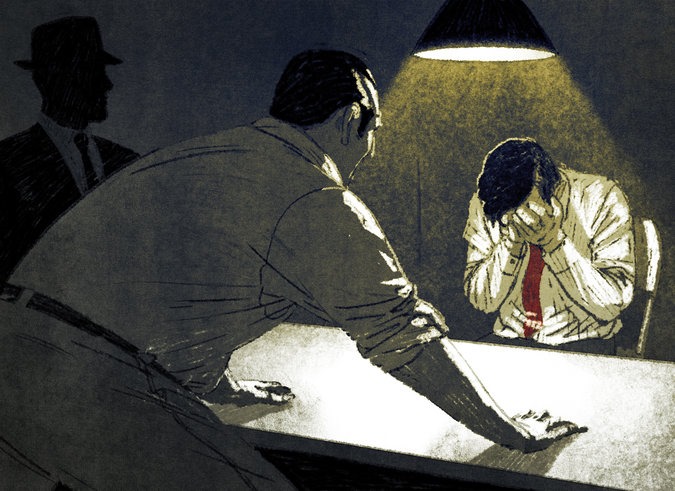
6a0105367eb457970b01a73dd30817970dA confession made by an accused person is irrelevant as regards admissible evidence, if the making of the confession appears to the Court to have been caused by any inducement, threat or promise, by the person in authority. If the Court considers that the threat or inducement made is sufficient to make the accused person believe that he would gain any advantage or avoid any evil in reference to the proceeding against him.
Obtaining an honest confession is tricky business. And while it is highly important for an honest admission to be obtained, the accused possesses all his rights until he is convicted, and even then, he retains many rights. Therefore, in the interest of conducting a criminal proceeding properly, confessions must be got according to the law. For that, the confession has to be made when the authority has not induced him to make that confession through a threat or a promise, in relation to the trial at hand.

For example, when the accused was in police custody, the police threatened to harm his family by planting false charges on them if he did not confess. The accused gave a confession under coercion. This is not a valid confession.

EXAMINATION OF WITNESSES

In a typical criminal proceeding, when the police get notice of a crime, they appear on the crime scene and try to reconstruct the sequence of events that took place. For this, they need to make certain educated deductions, gather evidence and question any witnesses as to their version of the events.

The questioning of witnesses takes place during the trial and is conducted by the counsels for the parties. The version of events that a witness provides is known as a testimony, and it must be a very honest deposition.

Point to be noted, milord!

Giving a false deposition to the court amounts to an offence in itself, known as ‘perjury’ or ‘lying under oath’ and is punishable by law.

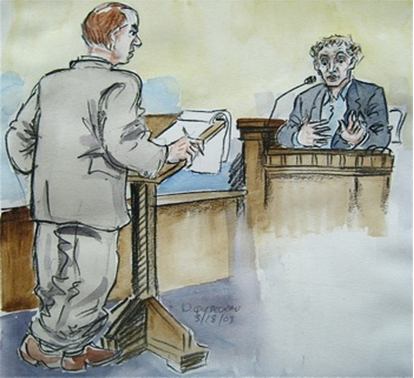
There may be witnesses for the prosecution and for the defence. The examination of a witness by the party who calls him is called his examination-in-chief, and when he is examined by the counsel for the opposing side is known as a cross-examination.
Witness examination must be done tactfully, and especially for the defence, it is a golden opportunity to uncover doubts and expose holes in the prosecution’s case. In a criminal proceeding, the prosecution’s job is harder than that of the defence, because the defence must merely cast doubts on the case that the prosecution has made. After one round of examination and cross-examination, the party that called the witness is allowed to re-examine his witness to set some records straight and clarify the final testimony.

Of course, the cross-examination and the re-examination are a prerogative of the parties and are not a necessary part of the procedure. The examination and cross – examination must relate to relevant facts but the cross –examination need not be confined to the facts to which the witness testified on his examination–in-Chief.

What is re-examination?

The re-examination may be done for a clarification or explanation of matters referred to in cross-examination. If new matter is introduced in re-examination, the adverse party may further cross-examine upon that matter. cross-exmination
Leading Questions

Any question suggesting the answer which the person putting it wishes or expects to receive is called a leading question.

For example, Where did you leave the weapon after committing the murder?

Leading questions must not be asked in an examination-in-chief or in a re-examination if objected to by the adverse party – unless the counsel has the permission of the Court.

This provision of the law has been enshrined in most Bollywood film court scenes with a thunderous “I object, Your Honour!”

The Court shall permit leading questions as to matters which are considered as conclusively proved, or not requiring any evidence. And leading questions may be asked in cross- examination.

Dying Declaration

It essentially means a statement made by a person as to the cause of his death or as to the circumstances of the transaction resulting in his death.

Point of Interest

The legal maxim “nemo moriturus proesumitur mentiri” translates to “a man will not meet his maker with a lie in his mouth.”

Though a dying declaration is entitled to great weight, it is worthwhile to note that the accused has no power of cross-examination. This is the reason Court also insists that dying declaration should be of such a nature as to inspire the full confidence of the Court in its correctness.

It cannot be laid down as an absolute rule of law that dying declaration cannot form the sole basis of conviction unless it is corroborated.

For example, if a man declares to a doctor, just before his death, that he was pushed from the top floor of a building to his demise, it is a dying declaration.

For example, if a newly married bride confides in her mother that her in-laws are ill-treating her very badly and she dies under mysterious circumstances a few days later, it is not a dying declaration.

Expert evidence

When the Court requires the assistance of persons skilled in foreign law, science, art or in the analysis of handwriting to provide their expert opinion on any of those matters, their testimony is known as expert evidence.

For example, a forensic scientist providing his opinion on the time of death of the deceased would be expert evidence.

For example, a handwriting expert providing his opinion on the handwriting on a suicide note would amount to expert evidence.

Hearsay

Hearsay is an out of court statement, made by someone other than the witness testifying at trial. If a statement is a hearsay, the statement is inadmissible as evidence. However, there exist certain exceptions where the rule against hearsay does not apply.

Generally, the material submitted as evidence will be evaluated as to how material it is to the case, and how relevant it is to the facts at hand. The rules regarding hearsay evaluate the manner in which the evidence is offered. The purpose of the rule against hearsay is to ensure that the adverse party is afforded an opportunity to cross-examine the declarant to test whether his testimony is accurate.

There are some statements, that although hearsay, are deemed to be trustworthy and therefore admissible as exceptions to the hearsay rule. Some of these exceptions require a declarant to be unavailable.

A declarant is unavailable if he is exempted from testifying by a court ruling, if he:

  1. refuses to testify despite a court ruling
  2. lacks memory to testify
  3. cannot testify due to death or illness
  4. cannot attend the trial

For example, if a man who has witnessed a murder suffers a stroke and cannot speak anymore, anyone who has heard an account of the event from him will be able to submit hearsay evidence.

For example, if a woman whose daughter was raped has lost faith in the judicial system and does not want to be involved in the trial, the trial may be held with hearsay evidence being submitted on her behalf.

Oral testimony

Oral evidence must, in all cases, be direct, i.e., If the evidence is a fact that was seen, it must be given by the person who saw it. Similarly, if the evidence is of a fact that was heard or perceived in any other sense, it must be affirmed by the person who heard it or perceived it in any other sense or manner.

If it refers to opinions or to the grounds in which that opinion is held, it must be the evidence of the person who holds that opinion on those grounds.

For example, if a woman sitting in her apartment heard a gunshot in the next room, she must give oral evidence in court that she heard it.

Witness

A witness is someone who has firsthand knowledge about a crime or significant event through their senses (e.g. seeing, hearing, smelling, touching), and can help certify important considerations to the crime or event. A witness who has seen the event first hand is known as an “eye-witness”. Witnesses are often called before a court of law to testify in trials.

witnessThe Code has set out certain parameters for a witness to be eligible to testify. Logically, there is a need to exclude those who cannot, whether due to age or health conditions, understand the questions posed to them while making their testimony.

All persons shall be competent to testify unless the Court considers that they are prevented from understanding the question put to them, or from giving rational answer to those questions, by tender years, extreme old age, disease, whether of body and mind or any other cause of the same kind.

For example, a man of 80 who is hard of hearing but has a reliable memory with regard to the events of which he has to provide his testimony will not be prevented from testifying, as he can read the questions put to him and answer accordingly.

For example, a woman who is at the final stages of her pregnancy who may go into labour very soon will not be prevented from testifying, although the court will consider her condition and postpone the date of her giving testimony.

For example, a boy of 14 with a rare medical condition that causes him to go into hysterics when addressed by strangers will be considered to be unable to understand the question put to them or to provide rational answers to the same, and hence prevented from testifying.

Privileged Communication

If every divulgence and confession may be taken as evidence, secrets would not be safe anymore. For professional purposes or other reasons, confidential information may have been divulged to certain individuals. In the absence of any protection by the Act, these individuals may have been obligated to give evidence using that information or based upon it, to attest to the truth or falsity of any allegation.

In India, Sections 126 to 129 of the Indian Evidence Act, 1872 deal with privileged that is attached to professional communication between a legal adviser and the client. Section 126 and 128 mention circumstances under which the legal adviser can give evidence of such professional communication. Section 127 provides that interpreters, clerks or servants of the legal adviser are restrained similarly. Section 129 says when a legal adviser can be compelled to disclose the confidential communication which has taken place between him and his client.

Section 126 states that no barrister, attorney, pleader or Vakil shall at any time be permitted to:

1. Disclose

  • any communication made to him by or on behalf of his client, or
  • any advice given by him to his client in the course and for the purpose of his employment;

2. To state the contents or conditions of any document with which he has become acquainted in the course and for the purpose of his employment.

There are certain exceptions to this rule. This Section does not protect from disclosure:

  1. any communication made in furtherance of any illegal purpose
  2. any fact observed in the course of employment showing that any crime or fraud has been committed since the commencement of the employment

Questions and Answers

CPR-questions-and-answers

Principle: The first rule is of Experts educational background. That means even the doctor is examined and is subjected to scrutiny and cross-examination. And if his opinion and observations contained in his statement are supported then the report can be looked at otherwise not. So even the examination of Doctor becomes essential.

If a person does not have the necessary educational background to qualify as a doctor, but still proffers an expert opinion as other people refer to him as an expert – will his opinion be counted as such?

(a) Yes, as long as he is aware of medical procedures to be able to offer an opinion.

(b) No, it is essential that the expert opinion be delivered by someone who is a qualified doctor.

(c) Yes, as long as the judge is convinced that he is an expert.

(d) None of the above.

Ans: (b). As stated in the principle, the qualification of a doctor to give the opinion carries as much weight as the opinion itself.

Principle: When the language used in a document is plain in itself but is not clear with reference to the facts, evidence may be given to clarify the reference made.

Mr Chatterjee had signed a deed pledging ‘his property in Kolkata’ to Mr Banerjee. It was found that he did not have property in Kolkata but in Howrah. Can Mr Chatterjee be allowed to provide more evidence to show that he was referring to the Howrah property?

(a) No, the words of a document should be read as to give effect to their natural meaning.

(b) Yes, because although the words make sense by themselves, the reference to the property in Kolkata is ambiguous as Mr Chatterjee does not have property in Kolkata.

(c) Since there is no ambiguity in the statement, there need not be any additional clarification provided.

(d) Yes, because his property in Howrah does not have the same description as his property in Kolkata.

Ans: (b). Following from the principle, if the document brings out an uncertainty with reference to the facts of the case, additional evidence may be provided to clarify the facts with reference to the case.

Principle: When the Court ‘may’ presume a certain fact, it is open for rebuttal by either of the parties by providing evidence as it is only a provisional acceptance of the statements.

Upon examination of witnesses and the circumstantial evidence, the Court provisionally presumed that the accused was present at the crime scene. However, after the results of the forensic tests came back, they were negative and thus, brought the presumption of the Court under threat. Can the accused give rebuttal evidence using the forensic results?

(a) No, as circumstantial evidence carries more weight than forensic evidence.

(b) Yes, as forensic evidence carries more weight than circumstantial evidence.

(c) Yes, as the presumption could be rebutted by providing convincing evidence of the opposing view.

(d) No, as any presumption of the Court will be binding upon the parties.

Ans: (c)

Principle: Judgements in rem are those that are pronounced as regards the legal character of a person or certain property and the entitlement of such person or to such property shall be against the rest of the world, and these shall be taken as conclusive evidence as to the legal status of the properties.

In which of the following cases would the judgement be taken as conclusive evidence?

(a) Probate on a Will is conclusive evidence of the title of the executors and the validity of the Will.

(b) A gets a decree against B for a right of easement over a particular piece of land.

(c) A judgement on possession of property that was never enforced as the property was acquired by the State.

(d) S gets a decree of judicial separation from T and is now living separately.

Ans: (a) and (d). (a) discusses the legal status of certain properties and as to the legal character of the executors of the Will. (b) is as to A’s right of easement which is only against B. (c) is a judgement that does not carry any weight. (d) is as to the legal character of S and T.

In the following two questions, there will be an assertion and a reason provided. You have to decide whether the assertion is right, and then decide whether the reason provided for it is valid.

Assertion: Hearsay information from a person who is now dead is not admissible as evidence, except if the information relates to the circumstances of his death.

Reason: If a person provides clear and accurate information as to the circumstances of his death, at the time of his death, it is admissible  as conclusive evidence of dying declaration.

(a) Both assertion and reason are right, but the assertion is not an effect of the reason.

(b) The assertion is not valid, but the reason provided is a valid statement.

(c) The assertion and reason are both false and invalid.

(d) The assertion and reason are both right, and the assertion is a natural consequence of the reason.

Ans: (d). One of the exceptions to the hearsay rule is the law on dying declarations. A declaration by a person on his death bed as to the nature and circumstances of his death is taken to be conclusive evidence because of a rule of evidence that states that a person does not meet his maker with a lie in his mouth.

Assertion: Electronic evidence is now acceptable on the same terms as documentary evidence.

Reasoning: Documentary evidence can amount to either primary or secondary evidence.

(a) Both assertion and reason are right, but the assertion is not an effect of the reason.

(b) The assertion is not valid, but the reason provided is a valid statement.

(c) The assertion and reason are both false and invalid.

(d) The assertion and reason are both right, and the assertion is a natural consequence of the reason.

Ans: (a). Through some amendments to the Evidence Act, electronic evidence is being treated on par with documentary evidence, in terms of admissibility, as long as the digital signature and authorisation are present.

Birth of a child during marriage leads to the presumption of the child’s legitimacy. Vidya and Krishna had a son after they were married, which proves that Vidya did not have extra-marital affairs. The logical structure of the argument above is most similar to which one of the following?

(a) If Lucy were in the school, I would not be able to call her. Therefore, the fact that I can call her shows that she is not in school.

(b) If Bhatt were rich, he would not spend his vacation in India. Therefore, his spending his vacation in the Europe shows that he is rich.

(c) If Sita were sociable, she would not avoid her friends. Therefore, the fact that she is sociable shows that she does not avoid her friends.

(d) None of the above.

Ans: (b). (a) and (c) both presume what they set out to prove. The logical structure and the point of fallacy is the same in both the question and (b), as both situations presume that only one factor is needed to determine a certain fact.

Which of the following fall under the head of facts that need not be proved i.e., (a) can be judicially noticed (b) have been admitted?

(a) The plaintiff’s accusation which the defendant first admits and then denies.

(b) The fact that a certain area has been attacked by terrorists and requires utmost attention.

(c) The accusation that a helpless woman was gang raped by her drunk acquaintances.

Ans: Since (a) consists of an admission which is subsequently redacted, and (c) requires proof beyond reasonable doubt to convict the alleged rapists, only (b) remains a fact that does not need to be proved because the Court can take judicial notice of the apparent state of affairs.


LawSikho has created a telegram group for exchanging legal knowledge, referrals and various opportunities. You can click on this link and join:  

https://t.me/joinchat/J_0YrBa4IBSHdpuTfQO_sA

Follow us on Instagram and subscribe to our YouTube channel for more amazing legal content 

 
Download Now

Fundamentals Of Criminal Procedure Code

0

In this blogpost, Amoolya Narayan, an Associate at Economic Laws Practice (ELP) and a former student of West Bengal National University of Juridical Sciences, gives a rudimentary yet comprehensive idea about the Criminial Procedure Code in India and attempts to cover the entire procedure of trying a criminal offence. Amoolya has included an enjoyable exercise for the readers as well.

0ff6bb9

Why do we need Criminal Procedure Law?

Anyone who has a rudimentary knowledge of criminal law will know that it deals with what amounts to an offence and what are the penalties associated with such offences. However, the nature of most criminal punishment is such that it confines the individual liberty of a person. Imprisonment, if illegal, violates some of the most basic freedoms and rights associated with a democracy. Thus, we need a law that sets the state’s machinery running with respect to enforcing law and order and imparting justice, and regulates the procedure followed by these institutions.

The Criminal procedure code refers to the working of these institutions for the entire time period between when a crime has been committed until the time the sentence against the crime is passed and the case is closed. It refers to the machinery to be adopted by the State when a violation of the penal law, i.e., offence under the Indian Penal Code, has been detected or reported. It also lays down the principles and procedure that must be followed while prosecuting and adjudicating other claims. The investigation, inquiry and trial of the other offences are also governed by these provisions, subject to any other law that may be in force which regulates the manner of investigation, inquiry or trial of the matter.

What is an Offence?

An offence is a transgression of the law, by action or omission. That means there may be some cases where the law requires you to abstain or refrain from performing a particular act. There may also be cases where the law requires you to take a positive action, failing which you may be held liable for the offence

Civil offences are against private persons (individuals like you and me) but criminal offences are against the State. The State, represented by the Prosecutor, will argue the case against the defendant. So now, the prosecutor will make the case against the suspect, by submitting the issue sheet (pleadings) and the necessary evidence.

Types of Criminal Offences:
1. Bailable offence and Non-bailable offence
2. Cognizable and Non-Cognizable offence

Bailable and Non-Bailable

The Code has classified certain offences as bailable. In such instances, the suspect may pledge some property with the Court and be released from jail on the condition that he will appear for the trial. Any offence that has not been classified as such is a non-bailable offence.

Cognizable and Non-Cognizable

An arrest is a violation of the liberty of the suspect in connection with an investigation or prevention of crime. Since it affects the fundamental rights of the individual, the police need a warrant from a magistrate that allows them to arrest the person. (This warrant is granted on grounds of ‘probable cause’)

There are some offences, however, that do not require the police to procure a warrant before making an arrest, and these are known as cognizable offences and are specified in the Schedule to the Code.

What is the process that the Code regulates?

Primarily, the Code addresses the procedure followed by the law enforcement and judicial departments of the State when a criminal complaint has been filed.

The various steps are:
1. Filing an FIR
2. Gathering Evidence
3. Initiating an enquiry

Filing an FIR

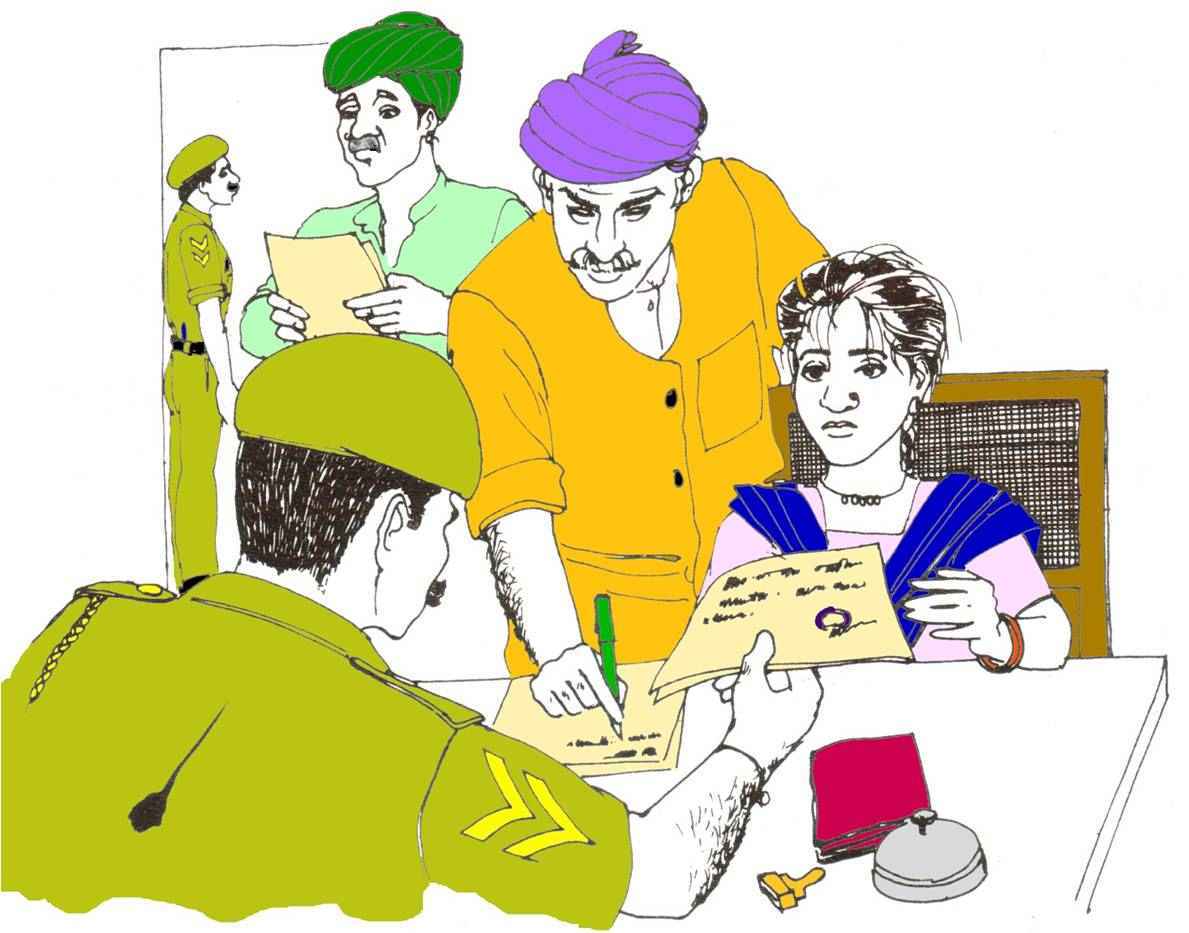
Picture-fir

Although the Police force and the Courts exist, many crimes remain unknown and unsolved because of the lack of information. Thus, information is the first important tool required to address the problem of crimes, and deliver justice.
The legal process of tackling crimes begins with the filing of a First Information Report (FIR). Based on the information given in the FIR, the police will file a charge. This is a vital step in the process as it is the first document that will lay the groundwork for the rest of the case. Even an anonymous letter sent to the Police Station may be treated as First Information Report.
Example: If a person witnessed a theft and describes the appearance of the thief in the FIR, the police will begin investigation on the people that were present at the scene of crime at the time, whether anyone fits the description, and the whereabouts of that person.

Complaint

‘Complaint’ means any allegation made orally or in writing to a Magistrate, with a view to his taking action under this Code, which states that some person, whether known or unknown, has committed an offence. Any document fitting the description may be considered as a complaint for the purposes of taking action, but it does not include a police report.

The regulations relating to filing an FIR are very relaxed so as to encourage reporting of crimes. Any person can file an FIR, and he need not be the victim. The account of events may be merely hearsay and it need not be by the person who has first-hand knowledge of the facts. The point of this is to bring all suspicious information to the police who can then investigate and sort out the facts. If the police officer refuses to record the complaint, there is a provision for relief to the person trying to file the FIR.

Gathering of Evidence

fingerprint-small1

Once the charge has been filed and the information from the complaint is with the police, they will use all their resources to get more information to string the pieces together. This is the process of investigation into the crime and gathering of evidence. This process may include going to the scene of the crime, talking to witnesses, logical and scientific deductions etc. Once evidence has been gathered, the police will file a report containing their account of the events and the statements of the witnesses they examined.

Initiation of Inquiry

The Magistrate of the relevant court will inquire into the matter, and upon finding a triable case, he will issue an order for process depending on whether it is a

Summons case: he shall issue a summons for the attendance of the accused;

Warrant case: he shall issue a warrant or a summons for the accused to be brought in front of the Magistrate.

However, if the case was brought before the wrong court, the Magistrate would not be able sit in judgement for that case as it would be ultra vires his powers, but would it not be justifiable to dismiss the claim on the sole ground of wrong jurisdiction. There exist provisions in the Code for a Magistrate to transfer the case to the appropriate court of the right jurisdiction.

The different ambits of jurisdiction of the different courts and the nature and extent of their jurisdiction has been laid down in the Code itself, dividing the Courts on the kinds of offences they may try and the types of punishment they may award.

Classes of Courts

thkra-27-rahi-m_TH_2421850e

Every state in India has a court setup that tries to ensure that justice is accessible and available to every citizen. The law under the Code mandates that each state will have the following classes of Criminal Courts, in ascending order of jurisdiction and power:

1. Courts of Session;
2. Judicial Magistrate of the first class and, in any Metropolitan area, Metropolitan Magistrate;
3. Judicial Magistrate of the second class; and
4. Executive Magistrate

The Code covers the manner in which the police may gather evidence and the court examines the evidence; it also lays down the division of powers between the different levels of courts and magistrates, in terms of:

1. the nature of offences they can try,
2. the maximum sentence that each of these courts may pass; and,
3. where these powers come from.

It bears repeating that every offence is classified into either of two categories, those falling under the Indian Penal Code and those that do not. Once this is understood, the magnitude of powers held by the courts that can try criminal cases may slowly come into focus.
If a man who has committed a murder is made to appear before the High Court of any state, it may pass any sentence after trying the accused, including a death sentence. Even a Sessions Judge or an Additional Sessions judge may pass any sentence, but if either of them sentences the accused to death, the sentence needs to be confirmed by the respective High Court. An Assistant Sessions Judge, who is lower on the power ladder, does not have the authority to sentence the accused to death, or to life imprisonment or even imprisonment for a period exceeding 10 years.

Try Being a Judge!

Chota Krishna is brought before the court on the charge of murder. an Additional Sessions judge passes a sentence of imprisonment for 13 years – although the prescribed limit in the Penal Code is 10 years, does the sentence need the approval of the respective High Court?

The provision in the Code says that the High Court and the Sessions Judges (except the Assistant Sessions Judge) can pass any sentence. The words ‘any sentence’ carry heavy import, and they are understood to be irrespective of the prescribed maximum limit in the Penal Code.

Point of Interest!

Of course, in considering the adequacy of the sentence, the Court needs to keep in mind the magnitude of the crime, the intention of the criminal and the context of the criminal’s age, character and his position and the circumstances that may have led to the crime being committed.

How is a Trial conducted?

Point of Interest!

We all know that Judges pass judgments in courts of law. So who is a Magistrate? A Magistrate is a judicial officer. In ancient Rome, the word magistratus denoted one of the highest government officers with judicial and executive powers. Today, in common law systems, a magistrate has limited law enforcement and administrative authority.
Magistrates

Courts are headed by Magistrates and there may be different types of Magistrates sitting in a single court. The powers of the different types of Magistrates has been set out on the basis of their authorization to pass certain sentences.

BTB71A Judge holding gavel in courtroom. Image shot 2010. Exact date unknown.

The different types of Magistrates are:

Chief Judicial Magistrate

The Court of the Chief Judicial Magistrate may pass any sentence except that of death sentence or any term of imprisonment exceeding 7 years, including life imprisonment. The powers of a Chief Metropolitan Magistrate are the same as that of a Chief Judicial Magistrate.

Court of Magistrate of first class

The Court of Magistrate of the I class is not authorised to pass any sentence of imprisonment longer than 3 years or to impose a fine greater than Rs. 10,000, or anything greater than the combination of the two punishments. The powers of a metropolitan magistrate are equal in nature and extent to that of a Court of Magistrate I class.

Court of Magistrate of second class

The Court of Magistrate of the II class is not authorised to pass a sentence exceeding 1 year in imprisonment or to exceed a fine of Rs. 5,000 or a punishment greater than both of them put together.

Now think!

If a Magistrate is trying the accused for the offence of manslaughter and believes that he is guilty of murder, he will determine that he deserves greater punishment. If he is not authorised to give a greater punishment, what is the Magistrate empowered to do?

There is a provision in S. 325 of the Criminal Procedure Code where, if a Magistrate feels the accused deserves a greater punishment than he is authorised to give, he may forward the case to the Chief Judicial Magistrate.

Special Executive Magistrate

The State Government may appoint Executive Magistrates to be known as Special Executive Magistrates for a particular area and duration and the performance of certain functions for which he is given the power. Except for specified holders of a particular position, the Executive Magistrates are generally subordinate to the Judicial Magistrate.

We had reached up to step 3 in the process of adjudicating criminal complaints or reports, and now the matter is directly under the scrutiny of the Court. Let us go on to understand the role of the lawyers in these proceedings.

Public Prosecutors

The prosecutor is the attorney who represents the State. The prosecution is the legal party responsible for presenting the case against an individual suspected of breaking the law in a criminal trial. They usually become involved in a criminal case once a suspect has been identified and charges need to be filed.

Who appoints the Public Prosecutor?

The Prosecutor is simply the State’s attorney. So, for every High Court, the Central Government or the State Government shall, after consultation with the High Court, appoint a Public Prosecutor and may also appoint one or more Additional Public Prosecutor for conducting in such court, any prosecution, appeal or other proceeding on behalf of the Central Government or State Government, as the case may be.

Burden of Proof

In a criminal proceeding, the burden of proving the guilt of the suspect lies on the prosecution. The work of the defendant is to weaken the case of the prosecution, and raise doubt about the veracity of the case. However, under certain circumstances, the burden of proof may lie on the defendant to prove that he did not commit the crime. Sometimes, the burden may shift after the prosecution has established a certain level of proof.

What is an arrest?

B3K6WM--Handcuffs_3152651b

An arrest consists in the taking into custody of another person under authority empowered by law, to be held or detained to answer a criminal charge or to prevent the commission of a criminal offense. This means that the power of the authorities is very wide. They can decide to detain you if they suspect you of having committed an offence or even if they are under the suspicion that you may commit an offence.

Who may arrest?

The police and Magistrates have the power to arrest people.

The police can arrest a person without a warrant for a number of reasons as provided in S. 41. A few of them are, if a non-cognizable offence is committed in their presence, or if he has been proclaimed an offender either under the Code or the State Government, or if he has escaped or attempts to escape from lawful custody. A Magistrate can, himself or through direction, arrest any person when a crime has taken place in his presence or within his local jurisdiction.

The procedure for Arrest is provided for in S. 46 of the Code and it sets out the norms that are generally followed by the persons carrying out the arrest. With the power to arrest, the police also have the powers of search and seizure.

Point of Interest!

The words ‘Arrest’ and ‘Custody’ are not synonymous. In every arrest there is custody, but the reverse may not be true. The arrest consists of taking a person into custody on certain grounds and detaining him.

Bail

When any person, who is accused of a bailable offence, is arrested or detained without warrant by an officer of a police station, or appears before a court, and is prepared at any time while in custody or at any stage of the proceeding before the Court to give bail, such person shall be released on bail.

Point to be noted, Milord!

If a person is unable to pay his bail bond within a week of his arrest, the Court shall find it sufficient to deem him an indigent person. An indigent person is considered unable to furnish surety and will be discharged without sureties.

There exists a provision for bail for persons accused of non-bailable offences too, provided they fall into one of the many categories enumerated by S. 437.

Anticipatory Bail

There even exists a provision for something known as ‘anticipatory bail’. With this, a person who apprehends his arrest for a non-bailable offence may apply to the High Court or Sessions Court. The Court may give a direction that he should be released on bail in the event of arrest upon consideration of a few factors, such as:
(a) the nature and gravity of the situation
(b) whether he has previously served a sentence in respect of any cognizable offence.
(c) the likelihood the applicant fleeing
(d) where the object of arresting him is to humiliate or injure the applicant.

Summons

A judicial summon is addressed to a defendant in a legal proceeding. Typically, summons announce to the person to whom it is directed that a legal proceeding has been started against that person, and that a file has been started in the court records. Summons announce a date by which the defendant(s) must either appear in court, or respond in writing to the court or the opposing party or parties.

Warrant

The term warrant refers to a specific type of authorization; a writ is issued by a competent officer, usually a judge or magistrate. Whoever possesses a warrant to do a particular thing, has the right to violate individual rights and to perform acts which would have been illegal, if there had been no warrant to authorise it. The warrants issued by a court normally are search warrants, arrest warrants, and execution warrants.

A warrant of arrest shall ordinarily be directed to one or more police officers; but the court issuing such a warrant may, if its immediate execution is necessary and no police officer is immediately available, direct it to any other person, and such person shall execute the same.

Trial

By the time of the trial, the role of the prosecution grows and the prosecutor is required to carry the case on his shoulders. The judgement of the Court is based upon his depositions and submissions. The prosecution must, at the time of bringing a case to trial before a Court of Session, open the case.

Opening case for prosecution

When the accused appears, or is brought before the Court of Session in order to be tried for an offence, the prosecution shall open the case by describing the nature of the charge against the accused, and he shall state the evidence that he intends to use to prove the guilt of the accused.

Discharge/Framing of Charge

At this stage, the prosecution and the accused have made certain submissions. Depending on the strength of the case and the judge’s consideration, the case may either be discharged or the Judge may frame the charges.

After this stage, the accused may make his pleadings. If the accused pleads guilty, there is no dispute, and the Judge will record the plea and convict the accused at his discretion.

Acquittal

After hearing the evidence put forth by the prosecution and examining the accused and the prosecution, if the Judge feels that there is no evidence of the commission of the crime by the accused, he will make an order for acquittal.

Entering upon defence

If the accused reaches this stage of the trial, it is time for him to adduce any evidence that supports his case. The accused can also apply for the issue of process for the production of any documents, or things or witnesses.

Arguments

After the prosecution has conducted the examination on the defence’s witnesses, it may sum up the arguments and the accused is entitled to reply to such arguments.

Plea bargaining

One way that a person can try to get his sentence reduced although his crime may merit a greater punishment is through plea bargaining. If a person who has been accused of a crime which does not fall within the following categories:

1.  Affects the socio-economic status
2. Calls for imprisonment of not less than seven years
3. Is against women or children below fourteen years,

he can make an application to bargain a plea.

The scheme could involve payment of compensation by the accused to the victim, and to set off the period of detention against the period of imprisonment and bring down the sentence, whatever it must have been.

Once the prosecution and the accused work out this mutually acceptable disposition, a report is submitted to the Court, which will deliver a final judgement based on this report. This final judgement will be absolutely final and no appeal lies directly from it, except under the special leave petition (Art. 136) and the writ jurisdiction under the Constitution (Arts. 226 and 227).

Since the essence of plea bargaining involves the admission of a certain degree of guilt or liability, in order to get a less stringent punishment, some sensitive information would be exchanged at the time of negotiating the mutually acceptable disposition. This information that is divulged for the purposes of plea bargaining may not be used at any other point for any other purposes. Thus, the accused is immune from further prosecution based on the admission or confession on the existing charge.

Example: An accomplice in a crime gives information about the accused’s whereabouts. And also divulges some information about another crime they had committed together. The police may not proceed against him on the basis of the admission of that crime.

The Judgement

As soon as the trial is over, the judge pronounces his judgement in open court.

Appeal

The law of criminal procedure provides for an appeal procedure, which avails the losing party a second chance at the trial.

Execution, Remission, Suspension and Commutation of Sentences

Execution

When a case that had been submitted to the High Court for confirmation of death sentence, receives the necessary confirmation, the Session Court may issue a warrant for the execution of the sentence.
However, for every death sentence passed by the High Court, if an appeal lies from it to the Supreme Court, then the execution of the sentence will be postponed until the period for preferring such an appeal comes to an end, or if the appeal is disposed of.

Suspension and remission of sentences

To suspend a sentence is to put a hold on its execution, whether or not for a specified time period. To remit a sentence is to give amnesty to the accused and forgive him. Some are crimes under a central legislation, and the others are violations of the state laws. In the former cases, the Central Government may suspend or remit the whole or any part of the sentence passed on the person, on a unilateral basis.

Commutation of sentence

To commute a sentence is to lessen the stringency or the length of the punishment. The appropriate government has the power to commute the sentence of the accused, without his consent.

  1.  death sentence may be commuted,
  2.  a sentence for life imprisonment to a period not exceeding 14 years, and
  3.  a sentence of rigorous imprisonment may be commuted to simple imprisonment.

If the accused has tried all of these avenues and has not been able to find mercy anywhere, there is still an avenue for the accused, which is by making an application for mercy to the President of India. The President’s power of pardon may be found in the Constitution of India under Article 72. It empowers the President to grant pardons, reprieves, respites or remissions of punishment in all cases where the punishment is for an offense against any law to which the executive power of the union extends. The same is also available against sentences of courts-martial and sentences of death. A parallel power is given to the Governor of a state under Article 161. A pardon may be absolute or conditional. It may be exercised at any time either before legal proceedings are taken or during their pendency or after conviction. The rejection of one clemency petition does not exhaust the pardoning power of the President.

Point of Interest!

Afzal Guru was sentenced to death after being convicted for planning an attack on the Parliament in 2001. After the Supreme Court decision in 2004, Guru’s wife made a mercy plea before the President and the plea has been pending ever since. His case received fresh attention since Kasab’s conviction. His mercy plea has been rejected and the Supreme Court held that he has exhausted all his remedies before the law and so he was sentenced to death.

Here is a legal aptitude exercise to help you get a better grasp on Indian criminal law

Silhouette of a man in a business suit giving a shrug with a question mark

Principle: Irregularity in arrest does not affect the validity of the trial of the person arrested or confession made by him. It is merely an irregularity which does not go into the root of the matter and does not oust the jurisdiction of the Court.
Principle: Neither resistance to an illegal arrest nor a rescue from illegal custody is an offence.

1. George was arrested on the grounds of public nuisance by a police officer who produced a fake warrant. He protested and demanded that he be released as the police officer was not authorised to arrest him. The police officer threatened him that resistance to arrest was a punishable offence. What remedy does George have?

(a) Resistance to illegal arrest is not an offence, so George can protect himself with his right of private defence as provided for under the Indian Penal Code.
(b) George can sue the State for compensation and damages on the grounds of assault and battery.
(c) George cannot do anything but try to present his case as best as he can when he is produced within 24 hrs before a magistrate.
(d) None of the above.
Ans: (a)
Although (b) is also open to George as a remedy against the State, the more accurate grounds to receive compensation and damages would be ‘false imprisonment’ and ‘illegal deprivation of liberty’. Therefore, (a) is a more correct answer than (b).

Principle: A confession made must be voluntary. A statement can be said to be voluntary if he has not made it in consequence of (a) some promise of advantage or a threat (b) of a temporal character (c) held out or made out by a person in authority and (d) relating to the charge.

2. Akshay was in police custody in relation to certain charges of grievous hurt caused to some political rivals. He did not seem ready to admit to the charges, so the police decided to try a different strategy. They sent the prison doctor in to check him, who revealed to him that the police often released offenders who confessed to their crimes as long as they promised to behave in future. Akshay confessed to the crime as charged. Is this an involuntary confession?

(a) Akshay made a voluntary confession as it was not as a consequence of any promise or any threat. It was a mere exchange between himself and the doctor that made him decide to confess.
(b) Akshay made a voluntary confession as he had not been induced or threatened by any person in authority. It was a mere exchange between himself and the doctor that made him decide to confess.
(c) Akshay did not make a voluntary confession as the strategy employed by the police was an indirect inducement to confession.
(d) Akshay did not make a voluntary confession as the doctor (a person who had authority over Akshay) induced him to confess.

Ans: (b)
Akshay has not been falsely induced by the police officers, but by a doctor. It is not based on any police inducement and is thus a voluntary confession.

3. Principle: Grant of bail is the right and the refusal is the exception, in bailable offences. No executive instructions or administrative rules can abridge or run counter to the bail provisions of the code.
A circular was issued by the Superintendent of Police stating that all the bail applications were to be put on hold until further notice was issued. Abhinav who had been arrested on a bailable offence was very sick. The Inspector on duty, taking into the consideration the ill-health of the accused, did not obey the circular. Is he liable to be punished?
(a) No, he is not as the grant of bail is the rule and the refusal to grant bail is the exception, especially for a bailable offence.
(b) No executive or administrative orders can violate the statutory provisions which provide for bail of accused, he is thus not punishable.
(c) The Inspector on duty was not authorised to use his discretionary powers to release the accused on bail.
(d) None of the above

Ans: (b)
As the accused was there on charges of a bailable offence, the inspector on duty did not commit any wrong in letting the sickly accused off on bail.

4. Principle: The law of Juvenile Justice states that the age of the juvenile must be taken as his age on the date of his arrest for the purposes of the proceedings and applicable law.

Iqbal, a 17 year old farmhand, had been arrested on charges of murder of his once associate over a land dispute. He was arrested and placed in judicial custody for a few days, during which time he turned 18. Does he still get treatment under juvenile justice or is he treated as an adult criminal?
(a) He is treated as an adult criminal as he turned 18 before his proceedings were due to commence.
(b) He is treated as an adult criminal for the purpose of interning him in prison and not in the juvenile observation home.
(c) He is treated as a juvenile because he was only 17 at the date of his apprehension and that is the date that counts.
(d) He is treated as a criminal because the date of arrest is the date on which his charges are officially filed.

Ans: (c)
As the principle states, the Juvenile Justice Act mandates that the age of the accused be calculated as to his age on the date of his arrest. This is to ascertain his mental capacity for crime with regard to his age.

5. Principle: The legal process of adjudicating claims begins with the filing of a First Information Report (FIR) and the police will file a charge. This is a vital step in the process, as it is the first document that will lay the groundwork for the rest of the case.

There was an incident of dacoity in a remote village and the police reached the scene soon. The officers who followed up the case did so purely on the basis of word of mouth representations of the villages. So, there was no FIR filed that recorded the charges. The defendants alleged that there was no criminal case without FIR. Decide.
(a) The FIR must be filed for the case to be registered and to be brought before the court.
(b) Oral FIRs work as well as written FIRs and the reports in this case will qualify as an oral FIR.
(c) The FIR need not be filed before the police begin investigation. It can be filed at any stage of the case.
(d) The FIR must not be filed for cases where the victim cannot himself file it.

Ans: (a)
Even if the police were able to identify and arrest the dacoits, there is a necessity for a first information report which will lay down the groundwork for the rest of the criminal proceeding.

Logical Reasoning

709849e2ec1928798a99c450d440036f

Following are Assertions and Reasoning:

1. Assertion: People booked under Non-Bailable offences can also avail of bail.

Reasoning: Arrest is a violation of the Fundamental Right personal liberty, thus bail is the rule and the refusal of bail is the exception.

(a) Both assertion and reason are right, but the assertion is not an effect of the reason.
(b) The assertion is not valid, but the reason provided is a valid statement.
(c) The assertion and reason are both false and invalid.
(d) the assertion and reason are both right, and the assertion is a natural consequence of the reason.

Ans: (d)
The right to bail must be given in all bailable offences, and the magistrate can grant bail in non-bailable cases at his discretion. Thus, the assertion is the effect of the reasoning.

2. Assertion: Sentence of death by sessions court must be confirmed by the High Court.

Reasoning: Order by a court lacking in jurisdiction is void.

(a) Both assertion and reason are right, but the assertion is not an effect of the reason.
(b) The assertion is not valid, but the reason provided is a valid statement.
(c) The assertion and reason are both false and invalid.
(d) the assertion and reason are both right, and the assertion is a natural consequence of the reason.

Ans: (a)
The sessions court is not lacking in jurisdiction when it provides its verdict, except the case is not concluded until the High Court replies to the reference by either confirming or negating the death sentence.

3. On what grounds may a person be refused bail?

(a) that he may tamper with the evidence
(b) that he may commit further crimes
(c) that he may leave the country

Ans: (a), (b) and (c)

4. Solve:

If every offence that is not a criminal offence is a civil offence, then, no civil offence can also be a criminal offence. Yes/No?

Ans: No, bigamy is an example of a civil offence that is also a criminal offence.

Download Now

Understand The Basics Of Consumer Protection Law

0

In this blogpost, Amoolya Narayan, an Associate at Economic Laws Practice (ELP) and a  former student of West Bengal National University of Juridical Sciences, has tried to provide a brief but essential understanding of the legal provisions that encapsulate the rights available to consumers in India. Amoolya has also included a few interesting questions related to consumer protection law in India in the form of an exercise for everyone’s benefit.

0ff6bb9

Why do we need Consumer Protection laws?

Every product on the market follows a long chain of manufacturing processes. There are many entities that take part in the process of production. Due to the nature of today’s markets, it is essential to have a mechanism through which the consumer’s voice may be heard.

Consumer protection is a recent phenomenon. It first took birth in the United States with Ralph Nader pushing for consumer rights of every citizen, and it was then that March 15th was declared as International Consumer Rights Day.

The Law on Consumer Protection in India was not a citizen initiative; it was, on the other hand, propounded by the Government and a law was passed enumerating the rights of a consumer against defects and deficiencies in goods and services. The Government did not stop at making the law but it also set up consumer fora at various levels of governance and even instituted a consumer information cell, because information is the most powerful tool that a consumer may possess.

jago grahak jago

A glance at the MRTP Act, 1969

The Consumer Protection Act was not the first and only Act of its kind. There was a law before it which was known as the Monopolies and Restrictive Trade Practices Act, 1969 (MRTP Act), dealing primarily with the conditions of competition in the market, which affected the rights of consumers.

The main objective of the MRTP Act, when it was enacted, was to ensure that the operation of the economic system does not result in the concentration of economic power to the common detriment. In addition, the enactment sought to curb certain factors that accompany such concentration of economic power, viz., the monopolistic and restrictive trade practices. The Act dealt with consumer rights in an incidental manner. It aimed at protecting competition in the economy by ensuring free flow of capital and resources and by curbing manipulation of prices, conditions of delivery or flow of supplies in the market which have (or may have) the effect of imposing unjustified costs and restrictions on the consumers.

act_04

An unfair trade practice is one, which, for the purpose of promoting the sale or use of any goods or services, adopts unfair methods, or unfair or deceptive practice. The provisions for curbing unfair trade practices independently seek to safeguard the interest of consumers by providing them protection against false or misleading advertisements and/or similar deceptive trade practices. The MRTP Commission enabled the consumer to approach it in case of complaints.

On the other hand, the Consumer Protection Act has a two pronged approach:

(i) To provide simplified inexpensive and speedy remedy for the redressal of grievances of the consumer

(ii) Consumer education to create awareness as to consumer’s rights.

Therefore, although there are overlaps as to the jurisdiction of the two Acts, there is sufficient distinction between the type of persons who may seek relief and the procedure to seek such relief, the nature and scope of the relief etc.

Comparison between MRTP Act and Consumer Protection Act

Let us compare the two and see.

MRTP Act Consumer Protection
Regarding Restrictive Trade Practices, the MRTP Act only discusses situations with respect to its effect on the competitive situation in the economy. The Consumer Protection Act has been enacted in the interest of a single player in the economy i.e., the consumer.
The MRTP Act does not apply to many enterprises, such as banking or insurance companies. This kind of an exemption is not proffered under the Consumer Protection Act.


The MRTP Commission can take up issues suo motu and initiate inquiries into restrictive or unfair trade practices.


The Consumer Protection Act is a device to be used by aggrieved consumers and does not operate to regulate the economy as a whole. Due to this, the Act does not envisage suo motu powers to initiate inquiries into restrictive or unfair trade practices.


There is no restriction on any buyer of goods, whether for commercial or non-commercial purposes, to approach the MRTP commission under the MRTP Act.


The Consumer Protection Act does not regard a buyer of goods for commercial purposes as a ‘consumer’, as contained in the definition of the Act.
Under the MRTP Act, the MRTP Commission was the only body to approach in case of any grievance. The Consumer Protection Act has a 3 tier redressal setup, at the district, state and national level.


There is no limitation period for those applying under in the MRTP Act. There is a limitation period of two years within which an aggrieved consumer must file a suit under the Consumer Protection Act.

Both the MRTP Act and the Consumer Protection Act have similar provisions particularly in the areas of unfair trade practices.

A peek into the Sale of Goods Act, 1930

The sale of goods Act applies when the proprietary right in the goods passes from the seller to the buyer. It deals with a branch of mercantile law, which is based on the simple law of contracts. The principles of the contract Act apply in this statute as well.

This law has special provisions relating to contracts and provides for the rights of unpaid seller against the goods, unpaid seller’s lien, and stoppage in transit. It discusses suits for breach of contract of sale. It also provides for remedies for the buyer in case the seller is in breach of the contract. The buyer can treat the contract as repudiated and may reject the goods in question.

 Point of Interest!

The operative concept among people who took part in buying and selling transactions was caveat emptor, and this is a Latin phrase that translates to ‘let the buyer beware’.Under this doctrine, the buyer has no remedy against the seller for defects on the goods bought, including defects that may render the goods unfit for use. If the seller actively concealed the defects, the buyer could proceed against him under fraud or misrepresentation.

With the advent of consumer rights, one hopes it is the era of caveat venditor, where the seller has to beware before selling defective goods or providing deficient services to the buyer, because the buyer’s position is protected by the presence of consumer rights.

The Consumer Protection Act, 1986

This was enacted for better protection of the interests of consumers. Consumer Protection Act imposes strict liability on a manufacturer, in case of supply of defective goods by him, and on the service provider, in case of deficiency in rendering of services.

Consumer Protection Councils

stand_up_4ur_rights

The Act mandates establishment of Consumer Protection Councils at the Centre as well as in each State and District, with a view to promoting consumer awareness.

The Central Council is headed by the Minster in-charge of the Department of Consumer Affairs of the Central Government and the State Councils are headed by the Minister in-charge of the Consumer Affairs in the State Governments.

The Councils are entrusted with various duties over the course of this Act. We shall read about the functions that it is supposed to perform under different sections.

Consumer Courts: District, State and National Level 

To provide inexpensive, speedy and summary redressal of consumer disputes, quasi-judicial bodies have been set up in each District and State and at the national level, called the District Forums, the State Consumer Disputes Redressal Commissions and the National Consumer Disputes Redressal Commission respectively.

The Consumer Protection Act, 1986, guarantees the following statutory rights to the consumers.

The right to be protected:

It is the duty of the manufacturers and the distributor not to supply any goods to the consumers which fails to comply with the general safety requirements in all circumstances.

Safety standards are published from time to time by the relevant authorities in relation to many types of consumer goods.

 Example: The Bureau of Indian Standards (BIS) and the International Standards Organisation (ISO) are institutes that regulate safety standards and provide validation to quality.

The right to be informed:

Right to be informed about the quality, quantity, potency, purity, standard and price of goods or services, as the case may be, so as to protect the consumer against unfair trade practices like false and misleading descriptions about the nature and quality of goods, exaggerated statements about their power or potency.

 Example: A brand making a claim that their hair oil is capable of promoting hair growth or preventing hair loss where there is no such power to an appreciable extent.

It may be noted that a victim of unfair trade practices would be able to come before a Consumer Forum only if he is a consumer within the meaning of the Act. Other buyers would have to go to the Monopolies Commission under MRTP Act.

The right to choose:

Right to choose from a variety of goods and services at competitive prices.

For the benefit of the consumers, the Central Council has been charged with the responsibility of bringing about the organization of markets and market practices in such a way that all dealers are supplied with a variety of goods for the benefit of the consumers and that such goods are being offered at competitive prices. It is only then that the consumers will have access to variety and will be able to enjoy the benefit of competitive prices.

The right to be heard:

Right to be heard and to be assured that consumer’s interest will receive due consideration at appropriate forums. The right to be heard is not only an important consumer right, it is also a principle of natural justice. The Central Council is charged with the responsibility of assuring to consumers that they would be heard by appropriate forums and will receive due attention and consideration from such forums.

The right to seek redressal:

The right to seek redressal against unfair trade practices or restrictive trade practices or unscrupulous exploitation of consumers. The consumers have been given the right to seek redress against restrictive/unfair trade practices or unscrupulous exploitation. The right can be explained clearly by the following example:

Example: Mr. Mehta gave his car for servicing and received it back in 2 weeks. When he took the car out for a drive, he noticed that there hadn’t been any changes made to the car and in addition, the stereo had stopped working.

Mr. Mehta has the right to claim his money back from the car servicing company, as it did not render proper services, and to seek damages for his non-functioning stereo.

The right to consumer education:

Consumer education is essentially the awareness of the rights mentioned above. Once the people are made aware of their rights, they may feel empowered to struggle against exploitation by manufacturers and traders.

Example: The Consumer Protection Act has itself provided for setting up various councils which have the responsibility to provide proper education to consumers as to their rights and remedies.

 Goods and Services 

“Goods” means every kind of moveable property other than actionable claims and money. It includes stock and shares, growing crops, grass, and things attached to or forming part of the land which are agreed to be severed before sale or under the contract of sale.

“Services” means service of any description which is made available to people, such as banking, transport, supply of electrical or other energy, board or lodging or both, entertainment etc., but does not include the rendering of any free service or under a contract of personal service.

“Defect” means any fault or shortcoming in the standard required to be maintained under any law or contract, or as is claimed by the trader in any manner whatsoever in relation to any goods.

“Deficiency” means any fault or inadequacy in the quality and manner of performance which is required to be maintained by or under any law for the time being in force or has been undertaken to be performed by a person in pursuance of a contract or otherwise in relation to any service;

Redressal

Depending on the facts and circumstances, the Redressal Forums may give order for one or more of the following reliefs:

(1) Removal of defects from the goods,

(2) Replacement of the goods;

(3) Refund of the price paid;

(4) Award of compensation for the loss or injury suffered;

(5) Removal of defects or deficiencies in the services;

(6) Discontinuance of unfair trade practices or restrictive trade practices or direction not to repeat them;

(7) Withdrawal of the hazardous goods from being offered to sale;

(8) Or award for adequate costs to parties.

Here is a legal aptitude exercise to help you understand consumer protection law better

5545228214_a7358d4923_z

  1. Principle: Section 2 (d) in defining a consumer in Clause (ii) uses the expression ‘hires and avails of”. The word “hire” means employ of wages or fees”. Secondly the words “any service” in s. 2 (d) (ii) in Consumer Protection Act are very wide.

Rukmini’s son was of poor health all the time, and had to be constantly under medical attention. She had explained his health situation to all his doctors. Yet, one of the doctors was negligent in administering painkillers and sent the boy into a critical asthma attack. Advice.

(a) She can institute a criminal proceeding and sue the doctor for criminal negligence.

(b) She can institute a tortious proceeding against him for negligence, and procure damages.

(c)  She can sue him under the Consumer Protection Act, as medical practitioners are also providers of a service.

(d) She cannot sue him as she signed away her rights when she entered into a contract with the hospital by admitting her son there.

Ans: (c)

 A medical practitioner can be sued under the Consumer Protection Act for his or her professional negligence resulting in damage to patient. Section 2 (d) in defining a consumer in Clause (ii) uses the expression ‘hires and avails of”. The word “hire” means employ of wages or fees”. Secondly the words “any service” in s. 2 (d) (ii) in Consumer Protection Act are wide enough to bring the delinquent medical practitioners within the ambit of Consumer Protection Act. This was held in the case of Indian Medical Association v. V.P. Shantha.

2. Principle: To be able to make an application under the Consumer Protection Act, one must satisfy the definition of a ‘Consumer’, defined as: a person who buys or avails of goods or hires services under any system of payment.

Does rejection of application for grant of loan by a Bank constitute deficiency in service for which I can approach the Consumer Court?

(a) The bank is a service provider but it is refusing to grant loan to the consumer. The consumer has a claim.

(b) The person is not a consumer until the bank has made the decision to offer their services to him. That decision is at the discretion of the bank.

(c) A loan is a good – therefore, the bank is a seller of goods, and the person trying to buy the loan is a consumer.

(d) None of the above.

Ans: (b)

The Bank has a wide discretion in the matter of granting loans and advances and continuing disbursement of loans sanctioned. The Consumer Courts cannot sit in judgement over the discretion exercised by the Bank and as such you will not succeed in any such action, if taken by you.

  1. Subho’s car met with an accident in which his car sustained major damages. However, when he made a claim for insurance, it was rejected on the ground that he was not holding valid driving license. Should he approach a Consumer Court for seeking the Insurance claim?

(a) He has to approach the Consumer Court as he has been paying his insurance premiums but is not being protected.

(b) He can approach the civil court under the Motor Vehicles Act and seek compensation although he does not have a driving license.

(c) He can approach the insurance company by using someone with a license to pose as the driver of the vehicle at the time.

(d) He cannot approach the consumer court because the law requires that he should have had a valid driving license.

Ans: (d)

The Consumer Court will not be able to grant Subho any relief as he did not have a driving license. The law (Motor Vehicles Act) required Subho to possess a valid driving license, and the failure to do so prohibited him from claiming the Insurance money.

  1. Principle: ‘Caveat Emptor’ tells us that the buyer has no remedy against the seller for defects on the goods bought, including defects that may render the goods unfit for use. If the seller actively concealed the defects, the buyer could proceed against him under fraud or misrepresentation.

Fatima wanted to download some software online and she accessed the website. It provided her with some terms which she was too impatient to read through, and she clicked on the software. She found out that it was incompatible with her computer and caused it to crash. Can she sue the website owner, a citizen of a foreign country, for the same?

(a) The concept of buyer beware tells us that the consumer does not have a remedy against the seller.

(b) Since the website owner is a citizen of a foreign country, the Indian courts will have no jurisdiction over him.

(c) Since Fatima did not bother to read through the terms of the contract, and click-wrapped it, she has no remedy because of caveat emptor.

(d) None of the above.

Ans: (c)

Since Fatima failed to read and understand the terms of the contract, when the information was available to her, she cannot avail of the protections of the consumer under any Act as she should have taken care before entering into the contract.

  1. Principle: A written complaint, can be filed before the District Consumer Forum, State Commission and the National Commission up to their pecuniary limits, in respect of defects in goods and/or deficiency in service. But no complaint can be filed for alleged deficiency in any service that is rendered free of charge or under a contract of personal service.

Veena’s desktop at home was giving her a lot of trouble, so she asked the technical personnel in her office to come by and take a casual look, and tell her if he noticed anything wrong. She had a lot of important and confidential information stored in her desktop, but when the person came and began to tamper with it, he caused her hard disk to fail, losing all the information. She wanted to sue him in the Consumer Court for the loss incurred to her due to this. He argued that he had not charged her for the service rendered. Decide.

(a) Veena’s company will be vicariously liable for the loss of important and confidential information due to the tech personnel’s mistake.

(b) The tech personnel will not be liable as he was not under a contract for services, and she is not a consumer.

(c) Veena can sue him in the civil court for negligence and breach of duty of care.

(d) None of the above.

Ans: (b)

As the principle states, the technical personnel cannot be held liable under the Act, as he was not under a contract for services with Veena. Moreover, he had not taken payment from her for the service, and hence she was not a consumer under the Act.

Logical Reasoning

logicalreasoning

In the following 2 questions, there will be an assertion and a reason provided. You have to decide whether the assertion is right, and then decide whether the reason provided for it is valid.

  1. Assertion: The Consumer Protection Act, 1986 is a badly drafted legislation that requires a major overhaul.

Reasoning: The MRTP Act protects the rights of the Consumer in an ancillary way, while ensuring that the market conditions and competition are healthy.

(a) Both assertion and reason are right, but the assertion is not an effect of the reason.

(b) The assertion is not valid, but the reason provided is a valid statement.

(c) The assertion and reason are both false and invalid.

(d) The assertion and reason are both right, and the assertion is a natural consequence of the reason.

Ans: (b)

The reasoning quite clearly has nothing to do with the statement asserted, and therefore, option (b) which affirms the validity of the reason, but denounces the assertion is the right answer.

  1. Assertion: I have a cause of action if my son bought biscuit packs where he was promised that he would grow 5 inches in 5 months, and he did not.

Reasoning: One of the cardinal rights of the Consumer is the right to information which is accurate and not misleading.

(a) Both assertion and reason are right, but the assertion is not an effect of the reason.

(b) The assertion is not valid, but the reason provided is a valid statement.

(c) The assertion and reason are both false and invalid.

(d) The assertion and reason are both right, and the assertion is a natural consequence of the reason.

Ans: (d)

If the biscuit manufacturers promised that whoever consumed those biscuits would grow 5 inches in 5 months, it is a misleading suggestion as it is medically rare and will not be a direct consequence of eating biscuits.

  1. Premise: People who buy goods or avail services for commercial purposes are not considered ‘consumers’ and cannot avail of the protection under the Consumer Protection Act, and they cannot approach the Consumer Courts.

(a) Wholesale dealers who find any defect in the goods.

(b) Instructors who receive training in instruction from an institute find the training poor, and feel a deficiency in the service.

(c) Deepak subscribes to many magazines and has a huge collection. He decides to sell them second hand and there is a lapse in the delivery of magazines.

Which of the above statements would be an application of the stated principle?

Ans: (a)

Instructors who receive training are being provided a service unto themselves. The training that the instructor receives is not the same as the instruction that he will provide. Deepak does not buy those magazines for the purpose of resale. He subscribes to magazines for reading pleasure and has every right to approach the consumer court in case of deficiency.

  1. Which of the following would amount to a contract of service?

(a) A freelance journalist writing for a national magazine.

(b) A municipality worker who cleans your roads every morning.

(c) A personal butler or attendant who waits on your every need.

(d) A free website that provides database and storage services for your business.

Ans: (c)

The freelance journalist works on a contract basis and will thus be employed under a ‘contract for services’. The municipality worker is an employee of the municipality and does not provide services to you in particular. A personal butler is employed under a contract of service. The free website is not under a contract because there is no consideration.

  1. An unfair trade practice is one, which, for the purpose of promoting the sale or use of any goods or services, adopts unfair methods, or unfair or deceptive practice.

Which of the following would amount to an unfair trade practice?

(a) An advertisement for hair oil that says that it cures baldness.

(b) A promotional event wherein children were targeted to ‘educate’ them about the benefits of carbohydrate rich snacks.

(c) An advertisement where one company maligns another company’s product by poking fun at its brand.

(d) A brand that buys up local shops so that they do not stock any other brands.

Ans: (a) and (b).

The advertisement for the hair oil was false and misleading; the campaign to ‘educate’ children to some fatty snacks was deceptive and harmful; the advertisement where one company maligns another will not directly result in harm to the consumer as we take reasonableness of the consumer into account. The brand that buys up local shops is aggressively expanding and is not conducting business unfairly, although it may be restrictive practice.


Download Now

Analysis Of The Amenability Of The Preamble

0

constitutional-law

In this blog post, Nidhi Gupta, a student of National Law University, Assam writes about the amenability of the preamble in the constitution. This post looks into the enforceability of the preamble in the courts of law with respect to the ideas inscribed in the preamble. The post also highlights the various case laws that have helped decide various aspects of amenability of the preamble.  

 Introduction

The Preamble is an introductory statement, stating the aims and objectives of the constitution. Accordingly, the preamble to the Indian constitution spells out the basic philosophy contained in the body of the Indian Constitution.

The Preamble, in brief, explains the objectives of the Constitution in two ways: one, about the structure of the governance and the other, about the ideals to be achieved in independent India. It is because of this, the Preamble is considered to be the key of the Constitution. Preamble as such is widely accepted as the quintessence or soul and spirit of a constitution, as it embodies the fundamentals and the basic of the constitution as well as the vision and commitment of a newly liberated nation or people after its passing through the inevitable birth pangs of national independence from an oppressive and colonial regime.

Though preamble is the quintessence or soul and spirit of a constitution but it is not free from controversies. One of the controversies about the preamble is its amenability as to whether it possess any accountability in the Constitution of India or not.

The matter of amenability of the Preamble has a wider connotation which includes various aspects related to its accountability which are interrelated to each other. For instances whether Preamble is a part of the Constitution or not, whether or not a citizen of a nation to which he is subject to can challenge in the court of law if in case his rights have been infringed which were mentioned in the Preamble. And if not, then whether the Preamble is merely a preface or introduction piece of a page in the book of our Constitution. And also whether the Preamble is a part of the Constitution would depend on the resolution of the next question, which follows as a corollary- whether the Preamble can be amended. So, while analyzing the authority of Preamble we need to focus on these questions for establishing the responsibility of Preamble of Indian Constitution

Is the Preamble part of the Constitution or not?

Constitutions all over the world generally have a Preamble. The form, content and length of the Preamble differ from Constitution to Constitution. Irrespective of these differences, the Preamble generally sets the ideals and goals which the makers of the constitution intend to achieve through that constitution.[1] Therefore, it is also regarded as “‘a key to open the mind of the makers’ of the Constitution which may show the general purposes for which they made several provisions in the Constitution”.[2] Therefore, the preamble is a legitimate aid in the interpretation of the provisions of the Constitution. In this respect, subject to the clarification given below, the preamble of the Constitution stands on the same footing as the Preamble of an Act.[3]

Under English authorities, it is well settled that preamble is an admissible aid to the construction. It can, therefore, be used as a legitimate aid in construing the enacting parts. As adumbrated by the English authorities, a preamble cannot be used to restrict or extend the enacting part of the statute when the language, object and scope of the Act are unambiguous and not in doubt. It means that the preamble of an Act cannot control, qualify or restrict the meaning and application of its enacting part if that part is explicit and unambiguous. But, if the enacting part is ambiguous, the Preamble can be used to explain and elucidate it. In Powell v. Kempton Park Racecourse Co. Ltd.[4], Lord Halsbury LC said:

Two propositions are quite clear: one that a preamble may afford useful light as to what the statute intends to reach; and another, that if an enactment is itself clear and unambiguous, no preamble can qualify or cut down the enactment.

Our courts have followed the same proposition laid down by the English authorities in the use of preamble for interpretation of statutes. Our Supreme Court has stated in the same vein, in Tribhuban Prakash Nayyar v. Union of India that[5] “where there is no ambiguity, it is hardly necessary to have resort to preamble”. The Supreme Court has extended this principle in interpreting constitutional provisions. In Berubari Union and Exchange of Enclaves, re[6], the Supreme Court stated that “the preamble shows the general purposes behind the several provisions but, nevertheless, it is not a part of the Constitution and is never regarded as a source of any substantive power.” In re, Kerala Education Bill[7], the Supreme Court held the same view. It stated that “the value of the preamble in respect of the interpretation of the constitution is the same as that of the preamble to any other Act.

The propositions are, however, subject to the clarification that the Preamble to an Act is not part of the Act, because it is not enacted and adopted by the enacting body in the same manner as the enacting provisions. The preamble of an Act is not introduced, discussed and passed in the enacting body – the legislature- like the enacted provisions – sections- of the Act. The Preamble of our Constitution was, however, enacted and adopted by the same procedure as the rest of the Constitution. It was introduced and discussed in the Constituent Assembly and passed by it like the rest of the provisions of the Constitution. The difference was not brought to the notice of the Supreme Court in Berubari Union and Exchange of Enclaves, re[8], where it is observed that “the preamble is not part of the constitution”[9]. Later when the constituent history of the preamble was brought to the notice of the court in Kesavananda Bharati v. State of Kerala[10], it held that “the preamble of the constitution was part of the constitution and the observations to the contrary in Berubari Union[11] case were not correct”. The Preamble is also part of the basic structure of the Constitution. In the case of SR Bommai v. Union of India[12] and Union Government v. LIC of India[13] also the Supreme Court reiterated that the Preamble is an integral part of the Constitution.

Amendment to the Preamble

The issue that whether the preamble to the constitution of India can be amended or not was raised before the Supreme Court in the famous case of Kesavananda Bharati v. State of Kerala.[14] An interesting argument advanced in this case has been noted by Y.V. Chandrachud, J. that the Preamble may be a part of the Constitution but is not a provision of the Constitution and therefore, we cannot amend the Constitution so as to destroy the Preamble. Discarding the submissions Chandrachud, J. held that it was impossible to accept the contention that the Preamble is not a provision of the Constitution; it is a part of the Constitution and is not outside the reach of the Constituent Assembly leaves no scope for this contention. It is transparent from the proceedings that the Preamble was put to vote and was actually voted upon to form a part of the Constitution. The Preamble records like a sunbeam certain glowing thoughts and concepts of history and the argument is that by its very nature it is unamendable because no present or future, however mighty, can assume the power to amend the true facts of past history. 

Kesavananda Bharati case is a milestone and also a turning point in the constitutional history of India. D.G. Palekar, J. held that the Preamble is a part of the Constitution and, therefore, is amendable under Article 368. He termed submission that the Fundamental Rights are an elaboration of the Preamble, as “an overstatement and half- truth”. Undoubtedly, the Constitution is intended to be a vehicle by which the goals set out are hoped to be reached. In the opinion of H.R. Khanna, J. the preamble is a part of the Constitution and walks before the Constitution”. S.D. Dwivedi, J. expressing his concurrence with the conclusion arrived at by A.N. Ray, J., held that the Preamble was a part of the Constitution because the heading “The Constitution of India” was placed above the Preamble. The Preamble cannot be a source of reading any inherent and implied limitations on the amending power. It is noteworthy that Justice Dwivedi has held the Preamble to be a part of the Constitution and then also referred to it as a provision of it.

In view of the provisions contained in Article 368 of the Constitution, Justice Beg discarded the contention that a creature of the Constitution could not possibly possess the power to create a recreate the Constitution as Article 368 expressly provides for the expansion or diminution of the scope of the powers of amendment. The amending power so as to meet the challenges of the times offered by rapidly changing social, political, economic, national and international conditions and situations was kept wide, elastic and expansible by the Constitution makers. In conclusion, Beg J. held that there was no limitation on the powers of constitutional amendment found in Article 368.

Thus, the majority of Kesavananda Bharati case bench has held that Preamble is the part of the constitution and it can be amended but, Parliament cannot amend the basic features of the preamble. The court observed, “The edifice of our constitution is based upon the basic element in the Preamble. If any of these elements are removed the structure will not survive and it will not be the same constitution and will not be able to maintain its identity.”

The preamble to the Indian constitution was amended by the 42nd Amendment Act, 1976 whereby the words Socialist, Secular, and Integrity were added to the preamble by the 42nd amendment Act, 1976, to ensure the economic justice and elimination of inequality in income and standard of life. Secularism implies equality of all religions and religious tolerance and does not identify any state religion. The word integrity ensures one of the major aims and objectives of the preamble ensuring the fraternity and unity of the state.

Enforceability of the Preamble in the Court of law

The Preamble of our constitution is part of the Constitution but is not enforceable by courts. The Preamble is non-Justifiable. This means that courts cannot pass orders against the government of India to implement the ideas in the Preamble. The courts can take recourse to the Preamble in order to explain and clarify other provisions of the constitution. This view was given by the Supreme Court in the Berubari Union Case[15] and Kesavananda Bharati Case[16] .

Conclusion

Thus, after analyzing various aspects and the various judgments and views in relation to the Preamble, we can derive from are that in active expressive term preamble has limited scope but passively it acts more authoritatively. Which means though the Preamble does not bestow power on legislation, it may only act as director but somewhere on the other it limits the power of legislation because the Constitution and other legislations should be read and interpreted in the light of the vision expressed in the preamble and not beyond or against the vision expressed in the preamble.

This article is reviewed by Pragya and published by Rebecca


Footnotes: 

[1] ‘The preamble contains in a nutshell its ideals and its aspirations”, per Subba Rao CJ in Golak Nath v. State of Punjab, AIR 1967SC1643.

[2] Berubari Union and Exchange of Enclaves,re, AIR 1960SC 845

[3] V.N. Shukla, Constitution of India, Eastern Book Company, Lucknow, 1990, pp.3, For details see,Maxwell, The Interpretation of Statutes (12th Edn. 1969) pp. 6-9

[4] 1899 AC 143, 153 (HL)

[5] AIR 1970 SC 540; (1970)2 SCR 732

[6] AIR 1960 SC 845; (1960)3 SCR 250

[7] AIR 1958 SC 956

[8] AIR 1960 SC 845.

[9] Ibid.

[10] (1973) 4 SCC 225; AIR 1973 SC 1461

[11] AIR 1960 SC 845

[12] (1994)3 SCC 1; AIR 1994 SC 1918

[13] 1995

[14] (1973) 4 SCC 225; AIR 1973 SC 1461

[15] AIR 1960 SC 845; (1960)3 SCR 250

[16] (1973) 4 SCC 225; AIR 1973 SC 1461


Download Now

Substantive Rights That Flow From Article 21

1
article 21

In this blogpost, Ankita Sharma, a student of National Law University, Assam tries to take a look at some of the most significant substantial rights that flow from Article 21 of the Constitution of India and the evolution of the judicial pronouncements which widened the purview of the terms ‘Right to Life’ and Right to Personal Liberty’.

AAEAAQAAAAAAAAlcAAAAJDE0ZGNmMDk2LTA0YzEtNDk5ZS1hYTc4LThkYmM4ODI3NTRjNg


The Constitution of India, 1950 (“the Constitution”) is a ‘transformative’ document in which provisions ‘embodying level-headed practicality and administrative detail’ stand alongside articles which aim ‘to spark and shape social and economic revolutions within India’. In particular, Parts III and IV of the Constitution – the Fundamental Rights and the Directive Principles of State Policy comprise ‘the conscience of the Constitution, allowing for the simultaneous achievement of ‘massive social and economic transformation’ and the preservation of individual liberties.[i]

The Fundamental Rights are predominantly phrased in negative terms so as to prohibit the State from restricting individual liberty and requiring that the State ‘abstain from prejudicial action’. Fundamental Rights listed in Part III of the Constitution are enforceable against the state, as defined in Article 12 of the Constitution of India. The State is also enjoined not to make any law which takes away or abridges the rights conferred by Part III of the Constitution of India and any law made in contravention shall be void to the extent of the contravention.[ii]

As far as Article 21 under Chapter III of the Constitution on India is concerned, it guarantees all citizens their fundamental rights to life, to dignity, to speech and expression, to education and information. Despite its ordinary terms, that is, no person shall be deprived of his life or personal liberty except according to procedure established by law, it has become an extraordinarily broad guarantee of the right to live with ‘human dignity’[iii], encompassing, when interpreted in light of the Directive Principles, implicit rights to the basic necessities of human existence, education, healthcare, and a healthy and sustainable environment.

Fundamental-Rights-of-Indian-Citizens

Article 21 as the source of Substantive Rights

Article 21 of the Constitution of India read as

Protection of Life and Personal Liberty: No person shall be deprived of his life or personal liberty except according to procedure established by law.”

Article 21 can only be claimed when a person is deprived of his “life” or “personal liberty” by the “State”, as defined in Article 12. Article 21 applies to natural human beings. The right is available to every person, citizen or alien. Thus, even a foreigner can claim a right under this article.

This Article is couched in a negative form and enjoins the State not to deprive any person, not necessarily only a citizen, of his life or personal liberty except according to procedure established by law.

Article 21 secures two rights:

  • Right to life; and
  • Right to personal liberty.

Right to Life

The right to life is undoubtedly the most fundamental of all rights. Everyone has the right to life, liberty and the security of person. All other rights add quality to this right and depend on the pre-existence of life itself for their operation. As human rights can only attach to living beings, one might expect the right to life itself to be in some sense primary, since none of the other rights would have any value or utility without it. There would have been no Fundamental Rights worth mentioning if Article 21 had been interpreted in its original sense.

The term “life” as mentioned in the Article 21 of the Constitution has been broadly interpreted by the Supreme Court. Right to Life does not merely mean the continuance of a person’s animal existence but a quality of life. In the case of   Kharak Singh v. State of Uttar Pradesh[iv], the Supreme Court held that, ‘By the term “life” is meant something more than mere animal existence. The inhibition against its deprivation extends to all those limbs and faculties by which life is enjoyed. The provision equally prohibits the mutilation of the body by amputation of an armor leg or the pulling out of an eye, or the destruction of any other organ of the body through which the soul communicates with the outer world.’[v]

Article 21 has a much wider meaning which includes right to live with human dignity, right to livelihood, right to health, right to pollution free air, etc. Right to life is fundamental to our very existence and includes all those aspects of life which go on to make a man’s life meaningful, complete and worth living. It is the only article in the Constitution which has received the widest possible interpretation. Under the canopy of Article 21 a plethora of rights have found shelter, growth and nourishment. Thus, the bare necessities, the minimum and basic requirements which are essential and unavoidable for a person is the core concept of right to life.

Homeless-India

In the case of Francis Coraliev. Union Territory of Delhi[vi], the Supreme Court  observed that “the right to life includes the right to live with human dignity and all that goes along with it, namely the bare necessities of life such as adequate nutrition, clothing and shelter, and facilities for reading, writing, and expressing oneself in diverse forms, freely moving about, mixing and commingling with fellow human beings. The magnitude and content of the components of this right would depend upon the extent of economic development of the country,  but it must, in any view of the matter, include the right to the basic necessities of life and also the right to carry on such functions and activities to constitute the bare minimum necessities of the human life.”

Again in the case of Sunil Batra v. Delhi Administration[vii], the Supreme Court observed that the “right to life” included the right to lead a healthy life so as to enjoy all faculties of the human body in their prime conditions. It would even include the right to protection of a person’s tradition, culture, heritage and all that gives meaning to a man’s life. It includes the right to live in peace, to sleep in peace and the right to repose and health.

The expanded scope of Article 21 has been explained further in the case of Unni Krishnan v. State of A.P.[viii] In the case the court provided the list of some of the rights covered under Article 21. Some of them are listed below:

  • The right to go abroad
  • The right to privacy
  • The right to education
  • The right against solitary confinement
  • The right against hand cuffing
  • The right against delayed execution
  • The right to shelter
  • Right to livelihood
  • Right to health and medical aid
  • The right against custodial death
  • The right against public hanging
  • Doctors assistance

Through various judgments the Court also included many of the non-justifiable Directive Principles embodied under part IV of the Constitution.  Some of them are:

  • Right to pollution free water and air
  • Protection of under-trial
  • Right of every child to a full development
  • Protection of cultural heritage.[ix]

Right to Personal Liberty

The expression “personal liberty” used in Article 21 has also been widely interpreted by the Supreme Court. It does not merely mean freedom from physical restraints or freedom from confinement within bounds of a prison. In other words, it means not only freedom from arrest or detention from wrongful confinement or false imprisonment, but it means much more than that. The term personal liberty is not used in a narrow sense but has been used in Article 21 as  a compendious term to include within it all those variety of rights of a person which go on to make up the personal liberty of a man.

In the case of A.K. Gopalan v. State of Madras[x], the Supreme Court took a liberal view of the expression “personal liberty”. The court held that the expression “personal liberty” did not include all that was implied in the term “liberty”. The court held that the expression “personal liberty” meant nothing more than the liberty of physical body i.e., freedom from arrest and detention from false imprisonment or wrongful confinement.[xi]

In Maneka Gandhi v. Union of India[xii], the Supreme Court expanded the horizons of the term “Personal Liberty” to give it the widest possible meaning. The Court held:

The expression “personal liberty‟ in Article 21 is of the widest amplitude and it covers a variety of rights which go to constitute the personal liberty of a man and some of them have been raised to the status of distinct fundamental rights and given additional protection under Article 19.”

Various aspects of the right to personal liberty are discussed in the diverse facets of personal liberty that follow:

Right to Privacy

6a00d8341bf67c53ef014e6008bc8c970c-800wi

Privacy can be defined as the state of being free form intrusion or disturbance in one’s private life and in affairs.

In the case of R. Sukhanya v. R. Sridhar,[xiii] the Court held that the publication of matrimonial proceedings, meant to be conducted in camera, as invasion of right of privacy. More importantly, the Court also held that “the rightful claim of an individual to determine the extent to which he wishes to share himself with others and his control over the time, place and circumstances to communicate to others.”

In R. Rajagopal v. State of Tamil Nadu[xiv], the Supreme Court has asserted that in recent times, the right to privacy has acquired constitutional Status. It is “implicit in the right to life and liberty guaranteed to the citizens” by Article 21.

Right to go abroad

14820470082_240b6df12d_z

In the year 1967, the court for the first time in the case of Satwant Singh v. Assistant Passport Officer, New Delhi[xv] held that right to travel abroad is contained in by the expression “personal liberty” within the meaning of Article 21. Later in Maneka Gandhi v. Union of India[xvi]it was held that if a procedure established by law was required in depriving a person of his personal liberty which included the right to travel abroad, then that procedure mentioned herein should not be arbitrary, unfair or unreasonable.

Right against Illegal Detention

handcuffed-man

The Supreme Court in the case of Joginder Kumar v. State of Uttar Pradesh[xvii] laid down the guidelines governing arrest of a person during investigation:

  • An arrested person being held in custody is entitled, if he so requests, to have a friend, relative or other person told as far as is practicable that he has been arrested and where he is being detained.
  • The police officer shall inform the arrested person, when he is brought to the police station, of this right.
  • An entry shall be required to be made in the diary as to who was informed of the arrest.

Further in D.K. Basu v. State of West Bengal,[xviii] the Supreme Court laid down detailed guidelines to be followed by the central and state investigating agencies in all cases of arrest and detention till legal provisions are made in that behalf as preventive measures. The court also held that any form of torture, cruel, inhuman or degrading treatment, whether it occurs during interrogation, investigation or otherwise, falls within the ambit of Article 21.

Conclusion

Thus the principles of natural justice are firmly grounded in Article 21 of the Constitution of India. With the introduction of concept of substantive and procedural due process in Article 21, all that fairness which is included in the principles of natural justice can be read into Art. 21. The sun of Article 21 would never set completely in a democratic set up like India and this article would live in all its sub-limit for eternity to serve the people of India whenever they are in any distress over any issue pertaining to their lives and personal liberties.

This article is reviewed by Pragya and published by Sylvine Sarmah.

[i]Nick Robinson, ‘Expanding Judiciaries: India and the Rise of the Good Governance Court’ (2009) 8 Washington University Global Studies Law Review. Also see Albert H. Y. Chen, ‘Pathways of Western Liberal Constitutional Development in Asia: A Comparative Study of Five Major Nations’ (2010) 8 International Journal of Constitutional Law849, 855: ‘The Indian Constitution was designed not only to establish political structures and declare fundamental rights and freedoms but also to bring about social reform.’ cited in McDonald Douglas, “The Meaning of Life:Socio-Economic Rights under Article 21of the Indian Constitution”

[ii] H. R. Khanna, ‘Making of India’s Constitution’(2nd ed, 2008) 87

[iii]CERC v Union of India AIR 1995 SC 922.

[iv]AIR 1963 SC 1295

[v] MP Jain, THE CONSTITUTION OF INDIA, LexisNexis ButterworthsWadhwaNagpur, Gurgaon, 2010

[vi]AIR 1981 SC 746

[vii]AIR 1978 SC 1675

[viii]AIR 2178, 1993 SCR (1) 594

[ix]VidhanMaheshwari, “Article 21 of The Constitution of India – The Expanding Horizons”

[x]AIR 1950 SC 27

[xi] Vijay Jaiwal, “Right to Life and Personal Liberty in Indian Constitution” posted in Indian Constitution on September 3, 2013

[xii]AIR 1978 SC 597

[xiii]AIR 2008 Mad. 244

[xiv]AIR 1995 SC 264

[xv]AIR 1967 SC 1836

[xvi]AIR 1978 SC 597

[xvii]AIR 1994 SC 1349

[xviii]AIR 1997 SC 610

Download Now

What Are The Duties Of A Liquidator?

1

In this blogpost, Nitin Jeswani, a student of National Law University, Odisha comprehensively lays down the fundamental duties of a liquidator during the complex procedure of winding up of a company.

AAEAAQAAAAAAAATfAAAAJGZkYjdhMDAxLTdlM2YtNDBiNy1iMzYzLTY4OTllM2JiMTM4NA

Liquidation, commonly known as winding up, is the process where by a company gets legally dissolved. The liquidation of a company is the process of conducting an investigation into the company’s affairs, cessation of the company’s activities, the realization of the company’s assets, the payment of the company’s creditors to the extent possible (i.e. if there are sufficient funds) and, if after having discharged the company’s debts there are any surplus funds, distribution of same to the members. The company is then dissolved, terminating its legal existence. [1]

When a Liquidator of a company is appointed, he is bound to perform many functions/ duties which are provided under various provisions of the law. The functions or duties of a liquidator so appointed under the provisions of a statute are given below:

Duty to provide notice

Lawfab-Hotels-Limited-Notice-Of-Appointment-Of-Liquidator

The first duty which a liquidator has to fulfill is that of providing notice of his appointment. Section 178 (b) of the Income tax act clearly conveys that who has been appointed as the liquidator shall, within thirty days after he has become such liquidator, give notice of his appointment to the Assessing Officer who is authorized to assess the income of the company. [2] Without adhering to this requirement such person shall not be capable of acting as liquidator. Sections 275(6) and 310 (4) of the Indian Companies Act 2013 [3] make it mandatory for the Company liquidator and the provisional liquidator to file such a declaration disclosing conflict of interest or lack of independence, if any, within 7 days of their appointment to the tribunal. Moreover, all letters, invoices or orders issued must describe the company as undergoing liquidation. [4]

 Duty to investigate into the affairs of a company from its inception

investigation-magnifying-glass-750xx3866-2175-0-202

The liquidator has a duty to examine the conduct of the company’s present and past officers and to see if they are guilty of any unlawful conduct in handling the company’s affairs. The liquidator may obtain all the necessary information which he reasonably requires in the course of winding up and accordingly all officers of the company are bound to inform him of any relevant issue. In case of any default, the officers will be committing an offence. [5] This function of the liquidator comes into effect through the provision of Section 277 (5) (ii) [6] which makes it clear that it is the function of the liquidator to investigate into the state of affairs of the company.

Duty to recover and realize the company’s assets

asset-recovery

The foremost duty of a liquidator is that of the recovery and realization of the assets of the company. All his powers are designed to ensure the effective discharge of this duty. As given in Section 277 (5) (iii), this is the fundamental duty of a liquidator. The liquidator must recover the assets of the company for the benefit of it’s creditors and members. He has to take into his custody and control, all the property, actionable claims etc. and to take such steps necessary to protect and preserve the properties of the company. This duty is confirmed under the Section 283 [7]. This is to effect the best possible distribution. [8]

Cases in which there are actual questions as to the veracity of the company’s management and to the quality of its record-keeping and accounting function, it will be an important part of a liquidator’s function to ensure that he obtains control of the records and books so that he can engage in all the necessary investigations of transactions of the company. [9]

And once he has taken control over all the necessary books and records and also recovered all the property of the company then he must realize the said property and if the realization has been done by way of a sale, he may act in the name of the company and sign or execute all the necessary documents. [10]

This is done so that the next step could be taken in furtherance and so that the company’s creditors can be paid. In the case of compulsory winding, the court shall cause the assets of the company to be collected and to be applied in the discharge of the company’s liabilities. In practice, this duty has to be fulfilled by the liquidator and not by the tribunal. Section 277 (5) (v) makes it clear that it is the function of the liquidator to cause the sale of the assets of the company.

And in case where the assets are not sufficient to pay off the company’s liabilities, the liquidator must distribute the proceeds by the way of dividends between those creditors who have proved their debts. Each creditor is paid in accordance with his order of priority and in proportion to the amount due to him. [11]

Duty to form winding up committee and to make reports

It is the duty of the company liquidator, within 3 weeks from the date of passing of winding up order, to make an application to the tribunal for the constitution of a winding up committee under Section 277 (4). The winding up committee shall comprise of the following persons:

  • Official liquidator attached to the tribunal;
  • Nominee of secured creditors;
  • A professional nominated by the tribunal.

And also it is the duty of the liquidator to hold meetings of the said winding up committee and be the convener of such meetings and to record the minutes of such meetings. Section 277 (6) obligates a liquidator to file a report of the meetings of the committee along with the minutes recorded of the meetings.

It is the duty of the Company liquidator under Section 288 [12], to make periodical reports, with respect to the progress of the winding up of the company, to the tribunal. And on the basis of such a report the tribunal may review its orders and make such modifications as thinks fit.

 Peripheral duties of a liquidator

To Act Impartially

A Liquidator is accountable to the court, to the creditors and to the shareholders as well. It is his duty to maintain an even and impartial hand among all the persons whose interest are involved in the winding up proceedings of the company.

It is also his duty to make himself thoroughly acquainted with the state of affairs of the company, and also about the technical hurdles that the company is facing. The liquidator has to act fairly and honourably in considering the claims of persons against the company.[16]

To act with skill and diligence

A liquidator owes a duty to act with care and efficiency. He has a duty to exercise his particular professional skills to complete the winding up process and he shall incur liability if he fails to show the required degree of care and skill which, by accepting the office, he holds himself out as possessing. Therefore, a high standard of care and diligence is required of a liquidator. He must act reasonably in all the circumstances. [17] He should always avoid placing himself in a position where personal interests could conflict with professional duties. [18]

To maintain Confidentiality

As the liquidator happens to be a person who is acquainted with all the state of affairs of the company and he also happens to be the one who has all the records and accounts of the company. Therefore it can be said that it is the duty of the liquidator to maintain all these records and accounts safely and should not disclose these information to a person who is not authorized to see these documents. The liquidator must not disclose information about the case to any person who does not have a legitimate reason to have the details of the case. [19]

Conclusion

A liquidator is an agent of the company, while a Court-appointed liquidator is, in addition, an officer of the Court, having a duty to act responsibly. He is accountable to the creditors, to the shareholders and also to the court.

The liquidator has a fiduciary relationship with the company as well as its shareholders and is generally obliged to make accounts and returns and should thoroughly investigate the causes of the company’s failure. He also has a duty to look upon the conduct of managers of the company and in the wider public interest, take action against those engaged in commercially culpable conduct.

The purpose of appointing a liquidator is to wind-up a failing business and so he should act with professional efficiency. He must not exercise the sort of complacency that might have caused the business to decline in the first place.

This article has been reviewed by Pragya and published by Sylvine Sarmah

Footnotes –

  1. The Principal Duties and Powers of Liquidators, Receivers & Examiners under the Companies Act,http://www.odce.ie/Portals/0/Documents/Functions/Liquidators_Receivers_Examiners.pdf.
  2. Official Liquidator v. Commissioner of Income Tax, AIR 1970 Cal 349.
  3. The Companies Act, 2013(18 of 2013), § 275(6) & 310 (4).
  4. Duties and Obligation of a Liquidator, http://www.lawteacher.net/free-law-essays/business-law/duties-and-obligations-of-a-liquidator-business-law-essay.php.
  5. Duties of a Liquidator, http://www.closedforbusiness.ie/duties-of-a-liquidator.
  6. The Companies Act, 2013(18 of 2013), § 277(5) (ii).
  7. The Companies Act, 2013(18 of 2013), §
  8. Duties And Obligation of a Liquidator, http://www.lawteacher.net/free-law-essays/business-law/duties-and-obligations-of-a-liquidator-business-law-essay.php.
  9. Parkwell Investments Ltd v. Wilson &Anor, [2014] EWHC 3381(Ch).
  10. Content of Order, Duties and Functions of Provisional Liquidator, https://www.insolvencydirect.bis.gov.uk/technicalmanual/Ch1-12/Chapter2/part2/part_2.htm.
  11. Insolvency Guardian, What is the Role of a Liquidator?, https://insolvencyguardian.com.au/liquidators-role/.
  12. The Companies Act, 2013(18 of 2013), § 288.
  13. The Companies Act, 2013(18 of 2013), § 314(3).
  14. The Powers and Duties of the Committee of Inspection of Winding up Process, COI, http://www.mfglobal.com.sg/downloads/COI%20Powers%20and%20Duties.pdf.
  15. The Companies Act, 2013(18 of 2013), § 318(1).
  16. BabulalRukmanand v. Official Liquidator, Bharatpur, AIR 1968 Raj 214.
  17. Standard Bank of South Africa v. The Master of the High Court (Eastern Cape Division), [2010] 3 All SA 2010 (SCA).
  18. Responsibilities of a liquidator, https://insolvencyguardian.com.au/liquidators-role/.
  19. Main Functions of Official Liquidator, http://www.companyliquidator.gov.in/12/aboutus_data.htm.
Download Now

Sourendra Mohan Chattaraj; Who runs an ICSE & ISC Board school, on why he joined the NUJS Business Law diploma course and how it is helping him in his current role

0

IMG-20160613-WA0005

Sourendra Mohan Chattaraj runs an ICSE & ISC Board school along with his associates in Howrah, West Bengal. Before this, he was working as Senior Manager Legal at ABC India Ltd which deals in logistics operation in India. He has prior experience of working in SREI, BNP Paribas Group and ICAI, New Delhi. He is an LLB from Department of Law, Hazra Campus, University of Calcutta.

He completed the NUJS diploma in Entrepreneurship Administration and Business Laws in 2015. Over here he talks about his experience with the NUJS diploma course, and how it helped his career so far. Over to Sourendra Mohan:

When I enrolled for the NUJS Diploma in Entrepreneurship Administration and Business Laws, I already had an experience of around 10 years in the corporate legal field and was running a nonprofit ICSE & ISC board school along with my associates in Howrah. I got to know about this diploma course from the NUJS website. I came across the advertisement of the diploma course there and I liked what it offered. On further research, I found the course curriculum to be really up to date. I was so impressed by the course content and syllabus that I decided to enroll for this course, despite having almost a decade’s experience in the legal field.

The modules on Investment Laws like FDI, ECB etc. were very informative. The modules on drafting & due diligence and the chapters on  Govt. tender was very useful and gave practical insight into the topics. The module on IT Acts was something I personally found very informative.

Although currently I’m not in a hardcore legal field, the learning from the course is still helping me in my current role. The day to day administration of my school which is a non-profit organisation requires compliance under Societies Registration Act, West Bengal and needs Payroll handling, TDS, EPF, ESI, Professional Tax and other Labour Laws related things. All  these were covered very well in the diploma course.

In future, I plan to enroll for a management programme and thereafter join some MNC. I definitely feel the knowledge gained from this diploma course would help me in my future endeavors as well.

I have mentioned this Diploma course in my CV and my LinkedIn profile and have recommended the NUJS Diploma in Entrepreneurship Administration and business Laws to many of my friends and colleagues.

I would be happy to recommend this course to anyone. I feel the course content is very relevant to anyone working in a legal department and even for people from non-legal backgrounds. The course provides an extensive idea about how companies operate as it covers a wide variety of fields such as laws relating to H.R, Taxation, IPR, I.T. etc.

These days we have many Companies regularly applying for government tenders, they can benefit a lot from this course as it provides in-depth knowledge about points to be considered while applying for tenders, what clauses to include while entering into tender agreement etc. It also provides an exhaustive idea about how a company works, under the new regime of Companies Act, 2013 which would be beneficial for entrepreneurs, startups etc.

The course has been designed in an in-depth manner and if a person wants to learn the basics of Law, this course would be very helpful.

Download Now

Talent is a curse

0
Talent

Talent Is A Curse


Talent doesn’t count for much – you’ll see the talent going down the drain all the time.

Talent can be a barrier in your way if it creates an ego in you that prevents you from learning. We learn from people around us – and ego stops us from doing that. It says, “Oh, I am an educated person. What can my uneducated domestic help know more than me?” It says “Haha, I studied political science at Stephen’s, what do you know about how the poor is suffering in India? Someday I shall make time and teach you all about India’s current political situation.” Obviously, your ego makes you forget that you can benefit from listening, that everyone has unique life experiences that teach them things that others don’t know. Talent slows down the intrinsic hunger for learning from every situation and every person.

It was talent that made the hare lose to the tortoise. Talent does not come bundled with responsibility, as Spiderman would like us to believe. Everyone has to learn to be responsible – talent without responsibility and accountability is hardly ever a great force.

Talent is a like a prize from a lottery that you received without having enrolled for it. Now that you got a prize you never asked for, you don’t know what to do with it. Until you learn to put it to good use, it’s utterly useless in your life.

Talent is not needed to do well. It is better to forget that you are talented. You rather need confidence that you can be the best in what you are doing. You need to believe that it is going to be a hard road, that you are not entitled to it, but no one can stop you from getting there because you are very motivated.

Forget your talent, and find your motivation. Find your true goals in life. Then we can see if the talent is of any use.
All the time, you shall see persistent, humble, never-say-die fighters with much less apparent talent or intelligence do well and beat the talented people again and again.

Download Now

If We Are Any Better Than A Colony Of Virus

0
If We Are Any Better Than A Colony Of Virus.

If We Are Any Better Than A Colony Of Virus.

Insect is the word that comes to mind at times. Or maybe, a better word is virus.

To think how human beings have infested the planet, the way we grow in number, spread, destroy natural environment to create an unsustainable and artificial habitat and the way we are pushing the planet towards ultimate destruction, without having any control on it – mankind seems to be the disease that ails planet earth.

Was it supposed to be like this? Aren’t we all good people? Nice, kind at heart? Don’t we all crave for heroic deeds, to save the worlds? Don’t we love the movies where protagonists behave selflessly, sacrificing their own interest for the greater good? Do not we create beneficial laws, treaties and conventions to prevent the evil from taking over?

Why, why is it then that the combined effect of the existence of humankind is so putrid, so disastrous for the whole world? Why does it seem that the entire race is unable to prevent the earth from falling into an irreversible disaster?
Is it that all the good people are manipulated by some evil people? Does that argument stand after decades of knowing what is happening and in which direction we are headed?

Are we even aware of the evil that we constitute collectively, as a species? Are we comfortable with that?

What can we do, what is our duty as individuals once we become aware of the fact that the human race, collectively, has not behaved any better than a colony of viruses in the last couple of centuries of its existence?

And, being lawyers, can we answer what kind of laws could make a difference? Does this have anything to do with the laws or is there something more fundamental about this that laws can not reach?


Download Now

3 Rules for Instant Breakthroughs

0
Read to Ponder

This blog post focuses on small rules of living well that we often end up ignoring. We sometimes lose out on taste because we have too much in our plate. Read to ponder.

Read to Ponder

It takes less time to do anything when you give it your undivided attention

You are sitting with the book open in front of you, are you reading it? no,, you want to go out and chat a bit with your friend. And you are listening to music as well. We all know that listening to the music, opening new browsers and files on the laptop, or answering calls in between is going to take away from your attention, almost always fatally. Still we tend to ignore the effect of those calls, the browsers, the music playing on your headphone. We say “Its ok, big deal, I’ll get the work done anyway even if I play music”. Those of us who will figure out how to avoid this phenomenon will be miles ahead of everyone else in terms of output.
I will be able to finish this blog post in less time if I don’t open other windows in between to check emails or think about my presentations scheduled for tomorrow.

Set deadlines and parameters for yourself and for others

People always manage expectations better when you lay down the expectation in clear terms. “Do a Good Job” – is not an instruction anyone can follow, unless you want to give them flexibility to do what they think is good, which may be very different from what you think is good. The same applies to time – what is soon enough for you may be very late for me.
Take the famous example of law school projects, everyone conveniently ignores the projects till the deadlines do not come into the scene which forces people to take think about the parameters. Also, deadlines work. Set deadlines for yourselves as well as others. Set your own deadline before others do it to you.

Set forth your action plan according to your goals

Whatever you are doing is generally, and should be, guided by your aim. Your aim can be anything. In law school, your aim can be to have all the fun you can. Then your action can possibly include watching all the series of Friends in your laptop or partying every weekend or maybe all you want is a good job, so you prefer to study every day and everything that is taught in class.
Have a vision on your mind, a higher goal that will motivate your action. You can start with the old, time-battered question: what do you want to do after 5 years in law school?
Or this one is better: What would you want to do if you had no limitations and restrictions and you could do whatever you wanted to do?
Or this one: What is the thing you’ll regret not doing the most if you were going to die today? Or next week?


Download Now
logo
FREE & ONLINE 3-Day Bootcamp (LIVE only) on

How Can Experienced Professionals Become Independent Directors

calender
28th, 29th Mar, 2026, 2 - 5pm (IST) &
30th Mar, 2026, 7 - 10pm (IST).
Bootcamp starting in
Days
HRS
MIN
SEC
Abhyuday AgarwalCOO & CO-Founder, LawSikho

Register now

Abhyuday AgarwalCOO & CO-Founder, LawSikho