Download Now
Home Blog Page 1777

Job Opportunity | iPleaders is looking for an Accounts and Finance Executive

1

iPleadersLogo Hi-Res_vectorized

Accounts and Finance Executive

We at iPleaders, a Delhi-based legal education startup is looking for a suitable candidate for the role of Accounts and Finance Executive. We are working on some exciting projects around legal education and access to legal education.

Duties and responsibilities of the job include:

  • Prepare and verify daily reports.
  • Prepare daily income/expense report and journal entries.
  • Calculating and checking to make sure payments, amounts and records are correct.
  • Sorting out incoming and outgoing daily post and answering any queries.
  • Managing petty cash transactions.
  • Controlling credit and chasing debt.
  • Reconciling finance accounts and direct debits.

Person Specification and Qualification:

  • Basic understanding of accountancy and book-keeping. Candidates having a B.Com. degree or pursuing B.Com. will be given preference.
  • Excellent interpersonal skills – to deal with clients and external contacts.
  • Attention to details, proficiency in working on computer and productivity.
  • Candidates based out of Delhi will be given preference.

Interested candidates are requested to send their CVs to [email protected].

Download Now

How To Incorporate A Company Under The New Companies Act 2013?

1

download (6)

In this blogpost Anushka Singh, Student, Delhi Metropolitan Education, IP University, writes about the important steps which needs to be taken for incorporating a company as per Companies Act, 2013.

“A company is an association of many persons who contribute money or money’s worth to a common stock and employs it in some trade or business and who share the profit and loss arising therefrom. The common stock so contributed is denoted in money and is the capital of the company. The persons who contributed to it or created it, or to whom it belongs, are members. The proportion of capital to which each member is entitled is his “share”. The shares are always transferable although the right to transfer them may be restricted”.  (Lord Justice Lindley)

The INC 29: Section 4, 7, 12, 152 and 153 of Companies Act 2013 deals with how to incorporate a company. The new Companies (Amendment) Act, 2015 bring some new provisions relating to the incorporation of a company.

Digital signature certificate

The first step towards the incorporation of the company is getting authorized signatories as mentioned under the Information Technology Act, 2000. A digital signature is basically an electronic signature which is duly issued by a certifying authority that shows the authority of a person signing the same. Under MCA-21 there are four types of identified users of digital signatures:

MCA Employees;

Professionals (CA, CS, cost accountants and lawyers);

Authorized signatories of the company including Managing Director or Manager or Directors or Secretary;

Representatives of banks and financial institutions

Section 153 obtaining directors’ identification number

The next step is to obtain directors identification number, every individual who is appointed as a director of a company will make an application for director identification number in form of Dir 3. It is mandatory for the directors to apply for the DIN. DIN is required before commencing the incorporation of the company.

Name for proposed company

According to the Section 4(4) with rule 9 of Companies (Incorporation) rules, 2014 the name of the company shall be in Form no. INC 1 with a payable fee of one thousand rupees and the name should be in accordance with name guidelines given in Rule 8. After the company’s approval name ROC will send a letter with respect to approval for the availability of name for a company. The name will be valid for sixty days from the date on which application was made.

Preparation of important documents

After the company’s name is approved by ROC, then the next step is to prepare documents like a memorandum of association and articles of association. It should be noted that main object of both the documents should match the objects mentioned in e-Form INC. 1 these two documents contain the rules and regulations of the company and, therefore, should be prepared with utmost care drafted in a broader sense. Memorandum of Association shall be in the respective form as prescribed in Tables A, B, C, D and E in schedule 1 and Article of Association in F, G, H, I and J in schedule 1.

Documents required for the incorporation of a private company

A private company requires certain documents

Memorandum of Association, Articles of Association, Declaration in Form no INC 8 by professionals, an affidavit from each subscriber, proof of residential address, verification signature of the subscriber, NOC, proof of identity.

Commencement

After all the documents are submitted the company is finally registered, the company can start the commencement from the date mentioned.

Download Now

Subconscious Compulsion: What Is It And How To Get Rid Of It

0
Subconscious Compulsion: What Is It And How To Get Rid Of It

The compulsion to put on a mask

Many a times we repeat certain actions inadvertently or do things even though we don’t really mean to.

For instance, have you ever found yourself checking the number twice before dialing or checking whether you have locked the door properly despite having locked the door seconds back or eating some food even if you don’t need to just because you can’t let it go waste.

Now think of a really confident, cool person – man or woman. Angelina Jolie. Or James bond. Or someone you know in real life who you trust in troubled times to know what to do. Even someone who is just charismatic or charming.

What is attractive about them is that they know what they are doing. They are not fumbling around – they are not always worried about an impending doom. Self-assured sure-footed action, when taken with conviction, evinces faith and positive feelings in our own selves as well as the people around us.

There are both good and bad things we do out of subconscious compulsion – and they tend to emerge as habit patterns. They are the triggers that control us no matter what we say we want to do.

Understanding and identifying things we do out of subconscious compulsion (or triggers for want of a better word) enables us to embrace the good ones and weed out the ones which are not so desirable. In this post, I am going to talk about a couple of negative ‘sub-con compulsions’ that we often overlook, sometimes even consider good and let them become part of our personality, with not-so-impressive effects.

Checking repeatedly if things are alright

While reading something, do you keep going back to see if you read it correctly? Happens to the best of us – and it adds a lot to our reading time, slowing us down considerably. if you try to avoid regressing while reading consciously, you’ll see that regression adds little to cognition or retention of what you are reading. This behavior manifests itself in many forms – checking two identical documents in two different formats just to see if they are identical., for instance. Or just going back to the door to check if it is properly locked, despite having locked it yourself moments earlier. We often think that such behavior is prudent and diligent – but the truth is that it comes with no benefit, slows us down, and if done in front of other people, such behavioural pattern, especially when recurring, can reduce how reliable people perceive you to be. Often others will see your actions to be an indication of innate fear or lack of confidence.

It also inevitably leads to wastage of time. It’s definitely not the way of self-assured people. At an extreme level, this can take the shape of OCD – Obsessive Compulsive Disorder.

How to get rid of such behavior?

Accept that while being prudent is good, being over cautious just wastes time and highlights lack of confidence.
Be confident about what you are doing. Do things consciously and give what you are doing your full attention. Paying complete attention to whatever you are doing soon develops into a habit – and it is a very beneficial habit to have. It translates into a confidence and assurance people feel around you. Get rid of the fear of being wrong. Know that you have done something with presence of mind and used your best judgment, no matter how small a thing it may be – and if it still goes wrong, you can take it in your stride.

Doing things even if you don’t want to

We do a lot of things we are ‘supposed to do’ or ‘expected to do’ – even when we don’t actually want to do them. Some examples of what you may do out of compulsion: You think you don’t have an option but to come to the party your friend has asked to and smile at every goddamn acquaintance; you feel a need to finish that surplus food you ordered as otherwise it would be wasted. You can’t go to a trip with friends because they are going to climb rocks and you never have done anything like that. Question yourself – do you really want to do it? Do you really want not to do something you usually don’t do?

Why would one eat beyond her limit, although she doesn’t really want to anymore? She probably doesn’t stop because she doesn’t give a thought to it and does it automatically, on a pre-programmed mode! She experiences a compulsion at a subconscious level.

How to get rid of it?

Subconscious compulsion does not only leads to a waste of time, it also leads to internal unhappiness. It’s important to stop, take note of them, make efforts to get rid of such behavior, if you want to appear more confident and happy!
When you realise that you are doing things which you don’t want to do, it’s simple to stop it. Just think why you don’t want to do it. Find the reason – and then say it out loud. Done. The difficult part, however, is to realise that you are doing things out of sub-con compulsion that you really don’t want to do.

There’s the only way for that – observe your own actions for signs of compulsive behaviour – things that lead you to be unhappy about it later, disturbs you a little bit somewhere inside your head. We all have such negative sub-con compulsive traits. Keep the radars turn on inside your head – and you’ll start picking them up.
Hope the post was useful for you. Feel free to drop your comment or suggestion.

Download Now

Position Of Capital Punishment In India

1

CAPITAL

In this blogpost, Rajnandini, Student, Rajiv Gandhi National University of Law, Punjab writes on the position of capital punishment in India, doctrine of rarest of rare cases and the position in other countries.

Capital Punishment or death sentence is where the life of a person is taken away by the state as a punishment for the offence committed by him. In Indian legal system, death sentence is prescribed under various statutes such as The Arms Act, The Narcotic Drugs and Psychotropic Substances Act, The Scheduled Caste and Scheduled Tribes (Prevention of Atrocities) Act, The Commission of Sati (Prevention) Act, The Air Force Act, The Army Act and The Navy Act. Apart from this, there are many provisions in Indian Penal Code which prescribe for capital punishment such as waging war against the state, culpable homicide amounting to murder, etc. However the judiciary can grant the death sentence only in rarest of rare cases.

Doctrine of Rarest of the rare cases

The expression ‘rarest of the rare case’ was first used by the court in the case of Bachan Singh v State of Punjab,[1] In this case, the Supreme Court analysed in detail the question as to whether the capital punishment should be granted or not. The court laid down broad guidelines to determine what circumstances would constitute rarest of rare case. The court opined that the death sentence should only be awarded when the sentence of life imprisonment is “unquestionably foreclosed”. The Court also asserted that a balance needs to be struck between the aggravating and mitigating factors in order to reach the conclusion regarding the punishment that should be awarded. If there is no option but to award capital punishment even after taking into consideration all the mitigating factors, only then it should be awarded. The factor which makes the case so uncommon as to make a life imprisonment inadequate should also be reasoned out. In Prajeet Singh v State of Bihar[2] the court opined the rarest cases were those in which the “collective conscience of the community is so shocked that it will expect the holders of the judicial power to inflict death penalty.”

Constitutionality of Capital Punishment

Capital Punishment is a highly debated topic across the world. In India too, the constitutionality of Capital Punishment is challenged on the ground that it violates right to life and right to equality enshrined in the constitution in Article 14 and 21 respectively in various cases. In Mithu vs State of Punjab[3] the court struck down mandatory death sentence as a punishment when a person commits murder while serving life imprisonment for some other crime. In Jagmohan Singh v State[4] the Court rejected the argument that capital punishment is violative of Article 21.  In Triveniben v State of Gujarat[5] it has been held that a person sentenced to death is also entitled to procedural fairness till his last breath of life. Art. 21 demands that any procedure which takes away the life and liberty of such person must be reasonable, just and fair.

Arguments in favour and against death penalty

The question of capital punishment is debated over and over many times. The critics of death penalty include prominent legal personalities. Justice Krishna Iyer has emphasised the heinous nature of death penalty in a number of judgements. In Rajendra Prasad v. State of UP[6] he opined that Death penalty is violative of Article 14, 19 and 21. Justice Ganguly has termed death sentence as barbaric, anti-life, undemocratic and irresponsible. In Bachan Singh, Justice P.N. Bhagwati, in his dissenting opinion termed death penalty as unconstitutional and undesirable. The concept is often criticised on the grounds that it is irrevocable in nature and not fit for civilised society. Law Commission in its Report in 2015 has recommended the abolition of death penalty except in terror-related cases. The arguments that are forwarded against death penalty are:

  • There is a risk of execution of an innocent person.
  • There are no foolproof criteria to determine what constitutes a rarest of rare case.
  • Usually, the poor and the less fortunate ones are at a greater risk of getting the death sentence because they don’t have enough means to defend themselves.
  • There is no conclusive evidence of the deterrent value of the death penalty” (UNGA Resolution 65/206)

However, in India, death penalty is very much in practice and convicts are still awarded death penalty. A court of sessions can grant death sentence only with confirmation from the High Court. The president has the power under Article 72 to grant pardons, reprieves, respites or remissions in case the punishment is a death sentence. Former President Mrs. Pratibha Patil made over 35 pardons during her tenure.[7] While her successor, Mr. Pranab Mukherjee has rejected 22 mercy petitions out of 24 including that of Ajmal Amir Kasab and Yakub Menon. [8] The debate over the capital sentence came to light once again in the case of Yakub Menon where the Supreme Court confirmed his death penalty for his involvement in terror attacks in Mumbai. The Court further rejected a curative petition filed to prevent his execution. After that certain members of civil society also urged the President to accept his mercy petition and stay his execution. However his petition was rejected, and the death penalty was subsequently executed. The arguments in favour of death penalty are:

  • Death penalty is the most effective way to remove unwanted, brutal and dangerous criminals from the society permanently.
  • It acts as a deterrent and it ensures justice to the victims. [9]
  • The constitution provides for ‘reasonable restrictions’ on freedoms under Article 19. Article 21 makes right to life and personal liberty conditional and not absolute. the condition is‘unless according to the procedure established by law.’
  • The government doesn’t have to spend the taxpayer’s money in maintaining anti-social elements.[10]

Position in other Countries

The entire world is divided between those who support the death penalty and those who oppose it. While 98 countries including Norway, United Kingdom and Switzerland have abolished it for all crimes, in 58 countries including China, Saudi Arabia, Nigeria, Iraq and Iran it still exists and alarming number of executions are carried out[11]

The United Nations is against capital punishment. United Nations General Secretary Ban Ki Moon has remarked,” The death penalty has no place in the 21st century.”  In 1984, the UN Economic and Social Council adopted Safeguards guaranteeing protection of the rights of those facing the death penalty. In 2007, 2008, 2010, 2012 through a series of resolutions, the UN urged the states to restrict the use of death penalty and safeguard the rights of the person undergoing such a penalty. Although Article 6 of the International Covenant on Civil and Political Rights permits the use of death sentence in certain circumstances.[12]

[1] (1980) 2 SCC 684

[2] Appeal (crl.) 1621 of 2007

[3] (1978) 1 SCC 248

[4] 1973 AIR 947

[5] 1989 AIR 1335

[6] 1979 AIR 916

[7] http://articles.timesofindia.indiatimes.com/2012-06-22/india/32367604_1_pardons-mercy-petitions-molai-ram

[8] http://www.catchnews.com/national-news/the-maths-of-mercy-which-president-would-have-been-most-likely-to-grant-yakub-a-pardon-1438183159.html

[9] http://www.capitalpunishmentuk.org/thoughts.html

[10] http://www.capitalpunishmentuk.org/thoughts.html

[11] http://www.deathpenaltyinfo.org/abolitionist-and-retentionist-countries?scid=30&did=140#all%20crimes

[12] http://www.ohchr.org/EN/Pages/Home.aspx

Download Now

Guidelines For Welfare of Children Living With Their Parents In Jail

0

Students_in_a_mock_-jail_cell-_at_the_University_of_Houston's_Frontier_Fiesta_(1950s)

In this blogpost, Haridya Iyengar, Student, Jindal Global Law School, Haryana, writes about the guidelines laid down by the Supreme Court for taking care of children of imprisoned parents.

This paper seeks to analyse the situation of children with incarcerated parents in India. It seeks to do this by – First, looking at the guidelines established for the safeguard of children in this situation. Second, taking into account reports of children in this situation.

Safeguards Established for Children in General

For the welfare and development of children, specific provisions have been made in part III and part IV of the constitution. The best interest of children had been one of the main consideration in the constitution. Apart from this, the government has also made special laws such as, Juvenile Justice Act 2000, Child Marriage Restraint Act 1929 and Child Labour Prohibition and Regulation Act 1986 to protect children.

India is also part of the International convention for child rights and has implemented various schemes and programs to reiterate its commitment to the cause of children.  It also adopted a national charter in 2003 to provide for the health, growth and development of children and to promote the community in the fight against all forms of abuse against children.

Safeguards Established for Children Residing in Prisons

There are many children residing in prisons, not because of any delinquent activities but, because of incarcerated parents. This happens because they are either born there or have nobody to take care of them. Children with imprisoned parents are affected adversely.

In 2002 there was a study conducted by the National Institute of Criminology and Forensic Science which first brought to light the problems faced by these children. It showed that most children were deprived of their basic rights and had no one to take care of them. This severely affected the mental and physical development of these children.
This study was followed by a field action project by the Tata Institute of Social Science. The report revealed five major problems – Firstly, the prison environment hindered the growth and development of children. Secondly, most children never experience a normal family life. Thirdly, socializing patterns got severely affected due to the prison life. Fourthly, children were unsettled due to the constant transfer from one prison to another. Finally, the children in the prison showed violent and aggressive tendencies.

After taking into consideration various reports, affidavits and submissions, the Supreme Court laid down the following guidelines[1]:

  • Children living with parents in prison should not be treated as a convict or under-trial. They should be entitled to food, shelter, medical facilities and other basic rights.
  • When a female prisoner is found or suspected of pregnancy, she must be sent to the district government hospital for medical examination and delivery if required. Before sending a pregnant woman to jail, the authorities must make sure that the jail has basic minimum facilities for delivery, pre-natal and post-natal care.
  • As far as possible prisoners should be given a temporary release from prison for delivery. However, if delivery does occur in prison this fact shall not be recorded in the registration office, and naming rites shall be extended.
  • Children shall be permitted to stay in the prison with their mother until the age of six. After this, they will be transferred to the surrogate of the mother’s choice or a suitable institution run by the Social Welfare Department. Such children shall be kept in protective custody either until the release of their mother or till they are old enough to earn a livelihood.
  • The children shall be given proper education and recreational opportunities in prison. When their mothers are working in jail, they will be kept in day care centres under the care of a female warden. Every prison shall have a day care centre and nursery. Children till the age of three shall be looked after in a day care centre, and children above the age of three shall be placed in a nursery.
  • Woman prisoners with children shall not be kept in sub-jails unless proper facilities are ensured.
  • Courts should take into consideration the guidelines mentioned above when it is sentencing convicts with children.

Apart from the guidelines established many State legislatures have made provisions to help children in this condition. In Kerala, children of prisoners serving, at least, two years are given a stipend. In West Bengal, children of prisoners who are attending school or college will receive financial support from the government[2].

Situation of Children Residing with Imprisoned Parents

 While the court has laid down guidelines to safeguard children with incarcerated parents, there is no authority to verify that these guidelines are being implemented in jails. Reports indicate that children of convicts imprisoned in detention camps are not being given their basic rights. In Assam, children in this situation have to eat and live with the prison convicts[3].

It must also be noted that the court does not take into consideration cases of domestic violence in the established guidelines. In many cases, it is not in the child’s best interest to stay with their incarcerated parents. In such cases, the best interest of children should be established by letting them participate in the proceedings.

Conclusion

While the courts have given guidelines to safeguard children with incarcerated parents, the enforcement of these guideline seems to be almost non-existent. The government must make institutions, to check whether or not prisons enforce the guidelines given by the court.

[1] R.D. Upadhyay vs State Of A.P. & Or  [2006 (4) SCALE 336]

[2] Laws on Children Residing with Parents in Prison, 2014, Global Legal Research Centre available at
http://www.loc.gov/law/help/children-residing-with-parents-in-prison/children-residing-with-parents-in-prison.pdf

[3] 0 INDIA: Innocent Children Forced to Live in Prison with Convict, ASIAN HUMAN RIGHTS COMMISSION (Jan. 8, 2014), http://www.humanrights.asia/news/ahrc-news/AHRC-STM-006-2014

Download Now

Is Foreign Subsidiaries of Indian Companies- A Tool to Evade Taxes?

1

parent co

In this blogpost, Ankita Sen, Student, National Law University, Odisha writes about the meaning of parent company and subsidiary company and explains the relationship between the two. She further writes about pricing rules applicable to such companies.

Companies that function both at the national and international level often adopt the system of incorporating subsidiary companies in different countries. However, the matter of concern does not lie here. The problem arises when the companies start incorporating subsidiaries mostly in countries with low or nil tax rates. The hint of loss to the domestic economy in which country the company is based raises questions pertaining to tax evasion. This article aims at posing before the readers a neutral view of the problem at hand, citing arguments both for and against it and the suitable legislations enacted to tackle the same.

Parent and Subsidiary Company- A Conceptual Understanding.

The terms ‘parent company’ and ‘subsidiary company’ have been defined in the Companies Act, 2013. It is important to note that a holding company is a company that is so, in relation to company that is its subsidiary.[1] Section 2(87) of the Companies Act, 2013 defines a subsidiary of a particular holding company as a company wherein the holding company meaning of a holding company and a subsidiary company can be understood in terms of each other.[2] Notwithstanding the prominent differences between the business functioning of a subsidiary and its parent company, a substantial degree of influence of the parent company can be assumed on its subsidiary. There might be distinctness among the assets of both, but loss suffered by one will inevitably affect the other, thus blurring the separateness between a parent company and its subsidiary in legal terms.[3] Thus, activities of one are likely to impact the other.

Transferring Income Abroad- Reality Check.

A parent company and its subsidiary are intertwined such that financial assistance by the parent to its subsidiary becomes commonplace and a matter of regular commercial nature. Often parent companies provide its subsidiaries such comforts that would enable them to seek debt funding at favourable rates from the credit market in the global scenario.[4] It is this guise that companies today use, in order to transfer portions of their income to subsidiaries abroad. However, it stands highly disputed as to what constitutes income. Often, an interest that could have been derived on the loans advanced interest free to the subsidiaries is also considered as income (though passive in nature) for the parent company. While one end of the coin focuses on the commercial health and need of the subsidiary, the flip side weighs the impact on the domestic economy of the country in which the parent company is based in.

The primary reason behind such transfer of income to foreign subsidiaries is claimed by many critiques as a move to evade taxes. The rationale behind such attack is backed by the fact that companies most commonly transfer their income to subsidiaries based in ‘tax havens.’ It is now important to understand the meaning and implications of a ‘tax haven’. A tax haven is in simple words, a jurisdiction with minimal or nil tax rates, sometimes also termed as ‘secrecy jurisdictions.’[5] Such tax havens can be commonly used to evade the tax legislations and rules prevalent in other jurisdictions; tax liability minimization is a key feature of a tax haven.[6] The following sections deal in detail with the arguments given by the opposing parties to the battle, namely the parent companies and the domestic tax authorities

Arguments- The Flip Sides.

The Companies’ Perspective:

The plea most commonly adopted by companies is that the parent is providing the necessary financial assistance to the subsidiary. Support for this plea has been lent by various judgments delivered by Courts across nations. Such financial assistance is provided by the parent companies in various forms. A major category of such help is provided as equity support to the subsidiary company- a parent company is said to provide integral equity strength to its subsidiary when it effectively controls its capital structure and undertakes activities to supplement the creditworthiness of its subsidiary.[7] Other forms of financial assistance provided to the subsidiaries are in the forms of interest-free loans, corporate guarantees, etc. The argument of commercial assistance to the subsidiary is also strengthened to a considerable extent by the Organization for Economic Development and Cooperation (OECD) Guidelines, 1995, that provide- any activity undertaken by a group member, a parent company essentially for its ownership interest in the subsidiary or other member/s of the group, such activity would be a ‘shareholder activity’ and in such case, no payment can be demanded.[8] A logical backup of implicit support works for this argument. In simple words, a parent company may provide to its subsidiary extra-contractual financial support as and when financial hardship is faced by the particular subsidiary.[9]

Contrasting Opinion of the Tax Authorities:

The tax authorities and the domestic legal system of the country state that the parent company is incorporated in, however, opposes this financial support structure put up by the parent company. This is primarily because, even though such a structure of transferring income in the cover of financial assistance to the subsidiary company does no harm to the parent company, it affects the domestic economy. It is the government that is deprived of the revenue received from income tax, by the shifting of profits and income to countries with low tax rates.[10]

The debate thus takes a turn of tax evasion versus tax planning. The companies on one hand argue that they are justified in channelling their business and other financial activities in a way so as to reduce certain tax liabilities as a part of their tax planning. On the other hand, the tax authorities claim such activities undertaken by the company as a part of tax evasion that is strictly prohibited by the laws of the country. The question is whether to view such activities as a part of tax planning or as a furtherance of a tax evasion motive.

Tax Planning v. Tax Evasion:

Tax evasion refers to a process of illegally trying to avoid the payment of such taxes that the taxpayer is bound to pay rightfully.[11] Tax planning, on the other hand, refers to a legitimate process of reducing one’s tax liability. The question as to whether or not conducting activities in a way so as to reduce the tax to be paid to the Government is permitted has been dealt with by various Courts, in various judgments. The issue was first discussed in the case of IRC v. Duke of Westminster[12] , wherein the House of Lords upheld the tax payer’s right to plan his activities in a way to reduce tax liability. It was in the case of CTO v. McDowell and Co. Ltd.[13], that the issue first came up before the Hon’ble Supreme Court of India. The apex Court of the country herein held that tax planning that is within the bounds of the law is legitimate. The Court, however, also held that colourable and dubious instruments cannot be considered as a part of legitimate tax planning. A larger bench of the Hon’ble Supreme Court in Union of India v. Azadi Bachao Andolan[14] dealt with this issue once again and upheld the Westminster principle. Finally, in the year 2012, the matter was again discussed by the Apex Court of the country in the case of Vodafone International Holdings B.V. v. Union of India[15] , wherein the Court has clearly held that the Westminster principle stands valid in the Indian pretext and a taxpayer is entitled to legitimately plan his activities so as to reduce tax liabilities and a motive to avoid taxes cannot per se invalidate the particular transaction. The Court also clarified that there was no conflict between the cases of Mc Dowell and Azadi Bachao Andolan. However, it still remains a question as to which transaction can be considered as a part of legitimate tax planning and which cross the boundaries of tax planning to fall in the ambit of tax evasion.

Substance or Form – The Question Remains:

Generally, it is imperative to look at the form of the transaction and not its substance if it is a genuine transaction.[16] It is important however, to note that if a company misutilizes the legal form of a transaction (bereft of any reasonable commercial purpose), the Revenue and the respective tax authorities may disregard the form of the transaction and consider the economic substance of the transaction, re-characterize it and tax it accordingly. It is thus when a transaction is used as a colourable instrument to illegally avoid the payment of taxes, the doctrine of substance over form may be used. However, this brings us again to the question as to whether a transaction has a motive of tax evasion or is a part of legitimate tax planning by a company.

Transfer Pricing Rules- Need of the Hour.

Companies shift profits to nil or low tax jurisdictions from high tax countries by pricing commodities and/or services to affiliation. However, in order to properly assess the income, the prices charged to related companies or affiliates must be equal to prices charged to unrelated parties.[17] This scenario led to the growth of transfer pricing guidelines in various nations all over the world. The transfer pricing rules and regulations across countries deal with computation of an arm’s length price at which international transactions between associated enterprises or related parties must take place. For instance, according to transfer pricing rules, a subsidiary company would have to pay arm’s length guarantee fee to its parent company in return for a corporate guarantee given by the parent company on behalf of its subsidiary.[18]

In India, Chapter X of the Income Tax Act, 1961 deals with transfer pricing regulations in regard to international transactions as well as specified domestic transactions. It is thereby important to understand the meaning and concept of the following keywords-

Arm’s length price- Section 92 of the Income Tax Act, 1961 specifies that income that arises due to international transactions must be at arm’s length price. According to the arm’s length price principle, a price that is set for the purpose of transactions between associated enterprises or related parties must for the taxation purposes be derived from the charge that would have worked out between unrelated parties. This principle applies only to associated enterprises.[19] The principle of arm’s length price is the most accepted process of determining transfer prices between associated enterprises.[20]

International Transaction- Section 92B of the Income Tax Act, 1961 deals with the concept of international transactions. International transactions refer to transactions between two non-resident enterprises or between one resident and another non-resident enterprise when the transaction concerns any of the following-

  • Tangible property
  • Intangible property
  • Capital financing
  • Provision of services
  • Business restructuring.[21]

Associated Enterprise- Section 92A of the Income Tax Act, 1961 deals with the meaning of ‘associated enterprise’. According to the Section, two enterprises are termed as ‘associated’, when they are controlled or owned, pursuant to the same interest.[22] The definition in Section 92A portrays two situations-

  • Where the between the two enterprises, one controls the other or is controlled by the other
  • Where the two enterprises share a mutual interest relationship or one of indirect ownership.

Article 9(1) of the OECD Model Convention with Respect to Taxes on Income and on Capital, also discusses the concept of associated enterprise in terms of direct or indirect participation in the management, capital or control of the concerned enterprise.

Conclusion

It is hence clear that a parent company and its subsidiary are associated enterprises and in a situation where at least either is situated outside India, transactions between the two, falling in the ambit of international transactions must comply with the arm’s length price principle in accordance with the transfer pricing regulations. Thus, in spite of all the arguments advanced by the companies, compliance to transfer pricing rules remains a reality worldwide. Economies around the world continue to accord importance to the substance of the transaction, often covered by the colourable form.

[1]Section 2(46), Companies Act, 2013.

[2]Civil Services Preliminary Examination Commerce, L.N Koli, Upkar Prakashan, pg no. 554C.

[3]The Case Of Oneness Of Group Companies, Rimali Batra,

http://www.jsalaw.com/Admin/uplodedfiles/PublicationFiles/The%20Case%20of%20Economic%20Oneness%20of%20Group%20Companies.pdf.

[4]The Application Of Section 482 Transfer Pricing Principles To Financial Transactions, Steven L. Walker, State Bar Of California Taxation Section, pg no. 2.

[5]Vodafone International Holdings B.V v. UOI, Civil Appeal No. 733 of 2012.

[6]Identifying Tax Havens and Offshore Finance Structures, available at http://www.taxjustice.net/cms/upload/pdf/Identifying_Tax_Havens_Jul_07.pdf.

[7]Kohinoor Food Ltd. v. ACIT, .T.A. no. 3669/Del/2012 (ITAT, Delhi).

[8]Tax Law On Intra Group And Shareholder Security From A Transfer Pricing Perspective, Jakob Bundgaard, International Transfer Pricing Journal, 2006, pg no. 81.

[9]Rupert Macey-Dare, Transfer Pricing and Generalized Implicit Support Networks, available at http://papers.ssrn.com/sol3/papers.cfm?abstract_id=2405925.

[10]International Tax Avoidance and Evasion, Jane G. Gravelle, Congressional Research Service, pg no. 6, available at https://www.fas.org/sgp/crs/misc/R40623.pdf.

[11] Worldwide Tax View Substance Over Form: Where Is The Limit?, Srinivasa Rao, available at

[12] [1935] All ER 259.

[13] AIR 1986 SC 649.

[14] (2003) ITR 706 SC.

[15]Civil Appeal No. 733 of 2012.

[16]Direct Taxes, BB Lal and N. Vashisht, 29th ed., 2008, pg no. 49.10.

[17] International Tax Avoidance and Evasion, Jane G. Gravelle, Congressional Research Service, pg no. 12, available at https://www.fas.org/sgp/crs/misc/R40623.pdf.

[18] The Application Of Section 482 Transfer Pricing Principles To Financial Transactions, Steven L. Walker, State Bar Of California Taxation Section, pg no. 3.

[19] The Concept Of Associated Enterprises, Ramon J. Dwarkasing, Kluwer Law Online, available at http://www.oecd.org/ctp/transfer-pricing/dwarkasing-maastricht-university.pdf.

[20] International Transfer Pricing In The Ethical Pharmaceutical Industry, Karl Winduisch, IBFD, 2nd ed., 2003, pg no. 107.

[21] Accountant’s Report U/S 92E Of The income Tax Act, 1961, CPE Study Circle Meeting At SIRC Of ICAI, available at https://sircoficai.org/(X(1)S(1ntqvs2qcomrvsvihokxyf55))/downloads/cpe-materials/CPE-Training-Accountants-Report-by-R-Vikram.pdf.

[22]Associated Enterprises Under Indian TP- A Detailed Analysis, B Mala and Bhavya Rangarajan, SAPR Advocates, available at http://saprtax.blogspot.in/2013/03/associate-enterprise-ae-under-indian-tp.html.


Download Now

What Are The Duty Of The Directors Towards Creditors In The Company

0
self dealing

directors

In this blogpost, Sneha Bhawani, Student, Jindal Global Law School, Haryana writes about the duties of the directors towards the creditors of the company.

The duties bestowed upon the board of directors are in nature of guidelines. It must be noted that the directors must discharge their duties as a trustee, an administrator and as an agent of the company. These duties bind the director in a fiduciary relationship, based on utmost trust, with the company. A fiduciary has the highest standard of care towards his principle (in this context, company) and therefore he must not unjustly enrich by putting his personal interests before duty.

Statutory Duties of the director

The duties of the directors have been codified in Section 166 of the Companies Act, 2013 (hereinafter referred as the “Act”). This section provides the following:

  • Subject to the provisions of this Act, a director of a company shall act in accordance with the articles of the company.
  • A director of a company shall act in good faith in order to promote the objects of the company for the benefit of its members as a whole, and in the best interests of the company, its employees, the shareholders, the community and for the protection of environment.
  • (3) A director of a company shall exercise his duties with due and reasonable care, skill and diligence and shall exercise independent judgment.
  • (4) A director of a company shall not involve in a situation in which he may have a direct or indirect interest that conflicts, or possibly may conflict, with the interest of the company.
  • (5) A director of a company shall not achieve or attempt to achieve any undue gain or advantage either to himself or to his relatives, partners, or associates and if such director is found guilty of making any undue gain, he shall be liable to pay an amount equal to that gain to the company. This specific provision is of much importance as it enumerates remedy against the directors.
  • (6) A director of a company shall not assign his office and any assignment so made shall be void.
  • (7) If a director of the company contravenes the provisions of this section such director shall be punishable with fine which shall not be less than one lakh rupees but which may extend to five lakh rupees

Section 184 of the Act provides that a director is mandated to disclose his concern or interest in any company or bodies or institutions or corporate, firms, or any other association of individuals. This provision suggests that it is the primary responsibility of directors to maintain transparency in order to avoid any conflict of interests or misuse of power entrusted on them.

Other duties

Apart from the statutory duties of directors, reference must be made to certain case laws. It was held in Harinagar Sugar Mills Ltd. v Shyam Sunder Jhunjhunwala and Ors. (1962) 2SCR339 that “the action of the  directors must be set aside if the same was done oppressively, capriciously, corruptly or in some other way mala-fide”. In the case of Bajaj Auto Ltd. v N.K. Firodia and Anr (1971)2SCR40 the Apex Court applied the bona-fide test of the directors and for the benefit of the company as a whole; the reasons assigned by the directors were analysed from there angles that are enumerated below:

  • whether thedirectors acted in the interest of the company
  • whether the directors acted on a wrong principle
  • Whether the directors acted on a wrong principle; and, (iii) whether they acted with an oblique motive or for a collateral purpose.

It is vital to make reference to National Textile Workers’ Union and Ors. v P.R. Ramakrishnan and Ors. In this case the Supreme Court of India re-iterated that the Memorandum of Association contains certain conditions some of which are basic to its existence of the company although they may be alterable by a prescribed procedure. The Articles of Association contain the terms relating to the internal regulation which may be altered by the members by passing resolution. These two constitutional documents of a company conform to the Act. Any action of the company which is beyond these two documents is considered ultra vires in order to protect the interest of the investors and creditors.

The directors owe a duty not to disadvantage the creditors especially when winding up proceedings [voluntary winding up by the company (Section 272(a) or by creditors (Section 272(b) of the Act] of the company are commenced. The directors must act in good faith as there are detailed provisions in the Act which protect the interests of the creditors during the winding-up proceeding. As for instance, Section 293(2) of the Act provides that any creditor or contributory may, subject to the control of the Tribunal, inspect any such books, personally or through his agent; Section 292 (1) of the Act provides that the company liquidator shall have regard to resolution of creditors when there is  administration and distribution of the company’s assets; Section 292(2) of the Act provides any directions given by the creditors or contributories at any general meeting shall, in case of conflict, be deemed to override any directions given by the advisory committee. Thus, it is evident that the intention of the legislature and judiciary is to protect the interests of the creditors from any manipulation. Also, since the director has being a fiduciary of the company and all its stakeholders under no circumstances may be permitted to prejudice the interest of creditors under the guise that there is no direct statutory codification for the same.

Download Now

Unique course on gambling laws launched on lawsikho.com

1
Jay Sayta
A unique course on gambling laws and how to start a gambling business has been launched by Jay Sayta, founder of http://glaws.in/, India’s first and only website monitoring gaming industry related developments. Sayta, the founder of glaws.in has been writing on gaming-industry related issues since 2010 and has been quoted by the national and international media on this area, offers a concise summary of the critical issues faced by the gaming industry in an interactive and lucid format.
The course, launched on popular legal portal lawsikho.com seeks to provide insights on the gaming industry in India, which is both fascinating and riddled with legal barriers.
Topics such as legality of poker, rummy, fantasy sports and skill games in India, lottery and other contests, betting on horse-racing, process to start a casino in the country, online gaming and states where it is legal, taxation and FDI issues will be covered in the course, which would have videos, interactive charts and tables and exclusive documents not readily available in the public domain.
Price at Rs. 599/- the course would provide answers to most queries relating to gambling, betting or lotteries lingering in the minds of students, entrepreneurs, gaming industry professionals, lawyers, consultants and other professionals. The preview and outline of the course is available here.
 
For any queries contact [email protected]
Download Now

Road Accident Law for Bystanders (Good Samaritans)

0
What problem can I face if I take an unknown road accident victim to hospital?

What problem can I face if I take an unknown road accident victim to hospital?

‘What problem can I face if I take an unknown road accident victim to hospital?’ I guess this question prevents many bystanders with helping heart to help a road accident victim. Surbhi Agarwal from UPES Dehradun writes on what you need to do in any road accident situation as far as legal risks about rescuing victims is concerned.

An economics professor at Carleton University in Ottawa, Canada has perfectly said that

“We are selfish and busy, but more importantly, we are afraid of a potential liability or harassment by the police. Human Beings are driven by both egoistic and altruistic motives. When you are in a situation where you can help, you might consciously believe that you are saving someone’s life, but on the other side, there is the danger that you might be harassed or even accused in the case”.

Road related death toll in India

India is a country which has the largest number of road-related deaths. As per the government statistics reference:

  • Road Accident – 4.8 lakh Injured/year
  • Vehicle Collision – 1.4 lakh Died/year
  • 16 People/Hour – dead by road accident
  • 20 Children/Hour – Under Age of 14

According to the latest data released by the National Crime Records Bureau (NCRB), biggest reasons for road fatalities were:

  • speeding and
  • dangerous driving

The 201st report of the Law Commission corroborates by stating that, according to doctors:

“at least 50% of the fatalities can be averted if victims have been admitted to the hospital within the first one hour of post-accident”

Let’s explore why that is not happening.

Why road accident victims are not getting immediate help?

Reason 1 – Police Harassment:

Most of the people in India are afraid to touch a victim because of a fear of getting involved in a legal hassle and this leads to thousands of deaths every year. In India, every aam aadmi faces a dilemma while helping an accident victim that whether to dodge police harassment or save a life.

Reason 2 – Hospital:

Even if someone dares to take the unknown road accident victim to the hospital, they are harassed by the police, hospital authorities and repeated visits of the court. They are treated like criminals, hospital authorities don’t leave the bystander until the police arrive. They are being interrogated unnecessarily, both by the hospital authorities and by the police.

Reason 3 – Crowded Tamasha:

Because of all these they hesitate to involve themselves in such road accident matters. And what they prefer is to stand around the victim or make a circle around the victim and see all the tamasha, but did not dare to take the victims who have succumbed from the injuries.

Reason 4 – Social Sharing:

They also like to make videos of such accident and prefer to post it on Facebook or on other networking sites, instead of using that time to help the victims.

Due to the apathy of society, many people just pass by; by leaving the person in the critical conditions and this apathy is mostly due to people being scared of police and legal proceedings.


Road Accident Law

Root Cause for hesitation:

The root cause because of which bystanders hesitate to help such victims is because they are subjected to civil and criminal liabilities and are forced to disclose their identities. They also think by helping such victims, they will waste their own precious time and therefore, they don’t want to indulge into such troubles and also because the police and hospital authorities take a lot of time to interrogate and also harass them.

Save Life Foundation Survey:

In a National survey done by the Save LIFE Foundation, the reason came out why people don’t want to come forward to help is because of the following:

  • 77% say that they were unlikely to help accident victims because hospitals unnecessarily detain good Samaritans and refuse treatment if money is not paid for the treatment.
  • 49% say that they don’t like to be late and bear extra transportation costs.
  • 88% say that they are unlikely or reluctant to assist injured victims because of legal hassles, repeated police questioning and court appearances.
  • 74% bystanders are unlikely to assist a victim of a serious injury, irrespective of whether they are alone at an accident spot or in a group.
  • 88% expressed the need for a Good Samaritan legal environment to help the accident victims.
  • 36% of all the bystanders feel that bystander’ responsibilities end with calling the emergency numbers.
  • 77% respondents are not aware of which emergency number to call to report an accident.
  • 78% of respondents belong to the lower section; probably the poorest people on the road are unlikely to come forward to assist a victim. 72% of middle income and 70% of Upper-Income stated that they would not come forward to help the injured victims.

Road Accident Law Loop Holes

Therefore, there is a great need for our State and the Central Governments to bring the necessary legislation that will not only protect citizens who help road victims but also recognize and reward them for their acts. The lives of many people, who have lost their lives in this accident, could have been saved, if they have received timely help.

Several countries like Europe, America, Australia already have the legislation in the form of Good Samaritan laws, while indemnifying those who choose to voluntarily help a person in imminent danger. They have legal standers that encourage common people to help those in need of urgent medical care. In our country, helping an accident victim is asking for trouble.

Moral Duty

It has been rightly said that: no law is necessary to motivate the bystanders to attend to an accident victim. It is the moral duty of a person to take the immediate action and inform the victim’s relatives. But most people avoid this because of fear of police harassment and legal procedures.

Guidelines for Bystanders or Good Samaritans:

Bystander Care

A non-profit and non- governmental organization Known as the Save LIFE Foundation is working on enabling bystander care.

save life foundation working on road accident cases

Bystander care is the immediate care that police and community volunteers can provide a critically injured person in order to improve his or her chances of survival.

Petition filed by Save Life Foundation to Protect Bystanders from Harassment

A petition was filed by the Save Life Foundation in the Supreme Court. After considering the petition, the court ordered the government to frame guidelines to shield Good Samaritans from harassment and thus enabled them to help accident victims. Most of these deaths have been prevented because bystanders had taken the necessary measures. Therefore, the new guidelines will have a legislative backing so that loss of precious lives can be saved.

The guidelines were officially notified on 13th May, 2015. Guidelines will be followed by hospitals, police and all other authorities for the protection of Good Samaritans.

Laws protecting bystanders or good Samaritans helping road accident victims

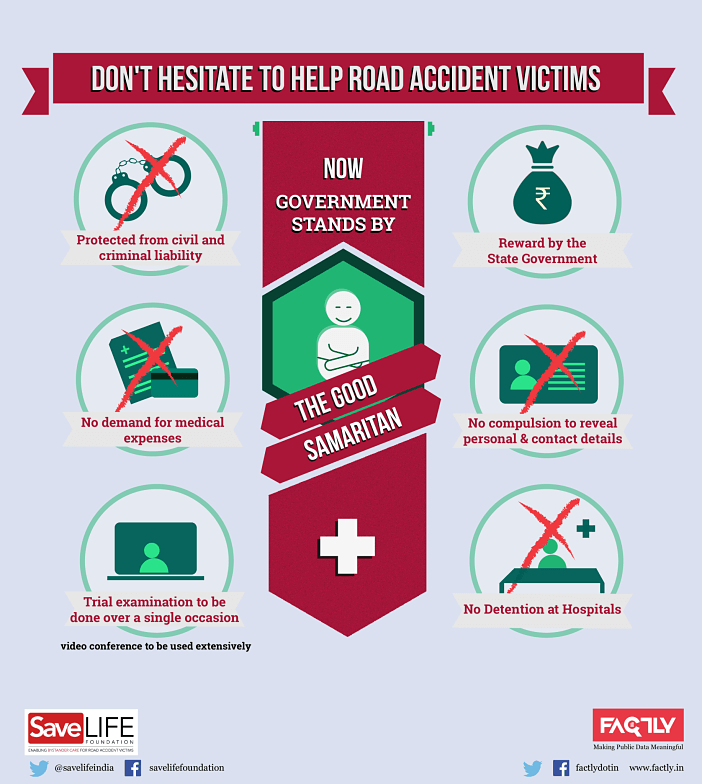
The guidelines says the followings:

  • A bystanders or Good Samaritan should be allowed to leave immediately after taking an accident victim to a hospital without having to answer any questions.
  • Neither the police nor emergency services can compel bystanders to reveal their name or personal details; neither they will be liable for any civil or criminal liability.
  • If required, only eyewitnesses to the accident can be asked for their addresses.
  • The bystander or Good Samaritan will be awarded or compensated as decided by the State Governments to encourage other citizens to come forward to help the road accident victims.
  • It is ensured that the bystanders who voluntarily disclose that they are eyewitnesses to accidents, not be subject to harassment or inconvenience while taking part in legal proceedings.
  • Eyewitness statement will be recorded in a single hearing. They should not be called repeatedly to appear in the court.
  • The disciplinary or departmental action will be initiated by the government concerned against public officials who coerce or intimidate a bystander or Good Samaritan for revealing their name or personal details.
  • If a doctor fails to act to help an accident victim when they are expected to provide care, their actions will be seen as “Professional Misconduct and disciplinary action will be taken against them.
  • All hospitals should publish a charter in Hindi, English and Vernacular language of the State and Union territory at their entrance, declaring that a bystander or Good Samaritan would not be detained or asked for money for treatment.
  • All public and private hospitals will implement the guidelines.


Therefore, these guidelines have already shown its impact on various States. Due to these guidelines, no of deaths due to road accidents, has been decreased. These guidelines are helping those people who hesitated earlier to help the injured in road accidents.

Let me know in the comment section if you had any experiences of road accident. Maybe you witnessed an accident where you wanted to help someone but hesitated. Or God forbid, you or someone you know needed help after a road accident, but bystanders hesitated to help. I know these experiences are not easy to talk to, but you’ll feel better by talking about it with others. Let me know if you think these guidelines would make a difference.

[divider]

Guest Author:
Surbhi Agrawal
B.B.A., L.L.B. (Hons.) IIIrd Year
University of Petroleum & Energy Studies

Download Now

Why Does India Need Witness Protection

0

hammer-620009_960_720

In this blogpost Shipra Prashant, 2nd year, student, UPES Dehradun, writes on why does India need witness protection, what are the laws relating to it and their implementation.

Introduction

When a trial is carried on for the demand of justice, it involves various aspects. The victim and the accused along with their councils are not the only parties to a trial, the witness and the supporting circumstances also play an important role. The decision of the trial is majorly based on the evidence and testimony of witnesses. Due to their important position, they are threatened the most.

Importance of witness

A witness performs a sacred duty of assisting the court to discover the truth and to decide on the guilt or otherwise in the case. The witness being neither the accused nor the victim has no risk in the decision of the court. He performs an important public duty, sacrifices his time and takes the trouble to travel all the way to the court to give evidence.

Threats to the witnesses

A major problem faced by the witness is their safety also the safety of their family members who face danger at different degrees. They are often threatened by the opposite party, and the seriousness of the threat depends on the type of the case and the background of the accused and his family. Many a times crucial witnesses are threatened or injured prior to their testifying in the court.

There have been many infamous cases involving various powerful, influencing people, who have everything in their favour except for the evidence. The witnesses are then threatened and the parties try either to mould witness in their favour or turn them hostile.

Incidents involving threats to witnesses

Vyapam Scam:

In the very famous Vyapam scam, the scam involving massive irregularities and corruption in the Madhya Pradesh Professional Examination Board (MPPEB) or MP Vyavsayik Pareeksha Mandal related to admission in medical colleges and recruitment for various government jobs. After this scam came into the picture, people have seen a number of accused and witnesses relating to this case dying mysteriously, while others have died of severe illness.

In this case, a whistleblower, Prashant Pandey, who exposed this massive recruitment and admission scandal, has urged the CBI to probe the deaths of the witnesses to this case, “There must be a CBI probe. It is not a coincidence that all the accused are dying of one ailment or another. There is something more to it,”

A total of twenty-five witnesses including the son of Madhya Pradesh Governor Ram Naresh Yadav, Shailesh, have died so far in this high profile scam of the Madhya Pradesh Professional Examination Board (MPPEB). [1]

Asaram Bapu Case:

In this case, a saint, who faced two rape charges, is currently in jail. A key witness, 35-year-old Kirpal Singh, who died of his injuries, was shot by unidentified assailants in Shahjahanpur. Before the killing of Kirpal Singh, two witnesses Amrut Prajapati in Gujarat and Akhil Gupta in Uttar Pradesh were killed.

A similar pattern of killing, in all these deaths of the witnesses, is a clear indication that these deaths were not natural or an accident. It is safe to deduce that these attacks are being made mainly to eliminate any sort of evidence to the accused. Yet, nothing has been done for the safety of the witnesses. Father of Late Akhil Gupta requested a probe in the death of the witnesses, by way of a letter to the Prime Minister, the Union Minister and the chief minister of Rajasthan and Gujarat.[2]

The Hit and Run Trial of Salman Khan:

The judgement of the Bombay High Court has been nothing short of a disappointment, the High court declared- not drunk, not driving, not guilty. The case proves to be a testimony that the rich and the famous are governed by different set of rules than the lesser mortals.

The witnesses in this case,  have been exploited; killed and corrupted in all of these instances. Ravindra Patil, the only witness who stood by his statement that the Actor was drunk was not considered and the High Court ordered that there was “erroneous application” of Section 33 of Evidence Act (relevancy of certain evidence for proving, in subsequent proceeding, the truth of facts therein stated) by the trial court. [3]

Importance of Witness Protection:

In the absence of the laws for the protection of witnesses, justice seems like a farfetched idea. In circumstances where the only source of truth is the witness, law for their protection is strongly required.

Law Commission:

The Law commission has made several attempts to draft a witness protection law and recommended to the Centre stressing its need. The last law panel report was sent to the government in 2006. After the Delhi high court’s direction, the state legal services authority drafted a ‘Delhi Witness Protection Scheme’ but that too has been pending since 2013.

Laws for witness protection:

United States of America:

USA has codified laws for Witnesses protection which clearly state that in the case of severe crimes and organised crimes, Attorney General may provide for the protection of the witnesses or close family members of the victim or a close associate. The guidelines have been laid down in various cases; to assure the health, safety, and welfare of that person, including the psychological well-being and social adjustment of that person, for as long as they require it.

There are provisions and guidelines available to provide temporary security to the witnesses in accordance to the situation.  The US Marshal Service provides for security to the witnesses and their dependants. The department provides 24-hour protection to all witnesses while they are in the high-trial environment, including pre-trial conferences, trial testimonials and other court appearances. The US Marshal Service have protected, relocated and given new identities to more than 8,500 witnesses and 9,900 of their family members.[4]

India:

The situation in India in comparison to the USA is rather bleak. The road to safety of the witnesses seems like a tough one.  Even the judiciary has raised concerns regarding it.

According to a senior lawyer and Member of Parliament Mr. KTS Tulsi, the rate of conviction in murder cases is 10 per cent, while in rape cases is around 12 per cent”. Further he says that, “These low numbers exist because witnesses are too scared to come to the court… Justice is being severely compromised because of the absence of a programme that protects witnesses.”

In India, presently, there is no legislation that provides the standard operating procedure to ensure the safety of witnesses who feel threatened. At present, a witness who feels threatened has three avenues:

Firstly, a person has the opportunity to approach the local police and ask for protection. Secondly, the witness can file a writ petition in the High Court and ask for a directive to the police to provide protection. Third, the witness can ask the trial court judge to order the police to provide security. But this is a very laborious process because the police only provide protection after carrying an audit of threat perception.[5]

Provisions in India:

Terrorist and Disruptive Activities Act, 1985:

However, there are certain provisions present; our legislature has made provisions to allow the witness to remain anonymous. The first such law was the Terrorist and Disruptive Activities Act, 1985 (commonly known as Tada). This Act states that if the witness desires, the court “may” take steps to keep the “identity and address of the witness secret”, the violation would result in, a fine of Rs 1,000 and punishment of up to one year in the case of violation.

Prevention of Terrorism Act, 2002:

A similar provision was made in the Prevention of Terrorism Act, 2002 (repealed in 2004), and continued in The Unlawful Activities (Prevention) Amendment Act, 2004. The provision for the protection of the identity of the victim and witnesses is also present in the Juvenile Justice Act and in laws that deal with sexual offences.

Drawbacks

But these laws do not take into consideration any possible threat to witness’s family or property. If a member of the family is feeling threatened, there is no procedure or law available for tackling this situation.

 The challenge remains in the implementation of the witness protection law. As the Law Commission’s report illustrates, the right of protecting the identity of the witness has to be balanced with other provisions of law. For instance, will a law that conceals the identity of the witness compromise the right of the accused to demand a fair trial, as the accused would want to check the authenticity of the witness?

The Law Commission’s answer is that unlike in some western countries, in India, neither the right to an open public trial nor the right of examination of the prosecution witness in the immediate presence of the accused is absolute. Therefore, where such a dilemma exists, the need for witnesses deposing without fear or intimidation should override the need for an open trial. Therefore, it’s rather difficult to have protection given as extensively as it is provided in the United States.

Absence of Man Power:

There is an absence of adequate manpower in our country According to the home ministry; India has 136 policemen for every 100,000 people, whereas the sanctioned strength is 181 policemen for 100,000 people. As compared to India, developed countries have a much better ratio: Canada has 191, Japan 200, the US 224 and Italy 550.

The number of policemen is less that it is very difficult to put them on duty to protect witnesses. It would cost around Rs 4-5 lakh to guard a man for a year. The state doesn’t have that kind of money to provide protection. [6]

Steps by the government:

However there have been certain steps been taken, the Delhi government has made a beginning with the notification of the Delhi Witness Protection Scheme. The scheme provides for ensuring anonymity of the witness and if the need arises, for changing the identity of the witness. This scheme also provides for installing security cameras and providing escort vehicles to the witness.

Though the scheme is far from the actual legislation that is in need, but it can still be considered as a positive step towards ensuring the safety of the witnesses.

[1] [1] http://indiatoday.intoday.in/story/vyapam-scam-madhya-pradesh-deaths-shivraj-chouhan-probe/1/449441.html

[2] [2] http://www.business-standard.com/article/current-affairs/will-india-be-able-to-protect-its-witnesses-115080101007_1.html

[3] [3] http://indianexpress.com/article/india/india-news-india/salman-khan-verdict-the-witness-who-stood-by-his-statement-till-his-death/

[4] http://www.usmarshals.gov/witsec/

[5] http://www.business-standard.com/article/current-affairs/will-india-be-able-to-protect-its-witnesses-115080101007_1.html

[6] ibid

Download Now
logo
FREE & ONLINE 3-Day Bootcamp (LIVE only) on

How Can Experienced Professionals Become Independent Directors

calender
28th, 29th Mar, 2026, 2 - 5pm (IST) &
30th Mar, 2026, 7 - 10pm (IST).
Bootcamp starting in
Days
HRS
MIN
SEC
Abhyuday AgarwalCOO & CO-Founder, LawSikho

Register now

Abhyuday AgarwalCOO & CO-Founder, LawSikho