Download Now
Home Blog Page 1789

Can you legally work at two different companies in India? Employment Agreement and Clauses to watch out for

1

Legal effect of Moonlighting clause in Employment Agreeement

This article is written by Ravindra Bhardwaj, a student of Institute of Law, Nirma University.

The employer-employee relationship is a very important relationship. It has always been in the constant state of evolution and now The New Economic Policy, 1991 has made a sharp change. It has changed the situation between their relationship as well as added altogether a  new domain to the concept of the “industrial relation”  regarding the disputes on the payment terms, termination  of services, non-compete or non-solicitation clauses etc.

These disputes may arise at various stages of relationship as:

Pre-Hire:

The dispute may arise before the person is hired because issue of violation of rights may arise because of the screening policy.[1]

During The Employment:

There are various chances that disputes might araise during the course of employment due to Misconduct or indiscipline of the employee or relation to restrictive covenants which can also be termed as ‘Moonlighting Clause’.

Post Termination:

After the termination of the employees, the employee may be restricted from joining the competitors.[2]

WHAT IS MOONLIGHT CLAUSE

In this modern era moonlighting clause can also be termed as ‘Negative Covenants’, ‘Restrictive covenants’ etc. Moonlighting clause is a clause in the agreement of service which contains negative covenants restricting the employee from working elsewhere during/after the period covered by the agreement. Moonlighting term means to hold another job outside of normal working hours. Both the job may be identical or may not. Moonlighting clause is the clause which is added as a clause in the employment agreement with the consent of the employee when he joins the company/business. It is added by the consent of both the parties.

The term ‘Moonlighting’ is most commonly used in the U.S.A. where tendency to work at two places is higher in comparison to India. In India this clause is mostly used as ‘Negative Covenants.’ A negative covenant is that the employee would not engage himself in a trade or business or would not get employment under any other employer for whom the employee would perform similar or substantially similar duties, is not a restraint of trade unless the contract is harsh or unreasonable. In India this clause is enforceable and it can be enforced wherever necessary.

Moonlighting clause can be categorised into in two types :-

  1. Term covenants
  2. Post term covenants.

Term Covenants

The term covenants are the covenants which restraints the employee to work elsewhere during the period covered by the agreement. An employee owes a duty to the employer to not disclose trade secrets or confidential information to others or for his own benefits and the employee could be restrained from or sued for divulging or utilizing any such information in his new employment.

Post term covenants.

Post term covenants are as Non Compete covenants, Non solicitation covenants, training bonds etc. In Indian scenario both these covenants are enforceable and can be enforced but the reasonability must be there to enforce.

Common moonlighting policy points are:

No Second Job At All:

The basic moonlighting clause is that no employee should work for any other company until he is in the employment of the first company. The reason behind this clause is to carve out more efficiency out of the employee.

https://lawsikho.com/course/labour-law-hr-managers

Not To Work For The Competitor:

Another clause may be that the employee should not work for the competitor of the former employer after the termination of his employment from the former company. This clause is added to protect their confidential information and trade secrets.

Permission From The Existing Employer For The Second Job:

This clause is added if the employee is allowed to do the second job than the prior approval from the first employer must be there.

All these are the common points of the moonlighting clause. The benefit of this clause will be to the employer only because the employer can carve out more efficiency out of the employee.

Consequences Of Two Jobs At A Time

  • The efficiency of the employee will go down because he may be too tired by handling two jobs at a time.
  • The second job may interfere with the first job or first with the second.
  • There may be chances of breach of confidentiality.
  • There may be conflict of interest.
  • Various issues as Fatigue, poor attentiveness etc may arise.

All these may be the consequences of handling two jobs at a time so in the agreement the moonlighting clause is added so that the employee works efficiently and does not work at any other company. This clause must be added with the consent of both the party and there must not be coercion, undue influence, misrepresentation etc.

NON-COMPETE AND NON DISCLOSURE OF CONFIDENTIAL INFORMATION CLAUSE

There may be a clause in the employment agreement which restricts the employee to engage himself in a trade or business by any manner with the competitor in term or post term employment. The reason behind adding the clause is that the employer can carve out more efficiency out of the employee and the employee should not disclose the secrets of the company. In India this clause is enforceable and an employee can be sued by the employer if the employee breaches the agreement. On the breach of the agreement by the employee, the employer can claim the damages.

According to Section 27 of Indian Contract Act, 1872 all agreement which are in restraint of the trade are void except when there is sale of goodwill or if the agreement is governed by the partnership act. Although the section states that all agreements in restraint of any profession, trade or business are void, the current trend as per various judicial pronouncements leads to the conclusion that reasonable restraints are permitted and do not render the contract void ab initio. A contract which is in restraint of trade cannot be enforced unless it is reasonable as between parties and it is consistent with the interest of the public.

In case of the public sector one can claim the right enshrined under Article 19 of the Constitution of India but in case of private sector one can not claim this right. Article 19 (g) of the Constitution of India clearly provides every citizen the right to practice any profession, trade or business. This right is not an absolute right and reasonable restrictions can be imposed on this right in the interest of the public so the courts interpreted the section and adopted an interpretation favourable to the employees. It is a settled position of law that restrictive agreements bind current employees in lawful employment of the employer throughout the duration of the contract. Unlike the law of the United Kingdom, the Indian Contract Act, 1872 does not distinguish between partial and total restraint of trade, if the clause amounts to restraint the employee after the post termination of the agreement, then the same is void otherwise not.

In India it is the settled position that agreement restraining the employee to work elsewhere during the period covered by the agreement is valid agreement and it can be enforced but sometimes even after the termination of the employment the employee can be restrained from working at the competitor of the former company.

In the case, V.N. Deshpande vs. Arvind Mills Company Limited,[3] the Bombay High Court held that if a man who works for a particular wage and for certain period he agrees to work then the agreement is not void. In this case the defendant was employed as a weaving master in a mill with the condition that he will not serve in that capacity for three years for anyone else in any part of India. The court granted an injunction to restrain him in terms of the agreement that he can not employ himself as a weaving master or as an employee under any title discharging substantially the same duties as a weaving master. The court granted the injunction on the view that the agreement was signed by the employee and the agreement was for the particular time period of three years hence reasonable term. The agreement and negative covenants were made enforceable on the basis that the terms of the agreement were reasonable.

Supreme Court of India in the case, Niranjan Shanker’s case,[4] observed that if the negative covenants are reasonable than the agreement is valid and these negative covenants must be necessary for the purpose of trade. In this case a foreign producer collaborated with a company manufacturing tyre cord yarn by an agreement which stated that the company would maintain secrecy of all technical information and would obtain corresponding secrecy arrangements from its employees. The defendant was appointed for a period of five years with the condition that he shall not serve at anywhere else even after he left the service. Court held it a valid agreement that the agreement is restricted as to time and nature of employment so it is a reasonable and the court restrained the defendant from serving at anywhere else during the currency of the agreement. The court held that there is an implied term in the contract not to use trade secrets of the previous employer.

In the case, Superintendence Company of India Ltd vs. K. Murgai,[5] it was held that an employee can not be restrained from joining the competitor but he can be restricted from the disclosing of the trade secrets of the former employer. In this case the employee agreed that he will not engage himself in any of the competitors during the employment and post employment. But the employee joined the other competitor after the termination from the first employment. Supreme Court held that the employee can not be restrained to join the competitor but court held that the clause to maintain the secrecy or not to disclose the trade secrets is enforceable.

In the case, Gopal Paper Mills Ltd vs. Surendra K. Ganesh Das Malhotra, (AIR 1962 Cal 61), it was held by the court that where the agreement is for the time period of 20 years and the contract gives the arbitrary power to the employer to terminate the service without the notice then it is void agreement.

But in the case, Percept D’Markr India Pvt. Ltd vs. Zaheer Khan & Anr.,[6] it was held by the Supreme Court that if a restriction is unreasonable, it can be null and void under section 27 of Indian Contract Act, 1872. In this case, an agreement was made with the cricketer for the period of three years with the condition that the player could not accept for any endorsement or promotion and before accepting this offer he would provide in writing all the terms and conditions of such third party. After that the cricketer informed the company that he is not interested in the extending or the renewal of the previous agreement and thereafter he entered into an agreement with the third party. The court held that under section 27 of the Indian Contract Act, a restrictive covenant extending beyond the term of the contract is void and unenforceable.

Delhi High Court in the case, Desiccant Rotors International Pvt. Ltd vs. Bappaditya Sarkar & Anr.,[7] held that restrictions, which interfere with the right of an employee, can not be said valid. Such negative covenants can not be said valid. In this case the employee signed an agreement under which he agreed to the conditions of the agreement. The conditions were that after the termination of the employment he will not in any capacity compete against the company and he would not disclose the trade secrets and the confidential information of the former company to any third party. In addition to this he also signed two declarations declaring that if he failed to comply with these two requirements, he would take full liability and responsibility for the same. After the three months of the leaving the employment the employee joined one of the competitors of the former company. The court held that such negative covenants are invalid because he was the marketing manager who could not be deemed to possess confidential information so there is no need of the claim to enforce injunction. The court observed that such type of clauses violate his right to livelihood hence such restriction could not allowed.

NON SOLICITATION CLAUSE

A non-solicitation clause is the covenant which prevents a former employee from indulging in business with the company’s employees or customers against the interest of the company. In India, Non solicitation clause has been enforced by the courts and they relied on the circumstances. All the High Courts have enforced non solicitation clause differently.

Delhi High court in the Dessicant Rotors case[8] held that the manager could not have deemed to possess confidential information so no question of solicitation arises. In the case, Wipro Ltd. v. Beckman Coulter International SA,[9] held that there are certain non solicitation clause which can not be said to be in violation of the section 27 of Indian Contract Act, 1872.

Court gave some guidelines:

“Negative covenants tied up with positive covenants during the subsistence of a contract would not normally be regarded as being in restraint of trade, business of profession unless the same are unconscionable or wholly one-sided; Negative covenants between employer and employee contracts pertaining to the period post termination and restricting an employee’s right to seek employment and/or to do business in the same field as the employer would be in restraint of trade and, therefore, a stipulation to this effect in the contract would be void; While construing a restrictive or negative covenant and for determining whether such covenant is in restraint of trade, business or profession or not, the courts take a stricter view in employer-employee contracts than in other contracts, such as partnership contracts, collaboration contracts, franchise contracts, agency/distributorship contracts, commercial contracts. The reason being that in the latter kind of contracts, the parties are expected to have dealt with each other on more or less an equal footing whereas in employer-employee contracts, the norm is that the employer has an advantage over the employee and it is quite often the case that employees have to sign standard form of contracts or not be employed at all; The question of reasonableness as also the question of whether the restraint is partial or complete is not required to be considered at all whenever an issue arises as to whether a particular term of a contract is or is not in restraint of trade, business or profession.”

Madras High Court in a case observed “the restrictive clause only stated that Defendant may not carry on a business which is prejudicial to the Plaintiff Company and as such clause did not restrict the Defendant in absolute terms from carrying on any business. The Madras High Court further noted that the agreement was entered into with the free will of both the parties and had equal bargaining power hence the term can not be said as unreasonable.”[10]

CONCLUSION

The relevance of inserting Moonlighting clause in the agreements has been evolved over a period and gained significant importance due to employee-employer relationship. Restrictive covenants can not be enforced directly but they must be analysed on a case-to-case basis. Whether the restrictive covenant is violative or not is a question of fact which only a court of law can examine and arrive at an appropriate conclusion based on facts and circumstances and all the High Courts have observed differently from the case to case. In India the Moonlighting clause is enforceable to the extent of reasonability and the reasonability is a question of fact which has been decided by the Court of law.

 
Get all the templates, formats, step by step guides, checklists and information you need related to employment laws in one place, free of cost. we have simplified compliances, record-keeping, contracts, policies, disputes and litigation for you. Never struggle with employment and labour law again in your life. Click here to download the  Legal handbook for HR managers.
 

LawSikho has created a telegram group for exchanging legal knowledge, referrals and various opportunities. You can click on this link and join:  

https://t.me/joinchat/J_0YrBa4IBSHdpuTfQO_sA

Follow us on Instagram and subscribe to our YouTube channel for more amazing legal content 
 
 
References:

[1] Vikram Shroff & Neha Sinha, Background checks in India, Society for HRM (2012).

[2] Niranjan Shanker Golikari vs. Century Spinning & Manufacturing Company Limited, AIR 1967 SC 1098.

[3] (1946) 48 BOMLR 90.

[4] Ibid.

[5] AIR 1980 SC 1717.

[6] (2006) 4 SCC 227.

[7] Desiccant Rotors International Pvt. Ltd vs. Bappaditya Sarkar & Anr. Delhi HC, CS (OS) No. 337/2008 (decided on July 14, 2009).

[8] Ibid.

[9] 2006 (3) ARBLR 118.

[10] GEA Energy System India Ltd. v. Germanischer Lloyd Aktiengesellschaf, [2009]149 CompCas 689.

Download Now

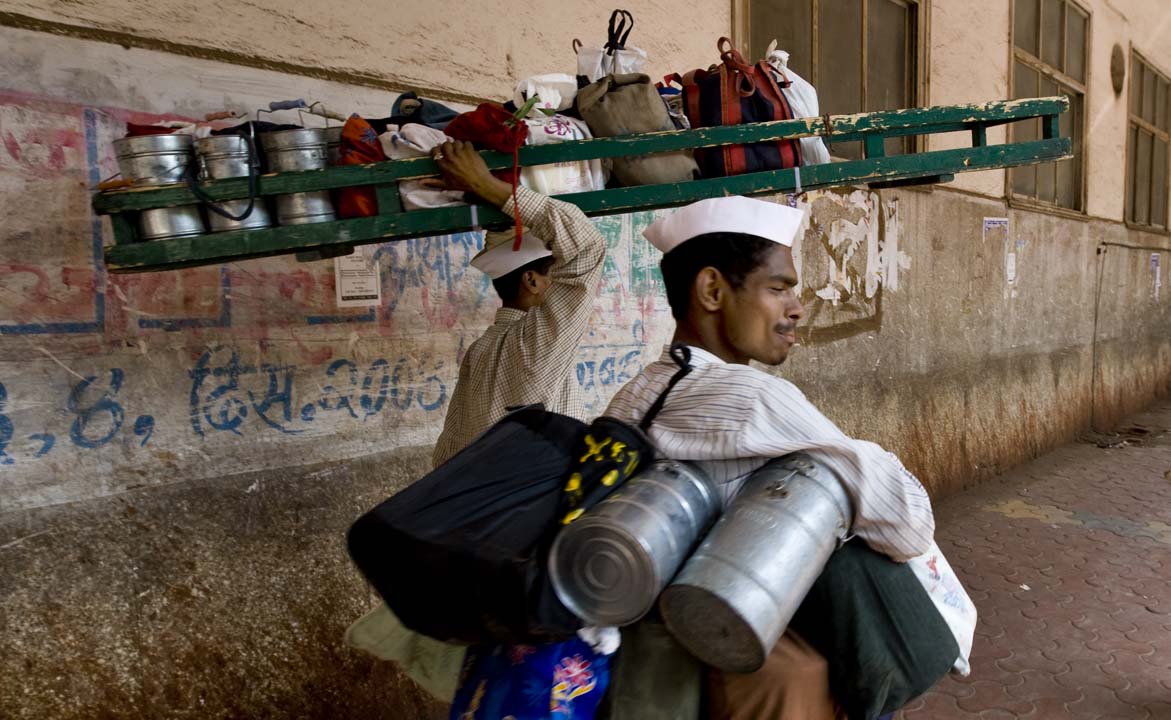
Licenses required for starting a tiffin service/home delivery of food in India

21
tiffin service

This article is written by Deiya Goswami, a student of UPES, Dehradun, on licenses required for starting a tiffin service / home delivery of food in India.

Download Now

Homosexuality and the Law in India

0


pride-828056_1920

This agreement is written by Ankita Sen, a 3rd Year student at National Law University, Odisha.

HOMOSEXUALITY- THE THIRD SEX

Popular belief and study of the behavioural trends of the homosexuals tell us, homosexuality is a romantic and physical attraction of a person towards another of the same sexual orientation. Scientists all over the world are not at consensus about the exact causes of homosexual behaviour in humans. Homosexuality, often called the third sex, has an unsettled legal and social status in India. While, we see rallies and public protests against the oppression of homosexuals in the society, we also see the homosexuals being looked down upon by a large number of members of the society. The Indian society appears ambivalent, being tugged between popular views and the call of their own conscience. These societal and legal perspectives in turn, have a plausible psychological impact on the members of the homosexual community, also called the LGBT (lesbians, Gays, Bisexuals, transgenders) community in the local jargon.

RIGHTS OF THE LGBT- LEGALLY SPEAKING

“Coined around 1050 by St. Peter Damian to denote sexual activity between men, “sodomy” is a shortened form of “the sin of Sodom,” referring to the Genesis account of the men of Sodom who tried to have intercourse with two angels and were smitten with blindness.”[1] The very famous scholar, William Blacksmith had always held a very abominable approach towards sodomy. His ideas had a marked influence on the development of anti sodomy laws in many parts of the world, including the Americas and the British colonies. Section 377 in the Indian Penal Code, drafted by Lord Macaulay is also an offshoot of such historical as well as popular conservative religious beliefs.

The Naz Foundation Case – challenging criminalization of homosexuality on constitutional grounds

The Naz Foundation had tucked at Section 377 of the Indian Penal code, the very root of anti-sodomy law in India.

The Naz Foundation India(Trust) Limited., a nongovernmental organization works towards the prevention of AIDS, providing support to the victims of this deadly disease, that includes people from the sexual minorities, like the homosexuals. The crusade against law criminalizing consensual same sex activity between adults started in the year 2001, when the Naz Foundation filed  a lawsuit in the High Court of Delhi against the anti sodomy law, alleging that Section 377 was being used for police atrocities, thus impeding their activities.

The Delhi High Court Judgement that legalized homosexuality in India

“In a landmark judgment, the Delhi High Court on Thursday struck down the provision of Section 377 of the Indian Penal Code which criminalised consensual sexual acts of adults in private, holding that it violated the fundamental right of life and liberty and the right to equality as guaranteed in the Constitution…”[2]

The petitioner, The Naz Foundation pleaded that Section 377 of the Indian Penal Code be declared unconstitutional on grounds that it clearly violates the sacrosanct Fundamental Rights enshrined in Part III of the Indian Constitution. They contended that the right to equality under Article 14 was being grossly violated by the discrimination against these sexual minorities. It was also contended that, sexual relations was a very private issue of an individual’s life. State interference in such a sensitive issue was a clear violation of the right to privacy, implicit in the right to life guaranteed under Article 21 of the Constitution. Such discrimination against the LGBT community on grounds of an aberrant sexual orientation had another impact too. It showed a clear violation of the fundamental right under Article 15(1), which eliminates ‘sex’ as a ground of state discrimination. The petitioners also contended that there was violation of the fundamental rights under Article 19 because, the victims were not being given the right to freely express their sexual preferences and also move at their own free will in order to get involved in any kind of homosexual behaviour.

“Limiting their plea, the petitioners submit that Section 377 should apply only to non-consensual penile non-vaginal sex and penile non-vaginal sex involving minors.”[3]

In the case of Govindarajalu In re[4] in 1886, the Court had held that oral sex would not fall under the umbrella of Section 377. This identical view was reprised in a later case, Khanu v Emperor[5], where, “the court held that the test to determine whether carnal intercourse is against the order of nature is to see whether the sexual act is performed without the possibility of reproduction.”[6] However, a gradual shift in views and ideas was seen in cases later. In the 1968 case of Lohana Vasantlal Devchand v State[7], “the issue was whether oral sex amounted to an offence under Section 377 IPC. It was held that the orifice of the mouth is not, according to nature, meant for sexual or carnal intercourse.”[8] Thus oral sex was an offence under Section 377. Emphasis now shifted to the words “against the order of nature”, instead of the emphasis earlier given to the words, “carnal intercourse”, that was interpreted as only such sexual activity that can result in procreation. The same trend as in the Lohana case was followed in subsequent cases. In the 1969 case of State of Kerala v Kundumkara[9], the Kerala High Court came up with the ruling, “committing intercourse between the thighs of another is carnal intercourse against the order of nature and the act fell within the ambit of Section 377.”[10] In the 1992 case of Calvin Francis v Orissa[11], oral sex was considered to fall under Section 377 and was thus considered an offence. However, a new concept of ‘sexual perversity’ came up in this case and in the case of Fazal Rab Choudhary v State of Bihar[12]. Any activity that would help in deriving sexual satisfaction that was abnormal would come within Section 377 and would be considered an offence. “Therefore, the first test described in Khanu in order to determine whether sexual acts were against the order of nature was based on considerations of possibility of procreation, whereas the later test described in Calvin Francis and Fazal Rab Choudhary was based on considerations of sexual perversity.”

After such extensive study regarding the interpretation of Section 377, came the much lauded Delhi High Court judgement. The Court sensitised on the issue of harassment of the homosexuals in the society and declared Section 377 as violative of Articles 14, 15, 19 and 21 of the Constitution, so far as it tries to criminalize the private sexual activities of consenting adults. The Court also realized that so far Section 377 has only been used to protect the victims from any kind of unnatural forced sexual activity. Thus, using it to criminalize sexual relations and activities between consenting homosexual adults, would be a misutilization of the Section. However, the Court held that “The provisions of Section 377 IPC will continue to apply to non-consensual penile non-vaginal sex and penal non-vaginal sex involving minors.”[13]

The Supreme Court Judgement that struck down a Delhi High Court judgment to make homosexuality illegal in India again

“The Supreme Court on Wednesday reinstated a colonial-era ban on gay sex that enables the jailing of homosexuals in a major setback for rights campaigners in the country.”[14]

After the landmark judgement by the Delhi High Court, Suresh Kumar Koushal, an Indian citizen who felt it important to protect the moral values embedded in the society, sent a petition to the Supreme Court of India, challenging the High Court judgement.

In the views of the petitioners scrapping down Section 377 was irrefutably baseless. It was argued that no constitutional right validates any act which has the tendency to cause harm to oneself and to others, intercourse between homosexuals being one such high risk activity. The petitioners brought in the concept of the code of nature- every organ in the human body have been assigned discrete functions by nature and man should not violate such naturally set norms. Thus, accepting the Delhi High Court Order might inimically perturb marriage as an institution itself and might tempt the youth towards homosexual activities.

The respondents showed through various cases, how Section 377 IPC was being used to harass people from the homosexual community. One such case was that of Jayalakshmi v State of Tamil Nadu[15]. In this case, concerning sexual abuse of eunuchs by the police, Section 377 was used by the Metroplitan Magistrate to penalise two women. This was grossly unreasonable because, the Explanation to Section 377 IPC mentions penetration as a requirement. The respondents argued on the archaic and obsolete nature of Section 377 IPC.

Repelling the moral stand taken by the petitioners, Shri F.S Nariman fighting on behalf of the respondents pointed out, Section 377 IPC falls under Chapter XVI, “Of Offences affecting the Human Body”[16] (and not under Chapter XIV). Thus, Section 377 should not be used to classify against the LGBT community morally.

The respondents also paid attention to the commonly debated question, whether Section 377 should apply to the sphere of homes. They argued that Section 377 IPC should not apply to the private activities of the homosexuals because the difference between amoral and depraved acts in the public and private spheres has been recognized statutorily by Section 294 IPC. It was argued that, the right of the homosexuals to enter into any personal relation of their choice, cannot be denied, by shedding an umbrella of criminality over same sex relationships. The respondents considered important, the view given by Justice Vivian Bose in S.Krishnan and Ors. v. The State of Madras[17], “…when there is ambiguity or doubt the construction of any clause in the chapter on Fundamental Rights, it is our duty to resolve it in favour of the freedoms so solemnly stressed.”[18]

The Debate On Constitutionality of criminalization of homosexuality

A major point of debate was regarding the constitutionality of Section 377 IPC. In the words of Shri V Giri, “if the judgement is rested purely on the constitutionality of the provision, then there is a fair chance of the judgement [of the High Court] being reversed. That is what has happened. The Court has not gone into any other issue.” [19]

The petitioners laid stress on the theory of presumption of constitutionality- a statute is presumed to be constitutional unless it directly violates a fundamental right. Thus, an indirect violation of the fundamental rights cannot be considered sufficient ground for quashing Section 377 of the Indian Penal Code. The petitioners also contended that there was no violation of Articles 14 and 15 of the Indian Constitution. This is because, Section 377 IPC applies to both the genders equally, if they engage themselves in “carnal intercourse against the order of nature”[20]. So, the Delhi High Court’s finding that, Section 377 unjustly discriminates against the homosexual community as a ‘class’, has no solid base. Shri Ahmadi, fighting on behalf of the petitioners argued that, the Delhi High Court is itself not clear whether it wants to severe portions of Section 377 or read down the Section. He added that, “the language of the section was plain, there was no possibility of severing or reading it down. He further argued that, irrespective of the Union Government’s stand, so long as the law stands on the statute book, there was a constitutional presumption in its favour.”[21]

The respondents tried to challenge the very constitutionality of Section 377 IPC. Quite a few situations can be derived from the language used in the Section- carnal intercourse or anal sex between a husband and a wife, procreative or non-procreative, with or without consent, etc. According to them, Section 377 in the practical scenario, considers the LGBTs as a separate class and thus stands repugnant to Articles 14 and 15- the constitutional pillars of equality. Also, Section 377 IPC does not lay down any well drafted policy or principle as to which of the various possible cases it should apply. Thus, it cannot be justified under Article 14 even on grounds of intelligible differentia and hence, reasonable classification. According to the respondents, Section 377 IPC also does not follow a  “procedure established by law”[22] as required by Article 21 of the Indian Constitution, by interfering into the lives of the homosexuals without following any proper statutory procedure. Cases like Mithu Singh v State of Punjab[23], Selvi Devi v State of Karnataka[24], were discussed in order to study the “ test of whether a law is just fair and reasonable has been applied in examining the validity of state action which infringes upon the realm of personal liberty.”[25]

The Supreme Court however, based their judgement solely on the constitutionality criteria and held that Section 377 IPC is constitutional and hence, overruled the Delhi High Court judgement.

WHAT DOES THE WORLD SAY ABOUT LEGALIZING HOMOSEXUALITY

In the international scenario, various human rights development programmes, have been undertaken time and again. However, if one focuses on the issue of LGBT rights, the situation is rather menacing. The United Nations Declaration on Human Rights, the protector of all human rights, had no place for LGBT rights, solely because, when it was drafted, homosexuality was considered a mental illness. “In 2003, the State of Brazil presented a resolution to the UN Commission on Human Rights to affirm rights based on sexual orientation.”[26] However, the proposal was deferred to 2004 and faced a dead end when, it expired from the UN agenda in 2005. In 2005, New Zealand’s statement supporting the rights of these sexual minorities was backed by 32 states in the UN, but did not result in a formal vote.

However, individual countries are showing progress in full tilt.

In the United States of America, a variety of organizations advocate the LGBT rights at different political and legal levels. However, homosexuality was banned in the USA till 1991 by the Immigration and Nationality Act, 1952. Homosexual relationships have been legalized throughout the nation after the Supreme Court judgement in Lawrence v Texas[27].It was “reasonably speculated that same-sex individuals desire intimacy or a private sphere of decision-making as much as heterosexual couples in a traditional marriage.”[28] Unlike America, homosexuality has been legal in China since 1997, with the revision of their national penal code. Australia has advanced a lot too in respecting the LGBT rights. Civil rights of these sexual minorities are recognized, though same sex marriage is an exception. Talking about the countries in the European Union, they are governed mainly by the treaties and laws of the EU, differing amongst themselves only in sensitive areas like homosexual marriage, etc. The EU laws ban any kind of discrimination against the LGBTs in areas of employment.

Thus, it is clear that, all over the world, the status of LGBT rights have gained ground, leaving out the Islamic countries, the continent of Africa (where 38 countries consider homosexual relationships illegal), the Vatican and other ultra conservative parts of the world.

POLICY FRAMEWORK AROUND HOMOSEXUALITY AND LAW

While the legal status of same sex relationships and marriages has always been in dispute, policies for these sexual minorities have been unstable too. In the year 1994, voting rights were granted to the LGBTs.

“In 2005, the Central Government introduced category ‘E’ in passport applications meant for transgender persons…Similarly they can get voter id cards with a third gender.”[29]

Very recently, the Supreme Court of India has declared that, “Transgenders should be treated as a third category and as a socially and economically backward class entitled to job reservation.”[30]

Government is still sensitive regarding issues like same sex marriage, adoption by same sex couples, commercial surrogacy for gays, etc. Thus, there is no clear policy for the LGBTs in India.

THINK FOR YOURSELF – WHAT IS THE COST OF MAKING HOMOSEXUALITY ILLEGAL?

After the innumerable attempts to determine the status of homosexuality in India, I would like to look at the problem from a personalized perspective.  First, we need to understand the primary point of conflict regarding the issue of homosexuality. People primarily raise opposition to the proposal of widely accepting the third sex and their right to lead a private life, on moral grounds. However, it is important to note that, sexual orientation being a biological function cannot act as a strong influencer on moral grounds. One who is not biologically homosexual, cannot get involved in homosexual activities simply on the basis of societal influence. Instead, if we as a society maintain a liberal outlook, we will be able to respect the rights of the LGBTs. This should not mean that we transform our way of living, but only nurture and develop ourselves into responsible citizens, who are able to space out their lives, thus allowing every right thinking member of the society to lead an undisturbed life.  It depends on the strength of human personality. We should be  able to place our own morals at the apex, without casting a shadow of contempt on the diverse individuals in the society. We should allow ourselves to respect the human diversity, that might come up in the form of variant cultures, festivals, food cuisines, and more recently in the form of a variant sexual orientation. Whether or not, we imbibe such variant in ourselves depends on our biological matrix, supported by the strength of our character. However, just as we get the right to absorb or abject this variant, the LGBT community should have the same right too. What the society considers normal, might as well be a variant to them. So criminalizing homosexuality is no solution.

The key lies in maintaining a strong, liberal and healthy outlook towards every member of this society.


[1]Dipika Jain, Impact of the Naz Foundation Judgement on The Gay, Bisexual and Transgender People in Delhi:An Empirical Investigation, 2 Centre for Health Law, Ethics and Technology, Jindal Global Law School

viii, xi (2012) available at http://www.jgls.edu.in/UploadedDocuments/Report_ImpactoftheNazFoundationJudgment.pdf , last seen on 10/5/2014.

[2] Nirnimish Kumar, Delhi High Court strikes down Section 377 of IPC, The Hindu (03/07/2009), available at http://www.hindu.com/2009/07/03/stories/2009070358010100.htm , last seen on 12/5/2014

[3]Suresh Kumar Koushal v. Naz Foundation and Ors, AIR 2014 SC 563.

[4] Govindarajalu In re, (1886) 1 Weir 382.

[5] Khanu v. Emperor, AIR 1925 (Sind).

[6] Ibid.

[7] Losana Vasantlal Devchand v. State, AIR 1963 Guj 252.

[8] Ibid.

[9] State of Kerala v. Kudumkara, (1969) CriLJ 818.

[10]Ibid.

[11] Calvin Francis v. Orissa, (1992) 2 Crimes 455.


[12] Fazal Rab Choudhary v. State of Bihar, (1982) 3 SCC  9.

[13]Suresh Kumar Koushal v. Naz Foundation and Ors, AIR 2014 SC 563.

[14]Supreme Court says gay sex illegal , govt hints at legislative route, Hindustan Times (11/12/2013), http://www.hindustantimes.com/india-news/supreme-court-says-gay-sex-illegal-govt-hints-at-legislative-route/article1-1161395.aspx , last seen on 5/7/2014.

[15]Jayalakshmi v. State of Tamil Nadu (2007) 4 MLJ 849.

[16]Ss. 299-377, The Indian Penal Code, 1960.

[17]S Krishnan and Ors. v. The State of Madras, AIR 1951 SC 301.

[18]Ibid.

[19]Murali Krishnan, In Conversation with  V Giri, Bar and Bench (18/12/2013), http://barandbench.com/content/212/%E2%80%9C-legislature-has-seriously-consider-whether-s-377-should-be-kept-statute-book%E2%80%9D-%E2%80%93-senior#.U8Lw4vmSylg , last seen on 07/07/2014.

[20]S. 377, The Indian Penal Code, 1960.

[21]Supra 13.

[22]Art. 21, the Constitution of India.

[23]Mithu Singh v. State of Punjab, AIR 1983 SC 473.

[24]Selvi Devi v. State of Karnataka, (2010) 7 SCC 263.

[25]Supra 13.

[26]The United Nations and the Advancement of LGBT right, ARC International, available at  http://arc-international.net/network-development/conference-presentations/presentation-un-mechanism , last seen on 28/6/2014.

[27]Lawrence v. Texas, 539 U.S. 558 (2003, Supreme Court of the United States).

[28]Same sex marriages- an overview, 97 (CP Nandini, 1st ed., 2008).

[29]Supreme Court’s Third gender status to Transgenders is a landmark, Biharprabha, available at http://news.biharprabha.com/2014/04/supreme-courts-third-gender-status-to-transgenders-is-a-landmark/ , last seen on 01/07/2014.

[30]SC says transgenders ‘third category’; activists turn verdict revolutionary, MSN News, available at http://news.in.msn.com/national/sc-says-transgenders-third-category-activists-term-verdict-revolutionary , last seen on 02/07/2014.

Download Now

How To Stop Procrastination

0
How To Stop Procrastination

In today’s world when it seems that every one of us has got the lot of work. We waste away a major chunk of time in procrastination. Stever Robbins, writer of the book “Get it done guys” provides wonderful ways to overcome procrastination. So, inspired by his book, here is a post for you that will tell you how to overcome procrastination.

How To Stop Procrastination
What is Procrastination?

Procrastination is the act of engaging oneself in the petty task on the pretext of work, and evading the real important stuff that is waiting to be done. Many a times people even fail to realise that they are procrastinating, and then blame their busy schedule for not getting the important work done.

Identify acts of procrastination

Till the time you don’t agree that you procrastinate and you don’t identify particular acts of procrastination, not even god can help you to get your work done.

Do you know you procrastinate when you shuffle between windows to check one facebook notification while you are doing some work; do you know reading all the emails in your inbox on pretext of work is procrastination; if you are working and chatting simultaneously, let me tell you, you are procrastinating simultaneously as well. Procrastination can be of various kinds, for me checking facebook every two minutes is the major act of procrastination, for you, it can be chit chatting with your fellow mates or workers when you are supposed to work or reading one blog after other which you found interesting.

Your next complaint can be that you know that you are procrastinating when you are doing so and so, but you find yourself unable to overcome it.

Types of procrastination do not matter, what is important is how you overcome it.

Steps to overcome procrastination

  • Divide work in small chunks

If your day’s goal is to read a chapter for next day’s class, research for the paper you are working on, write a blog post, instead of doing all these together, divide your work into small chunks. Read the chapter for next day’s class, take a break in which you can chit- chat, roam around a bit etc., and then come back to work, research for the article, take a break, work thereafter and the cycle goes on.

If you try to do everything together, you are just dragging your work for an infinite time. If you do a small amount of work and then take a break, you feel refreshed when you get back to work.

  • Make work your habit

The way you don’t forget to brush your teeth every morning when you wake up as it is your habit. Make work your habit. Sit down to do your work like you do other chores of the day, assign a fixed time and plan a schedule for it.

  • Stay motivated

There is always a higher goal behind your actions. The goal behind cleaning the scattered stuff lying in your room is a clean room and the final goal is to lead a healthy and hygienic life by keeping your surrounding clean. It is also important to convey an impression that you are a clean person to all the people who visit you. The goal behind your action keeps you motivated, the idea of a clean room will push you to arrange the scattered stuff lying in your room. So, whenever you procrastinate, remember the goal behind your actions, that will motivate you and push you to work.

  • Be Accountable

It’s a human tendency to focus on work only if you are accountable to anyone. Try to find a team to work with. Ask your buddies to keep a tab on you. Measure your own progress. Set your goals for the day and share it with your friend. At the end of the day tell him/ her that what you have accomplished. Since you have to tell your friend what all work you did throughout the day, you will feel a sense of accountability and you will try to finish all the tasks you have taken in hand.

  • Bribe yourself

This a thing that makes me works many a times. Promise yourself a movie show if you are able to finish your work by this and this time. Promise to treat yourself with a chocolate if you finish all the things that are there in your to-do-list for the day.

Procrastination eats away half of your time which you could have saved to have fun instead of dragging on with your work. Learn to get your work done faster by following any of these methods and get more time to have fun and trust me this works. For instance, I was able to finish this blog post in less than an hour’s time (without opening facebook even once- an act of procrastination) by promising myself a good sweet sleep if I finish it in one stretch! So, I’m off to sleep! Hope this post was helpful, drop your comment if you think this post was beneficial for you.


Download Now

How to get the best out of a conference you are attending

0
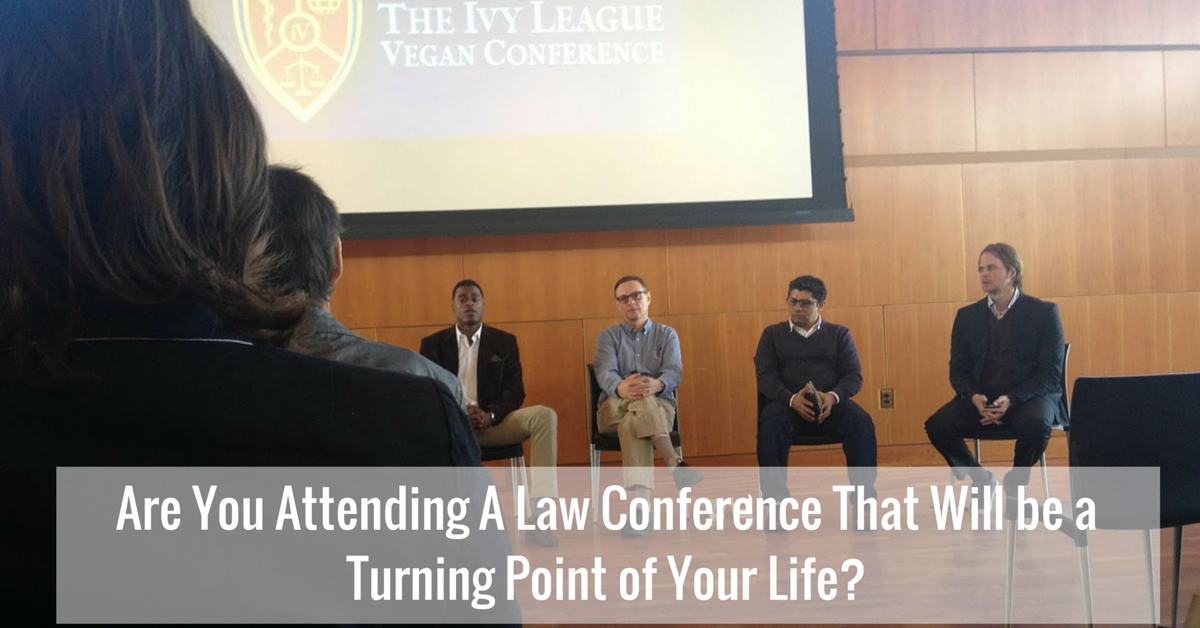
Are You Attending A Law Conference That Will be a Turning Point of Your Life?

You must have attended a conference or other or must be planning to attend one in near future. Even if you don’t plan to, chances are that you might find yourself in one because of professional obligations. Most people see a conference as an opportunity to travel, meet and greet people or just present a paper. Consequently, they add a line in their CV stating the achievement of presenting a paper at a prestigious conference. Is that the best you can get from a conference? Networking guru of this century Keith Ferrazi, author of legendary Never Eat Alone has a very different take on it, which I am going to share with you.

Conferences are great because they always bring together a host of people from an industry or area of study who matter. A smart networker will, therefore, see a conference less as an academic meeting, and more as an excellent place to build a network and make your presence felt amongst people in your field.

Keith Ferrazzi. I love Never Eat Alone because it shook my world.

Conferences provide a forum to meet like-minded people who can help you to fulfill your mission and goals.

In Keith Ferrazi’s words, don’t be just an attendee in a conference but be a conference commando. Attending a conference is an investment of your time, energy and skill and very often substantial money. You must seek some result from such investment. So, what results can you get? Look out to build relationships that will last beyond the conference, and strategise as to how can it help you to succeed. If the conference does not help you to achieve this, don’t attend it.

The challenge is to meet the shakers and movers of the area of study or industry who are coming to the conference. However, practically speaking, meeting them or building a relationship with them is not going to be easy. Why should they talk to you or pay you any attention? Well, they will if you are a conference commando. Here are some of the ways you can make this happen.

Rule #1

Help the organizer

tim-ferriss-on-conference

Organizing a conference is a cumbersome task. There are thousand things to take care of in a conference, from inviting guests, arranging the venue, various facilities etc. If your friend or acquaintance is one among the organizer, excellent! you can certainly offer your help in inviting people, arranging myriad things. What to do otherwise? Look through the website of conference, people who are responsible for organizing, call them few months in advance, let them that you are really looking forward to this conference, offer your help in organizing conference, be it in form of your connections, resources etc. This will also make it more likely that you can get a panel or speakers list since you are on the inside and the organizers are thankful to you for your help.

Once you are into it, you know who the invitees are, what do they do, who they are, what are the events. That certainly helps in getting to know people. Since you are one among the organizers, you get a better chance to interact with people, and they have a reason to talk to you and if nothing else, thank you for your help and support. That is an excellent point to start building a relationship.

Rule #2

If you are attending a conference, speak in it

f-scott-fitzgerald-on-conference-quote

Speaking in a conference is one of the most effective ways to get yourself, your business, and your ideas seen, heard of, and remembered. Being a speaker, gives you a special status, people see you speaking, they get to know who you are, you attain instant credibility and faux-fame that makes it easier to meet people.

Rule #3

What if you are attending a conference and you are not amongst the speakers?francis-bacon-quote-on-conference

Even if you are not a speaker, there are various other opportunities to make your presence felt. For instance, when the session opens up for questions, try and be among the first people to raise your hand. A really well-formed and insightful question offers you an opportunity to get seen by the entire audience. Be sure to introduce yourself, what you do, and then ask a question that leaves the audience buzzing. Ideally, the question should be related to your expertise so you have something to say when someone reverts back to you or ask a question. Don’t pester with questions, don’t ask questions that expose your ignorance and dis-interest, otherwise asking questions will backfire.

Rule #4

Organize a conference within a conference

Chessboard

Who says that conference is limited to the formal discussion and formal party arranged by the organizer? You can always have an informal discussion on the topic that interests you and group of similar minded people. You can organize your own parties, meet people, and invite them over dinner. People generally appreciate that. This way you interact more closely, get to know people personally and this leads to greater exchange of knowledge and information.

Rule #5

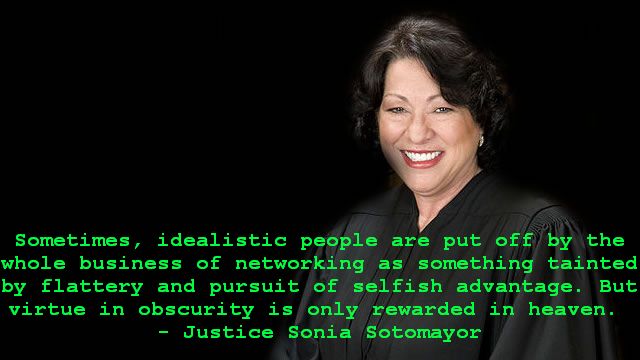
Get to know the big shots

sonia-sotomayor-on-networking-conference

Figure out who are the luminaries attending the conference. Arrive few minutes early for the conference. Stand in a place where you can easily get to see them and introduce yourself or “stumble upon” them, don’t lose your time and balance when you bump! Immediately pass a bright smile, make eye contact, introduce yourself.

Rule #6

Be an information hubarmstrong-william--on-networking

Know the details about the conference, people generally tend to forget or ignore the timings and program details of the conference. Make sure you know these, so much so that if someone asks you a question about these you can answer at once. Know about the local places and the restaurants of the city where the conference is organized, it’s unlikely that people will not want to be friends with such an information directory kind of person!

Rule #7

Cold approach people and drive the conversationslord-monckton-on-speaking-up

Way too many people in conferences wait to be approached and spoken to. This is the second worst crime after just thrusting business cards into people’s hands without building a context or creating a connection. Being passive at a conference may work for people who already attract attention for being recognizable celebrities. For most mortals, it is better to not attend than just being passive attendee in a conference. At the same time, you need to be relevant. What works best is advocating for a cause, demand a change, becoming a rallying point for other people to ask for a positive improvement over status quo. Speaking the truth where few people dare to is a great way to shape conversations, and it is a great thing to do at conferences. If more people did so, conferences would not remain the boring and dead forums they usually are.
Follow these rules, you will surely get to know a lot of people in the conference, don’t forget to follow up. Be a conference commando!

Download Now

How does fee hike affect a college student?

0
Aftertaste of The Fee Hike

This was the first ever blogpost I ever wrote. I launched a blog called A First Taste of Law when I was studying in my 2nd year in law school, in 2008 with this post that I was compelled to write when faced with a fee hike that threatened to cut my career as a law student short. The fee hike took place, and I managed to pay the increased fees as I started to work on the side. Interestingly, working part time was prohibited by the rules of the University. Anyway, as we have shut down A First Taste of Law, I am republishing this article on this blog. Read on to know how a 2nd year law student studying on student loan feels when there is a huge fee hike.

Aftertaste of The Fee Hike

I have been planning to create this blog for some time; the events that precipitated me to do so also determined the subject of my first post.

The news about the fee hike at National University of Juridical Sciences (NUJS)for the incoming batches as well as existing ones is not really new, and the students know about this for weeks now since they started receiving an ominous letter from the University summarily informing them that their annual fee has been hiked (by 50% of what it used to be) and depending on whether they have taken admission through general seats or NRI sponsored seats, they will now pay a fee increased by Rs. 45,000 (for general seats) or $1500 (for NRI sponsored seats) every year. While the existing students were shocked to know the quantum of the hike, most of them did not notice that the hike for the incoming batches was far more severe. For them, the fee was increased by 100%. NUJS as of now is charging the highest fee among all the law schools – three times the fee that is charged by, for example, RMLNLU, Lucknow, another law school with state-of-the-art infrastructure (Surprisingly, it was the law school that charged the least when I joined NUJS back in 2006). Though the news is not new, but all its consequences are becoming clearer as days go by.

Recently there has been some much needed and awaited improvement of infrastructure in NUJS. There has been tremendous improvement in the quality of faculty as well (currently there are 4 oxford alumni in the faculty, apart from a fairly large number of ex-law schoolites and those who have been to either a red brick or ivy league university). It understandable that the expenditures of the University has increased, especially in view of the sixth pay commission. The University has not offered any reason for the hike to the students, but from interaction with members of the faculty and others, the reasoning seems to be simplistic. The expenses have increased, so the fees must go up. Even the IITs and IIMs have been raising fees, why should the law schools not do the same?

There is no doubt that expenses are increasing and fees paid by the students is the source of income for a law school like NUJS which takes pride in its financial independence. However, anyone familiar with the law school scenario will be able to tell you that some very important things have been overlooked.

The ability to pay varies widely among the students. The fee was already high right from the inception of law schools, but the Rs. 70,000 per annum or so fee (which unlike the IIMs, have to be paid for 5 years) was not found to be something unmanageable even by those who did not have the money, as banks were forthcoming with educational loans as even the banks were aware of the 100% recruitment rate in NUJS. The world of banking has changed much since the subprime crisis and slow down. Banks, including PSU banks, are not even willing to extend an existing loan by the extra Rs. 90,000 that I need to complete my legal education. If at all they would consider it, they want a collateral security (naturally, as they know that in face of the economic slowdown the job market, including that part of it where young law school graduates seek to be employed, has been more than suffering).

The loan officer from SBI also reminded me that I must take Life Insurance coverage for the whole amount I shall take as a loan, and only 75% of the entire amount to be paid to the University can be financed according to their rules. The interest rate, of course, has to be floating (it is subject to change, and will always be above the standard rate of interest). I fail to satisfy the first condition of providing collateral itself, so an extension of the loan was ruled out.

And all these despite the fact that I pay monthly interest on the borrowed amount instead of letting it accumulate. Even before paying any part of the hiked fee, my parents already pay above Rs. 3,000 in interest and the necessary life insurance cover I had to take to get the loan. Anyway, I have been able to find alternative sources, at least for the time being, to finance my education (I am doing some part time work and my parents are breaking some of their savings to sail me through the last two years in law school education). I have been fortunate that both my parents have stable government jobs. I wonder what I would have done if one of them was in one of the many industries stricken by the recession, layoffs and salary cuts. For several reasons, as I learnt over the course of the last two months, and that not only of my own, I have come to believe that the nature, quantum, and timing of the hike has been unjust and inappropriate. The management has failed to take in consideration many issues that should have been their priority as custodians of the Institution.

Firstly, a law school is an inherently American concept. The Indian law schools were modeled after the law schools in the USA. Those law schools are not totally dependent on fees earned, and from infrastructure development to different chairs, much is financed by private endowments. Law schools there are free from the control of the government, and they are autonomous. Indian law schools want to have the same autonomy, but they have done precisely little to mobilize any sort of funds. At least NUJS does not have any private or government endowment to speak of, barring a couple of chairs endowments. In the past, the management has even turned away corporate donors. However, they expect to finance a world-class library, computer laboratory, wi-fi and a master roll of who’s who of Indian legal education for faculty out of the fees paid by the students. What is the result?

The fee levied on students is something that is out of reach of even the middle-class student, forget the poor ones. Law school is a dream for many who want to use education as a tool to do well in life, but it seems if you are not well-to-do and afford to pay 1.8 lakh per annum for 5 years, NUJS is no place for you. It is true that there are many many students ready to pay this fee for a seat in NUJS, and many of hem can afford even more, but this also puts many students out of the fray. NUJS is choosing who can study in the University, and I do not think this choice entirely belonged to them. If the economically weak is to be effectively excluded from the best legal education in the country, there ought to be a more public debate and a policy decision at a higher level.

Secondly, I heard that there has been a proposal that to enable poor students to study in NUJS, there will be 10 scholarships given per batch, though no criteria so far has been announced for that. I assume some of the scholarships will be reserved on basis of caste. the other criteria Will me means-come-merit as usual. Thereby, the number of poor students who can study in NUJS will now be effectively restricted to 10 seats per batch. Till now, almost anyone could finance a law school education by supporting it with a bank loan. Again, this was not a call NUJS management was entitled to take on its own. Interestingly, The VC has apparently told the student representatives that it will never happen that a student will fail to study at NUJS because of financial reasons. I hope he would explain his position more publicly.

Thirdly, given that till late neither faculty or infrastructure was anything remarkable compared to other law schools,NUJS always have done wonderfully compared to those which had better faculty and better infrastructure. It has always trumped other law schools with its students. Students broughtNUJS fame and recognition. Even now law firms visit NUJS in campussing season in hordes because of the quality and effort of the students. Now the fee hike move is going to compromise this strength NUJS always had. A number of students who cracked CLAT this year told me that they are wishing that they had put NUJS further down the preference list, and then they could have gone to another law school with little difference and pay half or one third the fee. Given that students get admission throughCLAT these days, the extra fee is going to make a difference as meritorious but financially weak students are likely to rule outNUJS (even assuming they had a choice).Fourthly, even if increasing fee was an inevitability, the timing of the decision is appalling. This is the first time in history of

NUJS the recruitment was not very good. it has been far worse than any recruitment ever (as it has been everywhere else), average salary has dropped by an approximate 50 -70% (still much better than most other law schools, with the possible exception of NLS, Bangalore. Law schools this time has not very forthcoming with their recruitment data), and I would not write any more details of it here, but the facts are very well known to the management. I also presume they know that all the banks have tightened their strings since the subprime crash, and they are fairly aware of the situation with the job market. They are more reluctant than ever to give hefty educational loans. Last time I heard, the University had a buffer of 14 crore stacked up in government bonds. Is this not the time to use such buffer rather than making the futures of law students uncertain (which is already uncertain given that foreign law firms has reduced their absorption rates from training contracts, and law firms in India are hardly expanding anymore; and starting salaries are all time low)?

Further, though the University treats the students as its only source of funding, it is not ready to discuss the hike with them. It did not find it necessary to explain to them why a fee hike was necessary or justified. No suggestion was asked from them about alternatives. The university seems to treat the students like a stretchable money bag, unworthy of consulting. Students and alumni are very important stakeholders of

NUJS, I wish the management understood that and could use that fact to the benefit of the university.

Lastly, NUJS is not facing a problem that no other law school faces. All other law schools are financially independent as well.NLS, Bangalore also increased its fee this year, but the new fee is applicable only to the new batches that will enter. Also, the quantum of hike is far more moderate.NUJS has a duty to explain this unprecedented hike.The worst off in this dilemma were who applied through the NRI quota to NUJS.

At the time they applied, the fee to be paid in 5 year was something around 9lakhs. After they had submitted their form to the CLAT office, they were notified that fee has been increased to 18 lakhs. Many of students who applied through NRI quota in the hope of getting through NUJS could afford 9 lakhs, sometimes with aid of an educational loan, but 18 lakh is an entirely different story. The worst thing is, due to a strange ‘preference system’ that law schools follow, if one gets NUJS through NRI quota (for which one have to get an NRI to officially agree to bear the fees; in reality though, the parents bear it), they can not go for another law school even if normally their rank would allow them to do so. What happens to those students who could afford 9lakhs, but can not afford 18lakhs? if they get through NUJS, they would not be able to study in any law school though their rank would have allowed them otherwise. The reason for this eludes me.I hope the management has very good reasons to increase the fee in such a manner, and would offer that explanation to the students and their anxious parents. They should engage in a public debate before giving effect to this decision.


Download Now

Pranjit Bhattacharya from BILS on why he did an online business law course despite already having a job at Trilegal

0
nujs business law diploma law firm
Pranjit currently works at Trilegal, Mumbai

Pranjit Bhattacharya completed the NUJS diploma in Entrepreneurship Administration and Business Laws in 2015. He is currently an associate at Trilegal Mumbai. He is one of the many alumni of NUJS Business Law Diploma course who are now working in the top law firms.

In the past he has interned with prestigious Law firms like Trilegal, Nisith Desai Associates, CorLit Legal to name a few. He has also interned as a Judicial Intern under Supreme Court Justice Ranjan Gogoi, Supreme Court of India and at the Office of the Additional Solicitor General of India.

We asked Pranjit how the course helped him so far in his career, and what he told us is relevant for many of you. Over to Pranjit.


I am currently working at Trilegal Mumbai in the Corporate and M&A practice. My primary goal over the next few year is to gain an intricate understanding of the nuances involved in transactional law practice which are critical for becoming a good Corporate lawyer. Apart from that I also intend to undertake some pro-bono work. I had undertaken one such project during law school. I served as a Research Assistant to the former Chairman on KCPCR for her book on child rights in India and how various authorities should engage with issues related to children.

I joined the NUJS diploma in Entrepreneurship Administration and Business Laws in the last year of my law degree at Bangalore Institute of Legal Studies. There was no need for me to do this course to get a job, because I already had a job offer at that time. However, I still decided to join the course because I wanted to gain practical knowledge before taking up a job. I wanted to start my work after giving myself the best training available to give myself the best shot at being a top performer.

My primary objective for joining the course was to gain practical insights into the practice of business laws. During my internship, I found that there is huge difference in studying law in college and applying the knowledge while working at a law firm. The NUJS Diploma in Entrepreneurship Administration and Business Laws gave me the confidence and expertise to deal with practical scenarios which is otherwise hard to come by, and definitely not imparted in law schools. The course was very useful for me, and the purpose for which I took it up was well served. Going forward I can see that this course will really help me in my work as a corporate lawyer. I will be able to apply the knowledge gained through this Diploma course in my career which would in turn help me deliver the high performance that my job demands.

I think that the business law course can be really very beneficial for people looking at working with law firms. Especially for students in their senior years in law school, I will recommend this very highly. Especially students studying law and people who have some basic understanding of law and interpretation of law can significantly benefit from the practical knowledge provided by this course.

Download Now

Specific Performance Of Contracts- Determinable Contracts

0
Confidentiality or Non-Disclosure Agreements

contract-408216_1280

This article is written by Dhruv Dikshit,  a student of LC-II, University of Delhi.

India’s economy is in a developing phase and the growth rate keeps on increasing. Everyday new businesses are started and joint ventures are forged by the dozen in a variety of different ways and stakes are very high as such investments are multimillion dollar investments made by business overlords, or are in terms of procurement of goods or services, etc.

A variety of business relationships are created daily through commercial contracts, which not only specify the duties and obligations of the parties to the contract, but also an opt out mechanism for the termination of contracts.

Termination of Contract

The courts do not go through the futile ceremony of ordering the execution of performance of a contract, which is terminable or revocable at the will of the executant. Therefore, determinable contracts derive their jurisdiction from the termination clause drafted within the contract. There are three types of termination clauses. Firstly, a contract can be terminated because of a certain action or omission on behalf of one of the parties which had been the essential condition on which the contract was hinged. Secondly, termination of a contract can be done for the sake of convenience as the enforcement of such a contract becomes counterproductive to one of the parties. And thirdly, the termination of a contract can happen in case the performance of the act on which the contract was contingent has exceeded the prescribed time limit.  Moreover, while a termination clause can be drafted in several ways, broadly speaking, termination could occur without any specific cause i.e. without providing any reason at the option of either party.

Specific Performance of Contracts

The law defines prohibitions and remedial measures in case the said prohibitions are not adhered to and thereby, seeking equality in all cases. The said remedies include specific performance of the contract, damages for breach of contract, injunction to a party to not commit a breach of the contract. Specific performance is the primary remedy in case a breach of contract occurs and it means that the performance of a contractual duty can be enforced in cases where awarding damages is not the adequate remedy. A contract is an agreement between parties comprising a bunch of duties and obligations that the law will enforce. Though the Act defines and amends the law relating to certain kinds of specific reliefs, it appears to be exhaustive in dealing with specific performance of contracts. As to whether or not specific performance is to be granted and as to whether or not any injunction is granted depends upon on the commercial intention of the agreement, the conduct of the parties, and other relevant considerations. Furthermore, section 10 of the Act lists certain black and white circumstances where the specific performance of any contract, in the discretion of the court, can be enforced. Despite the said enumeration of the cases in which specific performance is a certainty, the act makes it unequivocally clear that the relief of specific is a discretionary relief which means the dispensation of the said relief entirely depends whether the circumstances are apt or not. Therefore it is possible that even though the contract falls in the category of contracts specifically enforceable, the court may refuse the relief on the basis of facts and circumstances of the case, conduct of parties, etc.

What are determinable contracts?

The word determinable used in clause (c) of subsection (1) of section 14 of the Specific Relief Act of 1963 lays down that a contract is determinable if it can be put to an end. The implication being that all contracts that can be voided in one way or another fall within the ambit of determinable contracts.

Clause (c) of subsection (1) of Section 14 enumerates situations where the court cannot order specific performance of the contract. Sections 10 and 14 (1) (c) when read together, imply that there is more scope of refusal of specific enforcement rather than allowing it. Furthermore, according to section 41(e) of the Act, an injunction cannot be granted to restrain a party from committing breach of a contract that cannot be specifically enforced.  Therefore, an analytical reading of the above mentioned sections of the act establish that a contract cannot be specifically enforced which is in its nature is determinable and injunctions are not to be granted on breach of contract.

In the case of Indian Oil Corporation Ltd v. Amritsar Gas Service and Ors.1991, the apex court has opined on the definition of determinable contracts and their scope and ambit. In this case, the disputed contract was a distributorship agreement which had a clause drafted within for termination on the occurrence of a specified event and also contained a clause for terminating the agreement without providing any reason by giving a prior notice of 30 days.

The court held that a distributorship agreement which contained a clause gave the right to either party to terminate the said agreement with 30 days prior notice, and without assigning any reason, was “determinable” in nature and, hence, could not be specifically enforced. The only relief that could be granted was compensation for the loss of earnings for the notice period. In other words, a party to the distributorship agreement could not obtain specific performance of the contract as a remedy because the contract was “determinable”.

However, In the case of Crompton Greaves Ltd v. Hyundai Electronics 1998, the contract in dispute was a joint venture agreement in which a clause was rafted which bestowed the right to terminate the agreement if certain government approvals were not processed within the prescribed time limit. The presence of this clause prompted the court to conclusively establish that the agreement was determinable and the relief of specific performance was denied.

In another case, Rajasthan Breweries v. Stroh Breweries (2000), the contract was regarding the provision of technical skills and under the agreement Stroh Breweries had the right to terminate the agreement in case a specified event’s occurrence takes place. The contract was held to be determinable and an injunction restraining the respondent from terminating the agreement was denied.

In its 2006 decision of Turnaround Logistics (Pvt.) Ltd v. Jet Airways (India) Ltd, the Delhi high court held an agency contract to be determinable, stating that the term “determinable contract” means a contract that can be put to an end and, thus, all revocable deeds and voidable contracts would fall within this term.

Conclusion

A close analysis of these verdicts is suggestive of the fact that the presence of a termination clause in a contract in all probability leads to the contract being held as determinable and, therefore, the remedy of specific relief is not applicable.

The ratio decedendi of the above mentioned verdicts’ interpretation of the law establishes that the, specific performance of contracts would become an sisyphean proposition, even if there isn’t a without cause termination clause in a contract, most contracts have the reasonable foresight while being drafted to add a termination clause that entitles the contracted parties to terminate the contract on the occurrence of events specified therein.

The scope and ambit on the remedy of specific relief is expected to develop and get nuanced further, but presently, it appears that an order granting relief for specific performance would be difficult to obtain considering the determinable nature of such contracts.


Bibliography

  1. ‘Determinable’ or not: that’s the question in commercial contracts; http://www.livemint.com/Companies/xPiP32ElcuTgcA7Ej7DY8O/8216Determinable8217-or-not-that8217s-the-question.html
  2. India: Determinable Contracts; http://www.mondaq.com/india/x/408322/Contract+Law/Determinable+Contracts
Download Now

India and The Global Economy

0
GK Round Up Two: India and The Global Economy

Republishing from A First Taste of Law.

GK Round Up Two: India and The Global Economy

This is another high-frequency area for many entrance tests, including all sort of management entrances, government services, PSUs; even interview boards ask questions on this. Questions from Indian economy has turned up in limited number in almost every question paper of various law entrances. That is hardly the only reason you need to read up on these topics. Remember that even recruiters ask these questions to law graduates. Having some idea about the economy is going to be very handy for almost anyone with any professional profile. Even those already in law schools will find this write up useful if they have lost touch with what is happening in the economic world. GK is an important aspect and reading this post will certainly boost yours.

What are the issues at the forefront of discussion these days?

  • The fall of the dollar as a global currency: It was the normal practice for countries across the globe to store up dollars to meet their international expenditure. India has a phenomenal stock pile of dollars, so does China. Given that the price of a dollar is nose-diving, the value of these dollar stock piles is reducing.

What will happen now if India or China decides to sell off its dollar reserve (practically, some of it) to stock some other more stable currency like Euro? It already does so to an extent to reduce its exposure to price fluctuation of dollars, by having a basket of different currencies. Still, the mos significant portion is still in dollar, and if India decides to sell even half of these dollars to convert them into another currency, or even worse, china decides to do that, dollar is doomed! The price of the dollar will fall even further, probably causing a panic in the International Currency Markets, triggering a crisis.

These apprehensions and what seems to be the fall of the dollar from grace has brought up some issues, making them important for your preparation. Read about them on the internet and keep an eye out for news about these things:

IMF, clearing houses, gold standard, foreign currency reserve, international debt, pegging of currency, Dubai financial crisis

  • BRIC nations emerging as new economic forces: This is supposedly happening for a while now, but the economic downturn and the crisis of the financial giants have highlighted the strong fundamentals and also the potentials of these four countries. (DO you know which are the BRIC countries?

related issues: the share of India in international trade, GDP (the concept and projected figures), recession, economic concepts related to demand and supply, Adam Smith, business cycles, Keynes, energy security

  • India has a new minister representing it in the WTO and international trade negotiations. Who is he? The earlier one used to be Kamal Nath, who famously opposed the agenda of the developed countries and gave Indian bargaining some teeth.

Related issues: Uruguay round, WTO, GATS, negotiations at WTO, least developed countries, Doha round, food security, agricultural market access, export subsidy, quantitative restrictions, subsidy in agriculture, most favoured nation, national treatment, regional trade agreements, technical barriers to trade, sanitary and phytosanitary measures, major Indian exports (rice, tea, jute, sugarcane, spices, coffee, cashew – read up the data and figures like Indian share in the international market, biggest exporting country in the world about these products)

  •  Stock markets have been in the news a lot. While few will expect you to have comprehensive idea about stock markets, it will be a good idea to know what the following terms mean:
    IPO, QIP, insider trading, liquidity, FII, FDI, mutual funds, bonds, security, stock, share, SEBI, capital market, leveraged transaction, mergers, acquisition

Ok, that’s a lot to do. Good Luck! Please point out in your comments any issue I might have missed, I shall try and include them in the post.

Download Now

How to create a new state in India? The Telengana Example

0
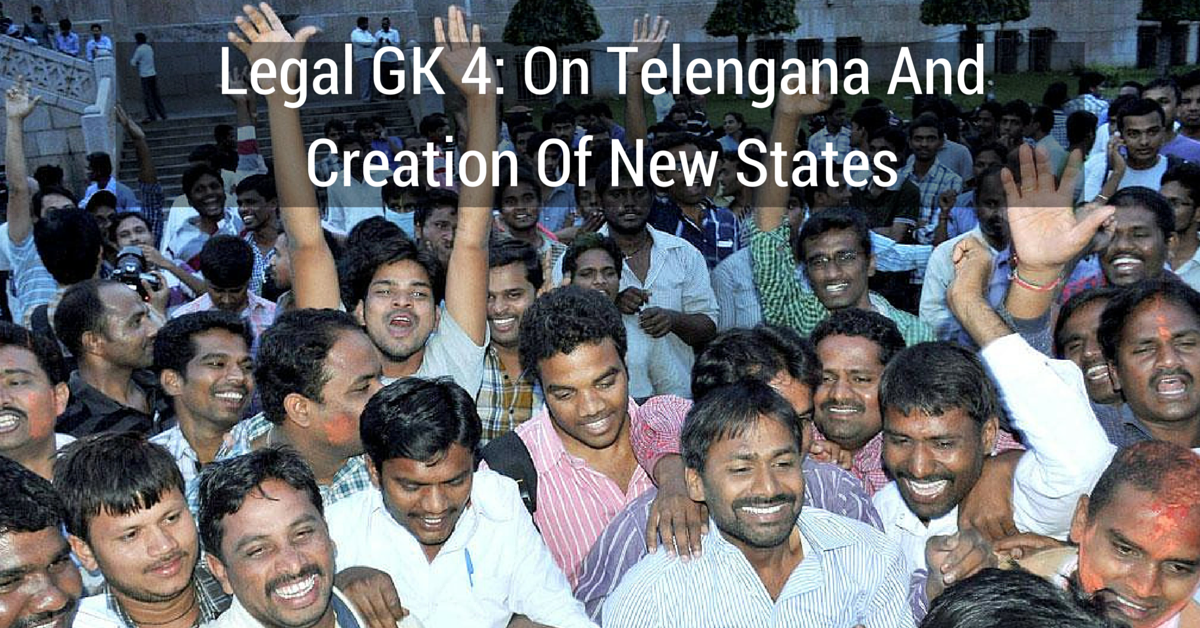
Legal GK 4: On Telengana And Creation Of New States

How is a new state formed in India? Telengana was once just an idea, a new state proposed to be carved out of Andhra Pradesh. At that time we had published this article in A First Taste of Law. Since the blog has been shut down, we are republishing some of the good posts from A First Taste of Law. Hope you enjoy this.

Legal GK 4: On Telengana And Creation Of New States

The cry for separate Telangana state has been raised for quite some time, and it went very violent in 1960’s during Chenna Reddy’s time. However, the agitation stopped with a change in Chief Ministership and on a promise of development.

In the past few days, we have witnessed one of the biggest political dramas in AP. over Telengana. It is not that something like this has never happened before. The demand for Telangana has been going on for quite some time now, just like in the cases of Khalistan and Gorkhaland. However, this time around the Congress has agreed to the demand, at least momentarily. This has churned a lot of political debates, which makes certain trivia and few legal and constitutional issues important for those planning to write any sort of competitive exam that involves legal or constitutional or even plain GK. We are ready to help, as usual, and this post has been carefully researched and written by Anwesha Pal of the 4th year from NUJS.

Telangana or Telengana or Telingana is a region of Andhra Pradesh state in India. The region lies on the Deccan plateau to the west of the Eastern Ghats range. On December 9, 2009, the Government of India announced its decision to separate Telangana from Andhra Pradesh as a new state.

The separation of Andhra Pradesh itself from the Madras Presidency happened with the formation of The States Reorganisation Commission, constituted in 1956, which was assigned the task of demarcation on the basis of linguistic lines. Consequently, Andhra, Rayalaseema and Telengana fell within the larger Pradesh though there were dialect differences in between them.

The reasons such as educational disparities, irrigational disparities, unemployment, budget allocation, infrastructural issues arguably, have led to a proposition for a separate state of Telangana.There are certain special provisions enshrined in Constitution of India to cater to the needs of the state of Andhra Pradesh.

Article 371D talks about special provisions with respect to the state of Andhra Pradesh.
Here is the entire section, but it is enough to remember what this article generally talks about. No one will expect you to know this article in detail.

  1. The president may by order made with respect to the state of Andhra Pradesh provide, having regard to the requirements of the state as a whole, for equitable opportunities and facilities for the people belonging to different parts of state, in the matter of public employment and in the matter of education, and different provisions may be made for various parts of the state
  2. An order made under clause (1) may, in particular,
    (a) require the state Government to organize any class or classes of posts in a civil service of, or any classes of civil post of state and allot in accordance with such principal and procedure as may be specified in the order the persons holding such post to the local cadres so organized;
    (b) Specify any part or parts of the state which shall be regarded as the local area
    (i) For direct recruitment to posts in any local cadre (whether organised in pursuance of an order under this article or constituted otherwise) under the State Government;
    (ii) For direct recruitment to posts in any cadre under any local authority within the State; and
    (iii) For the purposes of admission to any University within the State or to any other educational institution which is subject to the control of the State Government;
    (c) Specify the extent to which, the manner in which and the conditions subject to which, preference or reservation shall be given or made
    (i) In the matter of direct recruitment to posts in any such cadre referred to in sub-clause (b) as may be specified in this behalf in the order;
    (ii) in the matter of admission to any such University or other educational institution referred to in sub-clause (b) as may be specified in this behalf in the order, to or in favour of candidates who have resided or studied for any period specified in the order in the local area in respect of such cadre, University or other educational institution, as the case may be
  3. The President may, by order, provide for the constitution of an Administrative Tribunal for the State of Andhra Pradesh to exercise such jurisdiction, powers and authority including any jurisdiction, power and authority which immediately before the commencement of the constitution (Thirty-second Amendment) Act, 1973 , was exercisable by any court (other than the Supreme Court) or by any tribunal or other authority as may be specified in the order with respect to the following matters, namely:
    (a) appointment, allotment or promotion to such class or classes of posts in any civil service of the State, or to such class or classes of civil posts under the State, or to such class or classes of posts under the control of any local authority within the State, as may be specified in the order;
    (b) seniority of persons appointed, allotted or promoted to such class or classes of posts in any civil service of the State, or to such class or classes of civil posts under the State, or to such class or classes of posts under the control of any local authority within the State, as may be specified in the order;
    (c) such other conditions of service of persons appointed, allotted or promoted to such class or classes of civil posts under the State or to such class or classes of posts under the control of any local authority within the State, as may be specified in the order
  4.  An order made under clause (3) may
    (a) authorise the Administrative Tribunal to receive representations for the redress of grievances relating to any matter within its jurisdiction as the President may specify in the order and to make such orders thereon as the Administrative Tribunal deems fit;
    (b) contain such provisions with respect to the powers and authorities and procedure of the Administrative Tribunal (including provisions with respect to the powers of the Administrative Tribunal to punish for contempt of itself) as the President may deem necessary;
    (c) provide for the transfer of the Administrative Tribunal of such classes of proceedings, being proceedings relating to matters within its jurisdiction and pending before any court (other than the Supreme Court) or tribunal or other authority immediately before the commencement of such order, as may be specified in the order;
    (d) contain such supplemental, incidental and consequential provisions (including provisions as to fees and as to limitation, evidence or for the application of any law for the time being in force subject to any exceptions or modifications) as the President may deem necessary
  5. The order of the Administrative Tribunal finally disposing of any case shall become effective upon its confirmation by the State Government or on the expiry of three months from the date on which the order is made, whichever is earlier: Provided that the State Government may, by special order made in writing and for reasons to be specified therein, modify or annul any order of the Administrative Tribunal before it becomes effective and in such a case, the order of the Administrative Tribunal shall have effect only in such modified form or be of no effect, as the case may be
  6. Every special order made by the State Government under the proviso to clause (5) shall be laid, as soon as may be after it is made, before both Houses of the State Legislature
  7. The High Court for the State shall not have any powers of superintendence over the Administrative Tribunal and no court (other than the Supreme Court) or tribunal shall exercise any jurisdiction, power or authority in respect of any matter subject to the jurisdiction, power or authority of, or in relation to, the Administrative Tribunal
  8.  If the President is satisfied that the continued existence of the Administrative Tribunal is not necessary, the President may by order abolish the Administrative Tribunal and make such provisions in such order as he may deem fit for the transfer and disposal of cases pending before the Tribunal immediately before such abolition
  9. Notwithstanding any judgment, decree or order of any court, tribunal or other authority,
    (a) no appointment, posting, promotion or transfer of any person
    (i) made before the 1st day of November, 1956 , to any post under the Government of, or any local authority within, the State of Hyderabad as it existed before that date; or
    (ii) made before the commencement of the Constitution (Thirty second Amendment) Act, 1973 , to any post under the Government of, or any local or other authority within, the State of Andhra Pradesh; and
    (b) no action taken or thing done by or before any person referred to in sub-clause (a), shall be deemed to be illegal or void or ever to have become illegal or void merely on the ground that the appointment, posting, promotion or transfer of such person was not made in accordance with any law, then in force, providing for any requirement as to residence within the State of Hyderabad or, as the case may be, within any part of the State of Andhra Pradesh, in respect of such appointment, posting, promotion or transfer.
  10. The provisions of this article and of any order made by the President thereunder shall have effect notwithstanding anything in any other provision of this Constitution or in any other law for the time being in force.

The 32nd Amendment (1973) made certain changes in the Aricle-371D of the Constitution and provided certain reservation and facilities for the people of Telengana in Andhra Pradesh. It also authorised the President to establish a Central university in Andhra pradesh and the expenses of the same would be available from the University Grants Commission. Constitution (32nd Amendment) Act, 1973 also implemented a 6-point program for Andhra Pradesh.

Formation of a new state:

The formation of a new State in India usually has to follow a procedure as has been laid down under Article 3 of the Constitution of India. Article 3 has been quoted thus.
3. Formation of new States and alteration of areas, boundaries or names of existing States.—Parliament may by law—
(a) form a new State by separation of territory from any State or by uniting two or more States or parts of States or by uniting any territory to a part of any State;
(b) increase the area of any State;
(c) diminish the area of any State;
(d) alter the boundaries of any State;
(e) alter the name of any State:
Provided that no Bill for the purpose shall be introduced in either House of Parliament except on the recommendation of the President and unless, where the proposal contained in the Bill affects the area, boundaries or name of any of the States, the Bill has been referred by the President to the Legislature of that State for expressing its views thereon within such period as may be specified in the reference or within such further period as the President may allow and the period so specified or allowed has expired.
Explanation I.—In this article, in clauses (a) to (e), “State’’ includes a Union territory, but in the proviso, “State’’ does not include a Union territory.
Explanation II.—The power conferred on Parliament by clause (a) includes the power to form a new State or Union territory by uniting a part of any State or Union territory to any other State or Union territory.

Role of State Legislature

Now the question remains that whether a resolution by the State Legislature is mandatory to form a new State or not, and whether the Parliament is bound to accept the resolution of a State in the formation of a new State. The resolution by the State legislature is not mandatory, but the President must refer the Parliament Bill to the concerned State to express their views. Moreover, the Parliament may disregard the will of the State and may only hear its views as mandated by the Constitution. Thus it is the Parliament that is playing the vital role here, rather than the State Legislature.

However, in the recent past if one studies the issue of separation of States on the basis of socio-cultural identity and linguistic grounds, the issues of states of Jharkhand and Chattisgarh are sure to be of prime focus.

The most recent case under Article 3 being that of inclusion of Haridwar in the new Uttaranchal State, later named Uttarakhand. A bench of Justices S.B. Sinha and Cyriac Joseph put the seal of legality over inclusion of Haridwar in Uttarakhand, ruling that parliament, under Article 3 of Constitution, is supposed to merely consult the assemblies of the affected states and need not concur with their views or opposition to the alteration of their boundaries or reduction in their territory. The bench gave its ruling dismissing a lawsuit by a group of Haridwar residents who had challenged Section 3 of the Uttar Pradesh Reorganization Act, 2000, which provided for inclusion of Haridwar town and the entire district in the new Uttaranchal state, later named Uttarakhand, ignoring an Uttar Pradesh assembly resolution to the contrary. The apex court ruled: “The power to introduce the bill (to create a new state) is with parliament. Consultation with the (affected) state legislature, though is mandatory, its recommendations are not binding on parliament.” This observation of the Court merely reiterates the careful examination of Article 3.

Remember that Sikim as a state was acceded to India by a constitutional amendment in 1975.

Conflicts in the past over formation of new states in India

In the past India has witnessed many conflicts regarding the formation of new states. The issue of Khalistan is one such example. In India all states were created on the language basis but Punjab was not declared a Punjabi State. Sikhs started demanding for a Punjabi state and Sikhs launched a peaceful morcha. Nehru strongly opposed the movement.

Another example is that of Gorkhaland. On April 6, 1947 two Gorkhas, Ganeshlal Subba and Ratanlal Brahmin, members of the undivided CPI (Communist Party of India) submitted a quixotic memorandum to Jawaharlal Nehru, the then Vice President of the Interim Government for the creation of Gorkhasthan – an independent country comprising of the present day Nepal, Darjeeling District and Sikkim (excluding its present North District) in the line of Pakistan.

Then during the ‘80s Subash Ghising raised the demand for the creation of the state of Gorkhaland to be carved out of the hills of Darjeeling and areas of Dooars and Siliguri Terai contigious to Darjeeling, with a large population of ethnic Gorkhas. The Gorkhaland movement took a violent turn in the 1980s when Gorkha National Liberation Front (GNLF) issued a violent demand for statehood, which led to the death of over 1200 people. This movement culminated with the formation of Darjeeling Gorkha Hill Council (DGHC) in 1988.

Fragmentation of states: whose interest does it serve?

In conclusion it can only be observed that instead of promising a separate state for each ethnic group, the Government should majorly focus on the development of the concerned regions. The Telangana issue has been an agenda on the political manifestos of almost all the political parties of Andhra Pradesh. The Congress and TDP are sitting on the fence on the issue, while the BJP with the Left parties are in favour of Telangana, demanding its formation.

It was the death of Potti Sriramulu which forced Nehru’s hand into acceding to the demand of creating states based on language. Now Andhra Pradesh itself is being driven to fragmentation by the Telangana movement. If the Centre accedes to the division of Andhra Pradesh it will definitely open floodgates of such demands. It will increase the number of capitals and ministers in the country, but there is serious doubt about what development will take place. Take a look at Jharkhand if you want to know what I am talking about.

Download Now
logo
FREE & ONLINE 3-Day Bootcamp (LIVE only) on

How Can Experienced Professionals Become Independent Directors

calender
28th, 29th Mar, 2026, 2 - 5pm (IST) &
30th Mar, 2026, 7 - 10pm (IST).
Bootcamp starting in
Days
HRS
MIN
SEC
Abhyuday AgarwalCOO & CO-Founder, LawSikho

Register now

Abhyuday AgarwalCOO & CO-Founder, LawSikho