Download Now
Home Blog Page 504

Blog competition winner announcement (Week 4th July 2021)

0

So today is the day! We are finally announcing the winners of our Blog Writing Competition for the 4th week of July 2021 (From 19th July 2021 to 25th July 2021). 

We’d like to say a big thanks to everyone for participating! It has been a great pleasure receiving your articles on a different legal topic, they were all amazing! 

And now we’d like to congratulate our top 5 contestants, who become the undoubted winners. They will receive Prize money of Rs 2000, LawSikho store credits worth Rs. 1000 and a Certificate of Merit from team LawSikho.

They will also get an opportunity to intern at iPleaders under the mentorship of Ramanuj Mukherjee, Abhyuday Agarwal, Harsh Jain, and Komal Shah. Their articles will get published on iPleaders blog (India’s largest legal blog). Click here to see other perks available to them.

Their entries (see below) received maximum marks based on the average marks given by the panel of editors, and have been crowned the winners!

S.no Name About Author Article
1 Vivek Maurya Intern USA’s exit from Afghanistan – end of the war
2 Amrit Kaur Intern Intellectual Property Laws and systems in UK and USA
3 Rahulkumar Saini Guest Post Emergency provisions in India – a critical analysis
4 Nikhil Thakur Intern The dispute over the deceptively undifferentiated trademarks : Nandhini Deluxe v. Karnataka Cooperative Milk Producers (2018)
5 Smaranika Sen Intern All you know under the ambit of jurisprudence

Meet our next 5 contestants who made it to top 10 here. They will receive a Certificate of Excellence from team LawSikho.

They will also get an opportunity to intern at iPleaders under the mentorship of Ramanuj Mukherjee, Abhyuday Agarwal, Harsh Jain, and Komal Shah. Their articles got published on iPleaders blog (India’s largest legal blog). Click here to see other perks available to them.

S.no Name About Author Article
6 Meghana Rao Student pursuing Certificate Course in Competition Law, Practice And Enforcement from LawSikho. Role of competition law in the regulation of social media
7 Jeeni Thirumalanadha Siva Seshu  Student pursuing Certificate Course in Advanced Civil Litigation: Practice, Procedure and Drafting from Lawsikho.com. Golden rules for maximum impact in court proceedings : pointers for oral advocacy
8 Aparna Jayakumar Intern Legalization of assisted suicide : precautions that should be taken to avoid abuse and mistakes
9 Sharanya Ramakrishnan Student who is pursuing a Diploma in Companies Act, Corporate Governance and SEBI Regulations from LawSikho. Ultra Vires and Companies: The Indian Perspective
10 Alisha Dargar Guest Post All you need to know about drug courts

Click here to see all of the contest entries. Click here to see our previous week’s winners.

Our panel of judges, which included editors of iPleaders blog and LawSikho team, chose the winning entry based on how well it exemplified the entry requirements.

Certificates will be sent on the email address given by the contestant while submitting the article. The contestants have to claim their prize money by sending their account details as a reply to the mail in which they received their certificate within 1 month (30 days) of the date of declaration of results and not afterward. 

For any other queries feel free to contact Vanshika (Senior Managing Editor, iPleaders) at [email protected]

LawSikho credits can be claimed within twelve months from the date of declaration of the results (after which, credits will expire).

Congratulations to all the participants!

Regards,

Team LawSikho


Students of Lawsikho courses regularly produce writing assignments and work on practical exercises as a part of their coursework and develop themselves in real-life practical skills.

LawSikho has created a telegram group for exchanging legal knowledge, referrals, and various opportunities. You can click on this link and join:

Follow us on Instagram and subscribe to our YouTube channel for more amazing legal content.

Download Now

Blog competition winner announcement (Week 3rd July 2021)

0

So today is the day! We are finally announcing the winners of our Blog Writing Competition for the 3rd week of July 2021 (From 12th July 2021 to 18th July 2021). 

We’d like to say a big thanks to everyone for participating! It has been a great pleasure receiving your articles on a different legal topic, they were all amazing! 

And now we’d like to congratulate our top 5 contestants, who have become the undoubted winners. They will receive Prize money of Rs 2000, LawSikho store credits worth Rs. 1000 and a Certificate of Merit from team LawSikho.

They will also get an opportunity to intern at iPleaders under the mentorship of Ramanuj Mukherjee, Abhyuday Agarwal, Harsh Jain, and Komal Shah. Their articles will get published on iPleaders blog (India’s largest legal blog). Click here to see other perks available to them.

Their entries (see below) received maximum marks based on the average marks given by the panel of editors, and have been crowned the winners!

S.no Name About Author Article
1 Esha Bura Chowdhury Student  pursuing Diploma in M&A, Institutional Finance and Investment Laws (PE and VC transactions) from Lawsikho. Will venture capital funded fantasy sports find a pitch to hit a six
2 Bhumika Dandona Intern R.G. Anand v. M/S Delux Films and Ors. : case analysis
3 Reet Balmiki Intern International refugee law and human rights : a study of the status of refugees in Northeast India
4 Pranav Sethi Intern Highlights of the Amazon-Future Group dispute
5 Sneha Jaiswal Intern Understanding the concept of insurable interest

Meet our next 5 contestants who made it to the top 10 here. They will receive a Certificate of Excellence from team LawSikho.

They will also get an opportunity to intern at iPleaders under the mentorship of Ramanuj Mukherjee, Abhyuday Agarwal, Harsh Jain, and Komal Shah. Their articles got published on iPleaders blog (India’s largest legal blog). Click here to see other perks available to them.

S.no Name About Author Article
6 Paridhi Goel Guest Post Understanding different types of mortgage under the Transfer of Property Act, 1882
7 Udit Atul Kokanthankar 

and
Himani Sagar

Student pursuing a Diploma in Intellectual Property, Media, and Entertainment Laws from Lawsikho.com Copyrighting musical chords : emerging trends and the technicalities
8 Harmanpreet Kaur Intern Concept of omission : a critical analysis
9 Sonia Shrinivasan Guest Post Environmental impact assessment in India
10 Drishti Miglani Guest Post Footprints at crime scene: A forensic evidence 

Click here to see all of the contest entries. Click here to see our previous week’s winners.

Our panel of judges, which included editors of iPleaders blog and the LawSikho team, chose the winning entry based on how well it exemplified the entry requirements.

Certificates will be sent to the email address given by the contestant while submitting the article. The contestants have to claim their prize money by sending their account details as a reply to the mail in which they received their certificate within 1 month (30 days) of the date of declaration of results and not afterward. 

For any other queries feel free to contact Vanshika (Senior Managing Editor, iPleaders) at [email protected]

LawSikho credits can be claimed within twelve months from the date of declaration of the results (after which, credits will expire).

Congratulations to all the participants!

Regards,

Team LawSikho


Students of Lawsikho courses regularly produce writing assignments and work on practical exercises as a part of their coursework and develop themselves in real-life practical skills.

LawSikho has created a telegram group for exchanging legal knowledge, referrals, and various opportunities. You can click on this link and join:

Follow us on Instagram and subscribe to our YouTube channel for more amazing legal content.

Download Now

Blog competition winner announcement (Week 2nd July 2021)

0

So today is the day! We are finally announcing the winners of our Blog Writing Competition for the 2nd week of July 2021 (From 5th July 2021 to 11th July 2021). 

We’d like to say a big thanks to everyone for participating! It has been a great pleasure receiving your articles on a different legal topic, they were all amazing! 

And now we’d like to congratulate our top 5 contestants, who have become the undoubted winners. They will receive Prize money of Rs 2000, LawSikho store credits worth Rs. 1000 and a Certificate of Merit from team LawSikho.

They will also get an opportunity to intern at iPleaders under the mentorship of Ramanuj Mukherjee, Abhyuday Agarwal, Harsh Jain, and Komal Shah. Their articles will get published on iPleaders blog (India’s largest legal blog). Click here to see other perks available to them.

Their entries (see below) received maximum marks based on the average marks given by the panel of editors, and have been crowned the winners!

S.no Name About Author Article
1 R Sai Gayatri Intern A comparative analysis of lay-off and retrenchment
2 Divya MB Guest Post Climate change and its impact on the environment
3 Jeeni Thirumalanadha Siva Seshu Student pursuing a Certificate Course in Advanced Civil Litigation from LawSikho. Analysis of striking down of the Maratha reservation law
4 Samridhi Srivastava  Intern Difference between the Writ of Prohibition and Certiorari
5 Astitva Kumar Intern Freedom of speech : mother of all other liberties

Meet our next 5 contestants who made it to top 10 here. They will receive a Certificate of Excellence from team LawSikho.

They will also get an opportunity to intern at iPleaders under the mentorship of Ramanuj Mukherjee, Abhyuday Agarwal, Harsh Jain, and Komal Shah. Their articles got published on iPleaders blog (India’s largest legal blog). Click here to see other perks available to them.

S.no Name About Author Article
6 Niharika Goel Intern Cohabitation law reform in the UK : the requirement of imminent modern families 
7 Buddhisagar Kulkarni Student pursuing a Diploma in Business Laws for In-House Counsels from LawSikho. How will you protect your intellectual property rights under International Investment Law
8 Shashwat Kaushik Intern The right to food in international law : concept and mechanism
9 Manasvee Malviya Intern Signifying the role of parents in raising a child: the essential need of paternity leave laws in India
10 Khyati Guest Post Husband’s right to claim maintenance

Click here to see all of the contest entries. Click here to see our previous week’s winners.

Our panel of judges, which included editors of iPleaders blog and the LawSikho team, chose the winning entry based on how well it exemplified the entry requirements.

Certificates will be sent to the email address given by the contestant while submitting the article. The contestants have to claim their prize money by sending their account details as a reply to the mail in which they received their certificate within 1 month (30 days) of the date of declaration of results and not afterward. 

For any other queries feel free to contact Vanshika (Senior Managing Editor, iPleaders) at [email protected]

LawSikho credits can be claimed within twelve months from the date of declaration of the results (after which, credits will expire).

Congratulations to all the participants!

Regards,

Team LawSikho


Students of Lawsikho courses regularly produce writing assignments and work on practical exercises as a part of their coursework and develop themselves in real-life practical skills.

LawSikho has created a telegram group for exchanging legal knowledge, referrals, and various opportunities. You can click on this link and join:

Follow us on Instagram and subscribe to our YouTube channel for more amazing legal content.

Download Now

Whether the cookie policy of Amazon is in compliance with the data protection legislation of India

0
Image source: https://rb.gy/tl20dw

This article is written by Pankaj Rathi, pursuing Diploma in Cyber Law, FinTech Regulations, and Technology Contracts from LawSikho.

Introduction

In December 2020, France’s data protection agency, the CNIL slapped Amazon Europe with a 35 million Euros fine for dropping advertising/ tracking cookies on users’ computers, from the page amazon.fr, without obtaining prior consent and without providing adequate information. This reignited the debate surrounding Big Tech companies tracking their users’ online behaviour, in an unrestricted manner. While Europe with its strong laws like GDPR and ePrivacy Directive has been able to investigate and curb the unlawful activities of online players which violate privacy and data protection standards, to a certain extent; the situation in India remains still undebated and underrated due to lack of strong data protection laws coupled with regulatory oversight absenteeism. In this context, the article seeks to answer the question of whether Amazon India’s cookies policy is in compliance with the present framework of the law (Information Technology Act, 2000) as well as with the much anticipated new data protection Bill (Personal Data Protection “PDP” Bill, 2019).

What are cookies?

A cookie is a small piece of text file stored on a user’s computer browser (session cookies) or hardware (persistent cookies) by a web page or website which allows the website to identify the user and remember his/her preferences. It also allows the website to monitor how you use the site. In other words, the cookies provide information to the website which helps it in building the profile of its users for future marketing purposes, improve the site for better user experience, or detect and prevent site misuse. For example, Amazon uses cookies to save your account information for various activities on-site so that you don’t have to fill in information every time you visit it, to remember your shopping cart items, and also to deliver personalised ads and product suggestions. Generally, cookies are classified into two categories based on their source: First-party cookies, and third-party cookies. 

  • First-party cookies are those managed directly by a website/app when users visit it.
  • Third-party cookies are created by domains that are not the website (or domain) that you are visiting. Third-party cookies are generally used for cross-site tracking and online advertising purposes. It is also present when the site/app uses third-party services to incorporate for example images, social media plugins, or advertising. 

For example, when a user visits Amazon.in, that website is the “first party.” If Amazon.in partners with an advertising network, platform, or exchange to place ads on its website, the network, platform, or exchange is the “third party.” The advertising network uses cookies when the user visits Amazon.in to help it select and serve the best ads. These cookies are considered “third-party cookies.” 

Third-party digital advertising companies having better technology and expertise enables more efficient ad placements and provides better insight for personalised and targeted ads. Displaying ads on its website also becomes a major source of revenue for companies and displaying more relevant ads as per users’ preferences further increases the market value of the website. However, the use of cookies to profile individuals also raises serious security and privacy concerns which need to be addressed to ensure sustainable growth of digital economy architecture.

Present framework of Indian law governing cookies

The Amazon Privacy Policy states:

“We use “cookies” and other unique identifiers, and we obtain certain types of information when your web browser or device accesses Amazon Services and other content served by or on behalf of Amazon on other websites. Click here to see examples of what we collect.”

In the examples section, it mentions, amongst others, IP address, browser version, login, email address, and password, phone numbers,  the location of your device, time zone content interaction information, device metrics, purchase and content use history, products and content you viewed or searched for, length of visits to certain pages, etc. as collected data. 

Though not all cookies collect personal data (eg. which are essential for the functionality of websites), Many of the data collected (see above mentioned examples) are in the nature of personal information or data under Rule 2(i) of Information Technology (Reasonable security practices and procedures and sensitive personal data or information) Rules, 2011 (enacted under section 43A of the Information Technology Act, 2000 and hereinafter “SPDI Rules” 2011) and may also come under the definition of sensitive personal information or data (hereinafter “SPI”) under Rule 3. Not to forget,  third-party cookies may also gather similar information about the users. Therefore, data collection through cookies by Amazon must comply with the SPDI rules, 2011.

The SPDI rules provide that while collecting information including personal information and SPI, the provider of information i.e. Users must be informed of information being collected, the purpose of collection, and intended recipients of the information. Further, any information that is collected shall be used only for the purpose for which it has been collected.

Additionally, while collecting SPI, the users’ prior consent needs to be taken. Users must also have the option to refuse or withdraw the consent if already given. Such collection must be necessary and for lawful purposes. Moreover, the Body corporate holding such information must not retain it longer than required for the purposes mentioned. Body corporate is also obliged to provide information about grievance officers to address any complaint of the user relating to the processing of such personal information. A body corporate must provide a comprehensive privacy policy to data subjects while handling SPDI.

Amazon India’s compliance to SPDI Rules, 2011 : a reality check?

At the outset, it is to be highlighted that there is no proper classification, by Amazon India, of information collected through cookies into personal or sensitive personal information or non personal information. In the absence of this, it becomes difficult to identify Amazon India’s compliance with the SPDI rules which require different sets of obligations for different sets of information.

Further, Amazon India in its privacy policy states that by using the website, users give consent to practices of Amazon India mentioned in its policy. The privacy policy includes cookie policy as an integral part of it. Hence, by merely using the website, the user consents to provide personal information or data through cookies. The consent procedure envisaged by SPDI Rules seems to be more in the direction of explicit and clear consent, not just in implied form; and hence, the manner of obtaining consent by Amazon.in is doubtful to be compliant with SPDI rules.

Personal data or information of users collected through third party cookies is another grey area of concern. While SPDI rules clearly require that users must be informed of intended recipients of their personal information, the vague and generic mention of third parties in the cookie policy, without any specific identification of recipients, undermines the intended objective of provisions.

Moreover, the mechanism of withdrawing consent under the cookie policy and privacy policy is also complex making it difficult to give effect to provisions of the Rules in their spirit. There is also no mention of the time period for retaining the collected information as required by the Rules. All these limitations reflect that Amazon hasn’t been in full compliance with the requirements of SPDI Rules, 2011. 

Amazon India’s cookie policy in the context of new Data Protection Bill

Soon to be enacted, the New Data Protection Bill (PDP Bill, 2019) is being considered as one of the most important legislation for India’s aspiration of achieving digital economy status. It will require businesses to revamp their data-related processes and embed privacy within their systems and operations. Therefore, it is necessary to analyse Amazon India’s cookie policy in the context of the new Bill so as to understand the willingness of big tech companies to respect and protect the digital privacy of citizens as well as pro-activeness in adopting data security, data protection and data integrity measures.

PDP Bill overview

The PDP Bill provides a wide definition of personal data or information which includes any data that can identify an individual, directly or indirectly, including inferences made about such individuals (Section 2(28)). Any information which allows an individual to be specifically targeted, whether online or offline will fall within this definition. Hence, IP addresses, web cookies and device IDs are also personal data if they can identify an individual. In addition, information such as location data, time zone or other information can similarly be combined to identify an individual, and such combinations would also fall under the scope of the PDP Bill.  It also has a wider definition of sensitive personal data.

  • The Bill casts duty on data fiduciaries like Amazon to take the consent of data principal i.e. users, before collection of personal data (Section 7). 
  • Such personal data can be processed only for the specific and clearly defined purposes for which data principal has consented or which is incidental to or connected with such purpose (Section 5). 
  • Data should be collected only to the extent necessary for such purpose (Section 6). 
  • Section 11(4) further provides that the provision of any goods or services cannot be made conditional on the consent where the processing of personal data is not necessary for that purpose.
  • Consent must also be free, informed, specific, clear by meaningful affirmative action and capable of being withdrawn (Section 11(2)). Moreover, explicit consent is required in case of sensitive personal data collection.

Data fiduciary is required to give notice to data principal at the time of collection of personal data including the purpose of collection; nature and categories of personal data being collected; identity and contact details of the data fiduciary and data protection officer, if applicable; procedure for withdrawal of consent; basis for such processing and consequences of failure to provide personal data; persons with whom the personal data may be shared; information regarding any cross-border transfer of personal data; period for which the personal data will be retained and procedure for grievance redressal. Such notice shall be clear, concise and easily comprehensible to a reasonable person and in multiple languages where necessary and practicable (Section 7(2)).

Amazon India’s cookies policy : analysing the present through the lens of the future

As stated earlier, the consent mechanism mentioned by Amazon.in in its privacy notice for personal information collection through cookies is highly deficient with the requirements of the PDP Bill. Amazon India does not state explicitly that it sets cookies on a user’s computer making it impossible for such a user to know; resulting in a possible exposure to privacy concerns arising from the use of cookies for tracking such individual’s online activities.

Moreover, as per the PDP bill, Amazon India is required to give notice at the time of collection of personal data. However, Amazon fails to provide any cookie banner or similar notification to users before collection. Moreover, by mere opening of the website, Amazon stores cookies in the user’s system giving him no choice to refuse consent.

While through cookies notice, Amazon India seeks to give some information about the purposes of cookie deposition, however, it constitutes only a general and approximate description of the purposes of all cookies deposited and that there is also no mention of the means available to the user to object to the filing of cookies. Moreover, it does not mention the nature and categories of cookies that collect different sets of data like personal information, sensitive personal information, and non personal information or data.

It is also to be noted that regardless of the user’s journey, whether he or she goes to Amazon.in’s homepage or visits a product page on the site via an ad, around 49 cookies were deposited on the user’s terminal; out of which 45 cookies are related to advertising and targeting purposes. It clearly plays foul with the Section 6 of PDP bill which seeks to limit the collection of personal data to the extent it is necessary for the purpose of processing. It also goes against the spirit of privacy by design principles enshrined in Section 22 of the Bill. As a concept, privacy by design means privacy as a fundamental core value should be incorporated in the organization function, system and technology by default. It focuses on user centric design of business operations which respects the privacy of users as an uppermost priority. However, Amazon India’s cookies policy requires much amendment to be in consonance with privacy by design principles.

Third party cookies

The privacy of users is in further potential danger due to cookies set by third parties through Amazon.in. The cookies policy of Amazon India states:

Approved third parties may also set cookies when you interact with Amazon services. Third parties include search engines, providers of measurement and analytics services, social media networks, and advertising companies.

As per the PDP Bill, the intended recipients of personal data as well as persons with whom the personal data may be shared by the data fiduciaries must be disclosed clearly to the users. However, just mentioning third parties in a generic way without specified recipients goes against the spirit of the PDP Bill. It is to be noted that Amazon, in EU and UK, does mention third party entities that set cookies along with purposes of specified cookies. Moreover, Amazon also absolves itself of any liabilities related to the third-party cookies. This creates a somewhat ironic situation wherein Amazon takes the consent of its own users of the website to enable third parties to collect the data of them; and at the same time it absolves its responsibility as to how third parties process these personal data of users. It reflects a clear lack of any linkage between consent of users for collection of data and processing of the same.

The situation becomes more complex if third parties who set cookies are also considered data fiduciaries as they do determine means and purposes of collection of personal data of users. If that is so, then third party cookies installed through Amazon.in are in gross violation of data fiduciary obligation under the PDP Bill. 

Further, Amazon cookies policy prescribes the browser setting as a means to manage cookies. However, these settings only allow users to opt out based on cookie domain classification (first-party and third-party cookies) without giving any other choice. It does not help the user in identifying the cookies set by a particular site are either as first party or third party, purpose or functionalities of such cookies and any other relevant information which can help the user to make informed choices. Nevertheless, in some cases in the different European countries, browser settings are considered to be an acceptable means of withdrawing consent.

Conclusion

The Amazon cookies policy requires significant amends to be in consonance with the present data protection law of the country as well as new data protection law which is expected, very soon, to be law of the land. The 7 aspects of privacy by design policy mentioned in Section 22 reflects the spirit of the new data protection bill and these aspects must be embedded by every organization including Amazon in its data related policies, mechanism and organisational structure. Moreover, general principles of processing personal data such as lawfulness, fairness, transparency, data minimisation, purpose limitation, storage limitation, accountability, and, integrity and confidentiality etc. required to be considered by Amazon India in its cookies policy. The recent decision of France data protection authority against the Amazon cookies policy for being violative of data protection laws as well as Google’s announcement to ban all third party cookies on its chrome browser from 2023 reflect the increasing understanding about the misuse of cookies mechanism by tech companies. India needs to ensure that it enacts the new data protection bill at the earliest; and implements it efficiently. 

At the same time, it also needs to be accepted that the present PDP Bill has no provision for regulating the third-party cookies. Several privacy risks are presented by third-party, persistent, targeting cookies. They contain a significant amount of information about the user’s online activity, preferences, and location. The chain of responsibility (who can access a cookies’ data) for a third-party cookie can get complicated as well, only heightening their potential for abuse.

Therefore, similar to e-privacy directives (it covers the cookies and other related technologies used for storing and accessing information stored on a user’s equipment such as a computer or mobile device) of the European Union which supplements GDPR, India also needs to adopt the similar rules or regulation to supplement the PDP bill. As the users have a right to know about the number and types of cookies the owner site hosts so that they can give informed consent regarding their personal data.


Students of LawSikho courses regularly produce writing assignments and work on practical exercises as a part of their coursework and develop themselves in real-life practical skills.

LawSikho has created a telegram group for exchanging legal knowledge, referrals, and various opportunities. You can click on this link and join:

https://t.me/joinchat/J_0YrBa4IBSHdpuTfQO_sA

Follow us on Instagram and subscribe to our YouTube channel for more amazing legal content.

Download Now

Mesne profits under the Code of Civil Procedure, 1908

0

This article is written by Oishika Banerji of Amity Law School, Kolkata. This article deals with the concept of mesne profits under the Code of Civil Procedure, 1908.  

Introduction

The underlying principle based on which the Code of Civil Procedure, 1908 functions is ubi jus ibi remedium that signifies where there is a right, there is a remedy. The concept of mesne profits has been developed from this principle because it is the law of nature to provide the right to compensation where there has been an infringement or breach of a legal right. Before delving into the concept of mesne profit, it is necessary to discuss the meaning of the terms “ownership” and “possession”. While the former is an exclusive collective right of a man to possess, enjoy, transmit, destroy a property owned by him, the latter acts a prima facie evidence of the former. The right to possess property is protected in the eyes of law until and unless another individual claim to have a better title on that property. When this claim arises, the law acts as a shield to protect the original owner of the property thereby ensuring compensation from the illegal or unlawful possessor. Mesne profits is a mode of such compensation facilitating remedy to the aggrieved party refraining the wrongful possessor from enjoying profits derived from such property. This article aims to explain the concept of mesne profits governed by the Code of Civil Procedure, 1908. 

Mesne profits under the Code of Civil Procedure, 1908

Section 2(12) of the Code of Civil Procedure, 1908 defines the term “mesne profits”. The Delhi High Court in the notable case of Phiraya Lal Alias Piara Lal vs Jia Rani And Anr (1973) interpreted the meaning of the term “mesne profit” by observing that when a party claims damages to recover the loss resulted from wrongful occupation of immovable property by a trespasser that originally belonged to the party then such damages will be known as mesne profits. The definition provided by Section 2(12) includes the exception of mesne profits which is the profits obtained from the improvements made by the wrongful possessor in the property will not fall under the ambit of mesne profits. The three significant takeaways from Section 2(12) of the Code have been laid down hereunder;

  1. It is to note that the definition has attached importance to due diligence for obtaining mesne profits. 
  2. Mesne profits can only be awarded if the property in concern was unlawfully occupied thereby depriving the original owner of his rights. 
  3. Interest is a fundamental part of mesne profits under Section 2(12). 

Order XX Rule 12 of the Code of Civil Procedure, 1908 lays down the provision for the passing of the decree by a competent civil court where there exists a suit for recovery of immovable property possession, rent, or mesne profits. Put simply, a civil court while presenting the rights of the parties involved in a suit concerning mesne profits, will rely on Rule 12 of Order XX. 

Calculation of mesne profit: all one needs to know 

After gaining an idea about mesne profits, it is now relevant to know as to how mesne profits are calculated. The answer to this will be different from case to case basis and as interpreted by the courts of law. If one goes by the provision, it gets clear that there exists no fixed rule for assessing mesne profits. Therefore, the scope for assessment of mesne profits has been left in the hands of the courts. It is thus ideal to discuss this section of mesne profits by means of case laws. 

M/S. Hindustan Motors Ltd. v. M/S. Seven Seas Leasing Ltd (2018)

In this case, the appellate being a tenant of the concerned property which commenced in 1986 and was terminated in 1998 had handed over the concerned premise during the pendency of the suit for the same and mesne profits in 1999. Taking into concern the facts of the case, the Delhi High Court decided to calculate the mesne profits from the date of filing of the suit for the premise (May 1998) to the date on which the concerned possession was returned (August 1999). 

Square Four Assets Management & Reconstruction Co. P. Ltd. v. Orient Beverages Ltd. & Ors. (2017)

The Calcutta High Court in this case while deciding the legislative intent behind Order XX Rule 12 of the Code of 1908 observed that where the defendant, who was the tenant to a plaintiff’s premise, had sub-leased the premise to a third person who did not leave the premise even after the expiry of the term, the mesne profit will be calculated taking into account the last date on which the premise was vacated. Although the defendant had handed the premise on the date of expiry (30th September 2015), the person whom it was sub-leased vacated the premise on 25th May 2017. Therefore, mesne profit was to be calculated from the date of institution of the suit (17th May 2016) till the last date of vacating the premise (25th May 2017). The Court in this case had ordered an inquiry into mesne profits from 17th May 2016 to 25th May 2017 as well. 

Laljee Shahay Singh And Others Decree-Holders, v. F.C Walker And Others (1902)

In this case, an appeal was brought before the Calcutta High Court against a District Court’s order which ascertained mesne profits in accordance to the fair rent that was supposed to be paid for the concerned land and not in accordance with the value of the production from the land. Taking into account that the land, in this case, was a raiyati, it was held that in such cases both the original owner and the trespasser are rent receivers and therefore the calculation of mesne profits should be done on the basis of fair rent only. 

The New India Assurance Co. Ltd. v. M/s. M. Gulab Singh & Sons P. Ltd (2018)

The Delhi High Court while deciding on this appeal case took into account the trial court’s assessment on determining the value of mesne profits. The trial court had come up with different rates of mesne profits for different periods taking into concern the lease deeds proved by the respondent and the period for determining mesne profits which were from 1.1.1999 to 30.6.2010. The Hon’ble High Court made the following observations in light of this case:

  1. The lease deeds that were exhibited by the respondent were relevant as they were not only prepared on the basis of the premise but also in alignment to 50% of the period determined for calculating mesne profits (that is from the year 2005 to 2010).
  2. If mesne profits have been evaluated in accordance with the rate of the rent payable by taking into account the rate of rent of the property in question or any other premise located in the same area, then such evaluation will be declared as an honest assessment of mesne profits. 

The Delhi High Court, therefore, upheld the decision made by the trial court in determining the value of the mesne profits payable by the appellant. 

Dr. JK Bhakthavasala Rao v. Industrial Engineers, Nellore (2005)

The Andhra Pradesh High Court in this notable case laid down two important assessment criteria for mesne profits when only the question of facts are involved in fixing certain damages for the purpose of occupation and usage of the building in issue as there lie no such evaluating parameters for determining the mesne profits. The criteria are:

  1. Assessing the location, nature, and surrounding features of the suit.
  2. Looking into premises with similar traits in the surrounding area. 

Drawing an inference from the above case laws, it can be said that there exists no uniform determining criteria that can be applied to assess the value of mesne profits. Each case has a different outlook on mesne profits. Applying the law of equity which demands mesne profits to be net profits that have been derived after deduction of necessary expenditures involved in gaining such kind of profits, the mesne profit was assessed. Although rent used to be one of determining factors of the value of mesne profits, with the passage of time this factor has been rejected and struck down by the Indian courts. Thus the one ground that has remained intact for the courts to take account of while assessing mesne profits is that the profits must have been acquired by the wrongful possessor with due diligence.

Circumstances when mesne profit not granted 

So far we have taken into account situations in which mesne profits have been granted to the original owner because of wrongful possession of the former’s property. It is equally important to know about the other side of the coin which is the circumstances or scenarios in which mesne profit has been disallowed by courts of law. They have been listed down hereunder.

Joint family property and parties that are in joint possession of the same

The Telangana High Court in the case of Smt. Subashini vs S. Sankaramma (2018) opined that if the immovable property in concern is a joint family property and both the appellate and the respondent are joint owners of such property then in such circumstance the appellate cannot claim mesne profits as the respondent is an owner himself and therefore not in wrongful possession of the said property. 

No Order or Decree by any court of law to the effect of the mesne profits

The Income Tax Appellate Tribunal observed in the case of Krishna N Bhojwani, Vs.  Assessee (2021) that Order or Decree by any civil court is the foremost condition to give effect to mesne profits. In this particular case, the grant of mesne profit has been disallowed on grounds that there exists no Order or Decree by any civil court which can give effect to mesne profit. Therefore, the appellate became prohibited from the same. 

Circumstances in which provisions of Section 144 of the Code of 1908 are not attracted

In the case of Murti Bhawani Mata Mandir REP. Through Pujari Ganeshi Lal (D) Through LR vs. Rajesh & Ors (2019) where the appellant had filed an application under Section 144 of the Code of Civil Procedure, 1908 for restoration of his possession on the disputed property and for awarding mesne profits, the Supreme Court of India observed that the provision of Section 144 will not be applicable in this case as there was no Decree or Order by the trial court which would vest the possession to the appellate, nor did any such Order or Decree mandated the respondent to hand over the disputed possession to the original owner. 

Lack of sufficient evidence

In cases of mesne profits, the burden of proof rests solely on the claimant of wrongful possession of his or her property, it is the responsibility of the claimant to provide sufficient evidence before the court of law against the illegal possessor before claiming mesne profits. 

Initial possession not wrongful but later assumed wrongful character

The Supreme Court of India made a notable observation in the case of Union of India (UOI) and Ors v. Banwari Lal and Sons (2004) regarding granting of mesne profits. The Court held that if a person possesses a property that was not wrongful initially but assumed a wrongful character in the future, then in such case the owner of the property will not be granted mesne profits, instead only the fair rent of that property will be provided. 

Although these circumstances are not exhaustive in nature, they are the interpretation of judgments delivered by Indian courts. 

Landmark judgments 

The ratio-decidendi of a few judgments have been listed down below to provide an overview of mesne profits and its associated elements. 

Smt.Subashini vs S.Sankaramma Died (2018)

While deciding on this case, the Telangana High Court highlighted the objective behind awarding mesne profits. It observed that mesne profits play the role of compensating the original owner of a property who has suffered loss and damages because of unauthorized possession of the same property by some other person. The term compensation is used to emphasize the fact that a person has been deprived of the right to the enjoyment of his property and the loss suffered by a lawful owner. The idea behind granting of mesne profit is to rectify a wrong that has taken place. 

M/s Skyland Builders P. Ltd v. Income Tax Officer (2020)

The Delhi High Court, in the case, of M/s Skyland Builders P. Ltd v. Income Tax Officer (2020) made a remarkable decision on mesne profits by holding that mesne profits received by the lawful owner on account of illegal possession of his immovable property will be considered as a revenue receipt and therefore will be a taxable subject-matter under Section 21 (1) of the Income Tax Act

Nazir Mohamed vs. J.Kamala and Ors (2020)

The Supreme Court of India, in this case, observed that a decree of possession of immovable property does in no way follow a decree of declaration of ownership automatically. The burden of justifying the allegation of wrongful possession exists solely on the plaintiff. If he fails to prove his allegations on the defendant, the Court shall presume the possession to be adverse by its nature. 

Conclusion 

If Section 2(12) of the Code is assessed, it can be made clear that there exist a lot of fundamental questions that the provisions fail to address. While the provision specifies mesne profits for wrongful possession of a property that originally belongs to someone else, it does not lay down the parameters on the basis of which mesne profit is supposed to be allowed by the courts. Not only this, the provision remains silent when it comes to the rate of interest that is supposed to be imposed along with mesne profit, leaving the entire responsibility on the courts. We see a variety of methods adopted by the courts to calculate mesne profits. Although uniform criteria cannot be laid down as the provision has presumed, one cannot ignore that specificity is the essence of any legislation. Thus there arises a need to address these questions and provide logical solutions for better implementation. 

References 

  1. https://thefactfactor.com/facts/law/civil_law/civil-procedure-code/mesne-profits/14645/
  2. https://www.taxathand.com/article/15768/India/2020/High-Court-rules-mesne-profits-from-unauthorized-occupation-of-property-are-revenue.
  3. http://www.legalservicesindia.com/article/397/Mesne-Profit.html#:~:text=Section%202%20(12)%20of%20the,shall%20not%20include%20profits%20due.

LawSikho has created a telegram group for exchanging legal knowledge, referrals, and various opportunities. You can click on this link and join:

https://t.me/joinchat/J_0YrBa4IBSHdpuTfQO_sA

Follow us on Instagram and subscribe to our YouTube channel for more amazing legal content.

Download Now

Analyzing the Vedanta Alumina Limited (VAL) Orissa India case

0

The article is written by Harmanpreet Kaur of Amity University, Kolkata. The article is written to analyze the case of Vedanta Alumina Ltd Orissa India case.

Introduction

There have always been efforts made by foreign investors in the developing countries with an aim to increase the economy of that particular country either by way of investing in extractive industries or in the organization. The increase in the economy is important but at the same time, the protection of the environment should not be compromised. The mining sector in India contributes to 4 percent of the gross domestic product. The mining sector in India is already plagued by several environmental and health hazards. One such case that can be cited is that of the Kudremukh Iron Ore Limited mining company, which caused environmental damage by inflicting damage to the hills, causing pollution and the Kudremukh national park was affected causing damage to the plant and animal species. The mining operations have adverse effects on the environment and so the laws were implemented to prevent the environment from damage. Consequently, the protection of the environment should be of primary concern.

The Indian judiciary has obviously played a very important role in environmental protection by applying the principles of sustainable development while deciding the cases, but at the same time, the citizens of India have also responded and contended to the environmental crisis caused by the indiscriminate quarrying, mining and stone crushing near the polluted areas and national highways and felling of trees and cause pollution resulting in the deforestation and other environmental degradation.

The case of Vedanta is one such case that has had great impacts on the environment in the Niyamgiri Hills of Orissa and the setting up of a mine would have violated the principles of environment protection and degraded the environment.

The certainty that led to the dispute

The dispute arose in 2003 between Vedanta Aluminium Limited (VAL) and the state of Orissa. Vedanta Aluminium Limited(VAL) is one of the subsidiaries of Vedanta resources. Vedanta resources is one of the registered mining corporations with its headquarters in the UK. It is one of the leading diversified and globally recognized companies of natural resources in the world. The company has its operations expanded all over the world in the nation-states of South America, Ireland, the UK, and the USA. The group is recognized for its bewildering innovations that have been done to improve the development in developing nation countries around the world. The group had shouldered various greenfield and brownfield expansion projects throughout the world and has consequently been successful in completing capital expansions at subordinate expenses. The company has already extended its operations in India. It has two operating subsidiaries in India namely: Sterlite India Private Limited in Mumbai and Vedanta Aluminium Limited in Orissa.

The cause of action arose when in 2003 Sterile India Private Limited proposed a plan for opening the aluminium mine in Orissa. Based on that recommendation, an agreement was signed in 2004 between Vedanta Aluminium Limited(Val) and the Orissa Mining Operation (OMC). The agreement conferred on the opening of an aluminium mine that would produce bauxite in the Niyamgiri Hills of Orissa. The purpose of the setting of the mine and the refinery was for the mining development and the proposed mining lease included a scheme for extracting bauxite from the Niyamgiri Hills. Due to the lack of informative resources, the people residing in the area were unaware of the establishment of the mining development and the bauxite refinery in the Niyamgiri Hills of Orissa. Resistance to the Vedanta operation was first observed in the year 2002 when the company started acquiring land for its mining operations. The resistance grew among the tribal communities when the company started construction activities on the lands of the indigenous people and the tribal communities residing in the Niyamgiri hills leading to adverse effects on their sustainability and livelihood. 

Impact of the setting up of the aluminium mining plant

The setting up of the mine and its refinery would lead to the development of the region but the area chosen for conducting the proposed plan would lead to adverse effects on the environment and the sustainable living of the tribal communities.

  • The operations of the mine i.e, acquiring the land, construction of the road, and other development plans in the Niyamgiri hills in Orissa threatened the tribal communities i.e., Dongria Kondh residing there.
  • The aluminium refinery that was also a part of the proposed plan would cause air and water pollution in the region thereby causing respiratory problems to the people.
  • The Niyamgiri hills was not only the region inhabited by the tribal communities but was also home to the tigers, leopards, elephants, sloths, and others, some of them which are already under the list of the endangered species.
  • The Niyamgiri hills would destroy various plant species and the felling of trees, thereby causing serious threats to the environment. 

Initiatives adopted by the organizations against the mining operations

The setting up of the aluminium mine in the Niyamgiri hills raised concerns on constitutional rights, human rights, environmental rights, and several damages to the health of the people residing there. There were  few initiatives taken by the various organizations and public interest litigations were filed to create public awareness. Some of them were:

  • Niyamgiri Suraksha Samiti or Niyamgiri Protection Society was formed in 2004 with an aim to protect the interests of the tribal communities. The society became more organized, persisting in opposition to the formation of the mine.
  • The Adivasi tribal movement was initiated by the leaders to contend against the mining operations in Orissa. Orissa has a population of about 41.9 million and 25 percent of them constitute the tribal communities and are mostly engaged in forest produce collection, hunting, gathering etc. 
  • Several unaffiliated Orissa based activists took action against the mining operations as soon as the agreement was signed between Vedanta aluminium limited and the state government of Orissa for the opening of the aluminium mine. The Odisha based activists consisted of various graduates, lawyers, environmentalists who voiced their opinion against the mining operations and cited it as the reckless industrialization policies by the government, thereby causing a serious threat to the environment.
  • In 2006, the Delhi Solidarity group was formed with an aim to address the issues of the environment and grant justice for the same and was aimed to provide solidarity to the social movements in Delhi. With regards to Vedanta, the group provided information to the activists and in 2007 also supported the Adivasis in order to save the Niyamgiri mountains.
  • The Wildlife Society of Odisha was formed in the year 1994, with an aim to conserve forests and wildlife in the state of Orissa and also to control pollution-related activities. The initiative was taken by the society and the complaint was filed against Vedanta aluminium refinery and its proposed mining operation to the Central Empowered Committee (CEC), on the grounds that Vedanta limited violated the forest and environmental laws.
  • Mines, minerals and PEOPLE is an alliance of the individuals and other social communities who take actions against the mining operations conducted in the states. The alliance played a very important role in establishing relationships between the tribal communities and the legal advocates so that the issues can be addressed to the legal fraternity.
  • Prafulla Samantra, an environmentalist and the convenor of the National Alliance of People’s Movements took initiative and filed a petition against the mining operations in the CEC of the Supreme Court.
  • Ritvick Dutta, an environmentalist and an advocate of the Supreme Court filed a petition in the Supreme Court on behalf of the Dongria Kondh, a tribal community of Orissa

Violation of the laws

Violation of Schedule V

Schedule V of the Constitution of India has been introduced to provide justice to the citizens of India in terms of social, economic, and political conditions. The schedule specifically deals with the administration and control of scheduled areas and the lands of the scheduled tribes and is designed to protect the lands of the Adivasis and the tribal communities.  It has stated that the private companies cannot seize lands of the scheduled castes without the prior consent of the scheduled tribes, as it would amount to the infringement of the laws of the land. The same happened in the Vedanta dispute, wherein the land of the Niyamgiri hills was seized without the prior consent of the scheduled tribes i.e Dongria Kondh.

Violation of Article 21

Article 21 of the Consitution of India states that the citizens should be guaranteed life and personal liberty and there should not be any discrimination based on the caste and scheduled tribes. The Article has been widely interpreted and also includes the right to livelihood, right to shelter, right to a clean environment, and right to water within its ambit. The construction of the roads and other activities violated the basic fundamental rights of the tribal communities as they were deprived of their livelihood and shelter.

Violation of the Forest Rights Act, 2006

The Scheduled Tribes And Other Traditional Forest Dwellers Rights Act, 2006 was introduced to recognize the rights of the tribal communities and the forest dwellers regarding land, and other necessities of life that they are mostly dependent on in terms of livelihood, habitat, and other socio-cultural needs. The aluminium mining operation conducted by the Vedanta was going against the rights as the land of the tribal communities was being illegally used by the company and it was also claimed that the land was acquired by force and corruption, thereby infringing the rights of the scheduled tribes under the Act. 

Violation of the Wildlife Protection Act, 1972

The Wildlife Protection Act, 1972 was passed by the Parliament under Article 252 of the Constitution and one of the aims included that the protection should be provided to the endangered species regardless of their location and areas. The Niyamgiri hills were not only a cultural site for the scheduled tribes, but was also home to the various animals that are red-listed under the international union for conservation of nature namely tigers, leopards, elephants, sloths, and sambar deer, etc. the Niyamgiri hills are also part of the migration corridor for elephants. So the setting up of the mines would make the endangered species homeless, thereby violating the provisions of the Act.

Violation of the Forest Conservation Act, 1980

The Forest Conservation Act, 1980 was passed for the companies to check deforestation that had caused ecological imbalance and thus led to environmental deterioration. Section 2 of the Act stated that the forest land cannot be used for non-forest purposes i.e., if the forest land is declared as a reserved forest or that the ministry and the central government has given permission to use that land for non-forest purposes or that any land should not be used without the approval of the government. By setting up an aluminium mine, Vedanta violated the provisions of the Act as it did not seek permission from the government authorities and the tribal communities as it was their owned lands and they were dependent on the lands for their livelihood.

The Supreme Court verdict

Role of the Central Empowered Committee 

Section 3 of the Forest Conservation Act gives the power to the central government to constitute committees for the conservation of forests when and where required The applications were filed by social organizations, non-governmental organizations, and other environmentalists before the Central Empowered Committee stating that the setting of the mine was against the laws. The supreme court in 2005 directed the committee to investigate the matters and seek reports on the validity of the environmental clearance granted by the Ministry of Environment and Forest.

The committee investigated and conducted meetings with the Ministry of Environment and Forest and the Vedanta accepted that the setting up of the mine involved the use of the forest land. The committee thereby asked the ministry to issue ‘stop orders’ on the setting up of the mining operations and consequently submitted its reports to the Supreme Court stating that the acts of the Vedanta violated the provisions of the Forest Conservation Act,1980

The Supreme Court thereby passed the orders under Section 4 of the Forest Conservation Act to terminate the mining project and also proposed the establishment of a Special Purpose Vehicle (SPV) to administer development through consultation and to develop rehabilitation packages for the Niyamgiri mine project.

Company’s appeal to the orders

The Vedanta Aluminium Limited was against the decisions and the investigations of the Central empowered committee and filed a statement of appeal in the Supreme Court of India.

The Supreme Court thereby on the statement passed an order that the forest can be used for the mining project for sustainable development, but the protection of the environment should not be compromised.

National and International NGOs and organizations

The national and international NGOs filed applications that the forest should be granted an order for clearance as it violated the Forest Conservation Act,1980 of India and the guidelines of the Organisation for Economic Co-operation And Development. However, Vedanta refuted the allegations that were filed by the social activist groups, and the case was further referred to the Supreme Court for its further orders. 

The intrusive function of the Saxena Committee

The Saxena Committee was formed and appointed by the Ministry of Environment and Forests on the orders of the Supreme Court to investigate the matter after a report was submitted by the Central Empowered Committee. The Saxena Committee was composed of experts and environmentalists. It was formed because the state government was not giving accurate facts of the dispute and the reports were actually “tainted in the favour of the industry”. The observations of the committee were:

  • The company used illegal methods to acquire the land when they were not granted permission for the usage of land for commercial purposes thereby threatening the lives of the tribal communities
  • The proposed mining lease, where the operations were to be conducted, was situated on the Niyamgiri hills, which was surrounded by dense forests and was a habitat for the plant and animal species.
  • The ecological costs of the mining operations with the proposed intensity would spread more than 7 square km that would disturb the wildlife especially the elephants because it was a migration corridor for the elephants.

In 2010, based on the recommendations, the Ministry of Environment and Forests decided that Vedanta should not be allowed mining in the Niyamgiri hills as it violated the provisions of the Forests Rights Act, 2006 and the Forests Conservation Act, 1940. The Supreme Court passed a judgment and the gram sabhas were given the authority to decide on the continuation of the proposed mining lease.

Role of the Gram Sabha

In 2013, the Supreme Court-appointed the gram sabha to investigate the matter of the Vedanta dispute and to submit the reports to the court.

The gram sabhas are the lowest level decision-making bodies that have been provided with the power to perform functions at the village level under Article 243 A of the Constitution. The gram sabha is the foundation of the Panchayati raj system and consists of persons registered in the electoral polls relating to the village within the area of panchayats at the village level. The gram sabha is a localised decision-making body and has granted the broad franchise to the adult community members. There were many controversies in the appointment of gram sabhas by the state government of Orissa, but the process demonstrates a number of advantages to the dispute of Vedanta. On behalf of the Supreme Court, meetings were conducted in thirteen villages in Orissa that would be affected by the proposed mine to ensure justice and integrity. The advantages of the gram sabha are:

  • The authorities granted the right to vote to all the adult members in the village.
  • The meetings were conducted in the villages where the communities were affected by the proposed mining lease.
  • They were empowered by the laws of India and acted accordingly. They are enormously enrooted in the local institutions. The case gave them the power and the authority to decide the case for the welfare of the tribal communities.
  • They performed all their investigations with utmost transparency and scrutiny
  • They were free, fair and impartial in making the decisions.

The Ministry of Environment and Forest finally concluded by stating that the Vedanta Aluminium could not be allowed to conduct mining operations as it acted against the violations of the forest and environment laws. The Supreme Court gave the verdict in the favour of the Niyamgiri hills and quashed the petitions for the allowance of the proposed mining lease operation in the Niyamgiri hills.

Policy regulations that must be adopted by the government related to mining

According to the Ministry of Coals and Mines, the officials stated that the situation on mining leases has improved considerably, but the foreign investment has been delayed. The central government has taken numerous initiatives to improve the FDI inflows in the mining sector so that the damage to the environment should be prohibited, have speeded up the environmental clearance of foreign and domestic investment proposals and effectively implemented legislations of the environment. Some other measures must be adopted by the government to control the mining operations:

  • Permission should not be granted by the central and state government for mining operations in ecologically sensitive and rich areas and environmentally fragile areas. It should ban mining in those places and should considerably prepare reports and submit them to the authorities to take action.
  • Environmental legislations and laws should be implemented effectively and the companies engaged in those proposed projects should be punished.
  • Environmental indicators for mining should be developed so that state governments may better manage the environment in mining regions.
  • It should be made mandatory to obtain environment certificates by the mining companies.

Conclusion 

The Vedanta case is a landmark case that proved that environmental protection should be considered of prime and supreme importance. Bhakta Charan Das, a member of the Indian Parliament stated that the Vedanta case is a prime precedent of a ‘Voiceless people’ being given a voice. Though the case has been cited as a success story it can also be considered as a cautionary tale. The tribal communities of the region face harassment and threat from the government. Thus, the judiciary in India has played a vital role in interpreting the laws in the case of Vedanta, but the case achieved success when the local citizens and the non-governmental organizations and authorities voiced their opinion against the setting up of the opinion.

It can be concluded by saying that the principle of sustainable development plays a very important role in deciding the cases and the disputes related to the environment have raised concerns of the judiciary, which have led to the creation of an ‘environmental jurisprudence’. It is true that in developing countries like India there have to be developments made but that development should have to be in the closest possible harmony with the environment as otherwise there would be development but no environment which would be resulting in total devastation. So, there must be a proper balance between the development and environment so that both can coexist but without affecting each other.

References


LawSikho has created a telegram group for exchanging legal knowledge, referrals, and various opportunities. You can click on this link and join:

Follow us on Instagram and subscribe to our YouTube channel for more amazing legal content.

Download Now

Different dimensions of contingent contracts

0
contract

This article is written by Yamini Jain, pursuing a Diploma in Advanced Contract Drafting, Negotiation, and Dispute Resolution from Lawsikho.com.

Introduction

A contract is the cornerstone of a binding legal relationship between two individuals or parties. The Indian Contract Act, 1872 (hereinafter the “Act”) defines a “Contract” as an agreement enforceable by law. Depending upon the nature of the contract, it can be broadly categorised into an absolute or a conditional contract. In an absolute contract, every clause or condition is independent of one another and the breach of one does not affect the enforceability of the others. On the contrary, in a conditional contract, the stipulated clauses are dependent and are subject to the happening or non-happening of the other clauses. Thus, in such contracts, the performance of a promise is subject to the fulfilment of the conditions. 

A contingent contract is a prototype of a conditional contract. Section 31 of the Act further solidifies its conditional nature by defining it as a contract to do or not to do something, if some event, collateral to such contract, does or does not happen. An instance where X promises to compensate Z in case his car’s airbag doesn’t blow up in an accident would amount to a contingent contract. 

Some of the prime examples of a contingent contract are contracts of insurance (as was held in Chandulal Harjivandas v CIT), guarantee, warranty and indemnity. Further, contingent clauses are a common norm in contracts pertaining to mergers & acquisitions wherein contingent payments may be part of the seller’s proceeds. Negotiations wherein no consensus is reached also often rely on contingent clauses. Home sale contingencies are frequently incorporated into real estate contracts for the benefit of the buyer who intends to sell one home before purchasing another. Through this article, the author seeks to explore the various dimensions of contingent contracts.

Essentials of a Contingent Contract

The definition of a contingent contract provided by Section 31 of the Act sufficiently identifies its essential features which are as follows:

Conditional 

A contingent contract must be conditional and thus should be dependent on the happening or non-happening of an uncertain event. Section 32 and 33 of the Act lays down the principle of a contract contingent upon the happening or non-happening of an event. The factor which brings about a prominent difference between them both is that of “impossibility” which makes the former void and the latter valid.

Collateral to the contract

The event, subject to which the contract is contingent mustn’t be a part of the contract or a performance promised for consideration. For instance, if A and B enter into a contract for the delivery of goods in the near future and A gives consideration of a certain amount to B for the delivery of goods, then it does not amount to a contingent contract since A’s obligation arises out of the event which is not collateral, but a part of the contract.

Uncertain 

Uncertainty is an essential part of a conditional contract. Thus, a contract must be contingent upon an uncertain event such as fire or any other natural calamity etc. since there is a possibility that it might not occur. For instance, a promise contingent upon the death of another person is certain and thus not valid. While a contingent contract envisages a future event, it might be for an event that has already occurred but the parties are unaware of.

Discretion of the promisor

An event cannot be solely the demand or will or wish of the promisor. A notable judgement in this regard is that of N.P.O Ballaya v. K.V.S Setty and Sons, wherein as stated by the court, if a person asserts that as long as his attorney wins the case, he will be responsible for all expenses related to his duties, the event would not fall under his control, mainly due to the fact that the person does not have the capacity to control the litigation proceeding. Hence, such a contract shall be considered to be a contingent contract.

Drafting a Contingent Contract/Clause

Some of the major key points that must be taken into consideration while drafting a contingent contract are as follows: 

Essentials

In order to draft a legally enforceable contingent contract/clause, it is pertinent to ensure that the contingency depends on the happening or non-happening of an uncertain event, are collateral to the contract and the performance must not be at the will of the performer. Further, it must be ensured that the clause is not contingent upon an impossible event or on the conduct of a living person as it may leave the clause void.

Specificity

The details of the performance, as well as the conditions precedent to the performance, must be drawn up in detail. All the factual and conditional representations must be expressly drafted so as to not leave any scope for ambiguity or multiple interpretations. 

Estimation of Risk

Monetary or any other risk involved in the subsequent stipulated happening/unhappening of an uncertain event to a certain event must be taken into consideration. 

Arbitration/Alternative dispute resolution

In case there are contentious contingency conditions, as are often observed in the case of non-consensus negotiation, the arbitration clause must be in place to cover such a dispute so as to save the time and monetary expenses of the parties involved.

Illustration

Let’s suppose, A plans on investing in company B subject to the condition that it raises/generates a certain amount of profit by a certain date. Thus, while the contract stipulates the date by which the profit is to be raised, it fails to reflect the date by which the same as to be notified to A. Now, B notifies the same to A after a substantial amount of time has passed and subsequently, A refuses to invest citing that the time period of the contingent contract has collapsed and hence he shouldn’t be held liable to invest in the Company. On A’s refusal, B filed a case upon him wherein A contended that the time period has been of the essence since the commencement of the Contract. B retaliated contending that such a stipulation had never been a part of the contract. In such a scenario, the Court has no option but to trace all the communication and other evidence in order to ascertain the truth. In case the Contract envisages an arbitration clause with respect to the dispute then the process might increase its pace.

This is a prime example highlighting the necessity of being specific and detailed along with having a steadfast arbitration clause in place.

Enforceability of a Contingent Contract

The enforceability of a contingent contract, mandated under Section 32 to 35 of the Indian Contract Act, is dependent on the happening or non-happening of an event within or without a stipulated time period as explained below:

Occurrence of an uncertain event

Section 32 establishes a dual principle, firstly that such a contract cannot be enforced by law unless the event has happened. Rojasara Ramjibhai Dahyabhai v Jani Narottamdas Lallubhai, [(1986) 3 SCC 300] wherein it was held that specific performance can only be demanded in light of the fulfilment of the precedent condition. Secondly that in case the event that was to happen becomes impossible then the contract shall stand void. It is only on the happening of the event that the contract unravels into an absolute contract as was concluded in Bashir Ahmad v Govt of A.P. [ AIR 1970 SC 1089].

Non-occurrence of an uncertain event

Contrary to the above-discussed provision, herein, the contract shall be performed only when it can be ascertained that the happening of the event has become impossible. As illustrated in Sec 33, if X agrees to pay Y sum of money if a certain ship does not return and if the ship sinks then the contract can be enforced after its stinking. 

Occurrence of an uncertain event within a specified timeframe

Under this provision, a contract is enforceable only when the event happens within a set-out time frame. In case the event does not happen or becomes impossible, or if the time period has been extinguished then such a contract shall not be enforceable. As illustrated in Sec 35, if A promises to pay B a sum of money if a certain ship returns within a year. The contract may be enforced if the ship returns within the year, and becomes void if the ship is burnt within the year. 

Non-occurrence of an uncertain event within a specified timeframe

In the case of non-happening of an uncertain event within a stipulated time period, the contract shall be enforced by law when either the time period has expired before the happening of the event or if before expiration, it becomes certain that such event will not happen. For example, if A were to pay B a sum of Rs. 1,00,00,000 in case B’s ship doesn’t return before 10 September 2021 and before the end of the given time frame, the ship sinks then the contract shall be enforceable upon A.

Contingent Contract when Void          

Aside from the non-fulfilment of the essentials, a contract may be void in case it is contingent upon: 

An impossible event

As per Section 36, Irrespective of whether the parties are aware or not, if the performance of a contract is reliant upon an impossible event, such a contract would be void ab initio. For instance, if A intends to buy a car from B and they subsequently enter into a contract contingent upon A selling his current car. Before the two parties entered into the contract, it was not known to either party that B’s car got demolished in an accident while being transported, rendering the sale of the car impossible. Such a contract shall be void ab initio.  

Conduct of a living person

Section 34 mandates that the occurrence of an event that is contingent on the conduct of another person is deemed impossible once the other person does something to hinder it or which he renders impossible. For instance, if A promises to sell his land to B within 15 days but instead sells it to C within the same time frame then the original event of selling it to B is rendered impossible. 

Conclusion

Contingent contract is a type of conditional contract which turns absolute only on the fulfilment of the condition precedent. Contingent contracts are integral for transactions and are often incorporated for the benefit or protection of the parties. In order to understand the concept of contingent contracts, it is imperative to know about its essentials, how to draft them and the circumstances wherein it might be enforceable or void. Contingent contract is bound by the essentials stipulated under the Act which includes, the happening or non-happening of an uncertain event which must be collateral to the contract and should not be at the discretion of the promisor. It is integral to avoid ambiguity and subsequent multiple interpretations of the same clause which is why it must entail all the relevant and specific details of the event. Lastly, the enforceability of such a contract depends upon its occurrence or non-occurrence within or without a specified time period. Thus, a contingent contract although is not an absolute or unconditional contract, it is similar in the way that it is the contract of doing or abstaining from doing something.

References


Students of Lawsikho courses regularly produce writing assignments and work on practical exercises as a part of their coursework and develop themselves in real-life practical skills.

LawSikho has created a telegram group for exchanging legal knowledge, referrals, and various opportunities. You can click on this link and join:

Follow us on Instagram and subscribe to our YouTube channel for more amazing legal content.

Download Now

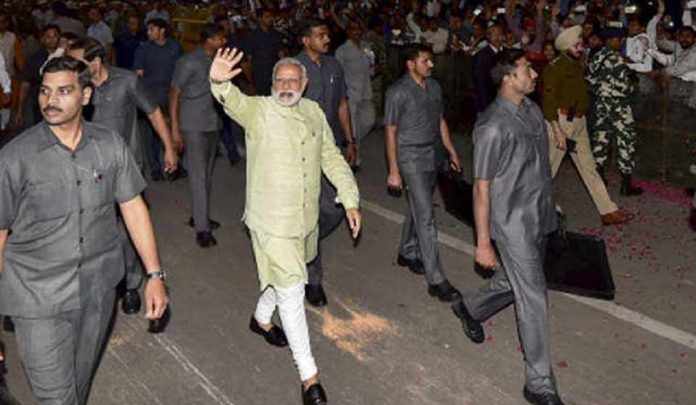
Special security provisions for the Prime Minister of India

0

This article is written by Rakchit Mishra from Birla Global University. This article completely deals with security provisions that are provided to the prime minister of India.

Introduction 

Special security in general terms means that a group of trained people protect the government of a particular country in case there is any threat to the government of a country. It is a special group popularly known as a Special Protection Group that not only protects the Prime Minister of a country but also protects other important persons or officials. Earlier in the 1980s, there was no such Special Protection Group to protect such “VVIPS” (very very important persons) rather there was an existence of a Delhi police security to protect the Prime Minister of India in every instance but after the murder of Indira Gandhi who was the Prime Minister of India at that time, it was observed that the Delhi police security was not able to perform their duties and even due to such incidence it was seen that the objective and the purpose for which such security was made was not fulfilled.

So after a few years, a committee named Birbal Nath Committee was set up to give suggestions for the establishment of special security for the Prime Minister of India, after which it was introduced in the year 1985. Rajiv Gandhi was also given such protection by the Special Protection Unit as he was the Prime Minister of India but after he discontinued from being the Prime Minister of India, he started receiving many warning signals from some of the sources because after such discontinuation of office the Prime Minister’s protection by the special security along with other facilities comes to an end, so as such there was no availability of such protections for Rajiv Gandhi. Several people started giving threat signals to him and even after a few years he was also killed so after such incidence certain changes were made in the SPG Act, 2019 which stated that protection will be given to the Prime Minister and his family for ten years from the time when the Prime Minister discontinues his/her/their office.

Indian Prime Minister’s security

As it is stated that security is meant for the protection of the prime minister of India. It is not provided on any special occasions, rather they protect the prime minister at every moment because they may receive any threats due to many reasons. The Prime Minister is the leader of our country so the protection of the prime minister is necessary. 

There may be some instances where the prior examination is required because if there is no such prior examination then there may be some possibilities of a larger threat to the Prime Minister of our country, so to avoid such threats prior examination is necessary. If the Prime Minister has to travel to some places within the country for addressing certain matters or for attending any types of high profile meetings then in such cases, all those places are examined by the  Delhi police security branch before the arrival of the Prime Minister so that if there are any threats found then either such thing will be removed from such place or such event will be cancelled. But after examination, if it is found that there are no threats to the life of the Prime Minister of India then it will be informed to the head of the security branch and after that only the event will be conducted.

On the day of the event, before the arrival of the Prime Minister of India, several arrangements of securities will be made even after the examination of such place by the Delhi police security branch because there are chances that someone may implant anything immediately at the time of the event or there are chances of any other threat which may endanger the life of the Prime Minister of our country. So to avoid such things, special protection group commandos generally go to such a place where the Prime Minister will arrive to address the people and after that, the Chief of such commandos arrives along with the Prime Minister of India. It is to be noted that such special commandos are only arranged for the Prime Minister of our country. 

There is again a special arrangement made for the Prime Minister for this journey from their residence to that place, so if such place where the event is to be conducted falls within the boundaries of that particular state where the Prime Minister resides, then in those circumstances the roads will be blocked for a particular period so that the prime minister can reach that place easily without facing any threat in between the passage of their journey. Then the Prime Minister travels in a bulletproof vehicle along with several other vehicles which include a vehicle of Delhi police security branch, two dummy vehicles, ambulance, jammer car, etc. After reaching such a place, the Prime Minister along with the national security guards will walk to the stage to address the assembly.

new legal draft

But if the Prime Minister is going to travel to any other state or any country then, in such case they will first reach the high tech area of the Delhi airport from where they will further travel to any place within or outside the territory of India in the Boeing aircraft and during that time other flight landings or take-offs are restricted. There is high security in the aircraft through which the Prime Minister travels to other places or countries for high-profile meetings and also there are more than 450 SPG commandos in and around the residence of the prime minister. Lastly, the type of security which is provided to the Prime Minister is named Z+ security which includes more than ten police authorities, NSG(National Security Guard) commandos, and several other staff.

The security provisions – a brief overview 

Certain security provisions are mentioned in the Special Protection Group Act, 1988 which was later on amended in the year 2019. Earlier it was seen that the special protection group commandos were provided to many other VIPs but after the amendment now it is restricted to the present and former Prime Minister and also to their families. This Act states several definitions and even talks about the members which will clarify the working of the securities. It also states that the securities will be controlled by the central government but for giving directions any other officer may be appointed by the central government.

It also talks about the persons to whom such security will be provided such as the Prime Ministers and their family but in the case of former Prime Ministers and their families they will be protected for a period not exceeding five years but before this amendment, it was stated that the families of the former Prime Minister will be protected for the term of ten years due to which Gandhi family was also given such protection after the assassination of Rajiv Gandhi and Indira Gandhi. If any Prime Minister disagrees with the protection of such security then in such a case that security will cease to operate for such Prime Minister and even for their family. This Act also states that the members who are included in the Special Protection Group will work till the president is satisfied with their work but if the President is not satisfied with their work then he can remove such members from the service. 

There are certain restrictions imposed on the members of the Special Protection Group such as they cannot meet any media, they cannot speak anything in front of the media and they cannot be a part of any other organizations or they cannot work under any other person or in any other firm. Any member who is affronted by any order then can appeal to the board which is formed by the central government within the period not exceeding thirty days and the order of the board will be the final order which will not be questioned further in any court of law within the territory of India. 

The need for more security provisions

As it is known that the prime minister is the head of our country so there are many possibilities that many of the citizens of the country may dislike their opinion and decisions so they may receive threat signals due to which their life may be at risk. In those situations, the security of the Prime Minister is mandatory because those security groups are the ones who will protect the Prime Minister from threats. 

As the securities will work under the control of the Prime Minister, it is also mandatory to keep a check on all the members who are a part of the special protection group because they might transfer all the information of the Prime Minister to any other person or they can help others in doing some illegal acts against the Prime Minister so there should be some specific guidelines for the security which will prescribe the workings of the security and if they work beyond such prescribed guidelines then they should be removed from the service. It is not possible to appoint only a person who will look after all the members of the Special Protection Group because in that particular security group there are more than 3000 members due to which it will not be easy for the person to keep a check on all the securities and to define whether the act done by the security is ground for disqualification or not. Even if there are no restrictions imposed on them then they can do anything according to their wish so it is also necessary to impose certain restrictions on the securities like as it is mentioned that they cannot communicate with any outsiders and neither they can work under any organization apart from working under the control of the central government that’s why it is necessary to have security provisions so that all the members will work in a prescribed manner to protect the Prime Minister at every instance. 

For example- if Mr. Yash is the Prime Minister of a country and in this residence, 900 people work as security but there were no restrictions made for such securities, and neither there was the existence of any provisions which defined working of the securities so after few days some of the securities helped some terrorists to enter into the residence of the Prime Minister to assassinate him. But if there were any such restrictions made for those securities then in such cases they would not have succeeded in doing such illegal act because in the case of normal human beings there are several laws that define the illegal act and according to which a person may be punished for violating such law. That’s why there is much need for the security provisions in our country so that they will work within the limits of such provisions.

Conclusion 

In our country, the Prime Minister is protected by the high-level securities popularly known as SPG commandos at every moment and there is a Special Protection Group Act which defines certain things related to the workings of those securities and if any of the security who is the member of the SPG commando is found violating any of the provision which is mentioned in the SPG Act then for such misconduct the member will be removed from the service. 

Furthermore, from my point of view, our country has one of the best security groups to protect the Prime Minister from any kind of threat as they work in a prescribed manner and they are also highly trained commandos.

References 


LawSikho has created a telegram group for exchanging legal knowledge, referrals, and various opportunities. You can click on this link and join:

Follow us on Instagram and subscribe to our YouTube channel for more amazing legal content.

Download Now

Enforcement of Cookie Policies

0
Image source - https://bit.ly/3AhEVHp

This article is written by Shreya Patil, pursuing a Diploma in Advanced Contract Drafting, Negotiation and Dispute Resolution from LawSikho.

Introduction 

“Every move you make, I will be watching you.” Doesn’t this sound like stalking? Probably, yes! Have you ever wondered how you sometimes see personalised ads which are highly specific to you, especially after you just searched for it on the internet? There might be several reasons for it. But accepting “All cookies” on a cookie disclaimer is one of the prominent reasons behind the same. In case you operate a website or your mobile app or your computer, it is obvious for you to have come across the “Cookies” disclaimer at some point of time, where the site primarily notifies the user there will be using of “cookies” to track our activity in order to enhance our “experience”. It then invites us to read their policy if we refuse to accept such tracking. Not just the users of any website, even business owners who own such websites must understand what a cookie actually is and how they are placed in order to prepare your website’s compliance with privacy legislations such as the EU Cookie Directive. 

Since the whole world is online than since the pandemic, this without a doubt means more dependency on online platforms, therefore, wesee an increased number of “Accept cookies” banners where its acceptance not only threatens our privacy but may also costs fortune if we come across some shady websites unintentionally. Many of the website users aren’t aware of the fact that these cookie banners may be customised according to the website viewers which assures our security and identity. Apart from individuals, having such “cookie banners’ ‘ and including options for customisations is equally important for the website owners and business personalities which desire to have global clients, viewers and make the most of the globalisation era since each country has their privacy laws which cookie policy is a part of. 

In today’s world of technology, privacy on the internet has become an oxymoron but protecting it has become more necessary than ever. Accordingly, it is requisite for individuals to manage their cookies. Regardless of you being an individual, website owner or an entrepreneur, if you wish to understand the Cookie policy, this article is for you! 

Meaning of a cookie policy

Cookies are small text files which are placed on the computer and mobile devices of the people who visit those websites/apps. Is similar to a privacy policy that is used to inform the users about the collection and use of personal information, a cookie policy is where the website owners will: 

  1. Provide detailed information about what cookies are being used by the website. 
  2. The detailed use of these cookies. 
  3. Provide an insight into the options that the users possess over these cookies. 

It is not all that uncommon to get confused between the Privacy policy and the Cookie policy. The privacy policy is a document which outlines the methods and the purposes of its data processing to users run by the data owners. If in case a website collects personal data, it is mandated to inform the data users of this fact or privacy policy. This consent is usually executed through the presence of a simple contract form. Where a cookie policy is concerned, it is a Section of the privacy policy dedicated to cookies that are responsible to track the behaviour which may result in potential privacy risk. 

There are various apps which contribute towards privacy and cookie policy generator resulting in its customization but it is always advisable to consult a tech/data privacy lawyer before incorporating any policy on your websites in order to acquire a clear perspective. 

Understanding Cookies and its types

Cookies are basically small text files that websites incorporate on our devices to further process and store on our web browser. Despite storing a lot of data to potentially identify us even without our consent, these are proven harmless as they can be easily viewed as well as deleted. Since the cookies can contain a lot of data, they have the potential to store personal data which are subject to GDPR. 

There are three different ways of classifying cookies based on how long they serve, what purpose they serve and their provenance.

  • Duration of the Cookies:
  1. Session cookies- These types of cookies are generally temporary and expire as soon as they close the browser. 
  2. Persistent cookies- This category of cookies hover until we erase them or our browser does until the expiration. The duration generally lasts 12 months or in accordance with any action. 
  • Provenance:
  1. First party cookies- These cookies are put directly on our devices through the website we are visiting. 
  2. Third party cookies- These cookies are placed by a third party like an advertiser or even as an analytic system. 
  • Purpose:
  • Necessary cookies– The cookies essential for the smooth functioning of websites and features according to the viewers recommendations and preferences are strictly necessary. We must be aware of shop apps such as “Amazon” and “Flipkart”. These types of apps use first party session cookies where consent of the cookies may not be necessary but why they are necessary are generally explained. 
  • Preference cookies- Also known as ‘Functionality cookies” these cookies allow a website to collect data of the choices we have made in the past on the website such as language, region, name and passwords. 
  • Statistics cookies- These cookies collect information about how we use a website and the pages we have visited and also the links we have clicked on but none of this information is used to identify you. These cookies are solely used for the improvisation of the website functions. 
  • Marketing cookies– Tracking our online activity to help the advertisers deliver more relevant advertising, these cookies share the information with third party provenance. 
  • Regardless of incorporating the cookie policy as a part of a privacy policy, many website owners leave their cookie policy as a stand-alone Section. However, it is mandatory for the websites to adhere to European GDPR and Californian CCPA to have one available for the website viewers and users. 

Effects of cookie policy under GDPR

The EU’s law on personal data i.e, the General Data Protection Regulation (GDPR), gives website visitors the right to receive specific, up-to-date information on what data is registered about, for what purpose, and where in the world it is being sent (along with the possibility to prevent it from happening). 

These rules affect your cookie policy as well as your cookie notification, your cookie consent and your documentation of consents.

The EU Cookie Directive is a legislation that came into effect due to Europe’s endeavour to provide protection for online privacy for the Europeans. The adoption of this directive in May 2011 not only applies to business websites or apps located in the EU, they are also subject to enforcement when residents of the European Union visit the website of businesses who are not European Union citizens. In accordance with the Directive, in the event of a European resident visiting your site, the usage of cookies must be informed to that person and moreover the option to refuse shall also exist. The only con of this is the less personalised browsing experience, however, the law requires the option to be strictly available. 

Consequently, the combination of these two laws, i.e., General Data Protection Regulation and e-privacy directive administered many websites to implement cookie banners to legally resume the engaging of business and their practices with respect to personalised advertising, retargeting and analytics. 

GDPR provides the users statutory rights with regards to their data. The controller is obligated to honour those rights. Such rights include: 

  • The right to be informed about the privacy policy. 
  • The right to access personal data and information on the procedure of how their data is being used. 
  • The right to rectify the personal data if it is inaccurate or incomplete. 
  • The Right to object to any activities in relation to their personal data. 
  • The Right of the users to obtain their personal data for their own purposes. 
  • The right to erase the users’ personal data where it no longer serves the original purpose. 
  • The right to restrict processing of the personal data in specific cases. 

This is how the protection of data takes place in the European Union. But what countries outside of the EU have such laws? Every country, without a doubt, has privacy laws, but what are the rules on cookies around some major markets around the world?

Before we understand how consent for cookies takes place in major economies of the world, it’s important to get a clarity of the concept of valid cookie consent and the contents included in a cookie policy. 

Contents included in a Cookie policy

It should be taken into utmost concern that that cookie policy is an extremely serious document that affects the privacy of the visitors and clients on their website. Thus, when working on the consideration of policies to be added, use of legal services for your policy, either internal or external is essential. 

However, in the event of you deciding to write the policy by yourself, there are some typical sections that should be used. They can be broken down as follows: 

Policy Introduction  

The purpose of introduction of the cookie policy is to get informed consent of the visitors in order to use their cookies who start using your website. The first stage of this cookie policy is to introduce your cookie policy, the display of the cookie consent should be immediate upon a user’s first visit which receives informed consent from the visitors of your website. 

Where can a banner be incorporated? There is no law that states a method of incorporation but the fact remains that it should ideally be visible. 

Website, in most manners, introduce their policies in 4 different ways: 

  1. Fixed Footer Notification – Adding cookie consent notice in the footer for your website is a smart move universally since most of the legal links are included in the footer which individuals are aware of the fact of looking for important things. 
  2. Top-header Notification – This notification gets displayed in front and centre at the top of the website which makes it impossible for the visitors to miss. 
  3. Inline Top-Header Notification – The notice uses a slightly lighter colour blue from the site background that fits well with the logo Section line and the “Welcome to GOV.UK” Section. Another example of a more inline notification can be seen here from Barclays. This notification bar is located between the top Section of the website and the start of their website content, which makes it pretty much impossible to miss.
  4. Box Notification – Some names need no introduction, right? This box notification works best with mobile phones since it can display largely on the screen. The small box is placed on a fixed position regardless of how you scroll. 
  5. Persistent Pop-Up- Few websites do not allow the users to interact with them unless they have given a consent. This is executed through consistent pop-up. 

What are Cookies? 

Despite being generated for smooth user experience, cookies have generated a lot of controversy with growing concerns of virtual privacy. Since cookies have an ability to track, store and share the activities of an individual, it’s a legal requirement for websites to get clear consent from website users. This information is extremely important to notify the users that your website is using cookies, and more specifically, what cookies are. 

Kind of cookies that shall be used (either by website owner or by a Third party)

The fundamental step of creating a cookie policy is to identify an accurate cookie policy as every website uses them differently. It is pertinent to take the use of cookies used by your website and the ones set by a third party to take into a consideration. If one’s not sure, using https://www.cookiebot.com/en/ can help to audit it with a complete overview of all the cookies in use. Generally, cookies are either used for marketing purposes or for the data you are tracking which should be clearly mentioned. 

Third party cookies on our site, if there are any 

A user must be informed if there shall be any third-party cookies usages in the website with necessary cookies. This helps the user to make a decision if they are willing to proceed with a valid consent. Third party cookies might be stored, this may enable it to collect data and show relevant ads on the device of the user. 

Tip for website users: Disabling third party cookies on your device can immediately refrain the advertisers from tracking any third-party entities.

Opt-out possibilities and consequences 

Some users are extremely conscious and protective about their data privacy, as they should be! Hence offering an opt out option is reasonably considerate. 

  • From an opt out option the user can deny storage of any data and information will no longer be stored in the cookies. The hard fact is that a few companies are not considering this option of privacy policy which makes it difficult for the users to object to the usage of personalised advertisements. 
  • The users should be informed that they have the right to refuse the “storing of the data” pertaining to any information. 
  • Lastly, a contact address should be provided for in case of questions and complaints. 
  • A valid consent from end-users to have their personal data processed by cookies and trackers on a website has to be an informed, clear and affirmative and unambiguous indication of their wishes. This means that websites are not allowed to activate non-necessary cookies that process personal data until after users have given their explicit consent.

Explicit or Implicit cookie consent mode and its validity geographically

There are two main modes of cookie script of consent depending on how strict you want it to be and it is called consent mode. The cookies which are set at the visitors’ computer where they are just informed about the storage of cookies are known as Implied consent cookies. However, under the GDPR the option of implied consent doesn’t comply with the law and hence no cookies can be stored without an informed consent of the visitor of the website when dealing with Europeans. 

It is pertinent to note that some EU Data Protection Authorities in alignment with the GDPR now also require records for the consent instead of proofs to be kept to maintain valid records of consent. Generally, website owners default use the explicit consent considering their website’s reach over the globe. It cannot be denied that Europe is way ahead in terms of its data privacy but understanding how the cookie consent works around the globe where data privacy may be developed or may not be is extremely important not only for website owners but visitors as well for self-awareness of their privacy. 

Cookie Consent in North America

  • United States 

The privacy law in the United States is considered to be extremely weak compared to the other major economies as the USA doesn’t require consent for cookies. However, the federal law places few restrictions on the usage of cookies for the children below 13 years of age and is named as the Children’s Online Privacy Protection Act (COPPA). The strongest privacy laws can be found in California where they are effectively applied to any business operating in the US. The very specific act relating to privacy policy i.e The California Online Privacy Protection Act” required the website owners to disclose their mode of the collection of personal information and they too should be collected via cookies. Not restricting to this, it also states that the Privacy policy should let the users know how the website treats browser “Do Not Track” requests but they aren’t actually obliged to obey such requests. Hence, although disclosure in a privacy policy is advised, California too doesn’t require consent for cookies. 

  • Canada 

When it comes to Canada, it definitely proves to be stricter than the USA. The two main privacy laws followed by the Canadian legislation are: 

  1. Personal Information Protection and Electronic Documents Act (PIPEDA) 

This law mentions two types of consent: 

> Express consent- where the consent is explicit, through a specific action. 

> Implied consent- it’s an inferred consent where the user has been given an option to opt but does not do so. 

2. Canada’s Anti-Spam Legislation (CASL) 

This law requires the website and app operators to get “express consent” for installation of certain “computer programs” and it deems the cookies as a type of computer program. 

The combination of these two legislations provides a requirement for cookie consents but not necessarily cookie banners. So, it definitely depends on the opt out choices of people and have express consent to set cookies under Canadian law. Concludingly, Canadian law does not require (express) consent for cookies unless proper information and opt-out process are provided. 

Cookie Consent in South & Central America

  • Argentina: 

Argentina’s Personal Data Protection Act requires that the websites only allow for the personal information to be collected with express consent given in writing or other similar means. But the personal information can be only collected in terms of information such as Name, National Identity Number, Occupation, Address and Phone number. So, coming to the question, are cookies considered as personal information? Though the law is unclear about this, cookies are world-wide considered as personal information. 

  • Brazil

The two privacy laws in Brazil are: 

  1. The Civil Rights Framework for the Internet 
  2. The Brazilian General Data Protection Law which came into force in 2020

These laws don’t provide any specific reference to the cookies; however, they do suggest that containing personal information requires express consent. Hence, Brazil may require consent for cookies. 

  • Mexico:

The two prominent legislations in privacy laws amongst many are: 

  1. The Federal Law on the Protection of Personal Data held by Private Parties
  2. The Privacy Notice Guidelines

Under these legislations, the consent for cookies is mandatorily required besides the cookies for technical purposes. The express notice as to how cookies collect the personal information shall be legally required. 

Cookie Consent in Africa

  • Nigeria: 

Nigeria’s privacy laws are: 

  1. The National Information Technology Development Agency Act 2007 
  2. The Nigerian Data Protection Regulation 2019

While there is no express reference to the Cookies in 2007 legislation, the 2019 regulation circles around consent which is quite similar to that of the EU’s GDPR suggesting a strong opt-in or express model of consent which is one of the six legal reasons for processing personal information. Therefore, Nigeria does require consent for cookies. 

  • South Africa: 

The privacy laws in South Africa are: 

  1. The Electronic Communications and Transactions Act 2002
  2. The Protection of Personal Information Act

The latter law bears similarities with the EU data protection law. Regardless of being passed in 2013, it has yet to come into full force. This law does not regulate the use of cookies as they are considered as “Online identifiers” and hence qualify as personal information covered by consent requirements. However, until POPIA comes into full force, it can be safer to state that South Africa does not require consent for cookies. 

Cookie Consent in Asia

  • China: 

There are a myriad of regulations, statutes and court opinions covering privacy law in China. However, Internet censorship, cybersecurity laws and the “Great Firewall of China” present additional challenges to enter the online market. The online markets include: 

  1. The Internet Email Services Regulations 
  2. The law of tortious Liability

Interestingly, no Chinese law appears to have made reference to cookies. Hence it can be partially considered as China does not require consent for cookies. 

  • Hong Kong: 

The main privacy laws in Hong Kong are: 

  1. The Personal Data Ordinance 
  2. The Unsolicited Electronic Messages Ordinance

These both laws don’t require consent for cookies and hence it can be concluded that Hong Kong does not require consent for cookies. 

  • India: 

Despite not having any comprehensive data protection or privacy law, the Information Technology the Information Technology Act, 2000 prohibits the use of cookies without consent since any Computer virus, can be considered as cookies. Hence, India may prohibit the use of cookies without consent. 

Position of Cookie Policy in India

As far as India is concerned, there is definitely a lack of comprehensive personal data privacy legislation with respect to regulating the usage of cookies. We all are aware of how right to privacy is a fundamental right as declared in the case of K.S. Puttuswamy v. Union of India. It was also stated that without the consent of the user, no information of the user shall be utilized by websites. However, it is pertinent to note that cookies, regardless of their type, are not considered as personal information in India which benefits the websites as they are allowed to apply various types of cookies in the device of the user. 

So how are websites regulated if not through any cookie law legislation? 

Such websites are regulated by legal binding agreements under the Indian Contract Act, 1872 which are mandated on agreeing to the terms and conditions as shown to the user where terms and conditions of a privacy policy are mentioned. The next legislation which governs such websites is the Consumer Protection Act, 2019 which contains important provisions related to the data privacy of the consumer which includes according to Section 2(46) of the Consumer Protection Act any unreasonable imposition of a condition on the consumers which certainly puts them in jeopardy would be treated as an unfair contract under the unfair trade practices. 

However, the arbitrariness and ambiguity under these legislations concerning privacy is prevalent in the inclusion of the definition of the privacy protection and hence there is no hard and fast rule as compared to other countries. 

What does India need to work on?

  1. Revised Personal Data Protection Bill, 2019: The new Personal Data Protection Bill, 2019 although has not been enacted yet but should be modified. This bill defines personal data as any data about a natural person that is directly or indirectly identifiable. This certainly pertains to identification of information related to a natural person. However, cookies generally do not have a function of identification of a natural person and thus this is outside its purview. In accordance with the views of the experts, personal data cannot be irreversibly anonymized and hence the companies which use browsing history as a way to identify individual users run the risk of de-anonymization. 

A study also finds that half of the population is uniquely identified based on place, date of birth and gender details. This bill proves to be inadequate in the regulation of the cookies as it does not address the standards of characterisation of the process of anonymisation and hence should be revised considering the gravity of the issue of privacy in the future. 

2. Need of a Cookie Law: 

The solution to all questions regarding the ambiguity in different legislations related to privacy, is a comprehensive cookie policy law which is jurisdiction-based, which shall prove beneficial in resolving interpretational problems and ensure robust enforcement. Enforcing a cookie law shall also ensure the protection of economic interests of the companies with elimination of privacy concerns by incorporating penalising regulations under such laws. 

  • Japan: 

The main privacy laws in Japan are: 

  1. The Act on the Protection of Personal Information
  2. The Act on Regulation of the Transmission of Specified Electronic Mail.

Under the APPI, consent for transfer of personal data and its collection requires mandatory consent. So, the first party might not require cookies; however disclosure of the privacy policy is prohibited. Hence it can be stated that Japan might require consent for third party cookies. 

Cookie Consent in Australia

  • Australia: 

Information collected by the cookies might constitute personal information if the person could be reasonably identified under Australian law. Therefore, Australia does not require consent for cookies as disclosure of your cookies in a Privacy Policy under Australia law is deemed to be necessary. 

  • New Zealand:

The main privacy laws in New Zealand are: 

  1. The Privacy Act 1993
  2. The Unsolicited Electronic Messages Act 2007

Neither of these laws make reference to cookies and hence New Zealand does not require consent for cookies. 

Determining the Law of Reference

Many users and service providers wonder which privacy laws they must honour. Here’s a simple rule of thumb-

Generally, the laws of a particular region apply if:

  • You base your operations there; or
  • You use processing services or servers based in the region; or
  • Your service targets users from that region.

This effectively means that regional regulations may apply to you and/or your business whether you’re located in the region or not. For that reason, it’s always advisable that you approach your data processing activities with the strictest applicable regulations in mind.

General Legal Requirements to incorporate a Cookie policy on your website

There is absolutely no straightforward answer to whether there is a legal requirement to incorporate a cookie policy onto your website as it largely depends on the privacy laws of each country. However, in countries like Europe and California, there is a legal requirement to incorporate such a policy and comply with these laws. If your business is based in Europe or California; wants to deal with their clients, the inclusion of cookie policy is mandatory. 

Since the trading and commercial activities are executed flourishingly in the European countries and USA, the pressing question shouldn’t focus on whether it is a Legal requirement but how you can get a cookie policy for your website. However, if you desire to get your website noticed, flourished and have customers or viewers all around the globe, it needs to comply with the privacy laws of that country. Hence having no cookie policy might affect the smooth functionality of your website, if it doesn’t add value unless you have economic profits. Hence it is not a legal requirement but certainly a necessary requirement in order to flourish in the world. 

Subject to the above, there can be questions as to how we consciously make ourselves aware of which country’s privacy laws. In terms of Data Privacy and Protection, the European Union is way ahead than any of the jurisdictions in the world. If you are a website owner from the EU or you are dealing with EU citizens, your website should comply with the EU’s General Data Protection Regulation. 

According to the EU Cookies Directive, the notice of usage of cookies is separate from your privacy policy. In order to comply with these, anyone who visits the website should: 

  1. Notify that the website is using cookies. 
  2. Inform about the type of cookies being used. 
  3. Inform the options available to them if they want to opt out of having the website’s cookies stored on their devices. 

Under the privacy policy of the United States, if cookies are used for the website, they are required by the law to have a privacy policy that discloses the use of cookies. 

Situational Legal Requirements

If your website is in operation of an e-commerce industry, there are applicable commercial laws and industry rules. 

Business to Business commerce

Commercial transactions that are subject to the applicable contracts, industry and national guidelines, falling within the scope of such governing law shall be applied in such cases. 

Business to Consumers commerce

Under most countries, the consumers need to be informed about the following- 

  • Returns/Refund details. 
  • Warranty/Guarantee information where applicable. 
  • Safety Information such as legal address and business name. 
  • Rights of consumers (such as withdrawal rights), where applicable.
  • Seller contact details (e.g., email address).

Other Legal Requirements

A terms and Conditions document also known as “terms of service, End-user license agreement or a Terms of Use agreement is often not legally required but is always a good practice for the sake of practicality and safety. It executes a contractual relationship between the users and therefore, is essential in terms of protection of potential liabilities. This legally binding agreement must be ensured to be updated and understandable to the layman.

While different businesses have different contexts of terms and conditions, they should at least include the following:

  • Identification of the business
  • Description the service that your site/app provides
  • Information on risk allocation, liability, and disclaimers
  • Warranty/Guarantee information (where applicable)
  • The existence of a withdrawal right (if applicable)
  • Safety information, including instructions for proper use (where applicable)
  • Terms of delivery of product/service
  • Rights of use (if applicable)
  • Conditions of use/ purchase (e.g., age requirements, location-based restrictions)
  • Refund policy/exchange/termination of service and related info
  • Info related to methods of payment
  • Any additional applicable terms

Third Party Legal Requirements and Obligations

An organization may be held liable for not meeting any legal obligations leading to reputational damages, fines and sanctions. Hence, it’s often mandatory for all the partners, customers to meet regulatory service standards. Generally, they require that organizations that use their services have in place a compliant privacy policy (and cookie policy if cookies are in use) that discloses relevant details about the relationship and services rendered.

Consequences of non-compliance, undoubtedly initiate legal ramifications which may include the following: 

  1. Fines: Government officials bring suits seeking civil penalties which can go beyond US$ 120000 for any violations whereas GDPR fines were raised to EUR 20 million. 
  2. Disciplinary measures: Measures such as official reprimands and periodic data protection are included in the event of any violations. The GDPR grants the users exclusive right to file a complaint with a supervisory authority if they suspect any processing of their personal data. 
  3. Liability Damages: To compensate for any unjust damage is a general principle of Civil law. Both GDPR and CalOPPA grants individual users the right to claim compensations. 
  4. Loss of service and contractual penalties: Some third-party services (including marketplaces and app stores) may be in compliance with specific regulations as a part of their terms of use; violation of their terms may lead to service termination or potentially, permanent bans.
  5. Criminal Law: It is possible to be held criminally liable if the conditions are met and if the sovereignty of a nation is at stake. 

Drafting and Incorporating an Ideal Cookie Policy

Considering the legalities of Cookie policy in different jurisdictions, finding the right template of a cookie policy which satisfies the requirements of data privacy laws of major economies is definitely a tough row to hoe. As we have now educated ourselves about the types of cookies used on websites, the most fundamental step is to identify the type of cookies which are being used for our website as every website uses them specifically and in varied forms. Since the third-party cookies are also taken into consideration while taking into account the use of own cookies, reading the cookie policies of third-party service is essential! Most websites practice displaying a pop up notification at the bottom of the screen when a visitor lands on the site. This ensures the visitor a brief notification about the cookies the sites might use where a link is provided for detailed information about the cookie policy that sits on. 

As mandated by the GDPR compliance regulations, the language needs to be plain and intelligible which shall include the following information: 

  • The type of cookies the website is using.
  • The data the website is tracking.
  • How long cookies shall stay on a user’s browser.
  • Why the website is using cookies (for marketing purposes for example).
  • Where the data is sent and with whom it’s shared from your website.
  • How to reject cookies and how to change cookie settings.

Consequences of rejection of cookies by the user

In the event of rejection of cookies, the activity of the user cannot be tracked. For this purpose, there are extremely strict rules with regards to gaining consent and in order for it to be valid, it must be gained through free, informed and specific consent. It also must be noted that simply providing information about cookie policy which the reader barely understands shall not be counted as a consent. Building on the same, it’s always a good idea to display the notification of the policy on all the pages of your website. 

Conclusion

If you are a website owner, customising your policy according to your needs, style and aesthetics is your own personalised choice, however to get a consent for your privacy policy, essential information, required links with notices not being placed before the consent cookie policy should be cautiously addressed in order to ensure that there are no legal implications upon you or your business. Hence, availing legal services shall always be preferable. Appointing a Data protection officer who carries out the task of ensuring all the processing activities and monitoring compliance with applicable laws is highly encouraged by all jurisdictions. When it comes to website users, consider your personal information as your wealth and hence make efforts in order to protect it. Consenting to cookies just for sake of efficient running of the website can be detrimental, reading the consent policy/cookie policy and acting upon it might save you a fortune. 

References


Students of Lawsikho courses regularly produce writing assignments and work on practical exercises as a part of their coursework and develop themselves in real-life practical skill.

LawSikho has created a telegram group for exchanging legal knowledge, referrals, and various opportunities. You can click on this link and join:

https://t.me/joinchat/J_0YrBa4IBSHdpuTfQO_sA

Follow us on Instagram and subscribe to our YouTube channel for more amazing legal content.

Download Now

Freedom of speech and national security 

0
Image source - https://bit.ly/3nDHfos

The article is written by Nikhil Thakur from Manav Rachna University. The author has attempted to explain the issue of freedom of speech with national security. Along with this, the author has included the European court of law’s verdict as a reference.

Introduction

Every person irrespective of his race, caste, sex has the right to freedom of speech and expression. Freedom of speech and expression incorporates freedom to hold conclusions and to get and confer information and ideas without obstruction by the public authority or the state.

Classically, the government legitimises intemperate abridgement of the right to speech and expression on the grounds of national security and terrorism, such a mishandling is encouraged by the troublesome relationship and pressure between national security and human rights protection. 

The key role that can be played in addressing and resolving this tension can be the judiciary. There are a plethora of instances around the globe where the judiciary has played a pro-active role by rejecting the justification as to curtailment of freedom of speech and expression at the time of emergency and in the interest of national security.

Meaning

National security

The concept of national security is pivotal to every nation which refers to the situation where the government ensures that the states and their citizens are protected and safe and assures these via political, economic, diplomatic and military mightiness.

Above all these, the states have a wider obligation concerning the protection of the fundamental rights of citizens, guaranteeing appropriate working of the democracy and establishing an atmosphere of amity and synchronization.

“National security is all about the free will of the government to take opposite decisions and to guarantee a country’s sovereignty and territorial integrity.

According to Collins dictionary, national security is defined as the ability of the government to protect itself from the threat of violence and so on.

Freedom of speech and expression

According to the Convention for the Protection of Human Rights and Fundamental Freedom (the European Convention on Human Rights), freedom of expression is a right in itself along with this it is a component of other rights like the freedom of assembly.

The phrase freedom of speech and expression is explicitly mentioned under Article 19(1)(a) of the Indian Constitution and is one of the fundamental rights guaranteed to its citizens. 

Freedom of speech and expression signifies the right of the citizens to verbalise their views, opinions, beliefs and thoughts by way of words through mouth, writing, printing and any other format. Article 19(1)(a) confers following of the rights:

  1. Freedom of press;
  2. Freedom of silence;
  3. Right to propagate one’s view; and
  4. Right against tapping of electronic communication and many more.

But, these rights are not absolute because they are subjected to few restrictions as according to Article 19(2), the right to freedom of speech and expression can be curtailed on the grounds of :

  1. Sovereignty
  2. Integrity
  3. Morality and decency
  4. Friendly relation with the foreign state
  5. Incitement to an offence
  6. Content of the court
  7. Public order and
  8. Security of the state.

Indian judiciary’s perspective of national security

In the interest of the security of the nation, the freedom of speech and expression can be curtailed if the government believes that such a speech and expression may:

  1. Wage war against the government,
  2. Exaggerate external aggression etc.

Following the State of Bihar v. Shailabala Devi (1952), the hon’ble court observed that the gestures, graphical representation having a high probability of causing the problem in the state can be restricted and are covered within the purview of Article 19(2) of the Indian Constitution.

In Sanskar Marathe v. The State of Maharashtra and Anr (2015), the court specifically held that only those expressions that influence or instigate hatred against the government or may cause public disorder are punishable within the meaning of Section 124A of the Indian Penal Code, 1860.

European Court of Law

In Hadjianastassiou v. Greece (1992), there was an officer who revealed classified information. The information disclosed by him were concerning weapons and their technical knowledge has the capability of effecting significant harm to national security. The Hon’ble court held that the conviction of such a person shall be an intrusion with the officer’s freedom of speech and expression.

Following Article 10 of the Convention for the Protection of Human Rights and Fundamental Freedom, it says that the freedom ensured carries certain rights and responsibilities that are subjected to formalities, conditions, restrictions and are necessary for a democratic society, or in the interest of national security, territorial integrity and so on. Article 10 says that the rights conferred are not absolute and hence in the interest of national security, territorial integrity can be restricted.

Article 10 of the Convention allows the domestic authorities to intervene with the exercise of freedom of expression when a three-part test condition is fulfilled:

  1. When the interference by domestic authority is prescribed by the law (Gaweda v. Poland (2002) and The Sunday Times v. The United Kingdom (1979)).
  2. When the interference by domestic authority is aimed at protecting and ensuring; national security, territorial integrity, public safety, prevention of disorder or crime, protection of health, reputation, morals, right of others, secret information (Observer and Guardian v. The United Kingdom (1991)).
  3. When interference by domestic authority is necessary for the democratic society (Dlugolecki v. Poland (2009) and Tolstoy Miloslavsky v. The United Kingdom (1995)).

The essential part of Article 10 of the Convention is to secure freedom of expression for everyone. In this manner, the court through the above-mentioned exception built up rules for a strict interpretation of the possible restrictions so that they cannot be misused.

The grounds as mentioned under Article 10 of the Convention concerning the restriction of freedom of speech and expression are exhaustive. Thus, domestic authorities cannot use any other mechanism falling outside the list to restrict freedom of expression. For illustration: an injunction against a newspaper company can be held as legitimate in the interest of national security if the same is distributing or publishing classified data/ information. However, the court of law must guarantee that the interest that is to be protected shall be genuine and not merely a dubious possibility. Once the court is satisfied that the interest was genuine, then it shall decide whether it was necessary for a democratic society or not.

In Observer and Guardian v. The United Kingdom 1991 the hon’ble court observed that the phrase as mentioned under Article 10 of the Convention shall imply the presence of “pressing social need” and the 1st one to assess the pressing social need is the national authorities.

Moreover, in Mukong v. Cameroon (2015), it was observed that merely in the name of national security and safeguarding the state, the author cannot be subjected to arrest and detention because it is violative of freedom of expression and Article 7 of the European Convention on Human Rights. Further, it was said that in the name of national security and safeguarding the state under difficult situations cannot be executed by restricting the right to freedom of expression and democratic tenets. 

Besides this, there are few more cases where the freedom of expression and national security was discussed like in Okcuoglu v. Turkey (1999) and Vereniging Weekblad Bluf! v. Netherlands (1995).

Observer and Guardian v. the United Kingdom 1991

The above-mentioned case is a landmark case where national security as the ground was taken to restrict the freedom of expression.

Facts

  • During the year 1986, two newspaper organizations planned to publish the extracts from a book Spycatcher which was written by Peter Wright, a retired intelligence agent.
  • When the newspaper organization announced that they were going to extract the information from the book and get it published, the book Spycatcher was yet to be published.
  • The book contained a description of alleged unlawful activities committed by the British intelligence service and its agents.
  • The book clearly mentioned all the unlawful activities committed by the intelligence like bugging the entire diplomatic conference that took place in London during the span of 1950s-1960s, the 1979 Zimbabwe independence negotiation was bugged, the entire diplomats from Germany, France, Greece and Indonesia were bugged, even the suit of Mr Khruschchev’s was bugged when he visited Britain in the 1950s, the Soviet Consulates were also bugged, Even Britain in order to have check on left-wing political group in the country relocated its resources for the same cause and so on.

Arguments

  • The attorney general requested the hon’ble court to issue a permanent injunction against the newspaper organization from publishing the extracts from the book Spycatcher.
  • The Hon’ble court allowed the injunction but temporary, to prevent the newspaper organizations from publishing the extracts during the proceedings of the case.
  • The newspaper organization contended that the book already got printed in the US and the copies of the same were distributed in the United Kingdom. Despite this fact, the court maintained the temporary injunction.
  • The British government contended that at the time the temporary injunction was imposed on the newspaper organization, the classified information available to Peter Wright was confidential.
  • Further, the government contended that if this information had been released then the British Intelligence along with its agents would have suffered huge damage because such information aided the alien country to identify the British agents. Not only this, the friendly relationship among British and allied countries would have been hampered, the trust that all had upon British intelligence would have been broken.
  • Moreover, the British government said that it was necessary to stop such a publication because it would invite other former agents to disclose confidential information.

Court’s observation

The court observed that the temporary injunction granted was justified till the time the book Spycatcher was not published but now it cannot be justified. Furthermore, the court held that after the publication of the book in the United States of America, the information available in the book lost its confidentiality and hence the interest of maintaining the information confidential and away from the public no longer existed. Therefore, the hon’ble court dismissed the injunction imposed upon the Observer and the Guardian.

Judge Pettiti gave a dissenting opinion and said that the temporary injunction even if imposed before the publication of the book in the USA could not be justified. Further, judge Pettiti said that it is a violation of the freedom to receive information as depriving the public of the information concerning the functioning of the state is a violation of the fundamental democratic rights of its citizens.

Analysis

The judgment in the immediate case accommodates 2 key significant principles such as:

  1. That if the information is present under the public domain, the right to freedom of expression cannot be restricted, obstructed or eliminated in the name of national security.
  2. The state is barred from unconditionally defining all information as confidential in the name of national security because such an act restricts the people to have an access to said information and hence is a violation of freedom to receive information.

Conclusion

The right to freedom of speech and expression is a basic fundamental right available to every person. Solely in the name of national security and territorial integrity, the freedom of expression shall not be restricted, withdrawn or taken away. A proper justification shall be provided by the state that why they are restricting these rights and is it important to restrict the same. 

The landmark judgment in Observer and Guardian v. The United Kingdom clarified that, if the information is publicly known then the same cannot be used arbitrarily by the state to restrict the right to freedom of expression and further, the state cannot designate every information under the head confidentiality. Hence, the state shall ensure a balance between the right to freedom of expression and national security.

References


LawSikho has created a telegram group for exchanging legal knowledge, referrals, and various opportunities. You can click on this link and join:

https://t.me/joinchat/J_0YrBa4IBSHdpuTfQO_sA

Follow us on Instagram and subscribe to our YouTube channel for more amazing legal content.

Download Now
logo
FREE & ONLINE 3-Day Bootcamp (LIVE only) on

How Can Experienced Professionals Become Independent Directors

calender
28th, 29th Mar, 2026, 2 - 5pm (IST) &
30th Mar, 2026, 7 - 10pm (IST).
Bootcamp starting in
Days
HRS
MIN
SEC
Abhyuday AgarwalCOO & CO-Founder, LawSikho

Register now

Abhyuday AgarwalCOO & CO-Founder, LawSikho