Download Now
Home Blog Page 1450

How do venture capital and private equity deals work

0

In this article, Anupam Pandey discusses how do venture capital and private equity deals work.

Introduction

Investor and investee, both need each others existence in order to make their own sustenance. Investor has an ample amount of fund but he needs proper avenues to invest money and investee needs assistance and guidance regarding the source for procurement of the money. Venture capital and private equity are the investors in this section and promoter is the investee.

Venture capital

Venture Capital is long-term risk capital invested in order to finance high technology projects. These projects have a potential for growth in the future. In order to assist new entrepreneurs in their initial phase of the project venture capitalist invests his resources and managerial abilities in the startup. When the project reaches the stage of boom, they sell their shares at a high premium to others and earn profit from it.

Venture Capital refers to the capital which invested in the firm specializing in novelty, as a shareholding. It does not merely include injection of funds into a new firm but also simultaneous input of skills, designing its marketing strategy, organize and manage it. It is a relationship with progressive phases of firms’ advancement with particular sorts of financing fitting to each phase of improvement.

Motive

The primary motive of any businessman would be to earn profit and Venture Capital puts resources into high risk ventures with the expectation of exceptional yields. These resources are invested into several ventures, which require funding, however can’t get to it through the customary sources, for example, banks and monetary organizations. Mostly new entrepreneurs undertake such enterprises. Such enterprises, for the most part, don’t have any significant collateral security to offer as security, subsequently banks and financial institutions are not inclined to fund them. Venture capital comes to rescue in this case for procuring fund in the form of equity or debt, however, equity is the most favoured choice. Since the vast majority of the ventures are financed through this course, the likelihood of progress is low. All ventures financed don’t give an exceptional yield. A few activities come up short and some give direct returns. The venture, be that as it may, is a long haul capital which typically takes 3 to 7 years to produce significant returns.

Financial speculators’ offer “more than money” to the venture and try to increase the value of the investee unit by active participation in its administration. They screen and assess the task consistently. The Venture Capitalists are anyway not stressed over disappointment of an investee’s organization, since they invest in many other alternatives which compensates their loss. The profits generally come from the sale of shares when the stocks get listed on a stock exchange or by timely offer of their stake in the organization to a strategic buyer.

Venture Capital Investment Criteria

Venture Capital alludes to the capital put into “unsafe” venture to acquire a high rate of profits. Funding is put into equity instead of loans to get a high rate of return. The Venture Capital is given to organizations in the different phases of improvement and Venture Capital speculation criteria are the techniques took after by Venture Capitalists to choose fitting endeavours for speculation. Venture capital investment criteria not only simply imply for small and medium sized organizations but also it can be a speculation into a task of a vast business, or into a new business expecting to develop essentially. The Venture Capital speculation criteria depend on the capability of the organization to develop quickly within constraints of limited time and resources.

The Venture Capital speculation criteria defines a set of standards in ventures to get a high development potential. The venture which can give extraordinary returns and the venture where the speculator can have an easy “exit” within the desired framework of time from three to seven years is thought to be a perfect Venture Capital investment option. The new business which depends on novelty structure and an all around planned model bolstered by a strong management group attracts Venture Capitalists.

The Venture Capitalists guarantee stocks take after the coveted Venture Capital speculation criteria to make mature investment in stocks to get significant yields. Venture capitalists should consider fundamental Venture Capital investment criteria before making any speculation. The fundamental Venture Capital speculation criteria are “never pay with pay off” and “prepare an exit plan.” The Venture Capitalists ought to never pay with pay off and dependably keep cash for individual needs before spending on Venture Capital in light of the fact that the disappointment rate can be over half. In a few stocks it can be more than 90% and if the venture fails, the whole financing is composed off. The Venture Capitalists burn through cash to collect more cash and the Venture Capital speculation criteria assist them with making the correct choices. Some huge Venture Capital speculation criteria are as per the following:

Criteria 1: More Risk More Returns- One of the main Venture Capital speculation criteria is “more risk gives more returns.” Investment in risky ventures can get higher returns if they are chosen deliberately. The financial specialist should know for which phase of development the speculation is required. It will give an essential element of the risk and uncertainty included and duration of the investment. There are diverse alternatives to profit in the venture – IPO, and Merger and Acquisition.

Criteria 2: Company’s Profile- The Venture Capital speculation criteria depends mostly on organization’s profile. The organization ought to be a quickly developing organization which has an enormous market presence and the organization ought to have plenteous intellectual property to have the capacity to put hindrance to its rival’s development. The organization ought to be huge or presumed enough to have the capacity to develop quickly. The organization ought to be into a promising business field.

Criteria 3: Company’s Development Stage -Venture Capital investment criteria are designed to anticipate the phase of development of the company and the risks involved. Ideally, Venture Capital speculation is needed for four different phases of company’s development – Idea generation, Start up, Ramp up and Exit (ISRE). The Venture Capital can be approached for getting the “seed money” i.e. for introducing a new idea in the market. Since new venture involves high risk, it consists of high profit too. It can be for start up of a company or for marketing and development in the existing company. Some companies require Venture Capital at initial stage– early sales and manufacturing, and some companies may need working capital.

Criteria 4: The business model- Venture Capital investment criteria aims to provide investor secure and high returns, and the business model of the company helps it to grow quickly. If the products sold by the company have a high market demand and coverage then the company will fulfil the investment criteria. The delivery of products should be successful to satisfy customers make them as permanent customers. The company should be able to generate more income with limited and adequate resources. It should have the tendency to attract customers and remain ahead of competitors.

Criteria 5: Management team- For sustainability of a company a strong management team is needed. In the event that an organization is not bolstered by a strong management, it won’t have the capacity to convey its designs and the organization may not perform well, in this way, a great management team is a standout amongst the most essential Venture Capital speculation criteria. There are numerous organizations which are not able to convey the expected results in light of the fact that there exists a conflict between the top management. The main administration of the organization ought to be strong, professional and master at its activity. The management team ought to have talented, sensible, honest and consist of individuals who possess will to convert a plan into reality. The organization ought to have individuals to have the capacity to foresee the issues and keep the organization from threats.

Criteria 6: Company’s Valuation- The market valuation of the company in term of investments and equity should be appealing because a good valuation reduces the risks and uncertainty involved in the investment.

Criteria 7: The Exit Plan- Three to seven years is the ideal time considered by the venture capitalist and they also consider a proper and easy exit plant to opt out of speculation.

PRIVATE EQUITY

Private value gives long term, conferred share capital, to help unquoted organizations to grow, develop and succeed. In the event that one is hoping to initiate, grow, buy into a business, purchase out a division of your parent organization, turnaround or renew an organization, private equity can assist him with doing this. Getting private value is altogether different from raising debt or a credit from a lender, for example, a bank. Lenders possess legal right to interest from the loan and reimbursement of the capital, independent of your prosperity or disappointment. Private equity is invested in order to trade for a stake in a company and, as investors, the investors’ returns are subject to the development and profit of the business.

Private Equity Investment criteria

Market criteria-

Market criteria are the ones initially considered in the investment process regardless of PE firm strategy. Market criteria along with financial criteria are of equal importance. The size of the market and the size of the potential investment in relation to the market are to be evaluated. Potential substitute for the company’s products is to be considered. The entry and exit barriers in the market and Innovation cycles of the product are to be considered before investing. Trends in the market are to be evaluated as it would clarify the fundamental trends like demographics, digital or environmental to be visible. Structural growth trends – trends that are not affected by the economic situation is also a part of market criteria which is considered important for many PE investors.

Financial criteria

The financial criteria are the second most occurring criteria in the investment process and are considered from the very start of the process. The majority of investors investing in companies in an early stage of the company first check that all of the financial information is correctly reported. Cashflow of the companies is the criteria mostly considered when focusing on the financials, as the cash flow reveals the liquidity of the company and explains how well it is positioned to pay its expenses. The turnover and profitability of the company are the parameters which tell how desirable the product or service is. The financial growth potential in future is regarded as important in order to predict some certainty. The inventory and customer receivables are important to assess, if analyzing producing companies, since many companies easily give misleading information regarding earnings before interest, taxes, depreciation and amortization (EBITDA).

Entrepreneur criteria

The entrepreneur criteria are considered as an important criterion for the business to flourish. These criteria mostly occur later in the investment process, after the initial evaluation of the investee companies. It is the most important criteria during the initial negotiation phase. Knowledge and business mindset of an entrepreneur is an important factor as his knowledgeable management will be able to understand the business and make better decisions successfully. Technical competence of entrepreneur is to be considered as in the modern era everything is technology based and one who lags behind in this would definitely face problems in the future. Prior experience in entrepreneurship will be helpful in avoiding mistakes. The persistence of the entrepreneur and management team is considered as those people are the ones who will make the business achieve its goals. Trust between entrepreneur and investor is considered very important for the future development of the business.

Product criteria

Investment process focuses on product criteria prior to investment. Focus on customers is laid when assessing the product or services of a potential investment in order to understand the customer and their desire and need. Differentiation of the potential investment is also an important factor. The technique used in order to produce the product or service are also considered in product criteria. The scalability of the product is also claimed when assessing the potential investment. Patents and other intellectual property is considered equally important as those reduce the risk of competitors.

Sustainability criteria

The environmental and social element in the sustainability criteria in the investment process and due diligence phase is considered to be an important factor in making the investment. There are two perspectives on sustainability criteria- first, minimizing risks, such as reduce dangerous emissions, avoid child labour and conduct sustainable production processes, and the second one is about the value-adding aspect of sustainability. Such factors have a commercial value as the customers mostly are willing to pay for environment-friendly products. It is complicated to quantify the sustainability thus it is considered as less important criteria.

Infrastructure criteria

The infrastructure of a product or service, as in IT sector, is of importance and that those aspects affect the scalability of a company. The age of the platform is important as it is costly to invest in new equipment or technology.

Relationship criteria

The importance of the relationship between the entrepreneur and the PE firm is vital in nature. The founders want to build a company for the rest of their lives and they want to build it big and nice, which is okay of course but simultaneously congruent goals, chemistry and a good relationship are essential otherwise they will meet obstacles in the development of the company.

Promoter’s Criteria for seeking investment

The criteria which should be followed by the promoter for seeking investment are as follows:

Name and Reputation of the Investor

Expertise, ability, experience and past performance tend to define the reputation of different venture capitalist. The name and notoriety of a VC regularly consider youthful organizations and impact future financing rounds. High reputation of speculators tends to boost the substantive value of the investing firm. The Promoter should be aware of the notoriety of the investors as it will be related to his organization

Development Phase of the Company

Different investors tend to finance different companies according to their development phase and one should consider his organisation’s phase of development i.e. seed,  startup or expansion and accordingly promoter should select the investors.

Industry Sector of Firm and Venture Capitalists

Venture Capitalists have a specialization in certain industry sector which should be considered by the promoter in order to seek assistance in the form of managerial experience other than investment.

Required Financing Volume

Promoter has to anticipate the required amount which he needs in order to run his business and accordingly seek assistance from the investors as different investors invest different amounts.

Location of the Investors

One should target investors that are geographically close to company’s offices as it can be helpful in the access of funds and credibility of the investors can be measured.

Win-Win Relation Between Investor And Investee

A win-win relationship is established where:

  1. Both the investor and investee have clear set of objectives and agree on the framework for achieving them;
  2. A clear and unhindered separation of management and board roles and responsibilities;
  3. Boards have the authority to make decisions and they do not refer to shareholders for decisions that boards should be making;
  4. To bring independence of board governance structure is explicitly mentioned and establish respective responsibilities of management, shareholders and board;
  5. Legal documentation is undisputed and comprehensible.

Characteristics of a win-win relationship within a company would imply a strong human and management capacity within the organization, Excellent performance culture; Achieving or exceeding of performance expectations; value creation for all stakeholders; achieving objectives within framed time-limit; quantifiable return both in financial and other relevant terms.
Download Now

Government of India Act, 1935

1

In this article, Saksham of UPES discuss the features of Government of India Act, 1935.

INTRODUCTION

The Government of India Act was passed by the British Government in the year 1935. It was one of the lengthiest Acts at that time as it contained 321 sections and 10 schedules. Once the act was passed the government saw that it was too lengthy to be regulated with efficiency and thus, the government decided to divide it into two parts for the act to function in a proper manner:

  1. The Government of India Act, 1935
  2. The Government of Burma Act,1935

The act gave new dimensions to the affairs of the country by the development of an All India Federation, Provisional autonomy and the removal of the dyarchy. It was also the last constitution of British India, before the country was divided, in 1947, into two parts-India and Pakistan. The act was implemented and formed from the sources like the Simon Commission Report, the three roundtable conferences etc. which were earlier declined by the government. The Act proposed various amendments in context to the act earlier framed in the year 1919.

HOW DID THE ACT COME INTO FORCE?

  • The Government Act of 1919, was not satisfactory at all and was too short in its provisions for the self-government form to be imposed in the country. The provisions of the act were not enough to fulfill the National Aspirations that the people of the country aspected. After which, a lot of discussions took place which also led to the Rowlatt Act in the same year. When the Simon Commission Report came out it was seen that the report was not satisfactory which would lead to the consultation with the then Indian Community Representatives at the Round Table conference, held in London.
  • The matter was important and was discussed in the round tables of 1930, 1931, and 1932 respectively.
  • On the basis of the report generated by the the government, it constituted a committee consisting of 20 representatives from the British India (which consisted of 7 members from Indian states which included 5 Muslims) afterwards, which discussed in the session which started in 1933 and after a lot of debate upon the topic and white papers, gave its report at the end of 1934 stating to pass the act.
  • After which the matter went to the parliament and the parliament gave its assent to pass the act and which was passed in the year 1935 and came to be known as the Government of India Act, 1935. The provisions and the material for the act were mainly derived from the Nehru Report, Lothian report, Simon Commission Report, the White papers, the Joint Selection Commission Report to form the act. One of the reasons for the enactment of the act were the Indian Leaders who urged and fought to bring reforms in the country through these acts.

IMPOSING DYARCHY AT THE CENTRE OF THE  GOVERNMENT

  • Dyarchy basically means the double form of government or dual form and it was first imposed in the year 1919 by the government of India act for the administration of policies by the British government.
  • Under the act, it basically implied that the executive authority is governed by the Governor-General on behalf of the crown who was advised by 3 councils of ministers on matters related to it.
  • The Dyarchy has divided into parts the Reserved and the Transferred depending upon the subject matters related, they were categorized respectively.
  • The provisions were divided under the heads of the advice of the ministers and the councilors. The idea of dyarchy was imposed so that better administration could be done and the governor general was appointed to look after and coordinate among the two parts of the government.
  • The act also gave a new dimension by making it a Federal form of Government. Also, the viceroy is vested with certain overriding and certifying powers in this under the Secretary of State for India. The main purpose of imposing dyarchy was to bring stability and efficiency at the center. So that the flaws that were there in the Act of 1919 could be corrected.

WHAT IS THE IMPORTANCE OF THE ACT?

The act holds great importance in the Indian history and some points are stated below which define its importance:

https://lawsikho.com/course/certificate-criminal-litigation-trial-advocacy
click above
  • The introduction of the act ended the dyarchy system by giving more freedom to british India for better governance in the form of Provincial Autonomy and established at dyarchy at the center,
  • There was a division of the federal Subjects between the Centre and the provinces, as the division made in the act of 1919 was revised,
  • This act is of utmost importance because it leads to the Relationship of a Dominion Status which urged the need for Independence again in the minds of the people,
  • The main provision of the act was to make the Governor General Pivot of the constitution to settle if there were any disputes among the people,
  • An important provision of the act was the protection of minorities such as women etc. and safeguarding their rights.

WHAT ARE THE FEATURES OF THE ACT?

The Salient Features of the act are as follows:

  1. The most important feature of the act was that it introduced a dyarchy at the central level in the government,
  2. The act mainly focused to fulfill the National Aspirations,
  3. The act gave a measure to form a federal form of government and an all India Federation,
  4. The act involved the making of a federal form of Government in India which is still prevalent in our Indian constitution by dividing the central and its units under 3 lists as- (Federal List, Provincial List, and Concurrent list)while the residuary powers were with the viceroy,
  5. There was the separation of states which lead to the creation of two new states -Sindh and Orissa.
  6. The act extended the Franchise by giving 10% voting rights to the public which was a great extension of rights to the people,
  7. The act provided for the establishment of a federal court which was done in 1937.
  8. The act abolished the Indian Council and made provision for the introduction of an advisory body in India,
  9. The act re-organized certain provinces such as separating Burma from India,
  10. To control the credit flow in the economy it leads to the establishment of the Reserve bank of India to control the currency in the country.

WHY DID THE ACT FAIL?

The act had so much to promise to the people for their welfare but was not able to deliver anything that could turn out in its implementation. The act was a complete failure and the main reasons why the act failed have been discussed below:

  • The concept of an All India Federation failed completely because the Indian National Congress never came for the accomplishment of the plan which was made because of the representation power of the princely states was still in the hands of the British so the concept could not be implemented.
  • The act failed to provide flexibility to the people at the constitutional level in regard to their amendments of rights as the power to change or alter any right was present with the British government while the Indians could not do anything according to their needs.
  • The act failed to provide a proper federal structure, majority of the power was with the governor general who was not at all responsible for the central legislature which meant that the legislature was not governed properly.

DIFFERENCE BETWEEN THE GOVERNMENT ACT OF 1935 AND 1919:

    GOVERNMENT OF INDIA ACT 1935       GOVERNMENT OF INDIA ACT 1919
1)The act did not talk about the preamble. 1)The act provided for a preamble.
2)The Act was passed by the British government. 2)The Act was passed by the U.K government in 1919.
3)It was the last constitution of the British era. 3)It was not the last constitution of the British government.
4)The concept of Bicameralism was introduced in some provinces of British India. 4)The concept of Bicameralism was not there at the time of such provinces.
5)There was the distribution of power among various people to accomplish their goal of a federal India 5)There was almost no distribution of powers as the head had the power to take all the decisions on his own.

CONCLUSION

  • The Government of India Act, 1935 was a major step towards the Independence of India  and helped in the reorganization of the states such as Sindh was separated from the province of Bombay, similarly Bihar and Orissa were separated, Aden which was earlier a part of the country was separated and was then made a new crown colony.
  • The Government of India Act was a total failure as it was not able to give what it had proposed.
  • The concept of dyarchy that was brought proved to be wrong and also the act was opposed by the Indian National Congress and the Muslim League.
  • Due to the lack of provision of a central government, it was not good for the Indians and there were many flaws in the act that was in a way hampering the rights and morals of the people. Even Honorable Jawaharlal Nehru said that the act for Indians seems like-” Driving a car with all breaks but with no engine”.


LawSikho has created a telegram group for exchanging legal knowledge, referrals and various opportunities. You can click on this link and join:  

https://t.me/joinchat/J_0YrBa4IBSHdpuTfQO_sA

Follow us on Instagram and subscribe to our YouTube channel for more amazing legal content 


Download Now

Difference between Coins and Tokens in reference to Cryptocurrency

0
Difference between Coins and Tokens in reference to Cryptocurrency

In this article, Rishabh of USLLS, GGSIPU discusses the differences between Coins and Tokens in reference to Cryptocurrency.

Currency

Going by the definition, a currency is basically an accepted form of money, which includes notes and coins, issued by the government, which then distributes it in the country’s economy.

The currency distributed then becomes a medium of exchange. A person in possession of a set amount of currency can exchange it for goods and services.

Different countries have different currencies, they have a certain exchange value in other countries, that value is determined by the forces of a market (demand and supply).

Cryptocurrency

Cryptocurrency, as the name suggests are digital currencies which are encrypted (a technical term for “secured”) using various techniques of cryptography. Cryptography involves the use of various techniques of encryption to verify and secure the transactions.

Bitcoin is the most famous of them all, which took the world by storm; although many cryptocurrencies existed prior to bitcoin, it became famous because of its distributed and decentralized nature, i.e., its independence from government and influence from central authorities and organization.

Cryptocurrency has a lot of unique features, such as :

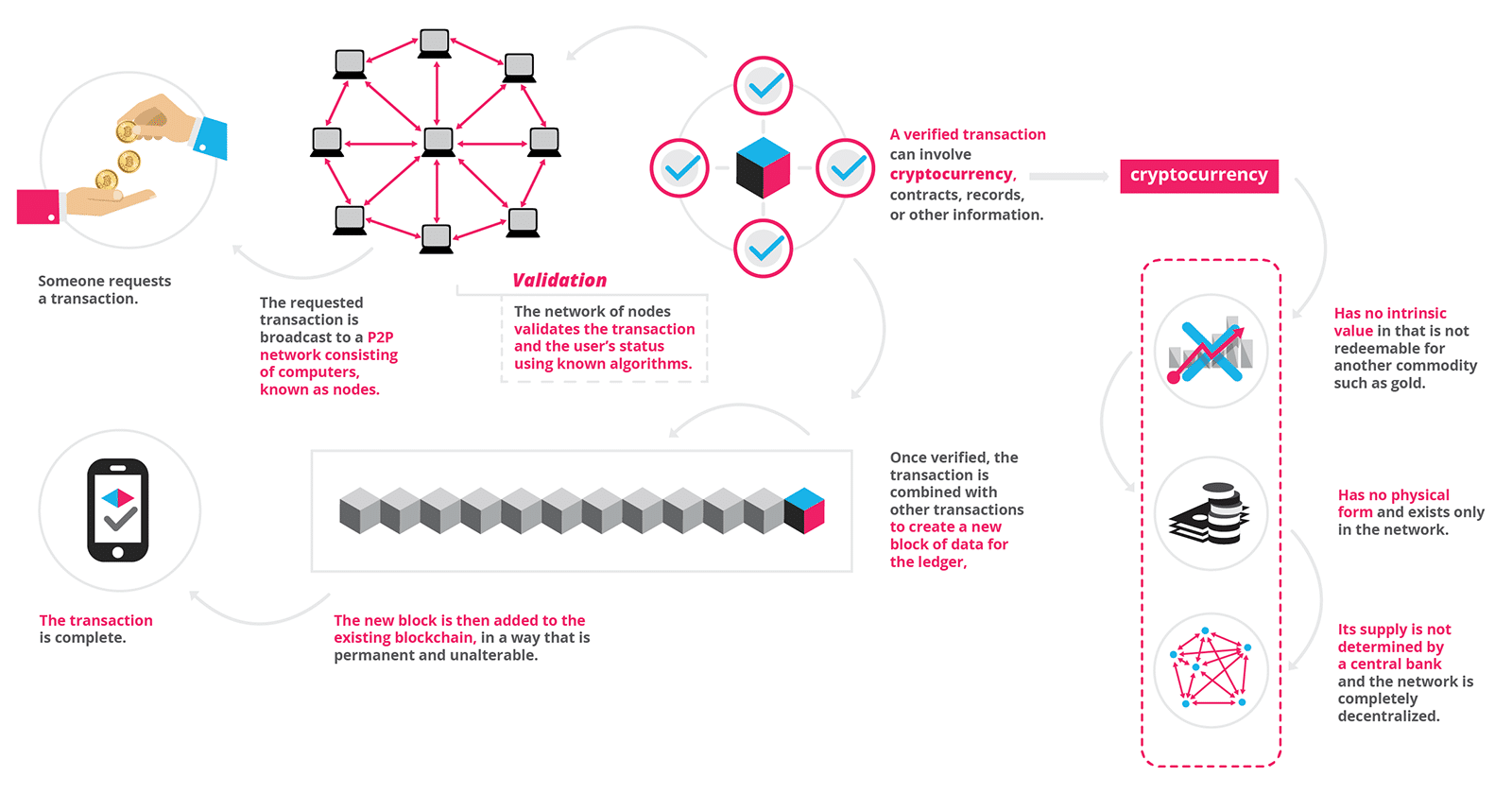
  1. No intrinsic value: which means it cannot be exchanged for any commodity such as gold.
  2. No physical form: it only exists on a digital network.
  3. Decentralized network: it is free from any bank’s influence and its supply not decided by a bank.

Why the decentralization of the bitcoin made it so popular?

Decentralization, as discussed, above is the independence from the influence of any government and/or central authorities. Since the government exercises no control over the cryptocurrency market (here the bitcoin’s market) the businessmen don’t have to abide by any trade laws and hence can enjoy super profits. Super profit is basically an amount of profit which is way more than the average profit earned on any trade. Generally, the super profits are earned in a monopoly where the trader is the only seller in that particular market and enjoys access to a huge customer/consumer base.

Bitcoin represents the first decentralized cryptocurrency, which is powered by a public ledger that records and validates all transactions chronologically, called the Blockchain.

As of May 2018, there are more than 1500 cryptocurrencies available over the internet, all but one of which are altcoins. New cryptocurrencies can be created at any time; additionally, there are many older cryptocurrencies which are no longer on the market.

Blockchain

The Blockchain is basically a digital ledger (a ledger is a book in which all the economic transactions are recorded, consisting of debits and credits in separate columns along with monetary balance at the beginning and at the end of the book after the transactions have been made.) where all the transactions are recorded and validated, chronologically/in order of occurrence.

The most unique and essential feature of blockchain is that it allows the distribution of digital data but that same data cannot be copied, making blockchain useful in various other fields other than digital currency.

The diagram goes on to explain the intricacies involved in the transactions involving the bitcoin:

  1. A transaction is requested;
  2. The transaction is then run through a series of computers, which are connected via a p2p network (a p2p network or a peer to peer network is created when two or more computers are connected to one another and share the same resources), validating the transaction and user’s status.
  3. A verified transaction can involve a lot of things like contracts, records, and various other information.
  4. Once validated, all the transactions are combined to form a new block of information, which is further attached to the existing chain of blocks.
  5. The new chain so formed is permanent and cannot be changed.
  6. After all these processes the transaction is said to be complete.

(NOTE: various blocks of information are combined to form a chain of information, hence the name blockchain)

Categorization of Cryptocurrencies

All tokens or coins are regarded as a cryptocurrency, even if most of them do not function as currency or medium of exchange.

The term cryptocurrency is a misnomer (wrong or inaccurate name; not what the name suggests) since it does not have the characteristics of a currency (no store value, not a medium of exchange).

But these characteristics are there within the bitcoin and since the bitcoin was responsible for kickstarting the cryptocurrency space; all the other coins conceived after bitcoin are generally considered as a cryptocurrency.

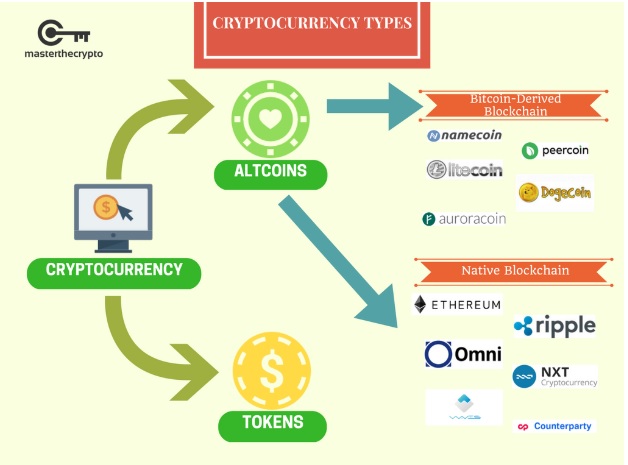
The most basic categorization of cryptocurrency is:

  1. Alternative cryptocurrency coins (altcoins)
  2. Tokens

Altcoins

“Altcoin” is a combination of two words: “alt” and “coin”; alt signifying ‘alternative’ and coin signifying (in essence) ‘cryptocurrency.’Altcoin simply refers to those coins that are an alternative to bitcoin.

Altcoins are basically generated by using the basic programming of the bitcoin while making some changes to coding thereby creating an entirely new coin with its own unique set of features.

Altcoins differ themselves from bitcoin with a range of procedural variations, including different proof-of-work algorithms, this system of an algorithm makes sure that there is no denial of service and other service abuses, different means by which users can sacrifice energy to mine blocks, and application enhancements to increase user anonymity.

The earliest notable altcoin, Namecoin, was based on the Bitcoin code and used the same work algorithm – and like Bitcoin, Namecoin is limited to 21 million coins. Introduced in April 2011, Namecoin primarily diverged from Bitcoin by making user domains less visible, allowing users to register and mine using their own bit domains, which was intended to increase anonymity and censorship resistance

Current leading examples of altcoin include Litecoin, Dogecoin, Ethereum (2nd to Bitcoin in market capitalization as of May 2018), and Ripple. However, Litecoin is seen as the closest competitor to Bitcoin.

Tokens

Going by the definition, a token is a type of cryptocurrency which is usually issued on top of another blockchain. Generally, in any use case(use case is a software engineering term which describes how a user uses a system to accomplish a goal), tokens represent utility or an asset, or sometimes both.

Tokens can represent basically any assets that are fungible(one unit is equivalent to another) and tradeable, i.e., from commodities to loyalty points to even other cryptocurrencies.

(Fact: Tokens cannot exist independently, they need the infrastructure of a coin to exist.)

Basically, a token is a secondary asset for a particular application on a blockchain ecosystem which also has a market value but isn’t a currency as straightforward as Bitcoin or Litecoin.

Creating tokens is a much easier process as you do not have to modify the codes from a particular protocol or create a blockchain from scratch. All you have to do is follow a standard template on the blockchain – such as on the Ethereum or Waves platform – that allows you to create your own tokens. This functionality of creating your own tokens is made possible through the use of smart contracts; programmable computer codes that are self-executing and do not need any third-parties to operate.

Tokens are created and distributed to the public through an Initial Coin Offering (ICO), which is a means of crowdfunding, the process of funding a project by raising small amounts of money from a large number of people, through the release of a new cryptocurrency or token to fund project development.

An initial coin offering is same as an initial public offering which is in case of stocks, with some distinctions.


(Image Source: https://blockgeeks.com/guides/what-is-blockchain-technology/)

Differences between Coins and Tokens

There are some basic yet essential differences between coins and tokens ;

  1. Structure: Coins are digital financial assets; they are actual currencies and are capable of being exchanged and used for trading purposes. Tokens are also digital financial assets but rather than being the actual financial assets like the coins they act as a representation of the actual financial assets.
  2. Infrastructure: Each coin has its own independent blockchain, distinguishing it from any other coin. While the same can not be said for tokens, tokens are built upon and entered into the same blockchain.
  3. Creation: Most of the coins use the basic framework of a bitcoin along with some additional coding and changes to the framework to introduce new and unique features so as to differentiate it from bitcoin or any other coin whose framework has been used. All the programming and coding is done from the scratch. Purpose of such a creation is to improve upon the existing technology, making it more efficient. While for creating a token no changes to the programming or additional coding is required, all the tokens use the same codes for their entry into a blockchain.
  4. Ease and Difficulty of Creation: Since, for the creation of cryptocurrency coins there is a need for programming and coding from the scratch; hence, the level of difficulty of creation is higher as compared to tokens, which use the same set of codes and programming for their creation.
  5. Platform for Operation: Coins are so programmed that it is in their nature to exist independently. Coins can be used for trading as well as a measure of exchange and a unit of measure for digital financial assets. Tokens on the other cannot exist independently and are not the direct financial assets rather mere representation of assets. They are based upon other platforms.

Conclusion

The difference is becoming more and more complex with the launch of various projects involving cryptocurrencies, However, several countries like US and Japan are forming regulations around different types of cryptocurrencies which will make it relatively easy for us to understand the nuances of this budding industry.

Bibliography

Download Now

Recent concerns over online courses at NUJS: Public Statement

5

This statement is written by Ramanuj Mukherjee, CEO, iPleaders

Recently NUJS uploaded a notification on their website. Here is the text of the same:

NUJS

After this, at iPleaders, we have been flooded with queries from existing students of online courses of NUJS (in excess of 3000) about what is happening. It has become impossible to deal with each query individually despite answering calls day and night, and even concerned parents of students are calling us up as NUJS does not respond to any calls. Hence we are forced to issue this statement.

Our role is that we are the service provider to NUJS for all of its current online courses. After students make payment on NUJS website and take enrollment, they are serviced by iPleaders (technology, content access, customer services). iPleaders also markets the courses. NUJS plays a role in approving study material, assessing the assignments and conducting exams (using iPleaders’ technology infrastructure) and issues certificates. These courses have been running smoothly since 2012 and over 4000 students have finished their courses so far, received certificates and have gone on to achieve success in their careers. If you want a sample of who these people have been, check here.

Approximately 15% of NUJS annual budget comes from these courses. So it has been very successful for NUJS as well. Apart from money, they got accolades for the same too – SILF (Society of Indian Law Firms) gave an award to NUJS for reaching out to a wide section of the society through online courses and India Today mentioned the same in an article. From secretary level IAS officers, CEOs and MDs and Supreme Court lawyers and even acting judges, many luminaries took these courses managed by us on behalf of NUJS.

While it is true that we played a significant role in conceptualizing these courses and bringing industry experts to teach in these courses, it was always clear that these are NUJS courses where iPleaders is a technology and service provider. Since NUJS did not want to make any investment in creating or running these courses, iPleaders was paid on a per enrolled student basis. Out of the money received, iPleaders is expected to bear all costs of running the course.

However, recently there was an administration change at NUJS. Retired Justice Mr. Amit Talukdar has been appointed as acting VC at NUJS from April 7. Since then, we have not received our due payments from NUJS. Any course completion certificates that were to be issued since then, even if signed by course coordinator, registrar, etc. were not signed by him so they could not be sent to the students. Those students who finished their courses in March, April or May continue to wait for their certificates. And we continue to run courses bearing all expenses from our own pockets for ongoing batches since we cannot shut down courses that are running and students are studying. Also, we believed that this is a temporary issue arising out of a new VC taking charge, and will soon be sorted.

We requested for meetings, appointments, wrote emails, made calls – but they were not even acknowledged. We continued to wait. Sometimes in June, we heard that Academic Council, led by the VC, has heard an objection related to distance courses offered at NUJS and have taken some decision to stop new admissions. We tried to approach the university, but the professors who agreed to speak with us such as Acting Registrar Sarfaraz Ahmed Khan (who since then resigned from that post), Prof. Anirban Mazumdar (Professor in charge of School of Distance and Mass Education at NUJS), Asst. Prof. Vaneeta Patnaik (Course Coordinator), Asst. Prof. Sujata Roy (Course Coordinator for Diploma and Certificate Courses) informed us that there is some decision taken by Academic Council and we will be informed in due course about what to do. We received no communication from NUJS thereafter. We continued to write emails, make calls and try to get appointments. Abhyuday Agarwal, COO of iPleaders, visited Kolkata and tried to meet the VC, and was unsuccessful.

The new Acting Registrar told Abhyuday that she has just taken charges and will see what to do. Abhyuday requested the Registrar that an opportunity for a hearing be provided before taking any adverse action. She said that she had not applied her mind to the matter as of then, and said she would consider the matter in due course. Abhyuday also furnished her a clarificatory statement explaining the extraordinary performance of the courses, which she received. Abhyuday also approached the Vice-Chancellor’s PA, Urmi Majumdar, who promised that she would fix an appointment with him after the vacations are over and let him know so that he could travel to Kolkata. Abhyuday followed up but was not provided with an appointment.

After this, since NUJS wasn’t paying us for several months, it severely affected our finances. We had to let go of close to 10 valuable team members. We decided to keep the courses running no matter what, even if that meant working late into the night and one person doing the job that normally 3 people do. Not only that, most team members took a pay cut to keep iPleaders running. For a couple of months, we could pay ourselves only 40% of our normal salaries, and co-founders including I decided to go without any remuneration indefinitely until the situation improves. We even received insolvency notices from aggrieved vendors whose payments were delayed but managed to pay those dues in one way or another and continued our journey. We also continued our other businesses (iPleaders blog, LawSikho courses that do not involve NUJS) and managed to survive as a venture so far. We were close to giving up, but we were not willing to give up on the students and that kept us going.

Nonetheless, the situation at NUJS has crippled us financially but made us realise that the work we do must continue, and preferably without the involvement of universities. We are doing exactly that. You would see us working on even more cutting-edge legal education without universities going forward. However, let me get back to the NUJS issue.

While NUJS has not clearly said anything to us or anyone else about what would happen to the past and ongoing batches of various online courses, we got a taste of what may happen last week. We found out that during an exam for medical laws distance course at NUJS (not an online course, not related to iPleaders in any way, but offered by NUJS), students who came to write the exam in NUJS from different places in India were turned away from exam hall stating that all courses are suspended. We heard this when we began our enquiry after seeing the notification on NUJS website. Some of those students told me, when I contacted them, that they are approaching the court against NUJS.

After this, I have received calls from various students who are anxious about the payment made to NUJS and their career plans being jeopardized. A few of them even accused me or iPleaders of cheating them. I understand their anger. After all, they talk to us as customer service providers regularly and identify us with the course. Also, some of them saw our marketing before buying the course. However, it is important to understand that we never anticipated that administration of a government university, that too a law university, will take such arbitrary actions without any explanation, prior intimation or information. And nothing changes the fact that we provided services on behalf of NUJS, for all of NUJS online courses, that NUJS launched and we serviced. As a vendor, our powers are very limited if the University engages in patently illegal and arbitrary actions.

At the end of the day, all students have enrolled with NUJS in courses announced by NUJS, on NUJS website and made all payment to NUJS. Many of them even finished their courses according to NUJS syllabus, and are waiting for their certificate. Others have done some assessments or appeared in exams which were set, checked and marked by NUJS faculty members. There is no way NUJS can deny you of your rights to finish the course. Most of you are lawyers, and I don’t need to explain that to you. However, you may have to take some actions to enforce your rights as when a government body fails to respect your rights, that is the recourse you are left with as you may have realised as all your calls and emails went without any answer over last 3 days.

iPleaders has served a legal notice and will initiate litigation as well as proceed with arbitration for violation of our contract with NUJS and to recover our dues.

Many of you asked us in Whatsapp groups if iPleaders can file a case against NUJS for violating your rights. We do not have legal standing (locus standi) to represent students’ case in a court of law directly, so they must do so themselves. We will, of course, point out these illegalities when we approach courts to protect our interests under the law.

NUJS has certain responsibilities in connection with the courses under our contract, and we will pray to the Courts that NUJS continues to do so for students who are already studying the courses. However, students approaching a court directly with respect to education promised by a University will stand a superior chance than a private party enforcing a contract.

We are putting out this statement as we have been contacted by media persons and many students. Some have come to the conclusion that we must have done something wrong based on inadequate information. It is important for transparency that you know the situation, especially when the University authority has been vague and strangely silent. Many of you were counting on us for to solve this deadlock, but our powers in this situations are nil except for sharing this information so that you can take any action you deem fit if you wish to. I have spent countless hours already answering questions and phone calls from upset students, many of them told us that they expect us to inform them about such debacle more proactively and I hope that putting out this statement will help the situation.

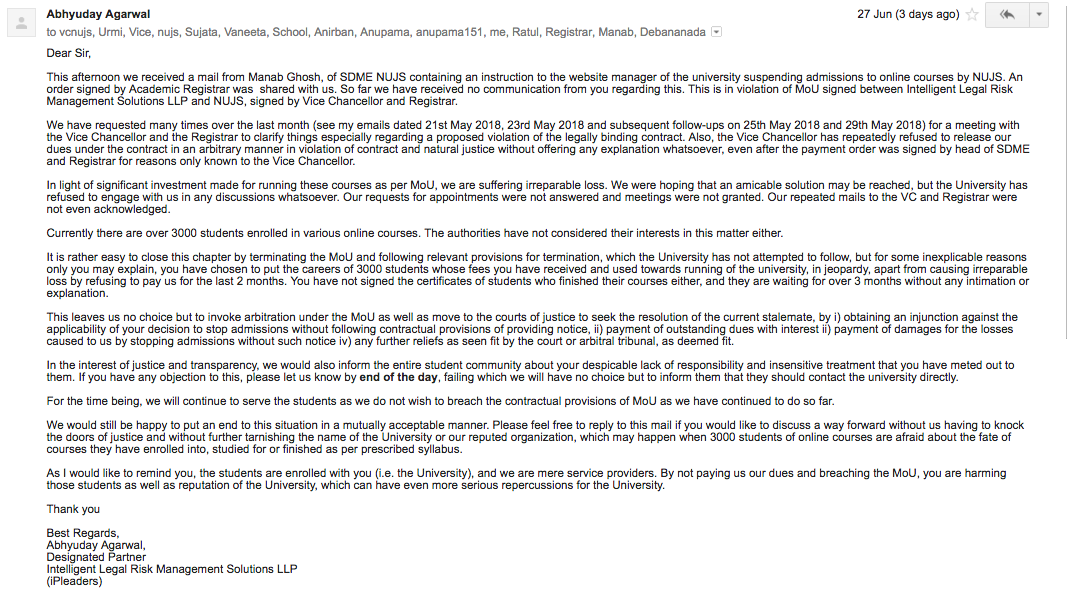
Here is the final mail we wrote the VC after we came to know of the 27th June notice on NUJS website.

NUJS

If you cannot read it, here is the text:

Dear Sir,

This afternoon we received a mail from Manab Ghosh, of SDME NUJS containing an instruction to the website manager of the university suspending admissions to online courses by NUJS. An order signed by Academic Registrar was shared with us. So far we have received no communication from you regarding this. This is in violation of MoU signed between Intelligent Legal Risk Management Solutions LLP and NUJS, signed by Vice Chancellor and Registrar.

We have requested many times over the last month (see my emails dated 21st May 2018, 23rd May 2018 and subsequent follow-ups on 25th May 2018 and 29th May 2018) for a meeting with the Vice Chancellor and the Registrar to clarify things especially regarding a proposed violation of the legally binding contract. Also, the Vice-Chancellor has repeatedly refused to release our dues under the contract in an arbitrary manner in violation of the contract and natural justice without offering any explanation whatsoever, even after the payment order was signed by the head of SDME and Registrar for reasons only known to the Vice Chancellor.

In light of significant investment made for running these courses as per MoU, we are suffering irreparable loss. We were hoping that an amicable solution may be reached, but the University has refused to engage with us in any discussions whatsoever. Our requests for appointments were not answered and meetings were not granted. Our repeated emails to the VC and Registrar were not even acknowledged.

Currently, there are over 3000 students enrolled in various online courses. The authorities have not considered their interests in this matter either.

It is rather easy to close this chapter by terminating the MoU and following relevant provisions for termination, which the University has not attempted to follow, but for some inexplicable reasons only you may explain, you have chosen to put the careers of 3000 students whose fees you have received and used towards running of the university, in jeopardy, apart from causing irreparable loss by refusing to pay us for the last 2 months. You have not signed the certificates of students who finished their courses either, and they are waiting for over 3 months without any intimation or explanation.

This leaves us no choice but to invoke arbitration under the MoU as well as move to the courts of justice to seek the resolution of the current stalemate, by

  1. obtaining an injunction against the applicability of your decision to stop admissions without following contractual provisions of providing notice,
  2. payment of outstanding dues with interest
  3. payment of damages for the losses caused to us by stopping admissions without such notice
  4. any further reliefs as seen fit by the court or arbitral tribunal, as deemed fit.

In the interest of justice and transparency, we would also inform the entire student community about your despicable lack of responsibility and insensitive treatment that you have meted out to them. If you have any objection to this, please let us know by end of the day, failing which we will have no choice but to inform them that they should contact the university directly.

For the time being, we will continue to serve the students as we do not wish to breach the contractual provisions of MoU as we have continued to do so far.

We would still be happy to put an end to this situation in a mutually acceptable manner. Please feel free to reply to this mail if you would like to discuss a way forward without us having to knock the doors of justice and without further tarnishing the name of the University or our reputed organization, which may happen when 3000 students of online courses are afraid about the fate of courses they have enrolled into, studied for or finished as per prescribed syllabus.

As I would like to remind you, the students are enrolled with you (i.e. the University), and we are mere service providers. By not paying us our dues and breaching the MoU, you are harming those students as well as the reputation of the University, which can have even more serious repercussions for the University.

Thank you

Best Regards,

Abhyuday Agarwal,

Designated Partner

Intelligent Legal Risk Management Solutions LLP

(iPleaders)

For those who are interested in more details, I am adding the entire story of how these courses came to be and what happened so far in greater details below.

At the end, I am also adding a suggested way forward, and providing contact details of responsible professors and administrative officials at NUJS. You can ascertain the facts provided here and take the actions that you deem to be fit.

How we started courses with NUJS

When I was in law school, I was a good student. I had topped the law entrance (2nd topper, actually). I didn’t want to be ordinary. I believed I was special. My dream was to become a successful, amazing corporate lawyer.

I wanted to learn beyond what was there in the textbook. I wanted something that will really prepare me for my life ahead as a corporate lawyer. Maybe reading all the big fat textbooks in the library will do it? Maybe the secret is to win some moots? Maybe I just had to get the right internships? Maybe I should just read the pink newspapers like everybody says?

I did all those things. Quite successfully. But then I was dissatisfied. I didn’t find something that would really teach me how to become a good corporate lawyer. Reading the big fat Mulla and Mulla didn’t teach me how to draft a single commercial contract for which a lawyer can get paid a fat sum. I read the Companies Act, yes I really did. I still couldn’t make head or tail of corporate governance. I didn’t know anything about how all these play out in the real world.

I didn’t get what I was looking for, but I was studying at a top law school, had the right CV and marks, and I knew stuff. So I got multiple offers on the Day Zero of recruitment. I had a job that paid close to 1 Lakh per month even before I started my final year. I graduated.

When I went on to work for one of the best law firms in India, I discovered that people really struggle through the process of joining a law firm, learning on the job, adapting to the work culture, delivering on the clock – all at the same time. It is a very hard process. A large number of lawyers drop out in less than a year. There are a lot of other lawyers who never make it because they do not get a good senior who is willing to train them.

Abhyuday Agarwal (my Co-founder) and I thought that there must be a better way of creating powerful lawyers in India! Something was clearly missing. The hallowed law schools are really not doing their job it seemed! They teach statutes and case laws. Some of them claim to teach the law students to think like a lawyer but hardly any of them do that.

Most students who manage to do well have mostly their own contacts, or have their own effort or serendipity to thank for. I wanted to change that. I wanted to create a systematic way to learn practical aspects of the law, from the best in the practice, without jargons and deadwood legalese. Something that will set people on the path to excellence as a lawyer, a program that will help them to hit the ground running as they graduate and join a practice. What if we can create a system – where we can train them to be extraordinary business lawyers? What if we made an equivalent of a business law gym? What would it look like? What will it take?

We wanted to simplify legal learning to the extent that even a high school student should be able to understand it. Somehow, that really appealed to me – that we are working on a project that will one day enable crores of Indians to understand the laws that govern their life without having to break their head to make sense of every sentence. That is what propelled us to create the iPleaders Blog (now used by over 50 lakh people in a year), and courses on subjects like RTI and FIR.

Also, while I was in law school, I noticed that there are many non-lawyers who want to learn the law. Managers, CEOs, Directors, NGO workers – people can be empowered through legal training.

That, and the intent to create a new generation of powerful lawyers in India. These are the things that not only inspired us back then but still keep us going.

It has been over 7 years since we began. Even earlier, back in 2010, we took that question seriously. What if we have a 1-year curriculum to teach business laws – what can we teach in 1 year to set people on the path of becoming extraordinary business lawyers? We went and talked to people from the industry and asked them exactly that. We went and spoke to retired judges, we spoke to partners and associates of law firms. We consulted investors, bankers, litigators about what we should teach young lawyers and law students.

To be honest, many of the people we asked were either blank or pessimistic. One well-known Supreme Court lawyer almost threw me out of her chamber because she felt we are doing a disservice by trying to create shortcuts.

We were indomitable. We found our champions, we convinced them, we got them to form an industry-academia panel and to volunteer their time. Then we went and met Prof. M.P. Singh, at that time the VC of NUJS, and we convinced him to start a course for lawyers and entrepreneurs together. We convinced him and a full strength faculty meeting that such a course will bring glory to NUJS. And that was how we started our first online course, Diploma in Entrepreneurship Administration and Business Laws.

Over the next 6 years, this course brought us many accolades. Prof. Ishwara Bhat, the new VC of NUJS who replaced Prof. MP Singh, was touched when while on summer vacation, he met a girl from Dharwad Law College, who did our course and then got a job at a Mumbai law firm. She told Prof. Bhat how the course made the impossible possible for her (she left the law firm in a while though, and now teaches at an NLU herself)! Prof. Bhat was impressed. He called us and told us to expand online courses at NUJS. Encouraged by his support, we launched a battery of certificate courses over the next few years. We also enabled NUJS to launch the MA in Business Laws course, with the goal of giving a solid competition to NLSIU Bangalore MBL course which is very popular.

We were successful beyond our wildest dreams. But NUJS had to stop the degree course due to some abrupt changes in rules by UGC. In order to offer a Degree course online, ideally, NUJS should get a NAAC accreditation which till date eludes the University because it never applied.

The diploma courses and certificate courses were continued. There are 3 MA in Business Law course batches running too. In all, there are over 3000 students in these batches currently studying. The revenue from these courses contributes to over 15% of the annual budget of NUJS as of last financial year.

What is the way forward we see

At iPleaders we have resolved to not work with NUJS going forward given the extreme uncertainty, not only our own but also that of future of students, that we have experienced despite the past 6-years’ relationship (so far we received not a single complaint from NUJS about our services, and no termination or notice whatsoever). As soon as the current deadlock is resolved, we will like to serve the notice period under our agreement and wrap up.

However, any student who took admission before such time, we will continue to serve even if NUJS doesn’t pay us. This is out of our belief that we must do everything in our power to make the situation for students as easy as possible.

However, students will need to take some concrete actions to ensure that NUJS continues to perform its share of the duties – such as evaluation of assessments and issuance of certificates to students who pass the exams. We would definitely represent student interest with NUJS wherever possible, but in the changed circumstances, as a vendor, our ability to do so in perhaps limited.

There is no stopping of any assessments or exams in any courses. These have been launched in accordance with a course calendar prepared for the academic year for the courses, prior to the suspension notification. Everything is going on as per declared schedule. Whatever may be the vague or unclear stand of NUJS, they have not so far stopped any courses, nor informed us to stop any activities. They didn’t ask us to stop new admissions either, which we stopped on our own volition so that new students who may join do not get into this deadlock.

I believe that with time more clarity will emerge, especially since many students have told me that they are planning to file writ petitions in their respective cities. Once such petitions are filed, NUJS will have to take a clear and coherent stance in the courts. There can be no justification for stopping an ongoing course or refusing to issue certificates to a student who already finished a course. Hence, it is likely that now or later NUJS will make the right decision, or be ordered by Hon’ble courts to correct their actions and not jeopardize the students.

However, the problem of commons may occur here. Some students are waiting for others to take actions. Hence, there is a risk that nobody may end up taking expedient action in the wait for others. We have to wait and watch on that front.

Some students have also started an online petition but I am quite doubtful about the final outcome of such efforts given that students of various online courses are not well connected with each other.

We are listing some pointers that may enhance the effectiveness of students’ action:

  • Students must send a communication or notice to the university staff mentioning their student ID, the course name and mention that they are performing/ have completed the requirements of their course. It is not necessary to coordinate for everyone, you can do this for your own self.   
  • The notice or communication must demand that the University must perform its responsibility in connection with the course. This is important because judicial forums may inquire as to whether you have approached the University first or not before entertaining the matter. This action will substantiate your claim that you have already demanded performance of NUJS’ responsibilities which has not been done by the University.     
  • If the university refuses to respond like it has done in the past, I see no option but to knock the door of justice as you may deem fit.

NUJS is our own alma mater and has been of support to us in the past, and we do not intend to promote litigation against the University. However, you must take your decision to protect your interests and enforce your rights, in light of the fact that you have spent large sums of money and much time and effort on these courses, especially since we would be unable to help you much here if the current administration at the University continues to refuse to see reason.

Important contact details

Since iPleaders is not able to help you with queries related to this so-called suspension order, as we have been told nothing by NUJS authorities, the best we can do is provide you direct contact details of those in charge of relevant offices at NUJS.

If you want to reach me, please call me on 8377972123 (Ramanuj Mukherjee).

Contact details:

Vice Chancellor: [email protected]

Registrar: [email protected]

Assistant Registrar: Anupama Ghoshal: her phone numbers and email ids are provided on her NUJS profile page.

Prof Anirban Mazumdar, Professor in charge of SDME – email id provided on NUJS website.

Sujata Roy, Course Coordinator, Diploma and Certificate courses – [email protected]

Vaneeta Patnaik, Course Coordinator, MA in Business Law courses – [email protected]

NUJS Landline: (+91)33-2335 7379 /0765/2806 /2809/2811/2812

Download Now

Draft law of ‘Manav Suraksha Kanoon’ (MASUKA) – National Campaign Against Mob Lynching

1

In this article, Saurabh Kumar discusses the draft law of ‘Manav Suraksha Kanoon’ (MASUKA) – National Campaign Against Mob Lynching.

DEFINITION OF LYNCHING

According to the Oxford English dictionary, lynching refers to the act of killing/s done by a mob without any legal authority or process involved. In older times, such acts of lynching used to involve hanging a person to death. The mob usually killed someone accused of a wrongdoing based on their suspicion and without looking into available evidence. Lynching is considered as a major crime like murder or rape. The mob serving as “judge, jury and executioner” would carry out their spontaneous or pre-planned act of killing with absolute impunity and without any fear of law[1].

CURRENT STATUS AND STATISTICS

According to the website- “India Spend”- there have been about 28 deaths and 63 incidents of mob lynching and violence in India that have taken place 2010 to 2017, linked with so-called cow protection groups.  97 per cent of these acts have taken place post-May, 2014. However, in 21 per cent of the cases, police officials ended up persecuting the victim/survivor (s) by filing cases against them on the suspicion of having engaged in cow slaughter. In about 90 per cent of the cases, the victim/survivor(s) belonged to Muslim community. In the first six months of 2017, the attacks increased by 75 per cent in comparison to 2017. This has been the most violent year in terms of cow protection related mob killings since 2010[2].

Lynching has also been due to other reasons and instances. Many women continue to be killed in parts of India on the suspicion of witchcraft. About 2000 women have been killed by mobs between 2000-2012 in 12 states on the suspicion of having indulged in witchcraft practices. There have also been historical caste related killings in India, which have involved mob-killings. However, in most cases, such acts are not reported. These killings are meant to enforce caste hierarchy and practices. In 2002, for the first time, it was reported that about 5 Dalits were killed by a mob on the suspicion of having killed cattle. Such killings of people from lower castes on the suspicion of having engaged in cattle slaughter has increased in the following years. Mob killings are also seen during riots or as instigation for groups to indulge in rioting as seen in Muzzafarnagar and Kokrajhar riots[3].

Mob killings of late have reflected a sense of violence and prejudice against certain communities and castes. In the past few years, several of these killings have involved self-professed cow vigilante groups. These groups, have acted with utmost impunity and targeted mostly Muslims, based on rumours and biases. According to India Spend, at least 101 mob killings in the past few years have involved cow protection groups. Such groups have cited their cause of protecting cows, considered as a holy animal in Hindu scriptures and the recent banning of cattle slaughter by the Central government as their motivation behind targeting those who are accused of killing cattle. In 61 cases filed in the past 3 years, the perpetrators belonged to cow vigilante groups and most of these cases have taken place in states ruled by a right to centre party[4].

IMPORTANT CASE LAWS

The Indian judicial system has in the recent past attempted to counter mob killings and emphasise on the rule of law and values enshrined in the Indian constitution as seen in the cases below[5]

  • National Human Rights Commission v. State of Gujrat and others (2009) 6 SCC 342- The Supreme Court said that-

“Communal harmony is the hallmark of a democracy. The Constitution of India, in its Preamble refers to secularism. Religious fanatics are’ no better than terrorists who kill innocent for no rhyme or reason in a society which as noted above is governed by the rule of law.”

  • Krishna Sradha v. State of Andhra Pradesh (2017) 4 SCC 516- The Supreme court said that-

 “A right is conferred on a person by the rule of law and if he seeks a remedy through the process meant for establishing the rule of law and it is denied to him, it would never subserve the cause of real justice.”

  • Cardamom Marketing Corporation v. State of Kerala (2017) 5 SCC 255- The Supreme Court said that-

 “The Rule of Law reflects a man’s sense of order and justice. There can be no Government without order; there can be no order without law”

CURRENT LAWS AGAINST LYNCHING

According to current laws,  provisions of Indian Penal Code (IPC) are applied to deal with instance of mob killing like Section 302 Section 302 (murder), 307 (attempt to murder), 323 (causing voluntary hurt) 147 (rioting), 148 (rioting armed with deadly weapons) and 149 (unlawful assembly[6].

Similarly, under Section 223 (a) of the Criminal Procedure Code (CrPC), it is allowed to try two or more accused for conducting a crime as a “same transaction”. However, it is to be noted that in spite of sections under IPC and CrPC being available to prosecute mob killings, legal experts have indicated the indeed for a specific law to counter mob killings in India[7].

Manav Suraksha Kanoon (MASUKA)

Manav Suraksha Kanoon (MASUKA) is a law against mob lynching which has been proposed by National Campaign against Mob Lynching (NCAML)[8]. NACML is a committee of the following eminent individuals, who aim to come up with a dedicated anti-lynching legislation in India[9]

  • Sadaf Musharraf
  • Apoorvanand Jha- Hindi Professor at Jawaharlal Nehru University(JNU)
  • Sanam Wazir
  • Rebecca John- eminent criminal lawyer
  • Manoj Jha- social worker and educationist
  • V Geetha- activist and writer with specialisation in Social History
  • Swara Bhaskar- Bollywood actress and media personality
  • Anil Chamadia- media personality, columnist and educationist
  • Nivedita Menon- Political Though Professor at Jawaharlal Nehru University(JNU)
  • Sanjay Hegde- practising senior lawyer at the Supreme Court

MASUKA also contains measures to help rehabilitate victims and/or their families fiscally with compensation packages from the state government as a mandatory measure and optional collection of fines from accused after their successful conviction. Taking a cue from Prevention of Child Sexual Offences Act (POCSOA) 2012 which came up with creation of special courts, the MASUKA law also calls for creation of special courts to fast track trials. MASUKA also calls for judicial probe to be conducted wherever lynching takes place and investigate into the possible role of the Station House Officer (SHO) and calls for action against SHO if found guilty of inaction or collaboration with the perpetrator. This will keep law enforcement officials in check and prompt necessary action from them. MASUKA also calls for a dedicated witness protection programme for witnesses in such cases to ensure their safety till the completion of trial[10].

NEED FOR MORE MEASURES

While the proposed MASUKA will fulfil the need for a specialised law to counter mob lynching, it has to be complemented with a multi-pronged approach with the help of laws like the Prevention of Communal and Targeted Violence (Access to Justice and Reparations) Bill, 2011, or the Anti-Communal Violence Bill and ushering in long pending police reforms[11].

The Anti Communal Violence Bill has been stalled due to opposition from states who feel that it infringes on their constitutionally guaranteed powers. However, the bill should be revived as it ensured accountability from concerned authorities to counter communal riots accepts that riots are meant to subjugate and oppress minorities and created a protocol to ensure timely investigation of communal offences with related redressal. However, in order to carry out effective investigation, police officials should be free from any political pressure. As emphasised by the Supreme Court in the case of Prakash Singh V Union of India, police reforms should have been initiated by the states in sync with the centre in order to grant police officials requisite autonomy. Without any proper investigation, the third aspect of the Anti-Communal Violence Bill cannot be implemented. Therefore, police reforms should also be initiated with further delay. Therefore, the framers of MASUKA should also include measures from the proposed Anti-Communal Violence Bill and also demand for police reforms in order to enforce and investigate with greater efficacy[12].

There is also a need to promote social inclusiveness via laws, as seen in The Maharashtra Protection of People from Social Boycott (Prevention, Prohibition and Redressal) Act, 2016. It helps in outlawing any act that may amount to boycotting any person or community socially. It includes denying anyone any social or religious rite, not allowing final rites, marriage, obstructing the right to receive medical aid or education, not allowing access to community hall or any facility meant for the general populace, not allowing a person to carry out any trade or profession amongst other rights etc.  If any person is found to be guilty of having engaged in acts of social ostracising, it will lead to a punishment of up to 3 years in prison and/or a fine of one lakh rupees. This act takes into account different factors that cause caste based discrimination like forcing someone to wear certain attire and/or using abusive or stereotypical language to refer to someone[13].

CONCLUSION

It cannot be denied that lynching killings are a major menace. Based on caste, religious, historical and other bias, it has affected too many lives to be ignored. Over 2000 lives have been lost in the last decade to lynching. It affects the public’s confidence in the government and rule of law. Therefore, it should not be ignored anymore. Legal and administrative reforms are needed on an extensive scale to counter them. There is a need for a specialised law- on the lines of MASUKA complemented with reviving the Anti-Communal Violence Bill. There is also a need promote social inclusiveness via laws, as seen in The Maharashtra Protection of People from Social Boycott (Prevention, Prohibition and Redressal) Act, 2016.There is also an urgent need to usher in police reforms. It will ensure better tackling of this menace in the future.

[1] Expertily, Why is India desperate for lynching laws , (June 27,2018), available at https://www.expertily.com/blog/lynching-laws-in-india (Last visited on June 20, 2018).

[2] The Hindu, It’s time to enact an anti-lynching law ,(August 4, 2017), available at http://www.thehindu.com/opinion/lead/its-time-to-enact-an-anti-lynching-law/article19421424.ece (Last visited on June 20, 2018).

[3] The newslaundry.com, Mob lynchings in India: A look at data and the story behind the numbers ,(July 4 , 2017), available at https://www.newslaundry.com/2017/07/04/mob-lynchings-in-india-a-look-at-data-and-the-story-behind-the-numbers (Last visited on June 20, 2018).

[4] Id.,3.

[5] LiveLaw.in, Government, Governance, Lynching And Rule Of Law ( July 5 ,2017), available at
http://www.livelaw.in/government-governance-lynching-rule-law/ (Last visited on June 20,2018).

[6] News 18, Civil Society Comes Together To Draft ‘Law’ Against Mob Lynching, (June 28, 2018), available at http://www.news18.com/news/india/civil-society-comes-together-to-draft-law-against-mob-lynching-1446177.html (Last visited on June 20,2018).

[7]SAMPATH, Supra note 2.

[8] SHRIVASTAVA, Supra note 1.

[9] Id., 8.

[10]iPleaders,  MASUKA – A draft bill by the collective National Campaign Against Mob Lynching to curb the menace of mob-lynching, (August 3, 2017), available at https://blog.ipleaders.in/masuka-draft-bill/ (Last visited on June 20,2018).

[11]SAMPATH, Supra note 2

[12] Id.,11.

[13] The Hindu, The boycott ban: on Maharashtra’s law against social boycott, (July 24,2017), available at http://www.thehindu.com/opinion/editorial/the-boycott-ban/article19337662.ece (Last visited on June 12,2018).

Download Now

5 Important Takeaways from Companies (Amendment) Act, 2017

0
takeaways

In this article, Aarthi S, pursuing Diploma in Entrepreneurship Administration and Business Laws from NUJS, Kolkata discusses on important takeaways from the Companies (Amendment) Act, 2017

Introduction

The Companies Law Committee (“CLC”) was constituted by the Ministry of Corporate Affairs (MCA) in 2015 to submit recommendations on the functioning of Companies Act, 2013. The CLC submitted its recommendations in a report on 1 February 2016. (see here) The Companies (Amendment) Bill, 2016 was not approved by the Parliament but on subsequent presentation in 2017, the Companies (Amendment) Act, 2017 (“Amendment Act”) (see here) was passed upon approval of the Parliament and assent of the President on 3 January 2018.

The provisions of the Amendment Act are to come into force on different dates that the Central Government may appoint by notification in the Official Gazette. The Amendment Act makes significant changes in the Companies Act, 2013 (“the Act”) with a view to inter alia facilitate ease of doing business in India.  

According to World Bank’s Ease of Doing Business Index, India has been ranked at 100 out of 190 nations, moving up 30 places from its initial position. Therefore, this amendment will foster prominence of India’s role in the global economy.  

This article aims to discuss 5 key takeaways from the Amendment and the impact that it has on the corporate sector.

Important Takeaways

Loans to directors

Section 185 embodies the provision related to grant of loans to directors. The erstwhile section prohibited a company from granting loans, guarantee or securities to any of its directors or other persons to whom the director is interested.

The purpose behind the introduction of the provision is to ensure that persons who hold a fiduciary relationship with the company, such as directors do not misuse their powers by facilitating loans towards themselves or companies they are interested in so that any conflict of interest between the company and directors can be avoided. The CLC observed the provision to be highly disproportionate as the overarching effect of this provision is not restricted to the intent behind its enactment.  Company laws across the world do not contemplate for such restrictive provisions on the grant of loans to directors. If the shareholders themselves approve of such transactions regarding utilization of their funds in a certain manner, the law need not be overly restrictive. The CLC acknowledged on the one end that this provision obstructed genuine transactions between a holding company and its wholly-owned subsidiaries with common directors and that at the same time this route was adopted to draw off funds by controlling shareholders. Therefore, a middle ground was adopted by relaxing the provision with increased safeguards.

On this pretext, the section has been replaced in its entirety. The new section is divided into 4 parts.

  1. The first part prohibits the companies from providing loans, guarantees and securities connected with such loans to a director of the holding company or any partner or relative of the director or a firm in which the director or relative is a partner.
  2. The second part removes prohibitions on lending to companies and body corporates in which director is interested. It is now subject to fulfilment of certain conditions instead. The conditions being that it must be approved by a special resolution passed by the company in a general meeting and that the loans are being used by the company in its principal business activities and not for further investment or grant of loans.
  3. The third part provides four cases in which the prohibitions and restrictions of the above two parts would not apply: loans granted to managing Directors or Whole Time Directors as part of their conditions of service or pursuant to scheme approved by a special resolution; companies providing loans in the ordinary course of business; loans made by holding company to its wholly owned subsidiary or guarantee or security by a holding company on loans made to its subsidiary.
  4. The fourth part lays down penalties for breach of this provision.  

Therefore, the amended provision is partly prohibitive and partly restrictive as opposed to the erstwhile provision which was prohibitive in entirety.

Private placement process

Section 42 of the Companies Act, 2013 primarily governs the private placement of securities. The procedure has often been criticized for being time-consuming, cumbersome and requiring elaborate and sensitive public disclosures. Although the purpose of the provision was to prevent the grave misuses of the earlier private placement procedure under the Companies Act, 1956 yet the CLC recommended substantial changes to the provision to simplify the procedure. Private placement has now been defined under section 42 as “any offer or invitation to subscribe or issue of securities to a select group of persons by a company (other than by way of a public offer) through private placement offer-cum-application, which satisfies the conditions specified in this section.”

Some of the key changes are:

  1. Non-requirement of private placement offer letter (“PPOL”). PPOL was circulated amongst investors to give them sufficient information about the company. The explanatory statement prepared under Rule 13(2)(d)  of Companies (Share Capital and Debenture) Rules, 2014 for preferential offer is relied on instead.
  2. More than one issue can be made to identified persons at a particular time.
  3. The right of renunciation of private placement has been barred.
  4. Return of allotment under Form PAS-3 is to be filed within 15 days as opposed to the erstwhile 30 days.
  5. The penalty for accepting monies or making an offer in contravention of the Section has been reduced to 2 crore rupees or amount raised through such private placement whichever is lower as opposed to the erstwhile provision which imposed the higher of the two as penalty.  
  6. The money obtained from allotment cannot be used until the return of allotment has been filed with the Registrar.

Insider trading and forward contracting

Section 194 and 195 of the Act were penal provisions which prohibited forward contracting of securities by directors or Key Managerial Personnel and insider trading of securities respectively. These provisions applied to both public and private companies. Additionally, these provisions have been covered under SEBI regulations as well. Certain jurisdictions have justifiably included insider trading prohibitions in their company laws as well, in addition to their securities law owing to the fiduciary duty of directors and KMP who may abuse this duty furthering their interests over the best interests of the company. However, the CLC noted, given that private companies do not have marketable securities affecting trade on the stock market and the insider trading prohibitions being unwarranted, adversely affecting capital raising activities, causing hindrances to the right of first refusal of shareholders etc. these provisions have been omitted. It is now comprehensively governed by the SEBI Act and corresponding SEBI regulations.

This omission has 3 essential implications. Firstly, forward contracting and insider regulations do not apply to private companies and public unlisted companies. Reading section 12A of the SEBI Act with Rule 3(1) and 4(1) of  SEBI (Prohibition of Insider Trading) Regulations, (“PIT Regulations”) the insider trading norms only apply to ‘securities that are listed or proposed to be listed.’ Secondly, an appropriate authority for investigating and prosecuting insider trading has been streamlined. Prior to the amendment, SEBI ( under section 458), the Registrar (under section 206 or 207), Central Government (under section 210) and NCLT (under section 222) were bestowed with overlapping powers to deal with insider trading under the Act. However, reading Regulation 10 of the PIT Regulations with section 15G and 15I of the SEBI Act, the authority for prosecution of insider trading offences lies with SEBI. Thirdly, jail term as a penalty for insider specified in section 194 and 195 of the Act has been done away with. As per section 15G of the SEBI Act, the only penalty is a monetary penalty of 25 crores or thrice the amount of profits made out of insider trading. However, a general provision namely, section 24 of the SEBI Act can be invoked for imposing imprisonment if the provisions of the Act are contravened.   

Significant beneficial owner

Quite often, corporate vehicles are used for illegal purposes such as evasion of tax, money laundering, terrorist activities etc. the real owner benefitting from such transactions hide behind the identity of the corporate vehicle. Owing to this, the Financial Action Task Force sought to strengthen the law behind beneficial owner and beneficial interest in the Prevention of Money Laundering Act, 2002 and SEBI guidelines. Section 89 and 90 of the Companies Act, 2013 pertaining to the declaration of beneficial interest and register of significant beneficial owners.  However, there was an absence of comprehensive definitions on beneficial ownership and beneficial interest in these provisions. Owing to this lacunae, several regulatory concerns such as the difficulty of maintaining a Register for the purpose were raised. Taking into consideration the definitions adopted by other nations such as UK for the said purpose, the Amendment now provides comprehensive definitions for significant beneficial owner and beneficial interest.

Beneficial interest in a share has been defined to include directly or indirectly the right of a person acting individually or together with other persons to exercise or cause to be exercised all or any of the rights attached to a share or receive or participate in any dividend or distribution in respect of such share.

Significant beneficial owner (SBO) has been defined to mean individuals acting alone or together (including trusts or person resident outside India) who hold a beneficial interest in not less than 25% of the shares of the company or have the right to or actually exercise significant influence or control over the company.

Implications

  1. The SBO is to make a declaration to the company detailing the nature of interest and such other particulars in the manner and within such period as may be prescribed. The Central Government reserves the power to prescribe classes of persons who are not mandated to make the declaration.
  2. Register of interest is to be maintained by all companies which will be open for inspection by members.
  3. A return of SBOs and the changes therein is to be filed with the Registrar.
  4. A company is empowered to give notice to any person if it has reasonable cause to believe the person to be an SBO but is not registered as one. The person is mandated to provide all the information sought for within 30 days of the date of the notice.
  5. The penalty by way of a fine has been imposed for non-compliance of these requirements.
  6. Willful furnishing of incorrect information or suppression of material information will be treated as fraud and action will be punished under section 447.  

Qualification for independent directors

Test of materiality to determine the pecuniary relationship

Section 149(6)(c) provided that to an independent director must not have had pecuniary relationships with the company, its holding, subsidiary or associate company or its directors or promoters in the two immediately preceding financial years or the current financial years. This imposition tends to cover even minor pecuniary relationships that do not compromise the independence of directors. Therefore, the CLC recommended that the pecuniary relationship must be qualified by the test of materiality to determine to the independence of an individual as an independent director.   

The section now lays down that an independent director must not have the aforesaid pecuniary relationship exceeding 10% of his total income or such other prescribed amount and excludes remuneration as such director.

Pecuniary relationship of relative of ID made more specific

The CLC noted that the requirement under section 149(6)(d)  for an independent director’s relatives do not have “pecuniary relationship” with the company, its holding, subsidiary or associate company or its directors or promoters in the two immediately preceding financial years or the current financial years is to be made more specific by categorizing the types of transactions.

The pecuniary relationship after the Amendment now means:

  1. Security or interest not exceeding higher than fifty lakh rupees or two per cent of the company’s (or its holding, subsidiary, associate company) paid-up capital or such higher sum as may be prescribed.
  2. Is indebted to the company (or its holding, subsidiary, associate company or promoters or directors)  in excess of the amount prescribed in the current or 2 preceding financial years.
  3. Given security or guarantee to the company (or its holding, subsidiary, associate company or promoters or directors)  for a prescribed amount in the current or immediately preceding two financial years
  4. other pecuniary relationship with the company (or its holding, subsidiary, associate company)  of two per cent or more of gross turnover or total income singly or in combination with the above three types of transactions.

Relative of a director as KMP or employee in the company  

The erstwhile section 149(6)(e)(i) restricted the appointment of an individual as an independent director if his relative is or was a KMP or employee of the company (or its holding, subsidiary, associate company) in the preceding 3 financial years. The CLC noted that a relative of the independent director operating at a lesser level in the company in comparison to a director or KMP in the preceding years would not impact the independence of a director and was hence recommended to be done away with.

A proviso has now been inserted to the clause which lays down that if the relative is an employee in the company (or its holding, subsidiary, associate company), the restriction shall not apply to his employment in the preceding three financial years.

Conclusion

The amendments brought about through the Companies (Amendment) Act, 2017 is with the aim to provide ease of doing business in India. These changes including the ones explained above facilitate the said purpose and are likely to help our nation secure a more prominent role in the global economy.

Download Now

Comparative Analysis of Data Use Policies of Different Applications

0
data use

In this article, Shreetama Ghosh, pursuing LawSikho Diploma in Cyber Law, Fintech and Technology Contracts discusses and reviewed data use policies of 5 daily used apps

Introduction

What is a data use policy?

Data use policy is a compulsory legal announcement about how a website operator retains, collects and shares information identifiable. There are legitimate reasons why the website organisation needs to keep data. The websites limit the collection of data by only asking for certain information which is needed to for maintaining the site and satisfying legal requirement.

Example applications reviewed

  1. Meru Cabs (https://www.meru.in/mobileappprivacypolicy.php)
  2. Foodpanda (https://www.Foodpanda.in/contents/privacy.htm)
  3. Gaana.com (https://gaana.com/privacy_policy.html)
  4. Opera (https://www.opera.com/privacy)
  5. Goodreads (https://www.goodreads.com/about/privacy)

Obtaining Consent

Meru Cabs

The data that can be accessed by an app with the user’s consent is known as platform permissions. The consent may be obtained by Meru Cabs by alerting or notifying the user, either before using the app or at its first usage. The permission seeking procedure varies according to the Operation Systems of the device on which the app is being used. The permissions requested by Meru Cabs may change over time and the same will thereafter be communicated to the user.

By using the app, the user agrees that Meru can collect any personal information necessary to provide the requested services and that such information may be disclosed to the service partners for those purposes. They do not sell or rent any such information to any third parties unless they have the user’s permission or are required to do so by law. Meru may also use personal information to send the user promotional information about third parties which he/she may find interesting if the user gives permission.

Foodpanda

By visiting and/or ordering services on Foodpanda, the user consents to the collection, use and transfer of his/her information. He/she consents to Foodpanda collecting and using his/her personal information for processing and delivering orders placed and any other service provided. He/she expressly consents to the disclosure of his/her personal information to riders delivering his/her order. He/she also consents to the use of his/her information for advertising and marketing purposes in order to keep him/her informed. The user consents to the disclosure of his/her personal information, to:

  1. other entities within the Foodpanda group of companies; and
  2. third parties engaged by Foodpanda to perform functions or provide products and services on their behalf.

Gaana.com

By accessing the website or otherwise using the Gaana services, the user consents to the collection, storage, and use of the personal information which he/she provides for any of the services that they offer.

Opera

Some Opera products may require the user’s personal data to function properly. Wherever technically possible, they will ask for consent to collect the user’s personal data. A complete list of the data collected and the purpose of collection may vary between their products and services.

Goodreads

  1. By providing Goodreads with his/her email address, the user consents to their using the email address to send him/her service-related notices. They may also use the email address to send him/her other messages.
  2. Goodreads does not provide any personally identifiable information to third-party ad servers without the user’s consent. 
  3. Goodreads does not knowingly collect or solicit personal information from anyone under the age of 13 or knowingly allow such persons to register. No one under age 13 is allowed to provide any personal information to or on Goodreads. If they learn that they have collected personal information from a child under age 13 without verification of parental consent, they will delete that information as quickly as possible.

Opt-in/Opt-out used to Collect Data

Meru Cabs

  1. The Meru Cabs app collects location details depending on the granted permissions. Even if this permission is disabled, Meru will be able to read trip locations and the approximate location of the user’s device, based on its IP address.
  2. Account information may be changed by logging into their app. The user can also request for deletion for his/her account by contacting Meru Cabs customer care. The user’s account information will be deleted only after resolving all the issues related to his/her account.
  3. Opt-out options are available in the messages sent to the user. Meru will, however, be able to send messages regarding the services used by the user, and about his/her account, even after opting out of this service.

Foodpanda

If the user would like to unsubscribe from receiving marketing communications from Foodpanda or does not want them to share his/her personal information with other parties, he has to unsubscribe from the same, requesting his/her personal information to be removed from their mailing list.

Gaana.com

Gaana may use its users’ email address or other personally identifiable information to send commercial or marketing messages without his/her consent (with an option to opt-out/unsubscribe).

Opera

Some Opera products may require the user’s personal data to function properly. Wherever technically possible, they will ask for consent to collect the user’s personal data and offer him/her the choice to opt-out. The exact set of the data collected, its purpose and opt-out choices depend on the product or service being used.

Goodreads

  1. If a user provides Goodreads with his/her email id, Goodreads may send him/her service-related notices on the same. They may also use the email address to send him/her other messages. If the user does not want to receive such email messages, he/she may opt out by changing his/her settings. However, he/she cannot opt out of service-related emails.
  2. It is Goodreads’ policy to provide notifications to their users via email notice, written or hard copy notice, or through conspicuous posting of such notice on their website, provided that the users may opt out of certain means of notification.

Purposes for use of Data and limits thereto

Meru Cabs

  1. Meru Cabs requires information to:
    • identify a person as a user,
    • use in data analytics,
    • improve their Services, and
    • provide new Services to their users.
    • Further, they use a user’s contact details to send trip-related information to him/her as well as their service partners.
  2. The information is stored for internal record-keeping purposes only. Sometimes, Meru sends information about their new services, special offers and/or other information which the user might find interesting, to his/her email id or mobile number, and they may also contact the user for feedback or market research purposes via the same modes.
  3. Meru ensures that every user’s information is secure with them and takes appropriate steps to protect such information. To that end, they have implemented security features and strict guidelines to safeguard the privacy of personally identifiable information from unauthorized access and improper use or disclosure, but they cannot guarantee its absolute security. The user is responsible for maintaining the secrecy of his/her unique password and account information, and for controlling access to his/her account, and his/her privacy settings may also be affected by changes to the functionality of his/her device or network.
  4. By using the app, the user agrees that Meru can collect any personal information necessary to provide the requested services and that such personal information may be disclosed to the service partners for those purposes. Meru does not sell or rent any personal information to third parties unless they have the user’s permission or are required to do so by law. Meru may also use such personal information to send the user promotional information about third parties which he/she might find interesting if the user gives permission to this effect.

Foodpanda

  1. Foodpanda can collect and use the user’s personal information for processing and deliver the order/s placed and any other service provided.
  2. Foodpanda may disclose the user’s personal information to riders delivering his/her order.
  3. Foodpanda can use the user’s personal information for advertising and direct marketing purposes in order to keep him/her informed.
  4. Foodpanda may disclose the user’s personal information to:
    • other entities within the Foodpanda group of companies; and
    • third parties engaged by Foodpanda to perform functions or provide products and services on their behalf.
  5. Foodpanda will use all reasonable efforts to maintain the security of personal information and to protect such personal information from misuse and loss and against unauthorised access. However, it does not provide any guarantee regarding the security of personal information. Foodpanda will also destroy any personal information it holds about the user which it no longer requires. The user is responsible for keeping his/her password confidential.

Gaana.com

  1. Gaana may use the user information to maintain, protect, and improve its services and for developing new services. They may also use the user’s email id or other personally identifiable information to send commercial or marketing messages without his/her consent (with an option to opt-out). They may, however, use his/her email address without further consent for non-marketing or administrative purposes.
  2. Gaana may use “clear GIFs” to track online usage patterns of their users in an anonymous manner, without personally identifying the user. They use this information to deliver web pages upon request, to tailor their Site to the interests of the user, to measure traffic within the Site, to improve the Site quality, functionality and interactivity and to let advertisers know the geographic locations of our visitors.
  3. Gaana takes appropriate security measures to protect data against unauthorized access or unauthorized alteration, disclosure or destruction. All information collected is securely stored within their controlled and secure database. However, they cannot guarantee the security of their database, nor can they guarantee that information supplied will not be intercepted while transmission. Moreover, any information the user includes in a post is available to anyone with Internet access.

Opera

  1. Opera only processes the user’s data for purposes that are objectively justified by their products and services. They collect data to:
    • Improve, debug, and maintain Opera products and services
    • Study and personalize user experiences
    • Fulfil legal requirements
    • Conduct business analysis and research, and marketing campaigns
    • Ensure better security and fraud protection
    • Send personalized information regarding updates, upgrades, enhancements, surveys, recommendations and/or ads, if they believe them to be relevant for the user.
  2. Opera treats the user’s personal data as required by the Norwegian data-security laws as well as other national legislations. They require their suppliers to successfully pass security assessments and prove compliance with applicable laws and industry standards. Only a limited number of Opera employees have access to the data collected. They ensure that their internal policies are followed, and immediately correct any non-conformance.

Goodreads

  1. Goodreads uses the personal information users submit to operate, maintain, and provide to them with the features and functionality of the service. Goodreads never discloses such personal information to any third party unless the user has instructed them to do so.
  2. Any personal information or content that the user voluntarily discloses for posting becomes available to the public and our business partners. If such user content is removed, copies may be viewable in cached and archived pages or if other users have copied or stored such content.
  3. Goodreads takes reasonable measures to keep messages that the user sends to other members through the service private. However, even if the user has deleted the message from his/her Goodreads inbox/outbox, copies of the same may be viewable in cached and archived pages or if other users have copied or stored the message.
  4. The user’s name and, depending on his/her privacy settings, email address, are used when he/she invites another person to join Goodreads, or when he/she requests to add another member to his/her friends’ list.
  5. Goodreads may use certain information about the user and/or his/her content without identifying him/her as an individual to third parties, for purposes such as analysing the use of the service, diagnosing issues, maintaining security, and personalizing ads and promotions.
  6. If Goodreads develops special sites in cooperation with other companies, and a user registers there, they may share the user’s registration information with that company.
  7. Goodreads may monitor user content posted on the site and has the right to remove any such information or material, on or without the request of any third party.
  8. Goodreads uses cookies, clear gifs, and log file information to:
      • remember information;
      • provide custom, personalized content and information;
      • monitor the effectiveness of their service;
      • monitor aggregate metrics such as total number of visitors and traffic;
      • diagnose or fix reported technology problems; and
      • help the users efficiently access their information after they sign in.
  9. Goodreads uses commercially reasonable safeguards to preserve the integrity and security of the user’s personal information, once they receive the user’s information. They cannot, however, warrant the security of any information transmitted to Goodreads. However, there is no guarantee that such information may not be accessed, disclosed, altered, or destroyed by breach of any of their physical, technical, or managerial safeguards.
  10. To protect the privacy and security of the user, Goodreads takes reasonable steps to verify his/her identity before granting him/her access to his/her account. The user is responsible for maintaining the secrecy of his/her unique password and account information, and for controlling access to his/her email communications from Goodreads.

Risks Involved

Meru Cabs

Following the deletion of the user account, Meru may retain the private profile information for a commercially reasonable time for backup, archival, or audit purposes, and any information that the user chose to make public on the app may not be removable.

Foodpanda

  1. Foodpanda reserves the right to disclose the user’s personal information if required by law, or, if it is reasonably necessary, in its opinion, to protect the rights or property of Foodpanda or any third party, or to avoid injury to any person.
  2. If the Foodpanda business is sold or merged with another entity, the user’s personal information may be passed to a third party.
  3. Some of the information collected will track the user’s use of the website through cookies so that Foodpanda can better understand how the website is being used by customers and in turn, enhance and improve his/her experience in ordering food. Cookies allow his/her device to ‘remember’ information from the Website for future use. his/her device and/or the web browser should allow the user to refuse cookies.

Gaana.com

  1. Gaana uses third-party advertising companies to serve ads. These companies may use information about the user’s visits to or use of a website, mobile app or services, in order to provide ads of interest to him/her.
  2. Gaana may alter the privacy policy from time to time to incorporate necessary changes in, and any such change will be effective immediately on notice, which they may give by posting the new policy on the site. The user’s use of the Gaana Services after such notice will be deemed acceptance of such changes.
  3. Any personally identifiable information provided will not be considered as sensitive if it is freely available or accessible in the public domain. Moreover, any comments, messages, blogs, scribbles, etc. posted/uploaded/conveyed/communicated to the public sections becomes published content and is not considered personally identifiable information.
  4. To improve the responsiveness of the site for our users, Gaana may use cookies to understand his/her individual interests. The only personal information a cookie can contain is information he/she supplies. The cookie cannot read data off his/her hard drive. However, the cookies assigned by their advertisers are not controlled by them.
  5. Gaana’s web servers automatically collect limited information about the user’s computer’s connection to the Internet when he/she visits their site. They may also collect log information from his/her device.
  6. Gaana may use “clear GIFs” to track online usage patterns of their users in an anonymous manner, without personally identifying the user. They may also use clear GIFs to track which emails are opened by recipients.
  7. Gaana may provide links to other websites, which are governed by their respective privacy policies, beyond their control. Once the user leaves our servers, use of any information provided is governed by the privacy policy of the operator of the site he/she is visiting.
  8. When they present information to our advertisers, it is usually in the form of aggregated statistics on traffic to various pages/content within our site.
  9. They use third-party advertising companies to serve ads on our website. These companies may use information about the user’s visits to this and other websites in order to provide ads of interest to the user.

Opera

  1. Opera’s commitment to protecting the user’s privacy does not extend to third-party products and services.
  2. Some third-party sites may monitor data traffic from our products and services, such as numbers of hits and the search terms used. They do not make available any personally identifiable information to these services.
  3. They retain personal data only as long as necessary for processing it in accordance with the purposes described in this statement, or as otherwise necessary to comply with applicable laws. When the user’s data is no longer necessary or relevant for our purposes or required by applicable laws, they take steps to have it deleted, aggregated or made anonymous.
  4. Because Opera is an international company with data-centres around the world, the user’s data may be transferred to countries which do not have the same level of data protection laws as those in the country where he/she are located. Opera will ensure that his/her data is protected to a strict standard.
  5. To collect information automatically, Opera may use cookies, web beacons, their own data-collection tools or various third-party services.

Goodreads

  1. Goodreads may store personal information in locations outside the direct control of Goodreads.
  2. Goodreads may buy or sell assets or business offerings, of which customer, email, and visitor information is generally a part. They may also transfer such information in the course of corporate divestitures, mergers, or dissolution.
  3. Goodreads can disclose personal information to any third party if it necessary to exercise or protect the rights, property, or personal safety of Goodreads, our users or others.
  4. Goodreads allows other companies, called third-party ad servers, to serve ads on their site. These third-party ad servers use technology to send the ads and links that appear on Goodreads. They automatically receive the user’s IP address when this happens. They may also use other technologies to measure the effectiveness of their ads and to personalize the advertising content.
  5. Goodreads is not responsible for the practices employed by websites linked to or from their website nor the information or content contained therein.
  6. Goodreads uses both session cookies and persistent cookies, log file information and clear GIFs.
Download Now

Must Needed Skill Sets and Knowledge for Lawyers In The Banking Sector

0
foreign national
Image Source: https://www.theglobeandmail.com/resizer/q7WVSoPMGn8YjQQ6YnDd7HBBolY=/1200x0/filters:quality(80)/arc-anglerfish-tgam-prod-tgam.s3.amazonaws.com/public/N5TQUXQK25HRVLUDUGIBQYWIB4

The banking industry has undergone drastic changes in the recent years. From mobile banking to managing your securities, financial management banks are no longer about small deposits and withdrawals. Today, you can even file your taxes through your bank account. You want to go shopping, out comes the debit or credit card. You need to send some money to someone’s bank account; you can instantly transfer through Unified Payments Interface (UPI). So banks are practically in every aspect of your finances.

Inspite of the constant annoying calls for getting ‘free’ lifetime credit cards, they are a part of our daily lives! Not only are they incessant but persistent too. Even the DND does not seem to help us with such calls!

This morning alone, three banks called me offering a lifetime free credit card and personal loan. How is it free if I have to pay for it at any point? How do they know so much about my finances even if I am not banking with them? That got me thinking. How big is the banking industry in India to make these calls on such a massive scale, day in and out?

I looked it up.

According to a Report of India Equity Brand Foundation, 2017, the Indian banking system consists of 27 public sector banks, 22 private sector banks, 44 foreign banks, 56 regional rural banks, 1,589 urban cooperative banks and 93,550 rural cooperative banks, in addition to cooperative credit institutions. Bank credit grew at 12.64 per cent year-on-year to Rs. 85.511 lakh crore (US$ 1,326.78 billion) on May 11, 2018, from Rs 75.91 lakh crore (US$ 1,131.47) on May 12, 2017! That is a lot of money!

So the next thing I do is I call up my friend from law school, now working with a prominent bank, and ask her about a lawyer’s role in the banking industry. I mean everyone needs lawyers, but what does a banking lawyer do differently. What kind of challenges do they face? What does someone need to do if they want to step into the banking industry? What do they need to know to ensure a successful transition into the banking sector?

What is the need for lawyers in the banking sector?

Lawyers are like the general without whom companies don’t go into war. Or you could say it’s like a healthy snack in your bag, you may not need one now, but it is always better to have it just in case.

Like any other sector, lawyers come into the picture to foresee the vulnerabilities in transactions and potential disputes and sort them out. Too vague? These lawyers handle the transactional paperwork, standardise documents, answer the queries, keep up with the regulations and handle the disputes.

Most importantly, you need banking lawyers when dealing with finances. Who else will keep up with ever-changing laws and RBI regulations? The banking industry needs to comply with the RBI regulation immediately as it is applied. So these knights in shining armour come to the rescue, and devise an action plan for the sales, retail and business teams! They not only need to create the action plan, but they also need to ensure that the other teams have understood them well enough to implement them.

Essential Skill Sets for a Banking Lawyer

While the skill sets for any lawyer includes contract drafting, advising, industry knowledge, astute legal acumen, it differs slightly based on the industry. There are various divisions in full-service bank like litigation which handles consumer complaints, debt recovery etc.; documentation team, retail teams which sell credit and debit cards, insurance; corporate which handles the term loans, etc. for corporate houses; investment advisory team which looks into funding based on underlying assets, etc.

With different departments, a lawyer’s work changes based on the nature of transaction he/she is handling. They need to know how to structure the loan or advise on the investment accordingly.

But there are some essential underlying skill-sets which are crucial for working as a banking lawyer. Such as:

  • Contract Drafting and Negotiation

I have been writing for a while about law and skill sets in different sectors. But it never ceases to amaze me that contract drafting is common to almost all of them! This is a skill that can be acquired through online courses that give you real-life situations as drafting exercises to work on or hands-on experience alone. It is one of the most enviable skill sets for a lawyer and an indispensable one.

Contract drafting is essential for a banking lawyer. He/she may need to draft a standard contract for a loan with an individual which is non-negotiable. He/she may have to draft a term loan agreement or draft a service provider agreement for the corporate clients, where the commercials are vehemently negotiated. So a lawyer needs to be adept at both contract drafting and negotiation. There has to be an extended due diligence and compliances done before extending such term loans, to avoid repeats of default like in the cases of Vijay Mallya or Nirav Modi.

Banks have to be clear and define the terms in the contract. They can’t modify them afterwards without your consent. A bank also cannot place conditions in the agreement where the balance of favour is with the bank or limits their liabilities to the detriment of the customer. They need to find the right balance because they are handling everyone’s money at the end of the day. There has to be sufficient transparency and accountability.

Remember this the next time you go to a bank and apply for a car loan, or house loan, or an education loan. It is a standardised document. Each clause there serves a purpose. Read it carefully. These contracts will have specific terms and conditions set out within them that will apply to all customers, and you’re one of them. Think of terms like ‘bank charges’ and how when your statement comes, and there is a deduction for that. The bank is providing you with a multitude of services, and when you agree to sign for those terms and condition (with a cursory glance), you’re legally bound by them! So no backing out once you have signed the contract. Trust me, I took an education loan 8 years ago and it is still haunting me!

  • Knowledge of law

A lawyer needs to know the laws. However, it is not possible to understand and remember all the laws that exist. So for the freshers in the industry, it is a good practice to develop a sound and specific knowledge of the Contract Act and Companies Act, The Securitisation and Reconstruction of Financial Assets and Enforcement of Securities Interest Act (SARFAESI), Transfer of Property Act (TOPA), Insolvency and Bankruptcy Code (IBC).

The concepts of indemnity, mortgage, hypothecation, secured loan etc. should be clear for the lawyers interested in banking law. For instance, did you know that the SARFAESI Act is effected only in case of secured loan and upon default, the bank does not require the intervention of the courts to take away the mortgaged or hypothecated security? I did not.  So if an individual has secured a loan against his house, the bank can seize the house upon default in payment!

Under the controversial IBC, a lot of changes have been made and it is being amended from time to time. So a company under IBC has to be either revived or liquidated within a strict timeline to pay off the lenders. There are case laws, ordinances and amendments which are changing the IBC’s interpretations regularly. This keeps the banking lawyers on their toes, as not only do they have to ascertain the impact of these changes, they also have to make actionable plans to minimise the risks.

They must have sound legal acumen. They need to be able to ascertain the risks to take the best approach. For instance, if the bank has lent to a builder, then under IBC, most likely the bank will get only a portion of their claim and have to forgo the rest. So the banking lawyer needs to find the best way to mitigate their losses.

  • Knowledge of commercial transactions and business

Apart from the understanding of the law, a lawyer in the banking sector needs to be able to comprehend the commercial aspects of a transaction. They need not be a commerce graduate, but must have the basic understanding of what is the business about. Banking industry requires lawyers who understand what balance sheets, repo rate, cash reserve ratio, (CRR), bank rate, prime interest rate, inflation, etc. are.

They need to know how the business is managing the finances and disbursing them, what services are being offered or retailed. They need the knowledge of the business, its model and the industry parlance. A banking lawyer has to advise on various transactions from a standard loan to a term loan of 100 crores. They need to be able to distinguish what kind of work goes into which agreement and how to structure such deals.

There are different kinds of finances banks offer like project finance, term loan, housing finance companies (like Bajaj offer consumer durables), or a real estate finance. Every transaction’s nature may require a change in the applicable laws, modification of the contract clauses, moratorium period, amount of loan, etc.  A banking lawyer is expected to understand not only the legal aspects of the said transactions but also the commercials involved. Therefore, they need to have sound knowledge of commerce and the business.

Challenges faced by a banking lawyer

I was in a media company and I faced day to day challenges. Just imagine, what the banking lawyers handling hundreds and thousands of crores worth transactions are going through on a daily basis. It cannot be a walk in the park for them either.

  • Keeping up with the evolving laws and regulations

The challenges in any job, especially as a banking lawyer impact the output of their work.

In the day to day business, a banking lawyer faces many challenges like keeping up with the RBI regulations and its strict compliances. They need to peruse through all the background materials to grasp the implications of the regulations. For instance, whenever the project finance involves a foreign company, strict adherence to FEMA laws have to be maintained.

The laws like Companies Act and IBC are evolving on a regular basis. The lawyers need to keep themselves updated by studying about them. Since they’re already out of law school the best way to do that would be through news articles, official notifications on government websites, research articles. If you’re ambitious and want to not only know the law but have real-practical knowledge about the implementation of it, online courses are a very convenient option.

The frequent changes in law lead to confusion and queries from management and clients alike. It also impacts ongoing litigation and its outcome. So the banking lawyers have to keep themselves updated continuously to be able to address the queries and adhere to regulations.

  • Volume of Work

Like most lawyers, these lawyers are pressed for time on a day to day basis. However, during the quarter end like March, June and December, their work increases manifold. That coupled with the changing laws increase the pressure to keep researching and making actionable plans for the company to adhere to.

The transactions under 100 crores are in multitude, and the sheer volume of paperwork that requires to be done is enormous. If the law changes, even the standardised documents and contracts need to be revised. After that, modification and negotiations are going on with the corporate houses for the various term loans and service provider agreements, etc.

All in all, the job of a banking lawyer requires a lot of attention to detail. It is not a law firm, so the lawyers cannot be trained or supervised as such. They’re expected to learn on the fly and keep afloat. These lawyers need to be generalists and be able to advise on a variety of matter even beyond the comfort zone of their expertise. They need to be sharp and quick on their feet.

So law students or even lawyers looking to become a banking lawyer, build your conceptual knowledge of laws, learn the industry parlance and the banking business, but most importantly learn how to draft a contract! Acquiring these skills is what will set you apart from the rest and pave your way into a successful banking career!

Download Now

One Day Workshop on Criminal Litigation & Trial Advocacy @ Mohammad Abdul Bari Institute of Juridical Science – Register by July 31st, 2018

0

About Mohammad Abdul Bari Institute of Juridical Science

Mohammad Abdul Bari Institute of Juridical Science, a legal education centre thriving for excellence and performing as one of the best law colleges. Established in the year 2008 the Institute has moved a long way and stood against odds and proved itself to be a contender as Best Law College. The institute has entered into MOU with Lex Research Hub, an online learning platform for the legal scholar, founded with an objective to provide information relating to curriculum activity, guidance for the competitive examinations and offer courses for the students of management, law, social sciences and professionals. We are using modern technology to disrupt the traditional legal education across the country.

ABOUT THE WORKSHOP

Mohammad Abdul Bari Institute of Juridical Sciences & Lex Research Hub are co-organizing a one-day Workshop on “Criminal Litigation & Trial Advocacy” on 12th August (Sunday) at Domkal, Murshidabad,West Bengal.

VENUE OF THE WORKSHOP

Seminar hall, MAB Institute of Juridical Science, Domkal, District – Murshidabad, West Bengal, 742303, India.

OBJECTIVES OF WORKSHOP

  • The present litigation workshop aims to address the fundamental as well as contemporary issues of substantive and procedural criminal law.
  • Court setup and investigative machinery, and the lawyer’s responsibility in connection with them
  • Role of a criminal lawyer in a trial, with special focus on cross-examination and examination technique
  • Drafting of key criminal documents (FIR, complaint, Bail, Protest petition, SLP, etc.)
  • Case management and litigation strategy
  • Operational aspects in building a criminal practice: Billing, ethics, business development.
  • Enhancement of knowledge, skills and learning from Industry top executives having decades of working experience.

TARGET GROUP OF WORKSHOP

Academicians, Lawyers, Practitioners, Government Officials, NGOs, Police Personals, Research Scholars and Students.

IMPORTANT DATE

  • Last date of Registration 31st July 2018.
  • Workshop held on 12th August 2018.

REGISTRATION FEES

  • For registration without accommodation & travelling facilities: Rs. 1250/- only.
  • Spot Registration Rs. 1500/- only.

(Registration fee is inclusive of kits, lunch, snacks and refreshments)

ACCOMMODATION AND TRANSPORTATION

  • Boarding and lodging facility will be provided by the college on payment of Rs. 1500/. Per participant.
  • Outstation Participants who will be availing accommodation from college will be given pick and drop facility from local railway station or bus stations by the organizers of the event.

FOR THE PAYMENT OF REGISTRATION

The participant can be made payment by NEFT/IMPS/RTGS/Demand Draft or Bank transfer in favour of:

BENEFICIARY NAME MAB INSTITUTE OF JURIDICAL SCIENCE
ACCOUNT NUMBER 1302010105151
IFSC CODE UTBI0BBDE61
BANK NAME UNITED BANK OF INDIA
BRANCH NAME BARTANABAD

After the completion of payment, along with complete registration form all the participants are required to take a picture/ screen-shot of the receipt. And compulsorily sent an e-mail at eventsmabijs@gmail.comattaching your receipt with mentioning (Participant Name & Contact No).

KINDLY FILL UP THE REGISTRATION FORM. CLICK HERE

FOR BROCHURE. CLICK HERE

FOR WORKSHOP SCHEDULE. CLICK HERE

CONTACT DETAILS

For any details, assistance for information, kindly contact:

FACULTY CO-ORDINATOR: +91-7479023269

STUDENT CO-ORDINATOR:

  • MD SHAKLAIN MOSTAQUE: +91-7501232413
  • MOUMITA DEBNATH: +91-9564155544
  • NAYEEM FARUK:+91-9735526080
  • SK SUJAUDDIN: +91-9083441698

LEX RESEARCH HUB CO-ORDINATOR:

  • MR. PRODIPTA BARMAN : +91-9830476901
  • SONAM HASSIM: +91-8001324635

QUEORY ABOUT ACCMMODATION & TRANSPORTATION:

  • MR. YUSUF ANSARY: +91-9733718218
  • MR. KISHAN PAL: +91-8436736280

Email: [email protected]

About Murshidabad

The name ‘Murshidabad’ comes from the place known as “Muksudabad” which was the capital of Bengal during Murshid Quli Khan’s rule. Before the advent of British, the city of Murshidabad was the capital of Bengal. It has a great significance in the Indian History as in 1757 the British defeated Siraj–ud–Daula in the Battle of Plassey, after which the entire nation was brought under the British Colonial Rule. Even after the conquest of Bengal by the British, Murshidabad remained for some time the seat of administration.

The town still bears memories of Nawabs with mosques, tombs, and gardens, and retains such industries as carving in ivory, gold and silver embroidery and silk weaving. Of historic interest are Nizamat Kila (the Fortress of the Nawabs) also known as the Hazaarduari Palace (Palace of a Thousand Doors), the Moti Jhil (Pearl Lake), the Muradbagh Palace and the Khushbagh Cemetery. Murshidabad today is a centre for agriculture, handicrafts and sericulture.

Geography

In shape, the district resembles an isosceles triangle with its apex pointing to the North-West. Murshidabad is in the middle of West Bengal lying between 23º43’N and 24º52’N latitude and 87º49’E and 88º44’E longitude with HQ at Berhampur. It has a total area of 5316.11 sq. km. Padma River flows through the entire eastern boundary, separating the district from the districts of Malda and Rajshahi (Bangladesh). Burdwan and Nadia are in the Southern side and Birbhum and the Pakur (Jharkhand) are on the western side of the District. The main river Bhagirathi divides the district in two parts namely ‘BAGRI’ on eastern side and ‘RARH’ on western side. The district has an international border with Bangladesh covering a distance of 125.35 km of which 42.35 km is on land and the remaining is riverine running along 11 blocks. Murshidabad has 254 Gram Panchayats, 26 blocks, 5 Sub-divisions and 7 Municipalities.

Demography

Murshidabad district has 6% of the area and comprises 7.78% of the total population of West Bengal. As per Census 2011, the total population is 71.02 lakh and is expected to cross 70 lakh and the literacy rate is 63.88%. Murshidabad has a large concentration of minority population may be more than 66% of the total population. It is educationally backward and the poor female literacy rate is a matter of concern.

Total Population (as per Census 2011) 71,02,430
Male 36,29,595
Female 34,72,835
Decadal growth 21.07%
Sex Ratio 957
Population density 1334/km square
Literacy rate (as per Census 2011) 63.88%
Male 61.25%
Female 55.04%
Child sex ratio 963
Rural population (%) 80.22%
Urban population (%) 19.78%

Bera Utsav : The grand celebrations of ‘Bera Utsav’ are conducted at Lalbagh, on the banks of river Bhagirathi, near the palace of Nawabs. The beautiful celebration is adorned by traditional dance and music. The splendid fireworks on Bhagirathi embankment make the venue a picturesque vista that impresses the visitors no end. The festival is enjoyed by people of different age-groups, religions and cultural backgrounds. It not only tells the tale of the city’s age-old splendor, but also marks the unity of its people and their love towards their cultural and traditional inheritance.Hazarduari Mela : Hazarduari Mela is conducted by West Bengal State Tourism Department alongwith the Murshidabad District administration. Hazarduari Mela is held on an open air stage keeping the Hazarduari palace in the backdrop. Between the palace and the Imambara on southern flank of the palace ground, the stalls are set up with various handicrafts of Murshidabad district. The Mela also includes songs by local artists of Bauls and Fakirs of Murshidi and Marfati genre.

HANDICRAFTS & SILK INDUSTRY

The skill of gifted craftsmen can be seen in the district markets. Ivory carving has been patronized from the Nawabs time and about 99% of total production of ivory is exported, which draws a significant amount of Murshidabad`s income. Sandalwood etching has become more popular than ivory carving now. Murshidabad is famous for brass and bell metal ware also.


Silk weaving industry constituted to be the principal cottage industry in Murshidabad. The raw silk weaving has been growing prominently since the pre – historic times. However the silk industry in West Bengal is concentrated in Murshidabad. The brand “Murshidabad silk” is not only famous across India, but also has a great demand throughout the world. Sericulture industry is the principal agro-based rural industry in Murshidabad

Download Now

Voluntary Licensing of Patents in India – An analysis

0
voluntary
Image Source: https://ak5.picdn.net/shutterstock/videos/2376695/thumb/1.jpg

In this article, Sarthak Chawla, pursuing Diploma in Entrepreneurship Administration and Business Laws from NUJS, Kolkata discusses on Voluntary Licensing of Patents

Introduction

Intellectual Property Rights are exercised through various forms – patents, trademarks, copyright etc. They need to be registered/licensed in order to be protected from possible infringers. The term patent refers to exclusive rights given to an inventor/assignee over an invention/creation created by them for a limited period of time in exchange of the said invention be disclosed to the public.

The problem with patents in India was that owners of patents used the said creation to gain excesses monetarily and thus restricting access to the general public. A classic example of this is the pharmaceutical industry where medicines were not easily accessible to the general public due to its exorbitant prices in the market. One thing we need to understand is that patents are granted to encourage inventions in the society and our Indian Patents Act ensures that no patentee (who has got patent on the invention) could create a monopoly in the Indian market which can go against our competition laws.

The agreement on Trade-Related Aspect of Intellectual Property Rights (TRIPS) concluded the relation between Patents on medicines and their prices. This agreement enforces the member countries to grant patents to Pharmaceutical companies on their product and provides certain flexibility to safeguard the public health. India faced a lot of issues after the implementation of the patent on medicines in India as it was expensive for the people suffering from diseases like Cancer, HIV and the medicine was not reaching to the patients to the extent as it should have been. But our Indian patent laws provide a remedy to the issue in the form of licenses to the generic manufacturers.

Access to Voluntary License

Indian Patent laws provide a remedy in the form of Voluntary and Compulsory license. Voluntary license(VL) has emerged from the issue of high prices on patented medicines. Voluntary license(VL) help the license holder to make, produce and market the generic drug and provide that to patients at affordable prices through the process of Reverse Engineering. There is no legal provision given under Patent Act as this license access is done through mutual contractual agreement.

Voluntary Licensing

Voluntary licensing is the arrangement between the parties where the patent holder and the third party from any of the country come to an agreement of making affordable medicines in their respective countries and sometimes with discounts. A patent holder may give license to the third party either with an exclusive or non-exclusive right, the right to manufacture, import and distribute a pharmaceutical product and much more. The licensee of the patent will act as an agent of the company. The terms in a voluntary license, they may set price ranges or could include other terms like the holder royalty from the distribution of the sales. Voluntary licensing arrangements, at the discretion of the holder, are usually made for strategic reasons rather than as price gestures and they may not entail any price reduction at all.

Implementation of Voluntary License over Compulsory License

The agreement between the countries during TRIPS (Trade-Related Aspects of Intellectual Property Rights) discussion evolved with the patenting of Pharma Products which lead to many issues in India due to a high cost of patented medicines. The Indian patent Act got amended in 2005 and the procedure of Compulsory license was introduced under Section 84 of Indian Patent Act which provides three conditions and on breach of any of those conditions, the government will issue the compulsory license to the applicant without the permission of the Third Party who is a holder of Patent.

  1. That the reasonable requirements of the public with the respect of the invention have not been satisfied.
  2. That the patented product is not available at the reasonably affordable price.
  3. That the patented invention is not worked in the territory of India.

The TRIPS allowed the Compulsory License but it is very difficult in the whole world to implement that due to the involvement of the litigation proceedings. The application for the Compulsory License requires the minimum waiting period of three years of time and after that, the applicant can file for Compulsory License to the Controller General and the decision will depend upon his discretion. This gap of three years can affect patient lives in a severe manner due to either high prices of medicines or due to the shortage of medicines. The very existence of statutory provisions on compulsory licenses may, in fact, be adequate to encourage voluntary licenses. The voluntary licenses are based on the mutual contractual agreement between the patent holder and the third party who is a generic manufacturer. Voluntary License is more favourable as they can save litigation time and cost of both the companies and could save many patient lives.

To know more about Patents please visit:


Gilead case of offering Voluntary License

Gilead Pharma is a US pharmaceutical company which manufactures medicines for different diseases and health issues. Gilead already had a patent on the medicine which helps to cure Hepatitis C. In 2011, The Company offered Voluntary Licenses to the local generic manufacturers of Indian, Malaysia and many more countries as they have the distribution in many countries. Malaysia didn’t accept the offer and waited for one more year to have the compulsory license from the government over the same drug but the Indian generic manufacturers accepted the offer. The Gilead issued VL’s to 11 Generic Companies and one of the company was Natco Pharma Ltd.  Which had opposed Gilead Patent but withdrew the opposition as soon company gave Natco the Voluntary License. In 2014, The Gilead filed for the patent on the medicine which was the modified drug of the last patented drug only. The Indian patent office rejected Gilead application on the same day. The rejection was based on sec 3(d) of the patent Act which states that no patent could be registered if it is an improved version of the previous patent. Later on, the Gilead went on to file an appeal in Delhi High court which instructed the patent office to reconsider the rejection of patent and after considering that again, the patent office granted the patent to the company drug which resulted in Indian generic manufacturers to stop the production of generic medicines.  There could be some loophole in the decision as the application was rejected because of not having novelty in the new product but after the instructions of the patent office, authorities found novelty in the same product. It is little bizarre but we could just wait for the expiration of three years for obtaining a compulsory license for the manufacturing of Gilead generic medicine.

Pros of Voluntary License

1) It could speed up the access to products. As all generic companies in developing countries are now operating under product patent regimes. This would directly help the patient as they will get the medicine according to the need and the Drug consumer need not have to wait for the pre-grant opposition.

2) This could help the patent holding company to get their product promoted and could reach the invented product to each corner of the world. This helps the holder to accelerate the marketing of the company’s name free of cost and that too with the royalty on total sales of the company.

3) It can speed up the manufacturing with the help of generic manufacturers as the Patent holder being the single holder of the patent could not manufacture with regards to the demand of the whole world.

4) It could also help to improve manufacturing in a more better and affordable way which would eventually lower down the prices for the drug consumer.

5) It would increase competition (if the VL is not exclusive) in the market and curb monopolistic trade practices in Pharma industry as one license could be issued to many generic companies.

Cons of Voluntary License

1) Offering VL to the generic manufacturers could deteriorate the due grant of patent process as the generic manufacturers won’t oppose to the patent application.

2) The generic companies also require enough technology to manufacture the generic medicines and most of the generic manufacturers lack in the technology and only some of them able to go forward with the release of the generic product but it doesn’t create much difference with the prices.

3) Licensor has all the authority to put any restriction during the agreement of the VL such as Geographical Indications that is where to supply the medicines and where not to and many other restrictions to which the licensee is bound.

4) Licensor royalty rate is 5% but it eventually adds up in the product so which is generally borne by the patient only.


Conclusion

In the light of above pros and cons, the Voluntary Licenses are preferable if we consider the areas like Sub-Saharan Africa where there is lack of money and improper R&D. The Indian Patent Act needs the amendment of Voluntary License provision which should include the restriction to the power of Licensor and which should solely be made according to the need of poorer section of the country. Voluntary Licenses should not be discussed while the process of pre-grant opposition is going on as it deteriorates the process of grant of the patent. Voluntary Licensing could eventually increase the GDP of the country as the import and national sales would be increased and would add up to National Income.

Download Now
logo
FREE & ONLINE 3-Day Bootcamp (LIVE only) on

How Can Experienced Professionals Become Independent Directors

calender
28th, 29th Mar, 2026, 2 - 5pm (IST) &
30th Mar, 2026, 7 - 10pm (IST).
Bootcamp starting in
Days
HRS
MIN
SEC
Abhyuday AgarwalCOO & CO-Founder, LawSikho

Register now

Abhyuday AgarwalCOO & CO-Founder, LawSikho