Download Now
Home Blog Page 1764

What Is The Relation Between Society And Crime

0

2314135125_45627a800c_z

In this blogpost, Sudhi Ranjan Bagri, Student, National Law Institute University, Bhopal writes about what is crime, society and their relationship 

Introduction

When we talk about crime and society, it becomes important to know about both the term i.e. crime and society. So the first question to be asked is: What is crime?

A crime is an act, omission or event, the commission of which is prohibited by law, and which if committed leads to prosecution by and in the name of the state rather than an individual person and, upon conviction, to punishment of some form administered by agents of the state rather than the payment of compensation.

Therefore from the above definitions, we can define crime to mean any wrong morally or socially committed by one or group of persons against another person or state that are prohibited by the state and when convicted punishment if inflicted by the state rather than the individual wrong person.   There are different types of crime such as; crimes against person, crimes against property, organized crimes, occupational crimes, and political crimes as well as corporate crimes.

Crime has three main elements:

  • Crimes are acts prohibited by law. A hidden assumption is the definition of law.
  • Crimes so defined are prosecuted by agents of the state/government, not by private individuals.
  • The result of conviction is a punishment, not compensation to the injured party (if there is one).

What is society?

The term ‘society’ has been derived from a Latin word ‘socious’ that means association and companionship. Thus, society means ‘A larger group of individuals, who are associated with each other.’ According to sociologists, society is a group of people with a common territory, interaction, and culture. Social groups consist of two or more people who interact and identify with one another.

Insofar as it is collaborative, a society can enable its members to benefit in ways that would not otherwise be possible on an individual basis; both individual and social (common) benefits can thus be distinguished, or in many cases found to overlap.

Society can also consist of like-minded people governed by their own norms and values within a dominant, larger society. This is sometimes referred to as a subculture, a term used extensively in criminology.

Characteristics of society:

For language, work division and living in society, food, air, and water is essential. Some requisites are inevitable for the systematic and regulated co-ordination of society. It is necessary to have different roles and conditions of people in any society.

Language is necessary for communication between them. Nature, style and grammar of a language may vary. In ‘Society’, every active member of the society is also a sociologist because he has some information about society for residing in it and for participating in its activities. On the basis of this knowledge, he thinks about his social life, about his family, neighborhood, city, village, and nation, becomes a member of a group, participates in religion, tradition, custom and culture and solves day-to-day problems of life.

Explaining the characteristics of the society in the book ‘Sociology of India,’ it is said that every human society appears similar to other human societies and basically social interaction and social relations to appear the same in all human societies. Along with this many social institution like marriage, family, brotherhood etc also exist in every society in one or the other form. Every society is facing a large number of social problems i.e. poverty slums, unemployment, prostitution etc. Besides these, there are some characteristics which are common to every society.

Every society has certain characteristics, which are unique. Any type of societies – primitives, rural, urban, tribal of civilized are identified differently from other society due their unique characteristics. A number of outcomes of culture appear different in two similar societies. In this way for the study and analysis of every society, different concepts and principles are made.

Society’s role in defining crime

Crime is basically defined through the eyes of society. An act is not a crime until society doomed it to be and if society considers some act not opposed to their group sentiments than that act is not a crime at all. Crime is an act which offends and threatens the society, and thus such acts need to be punished. The basic reasons behind the making of law are to penalize those who commit a crime and these laws are the result of society’s need to stop happening of such acts. An example can be taken to understand it better- much earlier witchcraft was considered as a crime and was punishable. At that time, people were very religious and believed in black magic or witchcraft and thought that witches were helping devil in his evil work. So witchcraft became a crime and also ground to prosecute someone believed to be practicing witchcraft.

Society plays an important role in defining crime as this leads to making of law which will prevent it from happening. Society’s outlook on the particular act is important in defining crime because, for example, if society doesn’t consider giving bribe as a crime then it will not be counted as crime and no law will be made on that although it morally incorrect.

Role of popular media images of crime

The media have a significant influence on the general portrayal of crime in society. The images that permeate the popular consciousness of crime are mainly generated by, and reflected in, the electronic and print media. Obviously, the media have a tremendous impact in terms of how crime is generally defined in society.

According to the media, in both fictional and factual types of programs and reportage, crimes tend to be defined primarily as ‘street crime’. Such crime is thus associated with personal terror and fear, and violence is seen as central. Crime is sensationalized, with important implications for the fear of crime among certain sections of the population. This fear is heightened by the way in which crime is seen to be random in nature, with anyone and everyone a possible target for victimization.

As well, there is often the idea that crime is related to morality, and specifically to the decline of that morality. What is ‘wrong’ is plain for all to see? Furthermore, the ‘criminal’ is distinctive and identifiably different from everyone else in society. Overall, the idea is that there is a continuing “law-and-order’ problem in society, and that thing is constantly getting worse.

The media is important not only in shaping our definitions of crime and crime control but introducing legal changes and reinforcing particular types of policies strategies. It has been demonstrated that the interests of the police and the media are entwined; they have a symbiotic relationship in that the media relies upon the police for much of their information, and the police uses the media to portray certain images relating to their work.

The media thus conveys a sensationalized image of crime, and a protective view of police and policing practices- and they make unusual events usual events in our life.

Changes in crime

Over a period of time with the change in society many changes in crime have also emerged owing to the technology and innovations. Earlier it was the thinking of people that crimes are mostly committed by the person of deprived class to attain materialistic things and to attain that there were not much legitimate means, so they opt to do it in illegitimate ways. But not only crimes are done by poor people but also by rich people, however, they most of the time manage to cover their traces of the crime. Crime can be committed by anyone regardless of their economical, political or social positions. It is suggested that crime does not disappear it simply changes. So, criminals learn newer and better ways to commit a crime. So, here are some crimes that emerged over the time with changes occurred in society and technology:

  • Cybercrime,also called computer crime, has become popular these days. The crime is committed using the computer as a means to commit illegal acts such as cyber pornography, committing fraud, infringing the intellectual property, stealing identities, or violating privacy. Cybercrime, especially through the Internet, has become prominent with the advancement of technology.

New criminal opportunities are created with the innovation in technology. Cybercrime is generally an attack on information about individuals, corporations, or governments. Although such attacks lack physical element, they do happen on the personal or corporate virtual body as in the digital age our virtual identities are essential elements of everyday life.

  • White collar crime– Prof. Edwin Sutherland in 1941 introduced for the first time the concept of White collar crime. He defined white collar crime as “crime which is committed by individuals of respectability and belonging to high-class

Examples of such type of crimes include false advertisements, copyright or trademark infringement, etc. generally committed by entrepreneurs, businessman, industrialists and other persons of repute in the course of their business in order to earn huge profits.

Negative impacts of crime

In most cases crime led to negative effect to the society economically, socially as well as politically. The following are the negative impacts of crime in the society today:-

Hinders development in the society

Crime often hampers the development of the society. For instance, the increase in crime rate compels the government to invest money in reducing the crimes instead of investing such money into productive sectors. Huge sums of money are spent on building prisons, purchasing instruments to combat crime as well as making payment to people involved in Criminal Justice System. In this way, preventing crimes increases expenses of the government thereby hindering the development of society.

Led to death of people

The number of people dying yearly increases with the increase in crime rate in a country. Crimes lead to the death of people either directly or indirectly. Directly crime causes death through violence like the one which took place on September 11 in 2001 in the USA where a terrorist attack at Pentagon and World Center killed approximately 2996 people, and more than 6000 people were injured.

Destruction of property

Property worth crores are destroyed due to crimes being committed. Destruction of properties is one of the serious impacts of crimes in the societies. The crimes which result in damage to the property includes vandalism, juvenile offenses, and other violent crimes. 

It increases the cost of living within the society.

The commission of crimes in the society, also results in an increase in the cost of living in the society. This comes about in several ways such as the cost is taken by the society to prevent crimes, cost incurred to investigate and prosecute criminal as well as the cost incurred by the society in keeping those imprisoned for criminal doings. For example, once the lawbreaker is prosecuted he/she has to be incarcerated. Housing, clothing and feeding criminals is expensive.

Conclusion

It can be concluded that the crime is a combination of different things in our life, the first and the most important being money clear from the phrase “money is the cause of all evil.” When there is a dearth of money and an individual is unable to fulfill his needs, then he commit different types of crimes just to avail money. Another essential cause for committing a crime is  the feeling of revenge. Crime and society, they both exist in society, and their relation is dependent on each other. Crime is always committed in society as it is the society which labels particular act as crime or not. And where there is society, crime is likely to happen because of social conflict and other factors as explained above.


Download Now

Call For Papers: International Journal of Advanced Research in Law & Social Science

0

Research Associates 20160229_212324

Call for Papers International Journal of Advanced Research in Law & Social Science: Submit by 31st March 2016; Publication Fees – Single Author Rs. 400, Co Author –Rs. 500

The Editorial Board of the International Journal of Advanced Research in Law & Social Science solicits submissions for its IInd Issue.

The International Journal of Advanced Research in Law & Social Science (IJARLS) is a peer reviewed ‘Online Quarterly’ Journal of The Lords Advocate in association with LexKhoj an organization working for the development of legal studies and research. It strives to achieve high level of legal scholarship and research.

The Advisory Council consists of Ms. Pinky Anand (Additional Solicitor General of India), Prof.(Dr.) Mrinal Raste, Prof. (Dr.) N.K Chakrabarti, Padam Shri, Prof. (Dr.) Pushpesh Pant and Mr. Anil Xavier.

The journal will be published at www.lexkhoj.com

The IJARLS is coming up with its second issue in April, 2016. The last date of paper submissions is 31st March, 2016. We welcome submissions from students, academicians, researchers & legal practitioners, to come up with their contributions in the form of articles, case comments, legislative comments and book reviews.

Theme of the Issue – Contemporary Legal and Social Issues (OPEN THEME).

 Publication Fees- Single Author (Rs.400), Co-author (Rs. 500). The account Details will be sent to those author(S) whose papers will be selected.

 All submissions will go through a rigorous review process and possible editing by the Editorial Board.

We accept the submissions under the following category:

  1. Articles ( 3000 – 6000 words)
  2. Research Paper ( 4000 – 6000 words)
  3. Short Note & Case Comment ( 1500 – 3000 words)
  4. Book Review ( 3000 – 6000 words)

Submission Guidelines:

  1. All submissions should be accompanied by an abstract of about 200 words outlining the central argument(s) of the paper.
  2. Authors shall warrant that the papers submitted for publication do not infringe the copyright of any other person. Except agreed otherwise, the copyright of the articles published shall vest with the publisher, viz., the Lords Advocate. However, the Lords Advocate shall not be liable for any copyright infringement by the authors.
  3. In order to facilitate anonymity, authors must mention their names, contact details and affiliations only on the cover page of the manuscript.
  4. Plagiarism will result in the summary rejection of the submission.
  5. Co – authorship is allowed to a maximum of two authors.

Formatting Guidelines:

  1. All Submissions must follow the Uniform mode of Citation; non – conformity will be a ground for rejection.
  2. Submissions must be in Times New Roman; font size 12 (main text) & line spacing of main text should be 1.5.
  3. All footnotes must be in Times New Roman Size 10.
  4.  Submissions must be made in. doc/ .docx/ .odt format.

All the manuscripts should be submitted only in electronic form and must be sent to, [email protected].

For further queries contact [email protected]

Contact Details

Name – Varun Suri, Founder Editor IJARLS

Phone: +91 8447163608

Email: [email protected]

Facebook page- https://www.facebook.com/thelordsadvocate/

Journal Page – http://lexkhoj.com/


Download Now

Everything You Want To Know About Habeas Corpus

0

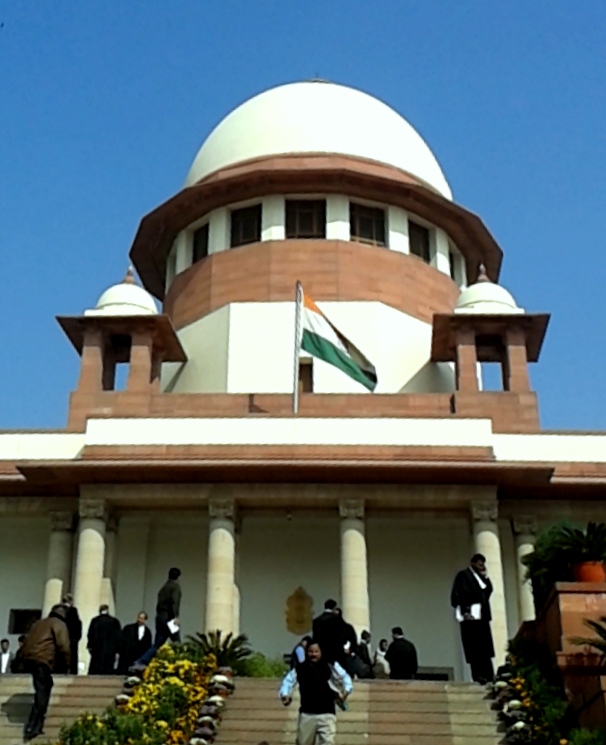
Supreme_Court_of_India_-_Central_Wing

In this blogpost, Sudhi Ranjan Bagri, Student, National Law Institute University, Bhopal, writes about the writ of habeas corpus, its meaning and different dimensions.

Introduction

Our Constitution entails the rules and guidelines; guiding, preaching and backing all the rights available and duties imposed upon the citizens as well as the non-citizens of the nation. No provision or legal principle listed in the constitution would truly be meaningful unless a mechanism exists for its enforcement. The concept of issuance of a writ has achieved its significance as it is one such enforcement device leading to achieving the benefit of fundamental rights in their literal sense. A writ is defined as a kind of special order sealed to any authority, government or any sovereign body in furtherance of abstinence or execution of a specified act. Our constitution specifies five writs which are Prerogative Writs, meaning they can be considered as a privilege or right exclusively for a specific category or class.

Issuance of any of these five writs has to be by the way of Article 32 or Article 226 for Supreme Court and High Court respectively. Article 226 has a broader jurisdiction than that of article 32 as SC can issue writs only when there is a fundamental right infringement, on the other hand, HC can issue these in both ordinary legal rights violation and fundamental rights violation. The writs available are namely Habeas Corpus, Mandamus, Prohibition, Certiorari and Quo Warranto.

Writ of Habeas Corpus

This writ (meaning, you may have the body) has been given the status of the most important writ out of all the five as it deals majorly on the liberty and justice of an individual. It is issued in matters when there is a need to produce the detenu before the court so as to judge the preconditions and dimensions of his arrest. The writ refers to a legal procedure which prevents the government to hold a person unnecessarily i.e. without any just cause and provides for the explanation given by the detainee to the court of law regarding the grounds of the detention of the detained person.

The writ thus became a means of testing the legality of detention and in this form, it may be regarded as the immediate ancestor of the modern writ of habeas corpus. The major object of this writ is that it provides for a prompt and effective remedy against any restraint which is illegal and unreasonable, and its sole purpose lies in the enforcement of personal freedom and right of liberty. Personal liberty being the very essence carrier of our Constitution needs to be well taken care of, and hence writ of habeas corpus has proven itself as one of such steps towards establishing of civil or personal liberty protection.

Different dimensions of the writ of Habeas Corpus

Few important aspects relating to this writ of habeas corpus are:

  • Nature of Proceedings: In determining the question that whether habeas corpus proceedings are civil or criminal in nature, it was held by the court in Narayan v. Ishwarlal[1] that it would depend on the nature of the proceedings in which the jurisdiction has been implemented.
  • Who may apply: Regarding the question of who may apply for the writ it has been stated by courts in various cases that not only the prisoner or the detained, but any other person who is aware of the merits of the case, and is acquainted with the facts and circumstances and has recognized interest in moving of such application in front of the court can apply under Art. 32, and Art. 226 of the Constitution.
  • Territorial jurisdiction: Regarding the territorial jurisdiction, Supreme Court’s jurisdiction under Article 32 extends over all the authorities; be it inside the territory of India or outside it, provided they must be under the control of the Government. Whereas, in the case of High Courts’ jurisdiction under Article 226, it applies to all the authorities lying within the control of that high court or where the cause of action arises.
  • Improper pleading: The question regarding whether the writ petition can be set aside if the pleading made is improper has been made clear by the court of law in Ranjit Singh v State of Pepsu[2] by stating that “the whole object of proceedings for a writ of Habeas Corpus is to make them expeditious, to keep them as free from technicality as possible and to keep them as simple as possible”.
  • Burden of proof: In regard to the question pertaining to upon whom the burden of proof lies, it was stated that it is the responsibility of the authority which is being questioned for unlawfully detaining a person to prove that the grounds were satisfactory enough to arrest and confine a person behind the bars. But if it is alleged by the detenu (viz. the person detained) that the order of detention is mala fide, the burden of proof is on the detenu and he has to establish it.[3]
  • New pleadings: The question regarding whether or not a new plea can be raised during the hearing of the writ petition, it has been stated that no fresh issue can be evoked during the pleadings of writs, but Habeas Corpus is an exception to this. But no such plea can be allowed if the respondent has no opportunity to rebut or controvert the plea and it may result in prejudice to the other side.[4]
  • Res Judicata: When the question of whether principle of res judicata applies in case of writ petition of Habeas Corpus, it was held that, “So far as Indian Law is concerned, it is fairly well settled that no second petition for a writ of habeas corpus on the same grounds is maintainable if an earlier petition is dismissed by the court”.[5] But this principle would not stand where the forums in which subsequent filing is there, have independent existence from one another and are entirely separate in competency and jurisdiction.
  • Alternative remedy: Habeas corpus being a writ of course or right may be refused if there is no cause shown. It, however, cannot be refused on the ground that an alternative remedy is available to the applicant.[6]
  • Validation order of detention: There may be fresh validation order of detention being passed by the government in cases when old order suffers from a formal defect or a flaw which is technical in nature. As a general rule, once an order of detention has expired, revoked or is quashed and set aside no fresh order of detention on the same facts and on the same grounds can be made.[7] If, however, new facts or fresh or additional grounds have come into existence after revocation or setting aside of the order, fresh order can be passed.[8]
  • Ex parte grant: Unless the facts and circumstances so demands or to meet the ends of justice, never can this writ be granted ex parte (i.e. for one party).
  • Disobedience of this writ: An intentional and willful disobedience of a writ of habeas corpus amounts to contempt of court.[9] This may attract punishment of imprisonment and/or property attachment for the one who committed the contempt.
  • Costs and compensation: The basic purpose behind the issuance of this writ is to secure the release of the prisoner/detenu rather than to punish the detainer. Although, there may be compensation granted and costs awarded in appropriate cases at the discretion of the court.
  • Conditions for refusal: There may be conditions under which the habeas corpus may be refused which are as follows:
  1. when the imprisonment is in nexus with the order or decision rendered by the court,
  2. when the person or authority i.e. detainer does not come under the territorial jurisdiction of the court,
  3. when the detenu has already been set free,
  4. when the detention has been validated by removal of defects,
  5. when the writ is sought during emergency situations,
  6. when the petition has been dismissed by a competent court after looking into the merits.

Preventive Detention: With the concept of Habeas Corpus comes the wide ambit of Preventive Detention Theory, which is a precautionary activity and not meant as a punishment. In other words, it is not a penalty for the past activities of an individual but is intended to pre-empt the person from indulging in future activities sought to be prohibited by the relevant statute and with a view to prevent him from doing harm in future.[10]

Further Article 22 governs the procedure for preventive detention, and only one enquiry is needed to be kept in mind i.e. regarding strict adherence to law requirements. Parliament is empowered to enact a law of preventive detention for reasons connected with

  • defence
  • foreign affairs
  • Security of India
  • Security of State
  • maintenance of public order
  • maintenance of supplies and services essential to the community.[11]

However, there may be monitoring of such detention by the way of the process of judicial review.

  • Emergency proclamation: It is held by the court of law that writ of habeas corpus would be maintainable for the enforcement of fundamental rights under Article 20 and 21 even during the emergency proclamation time.

[1] AIR 1965 SC 1818

[2] AIR 1959 SC 843, 845-46

[3] Ram Singh v. State of Delhi, AIR 1951 SC 270

[4] Arun Kumar v. State of W.B., (1972) 3 SCC 893

[5] Lallubhai Jogibhai v. Union of India, (1981) 2 SCC 427

[6] R. v. Pell, (1674) 3 Keb 279: 84 ER 720

[7] Chaggan Bhagwan v. Kalna, (1989) 2 SCC 318

[8] Ibid

[9] V.G. Ramachandran, LAW OF WRITS, Eastern Book Company, 6th ed. (2006) , p. 1078.

[10] A.K. Gopalan v. State of Madras, AIR 1950 SC 27

[11] Ibid

Download Now

Overview Of The Law On Expert Evidence In India

0

download (26)

In this blogpost, Sudhi Ranjan Bagri, Student, National Law Institute University, Bhopal, writes about section 45 of the Indian Evience Act, who is an expert, prerequisites of an expert evidence, difference between expert  and non- expert witness and the evidentiary value of expert witness.

Principle 

Under section 45, opinions of experts are relevant on questions of foreign law, science, art, identity, handwriting or finger impressions. Expert testimony is admissible on the principle of necessity. The help of experts is necessary when the question  involved is beyond the range of common experience or common knowledge or where the special study of a subject or special training or skill or special experience is called for. No man is omniscient; in fact, perfection is an attribute of divinity only.

As a general rule, the opinion of a judge only plays a part and is thus relevant in the decision of a case, and thus, the opinion of any person other than the judge about any issue or relevant fact is irrelevant in deciding the case. The reason behind such a rule is that if such opinion is made relevant, then that person would be invested with the character of a judge[1]. Thus, Section 45 is thus an exception to this general rule, as it permits the experts opinion to be relevant in deciding the case. The reason behind this is that the Judge cannot be expected to be an expert in all the fields-especially where the subject matters involves technical knowledge[2] as he is not capable of drawing an inference from the facts which are highly technical. In these circumstances, he needs the help of an expert- who is supposed to have superior knowledge or experience in relation to the subject matter.

Scope

Section 45, Indian Evidence Act, 1872:

“When the Court has to form an opinion upon a point of foreign law, or of science, or art, or as to identity handwriting or finger impressions, the opinions upon these points of persons especially skilled in such foreign law, science or art or in questions as to identity of handwriting or finger impressions, are relevant facts. Such persons are called experts.”

A fact is something cognizable by the senses such as sight or hearing, whereas opinion involves a mental operation. Under Section 3, the opinion of a person will be a fact too. U/s 60 oral evidence in all cases must be direct if inter alia it refers to an opinion or to grounds on which that opinion is held. It must be the evidence of the persons who hold the opinion on those grounds. A distinction must be drawn, however, between the cases where an opinion may be admissible u/s 6 to 11 as forming a link in the chain of relevant facts to be proved and between cases where opinions are admissible under sections 45-51. The former evidence is given by the non-expert or the unskilled witness while the latter is given by the expert witness. Thus, in matters of calling for special knowledge or experience or skill, opinions of expert witnesses is relevant u/s 45-51.

Prerequisites of an expert evidence

For the sake of consideration of an expert testimony, there are two important conditions that are necessary to be shown:

  1. That the subject is such that expert testimony is necessary.
  2. That the witness in question is really an expert.[3]

It must be proved that the witness is competent enough to give the evidence and that the fact to be proved is a point of science or art of which the witness is an expert in, before the opinion of a person can be admitted in evidence[4].

If a witness is not proved to be an expert, his opinion will become irrelevant.  It must be proved that the witness is an expert. He must be examined as a witness in the Court and be subject to cross-examination[5].

Who is an expert?

Section 45 defines an expert as a person who is especially skilled in a given field. The test of judging the competency of a person is this: “Is it peritus[6]?” Is he skilled? Has he adequate knowledge[7]?

An expert is a person who has special knowledge and skill in a particular calling to which the inquiry relates[8]. An expert witness is one who has devoted time and study to a special branch of learning, thus is especially skilled on those points on which he is asked to state his opinion. His evidence on such points is admissible to enable the tribunal to come to a satisfactory conclusion[9]. The section does not refer to any particular attainment, standard of study or experience, which would qualify a person to give evidence as an expert. All persons who practice a business or profession which requires them to possess certain knowledge of the matter in hand are experts, so far as expertness is required. It is the duty of the judge to decide whether the skill of any person in the matter on which evidence of his opinion is offered is sufficient to entitle him to be an expert.

Opinion is estimation, a belief or assessment, a view held as probable, what one thinks about a particular question or topic, an assessment short of grounds of proofs, a formal statement of reasons for the judgment, a formal statement of professional advice[10].

Difference between an expert and non-expert witness

Like a non expert witness the testimony of an expert witness need not be confined to actual facts and he may give evidence on facts as stated by other witnesses, e.g. a doctor who might not have seen the patient personally can opine as to the cause of his death on facts deposed. He may cite textbooks in support of his opinion or to refresh his memory (S.159); he may speak about experiments made by him in the absence of parties.

The opinion of an expert witness, however, eminent in his field he may be, must not be read as conclusively of the fact which the Court has to try[11]. However, evidence of eminent literary persons as experts can be relied upon.[12]

Competency and credit of an expert

Under section 45 of Indian Evidence Act, the evidence of an expert can be led on a question of foreign law etc., to enable the tribunal to come to a satisfactory conclusion. It is for the Court to decide the competency or fitness of a witness. The test is to see if the witness is sufficiently qualified by experience.[13] His credit can be challenged by cross-examination, or by the contrary evidence of another expert or by showing that he had expressed a different opinion on the same question previously or in any of the modes allowed u/s 146 to 153 and S. 155 to impeach the credit of a witness generally.

The questions put to an expert are generally hypothetical as they assume something for the time being. An expert witness must himself come and give evidence in court. His certificate cannot go in automatically without proof unless permitted by statutory exceptions like s. 509 (medical certificate), or section 510 or the CrPC (report of the chemical analyst).

Expert opinion– evidentiary value

The opinion of an expert must be of corroborative nature to the facts and circumstances of the given case. If the opinion contradicts an unimpeachable eyewitness or documentary evidence, then it will not have an upper hand over direct evidences[14]. The Section does not provide for any specific attainment of knowledge or study or experience for being called an expert. Experts are admissible as witness but, they are not to make conclusion as it is a judicial function[15].

In Forest Range Officer v. P.Mohammad Ali,[16] it was held that expert opinion is only the opinion evidence. It does not help the Court in interpretation. The mere opinion of an expert cannot override the positive evidence of the attesting witness.[17] Expert opinion is not necessarily binding on the Court.[18]

In Murali Lal v. State of Madhya Pradesh,[19]  it was held by the Supreme Court that here is no justification for condemning the opinion evidence of an expert to the same class of evidence as that of an accomplice and insist upon corroboration. The court also stated that it would be a grave injustice to base a conviction solely on the opinion of handwriting expert or any other kind of expert, without substantial corroboration. An expert deposes and not decides. His duty is to furnish the judge with the necessary scientific criteria for testing the accuracy of his conclusion so as to enable the judge to form his own independent judgment by the application of these criteria to the facts proved in evidence[20].

Foreign Law

Law which is not in force in India is foreign law. In England it can be proved by leading expert evidence. In India it may be proved the same way under section 45 or by producing of official books and reports on foreign law u/s 38. Foreign law is, therefore, a question of fact.[21] Hindu Law and Mohamedan Law are laws of the land and it is the duty of the court to interpret the law of the land and hence the opinions of experts however learned will be irrelevant.[22]

Science or Art

The expression Science or Art includes all subjects on which a course of special study or experience is necessary to the formation of an opinion. The words science and art are therefore to be broadly construed; the term ‘science’ not being limited to higher sciences and ‘art’ not being limited to fine arts. To determine whether a particular matter is of a scientific nature or not, the test to be applied is whether the subject matter of inquiry is such that inexperienced persons are unlikely to prove capable of forming a correct judgment without the assistance of experts.

Medical Experts

The deposition of a medical officer in the court and the reports produced by him are considered as evidence. A mere post-mortem report, however, is no evidence since no facts could be taken from it.[23]

Value of Medical Evidence

Expert evidence should be approached with care and caution. An expert witness, however, impartial is naturally biased in favor of the party who calls him. He is often called by one side simply and solely because it has been ascertained that he holds view favorable to his interest.[24] Medical evidence isn’t direct, and, therefore, value of such an evidence lies only on the extent to which it supports and lends weight to the direct evidence of eye-witnesses or contracts that evidence and removes the possibility that the injury could take place in the manner alleged by those witnesses.[25] The opinion of a doctor is entitled to great weight but may be discarded on good grounds.

https://lawsikho.com/course/certificate-criminal-litigation-trial-advocacy

Opinion of Handwriting Expert

U/s 45 of the Indian Evidence Act an expert can depose to the identity of handwriting between the questioned document and the document admitted or proved. A disputed handwriting may be proved either by calling an expert (S.45) or by examining a person acquainted with the handwriting of the person by whom the questioned document is alleged to have been written (S. 47) or a comparison of the two u/s 73.

However, the opinion of handwriting expert is only made admissible; it is not the only method of proving handwriting.[26] In Fakhruddin v. State of M.P.[27], the SC suggested three modes of proof of document: firstly by Direct evidence, secondly by expert’s evidence and thirdly, by the court coming to the conclusion by comparison[28].

Finger-impression

A man’s signature is called an unforgettable signature. This head was added to expert evidence’s scope in 1899. The study of fingerprints is generally admitted to constitute a science. Its two basic hypotheses are that:

Firstly, fingerprints of a person remain the same from birth to death;

Secondly, there has never yet been found any case where pattern made by one finger exactly resembled the pattern made by any other finger of the same or any other hand.

The opinion of thumb impression expert is entitled to greater weight-age than that of a handwriting expert.

Firearms Experts

The opinion of a ballistic expert can conclusively prove that a particular cartridge has been fired by a particular pistol.[29]

Where the ballistic expert has not seen the wound himself but has given his opinion based upon the recordings or photo produced by the doctor who saw or inspected the wound, no reliance can be placed on such an expert opinion.[30] Therefore, the firearms or ballistic expert must have concluded the opinion based on his own findings and personal observation.

Case laws

SRI CHAND BATRA V. STATE OF U.P.

AIR 1974 SC 639

Facts

In this case an Excise Inspector Shri C.D. Misra had raided a liquor shop and discovered drums of liquor. On performing smell test on the samples of liquor procured from the drums kept inside the shop, the Excise Inspector found out that the liquid was illicit liquor. He had further tested the contents of the drums with the aid of litmus paper, hydrometer, and thermometer to determine the strength and composition of the liquid under composition. After such observations, he gave testimony where he opined that the liquor shop had been involved in trading illicit liquor and submitted a detailed report regarding the same.

Issue

Whether the Excise Inspector could be considered an expert whose opinion about the nature of the liquid found was opinion evidence admissible under Section 45 of the Evidence Act?

Judgement

The Court held that he Excise Inspector, who had deposed, at the very outset of his evidence, that he had put in 21 years service as Excise Inspector and had tested lacks of samples of liquor and illicit liquor. Further, he had employed all possible ways to test the samples of the liquor present that time, which were clear tests of his reasonability and prudence.

Thus, the Excise Inspector would be an Expert and the testimony and evidence laid by him regarding the discovery of illicit liquor in the liquor shop would be relevant and admissible before the Court of law.

IN Re: Govinda Reddy & ORS.

AIR 1958 Mys 150

The science of comparison of fingerprints has developed to a stage of exactitude. It is quite possible to compare the impressions taken from the fingerprints of the individuals with the disputed impressions, provided they are sufficiently clear, and enlarged photographs are available. The identification of finger impressions with the aid of a good magnifying glass is not difficult, particularly, when the photos of latent and patent impressions are pasted side by side.

It was held that though the witness did not possess any technical qualification in as much as he had neither obtained a degree nor a diploma in photography, his experience of over 25 years in photography was sufficient enough to call him an expert[31].

SRI DHWAJENDRA C. ROY V. STATE OF ASSAM & ORS[32]

Decided On: 06.06.2012

Judgement

The court finalized that it was not solely relying on the opinion of the handwriting experts. The documents seized from the accused’s house when taken into consideration hinted towards the same conclusion which was similar to the one given by the handwriting expert. Further, the act of abscondance of the accused-petitioner furnishes evidence against him of his being responsible for committing forgery on the said two documents. one typed authorization letter, partially legible, in the name of Mangalu Roy, was also found in the said search, Mangalu Roy being, interestingly, the name of the person, in whose name, letter of authorization, in the present case, was shown to have been issued in order to enable withdrawing of the said sum of Rs. 1,65,000/-. This was yet another circumstantial evidence pointing to the guilt of the accused.

Conclusion

Thus, we may conclude that this provision is based on the principle that as judges are not properly equipped to draw proper inferences from the facts stated by witnesses, it is appropriate that the opinion of an expert must be taken into consideration. But the expert’s opinion is a weak form of evidence, especially in the cases where the sufficiency of knowledge is doubtful.

An opinion or belief may be of an expert or a non-expert. A witness, in order to give an opinion, must be competent and the subject matter must be one in respect of which an opinion is allowed. The subject matters of opinion involves skill in a particular trade or profession or a special knowledge of a particular science or art. However, in matters of age, identity or the condition of a person or thing, the belief of the witness is sometimes accepted when it is based on facts within his own knowledge. A jury, however, is entitled to accept or reject the belief or opinion of any witness.


LawSikho has created a telegram group for exchanging legal knowledge, referrals and various opportunities. You can click on this link and join:  

https://t.me/joinchat/J_0YrBa4IBSHdpuTfQO_sA

Follow us on Instagram and subscribe to our YouTube channel for more amazing legal content 
 
 
References:

[1] http://symlaw.ac.in/doc/syed.pdf

[2] works.bepress.com/krishnaareti/5/

[3] Parat v. Bissessar, ILR 39 Cal 245

[4] Raj Kishore v. State, AIR 1969 Cal 321

[5] Balkrishna Das Agarwal v. Radha Devi, AIR 1989 All 133

[6]“Peritus virtute official” i.e. the holder of some official position which requires and, therefore, presumes a knowledge of that law.

[7] U.S. Shipping Board v. Ship “St. Albans” 1931 PC 189

[8] Lawson on Expert Testimony, 2nd Edn, 229.

[9] Powell, 10th Edn, p. 39.

[10] www.legalserviceindia.com/article/l45-Law-of-Evidence.html

[11] Kamala Kuer v. Ratanlal AIR 1971 All 304

[12] Samaresh Basu v. Amal Mitra 1985 SCC (Cr) 523

[13] Gopeswar v. Biseswar 16 CWN 265 (285)

[14] http://www.legalserviceindia.com/article/l45-Law-of-Evidence.html

[15] Field’s, Commentary, “Law of Evidence”, Delhi Law House, 12th Edition, Volume 3

[16] AIR 1994 SC 120

[17] U.Jhansi Lakshmi Bai v. P.Mohammad Ali, AIR 1994 SC 120

[18] Las Society of India v. Fertilizers and Chemicals Travancore Ltd. AIR 1994 Ler. 308

[19] 1980 SCR  (2) 249

[20] www.indiankanoon.org/…/813088/?formInput=handwriting

[21] Khoday Gangadhara v. Swaminath Mudali 1926 Mad 218

[22] Aziz Bano v. Mohd. Hussain 47 All 823

[23] Ramswarup 6 CWN 98

books.google.co.in/books?isbn=8175349689

[24] Divan Singh v. Emperor 43 Cr. LJ 565

[25] Nagindra Bala v. Sunil 1960 Cr LJ 1020 (SC)

[26] State v. Tribikram (1971) 37 Cut LT 714

[27] AIR 1967 SC 1326

[28] www.indiankanoon.org/doc/1389965/

[29] Kalua v. State of U.P. 1958 Cr. LJ 30 (SC)

[30] Mohan Singh v. State of Punjab AIR 1975 SC 2161

[31] Evidence: Cases and Materials, by SV Joga Rao, LexisNexis- Butterworths Publication, (2003) at p. 351

[32] MANU/GH/0327/2012

Download Now

Analysis Of The CrPC Amendment By Maharashtra Government

2

hammer-620009_960_720

In this blogpost, Priyanshu Upadhyay, Student, Christ University, Bangalore, writes about the analysis of the CRPC amendment pertaining to Section 156(3) and 190 by Maharashtra Government.

The Government of Maharashtra last year amended Section 156(3) and 190 of CrPC wherein no complaint can now be filed against public officials without valid sanction from a competent authority. The Government asserted that the amendment aims at protecting the public officials against false, frivolous and politically motivated cases. The assertion here needs to be scrutinized properly as sufficient protection was already granted to protect the dignity and image of public officials. This paper will scrutinize different elements present in the amendment. The paper is analytical to the extent that the amendment is analysed in the light of different case laws related to the subject.

Introduction

Section 156(3) and 190 of CrPC grants special powers to a Magistrate to take cognizance of a case and order investigation on receiving a direct application from the complainant. The Government of Maharashtra last month amended Section 156(3) and 190 of Criminal Procedure Code by which it took away the discretionary powers of courts in case a complaint is filed against public officials. According to the amendment, no FIR can be registered against a public representative without the sanction from a competent authority. For instance, the police won’t be able to file an FIR against any MLA or MP without the sanction from the speaker of the house. The amendment extends to lowest level elected representatives and public officials like panchayats and municipalities. The amendment is claimed to be in conformity with the judgment of Supreme Court in Anil Kumar &Ors. v. M.K.Aiyappa & Anr[1] rendered in 2013. The Government also stated that the amendment aims at protecting Government servants and elected representatives against false, frivolous and politically motivated cases. It was contended that in several cases, the complaints are found to be false and totally bereft of truth and those who are doing their work honestly get harassed which prevented them from doing their work.[2] According to the Government, the amendment is aimed to protect the Government officials and allow them to perform their duties fearlessly and efficiently.

However, the legislative enactment cannot be accepted blindly, and it needs to be tested on the touchstone of constitutional provisions. Further, no conclusion can be deduced unless the aims and objectives of the act are studied properly in the light of their prospective effects.ELEMENTS OF AMENDMENT

Elements of amendment

Maharashtra Government by the amendment gives special privilege to the Public officials over other people as now no FIR can also be filed under Section 156(3) and 190 CrPC, 1908, without the sanction of a competent authority. For determining the justness and fairness of the amendment, its components need to be analysed in the light of legislative intention and judicial precedents. The two moot areas which needs to be analysed are:

  1. The Scope and nature of power exercised by magistrate under Section 156(3) and 190 of CrPC, and;
  2. Meaning and applicability of word ‘sanction’.

It is necessary to analyse the two components because special powers are granted to Magistrates under Section 156(3) and 190 of the CrPC and getting sanction from a competent authority is a special condition which needs to be satisfied before filing any case against public officials.

Scope and Nature of Power Exercised By The Magistrate Under Section 156(3) and 190 CrPC,1908:

Section 156(3) of and Section 190 CrPC empowers the magistrate to order an investigation on receipt of a direct complaint from any person. The Section reads as under[3]:

  1. 156. Police officer’s power to investigate cognizable case.

(1) Any officer in charge of a police station may, without the order of a Magistrate, investigate any cognizable case which a Court having jurisdiction over the local area within the limits of such station would have power to inquire into or try under the provisions of Chapter XIII.

(2) No proceeding of a police officer in any such case shall at any stage be called in question on the ground that the case was one which such officer was not empowered under this section to investigate.

(3) Any Magistrate empowered under section 190 may order such an investigation as above- mentioned.

Section 156(3) should be read with Section 190 CrPC which is as under:

  1. Cognizance of offences by Magistrates –

(1) Subject to the provisions of this Chapter, any Magistrate of the first class, and any Magistrate of the second class specially empowered in this behalf under sub-section(2), may take cognizance of any offence—

(a) upon receiving a complaint of facts which constitute such offence;

(b) upon a police report of such facts;

(c) upon information received from any person other than a police officer, or upon his own knowledge, that such offence has been committed

(2) The Chief Judicial Magistrate may empower any Magistrate of the second class to take cognizance under sub-section (1) of such offences as are within his competence to inquire into or try the case.

So, when a complaint is filed under Section 156(3) before a Magistrate empowered under Section 190 he/she can take cognizance of the case and instruct the Police for further actions as provided under Section 156. The scope and ambit of Section 156(3) can be best understood with the help of different case laws and the interpretations provided therein.

             In order to understand the scope and nature of both the sections, it is first important to ascertain the meaning of word ‘cognizance’. The meaning of the word can be best understood with the help of the decision of the Apex Court in the case of R.R. Chari v. The State Of Uttar Pradesh wherein it was held that,

“taking cognizance does not involve any formal action or indeed action of any kind but occurs as soon as a. magistrate as such applies his mind to the suspected commission of an offence” have to be read in the light of these facts.”

             Further, when an application is received by the Magistrate under Section 156(3) CrPC he orders the Police for inquiry. The effect of application under Section 156(3) and its effect on police were explained by the Supreme Court in the case of   Devarapalli Lakshminarayana Reddy and others v. V. Narayana Reddy and others[4] wherein it was held that,

 “It may be noted further that an order made under sub-section (3) of Section 156, is in the nature of a peremptory reminder or intimation to the police to exercise their plenary powers of investigation under Section 156(1). Such an investigation embraces the entire continuous process which begins with the collection of evidence under Section 156 and ends with a report or charge sheet under Section 173.”

After receiving information under Section 156(3) CrPC the Magistrate can order Police to file an FIR for the purpose of initiating the investigation. The proximity between information received under Section 156(3) and order to file an FIR was brought out by the Apex court in the case of Dilawar Singh v. State of Delhi[5]wherein it was held that,

“The clear position is that any Judicial Magistrate, before taking cognizance of the offence, can order investigation under Section 156(3) of the Code. If he does so, he is not to examine the complainant on oath because he was not taking cognizance of any offence therein. For the purpose of enabling the police to start investigation it is open to the Magistrate to direct the police to register an FIR. There is nothing illegal in doing so. After all registration of an FIR involves only the process of entering the substance of the information relating to the commission of the cognizable offence in a book kept by the officer in charge of the police station as indicated in Section 154 of the Code. Even if a Magistrate does not say in so many words while directing investigation under Section 156(3) of the Code that an FIR should be registered, it is the duty of the officer in charge of the police station to register the FIR regarding the cognizable offence disclosed by the complainant because that police officer could take further steps contemplated in Chapter XII of the Code only thereafter.”

The Government of Maharashtra in support of the amendment contends that it is in conformity with the Supreme Court’s Judgment in the case of Anil Kumar v. M.K. Aiyappa[6] rendered in 2013. Now, any person who runs through the judgment would easily say that the Maharashtra Government misinterpreted the judgment. The Court in its 2013 judgment brought out what can be called general guidelines which should be followed by the Magistrates on receiving any complaint under Section 156(3) CrPC against public officials. The court while drawing its conclusion referred the Maksud Saiyed’s[7] case also wherein the application of mind by the Magistrates was explained. The extract from the judgment which deals with the same is as under:

“The scope of Section 156(3) CrPC came up for consideration before this Court in several cases. This Court in Maksud Saiyed [(2008) 5 SCC 668] examined the requirement of the application of mind by the Magistrate before exercising jurisdiction under Section 156(3) and held that where jurisdiction is exercised on a complaint filed in terms of Section 156(3) or Section 200 CrPC, the Magistrate is required to apply his mind, in such a case, the Special Judge/Magistrate cannot refer the matter under Section 156(3) against a public servant without a valid sanction order. The application of mind by the Magistrate should be reflected in the order. The mere statement that he has gone through the complaint, documents and heard the complainant, as such, as reflected in the order, will not be sufficient. After going through the complaint, documents and hearing the complainant, what weighed with the Magistrate to order investigation under Section 156(3) CrPC, should be reflected in the order, though a detailed expression of his views is neither required nor warranted.”

After the 2013 judgement, the Supreme Court gave other two important judgments related to usage of Section 156(3) in the case of Mrs.Priyanka Srivastava and Another v. State of U.P. and others[8]. In this case, the apex court held that applications under Section 156(3) must be supported by an affidavit so that the chances of filing false complaints are reduced. The apex court also stated that the option to approach the Magistrate under Section 156(3) CrPC should be made available to a litigant with clean hands. The court held that,

“At this stage it is seemly to state that power under Section 156(3) warrants application of judicial mind. A court of law is involved. It is not the police taking steps at the stage of Section 154 of the code. A litigant at his own whim cannot invoke the authority of the Magistrate. A principled and really grieved citizen with clean hands must have free access to invoke the said power. In our considered opinion, a stage has come in this country where Section 156(3) CrPC applications are to be supported by an affidavit duly sworn by the applicant who seeks the invocation of the jurisdiction of the Magistrate. That apart, in an appropriate case, the learned Magistrate would be well advised to verify the truth and also can verify the veracity of the allegations. This affidavit can make the applicant more responsible. The warrant for giving a direction, that an application under Section 156(3) be supported by an affidavit so that the person making the application should be conscious and also endeavour to see that no false affidavit is made. It is because once an affidavit is found to be false he will be liable for prosecution in accordance with law. This will deter him to casually invoke the authority of the Magistrate under Section 156(3). In the present case, we are obligated to say that learned Magistrate should have kept himself alive to the aforesaid provision before venturing into directing registration of the FIR under Section 156(3) CrPC”

Section 156(3) and 190 CrPC gives power to Magistrate to take cognizance of a case on the direct complaint of the complainant. Decisions above explains that the Magistrate must exercise his power with due care and must apply his mind to different facts and circumstances before coming to any decision.Meaning and need for sanctions

Meaning and need for sanctions

The object and purpose underlying the need for a valid sanction from a competent authority before filing a case against public officials is to protect them from frivolous, vexatious or false prosecution with respect to the discharge of their official duties. Section 197 of Code of Criminal Procedure and Section 19 of Prevention of Corruption Act bars the Court from taking cognizance of the offence alleged to have been committed by the public servant except with the previous sanction of the Government/competent authority empowered to grant requisite sanction. Both sections start with the words; “No Court shall take cognizance of the offence”.Sanction as required should be given  by  the Central Government or the State Government  or  any  other  authority,  such sanction shall be given by that Government or  authority  which  would  have been competent to remove the public servant from  his  office  at  the  time when the offence was alleged to have been committed. The status and relevance of a sanction can be understood with the following cases:

               The importance of sanction and their role in protecting public officials was explained by the Apex Court in the case of General Officer, Commanding v. CBI[9]. It was held that,

“the law on the issue of sanction can be summarized to the effect that the question of sanction is of paramount importance for protecting a public servant who has acted in good faith while performing his duty. In order that the public servant may not be unnecessarily harassed on a complaint of an unscrupulous person, it is obligatory on the part of the executive authority to protect him….. If the law requires sanction, and the court proceeds against a public servant without sanction, the public servant has a right to raise the issue of jurisdiction as the entire action may be rendered void-ab-initio.”

The requirement of a sanction is mandatory for filing any case against public officials and at the same time the sanction should be from a valid authority. The Apex Court in the case of Nanjappa v. State of Karnataka[10] clearly brought out the distinction between valid sanction and invalid sanction. It was held that the court is competent to try matters relating to public servants only when the complaint is accompanied with a valid sanction. The court held that,

“The competence of the court trying the accused so much depends upon the existence of a valid sanction. In case the sanction is found to be invalid the court can discharge the accused relegating the parties to a stage where the competent authority may grant a fresh sanction for prosecution in accordance with law. If the trial Court proceeds, despite the invalidity attached to the sanction order, the same shall be deemed to be non-est in the eyes of law and shall not forbid a second trial for the same offences, upon grant of a valid sanction for such prosecution.”

So, requirement of a valid sanction has been a precondition for filing any case against public officials. The requirement protects the public officials from false, frivolous and vexatious allegations and allows them to work freely.

Analysis

The requirement of sanction from a valid authority was a valid condition for filing any case against public officials under Section 197 of Code of Criminal Procedure and Section 19 of Prevention of Corruption Act. So, cases filed against public officials required valid sanction from competent authority but there was not bar on filling of an F.I.R. The Maharashtra Government with the amendment to Section 156(2) and 190 of CrPC has made it mandatory to get a valid sanction from a competent authority before filing any case against public officials.

Further, the decisions related to Section 156(3), 190 CrPC and requirement of sanction clearly depicts that sufficient protection was already granted to public officials. The Government of Maharashtra passed the amendment by stating that it would protect the officials against frivolous and false complaints. But from all the settled cases involving public officials, it is has been made clear that the court always takes required amount of care before taking cognizance of the same. After the amendment by Maharashtra Government, no FIR can now be filed against public officials without a valid sanction from a competent authority. The investigation now cannot be initiated without a valid sanction which makes the filing of complaint more difficult. It is clear that the Government of Maharashtra has conferred unfettered immunity to public officials and has put one more obstacle in the path of complainants.

Further, the records related to the public officials in Maharashtra depict that there was no need for such a step. According to analysis by Association for Democratic Reforms of affidavits submitted by MLAs from Maharashtra at the time of election in 2014, 165 (57%) of the MLAs had declared criminal cases. Out of these 51 (31%) MLAs had declared cases where charges had been framed. Among all legislative assemblies in India, Maharashtra is second highest after Jharkhand in the proportion of MLAs with criminal cases. Three MLAs had declared cases related to murder and attempt to murder while 11 MLAs declared cases related to crimes against women, three MLAs declared cases related to causing communal disharmony, 14 MLAs with cases of robbery and dacoity and nine MLAs with cases related to kidnapping.[11]

Further, it was contended that the amendment is in conformity with the 2013 Supreme Court judgment in Anil Kumar vs MK Ayappa case[12]. However, from the judgment of the case, it can be clearly inferred that the Government wrongly interpreted it. The Judgment nowhere talks about the requirement of sanction in order to file an FIR. Former IPS officer-turned-lawyer YP Singh also stated that “this decision is legally incorrect. The Supreme Court prohibited filing of a complaint in the court without sanction of the competent authority under section 19 of the Act. However, this does not restrict filing of an FIR, which is necessary to start an investigation. This is just putting the cart before the horse. To seek sanction, you need evidence, and evidence can only be collected if an FIR is filed.”

The amendment confers unreasonable protection to Governmental officials which opens it to further misuse. The amendment also violates Article 14 of the Indian Constitution, 1950 as it goes against the principle of equality and equality before the law and gives unreasonable protection to public officials over the other class of people.

Conclusion

It can be inferred from the above that the step of Maharashtra Government is an anti-welfare step which acts as yet another protective shield to corrupt public officials. It is important that public officials should be allowed to enjoy enough freedom for doing their work properly and efficiently but at the same time, reasonable restriction should also be imposed in order to put a check on their misuse. In India requirement of a valid sanction for filing a case against public officials was already present as a valid protection. But, there was no restriction on filing an FIR.

The Government of Maharashtra with the amendment brought in a limitation on the filing of FIR, which in no way is reasonable. The amendment clearly imposes unfettered immunity on the public officials which opens it increased misuse. It is also clear that the basis of the amendment i.e the Supreme Court judgment nowhere matches the intention of the Government.

Therefore, it is concluded that the amendment can never be welcomed as it gives an unreasonable privilege to public officials being in violation of Article 14 and other settled principles of law.

[1] (2013) 10 SCC 705

[2]http://economictimes.indiatimes.com/news/politics-and-nation/maharashtra-amends-crpc-provisions-no-fir-against-mlas-bureaucrat-without-approval/articleshow/47609898.cms

[3]Section 156, Code of Criminal Procedure, 1980

[4] (1976) 3 SCC 252

[5] (2007) 12 SCC 496

[6] (2013) 10 SCC 705

[7] (2008) 5 SCC 668

[8]Criminal Appeal No.781 Of 2012

[9]Criminal Appeal No. 257 of 2011

[10] CRIMINAL APPEAL NO.1867 OF 2012

[11] http://www.afternoonvoice.com/repeal-the-amendment-to-the-crpc-ngo.html

[12]Supra note 7

Download Now

How Many Witnesses Are Required By Courts In Any Case

0

download (25)

In this blogpost, Sudhi Ranjan Bagri, Student, National Law Institute University, Bhopal writes about the number of witnesses required in courts in different cases.

Introduction

Section 134- Number of Witnesses

‘In any case, no particular number of witnesses shall be required for proof of any fact in the case’.

This section of Indian Evidence Act clearly laid down that no particular number of witnesses required to proof or disproof the facts of the case. This section applies to civil and criminal cases. This section is based on the popular maxim that evidence is to be weighed and not counted. There is no rule of law that the unsubstantiated testimony cannot be accepted. The rule is of prudence and its adoption or not depends on the circumstances of the cases. For ascertaining the truth by the court, the number of witnesses is not considered, but the quality of evidence is taken into a note.

In State of M.P. V. Chhagan, the court held that the section 134 of IEA clearly mandates that “in any case no particular number of witnesses is required for the proof of any fact of the case.

Indian legal system does not emphasise on the plurality of witness. Neither the judiciary nor the legislature (S.134, Evidence Act) mandates the compulsion of a particular number of the witnesses to find truth. Our legal system always has laid down the emphasis on the weight, quality and value of the evidence rather quantity and plurality of witnesses. Therefore, it is completely at the discretion of the court to convict accused on the basis of the single testimony also and in many cases, the court may acquit accused when it is not satisfied by the testimony of several witnesses.

It is not necessary to examine all persons who were present at the scene of the crime committed for proving the guilt of accused. Any rule that a particular number of witnesses are required to prove guilt would hamper the justice delivery system as in many cases it is not practicable to bring more than one witness. If any such rule were made than many crimes would go unpunished. In many secret murders even one witness to the crime is not obtainable and in these cases court needs to depend upon the circumstantial evidence. The discretion of judge has been left free from strict restrictions.

Quantity of Evidence Required for Judicial Decisions

A plurality of witnesses is a rule of prudence and not an inflexible requirement of the evidence has to be weighed not counted. Acceptability of evidence is material not the number of witnesses. If the court thinks unsafe for convicting the accused person on the testimony of a single witness, does not mean that the evidence of the witness is castigated. It is not dishonoring against the evidence of any witness if court merely wants to cross-examine the testimony by getting assurance from other sources.

In riots cases, it would be unjust to convict accused on the basis of the testimony of the single witness. In these cases, the rule of prudence requires that court should consider the emphasis on the plurality of eye witnesses for fair judgment. In the cases where sole eye witness is changing its stand about the identity of the accused, manner of incident and place, in that case, his testimony should not be relied upon.

In Ganpat Ram case, the court stated that when the testimony of the sole eye witness is reliable, trustworthy and cogent, the evidence cannot be rejected on the grounds of the some minor omissions considering the fact the examination of the evidence took place years after the occurrence of the incident. In cases, where it is not practically possible to present more than one witness before the court, the court should rely on the testimony of the sole witness if it satisfies the court.

Corroboration Of Testimony Of Sole Witness

In Mohammad Sugal case, the accused was convicted of murder on the basis of the uncorroborated testimony of a child witness, at the scene of the crime only, sole eye-witness was a girl of 10-11 years present. It was appealed to the Privy Council that conviction for the offence could not be based on uncorroborated testimony of the child; the Privy Council observed that there was no provision for inadmissibility of such testimony in India, unlike England. The court held that once the evidence is admissible before Court, then the Court could act upon it. It is a rule of prudence not to act upon the testimony of the child, but it is not a law. Justification to the testimony of the single witness should be emphasized upon where nature of the testimony itself requires. However, no general rule of some witnesses require could not be laid down.

In case of Shanker v. State, the Rajasthan High Court laid down the following proposition in respect to corroboration of evidence of single witness:

  1. As per the general rule, there is no fixed number of witnesses required for any particular case; a court can act on the testimony of some other witnesses of indifferent character;
  2. Unless corroboration is insisted upon by Statute, in the exceptional cases where the nature of testimony of single witness itself requires corroboration which courts should insist upon, for example in the case of testimony of child whose evidence is that of related character or an accomplice;
  3. The requirement of the corroboration of the testimony of a single witness is dependent on facts and circumstances of each case, and there is no general rule which can be laid down this matter like this and it also depends on the discretion of the Judge, who deals with the case.

In Cases of Unlawful Assembly and Riot

The testimony of a sole witness at the incident would be sufficient to establish the identification of the accused person as a member of an unlawful assembly if it is completely reliable. In Binay Singh case, the Supreme Court observed that in cases where the assembly is so large where many were a witness to the incident, it is prudent to have at least two reliable witnesses for the identification of accused. In Masalti Case, the Supreme Court observed that in the case of rioting and similar offence it is more prudent not to convict the accused on the basis of the testimony of a single eyewitness, as it would be an unfair and grave injustice for accused who is convicted. It is the quality of the evidence and not the number of witnesses that matters in such case.

In Dealing With Sexual Offences

In rape cases, there is no principle of law which forbids a conviction based on the victim’s uncorroborated testimony, though the victim wants in chastity if the jury is satisfied with the truth. However, the jury and the court should carefully guard themselves against the excessive sympathy for the victim. In Rameshwar Kalayan Singh case, the Supreme Court held that in a sexual offence like rape, corroboration is not essential before conviction, as the victim of the rape cannot be considered as a partner in offence, as it was without her consent, therefore, no need to corroborate her testimony. In cases where circumstance requires for the corroboration than the testimony of victim needs to be corroborated for the satisfaction of the court.

In Vadivelu Thevar case, the Supreme Court observed that in the cases of sexual offences, the testimony of victim itself need not be sufficient if the victim is suspected of the partner in crime. In Sannaila Subba Rao case, she was kidnapped and kept in room for month and was raped by two accused repeatedly, the court convicted the accused based on the testimony of minor girl with a reasoning that as she didn’t have any enmity against the accused, and there were no reasons found for giving false evidence against accused at the risk of her future.

In Prem Narian case, there was corroboration of the testimony of the minor girl by her parents and others but medical report showed that she was raped, in this case, court convicted the accused on the basis of the testimony of minor with the reasoning that she had sufficient maturity and understanding and her evidence free from any defect. In sexual offences like rape and others, the conviction can be based on the uncorroborated testimony of the prosecution, if the testimony of the victim is found to be convincing, reliable and beyond reasonable doubt. In these cases, the court needs to be satisfied that the victim is telling the truth and accused was not falsely accused of the offence.

Conclusion

Thus, it is clear that the quantity of the witness does not matter rather the quality of witness does. Since there is no general rule for the number of witnesses required in any particular case, therefore the testimony of the sole witness can also be relied upon to convict the accused, if it is found to be reliable and cogent.

Download Now

Enforceability of Force Majeure Clause in India and UK

1

IMAG0556-003

This article is written by Nimisha Srivastava,  a student of Gujarat National Law University.

What is force majeure?

Force majeure is a happening of inevitable accident which the parties, in spite of taking due care and caution could not have reasonably foreseen.  The term is French for ‘superior force’. Force majeure is a principle against contractual rigidity enshrined in the French Code Civil (Article 1147 and 1148). The event that constitutes force majeure renders the performance of contract absolutely impossible. The event must be of such a nature that the party could not have reasonably foreseen it, in spite of taking due care and caution. The term has a very wide scope. There exists a difference of opinion among French writers and courts with regards to the application of the phrase. Force majeure includes the term ‘act of god’. Wars, government decrees, floods, drought, epidemic, doctor’s refusal to issue a medical certificate, all have been held as force majeure

Force Majeure: Enforceability in UK

Force majeure is only recognised in English law if there is a force majeure clause in the contract or a reference in the contract to force majeure. Here, England, a common law country differs from civil law countries where force majeure can be invoked regardless of the contract. A force majeure clause defines when a party is released from its contractual obligations. Parties have the flexibility to negotiate the scope of clause including the conditions when the clause would be applicable and under what circumstances.  They can also include specific instances within the clause. Three tests are required to be fulfilled for an even to be regarded as a force majeure event:

  1. Externality – Parties had no control over the event/circumstance.
  2.  Unpredictability – Parties could not have anticipated or foreseen the occurrence of such event.
  3. Irresistibility –  Parties could not have avoided such event /circumstance.

In English law, the force majeure clause does not only include act of god but also includes events caused by human intervention. The burden of proof lies on the party claiming invocation of force majeure clause. The party must prove that occurrence of the event was within the scope of force majeure clause. The happening of such event has prevented the party from rendering the performance of contract. Inspite of reasonable precautions and measures taken by the party, the event was beyond party’s control and hence couldn’t be avoided. Parties can also add additional conditions while drafting the force majeure clause like requirement of notice before invocation, obligation on other party to take reasonable steps etc. Many clauses adopt a non-exhaustive list of events or circumstances that would qualify as force majeure and typically include, amongst others, “acts of God”, “earthquake, fire, flood or other natural physical disasters”, “acts of war” and “riot, insurrection, rebellion, sabotage or acts of terrorists”. Some parties attempt to include a wide scope provision in their force majeure clause, with wording such as “any other event”. However, such phrases should be adopted with caution.

In the case of Tandrin Aviation Holdings Limited v Aero Toy Store LCC and others[1], the Commercial Court in London was asked to consider whether the “unanticipated, unforeseeable and cataclysmic downward spiral of the world’s financial markets” triggered a contractual force majeure clause in an aircraft purchase agreement.

Hamblen J, in granting Tandrin’s application, held that it is well established under English law that a change in economic and/or market circumstances affecting the profitability of a contract or the ease with which the parties’ obligations can be performed, is not regarded as being a force majeure event. Whether a force majeure clause in a contract is triggered depends on the proper construction of the wording of the specific clause; “force majeure” is not a term of art. The particular clause simply did not refer to economic circumstances and there was therefore no basis for otherwise construing the provision so as to include the same. The phrase “any other cause beyond the Seller’s reasonable control” was interpreted by the court narrowly and it was held that, in the context of that case, the phrase was limited to the class of events specifically referred to in the force majeure clause.

If a contract does not have a force majeure provision, the parties will need to look to the narrow doctrine of frustration which essentially “kills the contract” if performance becomes impossible, or look to other available remedies.

Force Majeure: Indian Contract Act

In India, the Indian Contract Act, 1872 does not expressly provides for the force majeure provision. We see a jurisprudence of cases which have led to development of this doctrine.  Supreme Court has held that the expression “force majeure” is not a mere French version of Latin expression ‘vis major’. It has wider application.  Where reference to force majeure is made, the intention is to save the performing party from the consequences of anything over which he has no control.[2] The impossibility based whereon the force majeure clause was being invoked must pertain to the contractual obligation that has purportedly become impossible to perform. [3] The condition about “force majeure” is something which is unforeseen, unexpected and which happens suddenly and over which a person has no control. [4] Delay on account of flood and earthquakes due to which the project was delayed. Once the conditions for invocation of force majeure clause were shown to exist, the burden was on the other party to show when such conditions ceased to exist. [5] Labour problem is not force majeure. Force majeure means a supervening event beyond control which renders performance of contract impossible. [6]

In the case of Southern Gas Ltd. V Visveswaraya Iron & Steel Ltd.[7], Supreme court held that in the situation where force majeure clause exists in the agreement relieving parties of their obligations, the arbitrator has to first determine the applicability or otherwise of the force majeure clause and proceed to determine other questions only in case he finds force majeure clause to be inapplicable.’ In another case before Supreme Court[8], the respondent contractor and the appellant state had an agreement containing a force majeure clause excluding liability of state in case of unprecedented floods. The matter went for arbitration where the appellant state didn’t provide any evidence in support of its contention for the defense of act of God. The arbitrator in absence of such an evidence made an award in favour of the respondents based on the facts and said the rains were not unprecedented. On appeal it was held that award cannot be asked to set aside as the award of arbitrator is a speaking order. He was chosen by the parties therefore no interference can be made with the award unless there is a wrong proposition of law or an error apparent on the face of the records. Calcutta HC in a recent judgment declined to decide on the applicability of force majeure to a particular event as sufficient material was not provided by the party claiming the defense.[9]

If parties have not incorporated the force majeure clause in their contracts then the doctrine of frustration of contract under Section 56 will come into picture. Doctrine of frustration is a part of law where discharge of contract occurs by reason of supervening impossibility or illegality of the act agreed to be done.

Hon’ble Supreme Court in Industrial Finance Corporation of India Ltd. Vs. The Cannanore Spinning & Weaving Mills Ltd. and Ors. [10] held that “It may be noticed here that the Statute itself has recognised the doctrine of frustration and encompassed within its ambit an exhaustive arena of force majeure under which non-performance stands excused by reason of an impediment beyond its control which could neither be foreseen at the time of entering into the contract nor can the effect of the supervening event could be avoided or overcome. The decision of the Court of Appeal in F.A. Tamplin Steamship Co. Ltd. v. Anglo Maxican Petroleum Products Co. Ltd. [11](which stands quoted (with approval by this Court) in Naihati Jute Mills v. Khyaliram, seems to have settled the law on the same. on a true perspective of Section 56 of the Contract Act, three essential conditions appear to be the realistic interpretation of the Statute. The conditions being (i.) a valid and subsisting contract between the parties; (ii) there must be some part of the contract yet to be performed; and (iii) the contract after it is entered into becomes impossible of performance.

Conclusion

Indian scenario in case of force majeure varies from case to case depending upon facts and circumstances and the language of the force majeure clause in the contract. A force majeure clause is often added to a contract of commodities without careful consideration of its implications. Force Majeure clause is quite critical in commodity contracts and therefore should be carefully drafted. An event must meet several conditions to be viewed officially as a force majeure.

[1] (2010) EWHC 40 (Cmm)

[2]Dhanaramji Gobindram v. Shamji Kalidas & Co. (1961)3 SCR 1020

[3] Markfed Vanaspati & Allied Industries v. Union of India (2007) 7 SCC 679

[4] Esjay International (P) Ltd. v. Union of India (2011) 6 Mah LJ 750

[5] General Electric Inc. Canada v. National Hydroelectric Power Corporation Limited 2010 SCC OnLine Del 2015

[6] Pearl Agencies v. Union of India 2002 SCC OnLine Del 1244

[7] (1998) 9 SCC 555

[8] (2003) 7 Supreme Court Cases 396

[9] M/s. Besco Limited (Foundry Division) & Anr. v. The West Bengal State Electricity Distribution Company Limited & Ors. 2015 SCC OnLine Cal 6867

[10] (2002) 5 SCC 54

[11] 1916 2 AC 397

Download Now

Overview Of Copyright Law In Relation To Sound Recording And Musical Composition

0

images (11)

In this blogpost, Pritishree Dash, Student, National University of Advanced Legal Studies, Kochi, writes about the overview of copyright law in relation to sound recording and musical composition as per the Copyright Amendment Act, 2012. 

As and when a new song comes up, one can find a plethora of cover songs by various artists on the internet. Cover songs and remixes of popular and hit songs have lately become a means to get recognition and gain popularity.  It’s an apt way of reaching out to millions of listeners globally and achieve fan-following to revolutionize their career. The cover versions generally retain the original lyrics and musical arrangements but are sung in the author’s own stylistic originalities and nuances. While there might be a lot of advantages to this, there might be lots of copyright issues and breaches that an artist might unknowingly commit. The question is whether such practices lead to infringement of copyright provisions in India or not, whether by making covers and remixes, artists are violating the copyright of the original singer(s), lyricist and composers. Hence, this article addresses those issues and gives an insight to the existing legal norms which if taken care of in the beginning can help prevent a lot of hassle later. Artists need to be mindful of these prevalent copyright laws while making, posting and selling covers to ascertain that they are not contravening the confines that law has created.

Copyright law: Overview with regard to Sound recording and musical composition:

The expression copyright refers to the main act which, in respect of literary and artistic creations, may be made only by the author or with his authorization. That act is the making of copies of the work (WIPO). Musical compositions with or without words are included in the list of literary and artistic works given in the Berne Convention for the Protection of Literary and Artistic Works.

In a 1952 issue of the Chicago Daily Tribune, journalist Will Leonard described the idea of covering a song as “trade jargon meaning to record a tune that looks like a potential hit on someone else’s label”. There are also several concerns on the part of the original music composers that companies making cover versions, remixes and music videos of their compositions are debasing the compositions. In the case of The Gramophone Company of India Ltd vs. Super Cassette Industries Ltd[1], the Hon’ble Judge has remarked, “What is a version recording? A version recording, we are told, is a sound recording made of an already published song by using another voice or voices and with different musicians and arrangers. Version recording is thus neither copying nor reproduction of the original recording”. Infringing copy” with reference to a sound recording, which is relevant, is defined under Section 2(m) (iii), thus: “infringing copy” means,- in relation to a sound recording, any other recording embodying the same sound recording, made by any means. Section 13 defines the works in which copyright subsists. It provides that copyright shall not subsist in any sound recording made in respect of a literary, dramatic or musical work, if in making the sound recording; copyright in such work has been infringed. Section 14 specifies the content of the rights comprised in the “copyright.” Section 14(e) of the Copyright Act deals with sound recordings. An owner of copyright in sound recordings would have the following exclusive rights:

– to make any other sound recording embodying it;

– to sell or hire any copy of the sound recording; or

– to communicate the sound recording to the public.

The Copyright Amendment Act, 2012

The Copyright Amendment Act, 2012 brought in a phenomenal change with respect to the rights of music directors, lyricists and performers. Javed Akhtar’s maiden speech in Rajya Sabha for Amendment to Copyright Bill 2010 made a very persuasive speech and was instrumental in lobbying for the amendments. Section 31C of the Copyright Amendment Act, 2012 deals with statutory licenses that can be obtained for making a sound recording in respect of any literal, dramatic or musical work. “Cover version” means a sound recording made in accordance with the above-mentioned section. There can be two forms of licenses that legalise this action i.e. Statutory licenses and General licenses. While a statutory license is governed by the provisions of this Act, a general license is made on the terms and conditions as agreed upon between the licensor and licensee. This section also lays down various other rules which one has to abide by while making a cover. The person making the sound recordings should give prior notice of his intention to make the sound recordings. Such sound recordings shall be in the same medium as the last recording unless the medium of the last recording is no longer in current commercial use. Copies of the covers/labels have to be disclosed to the owner of the sound recording prior to the release of the cover version. The cover version should explicitly mention that it is a cover version of the original sound recording. There should be no alteration of the sound record unless it is technically necessary. Statutory licenses are not mandatory. If an artist wants to make a cover version before the expiry of 5 years of the original work or wants to negotiate on the point of royalty, he has the option of acquiring a general license. The production of covers without the consent of the owner of the original song amounts to copyright infringement. The owner is entitled to civil remedies like an injunction, etc. when such violations occur.

Some cases have arisen both in India and abroad where it has been contended that sound-alike recordings are an infringement of the original sound recording even though the same may have been validly made under the statutory mechanical licensing provisions. Fortunately, this illogical contention has been rejected by the courts; each sound recording constitutes the recording of a separate performance by a different set of performers and musicians and results in a new sound recording capable of being protected under copyright. In Mars Recording Private Limited v. Saregama India Limited, it has been clearly stated that “It would not be an infringement of copyright in a sound recording if the same has been made with the consent or by license of the copyright owner. If a negotiated consent is not possible, a person becomes legally entitled to make a sound recording of such a copyrighted sound recording by recourse to the procedure prescribed and subject to the conditions that would apply. It is to be emphasized that it, however, does not entitle the person to make a copy or a duplication of the sound recording. But is entitled to produce a “version recording”, which is a fresh recording using a different set of performers, musicians and artists and facilities. It would be a “sound alike” recording or a close imitation, of the original sound recording and would not be an infringement of the copyright.” As long as the cover versions are not intended to be economical in purpose, they can’t be violative of copyright laws.

[1] 58 (1995) DLT 99.

Download Now

Trade Mark Crossborder Reputation And Conflicts

1

download (24)

In this blogpost, Vernita Jain, Student, National Law Institute University, Bhopal, writes about the extraterritoriality in trademark its constitutional validity and its Indian application.

The tremendous advancement in technology and globalization has increased the trade among different countries. In this world of competition, the producers have to increase their sales by way of innovation, technology; cost reduction etc. The situation of fair competition favors the consumer by giving them the best product for the best price. Competition is an essential feature of the capitalist economy. It can be reasonably concluded  that  in  a  capitalist  economy the  producers  might  do  anything  in  the  name  of competition, even go to the extent of harming the consumers by charging unfair prices.

Producers may resort to unfair practices to get an upper hand in the market. This may also result in hampering the competition. For example, all the producers of rice join hands and fix a price below which they would not sell their produce or two producers who have a major portion of the market merge together to form one company that becomes a brand. If we extend this idea to the cross-border trade, the anti-competitive practices seem almost exploitative of the local producers.

In the present scenario, if a seller launches any product, his product and innovation are not limited to one country. The status and benevolence of those goods are of inherent importance and shall reach to every nook and corner of the world through magazines, newspapers, television, telephone, cinemas and internet. Thus, when a product comes into the market of a particular country, its trademark surpasses the national boundaries.

The notion that the State can make laws affecting the conduct of persons within its territory is known as the ‘territoriality principle’ and that regulating the behavior of its citizens when they are in other territories, citizens for this purpose including companies incorporated under its law is called the ‘nationality principle. The territoriality principle has been extended so that a State is recognized as having jurisdiction not only where the act originated in its territory known as ‘subject territoriality’, but also where the objectionable conduct originates abroad but is completed within it territory (‘objective territoriality’).

However such kind of jurisdiction becomes dicey when it comes to competition law. In this era of globalization, there can be many states claiming jurisdiction on a particular event. Also, when it comes to MNCs or E-commerce, the applicability is difficult to construe because it is still a debatable question whether the subsidiary should be considered separate from the parent company. For more light on this subject, we see the extraterritoriality principle as applicable in the US and EU countries.

In a world of global trade, it is essential to have our laws at par with the laws of the other countries. Since there is a connection between various countries, it is logical that measures to balance time, currency, quantity etc. be made. Since trade is an arena of businessmen, it remains an area where profit making is given the highest value. Therefore, it becomes all the more necessary to ensure that the acts of one party do not cause harm to other parties. If both/ either such parties are citizens the applicability of law is easy but what if one or all the parties are foreigners and the loss is caused to the nationals of one country, not at fault.

Extraterritoriality in trademark

This is where the importance of protecting trans-border or spillover of international trademark reputation of foreign companies arises. As the changing scenario and advancement in technology, it has become very important to protect the intellectual property rights among various countries.

Issues regarding infringement of  intellectual property rights in India or in any other country have been dealt with many precedents. The Supreme court in this issue has laid down in various cases that a company, having it’s trademark rights and its reputation in any other country can protect its intellectual property rights in India.

In re N.R. Dongre v. Whirlpool Corporation[1], the court considered the doctrine of “cross-border reputation” for the first time in detail.

“… a product and it’s trade name transcends the physical boundaries of a geographical region and acquires a transborder or overseas or extra-territorial reputation not only through the import of goods but also by its advertisement. The knowledge and awareness of the goods of a foreign trader and it’s trademark can be available at a place where goods are not being marketed and consequently not being used.”

It was further held that “In today’s world it cannot be said a product and the trademark under which it is sold abroad, does not have a reputation or goodwill in countries where it is not available. The knowledge and awareness of it and its critical evaluation and appraisal travels beyond the confines of the geographical area in which it is old.”

“Dissemination of knowledge of a trademark in respect of a product through advertisement in media amounts to use if the trademark whether or not the advertisement is coupled with the actual existence of the product in the market.”

Constitutional Validity

How can a country go on enforcing its own laws on the subject matter which neither happened in its territorial limits nor involved its citizens? Is it constitutionally valid for a nation to usurp its jurisdiction and extend it to the rest of the world? How can the legislators of a country make laws for those whom they do not represent?

As far as India is concerned the members of Parliament originally did not have powers to make laws regarding a subject matter which lay outside their geographical limit. Article 245 of the Constitution defines the ambit or territoriality of the legislative powers vested in the Parliament. Clause (2) of article 245 states that a law passed, made by parliament shall not be deemed invalid only on the ground that it has extra-territorial application. However, to prevent Parliament from being omnipotent in this regard a few principles are followed while making extra-territorial laws.

While making laws that will be applicable outside the territory of India t he Parliament has to conform to the principle of territorial nexus. This means that if the Indian Parliament makes such law which is intended to be applied outside India, it has to establish a connection or nexus between the object of such law and subject matter of the law.  The Parliament must make sure that this connection is (i) real and not illusory and (ii) the liability sought to be imposed must be pertinent to that connection.9

The Supreme Court also noted that the sovereign power of the Parliament to make laws with extra-territorial operation must respect the sovereignty of other States and therefore, the provocation of law must be found in India itself. The object of enactment of extra-territorial law must be found in India.10

Article 245 thus forms the basis of the validity of section 32 of Competition Act 2002 which talks about the extra-territorial application of competition law of India. Since there is a reasonable nexus between the object of section 32 (to protect Indian consumers) and the subject matter which lies outside India section 32 of Competition Act,2002 is constitutionally valid.

Indian Application

However, with the opening up of the economy by the adoption of LPG policy, Indian court felt the need to extend its jurisdiction outside India.

The Alkali case[2] changed the course of decisions; wherein the Commission had said that “the mere fact that the ANSAC agreement had been outside the country could not be construed in vacuum…  the  correspondence  with  an  Indian  consumer  reasonably  establishes  a  nexus between the two parties. The visible effects that the transaction produces on Indian soil should be the determinant factor for extending jurisdiction.” The commission gave an order against ANSAC, an American Company, which only had consumers in India,  against  which they appealed to the Supreme Court.

It was held by the Supreme Court that an American Company cannot be subjected to the jurisdiction of the MRTP Act because there is nothing in the words of section 14 that gives extraterritorial powers to the commission. In another case of Exports v. All India Floor Glass Manufacturers’ Assn[3]. the commission could not extend its jurisdiction on the actions performed by an exporter outside India.  Hence, a need was felt to give greater jurisdiction to Indian authorities to curb anti-competitive acts affecting the trade in India but taking place outside India.

The Raghvan Committee was set up in 1999 in the light of international developments and the need to promote competition. The task of the Raghvan committee was to come up with such a legal framework as was necessary for the globalised competitive economy. In its report, the committee corroborated that the MRTP Act was not fit to work in the new economy, and it was full of lacunae. The word ‘competition’ had been sparsely used in the MRTP Act; cartels were not mentioned; it gave no major control powers to the Commission; no distinction was made between horizontal and vertical mergers; government enterprises were not under the control of MRTPC. The Committee also recommended that the competition law should be applied universally whether the company is Indian or foreign.

However in the case of trademark, the Trade Marks Act, 1999 guarantees protection to the well-known trademarks thereby abiding the requisite of Article 16 of TRIPs, which grants protection of trademarks.

In order to protect a companies trademark rights, it was ruled in various cases that, a symbol is not possible to register if it is fallaciously similar to a well-known mark in India and the usage of it by any other person would be harmful for the reputation of the trademark owner. The effect of globalization has lead to a risk of such infringement outside India too.

No one can disagree with the fact that courts dealing with intellectual property in India have recognized the notion of cross-border reputation in the recent period. But the views expressed by different high courts are different at several point of time. The Bombay High Court in Kamal Trading Co., Bombay v. Gillette U.K.Limited Middle Sex, England, 1988 PTC 1, held:

 “…It is necessary to note that the goodwill is not limited to a particular country because in the present days, the trade is spread all over the world and the goods are transported from one country to another very rapidly and on extensive scale.

In Apple Computer Inc. Vs. Apple Leasing & Industries,1993 IPLR 63 DEL, while adopting the same notion Delhi High Court held that it is not necessary in the context of the present day circumstances that the free exchange of information and advertising through newspapers, magazines, video television, movies, freedom of travel between various parts of the world, to insist that a particular plaintiff must carry on business in a jurisdiction before improper use of it’s name or mark can be restrained by the court.

Another case in which the Supreme Court gave a verdict affirming the doctrine was the Blenders Pride Case; the court held that it does not matter that whether the company is first in a country or not, the thing to be paid attention to is that, which company started its business first. The country, in this case, is not of much concern.  

Conclusion

Today international trade is rapidly growing. There is a constant increase in competition and advancement in the technology. Indian judiciary has upheld the cross-border reputation of trademarks, thereby bringing down the infringement. The decisions and opinions of the courts show the concern regarding the misappropriation of the trademarks, both in India as well as foreign.

[1] 1996 PTC (16) 583 (SC)

[2] Alkali Manufacturers‘ Association of India v. American Natural Soda Ash Corporation (ANSAC) and others, 1997(5) CTJ 288 (MRTPC)

[3] (2002) 111 comp Case 617 at p 619 (SC).

Download Now

What Are The Laws Prohibiting Dowry In India

0

download (23)

In this blogpost, Sonal Srivastava, Student, Amity Law School, Lucknow, explains what is dowry, who is an offender in case of dowry, legal framework in India for prohibiting dowry laws and also tells about the misuse of the dowry laws in India.

“Dowry” is a word that is very prevalent and common in Indian households. It is a practice that has become a parasite for the Indian society and which has eroded the beautiful institution of marriage. It is not a new practice but has been followed from ages, and its impact is such in Indian society that one can make efforts to reduce it, but it cannot be totally eradicated. Several laws have been enacted to prohibit the practice of dowry, but the legal clutches are weaker than the ambit of the practice of dowry. Further, the article shall enumerate the social and legal consequences of practicing dowry along with its other various aspects.

What is dowry?

According to section 2 of Dowry Prohibition Act, 1961, the term “dowry” means any property or valuable security given or agreed to be given either directly or indirectly.

(a) By one party to a marriage to the other party to the marriage, or

(b) By the parent of either party to a marriage or by any other person, to either party to the marriage or to any other person, at or before [or anytime after the marriage] [in connection with the marriage of the said parties, but does not include] dower or mahr in the case of persons to whom the Muslim Personal Law (Shariat).

In Arjun Dhondiba Kamble v. State of Maharashtra[1], the court held that, “Dowry” in the sense of the expression contemplated by Dowry Prohibition Act is a demand for property of valuable security having an inextricable nexus with the marriage, i.e., it is a consideration from the side of the bride’s parents or relatives to the groom or his parents and/or guardian for the agreement to wed the bride-to-be. But where the demand for property or valuable security has no connection with the consideration for the marriage, it will not amount to a demand for dowry.

In Rajeev v. Ram Kishan Jaiswal[2], the court held that any property given by parents of the bride need not be in consideration of the marriage, it can even be in connection with the marriage and would constitute dowry.

Who would be an offender under the law?

According to section 3 of the Dowry Prohibition Act, 1961, it is an offence to both take dowry and give dowry. So the family of bridegroom would be liable for taking dowry so would the family of bride be to consent to give dowry.

Legal framework in India for prohibiting dowry

Dowry Prohibition Act, 1961

Penalty for giving and taking dowry (Section 3) – According to section 3, if any person after the commencement of the Act gives or takes, abets the giving or taking of dowry shall be punished with an imprisonment for a term not less than five years and with fine which shall not be less than fifteen thousand rupees or the amount of the value of dowry, whichever is more.

  • Penalty for demanding dowry (section 4) – According to section 4, if any person directly or indirectly demands dowry from the parents, relatives or guardians of the bride or the bridegroom shall be punished with an imprisonment of not less than six months and which shall extend to two years and with fine which may extend to ten thousand rupees.

The Supreme Court has held in Pandurang Shivram Kawathkar v. State of Maharashtra[3] that the mere demand of dowry before marriage is an offence.

In Bhoora Singh v. State of Uttar Pradesh, [4]the court held that the deceased had before being set on fire by her in-laws written a letter to her father that she was being ill-treated, harassed and threatened with dire consequences for non-satisfaction of demand of dowry. Thus an offence of demanding dowry under section 4 had been committed.

  • Ban on advertisement (section 4-A) – According to section 4-A, the advertisement in any newspaper, journal or through any other medium or a share in the property, business, money, etc by any person in consideration for marriage shall be punished with an imprisonment which shall not be less than six months and which may extend to five years or with fine which may extend to fifteen thousand rupees.
  • Cognizance of offence– According to section 7, a judge not below the rank of a Metropolitan Magistrate or Judicial Magistrate of First Class shall try an offence under this Act. The court shall take cognizance of the offence only on the report by the victim, the parents or relative of the victim, police report or on its own knowledge of the facts of the offence.
  • According to section 8 certain offences under this Act shall be cognizable, non-bailable and non- compoundable.

Indian Penal Code, 1860

  • Dowry Death (section 304 B)- Section 304(B) reads as follows-
  1. Where the death of a woman is caused by any burns or bodily injury or occurs otherwise than under normal circumstances within seven years of her marriage and it is shown that soon before her death she was subjected to cruelty or harassment by her husband or any relative of her husband for, or in connection with, any demand for dowry, such death shall be called “dowry death” and such husband or relatives shall be deemed to have caused her death.

Explanation – For the purposes of this sub section, “dowry” shall have the same meaning as in section 2 of the Dowry Prohibition Act, 1961.

  1. Whoever commits dowry death shall be punished with imprisonment for a term which shall not be less than seven years but which may extend to imprisonment for life.

In Vemuri Venkateshwara Rao v. State of Andhra Pradesh[5], the court has laid down the following guideline for establishing an offence under section 304(B) and they are-

  1. That there is a demand of dowry and harassment by the accused,
  2. That the deceased had died,
  3. That the death is under unnatural circumstances. Since there was demand for dowry and harassment and death within 7 years of marriage, the other things automatically follow and offence under section 304-B is proved.
  • Husband or relative of husband subjecting women to cruelty (section 498-A) – Section 498- A reads as follows-
  1. Husband or relative of husband of a woman subjecting her to cruelty- Whoever, being the husband or the relatives of the husband of a woman, subject such woman to cruelty shall be punished with imprisonment for a term which may extend to three years and shall also be liable to fine.

 Explanation – For the purpose of this section “cruelty” means –

  1. Any willful conduct which is of such a nature as is likely to drive the woman to commit suicide or to cause grave injury or danger to life, limb or health (whether mental or physical) of the woman, or
  2. Harassment of the woman where such harassment is with a view to coercing her or any person related to her to meet any unlawful demand for any property or valuable security or is on account of failure by her or any person related to her to meet such demand

In Bhoora Singh v. State[6], it was held that the husband and in-laws subjected the wife the cruelty for bringing insufficient dowry and finally burnt her down, thereby inviting a sentence of three years rigorous imprisonment and a fine of Rs.500/- for an offence committed under section 498-A of Indian Penal Code.

    Indian Evidence Act, 1872

  • Presumption as to dowry death (Section 113 B) – Section 113 B reads as follows-

When the question is whether a person has committed dowry death of a woman and it is shown that soon before her death such woman had been subjected by such person to cruelty or harassment for, or in connection with, any demand for dowry, the court shall presume that such person had caused the dowry death.

Explanation – For the purpose of this section “dowry death” shall have the same meaning as in section, 304B of the Indian Penal Code (45 of 1860).

Social evils of dowry

The practice of dowry has many ill effects on society and has eroded the beautiful institution of marriage to a mere contract of giving and taking of money and valuable assets in exchange for marriage. A few social evils which the practice of dowry bring along itself are-

  • Female foeticide– Even today, when there are so many for prohibiting female foeticide laws yet the statistics of the same are much more to one’s expectations. One of the biggest reasons behind this practice is the thought that if a female child is born then she would turn out to be a burden on the exchequer of her parents as a lot would have to be spent in her marriage. Therefore, people find it better to eradicate the root of the problem- “Female Child”.
  • Suicide by Young Girls– Many times when the parents are not able to marry off their daughters because of dowry, this brings in harassment to the family which leads the young girls to commit suicide to bring an end to the mental harassment to their families.
  • Uneducation to girls– Many families do not give good education to their daughters with a thought of saving the money being used for education to be used for the purpose of dowry.
  • Often the girls are subjected to mental harassment because of them being of dark colour, fat or any other lack in physical appearance because the parents or the relatives think that to marry them off a lot of dowry would have to be given and their constant taunts and statements not only mentally harass the girls but also bring in them an inferiority complex.

Misuse of dowry laws by women

There are always two sides of a coin; similarly, every law has its use as well as misuse. The anti-dowry laws have proved to be a panacea for women at the same time they have also proved to be a nuisance for men. Not all dowry cases filed by women are true and in more than 40% cases filed; the allegations made by women are false.

The two-judge bench of the Supreme Court headed by Justice Chandramauli Kumar Prasad recently in a 21-page order said that the simplest way to harass the husband is to get him and his relatives arrested.[7]

The Judges stated a notable point that in many cases the bedridden grandfathers and grand- mothers of the husbands, their sisters living abroad for decades are arrested.[8]

The judges also reminded the authorities that they must follow a so-called nine-point checklist that has been part of the anti-dowry law before noting down a dowry-related complaint.[9]

The court also said that in case the police makes an arrest, a magistrate must approve further detention of the accused.[10]

According to the National Crime Records Bureau statistics, nearly 200,000 people, including 47,951 women, were arrested in regard to dowry offences in 2012, but only 15% of the accused were convicted.[11]

Conclusion

“DOWRY” as a practice is deeply rooted in Indian society, and it cannot be totally eradicated. The major reason that this practice cannot be eradicated is the mentality, thought and mindset of Indians. In India, a boy is made highly educated so that parents can demand a huge dowry for him in the marriage. The more educated the man is, and the more stable his financial situation is, the more he gets dowry. Similarly, the parents of girls will educate them a lot so that they can marry her to a rich family. They are not hesitant in giving dowry because this practice has now become a custom and despite many laws, a very few percentage of offenders are convicted. This social evil can only be eradicated when there would be a change in the mentality of the people. When people might understand that giving and taking dowry is like selling your daughters and sons may be from then the roots of the practice would start eroding, and the practice shall get totally eradicated but that period seems to be very far off.

[1]  1995 AIR HC 273

[2] 1994 Cri LJ NOC 255 (All)

[3] 2001 Cr LJ 2792 (SC)

[4] 1993 Cri LJ 2636 All

[5] 1992 Cri. LJ. 563 A.P

[6] 1993 Cri. LJ 2636 All

[7] http://blogs.wsj.com/indiarealtime/2014/07/03/women-misusing-indias-anti-dowry-law-says-supreme-court/

[8] http://blogs.wsj.com/indiarealtime/2014/07/03/women-misusing-indias-anti-dowry-law-says-supreme-court/

[9] http://blogs.wsj.com/indiarealtime/2014/07/03/women-misusing-indias-anti-dowry-law-says-supreme-court/

[10]  http://blogs.wsj.com/indiarealtime/2014/07/03/women-misusing-indias-anti-dowry-law-says-supreme-court/

[11] http://blogs.wsj.com/indiarealtime/2014/07/03/women-misusing-indias-anti-dowry-law-says-supreme-court/

Download Now
logo
FREE & ONLINE 3-Day Bootcamp (LIVE only) on

How Can Experienced Professionals Become Independent Directors

calender
28th, 29th Mar, 2026, 2 - 5pm (IST) &
30th Mar, 2026, 7 - 10pm (IST).
Bootcamp starting in
Days
HRS
MIN
SEC
Abhyuday AgarwalCOO & CO-Founder, LawSikho

Register now

Abhyuday AgarwalCOO & CO-Founder, LawSikho