Download Now
Home Blog Page 1813

What would happen if you fail to get a service tax registration or pay service taxes in time?

0

rupees-435450_1280

 This article is written by Devashish Jain, a student of UPES, Dehradun.

Starting with a quote of franklin D. Roosevelt ‘Taxes after all, are dues that we pay for the privileges of the membership in an organized society’.

Introduction

Service tax means a tax imposed on transaction on certain specified services by the central government[1]. The said service tax comes under the head of indirect taxes. This tax is imposed only on taxable services which are defined under the section 65 of finance act 1994

At present the amount of service tax payable is calculated on ‘gross value of taxable service’ and as per section 66 of finance act 1994, a total of 12.36% is payable on the account of service tax, which includes Educational Cess of 2% and Secondary and Higher Education Cess of 1%  but this is also subjected to the condition.

As per the rule the person who provides the taxable services to the customer, on the receipt of those indirect tax i.e. service charge is liable to pay the service tax to the government under section 68(1) of the Finance Act 1994

SERVICE TAX REGISTRATION

Service tax registration is a mandatory requirement imposed by the government on every person who has provided  taxable services of more than 9 lakh rupees in a financial year. The main purpose for imposition of such a mandatory condition on registration is to identify the assesse, proper deposition of service tax along with the premises from where the assesse is operating so that the concerned department can identify the taxable entity.

In the case of Healthways Dairy Products Co. v. UOI[2] it was held that it is necessary to get the registration to render taxable services[3].

But for paying service tax there is no pre condition that the assesse should be registered. Though the non-registration may invoke a penalty under section 77 of the finance act but such penalty cannot at any time exceed Rs. 1000/- This is a stand-alone provision.[4]

Government of India has created the office of director general (ST) and has empowered him to look over this matter throughout India[5]. General principle, that is applicable, it is the service provider who has to get statutorily registered under the finance act 1994 but this is also subjected to exception that in certain cases where the service provider is the non –resident than as per the provision it is the service receiver who has to get registered[6] This principle is applicable in the insurance auxiliary services where the services are provided by the insurance agent it will be the insurance company who has to get itself registered as per rule (1)(d)(iii) and (iv) of service Tax Rules 1994.

All service providers availing exemption upto 4 lakh in a financial year whose value of taxable services exceeds Rs 3lakh in a financial year need to be registered[7]. This principle won’t be applicable to those who provides with a taxable service of upto 9 lakh but to those who claim an exception upto 4 lakh.

Time period

According to rule 4(1) of Service Tax Rules the person is liable to the service tax and to get himself registered within 30 Days from the date on which the service tax is levied.

Liability of a new owner

In Bhuvaneshwari Chemicals v. CCE[8] this question was brought to a rest where it was held that the new purchaser will not be held liable for the service tax that was previously unpaid. The previous liability ambit was explained and was held not only the raw amount rather no penalty, interest or any other charges will be acquired from such a new party.

CENVAT Credit

In the case of mPortal India Wireless Solutions (P) Ltd. v. CST[9] this issue was resolved where it was held that there is no statutory provision regarding compulsion of registration of service tax to claim refund of the CENVAT Credit of Service Tax that was paid on Input services and this judgment was further supported in the case of CST v. Varizon Data Services.

But this is amended from April 1 2015 no as per rule 4(7) and rule 9 there is no requirement of payment of the value of input services as indicated in invoice. Partial reverse charges can be availed right after the payment of the service tax.

Failure to register assesse     

For all those who have a liability to register themselves, if fails to do the same than under section 75A of the finance act 1994 penalty for the failure of an assessed to get himself registered was fixed at Rs. 500/- as a onetime payment but subsequently this section was deleted by the virtue of the finance act 2004 and now the general penalty that is applicable is Rs. 1000/- as per section 77 of Finance act.

 
https://lawsikho.com/course/diploma-entrepreneurship-administration-business-laws
Click Above

PENALTIES

Late Payment

It is a common principle as per which noncompliance with the taxation rules lead to the imposition of the penalty[10]. In West Minister International Pvt. Ltd. v. CCE[11] it was held that the penalty for the late submission can only be imposed on the ground of the provision applicable on that date and by the virtue of the notice issued on 21-10-1999 which amended the section 77 of the finance act maximum penalty that can be imposed is Rs 2000/- and the same was imposed.

Failure to pay Service Tax

As per the finance act 1994 under section 76 it was stipulated that, any person who fails to pay the tax in manner prescribed will be liable to the penalty which shall not be less than Rs. 200/- for each day but the maximum penalty cannot at any point exceed the amount of the service tax which the person has failed to pay[12]. But subsequently this was overruled by the provision stipulated under the finance act 2004 and now the penalty will be no less than Rs.100/- per day and if the failure continues it can exceed upto Rs.200/- and at no point of time the penalty for nonpayment of the service tax will exceed the unpaid service tax amount .further even this was overruled and now the provision that is applicable till date is either no less than Rs. 200/- or 2% per month whichever is higher will be applicable.

With this view an important case of M/s Jayraj enterprises v. CST  where the said enterprise was in the business of providing “Manpower recruitment and supply agency services” which they were the sub-contractor under an impression that being a sub-contractor they don’t have to pay the service tax and the same service tax will be payable by the contractor. Even though their business came under the ambit of taxable services which is being provided under the 65(105) (k) they neither registered their business under the service tax registration neither they paid taxes from the very inception of the commencement of the business. The court held that they are entitled to pay the service tax along with the interest and fine using the maxim of ignorantia juris non excusat which mean the ignorance of law is not an excuse and using the judgment of M/s. Sew Construction Ltd. Vs. CCE, Raipur[13] the CESTAT held there is no provision under the finance act 1994 that exclude the sub-contractors from the said act. And the enterprise will be held liable to pay the penalty amount along with cumulative service tax till date from the inception of the commencement of the business.

Section 77 of finance act 2004 will is applicable till date and subsequently has been converted into a general provision is a person who fails to file a service tax return which is required to be furnished every half yearly will be liable to pay a penalty which may exceed to Rs. 1000/-

Imposition of interest

In terms of the section 75 of the finance act 1994 failure to pay the service tax to the central government will attract a simple interest of 15% p.a. but this was brought down to 13%[14]. So as per this principle the person who have not paid the service tax that he was entitled to pay than court can impose a simple interest on the amount that was unpaid for a certain tenure.

But where the fault was on the government side because of the work load or any other reason the interest cannot be charged on. This was held in G.M. telecom BSNL v. CCE, Chandigarh[15].


EXCEPTIONS

  1. If the assesse has a reasonable justification for the failure on his account to submit the service tax than as per section 80 it provides with a great relief to the assesse. In the case of Pratibha Processors v. UOI[16] it was held that penalty is ordinarily applicable where there is a deliberate violation of provision of the statues
  2. Penalty cannot be imposed for the default of payment of the penalty
  3. Penalty not imposable for a mere procedural lapse without proving that there was a malafide intension
  4. Penalty will not be applicable with respect to ex-post facto laws.

CONCLUSION

The paper have drawn attention to various parts starting from introduction of what is service tax, what is the amount of service tax that is payable and who are entitled to pay it. Focusing on the main issue whether the registration is mandatory or not and for who it is mandatory i.e. the person who are doing business which are mentioned under the head of taxable services under the finance act and have a total taxable turnover of more than 9lakhs will be held liable to for the mandate of registration of service tax ; and whether a person can plead ignorantia juris in that regard this was made clear in M/s Jayraj enterprises v. CST, where it was held that ignorantia juris non excusat and the person was held liable for the payment of penalty, and all the condition and limitation regarding the same and what happens if a person doesn’t register under the service tax. Then a special reference was made to CENVAT Credit along with what is the current ruling regarding it. In the latter part of the paper it was explained that what happens if one doesn’t pay service tax and various condition attached to it with references to various case laws an understanding towards the current position of such penalties was made clear. At the end it was explained what happens if a person justifies the non- payment of the service tax and what happens where state is at fault.


LawSikho has created a telegram group for exchanging legal knowledge, referrals and various opportunities. You can click on this link and join:  

https://t.me/joinchat/J_0YrBa4IBSHdpuTfQO_sA

Follow us on Instagram and subscribe to our YouTube channel for more amazing legal content 


[1] As per Finance act 1994

[2] 1978(2) ELT J457 (SC)

[3] There is an identical provision in Central Excise Act for the registration of excise assesses and hence these ruling is also applicable in service tax.

[4] R.Krishnan and R.Parthasarathy, Service tax law, practice and procedure 12th edn. 2006 commercial law publishers (India) pvt. Ltd.

[5] By a Notification No. 46/98-ST dated 28-1-1998

[6] Service Tax (Fifth amendment) Rule 2005

[7] Notification 6/2005-ST dated 1-3-2005

[8] 1989 (44) ELT 569

[9] CST 34 STT 322

[10] Ref. to section 75A,76,77,78,79 and 80 of Finance Act 1994

[11] 2002 (140) ELT 244

[12] As per service tax rules

[13] 2011 (22) STR 666 (Tri.-Del)

[14] Notification No.26/2004-S.T. dated 10-9-2004

[15] 2003 (160) ELT 318(T)

[16] 1996 (88) ELT 12(SC)

Download Now

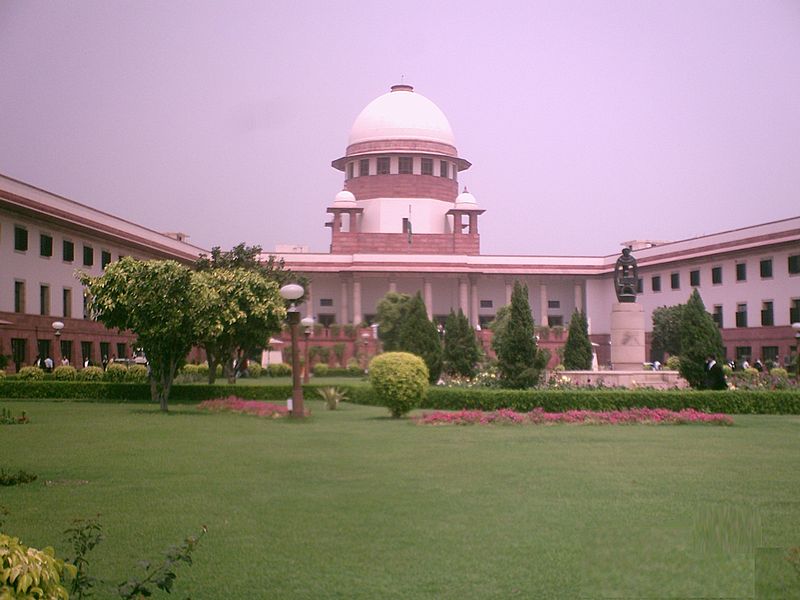
What is the procedure to visit the Supreme Court of India?

1

 Supreme_Court_of_India_-_200705

A law student visiting Delhi wants to visit the citadel of Judicial power and legal system in India, and is weighing his options. Over to Madan, a law student from ILS, Pune and an IDIA scholar.

I am a law student and I am from Bangalore. It has been a week since I arrived in Delhi to intern with a law firm.

Of course, it is the dream of every law student to visit the Supreme Court of India at least once. Every advocate on the rolls of Bar Council would have gone through numerous judgements of the Supreme Court of India but I am sure that not all advocates in the country had the opportunity to visit the Supreme Court although all litigators dream of arguing before it one day.

In the past some colleges used to organize educational trips to the Supreme Court or High Courts. However, on account of modernisation and advent ofthe internet, relative ease of transportation and increasing number of internships, such exposure may not be necessary and students should take their own initiative to see the Supreme Court. As for me, I am not interning under any advocate who practices in the Supreme Court and I want to witness the proceedings before the court. Hence if I want to visit the Supreme Court, I will be considered a member of the general public rather than an intern of a Supreme Court lawyer who would have access to the premises for doing their work. Keeping this in mind, I set out to research the various means by which I can enter the Supreme Court of India.

Why should general public be interested or allowed to witness court proceedings?

The law belongs to the people and access to legal system is a basic right and for public good. General Public are allowed to witness the court proceedings because the Indian Constitution recognises the ‘open justice system’ where justice is delivered after hearing both the parties and on sufficient evidence before the public. This ensures –

  1. Fairness in trial
  2. Inspires public confidence in the judicial process
  3. Promotes and fosters democratic values in the public.

Supreme Court of India has been a champion of these principles. However, the process one needs to undergo to achieve entry into the hallowed portals of the Supreme Court  are not necessarily simple.

Security Concerns

Earlier, I guess there was not much of a security threat to symbols of democracy such as Parliament, Supreme Court or Rashtrapathi Bhavan. Hence, armed police personnel would have sufficed for purposes of security.

However, with the advent of modern technology and radical ideologies over the globe, and in light of the Parliament attack that look place some years back, security measures ensuring a sense of safety to people visiting Supreme Court is very important. In fact, in 2011 there was bomb blast in Delhi High Court premises killing over 11 persons and inuring over 70. Hence, security of the courts are taken very seriously.

Hence, a person visiting the Supreme Court has to go through the prescribed security procedure.

The office of the Registrar of Supreme Court of India is responsible for all the security measures in place for entry of visitors to Supreme Court. It follows two procedures for grant of entry passes to visitors –

  1. Online registration request for entry passes.
  2. Old procedure for entry for those who are not aware of the online process.

Online Registration request for entry passes

The Supreme Court has launched a web based initiative – http://scvms.gov.in/WebVisitorBookingNew.aspx  to reduce the time taken to issue the entry passes and to lessen the inconvenience caused to the visitors.

An online request for issuing an entry pass can be made by visitor by providing his valid identity and address proof along with the details of the section of the Supreme Court to be visited and also the case details and the visitors advocate details.

Then, the request would be processed and the request has to be printed and presented to the security personnel along with the signature of the advocate and valid ID proof and has to be submitted to the visitor counter to obtain entry to the Supreme Court premises.

However, I as general public cannot access this facility as the advocate and case details are mandatory to be filled up as my purpose is not litigation but to just witness court proceedings.

Though, the Supreme Court circular on this point makes it clear that Online passes are for – Visitors (litigants and advocates) and other persons visiting the court, but in substance the online facility makes no provision for other visitors.

Advocates Entry

The Registrar’s Office would issue proximity cards for advocates who as members of Supreme Court Bar Association and Senior Advocates after they fill in the prescribed forms.

Proximity cards are also issued to any person enrolled on the rolls of any State Bar Council after they follow the prescribed procedure and submit their duly filled forms.

The advocates can also sign passes for their clients or interns to enter the court premises.

I have been thinking of requesting some advocate who might be entering the court and tell him of my problem to visit the court and perhaps enter under the guise of an intern but it did not appear appropriate to me.

Photo-entry passes or on-the spot passes

While googling, I have come across a circular of Supreme Court providing for an on-the spot entry to its premises with valid Identity and address proof for anyone wishing to enter the court premises. However, it compulsorily requires an advocate’s signature.

Conclusion

I plan to visit the Supreme Court in some days and try out my chance at the on-spot entry passes. I found on enquiry that it is necessary that an advocate must authorise my visit or else I cannot attend. I hope while researching my options I made some mistake, because if Indian citizens cannot visit the Supreme court unless they are litigating there – a big opportunity to sensitize Indian people about the legal system that governs them is lost.

There no reason why general public should not be allowed to get online entry passes to visit the apex court of one’s country. Any citizen of India wanting to see the highest seat of judicial power need not have approval of any advocate to do that. I do not intend that Supreme Court should be turned into a tourist place but I mean that any person with a bona fide interest to educate himself of the judicial process in the highest court must not be subject to handicap such as requiring some stranger’s signature for visiting the court even after providing valid proof of person and residence.

I hope my visit to the apex court would be sweet and smooth without any friction with the security personnel. However, throughout writing this article I have wondered as to how journalists gain entry to the court? May be they will flash their press cards. But what can I flash other than my voter ID card?

Download Now

Legalities involved in starting your own E-commerce Business

1

puneet-bhasin1

This article is written by Advocate Puneet Bhasin, Cyber Law Expert of Cyberjure Legal Consulting. You can contact her at [email protected]

E-commerce has seen a huge growth in the Indian consumer market, and with the advent of smart phones and tablets, an E-store is way more accessible to a consumer in comparison to a brick and mortar store. At the touch of a finger you can buy and sell products and in case of E-commerce portals involving dating, marriage or networking facility, one is connected with a single click. However, what most people entering this domain are unaware of is the legal compliances that are required under law and that can prevent litigation against them in the future and at best put them on a good footing in the litigation matters. Below is a list of legalities an E-commerce start-up must keep in mind:

  1. Structuring your E-commerce business

This is the first stage of your business activity and you need to have a clear picture of where you see your business going in the next 6 years. A Partnership or Limited Liability Partnership sounds a very good option, but it is not attractive to Investors who prefer a Private Limited Company. So if you plan to generate funds through Venture Capitalists in near future then it is advisable to structure your business in the suitable way right now, otherwise you would have to restructure your business later before approaching investors.

  1. Business Model

In my practice I come across many E-commerce start-ups whom I advice and I am on a retainer with, and the first thing I notice and point out when they approach me is the lack of a properly formulated business model. Most founders have an idea and they make points with respect to taking that idea forward and its implementation, but a well-researched professionally made business model is a must! It is the blue print of your business. I invariably advice clients to get a good consultant on board and get a proper business model made. The terms and conditions, vendor agreements and other legal documents that we draft are made keeping in mind this blue print. For example, today your portal is offering services for free but you do contemplate that maybe sometime in future you may want to charge a registration fees, then the blue print should have this data and the User agreement will be drafted specifying that the user agrees to any future registration charges on being intimated of the same by the E-commerce portal.

  1. Domain Name

I have seen most clients register a domain name and they feel that their intellectual property right with respect to the domain name is protected. This is a myth! The domain name has to be separately trademark protected. A domain name registration has to be renewed and a lapse in the same can cause you to lose the rights to use that name, however, a trademark registration gives you the exclusive right to use that domain name for your business.

  1. Privacy Policy

This is a must for every E-commerce Portal. You need to have a well drafted privacy policy to prevent you from being sued under Section 43A of the Information Technology Act, 2000 where the penalty that can be awarded against an E-commerce portal is upto 5 Crores.

  1. Terms and Conditions

These are the clauses that bind the E-commerce company and the User. A well drafted terms and conditions agreement should cover all the user covenants and company covenants along with restricting the liability of the E-commerce company in every way possible.

  1. Vendor Agreement

This is the Magna Carta of the Vendor–Portal relationship in a Market place E-commerce model. It should have well-defined clauses to deal with default, delivery, quality, termination and commission among the many other major provisions which have to be included keeping in mind the business model of the E-commerce venture.

  1. User Agreement

A user agreement has to be drafted in a manner to ensure that a User’s rights are preserved and also, the liability of the E-commerce portal is restricted due to its status of being an intermediary. An important clause that should always be there is that the Portal can update and change the terms of the User agreement and the user is responsible to keep himself updated with the same by reading through the User agreement before every transaction.

  1. Data Security

I have seen most E-commerce start-ups deciding not to invest in cyber security in the beginning of their venture, however, data security is a sensitive issue and failure to do so can render an E-commerce portal liable to pay penalty upto Rs. 5 Crores.

  1. Taxation

Depending on the business model, the founders of an E-commerce venture should focus on the taxation aspect too. Though, this is still a developing area of law in India, but still there are certain taxation compliances that apply to E-commerce ventures and non-compliance renders them liable.

The next article will focus on the main litigation issues faced by E-commerce companies and ways by which E-commerce companies can be on a better footing to deal with them.

Download Now

Bureau of Energy Efficiency – an analysis

0

This article was submitted by Adarsh Raj Singh Chaudhary,  a 2nd year student of B.A.LL.B. (Hons.), University of Petroleum and Energy studies, Dehradun as a part of a blogging contest which may lead to his selection as an iPleaders Energy Law Fellow. The fellow will be selected on the basis on engagement on these posts as well as quality of writing and research. We emphasise on engagement because it shows one’s ability to generate interest in an otherwise arcane subject like energy laws. The selected fellow will receive a paid internship with a boutique energy law firm in Delhi (stipend of INR 7000), an opportunity to be mentored by very senior lawyers  and a free course worth INR 5000 from iPleaders. If you want to participate, write to [email protected] for instructions.


What, thence would have had happened if not even a pint of petrol for jet planes, a single block of coal for steam engines and the last droplet of water in dams had gone depleted, well there are an n amount of comments and well researched speeches been delivered for such circumstances and some even declared it in their very calculated prophecies as a next approaching. If presumed for an instance going by the empirical data analysis yet available to the researchers, economists or scientists etc., that such dusk is to come then for such a contingency, on September 29th of 2001, there roared a paladin attested by the signature of president of India, with a name – “THE ENERGY CONSERVATION ACT”[1] (hereinafter act), This been duly believed by the Indian govt. that in a developing country like India, with such a growing amount of population, it’s consequential that energy consumption at this rate would lead to the depletion of the natural resources or fossil fuels which are as a matter of fact substances, once used cannot be retained to their previous state, thus awarding them a very limited existence, So to meet such challenges i.e., global warming, huge energy consumption, carbon emissions etc. a special body was enacted under this very act in Chapter 2 sec- 3 titled by Central govt. like “BUREAU OF ENERGY EFFICIENCY” (hereinafter bureau), with expressly laid objectives and functions of the board, deriving authority from the govt. of India or its federal states.

INCORPORATION

In Chapter; 2, the act clearly expresses the intention for the formation of a bureau as under section-3(1, 2, 3 . . .) and from the chapeau of the chapter – 2, which also describes the bureau as a person,[2] where the bureau’s office being at Delhi, also leaving a choice to the bureau for setting up offices elsewhere within the territory of India.[3], wherein the bureau shall be organized by the members of governing council, having members ranging from 20 to 26, as appointed by the central government.[4],

Here lies the enumerated itemization of the members of the Governing council –

  • the Minister in charge of the Ministry or Department of the Central Government dealing with the Power -ex officio Chairperson;
  • the Secretary to the Government of India, in charge of the Ministry or Department of the Central Government dealing with the Power – ex officio member;
  • the Secretary to the Government of India, in charge of the Ministry or Department of the Central Government dealing with the Petroleum and Natural Gas- ex officio member;
  • the Secretary to the Government of India, in charge of the Ministry or Department of the Central Government dealing with the Coal – ex officio member;
  • the Secretary to the Government of India, in charge of the Ministry or Department of the Central Government dealing with the Non-conventional Energy Sources – ex officio member;
  • the Secretary to the Government of India, in charge of the Ministry or Department of the Central Government dealing with the Atomic Energy – ex officio member;
  • the Secretary to the Government of India, in charge of the Ministry or Department of the Central Government dealing with the Consumer Affairs – ex officio member;
  • Chairman of the Central Electricity Authority established under the Electricity (Supply) Act, 1948 – ex officio member;
  • Director-General of the Central Power Research Institute registered under the Karnataka Societies Act, 1960 – ex officio member;
  • Executive Director of the Petroleum Conservation Research Association, a society registered under the Societies Registration Act, 1860  – ex officio member;
  • Chairman-cum-Managing Director of the Central Mine Planning and Design Institute Limited, a company incorporated under the Companies Act, 1956 – ex officio member
  • Director-General of the Bureau of Indian Standards established under the Bureau of Indian Standards Act, 1986 – ex officio member;
  • Director-General of the National Test House, Department of Supply, Ministry of Commerce and Industry Kolkata – ex officio member;
  • Managing Director of the Indian Renewable Energy Development Agency Limited, a company incorporated under the Companies act, 1956 – ex officio member;
  • one member each from five power regions representing the States of the region to be appointed by the Central Government members
  • such number of persons, not exceeding four as may be prescribed, to be appointed by the Central Government as members from amongst persons who are in the opinion of the Central Government capable of representing industry, equipment and appliance manufacturers, architects and consumers – members;
  • such number of persons, not exceeding two as may be nominated by the Governing Council as members – members
  • Director-General of Bureau – ex officio member (secretary);[5]

Also, there shall be a procedure for deciding or reaching upon a conclusion that is by a majority vote and in case the secretary of the bureau is absent than the person presiding over him, shall have a casting vote, whereas as per sec – 9 of the act, following are the criteria for becoming the secretary of bureau –

  • The person so appointed shall not be below the rank of deputy secretary of Govt. of India. And would be the chief executive authority of bureau.
  • Presumption is made that the person so elected has knowledge and experience relating to energy production, supply and energy management standardizations and efficient use of energy and its conservation to sufficient
  • At last, the power and duties so discharged shall be in accordance with the regulations of the act.

ADVISORY COMMITTEE

u/s – 8, there shall be an advisory committee from 6 months of enforcing of the act, for the efficient functioning of the bureau, where the committee should have a chairperson and other members for discharge of functions, where the members may have the technical expertise so required for the bureau.

POWERS & OFFICE [6]

As being a govt. Body the bureau has its own inherent powers, and with the advent of powers certain functions are allocated which need to be performed from time to time as given u/s – 13

(a) Recommend to the Central Government the norms for processes and energy consumption standards required to be notified.

(b) Recommend to the Central Government the particulars required to be displayed on label on equipment or on appliances and manner of their display of appliances of the nature as described in sub – clause (a);

(c) Recommend to the Central Government for notifying any user or class of users of energy as a designated consumer under clause, which as provided in 14(e) provides for switching of energy usage appliances which inhales less intensity of energy;

(d) Take suitable steps to prescribe guidelines for energy conservation building codes for energy savings in building of building complex;

(e) Take all measures necessary to create awareness and disseminate information for efficient use of energy and its conservation;

(f) Arrange and organize training of personnel and specialists in the techniques for efficient use of energy and its conservation;

(g) Strengthen consultancy services in the field of energy conservation;

(h) Promote research and development in the field of energy conservation;

(i) develop testing and certification procedure and promote testing facilities for certification and testing for energy consumption of equipment and appliances;

(j) Formulate and facilitate implementation of pilot projects and demonstration projects for promotion of efficient use of energy and its conservation;

(k) Promote use of energy efficient processes, equipment, devices and systems;

(l) Promote innovative financing of energy efficiency projects;

(m) Give financial assistance to institutions for promoting efficient use of energy and its conservation;

(n) Levy fee, as may be determined by regulations, for services provided for promoting efficient use of energy and its conservation;

(o) Maintain a list of accredited energy auditors as may be specified by regulations;

(p) Specify, by regulations, qualifications for the accredited energy auditors;

(q) Specify, by regulations, the manner and intervals of time in which the energy audit shall be conducted;

(r) Specify, by regulations, certification procedures for energy managers to be designated or appointed by designated consumers;

(s) prepare educational curriculum on efficient use of energy and its conservation for educational institutions, boards, universities or autonomous bodies and coordinate with them for inclusion of such curriculum in their syllabus;

(t) Implement international co-operation programs relating to efficient use of energy and its conservation as may be assigned to it by the Central Government;

(u) Perform such other functions as may be prescribed.[7]

FINANCES & AUDIT OF BUREAU

As clearly specified in Sec – 22 – 24, of act; that at each financial year there will be a budget adduced for the next financial year showing the estimated receipts or requirements and expenditures for the previous financial year in the annual report which would be produced before each house of parliament, after passing through the central govt. and,

Also, every year the annual report that is made in accordance with the instructions of the Govt. of India, be checked or audited either by Comptroller & Auditor General of India (hereinafter CAG) or by the person appointed on behalf, where the person appointed shall have the same authority as that would have been of CAG, where any expenditure so incurred shall be paid by the bureau to CAG, as under Sec – 25(1 – 3)  and the bureau should submit all the books, vouchers or any and all details as may be necessary for the auditing of the accounts, by CAG or any other person so appointed.

Reasonable LIMITATIONS

At first, the bureau is trammeled of the directions passed by the Government on questions of policy, upon the actions of authority, which are to be exercised by the Bureau, while discharging its functions, and whether a question is of or pertaining to related with policy or not, shall be left for determination by the Central govt. but the Bureau may have a voice, so it can at any time or whenever possible would disclose its view on any such directions as ordered by the Govt.[8]

But, if in case there exist a disability, of the bureau where disability taken in a sense of dysfunction within the limits of law set for the bureau. Thus in such cases for the sake of nation’s smooth functioning and interests so involved, the Central govt. may supersede or succeed to the bureau and would take all the authority back. And would function as a bureau in itself, but not more than the period of 6 months, but for all of this a notification be made containing all the reports of circumstances showing a disability for which it is believed that the bureau won’t be able to function due to such reasons and thus the central govt. should hold the bureau for now until bureau being capable of doing its functions, and this notification would then be laid down in the parliament.[9]

The causes for such dismissal of the bureau in the opinion of Central Govt:

  • ‘that on account of grave emergency, the Bureau is unable to discharge the functions and duties imposed on it by or under the provisions of this Act; or
  • that the Bureau has persistently made default in complying with any direction issued by the Central Government under this Act or in discharge of the functions and duties imposed on it by or under the provisions of this Act and as a result of such default, the financial position of the Bureau had deteriorated or the administration of the Bureau had deteriorated; or
  • The circumstances which exist render it necessary in the public interest so to do, the Central Government may, by notification, supersede the Bureau for such period, not exceeding six months, as may be specified in the notification.’[10]

Now a common question which twinkles at our minds is what would happen then if the bureau is so dismantled and taken away by the central government, well the answer is given by sec- 47(2,3) as follows –

  • That after such a notification is made the members; the ones which are appointed by the central government due to their field specific expertise would be ordered to vacate the office,
  • All the property or assets so owned by the bureau shall now fall under the jurisdiction of central govt. and until the notification is in action these assets be controlled by the central govt.
  • And all such powers are exercised by the persons appointed by central govt. for the disposal of functions or duties of bureau in accordance of the act till the notification are in effect.

Thus, as described above was the bureau of Energy efficiency, with its functions to members, authority and limitations so imposed, and is thus believed that? The board is of a vital nature as a constituting body of central govt. for meeting of the challenges of today up to tomorrow relating to environment protection, low energy consumptions etc. and hence it is hoped that the work done by the bureau would continue to preserve the energy of nation as it being one of the treasures of country.

[1] (An act no. 52 of 2001)

*Student of B.A.LL.B(HONS) 2ND year batch – 2018, University of Petroleum and Energy Studies, Dehradun

[2] Sec- 3(2), act (The Bureau shall be a body corporate by the name aforesaid having perpetual succession and a common seal, with power subject to the provisions of this Act, to acquire, hold and dispose of property, both movable and immovable, and to contract, and shall, by the said name, sue or be sued.)

[3] Sec – 3(4), act

[4] Sec -4(1), act

[5] Sec – 4(2), act

[6] The actions and activities assigned to or required or expected of a person or group – office

[7] Sec – 13(2), act

[8] Sec-46, act

[9] Sec-47(3)(d), act

[10] Sec – 47(1)

Download Now

What are the legal grounds to prefer one bail petition over another?

1

This article is written by Mayank Labh,  a student of NALSAR Hyderabad.

The life of the pavement dwellers is tragically interesting. Most of what is an integrated part of the life of pavement dwellers is the dust and at times mud in the rainy season, the squalid environment, the scornful passer-by and a growing fear of “accidents” and dangers to their life arising from those so-called accidents. The fear is such that it won’t be surprising for them to say while wishing good night that “Hope, You won’t get killed today.” However, what is striking is that they seem to be content and accept it.

One such fateful night was when Salman Khan’s hit his car on the intervening night of 27  and 28 September 2002 and “accidentally” killed a guy and injured four persons. The wheels of justice were set in motion with its defining feature of slow pace. 13 years on, He was held guilty and it seemed to us that the wheels of justice move slowly but it makes sure that it grinds finely. However, soon on the same date of conviction, he is granted an interim bail. Next day, he got his sentence suspended. The wheel of justice is still moving in the pursuit of justice but the sounds it is making is telling something else.

How are we to make sense of these judicial developments on this “Hit and Run” Case? Is the court within its jurisdiction to give the bail on the same date? If yes, then why is it denied to the common man who have to perish in the jai? Should we consider this quick delivery of bail just as a judicial aberration?

Power of the Court to grant Bail

Bail means an order of release of a person from prison and forms an integral part of our criminal justice system which assumes every man innocent until (conclusively) proven guilty. However, it is not an inherent right particularly when it comes to non-bailable offence and culpable homicide of which Mr. Khan is accused is a non-bailable offence. Under section 437(2) of non-bailable offence, it is the discretion of the court to grant bail in such cases provided that if there is a reasonable ground to prove that he is guilty of an offence which is punishable with death or imprisonment of life and secondly if he had been guilty of crime of an offence punishable with death, imprisonment for life or imprisonment for seven years or more, or he had been previously convicted on two or more occasions of a cognizable offence punishable with imprisonment for three years or more but not less than seven years then the court cannot grant bail.

Moreover, when a court gives bail for non-bailable it has to record his reasons for doing so. The ground given by the court is that he had been handed only two-page operative part of the verdict and not a detailed order. While the question of giving it on this ground is in itself debatable the question that must be asked is how Salman already knew of the fact that he won’t be given the detailed order for no reasons other than this was contended by his lawyer. Was it the case that there were no pending bail applications in Court?  Were all the clerks, judicial officers waiting to dispose of  Salman’s bail petition over the other cases? Are there any

No such grounds have been mentioned in the Cr.P.C which deals with the procedural aspects of Criminal Justice System. So, in the absence of normative framework, can the law prioritise matters of the powerful as against those of the weaker sections? These are the questions that must be answered.

Brouhaha overlooking another crucial substantive aspect

The irony of the law is that for poor people the question of granting of bail petitions has always given them pains. While in this case where the bails are granted they do not get justice but the fact is that the records of the court say that such grant of bail is the privilege of only rich and powerful case. Be it the case of 2G scam accused or the case of Sanjay Dutta. The case of poor people tells another story. Even though, myriads of court judgements have led the poorest to either get the bail or released on personal bond but this has not been implemented effectively. According to NCRB, 66 percent of prisoners are under-trials and out of them 2000 are languishing in jail for more than five years. Prominent reasons for the large number of under-trials in India is the inability of the poor people to pay the money for surety, their ignorance of their rights and a painful slow police investigation and delay in the delivery of “justice”.  This makes the plight of poor people unaltered. So, given the overall bias against the poor and marginalised in the criminal justice system, there have to be specific and institutional mechanisms to ensure that poor people are informed about their right to free legal assistance, about bail procedures and their rights as undertrials. Only then can we hope of some positive change in the life of poor people and the people who sit and sleep on the pavement and still remain content.

Download Now

Protection of Children on Internet, Karnika Seth (Book Review and Launch)

0

IMG-20150509-WA0001

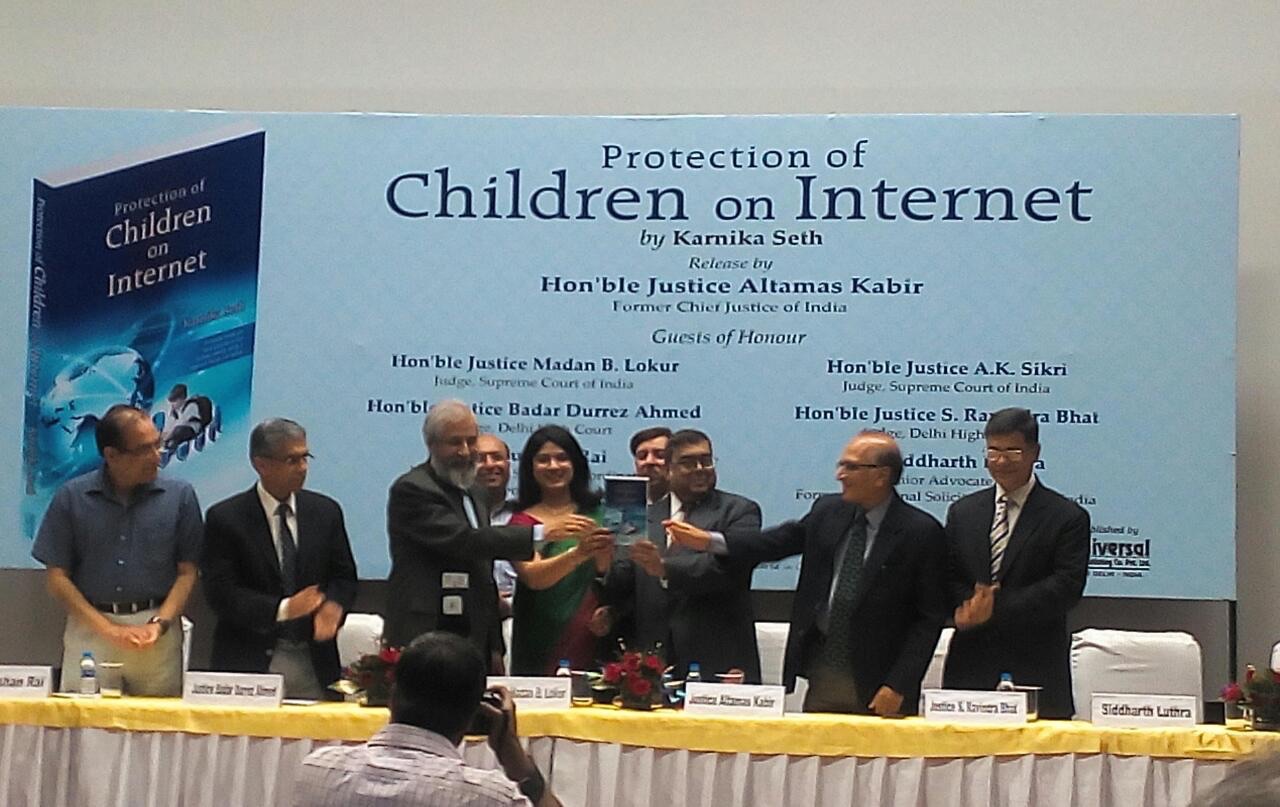
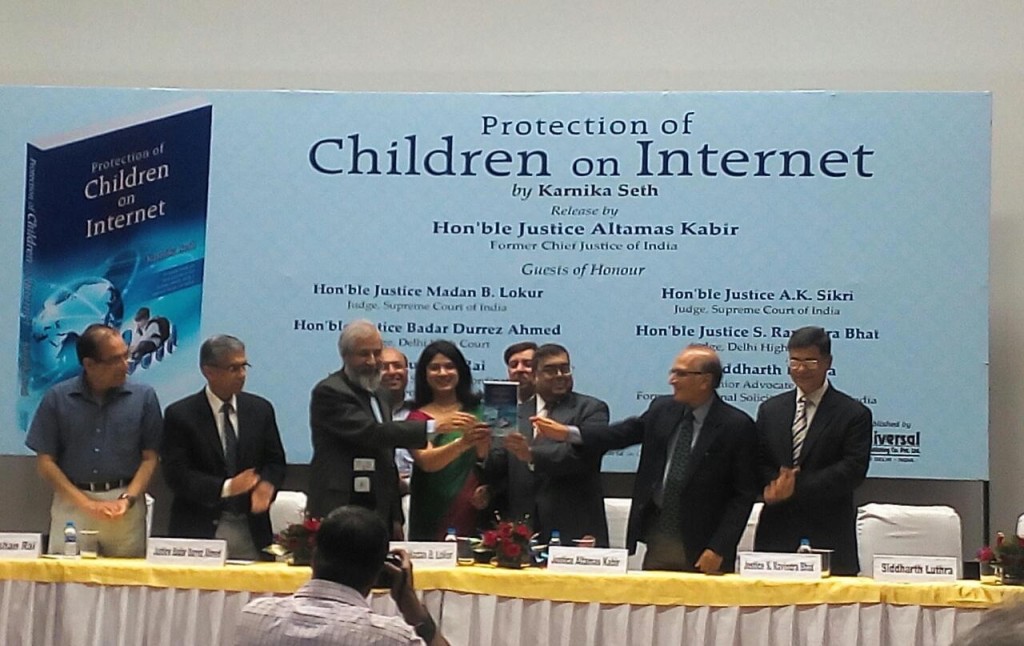
Image: Karnika Seth with guests at her book launch – Justice Altamas Kabir, Justice Madan Lokur, Justice Badar Durrez Admed, Justice A.K. Sikri, Senior Counsel Siddharth Luthra, Gulshan Rai

In this age of technology, children have easy access and adapt with the latest technology faster than the earlier generation. While the technology can be used by the children to enhance their learning and increase their knowledge, it can be easily misused by them or can be lured by strangers to their self-gratification. Recently, the newspapers were flooded with news of a minor girl raped by a Facebook friend in Gurgaon. While, this was highlighted by the media, 100s of cases goes unreported due to the social stigma attached and even in some cases it is not reported by the child themselves as they fail to realize that they have become a victim of an offence.

While laws including provisions of Information Technology Act, Indian Penal Code (IPC), Protection of Children from Sexual Offences Act (POCSO), 2012 criminalises certain offences like publication of child pornography, cyber stalking, voyeurism, sexual harassment and abuse, etc., it is important for the parents and guardians to understand how they can protect their child on internet, including mechanisms to restrict access to certain websites through technological means. It is also important that the guardians are aware about the legal steps they can take if their child is a victim of a cyber offence. Recently, Karnika Seth, a well-known cyber lawyer released a book titled “Protection of Children on Internet” which can be used by guardians to educate themselves on how they can protect their children online. The official press release is provided below:


Press Release

BOOK TITLED ‘PROTECTION OF CHILDREN ON INTERNET’ AUTHORED BY KARNIKA SETH RELEASED BY JUSTICE ALTAMAS KABIR, FORMER CHIEF JUSTICE OF INDIA

IMG-20150509-WA0000

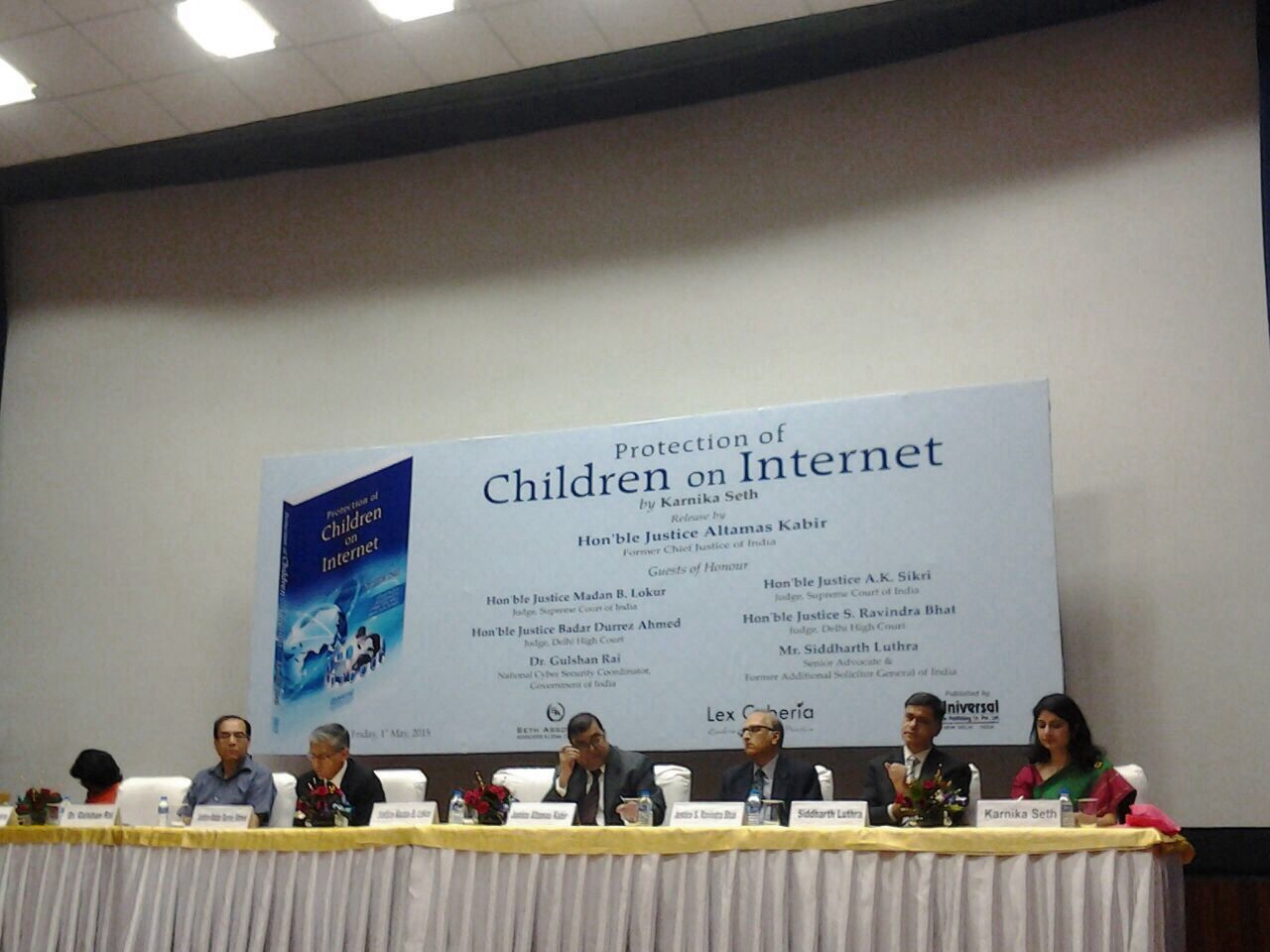
On 1st May 2015, a timely and useful guidebook on best practices for online safety of children , titled ‘Protection of Children on the Internet’ authored by acclaimed cyberlaw expert, Educationist & Author, Karnika Seth was released by Hon’ble Justice Altamas Kabir, Former Chief Justice of India at the Russian Centre for Science and Culture, New Delhi. The book release function was graced by distinguished Guests of Honour, Judge of the Supreme Court of India, Hon’ble Justice M.B. Lokur  , and Judges of the High Court of Delhi, Hon’ble Justice Badar  Durrez Ahmed and Hon’ble Justice S. Ravindra Bhat. Dr. Gulshan Rai, National Cyber Security Coordinator, Government of India and Mr. Siddharth Luthra, Senior Advocate & Former Additional Solicitor General of India also graced the occasion as Guests of Honour.  The book is a very simple, timely and practical guide book for parents, children, educators, lawyers, officers in Ministry of Women & Child Development, NGOs, and officials of  law enforcement. It aims to bring cyber awareness on protection of children in cyberspace from various cybercrimes including trolling, cyberbullying, cyberstalking, child pornography and other forms of online child abuse.  In their speech, Hon’ble Justice Altamas Kabir and other distinguished Guests of Honour appreciated the timeliness and massive utility of the book and its simple and lucid content. They acknowledged that it is perhaps the first Indian book on this subject & such a book was imperative in the digital times as it will contribute substantially in creating cyber awareness to protect children, who will be our leaders of tomorrow. The Author stated “The book is a social initiative directed at bringing cyber empowerment through cyber awareness to protect children who use Information technology more than any other section of our society”. On the occasion of her book release, Ms. Seth also announced that an Application  on Cyberlaws aimed at spreading cyber awareness ‘IT Act & Cyberlaws’ and a website childprotectionindia.com elucidating cybersafety tips for children have also been  developed and made operational by Lex Cyberia, specialized cyber law practice of Seth Associates, where she is the Managing Partner.  They have also released an Android app to create cyber awareness in India among all sections of our society. It contains tips for general safety on the Internet, including for children using Internet for social networking or otherwise. It is useful for every user of internet, including children, parents, educators, law enforcement, lawyers, police and international or government entities. The app can be accessed here.

Download Now

Atrocities against people from the North-East in Delhi and available legal recourses

1

3382892276_c041879f23_z

This article is written by Adya Garg, a student of NUJS, Kolkata.

India is the country that has always been identified through its motto of ‘unity in diversity’. However, at the same time, one can clearly see it as being divided amongst two countries in itself, due to the exclusion faced by the North-Eastern Communities in their own country. While the same is not confined to any particular city, and finds practice in many cities[1], the same has been the most apparent in the capital city of India, Delhi,[2] supposedly, one of the most inclusive and accommodating metropolitans of India. Surveys have revealed that North East communities deem the Capital as the most unsafe place in terms of ethnic discrimination.[3] Sociological as well as legal factors have been blamed for the practice of such discrimination in the country. While some demand a change in the attitude and mind-set of the citizens of the nation, others deem legal recourses as an effective option of curbing the discrimination.

This national level debate gained momentum in the year 2014, which witnessed multiple cases of atrocities against the North-East students residing in Delhi. The most prominent of them was the death of Nido Tania, a college student, due to an alleged racial attack.[4] This particular incident led other such incidents to also being highlighted. Similar controversies included a case of molestation of a Naga student.[5] Not only was she sexually assaulted in Delhi Metro, her supporters were threatened and beaten by the other professional colleagues of the offender.[6] Another was the brutal murder of Souloni Akha from Manipur.[7] Apart from these, the Priyanka Chopra starrer, Mary Kom, also found itself amidst criticism for casting a person with no mongoloid features as the female protagonist.[8] The argument raised was that this barred the display of racial discrimination faced by MC Mary Kom due to her mongoloid features, on the big screen.[9]  Even early years had faced practice of such discrimination such as the case in 2009, in which Ramchanphy Hongray from Ukhrul, was raped and murdered by her co-tenant.[10] Racial motives were attributed to the crime.

On examination of the cases of various kinds of atrocities inflicted upon the North Easterners, it can be reasonable concluded, that the discrimination faced by them is mostly racial in nature.  While their names are made fun of, for sounding different, it is their mongoloid features that attract most of the racial remarks. Often this also leads to North Eastern people being treated like foreigners in their own country. An apt example being the auto rides offered to these people till ‘Majnu ka Tila’, a Tibetan refugee colony.[11] Their upbringing also usually being culturally and socially different from the rest of the country faces the brunt of such atrocities. Often their progressive thinking is looked down upon as a lack of morals. Hence, North Eastern girls find themselves being tagged as ‘loose’ and ‘easy’, even to the extent of being stereotyped as ‘sexually available’.[12] This perhaps forms one of the foundation reasons of increasing gender crimes against females from North East. Even the Nido Tania case started from racial slurs being made at his blonde hair and red jeans. Job security has also been an issue with these people, often being terminated prejudicially. Due to economic reasons, these people mostly reside in rented homes in so called ‘urban villages’. The people in these localities have conservative roots and often deem North Easterners as a threat to the morality.

Not only at the personal level, but people from these communities are also often left victims of institutional racism. This racist prejudice is experienced while seeking legal recourse against the racism faced when police take such cases lightly or pressurize the victims to withdraw the case.[13] The police have often been found to delay the recording of the First Information Report and the subsequent investigations. So much so, that report of an assault against a Singaporean woman was delayed on the grounds of the similarity of the facial features with those of the North Easterners.[14] Police was highly criticized for being negligent in the Nido Tania case. After the altercation, Tania was dropped off by the police in the same locality where it took place, leading to easy track down of Tania by the offenders.[15] Such lackadaisical and discriminative attitude of the Police can be said to be the reason of only 4% of the North Eastern victims reporting their crimes to the police in Delhi.[16]

In the legal view, such acts have also been criticized the most for violating the fundamental rights as laid down in the constitution. The articles that have been invoked include Article 14, Article 15 and Article 16. While Article 14 confers the Right to Equality in the eyes of law, Article 15 bars discrimination on the grounds of race among others and Article 16 confers equality in terms of public employment. However, the loophole lies in the fact that these rights can only be invoked against the ‘State’ and not against any personal discrimination or violence.

With the murder of Tania, a furor was created in the city and legal proceedings were initiated in the High Court understanding the need for addressing the problem with a legal point of view and find legal remedies for the same. Advocate Upendra Hazarika represented two NGO’s on behalf of the North East communities. In its judgments dated 12 February 2014, the Delhi HC called for a legislation barring citizens of one state from harassing immigrants from other states of India. Other problems pointed out included the primary difficulties in handling of such cases by the Delhi Police. This was considered as being due to the language barrier between the Delhi Police and the North Easterners. It was noted that out of 90,000 personnel, less than fifty hailed from these regions. Recruitment of more police force comprising of North Easterners was pointed out as a mandatory step that ought to be taken by the government, by the Bench comprising of Chief Justice RV Rammana and Justice R S Endlaw. [17]

Not only the HC, but the people of India as well, especially the North East communities, were criticizing the dearth of an appropriate legal provision to tackle the problem faced by them and were thus demanding introduction of stringent legal provisions for the same. However, often the introduction of legal remedies targeted at the discrimination faced by the North Easterners only is questioned and criticized by the other residents of the metropolitan cities. It is raised that such acts or atrocities are not discriminative towards a particular community but are rather the daily ordeals faced by any common resident of such cities generally. However, it has been pointed out that compared to the small population of North Easterners in Delhi, the crime rate is proportionally very high.[18] Further, the rate of such crimes has been increasing, largely attributed to the difference in the physical features.[19] Such atrocities have been said to create a feeling of alienation and hatred among the youth of these communities, also blamed for encouraging the separatist movements led by youth in the North East regions back home.[20] Thus, addressing these issues in particular have been deemed as an urgency in regard to national integration.

The legal provision being demanded the most was the introduction of an Anti-racism law in India. While India recognizes SC and ST categories officially, unlike some countries such as UK, USA and Australia, no racial sets have been recognized. Thus, the continuous demand of an anti-racism law in India as being a necessity following the discriminative incidents needed to be focused upon. This initiated a plethora of media debates, often citing the Anti-racism law passed in Bolivia as an example.[21] However, the same has been criticized for the reason of infringing the right to freedom of speech. Article 16 of this Act makes, “A medium which authorizes and publishes racist and discriminatory ideas”, “subject to economic sanctions and to suspension of its license to function, subject to regulation”,[22] under which Media houses and journalists can be arrested for publishing racist content.[23]  Thus the Act found itself being criticized for being a tool for censorship by the government. Similar allegations have been noted in the case of the Victorian Racial and Religious Tolerance Act (2001) in Australia.[24] Thus an anti-racism law as a remedy against these problems faced by the North Easterners has not been considered as the best option in India.

With multiple acts of atrocities against the North Eastern community in the capital and the controversy regarding the efficiency of an anti-racism law, other legal remedies were also being sought as the need of the hour. In view of the same, the year 2014 also saw the set-up of the ‘Bezbaruah Committee’. Constituted by the Ministry of Home Affairs, it was chaired by Shri M.P. Bezbaruah, I.A.S. (Retd) and a member of the North Eastern Council.[25] The purpose was to address the grievances of the North Eastern residents of the metropolitan cities of India, and suggest some suitable remedies that ought to be taken by the government, especially in light of the Nido Tania case.[26]  While the committee compiled its report and suggestions, it did not fail to point out the need of High Court directives in order to tackle with the problem in the long run.

Before addressing the legislations that need to introduced, existing legal provisions that ight address the problem were focused upon. Often such acts are pleaded against under the Schedule Castes and Tribes (Prevention of Atrocities) Act, 1989. While the act does not comprise of any particular legal provision against racial discrimination towards North East people, the act is often resorted to due to the significant figure of people from North East falling under either of the categories i.e. scheduled castes or scheduled tribes.[27] Section 3 of the Act notifies deliberate insult and humiliation in public view as an offence. Under the Act, any person, even other than the victim, can lodge a complaint and the police can arrest the offender without any warrant or investigation. Even a directive from the Ministry of Home Affairs direct booking offenders guilty of atrocities against the North Easterners under the SC/ST Act.  One of these included booking under the ‘Chinki law’[28]  which marks calling North Easterners with names such as ‘Chinki’, ‘Chow-Chow’ as an offence that can lead to an imprisonment for five years, under the SC/ST Act. However, while the Act has been considered as a good enough legislation against atrocities faced by the North Easterners, it is not a permanent solution. Owing to its provisions for the protection of a certain set of people, it is considered as being similar to an anti-racism law. However the Act classifies people on the basis of caste instead of race. The two sets although often overlapping, do comprise of communities which is covered by one set but not by another. [29] Thus, large number of people from these communities such as Gonds, of whom only a few are ST’s, are left without any legal recourse against the discrimination faced under the Act.[30]

Another legal provision often resorted to in such cases or which might cover such acts is the Section 153A of the Indian penal Code. This section constitutes promotion of hatred or ill-will between different communities on the grounds of race among others. Thus the importance of maintenance of harmony between different racial classes has been laid down. While the section includes a stringent punishment of imprisonment of three years, fine or both, the Act is limited in scope due to the requirement of promotion of enmity amongst two classes.[31] Not every act of racial discrimination against the North Easterners can be considered as promoting hatred against the entire community.

Thus, the committee considered amendments to Section 153A of the IPC, Protection of Civil Rights Act, 1955 and the SC/ST Act, 1989 as legal recourses to these problems. The legal provision demanded for addressing this concern has been required to make the offence cognizable, bailable, completion of investigation of FIR within 60 days and completion of trial within 90 days.[32]

The recommendations of the committee were accepted by the Home Ministry quite positively, and early enforcement of the same had been promised.[33] However, approximately a year later to the incidents that led to the formation of the committee, no implementation has taken place. The Criminal Law (Amendment) Bill, suggested by the committee, was promised to be introduced in a recent meeting chaired by Kiren Rijiju.[34] However, the same did not take place in the recently concluded session as promised.[35]

Multitudes of legal remedies have been demanded by the citizens of the country especially North East communities and NGO’s supporting them and many have been suggested by the Bezbaruah committee and Ministry of Home Affairs subsequently. However, the question still remains as to what extent mere legal provisions can serve a remedial purpose for such racial and other atrocities inflicted upon the North Easterners in metros like Delhi. The need of the hour is to bring about a change in the sociological perspective and mindset of the people. Sometimes the sociological changes have been tried to be brought about using a legal medium. Examples include the ‘Chinki Law’, UGC and NCERT’s initiative to include chapters pertaining to the various aspects of the North East region of India[36] and inclusion of their cultural activities[37] among others. While the same may go a long way in facilitating the inclusion of North Easterners and eliminating the feeling of alienation, it is responsibility of the people of India to progress towards this even without any legal force. India needs to come out of its denial mode pertaining to accepting racism in India.  Accepting racism as a problem will be the first step towards identifying the trauma faced by people suffering from racial discrimination such as the North Easterners. The mentality needs to be changed and the people need to stop treating and seeing the people from North East as foreigners.  Ultimately, a correct balance of legal provisions and a change in the mindset is what India needs. Only then will India be able to witness a day in future when racism would have been eliminated and it could proudly claim as being a ‘racism – free nation’.

 Image taken from here.

[1] Sowmya Aji, ‘Rumour is villain in Bangalore People from North-East flee Bangalore fearing racial attacks Read more at: http://indiatoday.intoday.in/story/people-from-north-east-flee-bangalore-racial-attacks/1/213611.html’ (India Today 2012) <http://indiatoday.intoday.in/story/people-from-north-east-flee-bangalore-racial-attacks/1/213611.html> accessed May 05, 2015

[2] ‘Delhi tops in racial discrimination against North Eastern people, panel tells Delhi High Court’ (DNA India 2014) <http://www.dnaindia.com/india/report-delhi-tops-in-racial-discrimination-against-north-eastern-people-panel-tells-delhi-high-court-2012649> accessed May 05, 2015

[3] ‘Discrimination against north-east people a reality: Survey’ (The Economic Times 2014) <http://articles.economictimes.indiatimes.com/2014-12-06/news/56779899_1_discrimination-cent-survey-report> accessed May 05, 2015

[4] Tanima Biswas, ‘Daylight attack with iron rods killed college student Nido Tania’ (NDTV 2014) <http://www.ndtv.com/india-news/daylight-attack-with-iron-rods-killed-college-student-nido-tania-550373> accessed May 05, 2015

[5] Youth ki Awaaz, ‘With Another Attack On Northeast Indians In Delhi, It’s Time Everybody Gears Up For A War Against Violence’ (Bhavita Rangzen Bhumo 2014) <http://www.youthkiawaaz.com/2014/05/delhis-non-acceptance-towards-north-east-indians-time-war-violence/> accessed May 05, 2015/

[6] Ibid.

[7] David Boyes, ‘The Brutal Murdered of Akha Salouni’ (North-East Mirror 2014) <http://www.northeastmirror.com/index.php/north-east-india-state-news/351-the-brutal-murdered-of-akha-salouni> accessed May 05, 2015

[8] Konsam Panthoi, ‘Where is Mary Kom’s Story?’ (e-pao 2014) <http://e-pao.org/erang/Reviews/Where_is_Mary_Kom_Story_By_Konsam_Panthoi.php> accessed May 05, 2015

[9] Ibid.

[10] ‘Mortal remains of murdered girl brought home; many condemn; Accused held’ (e-pao 2009) <http://www.e-pao.net/GP.asp?src=1..271009.oct09> accessed May 05, 2015

[11] Aarushi Maheshwari, ‘The North Eastern community in India’ (India Opines ) <http://indiaopines.com/north-eastern-community/> accessed May 05, 2015

[12] Ibid.

[13] Bezbaruah Committee Report, pg 14. <http://mha.nic.in/sites/upload_files/mha/files/ReportOfMPBezbaruahCommittee.PDF>

[14] Ibid.

[15] ‘NEFIS Press Release on North East students’ protest at Delhi University’ (Sanhati 2014) <http://sanhati.com/articles/9047/> accessed May 05, 2015

[16] Madhu Chandra, ‘Social Profiling: The Root Causes Of Racial Discrimination Against North East Indians’ (Counter-currents 2012) <http://www.countercurrents.org/chandra051012.htm> accessed May 05, 2015

[17] Aneesha Mathur, ‘Recruit more police personnel from Northeast states: HC tells Delhi’ (The Indian Express 2014) <http://indianexpress.com/article/cities/delhi/recruit-more-police-personnel-from-northeast-states-hc-tells-delhi/> accessed May 05, 2015

[18] Bezbaruah Committee Report, pg 5.

[19] Ibid.

[20] Ibid.

[21] Ayushman Jamwal, ‘India does not need an anti-racism law’ (IBNlive 2014) <http://ibnlive.in.com/blogs/ayushmanjamwal/3248/65081/india-does-not-need-an-antiracism-law.html> accessed May 05, 2015

[22] Avani Chokshi, ‘The Racism Quandary’ (Journal of Indian law and Society 2014) <https://jilsblognujs.wordpress.com/2014/09/14/the-racism-quandary/> accessed May 05, 2015

[23] Ayushman Jamwal, ‘India does not need an anti-racism law’ (IBNlive 2014) <http://ibnlive.in.com/blogs/ayushmanjamwal/3248/65081/india-does-not-need-an-antiracism-law.html> accessed May 05, 2015

[24] Babette Francis, ‘OPINION: Free speech under attack in Victoria’ (News Weekly 2005) <http://newsweekly.com.au/article.php?id=2172> accessed May 05, 2015

[25] Bezbaruah Committee Report, pg 1.

[26] Ibid.

[27] Aman Sharma, ‘North-East racial slur could get you jailed for five years Read more at: http://indiatoday.intoday.in/story/north-east-racial-slur-home-ministry-sc–st-act-jail-term/1/198828.html’ (India Today 2012) <http://indiatoday.intoday.in/story/north-east-racial-slur-home-ministry-sc–st-act-jail-term/1/198828.html> accessed May 05, 2015

[28] Karishma Kuenzang & Kashika Saxena, ‘Call a Northeastern ‘Chinki’, be jailed for 5 yrs’ (Times of India 2012) <http://timesofindia.indiatimes.com/life-style/people/Call-a-Northeastern-Chinki-be-jailed-for-5-yrs/articleshow/13848316.cms> accessed May 05, 2015.

[29] The Racism Quandary.

[30] Ibid.

[31] Bezbaruah Committee Report, pg 19.

[32] Ibid, 29.

[33] ‘Home Ministry acts on slew of measures, says Bezbaruah Committee rep’ (DNA India 2015) <http://www.dnaindia.com/india/report-home-ministry-acts-on-slew-of-measures-says-bezbaruah-committee-report-2048932> accessed May 05, 2015

[34] Niglun Hanghal, ‘Much Ado about Bezbaruah Committee’ (e-pao 2015) <http://e-pao.net/epSubPageExtractor.asp?src=news_section.opinions.Opinion_on_Racial_Discrimination.Much_Ado_about_Bezbaruah_Committee_By_Ninglun_Hanghal> accessed May 05, 2015

[35] Ibid.

[36] Niglun Hanghal, ‘Much Ado about Bezbaruah Committee’ (e-pao 2015) <http://e-pao.net/epSubPageExtractor.asp?src=news_section.opinions.Opinion_on_Racial_Discrimination.Much_Ado_about_Bezbaruah_Committee_By_Ninglun_Hanghal> accessed May 05, 2015

[37] Ibid.

Download Now

SHALE GAS POLICY: TIME TO GO BACK OVER

0

fracturing-333330_1280

Arpita Sharma is  a 4th Year student of College of Legal Studies, University of Petroleum & Energy Studies, Dehradun. This article was submitted as a part of a blogging contest which may lead to her selection as an iPleaders Energy Law Fellow. The fellow will be selected on the basis on engagement on these posts as well as quality of writing and research. We emphasise on engagement because it shows one’s ability to generate interest in an otherwise arcane subject like energy laws. The selected fellow will receive a paid internship with a boutique energy law firm in Delhi (stipend of INR 7000), an opportunity to be mentored by very senior lawyers  and a free course worth INR 5000 from iPleaders. If you want to participate, write to r[email protected] for instructions.

When the shale gas was first extracted in the year 2000 in United States, it brought about a boom all over the globe. The gas which was considered to be impossible to dig out until now was at this instant extracted and stored. With this the whole world has started to fight upon the shale gas reserves and building up of most efficient hydraulic fracturing and horizontal drilling or fracking technologies.

A study conducted by US Geological Survey and International Energy Association (IEA) on 7 out of the 26 basins in India revealed that 4 might have shale gas reserves. In the year 2013, Indian government came up with the new shale gas policy, as under the existing exploration and production regime, the definition of petroleum & petroleum products excludes shale gas hence not allowed to be extracted along with crude oil and natural gas. Now, under this policy only National Oil Companies (NOCs), Oil India Limited (OIL) and Oil and Natural Gas Corporation (ONGC), are allowed to carry on exploration and production activities (E&P) with regard to shale gas. However, the central question here is not that why private players or FDI not allowed in shale gas, but the key question is, is India ready for shale gas exploration? Is shale gas exploration a viable option for India? Well, the answer to these questions is a big NOOO!

Firstly, for carrying out E&P activities for shale gas, huge land masses are required. Do we have those? NO! The population density of India is 382 per square kilometer as of in the year 2011 as against 34 per square kilometer in USA. These figures in themselves show the gap between the two countries and the viability of exploring shale gas. India is the second most populated country on the sphere and more than half of the people live below poverty line. In a country where people do not have a roof above their head to find shelter, from where does the huge land masses will come for E&P of shale gas. So, some option which might be feasible for USA does not essentially will be a viable option for India too.

Secondly, cost of production is way too high. There is a huge risk involved in this sector. Crores of investment is required to drill in a single well. Is government ready to take up so much of risk? What if none of the wells drilled leads to the discovery of shale gas? What about the expenditure incurred then? ONGC and OIL are government companies, any loss incurred by them is indirectly a loss incurred by the government. Is India ready to take such a huge risk?

Thirdly, a lot of fresh water is required for fracking. It can take millions of gallons of fresh water to frack a single well. Also, it has now been concluded that the process of fracking contaminates ground water because of the chemicals used during the process and the methane that seeps into water in the course of fracking. So, it does not seem to be a pleasant initiative at all to carry on fracking in the country. Plus, we have to keep in mind that approximately 70% of the population of India does not have fresh water to drink. Are we ready to afford fresh water for fracking at the cost of drinking water? It can be very well anticipated that the shale gas rush in India might lead to depletion of ground water and can make the country even more drought prone.

Yet another major critical issue associated with the extraction of shale gas is earthquakes. It is a proven fact that fracking leads to earthquakes because vast volumes of water are infused into the rocks and the water creates fractures between the rocks thereby creating hundreds of cracks from where the gas can escape. It is these gaps and fissures that actually results in tremors. Now, this is something which has been already witnessed by the United Kingdom. It wouldn’t be an intellect’s opinion to continue with the fracking in India. We should always learn and take a lesson from others’ mistakes and what can be a better time to rethink about it, than now?

Lastly, waste water management is yet another critical issue. Though, in some areas of the world techniques have been devised by way of which the water can be reused, but still after that large amount of toxic wastes water is left behind to be disposed of. It is noticed that only the developed world has been able to recycle the water, but in a country like India, where we do not have adequate technology to do so, how will we be able to work out for some technology like that to filter the toxic waters.

Indeed, shale gas has helped some countries to attain energy security but it surely came up with many more critical and vital issues. There are many other risks and problems which are associated with the shale gas extraction, but only those which are crucial for India has been discussed above.

So before it is too late, it’s time to think about it once again. Was India ready for shale gas policy? If not, then is it now? It’s time to reconsider what has already been decided.

Download Now

Taxation and Policy in Coal and Electricity Sectors

0

This article was submitted by Ayush Agarwal, a student of UPES as a part of a blogging contest which may lead to his selection as an iPleaders Energy Law Fellow. The fellow will be selected on the basis on engagement on these posts as well as quality of writing and research. We emphasise on engagement because it shows one’s ability to generate interest in an otherwise arcane subject like energy laws. The selected fellow will receive a paid internship with a boutique energy law firm in Delhi (stipend of INR 7000), an opportunity to be mentored by very senior lawyers  and a free course worth INR 5000 from iPleaders. If you want to participate, write to r[email protected] for instructions.

“Even with full development of the feasible hydro potential in the country, coal would necessarily continue to remain the primary fuel for meeting future electricity demand”, said by The National Electricity Policy, 2005 drafted by Central Electricity Regulatory Commission. Coal is one the most demanded fuel in the country like India. The pressure on the Coal Mining companies is adverse due to the demand and supply pull of the industry and market. The prices cannot be hiked in the Economy beyond a certain level as the increase in price will adversely affect prices of other commodities.

India’s ninety per cent coal reserves could be found in six states which includes Jharkhand, Orissa, Chattisgarh, West Bengal, Madhya Pradesh and Andra Pradesh while over a quarter is located in Jharkhand alone. The distribution of electricity is more uneven than coal. According to Central Electricity Authority report, 2013 five states which include Maharastra, Andra Pradesh, Tamil Nadu and Uttar Pradesh were among the states which have largest amount of electricity available.

Concerns

For the past many years, some of the major coals bearing states have repeatedly addressed their concerns to the inequality they are facing. Mr Naveen Patnik, the Chief Minister of Odisha, in the year 2011 in May, spoke “that mining activities impose significant economic, environmental and social costs in terms of displacement of people on account of land acquisition, loss of their livelihoods and mounting solution problems.” He clearly identified that, “power and coal consuming states benefit because of low costs of coal and power, revenues from electricity duty on consumption and revenue for sales of surplus power, the host states like Odisha bear most of economic, environmental and social costs.”

Asim Dasgupta, the former Finance Minister of West Bengal, in the year 2011 advised the Chief Minister to demand for Rs. 5000 crore in coal royalty, which he certainly believed to be sum owned by Central Government to the State of Bengal for the coal mined since 1991. Mr Arjun Munda, Chief Minister of Jharkhand in the year 2014 said, “the coal reserves of the state were both a boon and a bane”.

Taxes on Coal

Parliament enacted Minerals and Mines Development and Regulation Act in the year 1957 recognizing that the state owns the resource in question. Section 11 of the Act routes application for exploration permits, prospecting licenses or mining leases through the state government. Section 11A of the Act bars power of the state government in the cases where application is received from certain companies who are engaged in iron and steel or power generation sector. In case of application from these companies central will select and grant permits through bidding process. After the center allocating the permission that state government is bound to give permit for mining activities. Schedule I of the Act gives in details about royalty rates to be given on mining. Only Union Ministry can revise these rules, state ministry has no power to revise these rules. States cannot levy taxes on mining activities. The power is with the Union Government. This power is levying tax is just an interpretation and not expressly provided in any act or statue.

Taxation on Electricity

Under Entry 53 of List II states are empowered to levy taxes on the consumption or sale of electricity.

Consumption

Article 286 of the Constitution of India prohibits states from levying taxes on purchase on sale of goods outside the territory. Entry 92-A List I places taxes on inter-state sale of goods within competence of the Union. Thus, states are only allowed to tax consumption or sale of electricity which is completed within the boundaries of the state. The problem is exacerbated by the nature of electricity-electricity generation, its transfer and consumption is almost instantaneous. This means that the contacts are directly entered between into generators in one state and distributors or even consumers in another.

Generation of Electricity

States in the past have tried to tax generation of electricity. We can see example of Madhya Pradesh Upkar Adhiniyam, 1981 wherein tax of 20 paise was imposed on the captive producer of the total units of electrical energy produced. There is a straight forward limitation on State caused by Entry 84 and the broad interpretation of Entry 92-A List I which leaves State eventually powerless to benefit from the outflow of electricity generated using their resources. We can take example of Orrisa which is being the proposed site for a large number of electricity generation projects for near future, the increased revenue from such projects is unlikely to match their costs to the state.

Policy Options

Coal Sector

State has power under Entry 23 and 50 of List II to regulate and tax mineral and mineral rights subject to the restrictions imposed by the Parliaments. Center will impose restriction in the form of direct tax in the situation where it has imposed either direct tax on royalties or through elaborations on valuation process (which is exclusively a state subject). State can possibly grab this option and could make smart policy to tax its mining activities.

The second option would be tax under Entry 49 List II. In the past State had been busy in developing hybrid model where the Act specifically purports to tax the land but lays down a quantification based on royalties. Instead to developing a hybrid of two systems, the States could simplify the legislation to lay out the broad basis for the land valuation without developing detailed calculations specific to the mineral-bearing lands and leave the actual quantification to the executive.

Electricity Sector

Taking in consideration the extreme limitation on taxation of inter-state electricity flows, the states could collectively urge the center to enact a legislation levying taxes on inter-state in electricity. The tax enacted could authorize the government of the states where the electricity is generated to collect and also keep the tax.

Download Now

Integrated E- form INC-29 for incorporation of a new company under Companies Act, 2013

0

workstation-405768_1280

This article is written by Mayank Labh, a student of NALSAR, Hyderabad

According to the latest World Bank report, India stands at the 142th position in terms of ease of doing business globally. No wonder, there have always been clamour and concern for bureaucratic hurdles which prevent the business to run efficiently and smoothly. One such hurdle was the bureaucratic procedure as to the incorporation of a new company. However, a welcome step has been taken by the government of India to make the procedure more simple and user-friendly by introducing an integrated e-form INC-29 for incorporating a company in India.

What are the significant changes

First and foremost is the change that is quite apparent is that instead of separately filing five different  e-forms you can file an integrated e-form – INC-29. This form can be used for incorporating a  private, public, one-person and producer company, except a company under Section 8 of the Companies Act, 2013. Earlier, even in the case of a single-person company, the range of forms required to be filled included separate applications for obtaining DIN (Directors Identification Number), obtaining a DSC (digital signature certificate), form INC-1 for approval of the name of the company, form INC-7 for registration of the company along with memorandum of association and articles of association, form INC-22 for intimation of registered office and form DIR12 for each director.  However, the new integrated form INC-29 allows a maximum of three directors to apply for DIN. This integrated process is expected to reduce the incorporation process by atleast a week.

Secondly, it has done away with the requirement of Verification of specimen signature and the latest photographs of the promoters, first directors of the company by the banker or notary. Now, it is sufficient that the signature and photographs be self-attested by such promoters or first-directors.

What more could be done

The problem is that no timelines are given for processing the application given the diverse details sought in the integrated e-form. Otherwise, it would boil down to same old eight separate applications stuck at the same place. If a time-limits would have been provided to approve or reject the application then such measure could act as the driving force to expedite the process as much as possible.

Secondly, the notification by the government is silent on the corresponding process simplification within the ministry with the changes made in the act. This is important because otherwise the whole purpose of doing this would be defeated.

In conclusion, it can be said that this is a right step taken with a good motive. However, it has to be seen as to how effective it is going to be.

Download Now
logo
FREE & ONLINE 3-Day Bootcamp (LIVE only) on

How Can Experienced Professionals Become Independent Directors

calender
28th, 29th Mar, 2026, 2 - 5pm (IST) &
30th Mar, 2026, 7 - 10pm (IST).
Bootcamp starting in
Days
HRS
MIN
SEC
Abhyuday AgarwalCOO & CO-Founder, LawSikho

Register now

Abhyuday AgarwalCOO & CO-Founder, LawSikho