Download Now
Home Blog Page 1571

Five most important judgments on freedom of speech and expression

0
freedom of speech and expression

In this article, Shreya Rajan of The ICFAI University, Dehradun discusses Five most important judgments on freedom of speech and expression.

“If liberty means anything at all, it means the right to tell people what they do not want to hear” George Orwell

Freedom of speech and expression

The power or right to express one’s opinions without censorship, restraint, or legal penalty is known as Freedom of Speech.1 Unhindered flow of words in an open forum is the essence of free society and needs to be safeguarded at all times. One’s opinions may, therefore, be expressed by words of mouth, in writing, printing, pictures, or any other mode. This freedom includes a person’s right to propagate or publish the views of other people.2

In India, freedom of speech and expression is guaranteed under Article 19(1) (a) of the Constitution of India. Apart from this, provisions relating to freedom of speech and expression are also contained under various international conventions like Universal Declaration of Human Rights (UDHR), European Convention on Human Rights and Fundamental Freedoms, International Covenant on Civil and Political Rights, etc.

Freedom of speech and expression vis-a-vis Constitution of India

Freedom of speech and expression is one of the six fundamental rights conferred to the citizens of India under Part III of the Constitution. It is one of the most important aspects in the hierarchy of personal liberties provided under Article 19 to Article 22 of the Indian Constitution.

 Article 19(1) (a) states that all citizens shall have the right to freedom of speech and expression. But this right is subject to limitations imposed under Article 19(2) which empowers the State to put ‘reasonable’ restriction on various grounds, namely, security of the State, friendly relations with foreign States, public order, decency and morality, contempt of court, defamation3, incitement of offence4, and integrity and sovereignty of India.

https://lawsikho.com/course/certificate-course-in-advanced-civil-litigation-practice-procedure-and-drafting
Click Above

Purpose of Freedom of speech and expression

Freedom of speech and expression not only allows people to communicate their feelings, ideas, and opinions to others, rather it serves a broader purpose as well. These purposes can be classified into four:

  1. It helps an individual to attain self- fulfilment;
  2. It assists in the discovery of truth;
  3. It strengthens the capacity of an individual to participate in the decision making process;
  4. It provides a mechanism by which it would be possible to establish a reasonable balance between stability and social change.

Freedom of speech and expression of the press lays at the foundation of all democratic organizations, for without free political discussion no public education, so essential for the proper functioning of the popular government is possible.5

Freedom of Silence- National Anthem Case

Freedom of speech also includes the right to silence. In a case6, three children belonging to Jehovah’s witnesses were expelled from the school for refusing to sing the national anthem, although they stood respectfully when the same was being sung. They challenged the validity of their expulsion before the Kerala High Court which upheld the expulsion as valid and on the ground that it was their fundamental duty to sing the national anthem. On appeal, the Supreme Court held that the students did not commit any offence under the Prevention of Insults to National Honour Act, 1971. Also, there was no law under which their fundamental right under Article 19(1) (a) could be curtailed.

Accordingly, it was held that the children’s expulsion from the school was a violation of their fundamental right under Article 19(1) (a), which also includes the freedom of silence.

Freedom of Speech and Sedition

The offence of sedition, in India, is defined under Section 124-A of the Indian Penal Code as, “whoever by words either spoken or written, or by signs, or by visible representation or otherwise brings into hatred or contempt or excite or attempts to excite disaffection towards the government established by law in India shall be punished”.

In the recent case of Kanhaiya Kumar v. State of Nct of Delhi7, students of Jawaharlal Nehru University organized an event on the Parliament attack convict Afzal Guru, who was hanged in 2013. The event was a protest through poetry, art, and music against the judicial killing of Afzal Guru. Allegations were made that the students in the protest were heard shouting anti-Indian slogans. A case therefore filed against several students on charges of offence under Sections [124-A, 120-B, and 34]8. The University’s Students Union president Kanhaiya Kumar was arrested after allegations of ‘anti-national’ sloganeering were made against him. Kanhaiya Kumar was released on bail by the Delhi High Court as the police investigation was still at nascent stage, and Kumar’s exact role in the protest was not clear.

Case Study on freedom of speech and expression

  1. Hamdard Dawakhana v. Union of India9

The validity of the Drug and Magic Remedies (Objectionable Advertisement) Act, which put restrictions on advertisement of drugs in certain cases and prohibited advertisements of drugs having magic qualities for curing diseases was challenged on the ground that the restriction on advertisement abridged the freedom. The Supreme Court held that an advertisement is no doubt a form of speech but every advertisement was held to be dealing with commerce or trade and not for propagating ideas.

 Advertisement of prohibited drugs would, therefore, not fall within the scope of Article 19(1) (a).

  1. People’s Union for Civil Liberties(PUCL) v. Union of India10

In this case, public interest litigation (PIL) 11 was filed under Article 3212 of the Indian Constitution by PUCL, against the frequent cases of telephone tapping. The validity of Section 5(2)13 of The Indian Telegraph Act, 1885 was challenged. It was observed that “occurrence of public emergency” and “in the interest of public safety” is the sine qua non14 for the application of the provisions of Section 5(2). If any of these two conditions are not present, the government has no right to exercise its power under the said section.

Telephone tapping, therefore, violates Article 19(1) (a) unless it comes within the grounds of reasonable restrictions under Article 19(2).

  1. Indian Express Newspapers v. Union of India15

The Court, in this case, observed that, Article 19 of the Indian Constitution does not use the phrase “freedom of press”16 in its language, but it is contained within Article 19(1) (a). There cannot be any interference with the freedom of press in the name of public interest. The purpose of the press is to enhance public interest by publishing facts and opinions, without which a democratic electorate cannot take responsible decisions.

It is, therefore, the primary duty of courts to uphold the freedom of press and invalidate all laws or administrative actions which interfere with it contrary to the constitutional mandate.17

Similarly, imposition of pre-censorship of a journal18, or prohibiting a newspaper from publishing its own views about any burning issue19 is a restriction on the liberty of the press.

  1. A. Abbas v. Union of India20

The case is one of the firsts in which the issue of prior censorship of films under Article 19(2) came into consideration of the Supreme Court of India. Under the Cinematograph Act, 1952, films are divided into two categories- ‘U’ films for unrestricted exhibition, and ‘A’ films that can be shown to adults only. The petitioner’s film was refused the ‘U’ certificate, and he challenged the validity of censorship as violative of his fundamental right of freedom of speech and expression. He contended that no other form of speech and expression was subject to such prior restraint, and therefore, he demanded equality of treatment with such forms. The Court, however, held that motion pictures are able to stir emotions more deeply than any other form of art.

 Hence, pre- censorship and classification of films between ‘U’ and ‘A’ was held to be valid and was justified under Article 19(2) of the Constitution.

  1. Bennet Coleman and Co. v. Union of India21

In this case, the validity of the Newsprint Control Order was challenged. The Order fixed the maximum number of pages which a newspaper could publish, and this was said to be violative of Article 19(1) (a) of the Indian Constitution. The government raised the contention that fixing the newsprint would help in the growth of small newspapers as well as prevent monopoly in the trade. It also justified its order of reduction of page level on the ground that big dailies devote a very high percentage of space to advertisements, and therefore, the cut in pages will not affect them. The Court held the newsprint policy to be an unreasonable restriction, and observed that the policy abridged the petitioner’s right of freedom of speech and expression. The Court also held that the fixation of page limit will have a twofold effect- first, it will deprive the petitioners of their economic viability, and second, it will restrict the freedom of expression as compulsorily reducing the page limit will lead to reduction of circulation and area of coverage for news and views.

Hence, any restriction on the number of pages or fixation of page level of a newspaper invalid and violative of Article 19(1) (a).

LawSikho has created a telegram group for exchanging legal knowledge, referrals and various opportunities. You can click on this link and join:  

https://t.me/joinchat/J_0YrBa4IBSHdpuTfQO_sA

Follow us on Instagram and subscribe to our YouTube channel for more amazing legal content 


Notes :

  1. Oxford Dictionary
  2. Srinivas v. State of Madras AIR 1932 Mad 70
  3. Defamation: A statement which injures a man’s reputation amounts to defamation. It consists in exposing a man to hatred, ridicule, or contempt. Section 499, Indian Penal Code contains the criminal law relating to defamation.
  4. Incitement to an offence: Offence means any act or omission made punishable by the law for the time being in force. Incitement to an offence, however, is to be determined by the Court with reference to the facts and circumstances of each case.
  5. Romesh Thapper v. State of Madras AIR 1950 SC 124
  6. Bijoe Emmanuel v. State of Kerala 1986 3 SC 615
  7. P. (CRL)558/2016
  8. Section 124- A: Sedition; Section 120- B: Criminal Conspiracy; Section 34: Common Intention
  9. AIR 1960 SC 554
  10. AIR 1997 SC 568
  11. PIL: It is a legal contest fought judicially for the protection of public interest. It may be introduced in the court of law either by the court itself (suo motu) rather than the aggrieved party or by any private party as well.
  12. Remedies for enforcement of rights conferred by Part III of the Constitution of India.
  13. Section 5(2), The Indian Telegraph Act: This section permits the interception of messages in accordance of the provisions of the section.
  14. (Latin); Black’s Law Dictionary: without which not, meaning something that is absolutely essential
  15. 1985 2 SCC 434
  16. Merriam Webster Dictionary: the right of newspapers, magazines, etc, to report news without being controlled by the government
  17. In Re, Harijai Singh AIR 1997 SC 73
  18. Brij Bhushan v. State of Delhi AIR 1950 SC 129
  19. Virendra State of Punjab AIR 1957 SC 896
  20. AIR 1971 SC 481
  21. AIR 1973 SC 106

References:

  1. J.N. Pandey, Constitutional Law of India (52nd Edition)
  2. Indian Law Journal
  3. indiankanoon.org
  4. lawyered.in
  5. lexisnexis.co.in
  6. http://www.thehindu.com/specials/in-depth/JNU-row-What-is-the-outrage-all-about/article14479799.ece


Download Now

Professional ethics in the legal profession

0
Professional ethics in the legal profession

In this article, Aditi Lakhanpal of Rayat Bahra University Mohali Punjab discusses Professional ethics in the legal profession. What can we learn from legal luminaries?

Professional ethics in the legal profession

In law, a man is guilty when he violates the rights of others. In ethics is guilty if he only thinks of doing so.” –Immanuel Kant[i]

A paramount stride to being an individual who is capable of being comprehensive as to take a look upon the matter of ethics in broad-spectrum. Ethics are a moral doctrine that administers demeanor or the directing of an action. Ethics is a prerequisite of humanoid existence for the reason that it is the methodology of determining a root of an act. Thus, we have a standard value by which all our actions are determined. Devoid of, hominids would action without any reliable direction. An elementary of one’s moral principles intended for humans is the means of endurance. Other fundamentals take in self-regard and coherence of interests. Further, there are numerous of essentials—individuality, uprightness, scrupulousness, pride, generosity, rationality and liberty. Professional ethics entail of those necessary principles on which the profession has been put up. Legitimate principles are one of the professional ethics which deals with demeanor grounded on the sense of duty that a legal representative feel bounded to the law court, to the client, to his coworkers in the line of work, as well as to the society. Those responsibilities are owed to almost each person exhibits the social order regard for the legitimate profession and the society concern the profession serves. In lieu of amateur dealing with legal representatives, the utmost appropriate direct orientation about legal representatives ethics are the “Code of Professional Responsibility” that delineates the expectations from lawyers, and the “Code of Judicial Conduct”  that expressly applies to those in the Judiciary.

Professional ethics in the Legal profession

Code of professional Responsibility

Every single discipline, profession, job and every calling has a cutting edge. At that cutting edge, lines are drawn. Lawyers and judges are society’s ultimate line drawers. On one side of the line, the conduct, action, or procrastination is appropriate; on the other side of the track, it is not. [ii]Code of professional responsibility delineates a conduct that is “rational,” “judicious,” and consistent with “norms of the profession and the rule of law.” Lawyers and judges must be just and realistic in their dealings with their clients, counsel, and litigants. Our Constitution enshrines that the right to consult and to be defended by a lawyer of one’s choice is a fundamental right of a person and so; it is the duty of a lawyer to defend such person. Legal representatives accountability in our society is that he ought to stand “as an armor” in the security of moralities and to hold off corrupt. From the line of work charged with these sense of responsibilities, there must be expected those potentials of truth-speaking, high wisdom of honor, granite freedom of choice, of the firmest adherence of fiduciary accountability, that have thru the centuries been compendiously pronounced as “ethical character”. Some legal representatives have taken the barred route and, as a result, have been underprivileged of their privilege to practice law which validates termination from practice or dismissal takes account of great corruption. Great corruption is contemplative of immodesty to practice. Lawyers as custodians of the law play a dynamic part in the protection of society. The serenity of this responsibility entails an understanding by the legal representative of their connection with and function in our legal system. A consequent onus of legal representative is to uphold the highest ethics of ethical conduct. A legal representative shall at all times maintain the uprightness and pride of the legitimate profession.  Further in the light of professional ethics in the legal profession certain amendments in Advocates Act 1961 [iii]have been constructed.  This are-

  • The meaning of misconduct is “all-inclusive besides drafted in the utmost potential provocative manner.”
  • The license of Practice of an Advocate can be annulled or suspended on a complaint about his behavior or conduct made by a Justice or a Judicial Officer.
  • The Bill put forward imposition of a fine of Rs. 3 lakh and cost of proceedings in a complaint filed by a litigant against legal representatives. It addition provides for payment of compensation up to Rs. 5 lakh to a person aggrieved by a lawyer’s transgression. It also recommends imposing a fine of Rs. 2 lakh on a lawyer, if he does not cooperate in the disciplinary proceedings.
  • Advocates shall not be able to claim the security of non-receipt of fees while defending themselves against any proceedings initiated against them.

Code of Judicial Conduct

Judges have an exclusive representation in the egalitarian rule by way of the evenhanded interpreters of the law and the executors of fairness. A justice of the peace must not merely be well experienced in law, but he must act reasonably as well as fairly and provide judgments that are unbiased and bona fide. Judicial professional integrities work for the two-fold principle of governing judges in these activities and as well making the community attentive of what to look for from judges.

Savoir-faire

The code of judicial conduct holds ethical values and doctrines that assist judges in demarcating among moral and fallacies while carrying out their functions. Judges have remarkable authority and accountability since they resolve matters that affect the parties involved in a case. Hence, a judge must keep an eye on the law and execute judicial obligations generously and independently to make a true judgment. He has a duty to oppose external powers, for instance party-political force or else pressures that might influence him to make an unethical judgment.

Egalitarian Demeanor

Ethical rules mentor judges continuously regarding exactly how they can ensure fairness and refrain from immodesty in the award of justice. Every single individual is entitled to egalitarian conduct before the law. If the judge has particular information of the disputed facts, relations to any of the parties otherwise an interest in the result, a judge has a duty to abstain from deciding matters. In any of these cases, the principled judge will give away from the case.

Public Morale

 The law lords administer the law, before the Constitution, public must stay assertive of attaining shield for their privileges and sovereignties. A judge constantly has a duty to act thru nobility and carry out his callings to the utmost ethics to advocate and sustain the honor of his organization. Public confidence aids when individuals bring their issues to court of law and have a faith that a judge will act nobly and uprightly in the discharge of his duties.

Accountability

Obedience to professional moral code upholds clarity and stimulates judges to take accountability in lieu of their acts, which empowers them to be held responsible to their profession, government, and the society. A judge who acts unscrupulously takes the law lords into disgrace and possibilities of losing his position either through impeachment or failing to be re-appointed.

Conclusion

  • Legal representatives are not born skilled with awareness of the bylaw and its ethical outlooks. They all start as youngsters within their kinfolks as of where they grab their most primitive understanding of fair and fallacious and their wisdom of equanimity and reasonable.
  • Good behavior to parents and regard for others are prompt values that are generally cultured as element of ethics. Subsequently, these ethics transform into regard for and acquiescence to the law and the legal authorities.
  • Formal learning and drill on principles initiate at school; principles are armor-plated as rules and principles of demeanor imparted in classes on virtuous manners and right bearing, civics, societal educations, and religion. Guidance in these ethics and ideals should idyllically reinforce as youngsters mature into their challenging years of youth and as they buildup greater experience in the outside world.
  • This point of life, also, aids as an indispensable foundation of a coming legal representative’s ethical demeanor. Meanwhile a student enters law institute; educationalists are confronted with law students with their peculiar moderately matured beliefs, some of them by now completely implanted. This is an actuality that law schools should agree to take as a starting socket in training Legal Ethics.
  • Afterward law school and the Bar, the turns of the profession and the administrative authorities twitch. The legitimate profession, through the Bar and the law corporations, must aid and monitor its lawyer-members emancipate their ethical onuses, while the administrative authority – the Supreme Court – must be authoritarian though unbiased and evenhanded. The community dealing with legal representatives, alternatively, must also is responsive of legal representative’s ethical and professional onuses.
  • This responsiveness and their authoritarian demand for acquiescence must be there to impart to legal representative the need to toe the straightforward and confined aisle of ethical conduct. It is imperative for one and all to have ethical modules in every single profession for the reason that at the sundown it guides the moral awareness of that individual person in anything he does. [iv]
  • We all toil to work for the interest of the social order, and in lieu of the legitimate practitioners, it is an honorable profession that they should, consequently, endeavor towards work to safeguard public faith plus confidence.

This was all on Professional ethics in the legal profession. What are your views on Professional ethics in the legal profession? Please comment below and let us know. 

Suggested Readings.

Professional Misconduct Under The Advocates Act, 1961

Right of a lawyer to practice in India and duties of a lawyer


[i] https://www.brainyquote.com/quotes/keywords/ethics.html

[ii] http://www.notable-quotes.com/l/lawyers_quotes.html

[iii]http://www.livelaw.in/amendments-advocates-act-belong-dustbin-will-meet-law-minister-bar-council-india/

[iv] http://www.newtimes.co.rw/section/article/2017-04-29/211507/

Download Now

Strategies for conducting Arbitration expeditiously and at minimal cost

0
Arbitration Expeditiously

In this article, Aditi Nandanwar of Hidayatullah National Law University discusses Strategies for Conducting Arbitration Expeditiously and At Minimal Cost.

Introduction

Arbitration is a contract based Alternative Dispute Resolution process, which initially started as a substitute for the more lengthy, costly and rigorous litigation. It’s supposedly quicker and cost efficient way of resolving disputes has however in the recent times been resembling the litigation process, which the disputed parties were trying to avoid. In a nutshell, the overall benefit one is expecting from arbitration is enforceability, flexibility as well as time- and cost efficiency. Unfortunately, in practice, the latter are not always found to be true. This has become a major problem for solving disputes through arbitration these days. Hence, the government and the International Chamber of Commerce are trying to come up with measures to fix this problem.

The Problem

The key reason for the failure of this effective, dispute resolving technique is that the arbitration process has become too much like litigation. What is troubling is the sometimes lengthy period of time that it takes to complete the arbitration process following a substantive hearing, and for the Tribunal to publish its award.

In recent years, to be sure, much effort has been devoted to providing guidance for arbitrators, business users and advocates.    In addition, leading dispute resolution provider institutions have spent considerable time and effort developing and revising arbitration procedures.  Despite all of this, the problems—perceived and real—remain.

The Solutions, Measures, and Strategies for Change

The following measures and details can help in a faster, more cost-efficient arbitration process.

Making a suitable and detailed arbitration clause.

The arbitration clause is the most essential part of arbitration. The parties can sit for arbitration to resolve their disputes only when there exists an arbitration clause in their agreement or contract. Unlike litigation, arbitration can be made party-specific. The parties to the contracts have the liberty to choose the way their arbitration procedure will work, the basic cost involved and issues to be discussed during the said process. Drafting a proper arbitration contract will hence reduce a lot of time taken and money lost in the process. Courts have a set rule of procedure to govern their proceedings; however, arbitration is a contract made on the will of the parties involved in a business together hence enabling the parties to tailor the process to fit their needs and bypass litigation procedures. Therefore the parties must take advantage of this critical distinction and make their arbitration proceeding more efficient.

How to make an effective arbitration clause or agreement?

It is important to have an arbitration clause in an agreement but what does a precise and good arbitration clause contain is the question. Just adding an arbitration clause isn’t enough. It should be consice and serve the purpose of the disputed parties. Following are a few things that a good arbitration clause may contain:-

Enforceability

Why is enforceability essential? If the clause is not enforceable, there can be no option of resolving a dispute through arbitration at all. Enforceability ensures the certainity of enforcing the award of the arbitration.  If the other party has assets in several jurisdictions, then it is a good idea to have the seat of the arbitration in a neutral jurisdiction that is a signatory to the New York Convention on the Recognition and Enforcement of Foreign Arbitral Awards (the “New York Convention”). As there are 156 signatories to the New York Convention, having the seat in a neutral jurisdiction which is itself a signatory will ensure maximum flexibility when it comes to enforcement. For example, a Chinese company entering into a contract with a UK company that has assets in the UK, Malaysia and Australia might want to choose Hong Kong or Singapore as the seat of the arbitration as this will mean the award will be able to be enforced in each of those three jurisdictions as a foreign award under the New York Convention.

Cost

Cost of the procedure has to be considered while making the clause because one of the reasons of the disputed parties choosing this form of dispute resolution is to save their money that is required for proceedings in the court.

Procedural fairness

Arbitration is a party-specific document in comparison to the court proceedings. To make it fair for the both the parties so as to get justice is important. Ensuring that the arbitrator is not inclined toward one of the parties helps in efficient arbitration procedure.

Stepped arbitration clauses

Stepped arbitration clauses, which provide for “amicable negotiations” and/or mediation before a dispute is referred to arbitration, are quite popular these days. However, they can cause problems if they are loosely drafted with no clear deadlines or procedures for the settlement discussions. A well framed and drafted arbitration laying down all the essential things of arbitration such as its commencement, costs, etc.

Governing law

When drafting an arbitration clause, it is important to distinguish between the rules of the arbitration and the governing law . The rules of the arbitration related to the procedural aspects of the arbitration such as the appointment of the tribunal, the exchange of pleadings and evidence and the issuing of the award. The governing law is the substantive law that is to be applied to determine the underlying legal issues in dispute. Many general counsel consider the governing law clause to be of primary importance in a contract.

Scope of dispute for arbitration

The clause must contain a specific scope of dispute that can be resolved by arbitration. The scope must be carefully drafted and must be unambiguous. Any vagueness could render the arbitral award unenforceable and may result in litigation.

Confidentiality and trade secrets

One of the main reasons why arbitration is preferred over litigation is because of the confidentiality of proceedings and the award. It maintains the autonomy of the parties and prevents them from unwanted publicity. Hence, a confidentiality clause must be exist in the agreement so as to enforce the confidentiality of the proceedings and the information shared by both the parties.

Enforcing Budgets

One of the best and most effective ways of reducing the cost of Arbitration processes is to form a set budget that is regulated frequently by the attorneys and lawyers of the parties involved. The budget must include detailed expenditure of the complete proceeding. This will help the parties to review the money involved and cut down the unnecessary or unwanted expenditures during the complete arbitration process.

Choosing the right arbitrator

As with other aspects of the international arbitral process, a dominant feature of the selection of arbitrators is party autonomy.  As stated in the Hague Convention of 1907, arbitration affords the parties the freedom to have their disputes resolved by ‘judges of their own choice’.

An Arbitrator decides the costs, claims and orders. Hence, in order to make the arbitration proceeding efficient, it is must to select a suitable and an experienced arbitrator. It is one of the most vital and decisive steps in an arbitration. It has rightfully been said that arbitration is only as good as the arbitrators. Choosing the right Arbitrator also includes reviewing their qualifications so as to match the compatibility with both the parties and the dispute. He should be selected on the basis of reviewing his earlier decisions in similar disputes between other parties.

Limiting the production and discovery of documents

Every time a new document is introduced during the proceeding outside the specified time of production, the party would have to pay a certain cost for such production. This extra money spent can be saved by either producing the document within the said time or reducing the documents to be shared after the said time has elapsed.

In case of failure of the witness to be present in the proceeding, under Section 27(5) of the Arbitration and Conciliation Act, 1996, a contempt action against them shall be taken which would include penalties or fines. Such spendings can also be minimised by minimising the defaults on the witness’s part.

Limiting the motions raised during the process

Discussing irrelevant and out-of-the-context motions only result in more time consumption and stretching the arbitration to a greater length. The parties should only include those motions that are actually related to the dispute. However, motions that are vital for production of evidences and documents must be discussed thoroughly without any compromise.

Trying to settle the matter in the arbitration and limiting the appeals

The parties usually, eventually move on to courts even after the arbitration procedure is either in progress or has passed an order or a settlement. This leads to further lengthening of the process of arbitration and increasing the cost involved in resolving the disputes. Hence, an effort should be made to curb such unnecessary delay in dispute resolution which negates the complete idea of arbitration in the first place.

Amendments to the Arbitration and Conciliation Bill, 2015 to make the arbitration process expeditions and cost-efficient

In order to correct the lacunas in the process of arbitration, the law commission has suggested a few amendments for a more speedy and less costly process. These amendments ensure that every arbitration process is completed within a period of 12 months which maybe extended to another 6 months but not beyond that. Any such extension would be granted by the court only on any satisfactory/sufficient grounds. Also, such an extension will lead to the reduction in the fees of the arbitrator if it is found to be a fault or delay on his part.

The government has also amended Section 11 by adding a new subsection to it to the effect that an application for appointment of an arbitrator shall be disposed of by the High Court or Supreme Court as expeditiously as possible and an endeavour should be made to dispose of the matter within 60 days. To ensure a faster system of dispute resolution, such provisions are added that, if the parties to the dispute may agree to a fast-track dispute resolution procedure, awards may, in such cases, be granted within a six months period.

Section 31A has been added for a more cost effective arbitration. It has provisions for both, the arbitrator and related litigation in courts. The section relates to the regime of costs and provides that the Court or arbitral tribunal shall have the discretion to determine costs.  This will help in curbing the frivolous and meritless arbitration and litigation.

Conclusion

Arbitration is a very effective dispute resolution method and can be used efficiently if its process, rather than leaning towards a litigation base is brought back to its original form i.e, a concise contractual form. It is supposed to be an ‘alternative’ dispute resolution system for the disputed parted. The lengthy process and more expenditure is taking away its ‘alternative’ character. To preserve this element of the process it is high time the government and other regulating authorities bring about changes in its nature so as to be compatible with the fast moving commercial and business industries and companies.

Download Now

Responsibilities of promoters under Maharashtra ownership flats (Regulation of the promotion of construction, sale, management and transfer) act, 1963

1
Maharashtra ownership flats (Regulation of the promotion of construction, sale, management and transfer) act, 1963

In this article Pragya Mishra of New Law College, BVDU underlines the responsibilities of promoters under Maharashtra ownership flats (Regulation of the promotion of construction, sale, management and transfer) Act, 1963

Maharashtra ownership flats (Regulation of the promotion of construction, sale, management and transfer) act, 1963

Everyone dreams of their house. Real Estate Sector is one of the growing sectors, and it is very dynamic. But this sector is highly plagued. The cases like Adarsh Scam, Campa-Cola scam, bring to light the irregularities in this sector. The builders often defraud the buyers, and there are sundry abuses, malpractices, and there are troubles relating to promotion, sale, management and transfer of the flats. The Courts are flooded with these litigations and the people who dream of buying their house; their dream remains a dream.

Rationale behind enacting this Act

After the independence, there was a need to develop India as a country. In those days people were not aware of anything. Law and order were necessary to maintain peace in the society. The country was developing as a whole. But sadly the Real Estate Sector was plagued at that time as well. The State Government of Maharashtra was made aware of the malpractices within this sector and due to which there was an acute shortage of housing within the State of Maharashtra. The State Government appointed a Committee in 1960 to advice itself in a manner that should be adopted to deal with these matters and the Committee submitted its report in June 1961. The report was published for general information. The Act is enacted to implement the suggestions by the Committee and to deal with the defaulters in a strict manner.

Applicability of the Act

This Act applies to whole the of Maharashtra, and the other provisions of this Act shall come into force in[1][such] areas, and on dates as the State Government may, by Notification in the Official Gazette, appoint, and different dates may be appointed for different areas.

Important Definitions Under the Act

The important terms defined in the Act are as follows

FLAT

The MOFA defines the term to inculcate within itself:-

  • A separate and self-contained premises;
  • Which is used or intended to be used as a Residence, office, showroom, shop, godown, carrying on of any industry or business including a garage;
  • And the premises forms part of a building.

The term flat also includes an apartment. The Explanation to the section provides that even if a provision is made for sanitary, washing, bathing or other convenience as common to two or more sets of premises, the premises shall be deemed to be separate and self-contained.

All the criteria of this definition must be fulfilled to be able to apply the provisions of MOFA, and it is a misconception that it applies only to residential premises.

PROMOTER

The promoter includes as per this act:-

  • A person,
  • A Partnership Firm,
  • A body or association of persons whether registered or not

And who constructs or causes to be constructed

  • A block or buildings of flats or apartments
  • For selling all or any of them to a Company, Co-operative Society, Association of Persons

All the criteria of this definition must be fulfilled to construct a promoter, and the term also includes his assigns and thus, if a person assigns his interests in the land to another person then the assignee would become a promoter. If the builder and the person selling the flats are different, then both of them are promoters.  It happens many times that the builder who builds the flats gives the contract to an advertising agency to promote the flats than in this case both of them are promoters.

JUDICIAL PRONOUNCEMENT ON MAHARASHTRA OWNERSHIP FLATS (REGULATION OF THE PROMOTION OF CONSTRUCTION, SALE, MANAGEMENT AND TRANSFER) ACT, 1963

The Bombay High Court in Ramniklal Kotak vs. Varsha Builders[2] held that the Promoter must fall within the category of the promoter and a mere builder or contractor cannot be a promoter.

  • COMPETENT AUTHORITY

A Competent Authority means an Authority appointed under Sec 5A of this act.

  • CONVERSION ALSO INCLUDES CONSTRUCTION

The phrase “to construct a block or building of flats or apartments” includes converting a building or part thereof into flats or apartments.

General liabilities of the Promoter

Section 3 deals with the general liabilities of the promoters under this act.

  • Clause (1) states that a Promoter can be asked to produce the documents of the transaction to the person buying the flats in any state if he has constructed or intends to construct blocks or building of flats and he gives them on ownership basis.
  • Clause (2) obligates the Promoter, who constructs or intends to construct a block or building of flats to make the following disclosures:-
  • To make full and true disclosure of the nature of his title to the land on which flats are constructed or are to be constructed, and such title must be duly certified by the Advocate having at least three years of Practice [3]and having been duly entered in the Property card or extract of Village Forms VI or VII and XII or any other relevant revenue record;
  • To make full and true disclosure of all encumbrances on such land, including any right, title, interest or claim of any party in or over such land;
  • He should give inspection if asked by a seven-day prior notice or demand of the plans and specifications of the building built or to be built on the land and such plans and specifications have been approved by the local authority which he is required to do so by any law for the time being in force;
  • disclose the nature of fixtures, fittings and amenities (including the provision for one or more lifts) provided or to be provided;
  • The promoter is obligated to disclose the design and material used for the construction of the flat, and if he is not the builder, then he should disclose all the agreements entered into with architects and construction companies relating to design and constructions of the flat as well as material used.
  • specify in writing the date by which possession of the flat is to be handed over (and he shall hand over such possession accordingly);
  • He should also maintain a list of flats taken or are supposed to be taken with parties name, address and the proposed amount that is charged and also any terms and conditions of taking such flats;
  • state in writing, the precise nature of the organization of persons to be constituted and to which title is to be passed, and the terms and conditions governing such organisation of persons, who have taken or are to take the flats;
  • The Promoter shall not hand over the possession until and unless he has received completion certificate from the local authorities
  • Make full and true disclosure of all the outgoings (such as rent, taxes, charges for water and electricity, interest on encumbrances such as mortgage, etc.)
  • make a full and true disclosure of such other information and documents in such manner as may be prescribed, and give on demand true copies of such of the documents referred to in any of the clauses of this sub-section as may be prescribed at a reasonable charge therefor.
  • He should have kept all the relevant documents at the site, and he should permit their inspection by the prospective buyer.

Things to be Disclosed by the Promoter while Advertising

Advertising is an important aspect of Real Estate. Whenever a new building is constructed, and it has to be promoted so as to get prospective buyers advertising plays an important role. Most of the time it happens that the advertisements are misleading, so to increase transparency following disclosures should be made on behalf of the promoter:-

  1. Extent of carpet area of the flats as well as balcony and it should be shown separately;
  2. The prospective price including the price that has to be paid of the common areas and facilities and the intervals of instalments which are to be paid;
  3. the nature, extent and description of the common area and facilities; and
  4. the nature, extent and description of limited common areas and facilities, if any;

The promoter shall sell the flats by their carpet area only although he can charge separately for common areas and facilities.

The explanation to this section includes balcony of the flat in carpet area.

Registration of the Sale Agreement

The registration of the sale agreement is compulsory under the Registration Act, 1908 and then only the promoter can accept the advance money as a deposit, but such money shall not be more than 20% of the sale price.

Responsibilities of the Promoter

There exists a fiduciary relationship between the promoter and the buyer and the Promoter in all circumstances must value such relationship. The promoter is responsible and accountable to his prospective buyers. For ex: – If a promoter thinks to cater his selfish needs and hence defrauds the buyer he can do it just once. A person cannot be fooled twice. His reputation will be at stake in the market, and he will most probably not get any buyers for his future projects. So, the promoter should be transparent, and he should value the trust of his buyers. The responsibilities of promoters enlisted under this Act are:-

  • As per Section 5 of this act, the Promoter should maintain a separate account of sums taken as advance or deposit and to be trustee therefore and disburse them for purposes given. Such account can be maintained in any bank, and the transactions of such account are open to scrutiny by an officer appointed by general or special order by the State Government who demands that in writing.
  • As per Section 6 of this act a promoter shall, while he is in possession and where he collects from persons who have over flats or are to take over flats sums for the payment of outgoings even thereafter, pay all outgoings (including ground rent, municipal or other local taxes, on income taxes, water charges, electricity charges, revenue assessment, interest on any mortgage other encumbrances, if any), until he transfers property to the persons taking over the flats, or to the organization of any such persons. If the promoter fails to pay such outgoings, he is liable to pay it even after the transfer of property, and he can also be made liable for legal action by such persons or organisation.
  • As per Section 7 of this act, the promoter cannot make any additions or alterations to the disclosed specifications and plans without the consent of prospective buyers, and if he comes to know within three years of any unauthorised change, then he should take care of it without charging anything extra from the prospective buyers.
  • As per section 8 of this Act if the promoter fails to give the possession on the specified date or on any date agreed by the parties and for any reason he is unable to give possession even after providing extension of time, he shall be liable to refund the amount with simple interest@ of 9% from the date he received such sums to the date on which he finally returns those amounts.
  • As per Section 9 of this Act No mortgage etc., can be created without the consent of parties after execution of an agreement for sale.
  • As per Section 10, the promoter shall help in the formation of Co-operative Societies and Companies.
  • As per Section 11 of this Act the promoter shall convey title, etc., and execute documents, according to the agreement for sale and if he fails to do that, then such persons or Organization can approach the Competent Authority in writing and can take action against such promoter.

Offences

  • If a Promoter fails to comply with or contravenes Sections 3,4,5, 10 or 11 and if he is convicted is liable for imprisonment which may extend to 3 years or with fine or with both.
  • Any promoter who commits criminal breach of trust of any amount advanced or deposited with him for the purposes mentioned in section 5 shall, on conviction, be punished with imprisonment for a term which may extend to five years, or with fine, or with both;
  • Failure to comply with any other provisions or rules made under this Act can attract an imprisonment up to six months or a fine of 10,000rs which may extend to 50000rs or both in the case of conviction.

Conclusion

The Act increases transparency and provides various rights to the Flat owners against the Promoter. The Act is an important piece of Legislation to curb the malpractices going on in the Real Estate Sector. The Act is very stringent in its provisions and leaves no scope for the Promoter to escape his liabilities. The Act is yet not repealed, and it aims to tackle various problems faced by the Flat buyers or owners. It aims to reach the heart of the problems as the Real Estate industry is plagued.

This was all you need to know about the Responsibilities of promoters under Maharashtra ownership flats (Regulation of the promotion of construction, sale, management and transfer) act, 1963.

References

[1] Greater Bombay on the 10th day of February 1964 (vide G. N., U. D. & P. H. D., No. FOE. 1062/432/ Unification (a) dated the 8th February 1964).

[2] AIR 1992 Bom 62

[3]These words were added by Mah. 36 of 1986, s. 3(a).

Download Now

Top Russian Investments in India

0

In this article, Perin Gandhi a practicing advocate in Mumbai discusses top investments made by Russia in India.

In today’s era it is very important for any country to have friendly relations and co-operation from the neighboring countries. Whether it be United States of America or Russia, India has always maintained a dignified and civilized friendship with every country.

The golden years of ‘Hindi- Rusi bhai bhai’ phrase led to the deep civilized root of the relation between India and Russia. The friendship between the two countries dates back to 1960s and had its share of ups and downs.

In 2017, India and Russia would celebrate the 70 th anniversary of diplomatic relations established between them.

India owes a lot to Russia. It not only holds a very prominent place in India’s Foreign Direct Investment Policies but has immensely contributed in India’s growth in most of the sector including defence, political ,trade, finance, science, and technology etc. Over the years India has received huge investments from its old friend in different forms which proved to be much needed in India’s growth scale.

For making the economic partnership between the two countries stronger, India and Russia realized that it is a key priority for both the countries to promote a smoother movement of business. In order to accomplish the same, a protocol was signed on 24 th December 2015 by India and Russia setting a target of US$30 billion trade by 2025 and taking steps to simplify the visa procedure for businessmen. Several MOUs were signed by the two countries for meeting up its bilateral trade objective. Indian based Tata Power signed an agreement in the December 2015 with the Russian Military for exploring investment projects in the energy sector. Russia had also invested in providing high-speed rails and modernizing the Indian Railways. Russia had also provided its support in constructing Solar Plants in India by entering into an agreement with the Solar Energy Corporation of India.

Russian Entrepreneurs have always been fond of Indian companies/start-ups. Time and again investing in Indian business have proved to be a lucrative opportunity for Russians.

DST Global Investment Fund controlled by Russian tech billionaire Yuri Milner is known for his successful investments in some of the social networking sites like Facebook and Twitter, Real Estate Platform like Housing.com and Food delivery start-up like Swiggy. As per a report he finds growth potential in India’s retail start-ups and also in the online taxi service providers. He has always invested both in his personal capacity as well through DST Global, his venture firm. In order to expand his investment horizon, in 2015 Yuri Milner through his firm infused investment of $207 million in Ola, India’s largest online taxi service. Earlier, in the year 2014, he in his personal capacity had also invested $5 million in the same entity. DST Global had also invested around $210 million in Flipkart, India’s largest e-commerce entity and in the same year had also participated in another round of investments which led to Flipkart been valued around $11 billion.

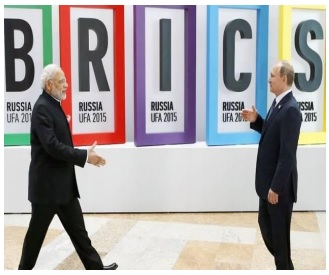
During the BRICS Summit in the year 2016, Russia agreed to invest upon $500 million into the Indian Infrastructure sector. The Russia based ‘Russian Direct Investment Fund’ (RDIF) and Indian fund i.e. National Infrastructure Investment Fund (NIIF) would be investing $500 million each in a joint fund forming a fund of $1 billion which will not only help to advance the infrastructure projects but also support any attractive investment opportunities and growth of Russian business activity in India be it in sectors like energy, petrochemicals, transport infrastructure etc. Such funds would provide equity capital to all the Russian-Indian projects backed in India. The Partnership of RDIF-NIIF was sealed in the BRICS summit held in India. The Russians also intend to create a platform of BRICS bank for building multiple small scale hydro projects in India with the prime use of Russian technologies.

The 8th BRICS Summit held in Goa in the year 2016 also saw a blockbuster foreign takeover in India and Russia’s largest outbound deal.

  • India’s second largest private oil refiner, Essar Oil, is under the control of Russia. Under the deal Rosneft acquired 98% of the Essar Oil and the Ruia family the current owner of Essar Oil would continue to hold a token 2% stake.

Russia

  • Rosneft with 49% stake in Essar Oil, a part of Essar Group would hold driver’s seat as per the deal and the other two investors would divide 49% equally. The deal turns out to be Russia’s largest investment in India and the value of the deal sums up to about $12 billion to $13 billion i.e. Rs. 80,197 crore to Rs. 86,882 crore.
  • This deal brings in a sigh of relief for Essar’s Ruias as it would help to meet the obligation of repaying the debts which for Essar Oil alone amounts to around Rs. 1 Lakh Crore.
  • The Essar group had been under pressure from its creditors for repayment of debt and in order to meet the obligation the group had considered options like debt restructuring and an asset sale etc. So on successfully completing the deal in March 2017, Essar group would be able to pay off the debts.

It is not the first time that Russia joined hands with India. In the area of Nuclear Power too Russia had lent its co-operation.

  • India is one of the important partner when it comes to peaceful use of nuclear energy. Kudankulam Nuclear Power Plant is the single largest nuclear power plant in India situated in the state of Tamil Nadu.
  • Construction of the said power plant began in the year of 2002. Nuclear Power Plant was built with the support and cooperation of Russia. Russia invested Rs. 6,416 crores i.e. $0.97 billion in the unit 1 & 2 of the said power plant.
  • In December 2014, the Department of Atomic Energy (DAE) and Russia’s Rosatom entered into an arrangement of strategic vision with a view to strengthen the peaceful co-operation for the use of atomic energy between Russia and India.
  • Russia has always participated actively in the construction and localization of the Nuclear Power Plant in India. Not only that, Russia has also taken initiated to provide automated control system for two of the nuclear power plant in Kudankulam from 2018 onwards.
  • Such systems are important in terms of ensuring safety and regular operation mode of the nuclear power plant. The construction of unit 3 & 4 is still in process while talks regarding unit 5 & 6 is yet to be finalized. Russia in the sphere of nuclear power intends to invest in India by providing their best technologies in constructing a total of 12 power units in different locations in India.

India has a well established relation with Russia when it comes to defence.

  • In the year 2004, more than 70% of the arm equipment and military hardware were supplied by Russia. Even today it meets around 70% of India’s defence needs. The cooperation between the two countries have evolved from buyer-seller relationship to joining hands in terms of design, joint production, training, research and development (R&D) etc.

Russia

  • Where most of the western countries like United States and others would restrain themselves from revealing its development in technology, Russia has always been open to sharing even its most sophisticated or sensitive or any newest creation in the field of technology with India.
  • BrahMos Missile System, Joint development and design and a well known licensed production in India of SU-30 aircraft and T-90 tanks of the Fifth generation aircraft is a classic example showcasing cooperation between the two countries.
  • ‘Make in India’ programme launched by the Government of India in the year 2014 has become the top destination for Foreign direct investment and Russia is the First country to have agreed to be a part of this initiative. India and Russia jointly took up the initiative to manufacture 200 KA 226 multi- role light choppers for the Indian Army replacing the ageing fleet of Cheetah and Chetak under the ‘Make in India’ programme for nine years.
  • In the year 2015 a joint venture was entered between Russia based Rostec Corporation that would be holding 49.5% stake and Indian Defense Public sector entity Hindustan Aeronautics Limited (HAL) holding 50.5% stake to manufacture these choppers. The deal was estimated about $1 billion i.e. Rs. 6,626 crores forming the first platform for defence under the ‘Make in India’ initiative.
  • In the year 2016, in order to conclude the Rs. 6000 crore project for manufacturing helicopters locally, Russia announced its partnership with the Reliance Defence, a subsidiary of the Private sector entity, Reliance Infrastructure.

Like an old friend, Russia never hesitates to be a supporting hand in India’s progress. When needed, it never hesitates to provide India its most sophisticated technology or give its nuclear submarine on lease or invest in establishing nuclear power station in India. It was the support of Russia that helped India in becoming a major space power. And it was Russia who voiced its full support in India becoming the permanent member of the United Nations Security Council. Obviously it is not a charity business and no one does anything for free in today’s world, Russia too had its own reasons to make sure that India remains its close friend. Even though at present India has improved its relation with the United States, the same way as Russia has increased its ties with India’s strategic competitor China or it might also be open to more opportunities from Pakistan. The fact still remains that Russia needs India as much as India needs Russia


Download Now

All you need to know about regulation of sports league in India

0
sports regulation

In this article, Lavanya Verma discusses laws regulating sports league in India.

League and court battles

The ownership of the badminton league is already being fought in court while in the Indian Super League (ISL), the football league faced a major controversy when the ISL regulatory commission banned popular club FC Goa for ‘indiscipline’ and imposed a hefty fine of US$ 1.6 million on the club owners. The club had boycotted the final prize distribution ceremony last year after some players had made allegations against the match officials.

The FC Goa management had made adverse comments in the media disputing the result of league’s final last year. The team co-owner Dattaraj Salgaocar claimed that two penalties given against his team in the last five minutes changed everything. “It was a terrible referring, one-sided and it was already decided to give away the match to Chennai team,” he alleged.

Amidst all this, India remains at a low 162nd spot in FIFA rankings. So much so that a nation with huge population pool to nurture talent is often beaten by much smaller nations like Nepal and war-struck Afghanistan.

Interestingly, European and German clubs are far more popular in India than the Indian clubs. This is mainly due to live telecast of the FA Cup, the Bundesliga and other international fixtures. It has produced thousands of armchair football fans. But the sport has vanished from the masses. Most of the schools in India do not even have a playing field. And wherever there are fields they are dotted with cricket players. Hardly anyone plays football. The standard, therefore, remains low.

During the league seasons, there is always a fight between clubs or franchises of the league and the national coaches. While the franchises want players for League fixtures, coaches demand that they be in a coaching camp for national duty. The fight goes on with the standard of the game static.

Competition law and sports

While cricket is the king of sports in India, other team sports like football and hockey and recently even Formula 1 races are gaining popularity and viewership with large corporates evincing interest in sponsorship and willing to invest in building brands and some even acquiring popular overseas clubs that attract a young audience. IPL is now in its fifth season and its continued success has clearly demonstrated the commercial viability of franchisee, endorsement and broadcasting rights for club and league sports. The moot question therefore is whether league and club events can be held outside the National Sports Federation (NSF) and if yes, the real benefits of such events including increasing the popularity of such sports.

Sports events worldwide are organized in a pyramid structure, where a particular sport is governed and regulated by a single International Federation (IF) with various NSFs affiliated to it. The IF governs the regulatory aspect i.e. laying down the rules of the sport, eligibility criteria and playing conditions. The IF also makes the annual calendar for that sport and conducts the world championship and other international level events. A corollary at the national level would be that the NSF would follow the regulations of the IF as a condition of its membership and have exclusive powers to make the annual calendar, develop grass-root level of sport and conduct tournaments and training camps in the country.

The importance of the pyramid structure and the risk

to the sports due to multiple sport federations have been recognized by IOC and have been addressed in the European Commission’s Helsinki Report and the White Paper on sport. Integrity, uniformity and strict control over regulations ensure that non-discriminatory uniform rules are applied to the sport worldwide and encourage growth of the sports across the globe. It includes sporting sanctions like disciplinary action, suspensions, fines and bans for behavior contrary to the spirit of sports which lie at the core of the sporting movement and can be applied only within the sporting structure.

The directions of the Delhi High Court directing the Competition Commission of India (CCI) to undertake enquiry against the All India Chess Federation for preventing its players from taking part in a tournament outside its aegis, BCCI’s sanctions on the Indian Cricket League and the conduct of the World Series Hockey by the Indian Hockey Federation allegedly fall within the ambit of the IF/NSF trying to curb the advent of breakaway leagues through their rules.

The IF/NSFs’ rules restricting rival tournaments and release of players for these tournaments (e.g. India) have come under the scanner of competition/anti-trust laws like abuse of dominant position and anticompetitive agreements leading to unreasonable restraint on trade. The sports industry is unique because the pyramid structure which ensures monopoly is essential in maintaining the integrity of sport and unlike other industries, the industry thrives on competition rather than from the lack of it. This reasoning gives birth to the exception of ‘Specificity of Sport’ i.e. certain sporting activities are excluded from the purview of the competition laws. The European courts while creating this exception have divided the IF/NSF activities into two parts. The first being pure sporting functions whereas the second being activities having a substantial economic impact.

Pure sporting activities like laying down the rules of the sport, defining the size and weight of the ball and dimensions of the playing field are excluded from the ambit of competition laws. But activities of the IF/NSF having substantial economic impact are within the purview of the competition law.

The regulatory power of the IF/NSF if used to gain commercial and financial advantage would fall within this ambit provided the following conditions are satisfied:

  • That the agreements are not anti-competitive i.e. they do not attempt/cause appreciable adverse effect on competition; and/or
  • That they are not abusing their dominant position and are not imposing unfair or discriminatory conditions.

The European courts have held that these conditions in the sporting sector are satisfied when a particular rule though restricting competition has a larger public objective and this objective can be achieved only by applying certain restrictive rules that are essential for the integrity, continuity, organization and conduct of the sport at national and international levels, and the rule is applied uniformly and transparently.

The Competition Commission of India is faced with a similar task today to recognize the specificity of sport and carve out exceptions in the Indian scenario. The decision of the CCI will have a huge impact on the Indian sports industry as many a corporate await a chance to start their own breakaway leagues and commercially gain from the revenues generated from these leagues.

Sports and Competition Law

Two teams playing against each other are like two corporate firms producing a single product. The product is the game, weighted by the revenues derived from its play. In one sense, the teams compete; in another, they combine in a single firm in which the success of each branch requires efficiency. Unequally distributed playing talent can produce “competitive imbalance”. Remuneration of the team members largely depends on the level of competition between the teams in the particular sports. sport is generally organized in a kind of a ‘pyramid’ structure, with a single governing body controlling most regulatory and commercial aspects of each sport, the governing body appears to be de facto ‘dominant’ and therefore claims relating to the abuse of monopoly.

Sports governing bodies such as BCCI, often attempt to preserve for themselves the sole ability to regulate the sport and to organize events. In order to prevent the development of rival organizations, they have sought to tie players in by prohibiting them from competing in other events, on pain of exclusion from ‘official’ events, and such rules have been the subject of challenge under competition law.

When the Zee launched Indian Cricket League, the BCCI sacked Kapil Dev as chairman of the National Cricket Academy for aligning with ICL and barred all the 44 defecting players from playing for India or at the domestic level. It made clear that any cricketer who aligns with ICL will be banned for life from playing for India. Such practice on part of the BCCI may attract liability under the provisions of the Competition Act, 2002. As per Section 4(2)(c) of the Act if any enterprise “indulges in practice or practices resulting in denial of market access in any manner”, then it shall be liable for abuse of dominant position. Thus, such practice of banning players from domestic tournaments on account of joining the rival leagues may prove expensive for the BCCI, which may face a challenge on grounds of abuse of dominant position.

The denial of stadiums by the BCCI can attract liability for abuse of dominant position under s.4(2)(c) of the Competition Act, 2002 as by denying the use of essential facility under its control it raises the barriers to entry in the market for its competitors, resulting effectively in denial of market access. Operating from just one stadium in Panchkula (in Haryana near Chandigarh), the ICL clearly missed out on one of the integral aspects of leagues sports i.e. a fan base, since it is unable to capture home crowds for matches on account of non-access to the stadiums in the club’s cities.

Sports Law and Arbitration

Arbitration, a form of alternative dispute resolution (ADR), is a legal technique for the resolution of disputes outside the courts, wherein the parties to a dispute refer it to one or more persons (the “arbitrators”, “arbiters” or “arbitral tribunal”), by whose decision (the “award”) they agree to be bound. It is a settlement technique in which a third party reviews the case and imposes a decision that is legally binding for both sides. Other forms of ADR include mediation (a form of settlement negotiation facilitated by a neutral third party) and non-binding resolution by experts. Arbitration in India is governed by the Arbitration and Conciliation Act 1996 (“Indian Arbitration Act”), which is based on the UNCITRAL Model Law. The Indian Arbitration Act is broadly divided into two parts. Part I applies to arbitrations held in India, whether domestic or international, and Part II applies to arbitrations held outside India. Part II, incorporates the rules related to international arbitrations governed by the New York or Geneva Conventions. In sports, the disputes are first referred to the federations that govern a particular sport and subsequently the international authorities that govern the sport. e.g. in hockey disputes are referred to the Indian Hockey Federation and after that the International Hockey Federation.

At a time when sports are becoming more professional and the stakes are becoming higher than ever, dispute resolution takes on an increasingly important role. In many respects arbitration offers the most suitable solutions with regards to the rapidity, diversity, incontestability and professionalism of the decisions rendered. With regular increase in the number of sports-related disputes in the country, India requires an independent authority that specializes in sports-related problems and that is authorised to pronounce binding decisions. The disputes when referred to courts take a long time to come up with the final decision since the Indian courts are already piled up with a number of pending cases. There is a need to have an authority for sports that offers flexible, quick and inexpensive method of resolution of disputes. With the inauguration of India’s first arbitration centre in Delhi in 2009, India is recognizing the necessity of arbitration for quicker disposal of cases. The increasing use of arbitration in sport over the last decade has challenged the legal framework in which arbitration disputes are addressed in many jurisdictions.

Court of Arbitration for Sport

Arbitration exists in international sport through the Court of Arbitration for Sport. All international disputes relating to sports are referred to it. The most prominent sports dispute resolution forum is the Court of Arbitration for Sport (CAS) which has its headquarters in Lausanne, Switzerland. The CAS was created by the International Olympic Committee (IOC) in 1983. It also has two permanent outposts in Sydney, Australia and New York, USA. It has a minimum of 150 arbitrators from 37 countries, who are specialists in arbitrations and sports law. They are appointed by the International Council of Arbitration for Sports (ICAS) for a four year renewable term and need to sign a ‘letter of independence’. The CAS also has a permanent President who is also the President of ICAS.

The body was originally conceived by International Olympic Committee (IOC) President Juan Antonio Samaranch to deal with disputes arising during the Olympics. It was established as part of the IOC in 1984. However in a case decided by the CAS, an appealed was made to the Federal Supreme Court of Switzerland, challenging CAS impartiality. The Swiss court ruled that the CAS was a true court of arbitration, but drew attention to the numerous links which existed between the CAS and the IOC. The biggest change resulting from this reform was the creation of an “International Council of Arbitration for Sport” (ICAS) to look after the running and financing of the CAS, thereby taking the place of the IOC. CAS is placed under the administrative and financial authority of the International Council of Arbitration for Sport (ICAS).

Almost all international sports federations or associations which are part of the Olympic Games require sports disputes arising between themselves and sportspersons to be decided by the CAS. Sporting federations whose sports are not part of the Olympics such as Formula I where the FIA which is the governing body of motor sports has its own dispute settlement tribunal. Even some sports which are included in the Olympics have their tribunals like football where its governing body FIFA has its own tribunal. For example, in 1993, a claim of bringing Formula I into disrepute was brought against former FI champion Alain Prost and the Williams Renault Team. The matter was however, satisfactorily resolved by the FIA resulting in Prost escaping a possible ban from competing in the remaining FI races of that particular season.

A dispute may be submitted to the CAS only if there is an arbitration agreement between the parties which specifies recourse to the CAS. The language for the CAS is either French or English. In principle, two types of dispute may be submitted to the CAS:

  1. those of a commercial nature, and
  2. those of a disciplinary nature.

Commercial

The first category essentially involves disputes relating to the execution of contracts, such as those relating to sponsorship, the sale of television rights, the staging of sports events, player transfers and relations between players or coaches and clubs and/or agents (employment contracts and agency contracts). Disputes relating to civil liability issues also come under this category (e.g. an accident to an athlete during a sports competition). These so-called commercial disputes are handled by the CAS acting as a court of sole instance.

Disciplinary

Disciplinary cases represent the second group of disputes submitted to the CAS, of which a large number are doping-related. In addition to doping cases, the CAS is called upon to rule on various disciplinary cases (violence on the field of play, abuse of a referee). Such disciplinary cases are generally dealt with in the first instance by the competent sports authorities, and subsequently become the subject of an appeal to the CAS, which then acts as a court of last instance.

The CAS is governed by its own Statutes and Rules of Procedure namely the Statutes of the Bodies Working for the Settlement of Sports Related Disputes, Code of Sports Related Arbitration and Mediation Rules. According to Articles S12, S20, R27 and R47 of the Code, the Appeals Arbitration Procedure is open for the appeal against every decision rendered by a federation or club and not limited to disciplinary matters, especially doping cases. In addition, Article R57 empowers the CAS Panels not only to annul a certain decision, but also to replace a decision by a decision by a decision of the arbitrators, or to refer the case back to the issuing body. Moreover, Article R58 authorises the Panel to apply the ‘rule of law’ it deems most appropriate for the case. Thus the Panels may deviate from the laws of the country in which the federation is domiciled and reach a decision on the basis of laws of another country or other rules of law, such as general principles of law.

The CAS acquires its jurisdiction in a particular case only through the mutual consent of the parties involved. Currently, all Olympic International Federations and many National Olympic Committees have recognised the jurisdiction of the CAS and included in their statutes an arbitration clause referring disputes to it. The CAS hears approximately 200 cases per year. While it was the international response to the rise in the use of performance-enhancing drugs and the resulting doping cases that fueled the creation of the CAS, the Court is called upon to assist in a wide range of sport conflicts, including sponsorship disputes, the eligibility of a particular athlete in accordance with a sport’s constitution, as well as the resolution of disagreements concerning competition results. The determination of issues arising in doping cases remains a significant portion of the CAS caseload.

CAS and Mediation

In addition to arbitration CAS also offers mediation services to any requesting parties of a sports dispute. Unlike arbitration, the mediation process is not binding—the mediator will provide recommendations, with solutions suggested, but these are not imposed as a result as in the case of arbitration. Mediations are designed to permit the adverse parties an opportunity to air their grievances in an atmosphere aimed at conciliation of the dispute.

Advantages for referring cases to CAS

  • Expertise in sports-related disciplines (there are more than 300 arbitrators from 87 countries qualified to hear CAS disputes) whereas a typical civil judge will not likely possess such sports-specific knowledge.
  • Its arbitrators are all high level jurists and it is generally held in high regard in the international sports community.
  • Procedure is flexible and informal.
  • Expeditious proceeding as cases are heard and determined within a few months from the date of reference. During the Olympics, awards are required to be made within 24 hours.
  • Lower legal cost to the participants
  • Also provides mediation services
  • CAS is a private procedure and therefore is conducted without the public or media interference. The arbitrators and CAS staff are obligated not to disclose any information connected with the dispute.

Important CAS rulings

  • In 2003, Canadian cross country skier Becky Scott successfully appealed to the CAS with respect to her claim that she be awarded the 2002 Olympic gold medal in the 5-km pursuit event. Russian skiers Olga Danilova and Larissa Lazutina finished first and second respectively in the competition, with Scott in third place, and each athlete passed their post-event doping test. Danilova and Lazutina each failed a subsequent doping test administered in relation to another Olympic cross-country event, when the presence of a prohibited blood doping agent, darbepoetin, was detected in each skier’s sample. Scott appealed her 5-km race result on the basis that both Russian skiers were engaged in ongoing doping practices. The Scott ruling was the first time in Olympic history that a gold medal had been awarded to an athlete as a result of a CAS ruling.
  • In 2005, the CAS arbitration panel ruled that American sprinter Tim Montgomery be banned from international competition for two years as a result of doping, in spite of the fact that Montgomery had never failed a doping test. The CAS ruled that it could find a doping violation on the basis of the third party evidence called against Montgomery, most of which connected Montgomery to the Bay Area Laboratory Cooperative (BALCO) athlete steroid scandal that had arisen in the United States in 2003.
  • In February 2010 Five-time Olympic speedskating champion Claudia Pechstein lost her appeal against a two-year ban for blood doping. CAS dismissed the German’s appeal against a ban imposed by the International Skating Union.

Setting aside proceedings against CAS arbitral awards may only be filed with the Swiss Supreme Court due to the seat of CAS tribunals being in Lausanne.

Everything you need to know about sports legislations in India

Per se, there are no central or state legislation to regulate sports in India; the Ministry, which was set up by the government was responsible for achieving excellence in different sports events which were conducted in India and also to build a good infrastructure for sports. By and large, the administration of sports activities is in the hands of autonomous bodies, such as Sports Authority of India (SAI), Indian Olympic Association (IOA), Hockey India (HI) and Board of Control for Cricket in India (BCCI).

These governing bodies are recipients of government’s aid and are also registered under the Societies Registration’s Act of 1860.[3]

The following govern the whole of the Sports Law

National Sports Policy, 1984/2001

The main objective behind enacting this was to raise the standard of sports for the reason that it was degrading due to corruption, betting, etc. It was later realized that the Bill of the year 1984 was incomplete, and its implementation was not complete, and in a bid to revise the bill the same was reformulated in the year 2001.

The guidelines are three-fold:

  • Firstly, to earmark the areas of responsibilities which different agencies have to undertake to develop and promote sports.
  • To lay down the procedure to be followed by the autonomous bodies and federations to make the assistance and aid by the government available.
  • And also identifying the sports federation that is eligible for coverage under these set guidelines.

It was only after this policy that the lawmakers realized the importance of sports and therefore ‘Sports’ was included in the Constitution in the State list of the Seventh Schedule (Entry 33). The central government by the provisions of this policy aims to achieve excellence in sports on the national and global plane and collaborates with the state government and other agencies to achieve it.

Sports Law and Welfare Association of India

It is a non-profit national organization that aims to understand, and work for the advancement of ethical sports law in India for promoting sports. The primary task of the organization is to provide consultancy services on different matters like Indian sports policy, sports injuries, health and safety in sports, IP issues in sports, etc. It also provides a forum for legal practitioners who represent different people, to set up rules for ethics for sports persons.

Sports Authority of India

The Sports Authority of India (SAI) is an apex National Sports body set up in the year 1984 by the Ministry of Youth Affairs and Sports for broad-basing and bringing excellence in sports across India as a whole. It is located across 9 regions at Bangalore, Gandhinagar, Chandigarh, Kolkata, Imphal, Guwahati, Bhopal, Lucknow and Sonepat; and two Academic institutions like Netaji Subhash National Institute of Sports (NSNIS), Patiala and Laxmibai National College of Physical Education. It also accounts for academic programs like coaching and physical education awareness programs.[4]

The Sports Broadcasting Signals (Mandatory Sharing with Prasar Bharati) Act

This Act was passed in the year 2007; its main objective was to provide access to listeners and viewers so as to encourage a larger audience. It shall cover the sporting events which are of national importance through mandatory sharing of sports broadcasting signals with Prasar Bharati and for matters related to it. The Act provides that no content right owner or holder or television or radio broadcasting service provider can carry out a live TV broadcast of important national sporting events. For doing this, it has to share its live broadcasting signal simultaneously (except advertisements) with the Prasar Bharati.

Role of different stakeholders

Ministry of Youth Affairs and Sports

  • To lay down the conditions for eligibility of National Sports Federation to get recognition
  • The conditions that have to be fulfilled by NSFs and other agencies if they wish to acquire government aid and support.
  • To provide assistance to the NSFs if they carry out long-term development program.

National Sports Federation

The responsibility for the complete management, direction, supervision and regulation of the discipline and promotion, development and sponsorship of the discipline is on National Sports Federation. They are expected to discharge these responsibilities in consonance with the principles laid down in the Olympic Charter or the Charter of the Indian Olympic Association in compliance with Government guidelines applicable to NSFs.

SAI

For providing the necessary support to NSF for the identification, training, and coaching of sportspersons, also to improvise infrastructure, equipment, and such other facilities, the SAI plays a significant role. Further SAI will also be responsible for releasing funds to NSFs against proposals approved by the Government.  The release of funds to IOA shall, however, continue to be made by the concerned Ministry.[5]

National Anti-Doping Agency

The centre has set up a National Anti-Doping Agency (NADA) as an autonomous body. It consists of persons from government and non-government agencies, scientists as experts and also members from IOA. In the recent past, the controversy surrounding the intake of dope by sports persons is prevalent and in this light, NADA was set up. It shall carry out ‘in competition’ and ‘out of the competition’ testing on the sportsman. NADA helps in the regulation of sports activities so that it can be corruption-free and non-controversial.

Sports law of United States of America

The U.S.A. has a very systematic law for sports. They have not provided with single legislation, but have divided it into 3 categories-:

Amateur sports

It includes athletic activities from high school athletics to organize intercollegiate or international competitions which are often organized and managed by groups that make rules for eligibility and competition, and courts do not interfere with the actions of these groups as long as they abide by the rules. The Amateur Sports Act of 1978 created the Athletic Congress, a national body for governance of amateur athletes, which administers a fund that allows amateur athletes an option to get funds and sponsorship payments and also not lose their amateur status.

Professional sports

In the case of some professional sports activity, most sports leagues do have a standard player’s contract, and that shall be the guiding force behind a contract between players and owners.

International sports

The two main international sports events include the Olympics, sponsored by the International Olympic Committee, and the World Cup, which is sponsored by FIFA. The United States has done the charting of the United States Olympic Committee (USOC) in the year 1950.

Some jurisdictions have passed separate legislation relating to sports. For example, in India sports information is in the Concurrent list of the Seventh Schedule (entry 33) of the Constitution on which both the union and state legislatures are proficient to put together laws. There are 3 States; Rajasthan, Himachal Pradesh and Uttar Pradesh, which have enacted laws on regulating sports activity including registration, regulation and recognition of Sports Associations (Uttar Pradesh has since repealed the Act).

It is one of the main revenue generating industries of the world and with the propagation of the Internet and other forms of media, the sports industry is growing at a faster tempo. An industry of billions of dollars with an all-encompassing worldwide presence is bound to raise its own disputes. This has resulted in the growth and development of sports law as a separate regulation in its own right.


Download Now

Unauthorised alienation of property and its consequences

0
alienation
Image Source: https://bit.ly/2OV0zeH

In this article, Varsha Gupta of College of Legal Studies, UPES, Dehradun discusses Unauthorised alienation of property and consequences.

Introduction

Property has always been a tangled issue amongst the family members which leads to conflict in the society. The rights over properties changes with the birth and death of the family members. Alienation of such property can be defined as the transfer of property through gifts, wills or mortgage. The ownership is incomplete without having a right to alienate that property. However, in a joint family property all the coparceners have an equal right over the property and thus it cannot be alienated without the authorization of all.

Karta is the manager of the Hindu family and therefore possess some different rights. However, this doesn’t mean that property will be treated as his whole and he also has interest like other coparceners. Alienation of a property for the common good of the family is a classic example of joint hindu families in India which is always ready to accommodate each other. Transfer of property without any justification is the ground for studying such laws. Whenever the karta steps out of his power and does something which is prejudicial to the interest of other coparceners the court steps in and gives the coparceners right to challenge such unauthorized alienation which shall be discussed further in detail.

This research paper deals with the alienations by different members of the family, validity of the alienation, conditions related to alienation, challenges to an unauthorized alienation, burden of proof and rights of an alienee. This paper mainly focuses upon the alienation of property by karta without any necessity, benefit of estate or to fulfill indispensable duties which are commonly known as unauthorized alienation. This paper addresses itself to one of the anomalous situation that is faced with the burden of proof in challenging the alienations.

Unauthorised Alienation of Property

Unauthorized alienation of property means the transfer of the property without any justification which leads to invalidation of such transfer. As discussed earlier alienation can be done through will, gifts or mortgage. As we know that karta is the manager of the hindu families and therefore works for the welfare of the family. Alienation can be defined as “it includes as any disposal by the father, karta, coparcener or the sole surviving coparcener of a part or the whole of the joint family property by any act or omission, voluntary or involuntary, intended to take part in presentor future.[1]

Karta’s Power of Alienation

It is always said that the power of hindu joint family vests in the karta. But when it comes to property matters, he is not the sole owner of the property and therefore power of alienation can be exercised by him only in certain cases. The powers of the karta under dayabhaga school are similar to that under mitakshara law. The alienation of property by karta can be done only in three circumstances i.e. necessity (Apatkale), benefit of the estate or for performance of indispensable duties. Now the question comes that how such authorization can be made? It can be done either expressly or judicially. Where some coparceners are major coparceners, he is not expressly authorized to do so, though this can be of help in filling the gaps to a limited extent, while providing legal necessity.[2]

Benefit of Estate

Benefit of estate which was commonly known as “kutumbarthe”. It has been explained that the alienation can be done for satisfying the needs of family property or any other family estate is benefited. Primarily this was allowed when transfers were purely defensive or protective in nature but with the instances of dilution of ‘apatkale’, alienations that an ordinary prudence man would view as appropriate in the given set of situations are also approved.[3] The alienations by the karta in favour of benefit of estate are not void and therefore are authorized under the law.

Legal Necessity

The courts have safeguarded enough measures while defining these terms so that they are not into a watertight compartment. Legal necessity can mean all acts done to fulfill the essential needs of the family members in emergency situations like flood, war, famine etc. It differs from the word purpose, to exercise this option there should be no alternative sources left with the karta.[4] Therefore we can analyze that the courts have given enough power of alienation which can be justified on these grounds.

Performance of indispensable duties

Proceeding to the third ground, the property can be alienated by the father or karta where the indispensable duties such as obsequies of the father or the like.[5] This also includes the marriage ceremonies of the family members which is also considered as legal necessity as it is the most essential sanskara.[6] Alienations are also permitted for charitable and pious purposes. However, here the quantum of the property sold is performance of indispensable religious ceremonies or where the transaction would be for benefit of estate, but only a small portion of family property can be alienated for pious or charitable purposes. The point to be noted here is that pious obligation does not include gifts made out of love and affection. Thus, it is very clear that karta or father can alienate property only with respect to performance of religious and indispensable duties.

Sole surviving coparceners and power of alienation of property

When a single coparcener is left with the property the question arises does he have absolute power over such property? According to principles of Hindu Law, A sole surviving coparcener becomes the separate owner of the property and entitled to pay the maintenance to the widows of the family. However, a child present in the womb at the time of alienation can challenge its validity. There is a contrasting view of the courts in case of adopted sons to have right over that property.[7] This is not applicable to child born subsequent to the transaction.

Invalid alienation of property

As discussed earlier, the grounds on which Karta can alienate the property if anything is done contrary to the aforementioned grounds then such alienation is invalid. The alienation by the karta can be invalid for two reasons i.e. when such alienation has been obtained without the express authorization of all the coparceners and secondly when the alienation is not made in favour of any of the aforementioned grounds. However, the judge made-law has certified certain exceptions and allows even voluntary alienations of undivided property in the state of Bombay, Madhya Pradesh, and Madras.

Status of such alienation

An alienation made in contrary to the objectives of the Hindu law is not void, but merely voidable[8] at the option of the other coparceners who, if major did not consent to this alienation or were minors at that time.[9] Where the coparceners, though against the alienation, do not express their dissent by challenging it as invalid or by asking for partition and ascertainment of their shares before it is effected, the alienation remains valid. Alienation can be made for the benefit of the estate, for legal necessity or for meeting any antecedent debts, for management of the joint property by the karta or pious obligation of a son to discharge his father’s debts subject to section 6(4)[10] of the Act as amended in 2005 which has abolished the doctrine of pious obligation for the debt contracted after 2005.[11]

Coparceners right to challenge such alienation of property

If the father, karta, coparcener, sole surviving coparceners steps out of their power and makes any alienation then such alienation can be challenged and set aside before it becomes time barred. According to Article 126 of the Indian Limitation Act, 1908 the period of limitation for a son to challenge his father’s alienation is 12 months and as per Article 144 the period of limitation for coparceners to challenge the alienation made by karta is 6 years.

Burden of proof lies on the alienee

It is a well settled law that when the validity of alienation is challenged before a court, the burden of proving that the transfer is valid lies on the alienee. Alienee is the person in whose favour karta has made the transfer. This is not subjected to any exceptions. When we deal with this the obvious thought that comes up is why alienee should be made liable? How is he supposed to know the family matters of Karta? Why should he prove that the transfer fell within the three grounds i.e. the legal necessity, benefit of estate or for performance of indispensable duties? This is always justified on the ground that it is prejudicial to the interest of the coparceners and alienee is seen as a beneficiary. If we critically analyze this there are many problems with such interpretation.

  1. Alienee is a stranger to the family members and therefore how can he know about the internal matters of the family. When the burden of proof lies upon him, he is required to go deeply into the matters of the family and inquire whether the transfer falls within any of the three categories.
  2. Secondly, for proving that the transaction was done for legal necessity he is required to show that there were no other financial alternative resources. Financial matters are the intrinsic matter of the family and thus alienee may have a difficulty in proving this.
  3. It is against the principles of natural justice. Litigation is very time-consuming process and it may sometimes take up to 10-20 years. It is clear that proving the validity of such transfer is very difficult on the part of the alienee as the ground of alienation are directed towards the internal family matters.
  4. Mere recitals in the transfer deed do not prove the validity of the alienation,[12] but only have the effect of putting the alienee on the ground; to probe further into the matter e.g., a recital in the mortgage deed executed by the karta may say that the property is mortgaged to use the loan for payment of government dues. Whether these dues exist, whether the family has alternate resources to pay them off or not, and whether the amount of dues is in consonance with the consideration or not, are the facts that must be ascertained by the alienee, from the karta, the coparceners or from other family members or even through independent means.

Rights of Alienee

In the states where an undivided coparcener is entitled to alienation his interest in Mitakshara coparcenary, such alienation cannot be challenged. In the states where he is not permitted to do, it can be set aside with the help of the court.

Right to Partition

The right to partition of the alienee has been interpreted by the courts in the different manners. However, it is well settled that this right exists. According to the Bombay and Madras High Courts, the purchaser cannot demand the very property which has been sold to him. He can only ask for the general partition of the interest of his alienor.[13] The reason is that because of the unity of ownership of the coparcenary property, the alienor coparcener cannot be held to be entitled to the specific property to the exclusion of the other coparceners.

Right to Mesne Profits

Mesne profits means the profit that has been accrued by a person by wrongful possession of a property as defined under Section 2(12) of Civil Procedure Code. Alienee is not entitled to any mesne profits from the date of purchase till date on which partition is decreed. The Supreme Court held that a purchaser in an auction purchase of coparceners share in execution of a money decree against him is not entitled to mesne profits from the date of his purchase.[14]

Right of Joint Possession

This right is different under different state laws. In the State of Bombay, the purchaser of such alienated property is entitled to sue for partition of the property and specification of his share. If the partition is effected he can take the exclusive possession of the property. In case, the partition is not affected and the property is delivered to the purchaser, and he takes the possession, the other coparceners are entitled to have joint possession with him, or they can file a suit for the recovery of possession from him.[15]

While in the State of Madras, U.P., West Bengal, Patna, Madhya Pradesh if the coparceners alienates his share in Mitakshara coparcenary, alienee gets only an interest to the extent of the coparcener’s share as it stood at the time of the alienation. He need not ask for general partition.[16] There also seems to be a consensus among judges and textbook writers that the alienating coparcener retains his status as a coparcener even after alienation and can take the whole of the remaining property as coparceners.[17]

Conclusion

Every coparcener has the right to make the full use of the joint property without retarding it or using it in such a way that is prejudicial to the interests of other coparceners. However, being the manager of the family karta should have some privilege in respect of maintaining the whole business of the family. It is necessary to devolve some powers onto him for the expedient functioning of the family business. Alienation of property is one such power which is given to him to be exercised in case of legal necessity and other two grounds. As far as these grounds are concerned they can be interpreted widely as well as strictly. We have most of the high court’s judgments on the issue involved. The Supreme Court should also intervene in these matters and explain the literal meaning of the word legal necessity, benefit of estate and performance of indispensable duties. The worst situation is with the challenge of unauthorized alienations. The burden of proof is rest on the person who is a stranger to the transaction.

The author suggests that instead of shifting the burden on the alienee the powers of karta should be strictly interpreted so that no unlawful means are used. It is because of the fear that the alienee has to prove everything he may not enter into a contract even when there is a legal necessity.  This will also result in loss to the family. Rights of alienee should be made similar in all the states by the apex court rulings and not by the individual opinion of every high court. It might be that karta and alienee are of two different places and their laws are different which may affect the whole process of alienation. An alienee should not be made liable for everything because that will discourage others to help the families in need. As far as gifts made by the father to daughter are concerned he should be able to make such gift and moreover, now the daughters are also the coparcener of the family as amended in 2005. Two things have to be there accountability as well as responsibility and neither must exceed. Thus, a lot of checks have been imposed by the courts on the powers of karta so that it is not misused. Karta works for the welfare of the family. Law has provided enough safeguards to the family members to be used against any despotic behavior of the karta.

[1] Hari Singh Gour,the hindu code 586 (6th ed., 1996).

[2] Salamat Khan v. Bhagat, AIR 1930 All 379; Khushi Ram v. Mehr Chand, AIR 1950 East Punjab 272.

[3] Balmukund v. Kamlavati, AIR 1964 SC 1386.

[4] Bukshum v. Doolhin, 3 BLR ACJ 423, 12 WR 337.

[5] Mitakshara I, 1, 28, 29.

[6] T.V. Subbarao and Vijender Kumar, (rev.), GCV Subba Rao, Family  Law  In India 77 (9th ed., 2006).

[7] Mahadevappa v. Chandabasappa, AIR 1965 Mys. 15; Bhimji  v. Hanumant Rao, AIR 1950 Bom. 271.

[8] R. Raghubanshi Narain Singh v. Ambica Prasad, AIR 1971 SC 776.

[9] Ramesh Damodhar Deshmukh v. Damodhar Domaji Deshmukh, 1999(1) Mh.L.J 153.

[10] Hindu Succession Act, 1956.

[11] Shalini Sumant Raut and Ors. v. Milind Sumant Raut and Ors., 2012 SCC OnLine Bom 1839 : (2013) 3 Mah LJ 364 : (2013) 1 AIR Bom R 713 : 2013 AIR CC 489 : (2013) 5 Bom CR 430.

[12] Sreeramulu v. Thandana Krishanayya, (1942) 2 Mad LJ 452.

[13] http://www.scribd.com/doc/68527077/Alienation-Under-Hindu-Law.

[14] Sidheshwar Mukherjee v. Bhubneshwar Prasad Narainsingh, 1953 AIR 487, 1954 SCR 177.

[15] Dugappa v. Venkataramanya, (1881) ILR 5 Bom 493.

[16] M.V.S. Manikayala Rao v. M. Narasimhaswami, AIR 1966 SC 470.

[17] See Mulla, Principles of Hindu Law 299 (13th ed., 1966).

Download Now

What should an Indian entrepreneur know about Mauritius if he or she is planning to take foreign investment?

0
Mauritius

In this article, ABUL KALAAM AZAD A.S. who is currently pursuing M.A. IN BUSINESS LAWS, from NUJS, Kolkata, discusses What should an Indian entrepreneur know about Mauritius if he or she is planning to take foreign investment?

Introduction

Mauritius is an Island nation in the Indian Ocean with an area of about 2000 Square Kilometers and has a population of just 1.3 million. Mauritius is different from similar island states as it is multilingual, multicultural, and multi-religious. Historically Mauritius is an important place in the ancient trade routes between Europe and the East. It is a wonder that this small island state is the top source of Foreign Investment in India.[1] Yes, Mauritius is the top source of foreign investment in India as Mauritius is a tax haven for decades.

Mauritius route

Mauritius route is the most preferred route used by Foreign Investors to invest in India under Foreign Direct Investment. It is also the preferred route by Indian investors for outward foreign investment to the African continent.[2] In the decade between 2001 to 2011, over 40% of Foreign Direct Investment in India came through the Mauritius route. In the financial year of 2015-2016 (Till March 2016), approximately 21% of Foreign Direct Investment in India was from Mauritius.

One Cathedral Square

One Cathedral Square is the name of a commercial building with 12 floors. It is situated in the heart of the capital of Mauritius, Port Louis. This building has a weird thing to be mentioned while talking about Foreign Direct Investment in India. As mentioned in the previous paragraph over 40% of the Foreign Direct Investment in India comes from Mauritius and it is about 55 Billion United States Dollars. Almost all of these investments are emanating from this 12 floored One Cathedral Square building.[3]  TMI Mauritius Ltd, a subsidiary of Axiata Group Bhd which is a Malaysian company,  Oracle Global (Mauritius) Limited, Blackstone FP Capital Partners, Blackstone GPV Capital Partners, and Intel Capital are having their respective registered offices on various floors of this building. The TMI Mauritius Limited is the top investor in India according to the reports of Department of Industrial Promotion and Policy. And one more interesting, but the coinciding fact is, Corporate and Business Registration Department,[4] which is the registration authority for companies in Mauritius, and Board of Investment[5] which is a National Investment Promotion Agency of Government of Mauritius are also located on the 10th Floor of the One Cathedral Square Building. There are several venture capital companies and angel investors operating from this same building and they provide capital to start-ups in India.

Top Source of FDI

For a brief period between April to September 2015, Singapore overtook Mauritius in Foreign Direct Investment to India.[6] It is because of the Double Taxation Avoidance Agreement (DTAA) between India and Singapore. And the Limit of Benefit (LoB) Clause in the treaty between India and Singapore is clear and beneficial to the investors and that was also a major reason for such spike in Foreign Direct Investment from Singapore. But in the last fiscal year,[7] Mauritius is still the top most source of Foreign Direct Investment in India beating US, UK, Singapore, and Japan.

Foreign Direct Investment

Foreign Direct Investment can be defined as investment by a person or company from one country to the business or start-up or company located in another country in the interest of establishing a business or investing in a business or acquiring a business or to control a business.

The Economic Development in India is mostly dependent on Foreign Direct Investment. It is because of the cheap wages, and vibrant, dynamic, and rapidly developing business environment in India. Neo-liberalism started in the year 1991 by the then Prime Minister of India, Shri. P.V. Narasimha Rao and the then Finance Minister of India, Dr. Manmohan Singh. Crores of people got employed through the neo-liberalisation policies and Foreign Direct Investment in India.  In the Year 2015, India became the top destination to attract more Foreign Direct Investment outdistancing the United States and China, etc. Foreign Direct Investment in India in 2015 was about approximately 31 Billion United States Dollars, while the China received 28 Billion United States Dollars and the United States attracted 27 Billion United States Dollars.

There are two routes to receive foreign direct investment by a company in India.

Automated route

The first one is called Automatic Route and the second one is called Government Route. In the Automatic Route, there is no requirement of pre-approval from Reserve Bank of India or Government of India. Annexure B of the Schedule 1 of the FOREIGN EXCHANGE MANAGEMENT ACT NOTIFICATION (FEMA Notification) contains the list of Sectors/activities in which a company can receive Foreign Direct Investment without prior approval of Reserve Bank of India or Government of India under the Automatic Route. The number of this notification is  FEMA 20 /2000-  RB dated 03-05-2000.

Government route

In the Second route, that is in the Government route, for all other sectors and activities which are not listed under Annexure B of the Schedule 1 of the FOREIGN EXCHANGE MANAGEMENT ACT NOTIFICATION (FEMA Notification), that is for the sectors and activities which are not covered under the Automatic Route, such foreign direct investment needs prior approval of the Government of India. Applications for such approval to receive foreign direct investment in India under the Government Route must be submitted in Form FC-IL to Foreign Investment Promotion Board (FIPB), Department of Economic Affairs, Ministry of Finance.

There are three types of instruments which are compatible with Foreign Direct Investment. To say, in other words, these are the three instruments through which a company or business in India can receive Foreign Direct Investment. [8]

Those are:

  1. Equity Shares of the company issued according to the Companies Act, 2013.
  2. Fully Convertible Shares and Debentures which are convertible mandatorily.
  3. Partially Paid Shares in equity which are issued according to SEBI guidelines and Companies Act, 2013.

The following are the prohibited sectors for Foreign Direct Investment:

  1. Lottery related businesses, Online lottery etc.
  2. Any kind of Gambling, Betting etc (This includes Casinos too)
  3. Any companies or businesses offering service like Chit funds
  4. Financial Business like Nidhi company
  5. Any kind of trading in Transferable Development Rights (TDRs)
  6. Any kind of business in real estate or developing Farm Stays, Farm-houses etc.
  7. Businesses manufacturing Cigars, cigarettes, products from tobacco and products manufactured from tobacco substitutes.
  8. The following activities and sectors are not available for investment by Private Sector. Those are a) Businesses in Atomic energy and, b) Operation of Railways (which are other than the activities permitted and listed in the entry 18 of Annexure B).

The government of India initiatives

In the year 2014, the Government of India took a major step in Foreign Direct Investment policy by increasing the limit of foreign investment in the Insurance Sector from 26% to 49%. In September 2014, the Prime Minister of India Shri. Narendra Modi launched Make in India scheme under which the Foreign Direct Investment was further liberalized in over 25 sectors. Because of the launch of Make in India initiative by Government of India, the inflow of Foreign Direct Investment has grown by 48% in the first four months of 2015. India was in the 15th position in world ranking list of countries attracting Foreign Direct Investment in 2013. Within a year, in 2014, India outpaced several countries and reached the 9th position in the world ranking.  The Government of India amended the policy related to Foreign Direct Investment on June 7, 2016, and again reviewed it on 24th June 2016. This amendment paved way for increased inflow of Foreign Direct Investment. For example, for manufacturing of medical devices, under the Automatic Route (in which the prior approval from Reserve Bank of India or Government of India is not required), 100% FDI is permitted. In 2015, India is in the top position to attract Foreign Direct Investment overtaking China, US etc. [9]

In India, over 10% of GDP (Gross Domestic Product) depends on the development of Infrastructure, that is in the Construction industry. 100% Foreign Direct Investment is allowed under Automatic Route for infrastructure development, construction etc. Over 7% of India’s Gross Domestic Product (GDP) is based on the Automobile Industry and 100% Foreign Direct Investment is allowed under Automatic Route in the Automobile Sector. The pharmaceutical sector is third largest in India and 100% Foreign Direct Investment is allowed under Automatic Route. Foreign Direct Investment in Service Sector was increased from 26% to 49% in the year 2014.  Other than the operation of Railways, 100% Foreign Direct Investment is allowed under Automatic Route for most of the activities in Railway Sector. Except for few chemicals like Hydrocyanic Acid, most of the Chemicals are de-licenced in India, and 100% Foreign Direct Investment is allowed under Automatic Route. Almost 11% of India’s total export is from Textile industry. 91% FDI was allowed in the year 2014 and now 100% Foreign Direct Investment is allowed under Automatic Route. In the Airline industry, 49% Foreign Direct Investment is allowed under Automatic Route. For above 49% FDI, it requires Government approval. For modernisation of airports, 100% Foreign Direct Investment is allowed under Automatic Route.

Why Mauritius Tops in FDI?

The exact reason is because of two things. 1) Mauritius is a Tax Haven, 2) It has Double Taxation Avoidance Agreement (DTAA) with India. A Tax Haven is a country with very low tax, almost no tax, or no tax at all. Example: Bahamas, Monaco etc. The maximum effective tax rate in Mauritius is just 3%. [10]

Double Taxation Avoidance Agreement enables the person to pay tax at any one of the countries between which the agreement (DTAA) is executed. Thus the investor has to pay tax at their base place (where they have their registered office) for the investment they made to another country. In the case of FDI coming from Mauritius to India, the investor will file a return in the Mauritius where there is no corporate tax and get tax exempted in India, based on the DTAA (Double Taxation Avoidance Agreement).

Most of the investors or businesses are not originally from Mauritius. They just register an offshore business in Mauritius and route the funds through Mauritius to India, just to avoid the tax. As the Mauritius charges only 3% Tax on Capital Gains and as it has Double Taxation Avoidance Agreement with India, companies/investors from various nations route their investment to India (FDI to India) via Mauritius. Recent Example is Vodafone investing in Essar (Hutch) through Mauritius.

Mauritius Financial Services Commission

Financial Services Commission of Mauritius was established in 2001 and is a statutory body under Financial Services Act, 2007 to regulate and monitor businesses operating in the Financial Services sector. The Financial Services Commission has the mission to develop, promote financial businesses and capital markets in Mauritius.[11] It also ensures to safeguard the financial activities routed through Mauritius. Mauritius has one of the best regulatory frameworks which is an added advantage for the investor to use Mauritius to route Foreign Direct Investment to India. The Strict and precise legal and regulatory framework of Mauritius is according to the guidelines to tackle money laundering provided by International Monetary Fund (IMF), Organization for Economic Co-operation and Development (OECD), and Financial Stability Board (FSB). Mauritius has followed and complied with the internationally agreed tax standards and hence Mauritius occupies a prominent place in the White List of Countries published by the Organization for Economic Co-Operation and Development (OECD). There was a peer review of Mauritius by the Organization for Economic Co-Operation and Development (OECD) which was conducted in two phases. The First Phase of the peer review was done on the existing legal and regulatory framework in Mauritius. The Second Phase of the peer review by Organization for Economic Co-Operation and Development (OECD) was on implementation and methods of implementation of the international standards of practice in Mauritius. The review done in both the phases endorse that the Mauritius follows and complies with the requirements to meet the internationally agreed standards of practice. It is also having an effective mechanism to exchange accounting information of businesses, bank accounts owned by the businesses, and ownership information of offshore and onshore companies with identity details of the officers and shareholders of the companies with other countries. Mauritius also complies with norms prescribed by the Basel Committee on Banking Supervision and has enacted legislations as required by the Basel Committee on Banking Supervision.

Mutual Assistance in Criminal and Related Matters Act, as well as the Financial Intelligence and Anti-Money Laundering Act 2002, are the legislations enacted according to the norms prescribed by the various International Organizations and these legislations provides mechanism/system for the exchange of information on money laundering to the Intelligence Organizations of various countries. There is also an Asset Recovery Act enacted by the Mauritius Parliament in 2011 and this legislation provides for the freezing of assets acquired by illegal means.

DTAA

India has Double Taxation Avoidance Agreement (DTAA) with over 88 countries. That doesn’t mean that the investment from all these 88 countries is tax-exempt. Each of these agreements with different countries has separately agreed on tax rate and for a particular type of income.[12] For example, some agreements (DTAA) may have agreed tax exemption for taxes levied under title Capital Gain and some of the agreements may have agreed tax exemption for taxes levied under title Gains on transfer of bonds.

In India, the Income Tax Act, 1961 has two provisions regarding the exemption of taxes under the Double Taxation Avoidance Agreements. Section 90 and Section 91 of the Income Tax Act, 1961 deals with specific provisions. According to Section 90, the tax relief is given to the assessee who has paid the tax in a country to which India has Double Taxation Avoidance Agreement. Section 91 of the Income Tax Act, 1961 provides specific relief to an assessee who has paid tax in a country to which India has no such Double Taxation Avoidance Agreement. Hence both type assessees irrespective of whether they paid tax in a country to which India has a Double Taxation Avoidance Agreement (DTAA) can seek relief under Income Tax Act, 1961.

The Double Taxation Avoidance Agreement (DTAA) between India and Mauritius provides that the Capital Gains can be taxed only in Mauritius. India has the same kind of Double Taxation Avoidance Agreement (DTAA) with over 16 countries. Since the tax for capital gains in Mauritius is just 3%, and as it has very high quality legal and regulatory framework in conformance with the standards internationally agreed, Mauritius has become the preferred jurisdiction to route Foreign Direct Investment to India. With this mutually beneficial DTAA between India and Mauritius, both the countries are mutually receiving benefits. Mauritius is able to develop its Financial Sector, while India is getting FDI, development and new job opportunities to citizens.

Various media reports claim that many people and businesses are abusing the DTAA between India and Mauritius as well as India and Singapore to evade taxes.[13] Some media reports claim that illegally acquired money from India is sent to Mauritius through Hawala channels and then routed back to India as Foreign Direct Investment. These media reports claim that the black money acquired in India is converted as White money by routing the same as Foreign Direct Investment (FDI) to India through Mauritius.

Hence there is a demand for General Anti-Avoidance Rule (GAAR) and the bill for GAAR was placed before the Parliament of India in 2012. While presenting the General Budget in 2015, the Finance Minister of India, Shri Arun Jaitley informed the Parliament that the GAAR will be implemented after two years. The Central Board of Direct Taxes (CBDT) has announced in January 2017 that the GAAR (General Anti-Avoidance Rule) will be applicable and enforced from 2017-2018.  Central Board of Direct Taxes (CBDT) has clarified various issues on GAAR in the same notification dated 27th January 2017.

Recent Amendments

In May 2016, India amended the DTAA with Mauritius to safeguard from tax evasion. The earlier DTAA was signed in 1983 and the amendment will come to force from April 2017. It is also applicable to a treaty between India and Singapore. It has also amended the exemption given earlier for short-term investments. This amendment will also help to close the loophole through which the illegally acquired money from India was sent abroad and routed through Mauritius to India as Foreign Direct Investment. Thus this amendment helped to end tax evasion and tax avoidance.[14]

For long term investors, that is for investments held in India for more than one year, there is no change in the provisions. Only Short-term investments, especially hedge funds and short-term investors are affected by this amendment. Such investors will have to shell out 10% as a tax on capital gains. This will definitely affect PE and VC investors. According to a research report by Bank of America, this amendment is beneficial to India and will increase the investment as the Short-term investors will try to invest for long-term to get the tax exemption on capital gains available for long-term investments. Investors will also hurry and invest quickly to benefit from the current tax regime until the new amendment comes into force. Such move of amending DTAA with Tax Havens coincide with global development. It is because of the global movement to avoid or to reduce Tax Havens. [15]

Conclusion

For past 34 years, Mauritius was a Tax Haven and it was one of the most preferred routes by investors for FDI in India.[16] As India has fixed the loophole by the Amendment to the treaty with Mauritius and Singapore, I do not think that it will affect Foreign Direct Investment in India. But definitely, this will affect and curb tax evasion and tax avoidance. This amendment will also end the black money illegally acquired in India to be routed to India as FDI to India through Mauritius and Singapore. In my opinion, FDI is not only dependent on Capital Gains Tax. FDI to India is based on various factors including the huge market in India, entrepreneurship, and other potentials for development. Hence the amendment in the treaty will be beneficial to India in all aspects.

Works Cited – Bibliography

  • Sunil Prasad: India and Mauritius: relationship of two centuries. Chanakya Publications, 01-Jan-2000
  • Laura Bloodgood: Competitive Conditions for Foreign Direct Investment in India. US International Trade Commission.
  • Ministry of Information and Broadcasting, Government of India: India 2017: Reference Annual
  • Wm. H. Allen & Co, London: The Asiatic Journal and Monthly Register for British and Foreign India, China, and Australia. 1836
  • OECD: OECD Investment Policy Reviews: Mauritius 2014
  • Patrick Eisenlohr: Little India: Diaspora, Time, and Ethnolinguistic Belonging in Hindu Mauritius
  • British and Foreign Anti-Slavery Society: Emigration from India: the Export of Coolies, and Other Labourers, to Mauritius
  • Equations: Bilateral Trade Agreements – Issues and Concerns for India. 2005
  • Arnold P. Kaminsky, Roger D. Long Ph.D.: India Today: An Encyclopedia of Life in the Republic
  • https://en.wikipedia.org/wiki/Mauritius
  • https://en.wikipedia.org/wiki/Mauritius_route
  • http://archive.indianexpress.com/news/40–of-indias-fdi-comes-from-this-bldg/990943/
  • http://companies.govmu.org/English/Pages/Contact-Us.aspx
  • http://www.investmauritius.com/contactus/headoffice.aspx
  • http://www.thehindubusinessline.com/economy/singapore-replaces-mauritius-as-top-fdi-source/article7955182.ece
  • http://www.business-standard.com/article/news-ians/mauritius-top-source-of-fdi-in-india-117011001226_1.html
  • https://www.rbi.org.in/
  • http://economictimes.indiatimes.com/news/economy/finance/india-replaces-china-as-top-fdi-destination-in-2015-report/articleshow/51932057.cms
  • http://taxsummaries.pwc.com/ID/Mauritius-Corporate-Taxes-on-corporate-income
  • https://www.ft.com/content/c78e52d4-1760-11e6-b8d5-4c1fcdbe169f
  • https://www.socialeurope.eu/2015/12/curbing-tax-avoidance-tax-evasion-and-tax-havens/
  • https://www.indiapages.in/mauritius-opens-doors-indian-companies-biggest-ever-investment-drive-4624.html

References

[1] https://en.wikipedia.org/wiki/Mauritius

[2] https://en.wikipedia.org/wiki/Mauritius_route

[3] http://archive.indianexpress.com/news/40–of-indias-fdi-comes-from-this-bldg/990943/

[4] http://companies.govmu.org/English/Pages/Contact-Us.aspx

[5] http://www.investmauritius.com/contactus/headoffice.aspx

[6] http://www.thehindubusinessline.com/economy/singapore-replaces-mauritius-as-top-fdi-source/article7955182.ece

[7] http://www.business-standard.com/article/news-ians/mauritius-top-source-of-fdi-in-india-117011001226_1.html

[8] https://www.rbi.org.in/

[9] http://economictimes.indiatimes.com/news/economy/finance/india-replaces-china-as-top-fdi-destination-in-2015-report/articleshow/51932057.cms

[10] http://taxsummaries.pwc.com/ID/Mauritius-Corporate-Taxes-on-corporate-income

[11] http://www.thehindubusinessline.com/economy/singapore-replaces-mauritius-as-top-fdi-source/article7955182.ece

[12] http://taxsummaries.pwc.com/ID/Mauritius-Corporate-Taxes-on-corporate-income

[13] https://en.wikipedia.org/wiki/Mauritius_route

[14] https://www.ft.com/content/c78e52d4-1760-11e6-b8d5-4c1fcdbe169f

[15] https://www.socialeurope.eu/2015/12/curbing-tax-avoidance-tax-evasion-and-tax-havens/

[16] https://www.indiapages.in/mauritius-opens-doors-indian-companies-biggest-ever-investment-drive-4624.html

Download Now

Importance of RERA (Real Estate Regulatory Act) and its possible effect on Real Estate sector

0
rera

In this article, Arpit Srivastava discusses Importance of RERA (Real Estate Regulatory Act) and its possible effect on real estate sector.

RERA (Real Estate Regulatory Act)

The much-awaited Real estate (Regulation and Development Act), 2016 came into ‘full force’ on 1st May 2017 but it came into force exactly 1 year back on the same day. When it was enacted in the year 2016 only 69 sections out of 92 sections were notified. There were many talks about RERA that it will bring a paradigm shift in the way the real estate industry works but it took a complete 1 year to come into ‘full force’. As per the rating agency ICRA, though the RERA came into effect on 1st May, 2016 but the delay in issuing notification may dilute the proper implementation of this Act.

Except for few states most of the states has missed the deadline (31.10.2016) for notifying the rules under the act. States like Karnataka and Haryana were ready with the draft but rules are not notified yet. Progress for setting up the RERA was slow, some states like Madhya Pradesh had set up its RERA on time but many states not even started with the process.

We needed RERA in order to revive confidence in our country’s real estate sector. It is one of the leading revenue generators in our country and it needed some regulatory authority or some transparent government authority to keep a check on developers. RERA will provide a common ground for both buyers and developers and will reduce the risks which were faced by the people before.

RERA was passed by Rajya Sabha on 10.03.2016 and Lok Sabha passed the bill on 10.03.2016 later it got the assent of the president 25.03.2016. On 26.03.2016 it was published on the Official gazette of India for the public.

RERA is of extreme importance as it will be applicable to more than 76,000 companies across the country. This act mandates number of things like registration of projects and real estate agents is mandatory now, 70% of the funds collected from buyers is to be deposited in a separate bank account in case of a new project and in case of ongoing project 70% of the unused amount is to be deposited in a separate bank account. A buyer will have all the rights to know every details about a real estate project and will also have the right to get all the documents related to the project.

RERA establishes a state authority which will govern both residential and commercial real estate transactions. RERA will ensure timely delivery of the project and it is a big relief to homebuyers. It will ensure more clarity between the developers and buyers thereby ensuring transparency.

RERA will impact the real estate or real estate brokers in many ways-

  • Now even brokers are to be registered with state level real estate regulatory authority.
  • Brokers in unorganized sector need to get license or they are out of the market.
  • It is mandatory to make code of conduct for the agents and they have to make all their transactions official thereby curbing the unfair trade practices.
  • Cost of developers will rise as now onward sale can only happen after the registration

RERA will also affect the organized real estate sector, for example a retail investor who invests in an under construction project for assured return will now have the detailed information about the financial strength of the developer offering the assured return. As a result it will put pressure on grade B developers and they need to be extremely careful before launching any project with assured return.

This Act empowers the regulators to fine and imprison the defaulters and the imprisonment can go upto a period of three years.

It is better to be late than never, although it took 1 year for RERA to come into ‘full force’ but one thing is sure that RERA will bring new hope for the people affected by the immoral practices of the builders. RERA is in its early days of development and it is the duty of the regulatory authority to make it work for the betterment of both buyers and developers.

Download Now

The present scenario of legal education in India

1
legal education

In this article, Sunidhi Sawhney of Rajiv Gandhi National University of Law discusses the present scenario of legal education in India. 

Law is an expression of the will of any government. It is an embodiment of the will of the people and is a manifestation of social and political needs of any country. Consequently, the study of law is very essential for any governmental setup, we need good lawyers and good judges to interpret the law and provide legal assistance to the citizens. Legal education refers to the education of lawyers before they start practicing in the court of law.

A historical trace of legal education in India

  • Legal education in India traces its origin to the Ancient period when the kings and princes were given teachings about Dharma and Nyaya.
  • Then in the Mughal Period, the concept of legal representatives of people or vakils came into existence.
  • In the colonial era, the right to act as counsel was granted only to the British or the Irish. In the post – Independence era legal education has been traditionally offered as a three years graduate degree.
  • However, the structure has been changed since 1987. Law degrees in India are granted and conferred in terms of the Advocates Act, 1961, which is a  statute regulating the aspect of legal education and also regulation of the conduct of legal profession.
  • Traditionally the degrees that were conferred were of LL.B. (Bachelor of Laws) or B.L. (Bachelor of Law). To be eligible to get a law degree, one needed to have a Bachelors degree in any subject of the choice.

Establishment of National Law Universities: A major step towards reforming legal education in India

However, owing to this system of offering of a law degree as an additional degree after graduation, law as a profession could not flourish as a specialized course. Hence the Law Commission and the Bar Council clamored for a more specialized form of legal education in India.

This decision was taken somewhere in 1985 and thereafter the first law University in India was set up in Bangalore which was named as the National Law School of India University (popularly ‘NLS’).

These law universities were meant to offer a multi-disciplinary and integrated approach to legal education. It was therefore for the first time that a law degree other than LL.B. or B.L. was granted in India. NLS offered a five years law course upon the successful completion of which an integrated degree with the title of “B.A.LL.B. (Honors)” would be granted. The credit for establishing the National Law School cut in India goes to Prof. NR Madhav Menon. Due to the highly specialized legal education that NLSIU offers, it is popularly known as ‘Harvard of the East’. Thereafter other law universities were set up, all offering five years integrated law degree. The next in line was National Law Institute University set up in Bhopal in 1997. It was followed by NALSAR university of law set up in 1998. The National Law University, Jodhpur offered for the first time in 2001 the integrated law degree of “B.B.A, LL.B. (Honours)” which was preceded by the West Bengal National University of Juridical Sciences offering the “B.Sc., LL.B. (Honours)” degree .

Reforming of Law entrance exam, CLAT: A major step towards reforming legal education

Till the year 2008, these National law Universities used to separate entrance test but then the Common Law Admission Test (CLAT) was brought into existence for unifying the system of law entrance in India just like in medicine and engineering. The turn of the century has witnessed a revolution in legal education. This has resulted in better infrastructure, greater private involvement and increased investment in legal education. Private universities like Jindal University in Sonipat, and Symbiosis University in Pune are adding are creating a new niche for themselves in the realm of legal education in India.

Thus any student in India who wants to pursue a specialized course in law after 12th standard has a multitude of options, be it the NLUs or the private institutes. Even if one wants to pursue law after graduation the option of three-year LLB degree is available to him or her in Delhi University or Punjab University etc . As a matter of fact the entrance coaching for law entrances has also become really specialized owing to centers such as Career Launcher or Time.

A look inside legal education institutions

The laws schools in India have a proliferating culture of moot courts which has made legal education for more practical and behavioral than just simply rote learning the letter of the law. There is also a development of an active debating circuit amongst the law schools which has made the budding lawyers more eloquent and expressive. There are various research centers within the law schools dealing with different branches of law publishing various journal and newsletters and thus encouraging the students to write research paper, this trend has, in turn, led to increasing the level of research in law on the whole. Almost every law school has an internship committee which mandates a certain number of compulsory internships for the students in order to make them well verse with the practical nuances of law.

The fact that law firms such as Amarchand and Mangaldas and Luthra and Luthra offer campus placements have given a great boost to the students to join the legal profession as they no longer have to worry about setting up their own legal practice from scratch. Many law schools even offer to coach for judicial services exams as well which is a great boon to the students.

As far as post graduation in law is concerned almost every law school in India offers an LLM degree by the way of an entrance exam. As a matter of fact, there is a rising number of law schools which offer a doctorate degree as well.

Hence, the scenario of legal education is becoming more and more specialized as was envisioned by the well wishers of the legal profession. The role of the UGC in providing assistance and guidelines for the functioning of the upcoming law schools has been indispensable. The new era of legal education in India has opened up avenues for students in law students an India and completely revamped the image and structure of the legal profession of the country and it is no longer viewed in the parochial manner as it used to be before.

Suggested Readings.

What’s Wrong With Legal Education In India

Legal Education in India: What lies ahead?


Download Now
logo
FREE & ONLINE 3-Day Bootcamp (LIVE only) on

How Can Experienced Professionals Become Independent Directors

calender
28th, 29th Mar, 2026, 2 - 5pm (IST) &
30th Mar, 2026, 7 - 10pm (IST).
Bootcamp starting in
Days
HRS
MIN
SEC
Abhyuday AgarwalCOO & CO-Founder, LawSikho

Register now

Abhyuday AgarwalCOO & CO-Founder, LawSikho