Download Now
Home Blog Page 1585

Is it rape if your boyfriend has sex with you after promising to marry you but doesn’t fulfill such promise

2
rape

In this article, Lavanya Verma put forth the legality behind an important social issue. Is it rape if your boyfriend has sex with you after promising to marry you but doesn’t fulfill such promise?

Does consensual sex retrospectively establish rape upon breach of the promise to marry? Does the context of marriage only value a woman’s consent as a matter of fact? Or does this tantamount to fake promises made by a man swindling a woman? Even so, does it constitute an offence of rape or that of cheating? Such cases have always been the hot topics of parley amidst women’s rights activists and legal practitioner’s since the early 20th century.

There are dissenting views questioning the validity of “Consensual sexual intercourse on a promise to marry’’ being termed as rape in the Indian criminal justice system. It is also confronted by allegedly saying this to be an offence fabricated by judges as the penal code does not mention any provision regarding the same.

Legal Aspects of nature of consent

Technically, Section 90 of the Indian Penal Code defines “Consent” known to be given Under fear or misconception. A consent is not such a consent as it intended by any section of this Code if the consent is

  • given by a person under fear of injury, or
  • under a misconception of fact, and
  • if the person doing the act knows or has reason to believe, that the consent was given in consequence of such fear or misconception.

However, courts are inclined to invoke IPC Section 375 (4), in accordance to which, a man is guilty of commission of rape on a woman if he has knowledge that he is not her husband, but she gave her consent because she believed that he was another man to whom she is or believed herself to be legally wedded.

Courts are bound to believe victims in matters of consent

The courts have to believe that the victim did not give her consent if she deposes so. India’s stringent rape laws bind the courts under Section 114A of the Indian Evidence Act to presume that the victim has not given her consent if she deposes that she did not give consent and Section 90 of IPC constitutes consent obtained under a misconception of fact to be invalid.

For instance, the norms in the failure of love affairs, say that if the victim submits to the lust of the accused under the misconception of the fact that he would marry her, then the sexual intercourse in not consensual.

In the following article, we have discussed cases where the Indian courts have observed a subtle attitude at such incidents.

Is sex on promise of marriage “rape”?

Subsequent withdrawal of a bonafide promise of marriage cannot bring an act of consensual sexual intimacy under the purport of offence under Section 375 of IPC, i.e., rape.

Year after year, the courts have pronounced varied judgments on breach of promise to marry and rape. Even though, there have been times of acquittal of men from rape charges or classification of such instances as cheating by the Indian judiciary.

The Madras High Court bench in November 2012 said that rape as under IPC section 376 does not include the indulgence in consensual sex with a woman under false marriage promise within its fold but cheating as defined under IPC section 417 is a punishable offence under the said act. On the other hand, in January 2014 the Delhi High Court tagged “Premarital sexual intercourse” as immoral and averse to religious tenets thus holding that all acts of sex between two grown-ups on a promise to marry is not rape. Thus, the court acquitted the man from rape charges.

                Judicial pronouncements

Supreme Court in Deepak Gulati vs. the State Of Haryana decided the matter on whether the accused made a faulty promise to marry or not? [1]

Distinguishing consensual sex and rape in May 2013, the Supreme Court held that having consensual sexual intercourse with a woman, with the will of marrying her, cannot be regarded as the commission of rape by that man, even if they do not marry afterward.

The girl being 19 years of age at the time of the incident, the court considered her to be conscious of the difficulty in their marriage due to caste factor. Thus her consent for having sex with the accused cannot be denied.  Analysing the facts the court said that “it is evident that there must be adequate evidence to show that at the relevant time, i.e. at initial stage itself, the accused had no intention whatsoever, of keeping his promise to marry the victim and thus Section 90 IPC cannot be called into aid in such a situation.”

Supreme Court in State of UP v Naushad gave the punishment of Life Imprisonment to man found guilty of rape charges arising out of false promise to marry [2]

On 19 November 2013, the Supreme Court imposed life imprisonment on a man for having a sexual relationship with a woman for approx. Two years by having her to believe that he would marry her. The accused Naushad promising to marry the prosecutrix had regular sexual intercourse with her on this pretext. Naushad enticed and cheated her. She was raped, and she got pregnant.

The court while analysing definition of consent in section 90 IPC was satisfied that the consent which had been obtained by the accused was not a voluntary and was given by her under a misconception of fact that the accused would marry her. The Court said that the man was guilty of causing a breach of trust by not ultimately marrying her.

Bombay High Court on July 2013 in Manesh Madhusudan Kotiyan v State of Maharashtra dealt with the aspect of consent [3]-

In its July 2013 ruling for rape cases filed on relationship failure, the Bombay High Court emphasised on the key aspect of consent in the sexual act between marrying couple before marriage.

Consent, how this consent is received and did the accused have a mala fide intent while promising to marry prior to intimacy in relationship with the victim.

The complainant woman was an interior designer, hence, an adult educated person. She alleged that the consent for sex was obtained fraudulently, under the false promise of marriage. The accused contended that the sex was consensual and not fraudulent. Ruling in favor of the accused, the Court relied on the judgment in the case of Mahesh Balkrishana Dandane v. the State of Maharashtra, here, it was held that subsequent withdrawal of a bonafide promise of marriage does not bring consensual sex under Section 375 of IPC.

Gujarat High Court in Sangray v State of Gujarat held that partner’s breach of promise to marry is not “rape.”

The Gujarat High court’s ruling in March 2015 said that partner’s breach of promise to marry will not amount to rape charges and rescinded a complaint accusing a Surat-based man by his former live-in partner who was also her colleague.

They parted their ways due to some personal disputes on March 1, 2012, after a live-in relationship of around a year.

On March 10, 2012, he visited the girl’s home to invite her at his marriage due on March 13, 2012. After that, the girl filed a police complaint alleging that the accused raped her after falsely promising to marry the complainant. Court held that the relationship between Sangray and his live-in partner was consensual hence cannot be defined as rape.

Bombay High Court in Rahul Patil v State of Maharashtra on December 2014:  held, Pre-marriage sexual relations not shocking. All such cases don’t constitute rape.

The Bombay High Court in its most significant ruling of 2014, held that every breach of marriage promise is not rape and premarital sexual intercourse is no more shocking, especially in big cities.

Seema claimed to be pregnant with Rahul’s child. Rahul was in a relationship with another girl despite promising to marry Seema. Rahul said that the relationship was consensual, but they could not marry due to their different religions.

Seema and Rahul were well acquainted since 1999 and had a physical relationship since 2006, and in 2009, when he said he could not marry Seema, Seema tried to commit suicide. They had a sexual relationship even after that.

The court observed that a major, educated girl is expected to know her physical needs and consequences of sexual relationships, and in a case, it would have to be tested independently if her decision to have sex with a man was a conscious one or not.

Quoting examples the High Court spoke of instances of rape under Section 376 of IPC, like if an uneducated poor girl is persuaded into having sex after promise to marry or any male concealing his first marriage to have a physical relationship. Highlighting the fact that a couple can fall out of love, the court also questioned the terming of a physical relation as rape.

Bombay High Court in Rajiv Patil v State of Maharashtra held every Breach Of Promise To Marry Cannot Amount To Rape

The Bombay High Court on 17 January 2017 reiterated the submission that every breach of promise to marry cannot amount to rape.

Justice Mridula Bhatkar calling it an “unfortunate but routine case” said that initially, a girl and a boy genuinely may want to get married and have true emotions, hence, established a sexual relationship, even though in a while anyone may decide to withdraw from the relationship on finding flaws in compatibility.

In such situations, none can be compelled to marry the other person only due to a sexual relationship. A healthy, legal and objective legal approach for such incidents is very crucial. Despite the fact that a woman may suffer more than the man, legally it cannot be termed as rape in any manner.

Relying on the circumstances qualifying for rape, Justice Bhatkar observed that in rape cases, the act of sexual intercourse is a forcible one, without consent of the woman.

https://lawsikho.com/course/certificate-criminal-litigation-trial-advocacy
click above

Conclusion

At all instances, breach of promise to marry after establishing sexual relationships does not simply, in itself, constitute the offence of rape within the purview of the Indian criminal laws.  Due to lack of a testamentary guidelines, it ultimately depends on the court’s discretion relying on the merits of facts and circumstances in the particular case while deciding the question of rape on false promise to marry.


LawSikho has created a telegram group for exchanging legal knowledge, referrals and various opportunities. You can click on this link and join:  

https://t.me/joinchat/J_0YrBa4IBSHdpuTfQO_sA

Follow us on Instagram and subscribe to our YouTube channel for more amazing legal content.


References

1.     Cr. A. NO. 2322 of 2010 Deepak Gulati vs. the State Of Haryana

2.     Cr A. NO.1949 OF 2013 State Of U.P vs. Naushad

3.     Cr. A.  NO.  892  OF 2012 Manesh Madhusudan Kotiyan vs. State of Maharashtra

Download Now

Can a registered will be challenged in an Indian Court

2

In this article, Anubhav Pandey discusses the topic on, how to challenge a registered will in an Indian Court. 

What is will

A man rules from his grave as regards to the devolution of his property after his death. A will is the intention of the person (testator) and his plans of what he wants to do with the property which he had acquired throughout his life. A will is the intention of a person for the time being as to who his successor would be.

Registration of the will

Section 18(e) of the Indian Registration Act, 1908 specifies that the registration of a will is optional. The mere fact that registration of the will is made optional, it cannot be said that because of its non-registration, an adverse inference can be drawn.

Who can get the will registered

The testator or after his death the executor of the will can get the will registered.

Why it is advised to get the will registered

It is advised that a testator should get his will registered under the provision of Indian Registration Act as it removes all the doubts of ingenuity revolving around the will. All the future ambiguities and hindrances are removed just by getting the will registered.

Where can a will be kept in a safe custody post registration

Any testator either personally or by any duly authorised agent deposit with any registrar his will in a sealed cover subscribed with the name of the testator and with a statement of nature of the document.

Can a registered will, be challenged in a court of law

  • A will although registered can be challenged in the court of law. The mere fact that a will has been registered will not, by itself, be sufficient to dispel all suspicions regarding it. A registered will may not be the last testament. A new will made, even if unregistered, if valid, will trump the registered will.
  • If there are any suspicious facts, the court will scrutinize the will even if it is registered.

Grounds for challenging a will. Registered or unregistered

A will irrespective of its registration can be challenged on the following grounds,

  • Fraud
  • Coercion
  • Undue influence
  • Suspicious nature
  • Lack of due execution
  • Lack of testamentary intention
  • Lack of testamentary capacity
  • Lack of knowledge and approval
  • Forgery
  • Revocation

A will containing any element of fraud, coercion or undue influence can be challenged

https://lawsikho.com/course/certificate-criminal-litigation-trial-advocacy
click above

A will or any part of the will, the making of which has been caused by fraud, coercion, undue influence is bad in the eyes of the law. It is well-settled law that once the execution of a will is proved, the burden to prove that it was fabricated or manufactured or was obtained by committing fraud, coercion or undue influence is upon the shoulder of objector of such will. Fraud can be said to be a willful act on the part of anyone, where another is sought to be deprived of illegal means of what he is entitled to.

A will containing any element of suspicious nature can be challenged

Wills having suspicious nature such as,

  • Execution of two wills at a time, the first being designed vaguely and the other supplementing it. Or,
  • Purchasing of number of stamps for writing out the will, or,
  • Too many thumb impressions, thereby confusing all with one another,
  • Giving the property to someone who not remotely close to the testator,
  • When the will is was executed in the hospital, and the same was not mentioned in the will,

Lack of due execution

A will must be made by the testator and duly signed by him. Signature or thumb impression of the testator is not the only requirement. Along with the testator, the will must contain the signature or thumb impression of two witnesses, witnessing that the will belongs to the testator. If any if these is not present, there is a lack of due execution in the will and the same can be challenged in the court of law.

Lack of testamentary intention

The wordings used in the will is to be followed religiously as it is the only desire left of the testator as to what is to be done with his property. It is the desire of the testator which is to be executed. If the will contains any element which shows that, any provision made in the will might be against the testamentary intention of the testator, the same can be challenged in the court of law.

Lack of testamentary capacity

The testator while making a will

  1. shall understand the nature of the act and its effects;
  2. shall understand the extent of the property of which he is disposing;
  3. shall be able to comprehend and appreciate the claims to which he ought to give effect and,
  4. that no disorder of the mind shall poison his affections, pervert his sense of right, or prevent the exercise of his natural faculties – that no insane delusion shall influence his will in disposing of his property and bring about a disposal of it which, if the mind had been sound, would not have been made.

How to challenge a registered will in an Indian court. Procedure to be followed

Step 1 Filing of the suit

The registration of case with the appropriate seat under the civil jurisdictional court. Different Indian states have different nomenclature of courts where matters relating to registration of documents are filed under section 18 of the Registration Act. Different courts have different form number for matter relating to registration of instruments.

Step 2 Issuing of Vakalatnama

Through Vakalatnama, a person gives all the authority to a lawyer to represent on their behalf. No tax is levied on the paper of vakalatnama, but nowadays various high courts have started to issue stamp papers of various denomination.

Step3 Paying of requisite court fee

In Maharashtra, for example, a court fee of INR 25 is payable for assets less than INR 50,000; 4% of assets between INR 50,000-2 lakh, and 7.5% for assets over INR 2 lakh. There is a ceiling of INR 75,000.

Step 4 Initiation of proceeding and writing of statement

After the case is accepted, the court will release summons issuing notice to the opposite party to appear before the court. Before such date, the defendant is required to file his “written statement,” i.e. his defense against the allegation raised by plaintiff, within 30 days from the date of service of notice, or within such time as given by the court. The burden of proof is on the person making the allegation on the will to prove that such will is mala fide in nature and do not represent the intention of the testator.

Step 5 Filing of several documents in support

Legal heir certificates, and other required documents. And lastly, listing of witnesses and due process of hearing.

Tips for contesting will

  • You must have a solid ground for contesting the will. By solid ground, it is meant that there must be elements of fraud, coercion, undue influence, suspicion present in the will.
  • Take actions as soon as possible. Once the will has been executed as per the clauses of the will, it becomes a difficult task for the court to administer or facilitate the redistribution of property. Therefore, if you think the will needs to be contested, do it quickly. Do not wait for a long period.
  • Consult a good legal advisor. Do not depend upon hearsay. Good legal advice is the last thing which you need in critical matters like these. One wrong advice can shake the whole ground!
  • Any person who has possession of a property has a huge advantage.


LawSikho has created a telegram group for exchanging legal knowledge, referrals and various opportunities. You can click on this link and join:  

https://t.me/joinchat/J_0YrBa4IBSHdpuTfQO_sA

Follow us on Instagram and subscribe to our YouTube channel for more amazing legal content. 


References

AIR 1951 SC 139

Sushila Devi v Pandit Krishna Kumar 1971 SC 2236

Law of Wills, Justice P.S. Narayana


Download Now

How to check whether I am eligible for gratuity or not

6
gratuity

In this article, Anubhav Pandey talks about payment of gratuity in India.

What is gratuity

Gratuity is a retirement benefit for long services as a provision for old age. Gratuity means something given voluntarily or beyond obligation. It is a gift which is in the form of some retiral benefit which is available to an employee for a minimum period of continuous service.

Where a person has put in his youth and prime of his life in the service of the establishment, he is entitled to receive gratuity which is not in any manner a charity but a right which he earned over the years.

How to check whether I am eligible for gratuity or not

Step 1 Checking whether your field or area is covered under the ambit of Payment of Gratuity Act, 1972

The workers of the following sectors are eligible for gratuity under the Payment of Gratuity Act.

  1. Factory workers. “Factory” means any premises including the following,
    1. Where ten or more workers are working or were working on any day of the preceding twelve months, and in any part of which a manufacturing process is being carried on with the aid of power, or
    2. Where twenty or more workers are working or were working on any day of the preceding twelve months, and in any part of which a manufacturing process is being carried on without the aid of power.
  2. Mine worker. “Mine” means any excavation where any operation for the purpose of searching for or obtaining minerals has been or is being carried on, and includes
    1. Every shaft in the course of being sunk,
    2. Every level and inclined plane in the course of being driven,
    3. All shafts, levels, planes, machinery, works, tramways, and sidings, whether above or below ground, in or adjacent to, and belonging to, the mine,
    4. Any workshop situated within the precincts of the mine and under the same management and used solely for purposes connected with that mine or a number of mines under the same management.
    5. Any power station for supplying electricity solely for the purpose of working the mine, or any group of mines.
  1. Oilfield workers. “Oilfield” means any area where any operation for the purpose of obtaining natural gas and petroleum, crude oil, refined oil, partially refined oil and any of the products of petroleum in a liquid or solid state, is to be or is being carried on.
  2. Plantation worker. “Plantation” not only includes the field where plantation activity is taking place but also includes offices, hospitals, dispensaries schools, and any other premises used for any purpose connected with such plantation.
  3. Port worker. “Port” also includes any part of a river or channel in which the Indian Ports Act 1908 is applicable.
  4. A worker of every Railway company. “Railway company” includes any persons, whether incorporated or not, who are owners or lessees of a railway or parties to an agreement for working a railway.
  5. Every worker in a shop, where 10 or more persons are employed or were employed on any day of the preceding 12 months.
  6. Every worker in any such establishment where 10 or more persons are employed or were employed on any day of the preceding 12 months.
  7. Every worker in any such other establishments or class of establishments, in which ten or more employees are employed, or were employed, on any day of the preceding twelve months. Once the Act becomes applicable to an organization i.e. once an establishment hires more than ten employees, the Act would continue to apply to the same even after the number of employees gets reduced below the minimum requirement.

(The definition of shop and establishment is different in every state in accordance with the Shops and Establishment Act of that particular state.)

The provision of gratuity is not applicable to plantation and port workers in the state of Jammu and Kashmir.

Therefore, if you work for any organised sector employer or even for SME with at least 10 employees, the first step is fulfilled.

If step 1 is satisfied is in your case, let’s go for the next step.

Step 2  Checking the time frame to be eligible for gratuity

The conditions required for being eligible for gratuity after qualifying the first step is as follows:

  • An employee acquires a right to receive gratuity on termination of his employment after he has rendered continuous service for not less than five years. The meaning of continuous period is important to understand and is explained in the following points.
  • If an employee renders continuous service for 240 days in a year, he will be deemed to have continued in service for one year. This must be applied for over a period of five continuous years.
  • As long as the employee is in service and his service has not been terminated, mere absence or mere not reporting to duty or ceasing to work for no fault of the employee, the employee is deemed to be in service. The thing which is required for continuous service is, the relation between the employer and the employee should not get terminated over the statutory period of five years.
  • If any break arises in the duration of the service, it must be due to the fault of the employee and not the employer.

The following are the acceptable breaks during the period of continuous service

  • Holidays are covered during the period of continuous service. This includes Sundays, national or state holidays.
  • Sickness, accidents, leave, lay-off, strikes.
  • Cessation of work but not due to employees fault.
  • Changes in management. Where a person is promoted from one post to the other, his service will be continuous and will not start from a fresh timeline.
  • Absence from duty without leave.
  • Maternity leave for women, Paternity leave, wherever applicable.

What to do when the employee does not fulfill the criteria of continuous five years service

  • Suppose an employee has worked continuously for four years, but after that, in his 5th year of work due to some reasons he is unable to continue his work for the said period of 240 days. What will happen in such cases? Will he still be eligible for gratuity?
  • Will the overall time duration of his work, that is four years will be considered void for the applicability of gratuity?

Where an employee is not in continuous service for the period of 5 years, he shall be deemed to be in continuous service for the employer-

  1. For the said period of one year, if the employee during 12 months preceding the date concerning which calculation is’ to be made, has worked under the employer for not less than,

(i) 190 days, in the case of any employee, employed below the ground in a mine or in an establishment which works for less than six days in a week; and

(ii) 240 days, in any other case.

  1. For the said period of six months, if the employee during six calendar months preceding the date concerning which the calculation is to be made, has worked under the employer for not less than,

(i) 95 days, in the case of an employee, employed below the ground in a mine or in an establishment which works for less than six days in a week; and

(ii) 120 days, in any other case.

Step 3  Identifying when the gratuity becomes payable

 Gratuity amount becomes payable on the following time,

  • On employee’s superannuation. Superannuation”, means the attainment by the employee of such age as is fixed in the contract or conditions of service as the age on the attainment of which the employer will have to vacate the employment.
  • On employee’s retirement or resignation, or
  • On employee’s death or disablement due to accident or disease.

Step 4  identifying the amount of gratuity payable

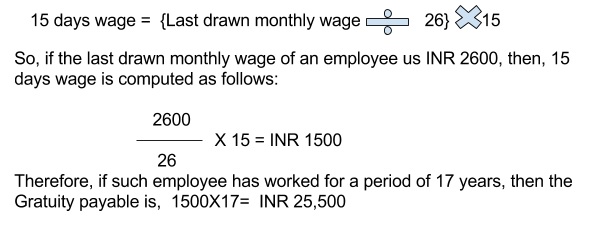
Gratuity is payable to an employee at the rate of 15 days wages which the employee has last drawn, for every completed year of service. Fifteen days are calculated by dividing monthly wage by twenty-six and multiplying the same by fifteen.

gratuity

Hope the article served your purpose. Please comment below and don’t forget to share the article with your friends and family. 

References

Payment of Gratuity Act, 1972.

K.D Srivastava’s Commentaries on Payment of Gratuity Act, 1972. Revised by Dr. R. Prakash


Download Now

What is the difference between Director & officer’s insurance policy and Keyman insurance

2
appointment
Image Source: https://blog.ipleaders.in/wp-content/uploads/2017/04/directors-and-officers-liability-insurance-inner.png

This article on the difference between Director & officer’s insurance policy and Keyman insurance is written by Tusharika Bhattacharya, pursuing Diploma in Entrepreneurship Administrative and Business Law from NUJS, Kolkata.

Download Now

Labour law amendments in the development of textile industry

2
labour law amendments

This article on the labour law amendments in the development of textile industry is written by Shubham Aparajita, pursuing  Diploma in Entrepreneurship Administrative and Business Law from NUJS, Kolkata.

Download Now

Licensing, registration and other legal requirements for export and import of aircraft or parts

1
export and import of aircraft

In this article, Lavanya Verma deals with legal frameworks regarding export and import of aircraft or its parts.

Licensing, registration and other legal requirements for export and import of aircraft or parts

  • The enormous expansion of the aviation industry had attracted huge amounts of aviation spares movement’s in the keep of the mammoth industry serving every institution of global trade. There is a need to apprehend the extent of relaxations manifested by the government of India upon the aviation industry.
  • The Central Government is empowered under Section 5 of the Aircraft Act 1934, to make rules regulating the export/import of an aircraft in view of securing the safety of the operation.
  • The Civil Aviation Requirements as laid down by the office of the director general of Civil Aviation also describes procedure for re-import and export into India aircraft and spares/items of equipment after repair, maintenance or overhaul etc.
  • In spite of the removal of restrictions on the repaired/reconditioned aircraft spares by the Indian Government, it is still mandatory to certify parts as aviation parts/spares for claiming notification benefits. Parts other than those of aircraft are governed by the rules and regulations for imports and exports.
  • Whereas the procedure for re-import/export of non-aviation and aircraft parts still remains the same as for the regular re-import/export shipment subjected to establishing/identification of products with such documents.
  • Only the parts of specified products which are exported for upgrade or repair or any other activity related to the enhanced technology can be imported without any license, must go through re-import clearance formality process of identification of exported goods from India.

This brief deals with the import/export rules and regulations, process, various precautious measures to be followed, from import/export documentation to actual import/export of the parts of Aircraft, spacecraft.

Registration to act as an Exporter/Importer

  • To act as and become an exporter/importer requires a government registration. The foreign trade government office of the corresponding country is empowered to issue such authorization to become an import/export trader.  
  • IEC or the Import Export code number is to be obtained in India from the office of the Director General of Foreign Trade Office to be entitled to be an exporter or importer on the Indian Territory. Registration requisites followed to be an exporter/importer is a one-time procedure requiring renewal based on the terms and conditions of the corresponding trade office of a country.  
  • Majority of the countries have linked the information of registration of exporter-importer to the reserve banks and customs location in verge of digitalization. Hence, the export-import tradesmen dealing with aircraft, spacecraft and the spares/parts involved are also necessitated to knock doors of the corresponding government agencies of their importing country for verifying the mandate of the completion of the onetime registration process.

Export/Import Procedures

  • According to the mutual agreements and contracts of discrete buyers and sellers, the export/import shipment is carried on. Quality specifications, pricing, mode of transport, terms of delivery, terms of payment and various other terms and conditions are agreed and mentioned, both in the purchase order and the export/import shipment document of the Aircraft, Spacecraft, and parts thereof is effected consequently.
  • As under any exportation or importation of goods, the important export/import documentation and the process of customs clearance at exporting/importing nation are to be facilitated either by the exporter/importer directly or through the customs broker in accordance with the foreign trade policy of that very exporting/importing nation.
  • Entry documents along accompanied by the carrier’s document (Airway bill/Bill of Lading), packing list, commercial invoice, certificate of origin, etc. Are the documents to be necessarily filled as part of completion of the export and import procedure and receiving delivery thereof of the goods as classified under the category of Aircraft, Spacecraft, and parts.
  • Currently, important information is filed online and the required documents are produced only at the times of inspection, delivery or assessment of the exports/imports of goods at destined custom locations. The global partners belonging to various countries share essential quality measures amongst one another to get exempted from multiple inspections of the same items both for import and export.
  • Yet, according to the policies of maximum developed countries export and import of aircraft or its parts from the (LDCs) i.e. Least Developed Countries ought to be certified by the authorised agencies before trade. Thus, if any export or import of Aircraft, Spacecraft and their parts occurs, the corresponding details of these information is easily obtained from the notes government agencies of importing or exporting countries.

HTS Code

The traders dealing in export and import of aircraft or parts of spacecraft must know the HTS code or the HS code i.e. the Harmonized system of coding of their trade product. Parts of Aircraft and parts of Spacecraft fall under HTS code/HS code chapter 88. In India, these aviation parts and spare products are categorised under ITC code (Indian Tariff Code) Chapter 88.

Certificate of Origin                            

In almost all countries the source of origin of the very exported/imported items of Aircraft, Spacecraft, and Parts is a must. Hence, the issued certificate of origin assists in determining the originality of the exported/imported products for availing exemption custom duties and levied taxes.

Distinct unilateral, bilateral and multilateral agreements among countries also authorize imports and exports with an exemption of import duties wherein Certificate of Origin is the basic proof on the point of country of origin for importing goods under Aircraft, Spacecraft, and Parts Thereof.

Importation agreements on Aircraft, Spacecraft, and Parts Thereof 

The countries may have bilateral, multilateral and unilateral agreements each other which exempt rates of import/export tax and duties and documentation. The importers/exporters have to collect precise information from noted government agencies prior to import/export of Aircraft, Spacecraft, and Parts Thereof.

Restriction to import

Few items are prohibited to import/export in certain countries based on their distinct and independent foreign trade policy on exports/imports. Hence, importer/exporter can cross check the requisites of export/import of their items before placing/taking order with overseas buyer/seller.

Prohibition on Export/Import of Aircraft or parts

Few items are prohibited from the export/import in some countries according to their foreign trade policy on exports/imports. Hence, importer/exporter can cross check the requisites of export/import of their items before placing/taking order with overseas buyer/seller.

Conclusion

This very article deals with the formalities, process, and documentation of the export and import of Aircraft, Spacecraft, and Parts Thereof. As mentioned above, this is general information applicable in mostly all countries for export/import Aircraft, Spacecraft, and Parts Thereof. This brief on Licensing, Registration and other Legal Requirements for export and import of aircraft or parts provides a basic idea. Specific mandates for each exporting/importing country are to be abided by exporter and importers of Aircraft, Spacecraft, and Parts Thereof. 

That’s all about Licensing, Registration and other legal Requirements for export and import of aircraft or parts. Do comment below and Don’t forget to share.


Download Now

Licensing, Registration, and other legal Requirements for starting an IT Business

0
IT startup

In this article, Lavanya Verma explains the required legal frameworks for an IT startup.

Required legal frameworks for an IT startup

Advancing a successful IT startup, an entrepreneur might faces many issues other than planning the most effective business strategy for the IT Company. Resolving legal issues ranging from brand protection to e-commerce is the basics of startup laws. In addition to this, a look into the tax regimes and regulatory environment involved in business is necessary.

The Central Government took the edge of promoting the IT start-ups by way of relaxing regulatory preconditions and tax exemptions. It was intended to help budding entrepreneurs primarily in transition stage of transforming their research ideas into business models.

The issues discussed below are an indication of the sort of tax, regulatory and legal points applicable to start-ups as they pace to maturity.

It must be remembered that the concerns mentioned may not be strictly applicable in all situations, and the rules will vary on case by case basis depending on the geography, type of activity and industry sought to be established by a start-up.

What is a “STARTUP.”

Following entities are considered to be a “start-up” –

  • From the date of its registration/incorporation up to five years
  • Turnover of less than 25 crores in any of the financial years
  • Working in the field of development, innovation or commercialization of new services products or processes guided by intellectual property or technology; that might create or add value in workflow or for customers.

Any entity born by reconstruction or splitting up of an already existing business shall not be considered a ‘start-up’.

Structuring of an IT startup

Knowing the kind of entity you want to set up is the most essential concern before pulling up an IT startup. The options prevalent includes the following,

  • A partnership firm,
  • A limited liability partnership (the Limited Liability Partnership Act, 2008),
  • Private limited company, or a public limited company (April 1, 2014, the Companies Act, 2013 has replaced the Companies Act, 1956).

Prior to this, it is crucial to analyze and ponder upon the sustainability, visibility, aptness practicality and related profits that are expected from this type of venture.

Incorporation Process as under companies act

  • Permanent Account Number (“PAN”), Digital Signature (“DSC”) and Director Identification Number (“DIN”)
  • Name Approval as off the provisions of the Emblems and Names (Prevention of Improper Use) Act, 1950
  • Filing of Charter documents of a company (MOA, AOA, Prospectus)
  • Certificate of Incorporation
  • Obtaining Permanent Account Number As per section 139A of the Income-tax Act, 1961
  • Board Meeting and Annual General Meeting
  • Appointment of Auditors
  • Central Excise Duty– Central Excise Act, 1944.
  • VAT, Service tax, and GST
  • Royalties & Fees for Technical Services

Structuring the entity and its business vehicle may take some time varying as per the entrepreneurs long term objectives and vision. Yet, an entrepreneur should be cautious of the finer points in the prevalent legal structure. Every type of business will be ruled by discrete laws and violation of which results in the loss by way of heavy fines even before you start making profit.

Following are the factors relevant for setting up of a startup

  • Location of business
  • Presence of management team/founders
  • Ease of doing business
  • Regulatory and tax considerations

Founder’s Agreement for your IT startup

Upon the formation your startup managerial team, next step is to design co-founder legal agreements to record founder’s legal relationship with the corporation, to one another and to the entity’s other participants. The contractual agreement between founder and partners is the most critical agreement which sets the platform for how you will run the IT startup.

Basic Documentation includes the following

  • Confidentiality & Non-Disclosure Agreement
  • Offer Letter/ Employment Agreements
  • Non-Competition & Non-Solicitation Agreements
  • Intellectual Property Assignment Agreement
  • HR Policy / Employee Handbook
  • Employee stock option plans (“ESOPs”)
  • Software License Agreement
  • Software Development/Services
  • Work for Hire Agreement
  • Equipment/ Technology Lease
  • Shrink Wrap/ Click-Wrap Agreements
  • Strategic Alliance Agreements
  • Outsourcing Agreements
  • Distribution Agreements
  • Vendor/ Supplier Contracts
  • Insurance Agreement

Business Licences for your IT startup

  • In India, several licenses are required before doing any business or even running any kind of office. Few of which are general tax registrations while others just necessitate Shops and Establishment Registration or a trade license.
  • You might require a bunch of licenses for some specific activities like export- import and manufacturing. Several labour and employment related registrations are a must for employing more than 10 employees. Such particulars are seriously looked into while any legal due diligence before foregoing investments.
  • Costly legal suits, hefty fines or business shutdown are a result of the violation of licensing norms. If you are a business owner in any sector, you better have a sense of what licenses are essential.

Securities laws and Business Finance

  • Know-how of Securities Laws becomes vital if you wish to list your IT startup, now or in the coming future. The Securities and Exchange Board of India (SEBI) issues various rules and regulations from time to time, precisely monitoring and regulating the securities market. Thus, possessing good working information of all these bylaws helps smoothen the listing process.
  • The management of all the various financial needs accruing during the multiple phases of the IT business life cycle dealing with all the possible options available for fundraising refers to Business finance.
  • Therefore, the know-how of problems like venture capitals, crowd funding, foreign direct investment, and angel investors, or even joint ventures, would assist in increasing the profitability of the IT startup.

Taxation issues

  • Each IT startup, must pay the required prescribed amount of taxes to the central, state and local authorities. Tricky tax laws vary across sectors, regions, and products. Misfeasance of tax laws by founder’s leads to heavy fines, with or without imprisonment and unproductive criminal cases and lawsuits with respect to tax bills.
  • A lot of businesses be it IT companies or others completely dwindle on this point. Hence, being abreast of accounting and taxation procedure it is obvious that entrepreneurs or other IT professionals will be profoundly profited.
  • Along with, the many of taxes applicable to various sectors, geographical regions or product greatly vary. So, area-specific and sector knowledge of taxation is beneficial in maintaining the legal and financial health of the business.

Contract Laws

It’s no exaggeration that no business organization would come to being without the use of contracts.  Contracts are requisite tools of entrepreneurs at some stage or the other, in some way or the other. Thus, basic information of certain fundamental principles as prescribed in the Indian contracts act of 1872 are a must.

Borderless Commerce

Technology companies can swiftly expand their operations into new countries due to the nature of the industry. However, organizations should comply the laws concerning security which differ greatly from country to country. Even though few regions have taken measures to reduce inconsistencies between jurisdictions, these efforts are limited in material and territorial scope.

Thus obligating the organizations to be aware of the legislation of each jurisdiction they wish to carry business and prove their compliance. Failure of which can open up the business to catastrophic risks for the success of the business. Hence, IT startup should strategically adapt while significantly investing in their policies and procedures to fulfill the requirements of any given territory.

Competition Policy

With large pool of experienced and professional investors, as well as industry leaders from around the globe, special focus must be given to the subject of the borders of competition policy in the high-tech sectors. To maintain a thorough implementation of both regulation and competition law, there is a need for continued co-operation with the national authorities.

Dispute Resolution

Owing to the inevitability of disputes in contemporary business world, being reactive and proactive to dispute is two completely different ends while prevention or minimization. You as the Founder and the CEO of the IT startup, would bat extremely well in hassles and regaining the power in your hands, by knowledge of court procedures and also methods like conciliation, mediation, arbitration, etc. as the means of dispute resolution.

Dissatisfied Customers

Dissatisfied customers have the right to file class action lawsuits against companies, in which they attack your business over faulty products, services or promises in large groups causing irreparable tarnish on your brand’s image. Prompt recalls for flawed products and proper redressal to customer issues is important to be safe from violation of provisions of the Consumer Protection Act.

Again, be proactive and keep a finger on the pulse of your customers through tech support, online message boards and e-mails. Corporate Governance

A start- up entrepreneur must possess firsthand -knowledge of corporate governance to facilitate effective management and formulation of additional expansion plans. The Indian Government is the compulsive spender as of the Indian economy. Thus, private businessmen share wonderful opportunities through bidding during public procurements. These biddings are a gold mine in creating steady flow of revenue since the government always orders in bulk and also portrays goodwill in the name of government contract in your market.

Employment and Labour Laws

Each IT startup with time needs to hire new people even if its aims to employ or outsource independent consultants, all such employee-employer relationships are guided by labour legislations. Breach of these will does not harm the entity financially rather spreads a bad review of the start up even before initiating it.

The ultimate success of the IT startup and productivity of the employees depends upon the happiness of employees working for the entity.

Applicable Employment laws for an IT startup

  • The Contract Labour (Regulation And Abolition) Act, 1970
  • Maternity Benefits Act, 196
  • Sexual Harassment Act enacted in the year 2013
  • Minimum Wages Act
  • Payment of Wages Act
  • Remuneration Act
  • Bonus Act
  • The Gratuity Act
  • Employee Provident Fund Act
  • Compulsory Notification of Vacancies (CNV) Act
  • Apprentices Act
  • Child Labour Act
  • Industrial Disputes Act, 1947
  • Trade Unions Act

Intellectual Property Laws

While engaging with innovations in designs, codes, research, etc. Timely audits of intellectual property (IP) are important. It’s crucial to file the right trademark/ patent/copyright claims to prevent theft.  In a global economy it is imperative to analyse and ascertain the nature and type of protection afforded to IPRs as they are country-specific. India, by amending existing statutes and enacting necessary statutes has complied with its obligations under the Agreement on Trade-Related Intellectual Property Rights (“TRIPS”).

Acts for leveraging IP are as follows

  • The Agreement on Trade-Related Intellectual Property Rights (“TRIPS”)
  • The Patents Act
  • The Copyright Act, 1957 (“Copyright Act”), along with the Copyright Rules, 2013 (“Copyright Rules”)
  • The Copyright Act and the Trade Marks Act, 1999
  • The Trade Marks Act, 1999 (“TM Act”) along with the TradeMark Rules, 2002 (“Rules”)
  • The Designs Act, 2000

Information Technology laws

E-contracts and digital signatures are included in IT laws. Upon use of cloud computing services and proprietary software bulk of consumer data is collected which requires protection for client’s privacy from hackers. At times, all the IP generated may be embedded in the IT used. Thus, protection from any infringers becomes quintessential. Acquaintance with IT laws comes to the business rescue.

Acts dealing with such risk management and content regulation are

  • The IT Act, 2000
  • The Indian Penal Code, 1860,
  • The Indecent Representation of Women (Prohibition) Act, 1986

The above compilation indicates that IT startup need to invest their time and resources to make sure that their products and services are not only in compliance with prevalent laws and regulations but should also continue to do so as the laws also evolve in response to innovation.

As such, it is crucial that a company seeks the advice of an experienced lawyer working with IT startup. Prevention of the legal pitfall necessitates following the above tips prior to the occurrence of the issues for triumph in your entrepreneurial IT startup at the end!

Did the article serve the purpose for all the future IT entrepreneurs? Please comment and share.

Want to explore more on startup laws? Read our exclusive articles on laws regarding startups.

HOW CAN THE INDIAN GOVT HELP YOUR STARTUP

Why you should never startup

How to tell which startup will work


Download Now

Protection of traditional knowledge and IPR. Does India need a ‘Sui Generis’ legislation

0
Traditional Knowledge

In this article, P. Mohan Chandran discusses the need for protecting Traditional Knowledge and why India needs a unique legislation on it.

WHAT IS TRADITIONAL KNOWLEDGE (TK)?

TK is a body of knowledge, pertaining to innovations and practices of a group of local people, extracted and developed through their close contact with nature for generations, which is later shared with the successive generations. TK encompasses development from one generation to another, tangible and intangible knowledge, and innovations of both potential and actual value. TK has continued to play a critical role in significant areas such as food security, agricultural development and medical treatment.

THE NEED TO PROTECT TK

The protection of indigenous and TK under intellectual property rights (IPRs) has received increasing attention since the adoption of the Convention on Biological Diversity (CBD) in 1992. Empowerment of local and indigenous communities (LICs) through recognition of community rights and protocols creates an impetus for preservation and restrained disclosure of TK in a culturally enlightened manner.

TK plays an indispensable role in supporting sustainable development (SD) practices, and facilitates SD in LICs through recognition of IPRs. The application of IPRs to TK held by LICs can enable SD. SD does not compromise the needs of future generations to satisfy the desires of the present, and establishes a realistic equilibrium between socio-economic development and environmental protection. SD must be established on reciprocally beneficial pillars of mutual respect and legal exactitude, with the active participation of LICs, and must be aimed at protective, practical and aggressive measures designed to eliminate poverty and inequality. Recognition of IPRs in TK held by LICs through a specialized globally-binding mechanism could work to harmonize lack of trust, positively stimulate preservation, and act as a fair enabler of SD. Recognition of IPRs held by LICs, especially TK associated with biodiversity and genetic resources, is an important step in realizing SD. TK plays a unique role, as it is inherently established in the doctrine of conservation and sustainable use of biodiversity. The ‘2030 Agenda for Sustainable Development’, comprising the 17 SD Goals (SDGs) and 169 goal-specific targets, was approved in September 2015, and represents the most recent declaration of an integral approach to define and realize SD.

The primary arguments for granting protection to TK include:

  1. Equity 

The prime concept for the protection of TK is based on equity. TK generates value that is not adequately recognized and compensated due to the currently erroneous system of funding and reward. The protection of TK, therefore, assumes significance to bring equity to primarily unjust and unequal relations.

  1. Conservation 

Another prime factor for the protection of TK is the importance of such knowledge for conservation. Maintenance of biological diversity in farming generates value for the global community. IPRs could be used to generate income to sustain the otherwise abandoned activities. Under this approach, the protection of TK helps fulfill society’s macro objectives for the conservation of environment, sustainable agriculture and food security.

  1. Preservation of Traditional Practices & Culture 

The protection of TK is a framework that encourages the maintenance of traditional practices, culture and knowledge. In this sense, the concept of ‘protection’ is quite different from the concept applied under IPRs. The preservation of TK is not only a key element of the right to self-identification and a pre-requisite for the continuous existence of traditional people and indigenous communities, but also a vital element of the cultural heritage of humanity. The crisis impacting the world’s diverse cultures and languages is much deeper than the biodiversity crisis. About 90% of the 6000-odd languages currently spoken – and their corresponding cultures – may face extinction in the next century.

  1. Promotion of Use of TK & Its Significance in Development

The promotion of the use of TK is a vital objective. Article 8 (j) of the CBD requires the promotion of ‘wider application’ of TK. Protecting TK against loss and misuse, or ensuring compensation to TK-holders are pre-requisites to boost the wider use of such knowledge. Protection may serve as an instrument for facilitating access to TK. Protection of some kind may create the basis for trust required for the LICs to share their knowledge and enhance their position to extract value from it. If certain rights are recognized, knowledge-holders will be more willing and prepared to provide access to their knowledge. Besides, compensating them adequately will encourage them to have more incentives to conserve it for future access. Promoting the development of TK may also be a prime motivation behind protecting TK from extinction and loss.

PROTECTING TK IN INDIA

Food security of the country is linked to protection of TK. Protection of TK of the LICs seem to be one of the most controversial and complex issues. Technology developments in the new millennium poses serious challenges to the global legal community to establish new global legal standards for encountering the problem of IP protection. The incorporation of IPRs in TK offers the most pragmatic route to providing both protection and fair access to TK held by LICs, with the identified drawbacks addressed through common but separate domestic legislation, capacity-building, and mutually-supportive compliance systems.

IP protection for TK can provide a fundamental system, established on transparency and recognition of rights of LICs, which will enable the collection, documentation and preservation of TK under a cloak of inalienable rights. Application of specific IPRs relating to TK assumes the nature of both a defensive posture preserving TK in a sui generis international legal mechanism, and of a proactive system to promote SD through codification of community protocols and effective benefit-sharing. SD must be viewed comprehensively, and not individually, requiring involvement with LICs based on a relationship of trust and mutual respect.

GLOBAL LEGAL FORA FOR INCREASING PROTECTION OF INDIAN TK

Indian TK is now available to the United States Patent and Trademark Office (USPTO) and European Patent Office (EPO), who can access the database of TK, courtesy the Indian Government’s permission. India’s Council of Scientific and Industrial Research (CSIR), and the Department of Ayurveda, Yoga and Naturopathy, Unani, Siddha and Homeopathy developed the TK Digital Library (TKDL), a 30-million page searchable database of TK translated from several languages such as Hindi, Sanskrit, Arabic, Persian, Urdu and Tamil into English, Japanese, French, German and Spanish.

There are several other international legal platforms and mechanisms that currently address IP protection relating to TK, including the following:

  • The UN Draft Declaration on Rights of Indigenous Peoples (UNDRIP): Article 29 of this UN Draft Declaration specifically states that people from LICs are authorized to the recognition of the complete ownership, control and protection of their cultural and IP. They have the special rights to control, develop and protect their sciences, technologies and cultural expressions, including human and other genetic resources, seeds, medicines, wisdom of the characteristics of flora and fauna, oral traditions, literature, designs and, visual and performing arts.
  • Global Guidelines: Another positive initiative is the inclusion of a set of draft corporate guidelines for businesses that want to use native plants and TK from LICs to make commercial drugs.

The CBD and the 2010 Nagoya Protocol establish the dominant international system for the recognition and protection of TK. Under Article 8(j) of the CBD, parties are required to respect and maintain knowledge held by LICs, and promote broader application of TK based on fair and equitable benefit-sharing. TK is further recognized in Article 16 as a ‘key technology’ for effective practices of conservation and sustainable use of biodiversity, with procedural requirements established in Article 15(4–5) for access to genetic resources, including those based on prior informed consent and mutually agreed terms. The Nagoya Protocol, which became effective from 2014, broadens the CBD provisions establishing a concrete system determining access and benefit-sharing. Other relevant developments relating to TK that evolved simultaneously to progress in the CBD leading up to the Protocol include the establishment of:

  • the International Treaty on Plant Genetic Resources for Food and Agriculture (ITPGRFA) passed by the Food and Agriculture Organization Conference in 2001, effective from June 29, 2004. This treaty provides for protections relating to ‘farmers’ rights’ including TK and traditional breeding practices.
  • the Inter-Governmental Committee (IGC) on IP and Genetic Resources, TK and Folklore, established under the World Intellectual Property Organization (WIPO) in 2000, which provides a forum for negotiations on issues related to development of a binding international mechanism on TK.

NEED FOR A ‘SUI GENERIS’ LEGISLATION IN INDIA

The protection of TK raises several policy issues, prominently the objectives and methods of such protection, and its impact and ramifications for intended beneficiaries. Such issues are extremely complex, since there are broad differences about the definition of the subject matter, the justification for protection, and the means for achieving its purposes. The issues pertinent to TK should be addressed in a comprehensive manner, including ethical, environmental and socio-economic concerns. Moreover, there are still several unresolved technical issues such as the problem of collective ownership and the modes of enforcement of rights.

The conviction that TK has helped the industry generate gargantuan profits has proved to be relentless. Of course, much of the international law governing access to genetic resources and benefit-sharing has been woven around this idea. TK should be protected on both human rights and utilitarian grounds, but the political strategy adopted by India for the past two decades needs to be seriously reconsidered. In terms of legal benchmark, this strategy has been dichotomous. The first is the access and benefit-sharing path via the CBD and its Nagoya Protocol. The second is based on IP law and comprises:

(i) reforms aimed to reduce misuse of genetic resources and TK, such as by enhancing patent prior art searching, restricting the scope of the subject matter claims in patent law to biological, biochemical and genetic issues, and necessitating patent applicants to disclose the origin of genetic resources and TK that were useful or essential to an invention; and

(ii) the enactment of sui generis TK protection laws, based partly on current forms of IPRs, but with some modern features.

TK cannot flourish when decisions affecting LICs continue to be made by urban educated elites. We need to give up political space to allow LICs to formulate the rules of involvement. The 2007 UNDRIP affirms territorial rights and self-determination, and these must be essential elements of strategies, activities, laws and regulations.

The development of any system for the protection of TK should be established on a logical definition of the objectives sought, and on the propriety of the mechanism selected to accomplish them. IPRs may be one of the devices to be used, but their limits and ramifications should be clearly gauged. A balance should be struck between the protection and promotion of the use of such knowledge. The extent to which the myriad proposals made for the protection of TK convey the aims and cultural values of the LICs they intend to serve should not be ambiguous. There is a risk of transferring concepts and models unsuited to their realities to such communities, or which may prove ineffective in solving the issues they are supposed to address. The protection of TK should not outweigh the fact that its preservation and use requires ensuring the survival and improvement of living conditions in the ambiance and cultural setting of such LICs.

THE WAY AHEAD

The following actions could be taken in future in this field:

  • A comprehensive national level development strategy boosting the protection of TK, including the settlement of prime issues such as land rights and the need to respect and maintain the lifestyles of LICs.
  • Recognizing the varying needs for the protection and promotion of TK in several areas such as TM and plant genetic resources.
  • Administering farmers’ rights at the national level.
  • Progressing towards the enactment of a misappropriation regime in the short-run.
  • Expediting the work in WIPO, UNCTAD, WTO and other fora to clarify the possible role, scope, and content of protection mechanisms for TK.
  • Guarantying a wide and effective participation of representatives from LICs in the definition and implementation of any protection system for TK.

REFERENCES & BIBLIOGRAPHY

  1. Freedom-Kai Phillips, Intellectual Property Rights in Traditional Knowledge: Enabler of Sustainable Development, (Sept. 29, 2016), http://www.utrechtjournal.org/articles/10.5334/ujiel.283/.
  1. Navin Anand, International Development Relating to Protection of Traditional Knowledge, (Apr. 6, 2015), http://www.lawctopus.com/academike/international-developments-relating-protection-traditional-knowledge/.
  1. Graham Dutfield, Traditional Knowledge, Intellectual Property and Pharmaceutical Innovation: What’s Left to Discuss? (2014), http://www.academia.edu/10427115/Traditional_Knowledge_Intellectual_Property_and_Pharmaceutical_Innovation_Whats_Left_to_Discuss.

Hope the article added value to your knowledge. Please do comment and don’t forget to share.

Intellectual Property Rights or IPR in Sports

National IPR Policy 2016: A Quick Look

Download Now

What should every entrepreneur know about income tax laws

0
income tax

In this article, Aashish Ahuja, a student of B.A.LL.B. Hon’s at University Institute of Legal Studies, Shimla, Himachal Pradesh University discusses legal provisions relating to income tax laws which every entrepreneur should know about

Few fundamental facts about Income Tax

Income tax can be defined as an annual charge which is levied on both earned income i.e. wages, salaries, and commission as well as unearned income i.e. dividends, interests, rents, etc. The two basic types are as follows:

  • Personal Income Tax which is levied on personal income of individuals, sole-proprietorships, households, and partnerships; and
  • Corporation Income Tax which is levied on profits of the incorporated firms. However, due to the presence of some loopholes, wealthy persons escape higher taxes without violating the tax laws.
  • According to Section 2(13) of Income Tax Act, 1961, business includes any trade, commerce or manufacture or any adventure or concern in the nature of trade, commerce or manufacture.
  • Section 28 of the Income Tax Act, 1961 deals with the income to be chargeable to income-tax under the head “Profits and Gains of business and profession.”

Tax exemption to startups for upto three initial years

  • Finance Minister, Arun Jaitley while announcing Union Budget 2016-2017 in Parliament proposed to exempt the tax for three years to give a much-needed boost to the budding entrepreneurs and promote the growth of startups. It was declared that startups would not incur any taxes on profits in the first three years.
  • However, innovation is the essence of every startup, and young minds kindle new ideas every day to think beyond conventional strategies of the existing corporate world. In the initial years, entrepreneurs struggle to evaluate the feasibility of their business idea, and capital investment is made to fight with the rising competition and navigate through unique challenges.
  • Also, the small and growing entrepreneurs have limited alternate financial resources, leading to constrained cash funds.

Thus, for three initial years, the profits of a startup are exempted from the income tax to facilitate their growth and development and given them a competitive platform.

Scope of income tax

Income Tax Act, 1961 contains the income tax laws and covers the following matters:

  • The basis of charging income tax.
  • Computation of income tax under various heads
  • Exempted incomes
  • Permissible deductions from income.
  • Rebates and relieves from income tax.
  • Clubbing of income.
  • Set off and carry forward of losses.
  • Double taxation relief.
  • Special provision for avoidance of tax.
  • General Anti-Avoidance Rules.
  • Determination of Tax.
  • Determination of residential status.
  • Special Provisions relating to companies.
  • Special Provisions for limited liability partnership.
  • Tax on dividend distributed by domestic companies.
  • Income tax authorities and their powers.
  • The survey, search, and seizures.
  • An assessment of income tax liabilities of assesses.
  • Tax Deduction at Sources.
  • Advance taxes.
  • Refunds.
  • Appeal and revisions.
  • Acquisition of immovable properties.
  • Penalty and Prosecutions.

The income tax rules prescribe the procedures, time limits, conditions and return form, etc. for implementation of various provisions of the act.

Income tax returns

Income tax return is considered as the most authentic proof of the income earned. In India, there is a system of self-declaration, wherein one is required to file income tax returns within the due date showing the income details, but due to some reasons, many people do not file tax returns because of the following reasons:

  • Tax at source has been deducted at source.
  • Filing of income tax return is considered as a time-consuming process.
  • Deadline for filing a tax return is far away.
  • The deadline has already passed away, so it is irrelevant to file income tax return.

Benefits of filing income tax returns

  • Tax refunds can only be claimed if the tax returns are filed. Unless one files income tax return, they will not get the extra taxes refund.
  • One can be saved from proceedings and assessments of income by income tax officials by filing timely and fair returns. A person may end up having to pay tax with interest and penalty if the IT department picks up his case.
  • If a business is having losses and want to carry forward it and set off with the future profits, then it is possible only if it files the tax return within due dates.
  • For making an investment, income tax return is essential, and it proves that you have a valid source of income for making the investment.

The different tax forms available for filing of tax returns

Form ITR-4

This form is used by the individuals who conduct a business or who earn through a profession and applies to any business, undertaking or profession on no limit of the income earned. The taxpayers can also club any income from salaries, speculation, lotteries, housing properties, etc. with the income earned from business.

Form ITR-4S

The form is also known as ‘Sugam’ form and can be used by the individuals who earn their income from any business. This form is used in special circumstances and applies to businesses where income earned is based on the presumptive method of calculation.

Form ITR-6

It is to be used by the companies other than the companies claiming exemption under section 11 of Income Tax Act, 1961.

Form ITR-7

It is to be used by the persons including companies required to furnish a return of income under section 139 (4A), 139 (4B), 139 (4C) or 139 (4D). The form can be filled either electronically or in the paper form.

Capital Gains

  • Capital Gain can be defined as any profit or gain which arises from the sale of a capital asset and is charged to tax in the year in which the transfer of the asset takes place. When an asset is inherited, then there is no capital gain as there is no sale but only a transfer.
  • Capital gain is applicable only if the asset is sold by the person who inherits it. Assets received as gifts by way of inheritance or by will are exempted from the Income-tax Act.

The difference between short-term capital gains and long-term capital gains

Short-term capital gain Long-term capital gain
Short term capital gains are obtained by sale or exchange of capital assets held for one year or less than one year. Long-term capital gains are obtained by the sale or exchange of capital assets held for more than one year.
The tax rates for short-term capital gains are higher than the tax on long-term capital gains. The tax rates are less in long-term capital gains.
Such gains are obtained by sale or exchange of shares. Such gains are obtained by sale of long-term assets such as real estate.
  • The difference between short-term capital gains and long-term capital gains depends upon the time frame for which they are held. Their nature and structure are very similar to each other.
  • The longer the assets are held, higher is the risk of fluctuation in the value, and this is the reason why long-term gains are taxed at a lower rate than short-term capital gains.

Tax on short-term and long-term capital gains

Tax on long-term capital gain

 Long-term capital gain is taxable at 20% along with surcharge and education cess.

Tax on short-term capital gain

Short-term capital gain is taxable at 15% along with surcharge and education cess if securities transaction tax is not applicable.

Exemptions on capital gains

  • The Finance Ministry has introduced in sections 53 to 54H to provide exemptions on capital gains if sale proceeds realized are invested into assets specified in the respective sections.
  • For example, Section 53 of the Income Tax Act, 1961 says that the capital gains arising out of the sale of the residential house are exempted if sale proceeds realised from the sale are reinvested in the purchase or construction of the new residential house.
  • Furthermore, section 54 EC provides that the capital gains arising from the sale of capital assets are exempted if such sale proceeds are invested in bonds of government companies notified by the government from time to time.

The appropriate ITR form

One needs to fill ITR form 2 as it declares the income from capital gains, all house properties, and other sources. (Including lottery)

Tax on ESOPs (Employees Stock Ownership Plans)

  • ESOPs stands for Employees Stock Ownership Plans. ESPOs are similar to profit-sharing plans and allow the owners of private companies to share their ownership with their employees. These are the good ways to motivate the employees and increase the distribution of shares of the company and create a market for them.
  • ESOPs can be defined as contribution employee benefit plans that invest in the stock of the employer company. However, ESOPs distribute the stock of the company to employees as a benefit instead of selling the shares to employees.
  • Employees Stock Ownership Plans gives way for the retiring owners to cash out their holdings without selling the entire company. As such, to raise funds for expansion, creating a market for shares can also be used.
  • These are the stock options granted over a vesting period to employees where they are given the right to purchase the company’s shares at a predetermined price or exercise price, and if the employee does not exercise the option within the prescribed time of the company, the option automatically expires.
  • ESOPs benefits received by the employee are taxable as a prerequisite for tax purposes. It is the difference between the fair market value of the shares on the date of exercise of options less the exercise price, and however, it shall be taxable only if shares are allotted under ESOPs.

Ways of reducing income tax liability

Proper recording of cash expenses

Most of the businesses in the country are labour intensive, and the wages of the unorganized labour are generally paid in cash. Improper recording of payments results in higher profits as a consequence of under-recording of expenses and results in higher amount of taxes. A proper register should be maintained along with the cash receipts to avoid extra taxes.

Always deduct tax at source

Tax which is deducted at source is deducted from an individual’s income on a periodical basis and is applicable to income which is either regular or irregular. Income Tax Act, 1961 regulates TDS in India through Central Board of Direct Taxes under Indian Revenue Services. It is applicable for salary, commission, interest, rent, professional fees, etc.

File your income tax return on time

To avail the benefits, income tax department suggests filing the income tax return on time. Carry forward of losses in the business income is one of the main benefits. The losses in the business income can be carried forward for a consecutive period of 8 years and hence can be set off against the income of the coming years if it is not set off with the income of the current year. As such, the benefits can only be availed if the income tax return is filed on time.

Depreciation

Depreciation is the decrease in value of assets and reduces the amount of taxes paid in the form of depreciation expense on the income statement. The depreciation expense of a company is recognized on the income statement after all revenue, the cost of goods sold and operating expenses have been paid. A company’s tax expense is calculated from the income statement reflecting the earnings before interest and taxes.

MAT (Minimum Alternate Tax)

MAT stands for “Minimum Alternate Tax.” This concept was introduced for companies, and it has been made applicable to all other taxpayers in the form of AMT (Alternate Minimum Tax).

  • At times it may happen that a company may have generated income during the year, but it may have reduced its tax liability or may not have paid the tax at all by taking the advantages of various provisions of income tax law such as exemptions, deductions, depreciation, etc.
  • The Finance Act, 1987 introduced MAT with effect from the assessment year 1988-89 due to increase in a number of zero-tax companies and later on, it was withdrawn by the Finance Act, 1990 and re-introduced by Finance Act, 1996 with effect from 1st April 1997.
  • The main objective of MAT is to bring into tax net “zero tax companies” which do not pay any tax due to various tax concessions and incentives provided under income tax law even after earning substantial profits and paying handsome dividends.

MAT Credit

The provisions related to the adjustment of MAT credit and carry forward are given in section 115JAA. A company is liable to pay as per MAT provisions or has to pay higher of normal tax liability, and if in any year it pays liability as per MAT then it is entitled to claim credit of MAT paid over and above the normal tax liability in the subsequent year. 

Period for which MAT credit can be carried forward

The MAT credit can be carried forward for adjustment in the subsequent year; however, it can be carried forward for a period of 10 years after which it lapses. In other words, if the company does not utilise it within ten years, MAT credit lapses. As such, the taxpayer is not paid any interest in respect of such credit.

LLP Vs Private Limited Company tax implications

On January 9, 2009, the Limited Liability Partnership Act, 2008 was published in the Official Gazette of India. The Act has been notified with limited sections only, and the rules have been notified in the Official Gazette on 1st April 2009. In the first week of April 2009, the first LLP was incorporated.

  • An LLP is treated like any other partnership firm in India.
  • There is no joint liability created by the partners, and no partner is liable on account of unauthorized actions of other partners.
  • LLP is a body corporate and a legal entity separate from its partners and has perpetual succession.
  • Indian Partnership Act, 1932 is not applicable to LLPs and there is no upper limit on the number of partners in an LLP unlike other partnership firms where the number of partners cannot exceed 20.
  • The provisions are made for corporate actions like mergers, amalgamations, etc.
  • The existing partnership firm, private limited company and unlisted public company can be converted into an LLP by registering with the Registrar of Companies.

Tax Implications on LLP

Limited Liability Partnership is a new type of business entity in India. The income of the LLPs is taxed at the rate of 30%. The taxation policy of an LLP is similar to that of partnership firm. The income of a partnership firm is taxed at the rate of 30% plus 2% education cess and 1% secondary and higher education cess, which is similar to that of private limited company.

Taxation on LLP Partner Remuneration and Interest

Deduction for remuneration and interest on capital provided to the LLP can be claimed by a partner while arriving at taxable income of Limited Liability Partnership. There must be a specific provision in the LLP agreement to claim partner remuneration and interest on capital. The clauses must be clearly specified in the LLP agreement that allows for payment of remuneration and interest on capital and the loan provided by the partners.

Profit Remuneration Deductible
On the first Rs. Three lakhs of book-profit or in case of loss Rs. 1.5 lakhs or at the rate of 90% of book profit
On the balance of book profit At the rate of 60% of book profit

LLP Partner Income

  • Interest from LLP or the receipt of remuneration is taxed as business income in the hands of LLP partner. For business purposes like interest payments and business loss of proprietary business, the expenses incurred can be set off against receipt of interest and remuneration.
  • While making payment of interest and remuneration to LLP partners, no TDS deduction is necessary. A designated partner signs the income tax filing return of LLP, and if he is unable to sign for unavoidable reasons, then it is signed by other partners.

Private Limited Company

A private limited company can be defined as a voluntary association of persons of not less than two and not more than fifty members, whose liability is limited and the transfer of whose shares is limited to its members and the general public is not invited to subscribe to its shares or debentures.

  • The liability of the members is limited.
  • The shares allotted to the members are not freely transferable between them.
  • Its existence continues even if all the members die or desert it.
  • Shares are not freely transferable.
  • The general public is not invited to subscribe to its shares.

A company is liable to pay tax on the income of the corporate. The income tax is levied on the private limited company at the rate of 30%.

Dividend distribution tax is charged at the rate of 16%. When a company pays a dividend, it is subjected to dividend distribution tax.

  • Minimum Alternate Tax is the third kind of tax applicable to a company. Using a straight line method, many companies charge depreciation in their books and the accounts maintained for the company law purposes shows that the profits are higher and declare as dividend. For the purpose of income tax, depreciation is charged on the written down value which is higher, and the company may show
  • For the purpose of income tax, depreciation is charged on the written down value which is higher and the company may show low profit or even loss. Such companies are known as zero tax companies.
  • If the income tax payable on the total income as calculated under the Act is less than minimum, then a company has to pay minimum alternate tax on its book profit which is accessed at the rate of 18% according to latest Finance Act.

Transfer Pricing

A transfer price is defined as the price at which the divisions of a company transact with each other, such as the trade of supplies or labour within departments. These prices are used when individual entities of a larger multi-entity firm are treated and measured as separate run entities.

  • India has given rise to new and complex issues emerging from transactions entered into between two or more enterprises belonging to the same group due to increase in participation of multinational groups in economic activities.
  • Hence, in the case of such multinational enterprises, there was a need to introduce a uniform and internationally accepted mechanism of determining reasonable, fair and equitable profits and tax in India. As such, the Finance Act, 2001 introduced
  • As such, the Finance Act, 2001 introduced law of transfer pricing in India through sections 92A to 92 F of Income Tax Act, 1961 which guides the computation of transfer price and suggests detailed documentation procedures.
  • The regulations of transfer pricing apply to all enterprises that enter into an international transaction with an associated enterprise and to all cross-border transactions entered into between associated enterprises. The main aim is to arrive at a comparable price as available to an unrelated party in open market conditions and is known as Arm Length’s Price.

Tax Deducted at Source (TDS)

TDS stand for ‘Tax Deducted at Source.’ It is a type of tax which is deducted from an individual’s income on a periodical basis and can be applicable to income that is regular as well as irregular in nature. TDS is regulated by Income Tax Act, 1961 through Central Board of Direct Taxes under the Indian Revenue Services and directs the employer to deduct a certain amount of tax before making full payment to the receiver. It is applicable for salary, commission, professional fees, etc.

Any source which withholds a small percentage of overall payment while making payments is known as deductor. A person whose payment is deducted is known as deductee. For example, when a deductor is an employer paying salary to the employee who is a deductee.

Advantages of TDS

  • Responsibility sharing for deductor and tax collection agencies.
  • Prevents tax evasion.
  • Widens the tax collection base.
  • A steady source of revenue for the government.
  • Easier for a deductee as tax gets automatically collected and deposited to the credit of the central government.

When TDS is not deducted

On payments made to the Reserve Bank of India, the Government of India, etc. TDS is not collected. TDS will not be collected when interest is credited or paid to:

  • Central or State Financial Corporations.
  • Banking companies.
  • Interest paid under Direct Taxes or refund from the IT department.
  • UTI, LIC and other insurance or co-operative societies.
  • Interests earned from recurring deposit or savings account in cooperative societies or banks.
  • Interest in Indira Vikas Party, KVP, or NSC.
  • Interest earned in NRE account.
  • All institutions notified under no-TDS.

TDS Certificate

  • It can be difficult to keep track of deductions by an individual as TDS is collected on an ongoing basis. According to section 203 of the Income Tax Act, the deductor has to furnish a certificate of TDS payment to the deductee/payee.
  • This certificate is also offered by banks making deductions on pension payments etc. At the deductor’s own letterhead, the certificate is issued. Individuals are advised to request for TDS certificate wherever applicable, and if not already provided.

Provisions of Audit

Tax Audit means a close examination of a tax return by internal revenue system to verify that the income and deductions are accurate. The taxpayers have to get the audit of accounts of their business or profession according to the provisions of income tax law.

Section 44AB of the Income Tax Act, 1961 covers the provisions of tax audits in India. According to the requirement of this section, an audit of accounts of the taxpayer is done by chartered accountant. The chartered accountant prepares the audit report and submits his findings.

Objective of Tax Audit

  • To ensure that the records of the assessee and the books of accounts are properly maintained.
  • The income of the taxpayer and deductions must be clearly mentioned in the books of accounts.
  • Proper presentation of accounts before the tax authorities facilitates proper administration of tax laws and save the time of assessing officers in carrying out routine verification.

Who should get their books audited

As per section 44AB, a person has to get his books of accounts audited by chartered accountant if he satisfies the following conditions:

  • An individual is carrying on any business and his turnover or total sales for the financial year exceeds 1 crore.
  • A person is carrying on any profession and his gross receipts for the financial year exceed 25 lakhs.
  • Where profits and gains from the business are determined on a presumptive basis under section 44AD and who has claimed his income lower than the profits of the business, yet exceeds the amount which is not chargeable as income tax.
  • Where profits and gains from the business are determined on a presumptive basis under section 44AE, 44BB and 44BBB and have claimed his income to be lower than the profits of the business.

Form 3CA, 3CB and 3CD

  • The chartered accountant must furnish the tax audit reports before income tax authorities in a prescribed form.
  • If the books of accounts of a person, carrying on any business or profession, are required to be audited under any law, form 3CA must be chosen and if not, then form 3CB must be used. Form 3CD must be accompanied by forms 3CA/3CB where prescribed particulars are reported.

Speculative Transactions

Speculation is considered as an act of trading in an asset or conducting a financial transaction that has a significant risk of losing most or all of the initial outlay with the expectation of a substantial gain.

Section 43 (5) of the Income Tax Act, 1961 deals with the speculative transactions. A speculative transaction is a transaction of purchase or sale of a commodity including stocks and shares settled otherwise than by actual delivery or transfer of a commodity.

Speculative Business Income

Income generated from intra-day trading is considered as speculation income. According to section 43 (5) of Income Tax Act, 1961, intra-day trading is considered as speculation business transactions and the income generated would be either speculation gains or speculative losses. The income generated from speculation gains is taxed at normal rates.

Intra-day trading means trading of shares within the same day. Delivery is not taken in such trading and thus, are said to be speculative transactions. The shares enter and exit on the same day from the trading account and does not enter DEMAT account at all.

Tax Treatment

Tax treatment is similar to the business income tax.The profit earned from intra-day trading is categorised under speculative business income and is taxed as per the tax slab you fall in while losses can be offset only against speculative gains.

Conclusion

It is vital to discuss with your tax accountant or attorney, no matter which legal form you choose, to make sure that you are operating legally and getting the best deal on your taxes. Thus, the statute of income tax in India is the Income Tax Act, 1961 and provides for levy, administration, collection and recovery of income tax.

Hope the article added value to your knowledge. Feel free to share more such unique provisions of income tax laws by commenting below and don’t forget to share. 

Read more on income tax laws

E-filing of Income Tax Returns

Taxation System in India

How Is Agricultural Income Taxed?

Download Now

IMPORTANT LABOUR LAW AMENDMENTS IN 2016

0
labour law amendments

This article on the important labour law amendments in 2016 is written by Shruti Sharma, pursuing Diploma in Entrepreneurship Administrative and Business Law from NUJS, Kolkata.

Download Now
logo
FREE & ONLINE 3-Day Bootcamp (LIVE only) on

How Can Experienced Professionals Become Independent Directors

calender
28th, 29th Mar, 2026, 2 - 5pm (IST) &
30th Mar, 2026, 7 - 10pm (IST).
Bootcamp starting in
Days
HRS
MIN
SEC
Abhyuday AgarwalCOO & CO-Founder, LawSikho

Register now

Abhyuday AgarwalCOO & CO-Founder, LawSikho