Download Now
Home Blog Page 1630

CBI Custody- Complete Procedure And Rules To Follow

1
CBI Custody- Complete Procedure And Rules To Follow

Once a person has been arrested as per the provisions provided in the DSPE Act and the Code of Criminal procedure- the next step, naturally, is the detaining of the accused i.e. CBI Custody.

If an accused person who has been arrested is not released on bail, then he should be produced before the magistrate-who’s having jurisdiction over the case within the next 24 hours.

In cases where it is not possible for the Investigating Officer to produce the accused before the magistrate on that day, the Arresting Officer has to keep the accused in the custody of the Police lock up. This is usually done by using the lock up facilities of the Police Station which deployed the Arresting Officers or by using the facility of the nearest Police Station.

When the accused gets remanded there, it is mandatory for the branch to have at least one officer posted to guard the lock ups. In case of a female detainee, a female police officer should be provided for.

Download Now

Fashion Boutique Licensing And Registration Requirements: Complete Guidelines

5
Fashion Boutique Licensing And Registration Requirements:

The Fashion Industry in India continuous to develop as it is strongly backed by consumer demand for fashionable clothing that is available in the domestic market. There are many portals that are available like malls, retail stores, small fashion boutique(s) and even online stores.

The fashion industry is far more developed and organized in recent times and this can be seen with the establishment of new fashion lines in India over the past couple of years. However, the demand still exists for small fashion boutiques as it’s easily available and even provides the customers with particular lines of garment and styles.

If you are looking to set up such a business and you feel that you have the right ideas to establish a name in the fashion business then this article will guide you through all the license and registration requirements to set up a fashion boutique.

Download Now

Architecture Agency: Licensing And Registration Policy in India

3
Architecture Agency Licensing and registration policy

There is a current boom in the real estate sector and is creating an enormous demand in India where there are only around 4,500 architects that graduate annually from 180 schools. This has created a demand and this demand will only grow further in the next couple of years.

If you are an architect graduate then this article will show you the licenses and registrations requirement to start up an Architecture Agency.

Download Now

Coaching Centre: Licensing And Registration Norms in India

47
Coaching Centre: Licensing And Registration Norms in India

With the ever growing population there are various hitches that are faced by Indians on a day to day basis. The main concern that lies with an average parent is whether their child would be able to crack the entrance exam of their interested stream. With the growing competition between the students, the examination boards have no other option but to raise the bar with respect to the difficulty level of the test to ensure that the top students are selected for enrollment in their colleges.

Every student has the ambition to do his best and obtain the highest possible score. However, this is not an easy task and, in most cases, not achievable without support and guidance of an experienced and knowledgeable mentor.

This article highlights the licenses and registrations that are required to be fulfilled if you believe that you have the right tutoring skills and have the intention to set up a coaching centre to show students the perfect route to take while preparing for the examinations.

Download Now

Gym In India- Licensing And Registration Norms

5
Gym Licensing And Registration Needs in india

There’s a burgeoning demand for Gym services as an increasingly unfit country looks to shape up.

India today is not only home to one of the largest populations of diabetics (10% of population) and people with hypertension or high blood pressure ( 10-33% across men and women in different demographics ), it also houses a rapidly increasing number of obese folk (5%of India is morbidly obese).

Many of them are living on a diet of junk food and no exercise.

If you have the goal to make India healthy again and strive for it independently, then this article highlights the few licenses you require to start a gym in India.

Download Now

How do the greatest become the greatest: self-affirmation as a power tool

0
self affirmation

In 1974, when Muhammad Ali was about to face world heavyweight champion George Foreman in a bout to regain his title as world heavyweight champion, it did not look like he stands a chance against Foreman. Foreman was heavier, stronger, much younger and on top form. Foreman expected to knock out the worn out coming back from forced retirement Ali in a few rounds.

In a pre-bout press interview, Ali was asked how he expects to perform against Foreman. What Ali said continues to inspire all sorts of people till date – sportsmen, CEOs and underdogs everywhere in the world. Here is a link to that

Download Now

Mohammed Azharuddin, a corporate counsel with a top IT company on how NUJS diploma course helped him

0
pic_azhar
I recently asked Mohammed Azharuddin about his experience with the iPleaders – NUJS Diploma course on Entrepreneurship Administration and Business Laws, and he shared some pretty good insights that I thought we should share with all of you. Over to Azharuddin.
 
I currently work with Borderless Access Panels, an IT company having a  global presence; as an in-house Legal counsel. The parent company is Cross-Tab Marketing Services with its subsidiaries being Borderless Access Panels and Blueocean Market intelligence. I handle the legal compliance for all three companies. Before this, I worked with ALMT Legal in Bangalore. 
 
I signed up for this online course, though I already knew a lot of the topics covered in the course since I was already working as a corporate lawyer, because I wanted to enhance my knowledge in upcoming areas of law. I learnt a lot from the course in terms of startups and legal issues they face, investment and banking laws, and especially information technology laws. Since I work in a tech company with a lot of IP, the advanced issues I learned in the course regarding IP and Information Technology laws really help me to advise my senior management and have informed conversation with experts about these issues. In fact, my organization sponsored me to take up this course.
 
I was able to access the course comfortably and I am very happy with the course because it was very easy for me to pursue it online. Giving exams online and submitting assignments was very easy and a satisfying experience. The study material is amazing. It is not like usual legal textbooks that focus on sections and case laws, and it was really easy to learn concepts and practical issues that I may have to deal with at work anytime. Professionally it was very beneficial for me.
 
I am going to mentor future students in this course as is the tradition. I have always received great support from the iPleaders team whenever necessary. I will strongly recommend this course to other in-house counsels for rapidly learning a lot of areas of business law in a comprehensive manner.
Download Now

Caste Based Reservation Is Good or Bad?

4
Caste Based Reservation

CASTE BASED RESERVATION

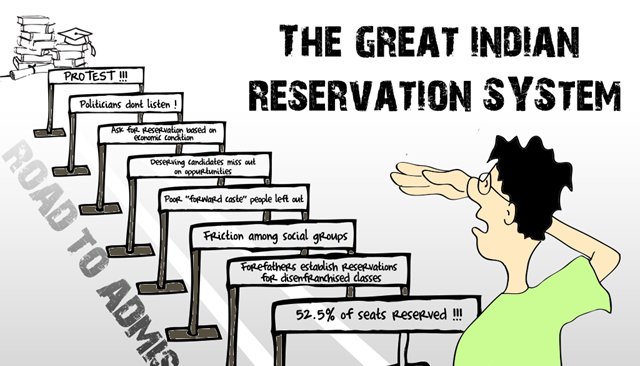
India is the world’s largest democracy, yet in spite of this, it has been subjected to a hoard of controversies owing to the caste system. The caste system which is prevalent to date has been a fundamental part of Indian culture for time immemorial. This system led to the subjugation of the “lower castes” by the “higher castes.” Thus to improve the situation of the lower castes, the Government of India introduced caste based reservation in governmental jobs and educational institutions. But the question remains whether this has been beneficial or if it has led to further enhancement of the differences? Or whether the income/economic-based reservation scheme is a better option?


History of Caste Based Reservation in India

The first written text which talks about the caste based system or “dharma of the four social classes” in its entirety is the Manusmriti. It says that every individual’s job was fixed by their birth.

In modern India, some of the notable instances are from when in 1933, the then Prime Minister of Britain, Ramsay MacDonald established the Communal Award. A separate representation awarded to Muslims, Sikhs, Indian Christians, Anglo-Indians and Europeans. This award was strongly opposed by Mahatma Gandhi who fasted unto death to express his displeasure. However, it received immense support from the likes of B. R. Ambedkar. After several negotiations, Gandhi called off his fast and the Poona Pact was a result of these negotiations.

However, this wasn’t the first instance where the demands for “special status” were made by the minorities. Incidents date back to as early as 1891 when in the Princely State of Travancore there was a demand for caste based reservation in government jobs. The first official instance was in 1902 in Kolhapur were 50% reservation was provided for in services for backwards classes/communities (BCs).

Post-independence the most significant step was taken in 1979 when the Mandal Commission was formed. It was headed by Indian parliamentarian Bindheshwari Prasad Mandal to consider the question of seat reservations and quotas for people to redress caste discrimination, and used eleven social, economic, and educational indicators to determine “backwardness.” In 1980, the commission’s report affirmed the affirmative action practice under Indian law whereby members of lower castes (known as Other Backward Classes and Scheduled Castes and Tribes) were given exclusive access to a certain portion of government jobs and slots in public universities, and recommended changes to these quotas, increasing them by 27% to 49.5%.

But today are these reservations actually being implemented as was envisioned by our policy makers? The answer is prima facie ‘NO’ because the benefits are being stolen away by the “creamy layer.”


The Reservations Against Reservation

In accordance with the 93rd Constitutional Amendment, the government is allowed to make special provisions for “advancement of any socially and educationally backward classes of citizens”, including their admission in aided or unaided private educational institutions. And it was proposed that this reservation policy should be gradually implemented in private institutions and companies. This move faced severe opposition from non-reserved category students, as it reduced seats for the General (non-reserved) category from the existing 77.5% to less than 50.5% (since members of OBCs are also allowed to contest in the General category).

Article 15(4) of our constitution empowers the government to make special provisions for advancement of backward classes. Similarly, Article 16 provides for equality of opportunity in matters of employment or appointment to any post under the State.

“Clause 2 of Article 16 lays down that no citizen on the grounds of religion, race, caste, sex, descent, place of birth, residence or any of them be discriminated in respect of any employment or office under the State.”

However, clause 4 of the same article provides for an exception by conferring a certain kind of power on the government:

“it empowers the state to make special provision for the reservation of appointments of posts in favour of any backward class of citizens which in the opinion of the state are not adequately represented in the services.”

In a case Balaji v/s State of Mysore[1]  it was held that ‘caste of a person cannot be the sole criteria for ascertaining whether a particular caste is backward or not. Determinants such as poverty, occupation, place of habitation may all be relevant factors to be taken into consideration. The court further held that it does not mean that if once a caste is considered to be backward it will continue to be backward for all other times. The government should review the test and if a class reaches the state of progress where the reservation is not necessary it should delete that class from the list of backward classes.’

Thus, the underlying premise of the philosophy of reservation that all members of the “backward classes” are disadvantaged, while all members of “forward castes” are deemed to be good enough to get admission under their own steam is in my opinion, not a valid assumption; neither is it fair. Economic considerations cannot be ignored when arriving at who needs extra care in and by our society.

What is ironical is that even though our constitution is reservation friendly, nowhere in a bare reading of the Constitution is the term ‘backward classes’ explicitly defined. What determines the backwardness or constitutes backwardness are still unanswered and only with the help of certain judicial pronouncements have they been given some meaning.

So the question arises, how can there be reservation for something that is undefined?

In all honesty, It must be appreciated that affirmative actions are taken to ensure that a level playing field is created for the under-privileged sections of our country. The issue is how for over the past 30 years nearly every government – no matter how “secular” they claim to be – has been trying to turn this socio-economic issue into an issue of dirty vote bank politics, communalism and a matter of pride.

The result: In individual states such as Tamil Nadu or within the north-east, where backward populations predominate, over 80% of government jobs are set aside in quotas, despite a Supreme Court ruling that 50% ought to be the maximum.[2]

Furthermore, the reservation policy is applicable only to higher institutions. Thus it does nothing to promote education at the primary level. Millions of children will still be denied access to even basic schooling- and it is this lack of primary schooling that often denies access to future education and employment opportunities.

Kapil Sibal erred even more than his successor in the present government, when as Human Resources Development minister he ordained 25% reservation (free seats) in private schools. Teachers of such schools are finding it impossible to bring such children on par with other bright children despite their best efforts.

Also, a sense of complacency has been instilled in students by the abolition of final exams as a criterion for being promoted up to class 10, after which they are left to the mercy of uninterested and grossly underpaid evaluators.

This is not to suggest that children from the poorer strata of society or from backward classes should be condemned to mediocrity or illiteracy. Instead, the answer lies in upgrading the education provided in government institutions. This would call for painstaking efforts in the appointment of teachers and a better pay scale which is at par with those of their private counterparts. Also analysing the American model of education would not be a bad idea, where 87% of children from kindergarten to grade 12 attend public schools[3]. Sadly in our country, the idea of private schools has somehow acquired elitist connotations.

To quote an example, the decision of IIT Roorkee to expel 73 students with poor performance was an eye-opener to the condition of many kids who make the near impossible entry into the IIT campuses. A report by The Indian Express[4] suggested that 90% of the expelled students were from SCs, STs and OBCs.  Another instance that could be stated is of the “alleged suicide” of a Dalit student at IIT Mumbai last year which gives us a glimpse into the suffering of backward caste students in institutions such as IITs. His performance had been poor, he had uncleared papers and was subject to taunts by general category students and shockingly a faculty member too. Reporting this case, DNA said that about 56% of students under reserved category felt discriminated against. Moreover, 60% of them also felt more pressured by academics than the general category students. There is a growing concern, the government might be trying to ensure a level playing a field, but it is failing- and miserably so- to ensure that they benefit from it. There are about 50% seats reserved for them, but if most of them fall through the cracks- as the above instances show- it serves no purpose.

Further, now being included in the list of backward classes/SCs/STs is now being viewed as a “status symbol,” the recent Jat agitation serves as the best example. This demand- by a group considered a “dominant caste” in the Northern part of our country- to be treated as a backward caste, put lives of many in jeopardy and affected livelihoods of people in three states. So the question is for how long can the demand for “privileges” as a “backward” class be maintained at the expense of a majority of the population.


THE OTHER ALTERNATIVE

Caste based reservation policy fails to recognize social backwardness as a fluid and evolving category. Gender, culture, purchasing power and so on could also influence capabilities, and any one of these, or a combination of these, could be the cause of deprivation and social backwardness. With increasing globalization and urbanization, caste loyalties are weakening and hence, new parameters to define social backwardness need to be identified. Reservation should explicitly include economic criteria. A rich person (irrespective of caste) can access and afford education for his/her children and does not need the protection offered by the reservation policy. Because in today’s world the correlation between the economically backward and the lower caste may not be as strong as it was earlier.  It is the poor who need such protection- irrespective of their caste. Rather than debate about what constitutes the “creamy layer” and how it is to be defined, everyone should be given an equal opportunity to prove their worth. No section of society should be spoon fed. Instead, they should be provided with adequate resources, and at the end of the day, merit should prevail.


LawSikho has created a telegram group for exchanging legal knowledge, referrals and various opportunities. You can click on this link and join:  

https://t.me/joinchat/J_0YrBa4IBSHdpuTfQO_sA

Follow us on Instagram and subscribe to our YouTube channel for more amazing legal content 


References –

[1] (AIR 1963 SC649)

[2] http://www.economist.com/blogs/banyan/2013/06/affirmative-action

[3] https://en.wikipedia.org/wiki/Education_in_the_United_States

[4] http://www.firstpost.com/india/90-percent-of-iit-roorkee-dropouts-are-backward-caste-a-case-against-affirmative-action-2379964.html

Download Now

Importance of ITAT or Income Tax Appellate Tribunal

0
role and importance of ITAT

ABSTRACT:

With the emergence of the concept of tribunalization in India along with the sowing the seeds of Appellate Tribunal, its highly appreciated that the workings and success of ITAT or Income Tax Appellate Tribunal has boosted the morale of the Government to establish other similar tribunal. This article focuses on the role and importance of ITAT along with its powers and function with some decided case laws and finally the admirable experience of some of the retired members of ITAT.

Role and importance of ITAT

On the historical premise the concept of ‘tax’ was brought by the Act of 1860. At this time the panchayat had the authority to make the assessment and if any person was aggrieved by the decision of the panchayat then an appeal can be made to the collector of the district whose decision was binding and final. Replacing the Act of 1860, the Act of 1868 made certain changes.

Firstly, regarding the petition of objections made to the Collector and Secondly, an appeal from the order of the Collector to the Commissioner of Revenue of the Division whose decision was binding and final. It is to note that no reference was available to the High Court under the act and also the same position was followed under the succeeding acts of 1869, 1870, 1872, 1886, 1916 and 1917.

The Income Tax Act in its modern form, was introduced which legislated advisory jurisdiction to the High Courts. The Act was rebuild in 1922 but did not introduce any changes in the adjudicatory structure. As the civil courts were prohibited from entertaining litigation in taxation matters, an urgent and critical demand was fixated on establishing an independent forum for redressal of the aggrieved under the Income Tax Act. The establishment of a tribunal as an independent appellate authority was possible when the Select Committee was appointed, in November 1938, to consider the amendments to the Indian Income Tax Act, 1922.

As a result with onward tribunalization in India, the Income Tax Appellate Tribunal or ITAT was constituted on 25th January 1941, by virtue of section 5A of the Income Tax Act, 1922. Since its establishment, ITAT has been working very hard except for vital changes due to its expansion and extension of its jurisdiction. There have been no significant changes either in the constitution or in the functioning of the tribunal in the Income Tax Act, 1961.The motto of Income Tax Appellate Tribunal ‘Nishpaksh Sulabh Satvar Nyay‘ basically means impartial, easy and speedy justice.

The most essential quality of ITAT is imparting justice to the litigants by an inexpensive, forum free from technicalities and its expert knowledge on the subject of Direct Taxes. It is noteworthy that the success and achievement of ITAT has motivated the Government of India to constitute similar Appellate Tribunals for indirect taxes i.e. Central Administrative Tribunal, Railway Claims Tribunal, Foreign Exchange Appellate Board, etc.

Over the years, ITAT has earned accolades, as its Members have adorned high positions in the judiciary and other equally important institutions. The first President of the Tribunal Mr. Mohammed Munir Dar, was elevated to the Hon’ble Lahore High Court and later as the Chief Justice of the Pakistan Supreme Court. The second President of the ITAT Shri Khan Bahadur Yahya was also elevated as Judge of the Hon’ble Madras High Court. Hon’ble Justice Ranganathan of the Supreme Court of India was Vice President of the Tribunal. Hon’ble Justice Fathima Biwi later Governor of Kerala was Member of the ITAT. Till now, almost 32 erstwhile Members/Vice Presidents and Presidents of ITAT have been elevated to various High Courts including two to the Supreme Court[1].

One can appreciate the workings of the ITAT from speeches delivered by the Law Minister in the Parliament, various Chief Justices, Former Presidents of India and Other Dignitaries from the 115th report of the Law Commission. For the purpose of ensuring highest degree of independence of the ITAT, it functions under the Department of Legal Affairs in the Ministry of Law and Justice, and is kept away from any kind of control by the Ministry of Finance.

The appeals before the Income Tax Appellate Tribunal are generally heard by a division bench – consisting of one judicial member and one accountant member. In cases involving assessed income of less than 15 lakh, any one member, though it is required that a work experience of minimum five years in the tribunal is must, can decide the appeals in a single member bench as well. However, the monetary limit for deciding an appeal by a single member bench of ITAT has been enhanced from 15 lakh to 50 lakh in 2016 Union budget of India[2].

In case of conflict of opinions by the division benches on the issues involved in an appeal, the appeals are sometimes heard by the special benches consisting of three or more members – at least one of which must be a judicial member and at least one of which must be an accountant member.

POWERS AND FUNCTIONS:

The Income Tax Tribunal Rules, 1963 provides vivid powers and functions to the tribunal to deal with the income tax cases as well as it is aimed at providing justice to the aggrieved party from the decision of the Commissioner of Income Tax. The act and rules provides the method of filling, time limit, disposal of the appeal, procedure for conducting the appeal and powers of the tribunal.

  1. Power to Restore an Ex-parte order:

Rule 24 of the Income-Tax (Appellate Tribunal) Rules, provides that where in case the appellate fails to appear in the tribunal on the day decided for hearing the appeal in person or through an authorized representative, the tribunal may dispose of the appeal on merits after hearing the respondent provided that when the appellant furnishes ‘sufficient cause’ for his non-appearance on the so day decided the tribunal on being satisfied on its truth may make an order setting aside the ex-parte order and restoring the appeal.

Case Law: In Devendra G. Pasale V. Assistant Commissioner of Income Tax, 2010[3]

The Gujrat High Court held that it is quite obvious that the tribunal, instead of examining the issue as to whether there was a sufficient cause for non-appearance of the appellant on the day of hearing has disagreed and taken into consideration other irrelevant factors. It also appears that the tribunal has failed to acknowledge the averments made in the application, since the aforesaid finding recorded by the tribunal is contrary to law.

  1. Power to Restore Appeal:

Case Law: In Nawal Kishore and Sons Jewelers V. Asst. Commissioner of Income Tax, 2011[4]

The Tribunal dismissed the appeal on the ground of non-prosecution. The situation is due to the boycott of the Tribunal by Chartered Accountants and Advocates.

The Tribunal held that whatever may be the punishment given to the striking professionals the litigants should not suffer because of such strike and the ex-parte order should recalled. The appeal was not decided on the merits for the default of the assesse. Section 254(1) of Income Tax Act, 1961 provides that the Tribunal may, after giving both parties to the appeal, an opportunity of being heard, pass such orders as it thinks fit.

The Tribunal under Section 254(2) can recall its order in entirety if it is satisfied that prejudice has resulted to the party which is due to the Tribunal’s error or mistake and which error is manifest error and it has nothing to do with the doctrine or concept of inherent power. The Tribunal set aside the ex-parte order and restored the appeal.

  1. Power of Remand:

Power of remand is an additional power to the power of an appellate authority for obtaining all relevant information for a fair conclusion. However, this power shall not be exercised as a routine matter.

Case law: In Commissioner of Income Tax V. Mira S. Khurana, 2010[5]

The High Court held that the findings of the Tribunal are not borne out of from the orders of the subordinate authority. The Tribunal has failed to appreciate that the Assessing Officer had granted opportunity to the assesse to prove the genuineness of the gift and credit worthiness of the donor but the assesse failed to adduce any proof in this regard. The onus thus could not have been shifted by the subordinate authorities. The Tribunal is duty bound to consider the reasons given by the appellate authority for its decision before upsetting the order made by the appellate authority.   The impugned order remanding is vitiated in law. The High Court restored the case to the Tribunal to decide the case afresh in accordance with law after giving reasonable opportunities.

  1. Power to Admit New Plea:

Generally, a new plea is not admitted in appeal and the tribunal cannot entertain a new plea which has not been raised before the lower authorities.

Case Law: In Commissioner of Income tax V. Hindustan Tin Works Limited, 2009[6]

The High Court rejected the plea of Revenue in so far as the Tribunal did not permit the Revenue to take up an additional ground pertaining to Sec. 14A of the Act. The Court is of the view that the Tribunal has put the matter in correct perspective while rejecting the plea of the Revenue. It is noticed upon a perusal of both the assessment order as well as the order of the Commissioner of Income Tax (Appeals) that no such plea was taken before two authorities. Nothing has also been indicated in the appeal which would lead the court to believe that there was material which could have been looked into had the Tribunal permitted the Revenue to take up the said additional ground pertaining to Sec. 14 of the Act. The Tribunal rightly rejected the plea.

  1. Power of Review:

Case Law: In K.K. Ravindran V. Income Tax Appellate Tribunal and another, 2010[7]

The appellant assailed the order of the Tribunal in exercise of its power under Sec. 254(2).  Against the order of assessment which was confirmed by the First Appellate Authority, the petitioner preferred an appeal before the Tribunal. The Tribunal partly allowed the appeal. The Department filed a review petition on the ground that the addition of Rs.17,17,205/- on account of unexplained house property by the assesse is mistake apparent on the record for which the finding of the Tribunal is to be set aside. The Tribunal set aside the order passed in appeal with a direction to hear the appeal afresh on merits in due course.

  1. Power of Rectification:

It is held by the Supreme Court that the power of rectification has been conferred on the tribunal to see that no biasness is caused to either of the parties appearing from the record and that the amends made to the wronged party by the court or the tribunal for the wrong committed by it has nothing to do with the concept of inherent power to review.

  1. Power to Recall Its Order:

Case Law: In Honda Siel Power Products Limited V. Commissioner of Income Tax, 2007[8]

The Supreme Court held that the Tribunal in certain circumstances can recall its own order and Section 254(2) does not totally prohibited so. Power to recall an order is prescribed in terms of Rule 24 of the Income Tax (Appellate Tribunal) Rules, 1963 and that too only in cases where the assesse shows that it had a reasonable cause for being absent at a time when the appeal was taken up and decides ex-parte.

CONCLUSION:

There is no doubt about the fact that the workings of the Income Tax Appellate Tribunal or ITAT has immensely contributed towards the development of other Appellate Tribunals. In the words of Shri Beni Sankar Prasad, ITAT in the income tax administration is an ‘oasis’. The Former Law Minister Late Shri. H. R. Ghokale said in the parliament that ‘All the tribunals in the country should be modelled on the model of ITAT, as it is a model tribunal delivering equitable justice expeditiously’. The constitutional law expert, author of Income-Tax and Former ambassador to the USA, Late Shri. Nani A. Palkhivala said with reference to ITAT, that ‘If a decision even on intricate questions of law is adverse to me, I will not bat an eyelid to accept the judgment In Toto and will not advise my client to file a Reference Application (RA) in the High Court.’

The glory of ITAT can be appreciated from the fact that many of its members were elevated as judges in various High Court. Some of them became the judges of the Supreme Court of India and others the Chief Justices of High Court.

It is quite commendable to note though 60% of the decision of the ITAT are adverse to the revenue, however the revenue has no grouse because each decision showed where the revenue went wrong, either in interpretation of law or findings of acts.

REFFERENCES:
  1. http://itat.nic.in/ (Last visited on 24th May)
  2. http://itatonline.org/archives/main/ (Last visited on 24th May)
  3. https://www.taxmanagementindia.com/visitor/detail_case_laws.asp?ID=2224 (Last visited on 24th May)
  4. http://www.itatonline.in:8080/itat/site/AboutITAT.htm (Last visited on 24th May)
  5. http://itat.nic.in/ Articles Speeches and Lectures (Last visited on 24th May)

[1] http://itat.nic.in/ (Income Tax Appellate Tribunal – Last Visited on 24th May, 2015)

[2] Budget 2016: Highlights of FM Arun Jaitley’s speech”, The Economic

[3] TMI 256 – Gujarat High Court

[4] ITR 659 (Lucknow)

[5] TMI 745 – Gujarat High Court

[6]  TMI 481 – Delhi High Court

[7] TMI 564 – Orissa High Court

[8] TMI 8 – Supreme Court of India

Download Now
logo
FREE & ONLINE 3-Day Bootcamp (LIVE only) on

How Can Experienced Professionals Become Independent Directors

calender
28th, 29th Mar, 2026, 2 - 5pm (IST) &
30th Mar, 2026, 7 - 10pm (IST).
Bootcamp starting in
Days
HRS
MIN
SEC
Abhyuday AgarwalCOO & CO-Founder, LawSikho

Register now

Abhyuday AgarwalCOO & CO-Founder, LawSikho