Download Now
Home Blog Page 1794

Ease Of Doing Business in India — Online Filing Of CST, VAT and Commercial Taxes

0

desk-603026_1280

This article is written by Dhruv Dikshit, a student of LC-II, Delhi University

The World Bank Group has created an index to statistically analyse which country has reforms and regulatory measures favourable for entrepreneurial ventures. The index analyses in a mutually inclusive manner 11 different parameters of all the countries to determine the demographic advantage and dividend. A Higher rank on the index or a lower numerical value implies that the said country has a better state of affairs than others and that the procedure that a person needs to follow is streamlined and defined. Furthermore, the ease of doing business is directly proportional to the economic growth of the country. India holds an abysmal rank in the aforesaid index. In 2014 its rank was 140 and in 2015 it became 142 out of 189 countries overall and is the second worst performing country in South Asia, which speaks volumes about the orders of magnitude of difficulty an organisation has to face if they want to expand or set up their business in India.

On the other hand the edge that India still has is its demographic advantage. The country’s present day situation amidst a humungous market of 1.25 billion people is that more than half of them are below the age of 27 which adds tremendous man power that the county can has in its arsenal and the said advantage will continue to draw big companies to expand and invest here, regardless of the extent of difficulties they will have to face as that is a trade-off they are willing to make.

Despite the fact that India is a big market, it is not even remotely homogenous in terms of the regulatory measures and the procedures one has to follow to establish a venture. Each and every state in India has its own rules imposed on land purchase, dealing with construction permits, getting electricity, paying taxes, trading across borders, etc.

But the World Bank ranking provides no information and analysis as to which state has the friendliest regulations. The ease of doing business takes into account only Delhi and Mumbai and considering the diversity that the country propounds, two states are not sufficient to draw conclusions. To rectify this lacuna, the Department of Industrial Policy and Promotions under the Ministry of Commerce and Industry has released it first ever conclusive analytical and reformative report of all 29 states with respect to the ease of doing business. It propounds a 98 point action plan to uplift the status of the various states. The ranks are contingent on progress made in terms of reformation of business regulations comprising of eight different parameters, including tax and employment. Gujarat tops the list and further legitimizes its business friendliness. Uttar Pradesh, which is inhabited by 200 million people, is ranked tenth. Bihar, a state where approximately 104 million people are going to cast their vote in its upcoming October elections, is ranked deplorably at the 21st position.

The role of the report is twofold. Primarily, the objective of the action plan was to lay down a series of recommendations aimed at increasing transparency and improving efficiency and effectiveness government’s regulatory functions and services for business in India. Secondly, it induces a psychological paranoia amongst the low ranking states to push them towards progress. As and when evidence regarding stagnation surfaces into the public sphere, the public opinion about the states will be radically altered which coerces them to act quickly and efficiently to counter the negative effect. Furthermore, the top ranking states can use the report’s conclusion to further strengthen their argument to avail Foreign Direct Investment.

The report expounds “various process streamlining and technology interventions have been undertaken in the areas of commercial taxes (time-bound VAT/ CST registrations, online mechanisms for payments and returns of various taxes etc.), labour (self-certification mechanisms for integrated returns and inspections, development of online labour management systems etc.) and environment (exemption of a number of green industries from approvals/ consents, implementation of consent management systems etc.)”.

To further accelerate the growth of a conducive environment for start-ups and expansions, the government has relaxed the process by establishing an online VAT registration system and replacing the physical stamp previously required with an online version. Furthermore, the aforesaid report argues that that by 2020, India’s population will be close to 1.35 billion and out that 906 million people eligible to work and will be ready to add on to the productivity of the country. These 906 million people will require jobs which are going to be difficult to generate unless the manufacturing sector in India gets a kick-start. That will indubitably lead to the creation of a plethora of job opportunities thereby, moving towards a self-sustaining growth for the country. To accomplish this, in December 2014, a workshop was held called “Make in India” which demarcated the goals to improve the economy.

To further incentivize entrepreneurs and venture capitalists, the government has made certain critical procedures of registering tax and filing for tax returns online thereby, reducing the time and energy spent on those procedures drastically and increasing efficiency simultaneously. The September 2015 report of World Bank of Ease of Doing Business revealed that: “29 States have allowed VAT to be paid online, and 28 States have allowed CST to be paid online. 30 States allowed e-filing of VAT, 27 States allowed e-filing of CST. 21 States have established helplines for users. 25 States have defined timelines for VAT registration, and 21 have defined timelines for CST registration.”

State wise website links for e-filing of VAT and CST

The following are the details for the various states’ online services regarding registration and filing of returns with respect to Value Added Tax (VAT) and Central Sales Tax (CST):-

                                STATE

 For e-registering and e-filing of VAT and CST
ANDHRA PRADESH https://www.apct.gov.in/apportal/
ARUNACHAL PRADESH http://web4.kar.nic.in/arunachalereg/RegistrationOptions.aspx
ASSAM http://103.8.248.130/AssamTimsInfo/index.html
BIHAR https://www.biharcommercialtax.gov.in/bweb/rightMenu.do
CHATTISGARH http://cgweb.nic.in/eServices/#
GOA https://egov.goa.nic.in/comtax/
GUJARAT http://commercialtax.gujarat.gov.in/vatwebsite/home/home.jsp
HARYANA https://haryanatax.gov.in/HEXWAR/createUserGet.html
HIMACHAL PRADESH https://hptax.gov.in/HPPortal/main.htm?actionCode=showERegTaxSelectPage
JAMMU AND KASJHMIR https://jkcomtax.gov.in/JKPortal/login.htm?actionCode=newLoginPage
JHARKAND https://eseva.jharkhandcomtax.gov.in/Portal/
KARNATAKA http://164.100.80.100/vat3/
KERALA http://comtax.kerala.gov.in/wdi/iCOMITRAX/login.jsp
MADHYA PRADESH https://mptax.mp.gov.in/mpvatweb/
MAHARASTRA http://www.mahavat.gov.in/Mahavat/index.jsp
MANIPUR http://manipurvat.gov.in/
MEGHALAYA https://meghalayaonline.gov.in/e_registration/index.htm
MIZORAM http://zotax.nic.in/
NAGALAND http://taxsoft-ngl.nic.in/nagalandereg/RegistrationOptions.aspx
ODISHA https://odishatax.gov.in/Portal/Login/Login.aspx?Mode=EC25A557BABA77DD40C4E960875E3693743FF5E40C80D5459F54E37661BEB514
PUNJAB http://115.248.24.91:9093/Return_System/FormDownLoad2.aspx
RAJASTHAN http://rajtax.gov.in/vatweb/eServices/eServeMain.jsp?viewPageNo=70
SIKKIM http://www.sikkimtax.gov.in/
TAMIL NADU http://www.tnvat.gov.in/indexnew.aspx
TELENGANA https://www.tgct.gov.in/tgportal/
TRIPURA http://web4.kar.nic.in/tripuraereg/RegistrationOptions.aspx
UTTAR PRADESH http://comtax.up.nic.in/main.htm
UTTARAKHAND https://comtaxappl.uk.gov.in
WEST BENGAL http://egov.wbcomtax.gov.in/eRegistration/

The shift from a physical mode of registration to an online mode has made it significantly easier for new start-ups to list their organisation with the government and avail benefits.

The objective of the aforesaid digital initiative is to actively make use of the existing and emerging technological innovations such as cloud computing and implement them to rectify the lacunas and inconsistencies present in the government’s regulatory measures and transform the government into a lean and efficient machine so that the country can in turn improve its economy and eventually, the standard of living.

Download Now

How First Year Law Students At UPES Started Jagriti, A Social Initiative In Dehradun

0
How First Year Law Students At UPES Started Jagriti, A Social Initiative In Dehradun

This was originally published in A First Taste of Law.

How First Year Law Students At UPES Started Jagriti, A Social Initiative In Dehradun

We all can contribute in our own ways. However, a few of us take action and most people don’t. We wait for other people to get us a chance. This Christmas, pick yourself. Don’t wait for your turn. Sow seeds right away to do great things, to make the world a little better, to become a better person and to go the extra mile to achieve all the potentials you have. Here is Kunal Dey, who in his first year of college decided to do something meaningful and didn’t say “I am just a first year student, how can I do something awesome?” or “but I have projects to write and exams to prepare for – how will I find time?” Like most good things, he had the support his friends and batchmates, and they together are making some real difference.

So, over to Kunal because we want to know the whole story.

—————————————————–

“The darkest of places in hell are reserved for those who maintain their state of neutrality during the time of moral crisis”- Dan Brown.

The first year of Law School, especially the first semester, is a dream come true for any law aspirant who not only wants to make a mark but on the same hand wants to fulfill the obligations one has towards the society at large.

I had inculcated the need for serving the society by being a good lawyer and more than that, by becoming a good human being since I started teaching differently-abled and underprivileged children in an organization in my city called Hope Foundation. The few things that I got to learn while serving that special institution for two years is something which motivated me to start off an organization of my own someday.

U.P.E.S, Dehradun has a unique location; something which cannot be forgotten in a lifetime.

The mountains, rivers and mostly the calm atmosphere, makes it the perfect place to gain knowledge. After the Dhabas named as D1, D2, D3 etc based on their distances from the University, the most famous of all was “Zaid Bhaiyyas Juice Stall”. Zaid Rao, is a boy of 23 years, from the Dunga district of Dehradun. Due to financial difficulties he could not continue his education beyond Class VIII and that is something he always regretted. When I met him, the only thing that I could conclude after our conversation that he is the most humble and compassionate person I have ever met and more than that, I could feel his regret for not being able to complete his education. I came back to my hostel and it was then that my roommate, a Chemical engineering student, spoke about starting a group just like his classmates did. I grasped on that idea and put forward to him my motive of serving the society by establishing a group that would work on educating mostly middle-aged adults and underprivileged children.

Next was planning. I started off my work towards the formation of the group by drafting the Constitution for the group; I initially named the group as AW

AAZ.

As I was drafting the Constitution for this group I understood that this cannot be a one-man show and I need people with me if I would like to give myself any chance of making the slightest of difference to the present situation. I arranged up a meeting with all the interested people, mostly of my hostel and the nearby hostels so that it becomes easier for me to coordinate better and also to take quick action in cases of any difficulty. I explained to them my plan and the approach I would like to take. (A copy is annexed herewith, marked as Annexure A). They all agreed to it though certain amendments were required in the procedure and it was finally after the entire procedure was completed, we had a brainstorming session and we ended up naming the group as JAGRITI, to enlighten people with knowledge. The planning was up to the mark but what required was the execution of the plan and for that I needed someone who is influential and at the same time has a good resource base and that is when I approached my classmate and a very close friend, Gandharv Garg. We together decided to change the teaching procedure and make it more interactive like, besides the textbooks, we decided to carry out Personality Education classes and probably that was the best idea I could have ever got.

Every social group has to undergo struggle before it can emerge and the same happened with our group as well. Promotion of the group and spreading awareness to the people about the group was a major task but with the help of all my fellow group members it was finally accomplished. Problems started when there occurred a shortage of teachers for the children. The Sarpanch had given us permission to work within 8 km from the college campus and that included 4 villages, namely, Bidholi, Kandholi, Paundha, Nanda Ki Chowki. We did not have enough funds to pay the rent in the places we thought of teaching and also there was a dearth of enough teachers give adequate time to towards the group. Thus, our area of work automatically got restricted to only Bidholi and Upper Kandholi.

The first student of our group was Zaid Bhaiyya who was extremely happy for finally being able to start fulfilling his dream of studying once again.

We started teaching Zaid Bhaiyya`s brothers and for that we used to provide them with books (oxford dictionary Hindi to English, grammar books, story books, literature books, handwriting made easy books etc.) For reaching out to the people of these two villages we created an outreach department in our group who used to visit these two villages and inform people about the group working their area. We motivated even the adults to join and come along with their kids but one does not always get what he wants and there is always some other story involved. After few days of work I started receiving information from our group members that there is extremely low turn-up of female students and the main reason for it being we were a group involving only boys and thus their parents were not considering our group to be safe. I respected their concern and immediately formed another department consisting only of female teachers who were my classmates and batchmates and started off a new Saturday and Sunday session exclusively for girls but that was not all as again another issue of permission and legitimacy of our affairs came up. We dealt with that as well. When I was in second semester of my law school, I got a call from the Head of the Directorate of Student Affairs, U.P.E.S who wanted my group to come under the umbrella of the U.P.E.S social group “Social Soldiers”. I disagreed and refused to come under the umbrella and probably that made all the difference. I wanted to keep my group independent but in due course of time we again faced challenges with regard to finances and permission. The group members started losing their patience and after a point of time almost everyone parted their ways from the group.

I thought of ending the group and the same was communicated to all the families who were still interested or had faith in us.

It was a difficult decision and it was truly heartbreaking. When I went to inform Zaid Bhaiyya about the problems that we were facing and the decision that we have taken, his eyes became moist and in his eyes I could again see that regret coming back and he said to me, “You taught me to read and write once again, I don`t feel that I am an illiterate anymore, I don’t want anything from you but keep this group alive for those who need it.” This statement gave me a new hope altogether and I decided to keep my group alive for those who needs it and wants it and for doing that I am ready to face all the difficulties that comes my way.

It has been a year now since the formation of Jagriti and I am proud to say that even though we are not a big social group operating in Dehradun, but we are a group who works for the people in need and we make people happy.

Every human being needs to understand his or her responsibility towards the people in need and do their part of duty being a citizen of this Nation. The day everyone will realize that, surely we will have a better India.

———————————

More about Jagriti

JAGRITI

JAGRITIis a non-profit organization which has been formed with the help of the students in the fresher’s batch of UPES 2013. It aims at teaching under-privileged children and those middle-aged adults who have started working at an early age and have not received the opportunity to study in spite of possessing the urge to learn. JAGRITI aims at recognizing such unfulfilled urges and desires and provide them with a platform where they can fulfill their dreams of being an educated human being.

MEMBERS

The organization consists of a committee of Core members who mainly reside in the Bidholi area hostels as it is thought to provide ease in coordinating and bring flexibility in the Management procedure. The list of Core Committee members are as follows:

Kunal Dey
BBA.LLB (2013-18)

Avalon Greens Boys Hostel

Mob: 7830945562

Email: [email protected]

Gandharv Garg
BBA.LLB (2013-18)

DUAA`S BOYS HOSTEL

Mob: 8954596568

Abhinav Gera
C.S. TELECOM INFOMATICS (2013-17)

AVALON GREENS BOYS HOSTEL

Mob: 9456226008

E-mail:[email protected]

Samarth Singh
Chemical Engineering

Avalon Green Boys Hostel

Mob: 9536064579

E-mail: [email protected]

Akshay Singh Siwach
BBA.LLB (2013-18)

UPES Campus Hostel

Mob: 9811744076

MANAGEMENT

The Management of the group is divided into 5 Departments namely:

  • The Finance Department
  • The Planning Department
  • Food and Health Department
  • Education Department
  • Transportation Department
  • The Finance Department
    The Finance Department will be headed by Kunal Dey and Akshay Singh Siwach

The Core Members along with the other members of the Organization will be contributing to the Fund of the group. The amount of contributionby every single person will be noted down along with their phone numbers; e-mail id and a receipt of their money being utilized for a specific purpose will be sent to their respective e-mail id or will be texted to them on their mobile phone numbers.

Vision

1) Optimum utilization of resources

2) Opening a Bank Account

3) Utilizing a portion of the funds towards donations to orphanages and old age homes.

The Planning Department
All the Core Committee members will collectively manage the Planning Department. All the modifications in the organization plan will be notified to each and every member and their opinion will also be taken into consideration while taking any decision regarding the group.

The Food and Health Department
The Food Department will be managed by Gandharv Garg. Our aim is to provide nutritious and healthy food to the children. Home cooked food shall also be provided once in a month with the help of our friends who are localites of Dehradun.

The Health Department will be managed by Kunal Dey and our aim is to provide Basic First Aid to the children and adults in cases of emergency.

Education Department
The Education Department will be managed by Abhinav Gera, Gandharv Garg and Samarth Singh. We aim at providing education in an interactive manner like it was conducted in the Personality Education Program classes in the UPES. The subjectswhich are going to be taught in the order of necessity and importance are:

English
Computer
Mathematics
History/ General Knowledge
More subjects are going to be added on taking into consideration the degree of progress of the children and adults.

Books will be purchased as per the needs and stationary will be also be provided.

Reason behind formation of JAGRITI

Each and every human being deserves a chance to get educated and achieve their goals in their life. Each and every member of our group believes in the concept that KNOWLEDGE IS WEALTH. If a person is educated he can achieve whatever he or she wants to in their lives. Basic education is necessary for the survival and self-sufficiency of every human being. In a country like India where poverty is such a big issue, efforts are bound to be taken to educate the mass because a country can only develop when its mass is educated and people possess the power to distinguish between what is right and what is wrong and as claimed by Mr. Arvind Kejriwal, to develop India one must develop the rural India. With this view and motive all our members decided to form into this group and make an effort to change the present scenario.

WHERE THE GROUP WILL OPERATE

With the permission from the Gram Sarpanch we have been allotted the Bhartiya Sarva Shiksha Abhiyan School located near the Doon Public School. Classes will be held on Saturdays and Sundays from 1 pm to 3 pm (timing is subjected to change as per the preference of the children and their parents)

HELP EXPECTED FROM UPES

Official recognition of the Group.
Permission to spread awareness about the group in the University.
Permission to organize workshops and presentations on topics related to the group.
Permission to use the UPES Medical Facilities in case of any emergency.
Permission to recruit members from the University by setting up Registration Benches.

Download Now

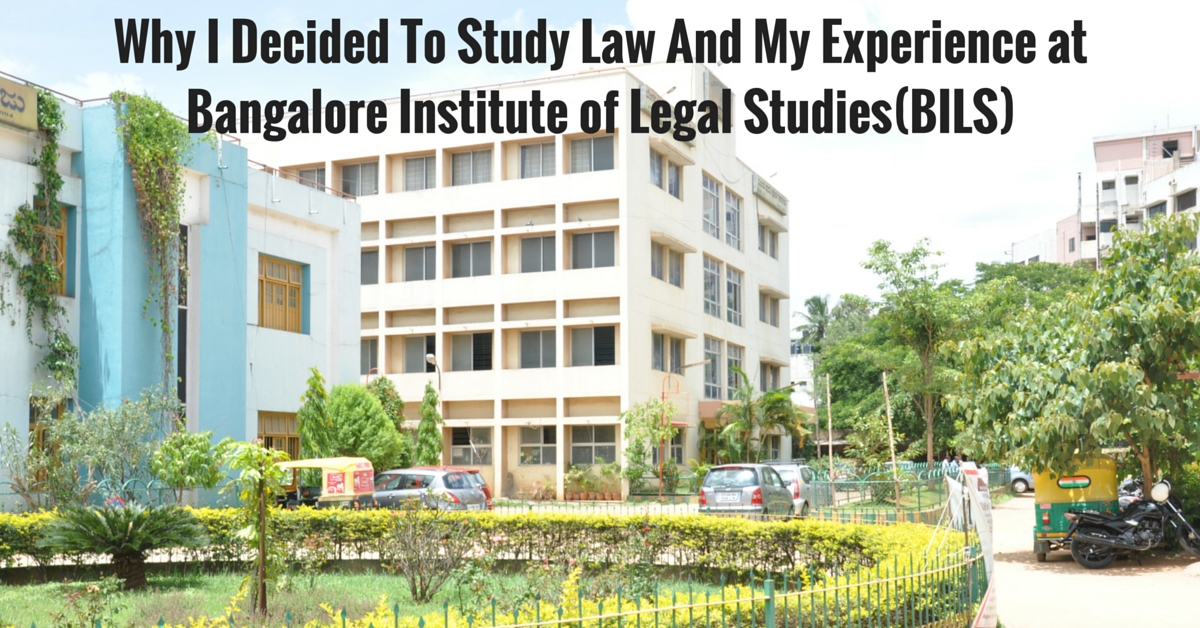
My Experience at Bangalore Institute of Legal Studies (BILS)

0
Why I Decided To Study Law And My Experience at Bangalore Institute of Legal Studies(BILS)

This article was originally published in A First Taste of Law.

I am Vaishnavi Shukla, pursuing 4th yr. LLB at Bangalore Institute of Legal Studies, Bangalore. Before starting on why I decided to study law, it would be more appropriate to give you an insight into my journey from Andhra Pradesh to BILS, which I cherish now. Being a student of commerce (emphasis to be laid on the fact that I hated science) I had always decided that I will never do something too mainstream, for instance, “Engineering”. As I took up Commerce after my 10th grade, there vanished the chances of becoming a doctor (though there are undisputedly plenty of other options available). I had strongly decided for myself that I would not opt to do something which every friend or relative of mine was doing, I find no substantial output in the ‘n’ number of Engineers and Doctors that are being produced by our country while there are plenty of other Professional courses and options available to explore, naming one, “Law”.

Why I Decided To Study Law And My Experience at Bangalore Institute of Legal Studies(BILS)

Then came, my turning point in the 11th grade which made me very clear in my head and heart that LAW is my dream and I will chase it.

As Mahatma Gandhi had once quoted: –

“If I have the belief that I can do it, I shall surely acquire the capacity to do it even if I may not have it at the beginning”.

This quote inspired me even more. My good grades in accounts and economics, made my parents and teachers believe that I should take up Chartered Accountancy (CA) and I was enrolled to take up CPT classes after my college hours, for which I was least interested. But what urged me to pack my bags after college each day and attend the CPT classes was nothing but the subject of “Law”, which was one of the departments of study in my CPT course.

I recognized that it was this subject and department amongst all other which would urge me from within to come and sit in the very first bench every day and listen to every single lecture attentively and passionately. I concentrated more on Law rather than CPT.

This interest was further boosted by my uncle, who himself is a criminal lawyer in the Andhra Pradesh High court. His professionalism and command over Law always made me look up to him as the ultimate source of inspiration. The black and white legal attire surely brings an immense sense of respect and responsibility and pride. He has been a constant support and a major reason for the decision. As Jonathan Hirst QC says:

“In my view, pupils who have done an undergraduate Law degree start with a very considerable advantage over those who have tried to cram in everything in less than a year. A Law degree allows a student to gain a broader and more mature understanding of the subject”.

A law degree surely is an advantage for those who have it over those who don’t.

I wanted to deepen my interest in this field of study and gain a broader understanding of the subject as I had only a little knowledge of it from the classes I attended.

A Law degree provides multiple career options for a student. This is a booster and unlike other professional studies, it gives the skills to not only be a successful lawyer, but also a politician, manager, journalist, police officer, successful producer or almost any other profession that requires intellectual strength combined with a practical approach to the world. One degree several advantages- then why not?

Studying Law gives the chance to deepen our experiences across the full range of Social sciences, sharpen our minds, & strengthen our understanding.

One acquires both breadths of understanding and depth in the areas of interest.

I was aware that the Law is a dry subject and there is no support of practical examinations to boost up scores, yet I took my interest further and started to learn more and more about Law as a career opportunity and with the exciting opportunities in numerous fields with one Law degree makes this course more distinct, challenging and exciting. In the recent times, more and more students are coming forward and taking up the profession as the Law has widened its scope both opportunities wise and monetarily. The monetary benefits do attract one, but it is not the sole reason to enter this area of studies. With the widening of the scope of the law, it is attracting more students like me to explore it and secure a degree.

The studies on humanities and social sciences over the law school years enables one to develop a sense of responsibility towards the society, also, my intolerance against the injustice that happens around me and the strong sense of rebellious attitude against something which I think around me is unjust and unlawful, encouraged me to take up law, as it is that profession where “in a gentle way, you can shake the world”, as quoted by Mahatma Gandhi.

There is an urgent need to curb the anti-social elements prevailing in the society and make it a better place to live in and this can happen when we Individuals, raise our voices against the injustice and crimes. The law degree provides a better platform to voice against the crimes and several such voices together does and will make a difference, sooner or later. Without using arms or violation, just by the power of words, in a gentle way lawyers can shake the world.

Also, robots can be taught the basics but law students develop an affinity for the subject by being exposed to different writers, critics, disciplines, arguments. [1]

These were the reasons why I decided to take up law, and there began my journey to pursue law and with it came multiple questions which every student aiming to pursue law goes through in his mind, namely:-

  • Which institution would be the best?
  • Is it feasible?
  • How is the faculty of the institute?
  • How are the placement opportunities?
  • Is this the right decision?
  • Should I go for it?
  • Will I earn more? Etc, etc.

I was no exception. Choosing a right institute is very important and all other decisions and opportunities in the future are based on how good or bad institute one chooses. A wrong decision at such crucial stage of life can change the course of life and opportunities drastically. Hence, a wise decision will only better our future prospects and enable us to contribute to the legal system in a better and useful way.

Bangalore Institute of Legal Studies (BILS) was the best decision undoubtedly.

I joined a month later than everybody else due to shifting from Andhra Pradesh to Bangalore, permanently with my family. Nevertheless, there was not a single doubt, which wouldn’t be cleared by my teachers as they are always available to help. The faculty of BILS is highly intellectual and world leaders in their field, they understand the learning method of student’s very accurately and make the art of teaching and learning easier and fun by explaining difficult concepts with simple vocabulary. This is another important training which will help us while dealing with clients. As while dealing, our vocabulary and oratory skills will not help the client in understanding the problem, who is unaware of law and many a times illiterate, it is at these situations that the ability to explain difficult concepts with simple vocabulary comes into picture. Even the slightest of details, which goes unnoticed most of the times help in a great way in the future.

The chapters of Labor law, Company law, etc. which most of us believe that the theoretical knowledge is way different from practical dealings, which is not so. My experience in BILS and my earlier internships have taught me that it this knowledge will be enable us to acquire a job and deal with clients, this makes my experience in BILS thrilling and I cherish every moment I spend here.

BILS provides a wide range of activities to its students ranging from Cultural to Academic, which keeps the student’s occupied over the semester and time flies by.

Every problem here is solved before it starts affecting and Sapna Mam is the best principal BILS has had till date.

I have actively participated in college Moot court competitions and each experience has allowed me to learn about a new department of law, which interests me more. Further, the seminars, debates, orientation classes, etc given by the faculty from within the Institute and outside has enabled the students to express their opinions and carefully choose their area of Interest for obtaining Internships, pursuing LLM in India & abroad and otherwise.

The cultural activities over the year bring students of different cultures together as BILS is the place where people from various states, countries come together, live together and enjoy the pride of National Integrity. I have been an active participant in the cultural activities with constant encouragement from teachers and friends and won many of them too.

Also, the encouragement and opportunities at BILS has allowed me to take up National and International Moot court competitions which helped me develop oral advocacy training and also the encouragement further enabled me to secure two International Publications in reputed journals, on topics of” “Copyright in Digital Era” and “Insight into Competition Law, Public Procurement Bill & Bid Rigging in India”. I am further aiming to write more articles as the research process on the required area excites me and as research is a pool of knowledge, I aim to cover as many areas of law possible in order to be well versed with the current amendments and provisions of law, which would help me in securing a LLM degree from a reputed Institution as at BILS with the kind of exposure I have got, I have developed a deep interest in Business law, which is my area of interest. I would pursue it further as I am aiming to do my LLM and gain more insight into the subject.

Apart from the academic opportunities, I have been fortunate enough to make good Friends which make life at BILS more exciting and contribute to one’s most cherishable moments. Most law students manage to combine an active social life and extra-curricular activities with the demands of a course. And they come out the better for it. Being a student of BILS has earned me great respect for the Institution by the people, who are constantly in praise of it and makes me proud to be a part of such Institution.

BILS is in the ranking of Top 20 law Institutes in India and one day it will include itself in Top 10 rankings as well.

The Seminars and orientation programs are given to students on every field with a view to equipping them for securing top internships, upgrading their resume, securing top notch jobs, which are indeed fruitful. The placement committee works hard to bring best of the opportunities for its students and all these programs at BILS is making my experience here more worthy.

I would surely recommend BILS to everyone who is aiming to pursue LAW at a good Institute with the best of faculty which enriches the minds of students and also provides the wide range of cultural, academic and social activities for engaging the students in activities which would yield great outputs for securing better positions in companies and Law firms, offices, etc. It is not always the NLU’s only which provide the best of opportunities and knowledge. A diamond will shine anywhere, and BILS follows that concept and that has made its former students secure top notch jobs and set the standard and inspire students to reach that point.

This was my journey from a Commerce student to being a Law student at BILS, and my experience over the 3.5 years (7 semesters) spent here which is enriching, unregrettable and marvelous.

Thank you.


Download Now

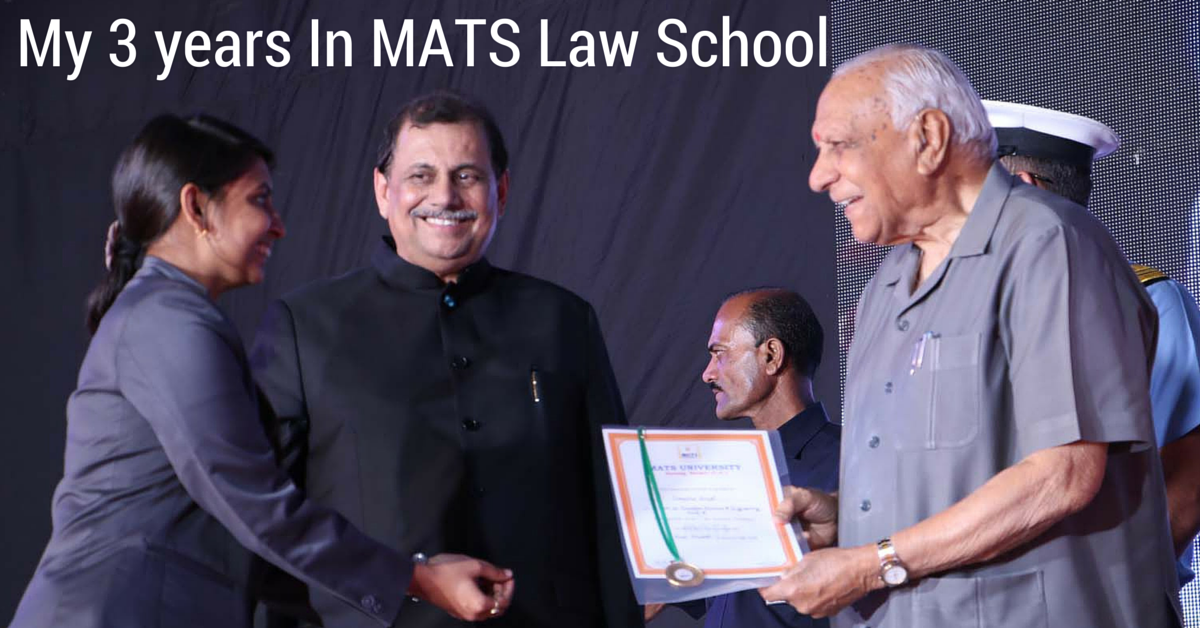
My 3 years In MATS Law School

0
My 3 years In MATS Law School

This post has been sent to us by a student of MATS Law School, who has requested us to keep the identity of the writer anonymous.

My 3 years In MATS Law School

I being a member of the business class family, has always seen my siblings doing either their own business or joining the family business. But I had always dreamt of doing something different and challenging in my life. With the beginning of the session of 11 Class, we had a career counselling in which we had been informed about the various courses which we can do after our school life, and so that’s when I came to know about ‘LAW’. This was the word that has driven me to take this course, to know the meaning of this word.

I took the CLAT examination but didn’t get through it.

I came to know about MATS Law School through my cousin’s friend, who is my senior here.

So I applied here and got my name registered for the B.B.A.LL.B (Hons.) course. Initially, the days were tough as it was my first experience when I was away from my family. With the beginning of the session I was really worried and nervous but after few days we had an interaction with our seniors & faculty and then they made the environment quite comfortable for me & my batch mates. Soon I had an interaction with three of my faculties, who played a very important role in shaping my career. From every three of them, I learnt so many aspects of life and more importantly of the meaning of the law.

When it was sensed by the faculty that I am having some trouble with regard to my studies I was called by Miss. S & Miss K in their cabin to have a word with the same. Few of my seniors were already there as they were discussing the various events that were to be conducted in the upcoming semester. I was introduced to various seniors of various batches all of them seemed to by studious and serious. As I was leaving the cabin as I Miss S & Miss K were pre occupied by the work I was offered to join the discussion, I was not able to say No and I eventually join the discussion and eventually I realised that my seniors were not the one who were having some other background they were the one who were same as me they were fun loving easy to communicate and with a good sense of humour and I dint realised when 2 hours passed. I was happy that my queries were answered in a positive way. In those two hours I became aware of various events which are there for the law students like moot court competition, Model United nation, Conference & Seminars.

At the end of the meeting I had a conversation with Miss K & Miss S who helped me and guided me to overcome the internal matters and asked me to focus on activities by which I can actually build up my Curriculum Vitae. I was introduced to various seniors who were easy to approach in case I had any query regarding anything in law school the seniors were from various year LLM students.

As the days passed by I started spending my free time in Library, I was not the one so studies type but I use to go to library and observe my senior and I try to give efforts as to understand how they spend their time in library how they write their articles and off course the boys but eventually all my desires shattered like a glass.

I participated in the Intra moot court competition which was organized to make us aware about the moot court, we were provided with the mentors for the same each team was provided with one mentor, initially it was hard to work as per expectation of my mentor buy eventually I adopted myself and as I was participating as a researcher I was asked to read out various case laws statutes ordinances. As every coin has two side there were few seniors who tried to deceive us from our research so that they can qualify for the next level but few of the moot court committee members asked us to focus on our research work and try to present with full confidence the result of which was that I was awarded the best researcher, I didn’t realised that I shall be happy or sad because I was asked to treat the mentor and few of the Committee members as they motivated and guided me, with the ending of 3 days long moot court session I build up a healthy friendship with various seniors now I use to enjoy their company while having lunch and dinner.

Every now and then we use to prepare something or the other in our rooms illegally as we were not allowed to cook after 10. Soon I realised that my taste buds are going to taste various dishes they are been prepared in various parts of my nation like bortenga, khorisa, potol posto, dhoka etc.

With the passage of time I was terrified by Miss S, Miss K and Miss D because if I lose my concentration in class I was summoned to meet them in their cabin and I was asked the reason for the same. I had my first semester exams I cleared it with flying colours.

I came back after my internship at an NGO on Human Rights, I had fun meet various students from various law colleges and I realised that the way my seniors treat me was far better than the treatment of students in various law colleges was getting.

As I returned back from my internship and I realised that someone has rightly said the whole struggle & suffering is for the stomach.

All the seniors whom I use to consider the most silent one and were studious one were fighting shouting for the good quality of the food they eventually started moving out the utensil and various other accessories of mess worker out of the campus and I realised the world is stage and every is playing different role at different moments of their life but yes it was fun.

On the very first day of the college, we were informed by the editorial committee about the national seminar. I wrote an abstract which eventually get selected. I thought selection of abstract was the toughest part but then I realised there are many road blocks for the same and good research was the major one somehow I was able to complete the same. On the day of the seminar I was confident enough but things didn’t turned out the way as I my name was to be announce I felt as if butterflies are flying in my stomach I was more nervous as I was about to present it alone it was making me more nervous but my Co-author understood from my face that I am scared enough and when my name was announced he got up and took the mike along with me and somehow we manage to justify our paper as for both of us it was our first experience.

Third Semester has played a very vital role in terms of my CV I was going on a national moot with my seniors as we were having a policy in out college that one junior and 2 senior will be participating in the moot court competition. We did really well but we didn’t qualify for the quarter-finals it was a wonder full experience I learned a lot after all winning and losing does not matter what matters is how much you have learned. As we were under pressure from past 30 days we chose to wander whole night at the streets of Nagpur.

I did my internship at Mehadia Associate at Nagpur, I used to refer the matters of western coal fields Ltd. and various other matters relating to labour laws, I use to prepare various case note drafting and research work for various cases. I understood the procedure of courts.

As I came back after internship and as the time passed the true face of people started coming forward and I was experiencing politics which eventually started and I was among the one who were worst affected, due to which there was decline in my marks, which was realised by the faculty. This was the semester that made me realised the bitter truth of life that as one moves forward towards the door of achievement the fewer people are their who actually wishes good for you in life.

This was the semester that I got the chance to attend the lectures of Mr S. He used to apply the method of negative motivation to me in order to get success in my life. This negative motivation has helped me to understand the jurisprudential aspects and apply it in real life. With this, I wrote a paper which when I even read it now, makes me feel proud of myself. Then I began writing papers for conferences and journals with Mr S and he became ‘MY GURU’. Whenever I was in need of motivation I talked to him. By the end of the semester, I came to know that he is going to join some other college. I was happy for him but at the same time sad about his leave.

Then the next semester came, at the beginning of the session we had our challengers round for the CSD National Moot Court Competition. One month went by in the preparation for the moot. This was my first time to be speaker in the moot, so in my leisure the time I used to practice in front of mirror with my arguments. Then the dates for the moot curt competition came, we travelled to Hyderabad. This was my first time to visit South India. I must say it was a beautiful city. We went to Quarter-Finals but can’t go further and the marks difference was very close. As I have already mentioned that winning and losing is a part of life, so I wasn’t much bothered by it and the next day, we roamed around the city.

When I came back from the moot, everyone was asking about my experience but my batch mates took me into more politics but this time I didn’t let any of it affect me. Then after some days, my juniors came to me and asked about the HNLU moot court competition. After thinking about it for a day, I said yes. But this time I wanted to become a researcher because I realised I enjoy the best till the time I was doing the research work. When the semester went by, I didn’t even realise. This was the first time I didn’t go on an internship, instead I spent my entire internship break at home because of my family problems. When I came back, everything changed. I found that my so-called friends are the ones who are making me involve in the politics. 10-semester seniors are my only friends left here. I was really depressed whenever I started thinking about my family problems as well as thinking that my friends have their last semester and going to leave the campus soon. I started spending as much as time I can. But at the same time I started writing papers and articles for the seminars and conferences. I did this so as to distract myself from thinking too much.

Download Now

Karnataka Labour Welfare Funds Act, 1965

0

This article is written by Divya Kathuria, a student of Raffles University

It is must to know how the welfare boards throughout the Country work and some are governed by the statutes by State Legislatures and Karnataka too is one of them and enacted Labour Welfare Funds Act in 1965. The board was mainly established to take over the various Labour welfare Centres all over the State under governmental control. It seeks to promote the welfare of labour and their dependents by providing for the constitution of a Fund for financing and conducting activities to promote welfare of labour in the State.

Constitution of Welfare Fund

The State government will constitute a welfare fund  in which all the unpaid accumulations by the employers all over the State must be paid to the Welfare Board. This fund will consist of all the fines realized from the employees, all the unpaid accumulations transferred to the board under Section 7 of the Act, the contributions made to the board, any penal interest, voluntary donations and any amount of sum borrowed. There are rules under the Act to collect all these amounts via various agencies and the manner of auditing is also prescribed therein. The Board is a corporate body by the name of Karnataka Labour Welfare Board and is thus, a legal entity. The Chairman of the board will be an independent member elected by all the other members of the Board. Conditions for disqualification of members are also prescribed under the statute itself.

Procedure

The claims are settled in the manner as provided by Section 7. As per this section, all the unpaid accumulations are deemed as abandoned property. It will discharge the liability of the employer to make payment to the employee to the extent he has paid to the Board. As soon as the Board receives any unpaid accumulation from any employer, it has the statutory duty to exhibit a notice on the notice board of the establishment (in which the accumulation is paid), publish the same in official gazette and in the two newspapers circulating in the area where establishment is located inviting claims from the employees if any payment is due to them. This notice is exhibited every year in the month of June and December for continuous three years from the date of the payment of the unpaid accumulation. If any claim is received within the first four years from the date of the first notice published in respect of such claim, the Board is obligated to transfer the claim to the authority appointed under Section 15 of the Payment of Wages Act, 1936[1] having the jurisdiction in the area of location of establishment and then, the authority will handle and adjudicate the claim and order the Welfare Board accordingly. However, the Board cannot be asked to pay more than the unpaid accumulation paid to it initially.

Once the claim to the claimant is refused, he has the right to appeal to the District Court having jurisdiction over that particular area and board must comply with the order made by appellate authority. An appeal will lie only till a period of sixty days. The decision of the authority or the district Court will be final. If no claim is made in the specified period or if the claim is refused by the said authority as well as in appeal (if made) then, the unpaid accumulations in respect of such claim would accrue and vest in the State as ownerless goods and are deemed to be transferred to form the part of the welfare fund. The fund will vest in the board and be held by the board as trustees and may use it for any purpose specified in Section 8(2).

Calculation

As per Section 7A of the Act, an employer and an employee are required to make labour welfare contributions to the Karnataka Labour Welfare Fund at specified rates that is, the calculation of KLWB is done through the contribution of company as well as the labourer.
he Employers are required to pay contribution by 15th January every year at the rate of 6:12 ie., employee:employer by deducting Rs.6/- from the employee and employers contribution of Rs.12/-. Also the employer is required to deposit the unpaid accumulations, like unpaid bonus, wages after three years of their becoming due. Further the penalty and fines are to be paid to the fund immediately. Under the Act, the employee, employer and the State Government have to contribute at the rate of 3:6:3 respectively, per employee per annum. The payments to the fund may be made through S.B.I. account No.30428019173 and the same bank slip (ie., Challan) along with Form-D[2] of the Board.

Dues and penalty

Any person who is convicted of contravening any of the provision under this act or rules made under it or who obstructs the inspector deliberately in discharging his duties under the act or rules or fails to produce any material necessary for inspection like register of records and documents can be imposed a fine which may extend up to five hundred rupees for committing the offence for the very first time. In case of subsequent or second time offence, with fine which may extend to one thousand rupees or with imprisonment for a term which may extend to one year or with both.

The offence under this Act cannot be tried by any court inferior than that of a 1st class Judicial Magistrate and cognizance can be taken only by the complaint of an inspector.

Form D under the Act can be accessed here: labour.kar.nic.in/labour/form-1.doc

Rules under the Act can be accessed here: http://www.lawyerservices.in/Karnataka-Labour-Welfare-Fund-Rules-1968

[1] 15. Claims arising out of deductions from wages or delay in payment of wages and penalty for malicious or vexatious claims.

Download Now

Punishment in Prison or Reform and Re-integration for juveniles committing heinous crime: A Counsellor’s Perspective

0

Kalpana Purushothaman, Senior Consultant – Counseling & Research, Juvenile Justice Program, Centre for Child and the Law National Law School of India University

I am a counsellor working with juveniles in conflict with law, most of whom are boys. Some of them  have committed heinous crimes like rape, murder, etc. In the wake of the Lok Sabha passing the Juvenile Justice (Care and Protection of Children) Bill, 2014, (which defines such crimes as ‘heinous’) there have been a series of articles in the media supporting and condemning the move in equal measure. The debate on the Bill has raised many important questions which needed to be asked. Should juveniles alleged to have committed ‘heinous’ offences be tried and punished as adults? Would punishing juveniles who commit such heinous crimes deter others from committing similar acts? Would our society, especially women and children, be safer if juveniles are sent to prison instead of reformatory/ correctional institutions?

A few more equally important questions also need to be asked and answers sought. Juveniles have often been portrayed in the media as cold, brutal, remorseless, testosterone-driven young men who are a danger to our society, waiting to kill, plunder and rape. That is because the one juvenile who gets involved in a high profile case gets all the media attention. What about the hundreds of them who are unwittingly caught in the web of crime? Who are these juveniles who commit such heinous crimes? What kind of educational, social, family backgrounds do they come from? What is it that happened to them at such a young age that made them do the terrible things they’ve done? What have their families, schools and society done to help them cope with their problems and the challenges of growing up so that they don’t end up committing these heinous crimes or any crime for that matter?   Has the Juvenile Justice Act in its current form been implemented properly or effectively to ensure reform in juveniles? Have models of ‘what works’ around the world been incorporated into our juvenile justice system so that there is healing and justice for both offender and victim?  How can young juveniles be taught and enabled to take accountability for their actions and make some amends for their actions to their victims and society?

As I hear the various debates raging for and against whether juveniles should be tried and punished as adults, many of the juveniles who were charged with heinous crimes or actually committed heinous crimes that I had the opportunity of working with over the last few years come to my mind.

Mohan*, a 17 year old charged with rape told me about his recurring nightmares of a gang rape that he had witnessed. He was the ‘lookout’ outside the door while a group of 4 local rowdies raped a middle-aged woman whose husband owed them money. The local rowdies had challenged him saying he was not ‘man enough’ for this and so he desperately wanted to prove them wrong. After they finished raping the woman, he was asked to clean up and he offered the lady a glass of water. She identified him in the line-up.Was Mohan guilty? Yes, he was. Should he be punished? Yes, he should. What should the form of that punishment be – should it be imprisonment that will inevitably expose him to brutal violence and sexual abuse and trigger further anger, or developmentally appropriate correctional methods that actually lead to change in his behavior while also enabling healing, solace and a sense of justice to the victim?

Will Mohan reform if he is sent to jail where adult convicts and offenders are most likely to groom him for further crime? Is there a possibility of Mohan taking responsibility for the damage and anguish caused to the victim and her family through a process or a correctional program that he is put through that teaches him to make amends for his behavior to the victim and society, behave responsibly in the future and actually understand his responsibilities? Mohan repeatedly told me and demonstrated through his behavior that he was remorseful and willing to do whatever it took to do this. But do we have such programs for juveniles in India? No.

Then there was Joseph*, a 17 year old with floppy hair and sad eyes. He would sit quietly in a corner and burst quickly into tears when I first met him at an Observation Home where he was kept. He was charged with the rape of Leena*, a 16 year old Hindu girl. It has hard for me to believe this of the gentle boy sitting in front of me. But how could I not believe the medical reports that showed that the girl was a few weeks pregnant. Joseph had been apprehended while trying to board an inter-state bus along with Leena two days after she had been missing from her home. As I worked with Joseph and learnt his story, a different truth emerged.

Joseph had known Leena for the last 2 years and both were in love with each other. A year before the incident, Leena’s father had caught Joseph taking Leena on his bike and warned him to stay away from his daughter. A few months later, Leena told Joseph she was seeing another boy and they broke up. Joseph had not met her since then. Three days before his apprehension, Leena had turned up at Joseph’s house and told him that she had decided to commit suicide as she was being harassed by her parents. She also admitted to him that she had got pregnant by her boyfriend (who was related to her father’s family) and her parents would kill her if they came to know of it. She asked for his help in aborting the child. Joseph stole money from his elder sister and decided to take her to a nearby city, where he was apprehended by the police. Leena’s parents filed a case of rape and kidnapping against Joseph.

Many of the cases of ‘rape’ by juveniles are cases where there has either been consensual sex between the parties or false cases filed against the boy (usually by the girl’s parents), especially where the boy and the girl are from different castes, religions or strata of society.

Speaking of murder, there was 16 year old Sathish* who was charged with killing his father in a fit of rage. Sathish’s father, a chronic alcoholic used to regularly beat him, his mother and his younger sister. He was forced to drop out of school despite being academically bright and work at a local hotel washing dishes while his father’s bouts of drinking and violence continued unabated. However, one day Sathish had had enough and during one such drunken brawl when his father attacked him, he hit back and slashed his father’s throat with a razor. He was found guilty of murdering his father and his mother was also sent to jail as an accomplice, although she had no role in it.

However, unlike other juveniles who simply languish in the system without any intervention or rehabilitative services, Sathish received intensive counseling from me and psychiatric treatment from the Department of Child and Adolescent Psychiatry, NIMHANS during his time in the juvenile justice system. With help from an NGO willing to take him in and support his education, he went on to write his 10th standard exams and later on enrolled in an evening college and is slowly but surely trying to reclaim his life. His mother and sister are also receiving counselling and support in piecing their lives together.

These are examples of just some of the juveniles charged with having committed heinous  offences and subsequently found guilty by the JJB, but not every juvenile charged with a heinous offence is actually found guilty. However, the  JJ Bill 2014, proposes a very arbitrary assessment of the child’s ‘mental and ‘physical capacity to commit the crime’ based on which he/she could be transferred to the adult criminal justice system for a trial, and potentially a jail sentence. As to the Juvenile Justice Board assessing the maturity of juveniles charged with heinous crime to decide whether they should be tried under the juvenile justice system or the adult criminal justice system, at the present in time, there is simply no way psychologists or psychiatrists or other experts can make a scientifically sound determination of whether the crime was committed in an ‘adult frame of mind’ or a ‘childish frame of mind.’

This is not to say that juveniles do not or are incapable of committing heinous crimes like rape or murder. They can and they do. However, what they are incapable of many a time is the ability to resist peer pressure to indulge in risky behaviors that often create or lead to such situations. Research by neuroscientists and psychologists show that adolescents – especially in the 16 to 18 year age group, are highly susceptible to peer influences, have poor impulse control and often their decision making abilities in high pressure situations may often fail them in a critical situation. This is because that part of the brain called the pre-frontal cortex which is responsible for controlling these aspects – namely impulse control, behavior regulation and future orientation – is still in the process of developing.

Also, in my experience, very often juveniles who do commit heinous crimes are very often themselves victims of violence, neglect, emotional deprivation, sexual abuse, broken families, poverty, substance abuse and so on. All of these factors are known to also influence and impede healthy brain development. No, this does not make their actions right or take away the pain and damage to the victims and their families. But it does give us a certain perspective in which to understand why and how adolescents who should be in school or college, exploring and enjoying the wonders and beauty of youth – end up committing rape or murder.

Almost every juvenile that I have worked with has expressed remorse and sadness for their actions when they feel safe to do so in a therapeutic environment. Many of them have often spoken of a deep desire to make amends to their victims and their families. I even had a young 17 year old charged with murder, who wanted to give his monthly earnings to the family of his victim as he felt he had deprived the family of an earning member.

For all those believe that juveniles committing heinous crimes get off lightly or easily, my experience has been that they don’t. They are traumatized by their experiences, haunted by their actions and the pain of their victims. Depression, post-traumatic stress, nightmares, psycho-somatic disorders and a host of other mental health problems continue to dog them for years. They are cut off from their families, have to give up their schooling and are removed from all that they hold dear. To a young person, that is often the harshest punishment one can give. Besides, the conditions at the reformatory institutions – whether Observation Homes, Special Homes or Places of Safety – are not exactly idyllic. There is nothing ‘special’ about Special Homes and all these are just euphemisms for prison or prison-like conditions. Physical violence, neglect, sexual abuse, drug /substance abuse, etc., is usually rampant coupled with over-worked, ill-trained, poorly rewarded staff who are not oriented to care giving or working professionally in a correctional setting for children/adolescents.

I believe that transferring adolescents in the 16 to 18 years age group to the adult criminal justice system and incarcerating them in adult prisons will only lead to a situation where these youngsters will come out of jail a few years later – thoroughly groomed and trained as career criminals. Instead, investing in strengthening the existing  juvenile justice system – where they still have a chance to reform themselves and helping them take responsibility for their actions, teaching them to make amends to their victims and to society in appropriate ways – is the way to help prevent further crime and actually bring about some measure of healing and justice for all concerned. Restorative justice is an approach that is a possibility, it has the potential to bring together the juvenile, the victim and society in a meaningful way and some countries are already trying it, with varying and encouraging degrees of success.

Juvenile justice is a complex issue and there are no easy answers that will satisfy all. There is a need to balance the rights and interests of the juvenile, the victim and the society. Debate, discussion and engagement with young adolescents at risk and understanding and addressing their concerns before they commit a crime would be a positive step forward. Shutting them away in prisons after would help no one.

*Names and some case details have been changed to protect identity.

Download Now

Jay Bhambhani, Associate at ANM Global on how he benefited from NUJS business law diploma course

0

11251382_369600023238809_5405951019330565892_o

Jay Bhambhani is  a 2012 graduate of University of Petroleum and Energy Studies (UPES), Dehradun and currently working as an Associate in ANM Global, a law firm based in Delhi. He was a student of July 2012 batch of Diploma in Entrepreneurship Administration and Business Laws offered by NUJS, Kolkata. Jay talks about his interaction with the course. Over to Jay.

[divider]

I was born and brought up in Delhi and also did my schooling from Delhi itself. I come from a business family and initially I thought that is what I wanted to do; which is why I to took a commerce background in school as well. I am a first generation lawyer and I chanced upon doing law through aptitude test results which said law would be my ideal professional choice. Initially, I had only thought I’d check it out, but I liked its prospects, especially the corporate side, after which I decided to get into it and have never looked back.

I finished law school in 2012 from University of Petroleum and Energy Studies, Dehradun, where through my course, I have specialization in Energy Laws.  I had interned with ILF Advocates, a law firm based in Delhi and Gurgaon.  I had a PPO from them and joined them right after my law school.  It was a great learning experience as I had exposure to be at the forefront of meetings and discussions and not just research and grunt work. After a year, I had joined my ANM Global, a Delhi based law firm where I have been working for just over two years.

Since it is a small law firm, it doesn’t have departmentalization, and hence I get to work on the forefront as well i.e. directly interacting and working with the client to form, shape and execute the project/assignment.

My work areas are very wide and include General Corporate, Transactional, Private Equity/M&A, Litigation and IPR. Primarily, my work includes planning, structuring, drafting agreements, documents and opinions in general corporate, compliance, commercial and transactions in various sectors including Real Estate, Telecom, IT, Private Equity Funds, Retail Trading and Pharmaceutical. Besides these, I am also singly handling various civil and criminal litigations of the firm, aside from assisting my seniors in some.

I came to know about the NUJS diploma course through the internet while I was doing some random searches. At the time I had just graduated and did not know much of the practical work that is required. At the workplace, I did not have immediate seniors through whom I could ask or learn from and when I saw the module I knew it would really help a fresher in learning the basics of corporate law.

My experience with the course was very pleasing. I was in the pioneering course and the people at iPleaders were really supporting and easily approachable. The most important thing that I learned through this course was that was able to figure out what sort of issues (on the legal side) an entrepreneur typically faces, whether initially or even after.

The course did help a lot. As explained before, when starting out, there is no one to help with the basic details. Even the ones which are in practice (those not provided in procedure but are accepted practices).

I was working for an app based start-up who were expanding into import – export of electronics to earn some side money. They had asked for a quick opinion for basic compliances and how to get going. I specifically remember the chapter for Import Export procedures in Module 2 which really helped me out to make the opinion asap, which would have otherwise taken more time. It really helped me to get to the main point without having to learn about the fundamentals myself. These are the sort of things, which are essential, basic and not difficult otherwise, but you don’t get to learn about these unless you chance upon them.

Also, my firm had started sessions at an incubation centre for start-ups where they could ask their legal queries. My firm used to send me to address their queries. As explained above, through this course I was able to figure out the typical issues an entrepreneur faces and through my legal skill set I was able to come up with solutions and answers to address these issues. It made it much easier to assist those start-ups accordingly as I was already prepared.

Module III (Corporate Governance) and Module IV (Raising Investments). These modules cover what typically a corporate lawyer works upon on a day-to-day affair. At the time when I was new, these really helped to establish and clear the fundamentals which meant I could clearly and easily concentrate on the issues of the client at hand and not waste time to research/understand the fundamentals.

I would really recommend this course to law students (preferably in their final year) and to freshers who are / who want to be on the corporate side as it really helps you develop your fundamentals as well as the practical updates. These have become especially important now since the enactment of the new Companies Act. There are very less precedents for the new provisions and it is important to stay updated with the changing rules and regulations of Company law, which are still at a nascent stage and are hence constantly being updated / changed.

 For the immediate future, my goal is to shift and concentrate mostly and specifically on Private Equity transactions and General Corporate and accordingly build myself in that area. For the long term, I would like to work in a law firm only in any capacity. I don’t like to believe in designations. My goal is to be the best Deal Maker and Negotiator in Delhi.

Apart from this, I also do stand-up comedy. I haven’t looked at it yet from an angle of making a profession out of it, but nonetheless, it is a great stress buster.


Download Now

The inclusion and exclusion of Jats in the OBC category

0

 reserved-355093_1280

This article is written by Dhruv Dikshit,  a student of LC-II, Delhi University.

On March 17th 2015, the Supreme Court set aside the order declared by the former UPA government regarding the inclusion Jats in the central list of Other Backward Classes (OBC) to avail the privileges associated with reservation.

The division bench comprising of Justice Ranjan Gogoi and Justice Rohinton Fali Nariman found infirmities with the centre’s decision to side-line the analysis and conclusion of the National Commission for Backward Classes (NCBC) stating that Jats do not deserve to be included in the central list of OBC as they don’t form socio-economic backward class.

BACKGROUND

The former UPA government had asked the NCBC to do a survey and make a report regarding Jat reservation and whether they actually do form a socio-economic backward class. NCBC did as it was directed and held that there is absolutely no need to include them in central list with the exception of Rajasthan.

Following that, the UPA government realised that in case they are unable to work on this with the elections around the corner, they will most definitely lose their vote bank and will eventually lose the elections and which is why they decided to put pressure directly and peripherally to include Jats in the category of OBC so that they are able to retain their vote bank. NCBC, even though it had already done what the UPA was asking it to do again, worked on the report again and came to the same conclusion.
At this point the government started questioning the credibility of the report and analysis provided by NCBC in an attempt to delegitimise it eventually the government was able to provide reservation for Jats in the central list. Following that several petitions filed against it and the division bench of Ranjan Gogogi and R.F. Nariman, following the PIL filed by the OBC Reservation Raksha Samiti – an organisation of members of communities that are included in the central list of backward classes, decided that the former decision to grant the Jats community the status of a socio-economically backward class was incorrect and needs to be overruled and thereby the notification was scrapped off.

JUDGES’ OPINION

The judges opined that, “Caste, though a prominent factor, cannot be the sole factor of determining the backwardness of a class”. Furthermore, they held that the accommodation of politically organised class like Jat would have a detrimental impact on the welfare of the other backward classes as vote bank politics becomes a significant parameter. The bench said that though the central government has the power and authority under the constitutional scheme to provide reservation to a particular class but it cannot be permitted to do so on the basis of a decade old finding about the backwardness of a caste.

The apex court had asked the then government why it refused to pay heed to the analysis and the conclusion of the NCBC to keep the Jat community from reservation privileges. The court had also opined that the matter was in fact “serious” and it had ordered the Ministry of Social Justice and Empowerment to bring before them all the records pertaining to the decision to ascertain “whether there was application of mind or not” while issuing the notification to grant Jats the desire status. The UPA government had held that at that time the Cabinet took into account the findings of a report of an Expert Committee constituted by Indian Council for Social Science and Research (ICSSR) before making the decision.

CONSEQUENCES

The decision of inclusion was made in 2014 and lasted to the point where the new academic session of 2015 started which basically means that a lot of students were admitted during the time the notification was in play and now that the decision has been retracted, there is a great amount of confusion amongst Jat students. The new decision does not have a retrospective effect. It only has a prospective effect, which means that the students who had enrolled during the time Jats were considered a category under OBC are not going to be expelled at the same time new admissions will not be entertained in that category.

Download Now

Pain And Achievement

0
Pain And Achievement

What does it take to be successful?

Pain And Achievement

What is achievement?

We all desire to be great. We all desire great health, enviable body, riches, comfort, success, awesome friends and other excellent things in life.

However, mere mortals that we are, our desire alone is not sufficient to achieve anything, to bring us results.

However, desire is a key piece to the puzzle. The stronger the desire, likely that you’ll succeed, or achieve whatever that is you want to achieve.

Truly sparkling achievements and great successes are not rare by chance.


They are sparkling and great because they are rare. The rarity can be caused by two factors –

1. There is not enough information about this kind of success to take action that is bound to succeed – such as buying tickets of Sikkim lottery, or walking into a casino in Las Vegas. You just don’t know of anything you can do that will definitely win you a fortune in a casino. This is not everyone’s cup of tea, but in the world there is no scarcity of gamblers and casinos do well.

2. There would be pain along the way, which is why few people ever try it. People know what it takes to do well – but it’s too difficult to be relentlessly pursuing the goal, to painful to be disciplined, and the world is too distracting. People face pain, and they give up. I don’t know how to succeed in the first category of activities. If I do not know how to win a game, I do not enter it unless I am going in as a student. However, to want to learn it I need to first believe that there is a sure shot way of winning, even if the way is painful. I never gamble and I never buy lottery tickets because I believe that there is no specific way to guaranteed success.

That brings us to the second category. It’s easy to succeed here. Embrace pain – because only the pain separates the winners from the losers. Everyone would be a winner if there was no pain – so it’s an ally of the winners.

Going through the pain is what makes the winners special. If you are a winner, you got to love pain – except that you do not sit and suffer the pain. You make progress relentlessly; you march like an unstoppable terminator through every difficulty towards your goal. You always find shortcuts whenever you can, but you are not afraid of pain.

The pain never stops you dead on your track. If you are a winner, you must love pain. Pain is the gateway to any significant achievement.

Download Now

Full time manager wanted for SuperLawyer in Delhi

0

superlawyer
Job profile: conducting interviews of lawyers, organizing superlawyer events, connecting with students from various colleges etc.

Qualification: dynamic, innovative lawyer with leadership skills, very good written and spoken English, perfect writing and communication skills, with at least 6 months of work experience, willing to work outside practice of law.

The selected person will get to play a very important role in growth of the organization, and be in a leadership position soon.

Starting salary 25,000-35,000 pm depending on qualification and experience. For exceptional candidates, we can consider more.

Please share this with any suitable person you may know! Apply to ramanuj attherate ipleaders.in


Download Now
logo
FREE & ONLINE 3-Day Bootcamp (LIVE only) on

How Can Experienced Professionals Become Independent Directors

calender
28th, 29th Mar, 2026, 2 - 5pm (IST) &
30th Mar, 2026, 7 - 10pm (IST).
Bootcamp starting in
Days
HRS
MIN
SEC
Abhyuday AgarwalCOO & CO-Founder, LawSikho

Register now

Abhyuday AgarwalCOO & CO-Founder, LawSikho