At iPleaders, we work on transforming what training one can give to budding lawyers, law students, entrepreneurs, government officials and others who want to understand the law and use it to their advantage. We are working on access to justice for the last few years, and have made some real headway. Things that were impossible 4 years back, are very much reality now. That’s how we work – away from the spotlights, cracking on the real problems and taking on things others think are impossible to change.
Now here is a position very essential right now to achieve the success of our dreams, and it is open for the first time. I don’t have a name or designation for it. You can come, join and decide what it should be.
I need a person with great communication skills, an indomitable will to learn, a lot of enthusiasm towards life. This person need to be able to communicate well in English and Hindi. Educational degree or qualification is no bar, if writing and speaking skill is superb which is the main criteria. We have a young person who is a recent graduate on our mind for this.
Your job will be to coordinate with people and support the founders in making their vision a reality. You should be a person of integrity, and good at keeping your words, since you may have to hold others accountable for the words they will give. Feel free to walk in for an interview into our office after prior notice to Ramanuj or Abhyuday.
Salary on offer in INR 20-25K. If you think you fit the bill, please act fast. We already have a few interviews lined up and we really need an extraordinary person on this position.
Lavina Manghnani, a GLC Mumbai graduate, completed the NUJS diploma in Entrepreneurship Administration and Business Laws in 2014. She is a certified Company Secretary from ICSI and is currently working as an associate at the Mumbai office of Indian Law Partners, a leading cross border transaction firm with best friend arrangements with Ashurst (a leading international law firm headquartered in London). She pursued her legal studies, CS as well as the NUJS business law diploma at the same time. We asked Lavina how the course helped her so far in her career, and she had very interesting things to talk about. We decided to share it with all of you as a success story. Over to Lavina.
When I took up the course, I was in my second year of CS. I saw an online advertisement for this course. I was very impressed by reading just the overview of the course and decided to do it. I was sure that this diploma is going to benefit me.
The course provided the necessary understanding of concepts such as corporate laws, contracts, tax, labour laws etc. It prepared me to easily understand concepts and speeded up my research on particular topics when needed. When I was appearing for my CS final exams, I referred the notes of my diploma course for an effective refresher on topics like procedural aspects of law and other corporate law basics.
The drafting marathon in which we drafted several contracts on a given situation was a really good experience. It gave me an insight into different kind of agreement, clauses etc. It gave me hands on experience of drafting, much before I would get such an opportunity at my work. Learning the theory part is very different from practically preparing a draft. It introduced me to the kind of language which has to be implemented, as it’s not the normal English which is used to draft these.
The NUJS diploma in Entrepreneurship Administration and Business Laws is an umbrella course with good exposure to every aspect of business laws. The case studies really helped me in understanding the concepts and to differentiate between similar concepts. The course introduces us to practical aspects in a very easy going and engaging manner. The sessions with lawyers and industry experts provided insights into advanced topics that I could not learn otherwise.
The video lectures and webinars helped me clear my basics. I have mentioned this diploma in my resume and I’m sure it has left a positive impact on my interviewers. The strong knowledge of basic laws gained from this diploma has helped me answer my interview questions as well. I wish there was much more personal interaction during the course, that would have really made a difference.
Any person, from any background can benefit from this diploma course as it’s a good platform to get introduced to practical concepts of law. I would also recommend The NUJS diploma in Entrepreneurship Administration and Business Laws to not just law students but innovators, businessmen, CS, CA and management professionals.
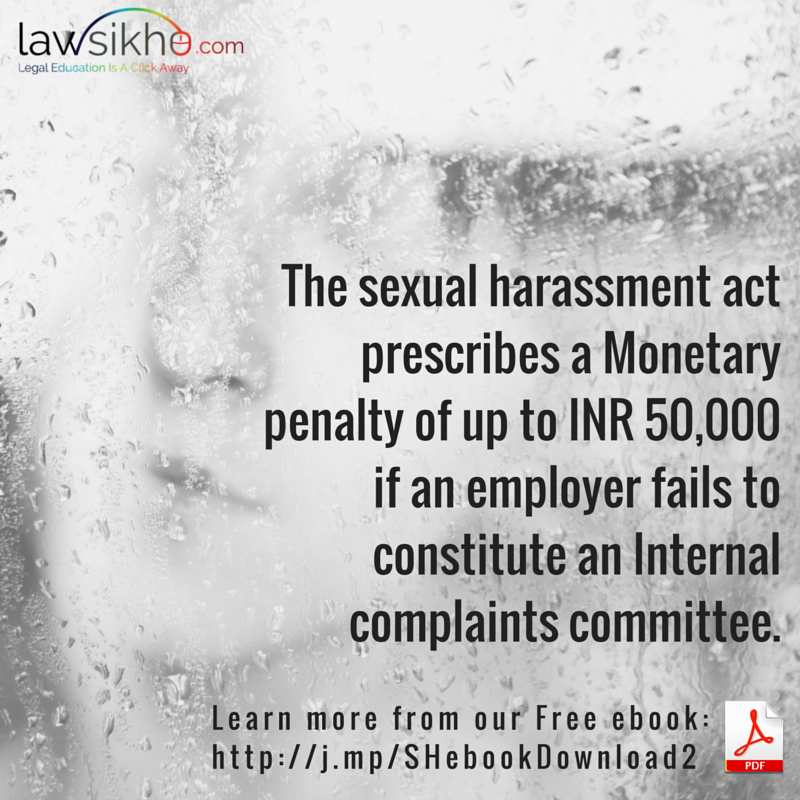
Since 2013, at iPleaders, we have been working on the problem of sexual harassment at workplace in India. Even before the law was notified we knew that it will not be easy to implement it in letter and spirits. Back in August 2013 we were already building the earliest tools to help individual employees as well as corporate India to make sense of the law and writing the earliest blog posts.
Since then we have catered to some of the best known names of India Inc for a reasonable fee as well as counseled and consulted many victims of sexual harassment for no cost. While Pallavi Pareek, one of our co-founders, inspired us to work on this issue; eventually the iPleaders team which is male dominated on the content development side, made the cause their Focal Point for a long time.
We had launched not only a Toolkit for HR managers to implement sexual harassment laws in their office and a cloud based corporate training program but also collaborated with a top National Law University to launch a 3 month expert certification course. However all our efforts sometimes appeared to be futile because it was clear that the common people of India had little idea about what the law short to do and what was going on.
It is impossible to implement the law like the Sexual Harassment Prevention Act without active participation of the common people. Many companies are doing mere formalities and the travesty of the procedure suggested by the law. Unless the law is known and understood to the common people, for the protection of whom (men and women alike) this law has been made, it will never serve purpose and it will remain a very good legislation only in the statute.
It was clear very soon that we need to make the basic knowledge related to this law available in a simple usable and easily accessible format that is already familiar to people. This was the Genesis of the idea to write a book like the one being launched along with this blog post.
To be honest this book should’ve been launched at least a Year earlier it is my fault alone that urgent took over what is important and the work on the book was delayed by almost a year. However I am proud to present this extremely functional and Powerful ebook, created by iPleaders and Design by Andheri and art affairs because I am very certain that it is going to make a difference out in the world.
It will provide hope to many those who are suffering unspeakable agony due to sexual harassment at the workplace or even for the reason of being falsely accused of indulging sexual harassment. It will give them access to knowledge and information that will make victims of harassment take effective action against the perpetrators and would make the Indian workplace more women friendly in the years to come.
As a proud contributor and de facto details of this ebook and a co-founder of iPleaders it is my privilege to give you this free eBook designed to combat sexual harassment in India through awareness and accurate information.
Here are some important points we’ve covered in this book: (Click to Tweet & spread awareness)
Give it to the people in your life and give it to strangers and ask them to pass it around. The few minutes you spend may make a difference in the life of a sexual harassment victim or someone who has been falsely implicated, so don’t be miserly with your time and effort. Spread it far and wide so no one lives remains untouched and the information in this book doesn’t remain unavailable to any person. Feel free to use the graphics used within this post to spread word about this ebook online.
If you want to know more about sexual harassment at the workplace you can also take up our course in collaboration with National University of Juridical Sciences here or you can also learn more about the implementation of various laws by taking our course here.
This article is written by Abhishek Praharaj and Debottam Chattopadhyay of 4th Year, B.A.LL.B of School of Law, KIIT University, Bhubaneswar.
INTRODUCTION
Arbitration has become the most vital mechanism to resolve disputes in the commercial world. But in India, the Arbitration and Conciliation Act, 1996 failed to be the elixir for relieving the Judiciary of the vast amount of commercial cases. Due to the incessant rapid development in the field of commerce in India there has been an unbridled increase in caseloads for already overburdened courts, further leading to an extremely slow adjudication of commercial disputes.
HISTORY OF ARBITRATION
Needless to say, arbitration has a long history in India. In ancient times, the mechanism called “Panchayat” acted as an arbitrator in several matters for a binding resolution[1].Modern arbitration law in India was created by the Bengal Regulations in 1772, during the British rule. The Bengal Regulations provided for reference by a court to arbitration, with the consent of the parties, in lawsuits for, inter-alia, accounts, partnership deeds, and breach of contract[2].Until 1996, the law governing arbitration in India consisted mainly of three statutes: (i) Arbitration (Protocol and Convention) Act,1937 (1937 Act) (ii) Indian Arbitration Act,1940 (1940 Act), and (iii) Foreign Awards (Recognition and Enforcement) Act, 1961 (1961 Act). The 1940 Act was the general law governing arbitration in India along the lines of the English Arbitration Act of 1934, and both the 1937 and the 1961 Acts were designed to enforce foreign arbitral awards. The 1961 Act implemented the New York Convention of 1958[3].
THE “NO TIME LIMIT” MALADY
Unfortunately, the biggest malady with the 1996 Act was that it departed from the 1940 Act, which fixed the time period for completion of arbitration proceedings[4]. The time frame for completion of the arbitration proceedings was done away with, without assessing the grave consequences. The intent might have been to give greater autonomy to the arbitrators, but the reality is quite different. Arbitrators, who are mostly retired judges, usually treat the arbitration proceedings in the same manner as traditional litigations, and are willing to give long and frequent adjournments, as and when sought by the parties.[5]
The delay of time in arbitral proceedings was not the only malady plaguing arbitration of India, another equally daunting challenge was Court interference in arbitration under Section 9 and awards being set-aside by Courts. Probably the most criticised aspect was setting aside of awards under the “Public Policy” doctrine.
“ONGC Vs SAW Pipes”[6] the Supreme Court of India expanded the scope of public policy by taking a wider view than Renusagar Power Co Vs General Electric Company[7] and held that Pubic policy means the statutory provisions of Indian law or even the terms of the contract. This was further expanded ONGC Vs Western Geo International Ltd[8]. In the context of these issues the Hon’ble President of India, promulgated the said ordinance.
Click Above
KEY HIGHLIGHTS OF ARBITRATION AND CONCILIATION (AMENDMENT) ORDINANCE, 2015
Section 12(1) of the Arbitration and Conciliation Act (Principal Act) has been amended to include certain conditions such as:
Disclosure by the arbitrator in writing of certain information such as any direct or indirect interest in the subject matter in dispute or to any of the parties.
Circumstances which might hinder the Arbitrator for giving sufficient time to the arbitration to complete the arbitration within 12 months.
Further, Section 23 of the Principal Act has been amended to insert subs-section (2):
That the respondent may file a counter-claim or set-off if it falls within the scope of arbitration.
Section 24 of the Principal Act contains probably one of the most important amendments in the form of insertion of a proviso that is:
The arbitral tribunal shall not give adjournments to any party without sufficient reason and may impose an exemplary cost on those seeking adjournments without sufficient cause.
Section 29-A is inserted which mandates that an award shall be made within 12 months from the date when the arbitral tribunal enters upon the reference i.e. the date on which the arbitrator or all the arbitrators, as the case maybe, have received notice in writing of their appointment. Further, if the award is made within 6 months then the parties have to give an additional incentive to the arbitrators as mutually decided by them. The parties also may extend the period by six months at most. This section further empowers the Courts to impose a reduction of fees of arbitrators due to delay because of the arbitrators. The Court may either extend or terminate the mandate of arbitrators in case of delay. Section 29-B that is inserted lays down a procedure for Fast-Track arbitration.
Section 34 has been amended to give a conclusive definition to the term “public policy” and includes:
If the making of the award was affected by fraud or corruption.
If it is in contravention to basic notions of morality or justice.
If it is in conflict with the fundamental policy of India.
Section 48 also has been amended to include the aforementioned points to clarify what is award in conflict of public policy.
A domestic arbitral award may be set aside due to patent illegality alongside other points as mentioned above.
Section 47 has been amended to give powers to High Courts having original jurisdiction to decide questions forming the subject-matter of the arbitral award.
CONCLUSION
The amendment ordinance promulgated can remedy the maladies that plague commercial disputes. The Government endeavour is commendable as arbitration will become the speedy process it was supposed to be and the ordinance espouses the best practices across the globe. Furthermore, the ambit for judicial interpretation is narrowed and fair certainty has been brought to the Act. Investors who were earlier wary of Court intervention may now heave a sigh of relief. Only time will tell if the Parliament shall give its assent to the Ordinance.
LawSikho has created a telegram group for exchanging legal knowledge, referrals and various opportunities. You can click on this link and join:
This article is written by Eklavya Malvai, a student of Amity Law School, Noida. He is also an Assistant Editor at blog.ipleaders.in
INTRODUCTION
Testifying by a witness is considered as key evidence in any court proceeding, helping the court to decide the final matter. However, for a witness to testify, there is a basic criterion he/she must fulfil, i.e., to be of a sane mind and be competent enough to testify.
In the past, we have often observed that one of the key witnesses to be a child, who was party to the event, but the admissibility of his testimony was not absolute in nature.
The Indian judicial system has laid down some rules to determine the competence of a testimony of a child witness, which has also been provided by the Indian Evidence act and other relevant judgements.
QUESTION OF ADMISSIBILITY
For a testimony to be admissible, it must fulfil certain conditions, such as;
A witness should be competent enough;
Must understand the question put before;
Must comprehend and give pragmatic and rational answers to the same.
The final discretion lies on the court to comprehend and determined whether the testimony shall be permissible or not, keeping the mind the account of the given facts and situation.
Hence, a court of law does prohibit anyone from testifying, as long as they are able to satisfy the above conditions to the satisfaction of the court of law. Thus, we have often questioned as to why the testimony of a child is a subject matter to various questions.
TESTIMONY OF A CHILD
A child or a person in his years of development is often subject to certain conditions, depending upon the conditions he lives in and nurtured in, keeping in mind the socio-economic contrasts every person is brought up, in India.
A child’s testimony can vary as it can be doctored by way of torture and coercing, and is not subject to absolute self-authority and assessment. As children, the mental development is tender in nature and can vary in different situations.
Hence, a pertinent question here to ask would be, ‘How does one define ‘maturity’ of an individual?’
Maturity is subject to the background and environment in which one has been born and brought up in, hence, maturity is subjective and varies among various individuals.
In a landmark case, Suresh v. the State of U.P established that a testimony from a 5-year-old child shall also be admissible, so long as the child is able to comprehend and understand the question of the given issue. Hence, it declared that there is no minimum required age for a person to legally testify in the court of law.
Section 118 of the Indian Evidence Act mentions who is considered as competent enough to testify in the court of law; ‘All persons shall be competent to testify unless the Court considers that they are prevented from understanding the questions put to them, or from giving rational answers to those questions, by tender years…”
Hence, the above provision clearly states that one shall testify in case competent enough if considered otherwise by the court of law.
click above
COMPETENCE OF THE TESTIMONY
The reason behind the court’s apprehension of a child’s testimony arises due to various factors. Children are often considered to be tender and at a volatile age where certain instances can make a lasting impact on the child’s memory and the way he perceives things from thereon. The court needs to take into account various factors before making the testimony admissible, such as, making sure that the child clearly understands the nuances of the circumstance, what led to the occurrence of those circumstance(s). Children often tend to be submissive due to the pressure and the tension surrounding the entire scenario, and the entire judicial proceedings can take a toll on a sensitive mind, leading to breakdown and change in testimony. Hence, the court needs to take care of intricate aspects, making sure that the child’s testimony is not affected in any way.
Principle of “Voir dire test”
“Voir dire Test”: A concept derived from the Anglo-Norman phrase, which refers to ‘Oath to tell the truth’. The word voir (or voire), in this combination, comes from French which states, “That which is true”.
The test is conducted for the purpose of deciding the competency of a child witness. Usually, the judge puts questions to the child witness to test his veracity and to verify that the facts build up with the progression of the accompanying facts.
This test is a precursor to determining the maturity and capability of the child to act in the full capacity as a witness to testify in front of the judge, hence, the judge may examine the child by posing certain questions which may not be related to the ongoing case. This is done in order to determine the absolute competency of the child witness, which may be limited in nature otherwise.
In the case, ‘Rameshwar S/o Kalyan Singh v. The State of Rajasthan’[1], the court held that every person is competent to be a witness in the court of law, unless incapable of understanding the question put before him/her, keeping in mind the provisions of Section 118 of the Indian Evidence Act.
Capability to understand at a young age is more likely to be dependent and to be formed at the opinion and perception of what others say and portray, due to which the testimony of a child is more likely to be modified or altered. Hence, dealing with a child witness is of key importance. This was also brought up in the landmark case, “Nivrutti Pandurang Kokate & Ors. v. The State of Maharashtra”, where the Supreme Court held that the testimony of a child witness must be scrutinised so as to make sure that it was not given under any situation of coercion and undue influence, and must corroborate other given evidence as well.
Child testimony in cases of sexual abuse and molestation
In the recent past, the cases of child sexual abuse and child molestation have come under the limelight. A 2007 survey by the Ministry of Women and Child Development showed that 53% of children in India had been sexually abused[2], bringing us to our next question, “To what extent can the child testify in his own case of sexual abuse/molestation?”
Children and infants are often victims of sexual abuse and molestation, and often are scared and apprehensive about disclosing the same to their parents and peers. This was only one indication of the increasing public pressure for the law, which was passed by both houses of Parliament on May 22, 2012. The Protection of Children against Sexual Offences Act (POCSO)[3] came into effect on Children’s Day, November 14, 2012, yet, its applicability remains to be a slippery slope, as children and infants are not very well equipped to ascertain and understand what they might have gone through.
Recently, the Supreme Court of the United States of the America, in its landmark judgement, Ohio Vs. Clark[4], made it easier for prosecutors to bring child-abuse cases without young children having to testify, allowing jurors to hear from teachers whose students told them they were abused. The unanimous judgement came in the case of a 3½-year-old Ohio boy whose wounds were visible to teachers at his day care centre. The boy was too young to testify, and thus, the court allowed the teachers to testify on his behalf, as the matter was immediately reported to the teachers by the child.
The veracity of the statement given by the child is always questionable, but other systems must be devised to verify the given testimony, making sure that it is unaffected by other external factors and is dealt with extreme care and caution.
CONCLUSION
As per the principles of the voir dire test, a judge must ascertain and verify the competency of the child to testify in the court of law. What must be understood is that children of such young and tender age must be dealt with extreme care and sensitivity, which might not be the expertise of the judge handling the case.
Trained personnel’s and counsellors must work with the court, who can deal with the child in a prescribed manner to ensure that the child’s testimony is not doctored in any way. The court takes into account expert opinion of various professionals and analyse them accordingly. There is also a requirement for a specific legislation and amendment to the criminal law which deals with child sexual abuse, which must be more gender neutral in nature.
The court must also take into account the testimony given by a person on behalf of the child and to what extent it can be held valid, in case a child is not competent enough to testify and understand what he/she went through.
LawSikho has created a telegram group for exchanging legal knowledge, referrals and various opportunities. You can click on this link and join:
Arman Sood is a Marketing and Communications Evangelist at a leading ed-tech startup called Embibe.com. Embibe combines technology and data sciences and brings the power of information to help students achieve their academic goals. His run in with entrepreneurship happened at the age of 20 when he promoted his own E-commerce venture eShack, retailing bar accessories while at Law school. He is a passionate speaker, avid sportsperson and wants to live and breathe the startup ecosystem.
Arman completed the NUJS diploma in Entrepreneurship and Business Law in 2014 and then graduated as a lawyer in 2015. He wants to start his own venture eventually. Over here he talks about his experience with the NUJS diploma course, and how it helped his career. Over to Arman.
After studying science in +2, I shifted to law because I wanted to do something where I will get a chance to hone my speaking skills and become a great public speaker. I wanted to argue and appear in public forums and platforms. I spent a lot of time in college pursuing debating and mooting, but at one point I realized that I don’t have desired expertise on practical legal issues, which I felt to be an absolute necessity since I was going to graduate as a lawyer.
I especially became aware of this when I started my own company with a roommate. After some time we started facing challenges like negotiating contracts, merchandizing agreements, merchant contracts, obtaining and managing trademarks and so on; but what we learnt up to then in law school could not help us to do these things. I knew that if I start my own business in the legal industry, I could do very well.
At this time I came across the NUJS Business Law Diploma course. I had looked at sample chapters, syllabus, and considered the price before taking up the course. Also the counselling session I had with someone from iPleaders really helped me to make up my mind. However, this course being an online course and self-paced, I was a little apprehensive about it and did thorough research before taking it. The course helped me a lot, and coupled with my experience of working at a rapidly growing start-up I know that the knowledge and skills acquired will help in my future ventures for certain.
The syllabus was really promising. It was also relevant from the point of view of someone who wanted to jump into the start-up world as the syllabus was totally geared towards that.
I had the experience of running a failed start-up while I was a student called eShack, and in hindsight I knew there was a lot of ground work to be done. I was in an unique position as a law student and entrepreneur both, and I really appreciated the course for what it provided to me at that time. It was very apt and covered all the relevant issues that one may come across at various stages of business.
By the time I was studying this course my first venture had almost shut shop, but the exposure really helped me. Even in my present company Embibe, though I am in a marketing role, as I am the only one in the company with legal qualification, I look at all the contracts, IP issues and all other legal aspects. I still refer to the course and find the material extremely relevant. It’s amazing that how it is not bookish but aptly addresses real life scenarios.
Another thing I did was to take it up along with two other friends rather than taking it alone and the idea was that we will be able to motivate each other through the course. To be honest, I believe I am the only one who really benefited from it amongst those three as the enthusiasm of others fizzled out a bit. It is important to follow the design of the course and give it a bit of time regularly which is at least 2-3 hours every week. It is amazing in this light that you have created the iPleaders club with academic mentors, industry mentors, regular exercises and structured calls. I believe this will really help to keep motivation of students high throughout the course.
I have been able to recommend the course to many people and I feel glad to do so. So many lawyers have an inclination towards business, and for such people this course is especially worth their while. However, I feel that every law student has something valuable to take away from this course.
I didn’t find it difficult to study the course at all as I broke it up into small chunks and studied bit by bit, module by module. I had small targets that I studied every week and felt great as I finished my target.
Finding time for the course was initially difficult for me but the fact that there were tests in regular intervals really helped me. I was able to keep the momentum throughout. Also the fact that in the new batches you are making it mandatory for the students to write short articles will really make a huge difference in their research and writing skills. It will also help to get the students to get noticed by the industry even better.
Two modules really helped me. One is business structuring. I made a mistake by structuring my first company as a partnership and it became a big problem when I was trying to expand, raise money etc. After doing the course I realized how important it is to structure your business right. Partnership is good for temporary businesses only, not for a start-up.
IP is my favorite subject and it was my forte while I was in college. Still I found immense value in the module you provided on IP. There was a presentation you provided on how to get IP registrations done, how to get it quickly and cost structures – I am still using that document at Embibe in terms of ground work as I manage our trademark portfolio.
One more thing I am really happy is that I still have access to the course and I can brush up anytime of skills I learnt. The career services you provide is also really amazing. I wish you had this during the time I was pursuing the course as well. But it is an amazing opportunity for the law students who will pursue the course now. I also keep reading the job opportunities you keep sharing with us. While I don’t need a job right now, it feels great that you are still sharing these opportunities with me and someday I may really benefit from this. I mentioned the course in my CV, and at the interview for the current job this definitely helped me.
I have recommended this course to many people, they took it and then later thanked me for suggesting it to them. There is no better joy than being able to help someone I care about with their career. If you have already taken the course, I would suggest that you must highlight this at your interviews and internships. And even after you are done with the course, keep going back to it and brush up. Go deeper where possible, discover a niche for yourself through the course. You must master one or two areas at least in depth and that will really help you in your career. This course is even more relevant for the students in colleges where there are not a lot of electives.
I’m inviting this to explicate to you why it is arduous for people to inscribe in a language that can be understood by hoi-polloi.
I bet you didn’t get half of what I wrote above and maybe if I continue in such language, you will close the window, or you may look for a dictionary before reading further.
If the readers don’t understand at a glance what I’m writing, what is the point in putting an effort in researching and writing? I have seen many people (and I myself suffered from this ailment) using heavy jargons and words, out of an undying habit or out of a belief that they must flaunt their vocabulary.
Why should you change this habit?
You have to if you want people to read what you are writing, be interested in what you are writing. If you want to be considered as a good writer, there is no way you can achieve it by writing either incorrect or rigid, jargon-heavy English that your intended audience find difficult to read.
How to get rid of it
It is really hard to get rid of this habit and write in simple language. After all, you are so used to it. However, you need to make conscious efforts. After you write something, read it again, see if there are words and jargon that you think people may not understand. If there is a possibility that people may be put off by use of a phrase or jargon, discard it. If there seems to be a more simple or concise way to describe something, then do that. Ask a friend to read it, take her help in assessing the readability of what you write.
Remember, you want people to connect to what you write. The intention is not to hit them with new and heavy words that you may know. That does not impress anyone. When you write something, address it to the people and not at the people.
Standard format contracts save time and reduce transaction costs. Businesses like their terms to be in a standard format, often rigid, because it drastically reduces cost of negotiation as well as doing business. A rather difficult situation, however, begins when one form is accepted through another form, which is given the almost theatrical name of battle of forms. This practice has been common for decades and present unique challenges to contract law. Whose form has precedence? Whose terms will survive? This article is written by Nikita Hora, a final year student at Jindal Global Law School and an Assistant Editor of this blog.
WHAT IS BATTLE OF FORMS
The term “battle of the forms” denotes the situation that serves “to describe effects of multiple of forms used by buyers and sellers to accept and confirm terms expressed in other forms.” [1]The contracting parties uses different standards printed forms to record the terms on which they are willing to bargain at the time of making the contract.
In simple terms it is a situation where it causes delays and confusion and in the worst case it might lead to long and protracted litigation. There are circumstances when the seller sends that invoice containing one set of terms and on the other hand buyer issues a purchase order that contains additional or different term. Then obviously this will lead to a conflict. The questions arise, whether there has been a contract at all and if so then whose term governs – the Buyer’s or the Seller’s? [2]Therefore typical battle of form occurs when the sellers include, an array of term and condition in the contract, that buyer wouldn’t like to get into.
When battles of forms takes places they become very difficult to resolve both domestically and internationally, especially when different legal system doesn’t have any way to decide what has been agreed upon amongst the parties and when they have to be dealt with inconsistent forms. [3]
SOLUTION OF BATTLE OF FORMS
An English Approach
“Mirror Image rule” has been adopted as a solution of the Battle of forms. Under this rule a contract cannot be formed till the time the acceptance corresponds exactly to the terms and condition mentioned in the offer. The acceptance that is not accordance with the offeror’s term would be considered as a rejection of the offer.[4] It can be considered as a counter- offer that the previous offeror can either accept or reject. A counter offer is considered to be an not only the non- acceptance of the offer, but also rejection of an original offer that can be accepted subsequently by the offeree. This rule is based on the formalist fiction of the common law where both the parties need to agree to the same terms and conditions simultaneously to create a binding contract.
In Hyde v. Wrench [5]the court held that when there is a situation where the acceptance introduces the new terms, then it is considered that no contract is formed as the initial offer was rejected and the counter offer is made.
Further in the case of Harris Case[6], the court held that whenever an additional term is made to an offer it should be expressed otherwise it be implied by law, it does not prevent the contract. In reference to this when an acceptance purporting to add new terms to the exclusive benefit of the offeror would not be considered as a counter-offer. In the case of Nicolene Ltd. v. Simmonds[7] a line of demarcation was made and Lord Denning stated “it would be strange indeed if a party could escape from every one of his obligations by inserting a meaningless exception.” There might be similar situation where a mere request for information included in the acceptance that asks for special indulgence to the offeree is effective if the offeree is ready to perform the contract even if the indulgences are not granted. [8] For these types of situation court came up with the test of whether a reasonable person would consider the alleged acceptance as introducing a new term to the bargain. After this judgment it became very clear that mirror image rule is very dominant as offer and acceptance must conform in order to be considered as valid contract.
Battle of form is the process that will continue till that time party considers an acceptance of the terms submitted by the other. This is an oversimplification however the courts strictly adhere to a mechanistic approach to contract with the battle of forms. In British Road Services Ltd v Arthur V. Crutchley Ltd [9]it was held that when both the parties agrees that there was an agreement and even the parties behaved accordingly the no courts has power to deny whether the contract was not binding. The task of the judiciary is to determine the term of the contract. When the last form constitutes the counter offer, on the other hand the performance operates as acceptance. Hence it is very clear that the terms mentioned in the last form of the agreement and the “Last shot” prevails.
In Butler Machine Tool Co.Ltd. v. ExCell 0. Corp.(England) Ltd[10], Lord Denning came up with solutions of the problems available in Battle of forms. His approach lead to separating the question of the extent that is similar to the American approach of Article 2-207 of the Uniform Civil Code. One of the main problems with Battle of forms is determination of the content of the contract. There are three ways for determining the content.
The man who fires the last shot won the battle. The party that keeps the latest terms and conditions and the opposite party do not object then it may be considered by the other party that, the party has taken over what was agreed.
The Battle can be won by the person who blow at the first as the difference can be materially different that it would affect the price of the buyer that ought not to be allowed to take advantage of the difference unless special attention is drawn by the seller.
There are cases where the battle depends on the shots fired on both sides. There is a concluded contract but the forms vary. The terms and conditions of both parties are to be construed together. If they can be reconciled so as to give a harmonious result, all well and good. If differences are irreconcilable, so that they are mutually contradictory, then the conflicting terms may have to be scrapped and replaced by a reasonable implication[11].
An American Law
The mirror image rules are reflected by the Section 59 of the Restatement (Second) of Contracts[12]. But in the American Approach under Uniform Commercial Code there were number of provisions that were modified from the common law of contracts. Article 2 of UCC deals with the all the transaction of goods other than securities transaction.
Section 2-207 of the UCC[13] abrogates the mirror image rule. Roto-Lith,Ltd. v. F.P. Barlett & Co.[14] is one of the best example of Battle of form under the American approach. In this case A offered defendant B to buy the barrel of emulsion. The offer did not state any warranty and specifically stated that particular purpose for which the emulsion was to be used. B acknowledged it and sent an invoice providing “ goods sold without warranties express or implied and subject to the terms on reverse side.” One of these terms stated: “B’s liability hereunder shall be limited to replacement of the goods which differ from B’s sample order. If these terms are not acceptable, the buyer must notify B at once. A did not object to the terms and accepted the goods on delivery, paid for them and put them in use. After using it, it was found that emulsion was defective. The suit was brought against B where it was it stated that there was a breach of warranty. The court said that response which states a condition materially altering the obligation solely to the disadvantage of the offeror is an acceptance . . . expressly . . . conditional on assent to the additional terms.” In this case, when A become bound to the contract he had the knowledge of the condition of the contracts then also he accepted the goods. Thus the court held that B’s response was a counter offer when A accepted to pay. Even in the common law approach would have reached to the similar conclusion that B’s action and writing did not constitute an expression of acceptance.
Poel v Brunswich –Balke- Collender Co[15]. case is an example where the court refused to find a contract based on the exchange of the conflict even though the parties believed that it was binding contract. This case became the example to bring in the changes in Section 2-207 UCC. The major changes were that Section 2-207 differentiated between
Acceptances that contain additional terms and those that contain different terms
Alterations that are material to the offer and immaterial alterations
Contract between merchants and non- merchants.
The United Nation Convention of Contract for International Sale of Goods
Article 19 of CISG provided that the purports to be an offer but it also contains the variant term that is supposed to be rejection of the offer and operates instead of counter offer.[16] The rules is supposed to be rigid but it is eased by subsection (2) that limits the mirror image rule by providing the provisions where there are additions and modifications that does not “materially alter” the offer. The terms of the offer and the altered response constitute the offer.
However Subsection 2 ‘s impact diminishes greatly by the overinclusiveness of materiality contained in subsection (3), which refers to the alternation of the material.
This CIGS also retains the spirits of the mirror image rule and on the other hand provides that any alteration done in the original offer are not material, it does not defeat the contract indeed it becomes the part of the contract unless an objection is made.
CONCLUSION
Battle of form is a situation where it causes delays and confusion and in the worst case it might lead to long and protracted litigation. Mirror image rule and last shot doctrine are the main two solutions that solve the problem of Battle of Form. Restatement of (Second) Contract, the United Nation Convention of Contract for International Sale of Goods and Article 2-207 of UCC are drafted but they are influenced by Mirror Image rule.
Still there is no absolute answers or solution to the Battle of form.
[9] British Road Services Ltd v Arthur V. Crutchley Ltd
[10] Butler Machine Tool Co.Ltd. v. ExCell 0. Corp.(England) Ltd
[11] Butler Machine Tool Co.Ltd. v. ExCell 0. Corp.(England) Ltd
[12] Restatement (Second)of Contracts,? 59 provides: “A reply to an offer which purports to accept it but is conditional on the offeror’s assent to terms additional to or different from those offered is not an acceptance but is a counter-offer.
[13] Article 2-207 of the UCC provides: “A definite and seasonable expression of acceptance or a written confirmation which is sent within a reasonable time operates as an acceptance even though it states terms additional to or different from those offered or agreed upon, unless acceptance is expressly made conditional on assent to the additional or different terms. (2) The additional terms are to be construed as proposals for addition to the contract. Between merchants, such terms become part of the contract unless: (a) the offer expressly limits acceptance to the terms of the offer; (b) they materially alter it; or (c) notification of objection to them has already been given or is given within a reasonable time after notice of them is received. (3) Conduct by both parties which recognizes the existence of a contract is sufficient to establish a contract. In such case the terms of the particular contract consist of those terms on which the writings of the parties agree, together with any supplement any terms incorporated under any other provision of this Act.”
What if your employer does not take enough precaution and you suffer an injury at workplace because of that? Can employers exclude such liabilities through a contract? This very old law provides a very valuable protection to Indian workers. This article is written by Anushka Singh, a student of Delhi Metropolitan Education, IP University.
Why was the Employers’ Liability Act enacted?
The Employers’ Liability Act was legislated with the objective of ruling out certain defences arising out of injuries sustained by workmen. This law was enacted to safeguard the interests and for the protection of workmen who bring suit for damages for injuries endured by them.
Under Common Law of England, in case of civil suits for damages sustained by workmen, the employer can plead the Doctrine of Common Employment, by virtue of which there was no liability on employers to pay damages to a workman for an injury resulting from the default of another workman. Similarly, another Doctrine which was protecting the employer was the Doctrine of Assumed Risk, by which an employee is presumed to have accepted the risk if it is of such a nature that he ought to know of it to be a part of his occupation. However, the Royal Commission on Labour recommended that a measure should be enacted abrogating these two defences and regarded these doctrines as inequitable. Provincial Governments were consulted in 1932 and they were in the favour of a legislation for the aforementioned purpose. Around that time, judicial decisions in British India, while generally agreeing to the inequitability of doctrines, had left it open to employers in most provinces to have recourse to them. The bill seeks to abolish these defences in case of all workmen. [1]
List of Amending Acts
The Act dealt with its extension over all the territory of India including State of Jammu and Kashmir. Earlier, Jammu and Kashmir was exempted from its application. However, this exemption was removed by Amendment Act, 1970 which came into force in 1971 and the State of Jammu and Kashmir was also brought within the purview. Later on, this Act was amended many times by different Amendment Acts including the Adaption of Laws Order, 1951, the Part B States (laws) Act no. 3 of 1951, the Employers’ Liability (Amendment) Act 5 of 1951 and the Central Labour Laws (Extension to Jammu and Kashmir) Act, 1970 (51 of 1970) to extend the provisions of the Act.
Definition of workman and employer
Employers’ Liability Act clearly states who the employers is in respect of workers deputed by man power supplying agencies to work in factories and establishment of employees. The definition provided under Section 2 of this Act helps to understand various definition of the terms like ‘workman’ in the Workman Compensation Act, 1923 (now Employees’ Compensation Act,1923), ‘workman’, ‘contract labour’ and ‘contractor’ in Contract Labour (Regulation and Abolition) Act, 1970, the terms like ‘employee’, ‘immediate employer’, ‘principal employer’ in the ESI Act, 1998. This Employers’ liability Act helped fill the gaps between various other labour welfare enactments. Section 2 of this Act reads:
“workman means any person who has entered into, or works under a contract of, service or apprenticeship with an employer whether by way of manual labour, clerical work or otherwise, and whether the contract is expressed or implied, oral or in writing; and
Employer includes anybody of persons whether incorporated or not, any managing agent of an employer, and the legal representatives of a decreased employer, and, where the service of a workman are temporarily rent or let on hire to another person by the person with whom the workman has entered into a contract of service or apprenticeship, means such other person while the workman is working with him.” [2]
Tortious liability on the employers which is not covered in any other enactment is fixed under the definition of this Act. It is not harmful to retain it in statute books.
Section 3 of the Act provides for ‘defense of common employment barred in certain cases’, where personal injury is caused to workman and it states:-
“a) By reason of the omission of the employer to maintain in good and safe condition any way, works, machinery or plant connected with or used in his trade or business, or by reason of any like omission on the part of any person in the service of the employer who has been entrusted by the employer with the duty of seeing that such way, works, machinery, or plant are in good and safe condition; or
b) By reason of the negligence of any person in the service of the employer who has any superintendence entrusted to him, whilst in the exercise of such superintendence; or
c) By reason of the negligence of any person in the service of the employer to whose orders or direction the workman at the time of the injury was bound to conform and did conform, where the injury results from his having so conformed; or
d) By reason of the act or omission of any person in the service of the employer done or made” [3]
This section also states that any suit for damages raised by any workman who has suffered from any personal injury due to non-maintenance of healthy condition of work, good and sound machinery, equipments etc. or by reason of negligence on the part of persons employed by employers as described under the provisions, such suits should not be fail by reason of employment of workman with such employer.
Section 3A originates from the Amendment Act of 1951, which make any provisions in contract of employment that deal with the duty of employer in respect of personal injuries to the employees and states that such provision should be treated as null and void as it would have effect of excluding or limiting any liability of employers as to personal injuries caused to the employees.
Section 4 talks about risks that are not to be assumed without full knowledge and reads as follows: “In any such suit for damages, the workman shall not be deemed to have undertaken any risk attaching to the employment unless the employer proves that the risk was fully explained to and understood by the workman and that the workman voluntarily undertook the same.” This means the employer should not assume that the workman knows all the risk which is attached to his employment unless such risk was fully explained to and understood by the workman. [4]
The last section of the Act speaks about saving: “Nothing in this Act shall affect the validity of any decree or order of a civil court passed before the commencement of this Act in any such suit for damages.” [5]
Conclusion
The Employers’ Liability Act has not been in the limelight and there have been no elaborate recent discussions on it. However, there is no harm in retaining this Act. Especially, when the other amendments contain flaws and legislators show no interest in discussion and taking steps. For instance, the amendment proposed in 2009 to the ESI Act, 1948 contains many flaws that affect the functioning of the organization till date..
Because excellence is often enough, and perfection is a futile quest, and idle pursuit.
Because in the run to become perfect when you are already excellent, you miss out on small pleasures in life as you get busy in search of elusive perfection.
Because idea of perfection sometimes get in the way of good imagination as to how the imperfection itself has utility.
Because sometimes the marginal return on being even more better is really low and does not justify the effort put in to improve.
Because your efforts to be perfect in one aspect of your life takes up inordinate time and does not let you focus on some other important aspects of life.
Because you take more time and spend more resources than actually necessary to do a thing because you want it to be perfect.
Life can become stagnant in search of perfection. Rather, enjoy every moment in life, strive towards excellence but not perfection.
Excellence gives you an incentive to work, to strive further, to be better, while perfection acts as an inhibition – “what if it’s not perfect?”
Perfection is almost always uncalled for – rarely one is required to be perfect or do things perfectly. The gap between excellent and perfect is narrow in the first glance, but to bridge that narrow gap – usually resources are consumed in a very inefficient manner.
Search for perfection is good as a hobby, not as a profession, or method of operation. Perfection is too costly, too inefficient when it comes to commercial causes or day-to-day affairs.
Think of an excellent watch – you can find one cheap. It will give correct time to the second. Think of a perfect watch – that gives correct time to one-millionth of a second. Apart from the fact that it is difficult to make such a watch and that it must be very costly – this perfect watch is hardly any better in usability – unless you are recording results of your experiments on an atomic reactor or putting it to some similarly obscure use.
It has been seen that if one knows 2000 most common words in The Spanish language, they can understand 80% of any average conversation in Spanish. Identifying those words and learning them will give you the excellent and efficient result. Perfection will need you to learn 500,000 Spanish words. That is often the difference between excellence and perfection – of efficiency.
Use what talent you possess; the woods would be very silent if no birds sang except those that sang best.
~Henry van Dyke


 At iPleaders, we work on transforming what training one can give to budding lawyers, law students, entrepreneurs, government officials and others who want to understand the law and use it to their advantage. We are working on access to justice for the last few years, and have made some real headway. Things that were impossible 4 years back, are very much reality now. That’s how we work – away from the spotlights, cracking on the real problems and taking on things others think are impossible to change.
















 Allow notifications





