Download Now
Home Blog Page 1829

Analysis of the consultation paper on Crowdfunding in India by SEBI

1

Crowdfunding

This article is written by Pratyush Pandey, a student of NLU Delhi.

SEBI had proposed a crowdfunding framework for India in a consultation paper in June 2014. It had invited comments and suggestions on the same by 16th July. The consultation paper outlined the details of crowdfunding in various other countries (US framed its rules earlier this year, Canada released its crowdfunding rules last year). It also detailed the existing model of investment in startups and SMEs through public offers and private placements by companies. SEBI already provides for funding for SME’s by listing their securities on Recognized Stock Exchanges. A company which has its post-issue face value capital not exceeding ten crore rupees shall list only in SME platform while that having more than ten crore rupees and up to twenty five crore rupees, has an option to list in SME platform. In case the post-issue face value capital exceeds Rupees twenty five crore rupees, the issuer should compulsorily list only on main board of the Stock Exchanges.

SEBI has clarified that the proposal does not necessarily mean draft rules shall be framed and crowdfunding provisions shall be introduced in India.

Crowdfunding is solicitation of funds (small amount) from multiple investors through a web-based platform or social networking site for a specific project, business venture or social cause. This funding can be used to raise money for a creative project, a benevolent or public-interest cause or a business venture. Those contributions are sought through an online crowd-funding platform, while the offer may also be promoted through social media.

Crowdfunding increases flow of credit to SME’s as funds are raised at lower capital cost. This saves them from the rigorous procedures in this mode. It increases competition in a field traditionally dominated by a few providers. It provides a platform for ventures which have a higher risk element to collect funds.

Investments in SME’s and startups carry risk and higher chances of loss to investors. There is a risk of misuse as well as cyber security and identity theft. The crowd may not have a say in the decision making or an influence on management. The crowdfunding carries with itself high chances of loss which cannot be anticipated by these investors (crowd).

SEBI’s Proposal

SEBI has proposed to allow only Accredited Investors to participate in crowdfunding. These include Qualified Institutional Buyers (QIBs); companies incorporated under the Companies Act of India, with a minimum net worth of Rs. 20 crore; High Net Worth Individuals (HNIs) with a minimum net worth of Rs. 2 crore; and Eligible Retail Investors.

Most of this limited class of investors expect an outcome out of their investment. This is a setback to creative works and social causes which do not give return on investments. The technical startups will benefit the most from this new class of analyze-before-investing. Earlier, most crowdfunding was through small donations from individuals who invested because a friend had recommended or they felt for the project. The emotional vibes in investment will take a backseat as the accredited investors will evaluate the project and its potential before investing.

A QIB will prefer to stay away from investing in a project where the risk element involved is higher and therefore, there are chances of investment not being returned. However, SEBI has proposed that a minimum of 5 per cent of the total number of shares of the company shall be held by QIBs.

The number of investors has also been limited to 200 except QIBs (on which there is no limit). SEBI gives a startup the freedom to have as many QIBs retains the traditional crowdfunding model, but does not address the disinterest of most QIBs in investing in creative or social cause startups as the chances of a return are lesser. A startup must be less than 4 years old and cannot raise more than Rs. 10 crore in a year. The investment may not satisfy the capital requirements of a few technical startups.

For receiving crowding, a company must not be a subsidiary or related to any other company which has a turnover in excess of Rs. 25 crore. It must not be listed on any Exchange. Companies engaged in real estate and activities not permitted under industrial policy of the Government of India shall not be allowed to raise money through crowdfunding. Further, the issuer shall not raise capital from multiple platforms, and shall not loan out the funds. An issuer shall have to disclose certain details of the company, its functioning and the venture it seeks to start. Most of the details required are basic and can be provided by an issuer. This is to ensure that an investor can make an informed choice.

SEBI proposes to limit the entities which can establish portals to stock exchanges, depositories, technology business incubators (TBIs) and angel investors. Internet companies which have so far effectively handled the crowdfunding business in India should not have been left out SEBI. Since the crowdsourcing is mostly done online, letting the existing internet companies to carry out their process should have eased SEBI’s work. They also require a platform to own the domain name, then why not let the internet companies themselves run the crowdfunding business? SEBI should itself be the gatekeeper and verify the various the authenticity of various issuers and their rather than leaving the job on the portals.

SEBI proposes three routes for crowdfunding:

  • Equity based Crowdfunding (EbC)
  • Debt based Crowdfunding (DbC)
  • Fund based Crowdfunding (FbC)

SEBI bars an investor from selling his shares in the startup except if he is selling it to the issuer of security, another accredited investor registered with the platform, or to a family member or relative or friend of the accredited investor. They do not want companies displayed on crowdfunding platforms to be treated as listed companies. However, not providing a secondary market or the right to sell shall act to the detriment of the investor and shall further restrict investments. SEBI could create a forum where the status of the company, its profits/losses could be shared, so the equity or debentures could be bought or sold at a fair price therefore, not resulting in any loss to the company.

SEBI seems to be introducing crowdfunding in India as a new concept, totally overlooking the fact that certain platforms are working well ahead of it. It has not included internet companies as an entity to provide platforms for crowdfunding. They have limited the number of investors to a few classes thus, blocking all the small amount investments from individuals who felt for the issue or wanted to promote an idea. SEBI’s proposal requires to undergo several modifications before the draft rules, if any, come out. SEBI has understood the concept of crowdfunding but seems to have decided to choose the ‘crowd’ itself.

The consultation paper by SEBI can be accessed here.

Download Now

Obscenity and the law in India: Moving from Hicklin test to Community standards

0

censored_2-wallpaper-1152x864

This article is written by Pratyush Pandey, a student of NLU Delhi.

‘She is humiliated, stripped naked, paraded, made to draw water from the well, within the circle of a hundred men. The exposure of breasts and genitalia to those men is intended by those who strip her to demean her.’ The portrayal of the tragic story of dacoit Phoolan Devi in Bandit Queen fell in a legal battle when a criminal case of obscenity was filed against the makers. The petitioners objected to some scenes depicting nudity and violence in the movie and claimed that they were obscene, lascivious, and would corrupt and deprave the minds of the viewers and hence, a criminal act under Section 292 of the Indian Penal Code.

The Supreme Court ruled in the Bobby International Case that the scenes depicting nudity must not be seen in isolation. They must be seen in the context or the background in which they (film, portrait, writing, and photograph) are made. The message being conveyed through the portrayal is of utmost importance when deciding the obscenity of an act. The movie Phoolan Devi depicts the social menace of torture and violence against a helpless female child which transformed her into a dreaded dacoit. The object of the scenes was not to titillate the cinemagoer’s lust but to arouse in him the sympathy for the victim and disgust for the perpetrators. ‘Nakedness does not always arouse baser instinct.’

The acceptable level of obscenity in films, photographs, paintings, and stories and novels, is not yet settled in India. In terms of section 292 of the Indian Penal Code, any matter is obscene if taken as a whole, it is lascivious or appeals to the prurient interest or if its effect and tends to deprave and corrupt persons who read, see or hear the matter contained or embodied in it. In this article, the author will argue for the community standards test as against the Hicklin test in the backdrop of the Supreme Court judgement in Aveek Sarkar v. State of West Bengal (3rd February 2014) Criminal Appeal No 902 of 2004).

AVEEK SARKAR CASE

In 1994, German magazine STERN published an article with a picture of Boris Becker, a world renowned tennis player and his dark-skinned fiancée, German actress Barbara Feltus. In the picture, both Becker and Feltus were naked and he had put his arms around her in a manner to cover her breasts with his palms. The article states that, in an interview, both spoke freely about their engagement, their lives and future plans and the message they wanted to convey to the people at large, for posing to such a photograph. Article picturises Boris Becker as a strident protester of the pernicious practice of “Apartheid”. Further, it was stated that the purpose of the photograph was also to signify that love champions over hatred.

https://lawsikho.com/course/certificate-criminal-litigation-trial-advocacy

The article along with the photograph was published in an Indian magazine Sports World and a Kolkata based newspaper Anandabazar Patrika. Aveek Sarkar, a lawyer filed a case under Section 292 of IPC against the editor, publisher and printer of the newspaper and the editor of the magazine alleging the photograph will corrupt and deprave the minds of the young and were against the cultural and moral values of society. He further alleged that both the publishing houses had published the photograph particularly with the intent of increasing sales.

It was further contended that the accused should also be prosecuted under Section 4 of the Indecent Representation of Women (Prohibition) Act, 1986 since the photograph prima facie gives a sexual titillation and its impact is moral degradation and would also encourage the people to commit sexual offences.

The respondents claimed that since the magazine was not banned in India and was never considered as obscene. Section 79 of the Indian Penal Code states that nothing is an offence which is done by any person who is justified by law, or who by reason of a mistake of fact and not reason of a mistake of law in good faith, believes himself to be justified by law, in doing it. Since there was no action taken against the sale of STERN in India, the respondents reasonably assumed that the reproduction of the photograph was valid in the eyes of law.

However, the Magistrate issued process against the accused and put them to trial for the offence punishable under Section 292 adding that it would be too early to give them the benefit of Section 79. The respondents then appealed before the High Court of Calcutta under Section 482 of the Code of Criminal Procedure for quashing the proceedings pending before the Alipore Magistrate Court. The court refused to quash the proceedings against which an appeal was preferred before the Supreme Court.

The Supreme Court found the appellants innocent of the charges levied against them under Section 292 of IPC and Section 4 of the Indecent Representation of Women (Prohibition) Act, 1986 and overturned the decisions of the lower courts. The appellants were given the defence of Section 79 of IPC. The Supreme Court held that the question of obscenity must be seen in the context in which the photograph appears and the message it wants to convey. The court further said that the correct test to determine obscenity would be Community Standards Test and not Hicklin Test.

The Hicklin Test was laid down by the Queen’s Bench in Regina v. Hicklin. The test of obscenity is whether the tendency of the matter charged as obscenity is to deprave and corrupt those whose minds are open to such immoral influences and into whose hands a publication of this sort may fall. On application of the Hicklin test, a publication can be judged for obscenity based on isolated passages of a work considered out of context. Works can be judged by their apparent influence on most susceptible readers, such as children or weak-minded adults.

The United States in Roth v. United States observed that sex and obscenity are not to be seen as synonyms. It was held that only those sex-related materials which had the tendency of exciting lustful thoughts were found to be obscene and the same has to be judged from the point of view of an average person by applying contemporary community standards.

In Canada, D. H. Lawrence’s novel ‘Lady Chatterley’s Lover’ was held not obscene in Brodie v. The Queen. In Regina v. Butler, the community standards test was held to be the dominant test. The court had applied the community standards test and not Hicklin test in Towne Cinema Industries v. The Queen.

In Ranjit D. Udeshi v. State of Maharashtra, the Supreme Court of India had upheld obscenity charges levelled against Lady Chatterley’s Lover and its release in India was banned. However, the judges had indicated that the concept of obscenity would change with the passage of time and what might have been obscene at one point of time would not be considered as obscene at a later period. Even though the case is heavily criticized for having curtailed the freedom of speech and expression, this observation in the case stands out to show how the community standards mattered even then.

Section 292 of the Indian Penal Code requires any material which is in question to be ‘taken as a whole’. When the material is taken as a whole, if it is lascivious and tends to deprave and corrupt persons who read, see or hear the matter contained. The Hicklin test is in contravention of IPC as the former requires the passages to be seen in isolation.

Further, the terms ‘obscene’ or ‘obscenity’ have not been defined in IPC, which makes the application of community standards test more suitable to India. The community standards test is more adaptive to any changing society. One cannot miss the myriad changes in the continuously emerging Indian society.

The Court had observed in Aveek Sarkar that the decisions in such cases must be taken keeping in mind the contemporary national standards and not that of a group of sensitive persons.

In a continuously evolving society, which changes with every passing day, having a fixed standard for determining a crime which is based on the perspective and acceptance of the society is wrong. The society will never accept murder, or rape. But if a filmmaker attempts to portray the sufferings of a Phoolan Devi, the society may not have accepted it then but criticizes the decision today. If a photographer wishes to send a message against domestic violence through the bruised bare back of a woman, the picture must be seen in the context of the message and not in isolation.

The Supreme Court by striking down the Hicklin test and upholding the more adaptive Community Standards test has done an admirable job. If the society accepts the portrayal of sexual activities on the silver screen, the court must not strike it down for the sake of a few sensitive persons. If it is acceptable to the society in general, the court must accept it too. Materials may have sometimes have content which is not acceptable to the society, like frontal female nudity is not acceptable in India but it is acceptable in United States of America and United Kingdom. In such scenarios, one needs to look into the bigger picture, the message being conveyed through the otherwise obscene material. The message should be beneficial and helpful to the society. People should have the freedom to send a message to the society through images/films/paintings/writings which if seen in isolation would be considered obscene or lascivious. It is important to see the full picture instead of squinting our eyes at certain sexually explicit scenes. The Court was justified in upholding the rights of the creators in Aveek Sarkar and Bobby International case.


LawSikho has created a telegram group for exchanging legal knowledge, referrals and various opportunities. You can click on this link and join:  

https://t.me/joinchat/J_0YrBa4IBSHdpuTfQO_sA

Follow us on Instagram and subscribe to our YouTube channel for more amazing legal content 

 
Download Now

Service tax on auxiliary educational services

3

Service-Tax-Services

This article is written by Navneet R., a student of RGNUL, Patiala.

Service Tax on services related to the education sector in India is governed by the provisions of Finance Act, 1994. Section 66D of the Act lists the services and Section 93(1) empowers the Government to provide exemption from Service Tax to certain other services. These services are listed in the notifications which are issued by the Government. Until recently, auxiliary educational services and renting of immovable property when provided to an educational institution were exempted from having to pay service tax. Auxiliary educational services (as per notification No.25/2012-ST dated 20th June, 2012) meant:

services relating to imparting any skill, knowledge, education or development of course content or any other knowledge–enhancement activity, whether for the students or the faculty, or any other services which educational institutions ordinarily carry out themselves but may obtain as outsourced services from any other person, including services relating to admission to such institution, conduct of examination, catering for the students under any mid-day meals scheme sponsored by Government, or transportation of students, faculty or staff of such institution.

As per the Circular dated 19th September 2013 (issued by Director, Tax Research Unit), this notification read with the list as per Section 66D of the Act made it absolutely clear that all services which are related to education are exempt from having to pay Service Tax. Auxiliary educational services also include canteens, hostels, and housekeeping and transportation services amongst others. Such a wide interpretation allowed the educational institutions to not pay any Service Tax to the service providers. This was not a healthy interpretation, especially for the service providers as the educational institutions/authorities who dealt with them refused to pay any sort of service tax.

The Government has clarified the scope of the exemption which is provided to the educational institutions. The new government has put an end to this confusion by means of a new notification (No. 06/2014- Service Tax). As per this notification, the following services are provided an exemption from service tax:

  1. Services provided by an educational institution to its students, faculty and staff;
  2. Services provided to an educational institution, by way of:
  3.  transportation of students, faculty and staff
  4. catering, including any mid-day meals scheme sponsored by the Government
  5. security or cleaning or house-keeping services performed in such educational institution
  6. services relating to admission to, or conduct of examination by, such institution

This notification has put an end to the ambiguity which was related with the concept of auxiliary services. Only those services which have been explicitly mentioned are exempt from the ambit of service tax. Exemption provided to the services involving renting of immovable property has also been done away with. Time is the right judge to declare the utility of such a move. The change has definitely removed a lot of ambiguity which was associated with the concept of service tax on services related to education.


  1. Circular issued by Director, Tax Research Unit on 19th September, 2013
  2. Government of India Notification No. 06/2014- Service Tax on 11th July, 2014


Download Now

Hassles Involved in Delhi Bar Council Registration

0

register_now_-_placard

Since 2010, anyone who wants to practice in a court of law in India needs to obtain a ‘Certificate of Practice’ by passing the All India Bar Exam (AIBE) which essentially tests the basic level of skills required to practice law. Enrolment in the Bar Council of the respective state is a pre-requisite for the same.

With AIBE-VII being round the corner, all the law graduates who had always dreamt in law college of galvanizing the judge by their brilliant arguments in the court with their robes on, are finally witnessing the hassles involved in the process of getting themselves registered with the Bar Council. Although the registration process for AIBE is quite convenient, the same cannot be said for the Bar Council Enrolment. This write-up will, therefore, deal with the problems faced by the law graduates in getting themselves enrolled in the Delhi Bar Council specifically, through the fictional story of a 2014 law graduate, based on the experiences shared by a number of recent law graduates.


While interning in High Court this summer, I ran into one of my seniors, Raman, who had graduated last month. He had always been an inspiration for me because of his optimistic outlook. But that day he looked worn out. Concernedly, I asked him, “What has been up with you lately?” He told me that he has been trying to get himself enrolled in the Bar Council of Delhi and is tired of the perplexities of the whole procedure. “How tiring can it possibly be?,” I asked. He said that he is going to the Council office to enquire about the date of issuance of the Certificate of Enrolment and explained the blemishes of the whole process on the way:

Non Intimation of Information:

An obvious step before registration anywhere is to be aware of the procedure. Raman was taken aback by the official site of Bar Council of Delhi when he first saw it. The section laying down the procedure for registration merely mentioned the address of the Bar Council office from where the application form can be collected, listed only half of the documents that have to be submitted and explained the process of scrutinizing the application form by the Enrolment Committee. Disappointed, he called at the Council’s helpline number to know the procedure but all in vain. The procedure for enrolment which is the most basic information was nowhere officially notified.

Haphazard Steps involved in the Registration:

The whole process of obtaining application form and making payments is haphazard. One has to procure the challans from the Council and then make the payment to the IDBI bank and again submit the receipts back to the Council. Like all the other people, Raman was given a bank challan in the Council’s office. After submitting the challan with the requisite fee in the IDBI bank adjacent to the Council office, he received a receipt which had to be submitted in the Council office to obtain the Application Form. Although the form mentioned the list of the documents to be submitted but it did not segregate the documents to be submitted in original from the ones to be submitted in duplicate. However, Raman managed to ask around and identify the proper list of documents that had to be submitted. Apart from this, he had to get his declaration formats in the form filled by 2 advocates who were enrolled with the Delhi Bar Council and have practiced for minimum 10 years along with their signatures on the photograph. With the requisite documents and the duly filled form, he again went to the Council office the next day who then issued 16 slips to him whose payments were again to be made to the IDBI Bank and then receipts submitted to the Council afterwards.

I was dismayed to hear the intricate procedure. Let alone the fact that there is no online procedure for registration in such a technologically advanced era, the current procedure has a number of unnecessary steps. Wouldn’t it be more convenient for both the candidates and the Council if the forms and challans were to be procured and payment to be made at the same place (IDBI Bank)?  Or if the form and the challans were available online and the payments could have been made through NEFT/Debit Card/Credit Card? The whole registration for AIBE (except the payment mode) is also done electronically and the challans are available online. Most of the educational and business institutions these days have electronic provisions for the enrolment and payments. The same facilities can be made available for the Bar Council Registration also which would save the time of the authorities as well as the candidates and make the process easier and expeditious which currently takes a week to be completed.

Attestation of the Documents:

All the documents for submission for enrolment have to be attested by self and any Government Officer who is a Class II (or higher) gazette servant of the Government. Hence, Raman went to his area’s SDM who attested his documents after 3 hours of waiting. He told me about Garima, who had also come to get her documents attested but had forgoten to get some of the original documents. The SDM attested her duplicates anyway on her plea. Confused, Raman asked himself, “What is the point of getting these documents attested by the Gazetted officer when they are not even bothered to actually verify the original documents? How will SDM defend himself in case he is held liable if the duplicate documents were fabricated?”

“This is not all,” he said. His original documents and the form were again verified in the Council office when he went to the council office to submit his receipts of the 16 slips obtained earlier. “When the original documents were to be reviewed again at this stage, why did I spend 3 hours in the SDM’s office the day before?” he complained.

Raman’s concern regarding attestation is not unsubstantial. PM Narendra Modi had also recently suggested the government department that they should do away with attestation of certificates by gazetted officers; instead, documents should be self-attested because it is a hassle for the common man to get it attested from gazetted officers. Anyway, the original documents are required to be produced at the final stage.

Passive attitude of the Enrolment Committee:

An Enrolment Committee sits once in every 10-15 days for scrutinization of the applications. Raman was informed that he’ll have to appear for an interview on the next date of sitting of the committee. However, the timings of the interview were not specified. Nevertheless, he went for the interview all prepared. He found himself amidst 80-100 people waiting for the committee to arrive since 2 hours. The committee members arrived at 6pm. Initially, they called in the female candidates for the interview. Two minutes per candidate was being taken where they were only asked casual questions. After interviewing 10 candidates, the committee members declared that the enrolment applications of all the 80 candidates have been accepted due to time constraints and the candidates will be intimated individually in case of any deficiency in particular application forms. However, the date of issuance of such certificate and ID Card was not intimidated and they were asked to keep checking about the dates regularly themselves.

Raman told me about Siddharth, who had applied for the registration through Tatkal procedure (which is a faster process as it deviates the need of waiting for the interview) whereby he paid Rs. 3000/- and his file was handed over to him and he was asked to get the signatures from all the Members of the Enrolment Committee individually. I grinned and said, “Then what did he pay Rs. 3000/- for, when he himself had to go after all the members for the signatures?”

A number of questions hit my mind: Why is there a provision for the interview when it is not serving the purpose? Is it justified for the committee to accept everyone’s application without scrutiny just because they had come late? Is it justified on the part of the committee to interview female candidates before male candidates?

Moreover, the concept of an interview by the Enrolment Committee is superfluous as the documents and forms are verified at the Bar Council office and an examination to test the skills of the candidates is conducted as AIBE.

No fee relaxation for Indigent Persons:

Where some people are paying Rs. 3000/- for nothing  under the Tatkal scheme, one of my friends, Rekha, couldn’t apply for bar council registration this year because of economic constraints as the whole process involves a cost of around Rs. 13,000/-. The current provision of fee relaxation in Delhi Bar Council Registration is for the people belonging to (SC/ST Category). The economic status of the person is immaterial under the present criterion.


Hearing the whole procedure, obtaining a Certificate of Enrolment does not seem less than obtaining a decree for a client.  Raman and I, in this whole process realised that not only the journey of becoming a good lawyer is tough but also the journey of obtaining the Certificate of Enrolment from the Bar Council is. However, it should not be misconstrued that the problems in registration process exist only with the Delhi Bar Council, the procedure of enrolment in the Bar Councils of almost all the states is equally cumbersome. There are a number of haphazard and unnecessary steps involved which unnecessarily delays the procedure. Thus, there is a need of a more effective, expeditious and convenient procedure. Most importantly, such procedure should be clearly notified in an official declaration by and on the official site of the Bar Council.


Download Now

When Is She Sexually Harassed? Identifying what is acceptable behaviour and what is not

1

892773_391888350909055_1172538301_o

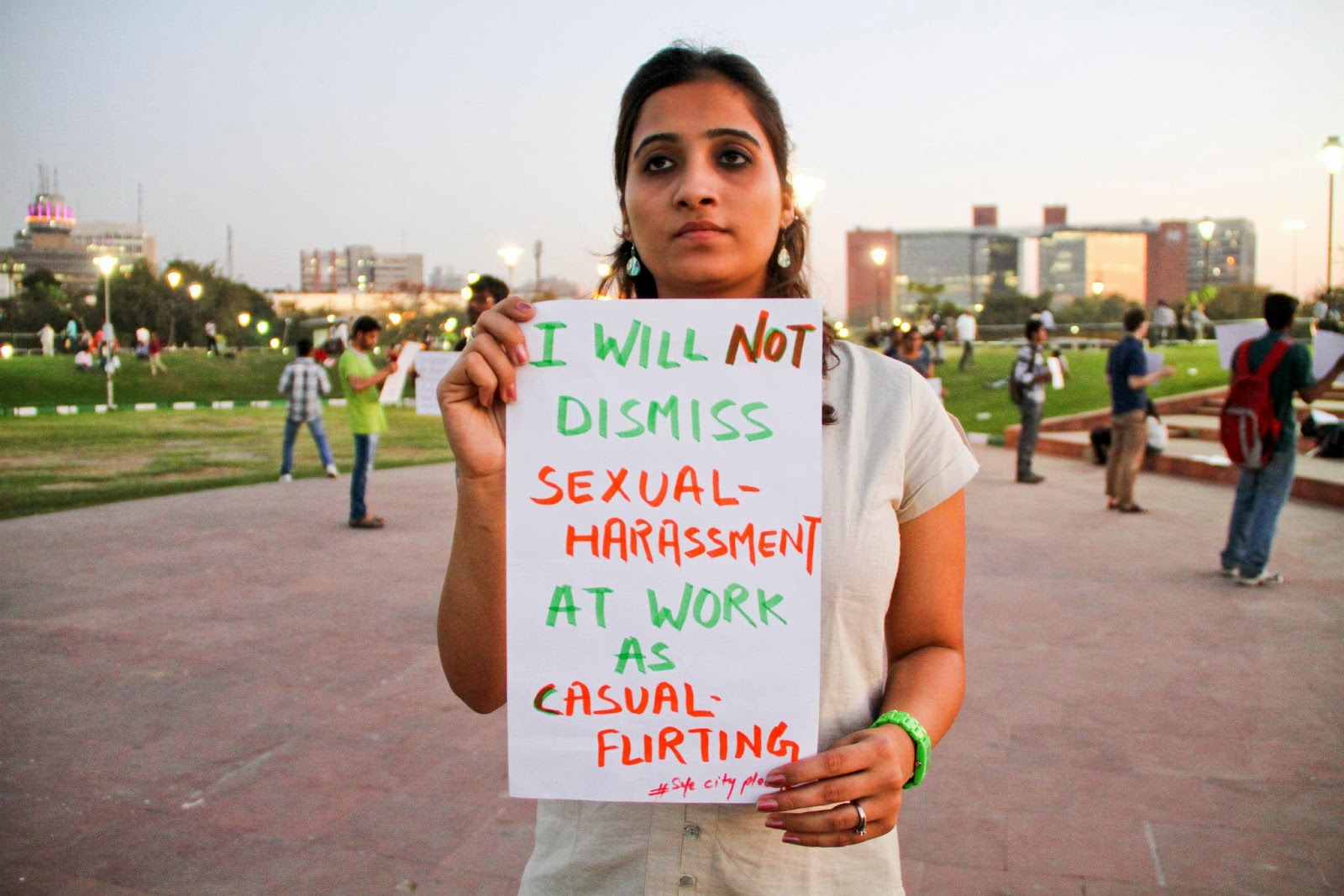
Ever thought that you could end up before an Internal Complaints Committee (ICC) on charges of sexual harassment just because you shared the 2014 comedy viral video ‘If boys got periods’ with your female colleagues? Pursuant to the introduction of 2013 Sexual Harassment of Women at Workplace Act, the country is witnessing a series of sexual harassment allegations that are not very well understood by the common office-goer. In fact, the Central Administrative Tribunal, which looks into professional misconducts by central government officials, has raised concerns about the environment of terror the new law has created in some circumstances as women employees are bringing charges against their male colleagues in increased numbers. The private sector is not immune to the phenomenon either – but very often instances of sexual harassment arise from lack of awareness and sensitivity. It is therefore, pertinent in the present scenario, for both the employers and every employee, men and women to understand what qualifies as sexual harassment.

PERSPECTIVE OF MALE EMPLOYERS/COLLEAGUES

The male employers or colleagues need to realise that in the current legal framework created to deal with sexual harassment at the workplace, your intention is immaterial.  Rather it is the effect of your behaviour on the individuals (looked from the perspective of a reasonable person) which is taken into consideration while determining the offence of sexual harassment at workplace. For instance, putting your arm around her waist when she is crying may amount to sexual harassment even if you merely intended to calm her down.

For understanding if your bona fide behaviour would make the woman feel uneasy or uncomfortable, ask yourself a number of questions. For instance, whether she is comfortable with your physical touch, whether you share an informal relationship with her outside work, whether she is positively responding back to your conduct out of her own free will, whether you are comfortable with somebody else behaving in the same manner with your family members or whether you will behave in the same manner with a male colleague before every action.

Apart from this, another important aspect for the employers to understand is that they cannot escape the provisions of law by taking the defence that there was assent of the woman in the sexual conduct. The word ‘unwelcomed’used in section 2(n) of the Act would mean that the woman did not initiate it or encourage it. But if she has given her consent because of the element of undue influence or otherwise, it might not mean that the conduct was welcomed.

Thus, it is advised that you should avoid any form of comment, request or prank which can be offensive or derogatory to the other person. In your itch to be tagged as ‘cool’ among your employees/colleagues or in your effort to create an informal, friendly or light environment, do not land into trouble by behaving in any inappropriate sexual way with a female colleague. This would definitely include sexual banter, sharing of content which refers to sex or describes sex that is not related to work and may be interpreted as unwelcome sexual gesture and any attempts to sexualize conversations or relationships between co-workers.

PERSPECTIVE OF FEMALE EMPLOYEES/COLLEAGUES

At the outset, women employees need to understand the phrase ‘Sexual conduct’ in order to identify when they are sexually harassed. Sexual conduct means the behavior or acts done specifically because of the gender of the intended person. Thus, comments because of the bad performance or caliber of the employee irrespective of its gender cannot be regarded as sexual harassment.  Similarly, if your employer has the habit of putting his hand on everyone’s shoulder (both male and female employees), then there might be no cause to worry.

However, it is extremely significant for a woman to understand the difference between sexual attention and sexual harassment. Sexual advances are a part of everyday social life. But it becomes harassment the moment that attraction starts causing trouble and discomfort for you. For instance, at a business tour, A confessed his attraction for B. Having cold reaction from B, he didn’t pressurize her again. This does not amount to harassment. But if A persists in her pursuit, asks B repeatedly to spend time with him alone or even comments on her relationship with her present boyfriend, it might amount to sexual harassment.

The moment you identify that the act is a discomforting sexual conduct and not a friendly gesture, bring the matter to the notice of the concerned authority. Even if such conduct is not serious enough to constitute a prima facie case (being the first instance of such kind), it will discourage the offender from doing any such acts in future with you or anyone else. You can know more about the law and various compliances related to it by taking up this course which is created by National University of Juridical Sciences. You can also learn about implementation of sexual harassment laws by taking up this course.

Download Now

Important issues in IPR & Competition law

0

Introduction

IP law seeks to create monopolies while competition law seeks to prevent monopolistic behaviour. On one hand it is necessary to create monopolies through IP law to incentivize innovation and creation, on the other hand there is a necessity to keep the markets competitive. Is there a conflict between IP law and competition law?

Competition Commission India

What is intellectual Property?

In the real world, we are mostly acquainted with the tangible property i.e. a kind of property which is physically present around us, can be seen & touched. We are the owners of that property, having a sole possession over it & thus our exclusive right to exclude other people from having or enjoying it. However, Intellectual property is another kind of property. It cannot be felt physically as it does not have a physical form. For example, a brand name such as Nike, Reebok, Titan watch, Samsung, Nokia, Apple, Sony, Philips, etc has a value, even though you cannot actually see the value associated with the word. The value lies in the brand recognition, which is an intangible concept.

These intangible assets could be brand reputation, franchisees, human capital, goodwill, consumer sentiments and the like. So, Intellectual property is one of the forms of intangible property which commands a material value, which can sometimes run in millions of dollars. It can be defined as an intangible creation of the human mind, usually expressed or translated into a tangible form that is assigned certain rights of property.

Examples of intellectual property include an author’s copyright on a book or article, a distinctive logo design representing a soft drink company and its products, unique design elements of a web site, or a patent on the process to manufacture chewing gum. However, intellectual property not having a physical form is also often susceptible to copying or unauthorized use by others. If all of my creations, which are results of hard labour or even investment of time and resources, can be used by others freely without my permission, I may not be interested in investing either time or resources. Hence, the state makes law to protect such creations and grant the creator a monopoly, usually for a certain period of time, over the creation. Hence, for the protection of these valuable creations of the human mind, we have legal protection so that we can exclude other people from using our intellectual property without our permission. This is the fundamental of intellectual property and the body of law surrounding this kind of property.

Intellectual Property Laws & their Significance

Intellectual property is the area of law that deals with protecting the rights of those who create original works. It is the primary source of encouragement towards investment in development of new technology, innovation and even the hard work that results in books, films, music, plays and many such other things that we cherish and benefit from. It covers everything from original plays and novels to inventions and company identification marks. The intellectual property laws protects the rights of the inventor, author, or creator. Intellectual property laws are generally negative in nature and so they only grant the holder of IP the ability to exclude third parties from infringing on their monopoly.

For example, the owner of a registered trademark has an exclusive right to use their mark in relation to certain products or services, and can exclude others from using that mark in relation to those products or services. No other person other than the owner of a registered trademark can exclude others from using that mark. These intellectual property laws vary from jurisdiction to jurisdiction, such that the acquisition, registration or enforcement of IP rights must be pursued or obtained separately in each territory or country.

Purpose of intellectual property laws

The purpose of intellectual property laws are to encourage new technologies, artistic expressions and inventions while promoting economic growth. When individuals know that their creative work will be protected and that they can benefit from their labour, they are more likely to continue to produce things that create jobs, develop new technology, make processes more efficient, and create beauty in the world around us.

What is competition law & Why is it needed ?

Competition law is a law that promotes or maintains market competition by regulating anti-competitive conduct by companies. An efficient market will only emerge when there are many players, when there are no barriers to entry in the free market & when the information flows freely in the market.

Competition law has some main elements like

  • Prohibiting practices that restrict free trading and competition between businesses.
  • Banning abusive behavior by a firm dominating a market or anticompetitive practices that tend to lead to such a dominant position. Practices controlled in this way may include predatory pricing, tying, price gouging, refusal to deal, and many others. All these practices are prohibited under the competition law.
  • Supervising the mergers and acquisitions of large corporations, including some joint ventures.

The need for competition law arises because market can suffer from failures and various players may resort to anti-competitive practices to create monopoly and distort the free market. Competition law makes it easier for businesses and consumers to challenge firms they believe are acting anti-competitively.

What happens if there is no competition?

  • Businesses that are not party to the anticompetitive agreement, will be adversely affected by the abuse of a dominant enterprise, & so they will have to cease operation as they will be priced out or otherwise driven out of the market.
  • Consumers dissatisfaction as they will have less choice, prices will be high and products may not be of good quality.
  • Enterprises which are consumers of goods and services in the course of their own business will also lose because the products they need to buy are denied to them or provided only on unfair terms like high prices, unfair payment terms, etc.)

Major drawback of not having a competitive and fair market is that the economy will not expand as new enterprises will be prevented from entering the market and existing enterprises will have no incentive to be innovative, creative or efficient.

Intersection of IP Law & Competition Law

Competition law and IP laws are important elements of the legal system that provides a framework for the modern economy. IP law seeks to create monopolies while competition law seeks to prevent monopolistic behaviour. On one hand it is necessary to create monopolies through IP law to incentivize innovation and creation, on the other hand there is an important necessity to keep the markets competitive. Is there a conflict between IP law and competition law?

IP laws and competition laws can be seen as complementary rather than conflicting because both the laws share the same fundamental goals of enhancing consumer welfare and promoting innovation. IP protection provides incentives for innovation and technological diffusion, which in itself is an important source of competition in the marketplace and therefore supports competition.

Lets examine the relationship of these two branches of law more carefully.

TRIPS in relation to IPR & Competition law

The Agreement on Trade Related Aspects of Intellectual Property Rights (TRIPS) is an international agreement administered by the World Trade Organization (WTO) that sets down minimum standards for many forms of intellectual property (IP) regulation as applied to nationals of other WTO Members. TRIPS Agreement provides scope for the enforcement of competition law vis-à-vis anti- competitive licensing practices and conditions.

Article 8.2 of TRIPS provides general recognition that appropriate measures may be needed to prevent the abuse of intellectual property rights by rights holders.

Article 31 of TRIPs provides for the grant of compulsory licenses, under a variety of situations, such as the interest of public health, national emergencies, nil or inadequate exploitation of the patent in the country, anti-competitive practices by the patentees or their assignees and overall national interests. However the drawback related with this provision is that the Agreements, however, do not restrict the freedom of members to determine the grounds for compulsory licenses other than those explicitly mentioned therein (with the only exception being semiconductor technology which can only be subject to compulsory licenses for public noncommercial use and to remedy anti-competitive practices). Diverse grounds are therefore to be determined by respective national laws.

Article 40 provides detailed conditions for the granting of compulsory licenses aimed at protecting the legitimate interests of rights holders.

“Members agree that some licensing practices or conditions pertaining to intellectual property rights which restrain competition may have adverse effects on trade and may impede the transfer and dissemination of technology.”

This sub-clause recognizes that licensing practices that restrain competition may have adverse effects on trade. This sub-clause permits members to specify anti-competitive practices constituting abuses of IPRs and to adopt measures to prevent or control such practices. Such practices may include exclusive grantbacks, clauses preventing validity challenges and coercive package licensing.

Nothing in this Agreement shall prevent Members from specifying in their legislation licensing practices or conditions that may in particular cases constitute an abuse of intellectual property rights having an adverse effect on competition in the relevant market.

Hence, as provided above, a Member may adopt, consistently with the other provisions of this Agreement, appropriate measures to prevent or control such practices, which may include for example exclusive grant back conditions, conditions preventing challenges to validity and coercive package licensing, in the light of the relevant laws and regulations of that Member.

Recognition of IPR in the competition law

The Competition Act, 2002 in India recognizes the importance of IPRs such as patents, Copyrights, trademarks, geographical indications, industrial designs and integrated circuit designs. Also, Section 3 of the Competition Act prohibits anti-competitive agreements, Section 3(5) lays down that this prohibition shall not restrict “the right of any person to restrain any infringement of or to impose reasonable conditions, as may be necessary for protecting any of his rights” enjoyed under the statutes relating to the above mentioned IPRs. Hence, this clearly implies that unreasonable conditions imposed by an IPR holder while licensing his Intellectual property rights would be prohibited under the Competition Act.

Relationship of Competition Law and Intellectual Property Law

Competition law maximizes social welfare by condemning monopolies while intellectual property law somehow also does the same by granting temporary monopolies. The rationale behind this approach is that the intellectual property law should provide economically meaningful monopolies. Otherwise, competition law which by itself does not condemn the mere possession of monopoly power, but rather certain exercises of or efforts to obtain it, might be allowed to interfere with the monopoly. Hence, there should be reasonable exercise of the monopoly power in order to protect the consumer’s interest, otherwise competition law would surely hinder the practices of the monopoly market.

Reference-

http://www.abhinavjournal.com/images/Commerce_&_Management/Feb12/5-%20Silky.pdf

http://ictsd.org/i/publications/11376/

http://ssijmar.in/vol2no1/vol2no1.11.pdf

International Journal in Multidisciplinary and Academic Research (SSIJMAR)) Vol. 2, No. 1, January-February (ISSN 2278 – 5973)

http://www.law.ed.ac.uk/ahrc/script-ed/vol7-1/kumar.asp

Download Now

The Sad State of Consumer Forums in Delhi

2


mallet (1)

The state of the consumer forums in Delhi is so bad that consumers try to avoid approaching the Consumer Courts in case of any grievance and advocates refrain from taking up Consumer Rights Violation Cases.  Officers and the staff are blamed by the public  for the delay in deciding cases. What are the ground realities in these consumer forums? Is attitude of the officers the cause of  time lag in consumer forums? In an endeavor to find out the answers to these question, the author stopped over at all the 10 District Consumer Forums of Delhi and here’s what she found:

Picture yourself working in a miniscule compartment with rats jumping over the broken desk, surrounded by stacks of files and without any basic amenities like drinking water in a city where summers have an average temperature of 36oC. This is the depiction of a District Consumer Forum in Delhi. Hon’ble Dr.Arijit Pasayat, former Judge, Supreme Court of India recognised lack of infrastructure as well as non-filling up the vacancies in time as the two major reasons for non-disposal of cases in the consumer fora in time. 

Shri H.R. Bhardwaj, the then Minister for Law and Justice, while addressing the issue in a conference organized by the NCDRC in 2009 had expressed his concern and said, “sufficient resources are not being given, and this is the tragedy of justice in our country that access to justice has been given in a big way, but the infrastructure, and judicial manpower has always been lacking. Unless you employ more judicial manpower, you will meet with the docket explosion in this country.”

Substandard Infrastructure

 “The drinking water area nauseates me”, said a lawyer in East Delhi District Forum. Most of the furniture is dilapidated, ceilings have water seepage, wooden planks have been put to prevent rats from entering the cabins and there are uncongenial provisions for drinking water and public lavatories. This is disheartening for both the consumers who approach these fora in pursuit of justice as well as the officers and staff working in such fora. A cobwebbed cell without exhaust fans and insufficient racks is provided in the name of Record Room, as a result of which the files are not properly arranged and have to be kept in bundles wrapped in cloth. The decided cases, therefore, cannot be traced out without avoidable loss of time. In few forums, photocopy machine has not been working for a month or two, consequently, registered copies of notices, orders and judgements cannot be sent and hearings have to be postponed. This defeats the very purpose of these consumer fora which have been setup to provide inexpensive, speedy and summary redressal of consumer disputes.  “Filing a complaint in forum seems like a second punishment,” expressed a litigant at West Delhi District Forum.

Inadequate Manpower

While the infrastructure problems persist for other fora, the two lately renovated fora are not plagued by them; however the impediment of inadequate staff hampers their efficiency as well. Out of ten sanctioned posts, the fora have six employees on an average, most of whom are either on contract basis or privately appointed. Due to dearth of stenographer, typist without technical skills of short hand typing is appointed in few fora. This renders it unwieldy to prepare orders on time and thus causes delay in disposal of cases. And ultimately it is the consumers who are agonized. As the staff appointed is accountable to the Department of Consumer Affairs, it becomes difficult to take any action against them in case of any default. A lawyer in South West Delhi District Forum expressed his abhorrence saying, “This is a personal case otherwise I detest coming to the consumer fora.”

Despite several complaints to the Department, for problems of infrastructure and inadequate manpower, no action has been taken yet. In certain fora, the engineers have been sent by PWD who have taken measurements many times but either no infrastructural changes have been made till now or only the president’s rooms has been renovated but the waste is disposed off at the entrance of the fora and in the absence of sweeper and inaction of PWD it remains dumped there.

 Root Cause and Suggestions for obviating the problem

Most surprisingly, the Central and State Governments, National and State Consumer Dispute Redressal commissions and the Department of Food, Supplies and Consumer Affairs are not incognizant of these facts. The Government of India had released Rs. 70 lacs, under the ‘One Time Grant of Financial Assistance Scheme’ in 1995 for this very purpose. But except the two fora which have been renovated lately, the district fora have not had any major infrastructural or human resource changes since inception. Time and again the central government and the Department of Consumer Affairs, GoI have sought information from all States/UTs regarding requirement of funds so that minimum level of facilities at each consumer forum required for their uninterrupted functioning can be made available. They have been providing financial aid to various states under One Time Grant scheme (2004-05), Integrated Project on Consumer Protection (IPCP) (2005-08), Strengthening Consumer Fora (SCF) (2008-12) and otherwise but no assistance was provided to Delhi Consumer Fora under the same. Necessary steps by the state government and the state commission are required to be taken in this regard. Moreover, additional sanctioning of posts is needed as was suggested in Bagla Committee Report. To have effective control over the functioning of the the District Fora, suggestion about entrusting the President of the State Commission with the power of appointment of Officers and staff (except the President and Members) of the district forum has also been proposed many times.

Conclusion

Inspite of these impediments, Delhi District Consumer Fora have disposed of 95.68% cases as on 30.09.2011 since inception which is commendable and once the basic facilities are provided keeping in view the dignity and status of the persons presiding over the fora, the consumer forums will be able to serve the very purpose of establishment of these fora.


Standard of Infrastructure in Delhi District Consumer Fora
(as on July, 2013)

Courts Central Delhi District Forum East Delhi District Forum New Delhi District Forum North Delhi District Forum North-East Delhi District Forum North-West Delhi District Forum South Delhi District Forum South Delhi-II District Forum South-West Delhi District Forum West Delhi District Forum
Infrastructure(as on July, 2013)
Area Of The Forum Sufficient Deficient Deficient Deficient Extremely Deficient Deficient Deficient Deficient Extremely Deficient Extremely Deficient
Seating Space in Courtroom Sufficient Deficient Deficient Sufficient Deficient Deficient Deficient Deficient Deficient Deficient
Facility for Drinking Water Average Extremely Below Average Average Not Available Extremely Below Average Not Available Extremely Below Average Extremely Below Average Extremely Below Average Extremely Below Average
Washroom for Officers And Staff Average Below Average Average Below Average Extremely Below Average Average Extremely Below Average Extremely Below Average Below Average Extremely Below Average
Washroom For Litigants And Lawyers Average Not Available Average Below Average Not Available Not Available Not Available Not Available Not Available Not Available
Furniture Above Average Extremely Below Average Above Average Extremely Below Average Extremely Below Average Extremely Below Average Extremely Below Average Extremely Below Average Below Average Extremely Below Average
Air Conditioner Available Not Available Available Not Available Not Available Not Available Not Available Not Available Not Available Not Available
Record Room Not Available Extremely Below Average Below Average Not Available Extremely Below Average Below Average Extremely Below Average Extremely Below Average Not Available Not Available
Racks Adequate Inadequate Adequate Inadequate Inadequate Inadequate Inadequate Inadequate Inadequate Inadequate
Computer Adequate Adequate Adequate Adequate Adequate Adequate Adequate Not Installed Yet Adequate Adequate
Lift Available Not Required Available Not Required Not Required Not Required Not Available Not Available Not required Not Required
Hygiene Average Extremely Below Average Average Below Average Extremely Below Average Below Average Extremely Below Average Extremely Below Average Below Average Below Average
Ceilings Above Average Extremely Below Average Above Average Below Average Below Average Below Average Extremely Below Average Extremely Below Average Below Average Below Average
Photocopy Machine Working Not Working Properly Working Not Working Working Not Working Working Not Working Properly Working Working
Transportation And Connectivity Above Average Above Average Average Above average Below Average Below Average Average Average Below Average Average
Parking Available Not Available Available Available Not Available Not Available Not Available Not Available Not Available Not Available


Minimum staff for District Consumer Forums as per the Bagla Committe Report

Minimum staff for District Consumer Forums as per the Bagla Committe Report
Private Secretary for President 1
Registrar
(in the scale of Superintendent)
1
Court Master 1
Stenographer 1
U.D.C. One UDC for every 250 pending files
L.D.C. One LDC for every 250 pending files.
Receipt & Despatch Clerk (LDC) 1
Record Keeper (LDC) 1
Accounts Knowing UDC 1
Peons 4
Sweeper 1
Despatch Rider 1
Chowkidar 1


Download Now

Corporate deposits under Companies Act, 2013

0

disinvestment_505_021512044718_022812110540_030112055322

This article is written by Pratyush Pandey, a student of NLU Delhi.

Finances are the prime requirement of any business. Equity firms, financial institutions and venture capitals are few of the sources for raising finances. These sources require the company to handover some control of the company to the users, which hinders the freedom of the company. Companies prefer to raise the capital from the general public. Since the fixed deposits in a company give better returns than those in a bank, it is a win-win situation for both.

Company deposits are governed by Chapter V of Companies Act 2013 (Acceptance of Deposits by Companies) read with Companies (Acceptance of Deposits) Rules 2014 (hereinafter referred to as Rules). These rules supersede the Companies (Acceptance of Deposits) Rules 1975.

The provisions relating to company deposits shall not apply on banking companies, non-banking financial companies, housing companies or any other company specified by the Central Government.

In this article, we shall briefly discuss the changes in key provisions dealing with company deposits from the old to the new Act. Companies Act 2013 deals with the subject in more detail with special emphasis on investor protection.

DEPOSITS

Money received by a company either through a deposit or loan or any other form is termed as a deposit. Certain exceptions to the definition were provided in the Companies (Acceptance of Deposits) Rules 1975. Companies (Acceptance of Deposits) Rules 2014 have added a few more exceptions, few of which are discussed below.

(i)                 The amount received after a subscription offer for securities is made shall not be considered as deposit if the securities are allotted within 60 days of its receipt or the money is refunded within 15 days after completion of 60 days.

The investors used to face a hard time getting the securities they had invested in. The accountability of the company has increased since the investors now have statutory protection.

(ii)               The amount raised by issuing bonds or debentures (whose amount shall not exceed the market value of assets) must be secured by a first charge or a charge ranking pari passu with the first charge on any assets (excluding intangible assets) or bonds or debentures which must be compulsorily convertible into shares of the company within five years for getting exemption under the definition of deposits.

This further restricts a company from getting away with subsequent charges. It recognizes debentures convertible shares of the company thereby, making investment more secure.

(iii)             The amount received by a company in the course of, or for its business purposes as an advance for the supply of goods or provision of services must be appropriated within 365 days failing which it becomes refundable. On the expiry of 15 days from the date the amount becomes refundable, it shall be deemed as a deposit.

The accountability of the company is further increased for amount it borrows in the name of business purposes. However, there is ambiguity in this rule as to what shall be considered as ‘appropriation’ of the amount received.

As to the deposits accepted prior to Companies Act 2013, the company shall submit to the Registrar of Companies the details of the deposits and the interest due which the company is supposed to repay within a year from commencement of Act (1st April, 2014) or a year from the time the payments are due, whichever is earlier.

If it is proved that the intention behind accepting the deposits was to defraud the depositors, every officer of the company who was responsible for the acceptance of such deposit shall be personally responsible without any limitation of liability for all or any of the losses or damages that may have been incurred by the depositors.

COMPANY OBLIGATIONS

Companies Act 2013 requires a public company to have a net worth of not less than INR 1 billion or a turnover of not less than INR 5 billion for accepting public deposits as against Companies Act 1956 which required a net worth of only INR 10 million. The public company is also required to obtain prior consent in the form of a special resolution for accepting deposits which must be submitted to the Registrar of Companies.

This is a blow to the small and medium enterprises who will not be able to take public deposits due to the high financial requirements which need to be met.

The Companies Act 2013 and the Companies (Acceptance of Deposits) Rules 2014 attempt to make investment by the general public more safe and secure. The various provisions which obligate a company ensure the money invested by the public is not lost as it can be converted into shares. The idea is to create a more investor friendly atmosphere in the corporate world and to reduce cases of fraud played on the investors by companies.

Download Now

Reasons behind unnecessary prolongation of execution of money decrees in India

0
transfer of case

Tulsa-family-court


This article is written by Lovisha Aggarwal, a student of VIPS, Delhi.


“…….that the difficulties of a litigant in India begin when he has obtained
a decree because the same is hardly executed.”

                        -Privy Council (Court of Wards vs. Maharajah Coomar Ramaput Singhad, 1872)


Often people in our country complain about the large number of pendency of cases in the Indian courts.  Everyone seeks an early justice in the form of a judgement by the court. However, the journey till the court’s judgement is just the half way. Getting such decree executed is equally cumbersome. The process of execution of a decree under the Indian law is similar to the process of suit. The Judgement Debtor (the person against whom the decree of payment of payment is to be sought) takes undue advantage of such procedural technicalities and intentionally prolongs the execution. As a result, the Decree Holder (the person in whose favour the decree has been passed) loses confidence in the judicial system.

Various instances which delay the execution of decree for payment of money by the Judgement Debtor and the provisions regarding that under The Code of Civil Procedure, 1908 are:

  1. Non payment of the decree amount despite having the means to pay

A Judgement Debtor is under the legal obligation to pay the decree amount to decree holder. If however, he fails to do that despite having the means to pay, then his property may be attached or sold and the proceeds be handed over to the decree holder. He may also be detained in the civil prison in case of default. The Court sometimes allows the judgment debtor to stay in the custody of an officer of the Court for a term not exceeding fifteen days so that he can arrange the decree amount. Notwithstanding all these provisions, the Judgement Debtor evades the payment under the decree either by using the procedural claptrap or otherwise.

  1. Non disclosure of assets

Disclosure of Judgement debtor’s assets for the purpose of attaching his property in case of non payment is vital.  The judgement debtor has the duty to orally inform the court of all its assets. However, if he fails to appear before the court, a warrant for his arrest is issued. If he doesn’t pay the decree amount in thirty days, the Court may order him to submit the particulars of his assets. In case of default, he may be detained in the civil prison for a term not exceeding three months. Still there have been many instances when the Judgement Debtor absconds and avoid the disclosure of particulars of assets.

  1. Intentionally avoiding the payment

The judgement debtor many times, leaves the country or dishonestly transfers or removes his property or conceals the particulars of his assets from the court to avoid the payment.  In such cases, he may be arrested and detained by the court.

  1. Insolvency

Insolvency refers to the inability of a debtor to pay his debts. When in case of non payment, the judgement debtor is arrested, he sometimes declares himself to be insolvent. He has to furnish security to the court in that case pursuant to which he is released from the custody. If after submission of security, he doesn’t appear in the execution proceedings, orders for his detention may be made. His property will vest in the Official Assignee or the Receiver who will then sell the property at reasonable price and distribute the sale proceeds.

  1. Part Payment

Sometimes, the Judgement Debtor merely pays some decree amount instead of making the full payment. In this case, the decree holder may receive the amount towards the interest first, then towards the costs and then towards the principal amount due under the decree. The interest has to be paid only on the remaining amount.

  1. Stay on execution proceedings

Although an application for execution of decree can be filed only after the time for filing of an appeal against the decree that is ought to be executed has lapsed. But if the judgement debtor goes in appeal after the limitation period, he can apply for stay on the execution proceedings. The property or person already seized or arrested will be restored or discharged, in this case, till the result of the appeal is pending.

  1. Death of Judgement Debtor

The decree amount can be recovered from the legal representative of the deceased judgement debtor in case of his death. However, such legal representative will be liable only to the extent of the property of the deceased which has come to his hands being his son or descendant under Hindu law. Attachment and sale of any such property for execution is also permitted.

  1. Postponement of sale

The Judgement Debtor can request the court to postpone the sale of his immovable property to enable him to raise amount of decree by mortgage, lease or private sale of such property. A specific time period for the same is defined by the court.  Such provision for postponement is often misused by the Judgement Debtors for delaying the execution proceedings.

  1. Objection to the attachment of any property

The judgement debtor has the option of objecting the attachment of any property for execution of decree, in which case the attached property will be released or the sale of such property will be stayed till the objections are adjudicated. This provision under the Code also aids in delaying the execution proceedings.

      10. Liability to pay more than one person

Sometimes the same property is attached in execution of decrees of more than one court or there are more than one decree holders against the same judgement debtor. In the former case, the court of highest grade can attach and sell such property. The other courts cannot attach the same. In the latter case, the assets of the judgement debtor will be distributed among all such persons. In such cases, some of the decree holders fail to realise the full or satisfactory decree amount because of liability of the same judgement debtor towards a number of decree holders.

     11. Exemptions from arrest

A number of persons are exempted from being arrested for the execution of decree like members of legislative bodies, judges and magistrates while going, presiding or returning from their courts and women. Apart from this a judgement debtor can be released from the custody before expiration of detention period on the ground of serious illness. Such legal provisions are frequently used by the Judgement Debtors for adverse purpose.

 Conclusion

Thus, despite comprehensive provisions and strict measures for execution of a decree for payment of money in case of default by the Judgement Debtor have been laid down under the Code, the same is escaped by him through unnecessary appeals, applications, objections, non appearance, non disclosure of assets or any other like method. It is not only the Judgement Debtor who is at fault for prolonged execution proceedings. The courts, in practice, attribute more importance to civil suits over execution of decrees. It should receive more attention of the courts. Supervision by District Judges over the execution among subordinate courts should be exercised and application for stay on execution should be timely adjudicated. Furthermore, a specific day in a week or a separate court for execution of decrees can be established for expeditious execution.

These atrocities faced by the litigants have not gone unnoticed by the Courts. The Apex Court in the 2013 case of Satyawati Vs. Rajinder Singh And Anr., condemning the practice adopted by Judgement Debtors observed, “The Decree Holders must enjoy the fruits of the decree obtained by them in an expeditious manner.”However, no measures to facilitate the same have been adopted yet. Thus, stringent and specific provisions for execution of decrees in an efficient and expeditious manner is the need of the hour to deliver intended justice, otherwise the whole judicial system becomes futile.


Download Now

Work From Home- Cyber Crime Scams….Are you a Victim?

22

wfh

The Work from Home concept is very attractive for most people, as the advertisements offer huge sums of money for a few hours of simple work. But would you really be paid well for doing nothing much! If it is too good to be true, then it probably is not true!

The modus operandi is usually attractive advertisements on websites, public places and social media. The application procedure involves filling up a form with all your details and you have to purchase a welcome kit. If you refer more people then you get paid a percentage for each reference that materializes, so basically you make other people also fall prey to the scam.

The scope of work is mostly like:

  • Envelope stuffing (mailing programs)
  • Assembly work
  • Gifting programs
  • Email processing
  • Rebate processing
  • Repackaging
  • Payment processing
  • Jobs that ask for money to hire you
  • Businesses that don’t have an evident product or service.

If you are a victim of a work from home scam, then cyber laws has recourse for you.If the scammers use your personal data to make fake profiles and commit any crimes, then they are liable under Section 66-D for Cyber Personation, which is punishable with imprisonment upto 3 years and a fine.

https://lawsikho.com/course/diploma-cyber-law-fintech-technology-contracts
click above

The scammers are liable for Identity Theft under Section 66-C if they use your password or any other unique identification feature.

The scammers are liable under Section 43 of the Information Technology Act makes unauthorized access an offence, and Section 43 A makes a Company liable for breach of privacy and confidentiality by payment of compensation to the victim for failure to protect data.

The data that you provide to the scammers is priceless. Along with your personal information they have your credit card data too and misuse the same. When you purchase the welcome kit you may not be directed to a safe payment portal. This renders you vulnerable credit card frauds. And your personal data is sold to marketing companies without your consent.

A leading case of this type of scam was when the Cyber Crime Cell of Crime Branch, C.I.D., Mumbai Police arrested a person by name Sripathi Guruprasanna Raj, aged 52 years old, who is the Chairman and Managing Director of Sohonet India Private Ltd., a company based in Chennai. Many complainants based in Mumbai had complained to the Cyber Crime Investigation Cell, that the said company has duped them each for Rs. 4,000/- and Rs. 6,000/- by promising them with monthly income of Rs. 15,000/-.

Cyber Crime Cell of Crime Branch, C.I.D., Mumbai Police have arrested a person by name Sripathi Guruprasanna Raj, aged 52 yrs who is the Chairman and Managing Director of Sohonet India Private Ltd., a company based in Chennai. Many complainants based in Mumbai had complained to the Cyber Crime Investigation Cell, that the said company has duped them each for Rs. 4,000/- and Rs. 6,000/- by promising them with monthly income of Rs. 15,000/-. The company had through its website having URL http://www.sohonetindia.com and through various attractive advertisements in the news papers as well as by holding seminars in five star hotels, in various metropolitan cities like Mumbai, Delhi, Kolkata, Bangalore etc. had lured the various computer literate people with attractive schemes named Instant Treasure Pack (ITP) and Green Channel The company then asked the interested people to register with their company for which they charged the registration fees of Rs. 4,000/- which was later increased to Rs. 6,000/-. The company CMD, Mr. Raj promised the people so registered that they would be provided with the data conversion job which would enable them to earn Rs. 15,000/- per month. The company then collected huge amount from the gullible computer users. Some of the users were provided with the job work whereas others were not even provided the job work (data conversion job) assured to them. The users who worked hard and completed the assignments did not receive any payment for the same, and when they tried getting in touch with the company, they received no response.

Works from Home scams are aplenty in India and scammers take advantage of the high rate of unemployment in India along with the house wife system which is popular in India.

A victim must make a complaint in the prescribed format to the Adjudicating Officer, DIT, Information Technology Act, 2000.

Above article is Written by:

Advocate Puneet Bhasin, Cyber Law Expert, Cyberjure Legal Consulting

www.cyberjure.com

[email protected]


Download Now
logo
FREE & ONLINE 3-Day Bootcamp (LIVE only) on

How Can Experienced Professionals Become Independent Directors

calender
28th, 29th Mar, 2026, 2 - 5pm (IST) &
30th Mar, 2026, 7 - 10pm (IST).
Bootcamp starting in
Days
HRS
MIN
SEC
Abhyuday AgarwalCOO & CO-Founder, LawSikho

Register now

Abhyuday AgarwalCOO & CO-Founder, LawSikho