Download Now
Home Blog Page 1843

In such a haste – the system of fast track courts in India

1

When the Delhi Gang Rape occurred in December 16, there was uproar. But, it wasn’t the first brutal crime against a woman in this country and it wasn’t even the case that it would be the last. We are riddled in guilt and shame with similar reports coming out time and again even when the Delhi case was tried in a Fast Track Court for about nine months before giving a verdict of guilty and sentencing the convicts to death penalty. This case is far from over yet. The sentence is likely to be appealed in the High Court.

India Gate Protest
Protesting civilians at the India gate © Ramesh Lalwani, via commons/flicker

The incident in Delhi was different from the others because the government was confronted and many uncomfortable questions were asked. There were protests occurring in this country in every way a common person would possibly do. There were heated discussions in the Parliament. After this the Delhi government announced that the trial of the case will be done is going to be in a Fast Track Court, ensuring speedier justice to the victim.


Fast track courts in India:

Fast track courts were set up first in India in 2001. In the report of Department of Finance, it was stated that the proposed Fast Track courts would dispense long pending Sessions cases and also help with the cases of vast under trial prisoners in the country who languish in court waiting for their case to end, in some cases the number of years the under trial prisoners spend in the courts are more than the maximum punishment they would get if convicted.A fast track case is heard by the court on a day to day basis. These courts were funded by the Central government till the year 2011 after which it stopped the funding. Presently, setting up and functioning of Fast track courts is entirely dependent on the State government and these courts are administered by the High Courts. The numbers of these courts have come down due to financial problems even when the number of cases dispensed by them was high.


Which cases go in Fast track Courts?

There are no guidelines as to particular cases that should be fast tracked. It has been observed that cases that get much media attention are declared to be tried before the fast track courts. Many intellectuals bash up this bias against other cases as it might be against the fundamental right to equality which is guaranteed by our constitution. When a case is fast tracked because of public pressure, the case tends to take more than average time in a Fast Track Court because there is extra caution while performing each step and these is lesser chance of cutting corners. A High Court can declare which case would be tried in a Fast Track Court.


Designating existing courts as fast track courts for special cases:

If the judgement of the gang rape in Delhi comes out in September as expected, it would be be one of the faster cases to be decided as fast tracking a case does not mean dispensing with the system of a criminal procedure, the court hears the case on a day to day basis and there are few adjournments in this process. But this court was drawn from an existing Sessions Court and it does not seem fair to transfer the other cases to the already backlogged system. The cases which are unable to garner such attention are looked at suspicion with the higher courts. It is true that the High Courts are skeptical of the judgments of these courts because of two main reasons; one, that the procedure might not have been followed properly and second, that the ad-hoc judges who are sometimes appointed might not invite confidence from the higher judiciary.

Fast tracking a case is a good method to remove backlogs, but, each of these cases is more than just numbers. There is no codified system to send cases to these courts and this can lead to arbitrariness. Even though the achievements of these courts have been credible and as these courts are also subject to the higher courts, there are proper sanctions to these courts they would work properly only when they are not chalked out of the existing batches of Courts as is done by some states.


Some notable fast track cases:

Best Bakery Case

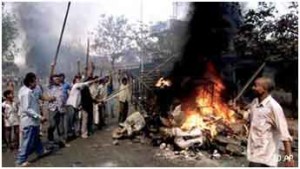
This case could be one of the examples of how fast tracking a case can have serious repercussions if the procedure and evidence are not taken properly by the court in the beginning of a case.  14 people were burnt alive in one of the post Godhra riots in Gujarat in the city of Vadodara in 2002. The case was tried in a Baroda Fast Track Court No.1 which amidst allegations of faulty procedure acquitted the 21 accused. This trial was just 44 days long. The court blamed the police for not investigating the case properly and also due to the fact that many witnesses retracted their statement in the court. Even the High Court upheld the verdict and it was not till the National Human Rights Commission intervened and petitioned to the Supreme Court that the Re-trial was ordered by the court.
 
Gujarat Riots
Gujarat Riots- Photo taken from here: Deutsche Welle


When the verdict by the Bombay High Court came in July 2012, upholding life imprisonment of four people and acquitting five, many people were left dissatisfied. Timely investigation is of great essence and due to the lapses in the conduct of the police as well as the Fast Track Court; the Supreme Court observed that there has been gross miscarriage of justice.In a rare instance, the SC had sentenced prime witness Sheikh to one year in prison for perjury in this case.


Jessica Lal Murder Case

When model and part time waitress Jessica Lal was killedby gunshot wound in 1999 in a party in South Delhi, it would have been an easy investigation, but for the fact that the accused was the son of a powerful politician.During the trial the three critical eye witnesses recanted earlier statements made to the police and twenty-nine witnesses of lesser importance did the same. One of theeye witnesses, Shyan Munshi, changed his testimony so completely that hisrevised statement was used as evidence by the defense.

 
Jessica Lal
File photos of Manu Sharma and Jessica Lal, Sourced from here:Outlook India

On February 2006, Sharma and other defendants were acquitted leading to a huge outcry. There was petition to the then President as well as the Prime Minister by the public. When the decision of the lower court was appealed, the High Court took the matter urgently and heard the case without allowing many adjournments. Though this is not a case which was Fast Tracked officially, many newspapers reported that the case has been fast tracked, referring to the nature of the events. This case explains why every court can be a fast track court in India and making a special court for controversial cases seems like giving a placebo to angry citizens.


26/11 Mumbai case

When on 26 November, 2008, Ajmal Kasab and nine other gunmen attacked various places in Mumbai killing 166 people; he was the only one who was caught alive by the police. There was overwhelming evidence of his guilt – including CCTV footage of him with the weapon in the CST station, his confession as well as testimony by the people who survived the attack, DNA match with the articles on the vessel hijacked by the terrorists and he was given a fair trial by following the proper mechanism of the judicial system which took some time to reach a verdict.

 
ajmal-kasab
Kasab pictured carrying an automatic rifle as he enters the station- credits AFP: Photo sourced from Radio Australia

The case of Ajmal Kasab, because of the nature of the offence (waging war on the nation, murder of 166 people), was put on Fast Track Court in January, 2009. The prosecution filed a charge sheet running into 11,000 pages. He was charged of at least 86 offences and was found guilty to most of them by the court on May 6, 2010 and sentenced to capital punishment. This case went into appeal to the High Court, then the Supreme Court and a Mercy Petition was applied for and rejected by the President of India. The lone surviving terrorist was hanged four years after the gruesome incident.


Is this course affecting the procedure of natural justice?

One more similarity one would find in all these cases is that in each of them there was extreme pressure on the judiciary as well as the executive to do their job. Each and every document was being followed up by thousands of interested people. Fast Track Courts also have been known to get unrealistic targets as compared to normal judicial process. According to the Department of Justice, “As per the latest available information received from the High Court /State Governments, 32.34 lakh cases have been disposed off by these courts, out of 38.90 lakh transferred to these courts leaving 6.56 lakh cases pending for disposal.” After looking at this data a question comes into mind that how such high numbers are achievable by remaining within the principles of natural justice and whether these speedier disposals are at the cost of bypassing the proper route necessary for both the victim as well as the accused.

The long term problem of delay in deciding the cases can be checked by increasing the number of permanent judges by five times the present number. Senior advocate of the Supreme Court,  Mr. Colin Gonzalves has been quoted in the Voice of America as saying that the present number of judges in India is 12 per million people whereas in developing countries, it should be around 60 per million. Fast track courts are Sessions court with improved efficiency. They are a proof that the system can work when it chooses to. By increasing the number of Judges, our country can significantly decrease the chances of ‘delayed justice’ and rebuild the faith in the Indian Judiciary.


 

Download Now

When she is angry

0


Photo taken  from flickers/creativecommons © morning shadow

Rajni got married to Akhil in 2002. They both are from lower middle class families in a small town in UP. It was difficult to make ends meet with Akhil’s meager income as a tailor and there were constant fights among the two because of this. Akhil started despising to go home after work and started looking for excuses to stay away from his wife, who got infuriated further due to his conduct. One day when he went home particularly late, he saw his little daughter crying. His mother told him that his wife beat them up whenever she is in bad mood and also makes her do all the household work. When he confronted his wife about this, his wife left his home crying that he will be sorry. He was distraught but he also used those few days’ peace to work and even started entertaining thoughts of expanding his business.

One week later police came to his shop and told him that his wife has filed an FIR against him for cruelty and harassment. He could not convince them that neither he nor his mother ever hit his wife; instead his mother was ill treated by Rajni. He was put in jail and he had to remain there for eight months before he was let out by the court as he had no money for bail or a good lawyer. His mother, who had to stay in Jail for a week, seemed to have aged a decade more in this period. His wife had also filed for divorce during this period. He now worries whole day as to how will he provide maintenance to his ex-wife and pay for education of his child whom she doesn’t want to raise.

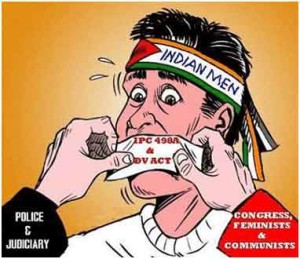
This is a situation in many households of India these days. There are two extremes of society; one which is majority is where women are not treated with respect and dignity in a household, where birth of a girl child is not considered good omen sometimes leading to female feticide or infanticide; and still there are other women, although perhaps in minority,who misuse the power given to them by the systemand they are not shy to use unfair means for getting even in a personal vendetta.

Let’s take a look at the laws that give enormous power to women – where their word is enough to put someone behind bars.


Current Women Centric Laws:

Section 498A IPC:

This section says that if husband or relative of a husband of a woman subject her to cruelty, they shall be imprisoned for a term up to three years and shall also be liable for fine. This provision was added to the Indian Penal Code in 1983 to protect women from cruelty by her husband and his family.The term cruelty has a wide scope so that the perpetrators are not let free due to insufficient protection of the law.There are many cases where courts have observed that the complaints by the victims are false and are made for some personal reasons.

What can be cruelty?

Cruelty, that is a criterion for penalty under IPC Section 498A, means harassment of a woman with a view to force her or any related persons to meet any unlawful demand for any property or any valuable security. Cruelty can be:

a. Mental cruelty

b. Physical Cruelty

Cruelty can be as vague as cruelty due to deprivation. Inability to provide for basic needs (irrespective of the fact that the condition is same for the family) or false allegations are also a few types of cases that can come under this law.

This offence is non bailable, that means a person might get caught off guard on a false complain and then there’s a chance of loss to his job as well. The offence is also non compoundable, which means that if later the woman changes her mind, and wants to reconcile, the case will still go on in the court because such crime is against the society at large.

There have been many reports of false cases by use of this section. In the case of Sushil Kumar Sharma v. Union of India and others, the Supreme Court of India agreed with the view that there are cases where the provisions of the law are being misused and expressed the desire that legislature should consider making provisions to stop this menace.

The Supreme Court observed, “But by misuse of the provision a new legal terrorism can be unleashed. The provision is intended to be used a shield and not assassins’ weapon. If cry of “wolf” is made too often as a prank assistance and protection may not be available when the actual “wolf” appears. There is no question of investigating agency and Courts casually dealing with the allegations.” 

Abuse of law

The court also said, “It is to be noted that the role of the investigating agencies and the courts is that of watch dog and not of a bloodhound. It should be their effort to see that in innocent person is not made to suffer on account of unfounded, baseless and malicious allegations.”


The Protection of Women from Domestic Violence Act, 2005

Section 3 of the PWDVA defines domestic violence as “any act, omission or commission or conduct” that:

(a) Harms or injures or endangers the health, safety, life, limb or well-being, whether mental or physical, of the aggrieved person or tends to do so and includes causing physical abuse, sexual abuse, verbal and emotional abuse and economic abuse; or

(b) Harasses, harms, injures or endangers the aggrieved person with a view to coerce her or any other person related to her to meet any unlawful demand for any dowry or other property or valuable security; or

(c) Has the effect of threatening the aggrieved person or any person related to her by any conduct mentioned in clause (a) or clause (b); or

(d) Otherwise injures or causes harm, whether physical or mental, to the aggrieved person.

It defines that an aggrieved person can only be a female. Such favor towards women in the absolute sense can allow her false statement to land a person and his family in jail.  This Act assumes that men are perpetrators in cases of Domestic Violence Act. A complain by the woman is considered primarily true.


According to SAVE organization, these laws are not gender neutral and cause grave misery for the affected man. One of the major cause of such situation is broad definitions of domestic “violence” – Civil definitions of domestic violence include ill-defined and non-violent actions such as causing “annoyance,” making your partner “afraid,” and engaging in “harassment.”


Dowry Prohibition Act,1961

In an absolutely bizarre case, a two month old toddler Zoya was granted anticipatory bail because there was a dowry harassment report filed against her family members which even implicated her name. Even if the fact that the name of baby was put in an application, there should have been some verification of the applicant. How can a complaint letter naming a two-month-old baby be blindly considered in this manner?


Both taking and giving dowry is illegal- picture © of The Hindu

In this Act, the Burden of proof is on the defendant and not the complainant. That means instead of the victim substantiating her complain the accused has to prove somehow that he has not committed this crime. There is an assumption of the person being guilty whereas in other type of cases victim has to prove the crime.

8-A. Burden of proof in certain cases- Where any person is prosecuted for taking or abetting the taking of any dowry under Sec. 3, or the demanding of dowry under Sec.4, the burden of proving that he had not committed an offence under those sections shall be on him.


Rape law

The punishment of this crime is rigorous imprisonment for seven years to imprisonment to life and fine.

Even after commencement of Criminal Law Amendment Act in April 2, 2013, there were still no checks on false complains. When a woman alleges rape by filing an FIR, the person who is accused is jailed. By the amended law, the crime is non bailable in nature. In March this year, there were reports of a man who committed suicide in Bhopal because he was falsely charged of this crime. He languished in jail for three months before the truth came out and he was allowed to go home. It was found out that he had lent some money to the “victim’s” husband and to avoid repayment, the wife had alleged that she was raped.

It has been reported in India Today that Delhi High Court recently observed  rape law was often misused by women as weapon for “vengeance and vendetta” to harass and blackmail their male friends by filing false cases to extort money and to force them to marry them.
“Many of the cases are being reported by those women who have consensual physical relationship with a man but when the relationship breaks due to one reason or the other, the women use the law as a weapon for vengeance and personal vendetta to extort money and sometimes even to force the boy to get married to them,” the court said in a recent order.

“There is a clear demarcation between rape and consensual sex and in cases where such controversies are involved, the court must very cautiously examine the intentions of both the individuals involved and to check if even the girl, on the other hand, is genuine or had malafide motives.”


The Marriage Laws Amendment Bill

This bill was passed in RajyaSabha on August 26, 2013 and seeks to amend Hindu Marriage Act, 1955 and the Special Marriage Act, 1954 makes divorce women friendly with provisions such as:

  1. The Marriage Laws (Amendment) Bill seeks to empower the courts to decide the compensation amount from the husband’s inherited and inheritable property for the wife and children once the marriage legally ends.
  2. The wife has the right to oppose the grant of a divorce on the ground that the dissolution could result in grave financial hardship.


Picture © of fakingnews.firstpost.com


Whenever a law is made, it is made for each citizen. The special laws like these are made to help marginalized persons in finding a ground for themselves. There’s no doubt that in each of these laws, the intention is absolutely harmless. The legislature has a duty towards the society and in trying to protect the women and children, it has led to creation of legal terrorists who use these laws to blackmail or coerce or extort money from hapless grooms and their families who have no other option apart from facing jail and social discouragement or giving up under demands of these extortionists.

The need to balance personal liberty with law enforcement has been stressed in Nandini Satpathy’s case by quoting Lewis Mayers: “The paradox has been put sharply by Lewis Mayers: “To strike the balance between the needs of law enforcement on the one hand and the protection of the citizen from oppression and injustice at the hands of the law-enforcement machinery on the other is a perennial problem of statecraft. The pendulum over the years has swung to the right”.


How can such misuse be prevented?

So, the legislature also owes a duty towards these people and there is an immediate need to make the existing women laws more concrete so that only genuinely harassed women use this law. This can be through measures such as:

1. Punishment for false reports by the women.

2. In Law Commission Report no 243, it has been observed that making offence under 498A compoundable (allowing the case to drop on the instance of complainant) can help in reconciliation efforts of the couple to take place amicably.

3. Proper investigation of the reports filed by women by the police.

4. Setting up of conciliation centers which counsels the couple who is having domestic troubles.


Download Now

Competition Law in India

2

What is Competition Law?

Competition Law is designed to maintain and promote a fair and healthy competition between enterprises in the market. It aims to protect the interests of the consumers and ensure freedom of trade carried on by other players in the market by regulating the conduct of these enterprises and by refraining them from practising any anti-competitive behaviour. While talking about competition regulatory systems the two most influential systems in the world are the competition law of the European Union and the anti-trust laws of the US.
 

What’s the status in India?

From the year 1969 to 2003, India had the Monopolistic and Restrictive Trade Practices Act (MRTP) which was enacted for the same purpose. However, it did not apply to government companies, undertakings owned or controlled by the government and undertakings owned by corporations established under a central or state Act, it also excluded its application in respect of matters for which specific provisions were made in the sectoral legislations relating to banks, the State Bank of India and insurance companies making the scope of the Act very limited and ineffective, as a result, the Competition Act, 2002 was enacted by the Parliament in 2003.This Act covers the major provisions dealing with anti-competitive agreements, abuse of a dominant position and a combination or an acquisition falling under Section 3, 4, 5 and 6 of the Act.


How does the Competition Act, 2002 work?

The Competition Commission of India (CCI) is a quasi-judicial body whichhas been established under the Competition Act (Section 7) to regulate competition in the market and to implement the Act.  It consists of a Chairperson and not less than two and not more than six other members to be appointed by the Central Government. The Commission inquires into the alleged contravention of the provisions of the Act either on its own or on the receipt of the information by any person or a reference made to it by the Central Government, State Government or a statutory authority.

When the Commission is of the opinion that a prima facie case exists, it directs the Director General (who is regarded as the investigative arm of the CCI) to investigate into the matter and submit its report.  On the basis of the DG’s report the Commission invites objections/replies from the parties, deliberates over the same and decides the case. In case of a combination (which essentially means an acquisition or a merger) any party entering into such a combination will have to notify the Commission disclosing the details of the proposed combination. The Commission’s approval to the combination will depend on its opinion whether it will have an appreciable adverse effect on competition or not.

The orders of the CCI passed under the specified sections mentioned under Section 53A of the Act can be appealed in the Competition Appellate Tribunal (COMPAT) and the orders of the COMPAT can be appealed in the Supreme Court.


What orders can be issued by the CCI while deciding a case?

After the inquiry when the Commission finds any contravention of the Act in respect to ant-competitive agreement or the abuse of a dominant power or a combination it may pass the following orders-

  1. It may impose penalty (not more that 10% of the average turnover for the last three preceding financial years).
  2. Direct the party to discontinue and not to re-enter any such anti-competitive agreement or to discontinue the abuse of its dominant position.
  3. It may suggest modifications to the agreement in question.
  4. Propose modification to combinations considered to have an appreciable adverse effect on competition.
  5. Pass any order or direction as it may deem fit.


[During an inquiry before the Commission, if it is satisfied that there has been a contravention then it may also issue interim orders.]


For more information –

The Competition Act, 2002 – http://cci.gov.in/images/media/competition_act/act2002.pdf
The official website of Competition Commission of India – www.cci.gov.in
The official website of Competition Appellate Tribunal- www.compat.nic.in

Download Now

How to get an ISBN number for your book – it’s FREE

16

If you are planning to write a book, this may be very necessary. If you approach a publisher for this, he will get this done for you at some cost. But for those who are planning to self-publish and can get it printed themselves, this is top priority. Also, to list your books on websites like Flipkart and Infibeam, you would need an ISBN number. So where and how do you get this number? Read on:

How to get an ISBN no. in India

In India the registration authority is New Delhi based Raja Rammohun Roy National Agency for ISBN.


Step 1

Decide and finalize the font, the size of the pages, the margins, the cover page, everything. When you apply for ISBN you have to necessarily fill in the number of pages. The process being very strict wouldn’t be flexible enough to let you change the number of pages later.


Step 2

Get a print of your book just the way you want it to be published, and marketed. You would need to send a printed version of the front and back cover of your book, and you would need to mention if it’s a hard bound or soft bound in your application to the authorities concerned.


Step 3

Decide the price at which you would sell it. This is going to be the maximum retail price. Remember to make some profit you’ll have to consider the amount of commission and the amount of overheads within the maximum retail price.
Typical costs include:
Printing, binding, storage, marketing, publisher’s commission, etc. If you want to keep Rs. 100 out of every book you may have to price it at Rs. 250.

https://lawsikho.com/course/diploma-cyber-law-fintech-technology-contracts
click above

Step 4

Fill in this draft application:

[divider]

In-charge of ISBN Allotment

Raja Rammohan Roy National Agency for ISBN
Government of India
Ministry of Human Resource Development
A2/W4, Curzon Road Barracks
Kasturba Gandhi Marg
New Delhi: 110001

Phone: +91-11-23384687


Dear Sir/Madam,

Subject:  Issuance of ISBN for my self-published book ‘<<Insert title of the book here>>

I have self published by book titled <<Insert title of the book here>> and need an ISBN to be assigned to the same. The details are given below:


Title of Book:
Author:
Publisher:
Year of Publication:
Place of Publication:
Pages:
Price:
Subject:
Language:
Paperback or Hardback:
Address for Communication:
<<Write address for communication here>>


The copy of Cover Page and my identity proof are enclosed with the application.
Request you to kindly issues me an ISBN for this book.


Thanking you
Sincerely,
<<Write your name and sign after taking a printout>>


Enclosed:

  1. Copy of Cover Page
  2. Copy of Id Proof
  3. Self Addressed envelope for return communication
[divider]

This draft letter covers all the details which you need to submit in order for them to make a new database entry.


Step 5

Enclose all the documents as mentioned in the draft letter above, along with a self-addressed envelope.


Step 6

Send it to this address:
Raja Rammohun Roy National Agency for ISBN
West Block-I, Wing-6, 2nd Floor,
Sector -I, R.K. Puram,
New Delhi-110066
Phone: +91-11-26172903/26172916


Step 7

What else? No I didn’t miss anything. Yes that’s right, getting an ISBN is free in INDIA.
Jay ho!


LawSikho has created a telegram group for exchanging legal knowledge, referrals and various opportunities. You can click on this link and join:  

https://t.me/joinchat/J_0YrBa4IBSHdpuTfQO_sA

Follow us on Instagram and subscribe to our YouTube channel for more amazing legal content 


Download Now

Online registration of a shop/establishment in delhi

15

Under which law the shops/establishments have to be registered in Delhi?

Shops and establishments in Delhi were usually registered by sending a statement to the Chief Inspector in a prescribed form with certain details specified under Section 5 of the Delhi Shops and Establishments Act, 1954 (thereafter referred as ‘the Act’). This process of registration was exhaustive and time consuming as compared to the service of e-registration which has been introduced under the Act. Shops/establishments can now be registered in not more than an hour by the process of e-registration.E-registration is mandatory in order to get the shop/establishment[1] registered under the Act.

Who can file for Registration?

This process of online registration can be adopted by anyone who wishes to register his/her establishment under the Delhi Shops and Establishments Act, 1954. Establishment for this purpose will include a shop, commercial establishment (e.g. an office), residential hotel, restaurant, eating-house, theatre or other places of public amusement or entertainment. In addition, the government can notify other types of establishments which will be governed by the act.

&nbsp:

What is the process of online registration?

In Delhi, it is possible to complete the process of registration online. This electronic service of registration can be availed by submitting an e-form available on the labor department website at www.labour.delhigovt.nic.in. As specified under Rule 3 of the Delhi Shops and Establishments Rules, 1954[2], Form ‘A’ needs to be filled to get the Registration Certificate for any establishment. The form requires certain details like name and category of establishment, complete address, details of the shop/establishment and the shop owner, details of the employeesandnature of business.

https://lawsikho.com/course/diploma-entrepreneurship-administration-business-laws

The online form required for the registration process can be submitted by going to http://www.labour.delhigovt.nic.in/ser/FSE01_Registration.asp. This form needs to be filled in two parts. Once the registration form is submitted, the Registration Certificate will be issued automatically to you within a fraction of seconds by the Department of Labor, Delhi. This complete process of registration is cost free. This process could be summarized in three very simple steps-

  1. Go to http://www.labour.delhigovt.nic.in/ser/FSE01_Registration.asp
  2. Fill the two page form and click on the register button.
  3. Get a print out of your Registration Certificate


Miscellaneous point to be kept in mind:

  1. If any change is required in the Registration Certificate issued to you, then the Occupier/Employer is required to notify the Chief Inspector.
  2. The Registration Certificate has to be obtained within 90 days from the date on which the establishment commences its work.
  3. Owners of placement agencies supplying domestic servants have should also be registered under the Act.
  4. Failure to get the establishment registered under the Delhi Shops and Establishment Act is a punishable offence.

Rachnendra is currently studying at the National Law University, Odisha


LawSikho has created a telegram group for exchanging legal knowledge, referrals and various opportunities. You can click on this link and join:  

https://t.me/joinchat/J_0YrBa4IBSHdpuTfQO_sA

Follow us on Instagram and subscribe to our YouTube channel for more amazing legal content 
 

[1]Delhi Shops and Establishments Act, 1954; §.2(9).

[2]Delhi Shops and Establishments Rules, 1954; Rule 3.

Download Now

Exclusive Jurisdiction Clause: Mere reference to a particular court ousts jurisdiction of all other competent courts

0

What is an exclusive jurisdiction clause?

Terms in a contract wavering the right of the parties to go to any of the civil courts having jurisdiction to resolve a dispute arising out of that contract by giving exclusive jurisdiction to one or more of the competent courts is known as an exclusive jurisdiction clause.

Illustration: Mr. B (buyer) went to Bombay for a conference and ordered 50 pendrives in a stationary shop near his hotel. Mr. B gave some advance money to the shopkeeper Mr. S (seller)  on Mr. S’s assurance that he can arrange 50 pendrives in a day, as Mr. B informed him that he needs these pendrives for the conference day after. Now when S delivers the pendirves the conference was over. Mr. B refused to take the pendrives and asked Mr. S to return the advanced money. Mr. B is a permanent resident in Kolkata. Now let’s say S wants to sue B. The cause of action arises at Bombay whereas the defendant’s residence is in Kolkata. Thus courts of both the places Bombay and Kolkata will have jurisdiction to try the dispute.

If it was written in Mr. B’s bill that disputes are to be referred to Bombay and this bill was signed by Mr. B while placing the order. This is an exclusive jurisdiction clause agreed by the parties through a contract,thus it will take away the power of a civil court in Kolkata to try this particular matter which was otherwise competent to try the matter according to the Civil Procedure Code , 1908 (“CPC”).


What is a competent court? Can there be more than one competent court to try a matter?

Several courts can be competent to try a single dispute arising out of a contract. In case of a dispute regarding an immovable property, the court within whose jurisdiction the immovable property situated will be the competent court to try the matter.  If the property situated within the jurisdiction of different courts then all the courts, within the local limits of whose jurisdiction any portion of the property situates, are competent to try the matter. The choice is with the petitioner to file the suit in any one of those competent courts.

When the dispute is not regarding any immovable property, then competency is derived from various facts like:

  1. defendant’s place of residence, business place or his for profit work place
  2. place where the cause of action arises, wholly or in part

Thus all the courts within whose jurisdiction such places fall will be competent to try dispute. The petitioner have the choice to approach the one he finds easy to work with.


Why should one keep an exclusive jurisdiction clause in a contract?

As it is evident from the above mentioned discussion that various courts can be competent to try a matter arising out of a contract. Thus to create certainty on the place of the forum in case of a dispute, it is strongly advised that a court is specified to have exclusive jurisdiction so that parties cannot take their disputes to other courts.


Power of the parties to impose jurisdiction on a court:

The parties cannot impose jurisdiction on a court which does not possesses the power to try the matter otherwise as per the law of the land. To try a matter, the court has to be a competent court to try the matter as per the Code of Civil Procedure, 1908 (“CPC”) or any other parallel prevailing law of the country (such as Arbitration and Conciliation Act, 1996). Contracting parties have the right to waive their rights which have been given to to them by the statutes without destroying the very essence or purpose of the statute. That is why absolute exclusion of all the competent courts is not permissible as that will destroy the very purpose of “CPC” i.e., to provide justice to all.

In the earlier discussed illustration the parties cannot confer the right to adjudicate such matters to the Gujarat High Court, even if Gujarat is the place of residence of the petitioner. Similarly, they can not specify in their contract that courts in UP will have exclusive jurisdiction over disputes arising out of the contract – as according to the land of the law such courts have no power to adjudicate such disputes. If such clauses are indeed mentioned, they will not be enforceable.


Exclusive Jurisdiction Clause

Whether such clauses are against public policy?  

As long as an exclusive jurisdiction clause does not oust jurisdiction of all the Civil Courts absolutely or does not confer jurisdiction on a civil court which does not possess any jurisdiction to try the matter under (Section 20) “CPC”, an exclusive jurisdiction clause is valid. Such clauses are not contrary to the public policy as they do not impose any absolute restriction on the parties to enforce their rights in respect of a contract through usual legal proceedings in the ordinary courts/ tribunals.


Whether exclusion of jurisdiction of other competent courts have to be expressed in the clause itself?

It is not necessary to expressly state in the clause itself that the jurisdiction of the all other competent courts are ousted thereunder. A mere reference to an appropriate, competent court under  a heading of “exclusive jurisdiction” ousts jurisdiction of all other competent courts not expressly mentioned in the clause.

Download Now

The Maharashtra Control of Organized Crime Act

0

Isn’t MCOCA reserved for terrorists and mafia?

How can police prosecute bookies and betting accused cricketers under this very heavyweight law?

Let’s try to understand this legislation.

Maharashtra Control of Organized Crime Act, 1999 is a law enacted by Maharashtra to combat organized crime and terrorism. Organized crime has for quite some years now come up as a threat for the society. It steals national wealth and encourages social evils like illegal trade of narcotics, kidnapping, collection of protection money etc.  Criminals make a great use of wire and oral communications while commissioning of crime. The interception of such communications to obtain evidence against them was becoming necessary and if at all they were caught then police needed to have more powers to hold them back into custody. The legal framework, that is the penal and procedural laws and the adjudicatory system, are found to be rather inadequate to curb or control the menace of organized crime. Therefore the government decided to enact special laws with stringent and deterrent provisions to control the organized crime.


What is organized crime?

Organized crime means any continuing unlawful activity by an individual, singly or jointly, either as a member of an organized crime syndicate or on behalf of such syndicate, by use of violence or threat of violence or intimidation or coercion, or other unlawful means, with the objective of gaining pecuniary benefits, or gaining undue economic or other advantage for himself or any person or promoting insurgency.[1]

Like the recent case of spot fixing, it is speculated that the money of underworld mafia is involved. According to the police the accused persons were acting on command of people like Dawood Ibrahim Kaskar and Chota Shakeel who have a continuous past record of organized crimes, provisions of MCOCA have been invoked against the accused.[2]


What crimes come under M.C.O.C.A.?

  1. Committing offence of organized crime which results to death;
  2. Being a member of organized crime;
  3. Aiding or Abetting or knowingly facilitating the commission of organized crime or helping in preparation of such acts. For eg- Communicating or handing over documents, passing and publishing of information or documents which is helping in commission of organized crime;
  4. Giving shelter or concealing any member of organized crime;
  5. Holding or looking after any property derived or obtained from commission of organized crime or property in possession on behalf of organized crime.

There has to be a “continuing unlawful activity” by individual or a group neither as a member of an organized crime syndicate or on behalf of such syndicate. To consider an act a continuing there are conditions which needs to be fulfilled. Firstly, it has to be a cognizable offence punishable with imprisonment for three years or more.[3] Second, more than one charge-sheet must have been filed before a competent court within the preceding period of 10 years and the court must have taken cognizance of such offence. Due to the peculiarity of this law it is necessary to sustain the charges against at least one of the accused in order to sustain the charge of conspiracy against the remaining accused, who might have acted on his or her behalf.

It was generally considered that assisting means helping with finances but the help does not necessarily means monetary but it could be ‘any’ kind of assistance to the criminals responsible or helping in commission of organized crime.[4]

How to decide whether M.C.O.C.A. has to be applied  instead of other laws?

  1. M.C.O.C.A, generally, deals with prevention and control of criminal activity by organized crime syndicate or gangs within India. Its aim is to minimize the unlawful activities done by organized criminal groups.
  2. It’s emphasis is on crime and pecuniary benefits arising from it. Activities which benefit or favours monetarily but could extend up to insurgency. Generally, it is about the cases of spoken or written words or any other form of visual representation. It isn’t about terrorism, bombs, guns etc.
  3. Unlawful activity used in M.C.O.C.A. is not some terrorist attack or insurgency.
  4. It punishes for promoting insurgency but not for insurgency per se.


[1] 2(1)(e) Maharashtra Control of Organized Crime Act, 1999
[2] Mumbai underworld involved in spot-fixing: Police
[3] Section 2 (1)(d), Maharashtra Control of Organized Crime Act, 1999.
[4] 2(1)(a)(iii), Maharashtra Control of Organized Crime Act, 1999.

Download Now

Tax structuring – How Google, Microsoft Apple and other major US tech giants save billions

2

According to Bloomberg Businessweek, Google has saved $3.1 billion since 2007 and boosted last year’s overall earnings by 26 percent. According to company disclosures, Apple, Oracle, Microsoft and IBM—which together with Google make up the top five technology companies by market capitalization—reported tax rates between 4.5 percent and 25.8 percent on their overseas earnings from 2007 to 2009.


The million dollar question is HOW?

It involves a tax avoidance strategy. These strategies might range from simple maneuvers to diabolically complex schemes of the shuttling back and forth of income earned overseas in order to reduce the tax burden of a company. And don’t be scandalised. These strategies are perfectly legal- exploiting the idiosyncrasies of national tax policies worldwide and milking loopholes in the law. Not necessarily ethical per se, but legal.


Coming back to the question at hand, Google and the Top 5 took the help of a few tax avoidance strategies to boost their earnings worldwide. One such ingenious scheme is the Double Irish with the additive Dutch Sandwich making for a sumptuous meal for the bigwigs in the USA. These path-breaking and delectable- sounding tax avoidance strategies are discussed below for the uninitiated.


First Things First: The Double Irish Arrangement

1. First we have a US Parent Company (lets say Microgoapacle, MG for short)

MG Inc

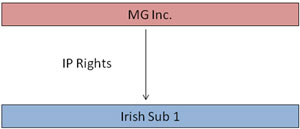
2. MG transfers its Intellectual Property Rights (meaning patents over inventions made by them, trademark related rights, or copyright on software or code – it could be anything depending on the business) to a subsidiary (child) of MG in Ireland

 MG Inc - Irish Sub

“Ah!”, you’d say, “and why would MG do that?” The fun part is yet to come.


Effect of transferring IP Rights to Irish Sub 1:

If MG assigns the rights over its intellectual property in Italy to Irish Sub 1, which would mean that the subsidiary would have all the rights over the invention in Italy that MG enjoys in the US. Irish Sub 1, in return (at least on paper) would market the product in Italy and pay for it from the profits arising from its sale.


3. The Bermuda Triangle: Where money goes once, never to be found again

bermuda triangle

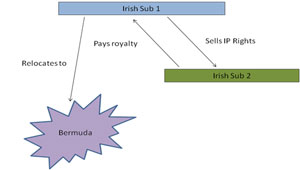
Irish Sub 1 relocates to Bermuda and becomes a double tax resident. This means two things:


  1. According to US tax laws, IS 1 is still resident in Ireland.
  2. According to Irish tax laws, the company is resident in Bermuda, since Ireland’s laws of taxation do not mandatorily require that companies incorporated in Ireland be resident there. Instead if the company is controlled and managed from outside Ireland, the company may elect to begoverned by the tax laws of that other country.


What can be the advantages with respect to tax-reduction by this relocation? Before we answer that question we need the help of another twist.


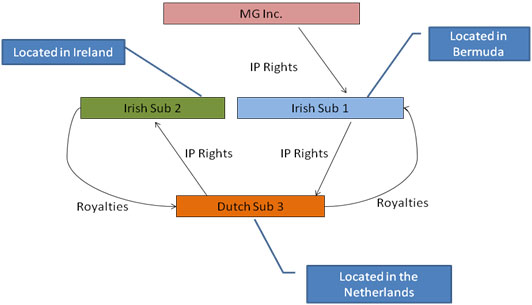
MG Inc. then sets up a second subsidiary namely IS 2 in the diagram above.  According to Irish provisions (explained in point 2 above), this means that even if it is assumed to be controlled and managed by the parent company, i.e., MG Inc., since it was incorporated in Ireland, it can opt to be governed by either Irish or American tax law. It chooses Irish.


IS 1 then sells the IP Rights given to it by MG Inc. to IS 2. So now IS 2 can commercially exploit the rights. In return, Irish Sub 2 pays Irish Sub 1 royalties for the intangible assets gained by it.


Why this twist? 

  • There is no income tax in Bermuda!!!  Bermuda is one of the tax havens of the world, and hence the royalties received by IS 1 in payment for the IP Rights “sold” to IS 2 is free from tax!
  • The IRS in the US cannot tax income of IS 2 (profits from commercial exploitation of IP Rights) as it elects to be governed by Irish Laws!
  • Income received from commercial exploitation of the IP right by IS 2 is now taxable @ 12.5% compared to 35% in the US, as IS 2 is tax resident in Ireland.
  • The outflow of money from IS 2 to IS 1 is not taxed as no withholding tax is charged for flux of money within the EU. IS 1 if you remember, is incorporated in Ireland and so is IS 2. So the transfer of royalties is seen to be a transaction between two Irish companies and is hence tax free!

Now for the Dutch Sandwich…

Dutch Sandwich

Now keep the Double Irish setup in your mind and make the following modifications:

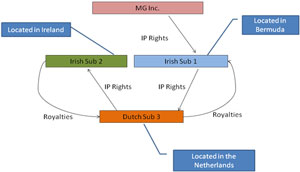
  1. Instead of selling IP Rights to IS 2, IS 1 sells them to a subsidiary of MG Inc. incorporated in the Netherlands, Dutch Sub 3 (DS 3).
  2. DS 3 then sells the IP Rights to IS 2, forming a sort of loop de loop in the middle of the Double Irish Agreement.
  3. The royalties paid by IS 2 to DS 3 are then channelled to IS 1.


Advantages of the Dutch detour

  1. Royalties paid by IS 2 to DS 3 are not chargeable by virtue of being a money transfer within the EU (from Ireland to the Netherlands).
  2. Netherlands takes only a small fee in the royalty paid by DS 3 to IS 1, i.e. from Netherlands to Bermuda, hence the royalty reaches Bermuda almost untaxed.
  3. Bermuda is income tax free zone, hence no tax on royalties received by IS 1.


The author Milinda Sengupta is currently studying at the Ram Manohar Lohia National Law University (RMLNLU), Lucknow

Download Now

What is a lock-in clause?

0
lock-in clause

Terms in an agreement prescribing for a time period within which any one of the contracting parties or either of the contracting parties cannot terminate the contract is known as a lock-in clause. If a contracting party terminates the contract within the lock-in period then such clause claims that the breaching party has to pay the rent for the remaining of the lock-in period, even though he would not be using the licensed premise anymore as a result of the termination of the contract.


Things that are generally specified in a lock-in clause:

  • duration of the lock-in period
  • remedy in case of breach of the lock-in commitment
  • notice period (to give a reasonable time for relocation to the licensee or, to give  time to the licensor to select a suitable licensee for his property) If there is a notice period of 3/4 months in the agreement, then after the notice of termination of the agreement, the licensee has to pay the rent for subsequent 3 months from the notice, even if he hands over the possession of the licensed place before completion of the 3 months of notice period. This time period has to be reasonable and the time period may vary depending on the use of the licensed premise. If the claim is unreasonable to burden the licensee then such claim is not enforceable in the court of law.


Most of the lock-in clauses in leave and license agreements claim that during the lock-in period (let it be 3 years/ 36 months) the licensor/ licensee cannot terminate the contract and whereas the licensee terminates the contract within the lock-in period (after 3 months of stay), for any reason whatsoever (he has been transferred to another city from his office), he has to pay the rent of the remaining of lock-in period (33 months) to the licensor.


Legal implications of a lock-in clause:

Question arises whether the claim of 33 months rent from a licensee in the above mentioned illustration is legally valid? Indian judiciary has clearly held in several cases that such a claim is not valid. The aggrieved party is only entitled to get a compensation/ damages valued by the court itself depending on the actual loss that the party has suffered due to such breach.


Remedies in case of breach of a lock-in clause is same to that of the remedies for any other contractual breach i.e., damages and specific performance of the contract. Damages to be paid in breach of the contract is generally quantified in the agreement itself. Nevertheless in each case it is for the court to decide  reasonability of the damages claimed based on evidences advanced during trial. Only reasonable damages is to be awarded by a court for a breach of any contract irrespective of whatever damages amount had been expressly consented upon by both the parties in the agreement.


Compensation/ Damages is awarded to make good the losses suffered by the aggrieved party, so as to reinstate him in his original position. Law does not penalise a contracting party for a contractual breach and neither does it allow the aggrieved party to take advantage of such a situation. The rule is that the parties are free to breach the contract provided they compensate the other party, if the other party has incurred an actual loss due to such breach.

https://lawsikho.com/course/certificate-course-in-advanced-civil-litigation-practice-procedure-and-drafting
Click Above

Similarly, as a result of a lock-in clause, a licensor cannot ask the licensee to vacate his place before completion of 3 years. If the licensor does so, then it will amount to breach of contract and the licensee can sue the licensor claiming reasonable damages for the actual loss he suffers due to the breach of the agreement or, ask for specific performance of the contract whereas he has to prove that non-performance of the contract will cause an irreparable damage to him, which cannot be compensated by monetary award.


Conclusion:

Therefore if the lock-in clause in a leave and license agreement states that, in case of breach of the said clause, the licensee is liable to pay the rent for the remaining lock-in period i.e., rent of 33 months, is not really enforceable in a court of law. Only a claim based on actual injury suffered by the aggrieved party can be made whereas he has to prove the following things  to make a successful claim[1]:

  1. That such amount claimed is a genuine estimate of damages
  2. That the landlord had altered its position by making the premises available to the licensee keeping in view the licensee’s requirements and spending thereupon. That certain expenditure was incurred on infrastructure specifically provided to the licensee as per licensee’s requirements; certain other expenditure incurred on whitewashing, fixture and fittings and the landlord was forced to incur expenditure again before giving the premises to the new licensee and , therefore, lock-in period was treated as reasonable period to avoid duplication of such expenditure, etc.
  3. That the licensor took all reasonable steps to mitigate the loss consequent on the breach.

Quantifying the compensation/ damages for a breach of the lock-in commitment  is unnecessary as by proving the above mentioned three points, the aggrieved party is only entitled to get a reasonable compensation based on the actual losses/ injury he has suffered and he is not entitled to the agreed quantified compensation amount. Thus mentioning a quantified compensation in the lock-in clause itself acts as a mere scaring provision unenforceable in the court of law.


Once the damages have been ascertained by the court, judgement has been passed awarding damages to the aggrieved party, the compensation so awarded takes the nature of debt on the party against whom the compensation has been awarded. Thus the Courts can order for winding up of the licensee/ licensor company, to clear such debt if it does not pay the debt willingly.


LawSikho has created a telegram group for exchanging legal knowledge, referrals and various opportunities. You can click on this link and join:  

https://t.me/joinchat/J_0YrBa4IBSHdpuTfQO_sA

Follow us on Instagram and subscribe to our YouTube channel for more amazing legal content 
 

[1]Silvermoon Construction Pvt. Ltd. v. South Asian Hospitality Services Pvt. Ltd., MANU/DE/4958/2012

Download Now

The [Andaman Trunk] Road Not Taken

0

The Great Andaman Trunk Road or National Highway 223 connects Port Blair to Diglipur. Port Blair and Diglipur are situated at the south and north ends of the island and the road therefore covers a distance of 360 kilometre.

Somewhere in the middle of this road lies a forest area which has been home for the “Jarawa” tribe for thousands of years. The Jarawa people have been exploited and mistreated by the local authorities and the tourists since the last 2 or 3 decades. A lot of environmental groups working for the welfare of Jarawas filed cases in courts following which the Supreme Court in 2002 passed an order to shut down the Andaman Trunk Road. This order was however ignored by the local authorities and the Andaman trunk road was continually used for commercial and tourist purposes.

To protect the interests of the Jarawa people, a notification in October 2007 was issued by the Tribal welfare department of the Andaman and Nicobar. This notification demarcated an area of up to 5 km radius around the Jarawa Tribal Reserve as a buffer zone and prohibited entry into the buffer zone of anyone other than a member of the aboriginal tribe. This notification was quashed by the Calcutta High Court. The matter was then brought to the Supreme Court as a special leave petition [ LG, Andaman and Nicobar Islands & Ors. v. M/s. Bare Foot Inns & Leisure Pvt. Ltd]. The Supreme Court in its judgment dated 2nd July 2012 stayed the High Court’s order and held that no commercial and tourism related activities shall be carried out by the administration or any private individual in violation of the prohibition contained in the October 2007 notification. The Court asked the Andaman and Nicobar administration to strictly enforce the notification till it was considered by the court.

The Supreme Court then passed an interim order on 17th of January 2013, banning tourists from taking the Andaman Nicobar Trunk Road that passes through the area where the Jarawas live. The order also stated that only government officials, persons residing in the reserve and vehicles carrying essential commodities for the Jarawas would be allowed on the Trunk Road.

As a response to this interim order, an application was filed on behalf of local inhabitants which stated that the Andaman Trunk Road is a very vital road and connects more than 350 villages. It also stated that the Andaman Trunk Road is used to reach the only government hospital on the island and it is therefore extremely necessary that access to this road is granted to everyone. The application also stated that the Jarawas can be protected by other means like banning photography of Jarawas but the road should be open to everyone.

The Supreme Court therefore, on 5th of March 2013 reversed its interim order and thereby opening Andaman Trunk Road to the Tourists.

Critique

The Supreme Court’s order has once again raised fears of the tribe’s exploitation. Tourists travel along the Andaman Trunk Road in hope to see the Jarawa people and throw biscuits and other edible items on them and ask them to dance. The Jarawas are treated like animals in a zoo.

It is important to mention here that this issue no longer remains a national or local issue. The whole world came to know about the atrocities faced by the Jarawa people when an English  journalist brought up a video in which a semi-nude Jarawa women was being asked to dance for the tourists by a police officer and was offering food in return.  Organisation like Survival International have been working for the cause of the Jarawa people since years and making people aware of the atrocities faced by the Jarawa people. Even the United Nation is urging India to  protect the Jarawa people by closing the Andaman Trunk Road. The report by the UN Committee on the Elimination of Racial Discrimination says that:

India should protect tribes such as the Jarawa against encroachments on their lands and resources by settlers, poachers, private companies or other third parties and implement the 2002 order of the Indian Supreme Court to close the sections of the Andaman Trunk Road that run through the Jarawa reserve.’

It is hard to say whether the step taken by the Supreme Court is just or not. Considering the fact that the road is being used to reach a government hospital, a complete ban on the usage of road is definitely unjust. The Courts and the local authorities will now have to take some other steps and formulate laws that will protect the Jarawa people from being exploited and make sure that these laws are adhered to strictly.


Download Now
logo
FREE & ONLINE 3-Day Bootcamp (LIVE only) on

How Can Experienced Professionals Become Independent Directors

calender
28th, 29th Mar, 2026, 2 - 5pm (IST) &
30th Mar, 2026, 7 - 10pm (IST).
Bootcamp starting in
Days
HRS
MIN
SEC
Abhyuday AgarwalCOO & CO-Founder, LawSikho

Register now

Abhyuday AgarwalCOO & CO-Founder, LawSikho